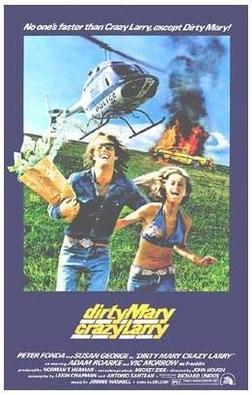
Cars are pretty cool, huh? Yes, another sterling lead courtesy of Just Hit Play, and you're welcome. It's a simple truth though, one that the movie industry has believed in for years. My car can go faster than yours. What are you going to do about it? There's something primal and stupid about watching a souped-up car gunning it down the road, typically with cops or gangsters or any number of random bad guys on their trail. From the decade of the car movie, here comes another gem, 1974's Dirty Mary Crazy Larry.
A stock car driver who's never quite made it to the big time, Larry (Peter Fonda) is convinced all he needs is a car and the equipment to make it big but no one will back him. With his longtime friend and down-on-his-luck mechanic, Deke (Adam Roarke), Larry has a plan. The duo concocts a plan though, robbing a grocery store that just received its payroll in a tiny, backroads town. The job goes off smoothly....until they try to get away. Waiting inside their getaway car is Mary (Susan George), a one-night stand (at the time) of Larry's who secretly tagged along. With no way to get rid of her -- without her turning them in -- she tags along on the getaway. Their plan comes together nicely, even when the local police, led by ridiculously persistent Captain Franklin (Vic Morrow), catch wind of them and aren't far behind.
Made on the cheap and the definition of a B-movie that thrives in its cheapness, 'Crazy' is a gem of a car movie. From director John Hough, it makes no bones about what it is. This is a movie about badass, souped-up cars with V-8 engines going wheel-to-wheel on the open road. Are you interested in a movie with well thought-out characters that develop over time? A story with twists and turns and an Oscar-caliber script? You should probably check out a different movie. It clocks in at 93 minutes and never truly slows down. In the vein of Thunder Road, Bullitt, Smokey and the Bandit, Vanishing Point, Two-Lane Blacktop and many more car flicks, 'Crazy' more than belongs in the conversation.
This is a movie to watch the cars drive and drive ridiculously fast. It was filmed in the California countryside away from the big cities, including some great locations in and around the walnut groves in Stockton and Linden, California. I'm a sucker for any car movies, and while I didn't love all of this flick -- more on that later -- the appeal is obvious. We're talking the souped-up cars (Larry and Deke drive a 1966 Chevy Impala and later a 1969 Dodge Charger) doing battle with similarly souped-up police cars, and in the coolest development? The Charger going up against an obsessed Franklin in a police helicopter on an isolated road. All the driving stunts are impressive in their own right, but this extended sequence is something else. The helicopter looks to be flying at top speeds just feet -- maybe inches -- away from the Charger. Great story this is not, just sit back and admire the truly impressive stunt work and driving.
This is a fun movie, but there are stretches that tested even my limits. That issue comes from the title characters. A rebel icon of the 1960s and 1970s, Peter Fonda is and always will be pretty cool. Playing crazy Larry though, he's just annoying. His character is hard to like even a little, and the cocky stock car driver gets old quick, especially his cackling laughter. Unfortunately, he's not the most annoying person here. That title belongs to Susan George as Dirty Mary. Around because the movie requires some eye candy and little else, Mary is beyond shrill. Larry affectionately calls her 'Dingleberry' after their magical one-night together so clearly it's a classic movie romance on par with Casablanca. George does look good, rocking low-rise jeans and a denim bikini top, but the shrillness is unreal, and the character's down right stupid.
That's all unfortunate because when Fonda's Larry and Roarke's Deke are together, we've got a good thing going. I especially liked Roarke as mechanic Deke, an expert in everything motor and gearhead. He just wants to get away with the money and is less than appreciative of Mary tagging along on the getaway. Even he grows a little tired of Larry's act though. A star of biker flicks, Roarke was my favorite actor here. As Capt. Franklin, Morrow continues to establish himself as the face of the evil Establishment, just like Bad News Bears. It's a funny part though, a cop who doesn't care about rules or appearances, just catching the bad guy. Also look for Kenneth Tobey as Donahue, Franklin's by-the-book superior, and Eugene Daniels as Hank, one of Franklin's cops who gets his hands on a police interceptor with a cranked-up V-8 engine.
The movie is a hot mess overall. Larry and Deke take the grocery store owner (an uncredited Roddy McDowall) captive, holding his family hostage at their home while they pull off the robbery. Unsympathetic characters to say the least, but thankfully that rights itself a little bit. Sure, there are flaws a-plenty here in this cult classic, but it's fun throughout. Enjoy it, and don't blink or you'll miss the shocker of an ending.
Dirty Mary Crazy Larry (1974): ***/****
The Sons of Katie Elder
"First, we reunite, then find Ma and Pa's killer...then read some reviews."
Showing posts with label Vic Morrow. Show all posts
Tuesday, May 14, 2013
Monday, March 25, 2013
Posse from Hell
Ah, the posse, where men can be men and.....do manly stuff? Ride horses, shoot guns, track bad guys, eat jerky and drink bad coffee around a fire out in the desert under the stars. Pretty cool, huh? Eh, probably not, but for a western nut like myself, I could get on board with that. Obviously it wasn't a pleasant experience -- tracking down the bad guys to bring them to justice -- but there's been countless westerns following the posse, but few have been better than 1961's Posse from Hell.
Four very dangerous, murdering convicts led by an outlaw named Crip (Vic Morrow) descend on a small, peaceful western town, wreaking havoc and leaving a handful of dead in their wake, including the town marshal. The gang steals $11,000 from the bank and also kidnaps young Helen Caldwell (Zohra Lampert) and takes her with them. As a posse forms the following day, a new deputy arrives in town. His name is Banner Cole (Audie Murphy), and he immediately assumes the marshal's duties, starting with forming the posse. His honesty about the coming hunt scares many people away, leaving Banner with just six men riding with him to take down a four-man gang. The trail awaits with ambushes, double crosses, personal grudges and cowards waiting around every corner. Can Banner hold the group together long enough to get the gang?
From director Herbert Coleman, here is an example of a solid western that's flown under the radar in the 50-plus years since its release. It doesn't hit the 90-minute mark -- wrapping up in 89 instead -- and is most definitely a B-western. 'Hell' was filmed on the backlots with a few excursions to the California desert. The music is pretty standard stuff to the point the full cast and crew listing don't even list a composer. So why does it work then? Western novelist Clair Huffaker (wrote the novel and the screenplay) knows what he's doing. He knows the western and more importantly the characters. His good guy is resolute, his bad guys extremely nasty, and the rest are cannon fodder. Familiar? Maybe, but it's fun and entertaining throughout.
Maybe because it was a B-western and not a huge studio release, 'Hell' can get away with some stuff. That stuff ranks pretty high on the nasty, dark meter. There are things you would expect out of a spaghetti western or revisionist American western from the late 1960s or early 1970s, not a 1961 western. Morrow's Crip is a cold-blooded killer (channeling a similar character he played on an episode of The Rifleman) who favors a double-barreled shotgun and kills with no discretion. His gang kills because they can, not because it actually accomplishes anything. After leaving the town behind, Crip's gang even rapes Helen and leaves her for dead. Banner's posse is equally treacherous with insane, cowardly, big-talking individuals who can't back themselves up. It's a refreshing change of pace from some straightforward white hat good guys and black hat bad guys.
The king of the American B-western, Audie Murphy is an ideal lead. At times, his acting could be a tad wooden, but his stone-faced, almost monotone delivery plays well here. He's less than interested in the feelings or reactions of his posse. He's out there to do a job, not worry about the personalities of these people he's just met. The best dynamic is between Murphy's Banner and John Saxon's Seymour Kern, an Easterner working with the bank in town who's told to go with the posse to watch over the recovered money. The veteran cowboy and the inexperienced Easterner is a familiar convention, but it works. The rest of the posse includes Robert Keith as a power-happy former Union officer, Rodolfo Acosta as a Mexican cowboy known for his tracking ability, Royal Dano as Helen's drunken uncle, Frank Overton as the revenge-seeking townsperson trying to avenge his brother, and Paul Carr as the fast-draw with a pistol who's got little real life experience with his pistols. Also look for Lee Van Cleef as one of Crip's gang. It's a cool group with a variety of personalities, some around to be targets for Crip's gang.
The story is fairly episodic once the posse gets out on the trail. With seven members of the posse, it's clear some aren't going to make it so it becomes a guessing game as to who will survive. There are some surprising twists there so stay tuned through the end. Overall, the story doesn't really know how to end so it does drag a little in the final 15-20 minutes, but the build-up is so worthwhile I barely noticed. It's not enough to detract from a western I very much enjoyed. Highly recommended. Give it a shot at Youtube, link included below.
Posse from Hell (1961): *** 1/2 /****
Four very dangerous, murdering convicts led by an outlaw named Crip (Vic Morrow) descend on a small, peaceful western town, wreaking havoc and leaving a handful of dead in their wake, including the town marshal. The gang steals $11,000 from the bank and also kidnaps young Helen Caldwell (Zohra Lampert) and takes her with them. As a posse forms the following day, a new deputy arrives in town. His name is Banner Cole (Audie Murphy), and he immediately assumes the marshal's duties, starting with forming the posse. His honesty about the coming hunt scares many people away, leaving Banner with just six men riding with him to take down a four-man gang. The trail awaits with ambushes, double crosses, personal grudges and cowards waiting around every corner. Can Banner hold the group together long enough to get the gang?
From director Herbert Coleman, here is an example of a solid western that's flown under the radar in the 50-plus years since its release. It doesn't hit the 90-minute mark -- wrapping up in 89 instead -- and is most definitely a B-western. 'Hell' was filmed on the backlots with a few excursions to the California desert. The music is pretty standard stuff to the point the full cast and crew listing don't even list a composer. So why does it work then? Western novelist Clair Huffaker (wrote the novel and the screenplay) knows what he's doing. He knows the western and more importantly the characters. His good guy is resolute, his bad guys extremely nasty, and the rest are cannon fodder. Familiar? Maybe, but it's fun and entertaining throughout.
Maybe because it was a B-western and not a huge studio release, 'Hell' can get away with some stuff. That stuff ranks pretty high on the nasty, dark meter. There are things you would expect out of a spaghetti western or revisionist American western from the late 1960s or early 1970s, not a 1961 western. Morrow's Crip is a cold-blooded killer (channeling a similar character he played on an episode of The Rifleman) who favors a double-barreled shotgun and kills with no discretion. His gang kills because they can, not because it actually accomplishes anything. After leaving the town behind, Crip's gang even rapes Helen and leaves her for dead. Banner's posse is equally treacherous with insane, cowardly, big-talking individuals who can't back themselves up. It's a refreshing change of pace from some straightforward white hat good guys and black hat bad guys.
The king of the American B-western, Audie Murphy is an ideal lead. At times, his acting could be a tad wooden, but his stone-faced, almost monotone delivery plays well here. He's less than interested in the feelings or reactions of his posse. He's out there to do a job, not worry about the personalities of these people he's just met. The best dynamic is between Murphy's Banner and John Saxon's Seymour Kern, an Easterner working with the bank in town who's told to go with the posse to watch over the recovered money. The veteran cowboy and the inexperienced Easterner is a familiar convention, but it works. The rest of the posse includes Robert Keith as a power-happy former Union officer, Rodolfo Acosta as a Mexican cowboy known for his tracking ability, Royal Dano as Helen's drunken uncle, Frank Overton as the revenge-seeking townsperson trying to avenge his brother, and Paul Carr as the fast-draw with a pistol who's got little real life experience with his pistols. Also look for Lee Van Cleef as one of Crip's gang. It's a cool group with a variety of personalities, some around to be targets for Crip's gang.
The story is fairly episodic once the posse gets out on the trail. With seven members of the posse, it's clear some aren't going to make it so it becomes a guessing game as to who will survive. There are some surprising twists there so stay tuned through the end. Overall, the story doesn't really know how to end so it does drag a little in the final 15-20 minutes, but the build-up is so worthwhile I barely noticed. It's not enough to detract from a western I very much enjoyed. Highly recommended. Give it a shot at Youtube, link included below.
Posse from Hell (1961): *** 1/2 /****
Labels:
1960s,
Audie Murphy,
John Saxon,
Lee Van Cleef,
Robert Keith,
Rodolfo Acosta,
Royal Dano,
Vic Morrow,
westerns
Thursday, March 14, 2013
Twilight Zone: The Movie
Airing for five seasons on CBS between 1959 and 1964, The Twilight Zone is one of the all-time great television shows. A mix of horror, science fiction, paranormal and all sorts of wackiness, almost all the episodes were able to deliver some shocker/twist in the end. It's been revived several times in TV reboots, and even received a big screen adaptation, the much-maligned 1983 Twilight Zone: The Movie, a film shrouded in controversy even before its release.
The story is broken down into four separate segments, including a prologue. The first segment follows Bill Connor (Vic Morrow), a despicably racist middle-aged man who finds himself in a variety of different situations where he's the one being prejudiced against. The second takes place at a retirement home where one of the residents, Mr. Bloom (Scatman Crothers) offers his fellow residents a chance at a new life of sorts. In the third, a young woman, a teacher, Helen (Kathleen Quinlan), is on a road trip west when she meets Anthony (Jeremy Licht) with a strange hold and ability to control his family. And last, John Valentine (John Lithgow), a man who hates flying, is on a cross-country flight and struggling mightily as the plane flies through a storm. Looking out the window, Valentine is absolutely convinced that something is out on the wing, tearing up the engine. No one else on board sees it though. Is he nuts?
I loved the original Twilight Zone episodes from creator/writer Rod Serling so I went into this movie with some at least modest expectations. As a result, I was more than a little worried as I watched the prologue, two men (Albert Brooks and Dan Aykroyd) driving at night on a road trip out in the desert. The tone was okay -- feeling like a set-up -- if a little odd, but a really stupid twist (supposedly a shocker?) comes completely out of left field. If it was supposed to be a shocker, it came across as laughable. Thankfully, it wasn't a complete harbinger of what was to come. For the most part, the movie does what it's supposed to do. It's creepy, unsettling and plays like a tribute to the original show. Is it perfect? No, not at all. Of the four segments, one is really good, two only good, and one really bad.
Beyond the actual movie, 'Zone' is known for a horrific accident that claimed the lives of three cast members on-set, including star Vic Morrow. Filming the movie's opening segment, Morrow and two child actors were killed when a helicopter crashed onto them after several explosions sent the helicopter out of control. There is actually some horrifically brutal footage of the accident via Youtube if you're curious. It's sickening stuff. The accident put the film in limbo, producers and the studio debating whether to continue with the film. The first segment's director, John Landis, took a ton of heat for the accident (understandably so), even getting through a lawsuit that ruled no one was at fault for the accident. With absolutely no disrespect meant to Morrow or the two child actors, a cloud hung over the film's production and eventual release. The opening segment with Morrow is one of the "only good" segments, but it's difficult to watch it without thinking about what actually happened in bringing this portion of the film to life.
Almost as a novelty, the four segments were divided by four different directors, Landis, Steven Spielberg, Joe Dante and George Miller. The odd part? Spielberg -- the most accomplished of the four by far -- delivers the weakest segment of the film by far. Apparently Spielberg was greatly affected by Morrow's death and debated even continuing the film. He did stick with it, but biographies claim the director just mailed in the effort, and it shows. While Crothers does a good job in his part, the segment plays like a happy go-lucky after school special. In other words? Nothing like the best Twilight Zone episodes, not even the average ones. Directing the prologue and the opening portion, Landis' parts are hit or miss. The Morrow story is good, but it had to be edited on the fly following Morrow's death. The end result is a rather abrupt ending.
Thankfully, the final two portions make up for the somewhat slow start. The Joe Dante portion is based off a Zone episode titled 'It's a Good Life' with the original star, Bill Mumy, making a quick appearance. Quinlan does a fine job as Helen, the young teacher thrust into something she can't even comprehend at first. 12-year old Licht is incredibly creepy as young Anthony, a boy with special powers. Also look for Kevin McCarthy and William Schallert in key parts. The highlight though is George Miller's segment, based off maybe the most well known and classic Twilight Zone episode ever, 'Nightmare at 20,000 Feet' starring William Shatner. Lithgow's performance as an obsessed, possibly paranoid airline passenger is the best performance in the entire movie. It is a truly unsettling segment, also delivering the biggest and best twist of all the four stories.
In the end, the TV show turned movie is a mixed bag. More than a movie that stands on its own, it plays like a tribute without a whole lot originality. Wrapping up at just 101 minutes, it covers a whole lot of ground. Could 15-20 more minutes have aided the cause? Maybe not, but it couldn't have hurt. Also listen for Burgess Meredith as the narrator, transitioning from story to story and keeping us mildly informed....as much as the Twilight Zone will allow!!! Imagine a dun-dun-duh!!! at the end of that statement.
Twilight Zone: The Movie (1983): ** 1/2 /****
The story is broken down into four separate segments, including a prologue. The first segment follows Bill Connor (Vic Morrow), a despicably racist middle-aged man who finds himself in a variety of different situations where he's the one being prejudiced against. The second takes place at a retirement home where one of the residents, Mr. Bloom (Scatman Crothers) offers his fellow residents a chance at a new life of sorts. In the third, a young woman, a teacher, Helen (Kathleen Quinlan), is on a road trip west when she meets Anthony (Jeremy Licht) with a strange hold and ability to control his family. And last, John Valentine (John Lithgow), a man who hates flying, is on a cross-country flight and struggling mightily as the plane flies through a storm. Looking out the window, Valentine is absolutely convinced that something is out on the wing, tearing up the engine. No one else on board sees it though. Is he nuts?
I loved the original Twilight Zone episodes from creator/writer Rod Serling so I went into this movie with some at least modest expectations. As a result, I was more than a little worried as I watched the prologue, two men (Albert Brooks and Dan Aykroyd) driving at night on a road trip out in the desert. The tone was okay -- feeling like a set-up -- if a little odd, but a really stupid twist (supposedly a shocker?) comes completely out of left field. If it was supposed to be a shocker, it came across as laughable. Thankfully, it wasn't a complete harbinger of what was to come. For the most part, the movie does what it's supposed to do. It's creepy, unsettling and plays like a tribute to the original show. Is it perfect? No, not at all. Of the four segments, one is really good, two only good, and one really bad.
Beyond the actual movie, 'Zone' is known for a horrific accident that claimed the lives of three cast members on-set, including star Vic Morrow. Filming the movie's opening segment, Morrow and two child actors were killed when a helicopter crashed onto them after several explosions sent the helicopter out of control. There is actually some horrifically brutal footage of the accident via Youtube if you're curious. It's sickening stuff. The accident put the film in limbo, producers and the studio debating whether to continue with the film. The first segment's director, John Landis, took a ton of heat for the accident (understandably so), even getting through a lawsuit that ruled no one was at fault for the accident. With absolutely no disrespect meant to Morrow or the two child actors, a cloud hung over the film's production and eventual release. The opening segment with Morrow is one of the "only good" segments, but it's difficult to watch it without thinking about what actually happened in bringing this portion of the film to life.
Almost as a novelty, the four segments were divided by four different directors, Landis, Steven Spielberg, Joe Dante and George Miller. The odd part? Spielberg -- the most accomplished of the four by far -- delivers the weakest segment of the film by far. Apparently Spielberg was greatly affected by Morrow's death and debated even continuing the film. He did stick with it, but biographies claim the director just mailed in the effort, and it shows. While Crothers does a good job in his part, the segment plays like a happy go-lucky after school special. In other words? Nothing like the best Twilight Zone episodes, not even the average ones. Directing the prologue and the opening portion, Landis' parts are hit or miss. The Morrow story is good, but it had to be edited on the fly following Morrow's death. The end result is a rather abrupt ending.
Thankfully, the final two portions make up for the somewhat slow start. The Joe Dante portion is based off a Zone episode titled 'It's a Good Life' with the original star, Bill Mumy, making a quick appearance. Quinlan does a fine job as Helen, the young teacher thrust into something she can't even comprehend at first. 12-year old Licht is incredibly creepy as young Anthony, a boy with special powers. Also look for Kevin McCarthy and William Schallert in key parts. The highlight though is George Miller's segment, based off maybe the most well known and classic Twilight Zone episode ever, 'Nightmare at 20,000 Feet' starring William Shatner. Lithgow's performance as an obsessed, possibly paranoid airline passenger is the best performance in the entire movie. It is a truly unsettling segment, also delivering the biggest and best twist of all the four stories.
In the end, the TV show turned movie is a mixed bag. More than a movie that stands on its own, it plays like a tribute without a whole lot originality. Wrapping up at just 101 minutes, it covers a whole lot of ground. Could 15-20 more minutes have aided the cause? Maybe not, but it couldn't have hurt. Also listen for Burgess Meredith as the narrator, transitioning from story to story and keeping us mildly informed....as much as the Twilight Zone will allow!!! Imagine a dun-dun-duh!!! at the end of that statement.
Twilight Zone: The Movie (1983): ** 1/2 /****
Labels:
1980s,
Albert Brooks,
Dan Aykroyd,
Horror,
John Landis,
John Lithgow,
Kevin McCarthy,
Sci-Fi,
Steven Spielberg,
Vic Morrow
Saturday, November 10, 2012
Men in War
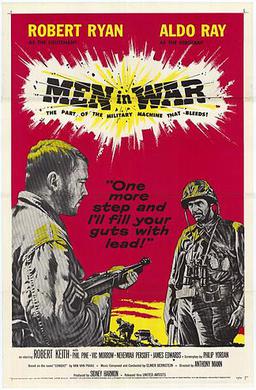
The Korean War was unlike any war Americans had ever been involved in. The movies made about it certainly reflected that. There was nothing simple about it, no easy answer, but I suppose that applies to all wars. One of the best movies about Korea is also one that has gone criminally unrecognized over the years, 1957's Men in War.
Following a horrifically costly engagement late in 1950 in Korea, Lt. Benson (Robert Ryan) finds himself in command of the ragged remains of his rifle platoon. With just 17 men and no idea where the rest of the battalion is, Benson leads his men to a prearranged objective that he's not even sure still exists. Along the way, they run into Sgt. Montana (Aldo Ray), a stubborn and very capable soldier who's transporting by jeep his shell-shocked commanding officer, the Colonel (Robert Keith). When Benson commandeers the jeep, Montana goes along more than a little unwillingly. Together, the motley group continues to their objective, an otherwise ordinary location, simply titled Hill 465. What awaits there? None of them know.
Never even mentioned among the best war movies around, this Korean War has been criminally neglected since its 1957. From director Anthony Mann, it is a cynical, extremely dark, very realistic, and even a tad existential at times. While it is based in Korea, it really could be any war. The infantry soldiers trudge on, fighting a mostly unseen enemy, just trying to survive. We learn nothing about anyone, and there's no bigger picture of the war. These men are separated from their possibly annihilated unit and walking in heavily occupied enemy territory. The North Koreans appear as needed; in the aftermath of a firefight, two survivors talk quietly -- not really hiding either -- where seconds before bullets and grenades were raining down on them. This is war and the effect it has on the individual.
Beyond that simple story is a realistic story. I try not to use this description too much, but it was truly ahead of its time. We're introduced to Benson's platoon in the aftermath of the attack that separated his platoon from the battalion. The men look exhausted to the point of fainting. One man has been killed -- stabbed in the back with a bayonet -- by a North Korean scout, and so it starts. The cynicism is palpable. Benson mumbles 'Son of a...' before veering off. Ray's Montana shoots a surrendering North Korean, albeit one reaching for a hidden pistol. Later, a second prisoner is used for bait to see if the platoon has been spotted. Filmed in a close-up black and white, I felt like a fly on the wall as a viewer. We feel like we're right there with the foot soldiers. By no means a flashy filming style, but the story doesn't call for it. Also worth mentioning is Elmer Bernstein's eerie but spot-on musical score.
Playing on the basic notion of the unit picture, 'War' has an impressive tough guy cast. It's great to see Ryan get a good guy role. Very capable of playing a hellishly bad villain, Ryan is a perfect choice to play the beaten down officer who must buck up to get his men to safety. Ray as his counter is just as spot-on, a similarly experienced soldier but one with a simpler mission. That angle (protecting your commanding officer) would be used 20 years later in A Bridge Too Far. Benson's platoon includes Riordan (Phillip Pine), the radioman, Lewis (Nehemiah Persoff), the unhinged sergeant, Zwickley (Vic Morrow), the scared to death private, Killian (James Edwards), the mechanic, and Davis (L.Q. Jones), the medic and BAR man. Seven other soldiers are listed in the cast but under the dirt, grime and three-day stubble, it's hard to distinguish them.
For the most part here, the story is fairly familiar. Nothing crazy or out of the blue. The platoon deals with North Korean scouts trying to pick them off, bickering amongst the men, even stumbling into a minefield. Where it distinguishes itself is in the finale as Benson's men reach Hill 465. There is nothing special about the hill, just a big chunk of jagged rock....that's occupied by North Koreans. The small-scale battle has elements of the surreal. The enemy fires only occasionally, only appearing for brief close-ups. In its small scale, it is a very personal, aggressive, and uncomfortable depiction of battle. Soldiers are killed, but we barely see their faces to know who it is. The film ends on a dour note, but an effective one just the same.
A war film that deserves better. Effective message that is never overbearing, great casting, almost documentary-like feel from Mann, all amount to a film well worth watching.
Men in War <---Youtube clip (1957): *** 1/2 /****
Following a horrifically costly engagement late in 1950 in Korea, Lt. Benson (Robert Ryan) finds himself in command of the ragged remains of his rifle platoon. With just 17 men and no idea where the rest of the battalion is, Benson leads his men to a prearranged objective that he's not even sure still exists. Along the way, they run into Sgt. Montana (Aldo Ray), a stubborn and very capable soldier who's transporting by jeep his shell-shocked commanding officer, the Colonel (Robert Keith). When Benson commandeers the jeep, Montana goes along more than a little unwillingly. Together, the motley group continues to their objective, an otherwise ordinary location, simply titled Hill 465. What awaits there? None of them know.
Never even mentioned among the best war movies around, this Korean War has been criminally neglected since its 1957. From director Anthony Mann, it is a cynical, extremely dark, very realistic, and even a tad existential at times. While it is based in Korea, it really could be any war. The infantry soldiers trudge on, fighting a mostly unseen enemy, just trying to survive. We learn nothing about anyone, and there's no bigger picture of the war. These men are separated from their possibly annihilated unit and walking in heavily occupied enemy territory. The North Koreans appear as needed; in the aftermath of a firefight, two survivors talk quietly -- not really hiding either -- where seconds before bullets and grenades were raining down on them. This is war and the effect it has on the individual.
Beyond that simple story is a realistic story. I try not to use this description too much, but it was truly ahead of its time. We're introduced to Benson's platoon in the aftermath of the attack that separated his platoon from the battalion. The men look exhausted to the point of fainting. One man has been killed -- stabbed in the back with a bayonet -- by a North Korean scout, and so it starts. The cynicism is palpable. Benson mumbles 'Son of a...' before veering off. Ray's Montana shoots a surrendering North Korean, albeit one reaching for a hidden pistol. Later, a second prisoner is used for bait to see if the platoon has been spotted. Filmed in a close-up black and white, I felt like a fly on the wall as a viewer. We feel like we're right there with the foot soldiers. By no means a flashy filming style, but the story doesn't call for it. Also worth mentioning is Elmer Bernstein's eerie but spot-on musical score.
Playing on the basic notion of the unit picture, 'War' has an impressive tough guy cast. It's great to see Ryan get a good guy role. Very capable of playing a hellishly bad villain, Ryan is a perfect choice to play the beaten down officer who must buck up to get his men to safety. Ray as his counter is just as spot-on, a similarly experienced soldier but one with a simpler mission. That angle (protecting your commanding officer) would be used 20 years later in A Bridge Too Far. Benson's platoon includes Riordan (Phillip Pine), the radioman, Lewis (Nehemiah Persoff), the unhinged sergeant, Zwickley (Vic Morrow), the scared to death private, Killian (James Edwards), the mechanic, and Davis (L.Q. Jones), the medic and BAR man. Seven other soldiers are listed in the cast but under the dirt, grime and three-day stubble, it's hard to distinguish them.
For the most part here, the story is fairly familiar. Nothing crazy or out of the blue. The platoon deals with North Korean scouts trying to pick them off, bickering amongst the men, even stumbling into a minefield. Where it distinguishes itself is in the finale as Benson's men reach Hill 465. There is nothing special about the hill, just a big chunk of jagged rock....that's occupied by North Koreans. The small-scale battle has elements of the surreal. The enemy fires only occasionally, only appearing for brief close-ups. In its small scale, it is a very personal, aggressive, and uncomfortable depiction of battle. Soldiers are killed, but we barely see their faces to know who it is. The film ends on a dour note, but an effective one just the same.
A war film that deserves better. Effective message that is never overbearing, great casting, almost documentary-like feel from Mann, all amount to a film well worth watching.
Men in War <---Youtube clip (1957): *** 1/2 /****
Labels:
1950s,
Aldo Ray,
Anthony Mann,
Korean War,
L.Q. Jones,
Nehemiah Persoff,
Robert Ryan,
Vic Morrow
Monday, July 16, 2012
Cimarron (1960)
My typical stance on an epic film is 'Bring it on.' You can't have too many of them, especially from the age of the epics, the 1950s through the 1960s. These are big, big movies. Then, I think of my favorite genre; the western. I can't name many quality epic, classic westerns. One exception is How the West Was Won, but I'm drawing a blank as to others. One that aspires to be an epic but ultimately fails is 1960's Cimarron.
Having put his wild cowboy drifting days behind him, Yancy 'Cimarron' Cravat (Glenn Ford) hopes to settle down with his newlywed bride, Sabra (Maria Schell). Yancy's plan starts with an impossible offer from the government, one that seems too good to be true. The Oklahoma territory and its millions of acres will be open to anyone who can stake a claim (the 1889 Land Run, read HERE), and Yancy has a spot all picked out to start a family with Sabra. Things don't go quite as planned though, forcing the couple to improvise and adjust. Setting up a small newspaper in Osage, Oklahoma, Yancy and Sabra are to become part of an era in American history full of drastic and modern change.
From director Anthony Mann, this is an appropriately big epic. The scale is impressive with scenes of hundreds of extras filling the screen behind the biggest names in the cast. None is more impressive than the depiction of the Oklahoma land rush. Literally hundreds of riders and wagons fill the screen from edge to edge as all these hopeful land owners race to stake a claim to their own land. Scenes like this make you appreciate what an epic is in all of its glory on such a large scale. The look of the movie is a beauty from the open prairies of the 1880s to the settled cityscapes of the 1910s. But that is where the positives end unfortunately.
Even with a movie clocking in at 149 minutes, it feels like Cimarron tackles too much. The story covers 25-plus years, but doesn't cover any of those years adequately. The script has jumps in times that come fast and furious, jumping a few months one time and then ten years the next. An episodic, somewhat drifting story can be a necessity dealing with a film of this scale, but at some point it has to be interesting even just a little bit. The tinier episodes here lack any of that interest with an exception here and there. Mann was at his best with smaller scale stories -- The Naked Spur, The Man from Laramie -- but struggles with stories of this magnitude. There's little heart, little emotion, and little interest to see a budding America growing from the wild west to the modern world.
That lack of emotion can be chalked up to any number of things, but the most glaring mistake was the casting. From top to bottom, 'Cimarron' lacks the huge star power of other epics, but that's not a deal breaker. It is though when almost to a man the characters are miscast. Ford and Schell don't have a great chemistry; a problem when these two characters are magnetically drawn together by their unexplained love. Ford's Yancy is trying to put a somewhat checkered past behind him, but that past is never even remotely dealt with, only hinted at. His character ends up being this icon of a growing America, and I'm thinking 'Really?' He bails on his wife for five years at one point, ten years at another. Schell too is trying here, but a character that could -- and probably should -- have been sympathetic comes across as shrill and whiny. When the two leads aren't especially likable, we could be in for a long ride.
The rest of the cast is hit or miss, and as is the case with epics gone bad, it's not always their fault. The ones given more screentime include Arthur O'Connell and Mercedes McCambridge as Tom and Sarah Wyatt, parents of a brood of eight trying to start a new life, a family that befriends Yancy and Sabra. Russ Tamblyn is a scene-stealer as the Cherokee Kid, a troubled youth Yancy tries to help with Vic Morrow as part of his gang. Anne Baxter is wasted as Dixie, a former love of Yancy's who now holds a grudge against him, a businesswoman who opens a whorehouse (a classy one at least). Potential for a cool character, but she's gone halfway through the movie. Also throw in Robert Keith, Charles McGraw, Harry Morgan, Edgar Buchanan, L.Q. Jones and David Opatoshu in supporting parts, some gone in a flash so don't blink. The problem is not the actors, but the lack of any character development. They drift in as needed and disappear as quickly as they appeared. Lots of potential for some very interesting characters, but nothing comes of it as Yancy and Sabra's story develops.
Once again, this won't sound like it makes a whole lot of sense, but there's both too much and not enough going on in a 149-minute movie. It's dull. The story moves along far too fast, glazing over significant portions of the story. I can't think of an epic with characters as unsympathetic as the ones here. I didn't care for most of the characters or how things ended up, and in the end, nothing comes of it. The resolution (using that term loosely) is disappointing and seemingly hypocritical for what we've seen up to this point. An epic attempt, but ultimately a disappointing failure.
Cimarron <---TCM trailer (1960): **/****
Having put his wild cowboy drifting days behind him, Yancy 'Cimarron' Cravat (Glenn Ford) hopes to settle down with his newlywed bride, Sabra (Maria Schell). Yancy's plan starts with an impossible offer from the government, one that seems too good to be true. The Oklahoma territory and its millions of acres will be open to anyone who can stake a claim (the 1889 Land Run, read HERE), and Yancy has a spot all picked out to start a family with Sabra. Things don't go quite as planned though, forcing the couple to improvise and adjust. Setting up a small newspaper in Osage, Oklahoma, Yancy and Sabra are to become part of an era in American history full of drastic and modern change.
From director Anthony Mann, this is an appropriately big epic. The scale is impressive with scenes of hundreds of extras filling the screen behind the biggest names in the cast. None is more impressive than the depiction of the Oklahoma land rush. Literally hundreds of riders and wagons fill the screen from edge to edge as all these hopeful land owners race to stake a claim to their own land. Scenes like this make you appreciate what an epic is in all of its glory on such a large scale. The look of the movie is a beauty from the open prairies of the 1880s to the settled cityscapes of the 1910s. But that is where the positives end unfortunately.
Even with a movie clocking in at 149 minutes, it feels like Cimarron tackles too much. The story covers 25-plus years, but doesn't cover any of those years adequately. The script has jumps in times that come fast and furious, jumping a few months one time and then ten years the next. An episodic, somewhat drifting story can be a necessity dealing with a film of this scale, but at some point it has to be interesting even just a little bit. The tinier episodes here lack any of that interest with an exception here and there. Mann was at his best with smaller scale stories -- The Naked Spur, The Man from Laramie -- but struggles with stories of this magnitude. There's little heart, little emotion, and little interest to see a budding America growing from the wild west to the modern world.
That lack of emotion can be chalked up to any number of things, but the most glaring mistake was the casting. From top to bottom, 'Cimarron' lacks the huge star power of other epics, but that's not a deal breaker. It is though when almost to a man the characters are miscast. Ford and Schell don't have a great chemistry; a problem when these two characters are magnetically drawn together by their unexplained love. Ford's Yancy is trying to put a somewhat checkered past behind him, but that past is never even remotely dealt with, only hinted at. His character ends up being this icon of a growing America, and I'm thinking 'Really?' He bails on his wife for five years at one point, ten years at another. Schell too is trying here, but a character that could -- and probably should -- have been sympathetic comes across as shrill and whiny. When the two leads aren't especially likable, we could be in for a long ride.
The rest of the cast is hit or miss, and as is the case with epics gone bad, it's not always their fault. The ones given more screentime include Arthur O'Connell and Mercedes McCambridge as Tom and Sarah Wyatt, parents of a brood of eight trying to start a new life, a family that befriends Yancy and Sabra. Russ Tamblyn is a scene-stealer as the Cherokee Kid, a troubled youth Yancy tries to help with Vic Morrow as part of his gang. Anne Baxter is wasted as Dixie, a former love of Yancy's who now holds a grudge against him, a businesswoman who opens a whorehouse (a classy one at least). Potential for a cool character, but she's gone halfway through the movie. Also throw in Robert Keith, Charles McGraw, Harry Morgan, Edgar Buchanan, L.Q. Jones and David Opatoshu in supporting parts, some gone in a flash so don't blink. The problem is not the actors, but the lack of any character development. They drift in as needed and disappear as quickly as they appeared. Lots of potential for some very interesting characters, but nothing comes of it as Yancy and Sabra's story develops.
Once again, this won't sound like it makes a whole lot of sense, but there's both too much and not enough going on in a 149-minute movie. It's dull. The story moves along far too fast, glazing over significant portions of the story. I can't think of an epic with characters as unsympathetic as the ones here. I didn't care for most of the characters or how things ended up, and in the end, nothing comes of it. The resolution (using that term loosely) is disappointing and seemingly hypocritical for what we've seen up to this point. An epic attempt, but ultimately a disappointing failure.
Cimarron <---TCM trailer (1960): **/****
Subscribe to:
Posts (Atom)