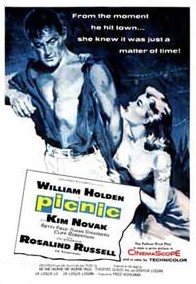
I tend to think of the 1950's as a pleasant mix of Leave it to Beaver and Happy Days. Naturally, that's not what the entire decade in the U.S. was like, but isn't it fun to think of it that way? They were more innocent times before the hair on fire 1960's rolled around, huh? Some of those 1950's movies though, you could see an indication of what was to come. One sexually charged or sexually repressed movie after another hit theaters, many of them based off scandalous novels or stage plays. One I've always been curious to watch and was finally able to track down? That's 1955's Picnic.
A freight train rolls into a quiet Kansas town on a hot summer day, and a man named Hal Carter (William Holden) jumps off. A drifter without a home or too much money in his pocket, Hal hopes to reunite with a friend from college and maybe get a job out of it...if possible. It doesn't take too long for Hal to find the friend, Alan Benson (Cliff Robertson), the well-to-do son of one of the richest men in town. Even after years apart and with both men having gone down such different paths, the two fraternity buddies pick things up like they were never apart. It's Labor Day, and Hal's timing is pretty good as the whole town is heading off to an immense picnic, a farewell of sorts to the summer. Hal is a little wary of the gathering as the outsider in town but ends up going. Problem? You bet, especially when Hal sets his sights on Madge (Kim Novak), Alan's beautiful girlfriend who comes from a poor(ish) family. Let the drama begin.
In the button-down, gentlemanly, poodle-skirt era of the 1950's, people simply did not have sex. It was simply...FORBIDDEN. Or so the movies would have you think. This was a huge time of change in Hollywood as studios got away from all sorts of production codes that limited what could and couldn't be shown. So as a result, audiences got a lot of sexually charged, forbidden love movies, often set in little towns where sexual frustrations apparently ran rampant. We got movies like this, Peyton Place, God's Little Acre, A Streetcar Named Desire, Baby Doll and plenty more I'm probably forgetting. All that repression and frustration always explodes in dramatic fashion! Ah, emotions and feelings! Yeah, at times, things can go a little overboard. That's Picnic. Some good moments, some good performances, with some really heavy, overdone moments.
'Picnic' is based off a Pulitzer Prize winning play that took Broadway by storm in 1953. Director Joshua Logan helmed both the play and the feature film, picking up an Oscar nomination in the process. In its filming techniques, 'Picnic' never feels like a stage-based play turned feature film. You can't say that for a lot of like-minded films. Logan filmed on-location in Hutchinson, Kansas and explores the town. You get a feel for the town, its people and its energy. The movie itself clocks in at 115 minutes and can clearly be divided in two parts. That first hour sets the stage, introducing all this hidden drama, rivalries, personal problems and lets the tension build into the high-drama of the second half as all those issues come to center stage. As for me? I loved the first hour and tolerated the second. More on that to come.
The cast doesn't feature a ton of big names, but that's not a bad thing. Holden took some heat because at 37 he was probably a little too old for the Hal part, but probably doesn't mean much. He brings the right energy to the part, hiding some personal demons while presenting an outgoing, fun-loving, likable persona. Really? He's a man in his mid-20s trying to find his lot in life, and so far, he's come up empty wherever he's turned. This isn't always a likable character, but Holden's Hal is a sympathetic one. His chemistry with Novak's Madge is perceptible in the air, just two people drawn to each other and they can't explain it. Novak would develop into a solid actress over the years, but here, her performance is a little rough. As a presence, she's unquestioned, stunningly beautiful, her Madge sick of everyone judging her by looks and looks alone.
Who else to look for? 'Picnic' was actually Cliff Robertson's first credited feature film, his Alan being an interesting mix, a spoiled kid who doesn't want to be the spoiled kid. We do get to see a mean streak in him though so stay tuned. Betty Field plays Flo, Madge's single mother, badgering and worrying and overbearing, while Susan Strasberg is Millie, Madge's tomboy little sister, smart, a reader and sick of Madge. Rosalind Russell hams it up as Rosemary, a 40-something schoolteacher in town, with a suitor/boyfriend of sorts in shop owner, Howard (Arthur O'Connell in an Oscar-nominated turn). Also look for Verna Felton as Helen Potts, the adorable next door neighbor, a bit of a conscience for the film/town, and Nick Adams as a horny teenager.
When Picnic is good, it's really good. But when it goes? Man, it goes. Everything comes to crazy fruition at the tail end of the picnic, and all hell breaks loose. The key, momentum-changing shift is started when a shirt gets torn, and literally everyone FREAKS THE EF OUT. A movie based on a stage play becomes very stagey and overdone and hammy. EMOTIONS and FEELINGS are everywhere. It's not that the drama isn't effective. It's that it lacks all subtlety at all. It becomes painful to watch at times. The ending itself is built up as a happy ending (of sorts), but man, when you think about it, this is NO happy ending at all. Still...it's a very cool final shot, so that counts for something right?
An interesting mix in the end. I really liked parts of it, especially Holden's performance, but the whole thing gets to be a little much in the end. The positives serve as a time capsule of sports. The entire story takes place in a 24-hour time period, and my goodness, it was quite the sunny, beautiful Labor Day. This is a beautiful movie to sit back and watch and appreciate it. We get a picture of 1950's life, especially in the extended picnic sequence as the whole town comes together to celebrate. Before all hell breaks loose in the emotions department in the second half, you get a sense of a more innocent time, and then Holden's shirt gets ripped and all bets are off. Still, there's enough to recommend but be forewarned that things turn into a sappy, tawdry soap opera in the second half.
Picnic (1955): ** 1/2 /****
The Sons of Katie Elder
"First, we reunite, then find Ma and Pa's killer...then read some reviews."
Showing posts with label Arthur O'Connell. Show all posts
Monday, August 10, 2015
Friday, April 19, 2013
The Proud Ones
What's the more iconic figure from the wild wild west, the sheriff/marshal or the cowboy? My first thought is the cowboy, but I'm safe picking either one. Yes, I'm the judge and jury here so deal with it. Countless westerns have dealt with both figures, some better than others, but 1956's The Proud Ones is a generally forgotten gem, the story of a small-town sheriff.
The sheriff of a small Kansas town, Cass Silver (Robert Ryan) is expecting trouble. The town has managed to avoid violence and bloodshed for years, but that's about to change. A new railroad line has made the town an important cattle depot, meaning cattle drives can now use Cass' town as a destination. The first herd is due any day now, and along with them comes Honest John Barrett (Robert Middleton), a saloon owner who has quite the checkered past with Cass as a marshal. Barrett sees the town as a gold mine, the potential for money and riches just waiting at his fingertips. His problem? Cass knows how he operates and doesn't intend to be intimidated by him. The experienced lawman braces for Barrett's plan while also weighing how much a new deputy, Thad Anderson (Jeffrey Hunter), can help. Anderson too has his own secrets, one that could doom them all.
The 1950s were packed to the gills with westerns hitting theaters from bigger budget A-level movies with smaller scale, cheaper B-movies. From director Robert D. Webb, 'Proud' is a better, more enjoyable western because it falls in between the two. It's familiar stuff, the town sheriff protecting his town, his word and his honor against a power-hungry businessman. Familiar isn't bad. There's some solid casting with some A-list names, but they're not there for the sake of star power. The story is mostly relegated to the town set which looks a lot like the set from The Ox-Bow Incident (from 13 years earlier), but the crowded streets with bars, businesses and alleys ending up being a key ingredient to the escalating situation. I also really liked Lionel Newman's score, a combination of soft and subtle -- especially Cass' whistle theme, listen HERE -- with bigger, louder outbursts in tense action scenes. It's a lot of little things again, but combined together it works out nicely.
By 1956, Robert Ryan was an established star in Hollywood, a reliable tough guy know for his villainous roles but also his ability to play flawed heroes. Playing veteran marshal Cass Silver, Ryan's part definitely falls into that second category. He's good at what he goes, but his past is checkered to say the least, thanks in great part to his history with Middleton's Honest John (Get it? It's ironic!). Silver has a tenuous relationship with saloon girl turned restaurant owner Sally (always reliable Virginia Mayo) and has a definite future with her, if he can get out of town and his job alive. In a semi-interesting but still unnecessary twist, Cass also gets knocked over the head and starts experiencing headaches that render him temporarily blind. It seems like something more worthy of a spaghetti western. Isolated and all but on his own, Cass might fight for what he believes in, what's right and upholding his word. I liked the main character a lot, and behind him, things fall into place nicely.
Presenting the town marshal as a main character in a western is nothing new, but I liked what Webb did just the same. 'Proud' had to be an influence on Howard Hawks who three years later with Rio Bravo would make a western with some similar undertones (and some less subtle connections). Cass has two deputies, Jake (Walter Brennan, basically playing the same role he'd play in Rio Bravo), the old jailer trying to keep Cass on his toes, and Jim (Arthur O'Connell), the doting father worried about his expecting wife. There's also a great dynamic between Silver and Hunter's Thad Anderson, the cowboy turned deputy. He blames Silver for his father's death, but he doesn't know all the facts. It's not quite a father-son relationship that develops -- maybe more of a brotherly relationship -- but it's fun to watch Silver keep working with the young deputy, not knowing if he'll get a bullet in his back whenever he turns away.
Rounding out the leads, Middleton is smooth and slimy as Honest John, wanting to get his way no matter what or who stands in his way. In this case, his means to an end is to hire "friends," Pike (Ken Clark) and Chico (Rodolfo Acosta), gunfighters waiting to shoot Cass in the back. In a smaller role that basically has her disappear after an early intro, Mayo fits in well as Sally, Silver's girlfriend who worries about his pride costing him his life.
Released in 1956, 'Proud' is surprisingly dark for an American western of the time. It delves into greed, backstabbing, betrayal and out and out murder. Even cynicism is evident almost from the first scene on. Trying to live up to his job and his word, Cass sees the town turn to Sodom and Gomorrah once there is any sort of money on the line, in this case lots and lots of money. The gunfights are quick and hard-hitting, and the finale in a dark, claustrophobic barn features the earliest use of blood squibs I've ever seen. One character gets shot in the face, another in the head, blood shooting out on impact. It's a western I don't hear much about, but I liked it from the start. Highly recommended.
The Proud Ones (1956): ***/****
Wednesday, February 13, 2013
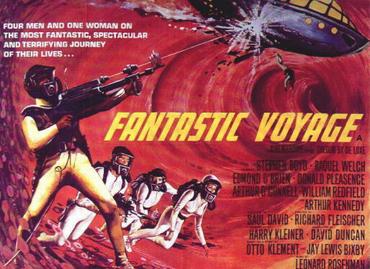
Fantastic Voyage
Groundbreaking doesn't mean groundbreaking for all-time. It qualifies only in the moment, maybe a few months, or even a year in the luckiest of situations. If a movie is considered groundbreaking, it kicks the door open and hundreds of rip-offs and wanna be follow-ups storm through the opening. That kept cycling through my head as I watched 1966's Fantastic Voyage.
A scientist (Jean Del Val) working for the Soviets has defected with American intelligence agencies desperate to help him and bring him to the United States. In the transport though, enemy agents attack, severely wounding him. He's in a coma with an unreachable blood clot on his brain, but he has info that the American government desperately wants. To relieve the pressure of the clot, a new technology will be utilized. A team of surgeons (including Arthur Kennedy and Donald Pleasence), a security officer (Stephen Boyd), and two others will travel via a submarine, be shrunk down to a microscopic size and injected into the scientist's body, traveling through his body and ultimately break up the clot and save his life. There's problems though. The body will most likely do everything it can to slow down the intruders, and they only have 60 minutes to get the job done before they begin to grow back to their normal size, whether they're in the body or not.
From director Richard Fleischer, this science fiction story won two Oscars, one for Best Art Direction and one for Best Special Effects. So while I didn't really care for the movie, I can appreciate the crazy visual on display. A tiny submarine the size of a period with five people inside traveling through a human body? How couldn't that be a great visual experience as a movie? Much of it comes from a green screen visual -- sets of the human body would be rather immense I'm supposing -- and just in terms of color alone, it's a beautiful movie. The little prototype submarine travels through the veins, arteries, lungs, heart, ears and ultimately, the brain.
So what do you think? A trip through the body and all its inner workings is unique, no doubt about that. Why then is this story so dull? I was bored to tears almost the second the submarine went to work. There's plenty of detours that provide some excitement. A miscalculation forces the crew to travel through the heart, but the problem is that the heart beating should tear the submarine apart. The medical staff monitoring the body basically shuts down the heart, giving the crew 60 seconds to travel through it. The premise presents all kinds of impressive, should-be cool situations like that. The crew is told that the body is going to do its best to protect itself, assuming that the submarine is a disease or virus of sorts. Those provide some cool visuals as well, antibodies swarming to the sub and the crew, but it's the weirdest thing. If that wasn't enough, someone involved with the mission is an enemy agent, but even that reveal is disappointing. It's a dull story of a very cool idea.
In a variation on one of my favorite sub-genres, 'Voyage' is a men-on-a-mission movie. Check that; a men-on-a-mission movie with Raquel Welch in a tight white bodysuit. So there it is, a group of specialists working to accomplish a mission. Along with Boyd's security and government agent, Kennedy's extremely talented lead surgeon, and Pleasence's reliable medical officer, there is Welch as Cora, Kennedy's assistant, and William Redfield as Capt. Owens, the Navy officer piloting the prototype submarine. Back at normal size, Edmond O'Brien and Arthur O'Connell play the bickering officers forced to make the difficult command decisions. Also look for a young James Brolin as one of the technicians working in the lab. None are given much in the way of background so instead of characters working to accomplish a dangerous mission, we're watching Stephen Boyd, Arthur Kennedy and Raquel Welch accomplish the mission. In other words, there's little personal investment in accomplishing the mission.
I thought I would enjoy this movie a lot in the early goings. The virtually silent, unexplained opening is a great scene-setter, eerie and unsettling because we don't know what's going on. It reminded me a lot of 1965's The Satan Bug in its simple style. I can't explain it though, but the second the miniaturized mission was presented I lost almost all interest in the story. There are some cool moments, but they didn't add up to a finished product that I enjoyed that much. Sorry to say it because I've long wanted to see it, but I came away disappointed with this 1960s sci-fi classic.
Fantastic Voyage (1966): **/****
Monday, July 16, 2012
Cimarron (1960)
My typical stance on an epic film is 'Bring it on.' You can't have too many of them, especially from the age of the epics, the 1950s through the 1960s. These are big, big movies. Then, I think of my favorite genre; the western. I can't name many quality epic, classic westerns. One exception is How the West Was Won, but I'm drawing a blank as to others. One that aspires to be an epic but ultimately fails is 1960's Cimarron.
Having put his wild cowboy drifting days behind him, Yancy 'Cimarron' Cravat (Glenn Ford) hopes to settle down with his newlywed bride, Sabra (Maria Schell). Yancy's plan starts with an impossible offer from the government, one that seems too good to be true. The Oklahoma territory and its millions of acres will be open to anyone who can stake a claim (the 1889 Land Run, read HERE), and Yancy has a spot all picked out to start a family with Sabra. Things don't go quite as planned though, forcing the couple to improvise and adjust. Setting up a small newspaper in Osage, Oklahoma, Yancy and Sabra are to become part of an era in American history full of drastic and modern change.
From director Anthony Mann, this is an appropriately big epic. The scale is impressive with scenes of hundreds of extras filling the screen behind the biggest names in the cast. None is more impressive than the depiction of the Oklahoma land rush. Literally hundreds of riders and wagons fill the screen from edge to edge as all these hopeful land owners race to stake a claim to their own land. Scenes like this make you appreciate what an epic is in all of its glory on such a large scale. The look of the movie is a beauty from the open prairies of the 1880s to the settled cityscapes of the 1910s. But that is where the positives end unfortunately.
Even with a movie clocking in at 149 minutes, it feels like Cimarron tackles too much. The story covers 25-plus years, but doesn't cover any of those years adequately. The script has jumps in times that come fast and furious, jumping a few months one time and then ten years the next. An episodic, somewhat drifting story can be a necessity dealing with a film of this scale, but at some point it has to be interesting even just a little bit. The tinier episodes here lack any of that interest with an exception here and there. Mann was at his best with smaller scale stories -- The Naked Spur, The Man from Laramie -- but struggles with stories of this magnitude. There's little heart, little emotion, and little interest to see a budding America growing from the wild west to the modern world.
That lack of emotion can be chalked up to any number of things, but the most glaring mistake was the casting. From top to bottom, 'Cimarron' lacks the huge star power of other epics, but that's not a deal breaker. It is though when almost to a man the characters are miscast. Ford and Schell don't have a great chemistry; a problem when these two characters are magnetically drawn together by their unexplained love. Ford's Yancy is trying to put a somewhat checkered past behind him, but that past is never even remotely dealt with, only hinted at. His character ends up being this icon of a growing America, and I'm thinking 'Really?' He bails on his wife for five years at one point, ten years at another. Schell too is trying here, but a character that could -- and probably should -- have been sympathetic comes across as shrill and whiny. When the two leads aren't especially likable, we could be in for a long ride.
The rest of the cast is hit or miss, and as is the case with epics gone bad, it's not always their fault. The ones given more screentime include Arthur O'Connell and Mercedes McCambridge as Tom and Sarah Wyatt, parents of a brood of eight trying to start a new life, a family that befriends Yancy and Sabra. Russ Tamblyn is a scene-stealer as the Cherokee Kid, a troubled youth Yancy tries to help with Vic Morrow as part of his gang. Anne Baxter is wasted as Dixie, a former love of Yancy's who now holds a grudge against him, a businesswoman who opens a whorehouse (a classy one at least). Potential for a cool character, but she's gone halfway through the movie. Also throw in Robert Keith, Charles McGraw, Harry Morgan, Edgar Buchanan, L.Q. Jones and David Opatoshu in supporting parts, some gone in a flash so don't blink. The problem is not the actors, but the lack of any character development. They drift in as needed and disappear as quickly as they appeared. Lots of potential for some very interesting characters, but nothing comes of it as Yancy and Sabra's story develops.
Once again, this won't sound like it makes a whole lot of sense, but there's both too much and not enough going on in a 149-minute movie. It's dull. The story moves along far too fast, glazing over significant portions of the story. I can't think of an epic with characters as unsympathetic as the ones here. I didn't care for most of the characters or how things ended up, and in the end, nothing comes of it. The resolution (using that term loosely) is disappointing and seemingly hypocritical for what we've seen up to this point. An epic attempt, but ultimately a disappointing failure.
Cimarron <---TCM trailer (1960): **/****
Monday, April 23, 2012
Ride Beyond Vengeance
Though he starred in over 40 films and countless TV shows as a star and guest star, I'll always think of Chuck Connors
as The Rifleman, Lucas McCain, the single father who raised his son
Mark on their small New Mexico ranch. I'm a huge fan of the show and not
surprisingly, Connors. He parlayed his success into other shows and
movies, but he always seemed quite at home in the western, like 1966's
B-western Ride Beyond Vengeance.
After 11 years away from his wife trying to earn as much cash as possible, buffalo hunter Jonas Trapp (Connors) returns home to Coldiron, Texas with $17,000 in his saddlebags. As he nears the town, he's ambushed by three townspeople, Brooks Durham (Michael Rennie), the rich banker, Elwood Coates (Claude Akins), the drunken, deranged cowboy, and Johnsy Boy Hood (Bill Bixby), who scar him with a brand on his chest and steal his money, leaving him for dead. Jonas continues on, dead set on getting his money back and finding his wife, Jessie (Kathryn Hays), at the same time. Jonas finds Jessie is in love with Durham (thinking him long since dead), and the town doesn't appreciate his revenge-fueled return. Everything seems stacked against him.
An oddity among westerns, 'Vengeance' is hard to compare to any other western I've seen. I was pleasantly surprised by the opening, a modern day setting as a census taker (James MacArthur) prepares to leave Coldiron, stopping at a bar and talking to the bartender (Arthur O'Connell) about the town's history. He discovers the story of Jonas' return is the stuff of legend, living on for years to come. For a B-western shot on the cheap on a lightning-quick schedule, it seemed like a genuinely unique story opener. It sets the stage for some sort of surprise and epicness (yes, I make up words) to come. What could have happened almost 100 years before in a tiny, quiet Texas town that still resonates with its citizens? Oh, and what would a B-western be without a ballad theme? Give it a listen HERE.
And that's where the problem is. What follows is not epic, doesn't feature much in the way of surprises, and ends up being disappointingly flat in the end. I'll give credit where it's due. 'Vengeance' doesn't take the easy way out, focusing on character development instead of relying solely on shoot outs and gunfights. It is different in a way that I can't quite put my finger on, and that's not necessarily a good thing. The acting tends to be a little on the exaggerated side, the tone is incredibly dark, and there's a general feel of Gothic -- maybe Shakespearean -- undertones. On a more straightforward note, it's stupid at times. Not writing to his wife for 11 years, what did Jonas think was going to happen? She'd be waiting at the doorstep for him? It comes across as partially lazy in the storytelling department, a plot device necessary to move things along without making much sense. Aren't those the best?
Typecast to a certain point as Lucas McCain, Connors spent much of the rest of his career trying to play different roles, and this definitely qualifies. Probably a little too old for the part, this isn't his best acting job. He's rocking an unrecognizable accent, and generally is required to look pissed off at everyone around him. As for the rest of the cast, while there is some impressive name recognition, the performances don't amount to much. Rennie looks bored as Durham, Akins could have been legitimately drunk playing his part, and Bixby looks confused, but more on that later. Hays as the "love interest" just doesn't have much in the way of chemistry with Connors although to be fair, their parts consist of a handful of scenes of screaming at each other. Former Rifleman co-star Paul Fix has a small part too as Hanley, an old saddle tramp who helps Jonah in a cool connection to their successful run on TV.
Mostly with a whole lot of name recognition, the cast is wasted. Along with all those previously mentioned, there are parts for Joan Blondell as a drunken owner of a whorehouse, Gloria Grahame as a married woman cheating on her husband with Bixby, Frank Gorshin (Batman's The Riddler) as a lovelorn, drunken cowboy, and Gary Merrill as Dub Stokes, Jonah's tough-love stepfather. None of these parts are essential to the story, but even in their out of left field qualities, they disappear as quickly as they appear with no rhyme or reason. Cameos are one thing, pointlessly wasted cameos are another. As for the acting, it's laughable at times. A drunken Akins always talks to Whiskey Man, his imaginary friend he drinks with, and Bixby loses his mind when confronted by Jonas. Literally the guys goes nuts with no hints, foreshadowing or warning. He brands himself and runs into the woods laughing hysterically. It's Gothic on steroids, like nothing I've seen in a western.
It all comes to a head with that final resolution....sort of. It's a weak ending in general although a knock-down, brutal fight between Connors and Akins is surprisingly realistic with a minimum use of stunt doubles (watch it HERE). The resolution is built up as this event that made a lasting impression on this town, an event that's still talked about 75-plus years later. Really? That's what made such an impression? I was disappointed with the ending in this off-the-wall B-western that basically wastes a good cast and at least some potential.
Ride Beyond Vengeance (1966): * 1/2 /****
Tuesday, April 3, 2012
The Last Valley
A longtime member of my 'Saved DVDs' option at Netflix, 1971's The Last Valley was finally made available this week, and I was delivered a pleasant surprise as the opening credits rolled, besides the strong casting. The film is directed by James Clavell, someone I think of as an author more than a director. The director of only six films in his career, Clavell is at the head of a different but still impressive historical epic.
It is the middle of the Thirty Years War in the early 1600s and a war that started off about religion in Germany has expanded to other European powers. Walking across a famine-ridden country, a former teacher, Vogel (Omar Sharif) stumbles across a beautiful valley up in the hills seemingly immune from the touches of war. The villagers living in the valley are away for the time, but behind Vogel comes a small company of mercenaries led by the Captain (Michael Caine). Vogel convinces them to winter in the village/valley, the mercenaries forming the uneasiest of alliances with the village leader, Gruber (Nigel Davenport), and the people. Vogel finds himself working as a mediator, both sides not happy with the other as this little valley is thrust into the war for the first time.
In the era of historical epics, this is a late entry to the genre. Clavell wrote, produced and directed this historical epic that I can only describe as...different, in a good way. It doesn't really have a similar movie you can even remotely compare it to. It deals with religion and faith, the lunacy of war, the lunacy of religion, corruption, blind faith, and generally boasts a cynicism that would have been prevalent at the time in the minds of the audience. Without getting pretentious, 'Valley' tries to ask what is the point of fighting? What's the point of a religion that forces its believers to fight and die simply because someone tells them to do so? In all its darkness and cynicism, I liked this movie because of those different features. It doesn't settle for the status quo and impressing with scale. This movie has that impressive scale with a worthwhile message to boot.
If you're going to do a historical epic, do it right in the casting department. Two of the best names around for an epic -- Caine and Sharif -- don't disappoint in their performances. Caine especially delivers an underrated, moving performance as the Captain, a long-time mercenary who's grown weary of the futility of battle, war, and organized religion. He continues to fight, meeting confrontations head on rather than taking the easy way out and running away. His counter is Sharif as Vogel, an intellectual, a former teacher who wants to talk things out, negotiate rather than fight it out. The duo plays well off each other as their situation becomes harder to handle. Neither truly knows what, but both men are looking for something while trying to put their past behind them. At what cost will it come though?
The ensemble cast that backs the duo up does not boast much name recognition, but the characters from Clavell's script come to life with the cast, a wide variety of eclectic characters. Florinda Bolkan plays Erica, a woman in the village who moves in with the Captain, her personal/religious beliefs ready to cause a stir among these God-fearing folks. Davenport as Gruber is perfect, a simmering pot of violence and manipulation just waiting to strike. Per Oscarsson plays Father Sebastian, the village's Christian priest, a religious fanatic who must have things his way. Arthur O'Connell seems like an odd choice to play Hoffman, one of the elder villagers, with his daughter, Inge (Madeleine Hinde), drawing the eye of the mercenaries and Vogel. I especially liked the dynamic among Captain's mercenaries, including the treacherous Hansen (Michael Gothard) and brutal right-hand man Graf (Ian Hogg) among a handful of other characters who would have benefited from more screen-time/development.
The story with a message and a solid cast is aided by two things; location shooting in Austria and the musical score from John Barry. It ends up sounding like an action- gothic horror score with hints of James Bond music. Oddly/bizarrely enough, it works really well. Go figure. Listen to 3 different parts HERE. 'Valley' shot on location in Austria for this mountain valley, and the end result is stunning. Watching the story unfold, it's easy to see why everyone involved is willing to work and fight for their homes, an idyllic green valley with sweeping fields and tree-covered hillsides. Clavell uses a wide camera lens to show the beauty of the Trins, Tol location and doesn't disappoint. Digging a little deeper, I question if there was symbolism going on here. Sharif's Vogel finds the village through a fog-covered forest surrounded by burned out, plague-infested villages. Is this village in the midst, seemingly untouched, some sort of heaven? Maybe not, but it's a cool thought to keep in mind as you watch this gothic historical epic.
My one complaint is that the sweeping story tends to drift a little too much at 125 minutes. It's never slow, but with so many characters and situations, the at-times episodic storytelling drags the pace down. 'Valley' seems to know where it's going though, and the ending -- in all its ambiguous doom and gloom -- works especially well. Its message is simple. War is stupid. Religion is stupid. Fighting for religion blindly? Inexcusable. Think for yourself and decide what's right, not what someone else tells you. Watch the whole movie HERE with Part 1 of 10.
The Last Valley <---trailer (1971): ***/****
Thursday, June 30, 2011
Operation Mad Ball
One of Jack Lemmon's most famous roles came in 1955 as the quiet, mousey, anti-confrontational Ensign Pulver in Mister Roberts starring alongside Henry Fonda and James Cagney. By the end of the movie, his character has transformed into his polar opposite; confident, sure of himself, and not worried about rustling some feathers. This was explored some in the all-around bad and unnecessary sequel Ensign Pulver unfortunately. So while in no way related to either 'Roberts' or 'Pulver,' 1957's Operation Mad Ball made me think of the character Pulver as he plays off a variation of that previous character.
As I'm discovering more and more with the comedies I see, I'm never quite sure how to review them. They're meant to be funny of course, but humor is one of the most subjective things about movies. What's funny to me can fall flat with everyone else in the audience. With an action movie, you can talk about the fight sequences or the car chase. With heavy dramatic movies, it's the performances and the actors. What about comedies? Should I just list all the scenes and bits that made me laugh or chuckle? Now that would be an invigorating read, wouldn't it? Basically this is an apology to any readers. I like comedies. I like watching them. Reviewing them? Not so much.
It's September 1945 in France at an Allied hospital near Normandy. World War II has been over for several months now in the European theater, and boredom and tedium have set in for the soldiers. At this hospital is Private Hogan (Lemmon), a highly intelligent wheeler dealer who doesn't actually like work but can get just about anything done if he puts his mind to it. One of his fellow soldiers (Roger Smith) would like nothing more than to meet his girlfriend in a private setting, but only Hogan can arrange it. What starts off as a small romantic evening turns into an extravaganza, a gigantic party with seemingly everyone in camp involved. Can Hogan pull it off though? The company adjutant, gung-ho Captain Lock (Ernie Kovacs), already has Hogan on his radar, and he threatens to bring everything crashing down around the scrounging, wheeling and dealing private.
This war flick was aired recently on Turner Classic Movies as part of a one-night tribute to Ernie Kovacs, the ahead of his time comedian from the 1950s who was tragically killed in a car accident in 1962 at the age of 42. I've seen him in a role here and there but didn't always come away impressed. To be fair, I think this is the first movie of his I've seen where he plays a dominant role. As a character you're not supposed to like, he hits this one out of the park. His Capt. Lock is that guy you're supposed to hate. He's not as bumbling as he could have been, but you know in the end Hogan will get the best of him. Kovacs shows a knack for subtle humor and more obvious humor in the form of physical comedy. Some of his facial expressions are priceless. The best though is his final scene, a look of ultimate despair on his face as to what's happening.
As the story moves along, I was reminded of a MASH episode where Hawkeye needs a new pair of boots and starts to trade things so he can get a pair. One trade turns into another until there's a long line of trades waiting to happen, all of them contingent on the other. That's this movie. A scrounger, a wheeler-dealer, a crafty negotiator, Hogan plays his cards right and almost always gets what he wants. The story isn't the most pointed one around because it needs some detours to show the ridiculous amount of detail the enterprising private goes through to pull off the party. Lots going on overall, including a love interest, Nurse Lt. Bixby (Kathryn Grant), a clueless commanding officer (Arthur O'Connell), a worthy foe for Hogan in a quick-witted French widow, Madame LaFour (Jeanne Manet), and a great bit with a German P.O.W. (Kort Falkenberg) posing as a corpse that Lock thinks is still alive.
One of the all-time greats when it comes to acting -- drama, comedy, it doesn't matter -- Jack Lemmon is the show here. His Private Hogan is the type of soldier who would be a great officer...if he wanted to or even applied himself. Instead, he's pleased with his low responsibility duties that allow him time for his "extracurricular activities." Lemmon is a scene-stealer in the sense that even when he's low-key, you're drawn to him. His crew of fellow low-ranking soldiers include Mickey Rooney, a pre-Bewitched Dick York, James Darren, Smith, an uncredited Paul Picerni, and L.Q. Jones among others. Rooney is memorable especially as a high-strung Southerner, often rhyming all his speech with a 'Fiddle-dee-doo, fiddle-dee-daa' sing-song style of talking, and York too shines as Lock's secretary/assistant who works as a spy and inside source for Hogan's antics and plans. Good performances at the top and strong supporting parts to back it all up.
What else to say, what else to say? I liked this easygoing post-World War II comedy. It is filmed in black and white -- always a bonus in my mind -- and never tries to be anything other than fun and entertaining. It succeeds. At 105 minutes, it's that perfect length for a comedy of its ilk. Good movie, great cast, and a fun movie overall.
Operation Mad Ball <---trailer (1957): ***/****
Labels:
1950s,
Arthur O'Connell,
Jack Lemmon,
James Darren,
L.Q. Jones,
Mickey Rooney,
Paul Picerni,
WWII
Saturday, March 12, 2011
Bus Stop
An icon of beauty and style, Marilyn Monroe isn't always thought of as a true, dramatic actress. In comedy, she was perfectly suited, often playing the sexy if ditsy blonde. Depending on the movie, it can take more acting ability to nail the comedy than the drama, but I've always thought Monroe was a solid actress across the board. It was only later in her shortened career that she turned to more dramatic roles consistently, including 1956's Bus Stop.
Before I jump into the review, I'm going to say this about the movie. I hated it. Truly hated it. I sat through it for Monroe alone, and little else. The story and plotting was beyond ridiculous, forced and hackneyed for the sake of the story and little else. The leading man was such an exaggerated, annoying character that I found myself rooting for something horrible to happen to him. And at 96 minutes, this movie could not have ended quickly enough. The one saving grace? Monroe, showing off her tremendous beauty and an ability to act in a dramatic role.
The owner of a successful ranch in Montana, 21-year old Beauregard 'Bo' Decker (Don Murray) is traveling to Phoenix with veteran ranch hand Virgil (Arthur O'Connell) to take part in a high-stakes rodeo competition. Decker is looking for the big payoff at the end, and hopefully finding a wife to come live with him. After a long bus trip, they arrive in Phoenix where Bo sees Cherie (Monroe), a saloon performer making her way west slowly but surely to Hollywood. It's love at first sight for the young cowboy, and he decides that she will be his wife. The only problem? No one told Cherie anything about the arrangement, and she can't manage to shake off the persistent efforts of Bo.
The premise sounded interesting enough even if the description at TCM's website emphasizes Bo's kidnapping of Cherie late in the movie as a huge plot point. It sounds like a screwball comedy but is played like a straight drama. See any problems there? There's no comedy, but the drama is so off-the-wall it never clicks or gels in the least. The movie is just there, never choosing a side or what it's about. If there was some slapstick comedy, maybe it works. If there was a sense of danger as to what Bo might actually do, we're talking about a decent thriller. Instead, we get this, a 96-minute movie that doesn't go anywhere and doesn't say anything.
I've written before about the likability of main characters and movies sinking or swimming on that decision. Do you like the main character at all? Are we supposed to? Unfortunately for Bus Stop, I hated Murray's Bo, but I'm pretty sure we're supposed to like him, root for him in some way. If I'm wrong, and he's meant to be a big joke, then what was the point of the whole movie? This was Murray's first feature film, and all the talent he would show in later roles just isn't there. I can't decide if its his character or the acting...or both. Beauregard is a 12-year old in a 21-year old's body. He is overbearing, obnoxious, a stalker, bull-headed, stubborn, and downright annoying. If you're going for a lovable cut-up who never grew up, so be it, but not like this. It's too much.
What's worse is that the story and all the characters around him allow all this. Is it the awful script that requires things to move along so no one stops Bo? Did anyone care? If this movie was released in 2011, it would be about a young man stalking a young girl, desperately trying to convince her to love him. At different points, he breaks into her apartment and lies down next to her, gets engaged without telling her, and plans on getting married the next day. When that doesn't work, he actually lassoes her as she tries to escape, and NO ONE stops him. The cries of help didn't alert anyone that she's distressed? He's convinced that he can make her fall in love with him. The Bo character gets a chance at redemption late (after he gets the crap kicked out of him by Robert Bray's bus driver character), but it's too late to save the movie, and too quick of a transformation for this man-child.
So unfortunately while Murray's character needed to be taken out and shot about 10 minutes into the movie, the rest of the cast is above average. Looking pale as a ghost and sporting an Ozarks hillbilly accent, Monroe shows off her acting chops, carrying the movie through its rougher patches. She looks great too which never hurts, and even gets to sing a song soon after her introduction. O'Connell is all right, Bray is a bonus because he beats down Murray, Betty Field having some fun as sassy diner owner Grace, and Eileen Heckart as funny sidekick Vera to Monroe's Cherie. But all things considered, Monroe is the only reason to invest 96 minutes here. Murray is awful and single-handedly ruins the movie.
Bus Stop <---trailer (1956): */****
Wednesday, May 5, 2010
The Silencers
Last month I reviewed Murderer's Row, the second of four Matt Helm movies. Starring Dean Martin, these were spoofs that had some fun with the spy movie that was at the height of its popularity thanks to the success of the James Bond franchise. In the last week or so, TCM had a spoof night and wouldn't you know it, another Matt Helm movie was on. Having already jumped into these movies mid-series, I caught up with the first Helm movie, 1966's The Silencers.
Mulling over what to write about this one, all I could come up is that this wasn't going to be a very long review. Judging by the two movies I've seen in the series, these are basically cookie-cutter variations on themselves. To a point, the Bond movies are like that too, but there's almost always something unique, something different in each entry. Not so much with the Helm movies. I didn't think Murderers' Row was that good, but I gave it a lukewarm positive review because it was still mildly entertaining. As for The Silencers, it wasn't nearly as good, not even close.
Brought out of retirement, ICE agent Matt Helm (Martin) is given a dangerous mission that involves the prevention of the destruction of the world....well, sort of. Supervisor MacDonald (James Gregory) informs him that an organization called Big O (oh, that's too easy) has a plan to explode an atomic bomb over an American nuclear site in Alamogordo, and that Helm must stop the plan. Working with an old partner/fling, Tina (Daliah Lavi), Helm heads to meet an agent who may have key information on the plan, but she's killed and the only suspect is a ditzy redhead, Gail Hendricks (Stella Stevens). Working with Gail, all Helm has is a phrase mumbled before the agent's death to work off of and time is running out.
This is one of the more pointless plotlines I've ever come across in a movie. It takes quite awhile to even get the story to a point where something is revealed, and then Helm spends the next half hour seducing every woman he meets. Then with 15 or 20 minutes left, it seems director Phil Karlson remembered they had to wrap things up and gets back to the story. Everything is wrapped up nicely with a bow, and voila, let's move on to the next 3 Matt Helm movies. I'm not looking for a Bond-esque twisting and turning storyline, but something, anything at all would be nice.
This was Martin at the absolute height of his popularity with his Rat Pack fame turning into a variety show that aired for almost 10 years. The same thing I wrote for Murderers' Row applies here with Martin playing himself and doing a lot of drinking and seducing whenever he gets the chance and singing much of the soundtrack -- including one good dig at Frank Sinatra. I'd have to go back and watch, but I'd bet no more than a minute goes by whenever he meets a woman from being introduced to kissing her. If you thought James Bond got around, all I can say is check out Matt Helm. And then there's the drinking, including one very dated scene where Helm is guzzling scotch while at the wheel of his -- wait for it -- secret agent station wagon dubbed 'the sex wagon' by Stevens' Gail. Not exactly an Aston Martin if you ask me.
With that flimsy storyline, it seems a waste to misuse this great cast. Gregory is the straight man, always shaking his head at Helms' antics, and Lavi is the sex kitten with a past with Helms. In the few movies I've seen with her, Stevens shows a knack for comedic timing, but here she's the clueless ditz along for the ride. Of those movies, this does continue a trend of having her in the slinkiest costumes around. Also here for this debacle are Robert Webber and Arthur O'Connell as O agents with Victor Buono as an Asian O mastermind behind the diabolical plan. None of these typically solid actors is given much to do and are generally wasted.
There are some funny moments, like a gun that fires backwards and turns Stevens into a hardcore spy too once she figures it out, but overall this movie is easily forgettable. All I'm looking for in a spy spoof is some laughs here and there, but even in that department this one fails. Now I'm wary of checking out the other two Matt Helm movies. If nothing else, they can't be as bad as this one.
The Silencers <----TCM clips (1966): * 1/2 /****
Wednesday, January 20, 2010
Anatomy of a Murder
A producer, director and actor at different points during his career, Preminger never shied away from telling stories without that glossy finish. His movies feel real, almost like a documentary, because they don't call attention to themselves in a highly visual way. These movies are nonetheless great to look at -- the German-born director favored black and white filming -- but as a viewer you feel like you are there with the actors in the scene. Where some directors overfilm (if that's a word/concept), Preminger puts the camera in place and lets his actors go to work. This style pays off with his depiction of a genre that's been used to death in film, the courtroom drama.
Having lost his position as the county district attorney, lawyer Paul Biegler (James Stewart) has settled into an easier, slower-paced lifestyle. He spends much of his time fishing, playing his piano, listening to music and reading law with his friend Parnell McCarthy (Arthur O'Connell), and then takes an occassional case here and there. But then Paul is offered a high-profile case to defend a soldier, Lt. Frederick Manion (Ben Gazzara), who shot a man five times for raping his wife, Laura (Lee Remick). Paul isn't sure if he should take the case but after looking into it and interviewing those involved decides to defend Manion. What's waiting for him in court is Michigan's best prosecutor, a ringer brought in from Lansing, Claude Dancer (George C. Scott).
Having grown up watching countless repeats of Law & Order, Boston Legal, and any number of courtroom movies like 12 Angry Men, I won't say I'm jaded when it comes to that type of story, but I feel like I've seen just about everything the genre has. That doesn't mean I don't seek these movies out, it just takes a little more to impress me. Preminger succeeds on that level with his sometimes leisurely -- slow-paced isn't the right choice of description -- courtroom story that runs 160 minutes. Even at over two and a half hours, it doesn't feel long. The first hour is Biegler's personal investigation as he figures out exactly what happened in the murder. The last 90-100 minutes is the actual trial, and it's one of the best presentations of a courtroom trial I've ever seen, thanks to Stewart and Scott bantering back and forth.
What's interesting in the execution of the trial is the feel of a twist coming, the expectation that we're about to be wowed with some huge revelation. It never comes. There is no twist. Preminger doles out the story, the situation and the characters and lets the story peel like an onion. The jury's verdict is read, and that's it. So in a way, it is a twist. The story is as linear as a story like this could be. Biegler is the viewer because he knows what we know. Was Laura Manion raped, or was she having an affair that went to far? Did Lt. Manion go temporarily insane when he shot the accused rapist? Preminger doesn't give you an easy out, no nice and tidy explanation. And that's why Anatomy of a Murder works.
Working with many of Hollywood's biggest stars, Preminger had a reputation as a stickler for details, but he was always able to get an impressive performance out of his actors. I can't decide about Jimmy Stewart because I say this with every movie I see with him in it, but this is one of his finest performances. With the Manion case, he's up against the wall and must use every trick in the book to get his client acquitted. It's one of those performances where you can't take your eyes off the star, it's that captivating to watch him work. Stewart worked with all the greats in his career, Preminger, Ford, Hitchcock, Capra, and it's easy to see why. He never mails it in, always making his performances special.
To work with Stewart, Preminger assembles an impressive listing for his supporting cast. Gazzara is his typical sneering, intimidating self as Manion, and Remick sexes it up as his possibly trampy wife Laura. Neither character is particularly likable, and we're never sure who's telling the truth so Stewart's Biegler has his work laid out for him if he wants to win the case and get Manion off. This isn't Scott's best part, mostly because it is a one-note part, but he makes the most of it. O'Connell is the stereotypical country drunk who never really lived up to his own expectations but gets a 2nd chance at success with Biegler. Eve Arden has a funny part as Paul's long suffering secretary looking for a paycheck, and Kathryn Grant plays Mary Pilant, the estranged daughter of the murder victim.
Certainly a unique look at a genre that's been overdone at times. Somewhat risque for the time in its depiction of a rape and the rape victim, Preminger has a winner with this courtroom drama. Not a perfect movie, but pretty close to being one. Enjoy the very cheesey, very enjoyable overdone trailer.
Anatomy of a Murder <----trailer (1959): *** 1/2 /****
Subscribe to:
Posts (Atom)