The Sons of Katie Elder

The Sons of Katie Elder
"First, we reunite, then find Ma and Pa's killer...then read some reviews."
Showing posts with label Glenn Ford. Show all posts

Wednesday, March 12, 2014

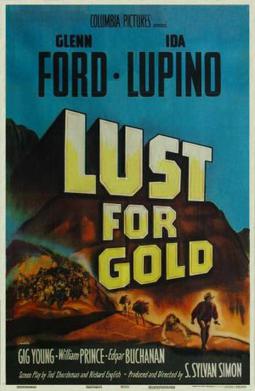
Lust for Gold

As Gordon Gekko profoundly said, 'Greed is good.' One of the all-time great films dealing with one of the seven deadly sins was released in 1948, Treasure of the Sierra Madre, a frightening look at what gold can do to one's minds. It's one of the all-time classics, making 1949's Lust for Gold an odd choice. Was it an effort to build off its success? Whatever the reason, it doesn't work despite some potential.

It's 1948 in Arizona, a treasure-hunter of sorts, Barry Storm (William Prince), is walking through the Superstition Mountains looking for a supposedly long-lost mine, the Lost Dutchman. He's actually following a famous treasure hunter who states he's got the mystery figured out, but Storm is stunned when he hears a gunshot and soon after finds the treasure hunter dead. He walks to the nearest town, still several days away, to report the murder, quickly realizing this isn't some innocent old treasure hunt. Storm is quickly cleared of suspicion, but his interest makes some curious as he claims to be the grandson of the original owner of the Dutchman mine. As the police waits for a break in the case, Storm sits back and listens to the legendary story of how the mine came to be, including how his grandfather, Jacob Walz (Glenn Ford), came to be involved.

This was an interesting movie, not always for the good. From director S. Sylvan Simon (and an uncredited George Marshall), 'Lust' does have its positives and negatives. It plays at times like a pseudo-documentary, a film noir meets a rough and tumble western. Unfortunately, it never really gels as one coherent film. I liked the framing device in the story, a 90-minute story split about 55 (the Glenn Ford part) and 35 (the 1948 part) divvying things up appropriately. It comes with a message from the state of Arizona -- almost like a Welcome Guide, "Come and see Arizona!" -- stating that the mine is still out there somewhere. It is based off a book by the real Barry Storm, called Thunder Gods Gold, and it plays like a pandering effort to sell some copies of the book. Prince's Storm's narration is a little much too, almost an attempt to sound like a James Cagney-esque gangster. "The gold's out there, I tells ya! Don't believe me, eh?!?"

Oddly enough though, I enjoyed the 1948 portion of the story far more than the 1885 portion. Prince is okay as the intrepidly curious Storm, jobless and interested in finding the lost mine that's supposedly filled with literally tons of gold. The film noir in the desert plays well, dead bodies and potshots piling up over the years as treasure hunters supposedly near the location of the lost mine. In addition to Prince, look for Paul Ford as the local sheriff with Will Geer and an uncredited Jay Silverheels (later Tonto on The Lone Ranger) as his two deputies. The mystery builds nicely and when things wrap up back in 1885, we get some solid resolution. The ending was pretty exciting, wrapping things up that the first 20-25 minutes set up.

Surprising for me was how dull the actual 1880 Arizona western was. It starts off well, greed, murder and betrayal introduced early to the point I thought I had stumbled onto a hidden gem from a genre I love. Well, I didn't. The story detours quickly and is never able to recover. Glenn Ford gets a rare turn as a bad guy -- an out and out bad guy -- but it's wasted because after he finds the gold mine by some rather duplicitous means (read = Murder) the story hamstrings the character as it devolves into a forced love triangle with Ida Lupino's Julia and her husband who she fights with constantly and would like to divorce, played to smarmy annoyingness by Gig Young. Wait, she loves her husband, but she doesn't because she loves Jacob but she doesn't love him either. Gag me, the story goes nowhere, turning a potentially really good story about what greed can do to people into a lame, glacially-moving love triangle. A love triangle of sorts. You've gotta be kidding me.

In the flashback portion, also look for Edgar Buchanan as a grizzled old trail hand working with Ford's Jacob and uncredited parts for Arthur Hunnicutt and Antonio Moreno as two rivals who may hold the key to the location of the lost gold mine. Even western veteran John Doucette turns up for a quick appearance in a barber shop talking about how much gold may be out there.

There are parts that worked surprisingly well. The explanation of how the gold came to be in the mine is a gem, an Apache war party descending on a heavily-guarded escort in a surprisingly graphic action scene. The same for the intro to the 1880s flashback, Glenn Ford's Jacob straight up murdering folks. How many movies can you say that about? Glenn Ford is a good guy for goodness sake! The ending in the flashback has some potential too, but by then I was so bored with the Ford-Lupino-Young part of the story I just didn't care. A movie that has its moments, but not enough of them unfortunately.

Lust for Gold (1949): **/****

Thursday, August 29, 2013

Imitation General

When I hear the name Red Buttons, I think of movies. Yes, he was also a Broadway performer and stand-up comedian, but I'm most aware of him for his film roles, like in The Longest Day, Hatari!, and The Poseidon Adventure. Not given many leading roles, Buttons was a great second banana, typically playing a partner or sidekick, like 1958's Imitation General, an underrated WWII comedy.

It's 1944 in France following the successful D-Day invasion, but the fighting rages on. After a bloody battle between German and American forces, an American officer, Brigadier General Charles Lane (Kent Smith) is traveling across the battlefield in a jeep with his two longtime aides, Master Sgt. Murphy Savage (Glenn Ford) and Corporal Chan Derby (Buttons). Remnants of American forces are still in the area, but they're cut off and surrounded by German forces. Lane wants to organize the men, hoping that the sight of a general on the front lines energizes them and brings them together. It is a solid plan, Murphy and Derby going along with it, but Lane is killed saving Murphy from a German machine gun. What to do? The Germans are on all sides and prepping for a counterattack. Murphy does the only thing he can think of....and poses as General Lane, hoping to do exactly what the general had hoped, organizing the men to avoid a horrific, bloody route.

Here we go down this route again. Reading up on this generally forgotten WWII comedy when it appeared on TCM's schedule, I was skeptical of the movie. The Leonard Maltin review called it "a tepid, occasionally tasteless" comedy that "defeats its game cast." Ringing endorsement, huh? I'd never heard of it though prior to it popping up on TCM, and I wanted to give it a fair shot. Well, Mr. Maltin was wrong on this one if you ask me. From director George Marshall, 'Imitation' not surprisingly doesn't rewrite the genre. It's a WWII comedy after all. Any war movie that's a comedy -- and not a dark comedy like MASH or Catch-22 -- has to tread that fine line. War isn't naturally funny so playing it for goofy, physical laughs can be iffy. The premise here did sound pretty goofy, but I stuck with it and was rewarded in the end. It's good stuff, and I'm glad I gave it a fair shot.

A few days since I reviewed 1956's Ransom!, here comes a complete 180 from star Glenn Ford. An underrated actor in general, Ford was home in just about any role he ever did, action, drama or comedy. For me though, I watch him and like him best when he gets to show off some of his comedic chops, like he does here. It's not the laughs a comic would get, but laughs from a really underplayed line delivery. He has an ease about him in parts like this that makes him very likable. His Master Sgt. Murphy has genuinely good intentions here when he dons the general's stars and puts on the dead officer's helmet. It isn't glory he's after, just trying to prevent a battlefield route of an already beaten down army. There's just enough drama to pull it off, Ford's Murphy questioning if he's made the right decision. Oh, and he gets to woo a pretty French woman, Simone (Taina Elg), so that's nice. Those scenes are the movie's weakest points.

Playing almost like a buddy flick, 'Imitation' is at its deadpan funniest when Ford and Buttons are on-screen together. Their Murphy and Derby have been friends and fellow soldiers across North Africa into Sicily and finally into France. In other words, they know each other well, trust each other and have a genuine friendship. They show that friendship through a non-stop running dialogue that revolves around insults and in-jokes, the duo's lightning-quick delivery back and forth playing well. I liked both Ford and Buttons a lot here. In a too short appearance, Smith is very good too as General Lane. As for some of the other men bottled up in the Allied pocket of resistance are Cpl. Sellers (Dean Jones), a shell-shocked bookworm of a soldier, Pvt. Orville Hutchmeyer (Tige Andrews), an adversary of Murphy's and the only man around who can identify him as a fraud, and Lt. Clayton (John Wilder), a young NCO always putting his foot in his mouth around Murphy.

When the story focuses on Murphy and Simone at her bombed-out farmhouse, the story in an 88-minute long movie begins to drag a little bit. It's at its best when 'Imitation' heads out into the field. With the hills around Hollywood standing in for France, the big Cinemascope look plays well, especially filming in black and white. The action scenes are on a small scale, but that smallish scale doesn't hurt a thing. It's actually the better for it. As well, the scenes with Murphy frantically trying to hide from Hutchmeyer provide some genuine laughs too amidst all the chaos. The whole movie succeeds on that smaller scale. No cast and crew of thousands, no bigger picture of what's going on. Instead, we get an enjoyable WWII comedy that isn't obnoxiously stupid or at the other end of the spectrum, ridiculously dark and cynical. It's just a good old-fashioned comedy that I liked a lot.

Imitation General (1958): ***/****

Friday, August 23, 2013

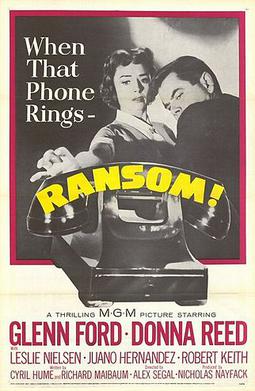
Ransom!

In an age of remakes, sequels, prequels, series and what not, it can be fun sometimes to stumble across an original you didn't even know existed. I can't remember for sure if I saw 1996's Ransom as I was growing up, but I've always been aware of it if nothing else. Well, I can also say I wasn't aware of its predecessor, 1956's Ransom! Forty years apart, is it enough time between original and remake?

A very well-to-do executive of a vacuum cleaner company, Dave Stannard (Glenn Ford) has created quite a life for himself with his beautiful wife, Edith (Donna Reed) and eight-year old son, Andy (Bobby Clark). Their idyllic home life is broken up one day when Andy doesn't return home from school. His teacher tells Edith that a nurse took him from school that morning, claiming to go to the doctor's office. The doctor though has no knowledge of Andy's whereabouts, leaving Dave and Edith to fear for the worst. The call comes later that night....Andy has been kidnapped, and his kidnappers are asking for $500,000. With some help from the police, including Chief Backett (Robert Keith), Dave and Edith discuss what to do. Should they come up with the ransom? Do the police have any chance of catching the kidnappers? As they weigh their options though, Andy is more at risk with each passing hour.

I was really worried about this movie for about 10-15 minutes, worried to the point I was wavering over whether to stick with it. The opening 15 minutes presents that idyllic Leave It to Beaver/Happy Days family life that is so sugary sweet it's almost impossible to take. Andy is the precocious kid who's always up to some shenanigans, but goshdarnit! His parents love him! Aw shucks, he stole slats from all the beds in the house to build a fort?!? What a crazy kid! I'm assuming the goal early on was to show what a good life Dave has from his wife and son to his house to his highly successful job. The problem is, it's so aggressively happy that it made me laugh, and I'm betting that wasn't the goal here. If I'm wrong, so be it, but I don't think I am.

But because I like reviewing movies, I stuck with it, wanting to give it a fair shot. I'm glad I stuck with it. In a way that most 1950s just didn't seem capable of, 'Ransom' is dark in a way I would associate more with the late 1960s or throughout the 1970s. Director Alex Segal turns in quite the thriller, low-key in terms of action but very high strung in terms of the personal level, in terms of an emotional attachment to the situation. The scenes where Dave and Edith begin to put two and two together are unsettling to say the least, some odd, unanswered questions turning into every parent's worst fear, someone has taken their child. Segal films in black and white, much of his story relegated to indoor sets for the Stannard's house as the ransom/kidnapping and case develop.

Why does it work so well? Mostly, it's the personal involvement. Other than a brief shot from behind a kidnapper watching TV, we don't see the kidnappers in the least. We don't know how many there are, what their motivations are, what drove them to do this. It's a gutsy decision in telling a story, one that works because it puts the spotlight entirely on Dave and Edith and those helping them. One of my favorite actors, Ford does a fine job as Stannard, an everyman type of father who loves his family more than anything. He has a good chemistry with Reed (similarly very good), including an early scene I'm assuming is one of the earliest mentions of a "quickie" in movie history. Seriously, it's there. Mostly though, we see their disintegration as parents, as adults, their world crumbling around them. Edith loses it, Dave doing the same but trying to keep a hold on reality, anything that will help bring his son back. His plea on TV is an effective scene, probably the movie's most effective scene.

The rest of the cast is solid too. The cast benefits from Segal and the script from Cyril Hume and Richard Maibaum showing how the community responds, from the police to the curious onlookers and everyone in between. Making his screen debut, Leslie Nielsen is very good as Charlie Telfer, the hardened journalist who has an in for the case and is allowed in the Stannard house. Juano Hernandez plays Jesse Chapman, the Stannard's longtime servant. He's called Uncle Jesse so just a little on the politically incorrect meter. Keith as Chief Backett is interesting because he's not just a pure cop. He's also worrying about his reelection coming up too. Ainslie Pryor plays Al, Dave's brother who begins to question his brother's thinking once the ransom demands are made. 

If you've watched any police shows since 1956, from Perry Mason to Law and Order and everything in between, you've no doubt seen at least a show or two dealing with ransom. What have we learned? Just because the family pays the ransom doesn't mean they'll be getting their loved one back. I'm guessing though that in 1956, this was a new concept for moviegoers. This information provides an interesting twist in the second half of the movie as Ford's Stannard learns the possibilities of what could happen. I wasn't sure exactly which ending this flick would go for, but it's a decent enough ending. It could have been one epic ending, but it works, capping off a tense, uncomfortable 1950s thriller.

Ransom! (1956): ***/****

Monday, April 15, 2013

The Man from the Alamo

One of the most well-known stories from the battle and siege of the Alamo is Colonel William Travis purportedly drawing a line in the sand and asking who among the defenders would stay, fight and certainly die in defense of the mission. The story -- and maybe history -- says that one man, Louis Rose, a Napoleonic War veteran, didn't cross the line and slipped away from the mission in the dead of night. Is it true? Opinions vary, but it has become part of the legend and myth of the Alamo. Having some fun with the what-if possibility that history offers, here we go with 1953's The Man from the Alamo.

Under siege by the Mexican army by General Santa Anna, the Alamo mission and garrison is in trouble. A messenger returns to the mission with the worst news possible; no reinforcements will come, leaving the defenders to fight it out themselves. He also tells of reports of raiding Mexican soldiers attacking, burning, destroying and killing Texan settlements where many defenders -- and their families -- lived. The small group decides that someone must go help protect the families, and John Stroud (Glenn Ford) draws the short stick. Leaving the garrison behind, Stroud slips out and returns home to find his family killed and house burned down. A young Mexican boy, Carlos (Marc Cavell), witnessed the attack and tells him Americans dressed as Mexicans led the attack. As he starts to track the men down though, Stroud finds out the Alamo has fallen, and a messenger from the Alamo, Lt. Lamar (Hugh O'Brian), identifies him as the coward who abandoned the mission, not knowing why he left. Can Stroud avenge his family while also clearing his name?

I like everything about the Alamo. I'll read anything, watch anything, talk about anything so for me, this 1953 B-western from director Budd Boetticher is a hidden gem. It's pretty standard stuff in terms of its western status, but instead of just telling the story of a coward who abandons his friends, it's a story of a coward from the Alamo. Using the basic premise of the famous 'Line in the Sand' speech, 'Man' runs with it. The Alamo portion of the story covers less than 20 minutes in a 79-minute movie, but it's a great bookend. The rest of the story is still interesting, playing fast and loose with the historical facts while always maintaining a high entertainment level. Stroud takes off on a journey through war-torn Texas in the Runaway Scrape, attempting to prove his innocence while taking an involvement in a wagon train trying to evade the chasing Mexican army. It's good stuff throughout, and for a sucker like me for anything even remotely Alamo-related, it's really good stuff.

Playing the titular character, Ford does a good job leading a pretty solid ensemble cast. He was always at home in the western, and he doesn't disappoint here. We don't learn a lot about him by seeing it, we simply here about it. As he leaves the Alamo, we hear from those left behind that his John "has always had bad luck." True, he won't be killed at the Alamo, but the tag of being the man that left the doomed mission will hang over him regardless of his intentions. We don't meet his family, only seeing him arrive at the charred remains of his home, Carlos having buried his own father along with John's wife and son. I liked the character a lot. He doesn't really care what others think of him because he knows the truth. Instead, he becomes obsessed with getting revenge on the men who killed his family. Not flashy for Ford, but very good, including handling many of his own stunts, including some impressive ones on horseback.

Because the story requires someone to believe Stroud is innocent -- at some point after the appropriate doubts -- Julie Adams stars as Beth, a young woman traveling with the wagon train away from the Mexican army. Oh, she's the love interest too. I know, I was stunned too. Chill Wills (who would star 7 years later in John Wayne's The Alamo) co-stars as Beth's father, a one-armed newspaper publisher, while Myra Marsh plays Beth's mother. O'Brian is a good quasi-bad guy, a Texan officer who's convinced Stroud is a coward, not knowing the entire story. Victor Jory is Jess Wade, the Texan/American working with a gang of cutthroats and killers on the Mexican's side to cause chaos, Neville Brand playing one of his thugs. Also look quickly in the opening scene for Stuart Whitman as a guard overlooking a Texan counsel.

Now for some Alamo analysis! Sure, the Alamo segment runs only about 20 minutes, but it's a worthy intro. The Alamo fortress seems to be only the fortified chapel -- nothing like the actual layout of the mission -- but it works in an odd way, giving a claustrophobic feel to the battle. Mexican cannon shells rain down on the condensed fortress, a living hell if there ever was. We meet Crockett, Bowie and Travis however briefly (even seeing Dennis Weaver as coonskin cap-wearing defender), but the focus is on the impending doom and Stroud's similarly doomed mission. I really enjoyed the intro, but I liked the whole movie a lot too. Well worth it.

Man from the Alamo (1953): ***/****

Friday, December 21, 2012

The Violent Men

A western doesn't have to be done on a huge scale to be a true epic. Sometimes the beauty of an epic western is that it's done on a more personal scale, like 1955's The Violent Men. Echoing characters, relationships, betrayals and backstabbings that Greek mythology and William Shakespeare would have been proud of, this is an underrated gem.

Having been severely wounded during the Civil War, John Parrish (Glenn Ford) moves west and starts up a successful ranch as his wounds heal. It takes some three years, but he's healthy again and intends to sell the ranch and move back East with his fiance, Caroline (May Wynn). Against his better judgment, Parrish is going to sell the ranch to Lee Wilkison (Edward G. Robinson), the crippled owner of the Anchor ranch, the biggest cattle ranch in the territory. In an effort to buy up the whole valley, Wilkison and his wife, Martha (Barbara Stanwyck), try to low-ball Parrish. Making matters worse, they try to strong-arm him, killing one of his ranch hands. Quite content to take the low offer prior to the killing, Parrish has had enough. Outnumbered by Wilkison's small army of gunhands, Parrish -- a former cavalry officer -- goes on the offensive.

Though I've long been aware of this 1955 western from director Rudolph Mate, I never actively sought it out. For whatever reason, I looked it up on Netflix recently and seeing a very impressive cast, I gave it a shot. I'm glad I did. Partially because of its relatively short run-time at just 95 minutes, it isn't remembered as a classic, and I suppose it isn't. What it is is an above average, well-told, exciting adult western that doesn't settle for a status quo in a typical sense. It was filmed in the Alabama Hills in California (along with some location shooting in Old Tucson) and definitely has the look, if not the feel, of a much larger scaled, epic western. I also liked composer Max Steiner's score, sounding somewhat like a Dimitri Tiomkin score. Whatever it reminded me of, I liked it.

While there are very clearly good guys -- Ford's Parrish obviously -- and very clearly bad guys -- Robinson, Stanwyck and more -- this Mate-directed western is far from your typical good guys in white hats shooting it out with bad guys in black hats type of western. Comparing any western to Greek mythology or a Shakespearean play is opening the door for all sorts of criticism, but it's all deserved here. Ford's Parrish is the unquestioned hero while Robinson's Wilkison is the crippled, aging ranch owner. That would be a one-on-one showdown worth the price of admission, but that's the start. Robinson's brother, Cole (Brian Keith), is also having an affair with Martha, who wants nothing more than to own the valley, not really caring which man she's with to get there. Filling out the family tree is Judith (Dianne Foster), Lee and Martha's daughter, who knows exactly what's going on but doesn't know where to start or who to help. As a bonus, Wynn's fiance is also a cold-hearted you know what. Lots of betrayal, backroom deals and back-stabbings around every corner, and everyone is looking out for themselves.

With a cast this good, I probably would have gotten some enjoyment out of the story even if it was a dud. Watching this much talent on-screen can be fun in itself. On the positive though, the cast does a solid job from top to bottom here. The more I see Ford, the more I like him. His Parrish is a great hero, but one with a mean streak as needed. Robinson, Stanwyck and Keith are the three heads of one bad snake, all working against and with each other at the same time. It's only a matter of time before they start attacking each other. Foster is good too as the maligned Judith while Wynn is your pretty typical evil woman looking out for herself. Richard Jaeckel is all duded up as Wade Matlock, the Wilkison's top hired gun. His scenes with Ford are worth it to track the movie down on its own. Also look for Warner Anderson, Basil Ruysdael, Willis Bouchey, Jack Kelly and William Phipps in key supporting parts.

After a somewhat slow start as all the characters are introduced, the story picks up the Wilkisons try to strong-arm Parrish into selling his ranch. He puts his military background into effect, unleashing his own kind of strategic offensive on the better equipped, better outfitted Anchor ranch riders. The action picks up including a classic showdown between Ford and Jaeckel, a night ambush in a rocky canyon, and one form of guerrilla warfare after another. Not a lot of analysis needed for this one. It's a western that mixes elements of a good old-fashioned shoot 'em up with other more adult-themed elements. Well worth checking out.

The Violent Men (1955): ***/****

Sunday, August 19, 2012

Trial

The system at its purest should always work. Yes, a pretentious "message" lede that I apologize for, but I've got nothing else. Government, politics and and the right to a fair trial are all ideal in their execution. It's when the human element is added that things get tricky, like 1955's Trial, a solid if somewhat meandering look at not only a courtroom case, but the sinister, sniveling grab for power in the background far from the court.

A law professor at a California university, David Blake (Glenn Ford) is in a jam. He's never actually had a court case so his superiors demand that if he wants to keep his job he must get some actual courtroom experience. Every lawyer and firm in town slams a door in his face except one, that of Barney Castle (Arthur Kennedy) who takes him on for an upcoming controversial murder case. A Mexican teenager, Angel Chavez (Rafael Campos), has been accused of murdering a white teenage girl, and things don't look good. Looking for experience and genuinely believing in the boy's innocence, David takes the case only to discover there's much more to the judicial system than knowing a law book.

What impressed me most about this Mark Robson-directed courtroom drama is that for much of its 105-minute running time, 'Trial' is less than interested in whether or not Angel actually committed the crime. His guilt or innocence is almost secondary. This is a story about the inner-workings of the system, how things get done not by what's right, but by who is able to tweak the system to their advantage. While obviously dealing with different subjects, 'Trial' reminds me in tone of Billy Wilder's Ace in the Hole. Not quite as dark -- especially in the ending here -- it still has a cynical, dark and jaded look at the people involved, at the individual and how simple and easy it is to manipulate the system.

Maybe in 2012, none of this should come as a surprise, but Robson's film is at its most effective in those very moments. When we meet Kennedy's Barney, he seems like a genuinely good guy willing to fight for the underdog and give this inexperienced lawyer a shot. Yeah, not even close. Everything in this world is a selfish, me-first type attitude. Robert Middleton's A.A. 'Fat Stamps, the county sheriff, will say and do anything that helps him get re-elected. Supremacist groups make the possible murder into a race riot, not a simple encounter gone wrong. Barney stirs up the masses wherever he goes, almost making Angel into a martyr before his guilt is decided. He manipulates Angel's mother (Katy Jurado) to embrace her Mexican culture for a sympathetic plea. The actual guilt or innocence steps to the forefront late, but the movie is at its best leading up to that.

Unfortunately a little more than halfway through 'Trial,' a big old curveball is thrown at us as an audience. It's timely for 1955, but overbearing and heavy-handed now. Yes, you guessed it. COMMUNISM!!!!! I won't go into specifics here as to how communism is involved, but there are ulterior motives working all over the place, all of them hamstringing an otherwise very solid courtroom drama. The last 45 minutes are slowed down significantly as communism rears its ugly head. We get it, Red Scare, Stalin, evil Russkies, but it feels overly forced here. On top of that, the ending forces a nice, happy conclusion on us, one that seems far-fetched for the story and out of left field.

Thankfully through all that craziness, the cast is uniformly above average. Chalk up another positive part for Glenn Ford, his David Blake an idealist who believes and has faith in the judicial system. When he sees it for what it really is? He's not naive anymore, just pissed. Like most of his roles, it comes across naturally, a tortured individual weighing all his options. His relationship with Barney's assistant, Abbe (Dorothy McGuire), is a bright spot too. Kennedy does what he does best, sneers and snivels and is generally as slimy as humanly possible. John Hodiak is Armstrong, the district attorney primed for bigger and better things down the road, making the most of a smaller, one-note performance. Along with Jurado and Middleton in supporting parts, Juano Hernandez is a scene-stealer as Judge Motley, an African American judge presiding over the case who must deal with prejudices and assumptions of everyone around him, especially on a racially charged case like this.

I've got mixed emotions about this movie. The parts I did like, I really liked. Ford and a deep cast are very watchable are solid throughout, even the portions of the movie that are too timely for their own good. In the end, the negatives prevent it from reaching its potential. Still a very worthwhile movie to seek out, but it never quite reaches the heights it could and should have.

Trial <---TCM clips (1955): ** 1/2 /****

Monday, July 16, 2012

Cimarron (1960)

My typical stance on an epic film is 'Bring it on.' You can't have too many of them, especially from the age of the epics, the 1950s through the 1960s. These are big, big movies. Then, I think of my favorite genre; the western. I can't name many quality epic, classic westerns. One exception is How the West Was Won, but I'm drawing a blank as to others. One that aspires to be an epic but ultimately fails is 1960's Cimarron.

Having put his wild cowboy drifting days behind him, Yancy 'Cimarron' Cravat (Glenn Ford) hopes to settle down with his newlywed bride, Sabra (Maria Schell). Yancy's plan starts with an impossible offer from the government, one that seems too good to be true. The Oklahoma territory and its millions of acres will be open to anyone who can stake a claim (the 1889 Land Run, read HERE), and Yancy has a spot all picked out to start a family with Sabra. Things don't go quite as planned though, forcing the couple to improvise and adjust. Setting up a small newspaper in Osage, Oklahoma, Yancy and Sabra are to become part of an era in American history full of drastic and modern change.

From director Anthony Mann, this is an appropriately big epic. The scale is impressive with scenes of hundreds of extras filling the screen behind the biggest names in the cast. None is more impressive than the depiction of the Oklahoma land rush. Literally hundreds of riders and wagons fill the screen from edge to edge as all these hopeful land owners race to stake a claim to their own land. Scenes like this make you appreciate what an epic is in all of its glory on such a large scale. The look of the movie is a beauty from the open prairies of the 1880s to the settled cityscapes of the 1910s. But that is where the positives end unfortunately.

Even with a movie clocking in at 149 minutes, it feels like Cimarron tackles too much. The story covers 25-plus years, but doesn't cover any of those years adequately. The script has jumps in times that come fast and furious, jumping a few months one time and then ten years the next. An episodic, somewhat drifting story can be a necessity dealing with a film of this scale, but at some point it has to be interesting even just a little bit. The tinier episodes here lack any of that interest with an exception here and there. Mann was at his best with smaller scale stories -- The Naked Spur, The Man from Laramie -- but struggles with stories of this magnitude. There's little heart, little emotion, and little interest to see a budding America growing from the wild west to the modern world.

That lack of emotion can be chalked up to any number of things, but the most glaring mistake was the casting. From top to bottom, 'Cimarron' lacks the huge star power of other epics, but that's not a deal breaker. It is though when almost to a man the characters are miscast. Ford and Schell don't have a great chemistry; a problem when these two characters are magnetically drawn together by their unexplained love. Ford's Yancy is trying to put a somewhat checkered past behind him, but that past is never even remotely dealt with, only hinted at. His character ends up being this icon of a growing America, and I'm thinking 'Really?' He bails on his wife for five years at one point, ten years at another. Schell too is trying here, but a character that could -- and probably should -- have been sympathetic comes across as shrill and whiny. When the two leads aren't especially likable, we could be in for a long ride.

The rest of the cast is hit or miss, and as is the case with epics gone bad, it's not always their fault. The ones given more screentime include Arthur O'Connell and Mercedes McCambridge as Tom and Sarah Wyatt, parents of a brood of eight trying to start a new life, a family that befriends Yancy and Sabra. Russ Tamblyn is a scene-stealer as the Cherokee Kid, a troubled youth Yancy tries to help with Vic Morrow as part of his gang. Anne Baxter is wasted as Dixie, a former love of Yancy's who now holds a grudge against him, a businesswoman who opens a whorehouse (a classy one at least). Potential for a cool character, but she's gone halfway through the movie. Also throw in Robert Keith, Charles McGraw, Harry Morgan, Edgar Buchanan, L.Q. Jones and David Opatoshu in supporting parts, some gone in a flash so don't blink. The problem is not the actors, but the lack of any character development. They drift in as needed and disappear as quickly as they appeared. Lots of potential for some very interesting characters, but nothing comes of it as Yancy and Sabra's story develops.

Once again, this won't sound like it makes a whole lot of sense, but there's both too much and not enough going on in a 149-minute movie. It's dull. The story moves along far too fast, glazing over significant portions of the story. I can't think of an epic with characters as unsympathetic as the ones here. I didn't care for most of the characters or how things ended up, and in the end, nothing comes of it. The resolution (using that term loosely) is disappointing and seemingly hypocritical for what we've seen up to this point. An epic attempt, but ultimately a disappointing failure.

Cimarron <---TCM trailer (1960): **/****

Monday, July 2, 2012

Don't Go Near the Water

This is going to sound a little odd when you consider that Glenn Ford was in over 80 movies. I've always been a fan of his, but that was without actually having seen many of his movies. As I check some more off his list, I came to a somewhat surprising revelation. I'm liking him as an actor, movie star and presence more and more. Add 1957's Don't Go Near the Water to the list. And no, this is not a Jaws prequel.

On the small South Pacific island of Tulura, the fighting in WWII seems a long way off. At a small navy base, the Navy Public Relations department is run by the stupidly gung-ho and generally clueless Lt. Commander Nash (Fred Clark), an officer who's never had a sea command, much less been on the water at all. Among his motley crew of officers who would rather be anywhere else is Lt. Max Siegel (Ford), a Harvard grad who does his best to keep his commander in check and his fellow officers from losing their minds. But even out at this remote post in the South Pacific, all sorts of loony characters and odd situations come up, all of them requiring Siegel to work his magic in one way or another.

For all the hard-hitting war movies with a message that were released following WWII, another sub-genre popped up, that of the service comedy. These were stories that focused on the day-to-day life of soldiers across the different branches, leaving the fighting and killing to the darker, more realistic stories. Saying that these movies and TV shows (McHale's Navy, Sergeant Bilko) minimized the war isn't right, and saying a "war comedy" doesn't sound correct at all, but these are fun, enjoyable movies. You look past them as anything profound, checking that sentiment at the door. Sit back and enjoy them, especially this 1957 service comedy from director Charles Walters.

Based off a 1956 novel, I don't think it's fair to say 'Water' has much of a plot. That's not a bad thing though, the easy-going story flowing nicely from vignette to vignette. None linger too long or overstay their welcome, staying around long enough to make an impression and then moving on. Once you figure out the rhythm, hopefully you enjoy the movie as much as I did. Ford's Lt. Siegel is the unifying link among all the subplots, some more interesting than others. The ones that work? One has Ensign Garrett (Earl Holliman) madly in love with a nurse, Lt. Tomlen (Anne Francis), but they can't as much as talk because she's an officer, Siegel intervening as needed. Another has Siegel teaming with Lt. Tyson (Russ Tamblyn) to blackmail a blustering war correspondent (Keenan Wynn, who better?) rather than deal with his daily blowhard complaints.

Maybe because he was steady throughout his career more than a huge breakout star, but Ford never received huge acclaim for his roles. I mostly knew him from his tough guys roles (3:10 to Yuma, The Big Heat among others), but where I've become a fan is in his parts that show off his comedic ability. He usually lets those around him show off while he plays the straight man, but he is sublimely perfect at it, especially here. One vignette has him giving the My Fair Lady treatment to a foul-mouthed soldier (Mickey Shaughnessy), and his facial expressions and physical reactions are worth the price of admission alone. More than just an action star or a comedic presence, he also gets the girl, a Tuluran beauty and schoolteacher named Melora (Gia Scala). Not a great part, but a memorable one, and another positive from the Ford filmography.

With Ford leading the way, the ensemble around him fills in all the holes as needed. What holds it all together is that this group -- no huge names, just recognizable, very capable actors/actresses -- has a ton of chemistry together. I thought Holliman and Tamblyn especially stood out as two young sailors who look to Siegel for help. Wynn is at his blustery best, a condescending know-it-all who plays everyone around him as needed. As the clueless Lt. Commander, Clark is a more obvious funny from his office headquarters. Also look for Eva Gabor as Deborah Aldrich, a war correspondent who causes a stir just by arriving with a low-cut shirt, and Jeff Richards as Lt. Pendleton, the ladies man on the island who Holliman's Garrett has to fight for Francis' Alice. All solid parts that alone don't do much, but together end up carrying the movie.

Not too much analysis needed here. Good, old-fashioned and entertaining WWII service comedy. Well worth seeking out.

Don't Go Near the Water <---TCM trailer (1957): ***/****

Thursday, August 25, 2011

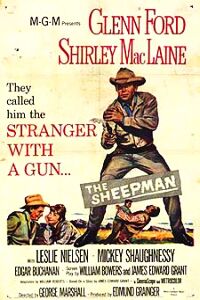
The Sheepman

Watching and reading enough about the taming of the west in the second half of the 19th Century, you notice certain rivalries popping up...if rivalries is the right word.  There was cowboys vs. Indians (not aliens), outlaws and bandits against marshals, sheriffs and law enforcement, American vs. Mexican (among any number of other nationalities who didn't care for each other), and because it wasn't just beef being shipped around the country, cattle vs. sheep.

Cattle grazed on the land while sheep basically picked the land clean, ripping the grass out by the roots so it didn't grow back.  Didn't think you were going to get that sort of introduction to a western now, did you?  That's the basic problem in many cattle vs. sheep westerns, including the 1958 oater The Sheepman. I'd seen this movie a few years ago but watched it recently on Turner Classic Movies when I thought I had not seen it. I watch a fair share of westerns so they start running together at a certain point...my bad.  A good, entertaining and relatively harmless western, typical of so many 1950s westerns.

In the western town of Powder Valley where the cattle dominates the land, a stranger, Jason Sweet (Glenn Ford), arrives one day on the train. He quickly makes his presence felt, buying a saddle, buying drinks, picking a fight with the town tough guy. What's he up to? Jason is making sure everyone knows he's not a man to be tangled with because the next day his herd of sheep are inbound on the train.  The cattle owners want nothing to do with Jason's herd, and they don't intend to go along quietly.  The big man in the area who controls everything, Colonel Bedford (Leslie Nielsen) -- who Jason knows from his opposite side of the law past -- leads the charge to stop him, but the situation gets murky when Jason meets Dell Payton (Shirley MacLaine), Bedford's fiance. Now it is more than just a cattle and sheep situation, and the solution doesn't seem like an easy one.

This is a western that is pretty typical of a 1950s genre entry.  Director George Marshall handles his straightforward, no frills story with his typical professionalism.  The movie is only 87 minutes long so there is not much in the way of wasted time here.  The story knows where it wants to get, especially that first half hour as Jason "introduces" himself around Powder Valley. That's the aspect of the comedic western that works best, an easy going, fun introduction.  From there on in, things settle in with the good guys taking on the bad guys. Until late in the movie, the bad guys -- Nielsen included -- aren't even that bad.  Finally Ford's Jason is pushed too far though, and he has to respond.

Realizing I've probably written this with all my Glenn Ford movie reviews, I think Ford is one of the most under-appreciated western stars that came out of the 1950s and 1960s.  He doesn't have the name recognition that a John Wayne would, mostly because his westerns aren't considered classics.  Ford probably belongs with Randolph Scott for his star caliber, solid, quality westerns that don't often wow you, but are always entertaining.  As sheep herder Jason Sweet, he brings his typical western persona to the part.  Ford was always very natural on-screen, showing off an ease that could give the impression he wasn't acting at all.  He is likable though from the start, and you're rooting for him.  Pointless bit of movie trivia, Ford wore the same hat in all his westerns.  Not the same hat style, the actual hat. It still looks relatively clean here.

Playing the part of the female love interest, Shirley MacLaine makes the most of her appearance.  So often this character -- the center of a pointless, needless, and unnecessary love triangle -- is forced into the story for the sake of having the character around. Not much is done to actually develop MacLaine's Dell character, but if nothing else she's trying, and that's all you're looking for at times. Anyone with an IQ over 10 or so knows from the second she is introduced she'll end up with Ford's Jason, but they've got to keep us guessing a little, right?  MacLaine isn't the damsel in distress thankfully, just a frontier woman caught in a bad situation. Her chemistry with Ford in their scenes together is easily seen, and their dialogue/conversations have an easy flow to them throughout.

Because there isn't a ton else to analyze about this one, we get more cast analysis and criticism! Yeah for people!  Before he became most well-known for The Naked Gun movies, Nielsen was a dramatic actor capable of drama, comedy, and action.  He's not the baddest of bad guys until late in the movie, but he has some good back and forths with Ford.  The rest of the cast includes some very recognizable western faces including Mickey Shaughnessy as one of Nielsen's henchmen, Edgar Buchanan as the wily, shifty stable owner who knows everything and everyone, Willis Bouchey as Dell's father, Pernell Roberts as Choctaw Neil, a gunslinger and adversary of Jason's, Slim Pickens as the town marshal who goes fishing when trouble arises, and Pedro Gonzalez Gonzalez as Angelo, one of Jason's sheepherders.

Not a great western, but certainly not a bad western. Just sort of in between, a western you can watch every couple years without getting bored or worn down.

The Sheepman <---trailer (1958): ** 1/2 /****   

Monday, April 25, 2011

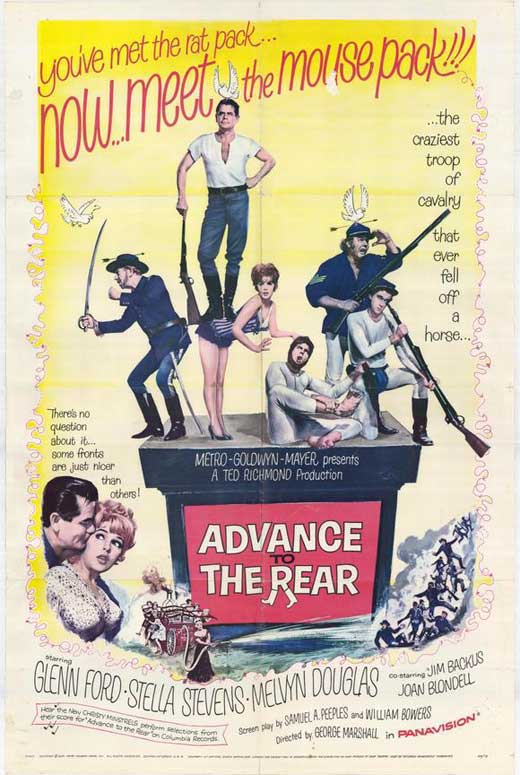
Advance to the Rear

Comedies seem to go through their ups and down patches like any genre movie does.  In the last 10 years or so, R-rated comedies have seen a resurgence in popularity while in the 1990s it was romantic comedies and in the 1980s raucous, mind-numbingly stupid sex comedies.  The 1970s and even the tail end of the 1960s? I guess it depends on the movie.  Prior to that though in the age of big screen spectacles and epics, there was an innocence to comedies that was lost over the years.  Epic comedies (how weird does that sound?) like The Great Race, It's a Mad, Mad, Mad World, The Russians are Coming and many more dominated movies.

Take 1964's Advance to the Rear, a comedic spoof of one of the funniest times in American history...the Civil War. There's no way that should work, right?  America's bloodiest conflict doesn't seem like its ripe for the picking for a big-screen spoof.  Somehow it does though, even if it isn't on the level of the previously mentioned comedies.  It's no classic, but it accomplishes what it sets out to do.  It is funny in a ridiculously stupid way, full of slapstick humor, some romance, and a cast full of recognizable names, all of them playing bumbling idiots. That's a formula for success if there ever was one.

It's 1862, and lawyer turned infantry soldier Captain Jared Heath (Glenn Ford) is the aide to a veteran of West Point and all-around clueless officer, Colonel Claude Brackenbury (Melvyn Douglas). Supposed to lead an attack on a Confederate position, Brackenbury's regiment instead turns and runs from the field of battle thanks to a simple miscommunication.  The unit is made an example of for their cowardice and receives order to go west to a remote outpost, also taking along misfits and screw-ups from other units in the Union army.  Dubbed Company Q, they head west by riverboat. Confederate intelligence catches wind of the new unit and assumes they're some sort of specialized unit meant to perform a dangerous mission. A beautiful Confederate spy, Martha Lou Williams (Stella Stevens), is sent west to investigate, and see exactly what these "special soldiers" are up to.

Slapstick comedy is completely hit-or-miss with me. I grew up watching The Three Stooges and Laurel and Hardy shorts so I do like some of it.  But if it isn't handled correctly, it's going to go poorly, and do it fast.  The problem is that you have to fully commit to doing the slapstick so you open things up to look completely stupid if it isn't funny.  The physical humor here isn't bad, but it certainly isn't good either.  Director George Marshall uses all sorts of wacky techniques, almost telling us when to laugh. Sound effects seem like they were used from a Batman TV episode and are painfully out of place. A soldier skis down a hill on tree branch skis? Add the sound of a plane taking off. Someone goes flying through the air? Cue the sound barrier being broken. Sound effects and sped-up action screams out desperation to me, and there's a good amount of it here.

When I think of Glenn Ford, I typically think of an underrated dramatic actor, someone able to move across genres and be believable and successful in all types of movies.  Comedy?  Not really the first thing that comes to mind.  I was pleasantly surprised then when Ford as Capt. Jared Heath, a ladies man and the rare competent soldier in the bunch, ends up carrying the movie.  By far, he's the biggest bright spot going for this 1960s comedy.  He delivers his lines in such a deadpan fashion while also handling the more physical scenes that it seems effortless.  Ford has a great chemistry with the always beautiful Stella Stevens (who poses as a showgirl briefly) in the romantic scenes and also with Douglas' clueless Colonel Brackenbury, the experienced officer who can't stand his aide and his way of going about things.  Their exchanges of cracks back and forth help make up for some of the worst examples of slapstick, as do the scenes with Ford and Stevens.  Ford's Heath quickly figures out she's a Confederate spy, but because he wants to marry her lets it go by the wayside. I don't blame him.

There was some wasted potential with the supporting cast to develop them into some better, even funnier characters.  Jim Backus and Whit Bissell are the equally idiotic Union generals who send Company Q out west only to realize they've sent them to lead an actual dangerous mission that could turn the tide of the war. Joan Blondell plays Easy Jenny, the leader of the showgirls who take a shining to Heath and his men. Michael Pate has a small part as Charlie Thin Elk, an Indian chief who went to West Point in the 1830s. James Griffith plays Hugo Zattig, the leader of a group of Confederate renegades. As for Company Q, there's Alan Hale Jr. as Sgt. Davis, Andrew Prine as Pvt. Selous, always hiccuping, and Jesse Pearson as Cpl. Geary, a soldier who always has horses following him around because of his unique smell. There were some other interesting soldiers -- a klepto, a firebug, a boxer, a brawler -- who are introduced but never get much to do.  If the movie was longer (it's only 100 minutes) like other 60s comedies, it's safe to say there would be some more development among Company Q.

It feels funny watching a Civil War comedy no matter how much of the humor does or doesn't work.  Marshall films it in a great-looking widescreen fashion -- in black and white at that -- making it feel like an epic action/adventure flick, not a spoof.  It is funny at times, but not as funny as it could have been.  I wanted to like the movie more than I did.  It's decent enough but nothing more. Also worth watching to see John Wayne's stunt man Chuck Roberson get a speaking role as a Confederate guerrilla. It is available to watch at Youtube starting HERE.

Advance to the Rear <--- TCM trailer (1964): ** 1/2 /****

Wednesday, March 16, 2011

The Desperadoes

One of my biggest pet peeves with westerns is female characters added to the story for the sake of having a female character.  Beyond just being eye candy and something nice to look at (I didn't intend that as sexist as it sounds), the character serves no real purpose. Yes, they might provide a secondary storyline that has them falling for one of the heroes, but generally, they are there to be saved, the damsel in distress.  One of the few actresses to make a positive impression in a western for me is Claire Trevor. She's beautiful but tough and always held her own with the guys.

Unfortunately the timing of me watching 1943's The Desperadoes wasn't that great with Trevor playing a key supporting role. The casting isn't the question, and the western itself isn't that bad.  Basically though, it just has too many similarities with 1941's Texas which I reviewed yesterday.  I felt like I was watching the same movie for a second time.  Similar cast, similar backstory, and overall a feeling of been there, done that. It's not awful by any means, but it's not that good either.

It's 1863 in Red Valley, Utah when the bank is robbed by a gang that murders three people in the process.  The bank owner, Clanton (Porter Hall) and the local mailman, Uncle Willie (Edgar Buchanan), pulled an inside job, netting almost $80,000 in the process.  The plan though was altered because the man originally hired to do it, Cheyenne Rogers (Glenn Ford), couldn't make it in time.  Now, he's arrived in town only to find that an old friend is the town sheriff, Steve Upton (Randolph Scott), is searching for the actual robbers. Worried that they will be exposed for stealing money from the townspeople, Clanton and Willie go about setting up another plan that will pit Cheyenne against Steve in hopes of covering up everything.

It is the rare western I won't be able to find something to recommend.  Some are just harder than others finding that positive aspect.  The Desperadoes is somewhere in between.  Ford and Scott working together is a pleasure to watch even if the script puts them in the stupidest, most implausible situations around.  This was Columbia Pictures' first color feature, and it looks great with the Utah locations really coming to life.  Trevor does what she does best, the somewhat scandalized woman (think a higher class Dallas from Stagecoach) caught in a tricky situation.  Her character isn't essential to the story, but she makes her presence known immediately. Her scenes with Ford and Guinn Williams are a high point, the few scenes that use both drama and comedy effectively.

As I watched this movie, I thought of another pet peeve that isn't exclusive to westerns.  It's just laziness on the part of someone involved in the production whether that be the screenwriter, the producer or the director.  A title card introduces the situation, explaining that 1863 Utah is struggling with little money available in the territory. For some reason, the setting is key, but I can't figure out why. If it's 1863, why is the Union army driving a herd of horses west away from the fighting with the Confederacy? Wouldn't it make sense to go the other way?  Then later, a character says a horse stampede will make this town feel like Custer's Last Stand.  So a throwaway line ends up predicting the future? If it is 1863, why is this town yokel aware that Custer is going to be massacred some 13 years later? Yes, these are little things, but they're all something that easily could have been fixed. Make a movie, and make sure you get the details right. Lazy when it comes to spending millions of dollars is inexcusable.

Maybe I've just been ruined by the cynicism of spaghetti westerns and American westerns from the 1960s, but westerns from the 1930s and 1940s drive me nuts more and more of late.  They walk that middle line that tries to please everyone.  Comedy, drama, and romance are all there.  Ford and Scott vie for the affections of Buchanan's daughter, Allison (Evelyn Keyes), always keeping it fair with an 'Aw, shucks, you take her!' mentality. Williams is painful to watch as dimwitted sidekick Nitro, the attempts at humor falling far short of succeeding. Then there's the story with Ford's Cheyenne wanted with a $10,000 bounty on his head.  We never find out what he did, but he's wanted nonetheless.  Scott's sheriff seems less than interested that his old friend may be a crook so I guess we're supposed to look past it in the end too.

Not much else to say here.  The story winds around a lot without ever getting anyplace interesting.  The talent of Scott, Trevor, and Ford only takes the movie so far.  I've seen much, much worse westerns, but I can't give this a positive review. It's just not good enough.

The Desperadoes (1943): **/****

Tuesday, March 15, 2011

Texas (1941)

Through the late 1940s and into the 1950s and 1960s, two of the most reliable, bankable stars in Hollywood were William Holden and Glenn Ford. But everyone has got to start somewhere, right? I've seen movies with both actors, but a majority of them were from the 1950s and 1960s when they were already established stars.  As very young-looking youngsters in 1941, they worked together on an odd but entertaining western simply titled Texas.

It can be fun with movies like this seeing stars before they were stars.  For one here with Texas, both Holden and Ford look like they're fresh out of high school. Holden was just 23 years old, and Ford not too much older at 25 when the movie was made.  Through all the exaggerated comedy, rambling story and over-reliance on stock footage, that is what makes Texas bearable.  Long before either man was a household name, the young acting duo shows off the talent that audiences would come to love and expect in future roles.

The Civil War has ended and two cavalry troopers from Jeb Stuart's forces, Dan Thomas (Holden) and Tod Ramsey (Ford), are drifting west. They find themselves in Abilene on their way further south to Texas and all its riches when they see a stagecoach being robbed. They turn the tables and rob the robbers, but through a miscommunication end up being chased by a posse. With little hope of getting away, they separate and make a getaway on their own. Time passes as Dan latches on with a group of rustlers harassing every herd that heads north while Tod signs on as a foreman at a well-to-do cattle ranch. Their paths seem destined to cross again, especially when both men have an interest in a beautiful rancher's daughter, Mike (Claire Trevor). Is their friendship going to last or will it be torn apart?

Director George Marshall turns in an odd, all over the place finished product with this 1941 western. At just 93 minutes, a ton of story is packed into a relatively quick running time.  That description above doesn't quite do it justice because there is much, much more going on.  It is an odd mix of a brotherly relationship in the west, slapstick comedy that is painful to watch at times, the always excruciating love triangle, way too much stock footage, and a story that is far too choppy at times, ending up playing like an hour-long serial instead of a feature length movie.  I don't know if a longer movie would have helped to flesh things out, but it couldn't have hurt.

I've never been much for comedic westerns with the exceptions of spoofs like Blazing Saddles that pull out all the stops.  If you're going to make it funny, go all the way.  Don't make a comedic drama (if that makes any sense).  An early scene introduces us to Dan and Tod which is fine. A departure from the set-up or a jumping off point for what's to come is fine if it helps us get to know the characters. An old school boxing match has Dan getting whaled on for 50 or 60 rounds that feels like it actually goes on that long. With a short 93-minute movie like this, it's too much.  Also in the comedy department, Edgar Buchanan (usually one of my favorite character actors) hams it up as a conniving dentist who happens to be the villain too, making evil, despicable decisions one after another. He is funny with that quiet, raspy stream of conscious talking, but next thing you know he's planning to shoot everyone around him.  Separately it could have worked, but together it never fits.

While it may not seem like it, I did enjoy Texas. Holden and Ford are always watchable even in their weakest efforts, and this isn't one of them.  The brother relationship in movies is as old as westerns themselves.  They're close and have bonded through the hellacious situations they've survived together.  Eventually, something is going to tear them apart, forcing them to either fight it out or knuckle under and run. Holden especially has some fun with the Dan Thomas part, the cowboy who will turn wherever there's money available.  It's the part that Holden would make his bread and butter, the lovable rogue.  Ford's part is more vanilla, the generic good guy who always makes the right decision no matter the consequences. Still, the movie is at its best when they duo is on-screen together.

Filmed in black and white, Marshall relies too much on stock footage, especially late with an epic cattle drive heading to Abilene.  As for the love triangle, it doesn't make a ton of sense how it develops, but with Trevor working with Holden and Ford, it isn't as bad as so many other love triangles are.  For a story that rambles as much as it does from one place to another with no real end in sight, the finale comes together quite quickly.  I would have liked this story much more with a few slight changes. Add maybe 15 minutes, take out the comedy, and thin out the stock footage. The talent in the acting department and the story has potential to be something better. Even then, I still liked the movie, but I didn't love it.

Texas (1941): ** 1/2 /**** 

Wednesday, January 19, 2011

Fate is the Hunter

When I think of disaster movies, I think The Poseidon Adventure and other 1970s epically bad but still enjoyable movies with huge casts of stars and dated special effects.  Through the 1950s and 1960s, disaster movies were made, just not on the same scale.  Only part of 1964's Fate is the Hunter really matches up with any of the criteria for a disaster flick, but it foreshadows what was to come in the coming decades as audiences watched planes crash, earthquakes tear apart the world, towering buildings go up in flames and much, much more.

Director Ralph Nelson takes control of the helms here in this quasi-disaster flick which is both ahead of its time in storytelling but also very dated at times.  Nelson is one of those hidden gems of a director you stumble across every so often.  He was never pigeon-holed into one specific type of movie and ended up directing films across countless genres.  Action, western, drama, comedy, message movies, he tried them all and did them all well.  Never flashy but always getting the job done in above average fashion, Nelson doesn't have a true classic to his name, but his filmography is nonetheless littered with worthwhile movies.

On a flight from Los Angeles to Seattle, veteran pilot Capt. Jack Savage (Rod Taylor) and his crew run into mechanical problems and are forced to crash land on a beach, the jet airliner exploding on contact with a pier running across the beach. Everyone on board other than one stewardess (Suzanne Pleshette) is killed, and the public, the corporation, and the media want answers.  What happened that caused Savage to attempt such a difficult maneuver? All evidence points to pilot error being the cause, but airline executive, former pilot and friend of Savage's, Sam McBane (Glenn Ford), thinks something else happened. Time is running out though, and McBane must prove Savage's innocence before a board of inquiry pins the blame on the deceased pilot.

Wasting little time surprising the viewer, Nelson kills off star Rod Taylor before the credits even roll.  Just when you think Taylor's Savage has successfully landed his jet airliner carrying 49 passengers...BOOM! The plane explodes, and 'Fate is the Hunter' pops up on the screen.  Talk about a tone-setter. No worries though for Taylor fans, this is not the last we'll see of him.  His involvement in the movie from there on in besides his character being constantly talked about is through flashbacks that flesh him out as an individual.  It's those little bits of character that should help us decide if this experienced, always calm and capable pilot was really incapable of dealing with what seemed like a minor mechanical issue.  Long story short, don't miss the first 10 minutes, or you'll be lost.

The problem any movie faces when it has such a strong start is sustaining that energy over the length of the movie.  That's where 'Hunter' struggles.  The investigation is interesting enough because it's hard not to be curious about what actually caused the plane to malfunction in such a surprising way.  But Ford's questioning gets tedious quickly.  The flashbacks are beyond tedious and serve only to make Savage more of a 3-D character.  After the first flashback, it becomes too much.  We get it.  He's a good pilot who is cocky, arrogant, not always likable and quite the ladies man.  But is a movie really going to peg Taylor as a boozehound who caused the deaths of over 50 people? I think not.  It's not a matter of if, it's a matter of how Taylor didn't crash the plane because he was drunk. 

Worse than that though (as a Lost fan I can appreciate even the slowest of flashbacks) is the direction Ford's character and the story takes overall in the final half hour.  Now granted, the word 'Fate' is in the movie's title.  As the evidence comes together and Ford's McBane talks to all these possible witnesses, he begins to question if maybe, just maybe, fate played a role in that plane crashing.  An out of season bird may have flown into the engine, three other planes were all off-schedule by a few minutes, the pier was supposed to have been removed a week earlier, it just doesn't add up.  Was something else at play here? Ford's testimony is even worse when he admits all this.  I can't tell if it is just all too sappy or handled poorly, but if Nelson was trying to deliver a message with this change in direction it didn't work.  I haven't read the source novel to know one way or another, but the ending disappoints on a lot of levels.

The redeeming factor through all the negatives is the impressive cast assembled here.  Ford is never flashy but is as reliable as always with Taylor making the most of his posthumous part...in character at least. Pleshette has a small but integral part (and looks great by the way). Also look for Nancy Kwan, Constance Towers, Jane Russell in a cameo as herself in 1945, Nehemiah Persoff, an uncredited Dorothy Malone, Max Showalter, Wally Cox and many more recognizable faces even if you don't know their name. Other than the cast and some nice-looking black and white camerawork, I struggled to get through this movie.  Potentially good but never amounts to anything much.

Fate is the Hunter <---trailer (1964): **/****

Tuesday, June 1, 2010

The Sacketts


In a career that spanned a handful of decades, author Louis L'Amour published over 100 works that included novels, short stories, and even some non-fiction, many of which were turned into TV shows and feature length film adaptations.   Most of these works were westerns, and I started reading them at a young age, starting with The First Fast Draw.   I've enjoyed some more than others, but the ones I've gone back to come from a series of books about the Sackett family.

In the time when miniseries were extremely popular -- better known as the 1970s and 1980s -- two of L'Amour's Sackett novels were turned into a two-part miniseries in 1979 appropriately titled The Sacketts. My first concern was that the two source novels are two separate works about three brothers -- two in one book, and the third in a separate book -- with a very quick crossover.  So how is a miniseries with two vastly different stories expected to work?  Like any adaptation, things were dropped and left by the wayside, but big picture, this miniseries works because of the talent involved.

Based on the novels The Daybreakers and Sackett, the miniseries focuses on three brothers from a Tennessee family heading west in the years following the Civil War.  Tell (Sam Elliott) is the oldest and despite growing up in the South, joined up with a Union infantry regiment during the war.  Once Lee surrenders, Tell heads west, ending up as a drifter/saddle tramp looking for work wherever he can get it.  Too young to join the fight, Orrin (Tom Selleck) is engaged to be married to a local girl, but a long-standing feud interrupts with young brother Tyrel (Jeff Osterhage) killing a man in his brother's defense.   With the local law looking for answers, Orrin and Ty head west to set up a new life.

Riding into Texas, Orrin and Ty sign on with a cattle drive heading north to Abilene.  Along the way, they become more than capable cowpunchers and in the process meet  ramrod and trail driver Tom Sunday (Glenn Ford) and veteran cowboy Cap Rountree (Ben Johnson). Delivering the cattle to a buyer, the quartet sticks together and heads west to Santa Fe only to find a range war brewing between the Mexicans (led by Gilbert Roland) and the Americans (the always evil John Vernon in charge). Further north in the mountains, Tell stumbles upon a gold vein, but that's just the start.  The Bigelow brothers are on his trail looking for vengeance.  And wouldn't you bet, at some point the brothers' trails cross?

Cramming two full books into a 4-hour miniseries had to have been a daunting task for writer Jim Byrnes, and he does a solid job adapting the novels. Both books delved into romantic subplots with the brothers meeting women along the way, but in putting together a story about three brothers -- and not the ladies -- these subplots are just that, subplots in the background.  Byrnes also had to invent basically a new storyline (the brothers meeting up on the trail) and an ending because Daybreakers and Sackett just didn't cross paths.  All in all, props to Byrnes for pulling it off.

Starting with the casting of the Sackett brothers, the actors involved from top to bottom are downright impressive, more so for fans of westerns.  Elliott, Selleck, and Osterhage were not stars when they were chosen to play these brothers.  It's funny that the best character, Tyrel, was played by the actor who for some reason, never became a bigger star.  As L'Amour writes them, Ty was my favorite.  Like Tell, he's quiet and unassuming, but when pushed he pushes back.  Elliott is basically a rougher, older Ty and growls his way through the part, and Selleck gets to be Selleck, a charming, likable personality.  Among the three, there's a definite chemistry which pays off in a big way.

L'Amour's main characters were the prototypical western hero; tough, honorable, and able to shoot their way out of any sticky situation.  These were men of few words who did what was right because they didn't know any other way.  These three actors were all so good there's even an unofficial sequel -- 1982's The Shadow Riders -- where they play a trio of brothers, the Travens this time.  Through all its other flaws in the miniseries, the casting is about as perfect as casting can be.

By 1979, the western had played out its line in terms of moviegoing popularity thanks to the spaghetti westerns and ultra-violent spins the genre took.  So in a way, this is a last hurrah for the western, and the casting represents that.  Tom Sunday is younger in the book, but Ford playing him is just right.  He's a former lawyer, a cowboy, and a gunfighter and serves as a replacement father for the boys.  Johnson as the saddle-sore cowboy who seen it all? Born to play the part.  Roland makes a quick appearance, and Vernon is typically evil.  Ruth Roman is good as Emma, a saloon owner in an outlaw town who knows Cap. The Bigelow brothers include Jack Elam, Slim Pickens, and Gene Evans.  For the cherry on top, throw L.Q. Jones and Paul Koslo in for good measure. It'd be hard to ask for a better cast.

This review is getting a little long so I'll start to wrap this up.   It's hard to complain about a TV miniseries looking like a TV miniseries, but The Sacketts isn't exactly made on a huge scale.  It feels like we see the same town over and over with the same backgrounds once the story requires the brothers to hit the trail.  My biggest complaint though was the music.  A soundtrack doesn't have to be great, it just can't be noticeably bad.  Well, the score here is bad, and in an obvious overdone way.  Overall though, just complaints for a highly entertaining, well-made miniseries that does justice to Louis L'Amour's novels.

The Sacketts (1979): ***/****

Tuesday, October 6, 2009

The Fastest Gun Alive

There is always someone faster than you; an idea that drove a whole subgenre of westerns over the years, the fast draw. From Clint Eastwood to John Wayne to Randolph Scott, westerns have dealt with fast draw artists for as long as movies have been made. And if books, magazines, TV shows, and movies have taught us anything, it's lonely at the top. But unlike the stakes in The Hustler which is just pride on the line, the fast draw in a western is a life and death situation.

So with little work needed, the framework is there for an easy story to be told. Someone always wants to take on the best and prove that they are in fact, THE BEST. The Gregory Peck western The Gunfighter explored this idea in 1950 which was reused more than a few times, including 1956's The Fastest Gun Alive. What starts off as a near classic completely derails in the final scene though in an otherwise above average western.

Riding into a western town with the two members of his gang (John Dehner and Noah Berry Jr), hardened gunfighter Vinnie Harold (Broderick Crawford) walks up to a saloon and calls out for Clint Fallon, a man known as one of the fastest guns in the west. Unprompted with no other reason to see who is quicker, Vinnie guns down Clint and a legend begins to grow. Down the trail in a little town called Cross Creek, a quiet storekeeper, George Temple (Glenn Ford), lives with his pregnant wife (Jeanne Crain) while going day to day hearing the digs and criticisms all of the men in town. George doesn't drink and doesn't wear a gun.

But after four years living in Cross Creek, George has had enough and snaps, strapping on the gunbelt he told his wife he threw away long ago. He puts on a show in the street in front of the whole town, shooting two silver dollars in midair and blasting apart a beer mug before it can hit the ground when dropped. And so George becomes his own sort of legend among the townsfolk. But unknown to George and the town, Vinnie Harold and his gang are riding their way with a posse on their tail. Is there any way George can avoid the showdown with the unhinged Harold?

The script is a strong one that intentionally or not borrows elements from High Noon. One man can either save or destroy a town with one decision. But like in High Noon, the situation can be enfuriating as someone watching the movie. Late in the movie, George is forced to make a decision that could save the town, full of whiney weaklings who won't pick up a gun. There's at least 20 men in town who could carry a gun who are scared of three gunslingers. Team up and take them out for God's sake!

As the title character, Glenn Ford has never been better. I've seen many of Ford's westerns, and I'm going out on a limb to say this is his best career performance. The first 45 minutes or so has Ford's George in a slow burn as his place in life starts to rattle around in his head. He's as good with a gun as just about any man and feels the need to show it after years of people doubting him and laughing at him. A late twist and revelation puts a nice spin on the story. You think it's going one way, and then WHAM!, it takes a different route. This twist sets up the ending which had a chance to be one of the great endings in a western if it wanted to be.

But no, director Russell Rouse and scriptwriters Frank D. Gilroy have to add another twist on the ending. I won't spoil it here, I'll let the ending ruin the movie for you to on first viewing. Heading into this one last shootout, I'm already thinking about the very positive review I would be writing, and even at the end of the shootout, it's still in my head how great, how appropriate that ending is. But in that last scene, a completely unnecessary twist is made just so the movie can end with a happy ending. I was ready to give 'Fastest Gun Alive' a 3, maybe 3.5 stars, but that ending really disappointed me.

On the whole, everything else is nearly perfect, especially Broderick Crawford as the possibly psychotic Vinnie Harold who has a deep-seeded obsession with proving he's the fastest gun in the west. Crawford's presence is always dynamic onscreen, and his deep, booming voice was made for him to be a western villain. The rest of the cast is solid too, including Crain as George's worrying wife, and a great list of character actors including Leif Erickson, Rhys Williams, John Doucette, Russ Tamblyn (even getting an unnecessary, out of place dance sequence), Allyn Joslyn, Virginia Gregg and J.M. Kerrigan.

A good example of how a bad ending can ruin an otherwise nearly great movie, The Fastest Gun Alive could have been a classic in the vein of High Noon. Like I said, I was ready to give it at least 3 stars, minimum, but the ending was a complete disappointment especially when considering how everything has built to a certain conclusion. Too bad because Glenn Ford delivers a career-best performance in this B&W western.

The Fastest Gun Alive <---trailer (1956): **/**** Watch the movie broken down into 10-minute segments starting here (movie starts about 3 minutes in)

Friday, August 14, 2009

A Glenn Ford double feature

Glenn Ford doesn't get a lot of credit as a major western star like a John Wayne, Clint Eastwood, or Randolph Scott. Maybe it's because he was only in one western that is considered a classic, the original 3:10 To Yuma, but Ford turned out a strong list of quality westerns especially later in his career in the 1950s and 1960s. TCM did a Glenn Ford Day as part of their Summer Under the Stars recently, and I was able to catch two westerns I'd missed in the past both from the second half of his career.

1967's A Time for Killing is a good example of how American westerns tried to respond to the cynical, darker spaghetti westerns from Italy. It's the closing days of the Civil War when a group of Confederate prisoners led by Captain Dorrit Bentley (George Hamilton) escape from a Union stockade near the U.S./Mexico border. Heading south, they ambush a supply train and take a prisoner, Emily Biddle (Inger Stevens), the fiance of the Union major, Wolcott (Ford), tracking them.

Bentley's Confederate escapees are a pretty slimy bunch, not too say that Wolcott's Union patrol is any better. It's the end of a long, bloody war, and these men on both sides are exhausted and just want to go home. I was caught off guard by how far the movie went to show those depths. Even when Bentley finds out the war is over, he keeps the news from the men, and Walcott disobeys orders and follows the fugitives into Mexico. The movie was filmed in Old Tucson and Utah and looks great, appropriately gritty and dusty.

While Ford is good as Major Tom Wolcott, the officer trying to rescue his fiance, it's Hamilton who leaves the deepest impression. His Bentley is an ultra-patriot who refuses to believe the war is over and will continue to take that war to the Yankees. Before her tragic death that was ruled a suicide, Stevens made a string of quality westerns late in the 60s, and she's very good here, holding her own with both Ford and Hamilton. The background players include Kenneth Tobey, Max Baer in a role slightly different from Jethro on Beverly Hillbillies, Timothy Carey, Harry Dean Stanton, Todd Armstrong, and for all you trivia buffs out there, Harrison Ford in just his third movie.

Made two years later, Heaven With a Gun is a more traditional western, but it does make efforts to change with the times when dealing with sex and violence. How many westerns have started with a stranger riding into a town and no one knows who he is or what his motives are? It'd probably take quite a few posts just to list all those movies, but that's how 'Heaven' begins with Jim Killian (Ford) riding into Vinegaroon, a town divided between cattle ranchers and sheepherders. Looking to make up for his violent past, Killian sets up a church in town with hopes of uniting both sides.

His main opposition is Asa Beck (John Anderson), a cattle rancher who with his son, Coke (David Carradine) will have nothing to do with sheepherders and refuses to even listen to Killian's ideas. On the other hand, Killian gets help from everyone else in town including Madge (Carolyn Jones), the saloon/brothel owner, Leloopa (Barbara Hershey), a young Indian girl Jim cares for after her father is killed, and Bart Patterson (William Bryant), a local ranch owner. Also worth mentioning are two supporting parts for J.D. Cannon as a hired gun, Mace, and Noah Beery Jr as Garvey, one of Beck's most trusted hands.

The script calls for some random nudity that feels just thrown into the script for the sake of some topless saloon girls, and the violence is pretty vicious even if it's not shown. Much of it is off-screen, but it's pretty grim whether you see the results or not. The sex and violence then makes the ending seem a little off for me. Killian is trying to stop Beck and his gunhands from massacring the sheepherders and cattle ranchers who are now working together. It doesn't work overall and comes across as too forced, like the money just wasn't there to set up a shootout.

The constant through both movies is Ford's steadying influence on the story. He was usually cast as the good guy, but later in his career they added a wrinkle to that old standby, the good guy who used to be a bad guy and is looking to repent. It's hard to judge Ford as an actor because in roles like this he didn't have to show a lot of range. But like John Wayne did in his later years, Ford nails these parts. He's likable on-screen with a very natural presence. I liked both movies, Time for Killing a lot and Heaven With A Gun despite the ending.

A Time for Killing <---fan-made trailer (1967): ***/****
Heaven With a Gun (1969): ** 1/2 /****