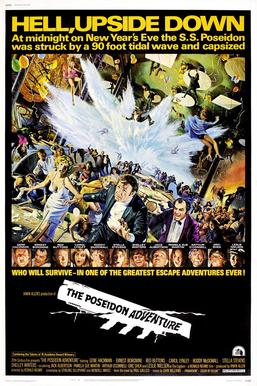
Every so often I get embarrassed when it comes to movies. Yeah, those movies you should have seen by now. The classics for good and bad, the great performances, an award-winning something or other. We've all got them. I do my best to make sure that list is ever-shrinking, but there are gaps. So while I've reviewed all sorts of dud disaster flicks from The Swarm to When Time Ran Out, I'd never seen one of the first disaster films all the way through in one sitting until a recent viewing. Here's 1972's The Poseidon Adventure. Don't judge me. You think you're better than me?!?
Sailing from New York City to Athens, the S.S. Poseidon is making one last voyage after years of service around the world, a ship destined for the scrap heap. That voyage is behind schedule though, and its captain (Leslie Nielsen) is under pressure to make up some serious time with so much money on the line. That speed may make up lost time but it puts the ship, crew and passengers at serious risk, but none of them know what awaits. Sailing through the Mediterranean, the Poseidon receives news of an immense earthquake off the Greek coast and its repercussions are heading right for the fully-loaded passenger ship. During a New Year's Eve celebration, an enormous wave moving at dangerous speeds is coming right for them. The ship is capsized in the wave's wake with much of the crew and many passengers killed. One small group survives though, and led by a fiery, trouble-making reverend, Scott (Gene Hackman), they try to make it through an upside down apocalyptic environment that was their ocean liner. Can they make it to the hull and possible rescue?
When it comes to disaster movies, I typically associate two movies with kick-starting the genre into its highest popularity. First, there's 1970's Airport. Second, well, here we sit. Though I've seen the entire movie here, I'd never before seen it in one viewing where I just sat down and blazed through it. Thanks, TCM! I didn't love it, but I did like it. It's difficult to watch this movie in 2015 and see it with a fresh light. This is a movie that has impacted hundreds of flicks since its release in 1972. So now on a fist-time view over 40 years later, it feels cliched, familiar and at times, overdone. None of those criticisms prove to be a deal-breaker in the end, but it will definitely impact your viewing. Still, this is a movie that helped launch an entire genre that was everywhere in theaters for almost a full decade. They weren't always classics -- or even that good -- but let's give credit where it is due.
One of the biggest impacts 'Poseidon' had on its future is the casting. This disaster movie from director Ronald Neame (and an uncredited Irwin Allen, the producer as well) assembles a pretty solid all-star cast. Future flicks would take the all-star cast concept to ridiculous levels where EVERYONE in Hollywood would make an appearance. If the script here is a little goofy, who better to keep righting the ship than Gene Hackman? I submit No One. His Reverend Scott is angry, a leader, a fighter and not interested in any excuses or garbage. When all else seems lost, he keeps his motley crew of survivors to keep moving as the water levels keep on rising. He's also rocking an impressive combover and a very stylish turtleneck. With a lot of actors, maybe the part gets a tad hammy, but because it's Gene Hackman, you go along for the ride. It's Hackman!
So what's the appeal of the ensemble all-star cast? Let's get down to business. We want to see which celebrity lives and which celebrity is due for an overdramatic death scene. So who is possible fodder for that finale? A Just Hit Play favorite, Ernest Borgnine goes for the gusto as Rogo, a police officer traveling with his new bride, a former hooker (Stella Stevens). There's also an older Jewish couple (Shelley Winters, Jack Albertson) traveling to see their grandson, two siblings (Pamela Sue Martin, Eric Shea) going to meet their parents, a lonely, middle-aged man (Red Buttons) who bonds with the ship band singer (Carol Lynley), and a member of the ship's crew, a waiter (Roddy McDowall). Winters was nominated for a Best Supporting Actress and comes across the best. The kids are pretty shrill, Borgnine and Hackman yell a lot, and Buttons is also very solid. A little hit or miss, but a strong cast overall.
How about some originality? Well, a capsized ocean liner quickly filling with water sure is a unique starting point. The survivors have to navigate their potential tomb...upside down. It's a hellish, claustrophobic, steamy, smoky environment littered with dead bodies and an ever-rising water level. You definitely feel like you're there with the survivors as they navigate this almost other-worldly situation. It's a cool premise that definitely pays dividends. The early, doom-building scenes are also incredibly effective as is the actual capsizing scene, just one epically uncomfortable extended sequence featuring some very cool special effects.
Sure, things get a touch overdone at times, especially with the pissing contest between Hackman and Borgnine for control of the group. Sure, the God/religion/faith aspects get to be a little much. Overall, it's an enjoyable movie that I've got to give a notch up simply because of its profound impact on countless movies released in its wake. Any movie that is still impacting flicks over 40 years later is okay in my book. Took quite a long time to sit down and watch it, but 'Poseidon' was worth the wait.
The Poseidon Adventure (1972): ***/****
The Sons of Katie Elder
"First, we reunite, then find Ma and Pa's killer...then read some reviews."
Showing posts with label Leslie Nielsen. Show all posts
Friday, April 3, 2015
Thursday, May 1, 2014
Day of the Animals
A few years back, October 2009 to be exact, I reviewed a dud of a movie made on a clearly pretty tight budget that rose above its cheapness to be 'So bad it's really good.' Okay, at least funny in an unintentionally way. That movie? 1976's Grizzly. It was a surprise success at drive-ins with fans to the point that a year later the stars and director returned with a similarly schlocky, generally pretty bad flick again dealing with some angry killer animals. Here we go with 1977's Day of the Animals.
In the mountains in northern California, experienced trail guide and outdoor enthusiast Steve Buckner (Christopher George) is readying to take a group of hikers on a several day hike. It's a mini-vacation offered away from society with little in the way of supplies, a way of getting back to nature. His group includes about 15 people, most of them city folks enjoying their time away from city life. But being dropped off by helicopters high up in the mountains, Buckner and his group quickly discovers something is very, very wrong. Animals are attacking them at an almost non-stop pace. What's going on? Can they survive or will the waves of animals wipe them out? They don't know it, but down below in the lower altitude towns, the population is dealing with exactly the same issue. Humanity....seems....doomed!!!!
Yikes, what a dumb, really dumb movie. Having directed Grizzly the year before (with George also starring and returning), director William Girdler is at the helm of another ultra-low budget drive-in special. It was made for cheap and intended for some cheap thrills. Can't go wrong, right? Well, you would think so. I liked the B-movie/disaster movie potential, but it never comes together. What exactly is driving the animals mad? The possibility that humans use of aerosol cans is ripping apart the ozone layer (Okay, we're doing a good job of that) and....lets radiation beat down on the Earth that turns animals into vicious, unstoppable killers. Oh, and some humans too but not all humans because that would make the story rather predictable, wouldn't it? I like my B-movies ridiculous and over the top, but don't hit me with a message!
Still, I figured there was enough going on here to make it watchable. Following the disaster movie formula, 'Animals' brings together a group of disparate individuals and lets us start guessing as to who will survive and who is just fodder for the vicious animals. No huge star power here, but definitely some familiar names. Going back to TV's The Rat Patrol, I've always been a fan of George, and he's having fun. His friendly, charming trail guide doesn't stretch any acting muscles, but it's not meant to be. Some of his hiking group include Richard Jaeckel as a bird-watching, photography-loving professor, Leslie Nielsen as an advertising executive with some anger issues, Michael Ansara as the wise Indian who knows all, and Ruth Roman has a Mom trying to bond with her nature-loving son.
That's as far as the name recognition goes, but there are some other interesting parts. Mrs. Christopher George, Lynda Day George, plays a TV newswoman trying to get away from work, Paul Mantee as an aging NFL star with a serious medical issue, and everyone else from a married couple looking to mend some wounds, a young couple in love, and Roman's son who needs a father figure. Who will make it? Who won't? Will anyone? That's part of the fun.
It cracked me up more and more as the movie went along. The premise is pretty cool, a variation on the Lost Patrol idea with a group of individuals banding together to survive, an enemy hovering all around them waiting to pick them up. Something never clicks though. The low budget most affects the actual animal attacks with some very cheesy special effects. For the most part, the sense of doom works better than anything. We see animals moving parallel to George's group, waiting to strike. Cheap filmmaking technique? Animals can look pretty scary just filming them so all Girdler had to do was film animals walk around and set those scenes to impending doom music from composer Lalo Schifrin (his score a bright spot). There are some scares along the way, but never as good as it could have been.
That's the entire movie. I wanted to like it, but it doesn't work. It's mindlessly entertaining but it's also a tad sluggish and never really picks up any momentum. Sure, it's cool to see character actors like George, Jaeckel, Nielsen and Ansara get their shot, but there's a limit. My limit? Nielsen's ad executive progressively getting hit with radiation. That translates to him taking his shirt off (All that is MAN!!!) and threatening to kill the men, rape the women and fight all the animals. By far, the funniest scenes in the movie.
Day of the Animals (1977): * 1/2 /****
In the mountains in northern California, experienced trail guide and outdoor enthusiast Steve Buckner (Christopher George) is readying to take a group of hikers on a several day hike. It's a mini-vacation offered away from society with little in the way of supplies, a way of getting back to nature. His group includes about 15 people, most of them city folks enjoying their time away from city life. But being dropped off by helicopters high up in the mountains, Buckner and his group quickly discovers something is very, very wrong. Animals are attacking them at an almost non-stop pace. What's going on? Can they survive or will the waves of animals wipe them out? They don't know it, but down below in the lower altitude towns, the population is dealing with exactly the same issue. Humanity....seems....doomed!!!!
Yikes, what a dumb, really dumb movie. Having directed Grizzly the year before (with George also starring and returning), director William Girdler is at the helm of another ultra-low budget drive-in special. It was made for cheap and intended for some cheap thrills. Can't go wrong, right? Well, you would think so. I liked the B-movie/disaster movie potential, but it never comes together. What exactly is driving the animals mad? The possibility that humans use of aerosol cans is ripping apart the ozone layer (Okay, we're doing a good job of that) and....lets radiation beat down on the Earth that turns animals into vicious, unstoppable killers. Oh, and some humans too but not all humans because that would make the story rather predictable, wouldn't it? I like my B-movies ridiculous and over the top, but don't hit me with a message!
Still, I figured there was enough going on here to make it watchable. Following the disaster movie formula, 'Animals' brings together a group of disparate individuals and lets us start guessing as to who will survive and who is just fodder for the vicious animals. No huge star power here, but definitely some familiar names. Going back to TV's The Rat Patrol, I've always been a fan of George, and he's having fun. His friendly, charming trail guide doesn't stretch any acting muscles, but it's not meant to be. Some of his hiking group include Richard Jaeckel as a bird-watching, photography-loving professor, Leslie Nielsen as an advertising executive with some anger issues, Michael Ansara as the wise Indian who knows all, and Ruth Roman has a Mom trying to bond with her nature-loving son.
That's as far as the name recognition goes, but there are some other interesting parts. Mrs. Christopher George, Lynda Day George, plays a TV newswoman trying to get away from work, Paul Mantee as an aging NFL star with a serious medical issue, and everyone else from a married couple looking to mend some wounds, a young couple in love, and Roman's son who needs a father figure. Who will make it? Who won't? Will anyone? That's part of the fun.
It cracked me up more and more as the movie went along. The premise is pretty cool, a variation on the Lost Patrol idea with a group of individuals banding together to survive, an enemy hovering all around them waiting to pick them up. Something never clicks though. The low budget most affects the actual animal attacks with some very cheesy special effects. For the most part, the sense of doom works better than anything. We see animals moving parallel to George's group, waiting to strike. Cheap filmmaking technique? Animals can look pretty scary just filming them so all Girdler had to do was film animals walk around and set those scenes to impending doom music from composer Lalo Schifrin (his score a bright spot). There are some scares along the way, but never as good as it could have been.
That's the entire movie. I wanted to like it, but it doesn't work. It's mindlessly entertaining but it's also a tad sluggish and never really picks up any momentum. Sure, it's cool to see character actors like George, Jaeckel, Nielsen and Ansara get their shot, but there's a limit. My limit? Nielsen's ad executive progressively getting hit with radiation. That translates to him taking his shirt off (All that is MAN!!!) and threatening to kill the men, rape the women and fight all the animals. By far, the funniest scenes in the movie.
Day of the Animals (1977): * 1/2 /****
Labels:
1970s,
Christopher George,
Horror,
Leslie Nielsen,
Michael Ansara,
Richard Jaeckel
Saturday, January 4, 2014
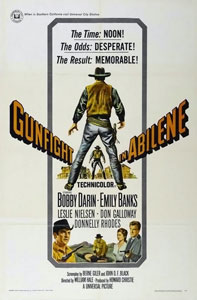
Gunfight in Abilene
When I think tough western stars, I can picture a whole lot of different actors, John Wayne, Clint Eastwood, Randolph Scott, Steve McQueen and many others. Then there's Bobby Darin who I typically think of as more of a singer/entertainer than an actor. He did act though if not often, like 1967's Gunfight in Abilene, a starring effort for Darin.
Having spent the last two years of the Civil War in a Yankee prison camp, former Confederate officer Cal Wayne (Darin) returns home to Texas having made a vow to himself that he won't use a gun anymore. The war has warped him, and he wants nothing to do with violence anymore, but his town may not let him abide by that decision. A range war is brewing between the farmers who want nothing more than their land to be untouched and the local businessman and banker, Grant Evers (Leslie Nielsen), who is backing the cattle ranchers. Cal is and was friends with Grant, putting him in an interesting spot. He wants nothing to do with the fight, but with Grant's encouragement, he takes the job as the town sheriff, hoping to hold the fight off and save plenty of lives in the process. With violence brewing, even Cal is going to have to decide how much he'll stand by his word and promise to himself to not use a gun.
From director William Hale, this 1967 western is interesting if not particularly good. A B-western with studio backing, it was clearly filmed on the cheap. The opening Civil War segment borrows quite liberally from 1965's Shenandoah for its battle sequences (and the music) only to have the action involving Darin's Cal and his men move to a very obvious indoor set. That sets the tone for the rest of the movie, a small-scale story set almost entirely in one small town. We get stock footage from some other westerns -- notably The Last Sunset among others -- that is rather jarring compared to the film footage for 'Abilene.' For me, this is a western that never really recovered from there on in. It never manages to create an identity for itself, content to be an inoffensive story with some rather obvious limitations.
So how about singer/crooner Bobby Darin as a wild west hero? Well, there's mixed results, but the fault can't be placed on his shoulders too much. The character -- if nothing else -- is interesting. We meet him during the fighting in the Civil War, commanding the remnants of a patrol that's been taken to pieces by Union forces. In the chaos of battle, he even accidentally shoots one of his own men, Grant Evers' brother, a secret that drives him to make the no-gun policy. The time in the prison camp warps him, wanting a clean slate once the war is over. So there's that, right? Yeah, it ends there. Darin does a good job as the brooding former sheriff turned sheriff who may/may not have a death wish. He also has to decide which of two women he loves, if he can ever tell Grant the truth, if he can complete the job without a gun, all that fun stuff. His outfit doesn't help, a perfect, immaculate black hat and what appears to be a beige corduroy shirt and pants set. It's quite a look, not quite the intimidating and iconic poncho worn by Clint Eastwood or the eye patch worn by John Wayne.
In the B-western casting department, there isn't much in the way of star power in the rest of the flick. Nielsen is the biggest name but his character is solely presented....and then allowed to do nothing really. He's off-screen too much and not utilized properly in the movie's last third. Emily Banks is Grant's fiance who was Cal's fiance but without hearing from him for years, she feared he was dead and moved on. Oh, and there's Leann (Barbara Werle), a possible hooker/saloon girl who also loves Cal because we needed an unnecessary love triangle. Donnelly Rhodes is pretty good as Slade, Grant's enforcer who isn't interested in any hurt feelings, just making a big payday. Don Galloway has some fun as Ward, Cal's deputy who tries to back him up as much as possible and also appears to be wearing a rug for a vest. Michael Sarrazin makes a small but key supporting part in his screen debut as Cord Decker, a young farmer returning to his land and family following the Civil War.
It's a weird western in general. It doesn't even break the 90-minute mark but still manages to be dull and slow-moving at almost all times. There's both too much going on in terms of characters and storylines and not enough. Not enough you say? Okay, not enough that's interesting. There is little to no action other than a brutal fist fight between Darin and Johnny Seven's sadistic Loop, and the titular gunfight involves some off-center camera angles and exactly one gunshot. A disappointing end result. It even has a disappointing theme song sung by Darin himself so...yeah, it's got that going for it. Listen below.
Gunfight in Abilene (1967): * 1/2 /****
Having spent the last two years of the Civil War in a Yankee prison camp, former Confederate officer Cal Wayne (Darin) returns home to Texas having made a vow to himself that he won't use a gun anymore. The war has warped him, and he wants nothing to do with violence anymore, but his town may not let him abide by that decision. A range war is brewing between the farmers who want nothing more than their land to be untouched and the local businessman and banker, Grant Evers (Leslie Nielsen), who is backing the cattle ranchers. Cal is and was friends with Grant, putting him in an interesting spot. He wants nothing to do with the fight, but with Grant's encouragement, he takes the job as the town sheriff, hoping to hold the fight off and save plenty of lives in the process. With violence brewing, even Cal is going to have to decide how much he'll stand by his word and promise to himself to not use a gun.
From director William Hale, this 1967 western is interesting if not particularly good. A B-western with studio backing, it was clearly filmed on the cheap. The opening Civil War segment borrows quite liberally from 1965's Shenandoah for its battle sequences (and the music) only to have the action involving Darin's Cal and his men move to a very obvious indoor set. That sets the tone for the rest of the movie, a small-scale story set almost entirely in one small town. We get stock footage from some other westerns -- notably The Last Sunset among others -- that is rather jarring compared to the film footage for 'Abilene.' For me, this is a western that never really recovered from there on in. It never manages to create an identity for itself, content to be an inoffensive story with some rather obvious limitations.
So how about singer/crooner Bobby Darin as a wild west hero? Well, there's mixed results, but the fault can't be placed on his shoulders too much. The character -- if nothing else -- is interesting. We meet him during the fighting in the Civil War, commanding the remnants of a patrol that's been taken to pieces by Union forces. In the chaos of battle, he even accidentally shoots one of his own men, Grant Evers' brother, a secret that drives him to make the no-gun policy. The time in the prison camp warps him, wanting a clean slate once the war is over. So there's that, right? Yeah, it ends there. Darin does a good job as the brooding former sheriff turned sheriff who may/may not have a death wish. He also has to decide which of two women he loves, if he can ever tell Grant the truth, if he can complete the job without a gun, all that fun stuff. His outfit doesn't help, a perfect, immaculate black hat and what appears to be a beige corduroy shirt and pants set. It's quite a look, not quite the intimidating and iconic poncho worn by Clint Eastwood or the eye patch worn by John Wayne.
In the B-western casting department, there isn't much in the way of star power in the rest of the flick. Nielsen is the biggest name but his character is solely presented....and then allowed to do nothing really. He's off-screen too much and not utilized properly in the movie's last third. Emily Banks is Grant's fiance who was Cal's fiance but without hearing from him for years, she feared he was dead and moved on. Oh, and there's Leann (Barbara Werle), a possible hooker/saloon girl who also loves Cal because we needed an unnecessary love triangle. Donnelly Rhodes is pretty good as Slade, Grant's enforcer who isn't interested in any hurt feelings, just making a big payday. Don Galloway has some fun as Ward, Cal's deputy who tries to back him up as much as possible and also appears to be wearing a rug for a vest. Michael Sarrazin makes a small but key supporting part in his screen debut as Cord Decker, a young farmer returning to his land and family following the Civil War.
It's a weird western in general. It doesn't even break the 90-minute mark but still manages to be dull and slow-moving at almost all times. There's both too much going on in terms of characters and storylines and not enough. Not enough you say? Okay, not enough that's interesting. There is little to no action other than a brutal fist fight between Darin and Johnny Seven's sadistic Loop, and the titular gunfight involves some off-center camera angles and exactly one gunshot. A disappointing end result. It even has a disappointing theme song sung by Darin himself so...yeah, it's got that going for it. Listen below.
Gunfight in Abilene (1967): * 1/2 /****
Friday, August 23, 2013
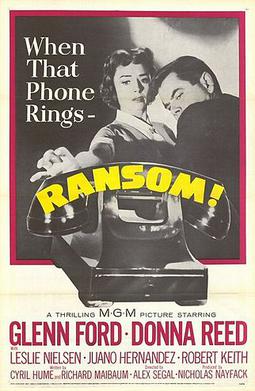
Ransom!
In an age of remakes, sequels, prequels, series and what not, it can be fun sometimes to stumble across an original you didn't even know existed. I can't remember for sure if I saw 1996's Ransom as I was growing up, but I've always been aware of it if nothing else. Well, I can also say I wasn't aware of its predecessor, 1956's Ransom! Forty years apart, is it enough time between original and remake?
A very well-to-do executive of a vacuum cleaner company, Dave Stannard (Glenn Ford) has created quite a life for himself with his beautiful wife, Edith (Donna Reed) and eight-year old son, Andy (Bobby Clark). Their idyllic home life is broken up one day when Andy doesn't return home from school. His teacher tells Edith that a nurse took him from school that morning, claiming to go to the doctor's office. The doctor though has no knowledge of Andy's whereabouts, leaving Dave and Edith to fear for the worst. The call comes later that night....Andy has been kidnapped, and his kidnappers are asking for $500,000. With some help from the police, including Chief Backett (Robert Keith), Dave and Edith discuss what to do. Should they come up with the ransom? Do the police have any chance of catching the kidnappers? As they weigh their options though, Andy is more at risk with each passing hour.
I was really worried about this movie for about 10-15 minutes, worried to the point I was wavering over whether to stick with it. The opening 15 minutes presents that idyllic Leave It to Beaver/Happy Days family life that is so sugary sweet it's almost impossible to take. Andy is the precocious kid who's always up to some shenanigans, but goshdarnit! His parents love him! Aw shucks, he stole slats from all the beds in the house to build a fort?!? What a crazy kid! I'm assuming the goal early on was to show what a good life Dave has from his wife and son to his house to his highly successful job. The problem is, it's so aggressively happy that it made me laugh, and I'm betting that wasn't the goal here. If I'm wrong, so be it, but I don't think I am.
But because I like reviewing movies, I stuck with it, wanting to give it a fair shot. I'm glad I stuck with it. In a way that most 1950s just didn't seem capable of, 'Ransom' is dark in a way I would associate more with the late 1960s or throughout the 1970s. Director Alex Segal turns in quite the thriller, low-key in terms of action but very high strung in terms of the personal level, in terms of an emotional attachment to the situation. The scenes where Dave and Edith begin to put two and two together are unsettling to say the least, some odd, unanswered questions turning into every parent's worst fear, someone has taken their child. Segal films in black and white, much of his story relegated to indoor sets for the Stannard's house as the ransom/kidnapping and case develop.
Why does it work so well? Mostly, it's the personal involvement. Other than a brief shot from behind a kidnapper watching TV, we don't see the kidnappers in the least. We don't know how many there are, what their motivations are, what drove them to do this. It's a gutsy decision in telling a story, one that works because it puts the spotlight entirely on Dave and Edith and those helping them. One of my favorite actors, Ford does a fine job as Stannard, an everyman type of father who loves his family more than anything. He has a good chemistry with Reed (similarly very good), including an early scene I'm assuming is one of the earliest mentions of a "quickie" in movie history. Seriously, it's there. Mostly though, we see their disintegration as parents, as adults, their world crumbling around them. Edith loses it, Dave doing the same but trying to keep a hold on reality, anything that will help bring his son back. His plea on TV is an effective scene, probably the movie's most effective scene.
The rest of the cast is solid too. The cast benefits from Segal and the script from Cyril Hume and Richard Maibaum showing how the community responds, from the police to the curious onlookers and everyone in between. Making his screen debut, Leslie Nielsen is very good as Charlie Telfer, the hardened journalist who has an in for the case and is allowed in the Stannard house. Juano Hernandez plays Jesse Chapman, the Stannard's longtime servant. He's called Uncle Jesse so just a little on the politically incorrect meter. Keith as Chief Backett is interesting because he's not just a pure cop. He's also worrying about his reelection coming up too. Ainslie Pryor plays Al, Dave's brother who begins to question his brother's thinking once the ransom demands are made.
If you've watched any police shows since 1956, from Perry Mason to Law and Order and everything in between, you've no doubt seen at least a show or two dealing with ransom. What have we learned? Just because the family pays the ransom doesn't mean they'll be getting their loved one back. I'm guessing though that in 1956, this was a new concept for moviegoers. This information provides an interesting twist in the second half of the movie as Ford's Stannard learns the possibilities of what could happen. I wasn't sure exactly which ending this flick would go for, but it's a decent enough ending. It could have been one epic ending, but it works, capping off a tense, uncomfortable 1950s thriller.
Ransom! (1956): ***/****
A very well-to-do executive of a vacuum cleaner company, Dave Stannard (Glenn Ford) has created quite a life for himself with his beautiful wife, Edith (Donna Reed) and eight-year old son, Andy (Bobby Clark). Their idyllic home life is broken up one day when Andy doesn't return home from school. His teacher tells Edith that a nurse took him from school that morning, claiming to go to the doctor's office. The doctor though has no knowledge of Andy's whereabouts, leaving Dave and Edith to fear for the worst. The call comes later that night....Andy has been kidnapped, and his kidnappers are asking for $500,000. With some help from the police, including Chief Backett (Robert Keith), Dave and Edith discuss what to do. Should they come up with the ransom? Do the police have any chance of catching the kidnappers? As they weigh their options though, Andy is more at risk with each passing hour.
I was really worried about this movie for about 10-15 minutes, worried to the point I was wavering over whether to stick with it. The opening 15 minutes presents that idyllic Leave It to Beaver/Happy Days family life that is so sugary sweet it's almost impossible to take. Andy is the precocious kid who's always up to some shenanigans, but goshdarnit! His parents love him! Aw shucks, he stole slats from all the beds in the house to build a fort?!? What a crazy kid! I'm assuming the goal early on was to show what a good life Dave has from his wife and son to his house to his highly successful job. The problem is, it's so aggressively happy that it made me laugh, and I'm betting that wasn't the goal here. If I'm wrong, so be it, but I don't think I am.
But because I like reviewing movies, I stuck with it, wanting to give it a fair shot. I'm glad I stuck with it. In a way that most 1950s just didn't seem capable of, 'Ransom' is dark in a way I would associate more with the late 1960s or throughout the 1970s. Director Alex Segal turns in quite the thriller, low-key in terms of action but very high strung in terms of the personal level, in terms of an emotional attachment to the situation. The scenes where Dave and Edith begin to put two and two together are unsettling to say the least, some odd, unanswered questions turning into every parent's worst fear, someone has taken their child. Segal films in black and white, much of his story relegated to indoor sets for the Stannard's house as the ransom/kidnapping and case develop.
Why does it work so well? Mostly, it's the personal involvement. Other than a brief shot from behind a kidnapper watching TV, we don't see the kidnappers in the least. We don't know how many there are, what their motivations are, what drove them to do this. It's a gutsy decision in telling a story, one that works because it puts the spotlight entirely on Dave and Edith and those helping them. One of my favorite actors, Ford does a fine job as Stannard, an everyman type of father who loves his family more than anything. He has a good chemistry with Reed (similarly very good), including an early scene I'm assuming is one of the earliest mentions of a "quickie" in movie history. Seriously, it's there. Mostly though, we see their disintegration as parents, as adults, their world crumbling around them. Edith loses it, Dave doing the same but trying to keep a hold on reality, anything that will help bring his son back. His plea on TV is an effective scene, probably the movie's most effective scene.
The rest of the cast is solid too. The cast benefits from Segal and the script from Cyril Hume and Richard Maibaum showing how the community responds, from the police to the curious onlookers and everyone in between. Making his screen debut, Leslie Nielsen is very good as Charlie Telfer, the hardened journalist who has an in for the case and is allowed in the Stannard house. Juano Hernandez plays Jesse Chapman, the Stannard's longtime servant. He's called Uncle Jesse so just a little on the politically incorrect meter. Keith as Chief Backett is interesting because he's not just a pure cop. He's also worrying about his reelection coming up too. Ainslie Pryor plays Al, Dave's brother who begins to question his brother's thinking once the ransom demands are made.
If you've watched any police shows since 1956, from Perry Mason to Law and Order and everything in between, you've no doubt seen at least a show or two dealing with ransom. What have we learned? Just because the family pays the ransom doesn't mean they'll be getting their loved one back. I'm guessing though that in 1956, this was a new concept for moviegoers. This information provides an interesting twist in the second half of the movie as Ford's Stannard learns the possibilities of what could happen. I wasn't sure exactly which ending this flick would go for, but it's a decent enough ending. It could have been one epic ending, but it works, capping off a tense, uncomfortable 1950s thriller.
Ransom! (1956): ***/****
Labels:
1950s,
Donna Reed,
Glenn Ford,
Juano Hernandez,
Leslie Nielsen,
Robert Keith
Thursday, March 1, 2012
Four Rode Out
Think spaghetti western, and where does your head go? Mine goes to gunfights, duels and long, extended shootouts. Thank you, Sergio Leone, you set the bar incredibly high and basically ruined even the good but average spaghetti westerns (for me at least). That's a little harsh, but you get the idea. Then there's 1970's Four Rode Out, almost an anti-spaghetti from the casting to the almost complete lack of gunplay. It wasn't even a problem....for awhile.
Having netted $120,000 after a successful bank robbery, bandit Fernando Nunez (Julian Mateos) sets out across the desert toward Mexico, but not before stopping to see his girlfriend, Myra (Sue Lyon). Her father catches them together and kills himself, but Nunez is blamed for the murder. He doesn't have much of a head start on Marshal Ross (Pernell Roberts), a veteran peace officer who intends to bring Nunez in and then retire for good. Ross intends to bring the bandit in on his own only to have a sinister Pinkerton agent, Brown (Leslie Nielsen) tag along, and Myra isn't far back either in hopes of saving her boyfriend.
This is not your typical spaghetti western, some reasons for good, others for really, really bad. From director John Peyser (I know, John freaking Peyser), 'Four' was filmed in Almeria, Spain and benefits from the on-location shooting in the desert with some familiar spots popping up here and there. It has little to no actual gunfighting with only a few shots even fired, and by my count two or three of those shots were to mercifully put horses out of their misery. It is low budget, focusing exclusively on the four main characters. The first 45-50 minutes are a positive start, familiar ground but entertaining. Even in the second half, there are some worthwhile twists in character and story that showed at least some effort was made, but more on that in a bit.
A haven for American actors looking for work, the spaghetti western again opens its doors to fading stars. For the audience, that's a good thing. Former Bonanza star Pernell Roberts brings the same easy-going confidence to his part that he did in the much better Ride Lonesome some 11 years earlier. Is this part on the same level? No, not by a long shot, but in a pretty dreary western, he stands out from the rest. The same goes for Leslie Nielsen, not yet a star of the spoof genre. His Mr. Brown, a somewhat suspicious Pinkerton agent, ends up being the most villainous of all the characters. Nielsen shows a dark side that I hadn't seen in any of his other roles, and he looks to be enjoying himself. His scenes with Roberts actually have some tension, two actors probably wondering what they're doing in a movie like this. As Myra, Lyons leans toward the wooden side in her acting, and Mateos is okay but overshadowed as Nunez.
The lack of any shootouts or actual gunplay is not a deal breaker, but 'Four' does have some that make up for it. The score is from songwriter and musician Janis Ian who also makes an appearance in the opening credits as a guitar player. Her songs are good enough, pretty typical of the American folk music so prevalent in the late 1960s and 1970s. Good enough doesn't qualify in a western either, much less one this dark. Long scenes of the quartet riding across the desert are almost unendurable with Ian's folks songs playing. There also seems to be different variations of running lengths, mine coming in at 95 minutes. Others are listed at 90 and 99. A few scenes felt like there was some awkward cuts, but I didn't notice anything significant missing, no huge plot holes left unexplained. Some odd bleeps pepper the story, basically anytime 'whore' is said. Was the DVD print recorded off a TV showing possibly?
At its most basic, the second half of the story reminded me of Anthony Mann's The Naked Spur. All differences are put aside when Ross, Brown, a wounded Nunez and a pissed off Myra must work together to get across the desert. They have little water, and their chances seem slim. The story shifts to the bizarre at times -- including a surreal wedding -- and dull/boring at others. Watching dehydrated folks walking across sandy ridges ain't too interesting, just saying. The ending is about as downbeat as you'd expect, but there were wasted moments even amongst the badness for a better ending. Disappointing when considering the first 45 minutes were fairly entertaining. Roberts and Nielsen make this worth checking out for diehard western fans only.
Four Rode Out <---Part 1 of 9 (1970): **/****
Having netted $120,000 after a successful bank robbery, bandit Fernando Nunez (Julian Mateos) sets out across the desert toward Mexico, but not before stopping to see his girlfriend, Myra (Sue Lyon). Her father catches them together and kills himself, but Nunez is blamed for the murder. He doesn't have much of a head start on Marshal Ross (Pernell Roberts), a veteran peace officer who intends to bring Nunez in and then retire for good. Ross intends to bring the bandit in on his own only to have a sinister Pinkerton agent, Brown (Leslie Nielsen) tag along, and Myra isn't far back either in hopes of saving her boyfriend.
This is not your typical spaghetti western, some reasons for good, others for really, really bad. From director John Peyser (I know, John freaking Peyser), 'Four' was filmed in Almeria, Spain and benefits from the on-location shooting in the desert with some familiar spots popping up here and there. It has little to no actual gunfighting with only a few shots even fired, and by my count two or three of those shots were to mercifully put horses out of their misery. It is low budget, focusing exclusively on the four main characters. The first 45-50 minutes are a positive start, familiar ground but entertaining. Even in the second half, there are some worthwhile twists in character and story that showed at least some effort was made, but more on that in a bit.
A haven for American actors looking for work, the spaghetti western again opens its doors to fading stars. For the audience, that's a good thing. Former Bonanza star Pernell Roberts brings the same easy-going confidence to his part that he did in the much better Ride Lonesome some 11 years earlier. Is this part on the same level? No, not by a long shot, but in a pretty dreary western, he stands out from the rest. The same goes for Leslie Nielsen, not yet a star of the spoof genre. His Mr. Brown, a somewhat suspicious Pinkerton agent, ends up being the most villainous of all the characters. Nielsen shows a dark side that I hadn't seen in any of his other roles, and he looks to be enjoying himself. His scenes with Roberts actually have some tension, two actors probably wondering what they're doing in a movie like this. As Myra, Lyons leans toward the wooden side in her acting, and Mateos is okay but overshadowed as Nunez.
The lack of any shootouts or actual gunplay is not a deal breaker, but 'Four' does have some that make up for it. The score is from songwriter and musician Janis Ian who also makes an appearance in the opening credits as a guitar player. Her songs are good enough, pretty typical of the American folk music so prevalent in the late 1960s and 1970s. Good enough doesn't qualify in a western either, much less one this dark. Long scenes of the quartet riding across the desert are almost unendurable with Ian's folks songs playing. There also seems to be different variations of running lengths, mine coming in at 95 minutes. Others are listed at 90 and 99. A few scenes felt like there was some awkward cuts, but I didn't notice anything significant missing, no huge plot holes left unexplained. Some odd bleeps pepper the story, basically anytime 'whore' is said. Was the DVD print recorded off a TV showing possibly?
At its most basic, the second half of the story reminded me of Anthony Mann's The Naked Spur. All differences are put aside when Ross, Brown, a wounded Nunez and a pissed off Myra must work together to get across the desert. They have little water, and their chances seem slim. The story shifts to the bizarre at times -- including a surreal wedding -- and dull/boring at others. Watching dehydrated folks walking across sandy ridges ain't too interesting, just saying. The ending is about as downbeat as you'd expect, but there were wasted moments even amongst the badness for a better ending. Disappointing when considering the first 45 minutes were fairly entertaining. Roberts and Nielsen make this worth checking out for diehard western fans only.
Four Rode Out <---Part 1 of 9 (1970): **/****
Subscribe to:
Posts (Atom)