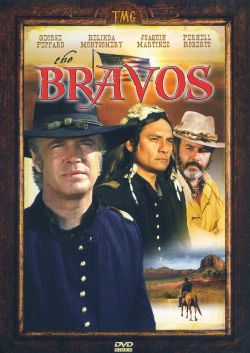
The TV movie is seemingly a thing of the past. In the 1970s and 1980s, TV movies and miniseries dominated the landscape, movie stars making the jump to television as roles presented themselves. Now with cable, dish and satellite, it's hard to consider what's even a TV movie and what isn't. Heading into the wayback machine, it's easy to identify them from the past, like 1972's The Bravos, a western with some potential that doesn't quite live up to it but is entertaining just the same.
It's just a year or two since the end of the Civil War, and the U.S. is focusing on expansion westward. At a remote outpost on the frontier, Major John Harkness (George Peppard) is doing his best to work himself out of quite the situation. His garrison is just 77 men and supplies and ammunition are running low. Those are problems enough, but reports are coming in from his patrols that the Navajo tribes seem to be joining up in the mountains. One report even has their numbers somewhere around 2,000. With so small a force though, Harkness has little options as to what he should do. The situation at the outpost is thrown for another loop when a small wagon train led by egotistical trail guide Jackson Buckley (Pernell Roberts) arrives seeking supplies for their coming trip. That's not all though. Buckley killed three young Kiowa warriors on the trail, Kiowas who were trying to join up with the gathering Navajo warriors. Can help arrive in time to stave off a brutal massacre?
It was pretty evident early-on that this was a TV western, a fact I wasn't aware of until after I started watching (clever Encore Westerns). From director Ted Post, 'Bravos' is a solid, entertaining western that is at times limited by its smallish budget. The 2,000 warrior war party is only mentioned as we never see more than 15 or 20 murdering Indians at a time. What does work though? It's a TV movie, but it was filmed on location in Sedona, Arizona, the sparse, windy and winter-bound desert providing quite the backdrop for the story. It's easy to understand the fear of living out there. Anything could be hiding in that desert just waiting to strike. As well, the set for the cavalry outpost is pretty cool, a crumbling little fort with obvious defensive deficiencies. Also worth mentioning is the musical score from composer Leonard Rosenman, similar to his score from 1962's Hell is For Heroes.
One of my favorite tough guys stars, Peppard does a good job here leading a capable cast. His Maj. Harkness has been dealt the lousiest of hands, his garrison undermanned, under-supplied and waiting for an inevitable attack against horrific odds. Somehow, he's got to keep his command together even as his officers and enlisted men question what the point of it all is for. A weak subplot involves his son (Vincent Van Patten) who was kicked out of his Eastern school arriving at the outpost at the worst possible moment. Peppard has a knack for being a condescending tough guy, that ever-present smirk on his face, and it works here well. His officers include George Murdock as the questioning second-in-command, Dana Elcar as the fort surgeon, Ron Kelly as the cigar-chomping lieutenant, and John Kellogg as the loyal sergeant-major.
For a TV western, a pretty good cast has been assembled with some familiar faces. It's cool to see L.Q. Jones get a major role, playing the capable scout, Ben Lawler, who always seems to tangle with Harkness despite their long-standing friendship. Jones and Peppard sparkle in their scenes together. Roberts get to preen and yell as the overmatched trail guide, blustering his way through his "occupation" of which he knows little other than money. A young Bo Svenson players Bucholz, a former soldier on the run with Buckley's wagon train, playing a key part in a mission late. Clint Ritchie is solid too as Cpl. Love, the trusted enlisted man seemingly always leading another five-man patrol. Because a love story was needed (????), Belinda Montgomery plays Heller, a young woman traveling with her fiance, Garratt (Barry Brown).
The biggest place the flick is hit by is in the action department. We're not talking any major battles, gunfights or chases across the desert. What we do get is a shootout here and there, the biggest being "an attack" on the fort by some sniping Navajo warriors. The best part though is a dangerous mission late as Harkness, Lawler and Bucholz head out into the wilderness to rescue Harkness' son from a raiding party. No spoilers here, but it's a cool premise and it is executed really well. You don't need a cast of thousands (hundreds, even tens I suppose) to be effective as is on display here.
Unfortunately though, then the movie just ends, almost like the TV movie just ran out of money or time to fit in a two-hour slot. One thing is resolved, but several other key things need to be dealt with. Nope, not here. Credits roll and the movie is over. I still liked the build-up, but it is a finale that feels forced in all sorts of ways. At 97 minutes, maybe it was getting too long. Maybe some resolution was cut out, but what we get is disappointing. Give it a try at Youtube HERE in its entirety. It's got enough going for it to recommend but know you'll most likely be disappointed with the finale.
The Bravos (1972): ** 1/2 /****
The Sons of Katie Elder
"First, we reunite, then find Ma and Pa's killer...then read some reviews."
Showing posts with label Pernell Roberts. Show all posts
Friday, October 4, 2013
Thursday, March 1, 2012
Four Rode Out
Think spaghetti western, and where does your head go? Mine goes to gunfights, duels and long, extended shootouts. Thank you, Sergio Leone, you set the bar incredibly high and basically ruined even the good but average spaghetti westerns (for me at least). That's a little harsh, but you get the idea. Then there's 1970's Four Rode Out, almost an anti-spaghetti from the casting to the almost complete lack of gunplay. It wasn't even a problem....for awhile.
Having netted $120,000 after a successful bank robbery, bandit Fernando Nunez (Julian Mateos) sets out across the desert toward Mexico, but not before stopping to see his girlfriend, Myra (Sue Lyon). Her father catches them together and kills himself, but Nunez is blamed for the murder. He doesn't have much of a head start on Marshal Ross (Pernell Roberts), a veteran peace officer who intends to bring Nunez in and then retire for good. Ross intends to bring the bandit in on his own only to have a sinister Pinkerton agent, Brown (Leslie Nielsen) tag along, and Myra isn't far back either in hopes of saving her boyfriend.
This is not your typical spaghetti western, some reasons for good, others for really, really bad. From director John Peyser (I know, John freaking Peyser), 'Four' was filmed in Almeria, Spain and benefits from the on-location shooting in the desert with some familiar spots popping up here and there. It has little to no actual gunfighting with only a few shots even fired, and by my count two or three of those shots were to mercifully put horses out of their misery. It is low budget, focusing exclusively on the four main characters. The first 45-50 minutes are a positive start, familiar ground but entertaining. Even in the second half, there are some worthwhile twists in character and story that showed at least some effort was made, but more on that in a bit.
A haven for American actors looking for work, the spaghetti western again opens its doors to fading stars. For the audience, that's a good thing. Former Bonanza star Pernell Roberts brings the same easy-going confidence to his part that he did in the much better Ride Lonesome some 11 years earlier. Is this part on the same level? No, not by a long shot, but in a pretty dreary western, he stands out from the rest. The same goes for Leslie Nielsen, not yet a star of the spoof genre. His Mr. Brown, a somewhat suspicious Pinkerton agent, ends up being the most villainous of all the characters. Nielsen shows a dark side that I hadn't seen in any of his other roles, and he looks to be enjoying himself. His scenes with Roberts actually have some tension, two actors probably wondering what they're doing in a movie like this. As Myra, Lyons leans toward the wooden side in her acting, and Mateos is okay but overshadowed as Nunez.
The lack of any shootouts or actual gunplay is not a deal breaker, but 'Four' does have some that make up for it. The score is from songwriter and musician Janis Ian who also makes an appearance in the opening credits as a guitar player. Her songs are good enough, pretty typical of the American folk music so prevalent in the late 1960s and 1970s. Good enough doesn't qualify in a western either, much less one this dark. Long scenes of the quartet riding across the desert are almost unendurable with Ian's folks songs playing. There also seems to be different variations of running lengths, mine coming in at 95 minutes. Others are listed at 90 and 99. A few scenes felt like there was some awkward cuts, but I didn't notice anything significant missing, no huge plot holes left unexplained. Some odd bleeps pepper the story, basically anytime 'whore' is said. Was the DVD print recorded off a TV showing possibly?
At its most basic, the second half of the story reminded me of Anthony Mann's The Naked Spur. All differences are put aside when Ross, Brown, a wounded Nunez and a pissed off Myra must work together to get across the desert. They have little water, and their chances seem slim. The story shifts to the bizarre at times -- including a surreal wedding -- and dull/boring at others. Watching dehydrated folks walking across sandy ridges ain't too interesting, just saying. The ending is about as downbeat as you'd expect, but there were wasted moments even amongst the badness for a better ending. Disappointing when considering the first 45 minutes were fairly entertaining. Roberts and Nielsen make this worth checking out for diehard western fans only.
Four Rode Out <---Part 1 of 9 (1970): **/****
Having netted $120,000 after a successful bank robbery, bandit Fernando Nunez (Julian Mateos) sets out across the desert toward Mexico, but not before stopping to see his girlfriend, Myra (Sue Lyon). Her father catches them together and kills himself, but Nunez is blamed for the murder. He doesn't have much of a head start on Marshal Ross (Pernell Roberts), a veteran peace officer who intends to bring Nunez in and then retire for good. Ross intends to bring the bandit in on his own only to have a sinister Pinkerton agent, Brown (Leslie Nielsen) tag along, and Myra isn't far back either in hopes of saving her boyfriend.
This is not your typical spaghetti western, some reasons for good, others for really, really bad. From director John Peyser (I know, John freaking Peyser), 'Four' was filmed in Almeria, Spain and benefits from the on-location shooting in the desert with some familiar spots popping up here and there. It has little to no actual gunfighting with only a few shots even fired, and by my count two or three of those shots were to mercifully put horses out of their misery. It is low budget, focusing exclusively on the four main characters. The first 45-50 minutes are a positive start, familiar ground but entertaining. Even in the second half, there are some worthwhile twists in character and story that showed at least some effort was made, but more on that in a bit.
A haven for American actors looking for work, the spaghetti western again opens its doors to fading stars. For the audience, that's a good thing. Former Bonanza star Pernell Roberts brings the same easy-going confidence to his part that he did in the much better Ride Lonesome some 11 years earlier. Is this part on the same level? No, not by a long shot, but in a pretty dreary western, he stands out from the rest. The same goes for Leslie Nielsen, not yet a star of the spoof genre. His Mr. Brown, a somewhat suspicious Pinkerton agent, ends up being the most villainous of all the characters. Nielsen shows a dark side that I hadn't seen in any of his other roles, and he looks to be enjoying himself. His scenes with Roberts actually have some tension, two actors probably wondering what they're doing in a movie like this. As Myra, Lyons leans toward the wooden side in her acting, and Mateos is okay but overshadowed as Nunez.
The lack of any shootouts or actual gunplay is not a deal breaker, but 'Four' does have some that make up for it. The score is from songwriter and musician Janis Ian who also makes an appearance in the opening credits as a guitar player. Her songs are good enough, pretty typical of the American folk music so prevalent in the late 1960s and 1970s. Good enough doesn't qualify in a western either, much less one this dark. Long scenes of the quartet riding across the desert are almost unendurable with Ian's folks songs playing. There also seems to be different variations of running lengths, mine coming in at 95 minutes. Others are listed at 90 and 99. A few scenes felt like there was some awkward cuts, but I didn't notice anything significant missing, no huge plot holes left unexplained. Some odd bleeps pepper the story, basically anytime 'whore' is said. Was the DVD print recorded off a TV showing possibly?
At its most basic, the second half of the story reminded me of Anthony Mann's The Naked Spur. All differences are put aside when Ross, Brown, a wounded Nunez and a pissed off Myra must work together to get across the desert. They have little water, and their chances seem slim. The story shifts to the bizarre at times -- including a surreal wedding -- and dull/boring at others. Watching dehydrated folks walking across sandy ridges ain't too interesting, just saying. The ending is about as downbeat as you'd expect, but there were wasted moments even amongst the badness for a better ending. Disappointing when considering the first 45 minutes were fairly entertaining. Roberts and Nielsen make this worth checking out for diehard western fans only.
Four Rode Out <---Part 1 of 9 (1970): **/****
Thursday, August 25, 2011
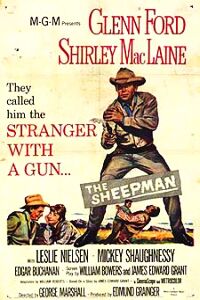
The Sheepman
Watching and reading enough about the taming of the west in the second half of the 19th Century, you notice certain rivalries popping up...if rivalries is the right word. There was cowboys vs. Indians (not aliens), outlaws and bandits against marshals, sheriffs and law enforcement, American vs. Mexican (among any number of other nationalities who didn't care for each other), and because it wasn't just beef being shipped around the country, cattle vs. sheep.
Cattle grazed on the land while sheep basically picked the land clean, ripping the grass out by the roots so it didn't grow back. Didn't think you were going to get that sort of introduction to a western now, did you? That's the basic problem in many cattle vs. sheep westerns, including the 1958 oater The Sheepman. I'd seen this movie a few years ago but watched it recently on Turner Classic Movies when I thought I had not seen it. I watch a fair share of westerns so they start running together at a certain point...my bad. A good, entertaining and relatively harmless western, typical of so many 1950s westerns.
In the western town of Powder Valley where the cattle dominates the land, a stranger, Jason Sweet (Glenn Ford), arrives one day on the train. He quickly makes his presence felt, buying a saddle, buying drinks, picking a fight with the town tough guy. What's he up to? Jason is making sure everyone knows he's not a man to be tangled with because the next day his herd of sheep are inbound on the train. The cattle owners want nothing to do with Jason's herd, and they don't intend to go along quietly. The big man in the area who controls everything, Colonel Bedford (Leslie Nielsen) -- who Jason knows from his opposite side of the law past -- leads the charge to stop him, but the situation gets murky when Jason meets Dell Payton (Shirley MacLaine), Bedford's fiance. Now it is more than just a cattle and sheep situation, and the solution doesn't seem like an easy one.
This is a western that is pretty typical of a 1950s genre entry. Director George Marshall handles his straightforward, no frills story with his typical professionalism. The movie is only 87 minutes long so there is not much in the way of wasted time here. The story knows where it wants to get, especially that first half hour as Jason "introduces" himself around Powder Valley. That's the aspect of the comedic western that works best, an easy going, fun introduction. From there on in, things settle in with the good guys taking on the bad guys. Until late in the movie, the bad guys -- Nielsen included -- aren't even that bad. Finally Ford's Jason is pushed too far though, and he has to respond.
Realizing I've probably written this with all my Glenn Ford movie reviews, I think Ford is one of the most under-appreciated western stars that came out of the 1950s and 1960s. He doesn't have the name recognition that a John Wayne would, mostly because his westerns aren't considered classics. Ford probably belongs with Randolph Scott for his star caliber, solid, quality westerns that don't often wow you, but are always entertaining. As sheep herder Jason Sweet, he brings his typical western persona to the part. Ford was always very natural on-screen, showing off an ease that could give the impression he wasn't acting at all. He is likable though from the start, and you're rooting for him. Pointless bit of movie trivia, Ford wore the same hat in all his westerns. Not the same hat style, the actual hat. It still looks relatively clean here.
Playing the part of the female love interest, Shirley MacLaine makes the most of her appearance. So often this character -- the center of a pointless, needless, and unnecessary love triangle -- is forced into the story for the sake of having the character around. Not much is done to actually develop MacLaine's Dell character, but if nothing else she's trying, and that's all you're looking for at times. Anyone with an IQ over 10 or so knows from the second she is introduced she'll end up with Ford's Jason, but they've got to keep us guessing a little, right? MacLaine isn't the damsel in distress thankfully, just a frontier woman caught in a bad situation. Her chemistry with Ford in their scenes together is easily seen, and their dialogue/conversations have an easy flow to them throughout.
Because there isn't a ton else to analyze about this one, we get more cast analysis and criticism! Yeah for people! Before he became most well-known for The Naked Gun movies, Nielsen was a dramatic actor capable of drama, comedy, and action. He's not the baddest of bad guys until late in the movie, but he has some good back and forths with Ford. The rest of the cast includes some very recognizable western faces including Mickey Shaughnessy as one of Nielsen's henchmen, Edgar Buchanan as the wily, shifty stable owner who knows everything and everyone, Willis Bouchey as Dell's father, Pernell Roberts as Choctaw Neil, a gunslinger and adversary of Jason's, Slim Pickens as the town marshal who goes fishing when trouble arises, and Pedro Gonzalez Gonzalez as Angelo, one of Jason's sheepherders.
Not a great western, but certainly not a bad western. Just sort of in between, a western you can watch every couple years without getting bored or worn down.
The Sheepman <---trailer (1958): ** 1/2 /****
Cattle grazed on the land while sheep basically picked the land clean, ripping the grass out by the roots so it didn't grow back. Didn't think you were going to get that sort of introduction to a western now, did you? That's the basic problem in many cattle vs. sheep westerns, including the 1958 oater The Sheepman. I'd seen this movie a few years ago but watched it recently on Turner Classic Movies when I thought I had not seen it. I watch a fair share of westerns so they start running together at a certain point...my bad. A good, entertaining and relatively harmless western, typical of so many 1950s westerns.
In the western town of Powder Valley where the cattle dominates the land, a stranger, Jason Sweet (Glenn Ford), arrives one day on the train. He quickly makes his presence felt, buying a saddle, buying drinks, picking a fight with the town tough guy. What's he up to? Jason is making sure everyone knows he's not a man to be tangled with because the next day his herd of sheep are inbound on the train. The cattle owners want nothing to do with Jason's herd, and they don't intend to go along quietly. The big man in the area who controls everything, Colonel Bedford (Leslie Nielsen) -- who Jason knows from his opposite side of the law past -- leads the charge to stop him, but the situation gets murky when Jason meets Dell Payton (Shirley MacLaine), Bedford's fiance. Now it is more than just a cattle and sheep situation, and the solution doesn't seem like an easy one.
This is a western that is pretty typical of a 1950s genre entry. Director George Marshall handles his straightforward, no frills story with his typical professionalism. The movie is only 87 minutes long so there is not much in the way of wasted time here. The story knows where it wants to get, especially that first half hour as Jason "introduces" himself around Powder Valley. That's the aspect of the comedic western that works best, an easy going, fun introduction. From there on in, things settle in with the good guys taking on the bad guys. Until late in the movie, the bad guys -- Nielsen included -- aren't even that bad. Finally Ford's Jason is pushed too far though, and he has to respond.
Realizing I've probably written this with all my Glenn Ford movie reviews, I think Ford is one of the most under-appreciated western stars that came out of the 1950s and 1960s. He doesn't have the name recognition that a John Wayne would, mostly because his westerns aren't considered classics. Ford probably belongs with Randolph Scott for his star caliber, solid, quality westerns that don't often wow you, but are always entertaining. As sheep herder Jason Sweet, he brings his typical western persona to the part. Ford was always very natural on-screen, showing off an ease that could give the impression he wasn't acting at all. He is likable though from the start, and you're rooting for him. Pointless bit of movie trivia, Ford wore the same hat in all his westerns. Not the same hat style, the actual hat. It still looks relatively clean here.
Playing the part of the female love interest, Shirley MacLaine makes the most of her appearance. So often this character -- the center of a pointless, needless, and unnecessary love triangle -- is forced into the story for the sake of having the character around. Not much is done to actually develop MacLaine's Dell character, but if nothing else she's trying, and that's all you're looking for at times. Anyone with an IQ over 10 or so knows from the second she is introduced she'll end up with Ford's Jason, but they've got to keep us guessing a little, right? MacLaine isn't the damsel in distress thankfully, just a frontier woman caught in a bad situation. Her chemistry with Ford in their scenes together is easily seen, and their dialogue/conversations have an easy flow to them throughout.
Because there isn't a ton else to analyze about this one, we get more cast analysis and criticism! Yeah for people! Before he became most well-known for The Naked Gun movies, Nielsen was a dramatic actor capable of drama, comedy, and action. He's not the baddest of bad guys until late in the movie, but he has some good back and forths with Ford. The rest of the cast includes some very recognizable western faces including Mickey Shaughnessy as one of Nielsen's henchmen, Edgar Buchanan as the wily, shifty stable owner who knows everything and everyone, Willis Bouchey as Dell's father, Pernell Roberts as Choctaw Neil, a gunslinger and adversary of Jason's, Slim Pickens as the town marshal who goes fishing when trouble arises, and Pedro Gonzalez Gonzalez as Angelo, one of Jason's sheepherders.
Not a great western, but certainly not a bad western. Just sort of in between, a western you can watch every couple years without getting bored or worn down.
The Sheepman <---trailer (1958): ** 1/2 /****
Monday, July 19, 2010
Ride Lonesome
Last fall I reviewed a western from director Budd Boetticher, Buchanan Rides Alone, one of seven pairings with star Randolph Scott. 'Buchanan' was one of the two I hadn't seen prior, and I enjoyed it, if not as much as the other pairings. Everyone has their favorites, but one always stood out from the others for me, 1959's Ride Lonesome, a western typical of the Boetticher/Scott pairings.
These were B-westerns, but in the most positive sense of what a B-movie can be when handled the right way. Almost criminal in their simplicity, these are must-see westerns for fans of the genre. 'Ride' has all the necessary elements; a tough, veteran cast, scenic Western locations, and a solid if unspectacular story that almost always features a twist or two. I won't say the films are a romantic portrayal of the old west, but at times it sure feels like it. Instead they followed a trend in the 1950s of more adult westerns, including a string of Anthony Mann and James Stewart westerns that are some of the best the genre has ever produced.
A former lawman turned bounty hunter, Ben Brigade (Scott) captures young outlaw Billy Joe (James Best), wanted for murder in Santa Cruz. Stopping over at a stagecoach station, Brigade runs into two men who tread that fine line on either side of the law, Boone (Pernell Roberts) and Whit (James Coburn). Anyone who brings Billy in earns an amnesty for past actions, and Boone and Whit intend to collect. Along for the ride is Carrie Lane (Karen Steele), the recent widow of the stagecoach station's owner. Brigade doesn't plan on giving his prisoner over to Boone and Whit, but he knows trouble is following them and he'll need their help. Wearing out horses behind them, Billy's brother Frank (Lee Van Cleef) and his gang are hot on their trail.
There are typically three different variations of characters in a Boetticher western -- four if you count the damsel in distress. There's the good, the bad and the yet to be determined. Scott always play the good, if a somewhat tortured good. The bad is the straight villain with no basically no chance of survival (sorry Lee). And third and the most fun is the yet to be determined, played here by Roberts and Coburn. These are the characters you're not quite sure which way they'll go. Will they turn on the good guy Scott or stay on the righteous path? It depends on the movie which way they turn, but there's always that sense of mystery. It's also the meatier, more showy character to have, but more on that later.
As the steely-eyed, tortured good guy, Scott has about 20 lines to say in the whole movie. The thing is? He doesn't need to say more than that. He's a man of few words with principles and beliefs he lives by, end result be damned. Scott is going to do the right thing no matter the cost. His Brigade has a past incident haunting him -- as most of his characters did in the Boetticher westerns -- and he will right a wrong whether you want him to or not. The more showy character is Roberts playing Boone, an outlaw looking for a second chance. He has this easy way about him that you can't help but like him, even if you're curious what he's really up to. A real scene-stealing part. Coburn in his first movie also shows some of the talent that would make him such a big star in the coming years.
On to the other elements, this one has the good and bad. Karen Steele plays the eye of everyone's affection, the babely widowed station owner's wife. Her platinum blonde hair and bras that could take an eye out look out of place, but her character is a whole lot tougher than most female characters in a western. Her looks sure don't hurt though. Best isn't given much to do other than negotiate for his release, and Van Cleef only has two scenes where he actually talks. For filming, Boetticher chose the California deserts and mountains, and along with cinematographer Charles Lawton Jr. turns in a gorgeous looking western that rivals some of John Ford's best in Monument Valley. The score by Heinz Roemheld is nothing special, but that's a minor complaint.
At just 73 minutes, there isn't a wasted moment or unnecessary scene anywhere to be found. Some reviews call it a dull or slow-moving story, but the time flies by. It isn't heavy on action if that's what you're looking for, instead building up to these quick outbursts of gunfire after long scenes of quiet. The dialogue from screenwriter Burt Kennedy is top-notch and features some quotable western lines while also giving some inspirations for Sergio Leone and the Dollars trilogy. It is available to watch through Youtube (here's Part 1), but it's in pan-n-scan. If you can find a widescreen version, I'd recommend watching that one.
Ride Lonesome <----TCM trailer (1959): *** 1/2 /****
These were B-westerns, but in the most positive sense of what a B-movie can be when handled the right way. Almost criminal in their simplicity, these are must-see westerns for fans of the genre. 'Ride' has all the necessary elements; a tough, veteran cast, scenic Western locations, and a solid if unspectacular story that almost always features a twist or two. I won't say the films are a romantic portrayal of the old west, but at times it sure feels like it. Instead they followed a trend in the 1950s of more adult westerns, including a string of Anthony Mann and James Stewart westerns that are some of the best the genre has ever produced.
A former lawman turned bounty hunter, Ben Brigade (Scott) captures young outlaw Billy Joe (James Best), wanted for murder in Santa Cruz. Stopping over at a stagecoach station, Brigade runs into two men who tread that fine line on either side of the law, Boone (Pernell Roberts) and Whit (James Coburn). Anyone who brings Billy in earns an amnesty for past actions, and Boone and Whit intend to collect. Along for the ride is Carrie Lane (Karen Steele), the recent widow of the stagecoach station's owner. Brigade doesn't plan on giving his prisoner over to Boone and Whit, but he knows trouble is following them and he'll need their help. Wearing out horses behind them, Billy's brother Frank (Lee Van Cleef) and his gang are hot on their trail.
There are typically three different variations of characters in a Boetticher western -- four if you count the damsel in distress. There's the good, the bad and the yet to be determined. Scott always play the good, if a somewhat tortured good. The bad is the straight villain with no basically no chance of survival (sorry Lee). And third and the most fun is the yet to be determined, played here by Roberts and Coburn. These are the characters you're not quite sure which way they'll go. Will they turn on the good guy Scott or stay on the righteous path? It depends on the movie which way they turn, but there's always that sense of mystery. It's also the meatier, more showy character to have, but more on that later.
As the steely-eyed, tortured good guy, Scott has about 20 lines to say in the whole movie. The thing is? He doesn't need to say more than that. He's a man of few words with principles and beliefs he lives by, end result be damned. Scott is going to do the right thing no matter the cost. His Brigade has a past incident haunting him -- as most of his characters did in the Boetticher westerns -- and he will right a wrong whether you want him to or not. The more showy character is Roberts playing Boone, an outlaw looking for a second chance. He has this easy way about him that you can't help but like him, even if you're curious what he's really up to. A real scene-stealing part. Coburn in his first movie also shows some of the talent that would make him such a big star in the coming years.
On to the other elements, this one has the good and bad. Karen Steele plays the eye of everyone's affection, the babely widowed station owner's wife. Her platinum blonde hair and bras that could take an eye out look out of place, but her character is a whole lot tougher than most female characters in a western. Her looks sure don't hurt though. Best isn't given much to do other than negotiate for his release, and Van Cleef only has two scenes where he actually talks. For filming, Boetticher chose the California deserts and mountains, and along with cinematographer Charles Lawton Jr. turns in a gorgeous looking western that rivals some of John Ford's best in Monument Valley. The score by Heinz Roemheld is nothing special, but that's a minor complaint.
At just 73 minutes, there isn't a wasted moment or unnecessary scene anywhere to be found. Some reviews call it a dull or slow-moving story, but the time flies by. It isn't heavy on action if that's what you're looking for, instead building up to these quick outbursts of gunfire after long scenes of quiet. The dialogue from screenwriter Burt Kennedy is top-notch and features some quotable western lines while also giving some inspirations for Sergio Leone and the Dollars trilogy. It is available to watch through Youtube (here's Part 1), but it's in pan-n-scan. If you can find a widescreen version, I'd recommend watching that one.
Ride Lonesome <----TCM trailer (1959): *** 1/2 /****
Subscribe to:
Posts (Atom)