The Sons of Katie Elder

The Sons of Katie Elder
"First, we reunite, then find Ma and Pa's killer...then read some reviews."
Showing posts with label Prisoners of War. Show all posts

Saturday, February 28, 2015

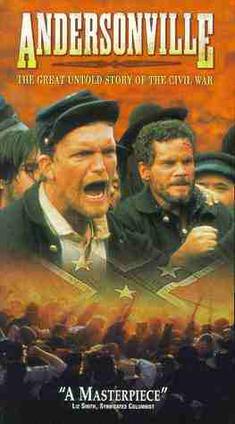
Andersonville

When you think of prisoner of war movies, World War II-era flicks dominate the landscape with movies like The Great Escape and Bridge on the River Kwai. There are others of course, some from the Korean and Vietnam Wars. But as if there wasn't already a scarcity of Civil War movies, there definitely aren't many Civil War P.O.W. movies. How about a gem, a made-for-TV flick from the mid-1990s? That's 1996's Andersonville.

During the battle of Cold Harbor in early June 1864, a group of Union troops from a Massachusetts regiment, including Corporal Josiah Day (Jarrod Emick) and Sergeant McSpadden (Frederic Forrest), are captured by Confederate forces. Packed into cattle cars, the Union infantry is shipped south to a prison camp that is quickly gaining a reputation for all the wrong reasons. It's called Andersonville, and thousands and thousands of prisoners are confined in a stockade meant for less than 8,000. Food, water and rations are limited, and the maniacal camp commandant, Capt. Henry Wirtz (Jan Triska), rules the camp with an iron fist. Josiah, McSpadden and their fellow Massachusetts men have no idea what awaits them in a prison camp where men drop like flies each day from disease, starvation and even a murdering group of prisoners called Raiders. Can they survive? As Andersonville wears on them, do they even want to survive?

Have you heard of Ted Turner? Well, he's quirky, rich and a Civil War enthusiast. Having already backed the 1993 Civil War epic Gettysburg, Turner turned his sights on this made-for-TV venture, bringing to the small screen a generally forgotten, truly dark part of American history. Once fighting began in 1861, both the Union and Confederate sides now had to deal with the ever-increasing number of prisoners of war. Clocking in at 167 minutes, 'Andersonville' is a horrifying, moving and realistic portrayal of the worst Civil War prison camp. Built in 1864, over 45,000 prisoners were held there, and over 13,000 died in just over a year-plus. The truth is horrifying just reading about it, but seeing it? Quite the moving experience.

With Turner backing the production, no expenses were cut short. An entire set was built almost to the exact measurements of the actual prison camp (it's a little bit smaller) to provide just a stunning visual for all the wrong reasons. Acres and acres of makeshift tents and shelters -- usually just holes in the ground covered with tarps -- stretch as far as the eye can see, prisoners packed into the camp like sardines. With no sanitation, you can only imagine how absolutely filthy and disease-ridden the camp was. Director John Frankenheimer brings this god-forsaken place to life, using long tracking shots that have the camera navigating through this claustrophobic, filthy, death lingering in the air, horrific location to life. By the end of the movie, you're exhausted, beaten up and truly get a sense of what living in the camp was like.

'Andersonville' utilizes an ensemble cast with some familiar faces, even some stage actors, but no huge stars. Playing the everyman hero, Emick -- a stage actor -- is our window into the camp as Josiah, an educated, well-spoken soldier who vows to survive no matter what it takes. Forrest too is excellent as the tough Sgt. McSpadden who wants nothing more than to get his Massachusetts men through this living hell. The prisoners we meet are a combination of those new Massachusetts infantry who arrive and the Pennsylvania miners who welcome them in, even letting them in their desperate escape attempt. Ted Marcoux plays Martin, one of the miners and simply a good man in who we see a horrific physical transformation over his time in the camp.

Also worth mentioning in a very solid supporting part is Cliff De Young (Glory, Centennial) as Sgt. Gleason, the leader of the Pennsylvania men who welcomes in the Massachusetts contingent. Experienced miners in the coal mines, Gleason's men are digging a tunnel under the wall. Their odds? Slim, but anything is better than staying in the camp. Also look for Jayce Bartok, Justin Henry, Andrew Kavovit, Olek Krupa, Thomas Wilson, Peter Murnik, and Gregory Sporleder as other key Union prisoners we meet. Frederick Coffin and William Sanderson play the leaders of the Raiders, more intent on survival than anything, even if it means attacking and killing fellow prisoners. Also look for William H. Macy as a Confederate officer tasked with examining what goes on within Andersonville's walls.

Originally broadcast over two separate nights, the story tries to accomplish a ton. The first half introduces our characters, the camp and the desperate escape attempt via tunnel while the second half shows the effort to rid the camp of raiders while also showing the horrific physical wear and tear the prisoners go through. It all builds to quite the ending, one that packs quite the emotional punch. It's heartbreaking with a last twist and ends on a quiet, somber note that shows the real horror of the camp. Highly recommended, an incredibly difficult movie to watch but one that is incredibly worthwhile.

Andersonville (1996): ****/****

Thursday, January 8, 2015

Unbroken

Just a few years ago, Louis Zamperini was a name generally lost in the annals of history. He accomplished a lot, one remarkable thing after another but in the grand scheme of things? LOST in the history books. Then, a little book called Unbroken, by author Laura Hillenbrand, was published back in 2010 and EVERYBODY knew the name. It was and is a great read, a tribute to the human spirit. A huge bestseller, it was only a matter of time, right? For what you ask? For the film adaptation of course. That's today's review, 2014's Unbroken.

This is a movie that defies a straightforward plot description. It tells the slightly condensed story of Louis Zamperini (Jack O'Connell), a young Italian-American man who grew up with his family in California. Putting a troublesome childhood behind him, Louis finds his niche as a runner, eventually becoming a world-class runner who competes at the 1936 Olympics. But this stubborn, fiery young man is about to be tested as the world is thrown into WWII as a bombardier on an American bomber flying missions in the Pacific. That plane will go down with no warning in the Pacific, he will fight through a survival ordeal adrift fro longer than anyone ever has, and be moved from one brutal Japanese prison camp to another over two-plus years. What helps him survive one horrific ordeal after another? What pushes him to keep on fighting, keep on hoping and keep on surviving?

I loved Hillenbrand's non-fiction book, racing through it in a week or so. It was a book that raced through my entire family with my parents, cousins, aunts and uncles also reading it. So to say I was excited when I found out it was being adapted into a film? Yeah, an understatement. The talent assembled to film that adaptation is a big reason for the excitement, starting with Angelina Jolie directing and Joel and Ethan Coen writing the screenplay with Richard LaGravenese and William Nicholson. Just because Louis's story is so all-enveloping, any book to film adaptation is a daunting task. How do you encapsulate so much in a reasonably timed movie? I think Jolie did as good a job as possible with this remarkable true story. It's not a movie you're necessarily going to love. Instead, it's one you watch and appreciate, and for me, question how Louis and all those around him made it through World War II in a Japanese prison camp.

This is a brutal, uncomfortable movie to watch, and that's as a PG-13 film. If this was an R-rated film...my goodness. It would be nearly impossible to watch. Jolie's direction is solid throughout, a personal story of survival that does an impressive job navigating Louis' life. O'Connell is the star, but through some flashbacks we see Louie growing up (C.J. Valleroy as young Louie, John D'Leo his older brother), and how he goes from a street punk of sorts to a world class runner. With cinematographer Roger Deakins shooting the film, it's a beautiful finished product, artsy at times without hitting your head with its art. Composer Alexandre Desplat's score is okay, nothing too flashy but doing a good job supporting the ever-increasing drama.

So we've got a feisty, cocky Italian-American young man as a main character. Who should we pick? How about a red-headed and generally unknown British actor?!? I kid. O'Connell does a fine job as Louis, sporting some dyed jet black hair and some skin-darkening makeup. This is O'Connell's first big role in a major film, and he doesn't disappoint. He brings that right amount of charm and likability to a character early on that goes a long way as we see the hell Louis is put through after his bomber goes down. Dramatically, it is quite a performance, but more importantly, it is an incredibly moving emotional and physical part. From his days adrift at sea to trying to survive the POW camps with little food while being progressively beaten down by his Japanese captors -- quite literally -- we see O'Connell's Louis start to wither away. One of the most moving scenes -- and most uncomfortable -- has Louis forced to hold a heavy wooden rail tie above his head. If he drops it, a guard will shoot him. In terms of survival, it doesn't get anymore cut and dry than that.

Years down the road, I think the role that will be most well-remember is that of Takamasa Ishihara as Watanabe, a brutal, sadistic Japanese guard who earns the nickname 'the Bird' from the prisoners (because what they actually call him would produce worse repercussions) and takes a liking to Louis. What's that mean? He wants to break him down, to grind him down to nothing at all. This isn't just a job though. The Bird enjoys what he does. He enjoys torturing and pushing and beating the prisoners. It's a terrifying performance, one I'm guessing will stir some Oscar buzz. The crazy part? Ishihara is actually a Japanese singer and songwriter with little in the way of acting experience. Well, if the whole music thing doesn't work out....yeah, he's got a future in acting.

Those are the two key parts where the focus remains throughout. It's a better movie because both O'Connell and Ishihara are relative unknowns. We come into 'Unbroken' with no preconceived notions about either actor. Who else to look for? Domhnall Gleeson and Finn Wittrock are excellent with O'Connell as Louis' fellow survivors adrift at sea just trying to hold out until some sort of help (any help really) arrives with Jai Courtney playing another member of the crew. One of the more recognizable faces, Garrett Hedlund plays Fitzgerald, the highest ranking prisoner at the POW camp Louis is sent to. Maddalena Ischiale (Louis' mom), Vincenzo Amato (Louis' dad) and Alex Russell (Louis' brother) play Zamperini's family, but they're not given much to do other than look worried and/or be supportive. No big stars overall across the cast, and the movie is the better for it.

The movie is at its strongest when following Louis' 47-day ordeal adrift at sea and then his two and a half years as a prisoner of war in the Pacific and later in Japan. Reading the book, these segments were excruciating to watch at times, and Jolie does a fine job bringing the real-life story to film. I think the best choice she could have made was focusing mainly on Louis' involvement in WWII. It's just that; focused. I don't know if it is a movie I will revisit anytime soon, but it is an excellent, well-done, moving story that shows how powerful history can be. There are thousands and millions of stories that history has swallowed up over the years. It's cool, informative, moving and educational to see a story like that of Louis Zamperini brought to life. Easy to recommend the film, and if you haven't already, definitely give the book a try.

Unbroken (2014): ***/****

Wednesday, November 26, 2014

The Bridge on the River Kwai

When you're talking about great prisoner of war movies, that conversation is inevitably going to come down to two movies. For me, it's an easy distinction, an easy pick for which one is the best. That's one of my two favorite movies ever, 1963's The Great Escape. What's the other classic P.O.W. film? One of Hollywood's all-time greats, 1957's The Bridge on the River Kwai.

It's 1943 in western Burma and a battalion of British prisoners has arrived at Camp 16 along the Burma Railway. Allied prisoners are being used all along the railway to help build the tracks and bridges it needs to move supplies up and down the country. The commandant of the camp, Colonel Saito (Sessue Hayakawa), has been given a quick deadline in order to build a bridge over the river Kwai, but he quickly hits a roadblock in the form of the ranking officer among the Brits, Colonel Nicholson (Alec Guinness). Both men are career officers, both of them stubborn and strong-willed that they know what is right and how to do it. What follows is a battle of wills as the two commanders see who will crack first with the deadline fast approaching. Unbeknownst to both of them, Allied intelligence has caught wind of the bridge across the river. A former prisoner, Shears (William Holden), of the camp is working with an experienced commando, Warden (Jack Hawkins), to lead a team back into Burma and take out the bridge. 

That David Lean, he was a halfway decent director, winning two Best Picture Oscars in his storied career. One win was for Lawrence of Arabia. One was for River Kwai. My favorite? You're reading that movie's review right now. It is a film remembered as one of the all-time greats, and it deserves that status. The portrayal of war, its message about war, the instantly recognizable Colonel Bogey March (listen HERE), the phenomenal casting, the on-location shooting in Ceylon (Sri Lanka), the gorgeous filmography, and a great musical score overall from Malcolm Arnold. The scale is gigantic, but the story remains personal. It is a giant movie with an ability to never lose its focus or get too far away from where it wants to go. On my most recent viewing, I thought (more than I remember) there were some slow/sluggish portions in the 161-minute movie but not nearly enough to fault an otherwise pretty perfect movie.

The name evades me, but I remember seeing another British actor say in an interview "I didn't understand the Nicholson part until I saw Guinness' performance." That's how good Alec Guinness is in his Oscar-winning performance. This is an incredible acting job, a layered character that is baffling at times to understand. Colonel Nicholson is a fascinating character because his word, his beliefs and his stubborn make-up are everything to him. If he believes he is right, he IS right. This is a career soldier willing to put his life on the line to stand by his beliefs. A career officer, he knows nothing else other than the army. His dynamic with Hayakawa's Col. Saito is the guts of the movie, two officers believing they're right and seeing who will blink first. Who needs the other more to accomplish their goal? A late scene where Guinness' Nicholson discussing his career illuminates what drives the man. He wants to leave something that will be remembered. He does, but what if it helps the Japanese war effort?

What a cast! Guinness rightfully deserves first mention, but that's only the start. William Holden's character, Shears, is underwritten some, but it is a necessary, still very interesting character to move the action along. Holden is one of my favorites, and I liked his Shears, especially when a big twist is revealed near the halfway point. Jack Hawkins is just solid as Warden, the unlikely commando officer, an interesting similarity to Nicholson in the very, very British officer category. Hayakawa at times gets lost in the conversation, but he too is highly memorable as Saito, rough facade, terrified/worried inside at a possible failure. James Donald (also starring in The Great Escape) is the viewer, playing Major Clipton, the medical officer, trying to figure things out, to understand what's going on. Also worth mentioning is Geoffrey Horne as Joyce, the young, inexperienced commando trying to prove he can handle the job.

Also look for Andre Morell as Colonel Green, a key officer in Force 316, and Percy Herbert and Harold Goodwin as two British soldiers in the camp, Grogan and Baker.

Without resorting to hitting us over the head with a message, Lean does an understated job of delivering an anti-war message. What is it? Well....war is crazy. This isn't a horrifically violent movie, and the portrayals of a Japanese P.O.W. camp are pretty tame, but 'Kwai' effortlessly lays out all these different responses to war. Shears = Survival. Warden = A job. Clipton = Chaos and confusion. And Nicholson? A career. There are some moments of humor, usually pretty dark, mostly cynical, but Lean's movie (working off a novel by Pierre Boulle) presents the lunacy of war and simply lets it breathe. Decide for yourself who is right, if anyone.

So let's talk about that ending. No real SPOILERS here, but still, I'm talking (hopefully vaguely) about the finale. Great movie overall, one of the best ever. The ending to 'Kwai' is maybe top 5 finales to a movie ever as Force 316 (Warden, Shears, Joyce, a Siamese guerrilla and several Siamese girls) attempts to destroy the bridge at its grand opening. With nothing given away, there's a twist that is too perfect to describe. The last 35-40 minutes are phenomenal, and it only gets stronger in the final 15 minutes when the twist is revealed. Talk about tension built to an almost unbearable level. You can't believe what you're seeing, especially when Nicholson makes an amazing decision. It is a finale that leaves you drained and hammers home Lean's anti-war message. In the end, what is accomplished and at what cost? Boulle's finale is a doozy, a true whopper, if you read the novel.

Sometimes movies just work, a synergy of everything assembled clicking together. It is a beautiful movie, and Arnold's score works in unison with that visual, especially when Warden, Shears, Joyce and Co. finally arrive deep in the jungle at the bridge site. It is the first time we're seeing the completed bridge, and there's something simple and beautiful about the structure. Arnold's score soars, and all the pieces fit together. I think that's the beauty of it. This is my favorite David Lean movie overall, and it deserves its status as an all-time classic.

The Bridge on the River Kwai (1957): ****/****

Monday, August 11, 2014

Von Ryan's Express

Introduced as a kid to 1963's The Great Escape, I fell hook, line and sinker for the entire prisoner of war genre. Some like 'Escape' and Bridge on the River Kwai are instantly recognizable among movie fans while many others have taken some digging on my part to track them down. How about one of the best? One of my all-time favorites? Oh, yes, one I always enjoy revisiting, 1965's Von Ryan's Express.

As the Germans try to hold off advancing Allied forces in Italy in August 1943, an American Army Air Corp pilot, Colonel Joseph Ryan (Frank Sinatra) is shot down and sent to a prisoner of war camp where he becomes the ranking officer. There he clashes quickly with his second-in-command, a fiery, stubborn British officer, Major Eric Fincham (Trevor Howard). When the camp's Italian guards abandon the camp, Ryan makes a difficult decision, one that ends up backfiring as almost 400 prisoners are rounded up and boarded on a German train heading north. Heading the wrong way away from the advancing Allied forces, it seems hope has run out for Ryan, Fincham and their fellow prisoners. When all seems lost though, Colonel Ryan has one more trick up his sleeve, a daring plan that has the prisoners attempting to take over the train. The closely packed train is headed to Germany, but not if Ryan has his say. Instead? They look to Switzerland, but can their plan hold together?

If there is one major difference between 'Von Ryan's' and other prisoner of war movies, it is this. While all entertaining, movies like The Great Escape, River Kwai, Stalag 17 and others are high drama, often delivering a message. That's not to say Von Ryan's Express isn't high drama, director Mark Robson doing a fine job in this WWII actioner. It's more than that. It's more than just describing it as a prisoner of war movie. I've long thought this is one of the most perfect popcorn flicks ever made, the most entertaining, the most adrenaline-pumping action/dramas I can think of. It clocks in at 116 minutes but with each viewing, it goes by quicker and quicker. There isn't a weak moment. There are no slow portions, no parts where the momentum lets up. It's the rare movie that can accomplish that. From beginning to surprising finale, I love it all, one of my all-time favorites, one film I can watch over and over again.

What's the best thing going here for this 1965 war movie? There's a ton to mention! Just a few weeks ago in my review for 100 Rifles I mentioned how much I loved composer Jerry Goldsmith's score. Well, as good as that score was, I think his score here is one of his bests (and that's saying something considering the breadth of his career). Listen to the main theme HERE. This is the perfect score to back up the action, the heart-pumping moments, the quieter, more inward scenes and everything in between. An underrated score that deserves more of a reputation. Right up there with the musical score as an additional character is the choice to film on location in Italy. The filming locations give an air of authenticity that Hollywood backlots just wouldn't have accomplished. From the hills and streams to the ancient ruins to the weathered towns and train stations, wouldn't you know it? The film actually looks like it takes place in Italy. Go figure, right?!?  These are things that if mishandled wouldn't be a deal-breaker, but when handled correctly.....well, they can lift the movie up a notch or two or 10.     

You know who's cool? Totally caught me off guard, but it's that guy -- maybe you've heard of him -- named Frank Sinatra. By the mid 1960s, Sinatra played variations on tough guy parts that allowed him to more or less, be himself. In other movies, it might seem too familiar, but there's an energy here as Sinatra brings this intriguing character to life. Dubbed 'Von Ryan' by his fellow prisoners for helping the Germans, he's forced to make difficult decisions left and right, often putting lives at risk with each passing decision. There's an easy-going confidence to Sinatra's Ryan, a 90-day wonder as he calls it, a capable leader making some impossible decisions. The best supporting part not surprisingly comes from Trevor Howard as the stubborn, action-driven Fincham. Their Odd Couple-like relationship works, the quiet, cool American and the fiery Brit officer providing some good energy, some good sparks throughout. Their chemistry is evident any time and every time they're on screen together. Two excellent leads.

Lost in the shuffle can be a damn good supporting cast beyond Sinatra and Howard. In the eye candy department, Raffaella Carra plays Gabriella, a beautiful Italian girl who becomes a part of the escape. As for the villains, there's Adolfo Celi as a Fascist Italian officer and commandant of the camp and the very German Wolfgang Preiss as a very German officer in command of the prison train. My favorite supporting parts are Ryan's fellow prisoners, a cool group, an almost oddball crew that includes Bostick (Brad Dexter), one of the few American prisoners, Capt. Oriana (Sergio Fantoni), a well-meaning Italian officer thrust in with the P.O.W.s, Orde (John Leyton, also in Great Escape), Fincham's right-hand man, Father Costanzo (Edward Mulhare), the naive at times but very brave priest, and Stein (Michael Goodliffe), the camp medic. Also look for James Brolin, Michael St. Clair, Richard Bakalyan and James Sikking as other prisoners with smaller parts.  

Based off a novel by David Westheimer, 'Von Ryan' certainly has plenty to offer, including a handful of memorable set pieces. The opening 40 minutes are spent in the camp, the next 15 or so on the road and the last hour is when the prisoners are boarded on the prison train. I loved Ryan's scene with an inquisitive Gestapo agent (supposedly William Berger, I'm not positive) asking about Ryan's American watch. I loved Mulhare's masquerade as a German officer hoping to dupe an inspection. There are all these great moments that embrace this ludicrous possibility of this happening and run with it. We go along because it's so damn fun. This is a thrill a minute flick that's meant to entertain scene in and scene out. Nowhere is that more evident than....

The finale. As strong as the movie is, 'Von Ryan' is at its absolute best over the last 25 minutes, the prison train making a desperate run to the Alps and Switzerland, a German troop train (commanded by John Van Dreelen) hot on their trail. Throw in a trio of Messerschmitt fighters, a bombed out bridge (Spain standing in for Italy), and a stunning backdrop on a mountainside railway trestle....well, you've got a winner. It is in the ending that the film deviates most from Westheimer's novel, but it is a doozy of a finale. In terms of pure excitement, of really getting your blood pumping, I can think of few movies that can the ending here. A race against time, Germans edging ever closer, it has it all. Just a great movie, one I can rewatch over and over and always pick up something new.

Highly recommended. One of my all-time favorites.

Von Ryan's Express (1965): ****/****
Rewrite of October 2009 review

Thursday, January 2, 2014

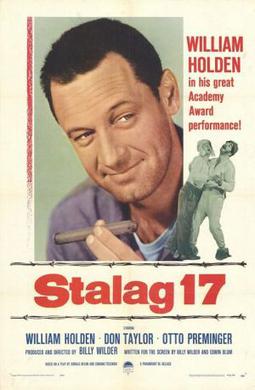
Stalag 17

Well, there are just certain movies I should have reviewed by now. I've mentioned on multiple occasions how much I like prisoner of war movies like The Great Escape and Bridge on the River Kwai, but the first one to really put the WWII sub-genre came along in 1953, Stalag 17, a classic that doesn't always get its due.

It's nearing Christmas in 1944, and a breakout is planned in Stalag 17, a German prisoner of war camp deep in Germany for Allied fliers. The night of the escape, the two prisoners making the attempt are machine gunned outside the barbed wire fence, leaving the prisoners they left behind in Barracks 4 to question what's going on. How did the Germans know details of the escape? The prisoners look to J.J. Sefton (William Holden) as the culprit, a possible stoolie who trades and bargains with the German captors for all sorts of luxuries from eggs to cigarettes to booze. Maybe Sefton has been giving away all their secrets for his own benefit, but Sefton knows otherwise. He may be a chiseler, but he's not a traitor. The problem is simple though, he can't prove it. Who among the other prisoners in Barracks 4 is the real culprit? He's going to need an answer and need it quick before his bunkmates decide they've had enough of him for good.

From director Billy Wilder, 'Stalag' is a gem of a film, one of my favorites going back to when I was a kid. It was based on a Broadway play that had 472 showings over its run. The stage-based play roots are obvious, but in a good way. Filmed in a very appropriate, very effective black and white, 'Stalag' is set almost entirely in Barracks 4 as the story develops, Christmas approaching ever quicker. The only departures we have from the barracks are outside into the camp compound. We never leave the camp, the entire story based in Stalag 17. The crowded, claustrophobic barracks becomes another character with the bunks almost bumping into each other, the windows with the frost and ice sticking to the panes, the clothes hanging from lines hung from wall to wall. Franz Waxman's uncredited score is solid as well if underplayed, Johnny Coming Marching Home a key component of the story as well.

One of three nominations the movie received went to William Holden as Barracks 4 chiseler and general trouble-maker J.J. Sefton. Nominated for his part in Sunset Boulevard but not winning, Holden got a much-deserved win here, taking home the Oscar. More impressive? He was going up against Burt Lancaster and Montgomery Clift in From Here to Eternity. Holden brings this character to life, a less than sympathetic but still appealing individual who's decided to make the most of his prisoner of war status. He's going to live in comfort, and if that means dealing/trading with his German captors, then so be it. It's not an issue until his bunkmates decide he's the traitor giving the Germans all their secrets. This is where Holden's acting steps up a notch, a desperate man now fighting for his survival instead of his personal comfort. Not often remembered as one of his best, but it's a goodie.

Holden's performance comes as part of a very solid ensemble cast that doesn't feature a ton of A-list stars, instead turning to a group of familiar character actors. Start with Robert Strauss as Animal and Harvey Lembeck as Harry Shapiro, the barracks cut-ups, Richard Erdman as Hoffy, the barracks chief, Peter Graves as Price, barracks security, Neville Brand as Duke, the hothead, and Gil Stratton as Cookie, Sefton's mousey assistant, and Robinson Stone, Robert Shawley, and William Pierson rounding out the bunch. Don Taylor co-stars as Lt. Dunbar, a prisoner in transit who comes under SS questioning, Jay Lawrence his impersonating, smart-mouthed traveling companion, Sgt. Bagradian. The comedy between Animal and Harry gets to be a little much at times, Bagradian's impersonations a little forced, but as a collective whole it's a good, strong, deep group of interesting characters.

It is hard to watch this without seeing the obvious influences some 10-plus years later with TV's Hogan's Heroes. Director Otto Preminger stars as Von Scherbach, the Stalag commander, an old-school German aristocrat and gentleman while Sig Ruman plays barracks guard Sgt. Schulz, a VERY obvious influence on John Banner's famous Sgt. Schultz character in the TV show.

An episodic story that clocks in at exactly 120 minutes, there really isn't a slow moment in Wilder's Stalag 17. In directing his film, Wilder decided to shoot chronologically so that way the cast and crew wouldn't know the twist -- the identity of the barracks traitor -- until the end of filming. The first hour or so of the movie blends the drama and comedy nicely setting up the second half of the movie. As the barracks traitor story comes to the forefront, that's when '17' is at its best. The last 30 minutes are pretty perfect, Holden's Sefton starting to piece the clues together in a great couple scenes, Wilder's talent fully on display in shooting style, while the actual reveal and the finale are spot-on. This is a movie that doesn't always get the recognition it deserves, but it sure deserves it. One of my favorites.

Stalag 17 (1953): ****/****

Thursday, August 23, 2012

The Bamboo Prison

Here we are again, the propaganda movie. I feel bad. I do, but I've got little else to go on here. Subtle, underplayed propaganda = anywhere from good to tolerable. Heavy-handed, aggressively in your face propaganda = not good to not tolerable. Unfortunately, 1954's The Bamboo Prison goes down the heavy-handed route.

Having marched for over 40 days, Corporal Brady (Brian Keith) and the remnants of a column of prisoners of war finally reach their destination; a brutal, under-supplied camp run by the North Korean army and several Russian/Communist advisers. Getting the scoop from his fellow prisoners, Brady discovers that one American P.O.W., Sgt. John Rand (Robert Francis), is a collaborator working with their captors for better treatment and billeting. Brady quickly finds out there's more than meets the eye when it comes to this believed collaborator. Rand is really an intelligence officer planted in the camp hoping to find proof/documentation of Communist atrocities committed against the POW's. Can he get the proof before a Russian counterpart figures him out?

Released just a year after the conclusion of the Korean War, 'Prison' was no doubt an incredibly timely story for audiences. Beyond it's issues with the propaganda angle -- more to come in that department -- the movie is undone by a general stupidity I had trouble getting past. At just 79 minutes, it doesn't really know where it wants to get other than delivering the "Communists are epically bad" message. Director Lewis Seiler was a talented director, even handling other propaganda-ish movies like Guadalcanal Diary, but the story here is too convoluted for its own good. Rambling, oddly and aggressively trying to be funny, it's a mess.

Propaganda in film can be good. I've said that before, and I'll most likely say it again. The story in 'Prison' has Francis' Rand searching for proof of Communist atrocities, anything from brainwashing to brutal physical beatings to lack of supplies and clothing. Brief sidenote; can't he just see these atrocities? What exactly is he looking for? Does pretending to be a collaborator actually help that much? Here's the thing. All those things were done by Communist/North Korean forces. There's evidence of it, but that doesn't make it any more pleasant to watch. We are subjected to long monologues about the Communist ideal, and then shown how evil it is. Movies like The Manchurian Candidate showed that this subject could be handled in a subtle but still scary and effective fashion. That isn't the case here.

Star of just four movies before his death at age 25 in 1955 in an airplane crash, Francis isn't the best choice to play this character. As was the case with his other roles, he just is not a very expressive actor. His line deliveries come across as beyond static. Monotone, wooden, one-note, all adjectives would apply here. His Rand is also given a love interest, Tanya (Dianne Foster), a Russian ballerina married to a Communist adviser/brainwasher. Those scenes -- lacking any real chemistry -- can be painful to watch. In the sidekick role, Keith is wasted as the tough, no-nonsense Cpl. Brady. He's introduced, and you think he's going to be a main character but unfortunately not. His character disappears for long stretches, only to pop up when Rand needs some help.

Then there's the portrayal of the American and international prisoners of war. For a camp that's supposed to be one step above Hell, the prisoners don't seem to mind too much. They're always laughing it up, hamming it up, and all at their Communist captors' expense. Haha communism! You're so stupid! The prisoners include Jerome Courtland as Arkansas, a shrill Southerner with that stereotypical drawl, E.G. Marshall as Father Dolan, Earle Hyman as Doc, the black medic (another redeeming part), Jack Kelly as Slade, the fast-talking car salesman, King Donovan as Pop, the family man trying to get home (bet that ends well for you, buddy), Pepe Hern as Ramirez, the Mexican soldier, Leo Gordon as Pike, the hot-headed prisoner, and Dickie Jones as Jackie, the youngster. At different points, they sing together, do impressions of Bogie, and all sorts of prisoner of war hijinks. Yeah for being a prisoner of war!

There just isn't much going on here in that whole positive vein. The ending is ridiculously stupid, making us question what the hell Sgt. Rand was even thinking all along. Has he started to believe all the things he was pretending to believe? Eh, not worth analyzing. Just not a good movie.

The Bamboo Prison <--- TCM trailer/clips (1954): * 1/2 /****

Thursday, June 14, 2012

A Man Escaped

When I discovered a few years back the French New Wave movies of the 1950s and 1960s, I dove in headfirst. My first impression back in school -- Breathless -- was less than impressive, but one movie after another impressed me, especially the work of Jean-Pierre Melville and Jacques Becker, especially Becker's 1960 classic Le Trou. I couldn't help but think of that film while watching an earlier French film, 1956's A Man Escaped.

In the midst of World War II, a French resistance fighter, Fontaine (Francois Leterrier), is captured by German soldiers after blowing up an important bridge. He is transported to a prison packed with resistance and guerrilla fighters run by the Gestapo. Death hangs in the air, the prisoners almost to a man waiting to find out their sentence and when they will be executed. Fontaine knows his date is coming and decides to do something about it. In a heavily guarded prison with high walls surrounding the place, can Fontaine manage an escape? He has no supplies and little in the way of tools, but locked away in his own cell, all he's got is time to hatch a plan. With the Germans waiting though, maybe it isn't too much time.

There are prison escape movies, and then there's this movie. From director Robert Bresson, 'Escaped' sets the groundwork in one way or another for basically any movie made since even remotely focusing on a prison escape. It's influences are easy to see from 1960's Le Trou to Escape from Alcatraz starring Clint Eastwood and countless other examples. Bresson films on the smallest of scales, right at the ground level on an ultra-personal level. There's only a few sets -- Fontaine's cell, the wash room, a hallway -- and only a few detours, one being Fontaine's desperate escape attempt in the opening scene that goes unseen on the streets of Paris. Filmed in black and white with dialogue held to a minimum, this is a minimalist escape story at its best. Throw in uses of Mozart for parts of the soundtrack, and you've got a winner.

I try to avoid using 'minimalist' as a description because I feel like I misuse it at times, and basically, it can sound kind of movie reviewer pretentious. But in 'Escaped,' it's a dead-on description. There is one pointed objective here. E-S-C-A-P-E. There's nothing else. We learn little about Fontaine, and what we do learn is enough. His options are simple; escape or die. Doesn't get much more nerve-wracking than that, does it? Even the WWII setting just gets the ball rolling. It could be looked at as an existential, artsy look at one man's desperate attempts at survival. This could be any country, any era, any time period as long as you've got an imprisoned man desperately seeking freedom. No wasted subplots or extraneous background. This is a meat and potatoes kind of story.

Now having said that, this admittedly won't be everyone's cup of tea. Just 99 minutes, the dialogue is truly kept to a minimum. Long scenes in Fontaine's cell have him quietly working as his escape; quietly chipping and hacking at the door frame, knowing that at any second a guard could discover his plans. Other scenes have Fontaine walking through the prison halls, cleaning himself, all the while Leterrier providing narration as to his thoughts, mindset, objectives and how his plans are progressing. Bresson's shooting style is of a fly on the wall in an almost documentary-like feel. Little editing, little to no actual spoken dialogue, and a feeling of reality and confinement. I came away somewhat disappointed with the ending, but looking back on it, I shouldn't have. The whole movie is minimalist. Why was I expecting something different in the finale?

In one of the first examples of method acting, Leterrier is in basically every single scene, but like the minimalist story, his performance is underplayed and generally authentic. Somehow he stays calm throughout his attempt so even a little emotion would have been cool to see. He's not obsessed with escape -- visibly at least, his emotions are in check -- but it becomes an end all, be all objective. Leterrier does a great job with the straightforward and at times profound narration, using his eyes the rest of the time to get his message across. Charles Le Clainche (his only film role) has the best supporting part as Jost, a German soldier jailed for desertion who is thrown in Fontaine's cell with him. Other prisoners he comes across include Maurice Beerblock as Blanchet, Roland Monod as a priest, serving as the conscience of the prisoners, Jacques Ertaud as Orsini, Fontaine's cellmate across the hall, and Roger Treherne as Terry, an older prisoner with some freedoms.

I feel like I'm not doing a great job of selling this movie, but it most definitely deserves a watch. It is a movie that I can't see being made in any other time or place. This was a movie meant to be made in France in the 1950s as film and cinema was changing in a big way. Maybe not a movie you truly enjoy, but one you have to experience.

A Man Escaped <---trailer (1956): ***/****

Sunday, April 29, 2012

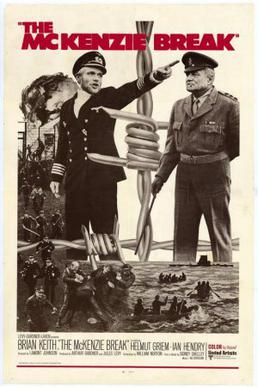
The McKenzie Break

While there have been obvious exceptions, I usually think of WWII prisoner of war movies from the Allied P.O.W.'s perspective. Movies like The Great Escape, Stalag 17, Bridge on the River Kwai among others. The lack of Axis POW movies can be explained with the fact that many prisoners spent the war in the U.S., but I suppose there's a more obvious one. The appeal of prisoner of war movies is the escape. You're rooting for the prisoners to get out. This may just be a personal thing, but unless I'm given some sort of motivation, I ain't rooting for German/Japanese prisoners to escape, like 1970's The McKenzie Break.

It is late in World War II, but the fighting rages on, even in isolated northern Scotland at a German P.O.W. camp in McKenzie commanded by the British, including Major Perry (Ian Hendry). Perry's prisoners are almost exclusively officers -- no enlisted men here -- and thanks to their ranking officer, a U-boat commander, Captain Willi Schlueter (Helmut Griem), those prisoners have organized. While they're still prisoners, they essentially run the camp, Perry unable to enforce even the most basic rules and laws. An Irishman and former journalist working for British Intelligence, Captain Jack Connor (Brian Keith), has been assigned to the McKenzie camp to aid the situation. What exactly are these German prisoners up to? Can Connor figure out their plan before it is unleashed?

As I'm planning what to write here, I'll say this out front. If it comes across poorly or naive, I apologize. I know atrocities were committed on both sides during WWII, but I'm more familiar with those of the German/Japanese forces against Allied prisoners than the other way around. The victors write the history books and all that. So anyways, here goes. Almost all countries signed the Geneva Convention, a document protecting prisoners of war as much as possible, basically treating them like humans. As presented in 'McKenzie' and making it difficult to watch, only so much can be done. German forces always seemed ready to brutally respond to any prisoner issues, but Hendry's Major Perry seems helpless here even when German prisoners physically assault his guards. He makes the point that any action against these prisoners will be taken against Allied prisoners in Germany which is true. Maybe it's just a deeper seeded issue, a more human way of doing your job. At what cost and how far does a country and its people go? Maybe the Germans were just more comfortable in their brutality? Sorry for a somewhat off tangent. Just had to say it.

I've mentioned before, and I'll most likely mention it again, but I'm a sucker for prisoner of war movies. They're unique to war movies because they can focus on the natural tension of the conflict without getting anywhere near the battlefield. Director Lamont Johnson is at the helm of a dreary-looking film (I suppose on-location Ireland doesn't get a lot of sun) that certainly adds some dimension to the story. It is refreshing to see the Allies as the guards and the Germans as the prisoners in this tweak of a familiar story-line. The opening set-piece especially sets the tone, Perry's complete failure at "commanding" his McKenzie camp. Watch it HERE. I kept waiting for the order to fire on the prisoners -- physical assault on guards seems like reason enough -- but the opener does a great job of setting things up. This is not your typical camp where the prisoners meekly assemble and wait out the end of the war, no matter how the war effort is going for the Germans.

Amidst all the bigger picture elements in 'McKenzie' is a simple plot device that is as close to a sure-thing as you can get; a cat and mouse game between two intelligent minds, in this case Keith's Capt. Connor and Griem's Schleuter. Connor knows his German counterpart is up to something, Griem knows Connor is hot on his trail. Keith does a great job in the part, a cynical, honest quasi-soldier who isn't interested in chain of command, honor, bravery, and the so-called glory of war. He's doing his job as if he was a civilian, military protocol be damned. Griem as U-boat commander Schleuter is the villain here, not just an enemy. A devout Nazi and former member of the Hitler Youth, he is an elitist, racist, brutal officer, obsessed with helping the German and Nazi war effort. No cost is too high for this young officer. At one point, he even organizes the murder of one of his own men, a homosexual. The banter between the rival officers is pitch-perfect, neither man letting on how much he knows, both men knowing they're facing a worthy competitor.

Not many other parts really stand out, but Hendry especially does his best. It's not that his Major Perry is a bad officer, but he's at the end of his rope and limited by orders from above. Too bad his character is basically pushed to the side once Connor shows up. Patrick O'Connell does a fine job as Sgt. Major Cox, the head non-commissioned officer who works with Connor and is drawn to his more straightforward approach to handling the issue of how to handle the German prisoners. Even Jack Watson has a small but interesting part as General Kerr, Connor's commander and old friend who wants the problem to be solved quickly, efficiently and quietly. Horst Janson plays Lt. Neuchl, the gay German officer who feels the wrath of his fellow soldiers.

Having watched countless prisoner of war movies, I was a little upset with myself about the conclusion I'd come to. It sounds obvious, I'm not going to root for the Germans to escape, just like I didn't want Hardy Kruger to escape in The One That Got Away. I want Keith's Capt. Connor to get his hands on these guys before they can reach safety. The final 45 minutes pick up the pace as the story reveals more of itself, not just prisoners trying to escape but why they're doing so with orders coming from German High Command. On the other side, Connor sees potential for an impressive coup. Which one will work? The ending is especially clever in its development in this underrated P.O.W. movie.

The McKenzie Break <---trailer/clips (1970): ***/****

Wednesday, June 1, 2011

The Great Escape

I have two favorite movies, neither of which I'm able to pick one over the other.  I love them both, and all other movies come after it, first is 1960's The Alamo which I've reviewed before and then there's 1963's The Great Escape. Introduced to it at a young age when I showed an interest in history, I've probably seen it 25 or 30 times straight through, and another 75 or 100 catching bits and pieces. For me, it is that rare perfect movie. Great story, impressive cast, exciting action, and one of the best soundtracks ever. You can't ask for much more.

In World War II, both the Allies and Axis forces had to deal with how to handle prisoners of wars. In Germany, the Luftwaffe, the German Air Force, was placed in charge of these Allied prisoners, placing them in P.O.W. camps all over their occupied territory. These prisoners -- as was their sworn duty -- tried countless escapes over the length of the war in typically small groups, sometimes getting as many as a dozen out. But one true story set the bar for heroism and courage among the prisoners, the true story of 76 prisoners escaping Stalag Luft III in March 1944. Literally hundreds of prisoners were involved in the effort as the escape even had an impact on D-Day some three months later.

It's 1943, and a new prison camp has been built. The German Luftwaffe has taken the worst prisoners from all their camps and thrown them in this new camp that features all the security aspects they've learned from previous camps.  In this "perfect" camp, the Germans (Hannes Messemer is the commandant) intend to watch these men very carefully. Leading the prisoners is Roger Bartlett (Richard Attenborough), dubbed 'Big X' for his leadership at the top of the 'X Organization,' a team of prisoners working together to bust out as many captured soldiers as they can. Bartlett has bigger plans though this time around. Instead of just getting two or three prisoners out, he intends to get 250 out of the camp with a large-scale plan that includes three extremely long tunnels under the barbed-wire fence. The plan seems impossible, but the prisoners go to work, slowly working their way toward escape.

Do you know the line 'They don't make them like they used to?' This movie applies. Director John Sturges (one of my favorites and an underrated filmmaker overall) turns in his all-time best film, one that stands at or near the top in the lexicon of World War II movies. It is based in fact, sticking to the details and truths in the story, without getting bogged down.  There is action, humor (never overplayed, just natural humor arising from the situation), and characters you love and are generally rooting for. Composer Elmer Bernstein turns in a score that is one of the greats, especially the main theme, listen HERE. Bernstein's score both drives the story as needed and keeps it grounded in the quieter, emotional scenes (including one where a tunnel is discovered and its tragic consequences).  Sturges filmed in Germany -- as his assistant said, 'Germany looks like Germany.' An entire camp was built, an exact duplicate of the actual camp, bringing this 1963 epic up another notch in terms of realism and authenticity.

Sturges' movies were famous for their male-dominated ensemble casts, but this may be his most impressive. Start with Steve McQueen as Hilts, the motorcycle-riding 'Cooler King,' the role that shot him to international stardom. Then there's James Garner as Hendley, the scrounger, and Attenborough as Bartlett, the prisoner's top man, a brilliant mind who comes up with this improbable plan. Not bad, huh? Oh yeah, there's also James Donald as Ramsey, the senior British officer, Charles Bronson and John Leyton as Danny and Willie, the tunnel kings, James Coburn as Sedgwick, the manufacturer, Donald Pleasence as Blythe, the forger, David McCallum as Ashley-Pitt, "dispersal," and Gordon Jackson as MacDonald, the intelligence officer. Other prisoners include Nigel Stock, Jud Taylor and Angus Lennie in a small but essential part as Ives, Hilt's progressively wire-happy partner. A more impressive cast could be impossible to assemble.

What is amazing is that even with all those stars -- some on the rise, some already established -- is that they all register, they all make a lasting impression in a positive way. More on McQueen later, but Attenborough delivers a career-best as Big X, the driven even obsessed leader who wants to take the war back to the Germans, not sitting out the war comfortably as his captors intend. Garner's Hendley bonds with Pleasence's Blythe in some of the movie's most touching scenes, two very different people forming a friendship. Bronson and Leyton as the tunnel kings certainly make an impression, carving three tunnels out of the Earth 30 feet below the surface. Bronson is at his best, a Polish flyer with claustrophobia who hides his fear of small, enclosed spaces and digs. Coburn doesn't get a ton to do compared to the others, but is his usual, laconic self. There is not a weakness in the cast from top to bottom.

When movie fans think of The Great Escape, they usually go right to Steve McQueen, a rising star who got his crack at the big time here and didn't disappoint.  His Capt. Virgil Hilts is one of his most iconic roles, the loner, trouble-making American prisoner who attempts escape attempt after attempt.  What's funny is that his character basically disappears for vast stretches of the movie, only to reappear after a stint in the cooler and steal every scene he is in. This is McQueen at his laid back, scene-stealing best. With all the notable actor's actors around him, he is the unquestioned star thanks in great part to the finale, a motorcycle chase across Germany with his captors in hot pursuit. It is one of the greatest chases sequences ever, caped with one of the most impressive stunts ever, a 7-foot jump by stunt man Bud Ekins over a high-strung barbed-wire fence. McQueen is my favorite, but this is always his best to me.

With a final run-time of 2 hours and 53 minutes, Sturges' true story doesn't have to rush along at a lightning pace...but does anyway. The first 105 minutes or so focus exclusively on the escape attempt, putting all the little details together that need to happen. The first and biggest of course is the digging of the tunnels, 30 feet down and over 300 feet straight out. A track is built to transport prisoners/diggers, and wooden boards are needed to shore up the entire length of the tunnel. Up above, forgers create documents, tailors make clothes, Intelligence gathers information, all part of an elaborate system of security and watchmen to make sure nothing is discovered by their ever-vigilant German guards. It would have been easy for this movie to get bogged down in these details, but The Great Escape revels in them, making the mundane and possibly boring, exciting at a breakneck pace.

It is a movie called 'The Great Escape' though, and it is at its most exciting once the prisoners do escape, 76 of them in the dead of night spread out all over the German countryside. The escape attempt covers the last hour of the movie, an incredible extended sequence that is hard to top. It is almost entirely dialogue free, Bernstein's score playing over the action the whole way. Finally free of their camp, the prisoners make their efforts to hopefully reach freedom, some by train, some by bikes, others by planes, and in Hilts' case, a stolen German motorcycle.  Sturges was an action master, and this may be his tour de force sequence.

I could go on and on with this movie, and I've already sort of done so. My head is full of little tidbits of information that I've picked up over the course of repeated viewings.  Above all else through the drama, the facts, and the action is that Sturges gets the tone right from Paul Brickhill's source novel, and most importantly, the true story it is based on. These men did the impossible in an impossible situation. Knowing their chances of escape back to freedom were slim, they plodded on when they could have just as easily quit. If you didn't know and just read the details -- check out the Wikipedia entry HERE for more details -- you would say there's no way this happened, but somehow, some way, it did. The ending hits you square in the stomach as it should, but the movie ends on a positive note; McQueen's Hilts once again in the cooler, bouncing his baseball off the wall.  You may capture him again, but you'll never stop him from trying.

A perfect movie, one of the best around, and one of my two favorite movies.

The Great Escape <---trailer (1963): ****/****

Wednesday, April 27, 2011

The Way Back

The timing of this review wasn't intentional to go back-to-back on prisoner of war movies, but that's just my bad luck or planning I guess.  To call 2010's The Way Back a prisoner of war movie isn't quite fair though because that only serves as a jumping off point. More than the POW angle, this is a story about survival, about man testing his limits in the hopes of getting back home, trudging through hell and back to get there.  Appropriately enough, it is a good movie (if flawed) and was in theaters for about an hour and a half.  The DVD was released recently, and I was able to finally catch up with it.

As the special features on the DVD point out, the atrocities committed by the Germans in concentration camps during WWII have been well documented.  To the east though in Russia, similar atrocities were committed...we just don't know about it.  It is a little slice of history generally forgotten by the masses as hundreds of Russian gulags kept thousands of people imprisoned through the war.  'Way' is based on a non-fiction book by Slawomir Rawicz called The Long Walk documenting his story of escaping from one of these gulags with six companions and their desperate, even unbelievable, 4,000 mile walk to freedom. The book's accuracy and general honesty has been called into question ever since it was released in the 1950s, but true or not, the story is one worth telling.

Accused of spying and sabotage against Stalin, a young Polish man, Janusz (Jim Sturgess), is sent to a Russian gulag buried deep in Siberia. There he finds hellacious conditions where even the strongest struggle to survive. Seeing no hope, he escapes with six companions, including mysterious American, Smith (Ed Harris), and a Russian criminal from the streets, Valka (Colin Farrell). Short on supplies, food and water, their plan is desperate, but they figure what worse could happen to them back in the camp?  Knowing if they're caught they will be executed, Janusz and his group head south, even picking up a young Polish refugee, Irena (Saoirse Ronan), along the way. As they put hundreds and eventually thousands of miles behind them, they wonder, can they actually escape to some sort of freedom?

On a purely visual level, this is one of the most breathtaking movies you will ever see.  Janusz and his fellow escapees end up traveling over 4,000 miles from deep in Siberia to freedom in India.  Actually look at a map and see how far that is.  It's insane what he accomplished (or claims he accomplished).  We start in the snow-swept mountains of Siberia, wind whipping around at all times, and then move south into the green, rocky hills surrounding Lake Baikal.  Continue on into the wastelands of Mongolia and the Gobi Desert into the Himalayas, one of the biggest mountain ranges in the world.  'Way' is an incredibly beautiful movie to watch, shots composed with an eye to impress and leave that lasting impression. Consider the movie a big winner on that account.

Survival stories are movies and stories at their most basic.  No extra, unnecessary plotlines, no wasted departures, just putting one foot in front of the other and keep on moving. Keep on breathing even though you want to give up. Director Peter Weir has a bare-bones type of story here, men already pushed to their limits forced to go even deeper into their mind, heart and soul to keep going, to push on.  That's good for awhile, but at 133 minutes it isn't always the most interesting story.  By a certain point, you're either rooting for these characters or you're not. I assume it was Weir's intention to beat you over the head, to exhaust you with this survival trial the same way the characters are going through it.  Mission accomplished because at times this is an exhausting story.  I won't say tedious because things don't repeat themselves, but seeing a man plunge to his absolute lowest can only be done so many times.

Before the movie even starts, a title card says that in 1942 three men walked into India having survived a 4,000 mile trek to get there.  I thought it was a poor decision to give that much information away from the get-go, especially because seven people escape the gulag.  We now know four aren't going to make it. It's just a matter of which ones.  Character development is not high on the list of things going for this movie.  Sturgess as Janusz simply isn't given enough information to be a real human being.  He felt like an idea of a character to me.  Harris and Farrell are the scene-stealers, Harris' Smith the most mysterious but also most sympathetic while Farrell's criminal Valka is the most interesting.  SPOILERS When he departs a little over halfway through the movie, my interest level went down END OF SPOILERS  The other four are fairly interchangeable, including Dragos Bucur as Zoran, the funny man and complainer, Alexandru Potocean as Tomasz, the artist, Gustaf Skarsgard as Voss, the priest, and Sebastian Urzendowsky as Kazir. Mark Strong is also very good as Khabarov, but his character gets left behind at the gulag.

Where does this movie fall then?  Above average for sure, but not a classic or one I'd revisit anytime soon.  With on-location shooting in Bulgaria, Morocco and Australia, it would be worth it just to watch the movie as a visual travel guide.  I'm unfamiliar with his other work, but composer Burkhard von Dallwitz does a subtle score that is memorable in its simplicity, its ability to match up so well with the visual. My only suggestion would be to cut about 20 minutes from the movie.  There is so much positive here that I have to recommend it, including a beautiful ending, moving in its execution as everything comes full circle.

The Way Back <---trailer (2010): ***/**** 

Tuesday, April 26, 2011

The Wooden Horse

Since I was introduced to the 1963 classic WWII movie The Great Escape as a kid, I've been a sucker for prisoner of war stories.  I've read books, seen movies, and watched documentaries about the lives of P.O.W.'s -- usually Allied prisoners -- as they fought the war from the inside of prison camps.  The courage shown by these men in continuing to attempt to perform their duty of escaping never ceases to impress me.  In camps specifically built to stop them from escaping, the prisoners concocted unique, innovative, even brilliant plans at getting outside the barbed wire and trying to make their way to freedom.

One of the first movies to show these efforts was 1950's The Wooden Horse, a British film documenting the story of British prisoners in a German prisoner of war camp in 1943. Movies like The Great Escape focused on a mass escape, a whole camp working together. Von Ryan's Express was a completely fictional story of a desperate mass escape that had no basis in reality. Other movies like Bridge on the River Kwai were about more than just prisoners of war, attempting to deliver a message about the war and what it does to its soldiers, bringing up questions of honor and duty. But in the early 1950s, a handful of British movies were almost documentary looks at prisoners of war, like The Colditz Story or here with The Wooden Horse.

A prisoner at Stalag Luft III in Germany, downed British airman Peter (Leo Genn) has seen countless escape attempts fail as the German guards foil most escapes before they can even get outside the barbed wire. His friend and fellow prisoner John (Anthony Steel) comes up with a plan just desperate and idiotic enough to work.  Building a movable gymnastic vaulting platform with a hollow bottom, the prisoners will sneak someone out underneath it into the compound. Then, while other prisoners use the platform as a means of exercise, one prisoner under cover of the platform will dig straight down and then out to the other side of the barbed wire. With some help from their bunkmates, including resourceful Phil (David Tomlinson), they go to work, the slow, dangerous work of moving hundreds and thousands of pounds of sand one bag full at a time. With the slow-going work proceeding at a snail's pace, will the German guards figure out their plan before the tunnel is complete?

There is a whole sub-culture of prisoner of war movies, a culture and knowledge I might take for granted as I write this review or even just talk about the POW movies in general.  Director Jack Lee doesn't have the time, sources, or budget to spend a lot of time giving background on the camp, a few title cards quickly explaining the situation. With nothing to do but sit around, these prisoners had countless hours to come up with plans of escape, and that's what they did.  These German POW camps were built specifically to hold them, the huts built hundreds of feet from the barbed wire so tunnels would be nearly impossible. The huts were built off the ground so sand from said tunnels couldn't be dispersed there. As desperate as it sounds, the 'Wooden Horse' plan was ingenious, and in reality the tunnel under the platform wasn't found until after the escape.

Like a lot of POW movies, it could be easy to get lost in the details of these highly involved, ridiculously detailed escape attempts.  But for 'Wooden Horse,' that's the strength of the movie. One scene shows the tunnel -- moving quite along toward the wire -- collapsing, a small hole opening up in the compound above. The prisoners must frantically think of something to cause a diversion to fill the hole, save their buried bunkmate, keep the German guards away, and do it all just seconds and minutes before roll call.  Perfectly simple in its execution, the scene is a prime example of how to build tension without any gimmicks, just a good twist.  The movie is at its best while in the camp as the tunnel digging gets underway.  A few montages show the tunnel proceeding, a process that ended up taking quite a few months.

What was disappointing is the second half of the movie after the actual attempt -- yes, three prisoners successfully escape.  The trick with these stories is that even getting out of the POW camps was a victory, but a small one.  These camps were hundreds of miles behind enemy lines in Germany and all over Europe.  The escapees now had to get out of a country full of military and intelligence officials frantically searching for them.  Unfortunately, none of the tension was really here after the trio of prisoners escaped, the story following Genn's Peter and Steel's John.  As they search for some means of reaching Sweden, the story even borders on boring when the momentum should be picking up, driving the story forward.  'Horse' limps to the finish, not quite sure where it should end, finishing on a note of dry British humor that didn't hit me right. It seemed too jokey for this type of movie.

No big names here in the cast although I've seen Genn in a few movies and know Tomlinson mostly for his acting in Disney movies, especially The Love Bug and Mary Poppins.  Without any particularly fascinating characters, they still manage to be interesting mostly because you're rooting for them to pull off this impossible escape.  Along with Steel as the bullheaded John, some of the POWs helping with the escape include Michael Goodliffe, Anthony Dawson, David Greene, Patrick Waddington as the Senior British Officer, Peter Burton and Bryan Forbes. I didn't recognize him at the time, but even Peter Finch makes a quick appearance as an Australian prisoner Genn meets in the hospital. No stars in the bunch, but several recognizable faces if you've seen any British movies from the 1950s and 1960s.  A good but somewhat disappointing POW story, one that could have been better, but is still worth a watch because you have to see this escape to believe it. It is available to watch at Youtube, starting HERE.

The Wooden Horse <--- TCM clips (1950): ** 1/2 /****

Sunday, February 6, 2011

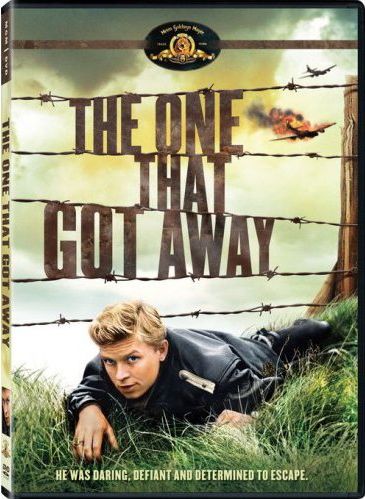
The One That Got Away

Right up there with John Wayne's The Alamo, The Great Escape is my favorite movie (either A or 1-A).  I love Stalag 17, Bridge on the River Kwai, Von Ryan's Express, and I can name a handful of other prisoner of war (P.O.W.) movies that I've stumbled across and really enjoyed.  WWII prisoners of war has always been an interest of mine, but for the most part the only stories I've seen are from the perspective of Allied prisoners captured by the Germans, Japanese, or Italian.

One of the exceptions is 1957's The One That Got Away, the true story of a German flier shot down over England in 1939 and his efforts that followed to escape from British and Canadian POW camps.  A major issue I had with the story is that it was going to be hard to root for this character to succeed.  Was it going to paint the Allies as bumbling idiots who couldn't contain this one individual? He's a German prisoner, am I sure I want his character to get back to Germany?  That ended up being a minor issue compared to one plot element used seconds into the movie.  It gives away the ending before we've even met anyone or the credits rolled. Kind of a momentum killer if you ask me.

It's early in the war in 1939 when German fighter pilot Franz von Werra (Hardy Kruger) is shot down over England and quickly captured by the locals. So early in the fighting, both sides are still figuring out the best way to handle captured soldiers, and Werra intends to take advantage of the situation. Working against him is the fact that he's known as a hero back home in Germany for his actions during combat, and his captors have no intention of letting him do as he plans.  But no matter where they send him, dogged Werra keeps working to escape whether it be in Britain where all he needs to do is get across the English Channel or even into Canada where an ocean will separate him from home and freedom.

A title card opening the movie explains that Franz von Werra was the only German prisoner of war to escape from a Canadian prison camp and return to Germany successfully.  Well, that takes the mystery away a little bit, doesn't it?  It is a movie based on a true story, but it is not a widely known and accepted story.  How many viewers going into this movie would have known that little tidbit of history? Director Roy Ward Baker makes a huge mistake in telling us that information, or at least in my mind he did. Part of the entertainment value from these movies is not knowing who will successfully escape in the end. Who is going to make it? Who will get caught and how? That's not an issue here. Franz von Werra is going to escape. It's only a matter of how.

What I love about The Great Escape is following the efforts of these prisoners as they desperately attempt escapes.  It's exciting, full of tension, and with Elmer Bernstein's score playing over the action, it's some of the best and most suspenseful action sequences I've ever come across.  All that energy, all that tension is missing here for vast stretches of story.  Werra's first escape attempt is an endless stream of him running shots followed by shots of his pursuers chasing him across the same fields. A second escape as he attempts to steal a British fighter and fly it to Germany is a high point of the movie, but it gets lost in a sea of slow-moving escapes.  The finale is painfully slow, and still comes across as rushed when all is said and done.

SPOILERS well, sort of SPOILERS So yes, von Werra escapes by making it to a then-neutral United States.  The movie closes with him being rescued after crossing a frozen over St. Laurence River only to have a title card explain what happened next.  The German pilot meets with some roadblocks only to escape into Mexico, Central America and South America before returning to Germany...only to go missing a year later in a flight in the north Atlantic.  For a movie that already clocks in at 110 minutes (and is sluggish at that length), it's an odd ending.  My first thought was that a whole movie about the closing explanation would have been miles ahead of the rest of the movie in terms of excitement levels.  Instead, the story is a series of vignettes that don't add up to much overall.

With his name the only one above the title, Kruger is the going away star here.  The British cast is not impressive with roles that are necessary for the sake of the story but not particularly interesting (sorry Colin Gordon and Michael Goodliffe, among others). The problem with the von Werra character is that regardless of his cultural/ethnicity background, German, British, American, he isn't likable.  He's too cocky, too sure of himself.  Kruger excelled in these roles and does a fine job here, but at no point was I rooting for him to pull off a successful escape.  It's an average movie based on facts that could have been interesting but never gels quite like it should. Give it a try if curious at Youtube, starting with Part 1 of 10.

The One That Got Away (1957): **/****

Saturday, December 25, 2010

Three Came Home

With all the World War II movies I’ve seen, some of my favorites have been prisoner of war stories. My favorite all-time movie is The Great Escape, but there’s also Bridge on the River Kwai, Stalag 17, and King Rat among others. They all share a common link though beyond just P.O.W.’s, and that’s that all the prisoners are males.  Well, not all of them, like 1950’s Three Came Home.

Time to hit all you loyal readers with a history lesson. Regardless of who was your captor during World War II, the experience was no doubt a hellish one. But it was a relative hell if that makes any sense. Germany signed the Geneva Convention which listed certain requirements for the treatment of prisoners.  The United States and many other countries also signed FYI. One country that didn’t? Good old Japan, basically giving the Japanese free reign to treat prisoners however they so chose. Add in the cultural belief that to be taken prisoner was a slight on who you were as a person, and prisoners of war in Japanese POW camps were a step far below most other experiences. And if you were a woman? God help you.

It’s 1941 in Borneo and American writer Agnes Newton Keith (Claudette Colbert) lives peacefully with her husband Harry (Patric Knowles) and 4-year old son, George (Mark Keuning). The Japanese are advancing though, and Borneo is on their path to dominance. It’s not long before they arrive, throwing all British and American civilians into prison camps throughout the countryside. Agnes and George are separated from Harry and thrown into a different camp that while unpleasant is not under the worst conditions. It’s not long before all the surviving prisoners are moved to a harsher camp where survival is that much more difficult. Through it all though, Agnes wants to survive and be reunited with her family as a whole.

Just the other day I reviewed a WWII movie heavy on the propaganda in 1943’s Air Force. What can be hard to distinguish when dealing with propaganda movies is the enemy side and their portrayal.  Now by all accounts, the Japanese and their war crimes didn’t need to be exaggerated. Whether in battle or in their treatment of prisoners, the Japanese were brutal both in victory or defeat. Prisoners captured in the heat of battle were often brutally slaughtered, and those unlucky enough to survive getting to the prison camps lived in horrific conditions with little to no medical treatment and less in the way of food and clothes. That’s not to say there weren’t war crimes committed by all sides, but the Japanese were almost certainly the worst. So translate this to movies released in 1950s, the portrayals were often toned-down, not showing what the actual experience was like.

I guess that was my issue with Three Came Home, a solid movie that never rises to anything on a special level. Yes, the experiences these men and women went through were horrific, but mostly we hear how bad all these things are without actually seeing them. Besides one incident where a Japanese guard tries to rape her, Colbert’s Agnes doesn’t experience anything worse than the mystery of whether her husband has survived. Food is limited, and living conditions are obviously leave something to be desired, but as a viewer you never get a real sense of how bad life in a prison camp as a woman really was. Is that the fault of the censors, or did the screenplay just not show the P.O.W. experience and how horrific it was?

Going into this movie, my only other experience (a good one at that) with Colbert was Drums Along the Mohawk. Well, I’ve now seen two good parts for the lovely Claudette Colbert. This isn’t the portrayal of a gung-ho mother trying to take the war back at the Japanese. In fact, the actual war is an afterthought here, seeming like a long way away from the conflict at hand. This is a woman pulled away from the life she loves, now reduced to just surviving and making sure her young son has everything he needs so that can he survive and grow up to. All the while, she goes forward with the hope and not the knowledge that her husband is somehow doing the same, surviving through all the hell in front of him.

With a link to another classic POW movie, The Bridge on the River Kwai, is Sessue Hayakawa as the regional commandant of all the prison camps. This is a very humane portrayal of a man that in many other movies would have been demonized.  In River Kwai, his Colonel Saito is a fair and balanced portrayal of a man under pressure. The same goes here, a commander in an uncompromising situation trying to make the best of it, and for everyone, not just him and his men. But overall – even considering the time it was released in – I would have made a harsher movie, one that dug deeper into the prisoner of war experience. Still, it's a good movie, and one you can watch at Youtube HERE.

Three Came Home <---TCM clips (1950):** 1/2 /****

Monday, November 15, 2010

The Colditz Story

I started reading about history pretty early in grammar school and never really stopped.  I was introduced early to The Great Escape -- the book and the movie -- and 40 or 50 viewings later, it is still one of my two favorite movies.  The story of Allied prisoners of war during WWII has translated well to both book form and movies in the 60-plus years since the end of the war, some more well known than others.  I've seen a fair share -- Bridge on the River Kwai, Stalag 17, King Rat -- among others, but I always keep an eye out for ones I've missed, including 1955's The Colditz Story.

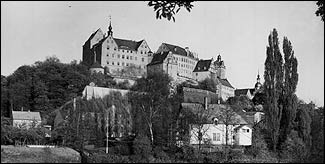
Like The Great Escape, this WWII P.O.W story is based on the actual escape attempts of the prisoners from their German captors.  The start of the WWII brought up the question for both sides; what to do with captured prisoners? The Geneva Convention provided for the treatment of prisoners, but there was still the matter of housing and feeding the thousands of prisoners on either side.  A prisoner's right and responsibility was to try and escape so the German Luftwaffe was forced to improvise.  One of the most infamous prison camps was in the town of Colditz in the Colditz Castle, a medieval building reserved for only those prisoners dubbed the most dangerous, those most likely to escape. A recipe for a successful POW movie if there ever was.

It's summer 1940 and two British officers, Captain Pat Reid (John Mills) and Mac McGill (Christopher Rhodes), have been captured by the Germans and sent to the prison camp at Colditz Castle deep in Germany. There they find only two other British officers, Pat Tyler (Lionel Jeffries) and Jimmy Winslow (Bryan Forbes), who they quickly hit it off with.  It's not long before truckloads of new prisoners arrive, including a senior British officer, Colonel Richmond (Eric Portman), who doesn't seem interested in escaping. In the crowded supposedly inescapable prison, the Brits go to work on their escape attempts, but coupled with the efforts of the French, Poles, and Dutch, end up stepping on each others toes.  With help from Richmond, the diverse group of prisoners begin to work together in their escape plans, all with the hopes of someone hitting a "home run" and making it all the way to Switzerland.

Mostly known and respected for some of the earliest and best James Bond movies, director Guy Hamilton makes an entertaining, somewhat atypical war movie here. For being supposedly an inescapable prison, Colditz actually had its fair share of successful escapes over the course of WWII so right off the start Hamilton is working with a story that maybe -- just maybe -- could end on a positive note.  The movie was filmed on location in Colditz (a nice touch), but I'm not sure how much and where.  Regardless, it gives the story an air of authenticity as we're seeing the actual buildings these events took place in.  Mills' character Pat Reid was an actual escapee from Colditz and wrote several books about his time in the prison so the story feels truthful and authentic in dealing with the facts.

Like other POW movies focusing on escape, the story isn't the most linear thing around.  It tends to bounce from escape attempt to escape attempt rather than focusing on one specific plan devised by the prisoners.  This could have ended with a bloated, overlong movie, but at just 97 minutes, Hamilton picked an appropriate run time.  He wastes little time early on, introducing his characters and the setting and moves on to what viewers want to see; the Allied prisoners cleverly trying to escape from their German captors.  Just the sheer audacity in which these prisoners make their attempts is impressive.  They had no fear, no worries about consequences and repercussions.  Watch one stupidly brave attempt HERE. These prisoners would try anything to escape, and that's maybe the most amazing thing about the story of this movie. These things actually happened.

Telling the story of a multinational group of Allied prisoners allows Hamilton to assemble a cast of multinational talent to fill out his ranks.  Mills leads the heavily British cast as Pat Reid, a prisoner who becomes "escape officer," basically a coordinator of escapes who by taking the position agrees not to attempt an escape on his own.  I like Mills as an actor on-screen because he has a knack for making his characters likable with little effort, and his Reid definitely is a prisoner you're rooting for.  Portman as Colonel Richmond too is a scene-stealer, the stiff upper lip British officer who'd like nothing more than to break out as many prisoners as possible.  Rhodes, Jeffries and Forbes are all solid as fellow British prisoners, especially Rhodes as a prisoner who may be too tall to escape.  Frederick Valk plays the German commandant at Colditz and Denis Shaw plays Priem, a German ferret assigned with rooting out any and all escape attempts.

Because of my love for The Great Escape, I'm a sucker for like-minded movies like this one.  It was a British production so it is not well known outside of England, but because it deals with the facts of being a WWII prisoner, it's easy to see the blueprint it laid out for prisoner of war movies yet to come.  Filmed in a stark black and white on location in Colditz, this flick doesn't do anything great and isn't as flashy as The Great Escape or epic as River Kwai.  But it is the truth in the story it tells that makes this movie worthwhile.

The Colditz Story <----opening 9 minutes (1955): ***/****