When you're talking about great prisoner of war movies, that conversation is inevitably going to come down to two movies. For me, it's an easy distinction, an easy pick for which one is the best. That's one of my two favorite movies ever, 1963's The Great Escape. What's the other classic P.O.W. film? One of Hollywood's all-time greats, 1957's The Bridge on the River Kwai.
It's 1943 in western Burma and a battalion of British prisoners has arrived at Camp 16 along the Burma Railway. Allied prisoners are being used all along the railway to help build the tracks and bridges it needs to move supplies up and down the country. The commandant of the camp, Colonel Saito (Sessue Hayakawa), has been given a quick deadline in order to build a bridge over the river Kwai, but he quickly hits a roadblock in the form of the ranking officer among the Brits, Colonel Nicholson (Alec Guinness). Both men are career officers, both of them stubborn and strong-willed that they know what is right and how to do it. What follows is a battle of wills as the two commanders see who will crack first with the deadline fast approaching. Unbeknownst to both of them, Allied intelligence has caught wind of the bridge across the river. A former prisoner, Shears (William Holden), of the camp is working with an experienced commando, Warden (Jack Hawkins), to lead a team back into Burma and take out the bridge.
That David Lean, he was a halfway decent director, winning two Best Picture Oscars in his storied career. One win was for Lawrence of Arabia. One was for River Kwai. My favorite? You're reading that movie's review right now. It is a film remembered as one of the all-time greats, and it deserves that status. The portrayal of war, its message about war, the instantly recognizable Colonel Bogey March (listen HERE), the phenomenal casting, the on-location shooting in Ceylon (Sri Lanka), the gorgeous filmography, and a great musical score overall from Malcolm Arnold. The scale is gigantic, but the story remains personal. It is a giant movie with an ability to never lose its focus or get too far away from where it wants to go. On my most recent viewing, I thought (more than I remember) there were some slow/sluggish portions in the 161-minute movie but not nearly enough to fault an otherwise pretty perfect movie.
The name evades me, but I remember seeing another British actor say in an interview "I didn't understand the Nicholson part until I saw Guinness' performance." That's how good Alec Guinness is in his Oscar-winning performance. This is an incredible acting job, a layered character that is baffling at times to understand. Colonel Nicholson is a fascinating character because his word, his beliefs and his stubborn make-up are everything to him. If he believes he is right, he IS right. This is a career soldier willing to put his life on the line to stand by his beliefs. A career officer, he knows nothing else other than the army. His dynamic with Hayakawa's Col. Saito is the guts of the movie, two officers believing they're right and seeing who will blink first. Who needs the other more to accomplish their goal? A late scene where Guinness' Nicholson discussing his career illuminates what drives the man. He wants to leave something that will be remembered. He does, but what if it helps the Japanese war effort?
What a cast! Guinness rightfully deserves first mention, but that's only the start. William Holden's character, Shears, is underwritten some, but it is a necessary, still very interesting character to move the action along. Holden is one of my favorites, and I liked his Shears, especially when a big twist is revealed near the halfway point. Jack Hawkins is just solid as Warden, the unlikely commando officer, an interesting similarity to Nicholson in the very, very British officer category. Hayakawa at times gets lost in the conversation, but he too is highly memorable as Saito, rough facade, terrified/worried inside at a possible failure. James Donald (also starring in The Great Escape) is the viewer, playing Major Clipton, the medical officer, trying to figure things out, to understand what's going on. Also worth mentioning is Geoffrey Horne as Joyce, the young, inexperienced commando trying to prove he can handle the job.
Also look for Andre Morell as Colonel Green, a key officer in Force 316, and Percy Herbert and Harold Goodwin as two British soldiers in the camp, Grogan and Baker.
Without resorting to hitting us over the head with a message, Lean does an understated job of delivering an anti-war message. What is it? Well....war is crazy. This isn't a horrifically violent movie, and the portrayals of a Japanese P.O.W. camp are pretty tame, but 'Kwai' effortlessly lays out all these different responses to war. Shears = Survival. Warden = A job. Clipton = Chaos and confusion. And Nicholson? A career. There are some moments of humor, usually pretty dark, mostly cynical, but Lean's movie (working off a novel by Pierre Boulle) presents the lunacy of war and simply lets it breathe. Decide for yourself who is right, if anyone.
So let's talk about that ending. No real SPOILERS here, but still, I'm talking (hopefully vaguely) about the finale. Great movie overall, one of the best ever. The ending to 'Kwai' is maybe top 5 finales to a movie ever as Force 316 (Warden, Shears, Joyce, a Siamese guerrilla and several Siamese girls) attempts to destroy the bridge at its grand opening. With nothing given away, there's a twist that is too perfect to describe. The last 35-40 minutes are phenomenal, and it only gets stronger in the final 15 minutes when the twist is revealed. Talk about tension built to an almost unbearable level. You can't believe what you're seeing, especially when Nicholson makes an amazing decision. It is a finale that leaves you drained and hammers home Lean's anti-war message. In the end, what is accomplished and at what cost? Boulle's finale is a doozy, a true whopper, if you read the novel.
Sometimes movies just work, a synergy of everything assembled clicking together. It is a beautiful movie, and Arnold's score works in unison with that visual, especially when Warden, Shears, Joyce and Co. finally arrive deep in the jungle at the bridge site. It is the first time we're seeing the completed bridge, and there's something simple and beautiful about the structure. Arnold's score soars, and all the pieces fit together. I think that's the beauty of it. This is my favorite David Lean movie overall, and it deserves its status as an all-time classic.
The Bridge on the River Kwai (1957): ****/****
The Sons of Katie Elder
"First, we reunite, then find Ma and Pa's killer...then read some reviews."
Showing posts with label Sessue Hayakawa. Show all posts
Wednesday, November 26, 2014
Sunday, February 26, 2012
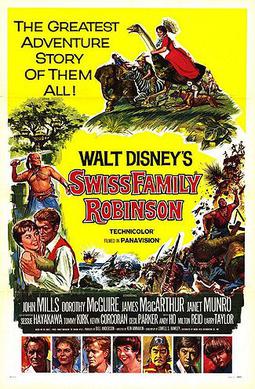
Swiss Family Robinson
Traveling to the colony of New Guinea, the Robinson family is aboard a ship caught up in a storm that wrecks the ship on a reef, the crew abandoning the ship and leaving the family to fend for themselves. Thankfully, an island is within sight, and the Robinsons -- including Father (John Mills), Mother (Dorothy McGuire), and their three sons, Fritz (James MacArthur), Ernst (Tommy Kirk) and Francis (Kevin Corcoran) -- are able to make it their with all the supplies, food and animals left onboard. Not knowing if rescue is coming, they make the most of their island paradise, embracing their new lives. But on this Pacific island full of animals and adventures, trouble awaits too including a pirate band (led by Sessue Hayakawa) who are after something the Robinsons possess.
In the current state and age of Disney with seemingly countless animated movies and generic shows on TV, it's hard to imagine Walt Disney movies of the 1950s and 1960s. Yes, it was a completely different time from now, a more innocent time, and because of that, movies like Swiss Family Robinson have an endearing charm that is hard to explain. It is an adventure, a trip to the exotic and is the definition of good, old-fashioned storytelling that is best accompanied by a big tub of popcorn. Everything from the musical score in all its epic, sweeping qualities (listen HERE, just scroll down) to the casting to the look of the movie adds up. They don't make them like this anymore, simple as that. It's a window to a Disney of the past when high-quality, professionally made and still entertaining feature films were released to adoring audiences.
One of the obvious appeals of 'Swiss' is that any kid who has ever read Robinson Crusoe or has the slightest bit of imagination has at some point wondered how cool it would be to live on a deserted island. Albeit this "deserted" island has plenty of food, water and supplies with lots of animals (elephants, tigers, zebras, ostriches) and adventure waiting around every tree. The coolest thing EVER though is the treehouse the Robinsons build and live in, an idyllic house in the branches that all viewers should want to live in. If you don't, you're lying. Get over it. HERE is the Disney's Magic Kingdom version. Director Ken Annakin shot this movie on the island of Tobago, and it is a stunning visual film. It is the island paradise we all dream of one day living on at some point. The screen is always full of incredible colors -- even the pirates seem fashion conscious -- and is a treat just to look at. To a point, everything else is just gravy.
An underrated facet of this movie's long-term popularity and success is the casting of the Robinson family using some Disney regulars and a few newbies. For starters, I believed this tiny, close-knit group as a family. They look out for each other, they fight, they celebrate holidays, and when needed band together to preserve their island paradise. John Mills and Dorothy McGuire are the quintessential parents, Father and Mother, no first names provided or needed. They just go together, an easy-going, believable chemistry between them. The boys include MacArthur as the athletic but smart Fritz, the intelligent and always trying to prove himself Ernst played by Kirk, and the curious, sometimes annoying Francis played by Corcoran, all three regulars in Disney movies. All five work together seamlessly, and then add in the adorable Janet Munro as Roberta, a teenage girl Fritz and Ernst rescue from pirates while exploring the island.
Growing up watching this movie on a regular basis, a long list of scenes were memorable to me, but none more than the finale when the Robinson family defends their island against a raiding party of pirates. It's the type of adventure where you never really believe they're in danger (would a Disney movie kill this family? I think not), but it doesn't take away from the excitement. Coconut bombs, pirate alarms, a pit filled with a tiger, a collapsing bridge, avalanches of logs and boulders, and booby traps left and right. All pretty ridiculous, and that's the fun. Reality got left behind a long time ago here. It is a great ending, the movie ending on a very positive note.
I could go on for paragraph after paragraph with this movie. Yes, Corcoran's Francis is annoying, but even that can't stop me from loving this movie. It is a gem, a classic, a keeper, whatever you want to call it. Great cast, great story, and one of the most fun, entertaining movies ever. Adventures with that Disney touch at its finest. You can watch it HERE at Youtube, starting with Part 1 of 10.
Swiss Family Robinson <---trailer (1960): ****/****
Friday, September 9, 2011
Tokyo Joe
It's amazing the stories you can find out about if you just do a little digging. That was certainly the case for me after watching 1949's Tokyo Joe. I liked the movie enough but was looking for something -- anything really -- to write about. The movie's main villain is played by Japanese actor Sessue Hayakawa, probably most well known for his roles in movies like The Bridge on the River Kwai and Swiss Family Robinson. Caught in France during WWII, the actor worked with the French Resistance to help rescue downed Allied fighters. He still worked in films during this time -- making the resistance involvement somewhat dubious in my head -- but his return to Hollywood films came in Tokyo Joe.
The background about the making of the movie is as interesting if not more so than the actual finished product. Along with Hayakawa's return to American films, this Columbia Pictures drama was the first movie to film in a post WWII and still war-torn Tokyo. Well, sort of filmed. For the most part, any scene with actual members of the cast was filmed in the Columbia backlot in Hollywood, but a film crew was sent to Tokyo to get second unit footage to help set the scene. In other words, we get covered up stunt doubles made to dress up like the cast which is then awkwardly transitioned to actual footage of the cast. Still, the actual Tokyo footage is pretty crazy to watch, an eerie look at a city still recovering from World War II.
As Japan recovers from WWII with U.S. occupation forces helping the process along, a former Colonel, Joe Barrett (Humphrey Bogart), arrives in Tokyo looking to start up his business that he was forced to abandon at the outbreak of the war some four years earlier. Before the war, he ran a successful, very popular bar in the city, but now finds himself working against the current as no one is able to get him through miles of red tape. Joe finds out his wife, Trina (Florence Marly), who he believed was killed in the war is very much alive, and is now married to an American bureaucrat, Mark Landis (Alexander Knox). Some shady Japanese underground and black market dealers (including Hayakawa) have some dirt on Trina, and only Joe can keep it under wraps, going to work for the dealers transporting illegal goods into the country via a surplus plane. Joe knows he's in over his head, but he has no other alternative, even if a confrontation is coming his way.
A pissed off Bogie in post World War II Tokyo with a score to settle was all I really needed to hear when this movie popped up on TCM's schedule recently. The 1940s were Bogart's decade, and his performance is the best thing going for this story, but other than that it doesn't have much going for it. My picture of director Stuart Heisler making this movie is a man spinning countless plates and seeing which ones stay up the longest. Anything left standing makes the final cut, and there are a lot of plates. As the story figures out where to go -- and the movie's only 88 minutes long to begin with -- as everything is introduced, the pacing suffers. The first 45 minutes border on straight boredom. The last 45 minutes or so do salvage things as best as possible, but the movie on the whole is a mixed bag.
Released in 1949 and the first movie to film in Tokyo since the end of the war, there is still a feeling of American propaganda here. Certain scenes seem written up by a government official to convince an American audience how noble our actions are in helping the country recover after defeating the Japanese in a brutal war that they had started. On the other hand, the script actually tries to portray the Japanese people as just that, people. We're talking two radically different cultures here, and the Japanese culture does not have the compassion in victory that the U.S. had. So when American forces occupied the country and tried to improve the situation, some Japanese were obviously confused and embarrassed. Thankfully, there isn't much in the way of pandering though, and it felt like a genuine effort to educate and teach as opposed to manipulate and trick an audience.
No one does the tortured, tragic tough guy lead quite like Humphrey Bogart. In a performance that isn't remembered among his best -- more so a judgment of the movie, not his acting -- he does what he does best. Bogie is tough as nails, but in a departure from so many of his other roles, we get to see a softer side of him. This is especially true when he finds out he has a seven-year old daughter, Anya (Lora Lee Michel). He has no idea how to be a father or even interact with the little girl, but he wants to and he at least makes an effort. Torn up inside over how he had to abandon Trina during the war, Jim is trying to right a wrong however he can. A more understated performance from Bogart than you might be used to, but a good one still.
As mentioned earlier, I enjoyed the second half of the movie leaps and bounds ahead of the first half. The drama and action kicks in with the story pointing in the right direction, knowing where it wants to go. Working with U.S. Intelligence, Joe realizes he's stumbled onto a plan to see a Japanese resistance group of angry WWII vets rise up all over Japan. Throw in his daughter being kidnapped as a bargaining chip, and you've got one pissed off Dad working against a clock. While the ending is cut and dry as to exactly what happens, I think it was pretty clear what happens. It is an appropriate ending for a movie from the 1940s, one that is pretty easy to see coming if you think things through.
Other than Bogart, Hayakawa is the only instantly recognizable face here (for me at least). He's a pretty cliched, stereotypical Asian villain, but that's what he did best in the second half of his career. He's one bad dude, and because it is 1949, he's going to get hit with a wall of karma in a big way. Knox is the cold American official while Marly looks almost skeletal as Bogie's squeeze, Trina. Their chemistry is lacking something too which is unfair because of how easy Bogie made it look with Ingrid Bergman or Lauren Bacall. Teru Shimada has a good supporting part too as Ito, Joe's business partner in running the bar, a middle-aged Japanese man trying to come to terms with everything that's happened during and since the end of the war. It's a decent movie limited by its flaws, but it is still Humphrey Bogart, and that's hard to beat.
Tokyo Joe <---TCM clips (1949): ** 1/2 /****
The background about the making of the movie is as interesting if not more so than the actual finished product. Along with Hayakawa's return to American films, this Columbia Pictures drama was the first movie to film in a post WWII and still war-torn Tokyo. Well, sort of filmed. For the most part, any scene with actual members of the cast was filmed in the Columbia backlot in Hollywood, but a film crew was sent to Tokyo to get second unit footage to help set the scene. In other words, we get covered up stunt doubles made to dress up like the cast which is then awkwardly transitioned to actual footage of the cast. Still, the actual Tokyo footage is pretty crazy to watch, an eerie look at a city still recovering from World War II.
As Japan recovers from WWII with U.S. occupation forces helping the process along, a former Colonel, Joe Barrett (Humphrey Bogart), arrives in Tokyo looking to start up his business that he was forced to abandon at the outbreak of the war some four years earlier. Before the war, he ran a successful, very popular bar in the city, but now finds himself working against the current as no one is able to get him through miles of red tape. Joe finds out his wife, Trina (Florence Marly), who he believed was killed in the war is very much alive, and is now married to an American bureaucrat, Mark Landis (Alexander Knox). Some shady Japanese underground and black market dealers (including Hayakawa) have some dirt on Trina, and only Joe can keep it under wraps, going to work for the dealers transporting illegal goods into the country via a surplus plane. Joe knows he's in over his head, but he has no other alternative, even if a confrontation is coming his way.
A pissed off Bogie in post World War II Tokyo with a score to settle was all I really needed to hear when this movie popped up on TCM's schedule recently. The 1940s were Bogart's decade, and his performance is the best thing going for this story, but other than that it doesn't have much going for it. My picture of director Stuart Heisler making this movie is a man spinning countless plates and seeing which ones stay up the longest. Anything left standing makes the final cut, and there are a lot of plates. As the story figures out where to go -- and the movie's only 88 minutes long to begin with -- as everything is introduced, the pacing suffers. The first 45 minutes border on straight boredom. The last 45 minutes or so do salvage things as best as possible, but the movie on the whole is a mixed bag.
Released in 1949 and the first movie to film in Tokyo since the end of the war, there is still a feeling of American propaganda here. Certain scenes seem written up by a government official to convince an American audience how noble our actions are in helping the country recover after defeating the Japanese in a brutal war that they had started. On the other hand, the script actually tries to portray the Japanese people as just that, people. We're talking two radically different cultures here, and the Japanese culture does not have the compassion in victory that the U.S. had. So when American forces occupied the country and tried to improve the situation, some Japanese were obviously confused and embarrassed. Thankfully, there isn't much in the way of pandering though, and it felt like a genuine effort to educate and teach as opposed to manipulate and trick an audience.
No one does the tortured, tragic tough guy lead quite like Humphrey Bogart. In a performance that isn't remembered among his best -- more so a judgment of the movie, not his acting -- he does what he does best. Bogie is tough as nails, but in a departure from so many of his other roles, we get to see a softer side of him. This is especially true when he finds out he has a seven-year old daughter, Anya (Lora Lee Michel). He has no idea how to be a father or even interact with the little girl, but he wants to and he at least makes an effort. Torn up inside over how he had to abandon Trina during the war, Jim is trying to right a wrong however he can. A more understated performance from Bogart than you might be used to, but a good one still.
As mentioned earlier, I enjoyed the second half of the movie leaps and bounds ahead of the first half. The drama and action kicks in with the story pointing in the right direction, knowing where it wants to go. Working with U.S. Intelligence, Joe realizes he's stumbled onto a plan to see a Japanese resistance group of angry WWII vets rise up all over Japan. Throw in his daughter being kidnapped as a bargaining chip, and you've got one pissed off Dad working against a clock. While the ending is cut and dry as to exactly what happens, I think it was pretty clear what happens. It is an appropriate ending for a movie from the 1940s, one that is pretty easy to see coming if you think things through.
Other than Bogart, Hayakawa is the only instantly recognizable face here (for me at least). He's a pretty cliched, stereotypical Asian villain, but that's what he did best in the second half of his career. He's one bad dude, and because it is 1949, he's going to get hit with a wall of karma in a big way. Knox is the cold American official while Marly looks almost skeletal as Bogie's squeeze, Trina. Their chemistry is lacking something too which is unfair because of how easy Bogie made it look with Ingrid Bergman or Lauren Bacall. Teru Shimada has a good supporting part too as Ito, Joe's business partner in running the bar, a middle-aged Japanese man trying to come to terms with everything that's happened during and since the end of the war. It's a decent movie limited by its flaws, but it is still Humphrey Bogart, and that's hard to beat.
Tokyo Joe <---TCM clips (1949): ** 1/2 /****
Saturday, December 25, 2010
Three Came Home
With all the World War II movies I’ve seen, some of my favorites have been prisoner of war stories. My favorite all-time movie is The Great Escape, but there’s also Bridge on the River Kwai, Stalag 17, and King Rat among others. They all share a common link though beyond just P.O.W.’s, and that’s that all the prisoners are males. Well, not all of them, like 1950’s Three Came Home.
Time to hit all you loyal readers with a history lesson. Regardless of who was your captor during World War II, the experience was no doubt a hellish one. But it was a relative hell if that makes any sense. Germany signed the Geneva Convention which listed certain requirements for the treatment of prisoners. The United States and many other countries also signed FYI. One country that didn’t? Good old Japan, basically giving the Japanese free reign to treat prisoners however they so chose. Add in the cultural belief that to be taken prisoner was a slight on who you were as a person, and prisoners of war in Japanese POW camps were a step far below most other experiences. And if you were a woman? God help you.
It’s 1941 in Borneo and American writer Agnes Newton Keith (Claudette Colbert) lives peacefully with her husband Harry (Patric Knowles) and 4-year old son, George (Mark Keuning). The Japanese are advancing though, and Borneo is on their path to dominance. It’s not long before they arrive, throwing all British and American civilians into prison camps throughout the countryside. Agnes and George are separated from Harry and thrown into a different camp that while unpleasant is not under the worst conditions. It’s not long before all the surviving prisoners are moved to a harsher camp where survival is that much more difficult. Through it all though, Agnes wants to survive and be reunited with her family as a whole.
Just the other day I reviewed a WWII movie heavy on the propaganda in 1943’s Air Force. What can be hard to distinguish when dealing with propaganda movies is the enemy side and their portrayal. Now by all accounts, the Japanese and their war crimes didn’t need to be exaggerated. Whether in battle or in their treatment of prisoners, the Japanese were brutal both in victory or defeat. Prisoners captured in the heat of battle were often brutally slaughtered, and those unlucky enough to survive getting to the prison camps lived in horrific conditions with little to no medical treatment and less in the way of food and clothes. That’s not to say there weren’t war crimes committed by all sides, but the Japanese were almost certainly the worst. So translate this to movies released in 1950s, the portrayals were often toned-down, not showing what the actual experience was like.
I guess that was my issue with Three Came Home, a solid movie that never rises to anything on a special level. Yes, the experiences these men and women went through were horrific, but mostly we hear how bad all these things are without actually seeing them. Besides one incident where a Japanese guard tries to rape her, Colbert’s Agnes doesn’t experience anything worse than the mystery of whether her husband has survived. Food is limited, and living conditions are obviously leave something to be desired, but as a viewer you never get a real sense of how bad life in a prison camp as a woman really was. Is that the fault of the censors, or did the screenplay just not show the P.O.W. experience and how horrific it was?
Going into this movie, my only other experience (a good one at that) with Colbert was Drums Along the Mohawk. Well, I’ve now seen two good parts for the lovely Claudette Colbert. This isn’t the portrayal of a gung-ho mother trying to take the war back at the Japanese. In fact, the actual war is an afterthought here, seeming like a long way away from the conflict at hand. This is a woman pulled away from the life she loves, now reduced to just surviving and making sure her young son has everything he needs so that can he survive and grow up to. All the while, she goes forward with the hope and not the knowledge that her husband is somehow doing the same, surviving through all the hell in front of him.
With a link to another classic POW movie, The Bridge on the River Kwai, is Sessue Hayakawa as the regional commandant of all the prison camps. This is a very humane portrayal of a man that in many other movies would have been demonized. In River Kwai, his Colonel Saito is a fair and balanced portrayal of a man under pressure. The same goes here, a commander in an uncompromising situation trying to make the best of it, and for everyone, not just him and his men. But overall – even considering the time it was released in – I would have made a harsher movie, one that dug deeper into the prisoner of war experience. Still, it's a good movie, and one you can watch at Youtube HERE.
Labels:
1950s,
Claudette Colbert,
Prisoners of War,
Sessue Hayakawa,
WWII
Subscribe to:
Posts (Atom)