The Sons of Katie Elder

The Sons of Katie Elder
"First, we reunite, then find Ma and Pa's killer...then read some reviews."
Showing posts with label Brian Donlevy. Show all posts

Friday, November 15, 2013

Hostile Guns

The name A.C. Lyles doesn't exactly ring a bell with famous western directors/producers. He's no John Ford, no Budd Boetticher, no Sergio Leone. Why no notoriety? Short answer? He didn't produce any classics, maybe not even any just old fashioned, good flicks. I caught 1967's Hostile Guns on a recent airing on a movie channel -- a Lyles production -- and let's just say it's.....well....not so good.

Readying to transport prisoners to the Huntsville Prison, Marshall Gid McCool (George Montgomery) is struggling to find a deputy willing to travel with him. No one is willing to take on the dangerous job -- even if it pays well -- until McCool meets Mike Reno (Tab Hunter), a young, fiery cowboy thrown into a jail cell for starting a fight in the town's saloon. With the promise of $50 for his services, Reno agrees, signing on as a deputy and immediately slugs it out with the prisoner they're transporting, a convicted murderer, Hank Pleasant (Leo Gordon), who intends to make the trip just as difficult as possible. With a specially outfitted wagon, McCool and Reno head out on the trail, picking up prisoners as they go at different stops on the way to Huntsville, including a female prisoner, Laura Mannon (Yvonne De Carlo), another convicted murderer. The new arrival may be the least of their concerns though, both McCool and Reno quickly realizing they're being followed. Who's trailing them?

I guess it should have clicked for me early on. I've been watching westerns since I was a little kid, and when this one popped up on the TV schedule, I should have put it together. At no point in my tries to watch as many westerns as I can had I ever come across this western from director R.G. Springsteen. No mention, N-O-N-E, for good or bad. Nonetheless, I plodded on. After all, it sounded promising with a more than respectable cast. Yeah, that's about all it's good. This is a western that at 91 minutes reeks of cheapness. I'm thinking total budget here couldn't have been more than a couple bucks here and there, and that money went to assembling the cast, the best thing going here by far. Where to start, where to start?

Made on a small budget doesn't/shouldn't be a deal breaker. On the contrary, it can be nothing but a positive. For 'Hostile' though, huge stretches of the already dull 91-minute flick is simply shots of McCool, Reno and the wagon riding through the rocky, desert mountains. Then, we get a follow-up shot of their pursuers. I swear the angles of the shot were tweaked because it felt like I saw the same rock formation one time after another. Same for the follow-up shot of those evil bad guys!!! My personal favorite in the Badness Department is the fight scenes. Usually a halfway decent movie does its best to delicately transition the shots of the stunt doubles fighting with those of the actors "fighting." This was almost amateurish in that department. Not only don't the stunt doubles resemble who they're posing as, the fight scenes are so poorly edited you clearly see the face of the doubles. Get a sample in the link below.

If there is anything to remotely recommend here, it's not surprisingly the cast. They're almost all stock characters you've seen before in any number of westerns, but they have their moments. A familiar face if not a star, Montgomery is solid as the stoic, very capable marshal who's working with a real bad hand. Hunter is actually pretty respectable for the most part, only going high up on the Annoying Meter late. Their veteran law officer, young punk cowboy dynamic is good. Gordon does what he does best, growls and looks menacing as the brutal killer while De Carlo makes the most of her part as the society woman who's guilt or innocence is debatable. Brian Donlevy makes what amounts to a cameo as another marshal, while Pedro Gonzalez Gonzalez (as a goat thief) and Robert Emhardt (as a corrupt railroad official) play two other prisoners being transported. John Russell plays Pleasant's pursuing brother, Aaron, James Craig playing his cousin, both looking to spring Pleasant. 

Familiar situations, bad stunt work, recognizable characters, none of them are deal-breakers for me with a western. Just plain boredom and laziness? Now we're talking. A B-western that uses the same stock footage over and over is just bad. How many times can we see Russell and Craig ride down the same hill? How much was actually filmed outdoors? Not much, most of the trail scenes relegated to indoor studio work. Mostly, it's just boring. There's lot of talking, intense staring, all of it building up to some sort of showdown that never comes to fruition. The finale is disappointing, and then it ends. Not very good.

Hostile Guns (1967): */****

Tuesday, June 26, 2012

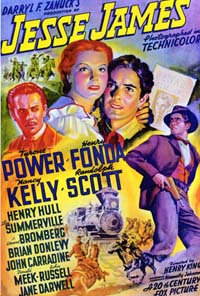
Jesse James

Thanks to films, television shows, dime novels, and with some time gone past, we can now look back at historical figures with rose-tinted glasses. Nowhere is that more evident than with wild west gunslingers, cowboys and outlaws. Some truly bad dudes have been remembered fondly, even as anti-heroes. One that always comes to mind for me is Jesse James, a Confederate guerrilla turned bank robber. He gets the whitewashed hero treatment in 1939's Jesse James.

Helping run the family farm with his mother (Jane Darwell), young Jesse James (Tyrone Power) works with his brother, Frank (Henry Fonda), to create a pleasant life for the family. Their country life is shattered as the railroad moves west, railroad agents ramrodding families off their land. An accident causes the death of the James' boys mother, forcing Jesse and Frank to seek revenge. With rewards posted for their arrest or death, Jesse and Frank are forced into a life of crime, robbing trains and banks as they're on the run. Jesse wants more revenge though, his name growing ever more well known.

Depending on the source, Jesse James is looked at as a heroic rebel, an intelligent bandit, a disturbed thief, and any number of options that fall somewhere in between. From director Henry King, this 1939 western goes an odd route. It makes Jesse a pretty straight hero, not even an anti-hero. We're not talking Butch and Sundance treatment -- it's too blase for that -- but it's approaching that territory. The history is condensed, tweaked and twisted from the start. Yes, it is based in the truth (or at least part of it), but then starts going off route quickly. Powers' Jesse isn't infallible, he's no immaculate hero. Still, it doesn't ring true. Railroad? Uber bad. Bandit? Bad....but he's fighting for his deceased mother.

A star of the 1930s and 1940s, Powers was quite the actor over a career that was cut short by his death in 1957 at the age of 44. I've never seen many of his movies, but he was always a likable enough actor. I came away less than impressed with this effort as the infamous, iconic western bandit, Jesse James. Only part of the blame can be chalked up to him. Even as Jesse's fame rises, we're still seeing him as pretty squeaky clean. Some characters flaws couldn't have hurt. Good or bad though, it just isn't that interesting of a part, and that's saying something. It's Jesse James! How could that not be interesting? It doesn't help the cause that much of the already condensed story is spent on Jesse's developing/loving relationship with Zee (Nancy Kelly), a young woman he's known since they were kids. Yeah! Love story about an outlaw!

Unfortunately for the rest of the cast, what's worth mentioning is that the cast is misused and underused. In a criminally underused part, Fonda is a huge bright spot as Jesse's older brother, Frank. This lanky, laconic, confident young man is a scene-stealer, especially his intro. Still a rising star, Randolph Scott is wasted too as Marshal Will Wright, a peace officer divided between his respect for Jesse and his call to duty. Thankfully, a love triangle isn't a focus of the story among Will, Jesse and Zee. Henry Hull hams it up like a crazy man as drunken newspaperman Rufus Cobb, Zee's uncle. Brian Donlevy has a great part as a sneering, vicious railroad agent who meets Jesse's wrath while John Carradine has a smallish part as Bob Ford, a possibly treacherous member of the James gang. Some interesting characters, just could have used more of them on-screen.

The movie is good and bad -- ridiculous history aside. It's a fondly remembered movie from one of the all-time great years in Hollywood history, 1939, so it does something right. There's some impressive scale, some great tracking shots full of hundreds of extras, one especially of Jesse (a stunt double at least) running across the top of a speeding train. It's a beautiful movie, and some scenes truly stand out, like the botched Northfield robbery and a subsequent chase. At just 106 minutes though, some 16 years of history is condensed into a rushed story. Maybe a rewatch would help, but for now, my first impression was pretty lukewarm. Some parts definitely work, but not on the whole.

Jesse James <---Youtube clip (1939): **/****

Saturday, February 13, 2010

Kiss of Death

Most actors have to pay their due before they make it as a big star. Maybe do some low-budget movies, a TV show, Broadway plays. I'm hard pressed to think of many who make the jump from complete anonymity to instant stardom. Only two really come to mind, Burt Lancaster and Richard Widmark.

A veteran of stage and radio, Widmark made the jump to movies in 1947 in a film noir classic called Kiss of Death. Making his screen debut, the 33-year old actor received fourth billing as a supporting character with three more established actors taking the lead roles. Even with a role that has him on-screen for maybe 20-25 minutes of a 98 minute movie, Widmark steals the film with a part that catapulted him to stardom and almost threatened to typecast him early in his Hollywood career.

Given a lengthy prison sentence for a jewel heist, low-level hood Nick Bianco (Victor Mature) refuses to squeal about the other men who took part on the job and accepts his sentence. Several years pass and then Bianco finds out his wife has killed herself and his two daughters have been sent to an orphanage. Cutting a deal with the assistant district attorney, Louis D'Angelo (Brian Donlevy), Bianco agrees to be a snitch for the cases D'Angelo is trying to put away. Bianco's first case? Get evidence on a suspected killer and a previous acquaintance, Tommy Udo (Widmark). Bianco gets the evidence and even testifies in court, but a jury acquits Udo and he quickly eludes his tail. Now living with his wife (Coleen Gray) and his two daughters, Bianco knows it's only a matter of time before Udo shows up looking for revenge.

With Mature and Donlevy taking the starring roles, Widmark leaves an instant impression as psychotic, cackling killer Tommy Udo. Mention 'Kiss of Death' and most people will associate Widmark with the movie, and more specifically one scene. Looking to catch a snitch, Udo infamously ties an old woman into her wheelchair and pushes her to her death down a flight of stairs, watch it HERE starting at the 2:40 mark. Widmark's Udo seems to revel and delight in administering punishment and death. His distinct giggle sends chills down your back, and hard to place accent with his low voice just add layers and personality to this character who is impossible to take your eyes off of.

In fact, Widmark was so good in the part that over the next three or four years, he was only offered similar roles, deranged psychos and villains in film noirish type movies. Granted, no actor wants to be typecast, but he's incredible in this part. The rest of the movie is entertaining enough, but when he's not onscreen it does lag in places. After the wheelchair incident, you're just not quite sure what he's capable of. Apparently audiences and critics agreed, Widmark was given his only Oscar nomination -- as best supporting actor -- for the part. On the irony meter, this one gets a 10. He lost to Edmund Gwenn who played Kris Kringle in Miracle on 34th Street. The most villainous guy around vs. the sweetest guy ever, too perfect.

The story takes a little while to develop, but the momentum picks up once Mature's Bianco cuts his deal with Donlevy's D'Angelo. Mature could be a little stiff in certain parts, but this is one of his stronger parts. Bianco has never really amounted to much and has spent several years behind bars, but when his daughters are in trouble he decides to do anything he can to make their lives better. Coleen Gray's Nettie used to babysit the girls and then marries Nick -- which has some creepy undertones as we see their marriage. Donlevy has a thankless role as the district attorney but always a professional still makes the character interesting. Also look for Karl Malden in a small part working with Donlevy.

The highlight of the movie is by the last 30 minutes following Udo's acquittal. The black and white shadows of film noir come to life and Henry Hathaway's direction creates an incredible mood, a sense of impending doom about to be unleashed. Mature sits in his home waiting for Udo to show up, only to decide he'll go on the offensive and seek out Udo instead. There's a great confrontation between Mature and Widmark in the finale although the climax does have a bit of a cop-out.

An above average, very professionally made film noir. Mature, Donlevy and Gray are decent enough with their respective leading parts, but this movie belongs to Richard Widmark in his screen debut. He'd go on to play more heroic parts, but this may be his most well-known role. Check the whole movie out at Youtube, starting with Part 1 of 10.

Kiss of Death <----trailer (1947): ***/****

Saturday, November 7, 2009

Slaughter Trail

If there's anything one thinks of in a western it's the cowboys vs. Indians, the gunfighters, the cattle drives, the outlaws. One thing I clearly don't associate westerns with is singing, whether it be musicals like Oklahoma! or even singing cowboys like Gene Autry. They just seem out of place. 'Hey, I just saved the pretty school teacher from bandits, let me get my guitar out and sing about it a little!' So you might ask, how do you make it worse? Combine the two with a ballad soundtrack that runs throughout and not singing cowboys, but singing cavalrymen. That evil combination comes to fruition with 1951's Slaughter Trail.

With a brisk running time of 78 minutes, director Irving Allen apparently did not have enough in the way of a story for a feature length movie. By my guess, there's about 30 minutes of actual story and 48 minutes of ballad soundtrack and various asides with characters bursting into song. There's not enough here to make a worthwhile Gunsmoke or Bonanza episode much less a theater-released movie. Other westerns have used a ballad-like sountrack, High Noon comes to mind, but never this much. Four and five minutes pass as a cavalry troop rides across the desert, not a word spoken, with the 'Slaughter Trail' ballad booming.

There's also six different musical numbers thrown in with the story when the ballad isn't blaring. Some fit better than others, like a dance at a fort in Arizona, but most seem thrown together to make the movie a little longer. At one point, Andy Devine's Sergeant Macintosh actually hands another soldier a guitar and asks him to play so he serenades the troopers. How sweet. All this happy singing is just out of place in a story that a typical B-western could have handled nicely, or at least better than this clunker.

Working together to knock off stagecoaches and the money/gold/jewels they're carrying, outlaw Ike Vaughn (Gig Young) and Lorabelle Larkin (Virginia Grey) hit the jackpot when they discover a purse full of diamonds onboard a stagecoach. Ike passes them off to Lorabelle for safe-keeping so he and his gang can get away. But as they run, the gang steals three horses from a small group of Navajo Indians, killing two of three. The one survivor returns to the tribe where the chief calls for war because the white men broke the treaty. At the nearest outpost, Fort Marcy, the commander, Captain Dempster (Brian Donlevy) has to figure out what to do in hopes of stopping what could be a bloody rampage.

This B-western story is nothing new or inventive, but it is a good story if nothing else. There's never enough time spent on that story though for it to be any good. There are some limitations with the budget as seen in the finale. The Fort Marcy set is a great, expansive outdoor location that was used in a long list of movies in the 40s and 50s. It's situated in a small valley ringed by hills. But when the Navajos attack, they're attacking on wide, dusty plain in the middle of nowhere. We never actually see the warriors in the same shot with the soldiers firing at them. There's also the angle that Donlevy's Dempster takes about the three outlaws. He won't turn them over to the Navajos, instead posting them outside the walls to apparently be brutally killed. Ends justify the means I guess.

Known as much for playing the evil villain as much as anything, Donlevy gets a crack at playing the heroic good guy and does pretty well as he looks out for his daughter and the fort and even tries to work some magic with Grey's Lorabelle, a forced movie relationship if there ever was one. He even compliments her, 'That was quick thinking,' when she picks off an Indian about to kill someone. Smooth talker that Capt. Dempster. Young as Ike Vaughn is all right, the outlaw with the maniacal laugh. Devine is his typically annoying, braying self as the apparently veteran cavalry sergeant.

On to one more thing that bugged me that I can thank all the John Wayne movies I've watched for helping me spot. Chuck Hayward was a long-time stunt man who always got bit parts in westerns and war movies, a face you'd probably recognize, if you've seen enough of these movies. In Slaughter Trail, he plays two bit parts, one as the Indian survivor in the beginning and two as the Indian scout working for the cavalry. At one point, his two characters are actually in the same scene together. Talk about a small budget, but that is just impressive. A stinker all around, I fortunately could not find a trailer for this gem. Steer way clear of this one.

Slaughter Trail (1951): */****

Sunday, July 19, 2009

Beau Geste

How gutsy does a director have to be to start a movie by showing the ending? I give any director with the cajones to do that points right off the bat. Opening the movie by showing how the story will end up can drive viewers away in some cases, but if handled well can make viewers even more involved with the story. After all, we now know how everything will end up, but getting there can be half the fun.

Director William Wellman pulls this off with his 1939 classic Beau Geste, a story of three brothers who enlist in the French Foreign Legion. The story opens with a relief column nearing Fort Zinderneuf, a far-off post near an oasis that came under siege by Arab tribesmen. But as the relief draws closer, they find the whole garrison massacred to a man, and the commanding officer dead on the parapets with a French bayonet through his heart. With no enemy dead anywhere in sight and no legionnaires to tell the story, the question arises; what happened to these 50 legionnaires?

After the cool opening sequence at the scene of the massacre, the story flashes back to 15 years prior where three brothers, Beau, Digby and John, have been adopted by a rich English woman, Lady Patricia (Heather Thatcher) The three orphans live the life of luxury, playing war games and playing pranks on each other and their 'cousin' Gussie, the heir to quite a family fortune. But the years pass and Lady Patricia receives a note from her long lost husband saying he'll soon return for the Blue Water diamond, the last thing of any value they own. Before he can retrieve it though, the diamond is stolen by someone living in the house. But who was it?

In hopes of removing suspicions from his younger brothers, Beau (Gary Cooper) takes the blame and enlists in the French Foreign Legion to avoid embarrassment for his family. But it's not too soon before brothers Digby (Robert Preston) and John (Ray Milland) join up too with their big brother. It's in the legion they come under the command of sadistic Sergeant Markoff (Brian Donlevy), who was humiliated at his last post and now seeks to redeem himself, no matter the cost even if it is his own men's lives. It is when Markoff finds out the Geste brothers may be diamond thieves that the real conflict arises, the sergeant splitting the trio up, Beau and John to Zinderneuf as replacements and Digby to another fort for mounted infantry training.

The French Foreign Legion is often presented as this glamorous, honorable fighting unit, but in just about every movie I can think of some unlucky company is getting massacred or abandoned at some far out post with no hope of outside help or survival. In Beau Geste, it's no different. The soldiers at Zinderneuf hope to lead a mutiny against Markoff, but that plan gets put on hold when the Arab tribesmen arrive en masse. The battle scenes are exciting from the start even if we know the end result. The desert outside Yuma, Arizona fills in nicely for the Sahara desert, oasis and all, with the set of the fort a perfect setting for the drama to unfold.

As for the cast, it would be hard to ask for a better one. As the title character, Cooper does what he does best, the sort of everyman role who is noble, honorable, and always looking out for those around him, especially his younger brothers. Preston and Milland round out the trio of brothers, Milland getting slightly more screen time and the love interest, and with Cooper provide the heart, the backbone of the movie. Their scenes together ring true whether it be with the comedic introductions or later in the movie when they've enlisted in the Legion. The three actors bring the characters to life, much like the three leads in another 1939 classic with a somewhat similar story, Gunga Din.

In a role he received a Best Supporting Actor nomination for, Donlevy has a great part as Markoff, the sadistic, half crazy sergeant who will drive his men to the breaking point and then keep on pushing. He wants his good name back and all the medals and privileges that come with a promotion, and as he sees it, it's all in grasp if he wins a significant battle, casualties be damned. Unfortunately for Donlevy, 1939 was the year of Gone With the Wind, Stagecoach, Mr. Smith Goes to Washington, so he didn't get the win, but it's still one of his best parts. Also in the cast is a very young Susan Hayward as Isobel, the love interest who grew up with the Gestes but starts to fall for the youngest brother, John. Just some of the other legionnaires include J. Carrol Naish, Albert Dekker, Broderick Crawford, and Charles Barton.

Labeled as Hollywood's strongest overall year just for the sheer number of classics that were released, 1939 was quite a year for the movies. The old reliable 'they don't make 'em like that anymore' applies to any number of movies from that year, especially Beau Geste. It is good old-fashioned entertainment with an exciting story, strong and likable characters and some creativity in telling the story. With a DVD released just weeks ago, don't skip this one by. A true classic from start to finish.

Friday, January 30, 2009

Never So Few

After reading a bio on director John Sturges the last couple of weeks, I thought I'd go back and watch some of his movies, starting with 1959's Never So Few starring Frank Sinatra and Gina Lollobrigida. The basic story is a good one that hasn't been dealt with in many WWII movies. Sinatra is Capt. Tom Reynolds, an OSS volunteer leading a group of Kackins, Burmese guerillas, in Burma in 1942-43. I can only think of two other WWII movies that even deal with that part of the war, Objective, Burma, a great action movie with plenty of flag-waving, and Merrill's Marauders, the story of 3,000 US volunteers trekking across Burma to take out a Japanese airfield.

When I first saw the movie a few years back, I was glad I found because of the subject matter. But when I saw what a great all-around cast was in it, I started to wonder how it'd slipped through the cracks since its release. I figured it out quick enough, it's an average war movie that's pulled down by a completely unnecessary love story. The story of Reynolds and his Kachin guerillas is the high point of the movie with some impressive action sequences, an ambush on a bigger Japanese force, a surprise attack on the Kachins' Xmas party, and an assault on a heavily guarded Japanese airfield.

Too bad of course the love story was added. It doesn't work for any number of reasons. For one, Sinatra and Lollobrigida had little to no actual chemistry. Two, it takes far too long to develop. The movie opens with an ambush and the aftermath and then spends most of 45 minutes to an hour with Reynolds and his 2nd in command, British officer Danny DeMortimer, back in civilization as Reynolds and Lollobrigida's Carla meet.

Having said all this, I did buy the DVD so there must be something positive, right? Sinatra is pretty good as Reynolds, although he does sport a ridiculous goatee early in the movie. Richard Johnson as DeMortimer has some funny moments and is a great character, a good counter to Reynolds. The whole supporting cast is good, Charles Bronson, Peter Lawford, Dean Jones, Brian Donlevy, Phillip Ahn, and Robert Bray. But most of them aren't given much to do because so much of the story's focus is away from the OSS volunteers and the Kachins.


The main reason to see Never So Few is a pre-stardom Steve McQueen. The 29-year old actor had been in several movies and was fast becoming a TV star as Josh Randall on "Wanted: Dead or Alive," but in a supporting role here as Cpl. Bill Ringa, McQueen steps above the material to show what he can do with very little. It's a relatively small part, but Ringa is what I came away from the movie remembering. He's cold-blooded, and a natural fighter, ready for anything if it helps the group. It was definitely a sign of things to come as McQueen teamed with Sturges again a year later in The Magnificent Seven in a somewhat similar role.

So overall, an average movie that could have been better, but it's a guilty pleasure for me. Worth checking out, but don't expect a classic.