The Sons of Katie Elder

The Sons of Katie Elder
"First, we reunite, then find Ma and Pa's killer...then read some reviews."
Showing posts with label Paul Picerni. Show all posts

Tuesday, June 2, 2015

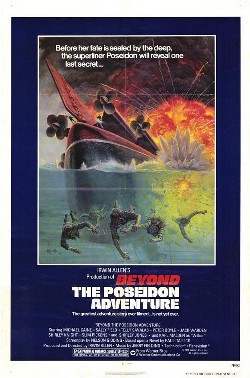
Beyond the Poseidon Adventure

I've never hid my feelings about sequels and remakes. Sure, they can be lazy and big, old cash-cows, but if there's a need to make more movies or an interesting plotline or character(s), then I'm all for it. Same for remakes. If the original sucked or had untapped potential, then fire away. But the other efforts? The purely for the big payday efforts...yeah, here we are today. I watched 1979's Beyond the Poseidon Adventure because I could, because I'm an idiot and...yeah, here's the review.

It's New Year's Eve and Captain Mike Turner (Michael Caine) is on the Mediterranean Sea on his tugboat, the Jenny, with his first mate, partner and friend, crusty seaman, Wilbur (Karl Malden), and a spunky young woman, Celeste (Sally Field), they picked up at their last port. Turner is in some serious financial trouble and will likely see his boat repossessed very soon. But out at sea, they stumble across the floating wreckage of the S.S. Poseidon as a helicopter flies away overhead. Turner's eyes light up. He claims the salvage rights for the ship and taking a huge risk tries to get onto the capsized cruise ship. Turner isn't alone though. Another ship boards, a Dr. Stefan Svevo (Telly Savalas) explaining his ship heard a distress signal and he intends to help any potential survivors. The ship could sink or explode at any moment, but Turner and Co. head into the wreckage, hoping to find some sort of treasure, money, diamonds...if they can survive.

What the hell? I mean, come on. Really? It took Master of Disaster Irwin Allen (directing and producing here) seven years to get this sequel made after the mega-success of 1972's The Poseidon Adventure. I liked the original Poseidon even if I didn't love it. It's hard not to appreciate it for all that it accomplished, influencing whole genres and hundreds of movies since. You know what it didn't call for? A sequel. As in AT ALL. This is an opportunity to make money, pure, plain and simple. Worst than that, it isn't even guilty pleasure good. The cast is interesting as they usually are with disaster movies, but mostly, it is just B-A-D.

It is literally the same movie with one minor change. We've got idiots heading into the sinking ship that is continually rocked with explosions. Sure, the reasons are greed-based (just about everyone can get on-board with that) but really? REALLY?!? And let's think about this for a minute. Does anyone actually believe that Telly Savalas is telling the truth? It's Telly Freaking Savalas. There's simply no way that he is what he says he is. The problem becomes that when the twist is revealed, it is absolutely ridiculous, ending in a gunfight in a cargo hold. So yeah, that happens but the twisting and turning story stretches the limits even for an unnecessary sequel. If it helps your peace of mind (and it should), things don't get better as the running time approaches two hours. It gets worse.

So at this point, the saving grace has to be the star power of the cast. The cast is pretty solid in name recognition, and the formula is the same as most disaster movies. Introduce all our Hollywood stars and see who makes it out relatively unscathed. This was an interesting part of Michael Caine's career, one he's admitted he was in it for the money. There's gems like The Swarm and more into the 1980s, Jaws IV: The Revenge. He was rough in 'Swarm,' but he's actually pretty decent here. He commits to the part/script -- however bad -- and goes for it. Along with Field, Malden and Savalas, there's also Peter Boyle, Jack Warden, Shirley Jones, Shirley Knight, Paul Picerni, Slim Pickens, Mark Harmon, Veronica Hamel, and Angela Cartwright rounding out our assorted ensemble of survivors. Give them some sort of personal background, throw them together and let things fall apart from there. It does so in pretty spectacular fashion.

Things get pretty out of control, truly boring and bad in the second half. The twists are ridiculous, and scene-to-scene, it just feels like everyone is trying too hard. Sally Field is at her disgustingly adorable cutest, always ready with a nervous one-liner in the face of impending doom. Slim Pickens hams it up like his paycheck depended on it and other stuff happens with other actors. Meh, just really bad pretty much from the get-go. Not even guilty pleasure good. Just lousy.

Beyond the Poseidon Adventure (1979): */****

Friday, January 30, 2015

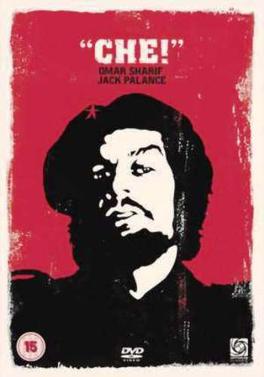
Che!

So by all accounts, everyone agrees a movie is awful. It's made some lists as one of the worst movies ever made. It tackles a controversial subject matter when the wound was still fresh in one of the most turbulent times in world history. The man? Revolutionary Che Guevara. No, it's not Steven Soderbergh's two-part Che. Silly you, I reviewed that HERE and HERE two years ago. It's time for a flick that's been critically panned for years, and don't we all love that?!? Here's 1969's Che!

It's 1956 and a young Che Guevara (Omar Sharif) lands in Cuba with a small revolutionary force of around 80 men commanded by Fidel Castro (Jack Palance). Having studied to be a physician, Che is brought along to be a medic, to treat the wounded but quickly becomes much, much more. As the revolution picks up momentum and followers all across Cuba, Che becomes an essential figure in the fighting, even becoming Castro's right-hand man, a key strategist and tactician in the fighting. It all leads to an overthrow of the government as Fidel, Che and their followers take the head of the coup, installing their own socialist government in 1959. It's just the start though as Cuba becomes a thorn in the side of the United States and worldwide. The revolution has changed though, and Che begins to feel uncomfortable. Maybe he can be of more use elsewhere where the fighting still rages...

Judging by reviews, IMDB ratings, word of mouth, all of the above, this movie from director Richard Fleischer is considered an all-around dud. As a jumping off point, I don't know what it says about me that I didn't think it was that bad. Rather, I was entertained throughout so go figure. Whether you love it or hate it, it's certainly an interesting film. It was made just two years after Che's death in 1967 as the world was tearing itself apart with one bloody conflict after another. My biggest question is 'What was the rush?' in getting a Che Guevara movie into theaters. The script certainly has some issues, packing a ton of stuff (about 10 years) into a 96-minute movie. It has far too many preachy scenes where Sharif's Che expresses his beliefs to anyone and everyone who will listen, and many who couldn't care less. Is it a good movie? No, but it's a fascinating flick in a guilty pleasure sort of way.

Talk about a daunting task. Mr. Sharif, would you be interested in playing infamous revolutionary Che Guevara? Working with a flawed script that tries to accomplish too much in its relatively short running time, Sharif makes the most of it. The screenplay certainly seems based off Guevara's diary and sticks relatively close to the facts of the revolutionary's life. The moments when he's preaching -- repeatedly -- his revolutionary beliefs, his hatred of imperialism (especially America) get to be tedious, but it is in the other, quieter moments where Sharif does an admirable job. We start to see Guevara as a man obsessed with revolution, with chaos, with taking down the system. These beliefs ultimately prove to be his undoing as Che becomes blinded with his goals rather than seeing that his plans simply can't work.

Now the rest of the cast, one actor in particular, has taken some abuse for his role. That man? Steely-eyed, gravelly voiced Jack Palance as Fidel Castro. Wearing a prosthetic nose, sporting big, wire-rimmed glasses and always chomping on a cigar, Palance seems to be playing a stereotype, a cliche of Castro rather than a flesh and blood individual. Fascinating, but not in a good way. The unfortunate part of the cast is that it features a long list of recognizable character actors who popped up in countless 1960s/1970s flicks. Oh, the unfortunate part? They're basically background performers. Some get a line here and there, but for the most part, they walk with Che or are visible in action scenes and dialogue exchanges.

Too bad. Among Che's followers we see Cesare Danova, Robert Loggia, Woody Strode, Perry Lopez, Rudy Diaz, Tom Troupe, Barbara Luna, Linda Marsh and Sid Haig. Other key parts go to Frank Silvera, Albert Paulsen, Rodolfo Acosta, Abraham Sofaer, and Paul Picerni. Just wish they could have been better utilized.

The one thing I can give credit for to this film over the Soderbergh version is that 1969 Che! takes a stance on the revolutionary icon. He's one flawed individual for good and bad. We see what his actions cause in terms of consequence on himself and those around him. In a somewhat odd storytelling device, we see some of the cast directly addressing the camera like a documentary, addressing the developments in Che's life but also in Cuba and Bolivia. Things obviously get a tad dark in the last half hour as Che's efforts in Bolivia never develop as planned. So you know what? I liked this movie. It's not necessarily good, but it's always entertaining (sometimes in a bad way). Still, it's worth a look.

Che! (1969): ***/**** 

Sunday, September 14, 2014

Force of Arms

Yuck, here we are again. War movies that aren't content to just be war movies. What else gets added to the formula? A love story, two tortured souls brought together because, God bless it, the universe just wants it to happen! Those crazy kids, they just belong together even if the war will do its best to keep them apart. Today's entry is 1951's Force of Arms.

It's 1943 and the fighting in Italy is intensifying all along the front. After weeks and months on the line, an infantry platoon commanded by Sgt. Joe Peterson (William Holden) is tasked with one more objective. Though it costs heavy casualties, the platoon retakes an important position from the Germans. The entire unit is awarded five days of leave far removed from the muddy, cold front lines, Peterson meets a WAC, Lt. Eleanor MacKay (Nancy Olson), who he starts off on a rocky path almost immediately. Still, as they argue and test each other back and forth, both Joe and Eleanor can't deny their attraction to each other. The clock is ticking though as the soldier and the WAC must decide where to go next before Joe returns to the front line fighting. Can they come to terms with how they feel about each other in time?

Gag me, I hate when I have to write plot descriptions like this. Don't get me wrong. If there's a good romance war story out there, I'll give it a fair shot. Also, I don't really count Casablanca. I'm talking war stories, men on the front lines when the story takes a detour for some loving away from the front. Director Michael Curtiz's flick has a ton of potential because the portions focusing on the fighting, on Peterson taking a leadership role, of the platoon both in action and resting, that is 'Force' at its strongest. Too much time is spent on the budding relationship between Holden and Olson in the process. 'Force' is filmed in black and white with some cool location shooting, California filling in surprisingly well for Italy. It has a gritty, worn look, but dang, enough with the love story.

Holden is one of my favorites, and Olson has more than held her own in Sunset Blvd., Battle Cry and several other flicks. They have some decent chemistry together, but this script does them absolutely no favors. They meet in a military cemetery in the dead of the night and at no point does Holden's Peterson ever think "Hmm, I wonder what she's doing here? Maybe someone she knew...died?" From there, we get to know two folks working through some stuff -- Peterson the war wearing him down day to day, Eleanor trying to overcome a lost love -- with death hanging in the air. They wonder aloud what love really is, question if they truly can love, take dreamy walks on the Italian countryside, and share tons of scandalous hugs where they rub faces. A love story is one thing. One that moves this sluggishly with not enough of a payoff? Yeah, not good.

At times, 'Force' reminded me of 1959's Never so Few, a WWII story that is at its strongest when it focuses on the war, on the soldiers, on the combat. That's 'Force' in a nutshell. The story starts at its strongest as Peterson's platoon is tasked with retaking a German-held position on a rocky hill. This isn't large scale warfare but a small unit of soldiers going toe to toe against another small unit of soldiers. The violence isn't graphic, but it's startling and quick just the same. That's most of the action/combat scenes, including the platoon moving into position under heavy German guns and later navigating an Italian town with winding streets and German shells and mortars raining down on them. As quick as these segments are over, the script jumps right back to the love story. Oh, joy.

Beyond Holden in the soldier department, look for Frank Lovejoy as Major Bradford, the unit's commanding officer and an old friend of Peterson's from back home. Commanding officer and one of his trusted officers but also friends with a past. In Peterson's platoon, look for Gene Evans as McFee, worried what his wife is up to back home, Dick Wesson as Kleiner, a capable soldier and a capable smartass, Paul Picerni as Sheridan, the smooth Italian (similar to the part he played in To Hell and Back), Ross Ford as Hooker, the southern farmer, Ron Hagerthy as Minto, Peterson's runner, and a young Don Gordon in one of his first speaking parts as Sgt. Webber. I like the group dynamic, their friendships, their arguments. It feels natural, and I just wish there was more of it.

A mixed bag unfortunately. When it's good, it's pretty good. When it's bad, love is pretty rough to watch.

Force of Arms (1951): **/****

Friday, July 6, 2012

Breakthrough (1950)

Maybe it's the difference in wars, but with the conflicts in Iraq and Afghanistan, movies about those conflicts have almost 100% in theaters. Audiences don't want to see those stories that are so fresh in their minds and memories. Why then after WWII were audiences hit with waves of war movies? Was it just a different war? Did people feel differently? Was it because the United States won? I'm trying to figure it out myself. Released just five years after the war, 1950's Breakthrough is a strong example of what was to come in the war genre.

In England in the spring of 1944, the Allied invasion force is prepping for the coming invasion of France. Among the armies is Lt. Joe Mallory (John Agar), a young, inexperienced officer fresh out of training school. He's been given command of a veteran rifle platoon that's been fighting in North Africa and Italy for two-plus years, with their former commander, Capt. Hale (David Brian), now placed in command of the company. Hale turns to Sgt. Bell (Frank Lovejoy), the similarly veteran soldier, to help Mallory adjust and keep an eye on the platoon. With the coming D-Day invasion, the platoon will have to count on each other if they hope to make it through the campaign alive.   

This straight forward, no frills WWII flick premiered recently on Turner Classic Movies so I took my chance and recorded it, remembering seeing an old VHS box of it years before at a local video store but never picking it up. It isn't a classic, but it is interesting to watch considering how much it foreshadowed what war films would become over the next 10 years. From director Lewis Seiler, it is an early example of a unit picture, a story focusing on a squad, platoon, company, regiment, brigade...you get the idea. Lovejoy's narration is solid without trying to be the end-all, be-all in narration, and the story chooses to focus on the platoon's involvement in the fighting, not the bigger picture of how the war effort is going.

I can't quite put my finger on it, but there was something appealing about this war movie. It doesn't have that whitewashed feeling of so many WWII movies made so close to the end of the war. It's war with one side fighting the other. No bigger picture about why they fought or for who. The Germans are the enemy, but they're not demonized. The Americans are regular troops from all walks of life, individuals forced to work together to help each other survive. It isn't a graphic movie, but it is certainly intense, especially considering its 1950 release, including one battle sequence late. The story follows the 3rd Platoon from spring 1944 to late summer 1944, following them through training, onto Omaha Beach at Normandy, and then through the hedgerows in the French countryside. The formula -- from the episodic story elements to the character archetypes -- would be used countless other times in the years to come, but this is one of the earliest ventures and one of the best.

I'll say again, but 'cliched' isn't necessarily a bad thing. The character archetypes here have been used in countless war movies before and since and will keep on being used as long as there's more war movies. The three lead performances are some of the basics, Brian's Hale the hard-edged commander, Agar's Mallory the newbie trying to learn on the job, and Lovejoy's Bell the veteran soldier who knows how to survive and get his men to do the same. Lovejoy especially represents himself well, having some fun with a familiar character. The platoon includes Cpl. Dominick (William Campbell), the motor-mouth aspiring politician, Rojeck (Paul Picerni), the natural soldier and better complainer, Finley (Greg McClure), the fitness freak, Nelson (Richard Monahan), the wet behind the ears newbie, Henderson (Edward Norris), the family man, Jimbo (Matt Willis), the amiable Southerner, Hansen (Dick Wesson), the jokester, with William Self and Danny Arnold having less visible parts.

Nothing fancy, and nothing that will startle or amaze you, just a good, old-fashioned war story. Solid casting, fast-moving, effective and interesting story, and an honest, forthright look and feel of what it must be to be a soldier. Well worth tracking down a copy if you can find one.

Breakthrough <---short Youtube clip (1950): ***/****

Saturday, November 19, 2011

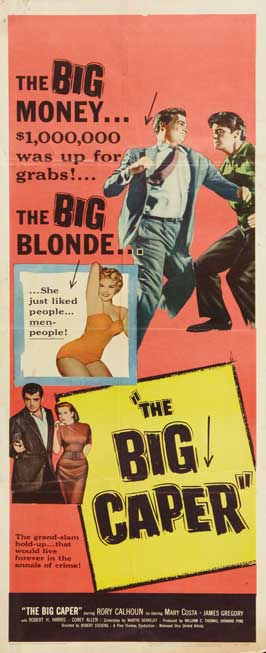
The Big Caper

Nothing flashy, nothing new to the genre, I still very much liked 1957's The Big Caper. Solid cast, interesting B-movie characters, and some bad guys as part of a heist crew that are just too much to believe. A classic? Nope, but it's pretty good for what it is, an entertaining heist movie that doesn't try to be anything that it isn't.

Several months removed from his last successful job, Frank Harper (Rory Calhoun) has ran out of money and has found a new job, one that he could retire on if it goes through. A poorly guarded bank with minimal security twice a month holds the payroll for the Marine base and Camp Pendleton, and to Frank, the money is begging to be taken. He approaches partner and bankroll, Flood (James Gregory), who agrees to go along with the plan. As a set-up, Frank and Flood's girl, Kay (Mary Costa), move into town, buy a gas station and a house, setting up shop as a young, married couple. Creating an alibi, they live there several months in preparation for the job, and then Flood's crew shows up. Let the trouble begin.

The one twist on the familiar noir-heist thriller was the 'what if?' concept added into the story. Setting up a nice, little life for themselves, Frank and Kay become a part of suburban life. Frank makes a profit at his gas station, Kay creates a home for the "couple" and things are looking all around pretty good for them. Kay wants nothing more than to get away from the menacing Flood while Frank's tortured past and childhood seemingly won't let him appreciate what he has.  Kay tries like crazy to convince him otherwise. We're not talking Shakespeare here, but it was nice to see at least some effort by a movie made to bring something new to the heist flick. The effort is very much appreciated.

A Just Hit Play favorite, Calhoun does what he does best here, the bad guy who maybe isn't so bad. He does the tough guy like nobody's business, treading that fine line between straight villain and flawed hero.  It's good to see him in a non-western too where he got pigeon-holed throughout the 1950s.  There's a definite chemistry with Costa, bringing some heart to their scenes together in idyllic suburban life. For you trivia fans, Costa was the voice of Princess Aurora in Disney's Sleeping Beauty so there you go. Being the more obvious sinister villain that he was born to play, Gregory is a scene-stealer, the crime kingpin who puts everything in motion. He doesn't seem like that bad of a guy until some problems arise pre-heist, and well, things go downhill from there. Not big names leading the way, but all strong performances.

This is a 1957 B-movie noirish heist story, and the bad guys have to be very bad to make Calhoun's Frank be sympathetic. Mission accomplished in that department. Let's start with some of Flood's crew, beginning with Zimmer (Robert H. Harris), an explosives expert who will create several diversions during the robbery. His flaw? He's an alcoholic pyromaniac who can never have too much gin. Next, there's Roy (Corey Allen), a fitness freak with some rapist tendencies, or at least some sexual issues that Flood plays up. There's also Harry (Paul Picerni), a ladies man and all-around dope, and Dutch (Florenz Ames), the safecracker who wants nothing to do with the crew or the take, just a flat rate for his services. Quite a crew to say the least, one of the more eccentric, eclectic heist crews I can think of.

So has any heist in a movie ever gone smoothly, including the getaway? Okay, the Ocean's 11 remake doesn't count. Of course George Clooney and Co. are going to pull off the job. It's pretty clear that this heist won't go smoothly. For starters, it's a supposed "easy" job, and we all know how that goes.  Translation = Epic fail. The heist sequence -- about 20 minutes long -- is solid, ratcheting up the tension, but it is in the aftermath where 'Caper' falls short a bit. Yes, it's Doom and Gloom time. I wanted an epically downer ending, but the story and/or script just doesn't have the guts. It is far from a happy ending, but more could have been done. Still good, but it could have been great.

This movie across the board has a lot going for it. Director Robert Stevens keeps things moving with an 84-minute movie that is aided by some California locations and a jazzy score from Albert Glasser that is good in that really obvious way, music blaring to tell you what's coming next. Basically a completely forgotten flick, well worth checking out if you stumble across it.

The Big Caper (1957): ***/****

Thursday, July 21, 2011

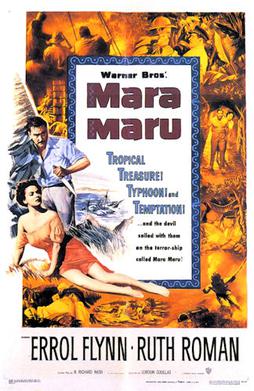
Mara Maru

Inevitably with movie stars, that star is going to fade a bit if your career has any sort of prolonged success. Audiences may tire of you a bit, or maybe the scripts just aren't there anymore.  How do you respond then? By 1952, Errol Flynn had his heyday in the late 1930s and throughout much of the 1940s. He continued acting up until his death in 1959 at the age of 50, but his movies through the 1950s just weren't par on with his previous work. A decent movie but not particularly memorable in any way, 1952's Mara Maru is one of those flicks.

Working with partner, Andy (Richard Webb), and former war buddy, Greg Mason (Flynn) runs and operates a successful salvaging business based out of post-WWII Manila.  Returning from a job, Mason finds Andy dead just a few hours after he was talking about a life-altering job, a treasure of over a million dollar's worth of diamonds at the bottom of the ocean. Mason is sure someone is trying to blackmail him for the murder, especially when shadowy businessman Brock Benedict (Raymond Burr) approaches him with a deal to recover the diamonds. Mason agrees to take on the job, hoping to move away with past love and Andy's recent widow, Stella (Ruth Roman), with his take from the job. With a nosy, greedy private detective, Ranier (Paul Picerni), along, the group heads out on the high seas to the location that only Mason knows for sure. 

One of those unheralded directors that never quite reached stardom, Gordon Douglas has quite a string of movies to his name from a 20-plus year career. He didn't have a personal touch that instantly alerted you to a Gordon Douglas movie, but his best efforts always had a knack for bringing a hard-edged, tough professionalism to his stories. 'Mara Maru' is listed as an adventure, but it is actually a little bit of everything. It is an adventure thrown in with some film noir and a murder mystery with a 'Who done it?' feel.  It is a little uneven because of that, the story not always sure what it wants to accomplish.

With a 98-minute run time, my biggest complaint would be an over-reliance on the script. This is a very talkative movie, but not the kind of dialogue that is that memorable. Long scenes of dialogue bring the first half of the movie to a snail's pace as all the characters and mysteries are presented.  It's not all bad though. The murder mysteries can't really be called a mystery because if you can't figure out who's pulling the strings, you should probably head back to elementary school.  Douglas does film in a shadowy black and white for that film noir feel, but it is so shadowy some scenes are difficult to follow. The same for the underwater salvage scenes which mainly consist of Flynn's stunt double walking slowly in a underwater diving suit.

Even in movies that weren't up to his standard, Flynn is always interesting to watch. I won't say he sleepwalks through this part, but the same energy just isn't there that you would have seen in his classics years before.  I don't know where you attribute that. The script? The direction? The only exception is Burr and Picerni who brings their typical flair to their parts. Burr is most remembered for his TV role as lawyer Perry Mason, but he made a name for himself in the 1950s as a menacing, intimidating bad guy. Picerni has some fun as a keeps you guessing P.I., always looking to make a quick buck. Roman too doesn't look very interested in being there for the movie, playing all sides for the best hand.

This review is going to be a short one just because there isn't much to talk about. It's not a bad movie, but I didn't like it either. Errol Flynn is cool as always, but that only takes it so far.

Mara Maru (1952): **/****

Thursday, June 30, 2011

Operation Mad Ball

One of Jack Lemmon's most famous roles came in 1955 as the quiet, mousey, anti-confrontational Ensign Pulver in Mister Roberts starring alongside Henry Fonda and James Cagney. By the end of the movie, his character has transformed into his polar opposite; confident, sure of himself, and not worried about rustling some feathers.  This was explored some in the all-around bad and unnecessary sequel Ensign Pulver unfortunately.  So while in no way related to either 'Roberts' or 'Pulver,' 1957's Operation Mad Ball made me think of the character Pulver as he plays off a variation of that previous character.

As I'm discovering more and more with the comedies I see, I'm never quite sure how to review them. They're meant to be funny of course, but humor is one of the most subjective things about movies.  What's funny to me can fall flat with everyone else in the audience.  With an action movie, you can talk about the fight sequences or the car chase. With heavy dramatic movies, it's the performances and the actors.  What about comedies? Should I just list all the scenes and bits that made me laugh or chuckle?  Now that would be an invigorating read, wouldn't it?  Basically this is an apology to any readers. I like comedies. I like watching them. Reviewing them? Not so much.

It's September 1945 in France at an Allied hospital near Normandy. World War II has been over for several months now in the European theater, and boredom and tedium have set in for the soldiers. At this hospital is Private Hogan (Lemmon), a highly intelligent wheeler dealer who doesn't actually like work but can get just about anything done if he puts his mind to it. One of his fellow soldiers (Roger Smith) would like nothing more than to meet his girlfriend in a private setting, but only Hogan can arrange it. What starts off as a small romantic evening turns into an extravaganza, a gigantic party with seemingly everyone in camp involved. Can Hogan pull it off though? The company adjutant, gung-ho Captain Lock (Ernie Kovacs), already has Hogan on his radar, and he threatens to bring everything crashing down around the scrounging, wheeling and dealing private.

This war flick was aired recently on Turner Classic Movies as part of a one-night tribute to Ernie Kovacs, the ahead of his time comedian from the 1950s who was tragically killed in a car accident in 1962 at the age of 42.  I've seen him in a role here and there but didn't always come away impressed.  To be fair, I think this is the first movie of his I've seen where he plays a dominant role.  As a character you're not supposed to like, he hits this one out of the park.  His Capt. Lock is that guy you're supposed to hate.  He's not as bumbling as he could have been, but you know in the end Hogan will get the best of him. Kovacs shows a knack for subtle humor and more obvious humor in the form of physical comedy. Some of his facial expressions are priceless.  The best though is his final scene, a look of ultimate despair on his face as to what's happening.

As the story moves along, I was reminded of a MASH episode where Hawkeye needs a new pair of boots and starts to trade things so he can get a pair. One trade turns into another until there's a long line of trades waiting to happen, all of them contingent on the other. That's this movie. A scrounger, a wheeler-dealer, a crafty negotiator, Hogan plays his cards right and almost always gets what he wants. The story isn't the most pointed one around because it needs some detours to show the ridiculous amount of detail the enterprising private goes through to pull off the party. Lots going on overall, including a love interest, Nurse Lt. Bixby (Kathryn Grant), a clueless commanding officer (Arthur O'Connell), a worthy foe for Hogan in a quick-witted French widow, Madame LaFour (Jeanne Manet), and a great bit with a German P.O.W. (Kort Falkenberg) posing as a corpse that Lock thinks is still alive.

One of the all-time greats when it comes to acting -- drama, comedy, it doesn't matter -- Jack Lemmon is the show here.  His Private Hogan is the type of soldier who would be a great officer...if he wanted to or even applied himself. Instead, he's pleased with his low responsibility duties that allow him time for his "extracurricular activities."  Lemmon is a scene-stealer in the sense that even when he's low-key, you're drawn to him.  His crew of fellow low-ranking soldiers include Mickey Rooney, a pre-Bewitched Dick York, James Darren, Smith, an uncredited Paul Picerni, and L.Q. Jones among others.  Rooney is memorable especially as a high-strung Southerner, often rhyming all his speech with a 'Fiddle-dee-doo, fiddle-dee-daa' sing-song style of talking, and York too shines as Lock's secretary/assistant who works as a spy and inside source for Hogan's antics and plans.  Good performances at the top and strong supporting parts to back it all up.

What else to say, what else to say? I liked this easygoing post-World War II comedy. It is filmed in black and white -- always a bonus in my mind -- and never tries to be anything other than fun and entertaining.  It succeeds. At 105 minutes, it's that perfect length for a comedy of its ilk.  Good movie, great cast, and a fun movie overall.

Operation Mad Ball <---trailer (1957): ***/****

Thursday, June 16, 2011

The Tanks Are Coming

In the midst of a directing career that saw over 30 feature films, WWII veteran Sam Fuller did his fair share or writing too, much of it is based in war stories and sometimes his own experiences. Fixed Bayonets and Merrill's Marauders are underrated classics, and The Big Red One is a direct retelling of Fuller's tour of duty in WWII with the famous division. His writing efforts aren't always remembered as well, but as was the case with 1951's The Tanks Are Coming, the talent is obviously there.

This WWII movie comes in the same year as two other Fuller flicks, Fixed Bayonets as I mentioned before and also the underrated and underappreciated The Steel Helmet.  It's tough to compare three different movies released in such quick succession, but 'Tanks' is probably the weakest of three.  That's not to say it is a bad movie. Far from it, it's pretty good overall.  The positives come from the Fuller story the screenplay is based on. It is cliched, but it never goes as far as flag-waving thankfully.  It is content to tell its story without pandering.

It is July 1944, just a month removed from the D-Day invasion. As the Allies prepare to unleash a spearhead right at the German lines, a tank battalion in the 3rd Armored Division readies itself to lead the attack. One of the advance tanks though is hit early on, the top sergeant killed.  A veteran tanker, Sgt. Sullivan (Steve Cochran), is transferred in to take over the tank and its surviving crew, picking up at the point of the column where they left off. Pushing his crew and his tank to the limit as they battle German forces, Sullivan rubs everyone the wrong way. His men believe he's a gung-ho hero seeking medals. His superiors think he's foolhardy and needlessly adventurous in combat. Is Sullivan pushing too hard, or is he just trying to make his men the best they can be?

As part of TCM's Memorial Day marathon a few weeks back, I caught this generally forgotten WWII movie for the first time. Part of the reason it gets lost in the waves of WWII pictures has to be the cast, generally a bunch of unknowns and supporting players.  Sullivan's crew includes Paul Picerni as Kolowicz, the machine gunner who clashes immediately with the sergeant, George O'Hanlon (later George Jetson's voice) as Tucker, the tank driver who can't get enough booze, Eugene Baxter as Marconi, and Robert Boon as Heinie, a German-American soldier with an agenda. Oddly enough, Baxter and Boon aren't even credited, especially odd when you consider how much they're in the movie. Among the tankers there's Ike (James Dobson), maybe the most annoying pip-squeak of a soldier ever, and Lemcheck (Harry Bellaver), the grouchy mechanic. Fuller fans will notice the director/writer's trademarks, using the names Kolowicz and Lemcheck in many of his movies.  

Looking through his filmography, I can say I've seen Cochran in several movies, but he didn't leave much of an impression obviously. This was an interesting part for him in a role that's a staple of the war movie genre.  He's that tough sergeant, damn good at what he does and dead-set on instilling everything he knows into his men.  His Sgt. Sullivan doesn't care much whether his men like him or hate his guts, as long as they do their job and stay alive, he's pleased (even if he'll never let on or show that). Other than an odd accent that sounds half Irish and half drawling Southerner, this was an interesting lead character. The story softens Sullivan up a bit by the end unfortunately, but it's not exactly a surprise. SPOILERS STOP READING SPOILERS I thought for awhile Sullivan would get killed in the end, but I guess for a B-movie in 1951 it just wasn't in the cards END OF SPOILERS

Directed by Hollywood veteran Lewis Seiler, 'Tanks' is an odd mix of elements all things considered. It isn't a patriotic flag-waving movie like so many WWII stories released in the years following the war's conclusion. On the other hand, it isn't cynical or overly dark. I think it finds a nice middle ground. 'Tanks' never glamorizes the war, the fighting, the combat. The soldiers aren't indestructible superheroes. They gripe and complain, they fight amongst each other, and mostly they just want to survive and go home. For a lower budget movie, the scale is somewhat limited, but a good mix of stock footage (edited in pretty seamlessly) and actual action scenes keep things moving.  I think the movie would have gone up a notch or two if it had the guts to kill off Sullivan, but as is, the ending is still pretty good. Look for Philip Carey and Robert Horton as two commanding officers in the battalion.

For all the positive elements, there's also the negative. Dobson's Ike character is beyond obnoxious, and for some reason the camera keeps going back to him for comic relief.  It's never actually funny, but they keep trying. Ike and Lemcheck are on another tank crew, but they're always hanging around too, probably because Sullivan's crew isn't always that interesting.  Then there's Mari Aldon as Patricia, a war correspondent who has a past with Sullivan. She's in exactly two scenes, and isn't even around long enough to be considered a love interest. Just little complaints on their own, but they do throw off the tone and pacing a bit.

Not great but far from bad either.  Good story from Fuller, and a solid lead performance from Cochran. If you can track down a copy, it's worth a watch if not a purchase. A made-to-order DVD is available through the Warner Archive if you're dying to see it. 

The Tanks Are Coming (1951): ** 1/2 /****

Friday, May 20, 2011

Land Raiders

Thanks to the huge success of Sergio Leone's Dollars trilogy starring Clint Eastwood in Europe and around the world, American studios were left trying to figure things out and somehow keep up.  American audiences had grown somewhat tired of the same old westerns by the late 1960s so seeing the success the spaghetti western genre made, the studios made similar movies that's become part of a whole new sub-genre of westerns, Italian westerns made with American backing.

These were movies that at first glance look and feel like a hard-hitting, dark spaghetti western. Give it a closer look though, and things are a little different.  The casts lean more toward American actors and actresses for one, and for the most part, they ease up on the gas.  So with that, you see movies like 100 Rifles and El Condor among others.  Of course, some went all-in, throwing all their chips in, taking everything that made the spaghetti westerns so good and taking it up a notch or two. I saw the end to 1969's Land Raiders a hundred times or so growing up on TBS' Afternoon Movie, and thanks to Netflix Instant watch, I caught up with it this week in its entirety.

In the Arizona territory in the 1870s, Vince Carden (Telly Savalas) has assembled millions of acres of land, his Carden Ranch dominating the area. He has hopes of building the ranch bigger and bigger, making himself the richest man around. His younger brother, Paul (George Maharis), has ridden back to see his ailing father after several years away from the ranch, a falling out with his brother driving the family apart. Paul still despises his brother for what he did in the past, but their family problems look ready to be swept away. An Apache war party is terrorizing the territory, and Vince sees the potential to wipe out every Apache for hundreds of miles around. His plan though has the potential to backfire, putting the lives of everyone else in the territory at risk.

Writing past reviews of spaghetti westerns, I haven't been shy about my love for the genre. This darker, even harsher quasi-spaghetti is going to fall under that category. It isn't a particularly good movie with its fair share of cheese, bad acting, and low-budget qualities. I still like it though. Director Nathan Juran uses a handful of familiar locations in Almeria, albeit the greener, more picturesque areas of the region. I recognized the town from Django Kill! (among others), and the church from Guns of the Magnificent Seven. Composer Bruno Nicolai's score -- a frequent collaborator with spaghetti master Ennio Morricone -- seems to sample from a long list of spaghetti scores, but it's good samples if nothing else. I can't place the main theme (listen HERE), but even its familiar tune (especially the quieter moments) work well. 

Like many westerns, 'Raiders' has its roots in some Greek tragedy, even Biblical roots with Maharis as the Prodigal Son returning home after years away from his family.  In the darker, almost gothic tones of the movie, you get that sense of Greek tragedy, the family tearing itself apart, the individual members on the brink of killing each other. The motivating force here is a mystery with a young Mexican girl, Luisa (Jocelyn Lane), who was engaged to Paul but died under mysterious circumstances, apparently linked to Vince. A handful or so of grainy, fuzzy flashbacks pepper the story, adding a second layer to the proceedings even if it is clear what actually happened right away. I'm not saying Land Raiders is any sort of modern classic -- far from it -- but it is interesting, striving for something more than just a 90-minute shoot 'em up.

With the idea of the quasi-spaghetti comes the casting of two American actors as the leads, one a future TV star and the other a TV star of the past. Savalas is one of my favorites, a versatile actor who could play good, bad, amoral, and in between.  Here, he's fully embracing his epically bad side.  There is not a redeeming character about his Vince character, and that's the beauty of it.  He's one bad dude, and you know karma is coming around to kick him square in the butt.  Five years removed from Route 66, Maharis was still trying to become a bigger star, something he never really attained. His Paul is the more sympathetic of the two Carden/Cardenas brothers, even if Maharis makes a pretty bad attempt at a heavy Spanish accent and looks like a gay caballero all duded up immaculately in clothes that look like they've never seen the trail.

Trying to one-up the spaghetti westerns, 'Raiders' certainly does its best to push the boundaries as so many movies did in the late 1960s.  This movie has it all, surprising amounts of language (Savalas even calls a woman a bitch), some gratuitous nudity, and over the top violence that uses squibs and gallons of that ultra-red blood-like substance.  Where other movies edit this type of thing into the movie in a subtle fashion, 'Raiders' doesn't really care.  A woman captured by Apaches has her shirt ripped off. Oh, a topless woman! The camera lingers a little too long. The violence is a little shocking, some graphic depictions of scalpings, among other things. Changing times for the western genre, and Land Raiders doesn't disappoint in trying to do something very different.

Leading into the supporting cast, one odd note. Character actor Paul Picerni plays two parts in a bizarre fashion, no explanation provided. The studio clearly thought it could pull a fast one, listing one character as played by Picerni, the other by H.P. Picerni. One character is a murdering gunman working for Vince, the other an old fun-loving Mexican friend of Paul's. Too weird, just one of those things I guess. Other parts worth mentioning include Arlene Dahl as Martha, Paul's wife, Janet Landgard as Kate, a young girl all grown up with a crush on Paul, Guy Rolfe as Major Tanner, the local cavalry commander, and Phil Brown as Sheriff John Mayfield, Kate's father caught in the middle of a situation with no easy way out. Even look for spaghetti regular Fernando Rey as what else? A priest. A good western that isn't really that good at all, but it's a solid guilty pleasure.

Land Raiders <---trailer (1969): ***/****

Saturday, January 15, 2011

Drive a Crooked Road

Thanks to a heavy day of programming in late December with movies I'm interested in, I've been on Mickey Rooney overload over the last week or so. That's not a bad thing because as I've pointed out in recent reviews, he's one of my favorite character actors once he grew up into an adult actor.  The latest Rooney flick I reviewed, My Outlaw Brother, wasn't a great showcase for his abilities, but an unknown noir that's slipped through the cracks over the years, 1954's Drive a Crooked Road, certainly does. 

There's nothing about Rooney that upon looking at him screams 'I'm a movie star!' He stood only 5'3 and wasn't a classically handsome guy.  For me though, that's part of his appeal.  He was the anti-star who overcame an early career as a child star to become an adult star.  In this age of failed celebrities, how rare does that actually happen?  He was capable of humor (Mad, Mad World), drama, action, and combinations of the three like his parts in Ambush Bay or The Secret Invasion where he got to ham it up with scenery-chewing parts.  Of all the Rooney roles I've seen though, 'Crooked Road' may be the best.

Working as a mechanic in a Los Angeles garage, Eddie Shannon (Rooney) leads a quiet life.  He rents a small apartment and lives alone, sometimes entering road races on the weekend for some extra cash.  Eddie has a scar across his forehead from an incident in his past, one that clearly troubles him as he goes through his lonely life.  One day, he meets the very beautiful Barbara (Dianne Foster) when she brings her car into the garage Eddie works at.  He can't explain it, but for some reason Barbara is interested in him, and they start seeing each other.  It all seems too good to be true, and it is.  After several weeks, Barbara introduces him to two friends of hers, Steve (Kevin McCarthy) and Harold (Jack Kelly) who have a business proposition for him. Steve has planned the perfect robbery, and all he needs is a skilled driver for the getaway. Torn about what to do, Eddie balances out his feelings for Barbara with the knowledge he's going down a road he can't return on.

If you're not familiar with Rooney or any of his roles, or you are familiar with him and didn't think much of him as an actor, check this movie out.  As Foster's Barbara describes Rooney's Eddie, he is a 'lonely, little animal' who is just looking for some sort of happiness.  His facial scar is left unexplained for the most part other than a throwaway line explaining it was 'part of a car accident.' Maybe that line is truthful, but there is something more to it that we never find out about it.  Was someone else in the car with him, someone he cared or loved about very much?  His Eddie Shannon character doesn't have a mean bone in his body, going about his business quietly even as co-workers (including Jerry Paris, Paul Picerni, Harry Landers and Dick Crockett) poke fun at him.   

What takes this character to another level is his relationship with the very pretty Barbara, someone he clicks with right away.  You can tell through his interactions that he's somewhat skeptical about the developments.  He's burn hurt in the past somehow and isn't quite ready to open up to someone new, even if he does have strong feelings for her.  The tragic character description comes through when Barbara introduces him to Steve and Harold, and you start to question what her motives were all along.  Was it as a favor to old friend Steve, or at any point were there genuine feelings involved?  Pushed too far and already head over heels, Eddie continues because he genuinely cares for her and thinks this is what she wants him to do. Rooney does a fabulous job bringing this character to life, a vulnerable but kind-hearted man just looking for some sort of normalcy, some sort of happiness. He sees his shot -- however slim -- in getting to that point in a relationship doomed from the start.

Something appealed to me about this movie that I can't quite put my finger on, even now a day after finishing it.  Director Richard Quine doesn't do anything too spectacular here, nothing out of left field, but everything from casting to locations to story is handled professionally and capably.  The movie is shot in black and white giving the Los Angeles locations an old nostalgic feel of a time long since passed.  Foster is the femme fatale, the female character you're just not sure of.  She seems perfect early on, basically the ideal woman even though later we find out everything isn't as it seems.  McCarthy plays the impossibly smooth friend/crook who gets Eddie involved in the heist while Kelly plays his partner and heavy doomed to meet a nasty fate.  The heist itself is nothing special and is more of a vehicle to the end than anything else although Eddie's getaway across a desert road is a highlight.

So what worked so well?  All the little pieces add up nicely, but the selling point here is Mickey Rooney.  With a B-movie, a noir like this, I think it would have been hard for Rooney to get anything in the way of recognition from the Academy Awards, but I feel safe saying he certainly deserved a nomination here.  It's an understated performance that doesn't get caught up in theatrics, and credit to Rooney for that.  Like many heist/robbery movies, the heist is actually the easy part, it's the fallout that causes the problems.  It's there where the movie goes into tragic territory. A great part, a moving, heart-breaking ending, and a movie that has been wrongfully forgotten in the years since.

Drive a Crooked Road <---TCM trailer (1954): ****/**** 

Saturday, July 10, 2010

The Dirty Dozen: The Deadly Mission

Released in 1967, The Dirty Dozen featured a long list of stars, tough guys who worked perfectly together to make a WWII classic.  Almost 20 years later in the era of TV movies and miniseries, Lee Marvin reprised his role as Major Reisman for The Dirty Dozen: The Next Mission, and was all set to play the character again before he passed away from a heart attack in 1987.  Someone had to step into the role though, and producers turned to one of the stars of the original Dozen, Telly Savalas

Now 65 years old and on the downside of his career, Savalas plays Major Wright in 1987's The Dirty Dozen: The Deadly Mission.  It's not so much a sequel as a reworking, just like Marvin's 1985 movie, with whole scenes duplicated albeit with a new cast and some slightly older returnees from the original.  As stand alones, these sequels might be better -- there would be one more in 1988, review to come -- if you haven't seen the original.  On the other hand, it's a good guilty pleasure seeing all the low-budget, scene for scene repeats of the original classic.  A bad TV movie if there ever was one, but an entertaining bad movie.

It's 1944 and Major Wright (Savalas) has been recalled from a behind the lines mission in Italy to undertake a new, more important mission.  General Warden (Ernest Borgnine) orders Wright to assemble a squad of 12 men sentenced to death or long terms of imprisonment and train them until they're an effective fighting force.  Intelligence reports have the Germans making a new nerve gas in a rocket with the capability to reach the U.S..  The Germans are doing this work hidden away in a heavily guarded French monastery.  Wright's more than a little suicidal mission is to lead his squad in -- with some help from loyal Sgt. Holt (Vince Edwards) -- and not only destroy the nerve gas but also rescue six scientists commissioned to work on the experiments.

Even with the original, the problem with a squad of 12 soldiers is that all of them can't receive equal screentime.  The 1967 original at least tried to introduce all 12 convicts turned commandos.  That way when they do inevitably start getting picked off, we know who it was.  Well, the TV versions lose about an hour of actual movie time and a significant amount of the budget.  Five or six of the 12 are even identified, the rest mostly serving as cannon fodder who are typically identified after they get killed.  Of those that do stand out there's Bo Svenson channeling Savalas' Maggott character, Randall 'Tex' Cobb as Swede Wallan, Gary Graham as Stern, Paul Picerni as Pops Ferucci, and two van Patten brothers as two convict brothers (quite a stretch).  Rounding out the new dozen were a handful of Yugoslavian actors who don't have more than a line or two combined.

As for the returning cast members, Savalas as Major Wright is a similar feeling to watching Marvin in 'Next Mission.'  They're clearly too old to play the parts, but because it's Telly freaking Savalas you let it pass.  He's Big Joe, he's Kojak!  He looks like he's having some fun with the part, and some of his line deliveries provide some funny moments in an otherwise slow script.  Borgnine really makes nothing more than a two-scene appearance as General Warden, the staff officer tasked with keeping tabs on Wright and coming up with these missions that will save the war.  Vince Edwards steps in for Richard Jaeckel as the tough but loyal sergeant.  His part requires him to squint, growl and throw a grenade now and then.  Wolf Kahler plays the SS commander in the area trying to stop Wright's commando squad.

After the requisite in-fighting and then bonding as a fighting unit, the new Dozen are unleashed in France.  Even with a small TV budget, director Lee Katzin handles the action-packed finale nicely. It's heavy on gunfire and short on actual blood, but it is entertaining.  It is an action sequence that is aided by the monastery location and has that right blend of chaos and explosions.  As with the other Dozen movies, it's only a matter of time and who will get picked off against the overwhelming odds.  The ending did surprise me -- one character gets to redeem himself with a big sacrifice -- in how many of the squad survive the mission.  See if you can guess which ones make it.

A made for TV movie that's probably only recommended for fans of the original Dirty Dozen or at least WWII movies.  It's the type of unpretentious, cheap action flick that is best when you don't take it too seriously.  Sit back and enjoy this one, watch Savalas and Co. gun down German and SS soldiers by the busload.  If that fails, there's always the original.  Just interested in the action? Watch THIS fan video (SPOILERS obviously) with every kill from the movie.

The Dirty Dozen: The Deadly Mission <----trailer (1987): ** 1/2 /****