One of the perks of a B-movie is the scale, or more importantly the lack of scale. A smaller budget and a smaller cast keep things on the personal level. Take 1953's The Stand at Apache River, set in the midst of an Apache uprising. We never get a sense of a bigger picture, the murder, mayhem and rampaging, just how a small group of people are affected by it. Simple, right?
Riding far into the desert, Sheriff Lane Dakota (Stephen McNally) is in pursuit of a believed killer, Greiner (Russell Johnson). Greiner stumbles into an Apache ambush and is wounded, but ultimately rescued by Dakota who gets his wounded fugitive to safety at a river crossing outpost at Apache River. They arrive at the same time as a stagecoach arrives full of passengers, but the timing couldn't have been worse. An Apache chief, Cara Blanca (Edgar Barrier), has led over 90 warriors off the reservation, and before Dakota can lead everyone away, the war party is across the river. Now what to do? Dakota must look out for how to get out with his prisoner, but he's also got to keep an eye on a beautiful young woman (Julie Adams) who's also trapped. Can he figure out a plan in time?
This is a prime example of what a B-western is at its most basic makeup. For the most part, that's a good thing. From director Lee Sholem, 'Stand' doesn't even break the 80-minute mark, clocking in at just 77 minutes. It only has nine speaking parts, and after the early intro at the desert ambush, the entire movie is based at the two-story adobe river outpost. In that sense, it reminds me a lot of what a western could be if it was based off a stage play. The outpost becomes its own character, long, windy halls, poorly lit, giving a good backdrop to the developing Apache uprising.
The not-so-good part of the B-movie angle is that the cast isn't eye-popping or especially noteworthy in any sense. McNally is okay as the necessary heroic sheriff, but I've never been a huge fan. He yells and glares more than anything, leaving something to be desired as Dakota. Julie Adams is Julie Adams, very pretty, decent actress. Her and co-star Jaclynne Greene always manage to have immaculate hair and dresses in the desert too, go figure. Greene is pretty good as a married woman seeking survival with whoever will offer it, including outpost employee, Hatcher (Jack Kelly). Hugh Marlowe is given a good part too as Colonel Morsby, a veteran cavalry officer who doesn't trust anything about the Apaches, Hugh O'Brian is Greene's late-arriving husband, Johnson (later the Professor on Gilligan's Island) has a surprising dark turn, and Forrest Lewis is Deadhorse, the grizzled stagecoach driver.
So while it lacks any real star power, 'Stand' does a good job giving us a variety of characters and as a jumping-off point from there, how that variety of characters reacts in such a hellish, basically suicidal situation. I'm slowly changing my stance on this thought, but I've always figured 1950s westerns had a whitewashed sense to them. This is a surprisingly dark western, especially for one released in 1953. In this isolated desert outpost, we see growing conflicts, disagreements and hatred among our group of survivors. It feels real, not forced. If 90 Apache warriors were surrounding you and ready to attack at any moment, you'd be a little upset, wouldn't you?
Even at just 77 minutes, 'Stand' struggles to keep up its momentum. The Apaches have a few attacks on the outpost, but they never seem in any real rush to full-out attack. Not surprisingly, the attacks are the best part of the flick, quick and hard-hitting, there's just not enough of them. The ever-constant talking gets to be a little too much, and as dark as the ending is, the story taps the brakes in the final scene, providing an oh-so-sweet ending that is unnecessary and forced. Decent B-western with some positives and negatives, just enough more positives to recommend this one.
The Stand at Apache River (1953): ** 1/2 /****
The Sons of Katie Elder
"First, we reunite, then find Ma and Pa's killer...then read some reviews."
Showing posts with label Jack Kelly. Show all posts
Saturday, March 2, 2013
Friday, December 21, 2012
The Violent Men
A western doesn't have to be done on a huge scale to be a true epic. Sometimes the beauty of an epic western is that it's done on a more personal scale, like 1955's The Violent Men. Echoing characters, relationships, betrayals and backstabbings that Greek mythology and William Shakespeare would have been proud of, this is an underrated gem.
Having been severely wounded during the Civil War, John Parrish (Glenn Ford) moves west and starts up a successful ranch as his wounds heal. It takes some three years, but he's healthy again and intends to sell the ranch and move back East with his fiance, Caroline (May Wynn). Against his better judgment, Parrish is going to sell the ranch to Lee Wilkison (Edward G. Robinson), the crippled owner of the Anchor ranch, the biggest cattle ranch in the territory. In an effort to buy up the whole valley, Wilkison and his wife, Martha (Barbara Stanwyck), try to low-ball Parrish. Making matters worse, they try to strong-arm him, killing one of his ranch hands. Quite content to take the low offer prior to the killing, Parrish has had enough. Outnumbered by Wilkison's small army of gunhands, Parrish -- a former cavalry officer -- goes on the offensive.
Though I've long been aware of this 1955 western from director Rudolph Mate, I never actively sought it out. For whatever reason, I looked it up on Netflix recently and seeing a very impressive cast, I gave it a shot. I'm glad I did. Partially because of its relatively short run-time at just 95 minutes, it isn't remembered as a classic, and I suppose it isn't. What it is is an above average, well-told, exciting adult western that doesn't settle for a status quo in a typical sense. It was filmed in the Alabama Hills in California (along with some location shooting in Old Tucson) and definitely has the look, if not the feel, of a much larger scaled, epic western. I also liked composer Max Steiner's score, sounding somewhat like a Dimitri Tiomkin score. Whatever it reminded me of, I liked it.
While there are very clearly good guys -- Ford's Parrish obviously -- and very clearly bad guys -- Robinson, Stanwyck and more -- this Mate-directed western is far from your typical good guys in white hats shooting it out with bad guys in black hats type of western. Comparing any western to Greek mythology or a Shakespearean play is opening the door for all sorts of criticism, but it's all deserved here. Ford's Parrish is the unquestioned hero while Robinson's Wilkison is the crippled, aging ranch owner. That would be a one-on-one showdown worth the price of admission, but that's the start. Robinson's brother, Cole (Brian Keith), is also having an affair with Martha, who wants nothing more than to own the valley, not really caring which man she's with to get there. Filling out the family tree is Judith (Dianne Foster), Lee and Martha's daughter, who knows exactly what's going on but doesn't know where to start or who to help. As a bonus, Wynn's fiance is also a cold-hearted you know what. Lots of betrayal, backroom deals and back-stabbings around every corner, and everyone is looking out for themselves.
With a cast this good, I probably would have gotten some enjoyment out of the story even if it was a dud. Watching this much talent on-screen can be fun in itself. On the positive though, the cast does a solid job from top to bottom here. The more I see Ford, the more I like him. His Parrish is a great hero, but one with a mean streak as needed. Robinson, Stanwyck and Keith are the three heads of one bad snake, all working against and with each other at the same time. It's only a matter of time before they start attacking each other. Foster is good too as the maligned Judith while Wynn is your pretty typical evil woman looking out for herself. Richard Jaeckel is all duded up as Wade Matlock, the Wilkison's top hired gun. His scenes with Ford are worth it to track the movie down on its own. Also look for Warner Anderson, Basil Ruysdael, Willis Bouchey, Jack Kelly and William Phipps in key supporting parts.
After a somewhat slow start as all the characters are introduced, the story picks up the Wilkisons try to strong-arm Parrish into selling his ranch. He puts his military background into effect, unleashing his own kind of strategic offensive on the better equipped, better outfitted Anchor ranch riders. The action picks up including a classic showdown between Ford and Jaeckel, a night ambush in a rocky canyon, and one form of guerrilla warfare after another. Not a lot of analysis needed for this one. It's a western that mixes elements of a good old-fashioned shoot 'em up with other more adult-themed elements. Well worth checking out.
The Violent Men (1955): ***/****
Having been severely wounded during the Civil War, John Parrish (Glenn Ford) moves west and starts up a successful ranch as his wounds heal. It takes some three years, but he's healthy again and intends to sell the ranch and move back East with his fiance, Caroline (May Wynn). Against his better judgment, Parrish is going to sell the ranch to Lee Wilkison (Edward G. Robinson), the crippled owner of the Anchor ranch, the biggest cattle ranch in the territory. In an effort to buy up the whole valley, Wilkison and his wife, Martha (Barbara Stanwyck), try to low-ball Parrish. Making matters worse, they try to strong-arm him, killing one of his ranch hands. Quite content to take the low offer prior to the killing, Parrish has had enough. Outnumbered by Wilkison's small army of gunhands, Parrish -- a former cavalry officer -- goes on the offensive.
Though I've long been aware of this 1955 western from director Rudolph Mate, I never actively sought it out. For whatever reason, I looked it up on Netflix recently and seeing a very impressive cast, I gave it a shot. I'm glad I did. Partially because of its relatively short run-time at just 95 minutes, it isn't remembered as a classic, and I suppose it isn't. What it is is an above average, well-told, exciting adult western that doesn't settle for a status quo in a typical sense. It was filmed in the Alabama Hills in California (along with some location shooting in Old Tucson) and definitely has the look, if not the feel, of a much larger scaled, epic western. I also liked composer Max Steiner's score, sounding somewhat like a Dimitri Tiomkin score. Whatever it reminded me of, I liked it.
While there are very clearly good guys -- Ford's Parrish obviously -- and very clearly bad guys -- Robinson, Stanwyck and more -- this Mate-directed western is far from your typical good guys in white hats shooting it out with bad guys in black hats type of western. Comparing any western to Greek mythology or a Shakespearean play is opening the door for all sorts of criticism, but it's all deserved here. Ford's Parrish is the unquestioned hero while Robinson's Wilkison is the crippled, aging ranch owner. That would be a one-on-one showdown worth the price of admission, but that's the start. Robinson's brother, Cole (Brian Keith), is also having an affair with Martha, who wants nothing more than to own the valley, not really caring which man she's with to get there. Filling out the family tree is Judith (Dianne Foster), Lee and Martha's daughter, who knows exactly what's going on but doesn't know where to start or who to help. As a bonus, Wynn's fiance is also a cold-hearted you know what. Lots of betrayal, backroom deals and back-stabbings around every corner, and everyone is looking out for themselves.
With a cast this good, I probably would have gotten some enjoyment out of the story even if it was a dud. Watching this much talent on-screen can be fun in itself. On the positive though, the cast does a solid job from top to bottom here. The more I see Ford, the more I like him. His Parrish is a great hero, but one with a mean streak as needed. Robinson, Stanwyck and Keith are the three heads of one bad snake, all working against and with each other at the same time. It's only a matter of time before they start attacking each other. Foster is good too as the maligned Judith while Wynn is your pretty typical evil woman looking out for herself. Richard Jaeckel is all duded up as Wade Matlock, the Wilkison's top hired gun. His scenes with Ford are worth it to track the movie down on its own. Also look for Warner Anderson, Basil Ruysdael, Willis Bouchey, Jack Kelly and William Phipps in key supporting parts.
After a somewhat slow start as all the characters are introduced, the story picks up the Wilkisons try to strong-arm Parrish into selling his ranch. He puts his military background into effect, unleashing his own kind of strategic offensive on the better equipped, better outfitted Anchor ranch riders. The action picks up including a classic showdown between Ford and Jaeckel, a night ambush in a rocky canyon, and one form of guerrilla warfare after another. Not a lot of analysis needed for this one. It's a western that mixes elements of a good old-fashioned shoot 'em up with other more adult-themed elements. Well worth checking out.
The Violent Men (1955): ***/****
Thursday, August 23, 2012
The Bamboo Prison
Here we are again, the propaganda movie. I feel bad. I do, but I've got little else to go on here. Subtle, underplayed propaganda = anywhere from good to tolerable. Heavy-handed, aggressively in your face propaganda = not good to not tolerable. Unfortunately, 1954's The Bamboo Prison goes down the heavy-handed route.
Having marched for over 40 days, Corporal Brady (Brian Keith) and the remnants of a column of prisoners of war finally reach their destination; a brutal, under-supplied camp run by the North Korean army and several Russian/Communist advisers. Getting the scoop from his fellow prisoners, Brady discovers that one American P.O.W., Sgt. John Rand (Robert Francis), is a collaborator working with their captors for better treatment and billeting. Brady quickly finds out there's more than meets the eye when it comes to this believed collaborator. Rand is really an intelligence officer planted in the camp hoping to find proof/documentation of Communist atrocities committed against the POW's. Can he get the proof before a Russian counterpart figures him out?
Released just a year after the conclusion of the Korean War, 'Prison' was no doubt an incredibly timely story for audiences. Beyond it's issues with the propaganda angle -- more to come in that department -- the movie is undone by a general stupidity I had trouble getting past. At just 79 minutes, it doesn't really know where it wants to get other than delivering the "Communists are epically bad" message. Director Lewis Seiler was a talented director, even handling other propaganda-ish movies like Guadalcanal Diary, but the story here is too convoluted for its own good. Rambling, oddly and aggressively trying to be funny, it's a mess.
Propaganda in film can be good. I've said that before, and I'll most likely say it again. The story in 'Prison' has Francis' Rand searching for proof of Communist atrocities, anything from brainwashing to brutal physical beatings to lack of supplies and clothing. Brief sidenote; can't he just see these atrocities? What exactly is he looking for? Does pretending to be a collaborator actually help that much? Here's the thing. All those things were done by Communist/North Korean forces. There's evidence of it, but that doesn't make it any more pleasant to watch. We are subjected to long monologues about the Communist ideal, and then shown how evil it is. Movies like The Manchurian Candidate showed that this subject could be handled in a subtle but still scary and effective fashion. That isn't the case here.
Star of just four movies before his death at age 25 in 1955 in an airplane crash, Francis isn't the best choice to play this character. As was the case with his other roles, he just is not a very expressive actor. His line deliveries come across as beyond static. Monotone, wooden, one-note, all adjectives would apply here. His Rand is also given a love interest, Tanya (Dianne Foster), a Russian ballerina married to a Communist adviser/brainwasher. Those scenes -- lacking any real chemistry -- can be painful to watch. In the sidekick role, Keith is wasted as the tough, no-nonsense Cpl. Brady. He's introduced, and you think he's going to be a main character but unfortunately not. His character disappears for long stretches, only to pop up when Rand needs some help.
Then there's the portrayal of the American and international prisoners of war. For a camp that's supposed to be one step above Hell, the prisoners don't seem to mind too much. They're always laughing it up, hamming it up, and all at their Communist captors' expense. Haha communism! You're so stupid! The prisoners include Jerome Courtland as Arkansas, a shrill Southerner with that stereotypical drawl, E.G. Marshall as Father Dolan, Earle Hyman as Doc, the black medic (another redeeming part), Jack Kelly as Slade, the fast-talking car salesman, King Donovan as Pop, the family man trying to get home (bet that ends well for you, buddy), Pepe Hern as Ramirez, the Mexican soldier, Leo Gordon as Pike, the hot-headed prisoner, and Dickie Jones as Jackie, the youngster. At different points, they sing together, do impressions of Bogie, and all sorts of prisoner of war hijinks. Yeah for being a prisoner of war!
There just isn't much going on here in that whole positive vein. The ending is ridiculously stupid, making us question what the hell Sgt. Rand was even thinking all along. Has he started to believe all the things he was pretending to believe? Eh, not worth analyzing. Just not a good movie.
The Bamboo Prison <--- TCM trailer/clips (1954): * 1/2 /****
Having marched for over 40 days, Corporal Brady (Brian Keith) and the remnants of a column of prisoners of war finally reach their destination; a brutal, under-supplied camp run by the North Korean army and several Russian/Communist advisers. Getting the scoop from his fellow prisoners, Brady discovers that one American P.O.W., Sgt. John Rand (Robert Francis), is a collaborator working with their captors for better treatment and billeting. Brady quickly finds out there's more than meets the eye when it comes to this believed collaborator. Rand is really an intelligence officer planted in the camp hoping to find proof/documentation of Communist atrocities committed against the POW's. Can he get the proof before a Russian counterpart figures him out?
Released just a year after the conclusion of the Korean War, 'Prison' was no doubt an incredibly timely story for audiences. Beyond it's issues with the propaganda angle -- more to come in that department -- the movie is undone by a general stupidity I had trouble getting past. At just 79 minutes, it doesn't really know where it wants to get other than delivering the "Communists are epically bad" message. Director Lewis Seiler was a talented director, even handling other propaganda-ish movies like Guadalcanal Diary, but the story here is too convoluted for its own good. Rambling, oddly and aggressively trying to be funny, it's a mess.
Propaganda in film can be good. I've said that before, and I'll most likely say it again. The story in 'Prison' has Francis' Rand searching for proof of Communist atrocities, anything from brainwashing to brutal physical beatings to lack of supplies and clothing. Brief sidenote; can't he just see these atrocities? What exactly is he looking for? Does pretending to be a collaborator actually help that much? Here's the thing. All those things were done by Communist/North Korean forces. There's evidence of it, but that doesn't make it any more pleasant to watch. We are subjected to long monologues about the Communist ideal, and then shown how evil it is. Movies like The Manchurian Candidate showed that this subject could be handled in a subtle but still scary and effective fashion. That isn't the case here.
Star of just four movies before his death at age 25 in 1955 in an airplane crash, Francis isn't the best choice to play this character. As was the case with his other roles, he just is not a very expressive actor. His line deliveries come across as beyond static. Monotone, wooden, one-note, all adjectives would apply here. His Rand is also given a love interest, Tanya (Dianne Foster), a Russian ballerina married to a Communist adviser/brainwasher. Those scenes -- lacking any real chemistry -- can be painful to watch. In the sidekick role, Keith is wasted as the tough, no-nonsense Cpl. Brady. He's introduced, and you think he's going to be a main character but unfortunately not. His character disappears for long stretches, only to pop up when Rand needs some help.
Then there's the portrayal of the American and international prisoners of war. For a camp that's supposed to be one step above Hell, the prisoners don't seem to mind too much. They're always laughing it up, hamming it up, and all at their Communist captors' expense. Haha communism! You're so stupid! The prisoners include Jerome Courtland as Arkansas, a shrill Southerner with that stereotypical drawl, E.G. Marshall as Father Dolan, Earle Hyman as Doc, the black medic (another redeeming part), Jack Kelly as Slade, the fast-talking car salesman, King Donovan as Pop, the family man trying to get home (bet that ends well for you, buddy), Pepe Hern as Ramirez, the Mexican soldier, Leo Gordon as Pike, the hot-headed prisoner, and Dickie Jones as Jackie, the youngster. At different points, they sing together, do impressions of Bogie, and all sorts of prisoner of war hijinks. Yeah for being a prisoner of war!
There just isn't much going on here in that whole positive vein. The ending is ridiculously stupid, making us question what the hell Sgt. Rand was even thinking all along. Has he started to believe all the things he was pretending to believe? Eh, not worth analyzing. Just not a good movie.
The Bamboo Prison <--- TCM trailer/clips (1954): * 1/2 /****
Labels:
1950s,
Brian Keith,
E.G. Marshall,
Jack Kelly,
Korean War,
Leo Gordon,
Prisoners of War
Saturday, January 15, 2011
Drive a Crooked Road
Thanks to a heavy day of programming in late December with movies I'm interested in, I've been on Mickey Rooney overload over the last week or so. That's not a bad thing because as I've pointed out in recent reviews, he's one of my favorite character actors once he grew up into an adult actor. The latest Rooney flick I reviewed, My Outlaw Brother, wasn't a great showcase for his abilities, but an unknown noir that's slipped through the cracks over the years, 1954's Drive a Crooked Road, certainly does.
There's nothing about Rooney that upon looking at him screams 'I'm a movie star!' He stood only 5'3 and wasn't a classically handsome guy. For me though, that's part of his appeal. He was the anti-star who overcame an early career as a child star to become an adult star. In this age of failed celebrities, how rare does that actually happen? He was capable of humor (Mad, Mad World), drama, action, and combinations of the three like his parts in Ambush Bay or The Secret Invasion where he got to ham it up with scenery-chewing parts. Of all the Rooney roles I've seen though, 'Crooked Road' may be the best.
Working as a mechanic in a Los Angeles garage, Eddie Shannon (Rooney) leads a quiet life. He rents a small apartment and lives alone, sometimes entering road races on the weekend for some extra cash. Eddie has a scar across his forehead from an incident in his past, one that clearly troubles him as he goes through his lonely life. One day, he meets the very beautiful Barbara (Dianne Foster) when she brings her car into the garage Eddie works at. He can't explain it, but for some reason Barbara is interested in him, and they start seeing each other. It all seems too good to be true, and it is. After several weeks, Barbara introduces him to two friends of hers, Steve (Kevin McCarthy) and Harold (Jack Kelly) who have a business proposition for him. Steve has planned the perfect robbery, and all he needs is a skilled driver for the getaway. Torn about what to do, Eddie balances out his feelings for Barbara with the knowledge he's going down a road he can't return on.
If you're not familiar with Rooney or any of his roles, or you are familiar with him and didn't think much of him as an actor, check this movie out. As Foster's Barbara describes Rooney's Eddie, he is a 'lonely, little animal' who is just looking for some sort of happiness. His facial scar is left unexplained for the most part other than a throwaway line explaining it was 'part of a car accident.' Maybe that line is truthful, but there is something more to it that we never find out about it. Was someone else in the car with him, someone he cared or loved about very much? His Eddie Shannon character doesn't have a mean bone in his body, going about his business quietly even as co-workers (including Jerry Paris, Paul Picerni, Harry Landers and Dick Crockett) poke fun at him.
What takes this character to another level is his relationship with the very pretty Barbara, someone he clicks with right away. You can tell through his interactions that he's somewhat skeptical about the developments. He's burn hurt in the past somehow and isn't quite ready to open up to someone new, even if he does have strong feelings for her. The tragic character description comes through when Barbara introduces him to Steve and Harold, and you start to question what her motives were all along. Was it as a favor to old friend Steve, or at any point were there genuine feelings involved? Pushed too far and already head over heels, Eddie continues because he genuinely cares for her and thinks this is what she wants him to do. Rooney does a fabulous job bringing this character to life, a vulnerable but kind-hearted man just looking for some sort of normalcy, some sort of happiness. He sees his shot -- however slim -- in getting to that point in a relationship doomed from the start.
Something appealed to me about this movie that I can't quite put my finger on, even now a day after finishing it. Director Richard Quine doesn't do anything too spectacular here, nothing out of left field, but everything from casting to locations to story is handled professionally and capably. The movie is shot in black and white giving the Los Angeles locations an old nostalgic feel of a time long since passed. Foster is the femme fatale, the female character you're just not sure of. She seems perfect early on, basically the ideal woman even though later we find out everything isn't as it seems. McCarthy plays the impossibly smooth friend/crook who gets Eddie involved in the heist while Kelly plays his partner and heavy doomed to meet a nasty fate. The heist itself is nothing special and is more of a vehicle to the end than anything else although Eddie's getaway across a desert road is a highlight.
So what worked so well? All the little pieces add up nicely, but the selling point here is Mickey Rooney. With a B-movie, a noir like this, I think it would have been hard for Rooney to get anything in the way of recognition from the Academy Awards, but I feel safe saying he certainly deserved a nomination here. It's an understated performance that doesn't get caught up in theatrics, and credit to Rooney for that. Like many heist/robbery movies, the heist is actually the easy part, it's the fallout that causes the problems. It's there where the movie goes into tragic territory. A great part, a moving, heart-breaking ending, and a movie that has been wrongfully forgotten in the years since.
Drive a Crooked Road <---TCM trailer (1954): ****/****
There's nothing about Rooney that upon looking at him screams 'I'm a movie star!' He stood only 5'3 and wasn't a classically handsome guy. For me though, that's part of his appeal. He was the anti-star who overcame an early career as a child star to become an adult star. In this age of failed celebrities, how rare does that actually happen? He was capable of humor (Mad, Mad World), drama, action, and combinations of the three like his parts in Ambush Bay or The Secret Invasion where he got to ham it up with scenery-chewing parts. Of all the Rooney roles I've seen though, 'Crooked Road' may be the best.
Working as a mechanic in a Los Angeles garage, Eddie Shannon (Rooney) leads a quiet life. He rents a small apartment and lives alone, sometimes entering road races on the weekend for some extra cash. Eddie has a scar across his forehead from an incident in his past, one that clearly troubles him as he goes through his lonely life. One day, he meets the very beautiful Barbara (Dianne Foster) when she brings her car into the garage Eddie works at. He can't explain it, but for some reason Barbara is interested in him, and they start seeing each other. It all seems too good to be true, and it is. After several weeks, Barbara introduces him to two friends of hers, Steve (Kevin McCarthy) and Harold (Jack Kelly) who have a business proposition for him. Steve has planned the perfect robbery, and all he needs is a skilled driver for the getaway. Torn about what to do, Eddie balances out his feelings for Barbara with the knowledge he's going down a road he can't return on.
If you're not familiar with Rooney or any of his roles, or you are familiar with him and didn't think much of him as an actor, check this movie out. As Foster's Barbara describes Rooney's Eddie, he is a 'lonely, little animal' who is just looking for some sort of happiness. His facial scar is left unexplained for the most part other than a throwaway line explaining it was 'part of a car accident.' Maybe that line is truthful, but there is something more to it that we never find out about it. Was someone else in the car with him, someone he cared or loved about very much? His Eddie Shannon character doesn't have a mean bone in his body, going about his business quietly even as co-workers (including Jerry Paris, Paul Picerni, Harry Landers and Dick Crockett) poke fun at him.
What takes this character to another level is his relationship with the very pretty Barbara, someone he clicks with right away. You can tell through his interactions that he's somewhat skeptical about the developments. He's burn hurt in the past somehow and isn't quite ready to open up to someone new, even if he does have strong feelings for her. The tragic character description comes through when Barbara introduces him to Steve and Harold, and you start to question what her motives were all along. Was it as a favor to old friend Steve, or at any point were there genuine feelings involved? Pushed too far and already head over heels, Eddie continues because he genuinely cares for her and thinks this is what she wants him to do. Rooney does a fabulous job bringing this character to life, a vulnerable but kind-hearted man just looking for some sort of normalcy, some sort of happiness. He sees his shot -- however slim -- in getting to that point in a relationship doomed from the start.
Something appealed to me about this movie that I can't quite put my finger on, even now a day after finishing it. Director Richard Quine doesn't do anything too spectacular here, nothing out of left field, but everything from casting to locations to story is handled professionally and capably. The movie is shot in black and white giving the Los Angeles locations an old nostalgic feel of a time long since passed. Foster is the femme fatale, the female character you're just not sure of. She seems perfect early on, basically the ideal woman even though later we find out everything isn't as it seems. McCarthy plays the impossibly smooth friend/crook who gets Eddie involved in the heist while Kelly plays his partner and heavy doomed to meet a nasty fate. The heist itself is nothing special and is more of a vehicle to the end than anything else although Eddie's getaway across a desert road is a highlight.
So what worked so well? All the little pieces add up nicely, but the selling point here is Mickey Rooney. With a B-movie, a noir like this, I think it would have been hard for Rooney to get anything in the way of recognition from the Academy Awards, but I feel safe saying he certainly deserved a nomination here. It's an understated performance that doesn't get caught up in theatrics, and credit to Rooney for that. Like many heist/robbery movies, the heist is actually the easy part, it's the fallout that causes the problems. It's there where the movie goes into tragic territory. A great part, a moving, heart-breaking ending, and a movie that has been wrongfully forgotten in the years since.
Drive a Crooked Road <---TCM trailer (1954): ****/****
Labels:
1950s,
Film Noir,
Jack Kelly,
Kevin McCarthy,
Mickey Rooney,
Paul Picerni,
Richard Quine
Sunday, April 11, 2010
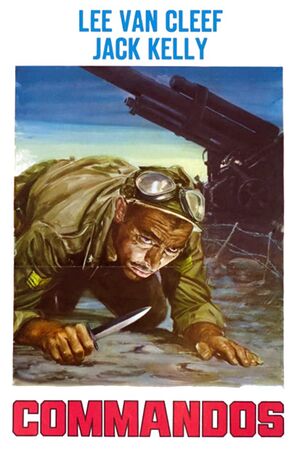
Commandos
Buying DVDs, I usually have a limit I'll spend on a movie. Those $40 8-disc special editions with 139 hours of special features seems pointless unless I really love the movie. The same goes for cheaper movies. Sure, it costs $7.99, but do I really like the movie enough to want to buy it? Typically, that's a no. On the other hand, what if it was so super-cheap that I didn't care if I would love or hate the movie? That was the case with 1968's Commandos which I purchased for the low sum of 50 cents with about 10 more added for tax.
It was lying there in a bargain bin and even knowing that the condition of the movie would probably be horrible, I bought it. Being a Lee Van Cleef fan, I've been aware of the movie for years, but it was never on TV, and I could never find a decent DVD copy. For the low price of 50 cents though, I'll put up with the low quality. And don't be confused, it's that cheap for a reason. It's one of many public domain movies, meaning anyone and everyone can sell it. The problem is that these versions are usually edited/cropped/pan-n-scan versions and overall, just pretty crappy. I rolled the dice here, and though the quality was well below average, I still enjoyed the movie.
It's late in 1942, and Sgt. Sullivan (Van Cleef) is training a group of Italian-American soldiers as commandos for behind-the-lines type missions. After a month-plus of training though, a new commander, Captain Valli (Jack Kelly), arrives with orders for a dangerous mission behind the lines in North Africa. Valli has put together every aspect of a mission where Sullivan's commandos will parachute into the desert, hike several miles, and take over an oasis guarded by German forces until Allied forces can reach the all-important wells. The plan seems well thought out, but Sullivan buckles at the thought of being commanded by a desk jockey with no combat experience like Valli. The mission is dangerous enough, but can the two men work together well enough to get it done?
Compared to some of the cheapie DVDs I've bought, this one wasn't that bad. I could hear just about everything, and the colors were only slightly washed out. There did seem to be some odd cuts in the middle of a scene, but the runtime -- 97 minutes -- came in longer than the one posted at the IMDB. As with any widescreen movie, something is obviously lost in the transfer from widescreen to fullscreen. I found a clip at Youtube with the widescreen presentation, and the difference is light years away. I liked the movie in its crappy form so seeing it as it was originally intended sounds like a no-brainer to me.
While spaghetti westerns were more well known in the late 1960s and early 1970s, 'spaghetti' war movies had quite a run too. They had similar styles and tones of spaghetti westerns, and other than the WWII setting, they're basically the same. Great anti-heroes, supremely evil villains, and lots and lots of action. Certain portions drag in the middle, but two well-put together action scenes bookend the movie. The first takes place at night as the commandos take over the oasis, and the second is the finale as a German panzer unit tries to retake the wells. For a low-budget film, no costs were spared in the action sequences. It's a chaotic, bloody, and surprising ending that works surprisingly well to point out the lunacy of war. It could have been sappy or overdone but ends up working pretty well. Of course, it's not exactly a real happy conclusion, but what war movie has an uplifting ending?
Starring at the height of his popularity in Europe, Van Cleef is not at his strongest here, resorting too much to either yelling like a nut or freaking out like a nut. His Sullivan is a combat veteran trying to put some demons behind him -- and failing across the board -- but instead of getting to know the character, he just snaps and screams at different people. Still, it's Lee Van Cleef, and he's a badass...so there, I don't need another reason to recommend the movie. Kelly's Valli could have been the more likable of the two, but he keeps you at arm's length. What drives him, or is it just an intense desire to prove he can handle combat? Other solid supporting parts include Joachim Fuchsberger as a German officer who was a professor back home, Marino Mase as Lt. Tommasini, an Italian officer looking out for his men, and Romano Puppo as Dino, a close friend of Sullivan's who survived Bataan with the sergeant.
There have been worse and there have been better, but for the price I paid, I felt like I got a square deal. Of course, .50 DVDs probably aren't a safe bet most of the time, and the more I think about it, the luckier I was. There's just enough here to recommend if you can find a cheapie DVD. For me, I liked it enough to look for a better copy in the future. There isn't much available online, but I did find an Italian trailer. I couldn't understand it, but it will give you a good idea of video-quality.
Commandos <---trailer (1968): ** 1/2 /****
It was lying there in a bargain bin and even knowing that the condition of the movie would probably be horrible, I bought it. Being a Lee Van Cleef fan, I've been aware of the movie for years, but it was never on TV, and I could never find a decent DVD copy. For the low price of 50 cents though, I'll put up with the low quality. And don't be confused, it's that cheap for a reason. It's one of many public domain movies, meaning anyone and everyone can sell it. The problem is that these versions are usually edited/cropped/pan-n-scan versions and overall, just pretty crappy. I rolled the dice here, and though the quality was well below average, I still enjoyed the movie.
It's late in 1942, and Sgt. Sullivan (Van Cleef) is training a group of Italian-American soldiers as commandos for behind-the-lines type missions. After a month-plus of training though, a new commander, Captain Valli (Jack Kelly), arrives with orders for a dangerous mission behind the lines in North Africa. Valli has put together every aspect of a mission where Sullivan's commandos will parachute into the desert, hike several miles, and take over an oasis guarded by German forces until Allied forces can reach the all-important wells. The plan seems well thought out, but Sullivan buckles at the thought of being commanded by a desk jockey with no combat experience like Valli. The mission is dangerous enough, but can the two men work together well enough to get it done?
Compared to some of the cheapie DVDs I've bought, this one wasn't that bad. I could hear just about everything, and the colors were only slightly washed out. There did seem to be some odd cuts in the middle of a scene, but the runtime -- 97 minutes -- came in longer than the one posted at the IMDB. As with any widescreen movie, something is obviously lost in the transfer from widescreen to fullscreen. I found a clip at Youtube with the widescreen presentation, and the difference is light years away. I liked the movie in its crappy form so seeing it as it was originally intended sounds like a no-brainer to me.
While spaghetti westerns were more well known in the late 1960s and early 1970s, 'spaghetti' war movies had quite a run too. They had similar styles and tones of spaghetti westerns, and other than the WWII setting, they're basically the same. Great anti-heroes, supremely evil villains, and lots and lots of action. Certain portions drag in the middle, but two well-put together action scenes bookend the movie. The first takes place at night as the commandos take over the oasis, and the second is the finale as a German panzer unit tries to retake the wells. For a low-budget film, no costs were spared in the action sequences. It's a chaotic, bloody, and surprising ending that works surprisingly well to point out the lunacy of war. It could have been sappy or overdone but ends up working pretty well. Of course, it's not exactly a real happy conclusion, but what war movie has an uplifting ending?
Starring at the height of his popularity in Europe, Van Cleef is not at his strongest here, resorting too much to either yelling like a nut or freaking out like a nut. His Sullivan is a combat veteran trying to put some demons behind him -- and failing across the board -- but instead of getting to know the character, he just snaps and screams at different people. Still, it's Lee Van Cleef, and he's a badass...so there, I don't need another reason to recommend the movie. Kelly's Valli could have been the more likable of the two, but he keeps you at arm's length. What drives him, or is it just an intense desire to prove he can handle combat? Other solid supporting parts include Joachim Fuchsberger as a German officer who was a professor back home, Marino Mase as Lt. Tommasini, an Italian officer looking out for his men, and Romano Puppo as Dino, a close friend of Sullivan's who survived Bataan with the sergeant.
There have been worse and there have been better, but for the price I paid, I felt like I got a square deal. Of course, .50 DVDs probably aren't a safe bet most of the time, and the more I think about it, the luckier I was. There's just enough here to recommend if you can find a cheapie DVD. For me, I liked it enough to look for a better copy in the future. There isn't much available online, but I did find an Italian trailer. I couldn't understand it, but it will give you a good idea of video-quality.
Commandos <---trailer (1968): ** 1/2 /****
Tuesday, September 29, 2009
Young Billy Young
Kennedy worked with a wide variety of tough guy actors in these westerns, including John Wayne, Glenn Ford, Henry Fonda, Ben Johnson, Yul Brynner, Frank Sinatra, Kirk Douglas and Robert Mitchum. Just like director Kennedy, many of these actors are remembered for their parts in westerns over the years. Mitchum especially never really left the western behind, joining with Kennedy for the 1969 oater Young Billy Young just two years removed from minor classic El Dorado.
Based loosely on a novel about Wyatt Earp's involvement with the Cowboy gang following the shootout at the O.K. Corral, Young Billy Young feels like a mash-up of several different stories all rolled into one. A great opening sequence has two young gunfighters, Billy Young (Robert Walker JR) and Jess Boone (David Carradine) sneaking onto a Mexican troop train and completing a hit on a Mexican general. In their escape, Jess abandons Billy when his horse throws up, and it's only by pure luck Billy escapes.
Billy makes it to the next town on the back of a burro, but it's not long before he guns down the town's sheriff for cheating in a card game. With some help from a gunfighter, Ben Kane (Mitchum), passing through town, Billy escapes a posse on his trail. He tags along with Ben who's on his way to a new job, working as a deputy in a roughshod town with no law and order run by slimy John Behan (Jack Kelly). The odds are against Ben, but he's got revenge on the mind as he looks for the man (John Anderson) who killed his son years ago in a jailbreak.
As if that wasn't enough, a saloon/dance hall girl, Lilly (Angie Dickinson), takes a shine to Kane, but Lilly is Behan's girl and doesn't take too nicely to Ben stepping in. There's more that is revealed in terms of plot twists that won't be spoiled here, but it's nothing too new that you won't have seen before. The only problem is that with all these different storylines about revenge and friendships and shootouts, the 89-minute running time is all sorts of convoluted. Maybe another 30 minutes could have served the movie better, but it's not a deal breaker.
Some characters get short-shrift, like Anderson's gunfighter who shows up in town, disappears for awhile, and then reappears with little warning for a final showdown with Mitchum (a disappointing end for that story). It would have been interesting to see two storylines, Billy and Jesse and then Ben's revenge dealt with exclusively, but what's there is entertaining nonetheless. It doesn't hurt that the movie was filmed in Old Tucson and looks great.
With the cast, Mitchum provides credibility just by being there. It's the type of part for the veteran star that he could do with no heavy lifting. He shows up, acts cool, shoots some baddies and gets the girl. Made the same year as he made Easy Rider, Walker JR gets a more mainstream role here as Billy who with Mitchum's older, more experienced gunfighter make a good old vs. young buddy pairing. Carradine's a good villain (when wasn't he?) while Kelly sneers as Behan, I guess loosely based on the real-life John Behan. In a role similar to her part 10 years earlier in Rio Bravo, Dickinson again plays a strong female character with a checkered past and even as little as she was height-wise is a good match with Mitchum.
So what's not to like with a western with a more than capable cast, some nice location shooting, plenty of gunfights, and Robert Mitchum singing the theme song? Maybe Burt Kennedy wasn't the best director around and one without much of a personal style, but he put together some exciting westerns during his career. Young Billy Young is certainly one of them, an oater that will keep you interested from start to finish.
Young Billy Young (1969): ** 1/2 / ****
Subscribe to:
Posts (Atom)