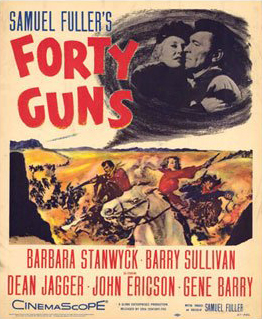
As many westerns as I've watched over the years, I'm drawing a complete blank as to how to describe 1957's Forty Guns. It is truly odd, weird, bizarre, unintentionally funny at times, surprisingly dark and cynical at others, and in spots, really, really entertaining. And at 79 minutes, it packs more into its short running time than movies that are much, much longer. What an odd mess of a movie.
A federal peace officer with a well-known reputation, Griff Bonnell (Barry Sullivan) rides into Cochise County, Arizona with his two brothers, experienced gunhand, Wes (Gene Barry), and inexperienced but motivated Chico (Robert Dix). Griff is holding an arrest warrant on a cowboy accused of robbing a mail stagecoach, and then he finds out the man is working for Jessica Drummond (Barbara Stanwyck), a cattle queen in the area who has money, power and the guns -- some 40 gunslingers -- to back her up. The arrest warrant is just the start of problems as Jessica's younger brother, Brockie (John Ericson), doesn't like Griff's arrival and intends to do something about it.
Nothing too out of the ordinary for a western, is it? I didn't think so reading the plot description over at Netflix. From director Sam Fuller (who also wrote and produced), 'Forty' is just a mess of a movie. The positives are great, showing that at some point there was a chance this could have been a good to great western. The negatives though are epic, bordering on movie-killers. Some of the positives? It is a beautiful black and white movie, the camera work impressive, featuring long tracking shots, plenty of interesting angles, and basically a feeling of seeing something different. It is also surprisingly brutal and in its message. As far as westerns went in the 1950s, this is far ahead of its time, especially considering the cynicism that developed in 1960s westerns.
Besides Stanwyck in the lead, I didn't recognize much of the cast by name alone, but that ends up being a good thing. The Bonnells -- a thinly veiled take on the Earp brothers -- are great leads, especially Sullivan and Barry. Griff is the sure-handed lawman, so confident in his ability that he hasn't had to fire his gun in almost 10 years. Wes is his right-hand man, always backing him up like a guardian angel hovering over the situation. Chico wants to be like his brothers having seen the "glory" and "romance" of being a gunslinger. Stanwyck too is a bright spot, playing a strong female character, something that is lacking in so many westerns. She's no damsel in distress for sure, even doing her own stunt as she's dragged by her horse. Both the Bonnells and the Drummond characters are strong characters, able to carry a movie on their own. Instead of that, we get a jam-packed, even rushed 79 minute movie.
For all the positives, there's just too much going on for 'Forty' to be truly effective. Another 30 minutes would have been perfect to flesh things out. Barry's Wes is wasted in what was potentially a very cool character, "wooing" gunsmith's daughter, Louvenia (Eve Brent), and disappearing for long stretches of a short movie. Dean Jagger appears as necessary as corrupt and bought Sheriff Ned Logan, a possibly interesting backstory kept in the shadows. Oh, and did I mention that Stanwyck and Sullivan have a tortured love affair, two strong-willed individuals falling for each other for all the wrong reasons? Yeah, that's sort of a major plot, but like anything and everything else.....yeah, you guessed it. Rushed.
Rushed is one thing because it at least implies some sort of wasted potential. It was there, just never taken advantage of. On the other hand, there's just some badness. Ericson's terribly hammy performance as Brockie is so ridiculous it comes across as laughable. Some not so subtle sexual references -- a gun "going off in a woman's face" or "caring for one's gun with care and daily attention" -- are so heavy-handed they're hilarious in their badness.
A lot of these issues I had were almost thrown by the wayside in the finale, Sullivan's Griff delivering a truly surprising, brutal surprise, especially considering this was made in 1957. It's a mess of a movie overall -- both really good and epically bad -- but there's just enough....jjjjjjjjjjust....to recommend this one.
Forty Guns <---Youtube clip (1957): ** 1/2 /****
The Sons of Katie Elder
"First, we reunite, then find Ma and Pa's killer...then read some reviews."
Showing posts with label Sam Fuller. Show all posts
Friday, June 8, 2012
Sunday, October 9, 2011
Underworld U.S.A.
A talented actor and a star who never rose to any sort of cult or iconic status, Cliff Robertson died September 10th at the age of 88, capping a career that dated back to the 1950s. He started off like so many actors in television before making the jump to feature films. Robertson starred in over 50 movies, including most recently in the Spiderman movies when he was introduced to a new generation of moviegoers. Never a huge star, he remains one of my favorites, starring in movies like PT 109 and The Devil's Brigade.
After spending most of the 1950s in television, Robertson did turn to feature films in the 1960s, including 1961's Underworld U.S.A., one of his best roles and an impressive starring debut. The movie comes from director Sam Fuller, a WWII vet and a director who was as tough as they come both personally and in his movies. 'Underworld' would serve as a good double feature with Fuller's 1963 movie, Shock Corridor, and for all the wrong reasons. What starts as an interesting film noir gets too hammy, too over the top before all is said and done. In a cast full of relative unknowns, Robertson is the best thing going in this hyper film noir.
As a 14-year old kid, Tolly Devlin sees his father beaten to death in an alley but is only able to identify one of the four killers. He turns to a life of petty crime and ends up in prison serving an extended sentence, stumbling across the one killer he can identify, dying from a heart ailment. Now in his late 20s, Tolly (Robertson) gets the names from the dying man and upon earning his parole goes to work exacting his revenge. The three men are all higher-ups in a national crime syndicate so instead of callously gunning them down, Tolly works from the inside, rising through the ranks of the criminal underworld. He slowly climbs to a position where he can do something only to find out the D.A.'s investigator, Driscoll (Larry Gates), is closing in on the men Tolly wants to get at. Could he manipulate even the Feds into helping him finish his revenge?
All the elements of a successful film noir movie are here; the dark, dank backstreets, the anti-hero, the damaged woman, the irredeemable baddie, the back stabbing and murder. The black and white filming gives a throwback feel to 'Underworld' to the late 1940s when noir was at the height off its popularity. In an effort to make the familiar noir formula more interesting though, Fuller amps it up to an 11 or so. It becomes too over the top, leaving even somewhat believable in the rearview mirror. A syndicate hitman (Richard Rust) revels in running over a little girl on her bike, later burning a man alive and similarly enjoying it a tad too much.
I guess it is the portrayal of the mobsters that bugged me the most. Connors (Robert Emhardt) is in charge of the national syndicate, ruling with an iron and unbending fist. They are so ridiculously over the top that the portrayal is unintentionally funny more than evil and intimidating. The syndicate is fronted by a nationwide charity that even sponsors a weekly kids swimming day at their own pool, pretending to be a reputable business. The three killers of Tolly's father include Paul Dubov, Gerald Milton and Allan Gruener, but they're not the bad guys so much as Rust's psychotic hired killer and Emhardt's Connors, who dominate the "badness" for lack of a better description. Just as the cherry on top, not only are these mobsters completely ridiculous, they're also mind-blowingly stupid, not realizing that trouble has started soon after the new guy -- Tolly -- arrived on the scene.
Through his career, Robertson had a knack for playing flawed heroes, the lead who was fighting through personal struggles. Of all the movies I've seen though, this character, Tolly Devlin, is the darkest by far. He's the anti-hero, which is a more appropriate description than 'the good guy' because he just isn't a good guy. Devlin is the lesser of two evils compared to the syndicate he's trying to take down. He's obsessed with exacting revenge no matter the cost, including sacrificing a possible relationship with Cuddles (Dolores Dorn), a young woman caught up in the syndicate's web, and turning his back on surrogate mom, Sandy (Beatrice Kay). Robertson brings Devlin to life, giving him an obsession, a cynicism and a general darkness that can be startling to watch. He has a look in his eye that makes you think he is capable of anything. I prefer Robertson in a more traditional hero role, but it's a nice change of pace to see otherwise.
The reviews are surprisingly positive for this movie. I don't think it is a bad movie, but at the same time the effort and intention comes across much too hard in the attempt. Tap the brakes or something there, Mr. Fuller. Just like Fuller's Shock Corridor, the effort in making a unique story is so interested in impressing the viewer that it loses all sense of reality. The finale -- the last 20 minutes or so -- is a fitting end, one that's telegraphed basically from the beginning. You know how this movie will end. So while it's not a favorite of mine, I can appreciate 'Underworld' for Cliff Robertson's performance. RIP Cliff, you'll be missed.
Underworld U.S.A. <---TCM clips/trailer (1961): ** 1/2 /****
After spending most of the 1950s in television, Robertson did turn to feature films in the 1960s, including 1961's Underworld U.S.A., one of his best roles and an impressive starring debut. The movie comes from director Sam Fuller, a WWII vet and a director who was as tough as they come both personally and in his movies. 'Underworld' would serve as a good double feature with Fuller's 1963 movie, Shock Corridor, and for all the wrong reasons. What starts as an interesting film noir gets too hammy, too over the top before all is said and done. In a cast full of relative unknowns, Robertson is the best thing going in this hyper film noir.
As a 14-year old kid, Tolly Devlin sees his father beaten to death in an alley but is only able to identify one of the four killers. He turns to a life of petty crime and ends up in prison serving an extended sentence, stumbling across the one killer he can identify, dying from a heart ailment. Now in his late 20s, Tolly (Robertson) gets the names from the dying man and upon earning his parole goes to work exacting his revenge. The three men are all higher-ups in a national crime syndicate so instead of callously gunning them down, Tolly works from the inside, rising through the ranks of the criminal underworld. He slowly climbs to a position where he can do something only to find out the D.A.'s investigator, Driscoll (Larry Gates), is closing in on the men Tolly wants to get at. Could he manipulate even the Feds into helping him finish his revenge?
All the elements of a successful film noir movie are here; the dark, dank backstreets, the anti-hero, the damaged woman, the irredeemable baddie, the back stabbing and murder. The black and white filming gives a throwback feel to 'Underworld' to the late 1940s when noir was at the height off its popularity. In an effort to make the familiar noir formula more interesting though, Fuller amps it up to an 11 or so. It becomes too over the top, leaving even somewhat believable in the rearview mirror. A syndicate hitman (Richard Rust) revels in running over a little girl on her bike, later burning a man alive and similarly enjoying it a tad too much.
I guess it is the portrayal of the mobsters that bugged me the most. Connors (Robert Emhardt) is in charge of the national syndicate, ruling with an iron and unbending fist. They are so ridiculously over the top that the portrayal is unintentionally funny more than evil and intimidating. The syndicate is fronted by a nationwide charity that even sponsors a weekly kids swimming day at their own pool, pretending to be a reputable business. The three killers of Tolly's father include Paul Dubov, Gerald Milton and Allan Gruener, but they're not the bad guys so much as Rust's psychotic hired killer and Emhardt's Connors, who dominate the "badness" for lack of a better description. Just as the cherry on top, not only are these mobsters completely ridiculous, they're also mind-blowingly stupid, not realizing that trouble has started soon after the new guy -- Tolly -- arrived on the scene.
Through his career, Robertson had a knack for playing flawed heroes, the lead who was fighting through personal struggles. Of all the movies I've seen though, this character, Tolly Devlin, is the darkest by far. He's the anti-hero, which is a more appropriate description than 'the good guy' because he just isn't a good guy. Devlin is the lesser of two evils compared to the syndicate he's trying to take down. He's obsessed with exacting revenge no matter the cost, including sacrificing a possible relationship with Cuddles (Dolores Dorn), a young woman caught up in the syndicate's web, and turning his back on surrogate mom, Sandy (Beatrice Kay). Robertson brings Devlin to life, giving him an obsession, a cynicism and a general darkness that can be startling to watch. He has a look in his eye that makes you think he is capable of anything. I prefer Robertson in a more traditional hero role, but it's a nice change of pace to see otherwise.
The reviews are surprisingly positive for this movie. I don't think it is a bad movie, but at the same time the effort and intention comes across much too hard in the attempt. Tap the brakes or something there, Mr. Fuller. Just like Fuller's Shock Corridor, the effort in making a unique story is so interested in impressing the viewer that it loses all sense of reality. The finale -- the last 20 minutes or so -- is a fitting end, one that's telegraphed basically from the beginning. You know how this movie will end. So while it's not a favorite of mine, I can appreciate 'Underworld' for Cliff Robertson's performance. RIP Cliff, you'll be missed.
Underworld U.S.A. <---TCM clips/trailer (1961): ** 1/2 /****
Wednesday, April 6, 2011
Shock Corridor
For a look into a mental institution, one needs only go as far as One Flew Over the Cuckoo's Nest. It's a good look to, honest but sympathetic in most ways, well except for Nurse Ratchet that is. Reading about 1963's Shock Corridor, I thought I was going into a similar story, the inner workings of a mental institution from the perspective of the patients. When I saw Samuel Fuller directed the film, I was even more excited. That excitement wore off pretty quickly. This movie was bad from the start, dated and campy but not in a good way. Instead, it ends up being surprisingly funny, but I'd assume for all the wrong reasons.
A movie that tries to explore social dilemmas, problems that should be dealt with, it has to be handled correctly or else the finished product is going to blow up on the launch pad. I was surprised and not surprised this movie is held in high regard by moviegoers and critics alike. For a movie released in 1963, it certainly does tackle some issues that were ahead of its time. But the execution of it on top of the really bad acting and hackneyed dialogue end up crippling any chance of success this movie had. Maybe I'm just looking at it the wrong way, but I thought this movie was awful and couldn't wait to get through it.
A highly-regarded newspaper reporter, John Barrett (Peter Breck) has thought of a story idea that he's convinced will win him the Pulitzer Prize. Recently, an unsolved murder occurred in a local mental institution, but the murderer was never found and the police gave up on the case (apparently). Barrett hopes to get himself committed to the place and piece things together from the inside. He goes through training so he can act like and appreciate what some of the patients will be going through. His girlfriend, Cathy (Constance Towers), poses as his sister who says her "brother" has made advances on her and has him committed. John goes along with it, feeling things out as he goes through therapy sessions -- some more extreme than the others -- trying to figure out what happened to the murdered patient. But as the clues come together, John begins to descend into his own madness. Can he figure out the murderer before it's too late for him?
I like Fuller as a director, but this was just a weird movie overall. It's off the wall and ridiculous, portraying the patients in such a bizarre way that the movie doesn't serve as a condemnation of mental institutions. Instead, it's more a big joke. One immensely obese patient (Larry Tucker) believes he is Pagliacci, constantly singing opera in the ward. Some patients do nothing but sit all day in the hallway, "the street" dubbed by the staff where patients who have behaved get to interact and have some sense of freedom. That's where most of the movie takes place, in the hallway, Breck's John doing his best to figure out exactly what's happened. It never works though. The murder mystery is never really established (it's fairly easy to predict who the killer is) and feels like the script needed any excuse to put this respected journalist into an institution.
Watching Barrett basically fall apart day by day and week by week, I came to dislike the character more and more until finally I just decided I hated him. Part of that is the character's fault because he just isn't likable. The other part is that Breck delivers a downright bad performance. His stream of conscious narration is hilarious, and his two go-to moves to show he's going crazy is stoned silence with an empty stare or scream like toddler who isn't getting his way. He's so obsessively driven to pull the stunt off and get his story he becomes oblivious to his own issues. You know where it's going almost from the start, and it isn't going to end well for Barrett. I'll also add this as someone with no medical experience or background. Are mental illnesses contagious? Can you catch some sort of sickness by just acting like you have said sickness? I realize he's basically imbedded himself in a world of crazy, but can that turn you crazy? I wouldn't think so, but the whole movie relies on that ridiculous (to me at least) premise.
Treading the ever so thin line between overacting and just delivering highly dramatic parts are three key supporting characters, the witnesses to the murder Barrett is trying to solve. They include James Best, Fuller favorite Gene Evans, and Hari Rhodes. All sane men at some point, they all had breakdowns. Best was captured in Korea and brainwashed by the North Koreans and Chinese, returning never quite the same. Evans was a brilliant scientist who just snapped one day, his mind regressing back to his childhood days. Rhodes plays a black student who broke the color barrier at an all-white school, and now thinks he's white, terrorizing the black patients. Each man is given a scene that delves into their mind (or what's left of it). If I had to recommend anything about this movie, it would be those three extended scenes. They're intense (if a little overbearing) and feel like the one authentic thing going for this story. On a sidenote, Barrett doesn't actually "investigate" anything. He talks to them, they rant for awhile, and he finally blurts out "Who killed Sloan?!?!" That's just good detective work there, sir! Good work.
All positives aside, there is much, MUCH more toward the negative. Constance Towers isn't a bad actress, but her character is mind-blowingly stupid. Pretending to be Barrett's sister who he's sexually interested in, she passionately kisses him during one of their visits at the institution. Yes, I can appreciate she's worried about her boyfriend/fiance, but does she not see the problem in her actions? She flips out then when Barrett pushes her away. Most of her part has her slinking around (she's a stripper for her day job) in Barrett's nightmares, convincing him that she's hooking up with other men while he's wasting away in the institution. The moments of clarity patients go through are laughable and border on the pretentious. The breakdowns are laughable when they do happen, and made me laugh more than I was probably supposed to. The best though by far is Barrett accidentally stumbling into a ward for a certain type of female patients. He realizes who and what they are, his first thought via narration...."NYMPHOS!" They proceed to attack him in a truly awful but still funny scene which you can watch HERE.
I really did not know what to make of this movie. At one time effective, others so misplayed that the movie comes across like a camp classic. Maybe because there was some potential here that the end result is that much more disappointing. Stretching for a positive is an increased role for Chuck Roberson, John Wayne's stunt double and one of the most talented stunt men in the business. If you've seen a Wayne movie from the 1960s, I guarantee you've seen Roberson whether you know it or not. He plays Wilkes, one of the institution's attendants who tries to help Barrett through his struggles. It's a small part, but one of the bigger ones Roberson had in an impressive career, rivaling his screentime in 1960's The Alamo. Still, it's a minor positive in a sea of major negatives.
Shock Corridor <---trailer (1963): */****
A movie that tries to explore social dilemmas, problems that should be dealt with, it has to be handled correctly or else the finished product is going to blow up on the launch pad. I was surprised and not surprised this movie is held in high regard by moviegoers and critics alike. For a movie released in 1963, it certainly does tackle some issues that were ahead of its time. But the execution of it on top of the really bad acting and hackneyed dialogue end up crippling any chance of success this movie had. Maybe I'm just looking at it the wrong way, but I thought this movie was awful and couldn't wait to get through it.
A highly-regarded newspaper reporter, John Barrett (Peter Breck) has thought of a story idea that he's convinced will win him the Pulitzer Prize. Recently, an unsolved murder occurred in a local mental institution, but the murderer was never found and the police gave up on the case (apparently). Barrett hopes to get himself committed to the place and piece things together from the inside. He goes through training so he can act like and appreciate what some of the patients will be going through. His girlfriend, Cathy (Constance Towers), poses as his sister who says her "brother" has made advances on her and has him committed. John goes along with it, feeling things out as he goes through therapy sessions -- some more extreme than the others -- trying to figure out what happened to the murdered patient. But as the clues come together, John begins to descend into his own madness. Can he figure out the murderer before it's too late for him?
I like Fuller as a director, but this was just a weird movie overall. It's off the wall and ridiculous, portraying the patients in such a bizarre way that the movie doesn't serve as a condemnation of mental institutions. Instead, it's more a big joke. One immensely obese patient (Larry Tucker) believes he is Pagliacci, constantly singing opera in the ward. Some patients do nothing but sit all day in the hallway, "the street" dubbed by the staff where patients who have behaved get to interact and have some sense of freedom. That's where most of the movie takes place, in the hallway, Breck's John doing his best to figure out exactly what's happened. It never works though. The murder mystery is never really established (it's fairly easy to predict who the killer is) and feels like the script needed any excuse to put this respected journalist into an institution.
Watching Barrett basically fall apart day by day and week by week, I came to dislike the character more and more until finally I just decided I hated him. Part of that is the character's fault because he just isn't likable. The other part is that Breck delivers a downright bad performance. His stream of conscious narration is hilarious, and his two go-to moves to show he's going crazy is stoned silence with an empty stare or scream like toddler who isn't getting his way. He's so obsessively driven to pull the stunt off and get his story he becomes oblivious to his own issues. You know where it's going almost from the start, and it isn't going to end well for Barrett. I'll also add this as someone with no medical experience or background. Are mental illnesses contagious? Can you catch some sort of sickness by just acting like you have said sickness? I realize he's basically imbedded himself in a world of crazy, but can that turn you crazy? I wouldn't think so, but the whole movie relies on that ridiculous (to me at least) premise.
Treading the ever so thin line between overacting and just delivering highly dramatic parts are three key supporting characters, the witnesses to the murder Barrett is trying to solve. They include James Best, Fuller favorite Gene Evans, and Hari Rhodes. All sane men at some point, they all had breakdowns. Best was captured in Korea and brainwashed by the North Koreans and Chinese, returning never quite the same. Evans was a brilliant scientist who just snapped one day, his mind regressing back to his childhood days. Rhodes plays a black student who broke the color barrier at an all-white school, and now thinks he's white, terrorizing the black patients. Each man is given a scene that delves into their mind (or what's left of it). If I had to recommend anything about this movie, it would be those three extended scenes. They're intense (if a little overbearing) and feel like the one authentic thing going for this story. On a sidenote, Barrett doesn't actually "investigate" anything. He talks to them, they rant for awhile, and he finally blurts out "Who killed Sloan?!?!" That's just good detective work there, sir! Good work.
All positives aside, there is much, MUCH more toward the negative. Constance Towers isn't a bad actress, but her character is mind-blowingly stupid. Pretending to be Barrett's sister who he's sexually interested in, she passionately kisses him during one of their visits at the institution. Yes, I can appreciate she's worried about her boyfriend/fiance, but does she not see the problem in her actions? She flips out then when Barrett pushes her away. Most of her part has her slinking around (she's a stripper for her day job) in Barrett's nightmares, convincing him that she's hooking up with other men while he's wasting away in the institution. The moments of clarity patients go through are laughable and border on the pretentious. The breakdowns are laughable when they do happen, and made me laugh more than I was probably supposed to. The best though by far is Barrett accidentally stumbling into a ward for a certain type of female patients. He realizes who and what they are, his first thought via narration...."NYMPHOS!" They proceed to attack him in a truly awful but still funny scene which you can watch HERE.
I really did not know what to make of this movie. At one time effective, others so misplayed that the movie comes across like a camp classic. Maybe because there was some potential here that the end result is that much more disappointing. Stretching for a positive is an increased role for Chuck Roberson, John Wayne's stunt double and one of the most talented stunt men in the business. If you've seen a Wayne movie from the 1960s, I guarantee you've seen Roberson whether you know it or not. He plays Wilkes, one of the institution's attendants who tries to help Barrett through his struggles. It's a small part, but one of the bigger ones Roberson had in an impressive career, rivaling his screentime in 1960's The Alamo. Still, it's a minor positive in a sea of major negatives.
Shock Corridor <---trailer (1963): */****
Labels:
1960s,
Constance Towers,
Gene Evans,
James Best,
Sam Fuller
Friday, December 3, 2010
The Crimson Kimono
Ahead of its time when it was released does not necessarily mean a movie will age well over the years. What's new or innovative whether in film-making techniques or types of storytelling in the 1960s or 1970s is almost certainly not exciting or unique some 40 years later. This can give a movie some cult status as fans embrace the nostalgia, but there's got to be something else for me to latch onto. That's my main problem with 1959's The Crimson Kimono.
From director Sam Fuller comes this noirish detective story that pushed some late 1950s boundaries when it came to on-screen relationships. No, we're not talking hardcore love scenes or anything, instead we're dealing with something that many might consider even more controversial....pause for dramatic effect...interracial relationships!!!! Pretty scandalous, huh? I guess it's an issue for some people, and in 1959 you can understand why it would have been controversial. I didn't even think twice about the ending, but reading some reviews I was completely caught off guard by the then-scandalous ending. You'll have to decide for yourself, but a supposedly controversial ending was the least of this movie's troubles.
One night after finishing a show, a stripper is murdered in Los Angeles on a busy street but no one saw who did it. Called in to investigate the murder, detectives Charlie Bancroft (Glenn Corbett) and Joe Kojaku (James Shigeta) try to piece the evidence together. A handful of paintings with an artist's signature is the only clue so they manage to track down Chris (Victoria Shaw), a pretty co-ed at USC who drew the paintings. Her description of the possible murderer puts them on the right path, but that's the least of their problems. Staying involved with the case as it unfolds, both Charlie and Joe fall hard for Chris. So now instead of just worrying about tracking down the killer, the two detectives are wrapped up in the worst thing possible, the love triangle!
Fuller does a great job filming the movie in making Los Angeles another character in the story. He films predominantly in the Japanese quarter of the city so you see (or at least I did) a part of LA that I was unfamiliar with. We see the sub-culture, the shops, the businesses, the traditions as our two intrepid detectives go about solving a murder case. Lots of great tracking shots through the city give the story a documentary-like feel as if it isn't a movie being filmed, instead a real police investigation. It goes too far at certain points because the story feels tacked on, like Fuller realizing 'oh wait, we've got to wrap this up...okay wait, one more shot of a Japanese parade.' So as with most movies, it's the balance between good and bad, just finding that right middle ground.
In a career that covered a little over 30 movies, Fuller did his best work with stars who weren't superstars, Hollywood actors who were as tough as Fuller himself. So not surprisingly, I was glad to see lesser stars like Corbett and Shigeta get a shot at starring roles. Well, it's not all good. Making his film debut, Corbett is pretty awful here. He was typically at his best in supporting roles where his stern demeanor (some might call it stiff or wooden) didn't require him to carry scenes on his own. There are scenes where he's required to show emotion that sound more like a little kid lashing out at his parents more than a veteran detective on the case. Shigeta goes for calmer, cooler and smoother, and in the process almost puts you to sleep. He speaks in a low mumble so it's nearly impossible to even hear him, much less be interested in the character.
There's potential with their background -- Korean War vets from the same unit turned detective partners -- but it gets lost in the shuffle of the love triangle and murder mystery. Honestly, the murder mystery gets lost in the shuffle of the love triangle. Fuller almost completely disregards the drive and focus of the story at the expense of this semi-controversial love story between a white detective, a Japanese detective and a white co-ed. What's worse is the portrayal of the Chris character. Shaw is a pretty girl, but her character is awful. She tells Charlie she'd be interested in seeing him post-investigation, makes out with him, and then doesn't understand why he's pissed when Joe professes his love for her, and she chooses him too. I couldn't decide if it was poor writing or plain laziness, but it's bad regardless. A love triangle is typically bad to begin with, and all these shenanigans don't help.
This builds to the finale when Charlie and Joe put their differences aside to oh yeah, catch the freaking killer. Blah blah blah, someone gets caught, but the case leading up to it is so ridiculous with so many clues mysteriously jump from one clue to the next with most of it going unexplained how these two detectives actually got to that point. Catch the bad guy, stare each other down, and Charlie lets his friend and partner take the girl. The ending has Shigeta kiss Shaw passionately while Corbett walks away with drunken artist Anna Lee (decent in a supporting part). An Asian man kissing a white woman? Let's hang him! By that point in the movie I was so frustrated it would have taken a lot more than that interracial kiss to impress me. It is available to watch on Youtube, start HERE with Part 1 of 8.
The Crimson Kimono <---TCM clips (1959): * 1/2 /****
From director Sam Fuller comes this noirish detective story that pushed some late 1950s boundaries when it came to on-screen relationships. No, we're not talking hardcore love scenes or anything, instead we're dealing with something that many might consider even more controversial....pause for dramatic effect...interracial relationships!!!! Pretty scandalous, huh? I guess it's an issue for some people, and in 1959 you can understand why it would have been controversial. I didn't even think twice about the ending, but reading some reviews I was completely caught off guard by the then-scandalous ending. You'll have to decide for yourself, but a supposedly controversial ending was the least of this movie's troubles.
One night after finishing a show, a stripper is murdered in Los Angeles on a busy street but no one saw who did it. Called in to investigate the murder, detectives Charlie Bancroft (Glenn Corbett) and Joe Kojaku (James Shigeta) try to piece the evidence together. A handful of paintings with an artist's signature is the only clue so they manage to track down Chris (Victoria Shaw), a pretty co-ed at USC who drew the paintings. Her description of the possible murderer puts them on the right path, but that's the least of their problems. Staying involved with the case as it unfolds, both Charlie and Joe fall hard for Chris. So now instead of just worrying about tracking down the killer, the two detectives are wrapped up in the worst thing possible, the love triangle!
Fuller does a great job filming the movie in making Los Angeles another character in the story. He films predominantly in the Japanese quarter of the city so you see (or at least I did) a part of LA that I was unfamiliar with. We see the sub-culture, the shops, the businesses, the traditions as our two intrepid detectives go about solving a murder case. Lots of great tracking shots through the city give the story a documentary-like feel as if it isn't a movie being filmed, instead a real police investigation. It goes too far at certain points because the story feels tacked on, like Fuller realizing 'oh wait, we've got to wrap this up...okay wait, one more shot of a Japanese parade.' So as with most movies, it's the balance between good and bad, just finding that right middle ground.
In a career that covered a little over 30 movies, Fuller did his best work with stars who weren't superstars, Hollywood actors who were as tough as Fuller himself. So not surprisingly, I was glad to see lesser stars like Corbett and Shigeta get a shot at starring roles. Well, it's not all good. Making his film debut, Corbett is pretty awful here. He was typically at his best in supporting roles where his stern demeanor (some might call it stiff or wooden) didn't require him to carry scenes on his own. There are scenes where he's required to show emotion that sound more like a little kid lashing out at his parents more than a veteran detective on the case. Shigeta goes for calmer, cooler and smoother, and in the process almost puts you to sleep. He speaks in a low mumble so it's nearly impossible to even hear him, much less be interested in the character.
There's potential with their background -- Korean War vets from the same unit turned detective partners -- but it gets lost in the shuffle of the love triangle and murder mystery. Honestly, the murder mystery gets lost in the shuffle of the love triangle. Fuller almost completely disregards the drive and focus of the story at the expense of this semi-controversial love story between a white detective, a Japanese detective and a white co-ed. What's worse is the portrayal of the Chris character. Shaw is a pretty girl, but her character is awful. She tells Charlie she'd be interested in seeing him post-investigation, makes out with him, and then doesn't understand why he's pissed when Joe professes his love for her, and she chooses him too. I couldn't decide if it was poor writing or plain laziness, but it's bad regardless. A love triangle is typically bad to begin with, and all these shenanigans don't help.
This builds to the finale when Charlie and Joe put their differences aside to oh yeah, catch the freaking killer. Blah blah blah, someone gets caught, but the case leading up to it is so ridiculous with so many clues mysteriously jump from one clue to the next with most of it going unexplained how these two detectives actually got to that point. Catch the bad guy, stare each other down, and Charlie lets his friend and partner take the girl. The ending has Shigeta kiss Shaw passionately while Corbett walks away with drunken artist Anna Lee (decent in a supporting part). An Asian man kissing a white woman? Let's hang him! By that point in the movie I was so frustrated it would have taken a lot more than that interracial kiss to impress me. It is available to watch on Youtube, start HERE with Part 1 of 8.
The Crimson Kimono <---TCM clips (1959): * 1/2 /****
Labels:
1950s,
Anna Lee,
Cops,
Film Noir,
Glenn Corbett,
Sam Fuller
Tuesday, October 19, 2010
The Big Red One: The Reconstruction
Director Sam Fuller made a career of making tough, hard-edged movies that didn't venture far from film noir, war movies, and the occasional western. But before he ever got into movies, Fuller was an American infantry soldier in WWII. Late in his career, he wrote and directed a movie that told the story of his time in the army in the 1st Infantry Division, a movie with the unit's nickname as its title, 1980's The Big Red One. For years, the movie was only available in a heavily edited version that cut almost 50 minutes from Fuller's intended final cut. Now it is available as Fuller intended in a restored version that runs 163 minutes.
Where some movies ring false in their portrayal of soldiers in war, Fuller does his best to avoid that problem. It is a semi-biographical account of his experiences in the war as his squad survives the European theater of war. Some scenes ring true with an authenticity that only a real soldier could no, but surprisingly enough that authenticity isn't sustained through the whole movie. In trying to be too cute or too philosophical, Fuller's storytelling and narration become too cliched in an almost embarrassing way. So like any movie, there's the good and the bad, but I'm still wavering on how much I actually liked this movie.
It's 1942 and the American army is preparing to hit the beaches at North Africa. In the 1st Infantry Division, 16th Regiment, a soldier known only as the Sergeant (Lee Marvin) prepares to lead his squad into battle. The fight is a success, and the Allies continue their attacks throughout Africa and Europe as the war progresses. Four men, Zab (Robert Carradine), Griff (Mark Hamill), Johnson (Kelly Ward), and Vinci (Bobby Di Cicco), from the Sergeant's squad seem immune to getting hit or wounded, earning them the nickname 'Sergeant's Four Horsemen.' They fight across Africa and into Sicily, Italy, France and Germany, fighting in most of the ETO's major battles, including D-Day, Battle of the Bulge and many others. As the war looks to be drawing to a close, can these four survivors and their sergeant make it all the way through?
Telling a story that covers three-plus years and a never-ending sense of moving around, Fuller doesn't so much as tell a story as show a series of vignettes that show the everyday life of these soldiers; long periods of boredom and marching/camping broken up by quick, startling instances of horrific violence. Nothing wrong with that, but it can get a little tedious at times. The soldiers talk like soldiers do (obviously filtered/censored some), but at times it gets to be too much. Carradine's Zab provides the narration, and as good as it can be at times, it tries too hard to say something profound about war. The action is handled on a smaller scale and is effective enough, but like the dialogue and storytelling, it starts repeating itself and with 162 minutes, that leaves a lot of room for repeating.
Sometimes lost in that shuffle is the four privates that become known as the Sergeant's Four Horsemen. The only one to really distinguish himself from the rest is Hamill as Pvt. Griff, a sharpshooter who begins to freeze in combat. Fresh off the success of the first two Star Wars movies, Hamill makes his character interesting because as a viewer you can appreciate what he's going through. I'd be scared stiff to if I was getting shot at by complete strangers in a situation that makes little sense to the individual. The other three aren't quite as good. Carradine's narration is the best part about Zab who otherwise spends his time chomping on cigars. He tries to sound tough, but it's never believable. Ward and Di Cicco are cardboard cutouts of characters and never give us any reason to root for them. Some sort of background other than 'Johnson had hemorrhoids and Vinci was from Brooklyn' would have been nice too.
Making The Dirty Dozen, Marvin swooped in and took over a role intended for John Wayne. Same goes here as he steps into the shoes of the Sergeant after a version starring Wayne was brought up in the 1950s. A Marine in WWII who fought in the Pacific, Marvin is the best thing the movie has going for it. A little old maybe to play his character at 56, he still pulls the part off. He's tough, a strong leader and is going to do his best to get his men through the war unscathed. The choice to dub him solely 'the Sergeant' could have been a little pretentious on Fuller's part, but it works. During WWII, there were thousands of soldiers like Marvin's tough Sergeant, and in a lot of ways, Marvin is representing every single one of them. A little too old, sure, but Marvin was born to play a role like this.
Watching the movie with almost 50 minutes reinserted into the final cut certainly makes a difference, but at times it felt like a wasted opportunity. It's longer, but instead of seeing new, interesting things that develop the characters, we get tedious battle scenes that are still somehow too short. Certain moments ring true beautifully like Marvin's Sgt. carrying a young boy who survived a concentration camp, Johnson delivering a baby in a sweaty, cramped tank, the discovery of the concentration camp, and an honesty that seems to be missing from so many war movies. A good finished product, but it never lives up to its potential.
The Big Red One <---trailer (1980): ** 1/2 /****
Where some movies ring false in their portrayal of soldiers in war, Fuller does his best to avoid that problem. It is a semi-biographical account of his experiences in the war as his squad survives the European theater of war. Some scenes ring true with an authenticity that only a real soldier could no, but surprisingly enough that authenticity isn't sustained through the whole movie. In trying to be too cute or too philosophical, Fuller's storytelling and narration become too cliched in an almost embarrassing way. So like any movie, there's the good and the bad, but I'm still wavering on how much I actually liked this movie.
It's 1942 and the American army is preparing to hit the beaches at North Africa. In the 1st Infantry Division, 16th Regiment, a soldier known only as the Sergeant (Lee Marvin) prepares to lead his squad into battle. The fight is a success, and the Allies continue their attacks throughout Africa and Europe as the war progresses. Four men, Zab (Robert Carradine), Griff (Mark Hamill), Johnson (Kelly Ward), and Vinci (Bobby Di Cicco), from the Sergeant's squad seem immune to getting hit or wounded, earning them the nickname 'Sergeant's Four Horsemen.' They fight across Africa and into Sicily, Italy, France and Germany, fighting in most of the ETO's major battles, including D-Day, Battle of the Bulge and many others. As the war looks to be drawing to a close, can these four survivors and their sergeant make it all the way through?
Telling a story that covers three-plus years and a never-ending sense of moving around, Fuller doesn't so much as tell a story as show a series of vignettes that show the everyday life of these soldiers; long periods of boredom and marching/camping broken up by quick, startling instances of horrific violence. Nothing wrong with that, but it can get a little tedious at times. The soldiers talk like soldiers do (obviously filtered/censored some), but at times it gets to be too much. Carradine's Zab provides the narration, and as good as it can be at times, it tries too hard to say something profound about war. The action is handled on a smaller scale and is effective enough, but like the dialogue and storytelling, it starts repeating itself and with 162 minutes, that leaves a lot of room for repeating.
Sometimes lost in that shuffle is the four privates that become known as the Sergeant's Four Horsemen. The only one to really distinguish himself from the rest is Hamill as Pvt. Griff, a sharpshooter who begins to freeze in combat. Fresh off the success of the first two Star Wars movies, Hamill makes his character interesting because as a viewer you can appreciate what he's going through. I'd be scared stiff to if I was getting shot at by complete strangers in a situation that makes little sense to the individual. The other three aren't quite as good. Carradine's narration is the best part about Zab who otherwise spends his time chomping on cigars. He tries to sound tough, but it's never believable. Ward and Di Cicco are cardboard cutouts of characters and never give us any reason to root for them. Some sort of background other than 'Johnson had hemorrhoids and Vinci was from Brooklyn' would have been nice too.
Making The Dirty Dozen, Marvin swooped in and took over a role intended for John Wayne. Same goes here as he steps into the shoes of the Sergeant after a version starring Wayne was brought up in the 1950s. A Marine in WWII who fought in the Pacific, Marvin is the best thing the movie has going for it. A little old maybe to play his character at 56, he still pulls the part off. He's tough, a strong leader and is going to do his best to get his men through the war unscathed. The choice to dub him solely 'the Sergeant' could have been a little pretentious on Fuller's part, but it works. During WWII, there were thousands of soldiers like Marvin's tough Sergeant, and in a lot of ways, Marvin is representing every single one of them. A little too old, sure, but Marvin was born to play a role like this.
Watching the movie with almost 50 minutes reinserted into the final cut certainly makes a difference, but at times it felt like a wasted opportunity. It's longer, but instead of seeing new, interesting things that develop the characters, we get tedious battle scenes that are still somehow too short. Certain moments ring true beautifully like Marvin's Sgt. carrying a young boy who survived a concentration camp, Johnson delivering a baby in a sweaty, cramped tank, the discovery of the concentration camp, and an honesty that seems to be missing from so many war movies. A good finished product, but it never lives up to its potential.
The Big Red One <---trailer (1980): ** 1/2 /****
Sunday, August 15, 2010
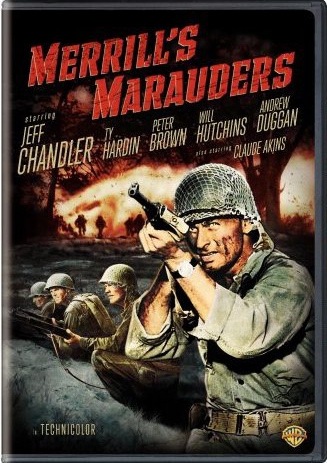
Merrill's Marauders
After reviewing a heavily anti-war movie yesterday, I thought it was only right to counter today with a different look at war and soldiers in a more heroic light. The 1960s were full of war flicks that focused on real-life military units, like 1968's The Devil's Brigade that dealt with the First Special Service Force, and then for a change of pace here, 1962's Merrill's Marauders in the Pacific theater of WWII.
Directed by WWII vet Samuel Fuller, Marauders tells a mostly factual story of the 5307th Composite Unit (provisional), dubbed Merrill's Marauders after their commander, General Frank Merrill. This was a fighting force of 3,000 American volunteers with experience in jungle warfare after years of island-hopping across the Pacific on places like Guadalcanal, Bougainville, and many others. Fuller doesn't try to present the Marauders as a unit of Superman-like soldiers who can't be defeated. These are men pushed to their physical, emotional and mental limits as they undertake a near-suicide mission late in WWII. Heroes of course, but Fuller isn't going to shove any rhetoric down your throat. Here's the story, and if you don't like it, tough.
Early in 1944 as the advantage shifts toward the Allies in WWII, the 5307th Composite Unit marches into Burma from India with a dangerous mission, get behind enemy lines and walk 125 miles undetected in Japanese territory to knock out a key Japanese supply base. Commander Brigadier General Frank Merrill (Jeff Chandler) is at the lead, pushing his men every step of the way. The mission is a success if a costly one, but it's only the start. The Marauders are ordered to continue on, marching further into the Burmese jungle on their way to an essential airfield at Myitkyina where they will link up with British forces. Out in front leading his scout platoon, Lt. Stockton (Ty Hardin) begins to see the men wear down but somehow continue on, ready for whatever awaits them.
Telling the story of the Marauders, Fuller puts together a fast-paced, full of action story that never slows down, even in the moments following the firefights as the men wait for orders. With backing from the U.S. Army, Fuller films his story in the Philippines which does a fine job filling in for Burma. Much of the movie is filmed in dense jungle, giving a feel of what trudging through such horrifically dense landscape would be like. Howard Jackson's musical score borrows some from 1945's Objective Burma! but stands well on its own, supplying a driving pace at times that balance out the softer moments as the Marauders cope with their situation.
Chandler tragically died at the age of 42 before this last movie of his was ever in theaters, a shame because of how good his performance is. Never a huge star, he was a class professional, and makes Merrill a red-blooded character, an officer who knows he must sacrifice some of his men if the Allies ever hope to win the war. Difficult decisions, but he knows the end result will prove it all worthwhile. He has a father-son relationship with Hardin's Stock, the platoon leader who struggles dealing with the ever-increasing casualties among his men. Joining the platoon is Bullseye (Peter Brown), the sharpshooter, Kolowicz (Claude Akins), the tough but fair sergeant, Muley (Charlie Briggs), the mule driver with his pack animal Eleanor, Chowhound (Will Hutchins), the platoon a-hole, and Taggy (Filipino star Pancho Magalona), a Filipino volunteer. We get to know little to nothing about these men, but by seeing their actions, as viewers we get a strong sense of who they are as people. The personal background would be a wasted effort.
Certain moments can bring a war movie up a notch or two, and it doesn't require an epic battle or a heroic sacrifice. Here, it comes following a bloody battle at a railyard. Stock walks over cement posts where the heaviest fighting took place, the bodies mingled together so closely it is impossible to tell who was American and who was Japanese. It is one long tracking shot as Stock surveys the battle silently, Jackson's score playing softly. A few minutes later, Akins -- in a career-best performance -- is offered food by a young boy and his grandmother. They're just offering a cup of water and a bowl of rice (very little in the grand scheme of things), but Akins' Wolowicz breaks down, the exhaustion taking over of months behind enemy lines. These are the moments that stick with you more than anything else, the mark of a truly moving story.
With his lightning quick pacing, Fuller covers a ton of ground in just 97 minutes. The studio made certain cuts -- including a slightly different ending -- giving the story a sometimes disjointed feel, but it never distracts for long. The battle sequences sound like toy guns instead of real guns (Fuller opted for blanks instead of sound effects), but they're shot so well you hardly notice minutes in. The movie ends on a positive note, asking the question that's been brought up the whole movie by Doc (Andrew Duggan). Men on the brink of exhaustion after months of fighting with limited supplies, how do they do it? They did it because they had to. A great, underrated WWII movie well worth catching up with.
Merrill's Marauders <---trailer (1962): *** 1/2 /****
Directed by WWII vet Samuel Fuller, Marauders tells a mostly factual story of the 5307th Composite Unit (provisional), dubbed Merrill's Marauders after their commander, General Frank Merrill. This was a fighting force of 3,000 American volunteers with experience in jungle warfare after years of island-hopping across the Pacific on places like Guadalcanal, Bougainville, and many others. Fuller doesn't try to present the Marauders as a unit of Superman-like soldiers who can't be defeated. These are men pushed to their physical, emotional and mental limits as they undertake a near-suicide mission late in WWII. Heroes of course, but Fuller isn't going to shove any rhetoric down your throat. Here's the story, and if you don't like it, tough.
Early in 1944 as the advantage shifts toward the Allies in WWII, the 5307th Composite Unit marches into Burma from India with a dangerous mission, get behind enemy lines and walk 125 miles undetected in Japanese territory to knock out a key Japanese supply base. Commander Brigadier General Frank Merrill (Jeff Chandler) is at the lead, pushing his men every step of the way. The mission is a success if a costly one, but it's only the start. The Marauders are ordered to continue on, marching further into the Burmese jungle on their way to an essential airfield at Myitkyina where they will link up with British forces. Out in front leading his scout platoon, Lt. Stockton (Ty Hardin) begins to see the men wear down but somehow continue on, ready for whatever awaits them.
Telling the story of the Marauders, Fuller puts together a fast-paced, full of action story that never slows down, even in the moments following the firefights as the men wait for orders. With backing from the U.S. Army, Fuller films his story in the Philippines which does a fine job filling in for Burma. Much of the movie is filmed in dense jungle, giving a feel of what trudging through such horrifically dense landscape would be like. Howard Jackson's musical score borrows some from 1945's Objective Burma! but stands well on its own, supplying a driving pace at times that balance out the softer moments as the Marauders cope with their situation.
Chandler tragically died at the age of 42 before this last movie of his was ever in theaters, a shame because of how good his performance is. Never a huge star, he was a class professional, and makes Merrill a red-blooded character, an officer who knows he must sacrifice some of his men if the Allies ever hope to win the war. Difficult decisions, but he knows the end result will prove it all worthwhile. He has a father-son relationship with Hardin's Stock, the platoon leader who struggles dealing with the ever-increasing casualties among his men. Joining the platoon is Bullseye (Peter Brown), the sharpshooter, Kolowicz (Claude Akins), the tough but fair sergeant, Muley (Charlie Briggs), the mule driver with his pack animal Eleanor, Chowhound (Will Hutchins), the platoon a-hole, and Taggy (Filipino star Pancho Magalona), a Filipino volunteer. We get to know little to nothing about these men, but by seeing their actions, as viewers we get a strong sense of who they are as people. The personal background would be a wasted effort.
Certain moments can bring a war movie up a notch or two, and it doesn't require an epic battle or a heroic sacrifice. Here, it comes following a bloody battle at a railyard. Stock walks over cement posts where the heaviest fighting took place, the bodies mingled together so closely it is impossible to tell who was American and who was Japanese. It is one long tracking shot as Stock surveys the battle silently, Jackson's score playing softly. A few minutes later, Akins -- in a career-best performance -- is offered food by a young boy and his grandmother. They're just offering a cup of water and a bowl of rice (very little in the grand scheme of things), but Akins' Wolowicz breaks down, the exhaustion taking over of months behind enemy lines. These are the moments that stick with you more than anything else, the mark of a truly moving story.
With his lightning quick pacing, Fuller covers a ton of ground in just 97 minutes. The studio made certain cuts -- including a slightly different ending -- giving the story a sometimes disjointed feel, but it never distracts for long. The battle sequences sound like toy guns instead of real guns (Fuller opted for blanks instead of sound effects), but they're shot so well you hardly notice minutes in. The movie ends on a positive note, asking the question that's been brought up the whole movie by Doc (Andrew Duggan). Men on the brink of exhaustion after months of fighting with limited supplies, how do they do it? They did it because they had to. A great, underrated WWII movie well worth catching up with.
Merrill's Marauders <---trailer (1962): *** 1/2 /****
Labels:
1960s,
Andrew Duggan,
Claude Akins,
Jeff Chandler,
Peter Brown,
Sam Fuller,
Ty Hardin,
WWII
Sunday, May 30, 2010
Run of the Arrow
On April 9, 1865, the Civil War officially ended when Confederate general Robert E. Lee surrendered his army to General Ulysses S. Grant at Appomattox Courthouse in Virginia. For many though, there was no end to the war. Many in the South never acknowledged that the war was over and kept on fighting, some more violently than others. 1954's Vera Cruz dealt with some of these individuals who headed south into Mexico for a chance at more fighting and riches and power.
Those men were looking for a chance to keep on fighting. In 1957's Run of the Arrow though, the main character is a patriot to the South and the Confederate army. When the war does end, he refuses to be positive about the country coming together because in his mind, he's a Virginian and a Southerner before an American or a Yankee. What to do? Why head west, young man.
Fed up with a post-war life in Virginia, infantryman and sharpshooter Private O'Meara (Rod Steiger) rides west beyond almost all signs of civilization. He doesn't know what he's looking for, but somewhere down the road hopes to find some where or some place he can be happy. On the trail, he meets an Indian scout for the cavalry and a member of the Dakota Sioux, Walking Coyote (Jay C. Flippen), who introduces him to the way and culture of his tribe. O'Meara is sold on the lifestyle immediately and ends up joining a tribe lead by the warrior Blue Buffalo (Charles Bronson) and taking an Indian wife, Yellow Moccasin (Sara Montiel). But this idyllic little life O'Meara has carved out for himself is endangered by the ever-advancing U.S. army trying to settle the west.
Storyline sound familiar? It should. It's called Dances With Wolves some 30 years later. Of course, there are differences but the basic premise is the same. Directed by the always tough, always reliable Sam Fuller, 'Arrow' is one of many westerns from the 1950s that dealt with more adult themes and messages, much like Anthony Mann's westerns. This isn't good vs. evil. There are all sorts of shades of gray here. Even working through the flaws though, this movie gets points for an attempt at being honest and not whitewashing any of the history.
Fuller was a director extremely capable of filming action, but he leaves the battles and gunplay off to the side for much of the movie -- although the ending is a doozy in terms of on-screen violence. This is more a story about principles, ideals and personal beliefs, what's important to an individual. Steiger's O'Meara is so distraught at the end of the war that he turns his back on his country completely and moves on looking for a new life. He ends up finding out that personal convictions and background are harder left behind than anticipated. Working as a scout late in the movie, O'Meara has a great scene with an army engineer (Brian Keith in a phenomenal scene-stealing part) where they find out men are not so different -- black or white, North or South. For a movie released in 1957, I was surprised at the story's honesty.
The movie's opening scenes jump out as impressive in terms of their effect on the overall storyline. The movie opens on Palm Sunday as Lee surrenders to Grant. A sharpshooter, O'Meara picks off a lone Union soldier but only wounds him. He takes him to a field hospital where the man's life is saved, the bullet missing his heart by centimeters. It's the last shot fired in the war. Years later, who is at the head of a U.S. cavalry company ready to wipe out O'Meara's new Sioux tribe? Lt. Driscoll (Ralph Meeker), the man O'Meara shot and saved years before who is now a bloodthirsty officer who wants to wipe out the Indians. It's a great opening and really sets the tone for the rest of the movie.
As good as this movie can be at times, it's also embarrassingly weird at other times. Jay C. Flippen as a Sioux warrior? Really? There was no one else available who is white? The portrayal of the Sioux also seems more applicable to the Apaches of the Southwest, not the tribes of the plains. It gets to a point where Fuller almost fetishsizes the Indian warriors who were nothing more than some barely there loinclothes and has them glistening in the sun. It's distracting and seems like an odd choice for a director like Fuller who typically went for realism over style.
That said, the movie was surprisingly good. Sure, Steiger's attempt at an Irish accent -- it tunes in and out -- is pretty awful, and a story that covers many years is condensed into 90 minutes seems rushed at times. But on the whole, Fuller and a strong cast turn in a western that is enjoyable, thought-provoking, and in an extremely positive way...different. The movie and story put a different spin on something that is too familiar in many other movies. Definitely check out this quasi Dances With the Wolves inspiration.
Run of the Arrow <---trailer (1957): ***/****
Those men were looking for a chance to keep on fighting. In 1957's Run of the Arrow though, the main character is a patriot to the South and the Confederate army. When the war does end, he refuses to be positive about the country coming together because in his mind, he's a Virginian and a Southerner before an American or a Yankee. What to do? Why head west, young man.
Fed up with a post-war life in Virginia, infantryman and sharpshooter Private O'Meara (Rod Steiger) rides west beyond almost all signs of civilization. He doesn't know what he's looking for, but somewhere down the road hopes to find some where or some place he can be happy. On the trail, he meets an Indian scout for the cavalry and a member of the Dakota Sioux, Walking Coyote (Jay C. Flippen), who introduces him to the way and culture of his tribe. O'Meara is sold on the lifestyle immediately and ends up joining a tribe lead by the warrior Blue Buffalo (Charles Bronson) and taking an Indian wife, Yellow Moccasin (Sara Montiel). But this idyllic little life O'Meara has carved out for himself is endangered by the ever-advancing U.S. army trying to settle the west.
Storyline sound familiar? It should. It's called Dances With Wolves some 30 years later. Of course, there are differences but the basic premise is the same. Directed by the always tough, always reliable Sam Fuller, 'Arrow' is one of many westerns from the 1950s that dealt with more adult themes and messages, much like Anthony Mann's westerns. This isn't good vs. evil. There are all sorts of shades of gray here. Even working through the flaws though, this movie gets points for an attempt at being honest and not whitewashing any of the history.
Fuller was a director extremely capable of filming action, but he leaves the battles and gunplay off to the side for much of the movie -- although the ending is a doozy in terms of on-screen violence. This is more a story about principles, ideals and personal beliefs, what's important to an individual. Steiger's O'Meara is so distraught at the end of the war that he turns his back on his country completely and moves on looking for a new life. He ends up finding out that personal convictions and background are harder left behind than anticipated. Working as a scout late in the movie, O'Meara has a great scene with an army engineer (Brian Keith in a phenomenal scene-stealing part) where they find out men are not so different -- black or white, North or South. For a movie released in 1957, I was surprised at the story's honesty.
The movie's opening scenes jump out as impressive in terms of their effect on the overall storyline. The movie opens on Palm Sunday as Lee surrenders to Grant. A sharpshooter, O'Meara picks off a lone Union soldier but only wounds him. He takes him to a field hospital where the man's life is saved, the bullet missing his heart by centimeters. It's the last shot fired in the war. Years later, who is at the head of a U.S. cavalry company ready to wipe out O'Meara's new Sioux tribe? Lt. Driscoll (Ralph Meeker), the man O'Meara shot and saved years before who is now a bloodthirsty officer who wants to wipe out the Indians. It's a great opening and really sets the tone for the rest of the movie.
As good as this movie can be at times, it's also embarrassingly weird at other times. Jay C. Flippen as a Sioux warrior? Really? There was no one else available who is white? The portrayal of the Sioux also seems more applicable to the Apaches of the Southwest, not the tribes of the plains. It gets to a point where Fuller almost fetishsizes the Indian warriors who were nothing more than some barely there loinclothes and has them glistening in the sun. It's distracting and seems like an odd choice for a director like Fuller who typically went for realism over style.
That said, the movie was surprisingly good. Sure, Steiger's attempt at an Irish accent -- it tunes in and out -- is pretty awful, and a story that covers many years is condensed into 90 minutes seems rushed at times. But on the whole, Fuller and a strong cast turn in a western that is enjoyable, thought-provoking, and in an extremely positive way...different. The movie and story put a different spin on something that is too familiar in many other movies. Definitely check out this quasi Dances With the Wolves inspiration.
Run of the Arrow <---trailer (1957): ***/****
Labels:
1950s,
Brian Keith,
Charles Bronson,
Ralph Meeker,
Rod Steiger,
Sam Fuller,
westerns
Subscribe to:
Posts (Atom)