When I hear the name Stanley Kramer, I think of any number of movies. The 1960s were quite the decade for this director with movies like Judgment at Nuremberg, Mad, Mad World, Inherit the Wind and Guess Who's Coming to Dinner to his name. Oh, and that 1950s decade? The Defiant Ones and On the Beach. Quite a list, huh? And that's only listing some. I'm familiar with most of Kramer's movies as a director, have seen many of them and was at least aware of some others. One that qualifies as...well, none of those is and was 1973's Oklahoma Crude, a quasi-western with little reputation.
It's the 1910s and feisty Lena Doyle (Faye Dunaway) owns a chunk of land smack dab in the middle of the Oklahoma oil fields. She has put the time into the land, building a shack and a derrick and intends to tap the crude oil she believes is in the ground below her. There's a problem of course. A powerful oil magnate is scooping up land left and right, purchasing all the small-time owners. Well, most of them. Lena refuses to sell, claiming (rightfully so) that the land is hers. In hopes of protecting her investment, Lena gets some help from some unlikely places, including her estranged father, Cleon (John Mills) and a hired gun he hired, Mason (George C. Scott). Mason isn't quite sure what to make of the job, looking to make some quick and easy cash, but the little group is in for more than they planned on when the oil company sends out an enforcer, Hellman (Jack Palance), to make sure Lena sells.
Well, this was certainly an interesting movie if a heavily flawed one. I struggled through it at times and was rewarded with a far stronger second half of a 108-minute movie. Getting there can be a trial at times though, and even the last hour isn't as good as it could have been. Still, Kramer chooses an interesting story to tell and picks the right time to release it, the 1970s when audiences would have been all sorts of stirred up about a huge company strong-arming small businesses (I guess that'd land pretty well now in 2014 too). The development of the oil fields in Oklahoma in the early 1900s is an interesting enough historical period -- one that hasn't gotten its due in films, TV and books -- with plenty of dark, nasty material to dive into, but...
Kramer doesn't seem to be able to pick a tone, a voice and stick with it. Is it supposed to be truly dramatic and dark and unsettling? Or is it supposed to be goofy and fun and the kinda oddball romance story I typically hate? And that's where the problem is. It's both. The song that plays over the opening credits, Send a Little Love My Way, had me worried I was jumping into a folksy, disgustingly pleasant western that I do love so much. It wasn't, but it's a good forebearer of what's to come. The score from Henry Mancini is simply put, very obvious, big and loud and not appropriate for what the dark and depths of the story could have been. Instead, we get the Dunaway/Scott rivalry, the Dunaway/Mills fighting, Palance vs. the world, and all mixed in with some "I hate you until I love you" story and some all too painful comic relief. Oh, look, that naked guy got shot in the butt with buckshot!!! Yeah, it's too schizophrenic for its own good.
There is a saving grace, one that quickly popped up as the pleasant song mentioned above plays over the credits. Yeah, it's that cast thing. Dunaway, Scott, Mills and Palance?!? Yes, I will invest some time to see how this develops. The script doesn't always do this quartet a ton of favors, but there is a ton of talent here that manages to bring these characters to life. Dunaway's Lena is tough as nails, never been handed anything in her life, ready to fight for what's hers and screw anyone who gets in her way. Scott's Mason -- or Mase, his full name revealed late -- is harder to read, a worker and quasi-hired gun looking for a payday but just as interesting to see develop. I loved the energy Mills as Cleon brought to his part, a father who wasn't there for his daughter as she grew up. Now that he can help? He's going to do everything he can, even when that daughter tells him to screw off. And then there's Palance, doing what he does best, playing that near lunatic but very obsessed bad guy that you're never quite sure what he's capable of.
The human moments are not surprisingly, those that work best in Kramer's film. I especially liked the dynamic between Dunaway's Lena and Scott's Mase. It develops nicely -- but takes quite awhile getting there -- and for the most part manages to avoid all the pratfalls of a sappy story of two opposites who aren't so opposite. Mills is a scene-stealer and Palance is solid. The darkness of the second half is what the entire movie should have been. Filming out on the desolate, stark prairies, you get a sense of what these small-time drillers went through. Isolated and alone with no help in sight should it be needed. I simply wish Kramer would have committed, not trying to mix the light-hearted with the dark. At least if he kept it light, so be it. It's there. That's it. That's all. Enjoyable enough to recommend but far from a classic.
Oklahoma Crude (1973): ** 1/2 /****
The Sons of Katie Elder
"First, we reunite, then find Ma and Pa's killer...then read some reviews."
Showing posts with label Faye Dunaway. Show all posts
Monday, September 8, 2014
Saturday, March 15, 2014
The Three Musketeers (1973)
Some stories and literature just translate well to the big screen. Plain and simple. What do you think is the piece of literature that has inspired the most film adaptations? Okay, as I write this I'm assuming the Bible, but I'm talking about author Alexandre Dumas' The Three Musketeers. There have been one adaptation after another over the years, an estimated 200 for Dumas' career work. Well, that's add another review from that list, 1973's The Three Musketeers.
It's the 1620s in France, and a young, poor and idealistic Frenchman, D'Artagnan (Michael York) is on his way to Paris to become a Musketeer. Without the experience necessary, D'Artagnan is quickly turned down and turned away. In the span of a few hours, he manages to insult three different Musketeers, agreeing to duel with each of them at three different times back-to-back. When he meets them later, D'Artagnan ends up fighting at their sides, including Athos (Oliver Reed), Aramis (Richard Chamberlain) and Porthos (Frank Finlay), against the Cardinal's guards. While he's not officially a Musketeer, young D'Artagnan is welcomed by the friendly trio, especially when they are thrust into some intrigue between the French queen and an English lord while Cardinal Richelieu (Charlton Heston) seeks to gain more and more power over the inept French king.
Ready to get your mind blown? This movie was originally intended for.....The Beatles!!! Director Richard Lester had worked with the famous British rockers in Help! and A Hard Day's Night, but the Musketeers a la The Beatles never came to fruition. Instead, we get this entry, a solid action-packed story with a great cast and some funny physical humor that works surprisingly well. With a ton of attention to period detail, 'Musketeers' shot on location in Spain (a nice stand-in for France, kudos to cinematographer David Watkin) and features a fun, big, fast-paced score from composer Michel Legrand. It isn't the cleaned-up, glossy vision like the 1948 version or even the 1993 reboot. I can't speak for the the newest take on Dumas' iconic characters from 2011. Lester's version though? It seems to be the favorite of all the versions, so good that most of four hours of footage was shot, Lester deciding to make one film into two. Yeah, the cast was less than pleased. Paid for one film, turned into two. That's good business.
Go figure, the high point of this 1973 take is the Three Musketeers. I haven't seen much with Michael York in it other than the Austin Powers trilogy so it was cool to see him in a part like this. Playing D'Artagnan, he just goes for it, committing to bringing the almost hyper-active, goofy, idealistic young man to life. He also falls for the lovely Constance Bonacieux, played by Raquel Welch, and that's never a bad thing. York fits in well with Reed, Chamberlain and Finlay as the three established Musketeers who all come to respect young D'Artagnan, originally thinking of him as one of their own. If anything, the group is underused through much of the 105-minute movie. I wanted to see more of them. Of the three, I was most impressed with Oliver Reed as the fiery Athos, the unofficial leader of the trio. Reed defined on-screen intensity in the 1970s, and his Athos is just a cool character, waiting for an enemy to make his mistake and unleash an attack. Also look for Roy Kinnear as Panchet, D'Artagnan's hired servant who becomes an unofficial fifth member of the group.
If there's a weakness, it's that Dumas' novel just has so much going on. A ton of characters, a fast-moving story, it's a lot to handle in a movie that's 15 minutes short of 2-hours, and that's including a credit sequence. There's a ton of talent here, but it gets lost in the shuffle at times. Heston is underused as Cardinal Richelieu, the treacherous papal official looking to take over France, Faye Dunaway playing his gorgeous spy, Milady de Winter, and Christopher Lee as Rochefort as the head of the Cardinal's guards. As for the French royalty, look for Geraldine Chaplin and Jean Pierre Cassel. Rounding out the cast is Simon Ward as the Duke of Buckingham and Spike Milligan as Bonacieux, Constance's dimwitted husband.
But what are the Musketeers all about? Sword fighting. Lots of sword fighting. Master swordsman William Hobbs choreographed some great fight scenes that are big and all over the place with four and five swordsman on either side. The highlight is a great extended fight at a quiet countryside convent, a group of laundry women working away when the Musketeers arrive to fight a group of the Cardinal's guards. The action features some great physical gags, rope swings that don't quite reach where they're needed, trips and falls at will. Kinnear provides some good laughs too, always ready to hit some baddies over the head with a blunt instrument while the Musketeers duel away with their swords. Fun throughout.
Because it was decided post-production to turn one movie into two, the ending is just sorta there. A tad disjointed to say the least with not much resolved. I hope to check in with the follow-up soon. In the meantime, this one was pretty good. How can you pass up a movie where Roy Kinnear walks around dressed up as a polar bear who can juggle and then causes massive amounts of havoc? Or a catfight between Raquel Welch and Faye Dunaway. I submit that you CANNOT.
The Three Musketeers (1973): ***/****
It's the 1620s in France, and a young, poor and idealistic Frenchman, D'Artagnan (Michael York) is on his way to Paris to become a Musketeer. Without the experience necessary, D'Artagnan is quickly turned down and turned away. In the span of a few hours, he manages to insult three different Musketeers, agreeing to duel with each of them at three different times back-to-back. When he meets them later, D'Artagnan ends up fighting at their sides, including Athos (Oliver Reed), Aramis (Richard Chamberlain) and Porthos (Frank Finlay), against the Cardinal's guards. While he's not officially a Musketeer, young D'Artagnan is welcomed by the friendly trio, especially when they are thrust into some intrigue between the French queen and an English lord while Cardinal Richelieu (Charlton Heston) seeks to gain more and more power over the inept French king.
Ready to get your mind blown? This movie was originally intended for.....The Beatles!!! Director Richard Lester had worked with the famous British rockers in Help! and A Hard Day's Night, but the Musketeers a la The Beatles never came to fruition. Instead, we get this entry, a solid action-packed story with a great cast and some funny physical humor that works surprisingly well. With a ton of attention to period detail, 'Musketeers' shot on location in Spain (a nice stand-in for France, kudos to cinematographer David Watkin) and features a fun, big, fast-paced score from composer Michel Legrand. It isn't the cleaned-up, glossy vision like the 1948 version or even the 1993 reboot. I can't speak for the the newest take on Dumas' iconic characters from 2011. Lester's version though? It seems to be the favorite of all the versions, so good that most of four hours of footage was shot, Lester deciding to make one film into two. Yeah, the cast was less than pleased. Paid for one film, turned into two. That's good business.
Go figure, the high point of this 1973 take is the Three Musketeers. I haven't seen much with Michael York in it other than the Austin Powers trilogy so it was cool to see him in a part like this. Playing D'Artagnan, he just goes for it, committing to bringing the almost hyper-active, goofy, idealistic young man to life. He also falls for the lovely Constance Bonacieux, played by Raquel Welch, and that's never a bad thing. York fits in well with Reed, Chamberlain and Finlay as the three established Musketeers who all come to respect young D'Artagnan, originally thinking of him as one of their own. If anything, the group is underused through much of the 105-minute movie. I wanted to see more of them. Of the three, I was most impressed with Oliver Reed as the fiery Athos, the unofficial leader of the trio. Reed defined on-screen intensity in the 1970s, and his Athos is just a cool character, waiting for an enemy to make his mistake and unleash an attack. Also look for Roy Kinnear as Panchet, D'Artagnan's hired servant who becomes an unofficial fifth member of the group.
If there's a weakness, it's that Dumas' novel just has so much going on. A ton of characters, a fast-moving story, it's a lot to handle in a movie that's 15 minutes short of 2-hours, and that's including a credit sequence. There's a ton of talent here, but it gets lost in the shuffle at times. Heston is underused as Cardinal Richelieu, the treacherous papal official looking to take over France, Faye Dunaway playing his gorgeous spy, Milady de Winter, and Christopher Lee as Rochefort as the head of the Cardinal's guards. As for the French royalty, look for Geraldine Chaplin and Jean Pierre Cassel. Rounding out the cast is Simon Ward as the Duke of Buckingham and Spike Milligan as Bonacieux, Constance's dimwitted husband.
But what are the Musketeers all about? Sword fighting. Lots of sword fighting. Master swordsman William Hobbs choreographed some great fight scenes that are big and all over the place with four and five swordsman on either side. The highlight is a great extended fight at a quiet countryside convent, a group of laundry women working away when the Musketeers arrive to fight a group of the Cardinal's guards. The action features some great physical gags, rope swings that don't quite reach where they're needed, trips and falls at will. Kinnear provides some good laughs too, always ready to hit some baddies over the head with a blunt instrument while the Musketeers duel away with their swords. Fun throughout.
Because it was decided post-production to turn one movie into two, the ending is just sorta there. A tad disjointed to say the least with not much resolved. I hope to check in with the follow-up soon. In the meantime, this one was pretty good. How can you pass up a movie where Roy Kinnear walks around dressed up as a polar bear who can juggle and then causes massive amounts of havoc? Or a catfight between Raquel Welch and Faye Dunaway. I submit that you CANNOT.
The Three Musketeers (1973): ***/****
Tuesday, April 9, 2013
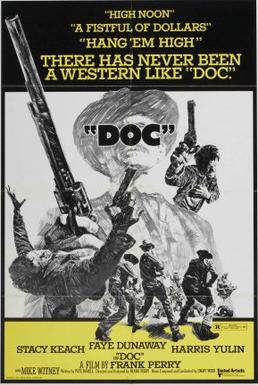
Doc
In a long line of truly interesting, fascinating individuals the wild west produced in the 19th Century, some stand out from the rest. For me, John 'Doc' Holliday has always been one of my favorites, a dentist turned gunfighter who gained fame for his friendship with famed lawman Wyatt Earp. Countless movies have been made about Earp and the gunfight at the O.K. Corral, but Holliday is typically a supporting player to Earp. That's not the case in 1971's Doc, a western devoted to Holliday himself.
Riding west to Tombstone, Arizona, Doc Holliday (Stacy Keach) stops at a wayward, isolated stop along the trail. In a game of cards with a cowboy, Ike Clanton (Michael Witney), Holliday "wins" a woman, Kate Elder (Faye Dunaway), a prostitute similarly making her way west. Holliday agrees to have Kate travel with him as far as Tombstone, but upon arriving in the violent booming mining town, the gunfighter finds something he wasn't expecting. His friend Wyatt Earp (Harris Yulin) is the territorial Marshal, but not the town sheriff in Tombstone. Just the same, Wyatt sees the potential for riches with a town in his fingertips waiting to be controlled. He needs Doc's help though, Wyatt controlling the town from his position as a law officer, Doc from the saloons controlling the business end. Earp's grab for power though is a tricky one with the Clantons standing in the way, leaving Doc to decide how he wants to proceed.
If you needed an example of what a revisionist western really is, this 1971 western from director Frank Perry is right at the top of the list. It isn't interested in painting a romantic, heroic vision of the west. It's going for real, violent, cynical and dirty. Within minutes of meeting, Doc and Katie are in bed together. Riding through the mountains, they have a conversation about farting and later oral sex. In other words, this isn't John Ford's My Darling Clementine. Wyatt Earp is played as an unhinged psychopath, and the Clantons are unknowing -- if a little slow -- dupes in Earp's master plan. I like anything that tries to take a fresh, new look at assumed 'knowns' in history, but there's a line too. The best revisionist westerns find that middle ground in between the romantic vision and the ultra-cynical picture.
So while I didn't love the version of the story that Perry and scriptwriter Pete Hamill presents, it did appeal to me. The story of Wyatt Earp, Doc Holliday, Tombstone and the gunfight at the O.K. Corral has had countless film adaptations, and it's fair to say this is unlike any of the other versions. From what's been revealed and discovered in the last 100-plus years, this vision of Earp has some truth to it. He wasn't the clean-cut marshal some history books have made him out to be. Was he this psychotically unhinged though? I'm thinking probably not. As well, we see Dunaway's Katie Elder (known now as Big Nose Kate) as a whore traveling through the west. The topper though is definitely the finale, the iconic showdown between Wyatt and his two brothers and Doc vs. the Clanton/McLaury clan at the O.K. Corral. It is by the far the most gunplay you'll see in the entire movie, but it's over in a flash. Without giving any spoilers away, this gunfight is unlike any other depiction of the iconic event we've seen in any film version.
Through all the revisionist history though, what stands out from this 1971 western is the focus on Doc Holliday. Still a relative unknown, Keach does a fine job playing the tuberculosis-ridden dentist turned gunfighter John 'Doc' Holliday. He has a reputation as a gambler and a killer, that reputation preceding him wherever he goes. Doc is struggling through a disease that is tearing him apart, sending him into horrific fits of coughing. Traveling west in hopes of holding off the disease as much as possible, Holliday is looking for something else out of life, not just what he's known with gambling, drinking and women. In Kate Elder, he may have found that outlet to a better life. We also get a window into Doc with his relationship with the Kid (Denver John Collins), a young cowboy working with the Clantons who seeks out Doc's help learning how to be a gunfighter. In a story dead set on tearing history down and apart, it's cool to see Keach do such a fine job creating a human character.
Unfortunately, not much of the rest of the cast is especially memorable. Dunaway is trying, but I think she's simply miscast. She's too good-looking for the part, a rather unglamorous part. I liked Yulin as Earp mostly because it's such a departure from the known Wyatt Earp, but it's a one-note performance. Earp is nuts. That's all. John Scanlon is good as Bartlett, the friendly bartender, Dan Greenburg plays Clum, the newspaper editor hovering over the situation like a social conscience (subtle, huh?). I did like Whitney as Ike Clanton, another fresh look at a supposedly known individual, a surprisingly sympathetic character caught up in the Earp's whirlwind. Also, Earp's brothers are completely marginalized to dupes, latchkeys, and idiots. Lack of star power isn't a huge issue, but the performances here other than Keach and Whitney are disappointing.
I liked a lot about this movie. The almost silent opening at the isolated tavern is tense and unnerving with Perry using some interesting camera angles in a slow, anxiety-ridden sequence. There's no soundtrack at all, just a few instances of mariachi music being played live in a cantina or saloon. 'Doc' was filmed on location in Almeria where countless spaghetti westerns were filmed, giving the story an oddly effective other-worldly feel. I loved how the film looks, how scenes are composed with lighting and shadows. On the other hand, the history is garbage. Revisionist is one thing, but like lesser efforts, it simply tries too hard to tear down the history. A mixed bag with some really good positives and some really bad negatives.
Doc (1971): ** 1/2 /****
Riding west to Tombstone, Arizona, Doc Holliday (Stacy Keach) stops at a wayward, isolated stop along the trail. In a game of cards with a cowboy, Ike Clanton (Michael Witney), Holliday "wins" a woman, Kate Elder (Faye Dunaway), a prostitute similarly making her way west. Holliday agrees to have Kate travel with him as far as Tombstone, but upon arriving in the violent booming mining town, the gunfighter finds something he wasn't expecting. His friend Wyatt Earp (Harris Yulin) is the territorial Marshal, but not the town sheriff in Tombstone. Just the same, Wyatt sees the potential for riches with a town in his fingertips waiting to be controlled. He needs Doc's help though, Wyatt controlling the town from his position as a law officer, Doc from the saloons controlling the business end. Earp's grab for power though is a tricky one with the Clantons standing in the way, leaving Doc to decide how he wants to proceed.
If you needed an example of what a revisionist western really is, this 1971 western from director Frank Perry is right at the top of the list. It isn't interested in painting a romantic, heroic vision of the west. It's going for real, violent, cynical and dirty. Within minutes of meeting, Doc and Katie are in bed together. Riding through the mountains, they have a conversation about farting and later oral sex. In other words, this isn't John Ford's My Darling Clementine. Wyatt Earp is played as an unhinged psychopath, and the Clantons are unknowing -- if a little slow -- dupes in Earp's master plan. I like anything that tries to take a fresh, new look at assumed 'knowns' in history, but there's a line too. The best revisionist westerns find that middle ground in between the romantic vision and the ultra-cynical picture.
So while I didn't love the version of the story that Perry and scriptwriter Pete Hamill presents, it did appeal to me. The story of Wyatt Earp, Doc Holliday, Tombstone and the gunfight at the O.K. Corral has had countless film adaptations, and it's fair to say this is unlike any of the other versions. From what's been revealed and discovered in the last 100-plus years, this vision of Earp has some truth to it. He wasn't the clean-cut marshal some history books have made him out to be. Was he this psychotically unhinged though? I'm thinking probably not. As well, we see Dunaway's Katie Elder (known now as Big Nose Kate) as a whore traveling through the west. The topper though is definitely the finale, the iconic showdown between Wyatt and his two brothers and Doc vs. the Clanton/McLaury clan at the O.K. Corral. It is by the far the most gunplay you'll see in the entire movie, but it's over in a flash. Without giving any spoilers away, this gunfight is unlike any other depiction of the iconic event we've seen in any film version.
Through all the revisionist history though, what stands out from this 1971 western is the focus on Doc Holliday. Still a relative unknown, Keach does a fine job playing the tuberculosis-ridden dentist turned gunfighter John 'Doc' Holliday. He has a reputation as a gambler and a killer, that reputation preceding him wherever he goes. Doc is struggling through a disease that is tearing him apart, sending him into horrific fits of coughing. Traveling west in hopes of holding off the disease as much as possible, Holliday is looking for something else out of life, not just what he's known with gambling, drinking and women. In Kate Elder, he may have found that outlet to a better life. We also get a window into Doc with his relationship with the Kid (Denver John Collins), a young cowboy working with the Clantons who seeks out Doc's help learning how to be a gunfighter. In a story dead set on tearing history down and apart, it's cool to see Keach do such a fine job creating a human character.
Unfortunately, not much of the rest of the cast is especially memorable. Dunaway is trying, but I think she's simply miscast. She's too good-looking for the part, a rather unglamorous part. I liked Yulin as Earp mostly because it's such a departure from the known Wyatt Earp, but it's a one-note performance. Earp is nuts. That's all. John Scanlon is good as Bartlett, the friendly bartender, Dan Greenburg plays Clum, the newspaper editor hovering over the situation like a social conscience (subtle, huh?). I did like Whitney as Ike Clanton, another fresh look at a supposedly known individual, a surprisingly sympathetic character caught up in the Earp's whirlwind. Also, Earp's brothers are completely marginalized to dupes, latchkeys, and idiots. Lack of star power isn't a huge issue, but the performances here other than Keach and Whitney are disappointing.
I liked a lot about this movie. The almost silent opening at the isolated tavern is tense and unnerving with Perry using some interesting camera angles in a slow, anxiety-ridden sequence. There's no soundtrack at all, just a few instances of mariachi music being played live in a cantina or saloon. 'Doc' was filmed on location in Almeria where countless spaghetti westerns were filmed, giving the story an oddly effective other-worldly feel. I loved how the film looks, how scenes are composed with lighting and shadows. On the other hand, the history is garbage. Revisionist is one thing, but like lesser efforts, it simply tries too hard to tear down the history. A mixed bag with some really good positives and some really bad negatives.
Doc (1971): ** 1/2 /****
Labels:
1970s,
Faye Dunaway,
Harris Yulin,
Stacy Keach,
westerns
Sunday, January 9, 2011
The Extraordinary Seaman
When director John Frankenheimer got it right with his movies, he hit it out of the park. We're talking movies like The Train, Seven Days in May, Grand Prix, The Manchurian Candidate, and Birdman of Alcatraz. These are movies that are classics or at least near-classics and should be must-watch for any movie fan. Just about any director though has to have a couple duds on his/her resume, and until now I hadn't seen Frankenheimer's dud. For all I know, he may only have the one, but 1969's The Extraordinary Seaman is one of the worst movies I've ever seen.
Reading through Turner Classic Movies' schedule each week, I typically look for actors/actresses I'm a fan of, or if nothing else a title that sounds interesting. When I stumbled across the cast of this one, my first thought was how had I completely missed the boat on this one? David Niven in the lead? Faye Dunaway and Alan Alda in supporting roles? Mickey Rooney too? And it's a World War II story? I don't know at what point I realized this was an awful movie, but it didn't take long. We're not talking a 'so bad it's good' type movie either. No guilty pleasure, no real redeeming quality anywhere in sight. Just plain awful and no amount of talent in the cast was going to save this clunker.
After their ship is sunk somewhere in the Pacific, four sailors (including Alda, Rooney and two relative unknowns) navigate their life boat to land where they seek help while trying to avoid any Japanese forces. In their wanderings, the foursome stumbles upon an abandoned old gunship with no crew commanded by Commander Finchhaven (Niven) of the Royal Navy. With his 'new crew,' the commander goes about readying his ship for sea and hopefully Australia. The sailors, especially Alda's Lt. Krim, are suspicious of the British officer. He drinks and drinks whiskey without ever getting drunk, never sleeps or eats, and never leaves the bridge of the ship. What's going on with this possibly nutty officer on this crazy ship?
I feel stupid when I've watched a movie, hated it intensely, and then gone over to the IMDB and find it has a ridiculously high rating. Did I miss the boat on something or are movie viewers like monkeys who like what they're told to like? So when I do watch a movie, hate it, and see that a majority of voters agree on how horrifically awful something is, it makes me feel better. 'Extraordinary' has earned itself a respectable 2.4 rating from 283 votes as of this review so clearly I wasn't missing anything major here. It's just a bad movie, and that definitely made me feel slightly better about wasting 80 minutes of my life watching it. I kept waiting for it to get better, but here's a secret for you...it doesn't. Don't even bother.
My first thought when I saw the movie was only 82 minutes long was that it packed a lot into a very small window. Yeah, I couldn't have been more wrong there. Unsuccessfully trying to either make an existential dig at the lunacy of war or a slapstick comedy that is short on the laughs, Frankenheimer refuses to pick a direction to go in. If there's a message, I missed it. The same goes for any supposed laughs. He uses an odd technique though, splicing in news reel footage of WWII and then editing in his cast. The off-screen narration usually has some oddball link to what's happening to the characters, but it's incredibly random and doesn't add much to the story. It's also overused to the point where I started fast-forwarding through huge stretches of the movie. Actual run time is 82 minutes, but I'd say about 45-60 minutes is actual filmed scenes with a cast that deserves so much better.
So, yes, it's awful almost right from the start, but a cast like that has to save it a little bit, doesn't it? That's what I figured. It's not necessarily the cast's fault that what they're working with is one of the more bizarre scripts I've ever seen, but you've got to hold someone accountable. Alan Alda is playing a younger version of Hawkeye Pierce, his M.A.S.H. character, with almost all of his eccentric mannerisms and oddities present. Niven is sleep-walking through this part and doesn't bring any of his typical charm to the story. I'm not sure why Faye Dunaway signed on for this because her character is completely unnecessary and has little involvement with the story. She does look good so that might be the lone positive I take away from this movie. Rooney is the lone one at least trying, his Oglethorpe character a paranoid cook convinced everyone is a Japanese spy.
What pulled me through this movie was some sort of explanation with David Niven's character. SPOILERS When it is revealed, it's not surprisingly pretty underwhelming. His family has a long tradition of dying in battle, and he did too...in 1914. Apparently, his grandfather admiral can grant wishes from beyond the grave and forces Niven's Finchhaven to remain on Earth until he can redeem himself by sinking an enemy cruiser. The only problem? The ending is so poorly handled that nothing is resolved at all. No resolution for any of the characters is always a solid capper in my book. What a bad, downright horrible movie. Talking about downright bad taste, read the caption on the poster above. It's not often you hear Adolf Hitler thanked for something that claimed the lives of millions of people.
The Extraordinary Seaman <---TCM clips (1969): */****
After their ship is sunk somewhere in the Pacific, four sailors (including Alda, Rooney and two relative unknowns) navigate their life boat to land where they seek help while trying to avoid any Japanese forces. In their wanderings, the foursome stumbles upon an abandoned old gunship with no crew commanded by Commander Finchhaven (Niven) of the Royal Navy. With his 'new crew,' the commander goes about readying his ship for sea and hopefully Australia. The sailors, especially Alda's Lt. Krim, are suspicious of the British officer. He drinks and drinks whiskey without ever getting drunk, never sleeps or eats, and never leaves the bridge of the ship. What's going on with this possibly nutty officer on this crazy ship?
I feel stupid when I've watched a movie, hated it intensely, and then gone over to the IMDB and find it has a ridiculously high rating. Did I miss the boat on something or are movie viewers like monkeys who like what they're told to like? So when I do watch a movie, hate it, and see that a majority of voters agree on how horrifically awful something is, it makes me feel better. 'Extraordinary' has earned itself a respectable 2.4 rating from 283 votes as of this review so clearly I wasn't missing anything major here. It's just a bad movie, and that definitely made me feel slightly better about wasting 80 minutes of my life watching it. I kept waiting for it to get better, but here's a secret for you...it doesn't. Don't even bother.
My first thought when I saw the movie was only 82 minutes long was that it packed a lot into a very small window. Yeah, I couldn't have been more wrong there. Unsuccessfully trying to either make an existential dig at the lunacy of war or a slapstick comedy that is short on the laughs, Frankenheimer refuses to pick a direction to go in. If there's a message, I missed it. The same goes for any supposed laughs. He uses an odd technique though, splicing in news reel footage of WWII and then editing in his cast. The off-screen narration usually has some oddball link to what's happening to the characters, but it's incredibly random and doesn't add much to the story. It's also overused to the point where I started fast-forwarding through huge stretches of the movie. Actual run time is 82 minutes, but I'd say about 45-60 minutes is actual filmed scenes with a cast that deserves so much better.
So, yes, it's awful almost right from the start, but a cast like that has to save it a little bit, doesn't it? That's what I figured. It's not necessarily the cast's fault that what they're working with is one of the more bizarre scripts I've ever seen, but you've got to hold someone accountable. Alan Alda is playing a younger version of Hawkeye Pierce, his M.A.S.H. character, with almost all of his eccentric mannerisms and oddities present. Niven is sleep-walking through this part and doesn't bring any of his typical charm to the story. I'm not sure why Faye Dunaway signed on for this because her character is completely unnecessary and has little involvement with the story. She does look good so that might be the lone positive I take away from this movie. Rooney is the lone one at least trying, his Oglethorpe character a paranoid cook convinced everyone is a Japanese spy.
What pulled me through this movie was some sort of explanation with David Niven's character. SPOILERS When it is revealed, it's not surprisingly pretty underwhelming. His family has a long tradition of dying in battle, and he did too...in 1914. Apparently, his grandfather admiral can grant wishes from beyond the grave and forces Niven's Finchhaven to remain on Earth until he can redeem himself by sinking an enemy cruiser. The only problem? The ending is so poorly handled that nothing is resolved at all. No resolution for any of the characters is always a solid capper in my book. What a bad, downright horrible movie. Talking about downright bad taste, read the caption on the poster above. It's not often you hear Adolf Hitler thanked for something that claimed the lives of millions of people.
The Extraordinary Seaman <---TCM clips (1969): */****
Labels:
1960s,
David Niven,
Faye Dunaway,
John Frankenheimer,
Mickey Rooney,
WWII
Friday, February 12, 2010
Network
Ah, the American public, always easy pickings for a roasting. Movies have done it left and right, like Billy Wilder's Ace in the Hole, and why not? As an enormous power in terms of what we'll watch, won't watch, what we'll pay to see, the public is as fickle as the weather. And to be fair, it's just not the U.S. So who has to decide what we watch, read and experience in terms of movies, TV shows, books, magazines, anything really. So goes 1976's Network, a not so subtle dig at the decline of television and news journalism into pandering for whatever audiences want.
Like any movie dealing with a timely issue, it's important to look at that time it's made in. Network was released in the mid 1970s after the U.S. had left Vietnam and just a few years removed from the Watergate scandal. There were issues to say the least, especially in the minds of the American people. So Network comes along with director Sidney Lumet presenting a cynical, very dark look at TV and the business it truly is to make money and be successful. Studio execs will do ANYTHING if the ratings are good, even to the point of taking a life.
After working for the UBS broadcasting station for many years, news anchor Howard Beale (Peter Finch) is being let go. Howard's wife has left him and his job was really all he had so on-air he tells his viewers that on a show a week away he is going to kill himself...on air for millions of people to see. Instantly, the ratings shoot up, and the network has a hit on their hands. They can't possibly take him off the air, instead giving Beale a stage to rant and rave about whatever suits him. The network's programming director, Diane Christensen (Faye Dunaway), plays it up, making it such a hit that almost half of the country is watching Beale's new show. All the while, Beale's close friend and boss, Max Schumacher (William Holden), wonders what's happened to the business he grew up with, and if there's any way to get back to the good old days.
That's basically the story in a nutshell, and I don't want to tell too much more because it will take away from the appeal of the movie, especially the last half hour. As presented, the UBS network is fourth in the ratings behind CBS, NBC, and ABC so working with a fictional channel, Lumet pulls out all the stops in portraying a cutthroat, profit above all else company. Dunaway's Diane is all business, all the time and can't carry on a personal life, Holden's Max is fighting to hold on to the last traces of a business that used to be, and Finch's Beale runs with the plan presented to him, preaching to his audiences nightly.
This movie had Oscars written all over it, getting 10 nominations and winning four. And while it's hard to dispute the movie didn't deserve them, I felt like I was watching something surreal, something completely over the top as the story unfolded, especially in the ending. Lumet was going for a satire of the TV industry, and it works -- the networks are skewered over an open fire -- but at times it's too much. Am I supposed to laugh or chuckle at what's going on, or be alarmed at what we're seeing? Probably a little of both, but the turns and twists just felt like too much to me.
What I won't argue with is the phenomenal casting, especially the three leads already mentioned and then throw in Robert Duvall for good measure. Finch was the first actor to be given a posthumous Oscar for his win in Best Actor. I personally would have given it to Holden (who was also nominated), but Finch is at a scenery-chewing, scene-stealing best as Howard Beale, an overnight ratings sensation. Most of his role requires him to deliver long, raving speeches -- and his "I'm as mad as hell" speech is top notch -- and he's presented both as a tragic figure and a bit of a stooge. Holden on the other hand, is much more subdued but equally effective as Max. His scene where he SPOILERS breaks up with Diane earns him the Oscar for me. Dunaway fully deserved her Oscar for Best Actress and is quickly becoming one of my favorite actresses.
Did I like Network? Yes, parts of it I loved. But as cynical as I can be in viewing and reviewing movies at times, I wish this was a little less cynical, maybe a little more subtle in its execution. Ned Beatty has a speech late in the movie that is rightfully impressive but I feel like I've heard it before. Maybe I shouldn't fault Network because other movies since 1976 have dealt with similar subjects, but it's hard not to. I completely recommend this movie to anyone who hasn't seen it for the performances alone, but I was a little disappointed with it. Thought provoking? Sure, but not a classic in my mind.
Network <----trailer (1976): ** 1/2 /****
Like any movie dealing with a timely issue, it's important to look at that time it's made in. Network was released in the mid 1970s after the U.S. had left Vietnam and just a few years removed from the Watergate scandal. There were issues to say the least, especially in the minds of the American people. So Network comes along with director Sidney Lumet presenting a cynical, very dark look at TV and the business it truly is to make money and be successful. Studio execs will do ANYTHING if the ratings are good, even to the point of taking a life.
After working for the UBS broadcasting station for many years, news anchor Howard Beale (Peter Finch) is being let go. Howard's wife has left him and his job was really all he had so on-air he tells his viewers that on a show a week away he is going to kill himself...on air for millions of people to see. Instantly, the ratings shoot up, and the network has a hit on their hands. They can't possibly take him off the air, instead giving Beale a stage to rant and rave about whatever suits him. The network's programming director, Diane Christensen (Faye Dunaway), plays it up, making it such a hit that almost half of the country is watching Beale's new show. All the while, Beale's close friend and boss, Max Schumacher (William Holden), wonders what's happened to the business he grew up with, and if there's any way to get back to the good old days.
That's basically the story in a nutshell, and I don't want to tell too much more because it will take away from the appeal of the movie, especially the last half hour. As presented, the UBS network is fourth in the ratings behind CBS, NBC, and ABC so working with a fictional channel, Lumet pulls out all the stops in portraying a cutthroat, profit above all else company. Dunaway's Diane is all business, all the time and can't carry on a personal life, Holden's Max is fighting to hold on to the last traces of a business that used to be, and Finch's Beale runs with the plan presented to him, preaching to his audiences nightly.
This movie had Oscars written all over it, getting 10 nominations and winning four. And while it's hard to dispute the movie didn't deserve them, I felt like I was watching something surreal, something completely over the top as the story unfolded, especially in the ending. Lumet was going for a satire of the TV industry, and it works -- the networks are skewered over an open fire -- but at times it's too much. Am I supposed to laugh or chuckle at what's going on, or be alarmed at what we're seeing? Probably a little of both, but the turns and twists just felt like too much to me.
What I won't argue with is the phenomenal casting, especially the three leads already mentioned and then throw in Robert Duvall for good measure. Finch was the first actor to be given a posthumous Oscar for his win in Best Actor. I personally would have given it to Holden (who was also nominated), but Finch is at a scenery-chewing, scene-stealing best as Howard Beale, an overnight ratings sensation. Most of his role requires him to deliver long, raving speeches -- and his "I'm as mad as hell" speech is top notch -- and he's presented both as a tragic figure and a bit of a stooge. Holden on the other hand, is much more subdued but equally effective as Max. His scene where he SPOILERS breaks up with Diane earns him the Oscar for me. Dunaway fully deserved her Oscar for Best Actress and is quickly becoming one of my favorite actresses.
Did I like Network? Yes, parts of it I loved. But as cynical as I can be in viewing and reviewing movies at times, I wish this was a little less cynical, maybe a little more subtle in its execution. Ned Beatty has a speech late in the movie that is rightfully impressive but I feel like I've heard it before. Maybe I shouldn't fault Network because other movies since 1976 have dealt with similar subjects, but it's hard not to. I completely recommend this movie to anyone who hasn't seen it for the performances alone, but I was a little disappointed with it. Thought provoking? Sure, but not a classic in my mind.
Network <----trailer (1976): ** 1/2 /****
Labels:
1970s,
Faye Dunaway,
Peter Finch,
Robert Duvall,
Sidney Lumet,
William Holden
Sunday, January 3, 2010
Chinatown
Now officially one of Nicholson's best roles was in the closing months of 1969 -- an Oscar-nominated role in Easy Rider -- but he just kept on rolling into the 70s. And while his turn as Randall MacMurphy in One Flew Over the Cuckoo's Nest will most likely always be remembered as Nicholson's best and most famous role, another part deserves recognition, his turn as private detective Jake 'J.J.' Gittes in Roman Polanski's 1974 detective story and period piece Chinatown.
This may come across more critically than I intend it to, but Nicholson in his personal life has become a caricature of himself in certain ways. It's easy to forget what a great actor he really is with 12 Oscar nominations to his name. His turn as Jake Gittes is typically solid Nicholson, both fiery and emotional but also calm and understated at times when the scene calls for it. He brings some charm to a character that could easily be despicable in the hands of a lesser actor, and as the lead character serves as the audience's guide because he sees exactly what we see and little else as a 1930s murder sets off an odd set of circumstances.
Working as a private detective in 1930s Los Angeles, Jake 'J.J.' Gittes (Nicholson) specializes in marriage cases and one day takes on a contract from a woman questioning if her husband is cheating on her. The husband, Hollis Mulwray (Darrell Zwerling), has become a notable public figure recently as head of the water department for a city suffering through a drought. Jake discovers Hollis is seeing a woman, but soon after the story breaks, the real Mrs. Mulwray, Evelyn (Faye Dunaway), shows up questioning how Jake got onto her husband's case. But before Jake can resolve anything, Hollis turns up dead in one of the city's water reservoirs. So starts a mystery that begins to unravel for Jake that includes corruption, phony business deals, and all sorts of shady dealings that Evelyn may or may not be involved with.
Made and released in 1974, Chinatown brings late 1930s Los Angeles to life so perfectly, so vividly that it's incredibly easy to get caught up in this winding murder mystery. Polanski films all over the city in a wide variety of locations, and everything looks immaculate from the backgrounds to the clothes -- all the guys go for the cool, stylish suit and a fedora look -- to the period cars. Everything looks and feels so authentic you're waiting for Robert Mitchum or Barbara Stanwyck to walk onto the set and join Nicholson and Dunaway in their scenes. All this is helped by Jerry Goldsmith's score that blends jazzy themes with understated music that helps drive the story and action along.
The DVD special features offered interviews with screenwriter Robert Towne, Polanski, and producer Robert Evans, all of them agreeing that this is a movie that would be difficult to make for today's audiences, and they're right. I try to avoid huge generalities about audiences because movies are subjective to each and every person watching, but movies now in 2010 and their audiences are different. Chinatown is never slow-paced, but Polanski does take his time building the story. It is a mystery that requires you to pay attention with clues hinted at and then dealt with later. This all comes together in a famously downbeat ending -- very 70s in its cynicism -- with one of the all-time great lines, 'Forget it, Jake. It's Chinatown.'
As I wrote before, Nicholson's private detective is a great performance and Dunaway is an ideal choice for a character we're led to believe is the femme fatale present in almost every noir ever made. Not so fast though as her Evelyn isn't letting Jake in on everything he needs to know, including one rather large twist toward the end. A great counter to Nicholson, and one of Dunaway's best parts which also earned an Oscar nomination (the movie earned 11 overall). Hollywood legend John Huston is on-screen for maybe 10 minutes tops in an 130-minute movie, but leaves a huge impression, as for what that impression is I'll let you find out what. Perry Lopez, Burt Young, Richard Bakalyan, Diane Ladd, Roy Jenson and John Hillerman round out the cast.
A classic film on many levels starting with the acting and continuing on down the line with Polanski's directing and John Alonzo's cinematography that echoes movies made 30 and 40 years earlier, Chinatown should definitely be on your list to see.
Chinatown <----trailer (1974): ****/****
Labels:
1970s,
Burt Young,
Faye Dunaway,
Film Noir,
Jack Nicholson,
John Huston,
Perry Lopez
Subscribe to:
Posts (Atom)
.jpg)