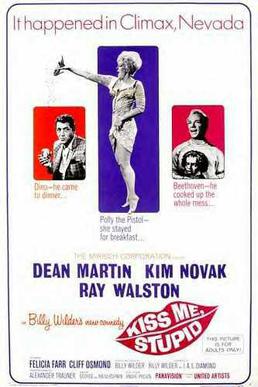
There wasn't much director and writer Billy Wilder didn't do over a career that spanned six decades. He did one of the best comedies of all-time in Some Like It Hot, one of the best dramas in Sunset Boulevard, some of the best noirs in Ace in the Hole and Double Indemnity, and many more I'm not even listing. How about something out of the ordinary then? Yeah, a romantic comedy...of sorts. Here's 1964's Kiss Me, Stupid.
Having closed out a successful show in Las Vegas, a highly successful musician and performer named Dino (Dean Martin) jumps in his car and starts driving toward Los Angeles. What's waiting him? A TV special and everything L.A. has to offer. Well, that's the plan at least. He stops in the little Nevada desert town of Climax where two aspiring songwriters, Orville (Ray Walston), a piano teacher, and Barney (Cliff Osmond), the gas station owner, see a chance to make their riches if they can sell a song or two to the famous singer. How should they go about it though? Dino has quite the reputation as a hard-drinking, partying womanizer so....what if he was interested in Orville's wife? The piano teacher can't go along with it, not with his actual wife at least. He enlists the help of a waitress, Polly the Pistol (Kim Novak), from the local roadhouse (that appears to be doubling as a bordello of sorts). Can they somehow pull this wacky plan off?
Leave it to Billy Wilder to completely throw an entire genre on its side and do it well. The 1960s were the age of the screwball sex comedies that as you watch them now 50-plus years later....they're not always that good. The jokes and innuendos are tame to say the least, and the attempts at humor are usually so overdone that any natural laughs get killed on the spot. Sure, there are some exceptions. There always are when the number of movies continues to pile up. This 1964 satire on the whole has some bite. All those laughs that fell short in the played straight for laughs comedies land with an effective boom here. The laughs crackle, they're subtle but not too subtle and overall? That formula just works so well. Sure, it's a little slow, a little long at times at 126 minutes, but for the most part it hits all the right buttons.
In production, 'Kiss' sure seemed like it was going to be a difficult film to make. Wilder originally wanted to cast Jack Lemmon (a frequent Wilder collaborator) in the Walston role, but Lemmon had prior obligations. Next up, Peter Sellers who was cast, started filming and had to bail when he had 13 freaking heart attacks!!! Six weeks into filming, Wilder had to recast the part, choosing Walston and then re-filming all those scenes. Does it show? No, not especially. Walston is excellent and the movie moves on without missing a beat. It was filmed in black and white -- I watched a beautiful print on MGM-HD on TV -- and is based off an Italian play and was later turned into an Italian feature film. The story develops like a play, the entire story taking place at Orville's home, Barney's gas station and the Belly Button (the roadhouse). It all fits together in pretty perfect fashion.
A movie that loses potential star power and quite the acting chops in Lemmon and Sellers could be quite an issue, but not here as the ensemble carries the sexually-charged comedic story. Martin plays a variation on himself, sleezy and without a care in the world other than hooking up with a different woman every night. Considering how harsh the script is, it's somewhat surprising Martin even took the role! Walston gets to ham it up some as Orville, paranoid and convinced his far prettier wife, Zelda (Felicia Farr), is cheating on him with anyone and everyone. In a role originally intended for Marilyn Monroe, Kim Novak -- one of my favorites -- is a sultry scene-stealer as Polly, a girl down on her luck who has to take some rather drastic measures to save some money. Playing Orville's sidekick of sorts, Osmond gets some big laughs as the big, boisterous Barney, putting this crazy plan into action.
The script/screenplay itself screams I Love Lucy episode when it comes to the gag Orville and Barney try to pull off. That's where some of that risque quality comes in. Using a stand-in wife, Orville just turns a blind eye to Martin's Dino making brutally obvious advances at his wife. He intends to give her to him. This is 1964?!? You can see why it met with some objections. Things get downright crazy and completely out of left field in the last 15 minutes in ways I was not expecting. So yeah, the ending kinda falls apart, but getting there is a lot of fun. The innuendos building up to it work pretty well, especially Orville talking about the size of his...well, never mind, and Polly overhearing the plan for what she's intended to do with Dino. Misunderstandings and all sorts of hijinks like that just shouldn't work, but it does.
A pleasant surprise. Go figure. Worst case? Kim Novak is downright perty here in one of her sexiest roles.
Kiss Me, Stupid (1964): ***/****
The Sons of Katie Elder
"First, we reunite, then find Ma and Pa's killer...then read some reviews."
Showing posts with label Billy Wilder. Show all posts
Thursday, January 15, 2015
Thursday, June 19, 2014
Witness for the Prosecution
It's easy to take the Internet for granted because it's so prevalent in day-to-day life. Think about it when new movies come out. If said movie has an epic twist in the finale, it takes minutes, hours and if things are going really slow, about a day for word of that twist to spread like wildfire. That wasn't always the case, movie studios doing their best to keep the surprises and twists under wraps so audiences could head into the movies surprised. Some movies even requested audiences don't reveal the twists as the credits rolled, movies like 1961's Homicidal, 1960's Psycho, and for today's reading, 1957's Witness for the Prosecution.
Coming off some serious health issues, barrister (a lawyer for our American readers) named Sir Wilfrid Robarts (Charles Laughton) returns to his office with orders to take it easy as he recovers. Naturally, Sir Wilfrid does just the opposite. Instead, he takes a high-profile case when he meets Leonard Vole (Tyrone Power), a WWII veteran who's been accused of murder. The victim was an older woman with plenty of money and no family, Leonard a recent addition to the woman's will. Wilfrid goes about preparing his case -- while dealing with his medical issues -- trying to work around the only alibi Leonard has, an alibi provided by Leonard's wife, Christine (Marlene Dietrich), but he would prefer not to call the cold Christine to the stand. Wilfrid believes Leonard to be genuinely innocent, but the amount of circumstantial evidence against him is daunting, and it continues to mount. A veteran of cases like this, even Wilfrid can't imagine how this case will develop.
Is there anything director Billy Wilder can't do? I submit that the answer there is a big N-O. His career filmography includes everything from comedies like Some Like it Hot to film noir-esque thrillers like Sunset Boulevard and darker social commentaries like Ace in the Hole. I guess it is only natural for him to check another sub-genre off the list, here at the helm of a courtroom drama. 'Witness' is based off a stage play from Agatha Christie who had adapted her own short story. The style plays like a stage-based play, long scenes of dialogue and exchanges going back and forth among characters, an impressive set even being built to stand in for the Old Bailey, a famous English courthouse in London, a very cool, claustrophobic set as the courtroom scenes develop, the black and white filming adding a minimalist touch. This is a movie considered a classic -- an 8.5 rating on IMDB, a 100% mark at Rotten Tomatoes -- but is it that good? I had some issues with it.
When I see ratings that high, I'm thinking we're talking about a perfect movie, or one pretty dang close to perfect. I liked 'Witness' -- it gets stronger near the halfway point -- but it slow-going early-on. Laughton's Wilfrid returns to his office in a scene that tries to play up the comedy as the medically-challenged Wilfrid deals with his nurse, Miss Plimsoll (Elsa Lanchester, Laughton's wife in real-life). Did we need that bit of humor? The dynamic continues throughout the case, and yes, they've got chemistry but these attempts at humor seem out of place. As for the acting, Powers overacts to the point it is almost painful to watch. His reactions while other people testify is just rough, his Leonard screaming and grabbing the wall, pulling at his hair. Dietrich is both good and bad, at her best when she underplays it. Her performance over the last 30 minutes helps leave the viewer with a big positive as to the strength of her performance.
Much of the first hour focuses on the background, from Wilfrid's health issues, to meeting Leonard to several unnecessary flashbacks. We see him meet the old, rich Mrs. French (Norma Varden), in scenes more suited to a 1950s screwball comedy. We see him meet Christine in a bombed-out city in WWII, all scenes that feel forced in an effort to draw out the running time. Where the movie hits its stride is in the courtroom scenes, Laughton showing off that acting ability that appears effortless scene-in and scene-out. He underplays it to the point you take for granted what he's doing. Laughton makes a go of it, but these scenes are hurt by Power's efforts at some sort of method acting. Still, Laughton is a powerhouse (picking up an Oscar nomination for Best Actor), playing nicely off the prosecuting lawyer, Mr. Myers (Torin Thatcher). More negative/flaws than a classic should have, but Laughton rights the ship as much as he can.
Also look for John Williams as Brogan-Moore, Wilfrid's assistant in court, Henry Daniell as Vole's representative who brings the case to Wilfrid, Ian Wolfe as Carter, Wilfrid's assistant and office clerk, Una O'Connor as a key witness (possibly), and Francis Compton as the judge presiding over the case.
And then there's that ending. I had it spoiled for me years ago because a Boston Legal episode used that same catch, but even knowing it's coming up, that finale still works. The entire back and forth dynamic in the court sequences are the movie's strongest scenes, the last 20 minutes delivering three different twists that I would consider a genuinely good and legitimate twist. It's best you don't know any of them going into the movie so deal with it. You ain't getting any spoilers here. So while I struggled through the first 45-60 minutes, the last hour is pretty perfect. Loved Wilder's direction, and I especially liked Laughton's Oscar-nominated performance.
Witness for the Prosecution (1957): ***/****
Coming off some serious health issues, barrister (a lawyer for our American readers) named Sir Wilfrid Robarts (Charles Laughton) returns to his office with orders to take it easy as he recovers. Naturally, Sir Wilfrid does just the opposite. Instead, he takes a high-profile case when he meets Leonard Vole (Tyrone Power), a WWII veteran who's been accused of murder. The victim was an older woman with plenty of money and no family, Leonard a recent addition to the woman's will. Wilfrid goes about preparing his case -- while dealing with his medical issues -- trying to work around the only alibi Leonard has, an alibi provided by Leonard's wife, Christine (Marlene Dietrich), but he would prefer not to call the cold Christine to the stand. Wilfrid believes Leonard to be genuinely innocent, but the amount of circumstantial evidence against him is daunting, and it continues to mount. A veteran of cases like this, even Wilfrid can't imagine how this case will develop.
Is there anything director Billy Wilder can't do? I submit that the answer there is a big N-O. His career filmography includes everything from comedies like Some Like it Hot to film noir-esque thrillers like Sunset Boulevard and darker social commentaries like Ace in the Hole. I guess it is only natural for him to check another sub-genre off the list, here at the helm of a courtroom drama. 'Witness' is based off a stage play from Agatha Christie who had adapted her own short story. The style plays like a stage-based play, long scenes of dialogue and exchanges going back and forth among characters, an impressive set even being built to stand in for the Old Bailey, a famous English courthouse in London, a very cool, claustrophobic set as the courtroom scenes develop, the black and white filming adding a minimalist touch. This is a movie considered a classic -- an 8.5 rating on IMDB, a 100% mark at Rotten Tomatoes -- but is it that good? I had some issues with it.
When I see ratings that high, I'm thinking we're talking about a perfect movie, or one pretty dang close to perfect. I liked 'Witness' -- it gets stronger near the halfway point -- but it slow-going early-on. Laughton's Wilfrid returns to his office in a scene that tries to play up the comedy as the medically-challenged Wilfrid deals with his nurse, Miss Plimsoll (Elsa Lanchester, Laughton's wife in real-life). Did we need that bit of humor? The dynamic continues throughout the case, and yes, they've got chemistry but these attempts at humor seem out of place. As for the acting, Powers overacts to the point it is almost painful to watch. His reactions while other people testify is just rough, his Leonard screaming and grabbing the wall, pulling at his hair. Dietrich is both good and bad, at her best when she underplays it. Her performance over the last 30 minutes helps leave the viewer with a big positive as to the strength of her performance.
Much of the first hour focuses on the background, from Wilfrid's health issues, to meeting Leonard to several unnecessary flashbacks. We see him meet the old, rich Mrs. French (Norma Varden), in scenes more suited to a 1950s screwball comedy. We see him meet Christine in a bombed-out city in WWII, all scenes that feel forced in an effort to draw out the running time. Where the movie hits its stride is in the courtroom scenes, Laughton showing off that acting ability that appears effortless scene-in and scene-out. He underplays it to the point you take for granted what he's doing. Laughton makes a go of it, but these scenes are hurt by Power's efforts at some sort of method acting. Still, Laughton is a powerhouse (picking up an Oscar nomination for Best Actor), playing nicely off the prosecuting lawyer, Mr. Myers (Torin Thatcher). More negative/flaws than a classic should have, but Laughton rights the ship as much as he can.
Also look for John Williams as Brogan-Moore, Wilfrid's assistant in court, Henry Daniell as Vole's representative who brings the case to Wilfrid, Ian Wolfe as Carter, Wilfrid's assistant and office clerk, Una O'Connor as a key witness (possibly), and Francis Compton as the judge presiding over the case.
And then there's that ending. I had it spoiled for me years ago because a Boston Legal episode used that same catch, but even knowing it's coming up, that finale still works. The entire back and forth dynamic in the court sequences are the movie's strongest scenes, the last 20 minutes delivering three different twists that I would consider a genuinely good and legitimate twist. It's best you don't know any of them going into the movie so deal with it. You ain't getting any spoilers here. So while I struggled through the first 45-60 minutes, the last hour is pretty perfect. Loved Wilder's direction, and I especially liked Laughton's Oscar-nominated performance.
Witness for the Prosecution (1957): ***/****
Thursday, January 2, 2014
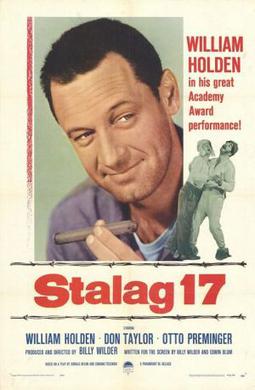
Stalag 17
Well, there are just certain movies I should have reviewed by now. I've mentioned on multiple occasions how much I like prisoner of war movies like The Great Escape and Bridge on the River Kwai, but the first one to really put the WWII sub-genre came along in 1953, Stalag 17, a classic that doesn't always get its due.
It's nearing Christmas in 1944, and a breakout is planned in Stalag 17, a German prisoner of war camp deep in Germany for Allied fliers. The night of the escape, the two prisoners making the attempt are machine gunned outside the barbed wire fence, leaving the prisoners they left behind in Barracks 4 to question what's going on. How did the Germans know details of the escape? The prisoners look to J.J. Sefton (William Holden) as the culprit, a possible stoolie who trades and bargains with the German captors for all sorts of luxuries from eggs to cigarettes to booze. Maybe Sefton has been giving away all their secrets for his own benefit, but Sefton knows otherwise. He may be a chiseler, but he's not a traitor. The problem is simple though, he can't prove it. Who among the other prisoners in Barracks 4 is the real culprit? He's going to need an answer and need it quick before his bunkmates decide they've had enough of him for good.
From director Billy Wilder, 'Stalag' is a gem of a film, one of my favorites going back to when I was a kid. It was based on a Broadway play that had 472 showings over its run. The stage-based play roots are obvious, but in a good way. Filmed in a very appropriate, very effective black and white, 'Stalag' is set almost entirely in Barracks 4 as the story develops, Christmas approaching ever quicker. The only departures we have from the barracks are outside into the camp compound. We never leave the camp, the entire story based in Stalag 17. The crowded, claustrophobic barracks becomes another character with the bunks almost bumping into each other, the windows with the frost and ice sticking to the panes, the clothes hanging from lines hung from wall to wall. Franz Waxman's uncredited score is solid as well if underplayed, Johnny Coming Marching Home a key component of the story as well.
One of three nominations the movie received went to William Holden as Barracks 4 chiseler and general trouble-maker J.J. Sefton. Nominated for his part in Sunset Boulevard but not winning, Holden got a much-deserved win here, taking home the Oscar. More impressive? He was going up against Burt Lancaster and Montgomery Clift in From Here to Eternity. Holden brings this character to life, a less than sympathetic but still appealing individual who's decided to make the most of his prisoner of war status. He's going to live in comfort, and if that means dealing/trading with his German captors, then so be it. It's not an issue until his bunkmates decide he's the traitor giving the Germans all their secrets. This is where Holden's acting steps up a notch, a desperate man now fighting for his survival instead of his personal comfort. Not often remembered as one of his best, but it's a goodie.
Holden's performance comes as part of a very solid ensemble cast that doesn't feature a ton of A-list stars, instead turning to a group of familiar character actors. Start with Robert Strauss as Animal and Harvey Lembeck as Harry Shapiro, the barracks cut-ups, Richard Erdman as Hoffy, the barracks chief, Peter Graves as Price, barracks security, Neville Brand as Duke, the hothead, and Gil Stratton as Cookie, Sefton's mousey assistant, and Robinson Stone, Robert Shawley, and William Pierson rounding out the bunch. Don Taylor co-stars as Lt. Dunbar, a prisoner in transit who comes under SS questioning, Jay Lawrence his impersonating, smart-mouthed traveling companion, Sgt. Bagradian. The comedy between Animal and Harry gets to be a little much at times, Bagradian's impersonations a little forced, but as a collective whole it's a good, strong, deep group of interesting characters.
It is hard to watch this without seeing the obvious influences some 10-plus years later with TV's Hogan's Heroes. Director Otto Preminger stars as Von Scherbach, the Stalag commander, an old-school German aristocrat and gentleman while Sig Ruman plays barracks guard Sgt. Schulz, a VERY obvious influence on John Banner's famous Sgt. Schultz character in the TV show.
An episodic story that clocks in at exactly 120 minutes, there really isn't a slow moment in Wilder's Stalag 17. In directing his film, Wilder decided to shoot chronologically so that way the cast and crew wouldn't know the twist -- the identity of the barracks traitor -- until the end of filming. The first hour or so of the movie blends the drama and comedy nicely setting up the second half of the movie. As the barracks traitor story comes to the forefront, that's when '17' is at its best. The last 30 minutes are pretty perfect, Holden's Sefton starting to piece the clues together in a great couple scenes, Wilder's talent fully on display in shooting style, while the actual reveal and the finale are spot-on. This is a movie that doesn't always get the recognition it deserves, but it sure deserves it. One of my favorites.
Stalag 17 (1953): ****/****
It's nearing Christmas in 1944, and a breakout is planned in Stalag 17, a German prisoner of war camp deep in Germany for Allied fliers. The night of the escape, the two prisoners making the attempt are machine gunned outside the barbed wire fence, leaving the prisoners they left behind in Barracks 4 to question what's going on. How did the Germans know details of the escape? The prisoners look to J.J. Sefton (William Holden) as the culprit, a possible stoolie who trades and bargains with the German captors for all sorts of luxuries from eggs to cigarettes to booze. Maybe Sefton has been giving away all their secrets for his own benefit, but Sefton knows otherwise. He may be a chiseler, but he's not a traitor. The problem is simple though, he can't prove it. Who among the other prisoners in Barracks 4 is the real culprit? He's going to need an answer and need it quick before his bunkmates decide they've had enough of him for good.
From director Billy Wilder, 'Stalag' is a gem of a film, one of my favorites going back to when I was a kid. It was based on a Broadway play that had 472 showings over its run. The stage-based play roots are obvious, but in a good way. Filmed in a very appropriate, very effective black and white, 'Stalag' is set almost entirely in Barracks 4 as the story develops, Christmas approaching ever quicker. The only departures we have from the barracks are outside into the camp compound. We never leave the camp, the entire story based in Stalag 17. The crowded, claustrophobic barracks becomes another character with the bunks almost bumping into each other, the windows with the frost and ice sticking to the panes, the clothes hanging from lines hung from wall to wall. Franz Waxman's uncredited score is solid as well if underplayed, Johnny Coming Marching Home a key component of the story as well.
One of three nominations the movie received went to William Holden as Barracks 4 chiseler and general trouble-maker J.J. Sefton. Nominated for his part in Sunset Boulevard but not winning, Holden got a much-deserved win here, taking home the Oscar. More impressive? He was going up against Burt Lancaster and Montgomery Clift in From Here to Eternity. Holden brings this character to life, a less than sympathetic but still appealing individual who's decided to make the most of his prisoner of war status. He's going to live in comfort, and if that means dealing/trading with his German captors, then so be it. It's not an issue until his bunkmates decide he's the traitor giving the Germans all their secrets. This is where Holden's acting steps up a notch, a desperate man now fighting for his survival instead of his personal comfort. Not often remembered as one of his best, but it's a goodie.
Holden's performance comes as part of a very solid ensemble cast that doesn't feature a ton of A-list stars, instead turning to a group of familiar character actors. Start with Robert Strauss as Animal and Harvey Lembeck as Harry Shapiro, the barracks cut-ups, Richard Erdman as Hoffy, the barracks chief, Peter Graves as Price, barracks security, Neville Brand as Duke, the hothead, and Gil Stratton as Cookie, Sefton's mousey assistant, and Robinson Stone, Robert Shawley, and William Pierson rounding out the bunch. Don Taylor co-stars as Lt. Dunbar, a prisoner in transit who comes under SS questioning, Jay Lawrence his impersonating, smart-mouthed traveling companion, Sgt. Bagradian. The comedy between Animal and Harry gets to be a little much at times, Bagradian's impersonations a little forced, but as a collective whole it's a good, strong, deep group of interesting characters.
It is hard to watch this without seeing the obvious influences some 10-plus years later with TV's Hogan's Heroes. Director Otto Preminger stars as Von Scherbach, the Stalag commander, an old-school German aristocrat and gentleman while Sig Ruman plays barracks guard Sgt. Schulz, a VERY obvious influence on John Banner's famous Sgt. Schultz character in the TV show.
An episodic story that clocks in at exactly 120 minutes, there really isn't a slow moment in Wilder's Stalag 17. In directing his film, Wilder decided to shoot chronologically so that way the cast and crew wouldn't know the twist -- the identity of the barracks traitor -- until the end of filming. The first hour or so of the movie blends the drama and comedy nicely setting up the second half of the movie. As the barracks traitor story comes to the forefront, that's when '17' is at its best. The last 30 minutes are pretty perfect, Holden's Sefton starting to piece the clues together in a great couple scenes, Wilder's talent fully on display in shooting style, while the actual reveal and the finale are spot-on. This is a movie that doesn't always get the recognition it deserves, but it sure deserves it. One of my favorites.
Stalag 17 (1953): ****/****
Sunday, July 7, 2013
Double Indemnity
In 1944, director Billy Wilder was a young, up and coming filmmaker with just three films to his name. The film noir genre was in its infancy too, a film popping up here and there that introduce audiences to things that would later become commonplace within the genre. With one fell swoop, Wilder put his name on the map in a big way and helped blow up the film noir in a huge way (that's a positive). The film? A classic, 1944's Double Indemnity.
An experienced and successful insurance salesman with 11 years under his belt, Walter Neff (Fred MacMurray) is very good at what he does, able to sell policies to people who didn't even want insurance. On one house visit where he's looking to re-up on an auto policy, Walter meets Phyllis Dietrichson (Barbara Stanwyck), a young woman who's married but it's far from a happy marriage. He is magnetically drawn to her and can't stop thinking about her. Getting to know her better, Walter finds out about Phyllis and her background with her husband (Tom Powers). Moral of the story? Phyllis wants out, and Walter is going to help. He intends to get her husband to unknowingly sign a life insurance policy and then kill him. A longtime salesman, he's got a perfect plan to pull it off and have him and Phyllis split the $100,000 payout. Could it actually work?
One of the great films from Hollywood's Golden Era (and Hollywood history in general), 'Indemnity' is one of those movies I just never sought out even though I knew its reputation. It was worth the wait. Watching it on a first viewing, it seems familiar -- if in a good way. Why? Because hundreds of movies have tried to duplicate its success in the 60-plus years since its release. The duped male anti-hero, the brutal femme fatale, the characters in general who are interested in me-first, everyone else....well, never. The entire genre in general was ahead of its time, but this was one of the first examples, and it definitely deserves its classic status.
Based off a 'ripped from the headlines' story, the script from director Wilder and another halfway decent writer, Raymond Chandler, is like much of the movie, far ahead of its time. In its incredible darkness, honest depiction of just how nasty people can be with money on the line, it feels like a movie that would have been right at home in the equally dark/sinister late 1960s and 1970s. The script lays it all out there, setting it up and letting Walter's predicament get the best of...well, everyone. The dialogue seems a little stilted at times, but it's sharp and quick and well-written for the most part (obviously delivered pretty well too).
The cast doesn't call for too many key roles, but on a bigger level, it doesn't need more characters. MacMurray and Stanwyck are perfectly cast, playing off each other so well. In past reviews, I've mentioned my troubles with watching MacMurray in darker roles because I'm used to him as the star of My 3 Sons or any number of Disney movies, but there's a sinister charm that works nicely here. Stanwyck is the equally sinister femme fatale, like a snake waiting to strike. A match made in movie heaven (eh, maybe hell. We know this won't end well). In a scene-stealing part, Edward G. Robinson is Keyes, the inspector at the insurance company tasked with seeking out payouts that aren't on the level. Robinson expressed some concern at the time that he was taking a supporting part, but he needn't have been worried.
The development of Walter's plan is what sets this movie apart from the rest. Wilder and Chandler's script develops flawlessly, the tension building and building with each passing scene. The actual execution of the plan (oh, watch out, murder!) is tough to watch. We're clearly not rooting for them to succeed and murder someone, but at the same time, it's almost unbearable to watch because at the same time, you don't want them to get caught. It's the fallout afterward that is even tougher to watch. Wilder uses another ahead of its time technique, revealing in the opening scene courtesy of Neff that the plan will not succeed. That could be a dealbreaker for a lesser movie. We basically know the ending a minute into the movie, but it adds an interesting layer to the film. Okay, it's not going to work. How then is it going to crumble?
A classic movie from Hollywood's Golden Era for a reason. This would start Wilder on a ridiculously successful path that would help elevate him to one of Hollywood's all-time great directors. The style, the characters, the dark story and script, the score from composer Miklos Rozsa, it all works well, like puzzle pieces fitting together. Any movie that has influenced so many other films in the years following its release is/was clearly doing something right. Too bad I took so long catching up with it, but it is the rare film that was worth the wait.
Double Indemnity (1944): *** 1/2 /****
An experienced and successful insurance salesman with 11 years under his belt, Walter Neff (Fred MacMurray) is very good at what he does, able to sell policies to people who didn't even want insurance. On one house visit where he's looking to re-up on an auto policy, Walter meets Phyllis Dietrichson (Barbara Stanwyck), a young woman who's married but it's far from a happy marriage. He is magnetically drawn to her and can't stop thinking about her. Getting to know her better, Walter finds out about Phyllis and her background with her husband (Tom Powers). Moral of the story? Phyllis wants out, and Walter is going to help. He intends to get her husband to unknowingly sign a life insurance policy and then kill him. A longtime salesman, he's got a perfect plan to pull it off and have him and Phyllis split the $100,000 payout. Could it actually work?
One of the great films from Hollywood's Golden Era (and Hollywood history in general), 'Indemnity' is one of those movies I just never sought out even though I knew its reputation. It was worth the wait. Watching it on a first viewing, it seems familiar -- if in a good way. Why? Because hundreds of movies have tried to duplicate its success in the 60-plus years since its release. The duped male anti-hero, the brutal femme fatale, the characters in general who are interested in me-first, everyone else....well, never. The entire genre in general was ahead of its time, but this was one of the first examples, and it definitely deserves its classic status.
Based off a 'ripped from the headlines' story, the script from director Wilder and another halfway decent writer, Raymond Chandler, is like much of the movie, far ahead of its time. In its incredible darkness, honest depiction of just how nasty people can be with money on the line, it feels like a movie that would have been right at home in the equally dark/sinister late 1960s and 1970s. The script lays it all out there, setting it up and letting Walter's predicament get the best of...well, everyone. The dialogue seems a little stilted at times, but it's sharp and quick and well-written for the most part (obviously delivered pretty well too).
The cast doesn't call for too many key roles, but on a bigger level, it doesn't need more characters. MacMurray and Stanwyck are perfectly cast, playing off each other so well. In past reviews, I've mentioned my troubles with watching MacMurray in darker roles because I'm used to him as the star of My 3 Sons or any number of Disney movies, but there's a sinister charm that works nicely here. Stanwyck is the equally sinister femme fatale, like a snake waiting to strike. A match made in movie heaven (eh, maybe hell. We know this won't end well). In a scene-stealing part, Edward G. Robinson is Keyes, the inspector at the insurance company tasked with seeking out payouts that aren't on the level. Robinson expressed some concern at the time that he was taking a supporting part, but he needn't have been worried.
The development of Walter's plan is what sets this movie apart from the rest. Wilder and Chandler's script develops flawlessly, the tension building and building with each passing scene. The actual execution of the plan (oh, watch out, murder!) is tough to watch. We're clearly not rooting for them to succeed and murder someone, but at the same time, it's almost unbearable to watch because at the same time, you don't want them to get caught. It's the fallout afterward that is even tougher to watch. Wilder uses another ahead of its time technique, revealing in the opening scene courtesy of Neff that the plan will not succeed. That could be a dealbreaker for a lesser movie. We basically know the ending a minute into the movie, but it adds an interesting layer to the film. Okay, it's not going to work. How then is it going to crumble?
A classic movie from Hollywood's Golden Era for a reason. This would start Wilder on a ridiculously successful path that would help elevate him to one of Hollywood's all-time great directors. The style, the characters, the dark story and script, the score from composer Miklos Rozsa, it all works well, like puzzle pieces fitting together. Any movie that has influenced so many other films in the years following its release is/was clearly doing something right. Too bad I took so long catching up with it, but it is the rare film that was worth the wait.
Double Indemnity (1944): *** 1/2 /****
Friday, February 8, 2013
Some Like It Hot
Some movies are just perfect. That's it. They just are. Ridiculously spot-on casting, great direction and writing, and a story and style that have more than withstood the test of time. In 2000, it was even voted the greatest American comedy of all-time. I'm not alone in this stance, but it's one of my favorites, 1959's Some Like It Hot.
Working in 1929 Chicago, down on their luck musicians Joe (Tony Curtis) and Jerry (Jack Lemmon) are looking for any kind of work.....any. Picking up a car to drive to Champaign, they accidentally witness a gangland massacre, gangster Spats Colombo (George Raft) and his crew knocking off seven rival gangsters. The only problem? They were spotted, and now they're desperately on the run. With no money, they resort to the only option available.....posing as female musicians leaving Chicago for Miami with an all-female band. There's no way the ridiculous plan could work, could it? Joe/Geraldine and Jerry/Daphne pass their first test and blend in with the band. Both fall right away for Sugar Kane (Marilyn Monroe), a ukelele-playing singer in the group. Uh-oh, let the hijinks begin, and Spats and his mobsters are still looking for them.
There is chemistry among actors, and then there's chemistry: Some Like It Hot style. I feel comfortable comparing Curtis and Lemmon to Paul Newman in Robert Redford in Butch and Sundance, my high point for on-screen chemistry in a buddy relationship. Other cast pairings were mentioned as director Billy Wilder put his movie together (Curtis and Frank Sinatra as one), but it's hard to imagine any other duo working quite this well. Obviously, you can attribute some to a lot of that success to the script written by Wilder and I.A.L. Diamond, but the actors have to turn that great script into great performances at some point. What I love about their parts is that both men are given their chance to play straight man and comedian in interchangeable parts. That's the beauty of the.....oh, yes.....cross-dressing.
From other films like Tootsie (very good) to White Chicks (end of the world bad) to TV shows like Bosom Buddies, cross-dressing is nothing new in a film/TV medium. What is it that's so funny about men dressing up as women? That's a question left best unanswered. The moral of the story is simple; it is funny, very funny when handled correctly. According to Curtis interviews, both he and Lemmon went through extensive "lady training" to be believable women because to a point, if we don't believe the duo as women, the movie is going to struggle. Yes, they look ridiculous in their wigs, dresses, heels and stockings, but somehow and some way, they make it work. Curtis as saxophone-playing Josephine plays it straight, quite and demure, always pursing "her" lips while Lemmon as lively bull fiddle-wielding Daphne (instead of Geraldine) gets to live it up in a showier, more physical part. It's a match made in heaven, and one that makes the movie the fondly remembered classic it is.
More than just the chemistry between Curtis and Lemmon is the chemistry consistently on display across the entire cast. Monroe could do drama and comedy, but I don't know if she was ever better than she was here as Sugar Kane, the goofy, somewhat ditzy blonde who just wants to find her true love. Shallow side note; she looks stunningly beautiful here, Wilder dressing her up in as risque fashion as possible (her intro especially has become an iconic scene). Her comedic timing is pretty perfect whether it be with Curtis or Lemmon. Both "female musicians" fall for Sugar immediately. Curtis' Joe poses as a young bajillionaire -- coke bottle glasses and all, ridiculous and spot-on Cary Grant voice impression along for the ride -- in hopes of wooing her while Lemmon's Jerry works from the inside of sorts, unfortunately becoming Sugar's fast friend and confidant. The triangle-like relationship (square-like I suppose even) is a gem to watch, just three actors having fun on-screen, and it shows from the start.
In terms of screen-time, those three dominate the movie, but in smaller parts the supporting cast help brings the movie up another notch. Building off his reputation as a long-time tough guy, Raft plays it straight throughout as the tough as nails Spats Colombo -- always up to something -- with Mike Mazurki and Harry Wilson playing his dim-witted, machine-gun wielding associates. Pat O'Brien makes a quick but memorable appearance as Detective Mulligan, the cop tailing Spats. Nehemiah Persoff makes a cameo as Little Bonapart, a mafioso trying to clear up the problem Spats created. Joan Shawlee plays Sweet Sue, the conductor of her all-female band, Sweet Sue and Her Society Syncopators, with Dave Barry as Beinstock, the maligned band manager. The best part goes to Joe E. Brown as Osgood Fielding III, a horndog of a millionaire who's got the hots for Daphne, including one of the most famous closing lines to a movie ever.
As a director, Billy Wilder had his fair share of gems, but this has always been my personal favorite. Whether it be his script with Diamond or his directing, it's a flawless film. It runs 122 minutes, but it never drags, and I can't come up with a wasted or unnecessary scene. Curtis said he and Lemmon had to do little to no improvising because the script didn't need it. The lines are perfect as is. He made a wise choice filming in black and white too, giving it that authentic, throwback feel that gives a sense of 1920s Chicago and Miami. 'Hot' filmed in California (standing in for Miami) at the beautiful Hotel del Coronado, an unreal looking building that feels like it would be on scenic Miami Beach. And last, the score from composer Adolph Deutsch, a jazzy score that will put a smile on your face at its first note. The scenes of Joe and Jerry running from mobsters is given that comedic touch courtesy of Deutsch's score, which you can sample HERE.
The defining factor in a comedy being truly classic is the quotability, that memorable scene or line that lingers long after the movie is over. It's Curtis' running bit doing his Cary Grant impression, "piloting" a motorboat backwards because he can't put it in drive. It's Lemmon -- as Daphne -- trying to move in on Sugar only to have his train car berth taken over by the female band for a drinking and tickling party, doing a tango (with a straight face) with Brown's Osgood and later celebrating their engagement with a maraca dance. That's just a sampling, 'Hot' never goes long without a laugh. It's beyond a classic, and not just one of the best comedies around, but one of Hollywood's all-time great movies.
Some Like It Hot (1959): ****/****
Working in 1929 Chicago, down on their luck musicians Joe (Tony Curtis) and Jerry (Jack Lemmon) are looking for any kind of work.....any. Picking up a car to drive to Champaign, they accidentally witness a gangland massacre, gangster Spats Colombo (George Raft) and his crew knocking off seven rival gangsters. The only problem? They were spotted, and now they're desperately on the run. With no money, they resort to the only option available.....posing as female musicians leaving Chicago for Miami with an all-female band. There's no way the ridiculous plan could work, could it? Joe/Geraldine and Jerry/Daphne pass their first test and blend in with the band. Both fall right away for Sugar Kane (Marilyn Monroe), a ukelele-playing singer in the group. Uh-oh, let the hijinks begin, and Spats and his mobsters are still looking for them.
There is chemistry among actors, and then there's chemistry: Some Like It Hot style. I feel comfortable comparing Curtis and Lemmon to Paul Newman in Robert Redford in Butch and Sundance, my high point for on-screen chemistry in a buddy relationship. Other cast pairings were mentioned as director Billy Wilder put his movie together (Curtis and Frank Sinatra as one), but it's hard to imagine any other duo working quite this well. Obviously, you can attribute some to a lot of that success to the script written by Wilder and I.A.L. Diamond, but the actors have to turn that great script into great performances at some point. What I love about their parts is that both men are given their chance to play straight man and comedian in interchangeable parts. That's the beauty of the.....oh, yes.....cross-dressing.
From other films like Tootsie (very good) to White Chicks (end of the world bad) to TV shows like Bosom Buddies, cross-dressing is nothing new in a film/TV medium. What is it that's so funny about men dressing up as women? That's a question left best unanswered. The moral of the story is simple; it is funny, very funny when handled correctly. According to Curtis interviews, both he and Lemmon went through extensive "lady training" to be believable women because to a point, if we don't believe the duo as women, the movie is going to struggle. Yes, they look ridiculous in their wigs, dresses, heels and stockings, but somehow and some way, they make it work. Curtis as saxophone-playing Josephine plays it straight, quite and demure, always pursing "her" lips while Lemmon as lively bull fiddle-wielding Daphne (instead of Geraldine) gets to live it up in a showier, more physical part. It's a match made in heaven, and one that makes the movie the fondly remembered classic it is.
More than just the chemistry between Curtis and Lemmon is the chemistry consistently on display across the entire cast. Monroe could do drama and comedy, but I don't know if she was ever better than she was here as Sugar Kane, the goofy, somewhat ditzy blonde who just wants to find her true love. Shallow side note; she looks stunningly beautiful here, Wilder dressing her up in as risque fashion as possible (her intro especially has become an iconic scene). Her comedic timing is pretty perfect whether it be with Curtis or Lemmon. Both "female musicians" fall for Sugar immediately. Curtis' Joe poses as a young bajillionaire -- coke bottle glasses and all, ridiculous and spot-on Cary Grant voice impression along for the ride -- in hopes of wooing her while Lemmon's Jerry works from the inside of sorts, unfortunately becoming Sugar's fast friend and confidant. The triangle-like relationship (square-like I suppose even) is a gem to watch, just three actors having fun on-screen, and it shows from the start.
In terms of screen-time, those three dominate the movie, but in smaller parts the supporting cast help brings the movie up another notch. Building off his reputation as a long-time tough guy, Raft plays it straight throughout as the tough as nails Spats Colombo -- always up to something -- with Mike Mazurki and Harry Wilson playing his dim-witted, machine-gun wielding associates. Pat O'Brien makes a quick but memorable appearance as Detective Mulligan, the cop tailing Spats. Nehemiah Persoff makes a cameo as Little Bonapart, a mafioso trying to clear up the problem Spats created. Joan Shawlee plays Sweet Sue, the conductor of her all-female band, Sweet Sue and Her Society Syncopators, with Dave Barry as Beinstock, the maligned band manager. The best part goes to Joe E. Brown as Osgood Fielding III, a horndog of a millionaire who's got the hots for Daphne, including one of the most famous closing lines to a movie ever.
As a director, Billy Wilder had his fair share of gems, but this has always been my personal favorite. Whether it be his script with Diamond or his directing, it's a flawless film. It runs 122 minutes, but it never drags, and I can't come up with a wasted or unnecessary scene. Curtis said he and Lemmon had to do little to no improvising because the script didn't need it. The lines are perfect as is. He made a wise choice filming in black and white too, giving it that authentic, throwback feel that gives a sense of 1920s Chicago and Miami. 'Hot' filmed in California (standing in for Miami) at the beautiful Hotel del Coronado, an unreal looking building that feels like it would be on scenic Miami Beach. And last, the score from composer Adolph Deutsch, a jazzy score that will put a smile on your face at its first note. The scenes of Joe and Jerry running from mobsters is given that comedic touch courtesy of Deutsch's score, which you can sample HERE.
The defining factor in a comedy being truly classic is the quotability, that memorable scene or line that lingers long after the movie is over. It's Curtis' running bit doing his Cary Grant impression, "piloting" a motorboat backwards because he can't put it in drive. It's Lemmon -- as Daphne -- trying to move in on Sugar only to have his train car berth taken over by the female band for a drinking and tickling party, doing a tango (with a straight face) with Brown's Osgood and later celebrating their engagement with a maraca dance. That's just a sampling, 'Hot' never goes long without a laugh. It's beyond a classic, and not just one of the best comedies around, but one of Hollywood's all-time great movies.
Some Like It Hot (1959): ****/****
Labels:
1950s,
Billy Wilder,
Comedy,
Jack Lemmon,
Marilyn Monroe,
Nehemiah Persoff,
Tony Curtis
Thursday, November 15, 2012
The Fortune Cookie
Ever been sued? No? Let me tell you. It ain't fun, mostly because you'll no doubt have trouble shaking the suspicion that the sue-es (Not you) are trying to stick it to you. Okay, that was my issue. So how about a 1960s comedy about such a suing scam? Well, if you're going to do it right, then let's do it. Enter 1966's The Fortune Cookie.
Working as an on-field camera man for CBS Sports, Harry Hinkle (Jack Lemmon) is knocked out on the sidelines when Cleveland Browns star Luther 'Boom Boom' Jackson (Ron Rich) crashes into him. Harry is diagnosed with a concussion, but nothing too serious.....until his shyster lawyer of a brother-in-law, Willie Gingrich (Walter Matthau) steps in. Nicknamed Whiplash Willie, he finds out Harry had a childhood injury that resulted in a compressed vertebrae in his back. Who or what's to say the injury wasn't sustained during the on-field accident? Convincing Harry to go along with the scheme (pretending to be paralyzed in one leg, partially in his hands), Willie puts it into action. They're going to sue the Browns, their stadium, and CBS for $1 million bucks. Can they keep up the act?
If that's not a spot-on, ideal description of a really funny movie, I don't know what is. I'm joking of course. Nothing about that even remotely screams 'THIS IS FUNNY! COME WATCH!' So how does it become funny? A director by the name of Billy Wilder, who had a few successful movies during his career. Teaming with I.A.L. Diamond, Wilder's script is pretty perfect, taking an extremely dark situation and breathing some comedic life into it. This isn't obvious physical humor. It's much more subtle although come to think of it, Lemmon does have a great scene late with some physical comedy. It's about the style, the dialogue, the story that knows where it's going and isn't in a huge rush to get there.
Like so many other genres of the 1960s, there is a certain charm to this movie. Wilder's confident style comes through in one criminally simplistic but incredibly unique storytelling device. Scenes are introduced via on-screen title cards/written words like 'Chapter 1: The Accident' and 'Chapter 4: The Legal Eagles.' There are 16 in all, wrapping up with 'Chapter 16: The Final Score.' Scenes fade to black and then fade back, the chapter titles introducing what's next. It's an effective technique for sure. Wilder also shoots in black and white and in Panavision, giving the film more depth with each passing scene. Some Cleveland locations include Municipal Stadium and St. Vincent Hospital, little touches that go a long way.
In the first of 10 pairings between the duo, Lemmon and Matthau show off an easy-going, effortless chemistry that carries the movie. Is it always laugh out loud hilarious? No, but when it's funny, it's because of these two. Lemmon is one of the all-time comedic greats, but this was one of Matthau's first comedies after years of drama and heavies. His line deliveries are hard to describe in their perfection, that deep voice going high-pitched and happy to the point it's even sing-songy. I loved their scenes together, both Lemmon and Matthau (who won the Best Supporting Actor Oscar) arguing like an old married couple. In one of his three career movies, Rich is a bright spot too as Boom Boom, the star NFL player who feels the guilt for "hurting" Harry. Also look for Judi West as Harry's gold-digging ex-wife, Cliff Osmond as Purkey, a private investigator (working with whiny Noam Pitlik), and Harry Holcombe, Les Tremayne, and Lauren Gilbert as O'Brien, Thompson and Kincaid, the powerful lawyers working against Whiplash Willie.
What I like most about so many Wilder films from the 1950s and 1960s is that while they are funny, they don't try to be too funny. It's human drama with touches of humor -- typically smart and/or underplayed -- that brighten up some pretty dark stories. Amidst all the scheming and insurance fraud, a surprising relationship develops between Harry and Luther. The football star feels extreme guilt for what he thinks he did, not realizing it's all a fake on Harry's part. Similarly, the scam starts to weigh on Harry's mind, leading to a satisfying ending for all involved. Yet another solid effort from Billy Wilder, and a good sign of things to come for the partnership of Lemmon and Mattau. Also worth mentioning? This is the earliest movie I can remember that has a woman character called 'a bitch.' So it's got that going for it.
The Fortune Cookie <---trailer (1966): ***/****
Working as an on-field camera man for CBS Sports, Harry Hinkle (Jack Lemmon) is knocked out on the sidelines when Cleveland Browns star Luther 'Boom Boom' Jackson (Ron Rich) crashes into him. Harry is diagnosed with a concussion, but nothing too serious.....until his shyster lawyer of a brother-in-law, Willie Gingrich (Walter Matthau) steps in. Nicknamed Whiplash Willie, he finds out Harry had a childhood injury that resulted in a compressed vertebrae in his back. Who or what's to say the injury wasn't sustained during the on-field accident? Convincing Harry to go along with the scheme (pretending to be paralyzed in one leg, partially in his hands), Willie puts it into action. They're going to sue the Browns, their stadium, and CBS for $1 million bucks. Can they keep up the act?
If that's not a spot-on, ideal description of a really funny movie, I don't know what is. I'm joking of course. Nothing about that even remotely screams 'THIS IS FUNNY! COME WATCH!' So how does it become funny? A director by the name of Billy Wilder, who had a few successful movies during his career. Teaming with I.A.L. Diamond, Wilder's script is pretty perfect, taking an extremely dark situation and breathing some comedic life into it. This isn't obvious physical humor. It's much more subtle although come to think of it, Lemmon does have a great scene late with some physical comedy. It's about the style, the dialogue, the story that knows where it's going and isn't in a huge rush to get there.
Like so many other genres of the 1960s, there is a certain charm to this movie. Wilder's confident style comes through in one criminally simplistic but incredibly unique storytelling device. Scenes are introduced via on-screen title cards/written words like 'Chapter 1: The Accident' and 'Chapter 4: The Legal Eagles.' There are 16 in all, wrapping up with 'Chapter 16: The Final Score.' Scenes fade to black and then fade back, the chapter titles introducing what's next. It's an effective technique for sure. Wilder also shoots in black and white and in Panavision, giving the film more depth with each passing scene. Some Cleveland locations include Municipal Stadium and St. Vincent Hospital, little touches that go a long way.
In the first of 10 pairings between the duo, Lemmon and Matthau show off an easy-going, effortless chemistry that carries the movie. Is it always laugh out loud hilarious? No, but when it's funny, it's because of these two. Lemmon is one of the all-time comedic greats, but this was one of Matthau's first comedies after years of drama and heavies. His line deliveries are hard to describe in their perfection, that deep voice going high-pitched and happy to the point it's even sing-songy. I loved their scenes together, both Lemmon and Matthau (who won the Best Supporting Actor Oscar) arguing like an old married couple. In one of his three career movies, Rich is a bright spot too as Boom Boom, the star NFL player who feels the guilt for "hurting" Harry. Also look for Judi West as Harry's gold-digging ex-wife, Cliff Osmond as Purkey, a private investigator (working with whiny Noam Pitlik), and Harry Holcombe, Les Tremayne, and Lauren Gilbert as O'Brien, Thompson and Kincaid, the powerful lawyers working against Whiplash Willie.
What I like most about so many Wilder films from the 1950s and 1960s is that while they are funny, they don't try to be too funny. It's human drama with touches of humor -- typically smart and/or underplayed -- that brighten up some pretty dark stories. Amidst all the scheming and insurance fraud, a surprising relationship develops between Harry and Luther. The football star feels extreme guilt for what he thinks he did, not realizing it's all a fake on Harry's part. Similarly, the scam starts to weigh on Harry's mind, leading to a satisfying ending for all involved. Yet another solid effort from Billy Wilder, and a good sign of things to come for the partnership of Lemmon and Mattau. Also worth mentioning? This is the earliest movie I can remember that has a woman character called 'a bitch.' So it's got that going for it.
The Fortune Cookie <---trailer (1966): ***/****
Labels:
1960s,
Billy Wilder,
Comedy,
Jack Lemmon,
Walter Matthau
Monday, November 14, 2011
Irma La Douce
Tweaking my intro to Bell Book and Candle, here goes for another pairing. After starring in the highly successful The Apartment, it took Jack Lemmon and Shirley MacLaine three years to star in another movie together, the odd screwball dramedy (drama-comedy) from 1963 Irma La Douce.
Rewarded a new beat for an act of bravery, naive Parisian cop Nestor Patou (Lemmon) goes on patrol, finding a street full of prostitutes looking for customers. He's unaware the girls, their pimps, and a hotel owner have to "look around" the obvious illegalities of the situation, and arrests them all. Among the girls is an affable, pretty hooker named Irma La Douce (MacLaine) who Nestor likes right away. Unfortunately, he gets fired for his actions and finds himself on the streets where he eventually meets, fights, and defeats Irma's "handler" (read: Pimp). Now, Nestor finds himself as Irma's handler. The only problem? He fell for her, and he fell for her hard. She refuses to leave the business so how can Nestor stop the woman he loves from sleeping with other men for money?
Anything strike you as particularly odd about the plot? Yeah, the story about prostitutes played for laughs. Director Billy Wilder pushed the boundaries throughout his career, but this one just didn't work for me in the least. There is just something skeevy with a story about a cop turned pimp trying to get the woman he loves to stop being a hooker with a crazy scheme, and by the way, it is a 1960s screwball comedy. Either ahead of its time by 10 years or so or just lost in the ether somewhere, 'Irma' is an oddity. There are moments of drama, comedy and sex jokes, but none of them work too well. It runs 147 minutes, and it feels it, every minute. Too long, not funny and/or serious enough, and proof that prostitution is not a good basis for a screwball comedy.
Filling out the elements of the screwball aspect is a "clever" scheme developed by Lemmon's Nestor that Lucy and Ethel would have been envious of in an episode of I Love Lucy. He doesn't want Irma sleeping with men for money so he poses as Lord X, an aging and very rich British man who pays Irma for her time and nothing else. He pays so much she doesn't need to "do business" elsewhere. It seems like a perfect plan, and it could be one of the dumbest gimmicks/schemes I've ever seen. Lemmon overplays his scenes as Lord X, the prim and proper stiff upper lip Englishman, and are we really supposed to believe Irma -- seemingly pretty intelligent -- doesn't see through the disguise? The story requires Irma not to notice so that's all the explanation needed I suppose.
During filming, MacLaine was apparently less than pleased with the script -- I don't blame her -- but her performance is nonetheless the best thing going for the movie. She was nominated for Best Actress for her titular part, eventually losing to Patricia Neal for her part in Hud. Playing Irma, MacLaine makes the character a hooker with a heart of gold, albeit with a weird sense of personal pride and ideals. Her introduction that is played over the opening credits is truly funny (watch it HERE), seeing her hustle her customers. As was the case with The Apartment, her chemistry with Lemmon is dead-on which makes it all harder to go along with. Comedy? Drama? Neither? Both? I wish Wilder would have chosen one route and stuck with it. It is surprising to see how much Wilder gets away with showing for a 1964 movie, MacLaine doing a handful of nude (<---discreetly covered in the right places) or partially nude scenes.
One other supporting part really impressed me, that of Lou Jacobi as Moustache, the owner of a bar where the pimps hang out while their girls bring in the cash. He apparently has had 20 or 30 previous lives with all the professions he claim to have done and all the knowledge he has floating around in his head. Standing behind his bar, Jacobi's Moustache dispenses wisdom and advice to anyone who will listen and some who won't. Not quite the straight man, he delivers his lines flawlessly, just that right blend of confidence and cocky, confused and helpful. Also look for James Caan in a wordless appearance as a soldier looking for a good time, his first part in a movie.
I was hoping the movie would end quickly when ta-da, the ending came along! Except it didn't make any sense, delivering a "twist" that defies logic. Wilder was famous for his off-the-wall endings that come out of left field, but this one was almost stupid in its surprise. A disappointing end to a movie that I never really got into despite Shirley MacLaine's Oscar-nominated performance. The link above is the first of 11 parts if you want to watch the whole thing.
Irma La Douce <---TCM trailer/clips (1964): **/****
Rewarded a new beat for an act of bravery, naive Parisian cop Nestor Patou (Lemmon) goes on patrol, finding a street full of prostitutes looking for customers. He's unaware the girls, their pimps, and a hotel owner have to "look around" the obvious illegalities of the situation, and arrests them all. Among the girls is an affable, pretty hooker named Irma La Douce (MacLaine) who Nestor likes right away. Unfortunately, he gets fired for his actions and finds himself on the streets where he eventually meets, fights, and defeats Irma's "handler" (read: Pimp). Now, Nestor finds himself as Irma's handler. The only problem? He fell for her, and he fell for her hard. She refuses to leave the business so how can Nestor stop the woman he loves from sleeping with other men for money?
Anything strike you as particularly odd about the plot? Yeah, the story about prostitutes played for laughs. Director Billy Wilder pushed the boundaries throughout his career, but this one just didn't work for me in the least. There is just something skeevy with a story about a cop turned pimp trying to get the woman he loves to stop being a hooker with a crazy scheme, and by the way, it is a 1960s screwball comedy. Either ahead of its time by 10 years or so or just lost in the ether somewhere, 'Irma' is an oddity. There are moments of drama, comedy and sex jokes, but none of them work too well. It runs 147 minutes, and it feels it, every minute. Too long, not funny and/or serious enough, and proof that prostitution is not a good basis for a screwball comedy.
Filling out the elements of the screwball aspect is a "clever" scheme developed by Lemmon's Nestor that Lucy and Ethel would have been envious of in an episode of I Love Lucy. He doesn't want Irma sleeping with men for money so he poses as Lord X, an aging and very rich British man who pays Irma for her time and nothing else. He pays so much she doesn't need to "do business" elsewhere. It seems like a perfect plan, and it could be one of the dumbest gimmicks/schemes I've ever seen. Lemmon overplays his scenes as Lord X, the prim and proper stiff upper lip Englishman, and are we really supposed to believe Irma -- seemingly pretty intelligent -- doesn't see through the disguise? The story requires Irma not to notice so that's all the explanation needed I suppose.
During filming, MacLaine was apparently less than pleased with the script -- I don't blame her -- but her performance is nonetheless the best thing going for the movie. She was nominated for Best Actress for her titular part, eventually losing to Patricia Neal for her part in Hud. Playing Irma, MacLaine makes the character a hooker with a heart of gold, albeit with a weird sense of personal pride and ideals. Her introduction that is played over the opening credits is truly funny (watch it HERE), seeing her hustle her customers. As was the case with The Apartment, her chemistry with Lemmon is dead-on which makes it all harder to go along with. Comedy? Drama? Neither? Both? I wish Wilder would have chosen one route and stuck with it. It is surprising to see how much Wilder gets away with showing for a 1964 movie, MacLaine doing a handful of nude (<---discreetly covered in the right places) or partially nude scenes.
One other supporting part really impressed me, that of Lou Jacobi as Moustache, the owner of a bar where the pimps hang out while their girls bring in the cash. He apparently has had 20 or 30 previous lives with all the professions he claim to have done and all the knowledge he has floating around in his head. Standing behind his bar, Jacobi's Moustache dispenses wisdom and advice to anyone who will listen and some who won't. Not quite the straight man, he delivers his lines flawlessly, just that right blend of confidence and cocky, confused and helpful. Also look for James Caan in a wordless appearance as a soldier looking for a good time, his first part in a movie.
I was hoping the movie would end quickly when ta-da, the ending came along! Except it didn't make any sense, delivering a "twist" that defies logic. Wilder was famous for his off-the-wall endings that come out of left field, but this one was almost stupid in its surprise. A disappointing end to a movie that I never really got into despite Shirley MacLaine's Oscar-nominated performance. The link above is the first of 11 parts if you want to watch the whole thing.
Irma La Douce <---TCM trailer/clips (1964): **/****
Labels:
1960s,
Billy Wilder,
Comedy,
Jack Lemmon,
James Caan,
Shirley MacLaine
Friday, November 4, 2011
The Apartment
Working for an enormous insurance firm in New York City, Bud 'C.C.' Baxter (Jack Lemmon) is one of thousands of nameless employees who goes about their daily work and takes some pride in it. Baxter however would like nothing more than getting a promotion, getting bumped upstairs to an office with windows. His plan for going about it? He makes a positive impression with four different insurance supervisors by letting them use his apartment with their mistresses. It is obviously a tax and burden on Baxter's somewhat lonely bachelor life, but it takes a turn when the big boss, Shelldrake (Fred MacMurray), finds out about the operation and requests the apartment for himself. With no real out, Baxter agrees, only to find out that Shelldrake is using the apartment with Fran Kubelik (Shirley MacLaine), an elevator girl at the office he's long had a crush on.
This is a classic film that I've always been told I would like. There's just too much talent involved for me not to like it. It was nominated for 10 Academy Awards and won five of them (Best Picture, Director for Wilder, screenplay among them) with Lemmon and MacLaine also receiving nominations. So looking back on it, I can't help but feel I missed something. It is a good story, very professionally done, and in 1960 I'm sure it was ahead of its time in terms of subject matter; marital infidelity on an epic level (the male gender takes a beating here), a bachelor pretending to hook up with a different girl every night, attempted suicide. Something didn't click for me, and I'm struggling to put my finger on it.
What I can explain is my issue between comedy and drama, two genres that can work together when handled correctly. Sometimes the two go hand in hand, drama coming out of a comedic situation or vice versa. For a darker story though -- with all the above mentioned topical issues -- it is handled with too much comedy. Lemmon is one of my favorite actors, but some of his mannerisms and physicality doesn't work. An effort to lighten the proceedings some? Maybe. The premise is there and interesting; a beaten-down, lonely, even depressed middle-aged man loaning his apartment to his bosses for flings with their mistresses. Either make it a madcap, ridiculous comedy or a dark as night drama. I lean toward the drama working better overall because 'Apartment' is at its best in the heavier, dramatic moments.
None of this is intended as a disclaimer or anything of the sort that the movie isn't good. It's just not as good as I had been told. There is too much talent for it not to be enjoyable on some level. Lemmon's Baxter is a pushover of epic proportions -- a little too much at times -- but the veteran actor delivers a great performance, earning him the third of eight Oscar nominations he would receive. He's Joe Everyman, a regular guy who wants success at work and a family at home. His chemistry with MacLaine is what makes this movie special. I like MacLaine more and more with each movie I see her in, and this is her best to date. They would work together again two years later in Wilder's Irma La Douce. As for MacMurray, it's hard to see the Disney star of The Absent Minded Professor and the father in TV's My Three Sons as a cheating husband and all around scumbag, but give the man credit. He's good at what he does.
There is a style from this 1960 that's hard to duplicate nowadays. So many 1960s comedies have that feature, a time capsule of an era long since past that is so much fun to watch. New York City is an ideal setting for a story like this, a personal level with three people looking for some sort of happiness. Baxter's apartment is a cool, little place, an additional character. The supporting parts are strong too, especially Jack Kruschen as Dr. Dreyfuss, Baxter's suspicious neighbor (earned him a Best Supporting Actor nod), and Ray Walston, Willard Waterman, David White and David Lewis are appropriately creepy and/or sceevy as Baxter's supervisors.
I liked the movie but not as much as I thought I would. Performances from Lemmon and MacLaine make it worth recommending.
The Apartment <---TCM trailer/clips (1960): ** 1/2 /****
Labels:
1960s,
Billy Wilder,
Comedy,
Fred MacMurray,
Jack Lemmon,
Shirley MacLaine
Wednesday, May 18, 2011
Love in the Afternoon
One of the biggest stars to come out of Hollywood's Golden Era, Gary Cooper was at the top of his game in the 1930s and 1940s. By the 1950s on the other side of 50 years old, Cooper's star faded some. He still made some great movies -- Vera Cruz and Friendly Persuasion are personal favorites -- but he didn't age well as cancer slowly spread through his system. He didn't always look well on screen, but he continued on working up to his death in 1961.
The image of Gary Cooper is what many movie fans remember most about him. I always think of Sgt. York, the country boy turned war hero in WWI. I think of Sheriff Will Kane, defending his town against a gang of outlaws even when the entire town turns their back on him. That's Gary Cooper, and without sounding cheesy, he's a symbol of Americana. He's honest, strong, steadfast, and when the chips are down, he's at his best. That is what makes Billy Wilder's 1957 film, Love in the Afternoon, so hard to digest. Cooper plays a philandering ladies man who moves from one woman to the next as he travels across the world. The movie is enjoyable enough, but it is an epic case of miscasting when it comes to Cooper's character.
Growing up in Paris, young Ariane (Audrey Hepburn) lives in an apartment with her father, Claude (Maurice Chevalier), hoping to one day be a concert cellist. Claude is a private detective, specializing in some of the sleazier cases in Paris. Ariane is a little naive to the ways of the world but can't help but be interested in her father's files, reading all about the steamy adventures of globe-trotting lovers. She takes a special interest in one case, one Frank Flanagan (Cooper), an American businessman with his hand in everything. He has a woman in every city, leaving them as quickly as he meets them. Ariane knows that a scorned husband is gunning for Flanagan, and at the last minute, saves him. She quickly falls for the older American, and he's curious about this mysterious Parisian girl. There's no way they should work, but can they?
Director Billy Wilder is too talented for this movie not to be worthwhile. He's just too good behind the camera, and it feels funny to write this, but this is the first review I've done here in over two years of his movies. He never had a dud in his career, just degrees of average to above average. This is a 1950s romantic comedy, full of style and story. It is well-written, and while the Parisian locations aren't used to their potential (Cooper and Hepburn are never outside if I recall), the Paris setting is hard to beat. I enjoyed the movie, appreciated the comings and goings of the story, and watching Cooper and Hepburn is never a bad thing.
The basic premise of the story though is that we have to buy Gary Cooper as this philandering, globe-trotting, worldly businessman. It's just not happening. Cooper was Grace Kelly's husband, Dorothy McGuire's husband. Flanagan would be TMZ fodder in the modern age, always in the news for his social shenanigans with any number of women. Wilder supposedly originally wanted Cary Grant in the role, and that makes sense. You would believe Grant as this character. Cooper -- as talented as he is -- just was not the right choice for this character. He's too old, and he looks it. It is hard to believe a beautiful young woman like Hepburn's Ariane falling for him as quickly as she does. This isn't a movie-killer, but it is certainly something you can't help but notice.
Because Cooper is too talented an actor for this movie to be a complete botched effort, it is still watchable, especially because of Miss Hepburn. The 27-year old actress was at the height of her success and popularity in 1957. She might be a couple years too old to play Ariane, but it works. As was the case with many of her roles (pre-Breakfast at Tiffanys at least), she plays the innocent, even naive young woman to a T. Ariane wants to be in love and quickly falls for Cooper's Flanagan (why, we never know, he's not smooth or charming). What's great about the character is how she ropes Flanagan in, pretending to be a female version of him, an exotic guy friend in cities all over the world. Hepburn sells it too, throwing off the cuff remarks left and right, Cooper slowly losing his mind, aware that he could be getting played but not knowing how to prove it.
If this is what romantic comedies were still like in 2011, the movie world would be a better place. It just would. The humor is smart, coming from interesting situations and worthwhile conversations. It's never obvious, painful slapstick humor. So while Cooper may have been miscast, the banter between him and Hepburn is well-written and well-delivered. Chevalier is great in the supporting role as Ariane's private detective father, and John McGiver is memorable as Monsieur X, one of Claude's customers. Also worthwhile, Flanagan's almost live-in band, the Gypsies, a jazz band who plays for him and his lady friends in his hotel room. The movie isn't great, and is a bit long in the tooth at 130 minutes, but it's good, old-fashioned moviemaking that rises above its flaws.
Love in the Afternoon <---trailer (1957): ** 1/2 /****
The image of Gary Cooper is what many movie fans remember most about him. I always think of Sgt. York, the country boy turned war hero in WWI. I think of Sheriff Will Kane, defending his town against a gang of outlaws even when the entire town turns their back on him. That's Gary Cooper, and without sounding cheesy, he's a symbol of Americana. He's honest, strong, steadfast, and when the chips are down, he's at his best. That is what makes Billy Wilder's 1957 film, Love in the Afternoon, so hard to digest. Cooper plays a philandering ladies man who moves from one woman to the next as he travels across the world. The movie is enjoyable enough, but it is an epic case of miscasting when it comes to Cooper's character.
Growing up in Paris, young Ariane (Audrey Hepburn) lives in an apartment with her father, Claude (Maurice Chevalier), hoping to one day be a concert cellist. Claude is a private detective, specializing in some of the sleazier cases in Paris. Ariane is a little naive to the ways of the world but can't help but be interested in her father's files, reading all about the steamy adventures of globe-trotting lovers. She takes a special interest in one case, one Frank Flanagan (Cooper), an American businessman with his hand in everything. He has a woman in every city, leaving them as quickly as he meets them. Ariane knows that a scorned husband is gunning for Flanagan, and at the last minute, saves him. She quickly falls for the older American, and he's curious about this mysterious Parisian girl. There's no way they should work, but can they?
Director Billy Wilder is too talented for this movie not to be worthwhile. He's just too good behind the camera, and it feels funny to write this, but this is the first review I've done here in over two years of his movies. He never had a dud in his career, just degrees of average to above average. This is a 1950s romantic comedy, full of style and story. It is well-written, and while the Parisian locations aren't used to their potential (Cooper and Hepburn are never outside if I recall), the Paris setting is hard to beat. I enjoyed the movie, appreciated the comings and goings of the story, and watching Cooper and Hepburn is never a bad thing.
The basic premise of the story though is that we have to buy Gary Cooper as this philandering, globe-trotting, worldly businessman. It's just not happening. Cooper was Grace Kelly's husband, Dorothy McGuire's husband. Flanagan would be TMZ fodder in the modern age, always in the news for his social shenanigans with any number of women. Wilder supposedly originally wanted Cary Grant in the role, and that makes sense. You would believe Grant as this character. Cooper -- as talented as he is -- just was not the right choice for this character. He's too old, and he looks it. It is hard to believe a beautiful young woman like Hepburn's Ariane falling for him as quickly as she does. This isn't a movie-killer, but it is certainly something you can't help but notice.
Because Cooper is too talented an actor for this movie to be a complete botched effort, it is still watchable, especially because of Miss Hepburn. The 27-year old actress was at the height of her success and popularity in 1957. She might be a couple years too old to play Ariane, but it works. As was the case with many of her roles (pre-Breakfast at Tiffanys at least), she plays the innocent, even naive young woman to a T. Ariane wants to be in love and quickly falls for Cooper's Flanagan (why, we never know, he's not smooth or charming). What's great about the character is how she ropes Flanagan in, pretending to be a female version of him, an exotic guy friend in cities all over the world. Hepburn sells it too, throwing off the cuff remarks left and right, Cooper slowly losing his mind, aware that he could be getting played but not knowing how to prove it.
If this is what romantic comedies were still like in 2011, the movie world would be a better place. It just would. The humor is smart, coming from interesting situations and worthwhile conversations. It's never obvious, painful slapstick humor. So while Cooper may have been miscast, the banter between him and Hepburn is well-written and well-delivered. Chevalier is great in the supporting role as Ariane's private detective father, and John McGiver is memorable as Monsieur X, one of Claude's customers. Also worthwhile, Flanagan's almost live-in band, the Gypsies, a jazz band who plays for him and his lady friends in his hotel room. The movie isn't great, and is a bit long in the tooth at 130 minutes, but it's good, old-fashioned moviemaking that rises above its flaws.
Love in the Afternoon <---trailer (1957): ** 1/2 /****
Thursday, March 4, 2010
Five Graves to Cairo
Walking out of the desert after his tank was destroyed and his crew killed, Cpl. J.J. Bramble (Franchot Tone) wearily stumbles into a hotel in a dusty, bombed-out town. The owner, Farid (Akim Tamiroff), and his staff of one, housekeeper Mouche (Anne Baxter), don't know what to do with him and the situation instantly escalates when a German convoy drives into town. It's an advance group of Field Marshall Erwin Rommel's headquarters looking to set up HQ as the Germans march back across Egypt, pushing the British back with ease. When Rommel's aide (Peter van Eyck) questions who the man is, Bramble poses as the hotel's waiter who was killed in the previous night's bombing.
But just looking for any shot at survival, Bramble's plan falls apart. The actual waiter, an Alsatian by the name of Paul Davos, was a German agent working as an advance scout for the German attacks. Luckily, no one knew Davos by appearance, only by reputation, so Bramble is able to play along and poses as the agent. Even Rommel (Erich von Stroheim) falls for the ruse, talking openly about his plans for an upcoming attack. But more importantly, Rommel talks about secret supply depots, the 'Five Graves,' buried deep beneath the Egyptian desert, explaining how his lines and troops are so well-supplied. But surrounded by Germans, can Bramble figure a way to get this information to the retreating Allies?
From the moment the Germans arrive, it's pretty clear who Bramble is going to have to worry about, Van eyck's German lieutenant, Schwegler. Based on a play by Lajos Biro, Wilder's story has that claustrophobic feel of being on a stage with Farid's run-down hotel substituting for that stage. Bramble is between a rock and a hard place; he can't run away, where would he go? Into the desert? If he stays, he's almost surely to be caught sooner or later. Instead, he's forced to hide in a hornets' nest of people who would shoot him as easily as snapping their fingers if they figured out his actual identity.
Wilder films these hotel scenes -- many of them at night -- in the dark and shadows where anything could be waiting to strike. This is not a large hotel with just 16 rooms so Bramble, Farid and Mouche room just a few doors down from Rommel and his staff. That does provide for some awkward moments as Bramble is a bit of a loud talker, making me question how no one heard him spouting his plans to ruin the Germans. These are some great scenes, full of foreboding and claustrophobia that Bramble is stuck in this situation with nowhere to go.
With this self-contained story -- the war somehow feels very far off even though bombs are dropping not too far away -- the characters are more archetypal than red-blooded, 3-D characters. Tone's Bramble is the stiff upper-lip British soldier who sees a chance to cripple the German war effort. Baxter's Mouche is a young French woman looking to rescue her brother from a German concentration camp and is not beneath conspiring with the Germans to get what she wants. Tamiroff's Farid is a worrier, both for his life and his hotel, and is more of a stereotype than anything but he still manages to make the character sympathetic. von Stroheim and van Eyck are perfectly cast as the intimidating Germans, and von Stroheim especially is an inspired choice to play Rommel, although he does make him a bit of an eccentric.
Released in 1943, Wilder's movie is suspiciously devoid of a propaganda, war-time message...until the end. For about 80 minutes, this is a spy story in a war setting full of tension and drama. The last 15 minutes try to deliver that ever-important message of hope to the home front. Surprisingly enough, this message works surprisingly well because of a twist revealed in these final scenes. Leave it to a pro like Wilder to make a propaganda message actually entertaining. Too often movies released in wartime sacrifice story and entertainment for delivering that message, but not Wilder, who revels in it and fits it in nicely with his script. A hidden gem from one of Hollywood's most well-known and well-respected directors.
Five Graves to Cairo <----trailer (1943): ***/****
Labels:
1940s,
Akim Tamiroff,
Anne Baxter,
Billy Wilder,
Franchot Tone,
Peter van Eyck,
WWII
Subscribe to:
Posts (Atom)