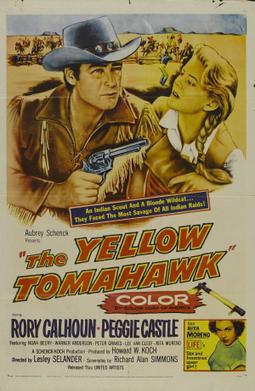
Every so often, I just need a good, old-fashioned B-western. It doesn't have to be great or even particularly good, but I need that dose of WESTERN. So while 1954's The Yellow Tomahawk is pretty run-of-the-mill, I liked it. Entertaining, surprisingly violent and with a cool cast, it's a solid western that's worth a watch.
Riding out of the wilderness, frontiersman Adam Reed (Rory Calhoun) finds himself being chased by Cheyenne warriors. He's cornered and looks to be in trouble until his blood brother, Cheyenne warrior Fire Knife (Lee Van Cleef), steps in, all of it a show to arrange a meeting. Fire Knife has a warning and a message he would like delivered. The U.S. cavalry is building a new fort nearby with a commander, Major Ives (Warner Anderson), who lead a bloody massacre months prior against a peaceful Indian camp. His reputation has preceded him with Fire Knife passing his message along to Reed. What is it? Tell Ives to stop building the fort and risk an attack that will wipe out the partially-assembled fort. Reed rides down to the fort and passes it along but Ives isn't having it, doubting the truth of the threat. What awaits for the small garrison and the soldiers' families who have traveled west? Reed sees the writing on the wall but no one else seems to believe what's coming.
Nothing flashy here, nothing too crazy. From director Lesley Selander, 'Tomahawk' is nonetheless an entertaining, pretty solid western that isn't limited by its budget or limitations. A longtime director in film and television, Selander is a pro at spinning a movie like this. So often, westerns are town-bound. limited by a fake-looking set that never allows the story to breathe. This particular entry does not have that problem with virtually no sets! The cavalry building a fort allows for no sets other than a couple half-assembled walls. It was shot on-location at the Kanab Movie Ranch and Fort, giving the story a cool, intimidating, scary sense of the openness of the desert and wilderness. You're all alone out there, and with the threat of an imminent Indian attack, there's no place to hide.
A star of B-westerns who often played supporting roles in bigger budget pictures, Calhoun is a favorite of mine. He plays a memorable, roguish good guy, a solid anti-hero with an edge who is quite comfortable in the western and in the saddle. His Adam Reed character, a frontiersman and scout of sorts, is interesting because of his hinted-at backstory. It's never told in detail, but it appears he lived with the Cheyenne at some point, his brotherhood and family connection with a young Lee Van Cleef as warrior Fire Knife. If there was a little more time to breathe ('Tomahawk' is a very pleasant 82 minutes), maybe we could have learned some more about out hero. Still, what's there is pretty cool.
No A-listers on-hand here, but that doesn't detract from an overall good cast. Peggie Castle (Lily Merrill on TV's Lawman) is the necessary love interest, a beautiful woman visiting her fiance, a cavalry officer, at the budding fort. She's no damsel in distress either, a welcome addition to the genre. Noah Beery Jr. has some stereotypical fun as Tonio, an ay-ay-ay Mexican horse wrangler with a beautiful Indian girl, Honey Bear (Rita Moreno), who follows him around. As the stupidly blind officer, Major Ives, Warner Anderson is frighteningly uncomfortable, portraying an officer that was probably all too familiar in the wild west. Also look for Peter Graves (gold prospector) and Adam Williams and James Best (cavalry troopers) in key supporting parts.
One good western after another followed a simple formula. Introduce a disparate group of survivors and individuals, throw them into a survival situation with an ever-present Indian war party, and see who makes it out. After an intense, tension-building first 30 minutes or so, that's what 'Tomahawk' uses as a base. We follow a small group of survivors of an Indian attack trying to get across the desert to safety. The action itself is pretty intense in itself, especially the Cheyenne attack on the hastily-built and poorly-defended fort. It's not hugely graphic -- it is still 1954 after all -- but the violence is incredibly rough and if it had been shown on-screen, whoo, we're talking one nasty picture. The ending too is pretty honest for a mid-1950's western, something that surprised me, caught me off-guard a little bit.
A solid western overall. Worth checking out.
The Yellow Tomahawk (1954): ** 1/2 /****
The Sons of Katie Elder
"First, we reunite, then find Ma and Pa's killer...then read some reviews."
Showing posts with label Peter Graves. Show all posts
Tuesday, January 12, 2016
Monday, January 5, 2015
The Raid (1954)
My movie list of hard to find films and hidden gems seems to get shorter every year. One, I'm proud of my persistence in tracking some down that aren't readily available. Two, I'm realizing how many movies I actually watch. Yeah, I kinda have a problem in that department. I read about this Civil War drama years ago when I stumbled across its ridiculously cool tough guy cast. Where'd I find it? Fox Movies Retro On-Demand. Here's 1954's The Raid.
It's fall of 1864 and the tide of the Civil War has fully turned in favor of the Union forces on all fronts. At a prison camp in the northeast, a group of Confederate prisoners led by Major Neal Benton (Van Heflin) plots their escape and manage to break out, hoping to head north into Canada. From there? Hopefully lead raids into Union territory to help ease the pressure on Southern forces. Their first target is a small town in Vermont, St. Albans, that offers several banks just waiting to be knocked off with the funds meant to help the Confederate cause. With his fellow escapees and several other Rebel soldiers hiding out in Canada, Benton puts the plan into play. He starts off posing as a landowner and businessman just visiting St. Albans, but all the while he's putting the pieces together to pull off the successful raid and robbery. There's so many pieces though and success depends on everything going off without a hitch. Can Benton and his Confederates succeed and get out alive in the process?
The American Civil War lasted four years, three weeks and six days between 1861 and 1865 with hundreds of thousands of soldiers killed, wounded and crippled. It is probably the darkest time in American history -- or certainly one of them -- and in general, is a historical era underutilized in film. There just aren't many Civil War movies out there for viewing pleasure. The unfortunate part? A movie like this is a prime example, a true story of a real-life incident. Read through the history books and there are literally hundreds and thousands of stories like this just waiting to be told. Sure, there are the major battles like Gettysburg, Shiloh and Antietam, but what about stories like these? Read about the real-life raid HERE if you're curious.
I was very glad to finally track this one down. From director Hugo Fregonese, 'Raid' clocks in at a crisp 83 minutes and has that distinct B-movie feel but is never held down by its relatively small scale and budget. It's dark and dirty and nasty with the raid being unleashed partially as a counter to Sherman's march through Georgia. In other words, it's about the war, but it's more too. It's about revenge. Title cards introduce the days as the raid draws closer, Benton's plan being put into action with minute details. Much of the story takes place in the St. Albans set with some brief detours into the prison camp and also across the U.S./Canada border. 'Raid' is content to not be an epic but to tell a little known story that's become a footnote in most Civil War and history books. Nothing flashy, but well done and always interesting.
Now what originally caught my eye with this 1954 Civil War drama was the cast. There's some established stars and some rising stars who would go onto bigger and better things in the late 1950s and into the 1960s and beyond. Heflin is just solid as always, the relative anti-hero and leader of the raid. We learn his family was murdered and his home burned down, the desire for revenge coursing through his body. His men include Lee Marvin as a fiery, unpredictable and possibly unhinged Confederate fanatic, Peter Graves as Benton's loyal, capable second-in-command, James Best, an uncredited Claude Akins and later, John Dierkes. Some cool names working together, giving some variety to the Rebel group.
A big plus to the story is that nothing is black and white. It isn't Confederates good and Union bad or vice versa. It's both. This was war, and there was nothing particularly pleasant about it. We get to meet some of the St. Alban residents, starting with Anne Bancroft (just 23 years old) as a widowed boarding house owner (with young Tommy Rettig playing her son), Richard Boone as a Union officer trying to overcome a mistake he made in combat, and assorted other townspeople from farmers to business owners to preachers. It adds a cool element to the story as we see this raid won't be as easy as planned once Benton gets to meet people around town.
If there is a relative disappointment, it comes in the finale, the actual raid. The quick-moving story builds and builds, and the raid is well done as Fregonese sticks pretty close to the facts of the 1864 raid. Unfortunately, the ending just kinda...well, ends. It's fairly accurate to the truth, but this is one case where maybe stretching the truth even a little would have livened things up a touch. As is, the ending scene is rather abrupt as 'THE END' pops up on the screen. It is still a worthwhile movie but the ending could have been far stronger. Still, it tells a little known slice of Civil War history that simply isn't very well known. Worth tracking down a copy for sure.
The Raid (1954): ** 1/2 /****
It's fall of 1864 and the tide of the Civil War has fully turned in favor of the Union forces on all fronts. At a prison camp in the northeast, a group of Confederate prisoners led by Major Neal Benton (Van Heflin) plots their escape and manage to break out, hoping to head north into Canada. From there? Hopefully lead raids into Union territory to help ease the pressure on Southern forces. Their first target is a small town in Vermont, St. Albans, that offers several banks just waiting to be knocked off with the funds meant to help the Confederate cause. With his fellow escapees and several other Rebel soldiers hiding out in Canada, Benton puts the plan into play. He starts off posing as a landowner and businessman just visiting St. Albans, but all the while he's putting the pieces together to pull off the successful raid and robbery. There's so many pieces though and success depends on everything going off without a hitch. Can Benton and his Confederates succeed and get out alive in the process?
The American Civil War lasted four years, three weeks and six days between 1861 and 1865 with hundreds of thousands of soldiers killed, wounded and crippled. It is probably the darkest time in American history -- or certainly one of them -- and in general, is a historical era underutilized in film. There just aren't many Civil War movies out there for viewing pleasure. The unfortunate part? A movie like this is a prime example, a true story of a real-life incident. Read through the history books and there are literally hundreds and thousands of stories like this just waiting to be told. Sure, there are the major battles like Gettysburg, Shiloh and Antietam, but what about stories like these? Read about the real-life raid HERE if you're curious.
I was very glad to finally track this one down. From director Hugo Fregonese, 'Raid' clocks in at a crisp 83 minutes and has that distinct B-movie feel but is never held down by its relatively small scale and budget. It's dark and dirty and nasty with the raid being unleashed partially as a counter to Sherman's march through Georgia. In other words, it's about the war, but it's more too. It's about revenge. Title cards introduce the days as the raid draws closer, Benton's plan being put into action with minute details. Much of the story takes place in the St. Albans set with some brief detours into the prison camp and also across the U.S./Canada border. 'Raid' is content to not be an epic but to tell a little known story that's become a footnote in most Civil War and history books. Nothing flashy, but well done and always interesting.
Now what originally caught my eye with this 1954 Civil War drama was the cast. There's some established stars and some rising stars who would go onto bigger and better things in the late 1950s and into the 1960s and beyond. Heflin is just solid as always, the relative anti-hero and leader of the raid. We learn his family was murdered and his home burned down, the desire for revenge coursing through his body. His men include Lee Marvin as a fiery, unpredictable and possibly unhinged Confederate fanatic, Peter Graves as Benton's loyal, capable second-in-command, James Best, an uncredited Claude Akins and later, John Dierkes. Some cool names working together, giving some variety to the Rebel group.
A big plus to the story is that nothing is black and white. It isn't Confederates good and Union bad or vice versa. It's both. This was war, and there was nothing particularly pleasant about it. We get to meet some of the St. Alban residents, starting with Anne Bancroft (just 23 years old) as a widowed boarding house owner (with young Tommy Rettig playing her son), Richard Boone as a Union officer trying to overcome a mistake he made in combat, and assorted other townspeople from farmers to business owners to preachers. It adds a cool element to the story as we see this raid won't be as easy as planned once Benton gets to meet people around town.
If there is a relative disappointment, it comes in the finale, the actual raid. The quick-moving story builds and builds, and the raid is well done as Fregonese sticks pretty close to the facts of the 1864 raid. Unfortunately, the ending just kinda...well, ends. It's fairly accurate to the truth, but this is one case where maybe stretching the truth even a little would have livened things up a touch. As is, the ending scene is rather abrupt as 'THE END' pops up on the screen. It is still a worthwhile movie but the ending could have been far stronger. Still, it tells a little known slice of Civil War history that simply isn't very well known. Worth tracking down a copy for sure.
The Raid (1954): ** 1/2 /****
Thursday, January 2, 2014
Stalag 17
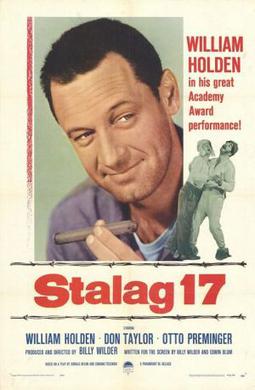
Well, there are just certain movies I should have reviewed by now. I've mentioned on multiple occasions how much I like prisoner of war movies like The Great Escape and Bridge on the River Kwai, but the first one to really put the WWII sub-genre came along in 1953, Stalag 17, a classic that doesn't always get its due.
It's nearing Christmas in 1944, and a breakout is planned in Stalag 17, a German prisoner of war camp deep in Germany for Allied fliers. The night of the escape, the two prisoners making the attempt are machine gunned outside the barbed wire fence, leaving the prisoners they left behind in Barracks 4 to question what's going on. How did the Germans know details of the escape? The prisoners look to J.J. Sefton (William Holden) as the culprit, a possible stoolie who trades and bargains with the German captors for all sorts of luxuries from eggs to cigarettes to booze. Maybe Sefton has been giving away all their secrets for his own benefit, but Sefton knows otherwise. He may be a chiseler, but he's not a traitor. The problem is simple though, he can't prove it. Who among the other prisoners in Barracks 4 is the real culprit? He's going to need an answer and need it quick before his bunkmates decide they've had enough of him for good.
From director Billy Wilder, 'Stalag' is a gem of a film, one of my favorites going back to when I was a kid. It was based on a Broadway play that had 472 showings over its run. The stage-based play roots are obvious, but in a good way. Filmed in a very appropriate, very effective black and white, 'Stalag' is set almost entirely in Barracks 4 as the story develops, Christmas approaching ever quicker. The only departures we have from the barracks are outside into the camp compound. We never leave the camp, the entire story based in Stalag 17. The crowded, claustrophobic barracks becomes another character with the bunks almost bumping into each other, the windows with the frost and ice sticking to the panes, the clothes hanging from lines hung from wall to wall. Franz Waxman's uncredited score is solid as well if underplayed, Johnny Coming Marching Home a key component of the story as well.
One of three nominations the movie received went to William Holden as Barracks 4 chiseler and general trouble-maker J.J. Sefton. Nominated for his part in Sunset Boulevard but not winning, Holden got a much-deserved win here, taking home the Oscar. More impressive? He was going up against Burt Lancaster and Montgomery Clift in From Here to Eternity. Holden brings this character to life, a less than sympathetic but still appealing individual who's decided to make the most of his prisoner of war status. He's going to live in comfort, and if that means dealing/trading with his German captors, then so be it. It's not an issue until his bunkmates decide he's the traitor giving the Germans all their secrets. This is where Holden's acting steps up a notch, a desperate man now fighting for his survival instead of his personal comfort. Not often remembered as one of his best, but it's a goodie.
Holden's performance comes as part of a very solid ensemble cast that doesn't feature a ton of A-list stars, instead turning to a group of familiar character actors. Start with Robert Strauss as Animal and Harvey Lembeck as Harry Shapiro, the barracks cut-ups, Richard Erdman as Hoffy, the barracks chief, Peter Graves as Price, barracks security, Neville Brand as Duke, the hothead, and Gil Stratton as Cookie, Sefton's mousey assistant, and Robinson Stone, Robert Shawley, and William Pierson rounding out the bunch. Don Taylor co-stars as Lt. Dunbar, a prisoner in transit who comes under SS questioning, Jay Lawrence his impersonating, smart-mouthed traveling companion, Sgt. Bagradian. The comedy between Animal and Harry gets to be a little much at times, Bagradian's impersonations a little forced, but as a collective whole it's a good, strong, deep group of interesting characters.
It is hard to watch this without seeing the obvious influences some 10-plus years later with TV's Hogan's Heroes. Director Otto Preminger stars as Von Scherbach, the Stalag commander, an old-school German aristocrat and gentleman while Sig Ruman plays barracks guard Sgt. Schulz, a VERY obvious influence on John Banner's famous Sgt. Schultz character in the TV show.
An episodic story that clocks in at exactly 120 minutes, there really isn't a slow moment in Wilder's Stalag 17. In directing his film, Wilder decided to shoot chronologically so that way the cast and crew wouldn't know the twist -- the identity of the barracks traitor -- until the end of filming. The first hour or so of the movie blends the drama and comedy nicely setting up the second half of the movie. As the barracks traitor story comes to the forefront, that's when '17' is at its best. The last 30 minutes are pretty perfect, Holden's Sefton starting to piece the clues together in a great couple scenes, Wilder's talent fully on display in shooting style, while the actual reveal and the finale are spot-on. This is a movie that doesn't always get the recognition it deserves, but it sure deserves it. One of my favorites.
Stalag 17 (1953): ****/****
It's nearing Christmas in 1944, and a breakout is planned in Stalag 17, a German prisoner of war camp deep in Germany for Allied fliers. The night of the escape, the two prisoners making the attempt are machine gunned outside the barbed wire fence, leaving the prisoners they left behind in Barracks 4 to question what's going on. How did the Germans know details of the escape? The prisoners look to J.J. Sefton (William Holden) as the culprit, a possible stoolie who trades and bargains with the German captors for all sorts of luxuries from eggs to cigarettes to booze. Maybe Sefton has been giving away all their secrets for his own benefit, but Sefton knows otherwise. He may be a chiseler, but he's not a traitor. The problem is simple though, he can't prove it. Who among the other prisoners in Barracks 4 is the real culprit? He's going to need an answer and need it quick before his bunkmates decide they've had enough of him for good.
From director Billy Wilder, 'Stalag' is a gem of a film, one of my favorites going back to when I was a kid. It was based on a Broadway play that had 472 showings over its run. The stage-based play roots are obvious, but in a good way. Filmed in a very appropriate, very effective black and white, 'Stalag' is set almost entirely in Barracks 4 as the story develops, Christmas approaching ever quicker. The only departures we have from the barracks are outside into the camp compound. We never leave the camp, the entire story based in Stalag 17. The crowded, claustrophobic barracks becomes another character with the bunks almost bumping into each other, the windows with the frost and ice sticking to the panes, the clothes hanging from lines hung from wall to wall. Franz Waxman's uncredited score is solid as well if underplayed, Johnny Coming Marching Home a key component of the story as well.
One of three nominations the movie received went to William Holden as Barracks 4 chiseler and general trouble-maker J.J. Sefton. Nominated for his part in Sunset Boulevard but not winning, Holden got a much-deserved win here, taking home the Oscar. More impressive? He was going up against Burt Lancaster and Montgomery Clift in From Here to Eternity. Holden brings this character to life, a less than sympathetic but still appealing individual who's decided to make the most of his prisoner of war status. He's going to live in comfort, and if that means dealing/trading with his German captors, then so be it. It's not an issue until his bunkmates decide he's the traitor giving the Germans all their secrets. This is where Holden's acting steps up a notch, a desperate man now fighting for his survival instead of his personal comfort. Not often remembered as one of his best, but it's a goodie.
Holden's performance comes as part of a very solid ensemble cast that doesn't feature a ton of A-list stars, instead turning to a group of familiar character actors. Start with Robert Strauss as Animal and Harvey Lembeck as Harry Shapiro, the barracks cut-ups, Richard Erdman as Hoffy, the barracks chief, Peter Graves as Price, barracks security, Neville Brand as Duke, the hothead, and Gil Stratton as Cookie, Sefton's mousey assistant, and Robinson Stone, Robert Shawley, and William Pierson rounding out the bunch. Don Taylor co-stars as Lt. Dunbar, a prisoner in transit who comes under SS questioning, Jay Lawrence his impersonating, smart-mouthed traveling companion, Sgt. Bagradian. The comedy between Animal and Harry gets to be a little much at times, Bagradian's impersonations a little forced, but as a collective whole it's a good, strong, deep group of interesting characters.
It is hard to watch this without seeing the obvious influences some 10-plus years later with TV's Hogan's Heroes. Director Otto Preminger stars as Von Scherbach, the Stalag commander, an old-school German aristocrat and gentleman while Sig Ruman plays barracks guard Sgt. Schulz, a VERY obvious influence on John Banner's famous Sgt. Schultz character in the TV show.
An episodic story that clocks in at exactly 120 minutes, there really isn't a slow moment in Wilder's Stalag 17. In directing his film, Wilder decided to shoot chronologically so that way the cast and crew wouldn't know the twist -- the identity of the barracks traitor -- until the end of filming. The first hour or so of the movie blends the drama and comedy nicely setting up the second half of the movie. As the barracks traitor story comes to the forefront, that's when '17' is at its best. The last 30 minutes are pretty perfect, Holden's Sefton starting to piece the clues together in a great couple scenes, Wilder's talent fully on display in shooting style, while the actual reveal and the finale are spot-on. This is a movie that doesn't always get the recognition it deserves, but it sure deserves it. One of my favorites.
Stalag 17 (1953): ****/****
Saturday, February 2, 2013
Texas Across the River
Comedy westerns are completely hit or miss with me. With rare exceptions like Blazing Saddles, I do my best to avoid them. Every so often though, I've got to give them a try, like 1966's Texas Across the River, a pleasant surprise thanks mostly to its casting.
Readying to marry Southern belle Phoebe Ann Naylor (Rosemary Forsyth), Spanish duke Don Andrea Baldassare (Alain Delon) is confronted by another suitor for Phoebe. The suitor ends up dead -- due to an accident -- in the ensuing fight, and Andrea is forced to run. He heads across the border into Texas, still an unsettled territory. He's rescued from a sticky predicament with the pursuing cavalry by Sam Hollis (Dean Martin) and his Indian sidekick, Kronk (Joey Bishop). Owing them his life, Don Andrea -- a crack shot and fine horseman -- accompanies them as they travel into Texas toward the little settlement of Moccasin Falls. What are they up to? Sam and Kronk are gunrunners, but that's just the start. Warring Comanches, revenge-seeking cavalry and a love....square are just some of the hijinks around the corner.
Let's get this over with. This comedy western from director Michael Gordon is pretty stupid. There's something about westerns that doesn't translate well to comedies (if you ask me, and you are asking, right?). So that considered, if you're going to make a comedy set in the wild west, you can't be subtle. Be dumb, be stupid and go for the politically incorrect angle. Thankfully, 'Across' commits. It is dumb, but it isn't completely stupid either. The script has some good running bits, some solid sight gags, and is politically incorrect without being offensive. It's harmless enough, running 101 minutes, and doesn't overstay it's welcome.
What is worth it then about this flick? What caught my eye was the casting. An established star in Europe, Delon was creating quite a name for himself in America as well. He gets to play the fish out of water here, the European aristocrat who ain't quite familiar with the rough and tumble ways of the wild west, especially Texas. His counterpart in Martin's Sam is just the opposite. Dean Martin does what he does best, funny, effortless line deliveries, and he's cool all the way. The 31-year old Delon (handling much of his own stunts) and 49-year old Martin have an easygoing chemistry that goes wells with the slightly schizophrenic nature of the story and other characters. As peaceful Indian Kronk, Bishop (an obvious choice to play an Indian, don't you think?) is surprisingly funny. He gets to play the straight man to all the craziness as a deadpan Indian always ready with a clever one-liner.
There are plenty of other names to look out for, starting with Forsyth as Phoebe Ann, the Southern belle who never has a lack of suitors pursuing her. Her purpose here is to bat her eyes and look good which she accomplishes with ease, especially a not so subtle scene where she walks out of a pond with nothing but a clingy poncho on. Martin's reaction is priceless. Watch it HERE. Providing another love interest is Tina Aumont as Lonetta, a Comanche woman Don Andrea rescues from certain death. Peter Graves and Andrew Prine play Rodney and Sibley, brothers in the cavalry trying to get revenge for their dead brother. Michael Ansara has some fun as Iron Shirt, a Comanche chief trying to prove his son, Yellow Knife (Linden Chiles), isn't a complete screw-up.
Goofy though they may be, 'Across' does have its fair share of laughs. Much of it is of the physical variety, especially the opening fight scene at the wedding gone wrong. What bits work? When Ansara and his Comanches speak "Indian" the English subtitles appear. When they speak English, pictures appear, translating things back into Comanche. Delon keeps getting into trouble, Martin rescues him, Bishop wisecracks. The running bit about Graves' Rodney's indecipherable cavalry commands is funny as well. Smart humor this is not, but I enjoyed it just the same. Not a classic, but still worth a watch for western fans, especially for the fun the cast looks to be having.
Texas Across the River (1966): ***/****
Readying to marry Southern belle Phoebe Ann Naylor (Rosemary Forsyth), Spanish duke Don Andrea Baldassare (Alain Delon) is confronted by another suitor for Phoebe. The suitor ends up dead -- due to an accident -- in the ensuing fight, and Andrea is forced to run. He heads across the border into Texas, still an unsettled territory. He's rescued from a sticky predicament with the pursuing cavalry by Sam Hollis (Dean Martin) and his Indian sidekick, Kronk (Joey Bishop). Owing them his life, Don Andrea -- a crack shot and fine horseman -- accompanies them as they travel into Texas toward the little settlement of Moccasin Falls. What are they up to? Sam and Kronk are gunrunners, but that's just the start. Warring Comanches, revenge-seeking cavalry and a love....square are just some of the hijinks around the corner.
Let's get this over with. This comedy western from director Michael Gordon is pretty stupid. There's something about westerns that doesn't translate well to comedies (if you ask me, and you are asking, right?). So that considered, if you're going to make a comedy set in the wild west, you can't be subtle. Be dumb, be stupid and go for the politically incorrect angle. Thankfully, 'Across' commits. It is dumb, but it isn't completely stupid either. The script has some good running bits, some solid sight gags, and is politically incorrect without being offensive. It's harmless enough, running 101 minutes, and doesn't overstay it's welcome.
What is worth it then about this flick? What caught my eye was the casting. An established star in Europe, Delon was creating quite a name for himself in America as well. He gets to play the fish out of water here, the European aristocrat who ain't quite familiar with the rough and tumble ways of the wild west, especially Texas. His counterpart in Martin's Sam is just the opposite. Dean Martin does what he does best, funny, effortless line deliveries, and he's cool all the way. The 31-year old Delon (handling much of his own stunts) and 49-year old Martin have an easygoing chemistry that goes wells with the slightly schizophrenic nature of the story and other characters. As peaceful Indian Kronk, Bishop (an obvious choice to play an Indian, don't you think?) is surprisingly funny. He gets to play the straight man to all the craziness as a deadpan Indian always ready with a clever one-liner.
There are plenty of other names to look out for, starting with Forsyth as Phoebe Ann, the Southern belle who never has a lack of suitors pursuing her. Her purpose here is to bat her eyes and look good which she accomplishes with ease, especially a not so subtle scene where she walks out of a pond with nothing but a clingy poncho on. Martin's reaction is priceless. Watch it HERE. Providing another love interest is Tina Aumont as Lonetta, a Comanche woman Don Andrea rescues from certain death. Peter Graves and Andrew Prine play Rodney and Sibley, brothers in the cavalry trying to get revenge for their dead brother. Michael Ansara has some fun as Iron Shirt, a Comanche chief trying to prove his son, Yellow Knife (Linden Chiles), isn't a complete screw-up.
Goofy though they may be, 'Across' does have its fair share of laughs. Much of it is of the physical variety, especially the opening fight scene at the wedding gone wrong. What bits work? When Ansara and his Comanches speak "Indian" the English subtitles appear. When they speak English, pictures appear, translating things back into Comanche. Delon keeps getting into trouble, Martin rescues him, Bishop wisecracks. The running bit about Graves' Rodney's indecipherable cavalry commands is funny as well. Smart humor this is not, but I enjoyed it just the same. Not a classic, but still worth a watch for western fans, especially for the fun the cast looks to be having.
Texas Across the River (1966): ***/****
Wednesday, December 8, 2010
The Five Man Army
This isn't your typical spaghetti western with gunfighters shooting it out for women and riches in the desert. As well, it was made with financial backing from MGM where most spaghetti westerns were made with backing from Italian studios. Considering all the different elements of the story, it's a heist zapata spaghetti western with a men on a mission/mercenary setting for all the characters. So all those things rolled together to form basically the coolest idea for a western ever. Is it a classic? No, but it isn't trying to be. Good cast, great musical score, and action around every corner.
During the Mexican Revolution, a group of revolutionists catches wind of a gold shipment bound for Mexico City and hires an American to get the job done. His name is simply, Dutchman (Peter Graves), and he goes about putting a team together to accomplish the mission. His crew includes Augustus (James Daly), an explosives expert, Mesito (Bud Spencer), a mammoth strongman, Luis (Nino Castelnuovo), an acrobatic bandit and dead eye with a slingshot, and Samurai (Tetsuro Tanba), a master swordsman and knife thrower. The mission/robbery seems suicidal though as the five men must get aboard a heavily guarded armored train outfitted with 100 guards, machine guns and a cannon that can pick them off if they try and board. All along the route, patrols of soldiers will be waiting for the signal to move in if trouble arises. It seems impossible, but the Dutchman's got a plan.
A sucker for men on a mission movies, I fell for this one from the first time I saw it. 'Army' follows a familiar formula, but director Don Taylor (who reportedly only filmed part of the movie) handles everything so smoothly it is fun just to go along for the ride. The movie follows the formula; recruit a team, introduce their specialties, reveal the mission, let the team loose on the mission, and the fallout with the survivors. Taylor does just enough different to keep you on your toes, and does throw the audience a curveball here and there when he thinks they're too comfortable. But at its most basic is an action-packed story that never waits too long in between gunfights and showdowns with Dutchman's crew, revolutionaries, bandits, and Mexican soldiers.
The calling card for 'Army' is easily the actual heist sequence when the Five Man Army hits the armored train. To this point, we've only been given hints as to how they'll pull off this impossible job, but it all comes together in an almost wordless 26-minute sequence that is a masterful presentation of how to shoot a tense, exciting heist action sequence. You can watch it starting HERE and continuing into Part 8, 9 and 10. The movie was shot on location in Spain (you'll see some familiar locations from other spaghettis, including Once Upon a Time in the West), and nowhere does that benefit more than the heist sequence which features some crazy, absolutely ridiculous, and I imagine rather dangerous stunts. But credit to the cast who seems to be doing a majority of their stunts, and on a moving train at that. I love the movie on the whole, but the heist is the strongest and best part.
Filling out the Five Man Army is a great group of actors who were never huge stars. Graves filmed this while on hiatus from his hit TV show Mission Impossible, and it's only fitting that the story is basically M:I in the wild west. I like Graves a lot, and he's a good choice to play the tough, no-nonsense leader of this group of mercenaries. His four men are all given a chance to shine, and none disappoint. Daly is a scene-stealer as dynamite expert Capt. Augustus, delivering a monologue about the changing times in the west and how he doesn't expect any of them to survive. Watch it HERE starting at the 4:30 mark. For a dumb old action movie, this speech says more than whole movies that cover the same time period. Spencer is awesome as ever as the immense, somewhat dim-witted Mesito, Castelnuovo is great as a shifty bandit you're never quite sure of, and Tanba doesn't say a word, letting his sword do his talking. A great group, and a perfect team to pull off an impossible heist!
Watch enough spaghetti westerns, and it gets to be an easy thing to overlook composer Ennio Morricone and his great musical scores. His 'Army' score is an underrated one (listen to the main theme HERE) mixing the big and epic with the quieter and emotional. Augustus' speech is aided by Morricone's soothing score being played under his words, but then the action sequence is boosted by this perfect action score that keeps the story flowing at all times. Just another element of one of my favorite movies. It is available to watch from start to finish starting with Part 1 of 11 in a great print on Youtube. Enjoy it!
The Five Man Army <---TCM trailer (1969): ****/****
Wednesday, October 20, 2010
Fort Defiance
If there was ever a place where having all your physical abilities and capabilities was necessary, the American West seems cut out to be that place. But a handful of westerns come to mind dealing with a character(s) who is deaf like The Great Silence or blind like Blindman and Eye for an Eye, or a B-western I recently watched 1951's Fort Defiance. A generally forgotten smaller budget western, 'Defiance' introduces a blind character and lets the story build around it in a surprisingly enjoyable, very easygoing western that caught me off guard.
It's been a few months since the end of the Civil War and former Union soldier Ben Shelby (Ben Johnson) is riding west. He's looking for revenge and finds the ranch of the man he's looking to kill, but the man, infamous gunfighter Johnny Tallon, isn't there. Instead he finds Johnny's blind brother, Ned (Peter Graves), and his uncle Charlie (George Cleveland) there. Ben takes a job and sits back and waits only to find out Johnny was gunned down while returning home. Having developed a brotherly relationship with Ned, Ben decides to stay on and help build up the ranch. He sends for his wife, and everything looks to be going smoothly. But the cavalry is having problems with a local Navajo tribe that's ready to go on the warpath, and just when everything is at its bleakest, Johnny Tallon (Dane Clark) shows up, throwing everyone for a loop.
Of the three moves mentioned before about gunfighters with disabilities, all of them had a bit of a superhuman element to them. Honestly, how long could a blind gunfighter survive? That's no problem here because Ned doesn't even carry a gun. He's a good man who lost his eye sight in a bar fight, but years later he refuses to pity himself. He knows he's up against it in terms of having any success running a large cattle ranch, but he's willing to try. Ned needs help and gets it through the relationship that develops between himself and Ben. With as many westerns as I've seen, I'm usually just looking for something, a change of pace, and this B-western does what few much bigger scale westerns I've seen couldn't do. 'Defiance' uses many familiar elements but adds just enough to be different, to be interesting.
Some of my favorite westerns are the of the more cynical variety, downbeat, realistic looks at the American west. There is a darkness to 'Defiance' but it never overshadows the good that's in these characters. Johnson's Shelby character is looking for revenge for the the death of his brother which could have been easily avoided. He's a family man who has to right a wrong done to his family. Hunting Johnny Tallon down, he doesn't expect anything to come of it other than a bullet in his gut or Tallon's. The relationship that develops between him and Ned -- also looking for help and needing a big brother -- is completely genuine. Credit to Graves and Johnson for nailing their parts. Amidst all the revenge, Indian uprisings and pissed off gunfighters are these two men looking to build a new life for themselves.
The dynamic among the three leads is what made this B-western more enjoyable for me. All three are flawed in some way, but they're not downright nasty people. Even Clark's Johnny Tallon has made mistakes in his past and resorted to a life of crime when nothing else was there, but when a situation presents itself where he has a chance to think of only himself, he thinks of his scorned brother. It was just one of many things that appealed to me about this western. Johnson was coming off the success of his two parts in John Ford's Cavalry trilogy and shows off his natural, easygoing way on-screen. In just his second credited part, Graves shows he's got some talent to work with, and Clark makes the most of playing a bad guy who isn't really that bad, but he has to live up to his hard-earned reputation.
With all this going on, throw in the cavalry, an Indian uprising, a runaway stagecoach with a pretty saloon girl (Tracey Roberts), a second vengeful gunman and his gang, and you've got quite a lot of plates trying to keep spinning at the same time. Some get neglected or left by the wayside, but at the heart of the movie is a bigger dynamic among men forced to work together in stressful, extremely deadly situations. When it would be easier to ride out, these men dig their heel in and brace themselves for what's coming. A classic by no means, but a western I really enjoyed from the start. I can't put my finger on it, I just liked the movie and hopefully you do too.
Fort Defiance (1951): ***/****
It's been a few months since the end of the Civil War and former Union soldier Ben Shelby (Ben Johnson) is riding west. He's looking for revenge and finds the ranch of the man he's looking to kill, but the man, infamous gunfighter Johnny Tallon, isn't there. Instead he finds Johnny's blind brother, Ned (Peter Graves), and his uncle Charlie (George Cleveland) there. Ben takes a job and sits back and waits only to find out Johnny was gunned down while returning home. Having developed a brotherly relationship with Ned, Ben decides to stay on and help build up the ranch. He sends for his wife, and everything looks to be going smoothly. But the cavalry is having problems with a local Navajo tribe that's ready to go on the warpath, and just when everything is at its bleakest, Johnny Tallon (Dane Clark) shows up, throwing everyone for a loop.
Of the three moves mentioned before about gunfighters with disabilities, all of them had a bit of a superhuman element to them. Honestly, how long could a blind gunfighter survive? That's no problem here because Ned doesn't even carry a gun. He's a good man who lost his eye sight in a bar fight, but years later he refuses to pity himself. He knows he's up against it in terms of having any success running a large cattle ranch, but he's willing to try. Ned needs help and gets it through the relationship that develops between himself and Ben. With as many westerns as I've seen, I'm usually just looking for something, a change of pace, and this B-western does what few much bigger scale westerns I've seen couldn't do. 'Defiance' uses many familiar elements but adds just enough to be different, to be interesting.
Some of my favorite westerns are the of the more cynical variety, downbeat, realistic looks at the American west. There is a darkness to 'Defiance' but it never overshadows the good that's in these characters. Johnson's Shelby character is looking for revenge for the the death of his brother which could have been easily avoided. He's a family man who has to right a wrong done to his family. Hunting Johnny Tallon down, he doesn't expect anything to come of it other than a bullet in his gut or Tallon's. The relationship that develops between him and Ned -- also looking for help and needing a big brother -- is completely genuine. Credit to Graves and Johnson for nailing their parts. Amidst all the revenge, Indian uprisings and pissed off gunfighters are these two men looking to build a new life for themselves.
The dynamic among the three leads is what made this B-western more enjoyable for me. All three are flawed in some way, but they're not downright nasty people. Even Clark's Johnny Tallon has made mistakes in his past and resorted to a life of crime when nothing else was there, but when a situation presents itself where he has a chance to think of only himself, he thinks of his scorned brother. It was just one of many things that appealed to me about this western. Johnson was coming off the success of his two parts in John Ford's Cavalry trilogy and shows off his natural, easygoing way on-screen. In just his second credited part, Graves shows he's got some talent to work with, and Clark makes the most of playing a bad guy who isn't really that bad, but he has to live up to his hard-earned reputation.
With all this going on, throw in the cavalry, an Indian uprising, a runaway stagecoach with a pretty saloon girl (Tracey Roberts), a second vengeful gunman and his gang, and you've got quite a lot of plates trying to keep spinning at the same time. Some get neglected or left by the wayside, but at the heart of the movie is a bigger dynamic among men forced to work together in stressful, extremely deadly situations. When it would be easier to ride out, these men dig their heel in and brace themselves for what's coming. A classic by no means, but a western I really enjoyed from the start. I can't put my finger on it, I just liked the movie and hopefully you do too.
Fort Defiance (1951): ***/****
Friday, September 10, 2010
The Long Gray Line
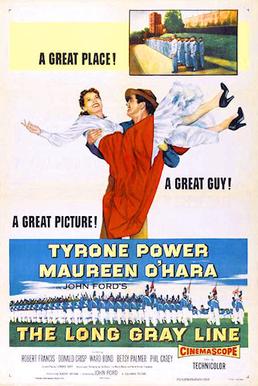
When comparing his movies, it's easy to overlook his non-westerns. When in front of a Congressional hearing, Ford even introduced himself saying "I'm John Ford, I make westerns." But over a career that spanned decades and over 100 movies, it's unfair to just say he was a good director of westerns. He was a good director for all his faults and tendencies that can drive me nuts at times. Maybe the best example of a Ford movie -- non-western -- is 1955's The Long Gray Line, a departure from the expected Ford movie but still similar in many ways.
An Irish immigrant fresh off the boat in New York, young Martin Maher (Tyrone Power) travels to the United States Military Academy at West Point in upstate New York. He enlists in the army and right away begins helping the cadets, some just as a mentor, others as an instructor in classes. Marty can be a bit of a klutz, a bit of a doof at times, but when the chips are down, he's a good friend and a better man. The years go by, and Marty continues to reenlist while also marrying Mary O'Donnell (Maureen O'Hara), a pretty redhead from Ireland. They send for Marty's family from Ireland (father Donald Crisp, brother Sean McClory) and life continues, the whole family together again. And so the years go by, West Point unchanging as the world changes around it in the first half of the 20th Century.
When Ford gets it right, he typically hits a home run, and this qualifies in many ways. One review described it as a "very Irish" movie. And somehow that description is dead on more than just the main characters being Irish. It's about family and sticking together through thick and thin. More than that, it's the extended family you make in your life. All those things that drive me up the wall are here, but whether he realized it or not, Ford reins it all in. It never gets to be too much. The story is downright sappy at times, but I don't think Ford ever intended to do anything but that. For the most part, it hits all the right notes, happy, sad and everything in between.
This was never an intentional slight, but this was the first Tyrone Power movie I'd ever seen from beginning to end. I never had a negative idea of Power as an actor, but I guess it's fair to say it wasn't particularly positive either. Above all else, Power's performance here as Sgt. Martin Maher is the reason to check this one out. Marty is one of the most likable characters ever, willing to help whatever and whoever needs his help. We see this over the years the impression he makes on his cadets who end up looking at him as a father figure, or at least a big brother looking out for their best interests. Power gives Marty some funny bits, nails the emotional scenes, and handles an Irish accent that if handled poorly could have derailed the part. A great performance to lead the movie.
Mentioned earlier, Ford's stock company of actors was a long list of actors/actresses the director worked with on repeated times. If you've seen more than one Ford movie, you've no doubt seen these faces whether you knew it or not. 'Gray Line' is full of these folks, starting with O'Hara in a perfectly cast part as Marty's tough-minded wife Mary, an ideal match for the equally strong-willed and tough-minded Marty. Crisp isn't in the movie for long but certainly makes quite an impression as Marty's old school Pops. My favorite of the stock company has always been Ward Bond, and he doesn't disappoint as Major Keeler, Marty's commanding officer. Also look for Ford regulars Harry Carey Jr. and Patrick Wayne along with Robert Francis, Peter Graves, Philip Carey and William Leslie filling out some meatier supporting parts.
Only one complaint here, and I'll keep it brief. A story that covers 50-plus years in 140 minutes can't help but feel a little episodic, a little disjointed. Characters go in and out at will, no explanations offered, but the link through all the slower moving segments is Power as Martin Maher. Throw the performances in with some great on-location shooting at West Point that help sell the tradition and honor of the academy, and you've got a winner if not quite a classic.
The Long Gray Line <---trailer (1955): ***/****
Subscribe to:
Posts (Atom)