The Sons of Katie Elder

The Sons of Katie Elder
"First, we reunite, then find Ma and Pa's killer...then read some reviews."
Showing posts with label Van Heflin. Show all posts

Tuesday, January 26, 2016

The Strange Love of Martha Ivers

Kirk Douglas is a Hollywood legend. With too many classic films to his name to mention, from Spartacus to Paths of Glory and countless others in between, Douglas is one of the few who deserves that legend status. What's so crazy about his career? He didn't have a climbing period of supporting roles, bit parts and background players. He dove right in, starting with a hugely important part in his screen debut, 1946's The Strange Love of Martha Ivers.

It's 1928 in the up-and-coming town of Iverstown in Pennsylvania when three teenagers from vastly different backgrounds and upbringings are witness to a horrific crime that results in murder. The truth never comes out though, putting the three teenagers on again, vastly different paths into the future. Fast forward to 1946 when the now grown-up Sam Masterson (Van Heflin) drives back into town looking to get his car fixed. He discovers that the other two teenagers have married, with Martha (Barbara Stanwyck) having become one of the most powerful businesswomen in the state with all sorts of public influence. Her husband, Walter (Douglas), is an equally powerful district attorney with political aspirations but really, it's Martha pulling his strings. Now after so many years have passed, the secret that bonds the trio threatens to tear everything down. Martha and Walter are convinced Sam is looking for a payoff. What is his intention exactly?

This is a flick that's hard to peg down. Not quite a romance or a mystery, not quite a thriller or film noir. Instead, director Lewis Milestone's film manages to blend all those elements into one very solid movie. At different points, it is all of those disparate pieces, providing a wave of different tones that might not work together but somehow...they just do. Filmed in black and white, there's a dark, shadowy and sinister look to it all. As well, there's that vein of small-town Americana where everyone has their secrets but no one ever gets called out on them. I will add it is an odd film when you take it all in, but there's something oddly appealing about it, the romance-thriller-mystery-film noir final product.

What holds it all together for me was the characters. We've got four main characters, all of them very human, very flawed and very vulnerable. I don't want to give spoilers away to the opening intro (it runs about 20-25 minutes) but it does involve a murder. If that doesn't provide some pyrotechnics some 17 years later, I don't know what will! Stanwyck, Heflin, Douglas and Lizabeth Scott as a troubled young woman brought into the years-old drama are all on-point in bringing their characters to life, the ensemble working quite well together. They all get their moments to shine and none disappoint. The chemistry between Stanwyck and Heflin is smoldering, as is between Heflin and Scott. In an age of movies that had a tendency to get a little overdone in the acting department, 'Strange' manages to harness all the melodrama and keep it relatively reserved (thankfully!). This is an acting movie, and the actors don't disappoint!

I came away especially impressed with Douglas in his first on-screen appearance and his first-ever film role. His Walter O'Neil is a product of his childhood and later, his marriage to Stanwyck's Martha. As Heflin's Sam points out, he's still a scared-looking little kid. Knowing where Douglas' career would go (and go quickly), it's startling to see him as an alcoholic, sniveling, weakling of a man. What's better? He nails the part. There's a perfect intensity to the proceedings, but he's perfectly believable as a grown man who can basically make a decision for himself. An underrated actor, Heflin delivers one of his best performances as Sam Masterson, a gambler, a WWII vet and with a checkered past to his name who still remains confident that something will come along because...well, because it always has before. Excellent parts for all four leads.

If there's an issue here, it's the pacing. At 116 minutes, 'Strange' can be a tad on the slow side. We spend a lot of time just introducing our characters and laying things out, most of an hour-plus actually. It's only then the wheels go into motion as we start to figure out what everyone's intentions are. What is Sam's plan? Is he interested in blackmail or is he just in the wrong place at the wrong time? What is Scott's Toni's background? Does Martha still have feelings for Sam? A lot to deal with for sure in the closing 45-50 minutes. So that said, I enjoyed the first hour more with its sense of mystery and foreboding doom hanging in the air over this budding industrial town. I was surprised by the ending itself because I just wasn't sure how dark this story would go...but it goes.

An excellent flick all-around, definitely worth checking out.

The Strange Love of Martha Ivers (1946): ***/****

Monday, January 5, 2015

The Raid (1954)

My movie list of hard to find films and hidden gems seems to get shorter every year. One, I'm proud of my persistence in tracking some down that aren't readily available. Two, I'm realizing how many movies I actually watch. Yeah, I kinda have a problem in that department. I read about this Civil War drama years ago when I stumbled across its ridiculously cool tough guy cast. Where'd I find it? Fox Movies Retro On-Demand. Here's 1954's The Raid.

It's fall of 1864 and the tide of the Civil War has fully turned in favor of the Union forces on all fronts. At a prison camp in the northeast, a group of Confederate prisoners led by Major Neal Benton (Van Heflin) plots their escape and manage to break out, hoping to head north into Canada. From there? Hopefully lead raids into Union territory to help ease the pressure on Southern forces. Their first target is a small town in Vermont, St. Albans, that offers several banks just waiting to be knocked off with the funds meant to help the Confederate cause. With his fellow escapees and several other Rebel soldiers hiding out in Canada, Benton puts the plan into play. He starts off posing as a landowner and businessman just visiting St. Albans, but all the while he's putting the pieces together to pull off the successful raid and robbery. There's so many pieces though and success depends on everything going off without a hitch. Can Benton and his Confederates succeed and get out alive in the process?

The American Civil War lasted four years, three weeks and six days between 1861 and 1865 with hundreds of thousands of soldiers killed, wounded and crippled. It is probably the darkest time in American history -- or certainly one of them -- and in general, is a historical era underutilized in film. There just aren't many Civil War movies out there for viewing pleasure. The unfortunate part? A movie like this is a prime example, a true story of a real-life incident. Read through the history books and there are literally hundreds and thousands of stories like this just waiting to be told. Sure, there are the major battles like Gettysburg, Shiloh and Antietam, but what about stories like these? Read about the real-life raid HERE if you're curious.

I was very glad to finally track this one down. From director Hugo Fregonese, 'Raid' clocks in at a crisp 83 minutes and has that distinct B-movie feel but is never held down by its relatively small scale and budget. It's dark and dirty and nasty with the raid being unleashed partially as a counter to Sherman's march through Georgia. In other words, it's about the war, but it's more too. It's about revenge. Title cards introduce the days as the raid draws closer, Benton's plan being put into action with minute details. Much of the story takes place in the St. Albans set with some brief detours into the prison camp and also across the U.S./Canada border. 'Raid' is content to not be an epic but to tell a little known story that's become a footnote in most Civil War and history books. Nothing flashy, but well done and always interesting.

Now what originally caught my eye with this 1954 Civil War drama was the cast. There's some established stars and some rising stars who would go onto bigger and better things in the late 1950s and into the 1960s and beyond. Heflin is just solid as always, the relative anti-hero and leader of the raid. We learn his family was murdered and his home burned down, the desire for revenge coursing through his body. His men include Lee Marvin as a fiery, unpredictable and possibly unhinged Confederate fanatic, Peter Graves as Benton's loyal, capable second-in-command, James Best, an uncredited Claude Akins and later, John Dierkes. Some cool names working together, giving some variety to the Rebel group.

A big plus to the story is that nothing is black and white. It isn't Confederates good and Union bad or vice versa. It's both. This was war, and there was nothing particularly pleasant about it. We get to meet some of the St. Alban residents, starting with Anne Bancroft (just 23 years old) as a widowed boarding house owner (with young Tommy Rettig playing her son), Richard Boone as a Union officer trying to overcome a mistake he made in combat, and assorted other townspeople from farmers to business owners to preachers. It adds a cool element to the story as we see this raid won't be as easy as planned once Benton gets to meet people around town.

If there is a relative disappointment, it comes in the finale, the actual raid. The quick-moving story builds and builds, and the raid is well done as Fregonese sticks pretty close to the facts of the 1864 raid. Unfortunately, the ending just kinda...well, ends. It's fairly accurate to the truth, but this is one case where maybe stretching the truth even a little would have livened things up a touch. As is, the ending scene is rather abrupt as 'THE END' pops up on the screen. It is still a worthwhile movie but the ending could have been far stronger. Still, it tells a little known slice of Civil War history that simply isn't very well known. Worth tracking down a copy for sure.

The Raid (1954): ** 1/2 /****

Tuesday, September 25, 2012

Cry of Battle

Made on a shoestring budget with a rogue, even amateurish feel to it, 1963's Cry of Battle is everything that a low-budget war movie should be. Unfortunately, it's also got a weird tie to history as it was the movie showing at the drive-in theater the night Lee Harvey Oswald was arrested. That minor blip on the radar aside, it's well worth a watch if you can track a copy down.

In the days following the Japanese attack on Pearl Harbor, Dave McVey (James MacArthur) finds himself on his own and on the run in the Philippines. The son of a prominent American businessman who got out of the country, Dave is helped by a Filipino guerilla fighter, Careo (Leopoldo Salcedo), and goes into hiding. It is there he meets Joe Trent (Van Heflin), a land-bound sailor also on the run. Joe makes a choice that forces them to join a different Filipino guerrilla group, thrusting the duo to take an active part in the fighting as Japanese forces sweep over the island. Joe has seen the worst the world can offer, but Dave has led a shielded life, until now at least.

Shot on location in the Philippines and almost always on a small, personal scale, 'Cry' has that distinct look and feel of renegade filmmaking styles. This is not a polished, manicured Hollywood war film. It is down and dirty, right in the mud with the guerrilla fighters. All those things can be a detriment to a lot of movies when handled poorly/incorrectly, but here it serves as a bonus. Director Irving Lerner used a mostly Filipino cast and crew, and the jungle locations give an authentic feel to the jungle fighting the islands saw during WWII. The music is kept in the background and to a minimum, the focus staying on the rather nasty elements of war.

It is in those rather nasty elements that 'Cry' amounts to a surprisingly dark, surprisingly effective war story. Two years before the U.S. was officially involved in Vietnam, it takes a low-budget, small scale WWII movie to show the outright brutality of war. More than that, it's a take on survival in war. Heflin's Joe at different points rapes a Filipino girl, uses his poker winnings to buy Dave a night with a prostitute, and sets up his own men in an ambush. Rita Moreno's character, Sisa, is a young Filipino woman who attaches herself to whoever can care for her. A rather blunt conversation about her being a whore is highly effective and far ahead of its time. Mostly though, this isn't a war story interested in the glory or heroism of war. It's war, and horrific things happen. Wounded soldiers kill themselves rather than be captured, and in general, death hovers over the hell of the situation. For a 1963 war film, 'Cry' has a lot of guts to be this honest.

There isn't a weakness among the three lead performances. Heflin gets top billing as Joe Trent, the veteran sailor who is light on morals and ethics but high on survival and enjoying life (women, fighting, drinking, gambling). In Dave, he sees potential for a big reward if he can bring the young man through the war safely. A credit to Heflin's ability as an actor, Joe is a despicable human being, and through it all, there is still that tiniest sliver of likability. A Disney star growing up, MacArthur breaks free from that clean, pure, cookie-cutter role in his part as Dave, a young man forced to grow up and be a man on the fly. An odd but believable buddy relationship (father-son, brothers) develops between the two as the movie develops. Moreno too is very effective as Sisa, a young woman who saw her family and village slaughtered by Japanese troops.

In looking at the action scenes in 'Cry,' it is another case of a small budget and very few extras being a bonus. The opening scene has Dave desperately trying to escape from machete-wielding bandits. A later ambush of a Japanese supply truck is similarly effective because it is a handful of guerrilla fighters against a handful of Japanese soldiers. There is no bigger picture, just a few men on either side trying to kill each other. The last 30 minutes get away from the war story some as Joe and Dave begin to drift apart as they fight over Sisa, but it's still interesting enough and builds to a solid ending. An underrated WWII movie that deserves more of a reputation.

Cry of Battle (1963): ***/****

Friday, February 17, 2012

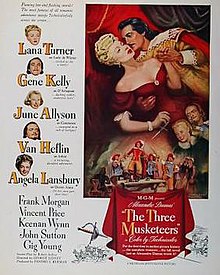
The Three Musketeers (1948)

First appearing as a serial in 1844 from French author Alexandre Dumas, The Three Musketeers have become some of literature's most popular, most famous and most well-liked characters in the history of the written word. That popularity has transitioned to film in countless efforts (ok, you can count them, but there's a lot, HERE), including 1948's The Three Musketeers.

Leaving his home and family behind, a young Frenchman named D'Artagnan (Gene Kelly) heads for Paris with hopes and dreams of joining the Musketeers of the Guard, the men who protect the King. He almost immediately meets three musketeers, Athos (Van Heflin), Porthos (Gig Young), and Aramis (Robert Coote), getting on their bad side and agreeing to duel to the death with each. Their problems are thrown by the wayside though as they see they must work together to save France from the treacherous prime minister, Richelieu (Vincent Price), who wants to start a war with rival England. With spies and traitors all around, the Musketeers -- plus D'Artagnan -- must fight for each other, for France, and for love.

Above all else, the cast here is truly impressive, a long list of recognizable names. That doesn't mean they're necessarily great performances, but well, the names are there! Not a great start, but Kelly is miscast as young D'Artagnan. He's just not believable other than his physical ability. Heflin is the only one of the three Musketeers to make any lasting impression, Young and Coote wasting away in the background. Price sneers and connives as Richelieu as only he can, but the best villain is the stunningly beautiful Lana Turner as Lady de Winter, Richelieu's most trusted agent. There's also parts for Angela Lansbury as the French queen, Anne, June Allyson as Constance, the Queen's maid and D'Artagnan's true love, Keenan Wynn as Planchet, D'Artagnan's servant, John Sutton as the Duke of Buckingham and Frank Morgan as King Louis.

What plagues this movie is something that affected so many movies in the 1940s and 1950s. It is interested in the spectacle of what's going on on the screen, and the truly impressive scale. It is intended to 'WOW!' the audience, and it does. The Technicolor technique has the action jumping off the screen, and visually it is an amazing movie to watch. The sets, the costumes, the detail. It's all there, but it's a shallow movie. Even knowing who the Musketeers were and the outline of the story, I was bored to tears. It took multiple viewings and a week-long break to even finish this one. There's no heart, no real interest in the characters. Rather than developing those bonds and the characters, we get countless fight scenes, lots of Musketeer carousing that goes nowhere.

Like anything, something good is best in small doses. The fight scenes here are a prime example. An early introduction has D'Artagnan fighting at first against and then with his new Musketeer buddies. The sword-fighting is a sight to behold, and then it keeps going....and going....and going. Kelly was a dancer first and foremost, and a talent with an incredible physical ability, but enough is enough. He jumps, he twirls, he flips, oh, and then he kills some guys. We get it, Mr. Kelly, you're extremely talented. Almost to a fault, the action -- whether it be hand-to-hand or with swords and pistols -- starts off well but doesn't know when to stop. It gets tedious, and with impressive sequences like this, that's never a good thing. Director George Sidney had to know when to pull the plug. Instead, he tries to wow the audience and ends up overdoing it. 

Now even with the thinly drawn characters and tedious action, this movie certainly has its pluses. When the story does get serious toward the end, dropping all the comedic carousing and shenanigans, wouldn't you know? The story significantly improves. As Lady de Winter, Turner especially shines, a snake waiting in the shadows to strike. There is a darkness to it as characters are killed, betrayals are unleashed, and allegiances tested. With a movie that runs at over two hours at 125 minutes, it just takes too long to get there. A darker, more straightforward Musketeers movie with this cast could have been a classic, but this 1948 version struggles to find a consistent tone. The last half hour is that good, but the build-up unfortunately is not. Still, there is too much positive going on here to not give it an at least partially positive review. Just know it's a mixed bag.

The Three Musketeers <---TCM trailer/clips (1948): ** 1/2 /****