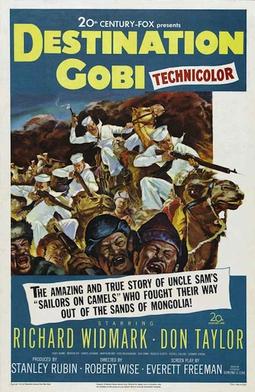
For every war film documenting a huge world-turning event like Saving Private Ryan, The Longest Day, A Bridge too Far, there are hundreds and thousands of other stories out there waiting to be told. And sometimes, it's good just to have a change of pace. These aren't stories that impacted thousands and millions of people or even altered the course of history. But as I've said before, dig a little and you'll always find some cool, very unique stories. Case in point, a 1953 World War II flick called Destination Gobi.
It's well into 1944 and with the tide of war officially turned toward the Allies, Chief Petty Officer Samuel McHale (Richard Widmark) is readying himself to head back into the fighting at Okinawa as part of the crew of the U.S.S. Enterprise. Well, that was his plan at least. He receives orders to report to a new office with an odd but very dangerous mission. McHale is going to be posted at a remote outpost in the Gobi Desert deep in Mongolia with a seven-man "garrison" tasked with observing weather patterns and how they will impact the fighting across the Pacific. The longtime Navy man wants nothing to do with the orders but ever the resolute soldier, he follows his duty and travels deep into the desert. Always used to having a ship's deck under his feet and water on all sides, McHale must adjust quickly at Argos Camp 6. Extremely isolated, the small camp must deal with limited/lousy supplies and growing rumors that Japanese forces are trying to find and destroy the camp (one of six all over the desert). McHale and the men must brace for what's coming, and oddly enough, a nomadic Mongol tribe that could help them.
What an interesting premise. I'll get into some details and depth in a bit, but the premise for 'Gobi' is incredibly interesting, and supposedly a true story. An opening title card introduces the basic premise as listed in Navy records as 'Saddle for Gobi.' Is it true? I hope. It's certainly fun to watch. From director Robert Wise, this is a World War II story far removed from the European battlefront and the island-hopping strategy of the Pacific fighting. It turns into far more of a survival story with some odd detours thrown in along the way. 'Gobi' covers a lot of ground in its 90-minute running time to the point I'd say it loses some of its effectiveness by the end credits. For the most part though, the ride is always fun and interesting, including some solid performances from an up and coming cast.
Start with Richard Widmark in a part that feels similar to several roles he did during the early 1950s as he carved out a niche and reputation for himself, many of them for 20th Century Fox. He specialized early on in manly roles like this, a tough guy leading other tough guys in movies like Halls of Montezuma, The Frogmen, and Take the High Ground!. Widmark spent years trying to distance himself from villainous roles like Kiss of Death that helped put him on the map, but he certainly did a good job. As Navy lifer Samuel McHale, Widmark is the strong, solid and resolute leader of Men who wants nothing more than to survive, to get through this hellish situation and to get his men through it too, even if it isn't his ideal posting. He's one of my favorite actors anyways, and this is a solid lead role.
Who else to look for at this isolated weather station in the sand-swept Gobi desert? Some familiar faces (and voices) to round out the inexperienced crew. The group includes Don Taylor as McHale's right-hand man, Max Showalter as the fast-talking ladies man of sorts, Darryl Hickman, Martin Milner, Ross Bagdasarian (creator of Alvin and the Chipmunks), Russell Collins, and an uncredited Earl Holliman. We don't learn much about the crew, just some off-hand comments about their backgrounds. Still, I liked the dynamic among the group as their scenes early-on show that natural, affable back-and-forth that seems realistic among men forced to get through such a difficult posting like the middle of the Gobi desert hundreds of miles from any sort of help. Nothing flashy, but some good parts.
It then proceeds to fall apart a touch because....well, because. An interesting angle is added when a tribe of nomadic Mongols, led by Kengtu (Murvyn Vye), a chieftain always looking out for the best interest of his people. At first, that involves helping the desert-bound American sailors and then it doesn't and then it does. The story proceeds to bounce around a ton among the survivors, their bickering, the Mongols, the patrolling Japanese and a surprising interlude across the Chinese border into a Japanese-held village. With just 90 minutes to do its thing, 'Gobi' simply tackles too much. In the last 20 minutes, things really fall apart. Is it the truth of the story behind the Navy files? Have things been stretched a little bit? Also look for Rodolfo Acosta, Judy Dan and Leonard Strong as some of Kengtu's tribesmen and tribeswomen.
A mixed bag in the end, but a mostly positive mixed bag. Now if they could just have fixed that last act!
Destination Gobi (1953): ** 1/2 /****
The Sons of Katie Elder
"First, we reunite, then find Ma and Pa's killer...then read some reviews."
Showing posts with label Don Taylor. Show all posts
Monday, April 13, 2015
Wednesday, October 29, 2014
Damien: Omen II
So I love the original The Omen. Everybody cool with that? Yeah, I'm not a horror fan, but there's a sick, disturbing appeal -- for me at least -- for movies dealing with Satan, pure evil, and in this case, the Antichrist. A big success in 1976, The Omen spawned two sequels, a TV movie, and a remake that I just reviewed recently. I've seen the sequels, but it's been years so thanks to an AMC mini-marathon, here we are with 1978's Damien: Omen II.
It's been seven years since young Damien Thorn barely survived an attack from his father who was trying to murder the five-year old boy. Now, Damien (Jonathan Scott-Taylor) is 12 years old and living in the Chicago suburbs with his uncle, Richard (William Holden), and aunt, Ann (Lee Grant). Richard is the C.E.O. of Thorn Industries, a company on the verge of some major, lucrative developments. Damien is heading to military school with his cousin, Mark (Lucas Donat), as he heads into his teenage years. His past is his past though, and he's moved on, but now he's starting to have odd feelings, weird sensations (and it ain't puberty!). What is going on? What's behind it all? Certain people keep telling Damien that big changes are coming and that he should fully embrace it. Others are willing to risk their lives to stop him from embracing his future.
Yeah, yeah, yeah, I can be wishy-washy when it comes to sequels. I typically think sequels are pretty dumb...until I like them. That's the beauty of it all here. If you look at the original The Omen, it's a perfect self-contained movie. The ending is slightly open-ended, but there is a creepy resolution including that great creepy final shot. But what happens to Damien? Where does he go from there? And that's where the sequels enter, letting Damien grow up. Director Don Taylor does a solid job developing the story of Damien and letting it breathe. The jump in time forward seven years was a cool choice -- the Antichrist as a teenager, gasp!?! -- and it keeps that incredibly creepy, underplayed vibe. Even composer Jerry Goldsmith tweaks his musical score, not the same score as the original but still perfectly sinister.
This isn't necessarily a smart horror movie, but it is a really good one. Creepy kids are a fixture in the genre, and Damien (here and in the original) is near or at the top of that list. But what about a creepy kid coming of age story? As cheesy and after-school special as that sounds, that's what this movie is. What Damien did in the original flick was never purely evil. Here....yeah, he's starting to realize who he is, what he's capable of, and what he can aspire to. When that aspiration is potentially ruling the world through evil? Sorta terrifying. Scott-Taylor does an excellent job playing Damien, a charming, smart young man. He's got that icy, steely look in his eyes and it is a terrifying premise as we see what is capable in this young man, especially when certain people around him are doing their best to protect him. A solid performance, a solid and interesting character.
As for the rest of the cast, there isn't a ton of star power. William Holden is obviously the biggest name here, and he does a solid, workmanlike job as Richard Thorn, a businessman who knows at least part of his family's past but maybe not the whole thing. His chemistry with Grant is believable, and just by being here, he legitimizes the whole proceedings. Also look for Lew Ayres (in his last role), Robert Foxworth and Nicholas Pryor as Thorn co-workers, all around for different reasons. Lance Henriksen is nicely cast as Sergeant Neff, Damien's platoon leader at military school while Sylvia Sidney and Elizabeth Shepherd play two women who may know the truth about Damien's background and possible future. In a cool connection to the original Omen, Leo McKern returns in a startling open scene as Bugenhagen, an exorcist and archeologist who knows the truth, with Ian Hendry as a friend and possible believer.
I read a topic at the IMDB message board for 'Damien' that cracked me up. It complained about a lack of plot with a reliance of "Hey, Damien is evil!....Ah, I'm dead" scenes. It's actually pretty spot-on. This isn't a plot-driven movie with more of a focus on the character. Now that said, the deaths are pretty gruesome -- if not graphic -- as some sort of evil power seemingly protects Damien wherever and whenever needed. There's some memorable deaths, the scenes full of impending doom and danger with Goldsmith's score doing its thing. Also worth mentioning, 'Damien' was partially filmed on-location in Chicago with some shots on LaSalle Street and some key scenes at the Field Museum including a great surprise ending.
A very solid sequel, one I was glad I could catch up with, especially during the Halloween season. Worth checking out for sure, especially for original Omen fans and horror fans in general.
Damien: Omen II (1978): ***/****
It's been seven years since young Damien Thorn barely survived an attack from his father who was trying to murder the five-year old boy. Now, Damien (Jonathan Scott-Taylor) is 12 years old and living in the Chicago suburbs with his uncle, Richard (William Holden), and aunt, Ann (Lee Grant). Richard is the C.E.O. of Thorn Industries, a company on the verge of some major, lucrative developments. Damien is heading to military school with his cousin, Mark (Lucas Donat), as he heads into his teenage years. His past is his past though, and he's moved on, but now he's starting to have odd feelings, weird sensations (and it ain't puberty!). What is going on? What's behind it all? Certain people keep telling Damien that big changes are coming and that he should fully embrace it. Others are willing to risk their lives to stop him from embracing his future.
Yeah, yeah, yeah, I can be wishy-washy when it comes to sequels. I typically think sequels are pretty dumb...until I like them. That's the beauty of it all here. If you look at the original The Omen, it's a perfect self-contained movie. The ending is slightly open-ended, but there is a creepy resolution including that great creepy final shot. But what happens to Damien? Where does he go from there? And that's where the sequels enter, letting Damien grow up. Director Don Taylor does a solid job developing the story of Damien and letting it breathe. The jump in time forward seven years was a cool choice -- the Antichrist as a teenager, gasp!?! -- and it keeps that incredibly creepy, underplayed vibe. Even composer Jerry Goldsmith tweaks his musical score, not the same score as the original but still perfectly sinister.
This isn't necessarily a smart horror movie, but it is a really good one. Creepy kids are a fixture in the genre, and Damien (here and in the original) is near or at the top of that list. But what about a creepy kid coming of age story? As cheesy and after-school special as that sounds, that's what this movie is. What Damien did in the original flick was never purely evil. Here....yeah, he's starting to realize who he is, what he's capable of, and what he can aspire to. When that aspiration is potentially ruling the world through evil? Sorta terrifying. Scott-Taylor does an excellent job playing Damien, a charming, smart young man. He's got that icy, steely look in his eyes and it is a terrifying premise as we see what is capable in this young man, especially when certain people around him are doing their best to protect him. A solid performance, a solid and interesting character.
As for the rest of the cast, there isn't a ton of star power. William Holden is obviously the biggest name here, and he does a solid, workmanlike job as Richard Thorn, a businessman who knows at least part of his family's past but maybe not the whole thing. His chemistry with Grant is believable, and just by being here, he legitimizes the whole proceedings. Also look for Lew Ayres (in his last role), Robert Foxworth and Nicholas Pryor as Thorn co-workers, all around for different reasons. Lance Henriksen is nicely cast as Sergeant Neff, Damien's platoon leader at military school while Sylvia Sidney and Elizabeth Shepherd play two women who may know the truth about Damien's background and possible future. In a cool connection to the original Omen, Leo McKern returns in a startling open scene as Bugenhagen, an exorcist and archeologist who knows the truth, with Ian Hendry as a friend and possible believer.
I read a topic at the IMDB message board for 'Damien' that cracked me up. It complained about a lack of plot with a reliance of "Hey, Damien is evil!....Ah, I'm dead" scenes. It's actually pretty spot-on. This isn't a plot-driven movie with more of a focus on the character. Now that said, the deaths are pretty gruesome -- if not graphic -- as some sort of evil power seemingly protects Damien wherever and whenever needed. There's some memorable deaths, the scenes full of impending doom and danger with Goldsmith's score doing its thing. Also worth mentioning, 'Damien' was partially filmed on-location in Chicago with some shots on LaSalle Street and some key scenes at the Field Museum including a great surprise ending.
A very solid sequel, one I was glad I could catch up with, especially during the Halloween season. Worth checking out for sure, especially for original Omen fans and horror fans in general.
Damien: Omen II (1978): ***/****
Labels:
1970s,
Don Taylor,
Horror,
Ian Hendry,
Lance Henriksen,
Lew Ayres,
Sequels,
William Holden
Thursday, February 13, 2014
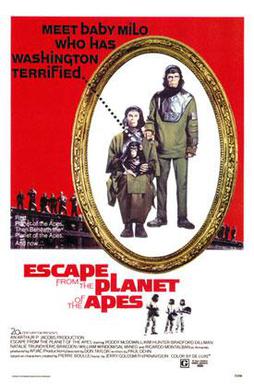
Escape from the Planet of the Apes
Sometimes a series is too successful to just let it end naturally. Following the success of Planet of the Apes and Beneath the Planet of the Apes, Fox Studios wanted another sequel, but there was a problem. Without giving too much away, the ending for 'Beneath' well....didn't really leave any opening for a follow-up. That's what screenwriters are for and ta-da! The series continued! A third movie in the series, 1971's Escape from the Planet of the Apes.
On a warm sunny day off the coast in southern California, a spaceship is discovered floating in the Pacific. The ship is brought ashore, the Army waiting to welcome the astronauts on-board but no one is sure where the spaceship came from or who is in fact on-board. Those waiting are stunned when the three astronauts remove their helmets, revealing themselves as apes. The three astronauts? Dr. Cornelius (Roddy McDowall), his wife, Dr. Zira (Kim Hunter) and Dr. Milo (Sal Mineo). The arrival of talking, intelligent apes stuns the world, forcing the government to decide what to do with the ape trio. Some are welcoming, Cornelius and Zira especially becoming instantly famous in pop culture. Others though aren't so welcoming, questioning where these apes came from and what is their intention in coming to Earth? Both sides need to find a happy medium, but some are sure the presence alone of these futuristic astronauts is a threat to the future of mankind.
So as we talked about, Beneath the Planet of the Apes didn't leave much of an opening for the series to continue, Charlton Heston insisting that be it for the series. Money is a powerful motivator though, isn't it? The series continues, but back on Earth in modern times. Director Don Taylor begins the second half of the series, catapulting the franchise in a different route for its final three films, composer Jerry Goldsmith returning as well with a great score. The premise linking 'Beneath' and 'Escape' is a tad contrived, a tad forced when you think about how 'Beneath' ended but for the sake of where the series is going, it's not so bad. Why does it stand out from the rest?
Two reasons. McDowall and Hunter. Playing Cornelius, McDowall returns to the series after being unable to to star in 'Beneath' because of a scheduling conflict. Less than pleased with her characterization in 'Beneath' (or maybe lack of), Hunter returned because she liked the script. The story is a departure from the first two movies, but this returning duo is perfect. Where we saw Heston's Taylor and James Franciscus' Brent struggling to adjust in a simian world, we now see Cornelius and Zira going through the same struggles in a human world. Where everything else has changed around them, having a spouse is a constant. Their chemistry is perfect, two intelligent individuals deciding what should be their next step, how best to survive in this human world. They have these perfect little moments, Cornelius trying on suits, Zira trying on stylish dresses, Cornelius standing up for his wife, Zira fighting for respect that carries the story surprisingly well on an emotional level.
It's cool to see Cornelius and Zira -- key supporting parts in the first two movies, still supporting parts -- step into the lead roles. That added dimension carries the movie. Who else to look for? Bradford Dillman and Natalie Trundy as Lewis Dixon and Stephanie Branton, two doctors and animal psychiatrists who become almost public relations representatives for Cornelius and Zira, but more importantly, they become trusted friends. Eric Braeden is Dr. Otto Hasslein, the scientific adviser to the President (William Windom), who questions that if these apes come from Earth's future...why did they leave? It's Eric Braeden so yes, he's a villain. Mineo makes the most of his smallish part as Dr. Milo, the third ape to travel through time with Cornelius and Zira, while Ricardo Montalban is a scene-stealer as Armando, the charming, friendly owner of a circus who works with Lewis and Stephanie. Also look for Jason Evers and Albert Salmi as Braeden's two henchmen, while John Randolph is the head of the commission investigating what to do with the visiting simians.
There are portions of this movie that are really sweet, great emotional moments that work because of the chemistry between McDowall and Hunter. Following the trend of the first two movies though, things take a turn for the dark though near the halfway point of the 98-minute movie. The time travel aspect comes up, if someone from the future knows what's going to happen, can we change it by wiping them out? We discuss issues of nuclear war, experimentation on animals, prejudices against races and cultures, but it is all handled in subtle enough fashion that it works. The ending is pretty heartbreaking in itself, but as the series has set us up for, there's a great twist in the final scene. Definitely stick with it to the final credits.
Another worthy Planet of the Apes movie, throwing us for a loop but all for the interesting. Coming up next, the final two films in the series, Conquest of Planet of the Apes and Battle for the Planet of the Apes, neither of which I've seen in one sitting. Stay tuned!
Escape from the Planet of the Apes (1971): ***/****
On a warm sunny day off the coast in southern California, a spaceship is discovered floating in the Pacific. The ship is brought ashore, the Army waiting to welcome the astronauts on-board but no one is sure where the spaceship came from or who is in fact on-board. Those waiting are stunned when the three astronauts remove their helmets, revealing themselves as apes. The three astronauts? Dr. Cornelius (Roddy McDowall), his wife, Dr. Zira (Kim Hunter) and Dr. Milo (Sal Mineo). The arrival of talking, intelligent apes stuns the world, forcing the government to decide what to do with the ape trio. Some are welcoming, Cornelius and Zira especially becoming instantly famous in pop culture. Others though aren't so welcoming, questioning where these apes came from and what is their intention in coming to Earth? Both sides need to find a happy medium, but some are sure the presence alone of these futuristic astronauts is a threat to the future of mankind.
So as we talked about, Beneath the Planet of the Apes didn't leave much of an opening for the series to continue, Charlton Heston insisting that be it for the series. Money is a powerful motivator though, isn't it? The series continues, but back on Earth in modern times. Director Don Taylor begins the second half of the series, catapulting the franchise in a different route for its final three films, composer Jerry Goldsmith returning as well with a great score. The premise linking 'Beneath' and 'Escape' is a tad contrived, a tad forced when you think about how 'Beneath' ended but for the sake of where the series is going, it's not so bad. Why does it stand out from the rest?
Two reasons. McDowall and Hunter. Playing Cornelius, McDowall returns to the series after being unable to to star in 'Beneath' because of a scheduling conflict. Less than pleased with her characterization in 'Beneath' (or maybe lack of), Hunter returned because she liked the script. The story is a departure from the first two movies, but this returning duo is perfect. Where we saw Heston's Taylor and James Franciscus' Brent struggling to adjust in a simian world, we now see Cornelius and Zira going through the same struggles in a human world. Where everything else has changed around them, having a spouse is a constant. Their chemistry is perfect, two intelligent individuals deciding what should be their next step, how best to survive in this human world. They have these perfect little moments, Cornelius trying on suits, Zira trying on stylish dresses, Cornelius standing up for his wife, Zira fighting for respect that carries the story surprisingly well on an emotional level.
It's cool to see Cornelius and Zira -- key supporting parts in the first two movies, still supporting parts -- step into the lead roles. That added dimension carries the movie. Who else to look for? Bradford Dillman and Natalie Trundy as Lewis Dixon and Stephanie Branton, two doctors and animal psychiatrists who become almost public relations representatives for Cornelius and Zira, but more importantly, they become trusted friends. Eric Braeden is Dr. Otto Hasslein, the scientific adviser to the President (William Windom), who questions that if these apes come from Earth's future...why did they leave? It's Eric Braeden so yes, he's a villain. Mineo makes the most of his smallish part as Dr. Milo, the third ape to travel through time with Cornelius and Zira, while Ricardo Montalban is a scene-stealer as Armando, the charming, friendly owner of a circus who works with Lewis and Stephanie. Also look for Jason Evers and Albert Salmi as Braeden's two henchmen, while John Randolph is the head of the commission investigating what to do with the visiting simians.
There are portions of this movie that are really sweet, great emotional moments that work because of the chemistry between McDowall and Hunter. Following the trend of the first two movies though, things take a turn for the dark though near the halfway point of the 98-minute movie. The time travel aspect comes up, if someone from the future knows what's going to happen, can we change it by wiping them out? We discuss issues of nuclear war, experimentation on animals, prejudices against races and cultures, but it is all handled in subtle enough fashion that it works. The ending is pretty heartbreaking in itself, but as the series has set us up for, there's a great twist in the final scene. Definitely stick with it to the final credits.
Another worthy Planet of the Apes movie, throwing us for a loop but all for the interesting. Coming up next, the final two films in the series, Conquest of Planet of the Apes and Battle for the Planet of the Apes, neither of which I've seen in one sitting. Stay tuned!
Escape from the Planet of the Apes (1971): ***/****
Thursday, January 2, 2014
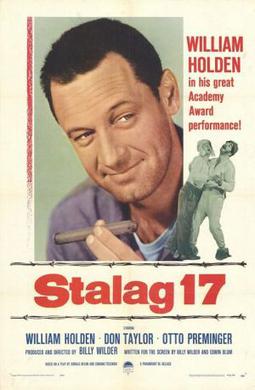
Stalag 17
Well, there are just certain movies I should have reviewed by now. I've mentioned on multiple occasions how much I like prisoner of war movies like The Great Escape and Bridge on the River Kwai, but the first one to really put the WWII sub-genre came along in 1953, Stalag 17, a classic that doesn't always get its due.
It's nearing Christmas in 1944, and a breakout is planned in Stalag 17, a German prisoner of war camp deep in Germany for Allied fliers. The night of the escape, the two prisoners making the attempt are machine gunned outside the barbed wire fence, leaving the prisoners they left behind in Barracks 4 to question what's going on. How did the Germans know details of the escape? The prisoners look to J.J. Sefton (William Holden) as the culprit, a possible stoolie who trades and bargains with the German captors for all sorts of luxuries from eggs to cigarettes to booze. Maybe Sefton has been giving away all their secrets for his own benefit, but Sefton knows otherwise. He may be a chiseler, but he's not a traitor. The problem is simple though, he can't prove it. Who among the other prisoners in Barracks 4 is the real culprit? He's going to need an answer and need it quick before his bunkmates decide they've had enough of him for good.
From director Billy Wilder, 'Stalag' is a gem of a film, one of my favorites going back to when I was a kid. It was based on a Broadway play that had 472 showings over its run. The stage-based play roots are obvious, but in a good way. Filmed in a very appropriate, very effective black and white, 'Stalag' is set almost entirely in Barracks 4 as the story develops, Christmas approaching ever quicker. The only departures we have from the barracks are outside into the camp compound. We never leave the camp, the entire story based in Stalag 17. The crowded, claustrophobic barracks becomes another character with the bunks almost bumping into each other, the windows with the frost and ice sticking to the panes, the clothes hanging from lines hung from wall to wall. Franz Waxman's uncredited score is solid as well if underplayed, Johnny Coming Marching Home a key component of the story as well.
One of three nominations the movie received went to William Holden as Barracks 4 chiseler and general trouble-maker J.J. Sefton. Nominated for his part in Sunset Boulevard but not winning, Holden got a much-deserved win here, taking home the Oscar. More impressive? He was going up against Burt Lancaster and Montgomery Clift in From Here to Eternity. Holden brings this character to life, a less than sympathetic but still appealing individual who's decided to make the most of his prisoner of war status. He's going to live in comfort, and if that means dealing/trading with his German captors, then so be it. It's not an issue until his bunkmates decide he's the traitor giving the Germans all their secrets. This is where Holden's acting steps up a notch, a desperate man now fighting for his survival instead of his personal comfort. Not often remembered as one of his best, but it's a goodie.
Holden's performance comes as part of a very solid ensemble cast that doesn't feature a ton of A-list stars, instead turning to a group of familiar character actors. Start with Robert Strauss as Animal and Harvey Lembeck as Harry Shapiro, the barracks cut-ups, Richard Erdman as Hoffy, the barracks chief, Peter Graves as Price, barracks security, Neville Brand as Duke, the hothead, and Gil Stratton as Cookie, Sefton's mousey assistant, and Robinson Stone, Robert Shawley, and William Pierson rounding out the bunch. Don Taylor co-stars as Lt. Dunbar, a prisoner in transit who comes under SS questioning, Jay Lawrence his impersonating, smart-mouthed traveling companion, Sgt. Bagradian. The comedy between Animal and Harry gets to be a little much at times, Bagradian's impersonations a little forced, but as a collective whole it's a good, strong, deep group of interesting characters.
It is hard to watch this without seeing the obvious influences some 10-plus years later with TV's Hogan's Heroes. Director Otto Preminger stars as Von Scherbach, the Stalag commander, an old-school German aristocrat and gentleman while Sig Ruman plays barracks guard Sgt. Schulz, a VERY obvious influence on John Banner's famous Sgt. Schultz character in the TV show.
An episodic story that clocks in at exactly 120 minutes, there really isn't a slow moment in Wilder's Stalag 17. In directing his film, Wilder decided to shoot chronologically so that way the cast and crew wouldn't know the twist -- the identity of the barracks traitor -- until the end of filming. The first hour or so of the movie blends the drama and comedy nicely setting up the second half of the movie. As the barracks traitor story comes to the forefront, that's when '17' is at its best. The last 30 minutes are pretty perfect, Holden's Sefton starting to piece the clues together in a great couple scenes, Wilder's talent fully on display in shooting style, while the actual reveal and the finale are spot-on. This is a movie that doesn't always get the recognition it deserves, but it sure deserves it. One of my favorites.
Stalag 17 (1953): ****/****
It's nearing Christmas in 1944, and a breakout is planned in Stalag 17, a German prisoner of war camp deep in Germany for Allied fliers. The night of the escape, the two prisoners making the attempt are machine gunned outside the barbed wire fence, leaving the prisoners they left behind in Barracks 4 to question what's going on. How did the Germans know details of the escape? The prisoners look to J.J. Sefton (William Holden) as the culprit, a possible stoolie who trades and bargains with the German captors for all sorts of luxuries from eggs to cigarettes to booze. Maybe Sefton has been giving away all their secrets for his own benefit, but Sefton knows otherwise. He may be a chiseler, but he's not a traitor. The problem is simple though, he can't prove it. Who among the other prisoners in Barracks 4 is the real culprit? He's going to need an answer and need it quick before his bunkmates decide they've had enough of him for good.
From director Billy Wilder, 'Stalag' is a gem of a film, one of my favorites going back to when I was a kid. It was based on a Broadway play that had 472 showings over its run. The stage-based play roots are obvious, but in a good way. Filmed in a very appropriate, very effective black and white, 'Stalag' is set almost entirely in Barracks 4 as the story develops, Christmas approaching ever quicker. The only departures we have from the barracks are outside into the camp compound. We never leave the camp, the entire story based in Stalag 17. The crowded, claustrophobic barracks becomes another character with the bunks almost bumping into each other, the windows with the frost and ice sticking to the panes, the clothes hanging from lines hung from wall to wall. Franz Waxman's uncredited score is solid as well if underplayed, Johnny Coming Marching Home a key component of the story as well.
One of three nominations the movie received went to William Holden as Barracks 4 chiseler and general trouble-maker J.J. Sefton. Nominated for his part in Sunset Boulevard but not winning, Holden got a much-deserved win here, taking home the Oscar. More impressive? He was going up against Burt Lancaster and Montgomery Clift in From Here to Eternity. Holden brings this character to life, a less than sympathetic but still appealing individual who's decided to make the most of his prisoner of war status. He's going to live in comfort, and if that means dealing/trading with his German captors, then so be it. It's not an issue until his bunkmates decide he's the traitor giving the Germans all their secrets. This is where Holden's acting steps up a notch, a desperate man now fighting for his survival instead of his personal comfort. Not often remembered as one of his best, but it's a goodie.
Holden's performance comes as part of a very solid ensemble cast that doesn't feature a ton of A-list stars, instead turning to a group of familiar character actors. Start with Robert Strauss as Animal and Harvey Lembeck as Harry Shapiro, the barracks cut-ups, Richard Erdman as Hoffy, the barracks chief, Peter Graves as Price, barracks security, Neville Brand as Duke, the hothead, and Gil Stratton as Cookie, Sefton's mousey assistant, and Robinson Stone, Robert Shawley, and William Pierson rounding out the bunch. Don Taylor co-stars as Lt. Dunbar, a prisoner in transit who comes under SS questioning, Jay Lawrence his impersonating, smart-mouthed traveling companion, Sgt. Bagradian. The comedy between Animal and Harry gets to be a little much at times, Bagradian's impersonations a little forced, but as a collective whole it's a good, strong, deep group of interesting characters.
It is hard to watch this without seeing the obvious influences some 10-plus years later with TV's Hogan's Heroes. Director Otto Preminger stars as Von Scherbach, the Stalag commander, an old-school German aristocrat and gentleman while Sig Ruman plays barracks guard Sgt. Schulz, a VERY obvious influence on John Banner's famous Sgt. Schultz character in the TV show.
An episodic story that clocks in at exactly 120 minutes, there really isn't a slow moment in Wilder's Stalag 17. In directing his film, Wilder decided to shoot chronologically so that way the cast and crew wouldn't know the twist -- the identity of the barracks traitor -- until the end of filming. The first hour or so of the movie blends the drama and comedy nicely setting up the second half of the movie. As the barracks traitor story comes to the forefront, that's when '17' is at its best. The last 30 minutes are pretty perfect, Holden's Sefton starting to piece the clues together in a great couple scenes, Wilder's talent fully on display in shooting style, while the actual reveal and the finale are spot-on. This is a movie that doesn't always get the recognition it deserves, but it sure deserves it. One of my favorites.
Stalag 17 (1953): ****/****
Friday, March 8, 2013
Jack of Diamonds
Turner Classic Movies devoted Tuesdays in January to one of my favorite sub-genres; the heist film. For the most part, I had seen most of the flicks that popped up on the schedule, and the ones I hadn't seen, I at least recognized them. Well, most of them. I'd never seen or heard of 1967's Jack of Diamonds, and away we go!
An infamous thief with police and law enforcement agencies around the world searching for him, Jeff Hill (George Hamilton), dubbed the Jack of Diamonds, has pulled off countless jobs, usually stealing rare jewels and diamonds. After one particularly successful job, Jeff heads on a skiing vacation with his friend and mentor, Ace (Joseph Cotten), but instead he stumbles into another job. They meet an old friend of Ace's, Nicolai (Maurice Evans), who presents a job that will net them the rarest of blood-red diamonds. There's a catch though. Always working on his own no matter the job, Jeff must conspire with Nicolai's daughter, Olga (Marie Laforet), to pull off the job. The heist itself -- robbing a well-guarded vault -- seems impossible, and that's if the quartet can actually work together to pull it off.
The 1960s were the decade of spy flicks, espionage thrillers, and heist capers. For all the serious entries in those three films though, there were probably just as many spoof and/or comedic takes on the genre. In a lot of ways, this 1967 caper reminded me most of the Matt Helm series starring Dean Martin. Goofy, tongue-in-cheek and very stylish, 'Diamonds' succeeds because it doesn't take itself too seriously....at all. At the same time, director (and former actor) Don Taylor knows not to make it outright stupid. As far as capers go, it sticks to the basics; likable, roguish thief pursued by cops. What shenanigans will he get into this time around? Pretty meat and potatoes, although there is a good twist in the final 10 minutes that breathes some new life into a familiar formula.
'Diamonds' has a very distinctive 1960s style from its cheesy-looking indoor sets to its odd musical score from composers Bob Harris and Peter Thomas. The music is good and bad, some reviews comparing it to a psuedo-Ennio Morricone score. When it works, that's a fair comparison. Much of the time though, it's just odd vocals that are annoying more than appropriate. Other reviews pointed out the style here in 'Diamond' is similar to the generally odd Danger: Diabolik which I think is fair too, if in a measured way. How best to describe it? A mix falling somewhere in between American, European and low-budget B-movie style that works because it is so random and eclectic. It's hard to describe this 1960s style in detail or pin-point fashion, but throw all that weirdness together, and it just works. And in the random department, stars Carroll Baker, Zsa Zsa Gabor and Lilli Palmer all make cameos as themselves, all victims of the Jack of Diamonds.
My first thought at hearing George Hamilton's name is not 'dramatic actor' so with that said, this is the perfect part for him! He gets to be charming, suave and cool, delivering basically all his lines with a kind of cheesy charm....and a whole lot of guy-liner. From the word 'go,' he's clearly having a lot of fun. I especially liked the dynamic between Hamilton's Jack and Cotten's Ace, the mentor-student relationship producing some pretty funny, cool scenes. Cotten does a solid job with a smaller part. Evans too is a scene-stealer as Nicolai, possibly suspicious partner in crime to Jack and Ace. Playing his daughter who's got a love-hate rivalry with Jack, Laforet is okay as Olga, but she doesn't have a ton of chemistry with Hamilton. In another solid supporting part, WWII movie vet Wolfgang Preiss plays Von Shenk, the Interpol agent on Jeff's trail.
For a movie with a pretty jokey, spoofish tone, I was surprised then when the actual heist comes along. I'm figuring it would be something ridiculous and completely out of left field that would make no sense. Well, I was wrong. It's the complete opposite in a sequence that runs about 15 minutes as Jack and Olga make their way into a heavily-guarded building via some Paris rooftops. The extended sequence is basically wordless, letting the silence mess with our heads as the tension gets ratcheted up. It's a great sequence with a surprising conclusion, but still an exciting one. The reviews are almost uniformly down to below average for this flick, but I liked it a lot. Watch Hamilton and Co. traipse across Paris, New York City, and Munich and have fun with them.
Jack of Diamonds (1967): ***/****
An infamous thief with police and law enforcement agencies around the world searching for him, Jeff Hill (George Hamilton), dubbed the Jack of Diamonds, has pulled off countless jobs, usually stealing rare jewels and diamonds. After one particularly successful job, Jeff heads on a skiing vacation with his friend and mentor, Ace (Joseph Cotten), but instead he stumbles into another job. They meet an old friend of Ace's, Nicolai (Maurice Evans), who presents a job that will net them the rarest of blood-red diamonds. There's a catch though. Always working on his own no matter the job, Jeff must conspire with Nicolai's daughter, Olga (Marie Laforet), to pull off the job. The heist itself -- robbing a well-guarded vault -- seems impossible, and that's if the quartet can actually work together to pull it off.
The 1960s were the decade of spy flicks, espionage thrillers, and heist capers. For all the serious entries in those three films though, there were probably just as many spoof and/or comedic takes on the genre. In a lot of ways, this 1967 caper reminded me most of the Matt Helm series starring Dean Martin. Goofy, tongue-in-cheek and very stylish, 'Diamonds' succeeds because it doesn't take itself too seriously....at all. At the same time, director (and former actor) Don Taylor knows not to make it outright stupid. As far as capers go, it sticks to the basics; likable, roguish thief pursued by cops. What shenanigans will he get into this time around? Pretty meat and potatoes, although there is a good twist in the final 10 minutes that breathes some new life into a familiar formula.
'Diamonds' has a very distinctive 1960s style from its cheesy-looking indoor sets to its odd musical score from composers Bob Harris and Peter Thomas. The music is good and bad, some reviews comparing it to a psuedo-Ennio Morricone score. When it works, that's a fair comparison. Much of the time though, it's just odd vocals that are annoying more than appropriate. Other reviews pointed out the style here in 'Diamond' is similar to the generally odd Danger: Diabolik which I think is fair too, if in a measured way. How best to describe it? A mix falling somewhere in between American, European and low-budget B-movie style that works because it is so random and eclectic. It's hard to describe this 1960s style in detail or pin-point fashion, but throw all that weirdness together, and it just works. And in the random department, stars Carroll Baker, Zsa Zsa Gabor and Lilli Palmer all make cameos as themselves, all victims of the Jack of Diamonds.
My first thought at hearing George Hamilton's name is not 'dramatic actor' so with that said, this is the perfect part for him! He gets to be charming, suave and cool, delivering basically all his lines with a kind of cheesy charm....and a whole lot of guy-liner. From the word 'go,' he's clearly having a lot of fun. I especially liked the dynamic between Hamilton's Jack and Cotten's Ace, the mentor-student relationship producing some pretty funny, cool scenes. Cotten does a solid job with a smaller part. Evans too is a scene-stealer as Nicolai, possibly suspicious partner in crime to Jack and Ace. Playing his daughter who's got a love-hate rivalry with Jack, Laforet is okay as Olga, but she doesn't have a ton of chemistry with Hamilton. In another solid supporting part, WWII movie vet Wolfgang Preiss plays Von Shenk, the Interpol agent on Jeff's trail.
For a movie with a pretty jokey, spoofish tone, I was surprised then when the actual heist comes along. I'm figuring it would be something ridiculous and completely out of left field that would make no sense. Well, I was wrong. It's the complete opposite in a sequence that runs about 15 minutes as Jack and Olga make their way into a heavily-guarded building via some Paris rooftops. The extended sequence is basically wordless, letting the silence mess with our heads as the tension gets ratcheted up. It's a great sequence with a surprising conclusion, but still an exciting one. The reviews are almost uniformly down to below average for this flick, but I liked it a lot. Watch Hamilton and Co. traipse across Paris, New York City, and Munich and have fun with them.
Jack of Diamonds (1967): ***/****
Wednesday, December 8, 2010
The Five Man Army
This isn't your typical spaghetti western with gunfighters shooting it out for women and riches in the desert. As well, it was made with financial backing from MGM where most spaghetti westerns were made with backing from Italian studios. Considering all the different elements of the story, it's a heist zapata spaghetti western with a men on a mission/mercenary setting for all the characters. So all those things rolled together to form basically the coolest idea for a western ever. Is it a classic? No, but it isn't trying to be. Good cast, great musical score, and action around every corner.
During the Mexican Revolution, a group of revolutionists catches wind of a gold shipment bound for Mexico City and hires an American to get the job done. His name is simply, Dutchman (Peter Graves), and he goes about putting a team together to accomplish the mission. His crew includes Augustus (James Daly), an explosives expert, Mesito (Bud Spencer), a mammoth strongman, Luis (Nino Castelnuovo), an acrobatic bandit and dead eye with a slingshot, and Samurai (Tetsuro Tanba), a master swordsman and knife thrower. The mission/robbery seems suicidal though as the five men must get aboard a heavily guarded armored train outfitted with 100 guards, machine guns and a cannon that can pick them off if they try and board. All along the route, patrols of soldiers will be waiting for the signal to move in if trouble arises. It seems impossible, but the Dutchman's got a plan.
A sucker for men on a mission movies, I fell for this one from the first time I saw it. 'Army' follows a familiar formula, but director Don Taylor (who reportedly only filmed part of the movie) handles everything so smoothly it is fun just to go along for the ride. The movie follows the formula; recruit a team, introduce their specialties, reveal the mission, let the team loose on the mission, and the fallout with the survivors. Taylor does just enough different to keep you on your toes, and does throw the audience a curveball here and there when he thinks they're too comfortable. But at its most basic is an action-packed story that never waits too long in between gunfights and showdowns with Dutchman's crew, revolutionaries, bandits, and Mexican soldiers.
The calling card for 'Army' is easily the actual heist sequence when the Five Man Army hits the armored train. To this point, we've only been given hints as to how they'll pull off this impossible job, but it all comes together in an almost wordless 26-minute sequence that is a masterful presentation of how to shoot a tense, exciting heist action sequence. You can watch it starting HERE and continuing into Part 8, 9 and 10. The movie was shot on location in Spain (you'll see some familiar locations from other spaghettis, including Once Upon a Time in the West), and nowhere does that benefit more than the heist sequence which features some crazy, absolutely ridiculous, and I imagine rather dangerous stunts. But credit to the cast who seems to be doing a majority of their stunts, and on a moving train at that. I love the movie on the whole, but the heist is the strongest and best part.
Filling out the Five Man Army is a great group of actors who were never huge stars. Graves filmed this while on hiatus from his hit TV show Mission Impossible, and it's only fitting that the story is basically M:I in the wild west. I like Graves a lot, and he's a good choice to play the tough, no-nonsense leader of this group of mercenaries. His four men are all given a chance to shine, and none disappoint. Daly is a scene-stealer as dynamite expert Capt. Augustus, delivering a monologue about the changing times in the west and how he doesn't expect any of them to survive. Watch it HERE starting at the 4:30 mark. For a dumb old action movie, this speech says more than whole movies that cover the same time period. Spencer is awesome as ever as the immense, somewhat dim-witted Mesito, Castelnuovo is great as a shifty bandit you're never quite sure of, and Tanba doesn't say a word, letting his sword do his talking. A great group, and a perfect team to pull off an impossible heist!
Watch enough spaghetti westerns, and it gets to be an easy thing to overlook composer Ennio Morricone and his great musical scores. His 'Army' score is an underrated one (listen to the main theme HERE) mixing the big and epic with the quieter and emotional. Augustus' speech is aided by Morricone's soothing score being played under his words, but then the action sequence is boosted by this perfect action score that keeps the story flowing at all times. Just another element of one of my favorite movies. It is available to watch from start to finish starting with Part 1 of 11 in a great print on Youtube. Enjoy it!
The Five Man Army <---TCM trailer (1969): ****/****
Monday, February 22, 2010
The Naked City
A combination of some French New Wave techniques, pseudo-documentary filmmaking and just a hint of some film noir, 1948’s The Naked City, directed by Jules Dassin, is a movie both a sign of the times it was made in and a sign of the things that were yet to come in moviemaking. But at its most basic, Dassin’s film is enjoyable, always entertaining, and a fascinating look into what police work used to be in a pre-computer, pre-Internet time.
Shows like CSI (and all its incarnations), Law and Order, NYPD Blue, and a long list of procedural police shows on television – not to mention countless cop movies – have given viewers a window into what it must be like in solving a case. Of course, there’s that flaw that every crime can be solved in an hour with all sorts of ridiculous technology at the police’s disposal. But what about those police officers who had to walk the streets, knock on doors, and work the phones to follow evidence and get their man? It seems like such a dated procedure watching it in film-form, but it worked for many years. Damn technology, always making things easier for us.
One lazy Monday morning, a young, blonde dress model is murdered in her apartment. The Homicide squad is called to the crime scene where the young woman was seemingly drowned in her bathtub. But evidence points out that she was knocked out with chloroform and forcibly held under water when she started to struggle. Two detectives, Lt. Dan Muldoon (Barry Fitzgerald), a 30-plus year veteran of the force, and Lt. Jimmy Halloran (Don Taylor), a WWII veteran and a relative newbie on the force, take the lead, trying to figure out the murderer. The evidence they have is minimal, and all they have is a name to work with; Henderson. But as the hours turn into days, their chances of closing the case get slimmer and slimmer.
Where those already mentioned TV shows tend to wrap up their cases in an hour – and seemingly in a single day and often in a few hours – Dassin’s movie has no such luxury. With little evidence to work with, the New York homicide detectives are forced to follow each and every lead they have, no matter how inconsequential they may seem. That’s what Dassin revels in with this 96-minute police procedural. Those tiny leads are filtered out, and the police try to figure out what is and isn’t important. It’s surprisingly effective because there’s no big twist, no huge revelation. This is a murder case with no frills, plain and simple.
Muldoon and Halloran – two good Irish cop names if there ever were – are the stars of the film. Irish actor Fitzgerald plays Muldoon a cop who’s seen everything and has a knack for figuring cases out. Whenever he’s convinced there’s an unknown suspect, he dubs him ‘J. McGillicuddy’ instead of John Doe until they can figure out who he is. Muldoon takes the young detective in Halloran under his wing, teaching him as best he can. Halloran is a good cop, if inexperienced, and thrives in situations where he’s forced to track down leads and work the streets for information. They form a good team together as the case unfolds in front of them.
Made in 1948, the best part of Dassin’s movie is its realism in terms of story and style. With the exception of scenes in the police office or in a few apartments, the movie was shot entirely on location in New York City. Scenes of Taylor’s Halloran interviewing witnesses on the street were filmed on those streets. The finale especially stands out as the murderer makes a run for it with the police chasing him, leading up an exciting showdown on the Brooklyn Bridge. It’s authentic from the start, and serves as quite a time capsule for late 1940s New York City. That on-location shooting gives the movie an authentic feel that just couldn’t have been duplicated on a Hollywood set.
Shows like CSI (and all its incarnations), Law and Order, NYPD Blue, and a long list of procedural police shows on television – not to mention countless cop movies – have given viewers a window into what it must be like in solving a case. Of course, there’s that flaw that every crime can be solved in an hour with all sorts of ridiculous technology at the police’s disposal. But what about those police officers who had to walk the streets, knock on doors, and work the phones to follow evidence and get their man? It seems like such a dated procedure watching it in film-form, but it worked for many years. Damn technology, always making things easier for us.
One lazy Monday morning, a young, blonde dress model is murdered in her apartment. The Homicide squad is called to the crime scene where the young woman was seemingly drowned in her bathtub. But evidence points out that she was knocked out with chloroform and forcibly held under water when she started to struggle. Two detectives, Lt. Dan Muldoon (Barry Fitzgerald), a 30-plus year veteran of the force, and Lt. Jimmy Halloran (Don Taylor), a WWII veteran and a relative newbie on the force, take the lead, trying to figure out the murderer. The evidence they have is minimal, and all they have is a name to work with; Henderson. But as the hours turn into days, their chances of closing the case get slimmer and slimmer.
Where those already mentioned TV shows tend to wrap up their cases in an hour – and seemingly in a single day and often in a few hours – Dassin’s movie has no such luxury. With little evidence to work with, the New York homicide detectives are forced to follow each and every lead they have, no matter how inconsequential they may seem. That’s what Dassin revels in with this 96-minute police procedural. Those tiny leads are filtered out, and the police try to figure out what is and isn’t important. It’s surprisingly effective because there’s no big twist, no huge revelation. This is a murder case with no frills, plain and simple.
Muldoon and Halloran – two good Irish cop names if there ever were – are the stars of the film. Irish actor Fitzgerald plays Muldoon a cop who’s seen everything and has a knack for figuring cases out. Whenever he’s convinced there’s an unknown suspect, he dubs him ‘J. McGillicuddy’ instead of John Doe until they can figure out who he is. Muldoon takes the young detective in Halloran under his wing, teaching him as best he can. Halloran is a good cop, if inexperienced, and thrives in situations where he’s forced to track down leads and work the streets for information. They form a good team together as the case unfolds in front of them.
Made in 1948, the best part of Dassin’s movie is its realism in terms of story and style. With the exception of scenes in the police office or in a few apartments, the movie was shot entirely on location in New York City. Scenes of Taylor’s Halloran interviewing witnesses on the street were filmed on those streets. The finale especially stands out as the murderer makes a run for it with the police chasing him, leading up an exciting showdown on the Brooklyn Bridge. It’s authentic from the start, and serves as quite a time capsule for late 1940s New York City. That on-location shooting gives the movie an authentic feel that just couldn’t have been duplicated on a Hollywood set.
This isn’t a great movie, but the no-frills storytelling pays off in the end. It’s a straightforward look at the nitty gritty police work, the day-to-day and even hour-to-hour development of the cases they’re trying to solve. None of the cast other than Fitzgerald and Taylor are that memorable, but overpowering acting from a supporting cast would seem out of place. Dassin lets his two leads work things out and in the end, get the job done. Couldn't find a trailer online, but you can watch the movie at Youtube, starting with Part 1 of 10.
The Naked City
Subscribe to:
Posts (Atom)