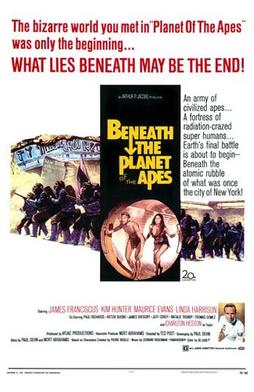
Well, let's not mess with a good thing. I love the original Planet of the Apes, and it's been years since I caught up with its four sequels. While none of the sequels live up to the original's success, these are good movies (even if there was no need for any sequel). My personal favorite has always been the first sequel, 1970's Beneath the Planet of the Apes.
Following where the previous NASA mission explored in deep space, a spaceship crashes on the same far-off planet, astronaut Brent (James Franciscus), trying desperately to survive. When the ship's commander (Tod Andrews) dies from his wounds, Brent is all alone among the wreckage. Thinking he's alone on this planet, Brent is shocked when a woman rides over the hill on a horse packed with supplies. The woman is Nova (Linda Harrison), and she's clutching the dog tags of Taylor (Charlton Heston) in her hand. Unable to speak, Nova can't communicate what happened to Taylor, Brent only knowing that he's landed on the right planet. Nova takes him to Ape City though, leaving the stranded astronaut stunned at what he's found. Now on the run, Brent and Nova must stay one step ahead of the gorilla army, an invasion planned for the mysterious Forbidden Zone.
Picking up exactly where the original 'Apes' left off, 'Beneath' is an interesting follow-up. Following the immense success of the first movie, Fox Studios went ahead with a sequel that star Charlton Heston wanted nothing to do with. That contract thing though, it gets in the way of what you want to do. Heston agreed to play a small part (he's only on-screen for about 10 minutes) with the demand that one sequel was all there would be. Well, he got his first part of the deal, but there were three more sequels to come. What's the result here? A solid sequel that stays true to the formula laid out by the first one, adding some new layers in the second half of a 95-minute movie. Early on, it feels almost like a scene-for-scene remake -- Brent going through what Taylor did -- but it's the second half that brings the movie up a notch or two.
Replacing Heston in the lead role is Franciscus, a good actor who never became a huge star in film or television. He was a familiar face though who does a solid if unspectacular job as Brent. The biggest issue with the character is what I mentioned earlier, Brent is just too similar to Taylor to really leave his own mark. Still, I liked Franciscus, and Brent does get his chance to step into the spotlight in the final act as we find out what's in the Forbidden Zone. Also returning from the first movie is Kim Hunter as the friendly, helpful intelligent Dr. Zira, Maurice Evans as the cynical, truth-hiding Dr. Zaius, David Watson replacing Roddy McDowall (other obligations) as Cornelius', Zira's husband and fellow scientist. Also joining the cast is James Gregory as General Ursus, the commander of the army who's obsessed with leading an invasion into the Forbidden Zone.
So what exactly is out there, hiding away in the Forbidden Zone? SPOILERS in this paragraph SPOILERS Chased by a squad of gorilla cavalry, Brent and Nova ride into the Forbidden Zone, hiding away in a subterranean cavern that ends up being the subway tunnels underneath New York City. They find a community of mutants who survived the original atomic blasts and now worship a Doomsday bomb that was built strong enough to destroy the world. What to do, what to do? The mutants have no way of protecting themselves while the invading gorilla army intends to wipe out anything they find in the Forbidden Zone. Brent, Nova and Taylor are caught in the middle to look for a solution, however dangerous. Look for Paul Richards as Mendez, leader of the mutants, with Victor Buono, Jeff Corey, Natalie Trundy, Don Pedro Colley and Gregory Sierra his Mutant Cabinent of sorts.
Where 'Beneath' sets itself above the other sequels is in the road the story goes down in the final act. A familiar story up to that point, it takes a big turn....for the better. I don't want to give spoilers away because like the original, the ending resonates more if you're surprised at where it goes. You know me by now, I'm a sucker for a dark, brutally cynical ending. This one sets the bar pretty high, unceremonious in how it knocks off certain characters, the final twist coming and going in a flash. That's it. That's all. Movie over. An underrated sequel for sure, well worth checking out for science fiction fans, especially for fans of the Apes series. Next up, Escape from the Planet of the Apes!
Beneath the Planet of the Apes (1970): ***/****
The Sons of Katie Elder
"First, we reunite, then find Ma and Pa's killer...then read some reviews."
Showing posts with label Maurice Evans. Show all posts
Friday, February 7, 2014
Friday, March 8, 2013
Jack of Diamonds
Turner Classic Movies devoted Tuesdays in January to one of my favorite sub-genres; the heist film. For the most part, I had seen most of the flicks that popped up on the schedule, and the ones I hadn't seen, I at least recognized them. Well, most of them. I'd never seen or heard of 1967's Jack of Diamonds, and away we go!
An infamous thief with police and law enforcement agencies around the world searching for him, Jeff Hill (George Hamilton), dubbed the Jack of Diamonds, has pulled off countless jobs, usually stealing rare jewels and diamonds. After one particularly successful job, Jeff heads on a skiing vacation with his friend and mentor, Ace (Joseph Cotten), but instead he stumbles into another job. They meet an old friend of Ace's, Nicolai (Maurice Evans), who presents a job that will net them the rarest of blood-red diamonds. There's a catch though. Always working on his own no matter the job, Jeff must conspire with Nicolai's daughter, Olga (Marie Laforet), to pull off the job. The heist itself -- robbing a well-guarded vault -- seems impossible, and that's if the quartet can actually work together to pull it off.
The 1960s were the decade of spy flicks, espionage thrillers, and heist capers. For all the serious entries in those three films though, there were probably just as many spoof and/or comedic takes on the genre. In a lot of ways, this 1967 caper reminded me most of the Matt Helm series starring Dean Martin. Goofy, tongue-in-cheek and very stylish, 'Diamonds' succeeds because it doesn't take itself too seriously....at all. At the same time, director (and former actor) Don Taylor knows not to make it outright stupid. As far as capers go, it sticks to the basics; likable, roguish thief pursued by cops. What shenanigans will he get into this time around? Pretty meat and potatoes, although there is a good twist in the final 10 minutes that breathes some new life into a familiar formula.
'Diamonds' has a very distinctive 1960s style from its cheesy-looking indoor sets to its odd musical score from composers Bob Harris and Peter Thomas. The music is good and bad, some reviews comparing it to a psuedo-Ennio Morricone score. When it works, that's a fair comparison. Much of the time though, it's just odd vocals that are annoying more than appropriate. Other reviews pointed out the style here in 'Diamond' is similar to the generally odd Danger: Diabolik which I think is fair too, if in a measured way. How best to describe it? A mix falling somewhere in between American, European and low-budget B-movie style that works because it is so random and eclectic. It's hard to describe this 1960s style in detail or pin-point fashion, but throw all that weirdness together, and it just works. And in the random department, stars Carroll Baker, Zsa Zsa Gabor and Lilli Palmer all make cameos as themselves, all victims of the Jack of Diamonds.
My first thought at hearing George Hamilton's name is not 'dramatic actor' so with that said, this is the perfect part for him! He gets to be charming, suave and cool, delivering basically all his lines with a kind of cheesy charm....and a whole lot of guy-liner. From the word 'go,' he's clearly having a lot of fun. I especially liked the dynamic between Hamilton's Jack and Cotten's Ace, the mentor-student relationship producing some pretty funny, cool scenes. Cotten does a solid job with a smaller part. Evans too is a scene-stealer as Nicolai, possibly suspicious partner in crime to Jack and Ace. Playing his daughter who's got a love-hate rivalry with Jack, Laforet is okay as Olga, but she doesn't have a ton of chemistry with Hamilton. In another solid supporting part, WWII movie vet Wolfgang Preiss plays Von Shenk, the Interpol agent on Jeff's trail.
For a movie with a pretty jokey, spoofish tone, I was surprised then when the actual heist comes along. I'm figuring it would be something ridiculous and completely out of left field that would make no sense. Well, I was wrong. It's the complete opposite in a sequence that runs about 15 minutes as Jack and Olga make their way into a heavily-guarded building via some Paris rooftops. The extended sequence is basically wordless, letting the silence mess with our heads as the tension gets ratcheted up. It's a great sequence with a surprising conclusion, but still an exciting one. The reviews are almost uniformly down to below average for this flick, but I liked it a lot. Watch Hamilton and Co. traipse across Paris, New York City, and Munich and have fun with them.
Jack of Diamonds (1967): ***/****
An infamous thief with police and law enforcement agencies around the world searching for him, Jeff Hill (George Hamilton), dubbed the Jack of Diamonds, has pulled off countless jobs, usually stealing rare jewels and diamonds. After one particularly successful job, Jeff heads on a skiing vacation with his friend and mentor, Ace (Joseph Cotten), but instead he stumbles into another job. They meet an old friend of Ace's, Nicolai (Maurice Evans), who presents a job that will net them the rarest of blood-red diamonds. There's a catch though. Always working on his own no matter the job, Jeff must conspire with Nicolai's daughter, Olga (Marie Laforet), to pull off the job. The heist itself -- robbing a well-guarded vault -- seems impossible, and that's if the quartet can actually work together to pull it off.
The 1960s were the decade of spy flicks, espionage thrillers, and heist capers. For all the serious entries in those three films though, there were probably just as many spoof and/or comedic takes on the genre. In a lot of ways, this 1967 caper reminded me most of the Matt Helm series starring Dean Martin. Goofy, tongue-in-cheek and very stylish, 'Diamonds' succeeds because it doesn't take itself too seriously....at all. At the same time, director (and former actor) Don Taylor knows not to make it outright stupid. As far as capers go, it sticks to the basics; likable, roguish thief pursued by cops. What shenanigans will he get into this time around? Pretty meat and potatoes, although there is a good twist in the final 10 minutes that breathes some new life into a familiar formula.
'Diamonds' has a very distinctive 1960s style from its cheesy-looking indoor sets to its odd musical score from composers Bob Harris and Peter Thomas. The music is good and bad, some reviews comparing it to a psuedo-Ennio Morricone score. When it works, that's a fair comparison. Much of the time though, it's just odd vocals that are annoying more than appropriate. Other reviews pointed out the style here in 'Diamond' is similar to the generally odd Danger: Diabolik which I think is fair too, if in a measured way. How best to describe it? A mix falling somewhere in between American, European and low-budget B-movie style that works because it is so random and eclectic. It's hard to describe this 1960s style in detail or pin-point fashion, but throw all that weirdness together, and it just works. And in the random department, stars Carroll Baker, Zsa Zsa Gabor and Lilli Palmer all make cameos as themselves, all victims of the Jack of Diamonds.
My first thought at hearing George Hamilton's name is not 'dramatic actor' so with that said, this is the perfect part for him! He gets to be charming, suave and cool, delivering basically all his lines with a kind of cheesy charm....and a whole lot of guy-liner. From the word 'go,' he's clearly having a lot of fun. I especially liked the dynamic between Hamilton's Jack and Cotten's Ace, the mentor-student relationship producing some pretty funny, cool scenes. Cotten does a solid job with a smaller part. Evans too is a scene-stealer as Nicolai, possibly suspicious partner in crime to Jack and Ace. Playing his daughter who's got a love-hate rivalry with Jack, Laforet is okay as Olga, but she doesn't have a ton of chemistry with Hamilton. In another solid supporting part, WWII movie vet Wolfgang Preiss plays Von Shenk, the Interpol agent on Jeff's trail.
For a movie with a pretty jokey, spoofish tone, I was surprised then when the actual heist comes along. I'm figuring it would be something ridiculous and completely out of left field that would make no sense. Well, I was wrong. It's the complete opposite in a sequence that runs about 15 minutes as Jack and Olga make their way into a heavily-guarded building via some Paris rooftops. The extended sequence is basically wordless, letting the silence mess with our heads as the tension gets ratcheted up. It's a great sequence with a surprising conclusion, but still an exciting one. The reviews are almost uniformly down to below average for this flick, but I liked it a lot. Watch Hamilton and Co. traipse across Paris, New York City, and Munich and have fun with them.
Jack of Diamonds (1967): ***/****
Tuesday, December 25, 2012
The War Lord
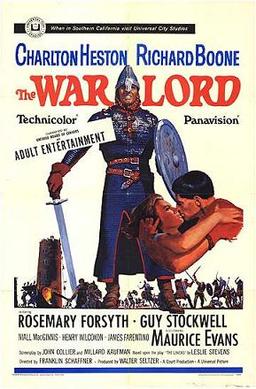
With movies like Ben Hur, The Ten Commandments, The Agony and the Ecstasy, El Cid and plenty more, Charlton Heston is an actor directly associated with historical epics. Some have gotten lost in the shuffle over the years, including the worthwhile 1965 epic The War Lord.
It's the 11th Century in the Middle Ages in France, knight Chrysagon de la Cruex (Heston) has been given a mission. An isolated Druid village along the coast comes under constant attack so Chrysagon is tasked with taking a small troop of knights and soldiers, including his brother, Draco (Guy Stockwell), and right hand man, Bors (Richard Boone). Upon arriving, he finds a poor village where a failed defensive castle was only partially built and villagers who have strayed from acceptable ways. Chrysagon's group works well though, but the knight falls for a beautiful young woman from the village, Bronwyn (Rosemary Forsyth). The only problem? She is engaged to a villager, and the only way Chrysagon can have her is to simply take her, angering the rest of the villagers. All the while, the threat of an attack looms.
In the age of the epics -- the 1960s -- this modestly scaled epic from director Franklin J. Schaffner has been lost in the shuffle over the last 40-plus years. I say 'modestly scaled,' and I don't intend that at all in a negative way. There are no on-location shooting, just California filling in for Middle Ages France. Much of the story is contained in one stretch of marshy coast, Chrysagon's single-towered castle sitting just off the land in a shallow waterway. There is something simple and elegant about the setting; the knights in their water-surrounded castle, the villagers hidden away in the woods. So while the scale isn't on a hugely epic level -- no countries warring, no government in-fighting -- it focuses on the personal at its most simple. In this case, it's just a man and woman who fall madly in love with each other and all the repercussions and fall-out.
I've made no secret about my general disdain for romance sub-plots in stories that simply don't call for it. In this epic though, it's not only necessary but handled well. I don't think of Heston as a natural choice for a historical epic's romantic lead, but he does a solid job here in an understated way. His Chrysagon has been fighting for a Duke for 20-something years, traveling, fighting and warring wherever he goes. When he meets Forsyth's Bronwyn, he can't help himself. He needs her, wants her. Similarly, Bronwyn is drawn to him in a way she can't explain. Without being ridiculously lovey-dovey or over the top, this relationship seems real. Everything hits the fan when Chrysagon realizes a local custom allows the powerful lords to take a virgin bride on her wedding night for himself. Not surprisingly, Bronwyn's husband-to-be (James Farentino) is less than pleased to give away his wife for a night. The results are not surprisingly pretty downbeat, but getting there is worthwhile, and the finale is a highly effective emotional punch.
Balancing out the effective love story is the solid casting backing up Heston. Adding another dimension is Stockwell's Draco as Chrysagon's brother. Brothers in the Middle Ages who differ in opinions on how to do things? Well, it doesn't take a nuclear scientist to figure out that might not end well. Stockwell does a fine job as Draco, the less-experienced knight in battle who nonetheless wants to prove himself. As the gruff voiced Bors, Boone delivers the best supporting performance. As we learn more about how these characters came to ride together, Boone's acting gets better and better, including a great job in the last few scenes without saying more than a few words. Also look for Maurice Evans as the local priest caught in the middle of the knights and villagers, Niall MacGinnis as Odins, the village elder trying to hold his people together, Henry Wilcoxon as the rival Frisian chief, and Allen Jaffe and Michael Conrad as two of Chrysagon's men.
So overall, I liked this movie a lot. I liked it a lot, and that's considering that there is little in the way of action until the last third of the 120-minute long movie. When it does arrive on the scene, the action does not disappoint. The Frisian raiders arrive to reclaim the chief's son -- accidentally left behind in a raid and feared dead -- forcing Chrysagon and his troop to retreat to their castle tower for defense. The violence is brutal without being graphic, and the action is kept from the view of the foot soldiers. We see the Frisians attacking -- catch an example HERE -- in various ways, any way to breach the heavily guarded door or at least get over the walls. The attack runs about 25 minutes, and it's a gem. The post-battle fallout is equally good too. Also worth mentioning, the score from Jerome Moross and Hans J. Salter is perfect for both the action and the love scenes. Check out the entire movie at Youtube starting HERE.
The War Lord (1965): ***/****
It's the 11th Century in the Middle Ages in France, knight Chrysagon de la Cruex (Heston) has been given a mission. An isolated Druid village along the coast comes under constant attack so Chrysagon is tasked with taking a small troop of knights and soldiers, including his brother, Draco (Guy Stockwell), and right hand man, Bors (Richard Boone). Upon arriving, he finds a poor village where a failed defensive castle was only partially built and villagers who have strayed from acceptable ways. Chrysagon's group works well though, but the knight falls for a beautiful young woman from the village, Bronwyn (Rosemary Forsyth). The only problem? She is engaged to a villager, and the only way Chrysagon can have her is to simply take her, angering the rest of the villagers. All the while, the threat of an attack looms.
In the age of the epics -- the 1960s -- this modestly scaled epic from director Franklin J. Schaffner has been lost in the shuffle over the last 40-plus years. I say 'modestly scaled,' and I don't intend that at all in a negative way. There are no on-location shooting, just California filling in for Middle Ages France. Much of the story is contained in one stretch of marshy coast, Chrysagon's single-towered castle sitting just off the land in a shallow waterway. There is something simple and elegant about the setting; the knights in their water-surrounded castle, the villagers hidden away in the woods. So while the scale isn't on a hugely epic level -- no countries warring, no government in-fighting -- it focuses on the personal at its most simple. In this case, it's just a man and woman who fall madly in love with each other and all the repercussions and fall-out.
I've made no secret about my general disdain for romance sub-plots in stories that simply don't call for it. In this epic though, it's not only necessary but handled well. I don't think of Heston as a natural choice for a historical epic's romantic lead, but he does a solid job here in an understated way. His Chrysagon has been fighting for a Duke for 20-something years, traveling, fighting and warring wherever he goes. When he meets Forsyth's Bronwyn, he can't help himself. He needs her, wants her. Similarly, Bronwyn is drawn to him in a way she can't explain. Without being ridiculously lovey-dovey or over the top, this relationship seems real. Everything hits the fan when Chrysagon realizes a local custom allows the powerful lords to take a virgin bride on her wedding night for himself. Not surprisingly, Bronwyn's husband-to-be (James Farentino) is less than pleased to give away his wife for a night. The results are not surprisingly pretty downbeat, but getting there is worthwhile, and the finale is a highly effective emotional punch.
Balancing out the effective love story is the solid casting backing up Heston. Adding another dimension is Stockwell's Draco as Chrysagon's brother. Brothers in the Middle Ages who differ in opinions on how to do things? Well, it doesn't take a nuclear scientist to figure out that might not end well. Stockwell does a fine job as Draco, the less-experienced knight in battle who nonetheless wants to prove himself. As the gruff voiced Bors, Boone delivers the best supporting performance. As we learn more about how these characters came to ride together, Boone's acting gets better and better, including a great job in the last few scenes without saying more than a few words. Also look for Maurice Evans as the local priest caught in the middle of the knights and villagers, Niall MacGinnis as Odins, the village elder trying to hold his people together, Henry Wilcoxon as the rival Frisian chief, and Allen Jaffe and Michael Conrad as two of Chrysagon's men.
So overall, I liked this movie a lot. I liked it a lot, and that's considering that there is little in the way of action until the last third of the 120-minute long movie. When it does arrive on the scene, the action does not disappoint. The Frisian raiders arrive to reclaim the chief's son -- accidentally left behind in a raid and feared dead -- forcing Chrysagon and his troop to retreat to their castle tower for defense. The violence is brutal without being graphic, and the action is kept from the view of the foot soldiers. We see the Frisians attacking -- catch an example HERE -- in various ways, any way to breach the heavily guarded door or at least get over the walls. The attack runs about 25 minutes, and it's a gem. The post-battle fallout is equally good too. Also worth mentioning, the score from Jerome Moross and Hans J. Salter is perfect for both the action and the love scenes. Check out the entire movie at Youtube starting HERE.
The War Lord (1965): ***/****
Subscribe to:
Posts (Atom)