The Sons of Katie Elder

The Sons of Katie Elder
"First, we reunite, then find Ma and Pa's killer...then read some reviews."
Showing posts with label Wolfgang Preiss. Show all posts

Sunday, January 31, 2016

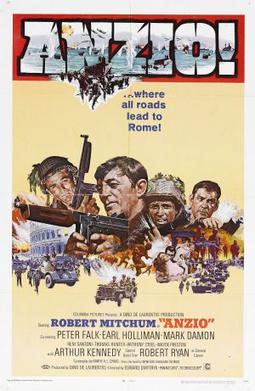
Anzio


Over the 1950's and 1960's, World War II movies were a dime a dozen hitting theaters. Even with the abundance of movies though, some theaters of war were often ignored, or at least covered less. Case in point? The Italian Campaign as Allied forces took Sicily and then Italy in horrific fighting that claimed thousands and thousands of lives in what some said/say was a waste of manpower. So while 1968's Anzio may not be a good movie, I can't help it. I'm a fan so sue me.

It's early 1944 and the fighting has dragged to a stalemate between Allied and Axis forces along the Monte Cassino line. The Allied forces are planning an invasion in Italy above the fighting as Cassino, intending to land some 70,000 troops north of the fighting at the port of Anzio. Among those landing is a war correspondent, Dick Ennis (Robert Mitchum), who will tag along with an American Ranger battalion (specially-trained infantry) as they hit the beaches. An expected hot landing is anything but...the troops hit the beaches with little to no resistance. There's no German forces for miles. On a patrol into the Italian countryside, Ennis and a corporal from the First Special Service Force, Jack Rabinoff (Peter Falk), discover just how open the countryside is. Back at the Allied beachhead though, no one on the general staff believes them. While the Allies dig in and establish a strong beachhead, the Germans take advantage, assembling a line as deadly as anything the war has seen.

If you're looking for a more detailed description of the Battle of Anzio, check out the Wikipedia page. I'm currently reading Alex Kershaw's The Liberator, an excellent read that explores the fighting in Italy in some detail. What's here in this 1968 war film is a condensed version with some embellishments and names changed. The actual battle of Anzio was a horrific miscalculation on the parts of the Allied commanders who made cautious decisions that ended up costing thousands of lives needlessly in fighting that could have been easily avoided. See? We learned something today!

'Anzio' itself is an interesting mess of a movie. It's from the 1960's, the age of the big, epic war films like The Great Escape, Battle of the Bulge, The Guns of Navarone, a trend that would continue into the 1970's. From director Edward Dmytryk (and Duilio Coletti in whatever the "Italian version" is), 'Anzio' is part of a trend of flicks dubbed Macaroni war movies (instead of spaghetti, get it?!?), films made with mostly Italian backing albeit with smaller budgets. Dino De Laurentiis produced the war film, bringing a respectable budget that's seen in landing shots where landing crafts empty of hundreds of soldiers hitting the beaches. There is a big budget feel (some of the time) as this story develops about one of the most costly battles of WWII. More detail later, but there's also truly odd moments sprinkled throughout, giving Dmytryk's film an off-balanced feel to the proceedings. More later!

Two performances here have always appealed to me, Robert Mitchum as war correspondent Dick Ennis, a character very loosely based on famed writer Ernie Pyle. Interesting tidbit? Mitchum earned an Oscar nomination for his performance in 1945's The Story of G.I. Joe, the story of Ernie Pyle in Italy! Ennis is a frontline guy, always sticking with the troops at the front even when he doesn't have to be. Mitchum treads that fine line between looking worn out and being interested, but that laconic, tired look favors Ennis well. He's sick of war, sick of stupid orders and commands that costs unnecessary lives. A good performance for Mitchum. As for Falk, it is an...interesting performance. His Jack Rabinoff is a SOLDIER. He loves fighting. He's good at it (maybe too good), and his backstory of how he ended up in the First Special Service Force is quite revealing. Again, there's some odd moments, but Falk brings a ton of energy, some humor to the part that's hard not to like.

This quasi-epic war film resorts to more familiar territory in the second half. Following a horrific German ambush, a small group of Rangers, including Ennis and Rabinoff, must get back to their own lines to report what the Allies are about to march into. If it's familiar, so be it. It's more at home. It's more comfortable. Among the survivors, look for Earl Holliman as the capable Sergeant Abe Stimmler, Reni Santoni as Pvt. Movie (always ready with an impression), an underused Mark DamonThomas HunterGiancarlo Giannini, and Joseph Walsh. In the epic vein, we also get unnecessary cameos from Robert Ryan and Arthur Kennedy with Kennedy at least getting something to do. Ryan is in two scenes, and he only speaks in one! Also look for ever the German, Wolfgang Preiss as Field Marshal Kesselring, the Allies' opposition across the line.

Where 'Anzio' falls in parts is its odd tone and general lack of epic qualities, even though it thinks it is an epic. It is NOT. It's a good, old-fashioned war flick. Simply put, it tries to cover too much ground in 117 minutes. The song that plays over the opening credits, This World is Yours (listen HERE), is awful. Truly out of place. The score itself is hit-and-miss, but when it works, I liked it a lot. As for the tone, this is a story that just refuses to pick one tone and go with it. Is it dark? Is it a light war film? While things are somewhat ironed out (not really), we get a painful scene of Falk's Rabinoff sitting in an ambulance with three prostitutes as he sings "Bye, Bye Blackbird" with them. There's another scene later where he does the same thing. What the hell is going on?!? Don't even get me started about the general combat tactics here either, highly-trained American troops charging into machine gun fire without even raising their weapons or trying to throw a grenade at the nest. Meh, run!!!

Now all that said, I've always liked this movie and held it up on my most recent reviewing. I love the Italian filming locations, especially the shots of Rome. I've always been a big fan of Mitchum and Falk, and even considering some script idiosyncrasies, they're both pretty good here, as is the whole supporting cast. Through all the general craziness and oddness, there's some...oddly charming. The action is harsh, including a late battle between our survivors and four German snipers, and from beginning to end, it is entertaining. It ain't a classic. So be it. It's very entertaining.

Anzio (1968): ***/****
Rewrite of May 2009 review

Monday, August 11, 2014

Von Ryan's Express

Introduced as a kid to 1963's The Great Escape, I fell hook, line and sinker for the entire prisoner of war genre. Some like 'Escape' and Bridge on the River Kwai are instantly recognizable among movie fans while many others have taken some digging on my part to track them down. How about one of the best? One of my all-time favorites? Oh, yes, one I always enjoy revisiting, 1965's Von Ryan's Express.

As the Germans try to hold off advancing Allied forces in Italy in August 1943, an American Army Air Corp pilot, Colonel Joseph Ryan (Frank Sinatra) is shot down and sent to a prisoner of war camp where he becomes the ranking officer. There he clashes quickly with his second-in-command, a fiery, stubborn British officer, Major Eric Fincham (Trevor Howard). When the camp's Italian guards abandon the camp, Ryan makes a difficult decision, one that ends up backfiring as almost 400 prisoners are rounded up and boarded on a German train heading north. Heading the wrong way away from the advancing Allied forces, it seems hope has run out for Ryan, Fincham and their fellow prisoners. When all seems lost though, Colonel Ryan has one more trick up his sleeve, a daring plan that has the prisoners attempting to take over the train. The closely packed train is headed to Germany, but not if Ryan has his say. Instead? They look to Switzerland, but can their plan hold together?

If there is one major difference between 'Von Ryan's' and other prisoner of war movies, it is this. While all entertaining, movies like The Great Escape, River Kwai, Stalag 17 and others are high drama, often delivering a message. That's not to say Von Ryan's Express isn't high drama, director Mark Robson doing a fine job in this WWII actioner. It's more than that. It's more than just describing it as a prisoner of war movie. I've long thought this is one of the most perfect popcorn flicks ever made, the most entertaining, the most adrenaline-pumping action/dramas I can think of. It clocks in at 116 minutes but with each viewing, it goes by quicker and quicker. There isn't a weak moment. There are no slow portions, no parts where the momentum lets up. It's the rare movie that can accomplish that. From beginning to surprising finale, I love it all, one of my all-time favorites, one film I can watch over and over again.

What's the best thing going here for this 1965 war movie? There's a ton to mention! Just a few weeks ago in my review for 100 Rifles I mentioned how much I loved composer Jerry Goldsmith's score. Well, as good as that score was, I think his score here is one of his bests (and that's saying something considering the breadth of his career). Listen to the main theme HERE. This is the perfect score to back up the action, the heart-pumping moments, the quieter, more inward scenes and everything in between. An underrated score that deserves more of a reputation. Right up there with the musical score as an additional character is the choice to film on location in Italy. The filming locations give an air of authenticity that Hollywood backlots just wouldn't have accomplished. From the hills and streams to the ancient ruins to the weathered towns and train stations, wouldn't you know it? The film actually looks like it takes place in Italy. Go figure, right?!?  These are things that if mishandled wouldn't be a deal-breaker, but when handled correctly.....well, they can lift the movie up a notch or two or 10.     

You know who's cool? Totally caught me off guard, but it's that guy -- maybe you've heard of him -- named Frank Sinatra. By the mid 1960s, Sinatra played variations on tough guy parts that allowed him to more or less, be himself. In other movies, it might seem too familiar, but there's an energy here as Sinatra brings this intriguing character to life. Dubbed 'Von Ryan' by his fellow prisoners for helping the Germans, he's forced to make difficult decisions left and right, often putting lives at risk with each passing decision. There's an easy-going confidence to Sinatra's Ryan, a 90-day wonder as he calls it, a capable leader making some impossible decisions. The best supporting part not surprisingly comes from Trevor Howard as the stubborn, action-driven Fincham. Their Odd Couple-like relationship works, the quiet, cool American and the fiery Brit officer providing some good energy, some good sparks throughout. Their chemistry is evident any time and every time they're on screen together. Two excellent leads.

Lost in the shuffle can be a damn good supporting cast beyond Sinatra and Howard. In the eye candy department, Raffaella Carra plays Gabriella, a beautiful Italian girl who becomes a part of the escape. As for the villains, there's Adolfo Celi as a Fascist Italian officer and commandant of the camp and the very German Wolfgang Preiss as a very German officer in command of the prison train. My favorite supporting parts are Ryan's fellow prisoners, a cool group, an almost oddball crew that includes Bostick (Brad Dexter), one of the few American prisoners, Capt. Oriana (Sergio Fantoni), a well-meaning Italian officer thrust in with the P.O.W.s, Orde (John Leyton, also in Great Escape), Fincham's right-hand man, Father Costanzo (Edward Mulhare), the naive at times but very brave priest, and Stein (Michael Goodliffe), the camp medic. Also look for James Brolin, Michael St. Clair, Richard Bakalyan and James Sikking as other prisoners with smaller parts.  

Based off a novel by David Westheimer, 'Von Ryan' certainly has plenty to offer, including a handful of memorable set pieces. The opening 40 minutes are spent in the camp, the next 15 or so on the road and the last hour is when the prisoners are boarded on the prison train. I loved Ryan's scene with an inquisitive Gestapo agent (supposedly William Berger, I'm not positive) asking about Ryan's American watch. I loved Mulhare's masquerade as a German officer hoping to dupe an inspection. There are all these great moments that embrace this ludicrous possibility of this happening and run with it. We go along because it's so damn fun. This is a thrill a minute flick that's meant to entertain scene in and scene out. Nowhere is that more evident than....

The finale. As strong as the movie is, 'Von Ryan' is at its absolute best over the last 25 minutes, the prison train making a desperate run to the Alps and Switzerland, a German troop train (commanded by John Van Dreelen) hot on their trail. Throw in a trio of Messerschmitt fighters, a bombed out bridge (Spain standing in for Italy), and a stunning backdrop on a mountainside railway trestle....well, you've got a winner. It is in the ending that the film deviates most from Westheimer's novel, but it is a doozy of a finale. In terms of pure excitement, of really getting your blood pumping, I can think of few movies that can the ending here. A race against time, Germans edging ever closer, it has it all. Just a great movie, one I can rewatch over and over and always pick up something new.

Highly recommended. One of my all-time favorites.

Von Ryan's Express (1965): ****/****
Rewrite of October 2009 review

Friday, January 17, 2014

The Fifth Cord

Take a look to your right and find the runner marked Labels. Can you tell I like spaghetti westerns, a sub-genre of westerns with a cynical take on violence and the old west from the late 1960s and 1970s made with Italian backing and often starring American actors. I love the genre, but it's also opened the door to all sorts of other Italian films like sword and sandal epics to a new genre for me, the Italian giallo, starting with 1971's The Fifth Cord.

A journalist and reporter with a drinking problem, Andrea Bild (Franco Nero) attends a New Year's Eve party and ends more than sufficiently liquored up. He staggers home, sleeps it off and heads into work the next day to find out that a woman who attended the party, and a friend of Andrea's too, was murdered following the party. With an in at the police department, Andrea does his own investigation and doesn't buy how the police are tying it all together. It's not long though before several other murders take place, all of them guests from that same New Year's Eve party. Andrea tries to piece it all together at the risk of his own life, knowing that this serial killer may be targeting him next. Can he track down the murderer before he becomes that next victim?

The term 'giallo' in this context can mean any thriller, often about serial killers, gruesome murders and all that good stuff. Pretty uplifting, right? The genre blends in all sorts of archetypes, from the rather gory murders -- throat slices to decapitations -- to the typically deranged killers doing the deeds. It wasn't just about gore or shock value though, typically trying to amount to more, making an art of the genre. There is a style and a visual that helps it rise above the same old, same old from a familiar genre. I'm not a huge fan of just the good, old-fashioned slasher genre so having something additional to focus on makes it more than just a scare factor movie, a jump out of your seat fright fest one after another. And oh yes, it is pretty creepy.

As a writer -- okay, a freelance writer who typically writes about sports and movies -- I'm a sucker for most movies depicting the oh so glamorous lives of writers, reporters and journalists. If you listen to movies though, anyone who has ever committed a word to paper is drunk, really drunk, a drug addict or has such serious personal issues that it's amazing writers aren't crippled by their own flaws. Franco Nero does a solid job in the lead performance as the drunken journalist trying to track down a murderer before that murderer can get to him. I think Nero was a solid to above average actor, but when he was at his best it was because he was a huge, brooding, emotional presence. A life and death situation certainly brings that out. Nero was always able to do a lot with his eyes, that sinister, low-burn intimidation or that big, wide-eyed fear and/or panic. The story was hard for me to follow at times, but Nero was excellent.

I can't say that for the rest of the cast. For me, it felt like I was seeing a rotation of similar characters with very little in the way of distinguishing features that sets them apart from each other. No doubt, part of that comes from my complete lack of familiarity with most of the Italian cast, but some of it has to be attributed to the script. Familiar WWII face Wolfgang Preiss plays the police inspector who works with Nero's Andrea but also starts to suspect him as the clues and evidence mount up. Here's a problem though. With an exception here and there, I can't remember a single other prominent character five days after watching this movie. Some people get killed, some are introduced (poorly), and then one is revealed as the killer. When it happens, I couldn't even place him, questioning if we'd even met him at some point. The reasoning is cool, something we've seen as an audience many times in Law and Order, but when the payoff alone isn't worth it, any twist and/or reveal lands with a thud.

So while the story is disappointing, the giallo qualities work well. As an underplayed, moody and downright unsettling murder mystery, it works because the murder scenes are so perfectly uncomfortable. Director Luigi Bazzoni uses some off-center, wide-angle camera angles, zoomed in and then zoomed out to extremes to build up the tension as to what's about to happen. A paralyzed woman (Ira von Furstenberg) is trapped in her home, unable to reach her wheelchair, the killer tracking her down in the spacious, poorly lit rooms and hallways. Later, a little boy desperately tries to lock all the doors to his home, his Mom on the phone willing him to go faster, the killer trying to get in. Why? Eh, not really explained why the little boy is a target. And there's your problem. I feel like I missed a whole lot of explanation, and the story falls short in the end.

The Fifth Cord (1971): **/****

Friday, March 8, 2013

Jack of Diamonds

Turner Classic Movies devoted Tuesdays in January to one of my favorite sub-genres; the heist film. For the most part, I had seen most of the flicks that popped up on the schedule, and the ones I hadn't seen, I at least recognized them. Well, most of them. I'd never seen or heard of 1967's Jack of Diamonds, and away we go!

An infamous thief with police and law enforcement agencies around the world searching for him, Jeff Hill (George Hamilton), dubbed the Jack of Diamonds, has pulled off countless jobs, usually stealing rare jewels and diamonds. After one particularly successful job, Jeff heads on a skiing vacation with his friend and mentor, Ace (Joseph Cotten), but instead he stumbles into another job. They meet an old friend of Ace's, Nicolai (Maurice Evans), who presents a job that will net them the rarest of blood-red diamonds. There's a catch though. Always working on his own no matter the job, Jeff must conspire with Nicolai's daughter, Olga (Marie Laforet), to pull off the job. The heist itself -- robbing a well-guarded vault -- seems impossible, and that's if the quartet can actually work together to pull it off.

The 1960s were the decade of spy flicks, espionage thrillers, and heist capers. For all the serious entries in those three films though, there were probably just as many spoof and/or comedic takes on the genre. In a lot of ways, this 1967 caper reminded me most of the Matt Helm series starring Dean Martin. Goofy, tongue-in-cheek and very stylish, 'Diamonds' succeeds because it doesn't take itself too seriously....at all. At the same time, director (and former actor) Don Taylor knows not to make it outright stupid. As far as capers go, it sticks to the basics; likable, roguish thief pursued by cops. What shenanigans will he get into this time around? Pretty meat and potatoes, although there is a good twist in the final 10 minutes that breathes some new life into a familiar formula.

'Diamonds' has a very distinctive 1960s style from its cheesy-looking indoor sets to its odd musical score from composers Bob Harris and Peter Thomas. The music is good and bad, some reviews comparing it to a psuedo-Ennio Morricone score. When it works, that's a fair comparison. Much of the time though, it's just odd vocals that are annoying more than appropriate. Other reviews pointed out the style here in 'Diamond' is similar to the generally odd Danger: Diabolik which I think is fair too, if in a measured way. How best to describe it? A mix falling somewhere in between American, European and low-budget B-movie style that works because it is so random and eclectic. It's hard to describe this 1960s style in detail or pin-point fashion, but throw all that weirdness together, and it just works. And in the random department, stars Carroll Baker, Zsa Zsa Gabor and Lilli Palmer all make cameos as themselves, all victims of the Jack of Diamonds.

My first thought at hearing George Hamilton's name is not 'dramatic actor' so with that said, this is the perfect part for him! He gets to be charming, suave and cool, delivering basically all his lines with a kind of cheesy charm....and a whole lot of guy-liner. From the word 'go,' he's clearly having a lot of fun. I especially liked the dynamic between Hamilton's Jack and Cotten's Ace, the mentor-student relationship producing some pretty funny, cool scenes. Cotten does a solid job with a smaller part. Evans too is a scene-stealer as Nicolai, possibly suspicious partner in crime to Jack and Ace. Playing his daughter who's got a love-hate rivalry with Jack, Laforet is okay as Olga, but she doesn't have a ton of chemistry with Hamilton. In another solid supporting part, WWII movie vet Wolfgang Preiss plays Von Shenk, the Interpol agent on Jeff's trail.

For a movie with a pretty jokey, spoofish tone, I was surprised then when the actual heist comes along. I'm figuring it would be something ridiculous and completely out of left field that would make no sense. Well, I was wrong. It's the complete opposite in a sequence that runs about 15 minutes as Jack and Olga make their way into a heavily-guarded building via some Paris rooftops. The extended sequence is basically wordless, letting the silence mess with our heads as the tension gets ratcheted up. It's a great sequence with a surprising conclusion, but still an exciting one. The reviews are almost uniformly down to below average for this flick, but I liked it a lot. Watch Hamilton and Co. traipse across Paris, New York City, and Munich and have fun with them.

Jack of Diamonds (1967): ***/****

Tuesday, August 23, 2011

The Formula

Following the conclusion of World War II, American movies had an easy enemy and opponent for the next 40-plus years.  Through the length of the Cold War, the Russians/Soviets/Reds were the perfect bad guy, a shadowy, dark, sinister and even evil villain to do battle with.  But let's not forget about that other villain to come out of the late 40s...the escaped Nazis in movies like The Boys from Brazil and Marathon Man, and to an extent 1980's The Formula.

From director John G. Avildsen comes a story that you think will go one way and instead goes down another path. It does involved Nazis -- including a very cool opening sequence -- but ends up being more about big business and billions of dollars on the line from international corporations that end up all but ruling the world.  Think Syriana meets Who Killed the Electric Car?, and you've got this movie.  I don't know what to think of it, liking it at times and groaning as the "twists" are revealed. Like any movie I guess, take the good and the bad.

A former government agent turned Los Angeles police officer, Lt. Barney Caine (George C. Scott) is called in to lead a murder investigation. Caine is startled to find it is the murder of an old friend and a fellow police officer. But as he examines the evidence at the scene, something doesn't add up. Something seems forced, but he follows what is presented to him and ends up traveling to Germany as the clues and evidence present themselves. His friend was apparently involved in some high-end things -- drugs, big business (including oil chairman Marlon Brando) and billions of dollars -- that few were aware of. Was Caine's friend involved in something bigger than all of that though? Something worth killing more people over? As the bodies start to pile up, Caine wonders what exactly is going on, and if he could be next.

Complicated, twisting storylines typically go two ways. One, it is a well-written, well thought out complicated plot that works if you pay attention and keep up with it. Two, it is complicated for the sake of being hard to follow. That's The Formula. I resent when reviewers say a viewer who doesn't "get it" wasn't paying attention. Here, I paid attention, but the twists are too ridiculous, too convenient to even come close to making sense.  It isn't so much a Nazi splinter group of survivors pulling the strings as big business with monetary concerns doing the work. Just too many things happen that are explained in one quick conversation. If it is going to work, some sort of clue has to be given. If not, that isn't a twist. It's just lazy on the part of the script.

In its twists and turns, 'Formula' probably tries to do to much. It was billed as the movie that "the oil companies don't want you to see." The subject matter is probably dead-on accurate as to how the oil companies actually work, but it is handled in such a heavy-handed fashion that the message gets murky and even darkly comical and over the top. The formula is a German solution and equation to create a synthetic fuel that will replace the world's need for oil. Naturally the oil companies want to cover up its existence and are willing to do just about everything possible to keep it under wraps.  The story does keep you guessing as to everyone's motives, and it ends on a pessimistic note, but the story is so far all over the place that it never gels as a finished product.

On to the positives, few that they are.  In well-written movies or schlock like this, George C. Scott is almost always a watchable movie star.  He is intense, believable, and feels like he's never acting (to me at least). His Barney Caine character keeps the movie grounded in its police procedural roots -- albeit one that has him globe-trotting and involved in multi-billion dollar deals.  He's more than a little fed up with the system, the higher-ups, and the limitations placed on him. Caine is an old school cop/investigator who is just going to get the job done, and Scott is a bright spot among the bigger mess. Another positive, the opening in spring 1945 as German stares the end of the war dead in the face. The closing days of WWII (really, any war) are Dramatic Situations 101, and the tension and mood are great in this quick but effective opener.

Okay, now back to the negatives!  Yeah, more fun!  Brando got a paycheck for this one, and I think that's all he was worried about. His extended cameo as the chairman of an oil corporation as the actor -- maybe Hollywood's all-time best actor -- hamming it up in such an over the top fashion that it is either unintentionally bad or a brilliant choice by a brilliant actor.  I lean toward unintentionally bad, but who knows? The rest of the cast is okay, including Marthe Keller as Lisa, a source for Caine in Germany, John Gielgud as a German scientist who escaped from the Russians, G.D. Spradlin as Clements, a higher-up official with his hand in everything, and a long cast listing following them, none really making much of an impression positive or negative. It was cool to see WWII movie vet Wolfgang Preiss in a small part if nothing else.

Needlessly confusing at times, boring at others, and even a memorable lead performance from George C. Scott can't save this one.

The Formula <---TCM clip (1980): **/****