Turner Classic Movies devoted Tuesdays in January to one of my favorite sub-genres; the heist film. For the most part, I had seen most of the flicks that popped up on the schedule, and the ones I hadn't seen, I at least recognized them. Well, most of them. I'd never seen or heard of 1967's Jack of Diamonds, and away we go!
An infamous thief with police and law enforcement agencies around the world searching for him, Jeff Hill (George Hamilton), dubbed the Jack of Diamonds, has pulled off countless jobs, usually stealing rare jewels and diamonds. After one particularly successful job, Jeff heads on a skiing vacation with his friend and mentor, Ace (Joseph Cotten), but instead he stumbles into another job. They meet an old friend of Ace's, Nicolai (Maurice Evans), who presents a job that will net them the rarest of blood-red diamonds. There's a catch though. Always working on his own no matter the job, Jeff must conspire with Nicolai's daughter, Olga (Marie Laforet), to pull off the job. The heist itself -- robbing a well-guarded vault -- seems impossible, and that's if the quartet can actually work together to pull it off.
The 1960s were the decade of spy flicks, espionage thrillers, and heist capers. For all the serious entries in those three films though, there were probably just as many spoof and/or comedic takes on the genre. In a lot of ways, this 1967 caper reminded me most of the Matt Helm series starring Dean Martin. Goofy, tongue-in-cheek and very stylish, 'Diamonds' succeeds because it doesn't take itself too seriously....at all. At the same time, director (and former actor) Don Taylor knows not to make it outright stupid. As far as capers go, it sticks to the basics; likable, roguish thief pursued by cops. What shenanigans will he get into this time around? Pretty meat and potatoes, although there is a good twist in the final 10 minutes that breathes some new life into a familiar formula.
'Diamonds' has a very distinctive 1960s style from its cheesy-looking indoor sets to its odd musical score from composers Bob Harris and Peter Thomas. The music is good and bad, some reviews comparing it to a psuedo-Ennio Morricone score. When it works, that's a fair comparison. Much of the time though, it's just odd vocals that are annoying more than appropriate. Other reviews pointed out the style here in 'Diamond' is similar to the generally odd Danger: Diabolik which I think is fair too, if in a measured way. How best to describe it? A mix falling somewhere in between American, European and low-budget B-movie style that works because it is so random and eclectic. It's hard to describe this 1960s style in detail or pin-point fashion, but throw all that weirdness together, and it just works. And in the random department, stars Carroll Baker, Zsa Zsa Gabor and Lilli Palmer all make cameos as themselves, all victims of the Jack of Diamonds.
My first thought at hearing George Hamilton's name is not 'dramatic actor' so with that said, this is the perfect part for him! He gets to be charming, suave and cool, delivering basically all his lines with a kind of cheesy charm....and a whole lot of guy-liner. From the word 'go,' he's clearly having a lot of fun. I especially liked the dynamic between Hamilton's Jack and Cotten's Ace, the mentor-student relationship producing some pretty funny, cool scenes. Cotten does a solid job with a smaller part. Evans too is a scene-stealer as Nicolai, possibly suspicious partner in crime to Jack and Ace. Playing his daughter who's got a love-hate rivalry with Jack, Laforet is okay as Olga, but she doesn't have a ton of chemistry with Hamilton. In another solid supporting part, WWII movie vet Wolfgang Preiss plays Von Shenk, the Interpol agent on Jeff's trail.
For a movie with a pretty jokey, spoofish tone, I was surprised then when the actual heist comes along. I'm figuring it would be something ridiculous and completely out of left field that would make no sense. Well, I was wrong. It's the complete opposite in a sequence that runs about 15 minutes as Jack and Olga make their way into a heavily-guarded building via some Paris rooftops. The extended sequence is basically wordless, letting the silence mess with our heads as the tension gets ratcheted up. It's a great sequence with a surprising conclusion, but still an exciting one. The reviews are almost uniformly down to below average for this flick, but I liked it a lot. Watch Hamilton and Co. traipse across Paris, New York City, and Munich and have fun with them.
Jack of Diamonds (1967): ***/****
The Sons of Katie Elder
"First, we reunite, then find Ma and Pa's killer...then read some reviews."
Showing posts with label Lilli Palmer. Show all posts
Friday, March 8, 2013
Wednesday, September 15, 2010
The High Commissioner
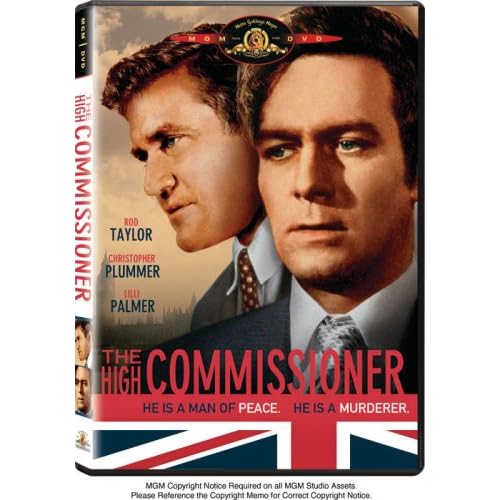
A fish out of water, one of the most reliable story ideas to use when making a movie. It's easy to take it in any direction whether it be drama, comedy or both. It seems movies lean more toward the comedy part, but dramatic ventures can be just as good, including 1968's The High Commissioner. A mostly forgotten smaller budget film with a good cast, 'Commissioner' has an Australian cop from the bush out of his element in London bringing in a murder suspect who happens to be a highly ranking government official.
I stumbled across this one on Netflix a few weeks ago and was curious why I'd never heard a thing about it. The stars are pretty good considering it is a late 1960s movie -- Rod Taylor and Christopher Plummer among others -- and the story sounded like it had a fair share of political intrigue and excitement. So what's the reasoning for its almost complete lack of popularity or even recognition? The stars are good, the intrigue is interesting, but that's it. 'Commissioner' is a straightforward thriller/action movie with a twist and turn here and there, but it doesn't possess anything major that sets it apart from the pack.
An Australian bush cop most comfortable and familiar with the Australian Outback, Scobie Malone (Taylor) receives a mission to travel to London and bring back a murder suspect from a case almost 15 years old. There's finally enough evidence to prosecute him, Sir James Quentin (Plummer), the High Commissioner of Australia currently living and working in London. Malone meets Quentin who agrees to go back to Australia with him, seemingly having waited all these years to be caught. But Quentin has one request; he's leading a commission with global trade ramifications that could unite 1st and 3rd world countries. All he needs is a few days to put it all together. Malone somewhat suspiciously agrees, not knowing that he's getting into a sticky situation with the powers that be not pleased with Quentin's intentions.
First off, I wasn't expecting the story to focus more on the global summit than Malone's mission to bring Quentin back. It was a pleasant surprise as the two plots balance each other out. A good cop no matter where he's working, Malone then devotes himself to protecting Quentin and helping him in any way he can. There's a leak in the meetings though so the Aussie cop has to narrow down the suspects, including Quentin's secretary Lisa (Camilla Sparv), his wife (Lilli Palmer), a gorgeous woman with suspicious motives (Daliah Lavi), and an American (Calvin Lockhart) who offers to help Malone in his investigation. The solution is not so surprising, but the momentum builds to the more surprising finale after that reveal.
Rod Taylor is one of my favorites, and he doesn't disappoint here as Aussie cop Scobie Malone. Cool name aside, the character is that fish out of water trying to figure everything out. He travels to London and is immediately out of place in this high-class setting. But on the other hand, he's a good cop above all else and no matter the situation he commits himself. Taylor also handles a lot of his really physical stunts, delivers some comedic one-liners and is pretty smooth in the process. Plummer drifts in and out of the story, but ever the professional he makes the most of it. The wisest choice made here is leaving his guilt up in the air until the end. Did he really kill his first wife so many years ago? If he didn't kill her, why'd he run? It all comes together nicely in the end, all the story lines converging and wrapping up with a nice tidy bow.
For a movie that's limited by a smaller budget, director Ralph Thomas balances out the limitations with some very cool location shooting. For every matte painting or indoor set standing in for a dark London street, there's an equally impressive on-location scene. One highlight has Taylor's Malone chasing down a possible hitman through the London streets and ending up at...Wimbledon, currently hosting the summer tennis major. It's a cool, fast-paced sequence as Malone realizes someone's making another attempt on Quentin's life. So for all the pretty obvious indoor set shooting, there's the good to balance it all out.
So for all the positive aspects of the movie, what's missing? I'm not quite sure. The story lacks a certain energy at times, relying too much on the talents of the actors to carry on through the slow patches. The biggest issue is that the story doesn't always know where it's going. It just drifts too much as all these characters go in and out of the story. Thankfully, the cast is up to the task so any slow parts are still entertaining enough to watch.
The High Commissioner (1968): ***/****
I stumbled across this one on Netflix a few weeks ago and was curious why I'd never heard a thing about it. The stars are pretty good considering it is a late 1960s movie -- Rod Taylor and Christopher Plummer among others -- and the story sounded like it had a fair share of political intrigue and excitement. So what's the reasoning for its almost complete lack of popularity or even recognition? The stars are good, the intrigue is interesting, but that's it. 'Commissioner' is a straightforward thriller/action movie with a twist and turn here and there, but it doesn't possess anything major that sets it apart from the pack.
An Australian bush cop most comfortable and familiar with the Australian Outback, Scobie Malone (Taylor) receives a mission to travel to London and bring back a murder suspect from a case almost 15 years old. There's finally enough evidence to prosecute him, Sir James Quentin (Plummer), the High Commissioner of Australia currently living and working in London. Malone meets Quentin who agrees to go back to Australia with him, seemingly having waited all these years to be caught. But Quentin has one request; he's leading a commission with global trade ramifications that could unite 1st and 3rd world countries. All he needs is a few days to put it all together. Malone somewhat suspiciously agrees, not knowing that he's getting into a sticky situation with the powers that be not pleased with Quentin's intentions.
First off, I wasn't expecting the story to focus more on the global summit than Malone's mission to bring Quentin back. It was a pleasant surprise as the two plots balance each other out. A good cop no matter where he's working, Malone then devotes himself to protecting Quentin and helping him in any way he can. There's a leak in the meetings though so the Aussie cop has to narrow down the suspects, including Quentin's secretary Lisa (Camilla Sparv), his wife (Lilli Palmer), a gorgeous woman with suspicious motives (Daliah Lavi), and an American (Calvin Lockhart) who offers to help Malone in his investigation. The solution is not so surprising, but the momentum builds to the more surprising finale after that reveal.
Rod Taylor is one of my favorites, and he doesn't disappoint here as Aussie cop Scobie Malone. Cool name aside, the character is that fish out of water trying to figure everything out. He travels to London and is immediately out of place in this high-class setting. But on the other hand, he's a good cop above all else and no matter the situation he commits himself. Taylor also handles a lot of his really physical stunts, delivers some comedic one-liners and is pretty smooth in the process. Plummer drifts in and out of the story, but ever the professional he makes the most of it. The wisest choice made here is leaving his guilt up in the air until the end. Did he really kill his first wife so many years ago? If he didn't kill her, why'd he run? It all comes together nicely in the end, all the story lines converging and wrapping up with a nice tidy bow.
For a movie that's limited by a smaller budget, director Ralph Thomas balances out the limitations with some very cool location shooting. For every matte painting or indoor set standing in for a dark London street, there's an equally impressive on-location scene. One highlight has Taylor's Malone chasing down a possible hitman through the London streets and ending up at...Wimbledon, currently hosting the summer tennis major. It's a cool, fast-paced sequence as Malone realizes someone's making another attempt on Quentin's life. So for all the pretty obvious indoor set shooting, there's the good to balance it all out.
So for all the positive aspects of the movie, what's missing? I'm not quite sure. The story lacks a certain energy at times, relying too much on the talents of the actors to carry on through the slow patches. The biggest issue is that the story doesn't always know where it's going. It just drifts too much as all these characters go in and out of the story. Thankfully, the cast is up to the task so any slow parts are still entertaining enough to watch.
The High Commissioner (1968): ***/****
Labels:
1960s,
Camilla Sparv,
Christopher Plummer,
Espionage,
Lilli Palmer,
Rod Taylor
Tuesday, October 13, 2009
The Boys From Brazil
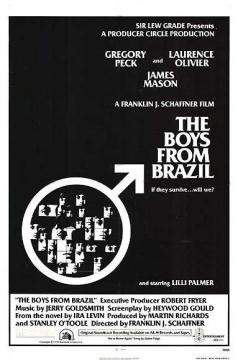
Depending on what movie you watch, cloning/reanimation/freezing can be handled quite differently. Think of Austin Powers and then compare it to real-life situation with baseball great Ted Williams. I realize they're different situations, but the idea is the same. What if someone from history thought far enough ahead to plan for a clone of themselves? Then think of it as one of the most hated people in history, and you've got 1978's The Boys From Brazil.
The idea of surviving Nazis trying to revive the Third Reich or even just blend in with society is nothing new in movies, with Marathon Man probably the best example. Late in WWII when it was clear the war had turned against Germany, many high-ranking officials and officers began to maneuver on how to survive in the world after the war. Some made their way to South America where support for the Nazi party still existed. Many just tried to get along and hide from the fact that they were still being hunted for their actions during WWII. But what if that wasn't all they were up to? What if they had plans to bring back Nazism into a world power?
In Paraguay in the early 1970s, inexperienced Nazi hunter and member of a young Jew organization, Barry Kohler (Steve Guttenberg) is onto something. He is convinced that retired, hiding Nazis are up to something, and even finds out their plan by bugging the villa they're staying in. Leading the group is Dr. Josef Mengele (Gregory Peck), a German doctor infamously known for his horrific, immoral actions during WWII in the concentration camps where he performed all sorts of scientific experiments on the unwilling prisoners. Convinced he is on to something huge, Barry contacts Ezra Lieberman (Laurence Olivier), a well-known Nazi hunter.
Ezra is not so easily convinced but while he's on the phone with Barry, the line suddenly goes dead and he can hear breathing at the other end. Suspicious of what might have happened, Lieberman begins to investigate the information Barry gave him even if it sounds incredibly strange. Mengele ordered that over a 2 1/2 year span, 94 men, all working in civil services, aged 65 will be murdered in locations all around the world. Confused as to how it all relates, Lieberman begins to look into the matter and does stumble upon Mengele's plan, a revival of the Nazi Party, a new Fourth Reich.
Based on a novel by Ira Levin and using real-life historical figures, The Boys From Brazil is successful as a 'what if?' in history. The true revelation of Mengele's plan is a doozy, and I won't spoil it here because part of the enjoyment from this movie is trying to figure it out as clues are slowly filtered out. The premise seems ridiculously complicated and over-the-top, but that's for after the movie. While watching the plan develop, I was too involved to think about how ridiculous it actually is. Just enjoy the movie and then rip it to pieces afterward.
With stars as huge as Gregory Peck and Laurence Olivier, you would think the leads are as solid as possible, at least I did. Peck plays the villainous Mengele, a brilliant mind who is also completely devoted to Adolf Hitler and his beliefs. With skin-lightening makeup and dyed hair, Peck doesn't look quite right, and his accent is in the evil German, Sgt. Schultz vein. Lines that are supposed to be dramatic and intimidating are instead unintentionally funny. Olivier is better as Nazi hunter Lieberman, a bit of an eccentric himself, but he still seems to go for a stereotypical older Jewis man in his characterization. Maybe I was expecting too much from these two Hollywood icons, but I came away disappointed with their performances.
The supporting cast is much better, especially third-billed James Mason. Playing Siebert, the leader of the extermination squads on the Eastern front in WWII, Mason makes the most of a role that only requires him to be onscreen in a handful of scenes. He is Mengele's security officer, making sure his plan comes to fruition even as that plan becomes more and more unwieldly. Other supporting roles go to Lilli Palmer as Ezra's sister/assistant, Denholm Elliott as a not so cooperative press agent working with Lieberman, John Dehner as a man involved with Mengele's plan whether he knows it or not, Walter Gotell as one of Mengele's key men, John Rubinstein as a friend of Barry's, and surprisingly enough, Guttenberg in a strong key role.
Aided by a solid, creepy score from Jerry Goldsmith, 'Brazil' is at its best when the story keeps you guessing. Mengele's diabolical plan for a Fourth Reich is an unexpected twist that caught me by surprise, both in terms of the story but also the science it involves. Just don't overthink this one while watching, and you'll be fine.
The Boys from Brazil <---trailer (1978): ** 1/2 /****
The idea of surviving Nazis trying to revive the Third Reich or even just blend in with society is nothing new in movies, with Marathon Man probably the best example. Late in WWII when it was clear the war had turned against Germany, many high-ranking officials and officers began to maneuver on how to survive in the world after the war. Some made their way to South America where support for the Nazi party still existed. Many just tried to get along and hide from the fact that they were still being hunted for their actions during WWII. But what if that wasn't all they were up to? What if they had plans to bring back Nazism into a world power?
In Paraguay in the early 1970s, inexperienced Nazi hunter and member of a young Jew organization, Barry Kohler (Steve Guttenberg) is onto something. He is convinced that retired, hiding Nazis are up to something, and even finds out their plan by bugging the villa they're staying in. Leading the group is Dr. Josef Mengele (Gregory Peck), a German doctor infamously known for his horrific, immoral actions during WWII in the concentration camps where he performed all sorts of scientific experiments on the unwilling prisoners. Convinced he is on to something huge, Barry contacts Ezra Lieberman (Laurence Olivier), a well-known Nazi hunter.
Ezra is not so easily convinced but while he's on the phone with Barry, the line suddenly goes dead and he can hear breathing at the other end. Suspicious of what might have happened, Lieberman begins to investigate the information Barry gave him even if it sounds incredibly strange. Mengele ordered that over a 2 1/2 year span, 94 men, all working in civil services, aged 65 will be murdered in locations all around the world. Confused as to how it all relates, Lieberman begins to look into the matter and does stumble upon Mengele's plan, a revival of the Nazi Party, a new Fourth Reich.
Based on a novel by Ira Levin and using real-life historical figures, The Boys From Brazil is successful as a 'what if?' in history. The true revelation of Mengele's plan is a doozy, and I won't spoil it here because part of the enjoyment from this movie is trying to figure it out as clues are slowly filtered out. The premise seems ridiculously complicated and over-the-top, but that's for after the movie. While watching the plan develop, I was too involved to think about how ridiculous it actually is. Just enjoy the movie and then rip it to pieces afterward.
With stars as huge as Gregory Peck and Laurence Olivier, you would think the leads are as solid as possible, at least I did. Peck plays the villainous Mengele, a brilliant mind who is also completely devoted to Adolf Hitler and his beliefs. With skin-lightening makeup and dyed hair, Peck doesn't look quite right, and his accent is in the evil German, Sgt. Schultz vein. Lines that are supposed to be dramatic and intimidating are instead unintentionally funny. Olivier is better as Nazi hunter Lieberman, a bit of an eccentric himself, but he still seems to go for a stereotypical older Jewis man in his characterization. Maybe I was expecting too much from these two Hollywood icons, but I came away disappointed with their performances.
The supporting cast is much better, especially third-billed James Mason. Playing Siebert, the leader of the extermination squads on the Eastern front in WWII, Mason makes the most of a role that only requires him to be onscreen in a handful of scenes. He is Mengele's security officer, making sure his plan comes to fruition even as that plan becomes more and more unwieldly. Other supporting roles go to Lilli Palmer as Ezra's sister/assistant, Denholm Elliott as a not so cooperative press agent working with Lieberman, John Dehner as a man involved with Mengele's plan whether he knows it or not, Walter Gotell as one of Mengele's key men, John Rubinstein as a friend of Barry's, and surprisingly enough, Guttenberg in a strong key role.
Aided by a solid, creepy score from Jerry Goldsmith, 'Brazil' is at its best when the story keeps you guessing. Mengele's diabolical plan for a Fourth Reich is an unexpected twist that caught me by surprise, both in terms of the story but also the science it involves. Just don't overthink this one while watching, and you'll be fine.
The Boys from Brazil <---trailer (1978): ** 1/2 /****
Labels:
1970s,
Gregory Peck,
James Mason,
John Dehner,
Laurence Olivier,
Lilli Palmer
Subscribe to:
Posts (Atom)