The Sons of Katie Elder

The Sons of Katie Elder
"First, we reunite, then find Ma and Pa's killer...then read some reviews."
Showing posts with label John Dehner. Show all posts

Thursday, May 23, 2013

Revolt at Fort Laramie

As the Civil War started in 1861, the U.S. Army was faced with a difficult task. Units were composed of men from both the Northern and Southern states, leaving Southern soldiers to decide if they remain loyal to the oath they took to the U.S. Army or if they remain loyal to their home states. A pretty standard but enjoyable B-western, 1957's Revolt at Fort Laramie jumps right in with that premise, albeit in the west, not in the east.

At isolated Fort Laramie in the west, Major Seth Bradner (John Dehner) is facing an Indian uprising. Sioux chief Red Cloud (Eddie Little Sky) has signed a treaty with the army and government, but he hasn't received his gold payment in exchange yet for signing the treaty. Among his command is Capt. James Tenslip (Gregg Palmer), an experienced Indian fighter who is a more than worthy second in command. But as the commands readies to deal with the Indian uprising, a new issue arises. Back east, tensions are rising between the North and the South until finally Confederate forces fire on Fort Sumter in South Carolina. Bradner's command is now squarely divided between Confederates and Union men. Now, Bradner and Tenslip must try and hold their command together long enough to deal with the Sioux uprising, but the Civil War might not give them enough time.

Director Lesley Selander specialized in B-westerns in the 1950s, small scale flicks that were typically limited by smallish budgets and casts. If you're introducing someone to the western genre, a flick like this probably isn't the best jumping off point. Nothing jumps off the screen that screams 'CLASSIC!' They're solid, self-contained westerns that are familiar but always entertaining. This one has some obvious flaws, like the Moab Desert being a pretty if ill-suited stand-in for the prairies and plains of Wyoming, the Dakotas and Montana. The score is unspectacular, and the set is even familiar to a recent review here and another Telander-directed western, Tomahawk Trail. I'm probably not doing a solid job here selling this movie, but it's one that is definitely for die-hard western fans. At 73 minutes, it doesn't stay long enough to be a bad flick.

The casting is okay here, but it doesn't have much in the way of star power.....as in, any star power. Dehner gets top billing, but he's relegated to a background part that doesn't give him much to do. His Maj. Bradner is from a Southern state, and as commander of Fort Laramie finds himself in quite the sticky situation. Loyal to the army or to the South? Palmer is pretty vanilla as Capt. Tenslip, his 2nd in command, who's also engaged to Bradner's shrill niece, Melissa (Frances Helm). Any disgustingly sweet scene between Tenslip and Melissa can be pretty painful. In an odd bit of casting, Don Gordon plays Jean Salignac, a half-breed scout working for the cavalry with both French and Indian blood. His accent alone is something else. Robert Keys is underused as Sgt. Darrach, the ringleader of the Southern men at the fort.

The North vs. South dynamic provides some cool moments, but it never quite delivers like I hoped it would. A cool scene has the Southerners singing Dixie when the Northerners join in with John Brown's Body. The rivalry is more than just a rivalry, two sides full of hate because of something going on thousands of miles away. Throw in an Indian uprising, a small treasure in gold, and an outnumbered cavalry troop, and we've got ourselves an interesting predicament. More than just its B-movie status, there's something missing to make it particularly memorable. Also look for Harry Dean Stanton in an uncredited part as Rinty, one of the Confederates in the garrison.

With a movie wrapping up in 75 minutes, there isn't a lot of time or space for any fluff. Okay, not entirely true, all the romance is fluff, but there's also some solid action to balance it out. The opener has a patrol intervening on an Indian attack on a payroll wagon, and a later scene has cavalry traveling down the river on rafts as Indians attack from the riverbank. The highlight though is the finale as an immense Sioux war party surrounds retreating cavalry, the wagons circling up to defend themselves. Not a great western, maybe not even a good one, but I liked it just enough to give it a mild recommendation.

Revolt at Fort Laramie (1957): ** 1/2 /****

Saturday, January 5, 2013

Apache Territory

Playing the lead role in 1954's Four Guns to the Border, actor Rory Calhoun had already starred in one western based off a novel by famed western author Louis L'Amour. Working with his own production company four years later, Calhoun returned to the well again, this time with 1958's Apache Territory.

Riding through the desert on the way to Fort Yuma, drifting gunfighter Logan Cates (Calhoun) stumbles across several dead bodies and a young woman, Junie (Carolyn Craig), who was the lone survivor of an Apache attack. It seems that Apache chief Churupati is leading his warriors on a rampage, killing everyone in their path. Logan heads to the nearest water hole, hoping to stock up on as much water as he can, but he's not the only one thinking like that. Other desert travelers have found their way to the water -- including a soon to be married couple, the remnants of a cavalry troop, a young man who survived an Apache attack -- and find themselves trapped by Churupati's Apache warriors. Can they hold the Apaches off until help arrives?

From L'Amour's novel Last Stand at Papago Wells, 'Territory' translates well to the big screen. L'Amour's writing style as an author generally translated well in that sense. His stories were straightforward with plenty of action and excitement featuring tough, loner heroes, beautiful women waiting to be wooed and villains who almost always meet a nasty end in the finale. These are far from flashy westerns, but they get the job done. This one isn't around long enough to leave too much of an impression -- positive or negative -- at just 72 minutes long. There's nothing wrong with that though. Just sit back and enjoy it.

So with a small, desperate group of survivors trapped at an isolated water hole, we follow the action as the mostly off-screen Apaches lay siege. And other than the opening as we see how Logan ends up at the water hole, the entire story is set around this water hole. It ends up being a cool addition to the story. Lying in the shade of a cliff face, the water hole is ringed by rocks and boulders that are perfect for defense. The water hole becomes a mini-fort of sorts as the survivors try not to lose their minds, stay sane as arrows rain down and ultimately survive. It's a pretty simple formula, but it works well. Kudos to director Ray Nazarro for keeping that action and drama contained in this one specific spot.

Never a huge star, Calhoun just the same was able to carve out a niche for himself as an actor. Much of that niche came in 1950s B-westerns like this one. His Logan Cates is a pretty typical L'Amour hero; strong, silent, tough and not one to let anyone else control what he does. He also gets the scorned love interest in Barbara Bates' Jennifer, a former love who is now engaged to John Dehner's Grant Kimbrough, a gambler. Who else ends up at this water hole? Why, lots o' people! Along with Craig's Junie, there's Lonnie (Tom Pittman), an 18-year old on his way to California, Lugo (Frank DeKova), a peaceful Pima warrior, and the remnants of a cavalry patrol (Leo Gordon, Myron Healey, Regis Parton) commanded by desk sergeant, Sheehan (Francis De Sales).

It's odd that with a movie that doesn't even break the 80-minute mark the pacing can be a little off. The negative part of a story surrounding a siege is that a whole lot doesn't happen. There's a lot of talking, a lot of worrying, and then an occasional arrow picking off one of our survivors. A few ventures away from the water hole provide some excitement, and the finale doesn't disappoint either as Calhoun's Logan comes up with a unique way to dispatch the waiting Apaches. Enjoyable, solid western, but nothing more.

Apache Territory (1958): ** 1/2 /****

Wednesday, August 15, 2012

Trooper Hook

As settlers moved west in the United States in the 1800s, there were just some things that a husband/grandfather/brother would not allow happen to a woman traveling with the group. At the top of that list? Don't allow a woman to become a captive of any number of Indian tribes. These were were abused, tortured and beaten down if they were even allowed to live. Obviously a darker topic, westerns nonetheless explored the unpleasant topic, most notably The Searchers, but with other movies as well, like 1957's Trooper Hook.

Having led a successful attack on a warring Apache village, Sgt. Clovis Hook (Joel McCrea) is left in an interesting predicament. Among the prisoners is the leader of the rampaging Apaches, a chief called Nanchez (Rodolfo Acosta). That's just one problem though because a white woman, Cora Sutliff (Barbara Stanwyck), is among the prisoners, and she has a son with her. The father? Nanchez himself. Cora has been a prisoner of the Apaches for nine-plus years and has long since been feared dead. What can she do now? She can't return to the Apaches, but the white people in the fort and the surrounding towns are less than welcoming, questioning how a white woman could become an Apache warrior's squaw. Hook steps in, taking orders to take Cora to her husband, but nothing will come easy on this trip for either of them. 

From director Charles Marquis Warren, 'Hook' is a no-frills, low-budget western from the 1950s. It was filmed on a small scale -- with ample use of poorly built "outdoor" sets standing in for nature's majesty -- and it shows. But because of its dark, adult subject matter, it rises above its smaller, modest background. Besides McCrea's Sgt. Hook, basically everyone forms an opinion (and quickly) about Stanwyck's Cora. They look at her with disdain, like she's less of a human because she tried to survive rather than kill herself and take the easy way out. This is a story about the people though, not interested in any bigger picture of how the west was conquered and the Indians were defeated.

An actor who made a career out of playing staunch, resolute heroes in B-movies and westerns, McCrea never rose to the heights of a John Wayne or even a Randolph Scott. He was excellent at playing a niche, a part in his comfort zone, and this movie is right in his wheelhouse. His Sgt. Hook (not Trooper as the title suggests) is a veteran horse soldier, experienced and trustworthy in every way, brutally effective in his soldiering. As for Stanwyck, she wasn't the in-demand starlet anymore, but she still delivers the movie's best performance. She doesn't say a word for some 30 minutes, but when she does speak (with a swinging shovel as accompaniment), you'd better watch out! The relationship that develops between Hook and Cora ends up being the key and the most important thing going for the movie. In his only career performance, Terry Lawrence plays Quito, Cora's half-breed six-year old son. 

In a movie that's more interested in the people than the action, violence or gunplay, a handful of other supporting parts are worth mentioning. The best one going is Earl Holliman as Jeff Bennett, a down-on-his-luck cowboy who ends up traveling with Hook, Cora and the boy. A little inexperienced in the ways of the world, Holliman's Bennett is one of those archetypal western characters, a scene-stealing part for sure. John Dehner similarly has an interesting part not because it's a likable character but because of a question hanging over his head. He plays Cora's husband, a man who thought his wife was long since dead and now has to decide if he wants to care for someone else's son, much less an Apache chief's son. Edward Andrews, Celia Lovsky and Susan Kohner play other  people the group meets on the stagecoach; Kohner a possible love interest for Holliman's Bennett. Royal Dano also has some fun as Mr. Trude, the fast-talking ex-Confederate soldier and current stagecoach driver. 

While the story is anything but light and fluffy, I liked the low-key nature of 'Hook.' The action is kept to a minimum for the most part, and even when there is some gunfights, they're over almost as quick as they start. This is more a story about the people and how they choose to deal with a not so easy topic. How does a woman reintroduce herself to a life she knew so many years earlier? Will that life and society let her back? The story does a good job showing all the different possible answers here. That said, the ending loses some momentum once Dehner shows up. It's never in doubt where the story's going, but it takes awhile to get there. Still a worthwhile western, especially for parts from McCrea, Stanwyck and Holliman.

Trooper Hook <---fan-made video (1957): ** 1/2 /****

Friday, February 24, 2012

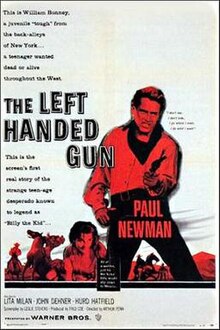
The Left Handed Gun

One of the most well known names to come out of the old west, William Bonney was better known as Billy the Kid, a gunslinger who reportedly killed 21 people in his short 21-year life. This controversial figure has become a favorite in the western genre, his quick, violent life being translated to the screen countless times. The problem? None of them are very good, all of them extremely flawed, especially 1958's The Left Handed Gun.

A drifter and gunslinger without much to his name, William Bonney (Paul Newman) is hired by rancher John Tunstall (Colin Keith-Johnston) to work as a cowhand. In the midst of a cattle range war, Tunstall is killed soon after by rival factions, leaving Bonney looking for vengeance. The four men responsible for the murder are basically let off without a slap on the wrist with young Billy deciding it's up to him to administer justice. With two other cowhands, he sets out to kill the men, one by one, gaining quite a reputation in the process. His name might be too big though with a new governor moving into the territory. Billy's friend, Pat Garrett (John Dehner), has been hired as a marshal to bring him in, and a tortured Billy seems to be running out of time.

The history here is one of the most well-known and still disputed stories involving the wild west. The general facts are known, the names, places and times, but it seems everyone has an opinion about Billy the Kid, especially his death in 1881. There is a comfort level then with a movie like this with anyone even remotely familiar with the Lincoln County War. Anyone not familiar? Oh, boy, this could be interesting. Director Arthur Penn takes a revisionist look at the story. That isn't automatically a bad thing. Many revisionist westerns try to paint the west as it really was, not as it is remembered. Mostly because of Newman's performance the movie is at least watching, but at other times it is surreal in its execution...and not in a good way.

Depending on the account you read, Billy the Kid was an amiable young man who was personable, intelligent and that his outlaw exploits were greatly exaggerated. How then does 'Left Handed' portray him? An uncaged animal who has the maturity of a 13-year old boy, the emotions of a schizophrenic, and personal demons that threaten to cripple his every move. Newman does what he can with the part, making it interesting if not very good, overacting like a crazy man. But no matter what he does, the portrayal of Billy is just plain weird. With his friends Tom Folliard (James Best) and Charlie Boudre (James Congdon), Billy is a cackling, giggling pre-teen who can snap into psycho with the snap of a finger, ready to gun down anyone. His struggles with women leads to the possible rape of Lita Milan's Celsa, a pretty Mexican girl. His vengeance comes after knowing Tunstall for a day (as the movie says, not real life), Billy clearly looking for some sort of father figure. He wastes away as the bodies mount, an anti-hero to conquer all anti-heroes. Worst though, I'm not sure what Penn is going for or what he's trying to say.

The part of Billy was originally given to James Dean, but the young actor was killed before production started and in stepped Paul Newman. The original casting is perfect because Billy here is basically Rebel Without a Cause with a six-shooter. I give Newman credit for committing to this part. He is eternally watchable no matter the part, and that is on display here. In the hands of a lesser actor, this part would have been a trainwreck, the overemotional, high strung gunslinger basically being asked to be gunned down. To a point, Newman keeps it grounded as much as he can, but the movie on the whole does nothing to help him. In its attempts to make the events "real," the story ends up being so theatrically ridiculous, so BIG emotionally, that it all falls apart.

There just isn't much going for this movie. The score from Alexander Courage basically blares in your ear the whole time, telling you what to feel emotionally. Dehner as Pat Garrett has potential, including several good scenes with Billy, but his reason for hunting down the Kid is laughable, and the theatrics of his explosion are equally laughable. Yes, big, angry eyes and screaming. The black and white shooting offers a stark look at the story, a washed out feel to this dark story, but it seems just one town set was used repeatedly. Oh, and for trivia buffs out there, Billy the Kid wasn't a left handed gun. He was a righty. Read about it HERE. It might be more interesting than the overdone movie.

The Left Handed Gun <---trailer (1958): * 1/2 /****

Saturday, April 10, 2010

Tension at Table Rock

In a career that spanned over 30 years, Richard Egan was in over 60 movies and made guest appearances on several TV shows.  But like so many Hollywood actors/actresses from the time, he's been mostly forgotten in the years since his death in 1987.  Some of it surely has to do with his films -- not one is a true classic -- but that doesn't mean he was in good movies.  Where some stars reach the heights of the profession, Egan became more known for his work in B-movies.  I'll never consider him a great actor, but even in his lesser roles, he had presence to spare.

A good example of his abilities is on display in the 1956 western Tension at Table Rock.  Egan plays the main character -- a gunfighter running from his past -- in a story that uses just about every western cliche available and still manages to be halfway decent.  Egan has one emotion in this movie, if you can call it an emotion, and it's monotone.  His voice never goes up or down whether he's angry, wooing a lady, or just having a conversation.  His face seems to be stuck in the one position for the whole 93 minutes, and through it all still makes it an interesting character.

Wes Tancred (Egan) is dealing with his name becoming legendary -- and not in a good way -- after he shot his best friend and partner, a fellow gunslinger, who was turning on him.  The legend builds that Wes gunned him down in the back, and soon enough, a ballad pops up describing the killing.  Wes is pardoned by the governor and moves further west under a new name. He takes a job at a stagecoach station but is forced to move on after a robbery with the loner survivor of the attempt, young Jody (Billy Chapin) in tow.  Jody has an uncle living in the nearby town of Table Rock who happens to be the sheriff, Fred Miller (Cameron Mitchell).  Some well-hidden sparks start to fly between Wes (alias 'Bailey') and Miller's wife Lorna (Dorothy Malone), but that's the least of the problems.  Fred is still recovering from a brutal attack and with a cattle drive coming his way, he will have to stick up for the town against the rowdy cowboys, with or without Wes's help.

The story does take its time setting everything up, and it's over 45 minutes in before the cattle drive and its boss (John Dehner) is even introduced.  The different storylines bounce every which way with just about every possibility imaginable taken into account in one way or another.  'Table Rock' borrows liberally from other 1950s westerns but still manages to put its own spin on things.  All the important elements of a good western are there; honesty, loyalty, doing what's right no matter the cost, and being true to yourself.  Still, it's hard not to shake the idea that the plot was never really settled on.  Everything wraps up nicely though in the end with the heroic Egan moving on to another town rather than cause a disruption where he is.

The western drifter/gunfighter has been done to death although on a positive note this was well before Sergio Leone got his hand on the genre and infused a bit of cynicism into the western.  Egan's Wes is a flawed man who's made out to be something he's not.  Sure, he's good with a gun, but he's not a cold-blooded killer.  1950s westerns love flawed characters like these because they're not bad guys, but they're not white hatted good guys either.  These sort of anti-heroes usually end up making some sort of personal sacrifice -- not usually involving their own death, it is the 1950s -- so that a family or a town can move on from their pasts.

Joining Egan is a strong supporting cast, especially Mitchell as Sheriff Fred Miller.  He's still recovering from a horrific beating that almost killed him and is thrown right into the fire to protect his town from the incoming rowdy cowpokes.  Mitchell makes Miller a character who wavers over what to do but ends up figuring out what's right and what's wrong, consequences be damned.  Malone is good as Miller's wife Lorna who can't help but be attracted to the steely-eyed, mysterious gunfighter.  Dehner is wasted as a quasi-villain with Royal Dano having some fun with his part as the crotchety old newspaper man.  Only in one scene, DeForest Kelly (pre Star Trek) makes a strong impression as Jim Breck, a hired gun with a unique mission.

Nothing really remarkable about this B-western, but as several IMDB reviewers point out, doing a well-worn formula picture well has to count for something.  At Youtube, several clips have been posted focusing on child star Billy Chapin's performance for those curious and looking for more about the movie.  Also look for a young Angie Dickinson in a small part, playing against the image she would become known for when she became a star.  Innocent enough western that is a pleasant enough way to spend 90 minutes.

Tension at Table Rock <----trailer (1956): ** 1/2 /****

Monday, November 9, 2009

Ten Tall Men

The Dirty Dozen may be the most well-known, but director Robert Aldrich's WWII convicts-turned-commandos adventure is just one in a long list of movies that used the same basic formula. Start with a suicide mission that is almost certain to fail -- but almost always succeeds in the end -- and add in a heavy dose of unwilling participants who want nothing to do with it. A good place to start? Go to the local prison/penitentiary and recruit some convicts. They come cheap and can't really make demands, and if they don't make it back, well too bad.

Aldrich's classic perfected this formula with Lee Marvin leading a group of 12 prisoners sentenced to death or extended prison sentences. But to say that formula is limited to just war movies would be wrong as westerns, historical movies, and action/adventure also put their own personal spin on the idea. Even Michael Bay's The Rock used Sean Connery as a prisoner turned savior. Making this premise easier to spin comes easy for French Foreign Legion stories, like 1951's Ten Tall Men, where this international group of soldiers often came from the dregs of society to begin with.

So starts Ten Tall Men where Sgt. Mike Kincaid (Burt Lancaster) and his two corporals and close friends Luis Delgado (Gilbert Roland) and Pierre Molier (Kieron Moore) return to their Foreign Legion post in Tarfa with a prisoner. Kincaid gets thrown in the stockade for going after the acting unit commander's girlfriend (Mari Blanchard). Put in the cell next to the prisoner he brought in, Kincaid finds out the Rif tribes are organizing and plan to attack the city in less than a week.

Approaching the unit commander, Lt. Kruger (Stephen Bekassy), Kincaid offers a proposition; let him take out a group of prisoners currently rotting away in the cells and slow up the Rif tribes until the regiment can return to help defend the city. Kruger somewhat suspiciously approves so Kincaid rides out with Luis and Pierre and seven prisoners in tow. Now, the tough sergeant must figure out how to slow up the upcoming attack while also keeping his guardhouse squad under control. Kincaid decides on a risky plan, kidnap the daughter (Jody Lawrance) of one of the chieftains who is responsible for bringing the previously warring tribes together.

'Tall Men' was released a year before another Lancaster movie, The Crimson Pirate, that while dealing with vastly different subjects, is similar in tone. Both movies were made to be as entertaining as possible with no deeper meanings or awards aspirations. Filmed in Technicolor, this Legionnaire story is colorful, full of action and over the top characters. Even when the evil Rif tribesmen, led by Gerald Mohr's Khalif Hussein, start to track down Kincaid's squad there's never a real sense of danger because in the end you know Kincaid's going to get the job done, and of course, get the girl, the Rif princess who hates him at first but ultimately falls for him. Totally didn't see that twist coming, right?

This is the type of role that Lancaster was born to play, extravagant, over the top, a lover of life who's always ready to flash his famous grin at whatever is put in front of him. Later in his career, Lancaster played a fair share of more serious, low-key characters, but this is him at his best. And less than five years removed from his screen debut in The Killers, Lancaster -- a circus performer before he got into movies -- does almost all his own stunts. In the Beau Geste/Gunga Din vein of the trio of friends, Roland gets to be the flamboyant 'Mamacita'-shouting Spanish legionnaire and Moore plays the equally nutty Frenchman. The convict squad Kincaid puts together includes Michael Pate, John Dehner, Mike Mazurki, George Tobias, and Nick Dennis.

With a Foreign Legion story, there isn't as much action as one might expect where its predecessors like Beau Geste and Gunga Din (even if it isn't Foreign Legion) were heavy on the gunfights and shootouts from the start. What's here is decent although a lot of it is tongue in cheek. As opposed to the Legionnaires gunning down Rif tribesmen, there's a lot of fistfights and hand to hand struggles. Let's face it, what solves a dispute better than a good old-fashioned brawl with crazy sound effects? The story though is a lot of fun, giving star Lancaster and the cast a chance to ham it up for some exciting action. A nice enough way to pass 90 minutes.

Ten Tall Men (1951): ** 1/2 /****

Tuesday, October 13, 2009

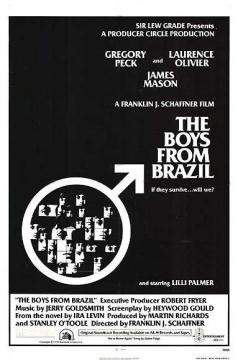
The Boys From Brazil

Depending on what movie you watch, cloning/reanimation/freezing can be handled quite differently. Think of Austin Powers and then compare it to real-life situation with baseball great Ted Williams. I realize they're different situations, but the idea is the same. What if someone from history thought far enough ahead to plan for a clone of themselves? Then think of it as one of the most hated people in history, and you've got 1978's The Boys From Brazil.

The idea of surviving Nazis trying to revive the Third Reich or even just blend in with society is nothing new in movies, with Marathon Man probably the best example. Late in WWII when it was clear the war had turned against Germany, many high-ranking officials and officers began to maneuver on how to survive in the world after the war. Some made their way to South America where support for the Nazi party still existed. Many just tried to get along and hide from the fact that they were still being hunted for their actions during WWII. But what if that wasn't all they were up to? What if they had plans to bring back Nazism into a world power?

In Paraguay in the early 1970s, inexperienced Nazi hunter and member of a young Jew organization, Barry Kohler (Steve Guttenberg) is onto something. He is convinced that retired, hiding Nazis are up to something, and even finds out their plan by bugging the villa they're staying in. Leading the group is Dr. Josef Mengele (Gregory Peck), a German doctor infamously known for his horrific, immoral actions during WWII in the concentration camps where he performed all sorts of scientific experiments on the unwilling prisoners. Convinced he is on to something huge, Barry contacts Ezra Lieberman (Laurence Olivier), a well-known Nazi hunter.

Ezra is not so easily convinced but while he's on the phone with Barry, the line suddenly goes dead and he can hear breathing at the other end. Suspicious of what might have happened, Lieberman begins to investigate the information Barry gave him even if it sounds incredibly strange. Mengele ordered that over a 2 1/2 year span, 94 men, all working in civil services, aged 65 will be murdered in locations all around the world. Confused as to how it all relates, Lieberman begins to look into the matter and does stumble upon Mengele's plan, a revival of the Nazi Party, a new Fourth Reich.

Based on a novel by Ira Levin and using real-life historical figures, The Boys From Brazil is successful as a 'what if?' in history. The true revelation of Mengele's plan is a doozy, and I won't spoil it here because part of the enjoyment from this movie is trying to figure it out as clues are slowly filtered out. The premise seems ridiculously complicated and over-the-top, but that's for after the movie. While watching the plan develop, I was too involved to think about how ridiculous it actually is. Just enjoy the movie and then rip it to pieces afterward.

With stars as huge as Gregory Peck and Laurence Olivier, you would think the leads are as solid as possible, at least I did. Peck plays the villainous Mengele, a brilliant mind who is also completely devoted to Adolf Hitler and his beliefs. With skin-lightening makeup and dyed hair, Peck doesn't look quite right, and his accent is in the evil German, Sgt. Schultz vein. Lines that are supposed to be dramatic and intimidating are instead unintentionally funny. Olivier is better as Nazi hunter Lieberman, a bit of an eccentric himself, but he still seems to go for a stereotypical older Jewis man in his characterization. Maybe I was expecting too much from these two Hollywood icons, but I came away disappointed with their performances.

The supporting cast is much better, especially third-billed James Mason. Playing Siebert, the leader of the extermination squads on the Eastern front in WWII, Mason makes the most of a role that only requires him to be onscreen in a handful of scenes. He is Mengele's security officer, making sure his plan comes to fruition even as that plan becomes more and more unwieldly. Other supporting roles go to Lilli Palmer as Ezra's sister/assistant, Denholm Elliott as a not so cooperative press agent working with Lieberman, John Dehner as a man involved with Mengele's plan whether he knows it or not, Walter Gotell as one of Mengele's key men, John Rubinstein as a friend of Barry's, and surprisingly enough, Guttenberg in a strong key role.

Aided by a solid, creepy score from Jerry Goldsmith, 'Brazil' is at its best when the story keeps you guessing. Mengele's diabolical plan for a Fourth Reich is an unexpected twist that caught me by surprise, both in terms of the story but also the science it involves. Just don't overthink this one while watching, and you'll be fine.

The Boys from Brazil <---trailer (1978): ** 1/2 /****

Tuesday, October 6, 2009

The Fastest Gun Alive

There is always someone faster than you; an idea that drove a whole subgenre of westerns over the years, the fast draw. From Clint Eastwood to John Wayne to Randolph Scott, westerns have dealt with fast draw artists for as long as movies have been made. And if books, magazines, TV shows, and movies have taught us anything, it's lonely at the top. But unlike the stakes in The Hustler which is just pride on the line, the fast draw in a western is a life and death situation.

So with little work needed, the framework is there for an easy story to be told. Someone always wants to take on the best and prove that they are in fact, THE BEST. The Gregory Peck western The Gunfighter explored this idea in 1950 which was reused more than a few times, including 1956's The Fastest Gun Alive. What starts off as a near classic completely derails in the final scene though in an otherwise above average western.

Riding into a western town with the two members of his gang (John Dehner and Noah Berry Jr), hardened gunfighter Vinnie Harold (Broderick Crawford) walks up to a saloon and calls out for Clint Fallon, a man known as one of the fastest guns in the west. Unprompted with no other reason to see who is quicker, Vinnie guns down Clint and a legend begins to grow. Down the trail in a little town called Cross Creek, a quiet storekeeper, George Temple (Glenn Ford), lives with his pregnant wife (Jeanne Crain) while going day to day hearing the digs and criticisms all of the men in town. George doesn't drink and doesn't wear a gun.

But after four years living in Cross Creek, George has had enough and snaps, strapping on the gunbelt he told his wife he threw away long ago. He puts on a show in the street in front of the whole town, shooting two silver dollars in midair and blasting apart a beer mug before it can hit the ground when dropped. And so George becomes his own sort of legend among the townsfolk. But unknown to George and the town, Vinnie Harold and his gang are riding their way with a posse on their tail. Is there any way George can avoid the showdown with the unhinged Harold?

The script is a strong one that intentionally or not borrows elements from High Noon. One man can either save or destroy a town with one decision. But like in High Noon, the situation can be enfuriating as someone watching the movie. Late in the movie, George is forced to make a decision that could save the town, full of whiney weaklings who won't pick up a gun. There's at least 20 men in town who could carry a gun who are scared of three gunslingers. Team up and take them out for God's sake!

As the title character, Glenn Ford has never been better. I've seen many of Ford's westerns, and I'm going out on a limb to say this is his best career performance. The first 45 minutes or so has Ford's George in a slow burn as his place in life starts to rattle around in his head. He's as good with a gun as just about any man and feels the need to show it after years of people doubting him and laughing at him. A late twist and revelation puts a nice spin on the story. You think it's going one way, and then WHAM!, it takes a different route. This twist sets up the ending which had a chance to be one of the great endings in a western if it wanted to be.

But no, director Russell Rouse and scriptwriters Frank D. Gilroy have to add another twist on the ending. I won't spoil it here, I'll let the ending ruin the movie for you to on first viewing. Heading into this one last shootout, I'm already thinking about the very positive review I would be writing, and even at the end of the shootout, it's still in my head how great, how appropriate that ending is. But in that last scene, a completely unnecessary twist is made just so the movie can end with a happy ending. I was ready to give 'Fastest Gun Alive' a 3, maybe 3.5 stars, but that ending really disappointed me.

On the whole, everything else is nearly perfect, especially Broderick Crawford as the possibly psychotic Vinnie Harold who has a deep-seeded obsession with proving he's the fastest gun in the west. Crawford's presence is always dynamic onscreen, and his deep, booming voice was made for him to be a western villain. The rest of the cast is solid too, including Crain as George's worrying wife, and a great list of character actors including Leif Erickson, Rhys Williams, John Doucette, Russ Tamblyn (even getting an unnecessary, out of place dance sequence), Allyn Joslyn, Virginia Gregg and J.M. Kerrigan.

A good example of how a bad ending can ruin an otherwise nearly great movie, The Fastest Gun Alive could have been a classic in the vein of High Noon. Like I said, I was ready to give it at least 3 stars, minimum, but the ending was a complete disappointment especially when considering how everything has built to a certain conclusion. Too bad because Glenn Ford delivers a career-best performance in this B&W western.

The Fastest Gun Alive <---trailer (1956): **/**** Watch the movie broken down into 10-minute segments starting here (movie starts about 3 minutes in)