The Sons of Katie Elder

The Sons of Katie Elder
"First, we reunite, then find Ma and Pa's killer...then read some reviews."
Showing posts with label Arthur Penn. Show all posts

Tuesday, July 7, 2015

Night Moves (1975)

The time of the film noir was long since past, its shadowy streets, scarred, flawed anti-heroes and dastardly villains gone the way of the do-do bird. The genre lived on into the 1950s some before moving on. Then...THEN, along came the 1960s and everything weird and drug-induced and dark and cynical. Here came a new type of film noir, almost as if it was on LCD or acid of some sort. A whole sub-genre of flicks came along, the private detective meets film noir meets general weirdness. That's today's flick, a 1975 neo-noir called Night Moves.

A former pro football player, Harry Moseby (Gene Hackman) is a mildly successful private investigator working in Los Angeles. He's a dogged investigator and good at what he does, stubborn to a fault to get answers, but there just isn't much money in the business. His home life with his wife (Susan Clark) becoming increasingly frustrated with that lifestyle, but now Harry has a case on his plate that's peaks his curiosity. A past her prime actress, Arlene Iverson (Janet Ward), wants Harry to track down her missing daughter, Delly, who's been gone for several days with no word at all. Delly is a teenager with a free spirit who's embraced quite the freeing lifestyle. Where to start though? Delly...well, she got around but Harry decides to start in Florida where her stepfather lives a life of ease (seemingly). Immediately though with anyone he talks to, Harry feels like he's getting the run-around. What has he stumbled into?

I recorded this movie on Turner Classic Movies a few months back and never got around to it, eventually deleting it. Just my luck, it popped back up on the schedule a few weeks ago so I gave it another shot. What to say? What an interesting, weird, off-the-wall movie in just about every description I can come up with. 'Night' comes from director Arthur Penn, he of Bonnie and Clyde, Little Big Man and The Missouri Breaks, among others. His movies were part of a New Wave in Hollywood, featuring European influences (mostly French) while also blending the general cynicism washing across America. Authority, the government, the system, all of it would come under question in the late 1960s and into the 1970s.

The filming style and technique used by Penn is a more natural effort. Scenes transition from one to the next in the blink of an eye. The story itself drifts along as Hackman's Harry meets one person after another, some he's met in the past, others he's meeting for the first time. There is some description or background of these people, but not a lot so pay attention or you'll miss the little tidbits here and there. There has to be a confidence within the story and the director and his crew to pull off something like that. Yeah, 'Night' has the idea of a story, but it is far from your typical, even straightforward story. So in that sense, this is a movie that drifts along in pretty easy-going fashion. It's also intensely frustrating at times because it slows down to a snail's pace where there's literally no story movement. The thing that holds it together...

Maybe you've heard of him. His name is Gene Hackman. The 1970s were Hackman's decade with one classic role and movie after another. Even when he hams it up a bit, he's still eternally watchable. When he plays things straight, you get movies like this. Hackman's Harry is calm and cool and exceptionally good at what he does. His personal life is a different story, like when he discovers his wife is having an affair (with Harris Yulin). Frustrated to no end, this P.I. dives back into his work, seeking some sort of solace in finding answers for his cases. He gets a lot of screentime with Jennifer Warren's Paula, a woman in her 30s with quite the checkered past that got her to this place. I didn't love the movie overall and struggled at time to stick with it, but Hackman helps get through the rough patches in a very solid lead performance.

The rest of the cast is okay, but nothing crazy. Not much in the way of big names so instead we get a lot of familiar faces in character actors. Along with Clark, Yulin and Warren, look for Edward Binns, Kenneth Mars, Anthony Costello, and John Crawford. In two of the best supporting parts, 17-year old Melanie Griffith plays the sexually free Delly while James Woods plays a mechanic who may be up to something who's also a friend of our young Delly. 'Night' caused a stir because the underage Griffith has several nude scenes and even had several love scenes cut from the final product. Woods is already brimming with intensity which works well in several scenes with Hackman.

It's been a week since I watched this 1975 detective noir story, and man, I still can't wrap my head around it. The second half of the movie does pack some surprises as Harry's investigation uncovers all sorts of shady dealings, but it never quite comes together. By the time everything is laid out....yeah, I'm still not sure what happened and why that person is dead or that person betrayed somebody. Confusing to say the least, but even with that said, there is still something oddly entertaining about this not so normal detective story. Flawed but interesting.

Night Moves (1975): ** 1/2 /****

Thursday, July 24, 2014

The Missouri Breaks

By the late 1960s, the idea of the good guys vs. bad guys westerns were a definite thing of the past. Spaghetti westerns helped blow the genre up, but back in the states, the concept of a revisionist western started to pop up more and more. Some are excellent -- Ulzana's Raid, The Hired Hand, The Culpepper Cattle Co. among others -- but for the most part, I've always felt they tried too hard to tear down the myths and legends, kneecapping themselves in the process. Somewhere in between is 1976's The Missouri Breaks, a truly odd film with some great moments canceled out by a fair share of bizarre moments.

On the wild frontiers of Montana, a horse rustler, Tom Logan (Jack Nicholson), and his gang have run into some trouble. One of their own has been captured and hung by a local land and cattle baron, Braxton (John McLiam), who took the law into his own hands. With his options somewhat limited, Logan puts a risky plan into action. He buys a small ranch near Braxton's home and poses as a farmer and horse trader, basically stealing from him from right under his nose. The plan seems just crazy enough to work, Logan's "farm" posing as a stop along the trail for stolen horses being transported. Sick of seeing his stock continually stolen, Braxton goes one step further to stop the unknown rustlers. He hires a regulator, a hired gun and killer, Robert E. Lee Clayton (Marlon Brando), to finish off the rustlers. The rancher might not know the extent of what he's gotten himself into, Logan and his gang in an identical spot. What does Clayton's arrival hold for all of them?

I like the idea behind most of the revisionist westerns. The American west in the 19th Century was a horrifically violent, tough place to start a life. In other words, the west wasn't the ideal, idyllic world many westerns show. From director Arthur Penn (Bonnie and Clyde), 'Missouri' is dark, gritty, violent, brutal and truly, truly bizarre. It is a little too long at 125 minutes -- aimlessly drifting a little much for my liking -- and definitely tries too accomplish a lot, maybe too much. The production was more than a touch checkered with difficulties, both Brando and Nicholson demanding massive rewrites for their characters. Somewhere in this movie is a genuinely good movie, but it gets lost in a maze of misguided attempts at humor, some physical and raunchy, and moments of heavy drama. It all tries to be too quirky and off-the-wall. If you're going to be different with story and characters, so be it. Just do it. Don't aggressively call attention to it at all times.

Massive rewrites aside, I did like Jack Nicholson as the leader of a gang of horse rustlers, Tom Logan. One of the biggest stars of the 1970s, Nicholson embraces the character, the anti-hero who as presented, isn't such a bad guy. It isn't exactly a sympathetic character, but it is certainly an interesting one. We're not given much background -- just a blink and you'll miss it description about his past -- but then again, a tough as nails anti-hero doesn't need a whole lot of background. There's that Nicholson energy in patches, those outbursts, that nasty grin where you just know he's up to something. He's aided by his gang, especially Cal (Harry Dean Stanton), his right-hand man and an underplayed psycho of sorts. Nicholson and Stanton have a couple very strong scenes together, quiet scenes as the duo talks. The gang also includes Little Tod (Randy Quaid), Cary (Frederic Forrest), and Si (John P. Ryan).

As good as Nicholson is though, what most viewers will take away from 'Missouri' is Marlon Brando. The definition of a method actor, Brando takes this part to places I've never seen before in a western. There have been psychos, there have been unhinged killers, even deranged lunatics, but nothing like this. Brando's Clayton favors flowery perfumes, rocks an Irish brogue that drifts in and out, uses a high-powered sniper rifle, a dainty Mexican pistol with flowers on the handle and a knife-like throwing object that looks like a crucifix. He also quotes literature, is profoundly uncomfortable in his interactions, poses as a priest and a woman and becomes obsessed with completing the job. He's going up against someone in Nicholson who could similarly chew some scenery, but this performance from Brando is both profoundly good and profoundly bad. It's just unreal. It is a part that has to be seen to be believed.

An interesting movie if not a particularly good one. It's all over the place in the end. Too much time is spent with Nicholson's Logan and Braxton's daughter, Jane (Kathleen Lloyd), and their budding relationship. At different points, Clayton and Braxton both from a distance watch Logan and Jane engage in some sex on the prairie. Who could pass that up? The last 30/40 minutes are the movie at its best -- Clayton officially going rogue -- but even then, the ending taps the brakes some when it could have gone for a great finale. The big picture is this, I think 'Missouri' simply tackles too much. At different points, it is equal parts weird, funny, dramatic, comedy falling short, oddly sexual, and quirky for the sake of being quirky.

A missed opportunity with just enough -- just -- to give it a very mild recommendation. Definitely know what you're getting into though, especially with the Godfather himself, Marlon Brando.

The Missouri Breaks (1976): ** 1/2 /****

Friday, February 24, 2012

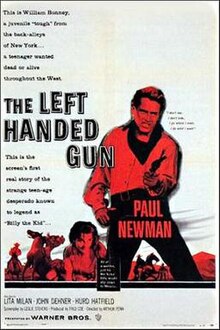
The Left Handed Gun

One of the most well known names to come out of the old west, William Bonney was better known as Billy the Kid, a gunslinger who reportedly killed 21 people in his short 21-year life. This controversial figure has become a favorite in the western genre, his quick, violent life being translated to the screen countless times. The problem? None of them are very good, all of them extremely flawed, especially 1958's The Left Handed Gun.

A drifter and gunslinger without much to his name, William Bonney (Paul Newman) is hired by rancher John Tunstall (Colin Keith-Johnston) to work as a cowhand. In the midst of a cattle range war, Tunstall is killed soon after by rival factions, leaving Bonney looking for vengeance. The four men responsible for the murder are basically let off without a slap on the wrist with young Billy deciding it's up to him to administer justice. With two other cowhands, he sets out to kill the men, one by one, gaining quite a reputation in the process. His name might be too big though with a new governor moving into the territory. Billy's friend, Pat Garrett (John Dehner), has been hired as a marshal to bring him in, and a tortured Billy seems to be running out of time.

The history here is one of the most well-known and still disputed stories involving the wild west. The general facts are known, the names, places and times, but it seems everyone has an opinion about Billy the Kid, especially his death in 1881. There is a comfort level then with a movie like this with anyone even remotely familiar with the Lincoln County War. Anyone not familiar? Oh, boy, this could be interesting. Director Arthur Penn takes a revisionist look at the story. That isn't automatically a bad thing. Many revisionist westerns try to paint the west as it really was, not as it is remembered. Mostly because of Newman's performance the movie is at least watching, but at other times it is surreal in its execution...and not in a good way.

Depending on the account you read, Billy the Kid was an amiable young man who was personable, intelligent and that his outlaw exploits were greatly exaggerated. How then does 'Left Handed' portray him? An uncaged animal who has the maturity of a 13-year old boy, the emotions of a schizophrenic, and personal demons that threaten to cripple his every move. Newman does what he can with the part, making it interesting if not very good, overacting like a crazy man. But no matter what he does, the portrayal of Billy is just plain weird. With his friends Tom Folliard (James Best) and Charlie Boudre (James Congdon), Billy is a cackling, giggling pre-teen who can snap into psycho with the snap of a finger, ready to gun down anyone. His struggles with women leads to the possible rape of Lita Milan's Celsa, a pretty Mexican girl. His vengeance comes after knowing Tunstall for a day (as the movie says, not real life), Billy clearly looking for some sort of father figure. He wastes away as the bodies mount, an anti-hero to conquer all anti-heroes. Worst though, I'm not sure what Penn is going for or what he's trying to say.

The part of Billy was originally given to James Dean, but the young actor was killed before production started and in stepped Paul Newman. The original casting is perfect because Billy here is basically Rebel Without a Cause with a six-shooter. I give Newman credit for committing to this part. He is eternally watchable no matter the part, and that is on display here. In the hands of a lesser actor, this part would have been a trainwreck, the overemotional, high strung gunslinger basically being asked to be gunned down. To a point, Newman keeps it grounded as much as he can, but the movie on the whole does nothing to help him. In its attempts to make the events "real," the story ends up being so theatrically ridiculous, so BIG emotionally, that it all falls apart.

There just isn't much going for this movie. The score from Alexander Courage basically blares in your ear the whole time, telling you what to feel emotionally. Dehner as Pat Garrett has potential, including several good scenes with Billy, but his reason for hunting down the Kid is laughable, and the theatrics of his explosion are equally laughable. Yes, big, angry eyes and screaming. The black and white shooting offers a stark look at the story, a washed out feel to this dark story, but it seems just one town set was used repeatedly. Oh, and for trivia buffs out there, Billy the Kid wasn't a left handed gun. He was a righty. Read about it HERE. It might be more interesting than the overdone movie.

The Left Handed Gun <---trailer (1958): * 1/2 /****