The Sons of Katie Elder

The Sons of Katie Elder
"First, we reunite, then find Ma and Pa's killer...then read some reviews."
Showing posts with label Walter Brennan. Show all posts

Monday, July 21, 2014

Rio Bravo

Do you have a favorite western? No? What's wrong with you?!? Do a search for top 10 lists, of fans and critics alike pointing out their favorite westerns, and you'll see countless picks. One that pops up often that I'm not a huge fan of is 1952's High Noon. You know who else isn't a big fan? The Duke himself, John Wayne. Working with a deep cast, a talented director and a great script, here's Wayne's response to High Noon, 1959's Rio Bravo.

In the Texas border town of Rio Bravo, Sheriff John T. Chance (Wayne) finds himself in a bit of a spot. A man named Joe Burdette (Claude Akins) callously shot down an unarmed man in a bar argument and is now sitting in Chance's jail. A murderer in itself isn't big news, but when Joe's brother is one of the richest men in Texas -- and with a small army of gunmen at his side -- that provides some problems for Chance. Burdette has bottled up the town so Chance can't transport his prisoner and he can't bring help in either. All the sheriff is left with is two deputies, Dude (Dean Martin), a drunkard, and Stumpy (Walter Brennan), an aging crippled man, to help do the job. With the town waiting to see what happens, Burdette's gunmen similarly waiting on the streets, Chance goes about putting a plan into action to get out alive and bring Joe Burdette to justice.

Wowza, what a good movie, a western that deserves its classic status. I grew up watching this Howard Hawks-directed western a lot as a kid and recently revisited it for the first time in years. The plot description proved a little rough because....well, the script is excellent, but the story isn't the most well-connected, concise of stories. If there's a complaint, it's that at 141 minutes and with an episodic story, things can be a tad slow at times, but you never really notice it (or I didn't at least). It isn't a comedy western, and it isn't a cynical, ultra-dark western, but somewhere in between as it mixes comedy (the script again), the drama and the action. Old Tucson is a great location spot for the town of Rio Bravo, that archetypal winding, dusty western town. Composer Dimitri Tiomkin turns in a great subtle score -- very whistle-worthy -- and even test runs part of the score he'd use a year later in The Alamo. All key contributions to a winning formula.   

Of all his movies, John Wayne is most associated with the western genre. Many consider his western roles -- The Searchers, Red River, She Wore a Yellow Ribbon, The Shootist -- to be among his strongest. Maybe not the showiest part, but Wayne's leading role here as Rio Bravo sheriff John T. Chance is Wayne at his tough, likable, easy-going best. If not his best acting performance, it's one of his most visually iconic, the vest over the red or blue shirt, the bent-up hat brim, the ever-present Winchester rifle in his hand. In the acting department, this is one of my favorites of the Duke's. He makes it look criminally easy what he's doing. He lets those around him show off more with "bigger" performances, content to do his thing. In the process, you can't help but watch him. He's the tough lead, the lead with some great comedic timing, and has one of his all-time best love interests in the form of Angie Dickinson as Feathers, a young woman with some troubles behind her. That chemistry is perfect, Wayne's Chance more and more exasperated with each passing scene. Just a great underplayed performance.

As a director, one of Hawks' specialties was the bonds and friendships formed among men in serious situations, a life and death drama. I don't know if that dynamic was ever better than it was here. There isn't a weak spot in the bunch with Wayne as Chance and Martin and Brennan as his maligned deputies. Even teen idol Ricky Nelson manages to find a good spot as Colorado Ryan, a young gunslinger looking to mind his business....at first. Facing seemingly insurmountable odds, they bond, put their differences aside and become stronger as a collective group. Their chemistry is evident throughout, their dialogue crackling with each passing scene. Sure, they sing a couple songs together (My Rifle, My Pony and Me, Cindy, listen HERE) but it's Dean Martin! You're rooting for these guys, each of the quartet bringing something different to the table. Just hard to beat, one of the best, underrated casts in a western.

That's where the script steps to the plate. We don't get much in the way of backstory about most of the characters. In a line here and there, we pick up more than you'd think. We learn what drove Dude to drink, why cackling, ranting Stumpy has a limp, why Chance carries a rifle. Good, interesting characters we get to know quickly, and from there, the cast does the rest. Also look for Ward Bond (in his last film role) as Pat Wheeler, a freight owner who offers to help Chance, an underused, sneering Akins at his best, John Russell as his intimidating older brother, Nathan, Pedro Gonzalez Gonzalez as Carlos, the hotel owner, and Estelita Rodriguez as his wife, Consuela. 

So there isn't the most pointed story here. So be it, Hawks was never interested in the most linear, fast-paced stories. The pacing works here, too many episodic moments to mention. The opener is several minutes of silence as we're introduced to Chance and Dude, ultimately seeing Joe gun an unarmed man down. My personal favorite is a set piece with Chance and Dude following a wounded hired killer with muddy boots into a saloon...only they can't find him. It's a great little scene with an excellent payoff. The movie is full of such great moments, including the finale as Chance and Co. go toe-to-toe with the Burdettes during a prisoner exchange with Old Tucson again providing a pitch perfect backdrop to the western action.

Is it a perfect movie? No, but as far as entertaining movies goes, this one is hard to beat whether it is a western or not. The cast is perfectly used, showing off a chemistry that makes it fun to watch. Some truly funny laughs (Chance calling Stumpy "a treasure" and kissing him on his bald head), some great dialogue and one-liners, and a script that provides some great quotables. Hard to beat, and one of my favorite movies. If you're a fan, check out both El Dorado and Rio Lobo, Hawks basically remaking his own movie twice more.

Rio Bravo (1959): ****/****

Friday, April 19, 2013

The Proud Ones

What's the more iconic figure from the wild wild west, the sheriff/marshal or the cowboy? My first thought is the cowboy, but I'm safe picking either one. Yes, I'm the judge and jury here so deal with it. Countless westerns have dealt with both figures, some better than others, but 1956's The Proud Ones is a generally forgotten gem, the story of a small-town sheriff.

The sheriff of a small Kansas town, Cass Silver (Robert Ryan) is expecting trouble. The town has managed to avoid violence and bloodshed for years, but that's about to change. A new railroad line has made the town an important cattle depot, meaning cattle drives can now use Cass' town as a destination. The first herd is due any day now, and along with them comes Honest John Barrett (Robert Middleton), a saloon owner who has quite the checkered past with Cass as a marshal. Barrett sees the town as a gold mine, the potential for money and riches just waiting at his fingertips. His problem? Cass knows how he operates and doesn't intend to be intimidated by him. The experienced lawman braces for Barrett's plan while also weighing how much a new deputy, Thad Anderson (Jeffrey Hunter), can help. Anderson too has his own secrets, one that could doom them all.

The 1950s were packed to the gills with westerns hitting theaters from bigger budget A-level movies with smaller scale, cheaper B-movies. From director Robert D. Webb, 'Proud' is a better, more enjoyable western because it falls in between the two. It's familiar stuff, the town sheriff protecting his town, his word and his honor against a power-hungry businessman. Familiar isn't bad. There's some solid casting with some A-list names, but they're not there for the sake of star power. The story is mostly relegated to the town set which looks a lot like the set from The Ox-Bow Incident (from 13 years earlier), but the crowded streets with bars, businesses and alleys ending up being a key ingredient to the escalating situation. I also really liked Lionel Newman's score, a combination of soft and subtle -- especially Cass' whistle theme, listen HERE -- with bigger, louder outbursts in tense action scenes. It's a lot of little things again, but combined together it works out nicely.

By 1956, Robert Ryan was an established star in Hollywood, a reliable tough guy know for his villainous roles but also his ability to play flawed heroes. Playing veteran marshal Cass Silver, Ryan's part definitely falls into that second category. He's good at what he goes, but his past is checkered to say the least, thanks in great part to his history with Middleton's Honest John (Get it? It's ironic!). Silver has a tenuous relationship with saloon girl turned restaurant owner Sally (always reliable Virginia Mayo) and has a definite future with her, if he can get out of town and his job alive. In a semi-interesting but still unnecessary twist, Cass also gets knocked over the head and starts experiencing headaches that render him temporarily blind. It seems like something more worthy of a spaghetti western. Isolated and all but on his own, Cass might fight for what he believes in, what's right and upholding his word. I liked the main character a lot, and behind him, things fall into place nicely.

Presenting the town marshal as a main character in a western is nothing new, but I liked what Webb did just the same. 'Proud' had to be an influence on Howard Hawks who three years later with Rio Bravo would make a western with some similar undertones (and some less subtle connections). Cass has two deputies, Jake (Walter Brennan, basically playing the same role he'd play in Rio Bravo), the old jailer trying to keep Cass on his toes, and Jim (Arthur O'Connell), the doting father worried about his expecting wife. There's also a great dynamic between Silver and Hunter's Thad Anderson, the cowboy turned deputy. He blames Silver for his father's death, but he doesn't know all the facts. It's not quite a father-son relationship that develops -- maybe more of a brotherly relationship -- but it's fun to watch Silver keep working with the young deputy, not knowing if he'll get a bullet in his back whenever he turns away.

Rounding out the leads, Middleton is smooth and slimy as Honest John, wanting to get his way no matter what or who stands in his way. In this case, his means to an end is to hire "friends," Pike (Ken Clark) and Chico (Rodolfo Acosta), gunfighters waiting to shoot Cass in the back. In a smaller role that basically has her disappear after an early intro, Mayo fits in well as Sally, Silver's girlfriend who worries about his pride costing him his life.

Released in 1956, 'Proud' is surprisingly dark for an American western of the time. It delves into greed, backstabbing, betrayal and out and out murder. Even cynicism is evident almost from the first scene on. Trying to live up to his job and his word, Cass sees the town turn to Sodom and Gomorrah once there is any sort of money on the line, in this case lots and lots of money. The gunfights are quick and hard-hitting, and the finale in a dark, claustrophobic barn features the earliest use of blood squibs I've ever seen. One character gets shot in the face, another in the head, blood shooting out on impact. It's a western I don't hear much about, but I liked it from the start. Highly recommended.

The Proud Ones (1956): ***/****  

Friday, April 12, 2013

The Westerner

Just over two years ago -- good lord, I'm getting old -- I wrote a review of the 1972 revisionist western The Life and Times of Judge Roy Bean. Based ever so loosely on the life of Judge Roy Bean, it's a mess of a movie if a quasi-interesting one. Some 30 years earlier though, an earlier film delved into the life of the infamous western figure. Interesting, but like its predecessor, still flawed. And away we go with 1940's The Westerner.

As settlers and homesteaders move into the wilds of Texas in the years following the Civil War, one man maintains his iron rule on his own territory. That man is Judge Roy Bean (Walter Brennan), a self-appointed judge who lives and rules by a very strict set of rules and laws. His typical verdict is simple no matter the crime; hanging. One day, the Judge meets a prisoner that he can't quite bring to send to the hanging tree. That man is Cole Harden (Gary Cooper), an amiable enough, fast talking cowboy making his way from job to job. Cole is accused of stealing a man's horse, and if there was ever a crime worthy of hanging in the old west, it would be horse thieving. The drifting cowboy is able to save himself from the noose, and he makes a fast friend in Judge Roy Bean. Their friendship though is threatened by an escalating range war, the cowboys readying to fight the homesteaders.

I liked a lot about this 1940 western from director William Wyler. For starters, the black and white look is perfect from the start. The outdoor scenes were filmed in the desert around Tucson, Arizona, adding a sense of realism to the story. The indoor scenes are mostly relegated to Bean's saloon-turned-courthouse in the Texas border country, almost like a play. I won't mention each of the names involved with the script -- there's 6 different names according to IMDB -- but the final product is full of darkly funny scenes that mix well with some great dialogue between Brennan and Cooper. A very natural back and forth makes any scene the duo is in that much more entertaining.

Having already won two Best Supporting Actor awards (1936 and 1938), Brennan made it a third win with his performance here as Judge Roy Bean. It is by far the best thing going for this Wyler-directed western. He makes a pretty nasty character always interesting to watch, if not particularly likable. He lives and rules by his own special laws which are steadfast....until they don't benefit him, in which case he tweaks the rules. Bean is stringent in that once he's ruled, the ruling is done. At one point, the Judge even hangs a man....a man who's already dead. Bean also has one obsession; his love for stage actress Lilly Langtry (Lilian Bond). His saloon is decorated with posters and cards and postcards of the lovely actress. He's never seen her, never met her, but he's desperately and madly in love. It's an oddly human (if not quite endearing) trait to one nasty dude.

For about 45 minutes, I loved this movie. We're introduced to Bean, his town and his posse of 'Yes Men' gunfighters (Paul Hurst and Chill Wills among them), and then Cooper's Cole (no relation to the real-life Cole Hardin) appears on the scene seemingly a sure thing for the hangman's noose. It is an extended scene with its intro and fallout that lasts more than 30 minutes. Bean in all his self-righteous judgment and Cole in his desperation to save his own skin are perfect with some surprisingly funny exchanges. Cooper was worried heading into the movie that Brennan would overshadow his secondary part, and he's right to a point, but he does a solid job (as expected) as the laconic but quick-thinking Cole. The running scene has several sight gags, some interesting twists and a great payoff. If only the rest of the movie could have kept up that energy, but unfortunately, it just doesn't.

The last half of the movie follows Cole and the Judge on opposite sides of a range war. No one seems to be able to convince Bean of anything, but he respects Cole (while also wanting one of the cowboy's prize possessions) enough to listen to him. Well, sort of. The range war feels forced, especially the slamming of a love interest -- Doris Davenport as Jane Ellen, the daughter of a farmer (Fred Stone) --  smack dab right into a story that just didn't need it. The range war offers a couple surprising twists, but the second half just never maintains the energy or momentum of the first half of the movie. Still a worthwhile movie for Brennan and Cooper throughout, but it's a mixed bag in the end because of the disappointing second half. Also look for Forrest Tucker and Dana Andrews.

The Westerner (1940): ** 1/2 /****

Friday, November 30, 2012

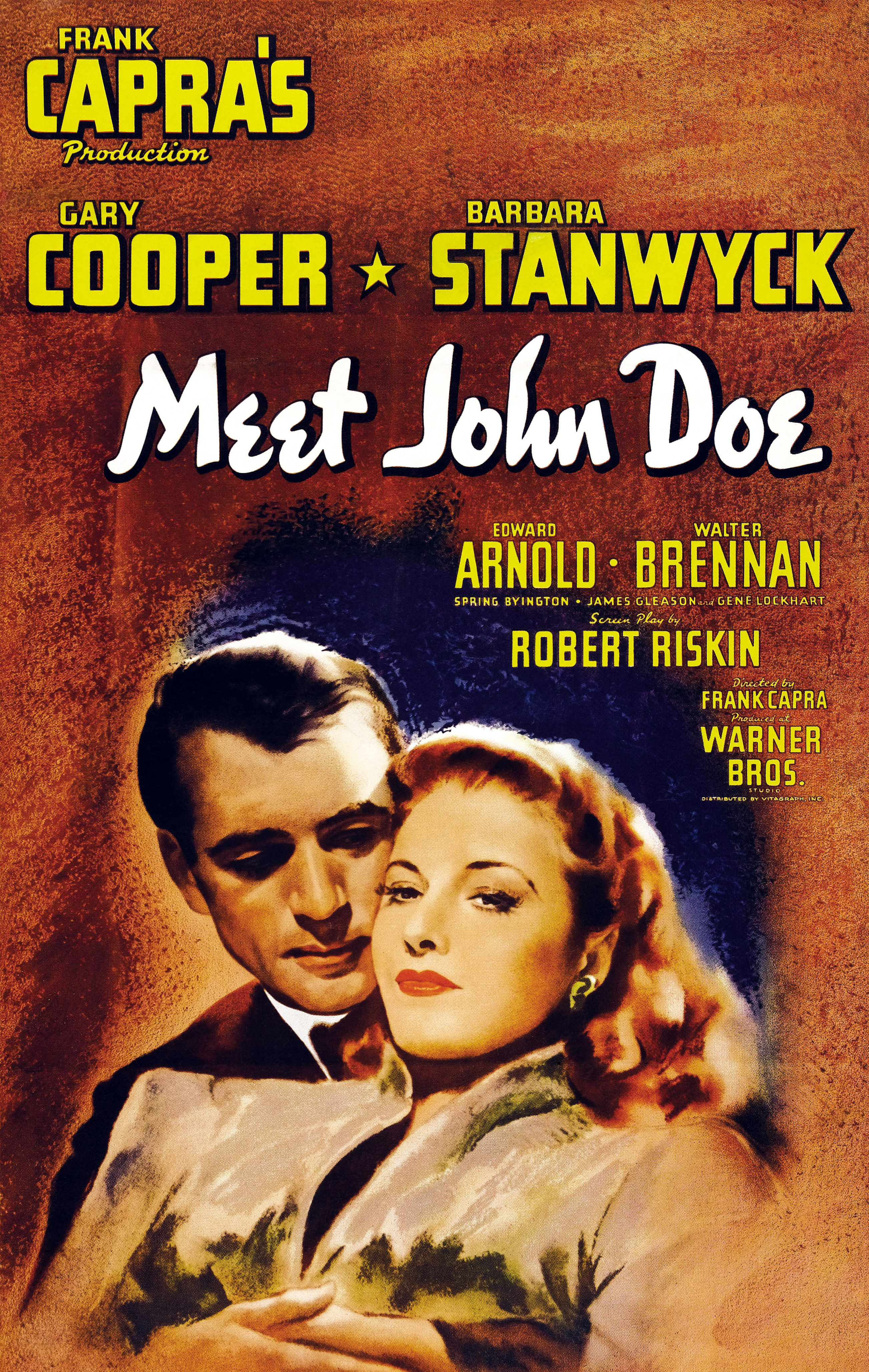
Meet John Doe

Released in the U.S. in spring of 1941, Meet John Doe is a successful movie that can chalk up at least part of its success to its release timing. At the tail end of the Great Depression and watching the world fall into WWII, the U.S. was at one of its historical low points. So how about a movie with a positive message that encourages the individual to work with others? Sounds simple, right?

Squeezed out of a job when a new owner takes over at her newspaper, columnist Ann Mitchell (Barbara Stanwyck) goes out guns blazing. She writes a column from "John Doe," a reader who's become disillusioned and frustrated with humanity and civilization, vowing to kill himself by jumping off City Hall on Christmas Eve. Uh-oh, we've got a problem. Readers are curious, wanting to save John Doe. Where to find a reader who never existed? Ann and the paper hire John Willoughby (Gary Cooper), an ex-baseball player turned drifter, to pose as John Doe. The response is tremendous though across America, but even Ann could not have planned what John Doe becomes as certain parties become involved with the grassroots movement.

In his last film before making almost a dozen WWII documentaries, director Frank Capra does not disappoint here. His films have a certain style to them, and not just in the visual sense. Maybe not in a visual sense at all. At their base, these are good-hearted stories that want to believe there's genuine good in people. There are those that are inherently good and those that are inherently bad with little to no middle ground. You're either one or the other. Watch enough of his movies, and you see those traits pop up in countless stories and characters.

As a story, this 1941 Capra film is a forerunner of later classics A Face in the Crowd and Network. It shows the rise -- and the inevitable and eventual fall -- of an individual, a person who inspires charity, faith and belief in the masses. Here, Cooper's John Doe is just looking for a meal, a place to sleep at night with a roof over his head. He has no ulterior motives. It's Ann who sees the potential for good, and there's a plenty. The John Doe movement -- help thy neighbor, be friendly, be helpful to all -- takes the country by storm. The ulterior motive comes from Ann's boss, D.B. Norton (Edward Arnold, doing what he does best, being BAD), who sees the power that can be manipulated with the John Doe movement. For a country struggling to get back on the right track, the message was simple (and appealing); work together, work to help and good things will happen.

Capra's films in general had a great sense of the Everyman, the normal guy. Obviously here, the focus is entirely on that individual in all his different forms. Who better to play the face of the Everyman than all-American actor Gary Cooper? In a career of iconic roles, this is certainly up there as one of his best.He does a fine job representing the average American. The shady nature of his business deal with Ann quickly hits hard, but he sees there's certainly potential for good too on an immense scale. He has a great believable chemistry with Stanwyck, the brow-beaten journalist who similarly sees the chance to do something in the country if people would just try. In addition to Arnold's snaky D.B. Norton, the cast includes Walter Brennan as the Colonel, John's questioning drifting partner who hates the system, and for the most part, people, and James Gleason as Connell, Ann's boss who sees what Norton is up to.

A sucker for anything in the dark, realist mode in films, I didn't always love 'Doe.' The sugary sweet outlook on life gets to be a little much at times, and the pacing can be a tad slow. One scene introducing the John Doe clubs goes on forever, Regis Toomey's Bert character explaining in expansive detail how the club came to be in his little town. The story is at its strongest at its darkest points. Norton's plan is hinted at -- uh-oh, sense of doom! -- and when it's revealed, the rug is pulled out from under John, Ann, and millions of Americans. As sweet as Capra's outlook can be at times, it's equally dark in these instances and equally effective. There are scenes where the symbolism is far too heavy-handed (portraying John as a martyr...a la Jesus), but what makes it bearable is the message of goodness. Well worth checking out. You can watch the movie in its public domain format HERE at Youtube.

Meet John Doe <---trailer (1941): ***/****

Sunday, July 10, 2011

Drums Across the River

Thanks to a release of a recent DVD collection of four Audie Murphy movies, Turner Classic Movies did a service to western fans with a night devoted to the World War II hero turned movie star.  Only one of the films shown is actually in the collection, but three Murphy westerns dotted the schedule, and not necessarily his more well-known flicks. In other words, expect a couple reviews over the next couple days of Murphy films, starting with 1953’s Drums Across the River.

I go back and forth on 1950s westerns, but when done right and not handled in a glossy whitewash, they can be a lot of fun. Just look to the Anthony Mann and Budd Boetticher westerns. With wave after wave of westerns made on a small scale hitting theaters, these movies needed bad guys, and the 1950s produced a lot of them. They aren’t instantly recognizable names now over 60 years later, but for a decade they parlayed their bad guy look into a long list of movies. One of the best at playing bad was Lyle Bettger, chief baddie in ‘Drums’ and Murphy’s main rival.

Working with his father (Walter Brennan) running a freight company in Crown City, a western mining town, Frank Brannon (Murphy) agrees to take on a job transporting goods to a mine that needs supplies. Along for the ride is a handful of cowboys looking to help out, including a man named Walker (Bettger), who has some other plans. Walker intends to start a war with the peaceful Ute Indians in the territory, all with hopes of getting a chance at mining gold out of the hills and mountains promised to the Indians. Brannin manages to negotiate a peace with the Utes after Walker’s failed attempt, but this fight is far from over.

I’ve been a fan of Audie Murphy since I first saw him in the autobiographical film To Hell and Back, the story of his exploits in World War II that earned him worldwide fame. Not always remembered with the John Waynes, Randolph Scotts and Clint Eastwoods, Murphy is nonetheless one of the all-time best western stars. As an actor, he didn’t have the greatest range, but as a western hero, he was strong, loyal, honest, trustworthy and tough as nails. You just know with a Murphy character that he’s not going to take any crap from the bad guys, and in the end, he’s going to win out and get the girl. As the western hero, he’s able to stay in that comfort zone as an actor, and as was the case here, he rarely disappoints.

What is cool about Murphy – and a few other action heroes – is that he does a majority of his stunts whether it be riding his horse at full speed chasing the bad guys or taking part in a knock down, drag ‘em out fistfight. That’s what works here with Drums. Starting with Murphy in the lead, this movie has a nasty streak right up its back, impressive stuff considering it was released in the early 1950s. Two fistfights are absolutely brutal affairs that don’t feel choreographed or overly staged, just two guys beating the hell out of each other. Murphy’s Brannin later dispatches a gunslinger by whipping him across the face and then shooting him twice in the stomach. You don’t see that too often in many pre-1960 westerns.

More than just the honest look at the brutality of the western life, this is a fun western, and one I enjoyed a lot surprisingly enough. Director Nathan Juran films his story on location for the most part in the hills and mountains of Red Rock Canyon State Park in California. It is a beautiful movie that features some familiar locations and some new ones. The story also treats Indians as human beings too, not just mindless savage killing machines. Later gaining fame as Tonto in The Lone Ranger, Jay Silverheels plays Taos, a Ute chief who strikes a deal with Murphy’s Brannin. With some twists and turns as to what everyone is up to, the story keeps you guessing enough to make it always entertaining, not easily settling for the typical route.

In one of his many 1950s western bad guy roles, Bettger is a gem as he so often was. These westerns weren’t interested in villains and shades of gray. There was black and white with nothing in between. So because of that, these bad guys are bad news with absolutely no redeeming qualities. Bettger revels in these roles, slimy, smooth villains who will no doubt meet a nasty fate in the end. As for the rest of the cast, screen veteran Brennan has a good chemistry with Murphy even if his part doesn’t require much after about half the movie. Lisa Gaye plays Jennie, the love interest with Mara Corday playing Sue, the saloon girl in cahoots with Bettger’s Walker. Hugh O'Brian plays Morgan, a hired gun who would like nothing more than a shot at Murphy in another part that has some fun with the over the top bad guy. It’s a fun western though, one that rises above so many average westerns from the 1950s. Well worth looking into.

Drums Across the River (1953): ***/****

Friday, April 22, 2011

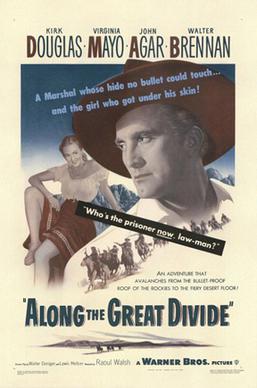
Along the Great Divide

Making his screen debut in John Ford's 1948 cavalry western Fort Apache, John Agar seemed to have all the makings of a star. In the next two years, he starred in two more John Wayne movies, holding his own alongside the Duke I always thought.  But after Sands of Iwo Jima in 1949, that stardom never came for Agar.  Instead, he was relegated to B-movies where he worked consistently into the 1970s and 1980s.  A good if not great actor, Agar was often cast as a second or third banana, the key supporting character, like in 1951's Along the Great Divide.

This western from director Raoul Walsh is an interesting one for several reasons. For one, it was star Kirk Douglas' first western, first of many really as he would return to the genre often during his career. Building off Douglas' strong performance in the lead role though, 'Divide' is a dark western, not like the whitewashed, bland westerns that were so often the product of the 1950s.  It had the potential to be extremely dark at that, but it is the 1950s, and we're not talking a spaghetti western here (unfortunately).  As I was watching this Walsh western though, I couldn't help but think that I'd seen this movie before.  It took me about 15 minutes in, and I had it figured, but I won't give it away yet. Read the plot summary and see if you can figure it out too.

Riding through the desert, U.S. Marshal Len Merrick (Douglas) and two deputies, Billy (Agar) and Lou (Ray Teal) stumble across a lynching. They save rancher Pop Keith (Walter Brennan) from another rancher, Roden (Morris Ankrum) who claims that Keith rustled 15 head of his cattle and murdered his oldest son in the process. Merrick can't prove either way if Keith is guilty or innocent but overpowers the lynch mob, promising to take the old rancher into the nearest town, Santa Loma, for a fair trial.  They hit the trail, picking up Keith's daughter Ann (Virginia Mayo) along the way.  But as they cut across the desert hoping to reach the next waterhole in time, Merrick sees that Roden has kept his word and is charging after them, ready to shoot them all to gain vengeance for his son's death.

This isn't a dead-on comparison where I'm saying they were identical movies, but it's pretty damn close with a few tweaks here and there.  Two years later, director Anthony Mann revamped this basic story with 1953's The Naked Spur, a classic western that is far better remembered than Along the Great Divide.  The story and characters are just too close for Mann not to have been influenced by this western.  Yes, certain things were changed. Douglas is a Marshal, not a bounty hunter like Jimmy Stewart. Brennan isn't a bad guy the way Robert Ryan was, but other things certainly ring true.  Janet Leigh is a spot-on copy of Mayo's character, and Agar and Teal were basically reworked into Ralph Meeker and Millard Mitchell.  I don't say any of this as a judgment or condemnation of The Naked Spur, a western I very much enjoyed.  Instead, I think it speaks to Along the Great Divide which jumps up a notch in my book because of how heavily it influenced 'Spur.'

By 1951, Kirk Douglas was a star, but still a rising star.  His best work was still ahead of him, but his Len Merrick character certainly shows the potential of his ability.  He was an intense actor, capable of high drama and comedy at the same time, and he always had quite a presence on-screen, especially when handling a majority of his own stunts.  So in his first western, Douglas shows a knack for playing that heroic lead who isn't so heroic.  His good guys always had a sense of being not quite so good, men with checkered pasts that rear their ugly heads at the worst possible time.  That is Len Merrick in a nutshell, a marshal trying to prove himself, partially for some sort of redemption for a past deed gone horribly wrong, one that still plagues his mind.  I liked this character though from the start as his ultra-driven motivations take over, pushing those around him to the limit as they struggle with a lack of water in the blazing desert heat.  A good first performance in a western, and a strong indication of what is to come.

More than just The Naked Spur, 'Great Divide' reminded me of several other movies, similar stories with a group of people trying to survive the hell that is the desert. At different points I thought of The Treasure of the Sierra Madre, The Professionals, 3 Godfathers, Yellow Sky and several other westerns and quasi-westerns.  That's basically my only real complaint here with Walsh's western. The story is predictable, and if you're paying attention at all, you know the ending almost from the first scene.  Walter Brennan played his fair share of bad guys, but it's clear this old, coot of a rancher isn't a killer.  It can be a little cookie-cutter at times as the story develops, the pieces falling into place.  On the positive though, it's never boring at 88-minutes, and Walsh films enough on location in the Sierra Madres and Mojave Desert to recommend the movie on just a visual level.  Filmed in black and white, that desert has an intimidating beauty about it, daring riders to come on in and see if they can make it.

I thought Douglas stole the movie here as the tortured U.S. Marshal, but the rest of the cast led by Brennan is nothing to shake your head at.  His Pop Keith character isn't a killer, but he's got a devious streak in him that the story keeps you guessing with as to his actual background.  Mayo as his daughter Ann is the necessary love interest, an easy on the eyes love interest at that.  Agar especially represents himself well as young deputy Billy who looks up to Merrick like a big brother while Teal plays a character he played countless times in other westerns, a gunslinger willing to go on either side of the law, usually the side that pays better.  Ankrum is good as rancher Roden while James Anderson plays his surviving son. An unfortunately little known western, but one I enjoyed very much. Definitely worth watching too if you're a fan of The Naked Spur.

Along the Great Divide <---TCM clips (1951): ***/****   

Friday, March 25, 2011

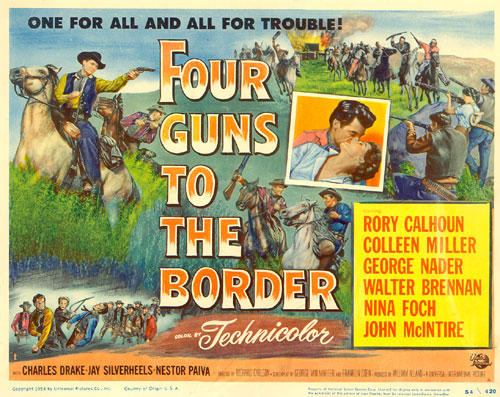
Four Guns to the Border

If I hadn't seen the credits at the opening of the movie, I'm pretty sure I would have been able to figure out that 1954's Four Guns to the Border was based on a Louis L'Amour story. Now it must have been a short story because eight years after this movie the fleshed-out version was released in its novel form, called High Lonesome.  But short story or novel, the main characters come right out of L'Amour's rotation of stock characters.  None of this is meant as a criticism -- I love his western novels -- but instead as a positive, another western that's the movie equivalent of comfort food.

All the old reliable characters I've come to expect were there, and it doesn't take long to establish who everyone is.  'Border' reminded me in a lot of ways of Catlow, another L'Amour western that was later turned into a feature film.  Let's start with the lead, a sullen gunfighter at the head of a gang that isn't so bad all things considered. He's just looking for something else in life.  Two, the older, grizzled right hand man. Three, the younger gunfighter who is the wild card, and four, the minority, a gunfighter with Indian/Mexican backgrounds.  For good measure, throw in a father and daughter traveling across the desert who need help and maybe....just maybe...the daughter will fall for our sullen, glum leader. Ooops, I think I gave away the whole movie.

After robbing a saloon that nets his gang nothing when the safe is empty, outlaw gunslinger Cully (Rory Calhoun) decides to pull a bank job that has long been on his mind. The bank in nearby Cholla holds a monthly deposit from local cattle ranchers, but the bank is well-guarded and the townspeople very protective of their holdings. Cully's gang is up to the task, especially considering their past with Cholla sheriff, Dan Flaherty (Charles Drake). But a big payday seems a long way off as they plan for the job. On the trail, the gang comes across small ranch owner, Simon Bhumer (Walter Brennan) and his young daughter, Lolly (Colleen Miller). Even more trouble is the rumors that an Apache war party has jumped the reservation and is terrorizing the territory, all the while Cully's gang preparing for the dangerous job in front of them.

A B-western released at the height of western popularity in the mid 1950s, 'Border' doesn't do much to distinguish itself from so many other westerns of the time, but I found myself very much enjoying it still.  Some of that can be attributed to L'Amour's comfort and ease writing about the American west, but it's more than that.  Even when the story starts bouncing off the walls in a hundred different directions, it's still entertaining.  That's my one complaint, just too much going on. Almost 30 minutes is spent setting everything up before Sheriff Flaherty and his wife (Nina Foch) and their past with Cully are brought up. In the meantime, Simon and Lolly fade into the background right when their story was getting interesting.  All the different stories of course end up together, but the route getting there could have been smoother.

Most of my enjoyment from 'Border' comes from the casting.  Calhoun was never a huge star, but he was always a reliable lead with the right part.  Cully is a prototypical L'Amour hero, a bad guy who isn't that bad. He just needs a reason to turn to the light, in this case Miller's Lolly character. His gang includes Dutch (John McIntire), the grizzled gunslinger, Bronco (George Nader), the cocky but likable gunfighter, and Yaqui (Jay Silverheels, the Lone Ranger's Tonto), a knife-throwing, affable Indian. Like Cully, they're not so bad compared to most wild west outlaws.  Given the chance, they redeem themselves in the eyes of the audience.  Brennan is Brennan, playing the crotchety old rancher looking out for his daughter's best interests.

Discovered by a movie scout that saw a picture of her on vacation, Colleen Miller plays Lolly in one of her few film roles, and the only one I've seen of hers.  The slim brunette is gorgeous, America's girl next door, and the studio apparently wanted to make her a sexpot with this part.  Their efforts though are so incredibly not subtle that it comes across as a 1950s version of softcore porn.  Upon being introduced, here are just some of the things thrown at Lolly. She's knocked out so Brennan pours a canteen over her, strategically wetting her shirt, continuing to pour even after she's awake. Later in a storm at night, Lolly heads outdoors in a white nightie to care for the horses. White nightie and water? Oh, I get it. She also undresses several times, needlessly but entertainingly hikes up her dress, and even enjoys some candy. Cully's gang stands around while she licks a candy cane.  Are they kidding? It's so ridiculous it is actually funny at times.

B-movie actor himself turned director, Richard Carlson does a solid, workmanlike job with this B-western. Balancing all these different plates at one time, he manages to get all the characters and storylines where they need to be in the end.  The finale had a chance to go for a whopper of an ending, spaghetti western-eque in terms of who makes it and who doesn't, but unfortunately this is 1954 Hollywood, not 1966 Italy.  Still, I liked this movie.  Nothing special, but always entertaining.

Four Guns to the Border (1954): ***/****

Friday, December 31, 2010

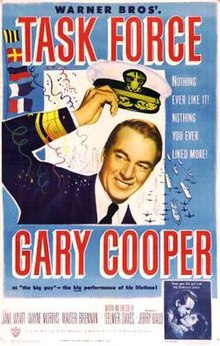
Task Force

This summer while visiting my sister in Norfolk I was lucky enough to get a tour of the destroyer my brother-in-law serves on, getting a look at a type of ship I'd seen countless times in countless war movies over the years.  For one thing, I found out I'm a little claustrophobic and wouldn't be a good sailor (I'd be a good 'land guy' to quote George Costanza).  But seeing the ship and its inner workings -- even in port with a skeleton crew -- certainly made a positive impression on me.  I was surprised by how small the ship seemed, and it's still pretty big all things considered.  It put in perspective how immense these Navy ships are, and relative to other ships, the destroyer is downright small.

All those things were bouncing around in my head as I watched 1949's Task Force this week. It tells the partial story of the development of carriers in the Navy and their involvement with pilots and aviation to advance the Navy's capabilities. They started off as basically sailing airfields on the oceans where rickety planes could land when necessary and developed into immense, very necessary war machines by World War II.  A character mentions early on that when trying to land on the flat top of a carrier deck it looks a lot like a tombstone with your name on it, the ship bucking and rolling with the sea.  The movie is certainly informative about the subject, but it's missing something, and I wish I could give it a higher rating.

As a young pilot in the Navy, Jonathan Scott (Gary Cooper) is among the first pilots to be trained in carrier landings.  Through all the difficulty in this extremely dangerous training, he sees the benefits of a plane being able to land on a ship as it sails across the ocean, and the Navy has a convert.  The higher-ups in the Navy don't see the benefit a carrier would have weighed against the huge costs and risks involved.  With help from his commanding officer, Capt. Pete Richard (Walter Brennan), Scott continues to work toward the development of carrier task forces in the U.S. Navy, often causing ripples when he should sit back and shut up. Aided on the home front by his wife, Mary (Jane Wyatt), Scott continues on as the Navy continues to develop, unknowingly working toward the coming conflict in WWII where carriers will play a key role in the Pacific theater.     

I'll say this first so no one accuses me of hating America or anything similar, but I do like Gary Cooper.  I don't love him though.  So many of his parts are so bland, so vanilla, that I don't consider myself a huge fan of his.  I've never avoided a movie of his because I saw his name and thought 'Hey, that guy sucks!' but at the same time I don't always seek him out.  His part here as Capt. Jonathan Scott falls somewhere in the middle of the movies I've seen with him.  It's not a particularly lively performance, and he comes across as a bit too whiny for my liking.  He has some good interactions with Brennan (solid as ever) and his marriage with Wyatt's Mary doesn't feel as out of place as so many other armed forces marriages in movies, but something's just missing overall in the movie, and that's not a criticism of Cooper or his acting.

All I can wrap my head around is that this movie is basically a documentary about the history of the Navy carrier, but instead of a voiceover provided we get actors stepping into the roles.  If anything, Cooper's part is the tour guide, navigating the viewer through this story. He does provide a voiceover of how things are changing for the Navy, but it becomes tedious.  If I wanted to watch a history of the U.S. Navy, I'd turn on the History Channel and get caught up with a better made documentary about the subject.  As is typical with these movies, a title card thanks the Navy for all their help in making the movie, and cynical guy that I am I couldn't wonder how much control the government and the armed forces had in what the story did and didn't cover.  As for Cooper's part, it's a lose-lose battle for him in a part that could have been filled by any cookie-cutter actor.

What saves the movie late is the depiction of the Navy in the days, weeks and months following the sneak attack on Pearl Harbor December 7th, 1941.  Pearl Harbor and the battle of Midway are both covered in detail in the movie's last 45 minutes.  The problem is though that no matter how good these segments are, there are whole movies devoted to these stories (1976's Midway is a personal favorite) that cover the subject better.  Still, that's not a fair criticism of Task Force because director Delmer Daves is doing what he can with what's in front of him. It's easy to forget now some 70 years later, but the course of the war changed at Midway, and if the U.S. had lost that battle WWII might have gone a very different route.  As Brennan's character explains, 'The west coast better be ready to fight on the beaches.' One of the darker times in American history, and one where the armed forces came through in a must-win situation.

This isn't a bad movie at all, it's just not a great movie either.  It certainly has some potential with an interesting story, but it focuses on trying to tell too big of a story instead of keying in on the most interesting parts of the story.  The movie on the whole lacks any real heart, any reason for us to get invested with the story and its characters.  It is informative but not very exciting in getting its info out.  Worth watching for WWII buffs probably.

Task Force <---trailer (1949): ** 1/2 /****

Tuesday, April 20, 2010

Blood on the Moon


In a biography I read and reviewed last spring about Robert Mitchum, the Hollywood star and one of the first bad-boy movie stars said he never really thought he was much of an actor.  He said it came easy to him, and typically, he never watched his movies once he was done making them.  Maybe it was easy for him, but there is a constant through almost all of Mitchum's movies.  He is smooth on-screen like few others, and as the title of the biography said 'Baby, I don't care.'  If you didn't like him or his movies, Mitchum just didn't care.

Early in his career, Mitchum was signed with RKO Studios and was usually stuck making low-budget westerns and film noirs that over 60 years later have generally withstood the test of time.  1948's Blood on the Moon is typical of the movies he made during his RKO days, but it has a trump card on most of those other movies.  The cast here is ridiculously good starting with Mitchum in the lead and trickling down through all the supporting parts.  It is a late 40s western that blends the western and film noir genres, falling somewhere in between.  Different for sure, and worth a watch.

Drifter Jim Garry (Mitchum) rides into a peaceful-looking valley and quickly finds out everything is not so peaceful as it appears.  There are two factions in the valley, both fighting for control of the land.  On one side is John Lufton (Tom Tully), a rancher trying to sell his cattle to the nearest Indian reservation.  On the opposition is a group of small homesteaders led by a gunfighter, Tate Riding (Robert Preston), and an old, wily homesteader, Kris Barden (Walter Brennan), who is just looking out for the land he's lived on for years.  Throwing a wrench into the situation is Lufton's daugther (Phyllis Thaxter) who has fallen in love with Riding.  Lufton's other daughter, Amy (Barbara Del Geddes) isn't quite sure what to make of Garry who himself doesn't know exactly what's he gotten himself into.

Blood on the Moon is based on a novel by western author Luke Short who over a 30-year span wrote more than 50 western novels.  It does use some well worn western cliches, but it's handled so smoothly it's not even worth complaining about.  The mysterious drifter is as old as westerns themselves, and the ranchers vs. the homesteaders is certainly nothing new in terms of storytelling.  But thanks to his strong cast and some great camera work in black and white, director Robert Wise turns in a solid effort all around.

As the mysterious drifter who only one person really knows, Mitchum does what he does best; the strong, silent type ready with a crack when needed or an equally effective and well-placed punch.  Opposed to a lot of stars in westerns, Mitchum looks comfortable in the saddle, and more than that he looks the part of a cowboy who's spent too long on the trail.  His Garry is a decent enough fellow looking to make some cash, but even he has his limits as to what he'll do to get it.  The subplot with Bel Geddes isn't that great mostly because the two don't have a ton of chemistry together.  Well, maybe they do, but it's hard to see after his pairings with Jane Greer and Jane Russell.

What works so well for the supporting cast is that for much of the movie there isn't good and bad, just varying shades of gray.  Everyone has their reasons, their motives, and even Preston -- who does end up being the villain -- isn't just a cold-blooded killer.  He's a poor homesteader turned gunfighter trying to carve a life out for himself and fiance.  Preston's Riling is that character though you know isn't quite right because it's Preston playing him, and he made a career out of parts like this.  Brennan is solid as a homesteader wavering on what's right and wrong.  Then, also look out for gravelly-voiced Charles McGraw as a hired gun and Frank Faylen as an Indian agent looking to make a buck, both good supporting parts.

While the story does use some wild west cliches -- they are tried and true for a reason -- Wise's movie sets itself apart from the rest because of its one.  Gunfighters, hired killers are looked upon as a scourge of society so Mitchum's Garry isn't exactly well liked upon his arrival.  Westerns often dealt with this issue, but in 1948, this dark tone is more than a little surprising.  The same goes for the violence which isn't graphic but is always realistic, especially a knock-down, drag 'em out saloon brawl between Mitchum and Preston.  With some great shadowy outdoor filming in California and Arizona, this 1948 western has all the elements.

Blood on the Moon <---trailer (1948): ***/****