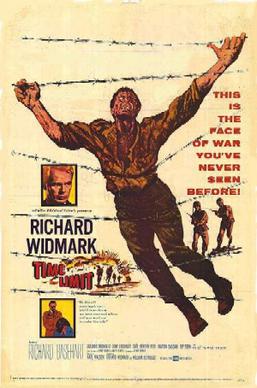
The Korean War helped change things when it came to portrayals of war in film. Sure, there were still huge, blockbuster epics to come like The Longest Day and The Greatest Escape. The nastiness of the war, changing times in America, darker methods of war, it all added up to something new, different and often times, uncomfortable. This wasn't soldier shoots soldier anymore. Part mystery, part prisoner of war drama, part courtroom drama, here's 1957's little-known Time Limit.
An officer in the Judge Advocate General's Corps, Colonel William Edwards (Richard Widmark) is wrapping up interviews for a messy little case that has crossed his desk. An Army major, Harry Cargill (Richard Basehart), has been accused of collaborating with the North Koreans during his time in a prisoner of war camp during the Korean War. Edwards has 14 other witnesses testifying what Cargill did in the P.O.W. camp and complicating matters is that Cargill absolutely refuses to defend himself, turning down legal counsel. If anything, it seems that the officer in question wants to be found guilty and prosecuted to the fullest extent, even if that court martial hearing sentences him to death. It seems like an open and shut case, and that's what makes Edwards curious. Something doesn't add up. What happened in that mountaintop prisoner of war camp in North Korea?
Despite the talent assembled to round out the cast in this 1957 military legal drama, I'd never really heard of this film. I've never seen it pop up in TV listings, and the DVD isn't readily available in Best Buys and Barnes and Nobles. But that Christmas stuff, you get some good presents, and I got this flick! What an interesting movie, one that doesn't get the attention and respect it deserves. Actor Karl Malden takes a crack at the directing chair (his only directing effort) and doesn't disappoint. It is a military film ahead of its time, willing to tackle some brutal, harsh realities about the changing concepts of war. As I mentioned earlier, this isn't Soldier A shoots Soldier B. This is total war that goes far beyond the battlefield. Maybe it's because 'Time' tackles those difficult to talk about subjects that its legacy has been buried over the years. Moral of the story? It's worth catching up with.
A co-producer who also encouraged Malden to direct the film, Widmark clearly had an interest in bringing this film to life. He's always been one of my favorite actors, and this is a performance that clearly shows off his ability. Some of his most well-known performances are big and bold, but this one is understated and subtle (and the better for it). His Colonel Edwards just wants to find out the truth, however dark it may be. It's also a performance that foreshadows Widmark's part four years later in Judgment at Nuremberg, a somewhat similarly-themed courtroom drama. Basehart gets the showier part as Major Cargill, an officer and former prisoner clearly struggling with some past demons. It's never over the top, just emotionally charged. Instead, this is a part of a man just trying to hold it all together as a secret from his past tears him apart.
'Time' doesn't have a huge cast, but there isn't a weak link in the bunch. Dolores Michaels provides a bit of a sexy secretary interest as Edwards' secretary, Jean, while Martin Balsam plays Sergeant Baker, Edwards' adjutant. I really liked and appreciated the dynamic among the trio in the office, three different people with different backgrounds all working toward the same goal. Some of the witnesses Edwards seeks out include June Lockhart as Cargill's worrying wife and Rip Torn as Lt. Miller, a fellow prisoner and bunkmate of Cargill's from the POW camp. Also look for Carl Benton Reid as Edwards' superior officer with a vested interest in the case and Khigh Dhiegh as Colonel Kim, the brutal POW camp commander.
Clocking in at 96 minutes, 'Time' is based on a play and definitely has that distinct feel. Malden's focus is on the actors, letting the camera linger for long, dialogue-driven scenes without a cut. Much of the movie is shot in Edwards' office with a quick departure near the halfway point to visit Lockhart's wife character. That lack of style oddly, gives 'Time' some style in a weird way. It's filmed in black and white and with some interesting camera angles, adds an unforeseen sense of tension that helps build the mystery. It isn't always the quickest movie -- especially the first 45 minutes -- but that momentum picks up in a huge way about the 45-minute mark as things start to reveal themselves.
I thought I had the twist pegged, but I was wrong. The final act features two different twists, one working just as well as the other. These aren't just twists for the sake of a surprise or shock either. These are genuine twists that work while also asking some tough questions. An underrated flick that deserves more of a reputation. Definitely worth checking out.
Time Limit (1957): ***/****
The Sons of Katie Elder
"First, we reunite, then find Ma and Pa's killer...then read some reviews."
Showing posts with label Martin Balsam. Show all posts
Wednesday, January 28, 2015
Tuesday, October 7, 2014
The Carpetbaggers
One of my favorite movies growing up -- and still is -- is the 1966 western Nevada Smith starring Steve McQueen. Wouldn't you know it? It's a prequel to a novel by Harold Robbins called The Carpetbaggers. How's that work? Well, it does and it doesn't. I'm still looking for the book, but I can check the film adaptation off the list. That's 1964's The Carpetbaggers.
It's the early 1920s and Jonas Cord Jr. (George Peppard) is a young man without a care in the world. Any problems he has, his rich father will solve or give him money or turn a blind eye to his antics. When Jonas' father suddenly dies from an aneurysm, a whole business empire is thrust upon Jonas. Will it crumble with the irresponsible Jonas at its helm? Far from it if he has anything to do with it. Young Cord wants to expand and grow and dominate the world. He starts the steady climb up, parlaying one factory into another and there's no market anywhere that Jonas doesn't want his hand in. He wants the power, the money, the prestige and nothing is going to stop him. But in the 1920s and 1930s, can anything actually slow Jonas down? Maybe only himself.
This was a movie I've long been aware of, one that I was vaguely familiar with because of 1966's Nevada Smith. For quite awhile it lingered on my Netflix Saved queue and lingered and lingered. Seriously....do people just hold onto the movies for months at a time?!? 'Carpetbaggers' finally popped up on the Retro Movie Channel, and I had to jump. I'm glad I did. From director Edward Dmytryk, it is a well-told story about business, ego, power, corruption and all that good, dark, sexy stuff that audiences can't turn away from. It clocks in at 150 minutes which might seem long, but the story moves at a lightning pace throughout. The timeline covers around 20 years but never feels rushed. We see the important moments from the good to the mostly bad to the really bad and often painful.
There's something simple and appealing about rise to power stories. How do they climb up? How do they stay there? What, if anything, will ultimately prove to be their downfall? This is a dark movie. There aren't good guys, just less bad guys. Everyone is out for themselves and willing to screw anyone over to get what they want with Peppard's Jonas leading the way. 'Carpetbaggers' takes place in posh hotel suites, busy movie sets, on new-model airplanes, in factories and follows Jonas with every decision he makes. It's nothing crazy original -- sure seems like a Howard Hughes-esque main character -- but there's something enjoyable, entertaining and appealing about this flick. I especially liked composer Elmer Bernstein's musical score with some familiar touches from other scores but forming its own identity. Listen HERE to the main theme.
Look at George Peppard's 1960s filmography, and you only see a couple classic movies, Breakfast at Tiffany's and How the West Was Won. But there's more there to appreciate, but he's got a handful or two of really solid movies worth seeking out. This film definitely counts. Peppard specialized in playing the anti-hero, that a-hole lead you just hate but can't look away from.This is a character who's icy, calculating, brutally efficient and with some deep-seeded personal issues. Obviously this isn't a character you're rooting for, but he's perfectly fascinating. We want to see what makes him tick. We want to see his next brutal takeover, whether it's on a personal basis or putting together a corporate buyout. An excellent performance from one of my favorites, Mr. Peppard. Nice work all around.
Peppard's Cord is the lightning rod for the story, but we meet a whole lot of other folks, most of them just as egotistical, greedy and downright lousy. Some good performances in a deep cast, starting with Alan Ladd in one of his all-time best parts as aging cowboy Nevada Smith. A checkered past to his name, Nevada tries to help Jonas knowing it can never really work. There's also Carroll Baker as Rina, Jonas' stepmother who's the same age as him and looking to make a name for herself. Slinking it up and quite sexy, Baker delivers an excellent part. There's also key supporting parts for Elizabeth Ashley (Jonas' wife), Robert Cummings (an agent turned producer), Martha Hyer (another femme fatale), Lew Ayres (Jonas' much-maligned yet capable accountant), Martin Balsam (a rival movie studio owner), Ralph Taeger (a pilot and business part of Jonas'), Archie Moore (the house servant who knows all) and Leif Erickson (Jonas' tough-love father).
If there's a weak point, it comes in the ending. I was looking for something better, something more appropriate and something DARKER. This is a tidy ending. An easy ending. The build-up makes up for it though to the point the last five minutes can't and won't ruin things. As for the connection to 1966's prequel, Nevada Smith, I think it is best to consider it two unrelated movies. Things don't jive just right, especially Brian Keith's Jonas turning into manipulative, evil Leif Erickson. One produced the other so that's cool, but that's about it. Both excellent movies, and let's leave it at that.
The Carpetbaggers (1964): ***/****
It's the early 1920s and Jonas Cord Jr. (George Peppard) is a young man without a care in the world. Any problems he has, his rich father will solve or give him money or turn a blind eye to his antics. When Jonas' father suddenly dies from an aneurysm, a whole business empire is thrust upon Jonas. Will it crumble with the irresponsible Jonas at its helm? Far from it if he has anything to do with it. Young Cord wants to expand and grow and dominate the world. He starts the steady climb up, parlaying one factory into another and there's no market anywhere that Jonas doesn't want his hand in. He wants the power, the money, the prestige and nothing is going to stop him. But in the 1920s and 1930s, can anything actually slow Jonas down? Maybe only himself.
This was a movie I've long been aware of, one that I was vaguely familiar with because of 1966's Nevada Smith. For quite awhile it lingered on my Netflix Saved queue and lingered and lingered. Seriously....do people just hold onto the movies for months at a time?!? 'Carpetbaggers' finally popped up on the Retro Movie Channel, and I had to jump. I'm glad I did. From director Edward Dmytryk, it is a well-told story about business, ego, power, corruption and all that good, dark, sexy stuff that audiences can't turn away from. It clocks in at 150 minutes which might seem long, but the story moves at a lightning pace throughout. The timeline covers around 20 years but never feels rushed. We see the important moments from the good to the mostly bad to the really bad and often painful.
There's something simple and appealing about rise to power stories. How do they climb up? How do they stay there? What, if anything, will ultimately prove to be their downfall? This is a dark movie. There aren't good guys, just less bad guys. Everyone is out for themselves and willing to screw anyone over to get what they want with Peppard's Jonas leading the way. 'Carpetbaggers' takes place in posh hotel suites, busy movie sets, on new-model airplanes, in factories and follows Jonas with every decision he makes. It's nothing crazy original -- sure seems like a Howard Hughes-esque main character -- but there's something enjoyable, entertaining and appealing about this flick. I especially liked composer Elmer Bernstein's musical score with some familiar touches from other scores but forming its own identity. Listen HERE to the main theme.
Look at George Peppard's 1960s filmography, and you only see a couple classic movies, Breakfast at Tiffany's and How the West Was Won. But there's more there to appreciate, but he's got a handful or two of really solid movies worth seeking out. This film definitely counts. Peppard specialized in playing the anti-hero, that a-hole lead you just hate but can't look away from.This is a character who's icy, calculating, brutally efficient and with some deep-seeded personal issues. Obviously this isn't a character you're rooting for, but he's perfectly fascinating. We want to see what makes him tick. We want to see his next brutal takeover, whether it's on a personal basis or putting together a corporate buyout. An excellent performance from one of my favorites, Mr. Peppard. Nice work all around.
Peppard's Cord is the lightning rod for the story, but we meet a whole lot of other folks, most of them just as egotistical, greedy and downright lousy. Some good performances in a deep cast, starting with Alan Ladd in one of his all-time best parts as aging cowboy Nevada Smith. A checkered past to his name, Nevada tries to help Jonas knowing it can never really work. There's also Carroll Baker as Rina, Jonas' stepmother who's the same age as him and looking to make a name for herself. Slinking it up and quite sexy, Baker delivers an excellent part. There's also key supporting parts for Elizabeth Ashley (Jonas' wife), Robert Cummings (an agent turned producer), Martha Hyer (another femme fatale), Lew Ayres (Jonas' much-maligned yet capable accountant), Martin Balsam (a rival movie studio owner), Ralph Taeger (a pilot and business part of Jonas'), Archie Moore (the house servant who knows all) and Leif Erickson (Jonas' tough-love father).
If there's a weak point, it comes in the ending. I was looking for something better, something more appropriate and something DARKER. This is a tidy ending. An easy ending. The build-up makes up for it though to the point the last five minutes can't and won't ruin things. As for the connection to 1966's prequel, Nevada Smith, I think it is best to consider it two unrelated movies. Things don't jive just right, especially Brian Keith's Jonas turning into manipulative, evil Leif Erickson. One produced the other so that's cool, but that's about it. Both excellent movies, and let's leave it at that.
The Carpetbaggers (1964): ***/****
Labels:
1960s,
Alan Ladd,
Carroll Baker,
Edward Dmytryk,
George Peppard,
Lew Ayres,
Martha Hyer,
Martin Balsam
Tuesday, May 27, 2014
Tora! Tora! Tora!
One of the most infamous days in American history, December 7, 1941 is one of those instantly recognizable dates. The ones that live on in history itself. The Japanese surprise attack on Pearl Harbor was a world-changer, the United States thrust into World War II in a flash. Released in 1970, Tora! Tora! Tora! takes an almost documentary look at one of the most horrific days in American history.
In 1941, World War II is raging across Europe, Adolf Hitler's army marching and conquering all over the continent. In Japan, a new commander, Admiral Yamamoto (So Yamamura), has been named in the Japanese Navy with huge plans in play. Negotiations have been going on for months with the America and will continue for months to come. The American fleet all over the Pacific waits and braces for an attack that many believe is imminent while American intelligence back in Washington D.C. tries to decipher countless pieces of information, clues and evidence that will point to Japan's intentions. Will the Japanese attack? At the navy base at Pearl Harbor in the Hawaiian islands, Admiral Himmel (Martin Balsam) tries to decide what to do next. As the end of November 1941 nears, a meticulous Japanese plan of attack is put into action; much of the fleet sailing toward Pearl Harbor to unleash a surprise attack that hopes to cripple the American navy.
From director Richard Fleischer, with Kinji Fukasaku and Toshio Masuda directing the Japanese sequences, 'Tora' is the anti-Longest Day. While that 1962 epic told the true story of the D-Day invasion at Normandy with an epic cast of Hollywood legends, 'Tora' goes for the true story angle but without the star power. Fleischer and Co. are interested in the details, the history, the build-up, the intelligence, the government responses, all those little things that history buffs will eat up. It takes a little while to get going -- clocking in at 144 minutes overall -- but it is never dull and once it finds its rhythm, the momentum gets going in a big way. This was a movie that struggled in American theaters but was a huge hit in Japanese theaters. Why is that you ask?
Well, the true story of the attack on Pearl Harbor is hard to believe in itself. There's no way it should have worked on so many levels. That's where 'Tora' is special. The Japanese surprise attack was a brilliant military plan, a reliance on air power leading to the success and that almost complete surprise on the American naval base. From the American side, any number of people and issues impacted the attack. Intelligence reports were handled slowly and sent to the wrong people and places. When the radar spotted the hundreds of Japanese fighters, reports were ignored. It's an amazing series of events, Fleischer's movie interested in all those little things. 'Tora' finds its groove near the hour-mark as the attack becomes imminent. The shots of the Japanese fighters and bombers taking off from carrier decks in the pre-dawn darkness as the sun rises in front of them are eerie, oddly beautiful and intensely uncomfortable as we know what their plan will accomplish.
That's the movie at it's absolute best. Nominated for five Academy Awards, 'Tora' won the award for Best Special Effects. Why? Because of the extended attack on Pearl Harbor, bringing one of the darkest moments in American history to life. The Pearl Harbor sequence is remarkable, starting about the 100-minute mark. The amount of ground it covers is remarkable from the attacks on Battleship Row to Hickam Field and anything and everything in between of military importance. The camera films from ground level to put the American POV in perspective while also filming in the air to give the view the Japanese pilots saw as they attacked. The sequence of the Japanese planes flying across Hawaii to Pearl Harbor especially resonated with me in terms of the reality of what we're watching. Amazing aerial sequences, some incredible stuntwork, and composer Jerry Goldsmith's score boosting it all up a notch, this is a sequence that works on all levels. It brings the horrors of the real-life incident to life to the point it is uncomfortable to watch. A great sequence.
With hopes of leaving the focus on the true story of the attack on Pearl Harbor, the cast was filled out with recognizable, respected actors who didn't exactly have star power. Among the high-ranking American military, look for Balsam, James Whitmore and Jason Robards, and with the Intelligence, E.G. Marshall and Wesley Addy. Among the Japanese there's Yamamura as Admiral Yamamoto with Takahiro Tamura as the flight commander leading the attack on Pearl with and Eijiro Tono as the Admiral leading the attack group across the Pacific toward Hawaii. There's gotta be a 100 or so speaking roles so far too many to mention here, but also look for Joseph Cotten, Richard Anderson and Neville Brand among many others.
An interesting movie basically across the board. Told from both the American and Japanese perspectives on seemingly countless levels, you get an excellent sense of the events leading up to the attack on Pearl Harbor, the actual attack, and the immediate fallout. It ends on a somber note, the world truly thrust into the war at this point on an international level, Yamamoto expressing his thoughts. "I fear all we have done is to awaken a sleeping giant and filled it with a terrible resolve." Profound words and a fitting end to the movie.
Tora! Tora! Tora! (1970): ***/****
In 1941, World War II is raging across Europe, Adolf Hitler's army marching and conquering all over the continent. In Japan, a new commander, Admiral Yamamoto (So Yamamura), has been named in the Japanese Navy with huge plans in play. Negotiations have been going on for months with the America and will continue for months to come. The American fleet all over the Pacific waits and braces for an attack that many believe is imminent while American intelligence back in Washington D.C. tries to decipher countless pieces of information, clues and evidence that will point to Japan's intentions. Will the Japanese attack? At the navy base at Pearl Harbor in the Hawaiian islands, Admiral Himmel (Martin Balsam) tries to decide what to do next. As the end of November 1941 nears, a meticulous Japanese plan of attack is put into action; much of the fleet sailing toward Pearl Harbor to unleash a surprise attack that hopes to cripple the American navy.
From director Richard Fleischer, with Kinji Fukasaku and Toshio Masuda directing the Japanese sequences, 'Tora' is the anti-Longest Day. While that 1962 epic told the true story of the D-Day invasion at Normandy with an epic cast of Hollywood legends, 'Tora' goes for the true story angle but without the star power. Fleischer and Co. are interested in the details, the history, the build-up, the intelligence, the government responses, all those little things that history buffs will eat up. It takes a little while to get going -- clocking in at 144 minutes overall -- but it is never dull and once it finds its rhythm, the momentum gets going in a big way. This was a movie that struggled in American theaters but was a huge hit in Japanese theaters. Why is that you ask?
Well, the true story of the attack on Pearl Harbor is hard to believe in itself. There's no way it should have worked on so many levels. That's where 'Tora' is special. The Japanese surprise attack was a brilliant military plan, a reliance on air power leading to the success and that almost complete surprise on the American naval base. From the American side, any number of people and issues impacted the attack. Intelligence reports were handled slowly and sent to the wrong people and places. When the radar spotted the hundreds of Japanese fighters, reports were ignored. It's an amazing series of events, Fleischer's movie interested in all those little things. 'Tora' finds its groove near the hour-mark as the attack becomes imminent. The shots of the Japanese fighters and bombers taking off from carrier decks in the pre-dawn darkness as the sun rises in front of them are eerie, oddly beautiful and intensely uncomfortable as we know what their plan will accomplish.
That's the movie at it's absolute best. Nominated for five Academy Awards, 'Tora' won the award for Best Special Effects. Why? Because of the extended attack on Pearl Harbor, bringing one of the darkest moments in American history to life. The Pearl Harbor sequence is remarkable, starting about the 100-minute mark. The amount of ground it covers is remarkable from the attacks on Battleship Row to Hickam Field and anything and everything in between of military importance. The camera films from ground level to put the American POV in perspective while also filming in the air to give the view the Japanese pilots saw as they attacked. The sequence of the Japanese planes flying across Hawaii to Pearl Harbor especially resonated with me in terms of the reality of what we're watching. Amazing aerial sequences, some incredible stuntwork, and composer Jerry Goldsmith's score boosting it all up a notch, this is a sequence that works on all levels. It brings the horrors of the real-life incident to life to the point it is uncomfortable to watch. A great sequence.
With hopes of leaving the focus on the true story of the attack on Pearl Harbor, the cast was filled out with recognizable, respected actors who didn't exactly have star power. Among the high-ranking American military, look for Balsam, James Whitmore and Jason Robards, and with the Intelligence, E.G. Marshall and Wesley Addy. Among the Japanese there's Yamamura as Admiral Yamamoto with Takahiro Tamura as the flight commander leading the attack on Pearl with and Eijiro Tono as the Admiral leading the attack group across the Pacific toward Hawaii. There's gotta be a 100 or so speaking roles so far too many to mention here, but also look for Joseph Cotten, Richard Anderson and Neville Brand among many others.
An interesting movie basically across the board. Told from both the American and Japanese perspectives on seemingly countless levels, you get an excellent sense of the events leading up to the attack on Pearl Harbor, the actual attack, and the immediate fallout. It ends on a somber note, the world truly thrust into the war at this point on an international level, Yamamoto expressing his thoughts. "I fear all we have done is to awaken a sleeping giant and filled it with a terrible resolve." Profound words and a fitting end to the movie.
Tora! Tora! Tora! (1970): ***/****
Thursday, May 22, 2014
The Delta Force
Here's a universal truth for you that just about everyone can agree about. Chuck Norris is in fact, an amazingly bad ass movie star. His movies aren't always that great -- sometimes they're not even good, sometimes they're truly bad -- but through it all, Chuck Norris and all his awesome facts, is one cool dude. I haven't seen many of his movies, but I do my best to catch up with them, like 1986's The Delta Force, loosely based on the true story of real-life 1985 hijacking of TWA Flight 847.
Flying out of Cairo with scheduled stops at Athens, Rome and New York City, ATW Flight 282 takes off with 100-plus passengers on-board. Not too long after takeoff, terrorists from the New World Revolutionary Organization led by a man named Abdul (Robert Forster) hijack the plane, starting a chain of events as the plane tries to find a landing site to deal with the terrorists and all their hostages. While the terrorists' demands are up in the air, an elite American special forces out, the Delta Force, led by Colonel Nick Alexander (Lee Marvin) and his second-in-command, Major Scott McCoy (Norris), is scrambled to help rescue the hostages. Can the Delta Force get their in time and rescue the hostages in time against nearly insurmountable odds as the terrorists prep to go out in a blaze of glory?
What an odd, weird movie. From director Menahem Golan (who co-wrote the script with James Bruner), 'Delta' was filmed on-location at a new studio in Jerusalem, the GG Israel Studios. The Israeli locations are pretty cool, adding an authentic look and feel to the story. Now with that said, it's a big old mess of a flick with some -- if not enough -- entertaining qualities. It mixes touches of disaster movies, action heavy shoot 'em ups and plenty of patriotic flag-waving, bouncing back and forth among the different angles. It's almost schizophrenic, never finding a rhythm. We go from on-board hostages to diplomatic and government situations, airport to Delta Force, hostages to terrorists. I felt like key parts of the story that explain what went on are completely missing. Title cards try and explain how and when and where, but there seems to be chunks completely cut away. Different segments with no real unifying link.
Instead of that focus on story and character and plot development, 'Delta' rides on one thing; Chuck Norris' awesomeness. That's it. That's all. Unfortunately, he's kept in the background for most of the first hour of the movie.When his McCoy is on-screen, Norris makes the most of it, his experienced Delta Force leader worn down by the horrors of fighting. That said, he sure embraces that whole fighting thing. The last 45 minutes (more on it later) are one scene after another where Norris' McCoy goes all America on some terrorist ass. He jumps off buildings, shoots, punches, and stabs countless terrorists while riding a motorcycle rigged with seemingly infinite rockets and missiles. In another way of showing how cool he is, McCoy typically likes to enter or leave a room by jumping through a window, opening the door for all sorts of badass entrances. Great drama it is not, but in the badass department, 'Delta' succeeds thanks to Norris.
In his last movie before his death a year later in 1987, Marvin is as cool as ever as Col. Alexander, the no-nonsense, smart-ass Delta Force leader, always ready with a quick shot from the hip or a snappy one-liner. Their scenes aren't too long, but Marvin and Norris are an excellent team together. Who else to look for? How about Robert Vaughn as the Delta Force commander back in Washington D.C. Oh, and some of the hostages? George Kennedy, Martin Balsam, Shelley Winters, Joey Bishop, Lainie Kazan, and a young Kim Delaney as a nun with Bo Svenson as the pilot of the hijacked jet airliner. Not a bad cast by any means, just the opposite, but the disjointed story doesn't give most of them a chance to do anything. George Kennedy manages to rise above the story, as do Balsam and Svenson.
If you can make it to the last 45 minutes, you'll be rewarded. It's almost non-stop from there until the final scene, making up for the slowish first 80 minutes and its schizophrenic nature that's all over the freaking place. In general, it's a pretty cheesy 1980s action movie with all sorts of good cliches and stereotypes. The Delta Force theme is unintentionally funny -- nice work from composer Alan Silvestri -- with an almost pleasant, light-hearted feel to it. Listen HERE if curious. You almost expect to be played over a sports movie montage.
Not a bad movie, not necessarily a good movie either, but entertaining enough. Cool cast that isn't used to its potential, but Marvin and Norris make it worthwhile.
The Delta Force (1986): ** 1/2 /****
Flying out of Cairo with scheduled stops at Athens, Rome and New York City, ATW Flight 282 takes off with 100-plus passengers on-board. Not too long after takeoff, terrorists from the New World Revolutionary Organization led by a man named Abdul (Robert Forster) hijack the plane, starting a chain of events as the plane tries to find a landing site to deal with the terrorists and all their hostages. While the terrorists' demands are up in the air, an elite American special forces out, the Delta Force, led by Colonel Nick Alexander (Lee Marvin) and his second-in-command, Major Scott McCoy (Norris), is scrambled to help rescue the hostages. Can the Delta Force get their in time and rescue the hostages in time against nearly insurmountable odds as the terrorists prep to go out in a blaze of glory?
What an odd, weird movie. From director Menahem Golan (who co-wrote the script with James Bruner), 'Delta' was filmed on-location at a new studio in Jerusalem, the GG Israel Studios. The Israeli locations are pretty cool, adding an authentic look and feel to the story. Now with that said, it's a big old mess of a flick with some -- if not enough -- entertaining qualities. It mixes touches of disaster movies, action heavy shoot 'em ups and plenty of patriotic flag-waving, bouncing back and forth among the different angles. It's almost schizophrenic, never finding a rhythm. We go from on-board hostages to diplomatic and government situations, airport to Delta Force, hostages to terrorists. I felt like key parts of the story that explain what went on are completely missing. Title cards try and explain how and when and where, but there seems to be chunks completely cut away. Different segments with no real unifying link.
Instead of that focus on story and character and plot development, 'Delta' rides on one thing; Chuck Norris' awesomeness. That's it. That's all. Unfortunately, he's kept in the background for most of the first hour of the movie.When his McCoy is on-screen, Norris makes the most of it, his experienced Delta Force leader worn down by the horrors of fighting. That said, he sure embraces that whole fighting thing. The last 45 minutes (more on it later) are one scene after another where Norris' McCoy goes all America on some terrorist ass. He jumps off buildings, shoots, punches, and stabs countless terrorists while riding a motorcycle rigged with seemingly infinite rockets and missiles. In another way of showing how cool he is, McCoy typically likes to enter or leave a room by jumping through a window, opening the door for all sorts of badass entrances. Great drama it is not, but in the badass department, 'Delta' succeeds thanks to Norris.
In his last movie before his death a year later in 1987, Marvin is as cool as ever as Col. Alexander, the no-nonsense, smart-ass Delta Force leader, always ready with a quick shot from the hip or a snappy one-liner. Their scenes aren't too long, but Marvin and Norris are an excellent team together. Who else to look for? How about Robert Vaughn as the Delta Force commander back in Washington D.C. Oh, and some of the hostages? George Kennedy, Martin Balsam, Shelley Winters, Joey Bishop, Lainie Kazan, and a young Kim Delaney as a nun with Bo Svenson as the pilot of the hijacked jet airliner. Not a bad cast by any means, just the opposite, but the disjointed story doesn't give most of them a chance to do anything. George Kennedy manages to rise above the story, as do Balsam and Svenson.
If you can make it to the last 45 minutes, you'll be rewarded. It's almost non-stop from there until the final scene, making up for the slowish first 80 minutes and its schizophrenic nature that's all over the freaking place. In general, it's a pretty cheesy 1980s action movie with all sorts of good cliches and stereotypes. The Delta Force theme is unintentionally funny -- nice work from composer Alan Silvestri -- with an almost pleasant, light-hearted feel to it. Listen HERE if curious. You almost expect to be played over a sports movie montage.
Not a bad movie, not necessarily a good movie either, but entertaining enough. Cool cast that isn't used to its potential, but Marvin and Norris make it worthwhile.
The Delta Force (1986): ** 1/2 /****
Saturday, October 6, 2012
The Stone Killer
The pairing of star Charles Bronson and director Michael Winner is no doubt best remembered for their 1974 film, Death Wish. Lost in the shuffle of the endless if entertaining sequels is that it's a pretty decent movie. The duo had worked together three times prior since 1972 though, including 1973's The Stone Killer, an interesting comparison piece compared to Death Wish.
Police Lieutenant Lou Torrey (Bronson) is interested in results and little else. He doesn't care how or why it got done. Cases need to get solved, crooks need to be put away. Torrey is bounced from his NYPD precinct and moves west, taking a job on the L.A. police department. Transporting a murder suspect from NYC to L.A., Torrey barely survives a hit attempt, the suspect killed by a drive-by shooter. Torrey thinks back on what happened. The suspect talked -- at the time nonsensically -- of a coming hit. Could the man have been onto something? Torrey begins to investigate, and the clues lead right to the top of the Mafia.
I've mentioned this before. Crime thrillers from the 1970s have a certain charm that you're either going to love or hate with very little middle ground. They can be low-brow, aggressively violent, sexually suggestive (usually pretty obviously), and in general.....just a hell of a lot of fun to watch. That's what you will be getting here with this Bronson-Winner pairing. Bouncing back and forth between NYC and L.A., the story never slows down as Bronson's Torrey gets deeper into the case. The soundtrack from Roy Budd is an odd mix of jazz and funk (listen HERE), but it works in a ridiculous way. That low-budget, gritty, dirty feel permeates the story -- for the better -- and even when it's not a "good" movie, it's still highly entertaining.
Based off a book by John Gardner (with maybe the best title ever) titled 'A Complete State of Death,' 'Stone' gets some points for originality. Released the year after the classic The Godfather, there are similar/familiar touches of that mobster story. It was hard for every mob movie made after 1972 not to have at least some hints of it. The touches are there, but 'Stone' also has a unique streak. Martin Balsam plays Al Vescari, a Sicilian mobster with quite a bit of power who intends to exact some long-awaited revenge. His plan? Recruit disillusioned Vietnam vets with clean records, and train them to lead the assault on a mob war across the country. It's a cool gimmick, and one that's fun to watch.
Oh, Mr. Bronson, you're pretty cool, aren't you? By 1973, Charles Bronson was typically playing the same character over and over again. That's far from a bad thing. He's perfect at the stoic, silent anti-hero. His Torrey is fed up with all the protocols and rules that limit his effectiveness, and basically, he just doesn't care. He will get the job done no matter how brutal his tactics are. Like many of his parts, he gets to throw a couple wisecracks here and there, and genuinely looks like he's having fun. Considering the part he would play a year later in Death Wish, it's hard not to smile at his Torrey who is basically Paul Kersey with a badge. Also look for 1970s familiar faces Jack Colvin, Stuart Margolin, Paul Koslo, Norman Fell, Ralph Waite and a young John Ritter as a beat cop on the investigation.
In his 1970s flicks, Winner had a formula, and he sticks to it here. Action, action and....um....oh, right, action. In a 91-minute movie, he packs it in at an almost frenetic pace. An opening chase in an NYC apartment is quick and to the point to get things going. A mid-movie chase with Torrey (in a boat of a car) chasing Paul Koslo (on a motorcycle) is priceless, a true gem in the ridiculous department with Torrey's car seemingly indestructible. Watch it HERE. A final showdown at the desert hideout of the Mafia army is a solid finish as well, an entertaining finish for an entertaining movie. I know it's far from a classic, and maybe it's just a bad movie, but I liked it a lot. Watch the entire movie HERE at Youtube.
The Stone Killer <---clip (1973): ***/****
Police Lieutenant Lou Torrey (Bronson) is interested in results and little else. He doesn't care how or why it got done. Cases need to get solved, crooks need to be put away. Torrey is bounced from his NYPD precinct and moves west, taking a job on the L.A. police department. Transporting a murder suspect from NYC to L.A., Torrey barely survives a hit attempt, the suspect killed by a drive-by shooter. Torrey thinks back on what happened. The suspect talked -- at the time nonsensically -- of a coming hit. Could the man have been onto something? Torrey begins to investigate, and the clues lead right to the top of the Mafia.
I've mentioned this before. Crime thrillers from the 1970s have a certain charm that you're either going to love or hate with very little middle ground. They can be low-brow, aggressively violent, sexually suggestive (usually pretty obviously), and in general.....just a hell of a lot of fun to watch. That's what you will be getting here with this Bronson-Winner pairing. Bouncing back and forth between NYC and L.A., the story never slows down as Bronson's Torrey gets deeper into the case. The soundtrack from Roy Budd is an odd mix of jazz and funk (listen HERE), but it works in a ridiculous way. That low-budget, gritty, dirty feel permeates the story -- for the better -- and even when it's not a "good" movie, it's still highly entertaining.
Based off a book by John Gardner (with maybe the best title ever) titled 'A Complete State of Death,' 'Stone' gets some points for originality. Released the year after the classic The Godfather, there are similar/familiar touches of that mobster story. It was hard for every mob movie made after 1972 not to have at least some hints of it. The touches are there, but 'Stone' also has a unique streak. Martin Balsam plays Al Vescari, a Sicilian mobster with quite a bit of power who intends to exact some long-awaited revenge. His plan? Recruit disillusioned Vietnam vets with clean records, and train them to lead the assault on a mob war across the country. It's a cool gimmick, and one that's fun to watch.
Oh, Mr. Bronson, you're pretty cool, aren't you? By 1973, Charles Bronson was typically playing the same character over and over again. That's far from a bad thing. He's perfect at the stoic, silent anti-hero. His Torrey is fed up with all the protocols and rules that limit his effectiveness, and basically, he just doesn't care. He will get the job done no matter how brutal his tactics are. Like many of his parts, he gets to throw a couple wisecracks here and there, and genuinely looks like he's having fun. Considering the part he would play a year later in Death Wish, it's hard not to smile at his Torrey who is basically Paul Kersey with a badge. Also look for 1970s familiar faces Jack Colvin, Stuart Margolin, Paul Koslo, Norman Fell, Ralph Waite and a young John Ritter as a beat cop on the investigation.
In his 1970s flicks, Winner had a formula, and he sticks to it here. Action, action and....um....oh, right, action. In a 91-minute movie, he packs it in at an almost frenetic pace. An opening chase in an NYC apartment is quick and to the point to get things going. A mid-movie chase with Torrey (in a boat of a car) chasing Paul Koslo (on a motorcycle) is priceless, a true gem in the ridiculous department with Torrey's car seemingly indestructible. Watch it HERE. A final showdown at the desert hideout of the Mafia army is a solid finish as well, an entertaining finish for an entertaining movie. I know it's far from a classic, and maybe it's just a bad movie, but I liked it a lot. Watch the entire movie HERE at Youtube.
The Stone Killer <---clip (1973): ***/****
Labels:
1970s,
Charles Bronson,
Cops,
Martin Balsam,
Michael Winner,
Norman Fell,
Paul Koslo,
Stuart Margolin
Thursday, March 8, 2012
The Taking of Pelham One Two Three (1974)
A trend in movies that seems to be taking root lately is remaking movies that don't need to be remade. Classic movies that resonate with audiences and are still remembered fondly must be ripe for the picking. Studios figure audiences liked it then....well, they'll like it now. That was the case with 2009's The Taking of Pelham 123 (read my review HERE). It was a good enough movie, but it didn't need to be made. The original, 1974's The Taking of Pelham One Two Three is a classic in its own right and hard to improve upon.
It's a typical day in New York City when four men suddenly hijack a subway train, Pelham 1-2-3. They call in to the Transit Authority, talking to Transit cop, Lt. Zach Garber (Walter Matthau). The four men, led by Mr. Blue (Robert Shaw), have uncoupled one train with 18 passengers and have some demands. The city of NY has exactly one hour to produce $1 million dollars and put it right in their hands. If they don't? Blue and his cohorts will start executing one hostage per minute. Garber passes the news along, and the city comes to life, police, SWAT, everyone getting involved. Garber starts to wonder though, what are the hijackers up to? They're underground in a tunnel with nowhere to go and surrounded on all sides. How can they possibly hope to escape?
If an example of a 1970s crime drama/thriller was ever needed, 'Pelham' is a perfect example. It belongs up there with The French Connection, Death Wish and Marathon Man as some of the best crime genre movies to come out of the otherwise pretty stylish 1970s (in films at least). Director Joseph Sargent has made a gritty, realistic gem here, one uninterested in a stylish, flashy story. There isn't a wasted moment in its 104-minute run-time. Watching it feels like a pseudo-documentary with a camera placed in front of the real-life performers, not actors. It isn't interested in being flashy. It only wants to ratchet up the tension to the point where it's unbearable. Blue's hour-long countdown keeps ticking away, and NYC doesn't seem any closer to giving him his money. A police car with the money racing through the streets is one thrill after another, time running out and the executions drawing ever closer.
This would be a fitting time capsule for New York City in the 1970s. Almost the entire film was shot on location in NYC, even using an abandoned stretch of subway for the underground shots. But more than just the visual, 'Pelham' paints a picture of 1970s NYC. The Mayor (Lee Wallace) is sick when the hijack takes place, but with free-falling numbers in popularity polls drags himself out of bed. His wife (Doris Roberts) claims he just earned "18 sure votes." From the police commanders handling the situation to the beat cops delivering the money to the hostages wondering what's happening to Garber and his crew at Transit Authority, there's a cynicism, a dark humor hanging over the situation. David Shire's score isn't used much, but it's jazzy, quirky aggressive sound is perfect. This is NYC. A hostage situation? Eh, just one more problem to deal with.
Thanks to the talents of Matthau and Shaw, a hostage situation handled entirely by radio conversations is surprisingly exciting to watch. They communicate via radio, Shaw's Mr. Blue calmly delivering his demands to a world-weary but shocked Garber sitting in the Transit Authority office. There is an ease to these scenes, a flowing rhythm between these two actors that drives the action. Who better to play a cynical New Yorker than Walter Matthau? I can't think of a single person. And playing Mr. Blue, a hardcore mercenary looking for cash? Robert Shaw is ideal. His Blue even does a crossword while sitting in the train waiting for news. The rest of Blue's crew include a scene-stealing part for Martin Balsam as Mr. Green, a former motorman fired from his duties, Hector Elizondo as Mr. Grey, and Earl Hindman (Yes, Wilson from Home Improvement wants to kill you) as Mr. Brown. Also look for Dick O'Neill as Corelli, a supervisor in Transit Authority worried about the train schedule backing up, and Jerry Stiller as Rico, a police officer working with Matthau's Garber.
As the hostage situation develops, the story's momentum picks up. What exactly do these nuts intend to do? They're trapped, cornered, no way out. How could they possibly manage an escape? The final 20 minutes provide some good twists (including a secret about one of the hostages) and a couple surprising revelations about how things are wrapped up. The best though is the last scene, a final shot so perfect that only Walter Matthau could pull it off.
It's easy now to see how this 1974 crime thriller has influenced countless movies of its ilk since. The most obvious of course is Quentin Tarantino's Reservoir Dogs, naming his heist crew by colors and not their real names. But that's only the start. 'Pelham' gets right to the point and isn't worried about any side stories or truly developing the characters. Here's the situation, they're doing it, sit back and enjoy. Anything else would be needlessly extra. You can watch it HERE at Youtube (Part 1 of 11), but it isn't the greatest quality.
The Taking of Pelham One Two Three <---trailer (1974): *** 1/2 /****
It's a typical day in New York City when four men suddenly hijack a subway train, Pelham 1-2-3. They call in to the Transit Authority, talking to Transit cop, Lt. Zach Garber (Walter Matthau). The four men, led by Mr. Blue (Robert Shaw), have uncoupled one train with 18 passengers and have some demands. The city of NY has exactly one hour to produce $1 million dollars and put it right in their hands. If they don't? Blue and his cohorts will start executing one hostage per minute. Garber passes the news along, and the city comes to life, police, SWAT, everyone getting involved. Garber starts to wonder though, what are the hijackers up to? They're underground in a tunnel with nowhere to go and surrounded on all sides. How can they possibly hope to escape?
If an example of a 1970s crime drama/thriller was ever needed, 'Pelham' is a perfect example. It belongs up there with The French Connection, Death Wish and Marathon Man as some of the best crime genre movies to come out of the otherwise pretty stylish 1970s (in films at least). Director Joseph Sargent has made a gritty, realistic gem here, one uninterested in a stylish, flashy story. There isn't a wasted moment in its 104-minute run-time. Watching it feels like a pseudo-documentary with a camera placed in front of the real-life performers, not actors. It isn't interested in being flashy. It only wants to ratchet up the tension to the point where it's unbearable. Blue's hour-long countdown keeps ticking away, and NYC doesn't seem any closer to giving him his money. A police car with the money racing through the streets is one thrill after another, time running out and the executions drawing ever closer.
This would be a fitting time capsule for New York City in the 1970s. Almost the entire film was shot on location in NYC, even using an abandoned stretch of subway for the underground shots. But more than just the visual, 'Pelham' paints a picture of 1970s NYC. The Mayor (Lee Wallace) is sick when the hijack takes place, but with free-falling numbers in popularity polls drags himself out of bed. His wife (Doris Roberts) claims he just earned "18 sure votes." From the police commanders handling the situation to the beat cops delivering the money to the hostages wondering what's happening to Garber and his crew at Transit Authority, there's a cynicism, a dark humor hanging over the situation. David Shire's score isn't used much, but it's jazzy, quirky aggressive sound is perfect. This is NYC. A hostage situation? Eh, just one more problem to deal with.
Thanks to the talents of Matthau and Shaw, a hostage situation handled entirely by radio conversations is surprisingly exciting to watch. They communicate via radio, Shaw's Mr. Blue calmly delivering his demands to a world-weary but shocked Garber sitting in the Transit Authority office. There is an ease to these scenes, a flowing rhythm between these two actors that drives the action. Who better to play a cynical New Yorker than Walter Matthau? I can't think of a single person. And playing Mr. Blue, a hardcore mercenary looking for cash? Robert Shaw is ideal. His Blue even does a crossword while sitting in the train waiting for news. The rest of Blue's crew include a scene-stealing part for Martin Balsam as Mr. Green, a former motorman fired from his duties, Hector Elizondo as Mr. Grey, and Earl Hindman (Yes, Wilson from Home Improvement wants to kill you) as Mr. Brown. Also look for Dick O'Neill as Corelli, a supervisor in Transit Authority worried about the train schedule backing up, and Jerry Stiller as Rico, a police officer working with Matthau's Garber.
As the hostage situation develops, the story's momentum picks up. What exactly do these nuts intend to do? They're trapped, cornered, no way out. How could they possibly manage an escape? The final 20 minutes provide some good twists (including a secret about one of the hostages) and a couple surprising revelations about how things are wrapped up. The best though is the last scene, a final shot so perfect that only Walter Matthau could pull it off.
It's easy now to see how this 1974 crime thriller has influenced countless movies of its ilk since. The most obvious of course is Quentin Tarantino's Reservoir Dogs, naming his heist crew by colors and not their real names. But that's only the start. 'Pelham' gets right to the point and isn't worried about any side stories or truly developing the characters. Here's the situation, they're doing it, sit back and enjoy. Anything else would be needlessly extra. You can watch it HERE at Youtube (Part 1 of 11), but it isn't the greatest quality.
The Taking of Pelham One Two Three <---trailer (1974): *** 1/2 /****
Wednesday, November 16, 2011
The Bedford Incident
Assigned to write a story about navy life aboard a U.S. ship, journalist Ben Munceford (Sidney Poitier) is flown by helicopter to join the U.S.S. Bedford in a patrol somewhere off the Greenland coast. Aboard the destroyer, Ben meets its captain, Eric Finlander (Richard Widmark), a career officer with a long list of accolades. Finlander is after results even though the United States is not officially at war. Ben finds a crew pushed to their limits, ready to split at the seams as they "hunt." Off the Greenland coast, sonar spots a Russian submarine where it shouldn't be. Finlander orders the Bedford to track it, hoping to receive orders to make the sub surface and identify itself. Ben begins to question though. What is the captain really up to, and what does he hopes will happen?
Tension doesn't begin to describe this movie from director James B. Harris, and why it's been forgotten or not remembered with Fail Safe I will never know. Harris films in black and white, the Bedford the one and only location for the length of the movie. It's cramped and claustrophobic, an odd feeling in the immensity of the ocean. But with Finlander's crew, we feel pushed to far too. We're waiting for something to happen, a confrontation we always wait for but never comes. It becomes almost unbearable as the Bedford hunts a Russian sub -- dubbed 'Big Red' -- with Finlander pushing and pushing, but for what? What does he hope to accomplish?
That of course leads to the ending, one of the best final 20 minutes in a movie ever. In terms of its ability to leave you feeling unsettled and even a little queasy, 'Bedford' and its ending are top notch. It rivals Fail Safe for pure shock and surprise value, and in the same way tries to deliver a message about the lunacy of the Cold War, a very timely message for 1965 and one that still rings true now in 2011. I want to discuss the ending in more specific detail, but I don't want to take away the emotional impact it can and should have. Stick with this one through to the end, a sense of doom and tension building until the very last shot.
Having worked together twice previously, Poitier and Widmark show off a chemistry together that actors dream of. Poitier is the intellectual, the journalist trying to understand exactly why and what this destroyer is doing. Nothing adds up for him. Widmark is one of my favorites, but I think this may be his best and by far most impressive character. He's a strong leader but a flawed one, driven to the point of obsession, a patriot but maybe too far. His Finlander will protect America at all costs, no matter the cost. Their interview midway through the movie is a highlight, two very talented actors going toe to toe, Harris filming in a close-up of each man's face the whole time.
The DVD packaging pushes those two lead actors as selling points, but that's just some of a handful of impressive supporting parts. Martin Balsam plays Doctor Chester Potter, the new medical officer who arrives with Munceford, immediately finding that he's out of his element, especially with Capt. Finlander. A young James MacArthur is Ensign Ralston, a young officer who Finlander pushes and pushes, possibly too far. Eric Portman is a scene-stealer as Commodore Schrepke, a former U-boat commander serving as an adviser now to the Navy, an extremely gifted commander who sees Finlander for all his flaws and abilities. Also look for Donald Sutherland, Wally Cox and Michael Kane as members of the crew.
This is a movie that deserves better, or at least more recognition. It deserves to be mentioned in the same breath as both Fail Safe and Dr. Strangelove, featuring strong performances from a deep cast, a unique tension-filled story, and one of the all-time great shocker endings. Definitely one worth catching up with.
The Bedford Incident <---trailer (1965): *** 1/2 /****
Thursday, August 11, 2011
Two-Minute Warning
When I think of movies from the 1970s, one genre rises above the rest...the disaster movie. Put an all-star cast together with a possibly world-ending catastrophe, and you've got a winner on your hands. Well, sort of. Most of these movies are pretty bad, the appeal coming from guessing which huge Hollywood star is going to die gruesomely in some horrific way. Hint: It's almost always the aging star sacrificing themselves for the lives of a younger person. The disaster movie opened the door for all sorts of movies with all star casts, not necessarily just at the end of the world.
Take 1976's Two-Minute Warning as an example. The caliber of names is certainly impressive, but more on that later. The premise is disaster-like, but it's more of the man-made variety. In fact, the movie and its premise -- a sniper setting up shop at a sporting event and opening fire -- was so controversial that it has been almost entirely buried over the last 30-plus years. To air it on TV, an additional 30 minutes were added to make the lone sniper a diversionary tactic for a heist in Los Angeles, supposedly lessening the blow and the impact of what's going on. The original theatrical version is a mixed bag overall though with a dull first hour, great middle half hour, and a finale and ending that rival the most uncomfortable scenes you'll ever watch.
Hosting a championship football game (supposedly between L.A. and Baltimore?), the L.A. Coliseum has opened its doors to some 90,000 fans who have turned out to see the contest. VIPs including politicians both locally and nationally have come out for the job, making Captain Peter Holly's (Charlton Heston) job that much more difficult maintaining security. Near halftime though, one of the countless cameras around the stadium spot a man with a rifle in the tower over the main entrance, a location that is impossible to get to without being detected. The high-powered automatic rifle will have free reign over the stadium, and no is seemingly safe. A SWAT team headed by Sgt. Button (John Cassavetes) is called in to handle the situation with Holly, but can they get the job done before the lone sniper opens fire on the thousands of targets in front of him?
This is a difficult movie to review, and I try to only use that complaint every month or so. It isn't so much a movie as a faux-documentary from director Larry Peerce, giving you the feeling of being a fly on the wall as this high-tension situation continues to escalate. Peerce's movie follows a handful of characters pre-game and as the game develops, giving us just enough info about them to get interested in them (hopefully that is, the attempt is hit or miss). Much of the movie was shot during the NFL season in 1975, also prominently featuring a Pac-10 game between USC and Stanford. The problem is that much of the story shows a quick scene with the cast then cuts quickly to the football game and then the police and SWAT efforts to handle the sniper. With that filming technique, the first 45-60 minutes have a disjointed feel that makes it difficult to actually get into any rhythm with the movie and keep up with it.
Thankfully the movie finds the right gear at about the hour mark once Cassavetes' SWAT team arrives on the scene, the anxiety and tension building as the game nears its close. SPOILERS STOP READING SPOILERS Despite the best efforts of the police and SWAT, the sniper does open fire, causing mass chaos as people start dropping dead all over the Coliseum, the deaths portrayed graphically and brutally. Pieces start to click together as to why the all-star cast is there....as targets and little else. Seeing movie stars shot aside, the finale as the sniper opens fire is one of the most troubling, uncomfortable extended scenes I've ever watched. Imagine 90,000 freaked out people all scrambling to stay alive, not quite sure what's going on. People are trampled and thrown, pushed aside like rag dolls as survival takes over above all else. The second hour most definitely makes up for the struggles of the first hour, a truly memorable ending.
Let's talk celebrities here for a bit, typically a trademark of the disaster movie. The description of the movie didn't do it justice, making it seem like Heston and Cassavetes worked closely together to stop the sniper. Well, sort of, but not really. Heston was in quite a few disaster movies so while it isn't a great part for him, he still brings his typical professionalism to the part. The same goes for Cassavetes, always intense and always very watchable. Who else? Lots more. Martin Balsam plays McKeever, the Coliseum event coordinator, Beau Bridges as a father who brought his wife and two kids to the game, David Janssen and Gena Rowlands as a bickering couple going through a bitter fight, Jack Klugman as a gambler who needs his bet to stand or he'll be murdered by his bookie, Mitch Ryan as the priest sitting alongside him, Brock Peters as a Coliseum employee, and Walter Pidgeon as an aging pickpocket working the crowd.
More than the cast, the uncomfortable premise is the star here. All it takes is one lunatic to decide to do this, not some huge, elaborate plan that takes terrorists years to plan. It is a reasonably easy thing to do, and anyone who has been to a sporting event can appreciate the terror in the situation. The sniper doesn't care who he hits, just that he hits something. There's so much going on here that just wouldn't work now in 2011. Can you imagine any stadium -- much less the well-known Coliseum -- opening its doors to a movie depicting mass murder? I'd say N-O. The movie works at its best in those moments, a feeling of realism, of pure terror and fear racking your body.
The story builds and builds, and thankfully the ending knows how far to push it. The sniper is never actually shown in close-up (we see glimpses of him, get a vague sense of what he looks like), and maybe most appropriate...his motivations or reasons are never given. He's a nut, going on a suicide mission that will have only one ending; his death. Cassavetes' SWAT leader delivers a cynical but ultimately honest brief of how the incident will be portrayed, appropriate for a late 1970s movie. The ending doesn't go for the jugular, just focusing on the emotion, Balsam's McKeever sitting in the empty stadium in the aftermath, wondering exactly what happened. The first hour is bad, but the second hour is that good to counter. Stick with this one.
Two-Minute Warning <---trailer (1976): ***/****
Take 1976's Two-Minute Warning as an example. The caliber of names is certainly impressive, but more on that later. The premise is disaster-like, but it's more of the man-made variety. In fact, the movie and its premise -- a sniper setting up shop at a sporting event and opening fire -- was so controversial that it has been almost entirely buried over the last 30-plus years. To air it on TV, an additional 30 minutes were added to make the lone sniper a diversionary tactic for a heist in Los Angeles, supposedly lessening the blow and the impact of what's going on. The original theatrical version is a mixed bag overall though with a dull first hour, great middle half hour, and a finale and ending that rival the most uncomfortable scenes you'll ever watch.
Hosting a championship football game (supposedly between L.A. and Baltimore?), the L.A. Coliseum has opened its doors to some 90,000 fans who have turned out to see the contest. VIPs including politicians both locally and nationally have come out for the job, making Captain Peter Holly's (Charlton Heston) job that much more difficult maintaining security. Near halftime though, one of the countless cameras around the stadium spot a man with a rifle in the tower over the main entrance, a location that is impossible to get to without being detected. The high-powered automatic rifle will have free reign over the stadium, and no is seemingly safe. A SWAT team headed by Sgt. Button (John Cassavetes) is called in to handle the situation with Holly, but can they get the job done before the lone sniper opens fire on the thousands of targets in front of him?
This is a difficult movie to review, and I try to only use that complaint every month or so. It isn't so much a movie as a faux-documentary from director Larry Peerce, giving you the feeling of being a fly on the wall as this high-tension situation continues to escalate. Peerce's movie follows a handful of characters pre-game and as the game develops, giving us just enough info about them to get interested in them (hopefully that is, the attempt is hit or miss). Much of the movie was shot during the NFL season in 1975, also prominently featuring a Pac-10 game between USC and Stanford. The problem is that much of the story shows a quick scene with the cast then cuts quickly to the football game and then the police and SWAT efforts to handle the sniper. With that filming technique, the first 45-60 minutes have a disjointed feel that makes it difficult to actually get into any rhythm with the movie and keep up with it.
Thankfully the movie finds the right gear at about the hour mark once Cassavetes' SWAT team arrives on the scene, the anxiety and tension building as the game nears its close. SPOILERS STOP READING SPOILERS Despite the best efforts of the police and SWAT, the sniper does open fire, causing mass chaos as people start dropping dead all over the Coliseum, the deaths portrayed graphically and brutally. Pieces start to click together as to why the all-star cast is there....as targets and little else. Seeing movie stars shot aside, the finale as the sniper opens fire is one of the most troubling, uncomfortable extended scenes I've ever watched. Imagine 90,000 freaked out people all scrambling to stay alive, not quite sure what's going on. People are trampled and thrown, pushed aside like rag dolls as survival takes over above all else. The second hour most definitely makes up for the struggles of the first hour, a truly memorable ending.
Let's talk celebrities here for a bit, typically a trademark of the disaster movie. The description of the movie didn't do it justice, making it seem like Heston and Cassavetes worked closely together to stop the sniper. Well, sort of, but not really. Heston was in quite a few disaster movies so while it isn't a great part for him, he still brings his typical professionalism to the part. The same goes for Cassavetes, always intense and always very watchable. Who else? Lots more. Martin Balsam plays McKeever, the Coliseum event coordinator, Beau Bridges as a father who brought his wife and two kids to the game, David Janssen and Gena Rowlands as a bickering couple going through a bitter fight, Jack Klugman as a gambler who needs his bet to stand or he'll be murdered by his bookie, Mitch Ryan as the priest sitting alongside him, Brock Peters as a Coliseum employee, and Walter Pidgeon as an aging pickpocket working the crowd.
More than the cast, the uncomfortable premise is the star here. All it takes is one lunatic to decide to do this, not some huge, elaborate plan that takes terrorists years to plan. It is a reasonably easy thing to do, and anyone who has been to a sporting event can appreciate the terror in the situation. The sniper doesn't care who he hits, just that he hits something. There's so much going on here that just wouldn't work now in 2011. Can you imagine any stadium -- much less the well-known Coliseum -- opening its doors to a movie depicting mass murder? I'd say N-O. The movie works at its best in those moments, a feeling of realism, of pure terror and fear racking your body.
The story builds and builds, and thankfully the ending knows how far to push it. The sniper is never actually shown in close-up (we see glimpses of him, get a vague sense of what he looks like), and maybe most appropriate...his motivations or reasons are never given. He's a nut, going on a suicide mission that will have only one ending; his death. Cassavetes' SWAT leader delivers a cynical but ultimately honest brief of how the incident will be portrayed, appropriate for a late 1970s movie. The ending doesn't go for the jugular, just focusing on the emotion, Balsam's McKeever sitting in the empty stadium in the aftermath, wondering exactly what happened. The first hour is bad, but the second hour is that good to counter. Stick with this one.
Two-Minute Warning <---trailer (1976): ***/****
Monday, January 31, 2011
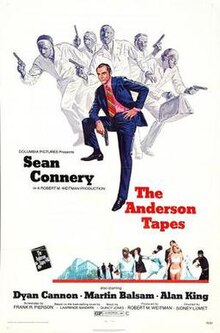
The Anderson Tapes
In a little over two years writing reviews here, I've watched my fair share of heist movies (11 if I've got the tags right). It's that perfect blend of action, suspense and drama all wrapped up into one as -- typically -- a group of specialists work together to steal something thought unattainable. Inception had dreams, Goldfinger was Fort knox, and Heat was piles of money. It's almost always one specific thing. That's not the case with 1971's The Anderson Tapes where the target isn't one thing, but one apartment building and everything in it.
To say director Sidney Lumet is slumming here isn't fair, but I'll admit it was the first thing I thought when his name popped up in the opening credits. This is the man who directed 12 Angry Men, Network, Dog Day Afternoon, Serpico, and so many more classic movies, and now he's directing a good old-fashioned heist movie? With a director of his caliber, I don't know if you can call it slumming, but it's a hell of a lot of fun to see someone like Lumet try a more mainstream movie dead set on entertaining more than delivering a message. It is a movie that isn't particularly unique compared to most heist movies, but it is solid all around and very entertaining.
After 10 years in prison for a burglary charge, master thief Duke Anderson (Sean Connery) visits an old girlfriend, Ingrid (Dyan Cannon), who lives in a posh apartment in New York City. Duke is looking for a job to pull off -- any job at all -- and realizes it's staring him dead in the face. Ingrid's building has 12 separate apartments owned by doctors and lawyers and all of society's best (translation = richest). Duke goes about putting together a motley crew of crooks and ex-cons to pull off the job, even going to the mob and kingpin, Angelo (Alan King) for backing. But as he goes about planning the elaborate heist of 12 apartments at one time, Duke realizes security has changed since he went into jail? Security cameras are everywhere, and it seems someone is watching him.
Released in 1971, this is a movie that at the time must have felt like a futuristic look at security with all its high-tech equipment. Now in 2011, it seems very dated that a team of crooks would be even slowed up by a security camera here and there. Composer Quincy Jones' score even plays that up with a robotic, electronic sound which is more distracting than necessary. The subplot with Anderson being constantly videotaped (hence the title of the movie) is disappointing though, not really going anywhere. It is the type of story where all these unknown elements feel like they're building to a huge, twist ending, but it never comes. The final scene is disappointing in that way as so many different elements and unanswered questions don't gel in the end.
That complaint aside, I really enjoyed this movie. This was one of Connery's movies in between James Bond roles, and before he returned to the part in Diamonds are Forever later in 1971. He is one of my all-time favorite actors so seeing him in a well-made heist movie is a cinch for me. His Duke Anderson is tough, intelligent and after 10 years in jail...desperate. He wants and needs to pull of a job. It's as high risk as they come, but the potential for payout at the end is huge so he puts it all on the line. I would have liked a little more resolution late in the movie with his character, but it does make it pretty clear what happens to him. Connery has a good chemistry too with Cannon in their few scenes together (he plays up his sexy, hairy Bond angle). If nothing else, 'Anderson' is worth seeing to get a glimpse of Connery without his toupee, just his thinning hair here.
So in the action equivalent of a men on a mission movie, Connery's Anderson must assemble a team of specialists to help him pull off the job. This is where 'Anderson' is better than most, the supporting cast. Martin Balsam is a scene-stealer and downright hilarious as Haskins, a gay interior decorator along to pick out what's valuable and what isn't worth stealing in the building. Stereotypical and a little politically incorrect? You bet, but it's funny. In one of his first featured roles, a young Christopher Walken plays the Kid, a young ex-con who's an expert in safecracking and dismantling alarms. There's also Val Avery as Parelli, the mob muscle, Dick Anthony Williams as Spencer, the getaway driver, Stan Gottlieb as Pop, an ex-con struggling to adjust to life outside prison, and Paul Benjamin as Spencer's former partner in crime along to help. With smaller parts, Anderson's crew makes the most of it, helping each character leave a lasting impression even with their limited screen-time.
Prior to the heist, there is little in the way of explanation of how Duke and Co. are going to pull this off so not surprisingly, the 40-minute heist sequence to close the movie out is a high point. Lumet films in it a unique way, showing the team get into an apartment, flash to the occupants later being interviewed by the police explaining what happened, and then bouncing back to inside the apartment during the job. It's a cool technique that keeps you guessing because if you pay attention in the background, you see clues of how the job went and if it was successful or not. In the heist, look for Ralph Meeker as a police commander brought in to deal with the crooks, and future SNL star Garrett Morris as a leader of a SWAT team. Nothing new, nothing flashy here, just a solid, exciting heist movie with a good cast.
The Anderson Tapes <---trailer (1971): ***/****
To say director Sidney Lumet is slumming here isn't fair, but I'll admit it was the first thing I thought when his name popped up in the opening credits. This is the man who directed 12 Angry Men, Network, Dog Day Afternoon, Serpico, and so many more classic movies, and now he's directing a good old-fashioned heist movie? With a director of his caliber, I don't know if you can call it slumming, but it's a hell of a lot of fun to see someone like Lumet try a more mainstream movie dead set on entertaining more than delivering a message. It is a movie that isn't particularly unique compared to most heist movies, but it is solid all around and very entertaining.
After 10 years in prison for a burglary charge, master thief Duke Anderson (Sean Connery) visits an old girlfriend, Ingrid (Dyan Cannon), who lives in a posh apartment in New York City. Duke is looking for a job to pull off -- any job at all -- and realizes it's staring him dead in the face. Ingrid's building has 12 separate apartments owned by doctors and lawyers and all of society's best (translation = richest). Duke goes about putting together a motley crew of crooks and ex-cons to pull off the job, even going to the mob and kingpin, Angelo (Alan King) for backing. But as he goes about planning the elaborate heist of 12 apartments at one time, Duke realizes security has changed since he went into jail? Security cameras are everywhere, and it seems someone is watching him.
Released in 1971, this is a movie that at the time must have felt like a futuristic look at security with all its high-tech equipment. Now in 2011, it seems very dated that a team of crooks would be even slowed up by a security camera here and there. Composer Quincy Jones' score even plays that up with a robotic, electronic sound which is more distracting than necessary. The subplot with Anderson being constantly videotaped (hence the title of the movie) is disappointing though, not really going anywhere. It is the type of story where all these unknown elements feel like they're building to a huge, twist ending, but it never comes. The final scene is disappointing in that way as so many different elements and unanswered questions don't gel in the end.
That complaint aside, I really enjoyed this movie. This was one of Connery's movies in between James Bond roles, and before he returned to the part in Diamonds are Forever later in 1971. He is one of my all-time favorite actors so seeing him in a well-made heist movie is a cinch for me. His Duke Anderson is tough, intelligent and after 10 years in jail...desperate. He wants and needs to pull of a job. It's as high risk as they come, but the potential for payout at the end is huge so he puts it all on the line. I would have liked a little more resolution late in the movie with his character, but it does make it pretty clear what happens to him. Connery has a good chemistry too with Cannon in their few scenes together (he plays up his sexy, hairy Bond angle). If nothing else, 'Anderson' is worth seeing to get a glimpse of Connery without his toupee, just his thinning hair here.
So in the action equivalent of a men on a mission movie, Connery's Anderson must assemble a team of specialists to help him pull off the job. This is where 'Anderson' is better than most, the supporting cast. Martin Balsam is a scene-stealer and downright hilarious as Haskins, a gay interior decorator along to pick out what's valuable and what isn't worth stealing in the building. Stereotypical and a little politically incorrect? You bet, but it's funny. In one of his first featured roles, a young Christopher Walken plays the Kid, a young ex-con who's an expert in safecracking and dismantling alarms. There's also Val Avery as Parelli, the mob muscle, Dick Anthony Williams as Spencer, the getaway driver, Stan Gottlieb as Pop, an ex-con struggling to adjust to life outside prison, and Paul Benjamin as Spencer's former partner in crime along to help. With smaller parts, Anderson's crew makes the most of it, helping each character leave a lasting impression even with their limited screen-time.
Prior to the heist, there is little in the way of explanation of how Duke and Co. are going to pull this off so not surprisingly, the 40-minute heist sequence to close the movie out is a high point. Lumet films in it a unique way, showing the team get into an apartment, flash to the occupants later being interviewed by the police explaining what happened, and then bouncing back to inside the apartment during the job. It's a cool technique that keeps you guessing because if you pay attention in the background, you see clues of how the job went and if it was successful or not. In the heist, look for Ralph Meeker as a police commander brought in to deal with the crooks, and future SNL star Garrett Morris as a leader of a SWAT team. Nothing new, nothing flashy here, just a solid, exciting heist movie with a good cast.
The Anderson Tapes <---trailer (1971): ***/****
Tuesday, January 11, 2011
Breakfast at Tiffany's
I can't remember the last movie that threw me off as much as the 1961 classic Breakfast at Tiffany's. I'd never seen it before today and knew nothing about it other than the setting of 1960s New York City, the style, and of course, Audrey Hepburn. My sister swears by this movie so really, that was my only exposure to it. So over the years, did I convince myself that the movie was something else, something vastly different? I didn't know what to expect heading into the movie and was quickly surprised by the route this story took. I don't even know where to start so bear with me.
My biggest preconceived notion of this movie heading into it was that it was the epitome of timeless style, the very beautiful Audrey Hepburn representing this ideal woman that all other women aspire to be. There are posters, books, puzzles, coffee cups, t-shirts, anything at all you care to name with Hepburn on it. So why does this movie get held in such high regard? Is it the style alone? Because honestly, this is an incredibly depressing movie. It's based on a novella from Truman Capote -- master of weirdness and eccentricity -- and is definitely a casualty of the decade/era it was released. So here goes, I'll try and be fair.
Washed-up writer Paul Varjak (George Peppard) is moving into his newly furnished New York City apartment when he meets one of the other tenants in the building, Holly Golightly (Hepburn). To say the least, Paul doesn't know what to make of this young woman, a carefree individual who seems to float along wherever life will take her. She is the oddest of oddballs and lives on a series of whims and gut feelings, not wanting to get pegged down wherever she is or whatever she is doing. Paul is instantly intrigued (and probably a little attracted) by Holly, but he just can't figure her out. They seem like such different people, but really, they're almost the same person and as Paul figures out, they belong together. Can he convince Holly of that though?
Okay, for openers director Blake Edwards is handicapped by 1960s censors and limitations around his storytelling. He is limited by what he can actually do or have characters talk about so instead of actual revelations or explanations we get subtle roundabouts and hints at what is going on. I was more than a little taken aback to find out that Hepburn's Holly is a call girl and Peppard's Paul is a gigolo. Really?!? None of this is ever directly addressed, but it's fairly obvious to put 2 and 2 together to make four. Weirder though, Holly is a call girl/escort who takes the money of the guy she's with and then bails on him, later calling him a 'rat' or 'super-rat.' Paul seems to have one customer -- Patricia Neal's 2-E, a middle-aged married woman -- after giving up a potentially lucrative writing career.
So the stylish duo is a call girl and a gigolo, not a movie breaker in the least, right? Okay, it did take awhile to get used to that idea, especially in a movie released in theaters in 1961 and held in such high regard some 50 years later. But that's the least of the problems if you ask me. At a certain point you just accept what the characters are. It's that the movie doesn't know what it wants to say or where to go. Are we supposed to support Holly or even like her? In reality, her character is not likable but as a wise IMDB poster explains...'She's pretty so we like her.' Is it a drama or a romantic comedy? Is it neither? Are we supposed to drift along and let the movie wash over us? I was surprised by where the movie went in the last half hour, but it was one in a long line of surprises.
Now where I can understand moviegoers falling in love with 'Tiffany's' is in the casting of Hepburn and Peppard. Throw aside the fact that both characters are willing to sleep with you for cash. There hasn't been a more classically beautiful actress in Hollywood before or since Audrey Hepburn. She's that perfect blend of cuteness and being amazingly sexy. She's headstrong and funny, adorable and cute, vulnerable and exciting, all rolled into one. The chemistry Hepburn has with Peppard is top-notch and is believable in a way that never makes you question if they're acting. They're just good together, plain and simple. Hepburn is the vision of beauty as Holly, a stylish icon that will not be soon forgotten in movie lore. Yes, her character isn't always likable -- Peppard either to a lesser degree -- but credit to both actors for making Holly and Paul not despicable to the point where you hate them and the movie they're in.
Maybe this is a movie that will hit me differently after I digest it fully in a couple of days, but I doubt it. As a whole, finished product, it is an odd movie and there's no other way to describe it. Also in the cast is Buddy Ebsen as Doc, a man from Holly's past, Martin Balsam as O.J., her quasi-agent, and Mickey Rooney in one of the most grossly stereotypical performances I've ever seen, playing an Asian man living in Holly's building. If it was intended as humor, it falls horrifically short. Too bad because Rooney is typically one of the most reliable character actors around. All in all, I can't give this a positive rating, but if I was it'd be because I looked at it through romantic comedy-colored glasses. Hepburn is perfect, Peppard is cool and NYC never looked so stylish.
Breakfast at Tiffany's <---trailer (1961): ** 1/2 /****
My biggest preconceived notion of this movie heading into it was that it was the epitome of timeless style, the very beautiful Audrey Hepburn representing this ideal woman that all other women aspire to be. There are posters, books, puzzles, coffee cups, t-shirts, anything at all you care to name with Hepburn on it. So why does this movie get held in such high regard? Is it the style alone? Because honestly, this is an incredibly depressing movie. It's based on a novella from Truman Capote -- master of weirdness and eccentricity -- and is definitely a casualty of the decade/era it was released. So here goes, I'll try and be fair.
Washed-up writer Paul Varjak (George Peppard) is moving into his newly furnished New York City apartment when he meets one of the other tenants in the building, Holly Golightly (Hepburn). To say the least, Paul doesn't know what to make of this young woman, a carefree individual who seems to float along wherever life will take her. She is the oddest of oddballs and lives on a series of whims and gut feelings, not wanting to get pegged down wherever she is or whatever she is doing. Paul is instantly intrigued (and probably a little attracted) by Holly, but he just can't figure her out. They seem like such different people, but really, they're almost the same person and as Paul figures out, they belong together. Can he convince Holly of that though?
Okay, for openers director Blake Edwards is handicapped by 1960s censors and limitations around his storytelling. He is limited by what he can actually do or have characters talk about so instead of actual revelations or explanations we get subtle roundabouts and hints at what is going on. I was more than a little taken aback to find out that Hepburn's Holly is a call girl and Peppard's Paul is a gigolo. Really?!? None of this is ever directly addressed, but it's fairly obvious to put 2 and 2 together to make four. Weirder though, Holly is a call girl/escort who takes the money of the guy she's with and then bails on him, later calling him a 'rat' or 'super-rat.' Paul seems to have one customer -- Patricia Neal's 2-E, a middle-aged married woman -- after giving up a potentially lucrative writing career.
So the stylish duo is a call girl and a gigolo, not a movie breaker in the least, right? Okay, it did take awhile to get used to that idea, especially in a movie released in theaters in 1961 and held in such high regard some 50 years later. But that's the least of the problems if you ask me. At a certain point you just accept what the characters are. It's that the movie doesn't know what it wants to say or where to go. Are we supposed to support Holly or even like her? In reality, her character is not likable but as a wise IMDB poster explains...'She's pretty so we like her.' Is it a drama or a romantic comedy? Is it neither? Are we supposed to drift along and let the movie wash over us? I was surprised by where the movie went in the last half hour, but it was one in a long line of surprises.
Now where I can understand moviegoers falling in love with 'Tiffany's' is in the casting of Hepburn and Peppard. Throw aside the fact that both characters are willing to sleep with you for cash. There hasn't been a more classically beautiful actress in Hollywood before or since Audrey Hepburn. She's that perfect blend of cuteness and being amazingly sexy. She's headstrong and funny, adorable and cute, vulnerable and exciting, all rolled into one. The chemistry Hepburn has with Peppard is top-notch and is believable in a way that never makes you question if they're acting. They're just good together, plain and simple. Hepburn is the vision of beauty as Holly, a stylish icon that will not be soon forgotten in movie lore. Yes, her character isn't always likable -- Peppard either to a lesser degree -- but credit to both actors for making Holly and Paul not despicable to the point where you hate them and the movie they're in.
Maybe this is a movie that will hit me differently after I digest it fully in a couple of days, but I doubt it. As a whole, finished product, it is an odd movie and there's no other way to describe it. Also in the cast is Buddy Ebsen as Doc, a man from Holly's past, Martin Balsam as O.J., her quasi-agent, and Mickey Rooney in one of the most grossly stereotypical performances I've ever seen, playing an Asian man living in Holly's building. If it was intended as humor, it falls horrifically short. Too bad because Rooney is typically one of the most reliable character actors around. All in all, I can't give this a positive rating, but if I was it'd be because I looked at it through romantic comedy-colored glasses. Hepburn is perfect, Peppard is cool and NYC never looked so stylish.
Breakfast at Tiffany's <---trailer (1961): ** 1/2 /****
Thursday, February 18, 2010
Murder on the Orient Express
Different directors have different personalities, different ways audiences look at them. Michael Bay? Loud, explosive movies. James Cameron? Huge blockbusters. Still chugging along at 86 years old, director Sidney Lumet has had a knack for working with some of Hollywood’s biggest stars in movies with a long list of those biggest stars. Working off an Agatha Christie source novel, 1974’s Murder on the Orient Express assembles one of the most impressive casts ever assembled.
Playing Belgian detective Hercule Poirot, Albert Finney leads this cast in an enjoyable, ridiculous murder mystery set in the 1935. Finney is in just about every scene and dominates the movie. I’ve never read a Christie novel or anything at all related with Poirot, but this character reminded me of Peter Falk’s TV detective Columbo. A quirky, eccentric detective solves convoluted crimes that no person in their right mind should be able to comprehend.
Boarding the Orient Express after receiving orders to return to London, famed detective Hercule Poirot (Finney) is given a berth on the crowded train thanks to a railroad official (Martin Balsam) and long-time friend. But on the second night out, a mysterious American passenger, Ratchett (Richard Widmark), is murdered, stabbed through the midsection 12 times. The railroad official turns to Poirot to solve the murder before the train reaches the next station. A snow-covered pass blocks the train’s way, giving Poirot free range to go about solving the mystery. The detective quickly figures out that Ratchett was involved in a well-known kidnapping case. So was it a hired killer, or was one of the many passengers onboard the murderer?
The murder mystery itself is an interesting one that unfolds quickly in the first 30 minutes or so. The whole next hour is devoted to a series of interrogations/interviews as Finney’s Poirot and Balsam’s Bianchi assemble the evidence concerning Ratchett’s murder. With a dialogue-heavy movie, the story sinks or swims on these scenes. In that sense, it swims long and hard. Finney earned an Oscar nomination for his performance, and it’s a treat to watch him interact with his supporting cast.
The cast is a who’s who of Hollywood stars from the Golden Age and then a newer wave of younger stars making a name for themselves and then a few in between. Describing all these characters would require a whole other review in itself so I’ll try and keep it shorter. Along with Finney, Balsam, and Widmark, there’s a list of names that include Anthony Perkins, Ingrid Bergman (Oscar-nominated supporting part), Lauren Bacall, Sean Connery, Michael York, Jacqueline Bisset, Vanessa Redgrave, Jean-Pierre Cassel, and John Gielgud. Most of them are given a brief intro and then their interrogations with Poirot. Basically that amounts to a cameo-like role for all of them, but it’s great just to see all those big-names working together.
SPOILERS Don’t read anymore if you want to know who the murderer is SPOILERS. Poirot does his detective work and then confronts all the train’s passengers. His conclusion? They all murdered Ratchett, each stabbing him once with the same knife. Each passenger has a connection to an infamous kidnapping case that Widmark’s Ratchett masterminded, resulting in the death of five people. So working together, the murdering dozen or so have planned this murder to a fault…they just didn’t plan on Poirot being onboard. This twist is stupid, ridiculous, over the top, and somehow…it works. The ending itself is a bit of a letdown, but that’s a minor complaint.
The reveal itself is well-handled in an almost 30-minute scene where all the clues and evidence comes together. Lumet handles it perfectly with quick flashbacks to Poirot’s questioning as Finney seemingly lose his mind only to figure everything out. And that’s why this is a movie worth watching, the performances from Finney to the long list of A-list actors making the most of their supporting roles. More than a little beyond the limits of believability, but still fun from beginning to end.
Murder on the Orient Express <----trailer (1974): ***/****
Wednesday, November 4, 2009
The Good Guys and the Bad Guys
Between 1966-69, established star Robert Mitchum made eight movies (so much for slowing down later in your career). Six of the eight were westerns ranging from near classics, 1966's El Dorado, to average, Young Billy Young. Mitchum seemed to know what his fans wanted, and from reading his biography, he actually enjoyed making westerns, he stuck with the genre. Why fix something that isn't broken? What sets 'Good Guys' apart from many wild west stories is that it deals with the closing of the west, but with some humor. We're not talking the grandiose violence of The Wild Bunch here.
In the town of Progress, U.S. Marshal James Flagg (Mitchum) tells the mayor, Randolph Wilker (a very funny Martin Balsam), that a gang has been spotted in the area. Leading the group is Big John McKay (George Kennedy), an old rival of Flagg's believed to have been killed in a bank robbery in Texas on the Red River. Flagg guesses that the gang is going to knock off a train carrying $100,000 for the new bank in town, but Wilker has another idea. The mayor retires Flagg -- ceremony and gold watch included-- and puts his own man in charge, leaving the marshal to take matters into his own hands.
Flagg pursues the gang but ends up a prisoner with who else as his guard, McKay. The gang has been taken over by a young outlaw, Waco (David Carradine), who doesn't have much regard for the veteran outlaw. Rescued by an old mule skinner, Grundy (Douglas Fowley), Flagg heads back to town with a handcuffed McKay. But when the chips are down, the marshal/outlaw combo realize they need to help each other so Flagg and McKay team up to stop Waco's gang from hitting the train, deciding they can't attack the train if it doesn't stop in Progress.
For the first hour or so, the comedy here is pretty low-key as Mitchum's Flagg deals with the forward-thinking mayor who's more concerned about the upcoming election than anything else. In Progress, the crowded, paved streets are covered with cars while Flagg rides through on his trusty horse. The humor is saved for the finale as Mitchum and Kennedy hijack the train with Waco's gang riding to catch up and Mayor Wilker leading a posse of cars, wagons, horsemen, and railroad push carts in pursuit. There's a great helicopter shot of the prolonged chase that is a site to see.
As the rivals who aren't so different, Mitchum and Kennedy bring the movie up a notch from what would have been a much lesser western without strong actors in these roles. It's the early 1900s and for better or worse, the duo has 'outlived their usefullness' as technology and the changing times have pushed gun-toting peace officers and bank robbers out the door. After they return to town, the two have a great scene as they discuss what used to be and how things aren't like they used to be. Flagg's been relieved of his duties and McKay has been left behind by his gang. So with nothing else to do, the former marshal and the former outlaw say 'what the hell?' and team up.
I'll recommend this movie mostly because of Mitchum, a long-time movie star, and Kennedy, who was still relatively new to movies after spending years in guest starring spots on TV shows. As always, Mitchum has this ease of making characters likable, and it's nice to see him in a good guy role. He was known for playing roguish brutes who were ultimately good, but Flagg is good through and through, even getting his own theme song. Kennedy gets some good laughs as McKay and has some great chemistry with Mitchum in their scenes together. Other cast members include Tina Louise as a married woman looking for a fling with the mayor, Lois Nettleton as Mary, the owner of the boarding house who is with Flagg, and John Davis Chandler as Deuce, a psychotic member of Waco's gang. Carradine is given little to do and has no background as Waco, but Carradine was intimidating and a good villain just standing there.
Absolutely nothing spectacular about this one --check that, the New Mexico locations are beautiful-- but as you've most likely figured out, a western has to be bottom of the barrel for me not to find something redeeming about it. Watch this one for typically strong performances from Robert Mitchum and George Kennedy and a great supporting part for Martin Balsam. Couldn't find a trailer on Youtube, but that's a good thing. The one featured on the DVD special features was unintentionally corny while also giving away the ending.
The Good Guys and the Bad Guys (1969): ** 1/2 /****
Sunday, July 12, 2009
Cape Fear
In my reviews since I started the blog in January, I've covered a handful of movies with Robert Mitchum in a starring role. He's always been an actor I appreciated, but the more I watch with him the higher he climbs into the list of my all-time favorite actors. But as much as he's known for being the smooth, often laid back anti-hero, two of his most well-known roles are of villains possibly bordering on insane.
In Night of the Hunter, he plays a religious fanatic, a preacher on the trail of a stash of money in the deep South. And in the other part in 1962's Cape Fear, Mitchum stars as Max Cady, an ex-con looking for revenge. Where Mitchum stands out from many actors of his generation is his physical presence on-screen. Like Marlon Brando, he just had an animalistic quality to him, an intensity brewing that was just waiting to explode. He could handle the dramatic scenes easily, delivering dialogue in a smooth, cool manner, but it's his presence that draws the eye, or at least mine when he's onscreen.
On the Cape Fear DVD, co-star Gregory Peck admits that as casting was being done he told the director that the meatier part was the supporting role, the part that went to Mitchum. Peck seems content in the movie to sit back and let Mitchum do his thing. If it was a comedy, oh the possibililties, Peck is the straight man to Mitchum's crazy antics. The two differing styles have a nice way of balancing each other out in the movie.
Living in Savannah with his wife, Peggy (Polly Bergen), and young teenage daughter, Nancy (Lori Martin), lawyer Sam Bowden (Peck) has a good life until one day a violent man from his past arrives in town. The man is Max Cady, a convict fresh out of jail after serving an 8-year sentence for physically assaulting a woman. Bowden's testimony put Cady away, and now the ex-con is looking for some revenge. Because of his time in jail, Max's wife divorced him and took their son with so Cady intends to even things up.
But even aware of the threat that's always there, Sam has little recourse about what to do. Max has not done anything that's against the law, and as Martin Balsam's Chief Dutton says 'You can't arrest a man for something he's thought about.' So waiting for Cady to strike in one way or another, Sam and his family live with the constant fear that some sort of attack is coming their way. Finally pushed to the breaking point when he finds out Cady intends to rape his young daughter, Sam puts together a desperate plan in hopes of baiting the ex-con to attack.
Filmed in black and white and shot on location in Savannah for some nice-looking shots, Cape Fear is the definition of what a good psychological thriller can be. Max Cady is a villain not because we've seen what he'll do, instead it's what he is capable of that can be scary. And with that, Mitchum is the ideal actor for the part. One look, one evil little grin, and you know what's on his mind. He plays mind games with Sam and his family, driving them insane slowly but surely. In the B&W, there's a film noir edge to the story.
Cady is often shot in the shadows, whether it be in brush observing the Bowdens or just sitting in a bar oggling a woman nursing her drink. The character is a ticking time bomb, and it's just a matter of time before that bomb goes off. With a score from composer Bernard Herrmann and dealing with a story that seems very Hitchcock, it's easy to see why fans could think this was an Alfred Hitchcock suspense/thriller. Parts are very similar to 1960's Psycho, both in terms of storytelling and then the actual shooting with the black and white.
It's Mitchum's movie from start to finish including a satisfying ending, but the cast is superb all around. Peck has the less flashy role, but going against a nut like Cady, he's just a father trying to protect the life he has built for his family. Bergen presents a strong female character as Peck's wife, a woman terrified of what may come but who's able to put up a brave front in hopes of saving her daughter. Playing Sam's daughter, 15-year old Martin is shot in a strange way as if from Max's POV. The camera holds on her a little longer than you'd think necessary, but it gest the point across. Max is going after her and nothing's going to stop him. From the rest of the cast, Telly Savalas has a good part as a hard-edged private detective and Barrie Chase plays Diane, a young woman who is attracted to Max's pure animal edge but comes to regret it.
But overall, I thought the movie was only 'OK.' The build-up is good as Cady starts to follow the Bowdens around, but Sam's plan just seems too farfetched. I haven't read the book so I don't know if the movie stayed true to the source material, but after a while I knew how the story was going to play out and it loses some steam. The finale itself works, but I had some trouble getting there, especially the last 30 minutes or so. Still, Cape Fear is a must-see for movie fans. Robert Mitchum carries the movie in a terrifying and real performance as an ex-con with a mind for revenge.
Cape Fear <---- trailer (1962): ** 1/2 /****
In Night of the Hunter, he plays a religious fanatic, a preacher on the trail of a stash of money in the deep South. And in the other part in 1962's Cape Fear, Mitchum stars as Max Cady, an ex-con looking for revenge. Where Mitchum stands out from many actors of his generation is his physical presence on-screen. Like Marlon Brando, he just had an animalistic quality to him, an intensity brewing that was just waiting to explode. He could handle the dramatic scenes easily, delivering dialogue in a smooth, cool manner, but it's his presence that draws the eye, or at least mine when he's onscreen.
On the Cape Fear DVD, co-star Gregory Peck admits that as casting was being done he told the director that the meatier part was the supporting role, the part that went to Mitchum. Peck seems content in the movie to sit back and let Mitchum do his thing. If it was a comedy, oh the possibililties, Peck is the straight man to Mitchum's crazy antics. The two differing styles have a nice way of balancing each other out in the movie.
Living in Savannah with his wife, Peggy (Polly Bergen), and young teenage daughter, Nancy (Lori Martin), lawyer Sam Bowden (Peck) has a good life until one day a violent man from his past arrives in town. The man is Max Cady, a convict fresh out of jail after serving an 8-year sentence for physically assaulting a woman. Bowden's testimony put Cady away, and now the ex-con is looking for some revenge. Because of his time in jail, Max's wife divorced him and took their son with so Cady intends to even things up.
But even aware of the threat that's always there, Sam has little recourse about what to do. Max has not done anything that's against the law, and as Martin Balsam's Chief Dutton says 'You can't arrest a man for something he's thought about.' So waiting for Cady to strike in one way or another, Sam and his family live with the constant fear that some sort of attack is coming their way. Finally pushed to the breaking point when he finds out Cady intends to rape his young daughter, Sam puts together a desperate plan in hopes of baiting the ex-con to attack.
Filmed in black and white and shot on location in Savannah for some nice-looking shots, Cape Fear is the definition of what a good psychological thriller can be. Max Cady is a villain not because we've seen what he'll do, instead it's what he is capable of that can be scary. And with that, Mitchum is the ideal actor for the part. One look, one evil little grin, and you know what's on his mind. He plays mind games with Sam and his family, driving them insane slowly but surely. In the B&W, there's a film noir edge to the story.
Cady is often shot in the shadows, whether it be in brush observing the Bowdens or just sitting in a bar oggling a woman nursing her drink. The character is a ticking time bomb, and it's just a matter of time before that bomb goes off. With a score from composer Bernard Herrmann and dealing with a story that seems very Hitchcock, it's easy to see why fans could think this was an Alfred Hitchcock suspense/thriller. Parts are very similar to 1960's Psycho, both in terms of storytelling and then the actual shooting with the black and white.
It's Mitchum's movie from start to finish including a satisfying ending, but the cast is superb all around. Peck has the less flashy role, but going against a nut like Cady, he's just a father trying to protect the life he has built for his family. Bergen presents a strong female character as Peck's wife, a woman terrified of what may come but who's able to put up a brave front in hopes of saving her daughter. Playing Sam's daughter, 15-year old Martin is shot in a strange way as if from Max's POV. The camera holds on her a little longer than you'd think necessary, but it gest the point across. Max is going after her and nothing's going to stop him. From the rest of the cast, Telly Savalas has a good part as a hard-edged private detective and Barrie Chase plays Diane, a young woman who is attracted to Max's pure animal edge but comes to regret it.
But overall, I thought the movie was only 'OK.' The build-up is good as Cady starts to follow the Bowdens around, but Sam's plan just seems too farfetched. I haven't read the book so I don't know if the movie stayed true to the source material, but after a while I knew how the story was going to play out and it loses some steam. The finale itself works, but I had some trouble getting there, especially the last 30 minutes or so. Still, Cape Fear is a must-see for movie fans. Robert Mitchum carries the movie in a terrifying and real performance as an ex-con with a mind for revenge.
Cape Fear <---- trailer (1962): ** 1/2 /****
Labels:
1960s,
Film Noir,
Gregory Peck,
J Lee Thompson,
Martin Balsam,
Robert Mitchum,
Telly Savalas
Subscribe to:
Posts (Atom)