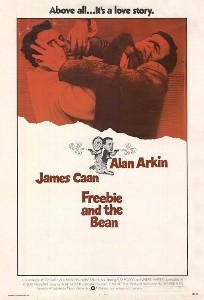
Let's get down to business. And I mean business. The buddy cop genre is the greatest genre in the history of cinema. Go ahead. I dare you to identify one that is better. See? You simply can-not. There were sprinklings before here and there, but the genre took off in the 1980's. One of those early sprinklings? An oddball, off-the-wall, politically incorrect comedy from 1974's Freebie and the Bean.
Longtime partners working the Intelligence Unit in San Francisco, Bean (Alan Arkin) and Freebie (James Caan) usually get the job done, sometimes in spite of themselves with their constant bickering. Their latest target? The duo has long sought to put well-known and long successful racketeer Red Meyers (Jack Kruschen) behind bars. After most of a year investigating, they've got the evidence -- finally -- but the key witness can't be put into custody for three more days. The solution? Freebie and Bean must shadow Meyers and make sure nothing goes wrong before they can officially arrest him. There are problems of course. Many people would be in trouble should Meyers testify so a hit man from Detroit (maybe more) has been dispatched to finish him. Oh, and it's Super Bowl week. Oh, and Freebie and Bean might kill each other in the process. What could possibly go wrong?
Reading some reviews and message boards about this 1974 buddy cop flick, I saw a lot of people questioning why this is a movie just about completely forgotten over the years. I'm glad I wasn't the only one to think of that issue. I love James Caan and Alan Arkin, and I'd never even vaguely, remotely even kinda heard of it. Why is that? Well, it's not a classic, but it's pretty good. It is kooky, completely without a story, has tonal shifts left and right, is especially goofy and is incredibly politically incorrect. There are flaws, but my goodness, is it a fun ride.
Arkin and Caan. Caan and Arkin. How can you possibly go wrong? You can't here. Two of my favorite actors working together make it look effortless. As you expect from any buddy cop pairing, the duo has to bitch and moan and criticize and ridicule...even though they're the best of friends. Arkin is Bean, a Mexican officer, all business, no nonsense. Caan is Freebie, wild and all over the place and not one to turn down a free gift here and there (hence the nickname). The story drifts as needed, and you get a sense the script was a couple set pieces, an outline of a story, and just blank sports for Arkin and Caan to improvise, to fire lightning fast insults and jokes and one-liners for as long as they could. Too many classic lines to mention -- most of them foul-mouthed, racist, sexist and generally inappropriate -- but quite the Batman and Batman (no Robin here) to lead the way.
'Freebie/Bean' comes from director Richard Rush and comes as a bit of fresh air considering the time it was released. We're talking cynical cop flicks like French Connection, Bullitt, the Dirty Harry movies and plenty others. It's just a funny movie. That's all and that's it. That's not a bad thing. You sit back and enjoy it because there isn't any messages in sight or anything dark or hard-hitting. These are two cops who are friends and fight like an old married couple bombing their way through San Francisco who stop at nothing to put their case together. If half the city should be destroyed in the process....well, so be it. We had a good time. San Francisco looks great as a backdrop as well, an interesting choice considering so many cop movies were shot on-location there. Moral of the story? As much as I love those previously mentioned flicks, it's cool to see a cop movie do a complete 180.
Who else to look for? Some fun, familiar faces. Kruschen has a ton of fun as Meyers, the racketeer who can't believe how stupid the cops pursuing him really are. Loretta Swit of MASH fame plays his pretty young wife. Also look for Alex Rocco as the conviction rate-minded district attorney, Mike Kellin as the boys' lieutenant, Paul Koslo and Christopher Morley as a couple witnesses, and a scene-stealing Valerie Harper as Bean's possibly cheating wife, Consuelo.
So there's gotta be something wrong...right? It's the bizarre, often out of left field shifts in tone. It's dark and funny and politically incorrect, and then a complete direction change into a never-ending car and motorcycle chase (had...HAD to be an influence on The Blues Brothers) that relies on sight gags and Keystone Cops-esque humor. There's little warning too as things shift, especially toward the end with more than a few crazy twists, some that work, some that are shocking, and one that almost had me questioning the whole movie. Thankfully, it was a twist within a twist in a mystery surrounded by a paradox. Anyhoo, this is all complaining to complain. The movie is a ton of fun with one laugh after another. It's James Caan and Alan Arkin basically spending 2 hours causing collateral damage and bitching at each other in their downtime. If that's not a recipe for success, I don't know what is.
Freebie and the Bean (1974): ***/****
The Sons of Katie Elder
"First, we reunite, then find Ma and Pa's killer...then read some reviews."
Showing posts with label Paul Koslo. Show all posts
Wednesday, September 16, 2015
Freebie and the Bean
Labels:
1970s,
Alan Arkin,
Alex Rocco,
Comedy,
Cops,
Jack Kruschen,
James Caan,
Mike Kellin,
Paul Koslo
Thursday, July 17, 2014
The Losers (1970)
Well, at the rate I'm going, I'll watch a new biker movie every year or so. It's not that I don't like them, far from it. It's that at times, it can be difficult to find good ones, even viewable ones. So following up 1968's The Savage Seven (a very pleasant surprise) and 1969's Hell's Angels '69 (liked it a lot, heist movie meets biker movie), here's 1970's The Losers.
At a a remote Army outpost deep in Vietnam, a heavily armed patrol cuts through several Viet Cong ambushes to deliver a special team being used for an almost suicidal mission. Who steps out of the Army truck? Five Hells Angels bikers led by Link Thomas (William Smith), a tough as nails biker recruited by his brother, an Army major (Dan Kemp), who's limited by international law as to what he can do. Just across the border a few miles into Cambodia, an American diplomat/CIA agent is a prisoner of the North Vietnamese and Viet Cong forces, but American forces aren't allowed to cross the border to rescue him. On the other hand, there's nothing stopping five rogue Hells Angels from hopping on their bikes and riding into Cambodia. With Army backing as long as they're in Vietnam, Link and his men armor their motorcycles with armor-plating, heavy machine guns and grenades, all the while preparing to go in and rescue the captured American.
There are certain low budget genres you just know aren't going to be truly quality moments, many of them from the late 1960s and into the 1970s. Think of the lousier spaghetti westerns, gory, schlocky horror flicks, and in this case, biker flicks. Put a bunch of tough-looking, grizzled bikers on some motorcycles and let the craziness ensue, low budget be damned! If you can embrace that cheap quality, you're in for a treat. Sometimes, it's just too much. I wanted to like this biker action movie from director Jack Starrett (also starring as the paranoid, ranting CIA agent). At its heart, it is a men-on-a-mission movie, a bunch of oddballs working together to pull off a suicide mission. Even the bad ones can be good with that formula, but this one just isn't good enough to recommend. It has a moment here and there, but in between can be rough-going.
For openers, the casting felt like a good jumping off point. A physical bear of a man, Smith is Link, a Vietnam vet turned biker who assembles a team of bikers to pull off a rescue at his brother's behest. He's the leader, but an anti-hero through and through, troubled at what the war has become. He has a soft spot for some of the people he runs into, all the while trying to hold his crew together. That group includes biker regular Adam Roarke as Duke, a fellow vet looking to find a past love in the Vietnamese boonies, Paul Koslo as Limpy, similarly finding love in a rundown old house, Houston Savage as Dirty Denny, the pot-smoking, booze-swilling, three-way having biker, and Eugene Cornelius as Speed, the goofy, long-haired hippie with an odd sense of humor. There's also Bernie Hamilton as Capt. Jackson, the regular army officer tasked with keeping the Losers in line, and John Garwood playing his right-hand man, Sgt. Winston.
Some cool potential there, right? That's what I figured, but that's what it remains with little else, potential. I expected a hard-edged men on a mission movie with said men fighting impossible odds. Instead, it's a half-boiled love story. We get Roarke's Duke reuniting with his lost love, walking through the fields dreamily, wondering about the future. Koslo's Limpy falls for a Vietnamese girl with a baby and steps in as a surrogate father. What the hell happened?!? Sure, there's some biker shenanigans, Dirty Denny (of course) having a three-way and then getting in a fight with some locals. There's no story, no sense of urgency, and no rhythm in the least. The bikers party and bitch and fight and screw around, outfit their cycles, and then oh yeah, they head into Cambodia. By that point, I'd been fast-forwarding through huge stretches of so-called 'story.'
If there's a remotely positive saving grace, it is the biker attack on the Red Chinese camp in Cambodia. All sorts of crazy bike stunts, gunfire and explosions throughout make it an exciting, adrenaline-pumping shootout. That isn't the end though, some preachiness saved for the last 15 minutes as a movie about bikers on a suicide mission decides it needs to deliver a message to its viewers. Seems logical, right? The ending is not surprisingly pretty downbeat, but it was yet another case of too little, too late. A pretty bad movie, aided by two folk songs in the soundtrack that try to again, add depth to a story that simply doesn't require it.
Make a movie about Hells Angels rampaging through Vietnam and Cambodia and be content with it. Don't try and make it something more. A disappointment.
The Losers (1970): * 1/2 /****
At a a remote Army outpost deep in Vietnam, a heavily armed patrol cuts through several Viet Cong ambushes to deliver a special team being used for an almost suicidal mission. Who steps out of the Army truck? Five Hells Angels bikers led by Link Thomas (William Smith), a tough as nails biker recruited by his brother, an Army major (Dan Kemp), who's limited by international law as to what he can do. Just across the border a few miles into Cambodia, an American diplomat/CIA agent is a prisoner of the North Vietnamese and Viet Cong forces, but American forces aren't allowed to cross the border to rescue him. On the other hand, there's nothing stopping five rogue Hells Angels from hopping on their bikes and riding into Cambodia. With Army backing as long as they're in Vietnam, Link and his men armor their motorcycles with armor-plating, heavy machine guns and grenades, all the while preparing to go in and rescue the captured American.
There are certain low budget genres you just know aren't going to be truly quality moments, many of them from the late 1960s and into the 1970s. Think of the lousier spaghetti westerns, gory, schlocky horror flicks, and in this case, biker flicks. Put a bunch of tough-looking, grizzled bikers on some motorcycles and let the craziness ensue, low budget be damned! If you can embrace that cheap quality, you're in for a treat. Sometimes, it's just too much. I wanted to like this biker action movie from director Jack Starrett (also starring as the paranoid, ranting CIA agent). At its heart, it is a men-on-a-mission movie, a bunch of oddballs working together to pull off a suicide mission. Even the bad ones can be good with that formula, but this one just isn't good enough to recommend. It has a moment here and there, but in between can be rough-going.
For openers, the casting felt like a good jumping off point. A physical bear of a man, Smith is Link, a Vietnam vet turned biker who assembles a team of bikers to pull off a rescue at his brother's behest. He's the leader, but an anti-hero through and through, troubled at what the war has become. He has a soft spot for some of the people he runs into, all the while trying to hold his crew together. That group includes biker regular Adam Roarke as Duke, a fellow vet looking to find a past love in the Vietnamese boonies, Paul Koslo as Limpy, similarly finding love in a rundown old house, Houston Savage as Dirty Denny, the pot-smoking, booze-swilling, three-way having biker, and Eugene Cornelius as Speed, the goofy, long-haired hippie with an odd sense of humor. There's also Bernie Hamilton as Capt. Jackson, the regular army officer tasked with keeping the Losers in line, and John Garwood playing his right-hand man, Sgt. Winston.
Some cool potential there, right? That's what I figured, but that's what it remains with little else, potential. I expected a hard-edged men on a mission movie with said men fighting impossible odds. Instead, it's a half-boiled love story. We get Roarke's Duke reuniting with his lost love, walking through the fields dreamily, wondering about the future. Koslo's Limpy falls for a Vietnamese girl with a baby and steps in as a surrogate father. What the hell happened?!? Sure, there's some biker shenanigans, Dirty Denny (of course) having a three-way and then getting in a fight with some locals. There's no story, no sense of urgency, and no rhythm in the least. The bikers party and bitch and fight and screw around, outfit their cycles, and then oh yeah, they head into Cambodia. By that point, I'd been fast-forwarding through huge stretches of so-called 'story.'
If there's a remotely positive saving grace, it is the biker attack on the Red Chinese camp in Cambodia. All sorts of crazy bike stunts, gunfire and explosions throughout make it an exciting, adrenaline-pumping shootout. That isn't the end though, some preachiness saved for the last 15 minutes as a movie about bikers on a suicide mission decides it needs to deliver a message to its viewers. Seems logical, right? The ending is not surprisingly pretty downbeat, but it was yet another case of too little, too late. A pretty bad movie, aided by two folk songs in the soundtrack that try to again, add depth to a story that simply doesn't require it.
Make a movie about Hells Angels rampaging through Vietnam and Cambodia and be content with it. Don't try and make it something more. A disappointment.
The Losers (1970): * 1/2 /****
Labels:
1970s,
Adam Roarke,
Biker flicks,
Paul Koslo,
Vietnam War,
William Smith
Friday, April 18, 2014
Rooster Cogburn
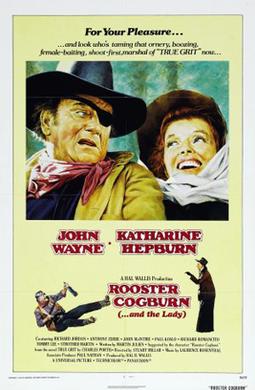
By the 1970s, there weren't too many bigger and better Hollywood legends than John Wayne and Katharine Hepburn. Both stars had been just that, stars, non-stop since the 1930s and by the mid 1970s were in the later parts of their careers. But even with all those classics films, classic roles and interesting pairings of stars, the duo had never worked together...until 1975's Rooster Cogburn, also known as Rooster Cogburn...and the Lady.
Still working as a U.S. Marshal, Rooster Cogburn (Wayne) is up to his old tricks again. Not too interested in how the law says he should bring suspects in, Cogburn has been suspended for his overzealous ways...for now. He's given his badge and title back if he promises to bring in a dangerous gang of killers led by a maniacal outlaw, Hawk (Richard Jordan). The outlaw's gang murdered an army convoy carrying nitroglycerin, shipments of rifles and a Gatling gun. Their goal? Knock off a federal depository up in the mountains. Cogburn is on their trail quickly, but he's got a problem. In Hawk's wake, the marshal finds an older woman, a missionary of sorts, Eula Goodnight (Hepburn), who saw her father and his mission almost wiped out by the gang. Cogburn hopes to bring her back to safety, but Eula has other plans. She intends to go with, helping bring her father's killers to justice.
I'm usually completely against sequels, especially when the first movie wraps up everything so nicely. That's the case with 1969's True Grit, a western that brought Wayne his only Oscar win for a long, distinguished career. It isn't a great western, but it has stood the test of time because of Wayne's scene-stealing part as Marshal Rooster Cogburn. This 1975 follow-up from director Stuart Millar takes the formula and takes it a step forward, pairing Wayne with Hepburn in a similarly scene-stealing part. Much the same way 'Grit' resonates, so does 'Rooster.' It's typical of many other late Wayne entries, straightforward and entertaining, likable, fun good guys versus dastardly bad guys, and just a lot of fun throughout. Laurence Rosenthal's score is solid, tweaking Elmer Bernstein's score from the original. Listen HERE for the theme. The Oregon locations go a long way too, the backgrounds for the shots providing a stunningly good-looking backdrop to the story.
Who are we kidding though? This is a movie that exists solely to put John Wayne and Katharine Hepburn together. The wait was worth it, the two Hollywood legends stepping to the plate in a big way. They make it look effortless. We learn some more about Rooster (including his first name), but he's still the same fat, one-eyed marshal who likes a good drink and is a tough as nails peace officer. Hepburn is not quite a spinster, but an older woman who looks to religion for answers, nagging Rooster about his drinking, his language, his boasting, a little bit of everything. The chemistry is on display from their first scene until the final scene. They argue, they bond, they talk about their pasts, finding there's plenty of differences between them, but there's also more similarities than they would have originally thought. Along for the trip is Wolf (Richard Romancito), an Indian boy in his teenage years, a capable rider who looks up to Rooster.
If you're going to have a great hero to lead the way, you need an equally bad villain to put in his way. In steps Richard Jordan, an underrated actor who never became a huge star. His Hawk is beyond intense, his upcoming robbery of a gold depository becoming almost an obsession. In some nice touches with Hawk and his gang, we learn about some past meetings with Cogburn. In his gang, look for Anthony Zerbe as Breed, a tracker/scout who used to ride with Rooster, now on the outlaw trail, and Hawk's maligned right-hand man, Luke, played by 1970s tough guy Paul Koslo. John McIntire makes a quick but memorable appearance as Judge Parker, the court representative who always has to deal with Rooster. Strother Martin hams it up in a one-scene appearance as McCoy, a cantankerous veteran of the sea now renting his raft for river crossings.
Heading into this movie, if you're looking for any sort of groundbreaking western, you're going to be disappointed. The focus is clearly on Wayne and Hepburn, the highpoints their scenes sitting around a campfire, talking while riding on a wagon, moving along the trail. The potential was there for a darker western with more shoot 'em up and gunplay, but for the most part Jordan as Hawk is underused. This is a good, old-fashioned western that plays like comfort food. Just sit back and enjoy this one.
Rooster Cogburn (1975): ***/****
Still working as a U.S. Marshal, Rooster Cogburn (Wayne) is up to his old tricks again. Not too interested in how the law says he should bring suspects in, Cogburn has been suspended for his overzealous ways...for now. He's given his badge and title back if he promises to bring in a dangerous gang of killers led by a maniacal outlaw, Hawk (Richard Jordan). The outlaw's gang murdered an army convoy carrying nitroglycerin, shipments of rifles and a Gatling gun. Their goal? Knock off a federal depository up in the mountains. Cogburn is on their trail quickly, but he's got a problem. In Hawk's wake, the marshal finds an older woman, a missionary of sorts, Eula Goodnight (Hepburn), who saw her father and his mission almost wiped out by the gang. Cogburn hopes to bring her back to safety, but Eula has other plans. She intends to go with, helping bring her father's killers to justice.
I'm usually completely against sequels, especially when the first movie wraps up everything so nicely. That's the case with 1969's True Grit, a western that brought Wayne his only Oscar win for a long, distinguished career. It isn't a great western, but it has stood the test of time because of Wayne's scene-stealing part as Marshal Rooster Cogburn. This 1975 follow-up from director Stuart Millar takes the formula and takes it a step forward, pairing Wayne with Hepburn in a similarly scene-stealing part. Much the same way 'Grit' resonates, so does 'Rooster.' It's typical of many other late Wayne entries, straightforward and entertaining, likable, fun good guys versus dastardly bad guys, and just a lot of fun throughout. Laurence Rosenthal's score is solid, tweaking Elmer Bernstein's score from the original. Listen HERE for the theme. The Oregon locations go a long way too, the backgrounds for the shots providing a stunningly good-looking backdrop to the story.
Who are we kidding though? This is a movie that exists solely to put John Wayne and Katharine Hepburn together. The wait was worth it, the two Hollywood legends stepping to the plate in a big way. They make it look effortless. We learn some more about Rooster (including his first name), but he's still the same fat, one-eyed marshal who likes a good drink and is a tough as nails peace officer. Hepburn is not quite a spinster, but an older woman who looks to religion for answers, nagging Rooster about his drinking, his language, his boasting, a little bit of everything. The chemistry is on display from their first scene until the final scene. They argue, they bond, they talk about their pasts, finding there's plenty of differences between them, but there's also more similarities than they would have originally thought. Along for the trip is Wolf (Richard Romancito), an Indian boy in his teenage years, a capable rider who looks up to Rooster.
If you're going to have a great hero to lead the way, you need an equally bad villain to put in his way. In steps Richard Jordan, an underrated actor who never became a huge star. His Hawk is beyond intense, his upcoming robbery of a gold depository becoming almost an obsession. In some nice touches with Hawk and his gang, we learn about some past meetings with Cogburn. In his gang, look for Anthony Zerbe as Breed, a tracker/scout who used to ride with Rooster, now on the outlaw trail, and Hawk's maligned right-hand man, Luke, played by 1970s tough guy Paul Koslo. John McIntire makes a quick but memorable appearance as Judge Parker, the court representative who always has to deal with Rooster. Strother Martin hams it up in a one-scene appearance as McCoy, a cantankerous veteran of the sea now renting his raft for river crossings.
Heading into this movie, if you're looking for any sort of groundbreaking western, you're going to be disappointed. The focus is clearly on Wayne and Hepburn, the highpoints their scenes sitting around a campfire, talking while riding on a wagon, moving along the trail. The potential was there for a darker western with more shoot 'em up and gunplay, but for the most part Jordan as Hawk is underused. This is a good, old-fashioned western that plays like comfort food. Just sit back and enjoy this one.
Rooster Cogburn (1975): ***/****
Saturday, October 6, 2012
The Stone Killer
The pairing of star Charles Bronson and director Michael Winner is no doubt best remembered for their 1974 film, Death Wish. Lost in the shuffle of the endless if entertaining sequels is that it's a pretty decent movie. The duo had worked together three times prior since 1972 though, including 1973's The Stone Killer, an interesting comparison piece compared to Death Wish.
Police Lieutenant Lou Torrey (Bronson) is interested in results and little else. He doesn't care how or why it got done. Cases need to get solved, crooks need to be put away. Torrey is bounced from his NYPD precinct and moves west, taking a job on the L.A. police department. Transporting a murder suspect from NYC to L.A., Torrey barely survives a hit attempt, the suspect killed by a drive-by shooter. Torrey thinks back on what happened. The suspect talked -- at the time nonsensically -- of a coming hit. Could the man have been onto something? Torrey begins to investigate, and the clues lead right to the top of the Mafia.
I've mentioned this before. Crime thrillers from the 1970s have a certain charm that you're either going to love or hate with very little middle ground. They can be low-brow, aggressively violent, sexually suggestive (usually pretty obviously), and in general.....just a hell of a lot of fun to watch. That's what you will be getting here with this Bronson-Winner pairing. Bouncing back and forth between NYC and L.A., the story never slows down as Bronson's Torrey gets deeper into the case. The soundtrack from Roy Budd is an odd mix of jazz and funk (listen HERE), but it works in a ridiculous way. That low-budget, gritty, dirty feel permeates the story -- for the better -- and even when it's not a "good" movie, it's still highly entertaining.
Based off a book by John Gardner (with maybe the best title ever) titled 'A Complete State of Death,' 'Stone' gets some points for originality. Released the year after the classic The Godfather, there are similar/familiar touches of that mobster story. It was hard for every mob movie made after 1972 not to have at least some hints of it. The touches are there, but 'Stone' also has a unique streak. Martin Balsam plays Al Vescari, a Sicilian mobster with quite a bit of power who intends to exact some long-awaited revenge. His plan? Recruit disillusioned Vietnam vets with clean records, and train them to lead the assault on a mob war across the country. It's a cool gimmick, and one that's fun to watch.
Oh, Mr. Bronson, you're pretty cool, aren't you? By 1973, Charles Bronson was typically playing the same character over and over again. That's far from a bad thing. He's perfect at the stoic, silent anti-hero. His Torrey is fed up with all the protocols and rules that limit his effectiveness, and basically, he just doesn't care. He will get the job done no matter how brutal his tactics are. Like many of his parts, he gets to throw a couple wisecracks here and there, and genuinely looks like he's having fun. Considering the part he would play a year later in Death Wish, it's hard not to smile at his Torrey who is basically Paul Kersey with a badge. Also look for 1970s familiar faces Jack Colvin, Stuart Margolin, Paul Koslo, Norman Fell, Ralph Waite and a young John Ritter as a beat cop on the investigation.
In his 1970s flicks, Winner had a formula, and he sticks to it here. Action, action and....um....oh, right, action. In a 91-minute movie, he packs it in at an almost frenetic pace. An opening chase in an NYC apartment is quick and to the point to get things going. A mid-movie chase with Torrey (in a boat of a car) chasing Paul Koslo (on a motorcycle) is priceless, a true gem in the ridiculous department with Torrey's car seemingly indestructible. Watch it HERE. A final showdown at the desert hideout of the Mafia army is a solid finish as well, an entertaining finish for an entertaining movie. I know it's far from a classic, and maybe it's just a bad movie, but I liked it a lot. Watch the entire movie HERE at Youtube.
The Stone Killer <---clip (1973): ***/****
Police Lieutenant Lou Torrey (Bronson) is interested in results and little else. He doesn't care how or why it got done. Cases need to get solved, crooks need to be put away. Torrey is bounced from his NYPD precinct and moves west, taking a job on the L.A. police department. Transporting a murder suspect from NYC to L.A., Torrey barely survives a hit attempt, the suspect killed by a drive-by shooter. Torrey thinks back on what happened. The suspect talked -- at the time nonsensically -- of a coming hit. Could the man have been onto something? Torrey begins to investigate, and the clues lead right to the top of the Mafia.
I've mentioned this before. Crime thrillers from the 1970s have a certain charm that you're either going to love or hate with very little middle ground. They can be low-brow, aggressively violent, sexually suggestive (usually pretty obviously), and in general.....just a hell of a lot of fun to watch. That's what you will be getting here with this Bronson-Winner pairing. Bouncing back and forth between NYC and L.A., the story never slows down as Bronson's Torrey gets deeper into the case. The soundtrack from Roy Budd is an odd mix of jazz and funk (listen HERE), but it works in a ridiculous way. That low-budget, gritty, dirty feel permeates the story -- for the better -- and even when it's not a "good" movie, it's still highly entertaining.
Based off a book by John Gardner (with maybe the best title ever) titled 'A Complete State of Death,' 'Stone' gets some points for originality. Released the year after the classic The Godfather, there are similar/familiar touches of that mobster story. It was hard for every mob movie made after 1972 not to have at least some hints of it. The touches are there, but 'Stone' also has a unique streak. Martin Balsam plays Al Vescari, a Sicilian mobster with quite a bit of power who intends to exact some long-awaited revenge. His plan? Recruit disillusioned Vietnam vets with clean records, and train them to lead the assault on a mob war across the country. It's a cool gimmick, and one that's fun to watch.
Oh, Mr. Bronson, you're pretty cool, aren't you? By 1973, Charles Bronson was typically playing the same character over and over again. That's far from a bad thing. He's perfect at the stoic, silent anti-hero. His Torrey is fed up with all the protocols and rules that limit his effectiveness, and basically, he just doesn't care. He will get the job done no matter how brutal his tactics are. Like many of his parts, he gets to throw a couple wisecracks here and there, and genuinely looks like he's having fun. Considering the part he would play a year later in Death Wish, it's hard not to smile at his Torrey who is basically Paul Kersey with a badge. Also look for 1970s familiar faces Jack Colvin, Stuart Margolin, Paul Koslo, Norman Fell, Ralph Waite and a young John Ritter as a beat cop on the investigation.
In his 1970s flicks, Winner had a formula, and he sticks to it here. Action, action and....um....oh, right, action. In a 91-minute movie, he packs it in at an almost frenetic pace. An opening chase in an NYC apartment is quick and to the point to get things going. A mid-movie chase with Torrey (in a boat of a car) chasing Paul Koslo (on a motorcycle) is priceless, a true gem in the ridiculous department with Torrey's car seemingly indestructible. Watch it HERE. A final showdown at the desert hideout of the Mafia army is a solid finish as well, an entertaining finish for an entertaining movie. I know it's far from a classic, and maybe it's just a bad movie, but I liked it a lot. Watch the entire movie HERE at Youtube.
The Stone Killer <---clip (1973): ***/****
Labels:
1970s,
Charles Bronson,
Cops,
Martin Balsam,
Michael Winner,
Norman Fell,
Paul Koslo,
Stuart Margolin
Wednesday, September 8, 2010
Conagher
Growing up, I became a reader at a young age, and I'd read just about anything having to do with the old west. Fiction and non-fiction, novels, short stories or encyclopedias, they were all the same to me. The master of the western story, Louis L'Amour, obviously appealed a lot to me, and I still remember the first book of his I read, The First Fast Draw. I still read his books from time to time because above all else, they're the literary equivalent of comfort food. You know what you're getting each time you open one of his books.
In the last few months, I've reviewed several L'Amour ventures into movies, made for TV movies and even TV shows. Unlike bigger scale westerns where the scale was important, L'Amour's novels never had that problem. They usually focused on a handful of main characters instead of hundreds of speaking parts and were about the problems of those individuals rather than a bigger western where a whole town or territory might be in danger. So with that thought, maybe Louis L'Amour and his novels were cut out for made-for-TV movies where the smaller scale was a benefit, not a hindrance. Not one of the best examples but a decent enough western, 1991's Conagher.
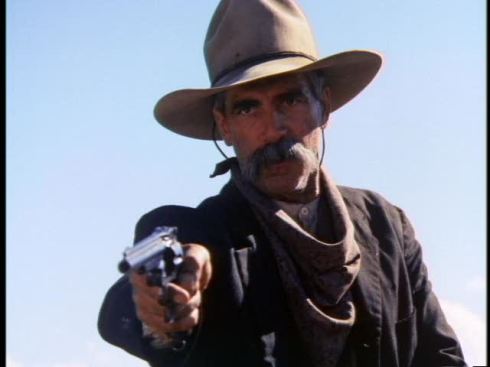
Traveling west with her recently married husband and his two kids from his previous marriage, Evie Teale (Katharine Ross) finds herself running the homestead by herself in unforgiving territory. Her husband went to buy cattle and has been missing for months, leaving her to believe he died somehow because he wouldn't just abandon his family. But Evie trudges on, living the toughest of frontier lives from day to day. A drifting cowboy, Conn Conagher (Sam Elliott), stops by one day on the trail and helps out briefly before moving on. There is a connection immediately between Evie and Conn, but they seem almost fated not to be together. But trying to carve out a living on their own, the two similar minded people can't help but be drawn to each other.
Some actors are cut out for certain genres, and Sam Elliott belongs in westerns, plain and simple. He has the look and the acting style that fits in perfectly with the genre. More than that, he's cut out to play a L'Amour hero, hard-working, tough, always willing to help, and honest/loyal to a fault. Basically, he's a man of principle. This was Elliott's fourth appearance in a movie based off a L'Amour novel, and he's got the part down to an art by now. His performance is the best part of the movie, and the story tends to drag when he's not around. It drags some even when he is around, but that's not entirely his fault.
Now I haven't read Conagher so I may be criticizing the movie more than I am the book here. At 117 minutes, this feels too disjointed without any unifying connection through the story. There are these little episodic sidebars that reveal more about the character but never anything surprising. Conagher signs on with an old rancher (Ken Curtis in a solid supporting turn) who is being run out by a rival ranch. These scenes show Conn's willingness to do what's right when it'd be easier to bail, but that's nothing we didn't know already. Then to add insult to injury, this drifter cowboy must tangle with two rustlers (James Gammon and Paul Koslo). Streamline the story some and these segments are gone for an overall more well organized story.
It isn't often I'm about to say this, but this is a western that could have used more of the romantic subplot that it introduces but doesn't do anything with until the end. Married in real life, Elliott and Ross have an obvious chemistry together without much in the way of words spoken. After a brief scene early where they meet, they spend most of the rest of the movie apart. Maybe I was just expecting something different from the story where they meet early, fall for each other and go from there, but I was disappointed in how the relationship developed. Basically they spend too much time apart in the slow-moving middle sections that don't do much anyways.
The rest of the cast is solid for a TV western. Barry Corbin is the best part as McCloud, the stagecoach driver who frequents the Teale's place. Billy Green Bush appears very briefly as Jacob, Evie's husband, with Gavan O'Herlihy making a reliably evil bad guy. Also look for recognizable western faces Buck Taylor as a rival cowboy and Dub Taylor as a stagecoach station agent. It's a decent enough western, but other than Elliott and Ross I'm remembering little to recommend. Average in every way and probably only for western completists.
Conagher <---trailer (1991): **/****
In the last few months, I've reviewed several L'Amour ventures into movies, made for TV movies and even TV shows. Unlike bigger scale westerns where the scale was important, L'Amour's novels never had that problem. They usually focused on a handful of main characters instead of hundreds of speaking parts and were about the problems of those individuals rather than a bigger western where a whole town or territory might be in danger. So with that thought, maybe Louis L'Amour and his novels were cut out for made-for-TV movies where the smaller scale was a benefit, not a hindrance. Not one of the best examples but a decent enough western, 1991's Conagher.
Traveling west with her recently married husband and his two kids from his previous marriage, Evie Teale (Katharine Ross) finds herself running the homestead by herself in unforgiving territory. Her husband went to buy cattle and has been missing for months, leaving her to believe he died somehow because he wouldn't just abandon his family. But Evie trudges on, living the toughest of frontier lives from day to day. A drifting cowboy, Conn Conagher (Sam Elliott), stops by one day on the trail and helps out briefly before moving on. There is a connection immediately between Evie and Conn, but they seem almost fated not to be together. But trying to carve out a living on their own, the two similar minded people can't help but be drawn to each other.
Some actors are cut out for certain genres, and Sam Elliott belongs in westerns, plain and simple. He has the look and the acting style that fits in perfectly with the genre. More than that, he's cut out to play a L'Amour hero, hard-working, tough, always willing to help, and honest/loyal to a fault. Basically, he's a man of principle. This was Elliott's fourth appearance in a movie based off a L'Amour novel, and he's got the part down to an art by now. His performance is the best part of the movie, and the story tends to drag when he's not around. It drags some even when he is around, but that's not entirely his fault.
Now I haven't read Conagher so I may be criticizing the movie more than I am the book here. At 117 minutes, this feels too disjointed without any unifying connection through the story. There are these little episodic sidebars that reveal more about the character but never anything surprising. Conagher signs on with an old rancher (Ken Curtis in a solid supporting turn) who is being run out by a rival ranch. These scenes show Conn's willingness to do what's right when it'd be easier to bail, but that's nothing we didn't know already. Then to add insult to injury, this drifter cowboy must tangle with two rustlers (James Gammon and Paul Koslo). Streamline the story some and these segments are gone for an overall more well organized story.
It isn't often I'm about to say this, but this is a western that could have used more of the romantic subplot that it introduces but doesn't do anything with until the end. Married in real life, Elliott and Ross have an obvious chemistry together without much in the way of words spoken. After a brief scene early where they meet, they spend most of the rest of the movie apart. Maybe I was just expecting something different from the story where they meet early, fall for each other and go from there, but I was disappointed in how the relationship developed. Basically they spend too much time apart in the slow-moving middle sections that don't do much anyways.
The rest of the cast is solid for a TV western. Barry Corbin is the best part as McCloud, the stagecoach driver who frequents the Teale's place. Billy Green Bush appears very briefly as Jacob, Evie's husband, with Gavan O'Herlihy making a reliably evil bad guy. Also look for recognizable western faces Buck Taylor as a rival cowboy and Dub Taylor as a stagecoach station agent. It's a decent enough western, but other than Elliott and Ross I'm remembering little to recommend. Average in every way and probably only for western completists.
Conagher <---trailer (1991): **/****
Labels:
1990s,
Katharine Ross,
Ken Curtis,
Louis L'Amour,
Paul Koslo,
Sam Elliott,
westerns
Tuesday, June 1, 2010
The Sacketts
In a career that spanned a handful of decades, author Louis L'Amour published over 100 works that included novels, short stories, and even some non-fiction, many of which were turned into TV shows and feature length film adaptations. Most of these works were westerns, and I started reading them at a young age, starting with The First Fast Draw. I've enjoyed some more than others, but the ones I've gone back to come from a series of books about the Sackett family.
In the time when miniseries were extremely popular -- better known as the 1970s and 1980s -- two of L'Amour's Sackett novels were turned into a two-part miniseries in 1979 appropriately titled The Sacketts. My first concern was that the two source novels are two separate works about three brothers -- two in one book, and the third in a separate book -- with a very quick crossover. So how is a miniseries with two vastly different stories expected to work? Like any adaptation, things were dropped and left by the wayside, but big picture, this miniseries works because of the talent involved.
Based on the novels The Daybreakers and Sackett, the miniseries focuses on three brothers from a Tennessee family heading west in the years following the Civil War. Tell (Sam Elliott) is the oldest and despite growing up in the South, joined up with a Union infantry regiment during the war. Once Lee surrenders, Tell heads west, ending up as a drifter/saddle tramp looking for work wherever he can get it. Too young to join the fight, Orrin (Tom Selleck) is engaged to be married to a local girl, but a long-standing feud interrupts with young brother Tyrel (Jeff Osterhage) killing a man in his brother's defense. With the local law looking for answers, Orrin and Ty head west to set up a new life.
Riding into Texas, Orrin and Ty sign on with a cattle drive heading north to Abilene. Along the way, they become more than capable cowpunchers and in the process meet ramrod and trail driver Tom Sunday (Glenn Ford) and veteran cowboy Cap Rountree (Ben Johnson). Delivering the cattle to a buyer, the quartet sticks together and heads west to Santa Fe only to find a range war brewing between the Mexicans (led by Gilbert Roland) and the Americans (the always evil John Vernon in charge). Further north in the mountains, Tell stumbles upon a gold vein, but that's just the start. The Bigelow brothers are on his trail looking for vengeance. And wouldn't you bet, at some point the brothers' trails cross?
Cramming two full books into a 4-hour miniseries had to have been a daunting task for writer Jim Byrnes, and he does a solid job adapting the novels. Both books delved into romantic subplots with the brothers meeting women along the way, but in putting together a story about three brothers -- and not the ladies -- these subplots are just that, subplots in the background. Byrnes also had to invent basically a new storyline (the brothers meeting up on the trail) and an ending because Daybreakers and Sackett just didn't cross paths. All in all, props to Byrnes for pulling it off.
Starting with the casting of the Sackett brothers, the actors involved from top to bottom are downright impressive, more so for fans of westerns. Elliott, Selleck, and Osterhage were not stars when they were chosen to play these brothers. It's funny that the best character, Tyrel, was played by the actor who for some reason, never became a bigger star. As L'Amour writes them, Ty was my favorite. Like Tell, he's quiet and unassuming, but when pushed he pushes back. Elliott is basically a rougher, older Ty and growls his way through the part, and Selleck gets to be Selleck, a charming, likable personality. Among the three, there's a definite chemistry which pays off in a big way.
L'Amour's main characters were the prototypical western hero; tough, honorable, and able to shoot their way out of any sticky situation. These were men of few words who did what was right because they didn't know any other way. These three actors were all so good there's even an unofficial sequel -- 1982's The Shadow Riders -- where they play a trio of brothers, the Travens this time. Through all its other flaws in the miniseries, the casting is about as perfect as casting can be.
By 1979, the western had played out its line in terms of moviegoing popularity thanks to the spaghetti westerns and ultra-violent spins the genre took. So in a way, this is a last hurrah for the western, and the casting represents that. Tom Sunday is younger in the book, but Ford playing him is just right. He's a former lawyer, a cowboy, and a gunfighter and serves as a replacement father for the boys. Johnson as the saddle-sore cowboy who seen it all? Born to play the part. Roland makes a quick appearance, and Vernon is typically evil. Ruth Roman is good as Emma, a saloon owner in an outlaw town who knows Cap. The Bigelow brothers include Jack Elam, Slim Pickens, and Gene Evans. For the cherry on top, throw L.Q. Jones and Paul Koslo in for good measure. It'd be hard to ask for a better cast.
This review is getting a little long so I'll start to wrap this up. It's hard to complain about a TV miniseries looking like a TV miniseries, but The Sacketts isn't exactly made on a huge scale. It feels like we see the same town over and over with the same backgrounds once the story requires the brothers to hit the trail. My biggest complaint though was the music. A soundtrack doesn't have to be great, it just can't be noticeably bad. Well, the score here is bad, and in an obvious overdone way. Overall though, just complaints for a highly entertaining, well-made miniseries that does justice to Louis L'Amour's novels.
The Sacketts (1979): ***/****
Saturday, March 20, 2010
The Omega Man
I've written before how Charlton Heston was made to be in historical epics, you pick the era. I'm going to amend that very broad statement to say that Heston was made to be in BIG movies, regardless the genre. Along with historical epics, he starred in westerns, disaster movies, and also science fiction like Planet of the Apes, Soylent Green, and 1971's The Omega Man.
This 1971 sci-fi movie is the second of three incarnations of Richard Matheson's classic novel I Am Legend, coming after The Last Man on Earth starring Vincent Price and followed almost 40 years later by Will Smith in I Am Legend. The novel is a classic and one of my all-time favorite books, and in one way or another the movies have put their own spin on the story. Why they decided they needed to do that I'll never know. The premise of being the last surviving human on Earth is a great jumping off point with all sorts of possibilities.
Germ warfare has wiped out mankind, killing millions and turning any of the few survivors into mutants who are blinded by light and only come out during the night hours. For the two years since the plague hit, Robert Neville (Heston) has survived on his own in a fortified house in Los Angeles believing he is the last man on Earth. He spends days looking for supplies in the abandoned city, anything that will help him survive. Neville's searches are limited to the daytime though because a group of mutants called the Family, led by a man named Matthias (Anthony Zerbe), comes out at night with the intent to capture and kill Neville. The doctor soon finds out he's not alone when he meets Lisa (Rosalind Cash) and Dutch (Paul Koslo) leading a small group of children. Neville discovers the cure to bringing humans back may be in his own blood, but can he figure it out before Matthias finally captures him?
Seeing a role like this must make actors happy; no rivals for screentime, long stretches of monologues, and basically a movie all to themselves. For the first 50 minutes -- when The Omega Man is at its best -- that's what Heston gets to do. This may be his best acting role in a career of great parts. He brings Neville to life, showing what two years living by yourself in an empty world would do to someone's psyche. He goes to the movies and recites them line for line, he plays chess with a Julius Caesar headpiece, and spends much of the days talking to himself. At other times, Neville is sane, trying to figure out how to develop a serum to reverse the affects of the plague and germ warfare -- which he is already immune to.
Like 2008's I Am Legend though, The Omega Man isn't content to let the story be about the last man on Earth. The best parts are Neville exploring the city (in some great shots of a vacant L.A.) looking for anything of value while trying to keep his sanity during the day and fighting for his life at night. Then unfortunately, new characters are introduced. Cash is doing her best Black Power Foxy Brown impression -- and not a good one at that. Is a romantic subplot really needed in a story like this? There is this great storyline with all these possibilities to deal with, but instead we get Neville schmoozing with Cash's Lisa all so we get some gratuitous 70s nudity (Cash thankfully, not Heston).
Because of the detour in the story, the last 40 minutes can't live up to the strengths of the first hour. That's not to say it's not an interesting ending, but Heston so dominates his time that when other characters are introduced, his Neville somehow gets lost in the shuffle. The movie is at its best when it stick to Matheson's novel and slows down when it drifts away from the source. Too bad because Zerbe (as always) is a fine villain as he leads the Family, a small army of albino mutants wearing monk-like hoodies and sunglasses. The movie has the look of a low budget flick but in a good, campy way. Some of the movie was shot in L.A. while other scenes are clearly on an outdoor set.
The movie does have a lot going for it though, in spite of those already mentioned flaws. Along with Heston and Zerbe, Koslo is strong in a supporting role as Dutch, a brilliant student of medicine now left behind to help the human race survive as the leader of a group of children. Some exciting action scenes blend well with the story, including one escape via motorcycle through Dodger Stadium with mutants all around. The ending sticks pretty close to the novel's ending, and although the final shot is a little heavy-handed (no subtlety here) it works in its symbolism. Composer Ron Grainer's score is solid too (sample HERE), a nice blend of a lot of different musical types ranging from jazz to classical to a few parts that sounded like they were from a spaghetti western.
A good, not great sci-fi movie, that could have been better. Definitely check out Matheson's novel I Am Legend, it's a cant-miss book. The Omega Man is a good companion to the book, and even with the changes that have been made, the heart of the story and the main ideas are there.
The Omega Man <----trailer (1971): ***/****
This 1971 sci-fi movie is the second of three incarnations of Richard Matheson's classic novel I Am Legend, coming after The Last Man on Earth starring Vincent Price and followed almost 40 years later by Will Smith in I Am Legend. The novel is a classic and one of my all-time favorite books, and in one way or another the movies have put their own spin on the story. Why they decided they needed to do that I'll never know. The premise of being the last surviving human on Earth is a great jumping off point with all sorts of possibilities.
Germ warfare has wiped out mankind, killing millions and turning any of the few survivors into mutants who are blinded by light and only come out during the night hours. For the two years since the plague hit, Robert Neville (Heston) has survived on his own in a fortified house in Los Angeles believing he is the last man on Earth. He spends days looking for supplies in the abandoned city, anything that will help him survive. Neville's searches are limited to the daytime though because a group of mutants called the Family, led by a man named Matthias (Anthony Zerbe), comes out at night with the intent to capture and kill Neville. The doctor soon finds out he's not alone when he meets Lisa (Rosalind Cash) and Dutch (Paul Koslo) leading a small group of children. Neville discovers the cure to bringing humans back may be in his own blood, but can he figure it out before Matthias finally captures him?
Seeing a role like this must make actors happy; no rivals for screentime, long stretches of monologues, and basically a movie all to themselves. For the first 50 minutes -- when The Omega Man is at its best -- that's what Heston gets to do. This may be his best acting role in a career of great parts. He brings Neville to life, showing what two years living by yourself in an empty world would do to someone's psyche. He goes to the movies and recites them line for line, he plays chess with a Julius Caesar headpiece, and spends much of the days talking to himself. At other times, Neville is sane, trying to figure out how to develop a serum to reverse the affects of the plague and germ warfare -- which he is already immune to.
Like 2008's I Am Legend though, The Omega Man isn't content to let the story be about the last man on Earth. The best parts are Neville exploring the city (in some great shots of a vacant L.A.) looking for anything of value while trying to keep his sanity during the day and fighting for his life at night. Then unfortunately, new characters are introduced. Cash is doing her best Black Power Foxy Brown impression -- and not a good one at that. Is a romantic subplot really needed in a story like this? There is this great storyline with all these possibilities to deal with, but instead we get Neville schmoozing with Cash's Lisa all so we get some gratuitous 70s nudity (Cash thankfully, not Heston).
Because of the detour in the story, the last 40 minutes can't live up to the strengths of the first hour. That's not to say it's not an interesting ending, but Heston so dominates his time that when other characters are introduced, his Neville somehow gets lost in the shuffle. The movie is at its best when it stick to Matheson's novel and slows down when it drifts away from the source. Too bad because Zerbe (as always) is a fine villain as he leads the Family, a small army of albino mutants wearing monk-like hoodies and sunglasses. The movie has the look of a low budget flick but in a good, campy way. Some of the movie was shot in L.A. while other scenes are clearly on an outdoor set.
The movie does have a lot going for it though, in spite of those already mentioned flaws. Along with Heston and Zerbe, Koslo is strong in a supporting role as Dutch, a brilliant student of medicine now left behind to help the human race survive as the leader of a group of children. Some exciting action scenes blend well with the story, including one escape via motorcycle through Dodger Stadium with mutants all around. The ending sticks pretty close to the novel's ending, and although the final shot is a little heavy-handed (no subtlety here) it works in its symbolism. Composer Ron Grainer's score is solid too (sample HERE), a nice blend of a lot of different musical types ranging from jazz to classical to a few parts that sounded like they were from a spaghetti western.
A good, not great sci-fi movie, that could have been better. Definitely check out Matheson's novel I Am Legend, it's a cant-miss book. The Omega Man is a good companion to the book, and even with the changes that have been made, the heart of the story and the main ideas are there.
The Omega Man <----trailer (1971): ***/****
Labels:
1970s,
Anthony Zerbe,
Charlton Heston,
Paul Koslo,
Sci-Fi
Thursday, February 12, 2009
Netflix Review #6: Joe Kidd
After the huge success of Dirty Harry the year before, Clint Eastwood returned to the genre that made him a star, the western, in 1972's Joe Kidd, the story of a range war in turn of the century New Mexico. It's another Eastwood western I've always avoided some because I enjoyed the Leone spaghettis so much, but I enjoyed it even with all its flaws of which there are many.
Eastwood is Joe Kidd, a small-time rancher who's just received a 10-day jail sentence for a number of offences. He's let out when a rich land owner, Frank Harlan, wants to hire Joe to lead a hunting expedition of sorts, a hunt for a Mexican stirring up trouble when it comes to land rights by the name of Luis Chama. Kidd turns down the offer but changes his mind when he returns home to find that Chama and his gang have stolen his horses and beaten one of his hired hands. Kidd joins up with Harlan and his posse, finding out how brutal their methods can be on the trail.
For one, it's a short movie at 88 minutes. I was disappointed to read the DVD has missing scenes from previous releases or TV showings. I can't verify having never seen it, but a DVD always gets lower points for something like that. With the short running time, you lose a ton of character and plot development. John Saxon plays Chama, appearing for the first five minutes and then disappearing until the last 20 minutes. Robert Duvall has always been a good villain, and lives up to reputation here, but his character is as one-dimensional as they come. Must kill Chama!
In spite of these flaws, it's a western I enjoyed. Eastwood is a more laid back gunslinger, and even if he is underwritten, Duvall provides a good counter to him. Composer Lalo Schifrin does his own version of a spaghetti western score that's memorable, and the California and Old Tucson locations are shot beautifully. Harlan's posse of hired guns, Lamarr Simms (Don Stroud), a hothead who would like nothing more than kill Kidd, Olin Mingo (James Wainwright), a sniper who can hit anything, and Roy Gannon (Paul Koslo), the calm, cool fast draw specialist, are also good villains, if underused. The showdown the movie builds to with Kidd and Simms has no pay-off, too bad, it would have been a goodie.
The DVD, missing scenes and all, is an average disc. Widescreen presentation is noticeably scratchy in certain scenes, but otherwise appears okay. Special features include the always boring production notes with cast and crew info, and a trailer that plays up the action in the movie. A western with flaws, sure, but still check it out.
Joe Kidd (1972): ***/****
Labels:
1970s,
Clint Eastwood,
John Saxon,
John Sturges,
Paul Koslo,
Robert Duvall,
westerns
Monday, January 19, 2009
Charles Bronson is cooler than you; Netflix review: Mr. Majestyk
So after signing up with Netflix this summer, I've been catching up with a lot of movies that in the past I either couldn't find or couldn't afford. I pay about 10 bucks a month and see eight or nine movies a month if the mail cooperates. After watching the Death Wish movies on AMC last week, I was in a Charles Bronson state of mind so Mr. Majestyk went to the top of the queue.
Bronson plays Vince Majestyk, a Vietnam vet who now owns a 160-acre spread where he grows melons. It's harvest time and the crops needs to be brought in which leads to trouble when local a-hole Bobby Kopas (Paul Koslo) brings in his own crew to work Majestyk's fields for cheap. Vince is having none of that, and after a shotgun showdown, including a rifle butt to Kopas' crotch, he finds himself in jail.
Cue classic 70s villain Al Lettieri (The Godfather's Virgil Solozzo) as mafioso hit man Frank Renda. An escape attempt goes wrong, and Majestyk ends up on Renda's bad side. Majestyk now just wants to get his melon crop in before it's too late so he agrees with the evil "fuzz" to be bait to see if Renda will come back and finish him off.
All-around, a good Bronson action drama when the stone-faced actor was at the top of his game in the years following the first Death Wish. Bronson will never be called a great actor, but he was always a presence on screen, whether it be as a supporting part in John Sturges' 1959 WWII story 'Never So Few' or here when he was a bankable action star. He handles the action well, especially in the final shootout, and his attempts at humor work.
The rest of the cast is solid, especially Lettieri as the villain you love to hate. Linda Cristal (Flaca in John Wayne's The Alamo) is Nancy, a migrant worker who starts off working for Majestyk but ends up dating him, and Koslo as local troublemaker Bobby Kopas is a good counter to Lettieri's tough guy.
The DVD is a good buy, offering widescreen and standard presentations, with a short trailer the only special feature. Not a classic, but certainly worth a watch.
*** out of ****
Mr. Majestyk trailer from Youtube
Subscribe to:
Posts (Atom)