I've been in a bit of a movie funk of late. I've given some newer flicks a try and couldn't/didn't get through them. The same for some older entries, movies that just didn't pull me in quick enough. Well, it is as good a time as any to revisit some reviews and give them an old-fashioned update. Today's review, 1967's Chuka, an underrated western I caught for the first time as I was just starting my reviews here at Just Hit Play.
Out of the snow-capped, frigid mountains of the north, a man named Chuka (Rod Taylor) rides south into the desert. A hired gun and a saddle bum, he has not set destination but is quickly realizing he's riding into the beginnings of an Indian uprising. As he rides across the desert, Chuka stumbles across a waylaid stagecoach carrying two women, one a woman from his past many years ago, the beautiful Senora Veronica Kleitz (Luciana Paluzzi). He agrees to escort them to the nearest outpost, Fort Clendennon but has no idea what he's heading into. The fort is commanded by a former English army officer now serving in the U.S. cavalry, Colonel Valois (John Mills), who is ignoring all the telltale signs of the coming uprising. Can Chuka convince the stubborn colonel to do something or is the entire outpost doomed to be wiped out by the warring Arapaho warriors?
This was a Netflix find for me way back in 2009. I'd never heard of it despite its impressive cast, much less seen a single minute of it. It left quite an impression on me then, and it did again on this recent revisit courtesy of Encore Westerns. The biggest reason? Made on the relative cheap, it is B-L-E-A-K. This is one dark, nasty western from director Gordon Douglas. It has the feel of a TV movie, but my goodness, it doesn't pull any punches. 'Chuka' is a tough guy movie for guys. Plain and simple. There aren't heroic good guys or even despicable villains, just flawed folks in a hellish situation looking for some way -- any way really -- to get out unscathed and keep on living. If there's no way out? Well, hell, let's have a bloody finish.
One of Hollywood's more underrated tough guys and one of my favorites, Rod Taylor passed away this past January at the age of 84 after a long, distinguished career. This is a dark role even for Taylor, ranking up there with Dark of the Sun as one of his more highly charged tough guy roles. I like his Chuka character, a reflection of where the western genre was in 1967. He's not particularly heroic, thinks of himself for the most part and has a reputation as a brutal gunslinger. It's a cool part because it is so brutally efficient. He is the anti-hero, a flawed figure, and as far as westerns go, you don't see a lot of main characters who are just what they seem. Chuka is a saddle tramp, a drifter, a killer and trying not to get shot in the back because of his bloody, body-riddled past. Taylor is always an above average screen presence, and he looks to be having some fun with this darker part.
How about the rest of the cast? It isn't a huge cast -- that whole B-movie feel -- but what's there, it's pretty preemo. John Mills is the flawed outpost commander, his checkered past floating over him at all times. Redemption? You bet, no matter the cost. Ernest Borgnine has some fun too in a role he specialized over the years, the tough as nails right hand man, playing Sgt. Otto Hahnsbach, Valois' loyal NCO who's served next to him for years. The always reliable James Whitmore plays Lou Trent, the fort's drunken scout who forms a fast friendship with Chuka upon his arrival. Paluzzi unfortunately isn't given much to do other than look worried/distressed, but dang, she's gorgeous. Also look for Victoria Vetri as her traveling companion, Louis Hayward as the cowardly Major Benton, and Joseph Sirola as Baldwin, the stagecoach guard who finds himself trapped in the fort with all the others.
So that whole bleak angle....yeah, this is one rough western. There are some slower portions -- Taylor and Paluzzi reuniting just ain't as interesting -- but the focus is this isolated, lonely outpost with a small army of Arapaho warriors waiting to attack. The odds are (to say the least) stacked against them. The fort's garrison? From Mills' Valois and his officers down to the enlisted men, these are the dregs of the army, all of them screw-ups, foul-ups, thieves, killers and deserters. A massacre seems impossible unless something is done and done quickly. A brutal knockdown fight between Taylor and Borgnine is an exhausting affair and a testament to the two actors who didn't appear to use ANY stunt doubles. When the action does come along, it is surprisingly graphic. It isn't bloody, but it is quick and hard-hitting and uncomfortable. It's quite an ending.
A hidden gem of a western. Sure, it has some flaws, but I'm glad I caught up with it (again). The claustrophobic fort set is a gem, really giving a sense of being closed in by the surrounding Indians. You get a sense of the coming doom, all of it building to quite an ending. Solid cast, surprisingly dark, a refreshingly brutal change of pace. Well worth catching up with.
Chuka (1967): ***/****
Rewrite of March 2009 review
The Sons of Katie Elder
"First, we reunite, then find Ma and Pa's killer...then read some reviews."
Showing posts with label John Mills. Show all posts
Tuesday, March 24, 2015
Monday, September 8, 2014
Oklahoma Crude
When I hear the name Stanley Kramer, I think of any number of movies. The 1960s were quite the decade for this director with movies like Judgment at Nuremberg, Mad, Mad World, Inherit the Wind and Guess Who's Coming to Dinner to his name. Oh, and that 1950s decade? The Defiant Ones and On the Beach. Quite a list, huh? And that's only listing some. I'm familiar with most of Kramer's movies as a director, have seen many of them and was at least aware of some others. One that qualifies as...well, none of those is and was 1973's Oklahoma Crude, a quasi-western with little reputation.
It's the 1910s and feisty Lena Doyle (Faye Dunaway) owns a chunk of land smack dab in the middle of the Oklahoma oil fields. She has put the time into the land, building a shack and a derrick and intends to tap the crude oil she believes is in the ground below her. There's a problem of course. A powerful oil magnate is scooping up land left and right, purchasing all the small-time owners. Well, most of them. Lena refuses to sell, claiming (rightfully so) that the land is hers. In hopes of protecting her investment, Lena gets some help from some unlikely places, including her estranged father, Cleon (John Mills) and a hired gun he hired, Mason (George C. Scott). Mason isn't quite sure what to make of the job, looking to make some quick and easy cash, but the little group is in for more than they planned on when the oil company sends out an enforcer, Hellman (Jack Palance), to make sure Lena sells.
Well, this was certainly an interesting movie if a heavily flawed one. I struggled through it at times and was rewarded with a far stronger second half of a 108-minute movie. Getting there can be a trial at times though, and even the last hour isn't as good as it could have been. Still, Kramer chooses an interesting story to tell and picks the right time to release it, the 1970s when audiences would have been all sorts of stirred up about a huge company strong-arming small businesses (I guess that'd land pretty well now in 2014 too). The development of the oil fields in Oklahoma in the early 1900s is an interesting enough historical period -- one that hasn't gotten its due in films, TV and books -- with plenty of dark, nasty material to dive into, but...
Kramer doesn't seem to be able to pick a tone, a voice and stick with it. Is it supposed to be truly dramatic and dark and unsettling? Or is it supposed to be goofy and fun and the kinda oddball romance story I typically hate? And that's where the problem is. It's both. The song that plays over the opening credits, Send a Little Love My Way, had me worried I was jumping into a folksy, disgustingly pleasant western that I do love so much. It wasn't, but it's a good forebearer of what's to come. The score from Henry Mancini is simply put, very obvious, big and loud and not appropriate for what the dark and depths of the story could have been. Instead, we get the Dunaway/Scott rivalry, the Dunaway/Mills fighting, Palance vs. the world, and all mixed in with some "I hate you until I love you" story and some all too painful comic relief. Oh, look, that naked guy got shot in the butt with buckshot!!! Yeah, it's too schizophrenic for its own good.
There is a saving grace, one that quickly popped up as the pleasant song mentioned above plays over the credits. Yeah, it's that cast thing. Dunaway, Scott, Mills and Palance?!? Yes, I will invest some time to see how this develops. The script doesn't always do this quartet a ton of favors, but there is a ton of talent here that manages to bring these characters to life. Dunaway's Lena is tough as nails, never been handed anything in her life, ready to fight for what's hers and screw anyone who gets in her way. Scott's Mason -- or Mase, his full name revealed late -- is harder to read, a worker and quasi-hired gun looking for a payday but just as interesting to see develop. I loved the energy Mills as Cleon brought to his part, a father who wasn't there for his daughter as she grew up. Now that he can help? He's going to do everything he can, even when that daughter tells him to screw off. And then there's Palance, doing what he does best, playing that near lunatic but very obsessed bad guy that you're never quite sure what he's capable of.
The human moments are not surprisingly, those that work best in Kramer's film. I especially liked the dynamic between Dunaway's Lena and Scott's Mase. It develops nicely -- but takes quite awhile getting there -- and for the most part manages to avoid all the pratfalls of a sappy story of two opposites who aren't so opposite. Mills is a scene-stealer and Palance is solid. The darkness of the second half is what the entire movie should have been. Filming out on the desolate, stark prairies, you get a sense of what these small-time drillers went through. Isolated and alone with no help in sight should it be needed. I simply wish Kramer would have committed, not trying to mix the light-hearted with the dark. At least if he kept it light, so be it. It's there. That's it. That's all. Enjoyable enough to recommend but far from a classic.
Oklahoma Crude (1973): ** 1/2 /****
It's the 1910s and feisty Lena Doyle (Faye Dunaway) owns a chunk of land smack dab in the middle of the Oklahoma oil fields. She has put the time into the land, building a shack and a derrick and intends to tap the crude oil she believes is in the ground below her. There's a problem of course. A powerful oil magnate is scooping up land left and right, purchasing all the small-time owners. Well, most of them. Lena refuses to sell, claiming (rightfully so) that the land is hers. In hopes of protecting her investment, Lena gets some help from some unlikely places, including her estranged father, Cleon (John Mills) and a hired gun he hired, Mason (George C. Scott). Mason isn't quite sure what to make of the job, looking to make some quick and easy cash, but the little group is in for more than they planned on when the oil company sends out an enforcer, Hellman (Jack Palance), to make sure Lena sells.
Well, this was certainly an interesting movie if a heavily flawed one. I struggled through it at times and was rewarded with a far stronger second half of a 108-minute movie. Getting there can be a trial at times though, and even the last hour isn't as good as it could have been. Still, Kramer chooses an interesting story to tell and picks the right time to release it, the 1970s when audiences would have been all sorts of stirred up about a huge company strong-arming small businesses (I guess that'd land pretty well now in 2014 too). The development of the oil fields in Oklahoma in the early 1900s is an interesting enough historical period -- one that hasn't gotten its due in films, TV and books -- with plenty of dark, nasty material to dive into, but...
Kramer doesn't seem to be able to pick a tone, a voice and stick with it. Is it supposed to be truly dramatic and dark and unsettling? Or is it supposed to be goofy and fun and the kinda oddball romance story I typically hate? And that's where the problem is. It's both. The song that plays over the opening credits, Send a Little Love My Way, had me worried I was jumping into a folksy, disgustingly pleasant western that I do love so much. It wasn't, but it's a good forebearer of what's to come. The score from Henry Mancini is simply put, very obvious, big and loud and not appropriate for what the dark and depths of the story could have been. Instead, we get the Dunaway/Scott rivalry, the Dunaway/Mills fighting, Palance vs. the world, and all mixed in with some "I hate you until I love you" story and some all too painful comic relief. Oh, look, that naked guy got shot in the butt with buckshot!!! Yeah, it's too schizophrenic for its own good.
There is a saving grace, one that quickly popped up as the pleasant song mentioned above plays over the credits. Yeah, it's that cast thing. Dunaway, Scott, Mills and Palance?!? Yes, I will invest some time to see how this develops. The script doesn't always do this quartet a ton of favors, but there is a ton of talent here that manages to bring these characters to life. Dunaway's Lena is tough as nails, never been handed anything in her life, ready to fight for what's hers and screw anyone who gets in her way. Scott's Mason -- or Mase, his full name revealed late -- is harder to read, a worker and quasi-hired gun looking for a payday but just as interesting to see develop. I loved the energy Mills as Cleon brought to his part, a father who wasn't there for his daughter as she grew up. Now that he can help? He's going to do everything he can, even when that daughter tells him to screw off. And then there's Palance, doing what he does best, playing that near lunatic but very obsessed bad guy that you're never quite sure what he's capable of.
The human moments are not surprisingly, those that work best in Kramer's film. I especially liked the dynamic between Dunaway's Lena and Scott's Mase. It develops nicely -- but takes quite awhile getting there -- and for the most part manages to avoid all the pratfalls of a sappy story of two opposites who aren't so opposite. Mills is a scene-stealer and Palance is solid. The darkness of the second half is what the entire movie should have been. Filming out on the desolate, stark prairies, you get a sense of what these small-time drillers went through. Isolated and alone with no help in sight should it be needed. I simply wish Kramer would have committed, not trying to mix the light-hearted with the dark. At least if he kept it light, so be it. It's there. That's it. That's all. Enjoyable enough to recommend but far from a classic.
Oklahoma Crude (1973): ** 1/2 /****
Labels:
1970s,
Faye Dunaway,
George C Scott,
Jack Palance,
John Mills,
Stanley Kramer,
westerns
Monday, September 17, 2012
Around the World in 80 Days (1956)
There are epics, and then there are EPICS. In the age of such immense, gigantically-scaled films of the 1950s and 1960s, studios pulled out all the stops in hopes of impressing moviegoers. Huge all-star casts with thousands of extras, lavish sets and costumes, and in general, a sight to behold on the big screen. Some movies were just made for a viewing that only a full-size movie theater can offer, like 1956's Around the World in 80 Days.
It is the 1870s and new technological advances have made travel to far-off places not only possible but quicker, more efficient, and more entertaining. A prim and proper Englishman, Phileas Fogg (David Niven), even boasts to his fellow members of the Reform Club that he can travel completely travel around the world in just 80 days. The club members laugh at the thought, but Fogg maintains his stance and a bet is born. With a significant amount of money on the line, Fogg and his assistant/valet, Passepartout (Mexican actor Cantinflas), embark on a journey around the world against the clock with no idea of what will be actually thrown their way during their adventurous travels.
If you were trying to define what an old-school Hollywood epic is to someone who didn't know, this would be a great start. Filming in locations around the world from Japan, the U.S., Thailand, Spain, England, France, Pakistan and China, '80 Days' is a true visual stunner. The screen is filled with incredible locations packed to the gills with the cast and then hundreds and thousands of extras behind them. Director Michael Anderson filmed with a Todd-AO technique, an ultra-widescreen filming process that makes certain shots look like epically wide panoramic shots. I was impressed watching the film on my 32-inch TV. I can only imagine what this film would look like on a movie screen. As well, composer Victor Young's score (which won an Oscar) is light-hearted and fun, keeping the travels moving.
It is hard to criticize this movie on its technical levels. It is far easier to criticize the movie for basically everything else. Oh, didn't see that twist coming, did you? All that epic quality comes at the expense of character, story and any sort of development involving either of those. This is a movie you appreciate, just sit back and enjoy it. The widescreen filming process is a sight to behold, but they become tedious by the 11th or 12th such long shot of a mountain vista, train running down a track, Cantinflas fighting a bull. Yes, I get it. On visuals alone, this is a stunningly beautiful movie. But at almost three-hours long, it feels like nothing more than an extended world travel guide. There never is even the slightest sense of urgency to the 80 day deadline until the final 10 minutes. Instead we get the visual, Niven's Fogg paying someone to right a wrong, then another nature shot.
I'll go into more depth about the supporting cast of thousands in a bit, but let's start with the lead performances. David Niven is one of my favorite actors, but I came away disappointed here. His Fogg is the definition of a prim and proper Englishman. He's even asked 'Why must you be so British?' at one point. At no point though does he actually look interested in bringing the part to life. To me, Niven look bored, and that's tough to say as a fan. Famed Mexican actor Cantinflas sure takes some grief for his part as Passepartout, but I thought he did a fine job with his limited grasp of English. His bit with Red Skelton is a highlight, the duo shoveling food into the others mouth in a very funny routine. Other bigger parts include Shirley MacLaine oddly cast as an Indian princess traveling with Fogg and Passepartout, and Robert Newton as Mr. Fix, a bank investigator trailing Fogg who's convinced the Englishman is an infamous bank robber.
Then there's the cameos, a long list that must put even The Greatest Story Ever Told to shame. Take a deep breath, and here goes. Look out for Finlay Currie, Robert Morley, Noel Coward, Trevor Howard, John Gielgud, Charles Boyer, Gilbert Roland, Cesar Romero, Cedric Hardwicke, Peter Lorre, George Raft, Marlene Dietrich, Frank Sinatra, John Carradine, Buster Keaton, Joe E. Brown, Andy Devine, Victor McLaglen, John Mills and Glynis Johns among others. I include those names because I recognized them in the cast, not because I necessarily saw them in the actual film. They are the 'blink and you'll miss them' type of cameos to the point many don't even register. Sinatra is shown over his shoulder three times and then turns and smiles. Mind you, he doesn't even say anything. He SMILES. That's it. Yes, it's fun seeing all these actors/actresses together but give them something to do.
This is a tough one to review in the end. It's too long, downright dull at times, a visual treat to watch, and a movie experience unlike any other. It's flaws though are crippling. '80 Days' may be three-hour longs but because of its schizo, hyper kinetic energy that bounces all over the place, it feels significantly longer and has not aged well over the years. A movie to be appreciated for its positives for what it does amount to, even if I won't be watching it again anytime soon. Okay, maybe in a movie theater.
Around the World in 80 Days <---trailer (1956): ** 1/2/****
It is the 1870s and new technological advances have made travel to far-off places not only possible but quicker, more efficient, and more entertaining. A prim and proper Englishman, Phileas Fogg (David Niven), even boasts to his fellow members of the Reform Club that he can travel completely travel around the world in just 80 days. The club members laugh at the thought, but Fogg maintains his stance and a bet is born. With a significant amount of money on the line, Fogg and his assistant/valet, Passepartout (Mexican actor Cantinflas), embark on a journey around the world against the clock with no idea of what will be actually thrown their way during their adventurous travels.
If you were trying to define what an old-school Hollywood epic is to someone who didn't know, this would be a great start. Filming in locations around the world from Japan, the U.S., Thailand, Spain, England, France, Pakistan and China, '80 Days' is a true visual stunner. The screen is filled with incredible locations packed to the gills with the cast and then hundreds and thousands of extras behind them. Director Michael Anderson filmed with a Todd-AO technique, an ultra-widescreen filming process that makes certain shots look like epically wide panoramic shots. I was impressed watching the film on my 32-inch TV. I can only imagine what this film would look like on a movie screen. As well, composer Victor Young's score (which won an Oscar) is light-hearted and fun, keeping the travels moving.
It is hard to criticize this movie on its technical levels. It is far easier to criticize the movie for basically everything else. Oh, didn't see that twist coming, did you? All that epic quality comes at the expense of character, story and any sort of development involving either of those. This is a movie you appreciate, just sit back and enjoy it. The widescreen filming process is a sight to behold, but they become tedious by the 11th or 12th such long shot of a mountain vista, train running down a track, Cantinflas fighting a bull. Yes, I get it. On visuals alone, this is a stunningly beautiful movie. But at almost three-hours long, it feels like nothing more than an extended world travel guide. There never is even the slightest sense of urgency to the 80 day deadline until the final 10 minutes. Instead we get the visual, Niven's Fogg paying someone to right a wrong, then another nature shot.
I'll go into more depth about the supporting cast of thousands in a bit, but let's start with the lead performances. David Niven is one of my favorite actors, but I came away disappointed here. His Fogg is the definition of a prim and proper Englishman. He's even asked 'Why must you be so British?' at one point. At no point though does he actually look interested in bringing the part to life. To me, Niven look bored, and that's tough to say as a fan. Famed Mexican actor Cantinflas sure takes some grief for his part as Passepartout, but I thought he did a fine job with his limited grasp of English. His bit with Red Skelton is a highlight, the duo shoveling food into the others mouth in a very funny routine. Other bigger parts include Shirley MacLaine oddly cast as an Indian princess traveling with Fogg and Passepartout, and Robert Newton as Mr. Fix, a bank investigator trailing Fogg who's convinced the Englishman is an infamous bank robber.
Then there's the cameos, a long list that must put even The Greatest Story Ever Told to shame. Take a deep breath, and here goes. Look out for Finlay Currie, Robert Morley, Noel Coward, Trevor Howard, John Gielgud, Charles Boyer, Gilbert Roland, Cesar Romero, Cedric Hardwicke, Peter Lorre, George Raft, Marlene Dietrich, Frank Sinatra, John Carradine, Buster Keaton, Joe E. Brown, Andy Devine, Victor McLaglen, John Mills and Glynis Johns among others. I include those names because I recognized them in the cast, not because I necessarily saw them in the actual film. They are the 'blink and you'll miss them' type of cameos to the point many don't even register. Sinatra is shown over his shoulder three times and then turns and smiles. Mind you, he doesn't even say anything. He SMILES. That's it. Yes, it's fun seeing all these actors/actresses together but give them something to do.
This is a tough one to review in the end. It's too long, downright dull at times, a visual treat to watch, and a movie experience unlike any other. It's flaws though are crippling. '80 Days' may be three-hour longs but because of its schizo, hyper kinetic energy that bounces all over the place, it feels significantly longer and has not aged well over the years. A movie to be appreciated for its positives for what it does amount to, even if I won't be watching it again anytime soon. Okay, maybe in a movie theater.
Around the World in 80 Days <---trailer (1956): ** 1/2/****
Friday, September 14, 2012
Morning Departure
To quote Seinfeld's George Costanza, "Can't I be a shore guy?" I watch movies about the Navy or the Coast Guard and give those gents a lot of credit. Big bodies of open water and me just don't agree, but silly me, I keep watching those movies. So as an individual who just don't like bodies of water, movies that show maritime disasters? Yeah, I'm fairly uncomfortable watching them, like the underrated 1950 movie, Morning Departure.
Several years removed from the end of WWII, Lt. Commander Armstrong (John Mills) has remained in command of the Trojan, a British sub crewed by veterans and youngsters alike. A 12-year veteran of the Navy, Armstrong is feeling pressure from his wife to leave that life behind and settle down with a not so dangerous job, but first he make take the Trojan out on an annual exercise. So with his first officer, Lt. Manson (Nigel Patrick), and crew, Armstrong takes the Trojan out only to strike disaster. The sub accidentally collides with a mine that's been drifting at sea for years and sinks to the ocean floor with 12 survivors. Armstrong holds out hope they will be found, but can he hold his crew together until then?
Based off a stage play, 'Departure' is a prime example of the quality British war movies made in the 15-20 years following the end of World War II. They typically lacked the immense scale and sheer size of many American movies, but they equaled that out with an emotional link. It isn't always impressive to the eye, but more on the personal level. We feel what these survivors are going through. Lt. Cmdr. Armstrong can send four men through one chute to the surface, four men through another, leaving four to sit on the ocean floor waiting to be salvaged in a process that could take a week. Uncomfortable much? The situation on its own is completely uncomfortable. When you're invested in the characters, it is that much worse.
Those individuals are somewhat borrowed from the War Movies Stock Characters list, but that's not necessarily a bad thing. Familiar can be okay when handled right. Mills is one of my favorite actors, and his lead performance as Armstrong -- solid, resolute, a calming effect on his men -- is perfect for the role. Patrick's Lt. Manson is the ladies man, but more importantly, he's a good officer standing at Armstrong's side. A past incident from WWII lingers on his mind, making an impact on their waiting rescue. A young 27-year old Richard Attenborough is given a chance to do his thing and doesn't disappoint playing Snipe, a young seaman with a wandering wife back home. Faced with a perilous situation in the definition of a claustrophobic situation, he finds out who he really is. Also look for Bernard Lee as Commander Gates, the high-ranking officer leading the rescue effort for his possibly lost ship, Kenneth More as his adjutant, Lt. James, and James Hayter as Higgins, the veteran submariner and cook for the Trojan.
Director Roy Ward Baker does a great job here not only setting up the story but also executing it successfully. It's clear early on that this "routine afternoon exercise" will no go smoothly (thanks for making me cynical, Gilligan's Island.), but seeing it happen is no less troubling to watch. Stories of survivors waiting to be rescued can be tricky then because basically we're watching people sit around waiting. It's here though we get to know some of these characters on a more personal level, making their struggles more personal to watch. The rescue effort on the high seas with weather and tides a factor is interesting to watch, building to an ending that I certainly didn't see coming. Moving, highly effective surprise ending at that.
One other thing worth mentioning, 'Departure' was made just months prior to an accident with a British submarine -- the HMS Truculent -- that cost the lives of some 60 people. The film had been made with Navy backing but was still almost withdrawn because of its similarities to the real-life incident. The movie was released though and was the better for it. There's some great footage of the Trojan and all the rescue ships, not to mention some cool underwater footage as some survivors make it to the surface and another scene where a diver heads down to get in contact with the Trojan. Underrated, not hugely well known movie, but an above average one worth seeking out.
Morning Departure <---Movie @ Youtube (1950): ***/****
Several years removed from the end of WWII, Lt. Commander Armstrong (John Mills) has remained in command of the Trojan, a British sub crewed by veterans and youngsters alike. A 12-year veteran of the Navy, Armstrong is feeling pressure from his wife to leave that life behind and settle down with a not so dangerous job, but first he make take the Trojan out on an annual exercise. So with his first officer, Lt. Manson (Nigel Patrick), and crew, Armstrong takes the Trojan out only to strike disaster. The sub accidentally collides with a mine that's been drifting at sea for years and sinks to the ocean floor with 12 survivors. Armstrong holds out hope they will be found, but can he hold his crew together until then?
Based off a stage play, 'Departure' is a prime example of the quality British war movies made in the 15-20 years following the end of World War II. They typically lacked the immense scale and sheer size of many American movies, but they equaled that out with an emotional link. It isn't always impressive to the eye, but more on the personal level. We feel what these survivors are going through. Lt. Cmdr. Armstrong can send four men through one chute to the surface, four men through another, leaving four to sit on the ocean floor waiting to be salvaged in a process that could take a week. Uncomfortable much? The situation on its own is completely uncomfortable. When you're invested in the characters, it is that much worse.
Those individuals are somewhat borrowed from the War Movies Stock Characters list, but that's not necessarily a bad thing. Familiar can be okay when handled right. Mills is one of my favorite actors, and his lead performance as Armstrong -- solid, resolute, a calming effect on his men -- is perfect for the role. Patrick's Lt. Manson is the ladies man, but more importantly, he's a good officer standing at Armstrong's side. A past incident from WWII lingers on his mind, making an impact on their waiting rescue. A young 27-year old Richard Attenborough is given a chance to do his thing and doesn't disappoint playing Snipe, a young seaman with a wandering wife back home. Faced with a perilous situation in the definition of a claustrophobic situation, he finds out who he really is. Also look for Bernard Lee as Commander Gates, the high-ranking officer leading the rescue effort for his possibly lost ship, Kenneth More as his adjutant, Lt. James, and James Hayter as Higgins, the veteran submariner and cook for the Trojan.
Director Roy Ward Baker does a great job here not only setting up the story but also executing it successfully. It's clear early on that this "routine afternoon exercise" will no go smoothly (thanks for making me cynical, Gilligan's Island.), but seeing it happen is no less troubling to watch. Stories of survivors waiting to be rescued can be tricky then because basically we're watching people sit around waiting. It's here though we get to know some of these characters on a more personal level, making their struggles more personal to watch. The rescue effort on the high seas with weather and tides a factor is interesting to watch, building to an ending that I certainly didn't see coming. Moving, highly effective surprise ending at that.
One other thing worth mentioning, 'Departure' was made just months prior to an accident with a British submarine -- the HMS Truculent -- that cost the lives of some 60 people. The film had been made with Navy backing but was still almost withdrawn because of its similarities to the real-life incident. The movie was released though and was the better for it. There's some great footage of the Trojan and all the rescue ships, not to mention some cool underwater footage as some survivors make it to the surface and another scene where a diver heads down to get in contact with the Trojan. Underrated, not hugely well known movie, but an above average one worth seeking out.
Morning Departure <---Movie @ Youtube (1950): ***/****
Labels:
1950s,
Bernard Lee,
John Mills,
Military,
Nigel Patrick,
Richard Attenborough
Sunday, February 26, 2012
Swiss Family Robinson
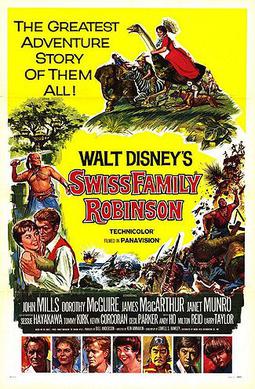
Traveling to the colony of New Guinea, the Robinson family is aboard a ship caught up in a storm that wrecks the ship on a reef, the crew abandoning the ship and leaving the family to fend for themselves. Thankfully, an island is within sight, and the Robinsons -- including Father (John Mills), Mother (Dorothy McGuire), and their three sons, Fritz (James MacArthur), Ernst (Tommy Kirk) and Francis (Kevin Corcoran) -- are able to make it their with all the supplies, food and animals left onboard. Not knowing if rescue is coming, they make the most of their island paradise, embracing their new lives. But on this Pacific island full of animals and adventures, trouble awaits too including a pirate band (led by Sessue Hayakawa) who are after something the Robinsons possess.
In the current state and age of Disney with seemingly countless animated movies and generic shows on TV, it's hard to imagine Walt Disney movies of the 1950s and 1960s. Yes, it was a completely different time from now, a more innocent time, and because of that, movies like Swiss Family Robinson have an endearing charm that is hard to explain. It is an adventure, a trip to the exotic and is the definition of good, old-fashioned storytelling that is best accompanied by a big tub of popcorn. Everything from the musical score in all its epic, sweeping qualities (listen HERE, just scroll down) to the casting to the look of the movie adds up. They don't make them like this anymore, simple as that. It's a window to a Disney of the past when high-quality, professionally made and still entertaining feature films were released to adoring audiences.
One of the obvious appeals of 'Swiss' is that any kid who has ever read Robinson Crusoe or has the slightest bit of imagination has at some point wondered how cool it would be to live on a deserted island. Albeit this "deserted" island has plenty of food, water and supplies with lots of animals (elephants, tigers, zebras, ostriches) and adventure waiting around every tree. The coolest thing EVER though is the treehouse the Robinsons build and live in, an idyllic house in the branches that all viewers should want to live in. If you don't, you're lying. Get over it. HERE is the Disney's Magic Kingdom version. Director Ken Annakin shot this movie on the island of Tobago, and it is a stunning visual film. It is the island paradise we all dream of one day living on at some point. The screen is always full of incredible colors -- even the pirates seem fashion conscious -- and is a treat just to look at. To a point, everything else is just gravy.
An underrated facet of this movie's long-term popularity and success is the casting of the Robinson family using some Disney regulars and a few newbies. For starters, I believed this tiny, close-knit group as a family. They look out for each other, they fight, they celebrate holidays, and when needed band together to preserve their island paradise. John Mills and Dorothy McGuire are the quintessential parents, Father and Mother, no first names provided or needed. They just go together, an easy-going, believable chemistry between them. The boys include MacArthur as the athletic but smart Fritz, the intelligent and always trying to prove himself Ernst played by Kirk, and the curious, sometimes annoying Francis played by Corcoran, all three regulars in Disney movies. All five work together seamlessly, and then add in the adorable Janet Munro as Roberta, a teenage girl Fritz and Ernst rescue from pirates while exploring the island.
Growing up watching this movie on a regular basis, a long list of scenes were memorable to me, but none more than the finale when the Robinson family defends their island against a raiding party of pirates. It's the type of adventure where you never really believe they're in danger (would a Disney movie kill this family? I think not), but it doesn't take away from the excitement. Coconut bombs, pirate alarms, a pit filled with a tiger, a collapsing bridge, avalanches of logs and boulders, and booby traps left and right. All pretty ridiculous, and that's the fun. Reality got left behind a long time ago here. It is a great ending, the movie ending on a very positive note.
I could go on for paragraph after paragraph with this movie. Yes, Corcoran's Francis is annoying, but even that can't stop me from loving this movie. It is a gem, a classic, a keeper, whatever you want to call it. Great cast, great story, and one of the most fun, entertaining movies ever. Adventures with that Disney touch at its finest. You can watch it HERE at Youtube, starting with Part 1 of 10.
Swiss Family Robinson <---trailer (1960): ****/****
Sunday, April 17, 2011
In Which We Serve
When I hear British director David Lean's name, I typically think of one thing and one thing only; epics. Huge, monstrous movies like Lawrence of Arabia, Doctor Zhivago, The Bridge on the River Kwai. Basically, everything that is good and right about movies when handled correctly with the right crew, cast and story. Even one of the most respected directors of all-time has to start somewhere though, right? You don't jump right in and get an epic movie handed to you. Still, for a first movie, 1942's In Which We Serve is quite the first impression.
Making his directorial debut, Lean shares the director's chair with British writer/actor Noel Coward who also stars in the movie. I try my best to keep my reviews as different as possible without repeating topics, but I can't help it with this one. It pertains to the time the movie was released, in this case a WWII movie hitting theaters during WWII. We're not talking late in the war either when the end result had all but been decided. We're talking 1942 when the war was very much still up in the balance. We never actually see any German soldiers/sailors/pilots as the story focuses exclusively on the British armed forces, specifically the Navy. The tone though is certainly one meant to inspire although to Lean and Coward's credit, it isn't straight propaganda. Instead, it's a story of people rising up and working together in one of history's darkest chapters.
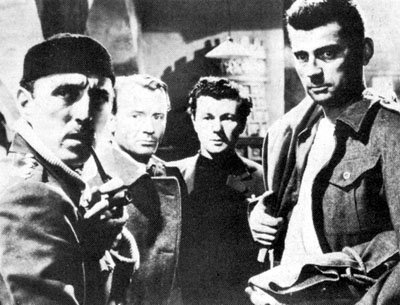
It's the middle of WWII and a British destroyer, the HMS Torrin, is sailing through the Mediterranean in support of the invasion of Crete. Commanded by Captain Kinross (Coward), the Torrin is attacked by German dive bombers and the crew is forced to abandon ship. In all the chaos, a small group of survivors manage to get off the ship -- including Kinross -- and cling together on a small life raft, hoping that a rescue effort is coming to save them. As they await their hopeful rescue, they look back on how they got to this point, reflecting on the ship being made and the coming years as WWII broke out. They think back, remembering their families, their friends, and their stories, all the while hoping time won't run out on them.
Telling the story of an HMS destroyer and her 300-man crew, 'Serve' has a cross-section of actors filling out the ranks so we get to know all sides of the story, not just the captain and the officers or the lowly sailors. Coward's Captain is the stiff upper lip commander, unshakable in battle and a courageous leader. He addresses his men three different times, the third and final time being the most moving. Then there's Seaman Shorty Blake (John Mills), a young sailor with an expecting wife back home. He's the lower/middle class sailor, the representative of the crew more or less. There's also Chief Petty Officer Hardy (Bernard Miles), an intelligent if somewhat clueless officer who you nonetheless come to like. Also look for Richard Attenborough in his first film, an uncredited but worthwhile role, and James Donald as the Torrin's on-board doctor.
It's best to think of this as two movies. First, the plight of the survivors which is handled briefly but fairly. How much can you show of 10 or 11 men clinging to a life raft without the proceedings getting tedious? Second, the flashbacks of Coward, Mills, Miles, and even Attenborough briefly. While those too are tedious at times (how many times can we see sailors say goodbye to their wives and still have it mean something?), they end up being worthwhile. Stories that deal with the home front are few and far between, especially anything documenting London and England during the massive German bombings. Getting to these scenes can be a slow-go at times, but the wait is worth it. Worthwhile parts for the women left behind include Celia Johnson as Mrs. Kinross, the captain's wife, Joyce Carey as Kath Hardy, the doting but tough wife of the petty officer, Kay Walsh as Freda, Blake's fiance and eventually his wife, and Kathleen Harrison as Mrs. Blake, Shorty's always-worrying mother.
Whether it was released in the 1940s when audiences needed a positive jolt or 30 years later in the 1970s when audiences were more cynical, a war movie has to leave some impression on you to be truly effective. Coward's last address of his men is well-handled, but two other scenes hit me. SPOILERS STOP READING SPOILERS Blake finds out that Hardy's wife and mother-in-law were killed in a bombing and has to deliver the news, a poignant scene showing two men struggling with how exactly to handle the situation. Second, after the Torrin sinks, Blake's mother receives a telegram saying her son is alive. Her genuine relief, her screaming to tell his wife hit me right in the gut in terms of emotional impact. So that's what I'll take away from this movie which does have its dry spots. A moving story that could have been better, but still worthwhile.
In Which We Serve <---full movie (1942): ***/****
Making his directorial debut, Lean shares the director's chair with British writer/actor Noel Coward who also stars in the movie. I try my best to keep my reviews as different as possible without repeating topics, but I can't help it with this one. It pertains to the time the movie was released, in this case a WWII movie hitting theaters during WWII. We're not talking late in the war either when the end result had all but been decided. We're talking 1942 when the war was very much still up in the balance. We never actually see any German soldiers/sailors/pilots as the story focuses exclusively on the British armed forces, specifically the Navy. The tone though is certainly one meant to inspire although to Lean and Coward's credit, it isn't straight propaganda. Instead, it's a story of people rising up and working together in one of history's darkest chapters.
It's the middle of WWII and a British destroyer, the HMS Torrin, is sailing through the Mediterranean in support of the invasion of Crete. Commanded by Captain Kinross (Coward), the Torrin is attacked by German dive bombers and the crew is forced to abandon ship. In all the chaos, a small group of survivors manage to get off the ship -- including Kinross -- and cling together on a small life raft, hoping that a rescue effort is coming to save them. As they await their hopeful rescue, they look back on how they got to this point, reflecting on the ship being made and the coming years as WWII broke out. They think back, remembering their families, their friends, and their stories, all the while hoping time won't run out on them.
Telling the story of an HMS destroyer and her 300-man crew, 'Serve' has a cross-section of actors filling out the ranks so we get to know all sides of the story, not just the captain and the officers or the lowly sailors. Coward's Captain is the stiff upper lip commander, unshakable in battle and a courageous leader. He addresses his men three different times, the third and final time being the most moving. Then there's Seaman Shorty Blake (John Mills), a young sailor with an expecting wife back home. He's the lower/middle class sailor, the representative of the crew more or less. There's also Chief Petty Officer Hardy (Bernard Miles), an intelligent if somewhat clueless officer who you nonetheless come to like. Also look for Richard Attenborough in his first film, an uncredited but worthwhile role, and James Donald as the Torrin's on-board doctor.
It's best to think of this as two movies. First, the plight of the survivors which is handled briefly but fairly. How much can you show of 10 or 11 men clinging to a life raft without the proceedings getting tedious? Second, the flashbacks of Coward, Mills, Miles, and even Attenborough briefly. While those too are tedious at times (how many times can we see sailors say goodbye to their wives and still have it mean something?), they end up being worthwhile. Stories that deal with the home front are few and far between, especially anything documenting London and England during the massive German bombings. Getting to these scenes can be a slow-go at times, but the wait is worth it. Worthwhile parts for the women left behind include Celia Johnson as Mrs. Kinross, the captain's wife, Joyce Carey as Kath Hardy, the doting but tough wife of the petty officer, Kay Walsh as Freda, Blake's fiance and eventually his wife, and Kathleen Harrison as Mrs. Blake, Shorty's always-worrying mother.
Whether it was released in the 1940s when audiences needed a positive jolt or 30 years later in the 1970s when audiences were more cynical, a war movie has to leave some impression on you to be truly effective. Coward's last address of his men is well-handled, but two other scenes hit me. SPOILERS STOP READING SPOILERS Blake finds out that Hardy's wife and mother-in-law were killed in a bombing and has to deliver the news, a poignant scene showing two men struggling with how exactly to handle the situation. Second, after the Torrin sinks, Blake's mother receives a telegram saying her son is alive. Her genuine relief, her screaming to tell his wife hit me right in the gut in terms of emotional impact. So that's what I'll take away from this movie which does have its dry spots. A moving story that could have been better, but still worthwhile.
In Which We Serve <---full movie (1942): ***/****
Labels:
1940s,
David Lean,
James Donald,
John Mills,
Richard Attenborough,
WWII
Monday, November 15, 2010
The Colditz Story
I started reading about history pretty early in grammar school and never really stopped. I was introduced early to The Great Escape -- the book and the movie -- and 40 or 50 viewings later, it is still one of my two favorite movies. The story of Allied prisoners of war during WWII has translated well to both book form and movies in the 60-plus years since the end of the war, some more well known than others. I've seen a fair share -- Bridge on the River Kwai, Stalag 17, King Rat -- among others, but I always keep an eye out for ones I've missed, including 1955's The Colditz Story.
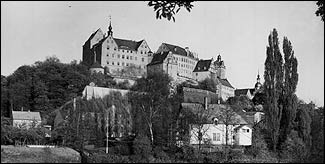
Like The Great Escape, this WWII P.O.W story is based on the actual escape attempts of the prisoners from their German captors. The start of the WWII brought up the question for both sides; what to do with captured prisoners? The Geneva Convention provided for the treatment of prisoners, but there was still the matter of housing and feeding the thousands of prisoners on either side. A prisoner's right and responsibility was to try and escape so the German Luftwaffe was forced to improvise. One of the most infamous prison camps was in the town of Colditz in the Colditz Castle, a medieval building reserved for only those prisoners dubbed the most dangerous, those most likely to escape. A recipe for a successful POW movie if there ever was.
It's summer 1940 and two British officers, Captain Pat Reid (John Mills) and Mac McGill (Christopher Rhodes), have been captured by the Germans and sent to the prison camp at Colditz Castle deep in Germany. There they find only two other British officers, Pat Tyler (Lionel Jeffries) and Jimmy Winslow (Bryan Forbes), who they quickly hit it off with. It's not long before truckloads of new prisoners arrive, including a senior British officer, Colonel Richmond (Eric Portman), who doesn't seem interested in escaping. In the crowded supposedly inescapable prison, the Brits go to work on their escape attempts, but coupled with the efforts of the French, Poles, and Dutch, end up stepping on each others toes. With help from Richmond, the diverse group of prisoners begin to work together in their escape plans, all with the hopes of someone hitting a "home run" and making it all the way to Switzerland.
Mostly known and respected for some of the earliest and best James Bond movies, director Guy Hamilton makes an entertaining, somewhat atypical war movie here. For being supposedly an inescapable prison, Colditz actually had its fair share of successful escapes over the course of WWII so right off the start Hamilton is working with a story that maybe -- just maybe -- could end on a positive note. The movie was filmed on location in Colditz (a nice touch), but I'm not sure how much and where. Regardless, it gives the story an air of authenticity as we're seeing the actual buildings these events took place in. Mills' character Pat Reid was an actual escapee from Colditz and wrote several books about his time in the prison so the story feels truthful and authentic in dealing with the facts.
Like other POW movies focusing on escape, the story isn't the most linear thing around. It tends to bounce from escape attempt to escape attempt rather than focusing on one specific plan devised by the prisoners. This could have ended with a bloated, overlong movie, but at just 97 minutes, Hamilton picked an appropriate run time. He wastes little time early on, introducing his characters and the setting and moves on to what viewers want to see; the Allied prisoners cleverly trying to escape from their German captors. Just the sheer audacity in which these prisoners make their attempts is impressive. They had no fear, no worries about consequences and repercussions. Watch one stupidly brave attempt HERE. These prisoners would try anything to escape, and that's maybe the most amazing thing about the story of this movie. These things actually happened.
Telling the story of a multinational group of Allied prisoners allows Hamilton to assemble a cast of multinational talent to fill out his ranks. Mills leads the heavily British cast as Pat Reid, a prisoner who becomes "escape officer," basically a coordinator of escapes who by taking the position agrees not to attempt an escape on his own. I like Mills as an actor on-screen because he has a knack for making his characters likable with little effort, and his Reid definitely is a prisoner you're rooting for. Portman as Colonel Richmond too is a scene-stealer, the stiff upper lip British officer who'd like nothing more than to break out as many prisoners as possible. Rhodes, Jeffries and Forbes are all solid as fellow British prisoners, especially Rhodes as a prisoner who may be too tall to escape. Frederick Valk plays the German commandant at Colditz and Denis Shaw plays Priem, a German ferret assigned with rooting out any and all escape attempts.
Because of my love for The Great Escape, I'm a sucker for like-minded movies like this one. It was a British production so it is not well known outside of England, but because it deals with the facts of being a WWII prisoner, it's easy to see the blueprint it laid out for prisoner of war movies yet to come. Filmed in a stark black and white on location in Colditz, this flick doesn't do anything great and isn't as flashy as The Great Escape or epic as River Kwai. But it is the truth in the story it tells that makes this movie worthwhile.
The Colditz Story <----opening 9 minutes (1955): ***/****
Like The Great Escape, this WWII P.O.W story is based on the actual escape attempts of the prisoners from their German captors. The start of the WWII brought up the question for both sides; what to do with captured prisoners? The Geneva Convention provided for the treatment of prisoners, but there was still the matter of housing and feeding the thousands of prisoners on either side. A prisoner's right and responsibility was to try and escape so the German Luftwaffe was forced to improvise. One of the most infamous prison camps was in the town of Colditz in the Colditz Castle, a medieval building reserved for only those prisoners dubbed the most dangerous, those most likely to escape. A recipe for a successful POW movie if there ever was.
It's summer 1940 and two British officers, Captain Pat Reid (John Mills) and Mac McGill (Christopher Rhodes), have been captured by the Germans and sent to the prison camp at Colditz Castle deep in Germany. There they find only two other British officers, Pat Tyler (Lionel Jeffries) and Jimmy Winslow (Bryan Forbes), who they quickly hit it off with. It's not long before truckloads of new prisoners arrive, including a senior British officer, Colonel Richmond (Eric Portman), who doesn't seem interested in escaping. In the crowded supposedly inescapable prison, the Brits go to work on their escape attempts, but coupled with the efforts of the French, Poles, and Dutch, end up stepping on each others toes. With help from Richmond, the diverse group of prisoners begin to work together in their escape plans, all with the hopes of someone hitting a "home run" and making it all the way to Switzerland.
Mostly known and respected for some of the earliest and best James Bond movies, director Guy Hamilton makes an entertaining, somewhat atypical war movie here. For being supposedly an inescapable prison, Colditz actually had its fair share of successful escapes over the course of WWII so right off the start Hamilton is working with a story that maybe -- just maybe -- could end on a positive note. The movie was filmed on location in Colditz (a nice touch), but I'm not sure how much and where. Regardless, it gives the story an air of authenticity as we're seeing the actual buildings these events took place in. Mills' character Pat Reid was an actual escapee from Colditz and wrote several books about his time in the prison so the story feels truthful and authentic in dealing with the facts.
Like other POW movies focusing on escape, the story isn't the most linear thing around. It tends to bounce from escape attempt to escape attempt rather than focusing on one specific plan devised by the prisoners. This could have ended with a bloated, overlong movie, but at just 97 minutes, Hamilton picked an appropriate run time. He wastes little time early on, introducing his characters and the setting and moves on to what viewers want to see; the Allied prisoners cleverly trying to escape from their German captors. Just the sheer audacity in which these prisoners make their attempts is impressive. They had no fear, no worries about consequences and repercussions. Watch one stupidly brave attempt HERE. These prisoners would try anything to escape, and that's maybe the most amazing thing about the story of this movie. These things actually happened.
Telling the story of a multinational group of Allied prisoners allows Hamilton to assemble a cast of multinational talent to fill out his ranks. Mills leads the heavily British cast as Pat Reid, a prisoner who becomes "escape officer," basically a coordinator of escapes who by taking the position agrees not to attempt an escape on his own. I like Mills as an actor on-screen because he has a knack for making his characters likable with little effort, and his Reid definitely is a prisoner you're rooting for. Portman as Colonel Richmond too is a scene-stealer, the stiff upper lip British officer who'd like nothing more than to break out as many prisoners as possible. Rhodes, Jeffries and Forbes are all solid as fellow British prisoners, especially Rhodes as a prisoner who may be too tall to escape. Frederick Valk plays the German commandant at Colditz and Denis Shaw plays Priem, a German ferret assigned with rooting out any and all escape attempts.
Because of my love for The Great Escape, I'm a sucker for like-minded movies like this one. It was a British production so it is not well known outside of England, but because it deals with the facts of being a WWII prisoner, it's easy to see the blueprint it laid out for prisoner of war movies yet to come. Filmed in a stark black and white on location in Colditz, this flick doesn't do anything great and isn't as flashy as The Great Escape or epic as River Kwai. But it is the truth in the story it tells that makes this movie worthwhile.
The Colditz Story <----opening 9 minutes (1955): ***/****
Labels:
1950s,
Bryan Forbes,
Guy Hamilton,
John Mills,
Prisoners of War,
WWII
Tuesday, September 14, 2010
I Was Monty's Double
World War II produced its fair share of personalities on all sides, both good and bad. They were bigger than life people from the high-ranking generals like Patton to the more common soldier like Audie Murphy or JFK who rose to heroic levels through their actions. The obvious charisma, machismo, whatever you want to call it, translates well to the movies so viewers get the chance to see the Pattons, the Kennedys in their war exploits. But what about someone who impersonated one of those heroes? That's 1958's I Was Monty's Double, AKA Hell, Heaven or Hoboken.
Maybe one of the most famous British generals in history, Bernard Montgomery is also one of the more controversial figures from the war. For all his positives as a general, there's two or three things you could counter with in an equally negative light. He was egotistical beyond all belief and often made decisions that would benefit him more than his army, his staff or even the war effort, in the process driving Supreme Allied commander Dwight D. Eisenhower absolutely crazy. An interesting figure if there ever was, Monty's fame and influence play heavily into this 1958 British war picture. Of course, it was the 1950s and Monty was still alive so this isn't exactly the most factual retelling of a true story.
Early in 1944, two British intelligence agents, Major Harvey (John Mills) and Colonel Logan (Cecil Parker) concoct a plan that could heavily influence the amount of lives saved during the coming invasion. One night at the theater, Harvey sees a General Montgomery impersonator and an idea is formed. What if the Allies could use this impersonator and have him travel to Gibraltar and North Africa, hoping to trick the Germans into thinking the coming invasion will come from the south and not at the actual Normandy location. Harvey and Logan work with the actor (M.E. Clifton James, playing himself) to get the mannerisms, the characteristics of the famous general down, and quickly enough, he's the spitting image of Monty. But that's just for practice. Can he pull off the ruse in public, even with people who've personally met the general?
Based on a true story -- James actually did impersonate Montgomery during the war in 1944 -- director John Guillermin's movie has a quasi-documentary feel to it. For such a serious topic though, the tone is often surprisingly comical (and not in a good way). Much of James' transformation is played for laughs with an oddly out of place musical score from composer John Addison. A story about an Aussie actor posing as one of the war's most recognizable faces leans toward a more serious subject matter if you ask me. It's never straight slapstick or anything, and the humor is fairly subtle, but it felt grossly out of place for me in an otherwise quality movie.
Even 13 years since the end of the war, James still resembles General Montgomery and right off the bat the movie starts off on a positive note because of his casting. The guy actually passed for this most famous of generals, convincing the German High Command to move over 60,000 and a Panzer division to the south because German agents saw James making appearances in Gibraltar and North Africa. Playing himself, James is very natural, a man who questions if he can perform this most epic of performances. As a viewer, you feel for him in this odd predicament. He may not have carried a gun on the front lines like so many millions of soldiers, but his actions showed a different bravery. He displayed a courage that saved the lives of thousands of Allied soldiers.
So when a movie's title describes your character, the movie basically sinks or swims with that person. James is perfect playing himself, but Mills and Parker are extremely key characters to go along with the lead. Neither part is especially flashy as the British duo tackle the more workmanlike roles that keep the story chugging along. Mills gets more screen time as Major Harvey and doesn't disappoint. Once James goes out as Montgomery, Mills' Harvey poses as an adjutant always by his side, always there to help him out in a pinch. The more I see of John Mills, the more a fan I become, and this is another solid part. Parker is given less to do but nails the part of the stiff upper lip, highly sophisticated, smooth British agent. Barbara Hicks has a good part too as the secretary who helps arrange this ambitious spy game.
When at its best, 'Double' deals with the high-wire act James and his support team go through. One slip-up and the whole thing goes down the drain with disastrous consequences. The 2nd half of the movie when James steps up to the plate is the more exciting half obviously, including one fictionalized account of a possible German commando mission to kidnap "Monty." Fictional maybe, but it's an exciting ending with a good build-up to a genuinely funny final line. A true story and generally a forgotten one, but a good movie nonetheless.
I Was Monty's Double <---TCM clips (1958): ***/****
Maybe one of the most famous British generals in history, Bernard Montgomery is also one of the more controversial figures from the war. For all his positives as a general, there's two or three things you could counter with in an equally negative light. He was egotistical beyond all belief and often made decisions that would benefit him more than his army, his staff or even the war effort, in the process driving Supreme Allied commander Dwight D. Eisenhower absolutely crazy. An interesting figure if there ever was, Monty's fame and influence play heavily into this 1958 British war picture. Of course, it was the 1950s and Monty was still alive so this isn't exactly the most factual retelling of a true story.
Early in 1944, two British intelligence agents, Major Harvey (John Mills) and Colonel Logan (Cecil Parker) concoct a plan that could heavily influence the amount of lives saved during the coming invasion. One night at the theater, Harvey sees a General Montgomery impersonator and an idea is formed. What if the Allies could use this impersonator and have him travel to Gibraltar and North Africa, hoping to trick the Germans into thinking the coming invasion will come from the south and not at the actual Normandy location. Harvey and Logan work with the actor (M.E. Clifton James, playing himself) to get the mannerisms, the characteristics of the famous general down, and quickly enough, he's the spitting image of Monty. But that's just for practice. Can he pull off the ruse in public, even with people who've personally met the general?
Based on a true story -- James actually did impersonate Montgomery during the war in 1944 -- director John Guillermin's movie has a quasi-documentary feel to it. For such a serious topic though, the tone is often surprisingly comical (and not in a good way). Much of James' transformation is played for laughs with an oddly out of place musical score from composer John Addison. A story about an Aussie actor posing as one of the war's most recognizable faces leans toward a more serious subject matter if you ask me. It's never straight slapstick or anything, and the humor is fairly subtle, but it felt grossly out of place for me in an otherwise quality movie.
Even 13 years since the end of the war, James still resembles General Montgomery and right off the bat the movie starts off on a positive note because of his casting. The guy actually passed for this most famous of generals, convincing the German High Command to move over 60,000 and a Panzer division to the south because German agents saw James making appearances in Gibraltar and North Africa. Playing himself, James is very natural, a man who questions if he can perform this most epic of performances. As a viewer, you feel for him in this odd predicament. He may not have carried a gun on the front lines like so many millions of soldiers, but his actions showed a different bravery. He displayed a courage that saved the lives of thousands of Allied soldiers.
So when a movie's title describes your character, the movie basically sinks or swims with that person. James is perfect playing himself, but Mills and Parker are extremely key characters to go along with the lead. Neither part is especially flashy as the British duo tackle the more workmanlike roles that keep the story chugging along. Mills gets more screen time as Major Harvey and doesn't disappoint. Once James goes out as Montgomery, Mills' Harvey poses as an adjutant always by his side, always there to help him out in a pinch. The more I see of John Mills, the more a fan I become, and this is another solid part. Parker is given less to do but nails the part of the stiff upper lip, highly sophisticated, smooth British agent. Barbara Hicks has a good part too as the secretary who helps arrange this ambitious spy game.
When at its best, 'Double' deals with the high-wire act James and his support team go through. One slip-up and the whole thing goes down the drain with disastrous consequences. The 2nd half of the movie when James steps up to the plate is the more exciting half obviously, including one fictionalized account of a possible German commando mission to kidnap "Monty." Fictional maybe, but it's an exciting ending with a good build-up to a genuinely funny final line. A true story and generally a forgotten one, but a good movie nonetheless.
I Was Monty's Double <---TCM clips (1958): ***/****
Sunday, September 12, 2010
Dunkirk
Nothing personal here, but just in case, I'm sorry to any Brits reading this. I didn't intend to do multiple reviews so closely about British military disasters, but here goes. After reviewing Zulu Dawn a few weeks back, we jump ahead in time to the early part of WWII when those cocky Brits were up to it again. There really needs to be a sarcasm font is all I can think of as I write this. One part epic disaster and one part heroism to the nth degree, the battle of Dunkirk was a history changer and if it had ended differently, could have been the final straw in Adolf Hitler completely taking over Europe. In movie form, the focus is more on the heroism in 1958's aptly titled Dunkirk.
It's late spring in 1940, and English and French forces are perched on the Belgium border across from the waiting German armies. No one seems overly concerned at the build-up of German troops, and then the attack comes, waves of soldiers pushing the English and French back across France. The troops in mass retreat are just trying to stay one step ahead of the Germans on their heels. As the attack continues and the lines continue to collapse, a small sector near the port city of Dunkirk is all that remains for the Allied forces. Their backs against the sea, hundreds of thousands of troops wait for their ultimate destruction while back in England the home front attempts to organize a rescue. Hundreds of non-military boat and ship owners sail across the English Channel hoping to rescue as many troops as possible, but can they be rescued in time before the Germans overwhelm them?
Just on pure bravery and heroism, this is one of the most amazing stories to come out of WWII. Thousands of Allied soldiers were on the verge of being wiped out, and the home front organized this massive effort to save those troops. The beaches around Dunkirk were packed with troops and therefore wide open to air attacks by the German Luftwaffe. The ships coming to save them? Even more wide open and completely exposed to attack. Casualties were enormous among these heroic Englishmen and over 70 years later it is a story that is hard to comprehend in the simplicity of the bravery involved. Odds against them, these men and women risked it all to save others. If there's a better way to put it, I can't think of it.
This disastrous WWII campaign is told from two different perspectives. One is a British corporal, Cpl. Tubby Bins (John Mills), who finds himself in charge of a motley squad of British soldiers after the highest ranking officer around is killed. Two is the effort from private British citizens back in England organizing the rescue effort, seen through the eyes of a British newspaper reporter (Bernard Lee) and a factory owner (Richard Attenborough) who must balance out his fears with his desire to do what's right. It's a great balance because one or the other would have been effective, but combining the two gives a much bigger perspective of the scale involved. Thousands of soldiers were lost in the shuffle of the retreat, but seeing one man and a handful of soldiers puts it all in a very personal light.
I grew up watching John Mills as Father Robinson in Swiss Family Robinson so I've always been a fan. But the more I see him in dramatic roles, the more I like him as an actor, not just a great memory from growing up. His Corporal Bins is another great character for him. Slight in stature, Mills is no super-soldier gunning down legions of German troops. He's a regular guy thrust into an unlikely leadership position. Robert Urquhart plays Pvt. Mike along with Ray Jackson and Meredith Edwards as some of the soldiers under Bin's command. The 'lost patrol' aspect of the story was my favorite part as Bins' squad makes their way back across France dodging Luftwaffe strafes and roaming German patrols.
Still strong but not quite as strong is the build-up to the sea rescue. Lee and Attenborough balance each other out, Lee willingly to volunteer to commit his small boat to the effort, Attenborough not so sure about committing so much. Now this is a British-made movie about a British disaster so you can figure out that in the end everyone gets a chance to redeem themselves. That said, the performances from these two class-act actors are top notch. Subtle in their effectiveness without any big theatrics, both characters let their actions speak louder than any words could.
What was most impressive was the depiction of the Dunkirk beaches packed to the gills with waiting British troops. Thousands of extras were used to show just how crowded this long stretch of beach really was. The problem is that the last 30 or 40 minutes get a little tedious in showing how hopeless the situation is. At a certain point it's just beating us over the head. The end is an uplifting one though, especially knowing that the heroism displayed by soldier and civilian alike ends up helping turn the tide of war. Also worth pointing out, Malcolm Arnold's musical score seems like a rehash of his 'River Kwai' score. Minor complaint in an above average look at a military disaster that could have been a debacle.
Dunkirk <---trailer (1958): ***/****
It's late spring in 1940, and English and French forces are perched on the Belgium border across from the waiting German armies. No one seems overly concerned at the build-up of German troops, and then the attack comes, waves of soldiers pushing the English and French back across France. The troops in mass retreat are just trying to stay one step ahead of the Germans on their heels. As the attack continues and the lines continue to collapse, a small sector near the port city of Dunkirk is all that remains for the Allied forces. Their backs against the sea, hundreds of thousands of troops wait for their ultimate destruction while back in England the home front attempts to organize a rescue. Hundreds of non-military boat and ship owners sail across the English Channel hoping to rescue as many troops as possible, but can they be rescued in time before the Germans overwhelm them?
Just on pure bravery and heroism, this is one of the most amazing stories to come out of WWII. Thousands of Allied soldiers were on the verge of being wiped out, and the home front organized this massive effort to save those troops. The beaches around Dunkirk were packed with troops and therefore wide open to air attacks by the German Luftwaffe. The ships coming to save them? Even more wide open and completely exposed to attack. Casualties were enormous among these heroic Englishmen and over 70 years later it is a story that is hard to comprehend in the simplicity of the bravery involved. Odds against them, these men and women risked it all to save others. If there's a better way to put it, I can't think of it.
This disastrous WWII campaign is told from two different perspectives. One is a British corporal, Cpl. Tubby Bins (John Mills), who finds himself in charge of a motley squad of British soldiers after the highest ranking officer around is killed. Two is the effort from private British citizens back in England organizing the rescue effort, seen through the eyes of a British newspaper reporter (Bernard Lee) and a factory owner (Richard Attenborough) who must balance out his fears with his desire to do what's right. It's a great balance because one or the other would have been effective, but combining the two gives a much bigger perspective of the scale involved. Thousands of soldiers were lost in the shuffle of the retreat, but seeing one man and a handful of soldiers puts it all in a very personal light.
I grew up watching John Mills as Father Robinson in Swiss Family Robinson so I've always been a fan. But the more I see him in dramatic roles, the more I like him as an actor, not just a great memory from growing up. His Corporal Bins is another great character for him. Slight in stature, Mills is no super-soldier gunning down legions of German troops. He's a regular guy thrust into an unlikely leadership position. Robert Urquhart plays Pvt. Mike along with Ray Jackson and Meredith Edwards as some of the soldiers under Bin's command. The 'lost patrol' aspect of the story was my favorite part as Bins' squad makes their way back across France dodging Luftwaffe strafes and roaming German patrols.
Still strong but not quite as strong is the build-up to the sea rescue. Lee and Attenborough balance each other out, Lee willingly to volunteer to commit his small boat to the effort, Attenborough not so sure about committing so much. Now this is a British-made movie about a British disaster so you can figure out that in the end everyone gets a chance to redeem themselves. That said, the performances from these two class-act actors are top notch. Subtle in their effectiveness without any big theatrics, both characters let their actions speak louder than any words could.
What was most impressive was the depiction of the Dunkirk beaches packed to the gills with waiting British troops. Thousands of extras were used to show just how crowded this long stretch of beach really was. The problem is that the last 30 or 40 minutes get a little tedious in showing how hopeless the situation is. At a certain point it's just beating us over the head. The end is an uplifting one though, especially knowing that the heroism displayed by soldier and civilian alike ends up helping turn the tide of war. Also worth pointing out, Malcolm Arnold's musical score seems like a rehash of his 'River Kwai' score. Minor complaint in an above average look at a military disaster that could have been a debacle.
Dunkirk <---trailer (1958): ***/****
Labels:
1950s,
Bernard Lee,
John Mills,
Richard Attenborough,
WWII
Tuesday, August 24, 2010
Zulu Dawn
Military victories when handled the right way -- good cast, big enough budget, halfway decent script -- can translate well to a feature length movie. Think of D-Day, Gettysburg, Battle of Britain for examples of a battle filmed on an epic scale with the final result the better for it. So flip the coin then and look at the opposite, military disasters. It can be fascinating to see a skirmish, battle, or even a war turn for the worse and what made it do that. Telling the story of one of the worst military disasters in history, 1979's Zulu Dawn does everything it should in giving an honest look at that disaster.
In theaters 15 years before 'Dawn,' 1964's Zulu told the true story of the battle of Rorke's Drift, a last stand situation where about 100 British soldiers in 1879 held off the attacks of thousands of Zulu warriors for over a day. Before that battle, an army of thousands of Zulu warriors had almost completely destroyed a whole British battalion a few miles away. So while there is no link other than the same setting and story, Zulu Dawn is an unofficial prequel to a movie made 15 years earlier. 1964's Zulu mentioned the previous battle in a prologue, but director Douglas Hickox delves right in to tell the story of one of history's biggest military disasters.
In the South African province of Natal in 1879, British general Lord Chelmsford (Peter O'Toole) awaits orders on what to do with the possibility of a war breaking out between the British and the Zulu nation. A representative of the British government (John Mills) has sent an ultimatum to the Zulus, disassemble your army of warriors and dissolve the nation as a whole and there will be no issue. The offer is of course refused so Chelmsford leads a small army of around 2,000 men (including 2nd in command Burt Lancaster, a real scene-stealer here) into the Zulu territory against an army estimated at 30,000 men. But the proud, even arrogant British march into Zululand assuring themselves of an easy victory, not knowing what awaits them.
If you haven't figured by now, that easy victory never comes to fruition after Chelmsford foolishly splits up his forces and basically invites piecemeal destruction as overwhelming numbers just destroy his men. It seems through history the British have had their fair share of military disasters and never really learn from those defeats. Marching into Zulu territory, one officer (Christopher Cazenove) remarks how noble their effort is, how heroic their actions like the campaign will be a walk in the park. Like any story where the end result is never in doubt, Hickox creates palpable tension, a sense of doom of what is to come.
Of course with a historical movie like that, you want to see the disaster, you want to see the Titanic sink so getting there can be a little tedious at times. Where 'Dawn' is at its absolute best is in the depiction of the battle of Isandlwana where thousands of Zulu warriors take heavy casualties as they wipe out almost all the British defenders at their camp in a ragtag defense. As near as I can figure, the battle scene was filmed on the actual location of the massacre, giving the whole sequence an eerie feeling. On a huge scale, the battle is amazing to watch, but never overwhelming. You're always aware of what's going on, where the lines are, if the British are holding or falling back. Elmer Bernstein's score aids the cause, helping the battle both on an epic scale but also the smaller scale of the man-to-man fighting element of what a last stand must be like. The movie's good, but the Isandlwana sequence at almost 40 minutes long is great.
With a large cast with a long list of characters, some get lost in the shuffle more than others. O'Toole is the stereotypical arrogant, gentlemanly British officer while Lancaster is more an officer of the men, looking out for their best interest whenever possible. Lancaster's Colonel Durnford is definitely the star of the movie, even in an underused part. Simon Ward impresses as Lt. Verecker, a cavalry officer who lived in South Africa before volunteering with the Brits. Also joining the British army is Denholm Elliott as a commanding officer, Cazenove and James Faulkner as lower ranking officers who make a gallant charge in the closing moments in the massacre, Bob Hoskins as a veteran sergeant desperately trying to keep his men in order and alive, Nigel Davenport as O'Toole's aide, and many more, some making better and longer impressions than others, but those are the best of the bunch.
Filming on location in South Africa, you truly get a sense of the wide open expanses of the African frontier. This definitely aids the battle scenes with an enormous scale of armies and strategy as the battle develops from a firefight into a bloody, fleeing massacre. There are some great visual moments but also emotional, surprising moments, like Verecker's patrol riding over the crest of a hill and stumbling upon an immense army of Zulu warriors facing them. In the massacre, all the soldiers we've met go out in their own blaze of glory. This is available to watch through Youtube, start with Part 1 of 12. Overall, not as good as Zulu but a worthy prequel, and it would certainly make an entertaining double-bill.
Zulu Dawn <---Video Detective trailer (1979): ***/****
In theaters 15 years before 'Dawn,' 1964's Zulu told the true story of the battle of Rorke's Drift, a last stand situation where about 100 British soldiers in 1879 held off the attacks of thousands of Zulu warriors for over a day. Before that battle, an army of thousands of Zulu warriors had almost completely destroyed a whole British battalion a few miles away. So while there is no link other than the same setting and story, Zulu Dawn is an unofficial prequel to a movie made 15 years earlier. 1964's Zulu mentioned the previous battle in a prologue, but director Douglas Hickox delves right in to tell the story of one of history's biggest military disasters.
In the South African province of Natal in 1879, British general Lord Chelmsford (Peter O'Toole) awaits orders on what to do with the possibility of a war breaking out between the British and the Zulu nation. A representative of the British government (John Mills) has sent an ultimatum to the Zulus, disassemble your army of warriors and dissolve the nation as a whole and there will be no issue. The offer is of course refused so Chelmsford leads a small army of around 2,000 men (including 2nd in command Burt Lancaster, a real scene-stealer here) into the Zulu territory against an army estimated at 30,000 men. But the proud, even arrogant British march into Zululand assuring themselves of an easy victory, not knowing what awaits them.
If you haven't figured by now, that easy victory never comes to fruition after Chelmsford foolishly splits up his forces and basically invites piecemeal destruction as overwhelming numbers just destroy his men. It seems through history the British have had their fair share of military disasters and never really learn from those defeats. Marching into Zulu territory, one officer (Christopher Cazenove) remarks how noble their effort is, how heroic their actions like the campaign will be a walk in the park. Like any story where the end result is never in doubt, Hickox creates palpable tension, a sense of doom of what is to come.
Of course with a historical movie like that, you want to see the disaster, you want to see the Titanic sink so getting there can be a little tedious at times. Where 'Dawn' is at its absolute best is in the depiction of the battle of Isandlwana where thousands of Zulu warriors take heavy casualties as they wipe out almost all the British defenders at their camp in a ragtag defense. As near as I can figure, the battle scene was filmed on the actual location of the massacre, giving the whole sequence an eerie feeling. On a huge scale, the battle is amazing to watch, but never overwhelming. You're always aware of what's going on, where the lines are, if the British are holding or falling back. Elmer Bernstein's score aids the cause, helping the battle both on an epic scale but also the smaller scale of the man-to-man fighting element of what a last stand must be like. The movie's good, but the Isandlwana sequence at almost 40 minutes long is great.
With a large cast with a long list of characters, some get lost in the shuffle more than others. O'Toole is the stereotypical arrogant, gentlemanly British officer while Lancaster is more an officer of the men, looking out for their best interest whenever possible. Lancaster's Colonel Durnford is definitely the star of the movie, even in an underused part. Simon Ward impresses as Lt. Verecker, a cavalry officer who lived in South Africa before volunteering with the Brits. Also joining the British army is Denholm Elliott as a commanding officer, Cazenove and James Faulkner as lower ranking officers who make a gallant charge in the closing moments in the massacre, Bob Hoskins as a veteran sergeant desperately trying to keep his men in order and alive, Nigel Davenport as O'Toole's aide, and many more, some making better and longer impressions than others, but those are the best of the bunch.
Filming on location in South Africa, you truly get a sense of the wide open expanses of the African frontier. This definitely aids the battle scenes with an enormous scale of armies and strategy as the battle develops from a firefight into a bloody, fleeing massacre. There are some great visual moments but also emotional, surprising moments, like Verecker's patrol riding over the crest of a hill and stumbling upon an immense army of Zulu warriors facing them. In the massacre, all the soldiers we've met go out in their own blaze of glory. This is available to watch through Youtube, start with Part 1 of 12. Overall, not as good as Zulu but a worthy prequel, and it would certainly make an entertaining double-bill.
Zulu Dawn <---Video Detective trailer (1979): ***/****
Thursday, June 10, 2010
Operation Crossbow
Most of the war movies I watch are depictions of front-line action or at least the generals/headquarters making the decisions that affect the front-line soldiers. But what about the Intelligence agencies doing their damnedest to help the war effort through espionage, gaining information and sabotage behind enemy lines. So goes 1965's Operation Crossbow, a British-Italian production telling the true story of British efforts to slow down Germany's rocket/technological advances as WWII reaches its middle years.
As much as WWII was about one Allied soldier facing one Axis soldier, there was a race at home to be the first country to develop the atom bomb. On less destructive levels, both sides tried to create weapons technology that could cause more death and destruction than the average grenade or artillery shell. Obviously, these advances were kept as top secret as possible, but that doesn't mean each side wasn't trying to one-up their enemy by playing a little defense courtesy of the Intelligence community doing a little sabotage.
It's midway through 1943, and the Germans have developed a new flying bomb that they plan to unleash on London and other English cities. The Allies are aware of the new development, and do their best to slow down the advances by consistently bombing German work sites where they believe the bombs to be built and launched. But as dangerous as the bombs are, the Germans have a new weapon in the late stages of development; the V-2 rocket, that could drastically change the course of the war, including the D-Day invasion. Facing such a huge game changer, Allied Intelligence is forced to use a desperate plan; send Allied agents into Germany disguised as engineers who will help develop the rockets.
You might have noticed there's not a single actor/actress listed in the plot description. Basically, it would have taken too long to include them and make that paragraph a behemoth to read. Like other big budget war movies, 'Crossbow' utilizes an ensemble cast with talent from all over the world taking part. And in terms of story, the ensemble works better because the plot is very episodic. The first 30 minutes is almost exclusively from the German perspective, the next 30 the Allied Intelligence, and the last hour mostly with the agents working deep undercover. Each of these segments could have been expanded for their own movie, but together they work to form a coherent storyline.
The cast listing is an odd one because producer Carlo Ponti listed his wife Sophia Loren as the lead when really she makes a 20-minute or so appearance and is an add-on more than anything else. That's not being critical of Loren because she's a fine actress, but big picture her part isn't essential to the movie. Starring as Germans the ensemble includes Paul Henreid and Helmut Dantine as two high-ranking German generals, Barbara Rutting as German aviator Hannah Reitsch, and Anthony Quayle as Bamford, a secret agent/spy. Allied Intelligence includes Richard Johnson, Trevor Howard, John Mills and Richard Todd as the men trying to halt the German advances. The agents sent into Germany include George Peppard, Jeremy Kemp and Tom Courtenay, all posing as deceased scientists so they can access the German rocket plants with Lilli Palmer playing a resistance contact.
The whole movie is a good example of a solid WWII ensemble, but the best and most interesting/exciting part is when the story follows these three agents. They are all forced to become someone else, knowing if they are caught they will be summarily shot on site. Even getting to that point is difficult as Peppard's Lt. Curtis finds out when the scientist he is posing as is visited by his wife (Loren). Courtenay's Henshaw is dealt a cruel twist of fate and must decide how much he is willing to sacrifice. Kemp's Bradley is dropped into Germany as a last-minute resort with little knowledge of the man he's impersonating. Their scenes as they try to dupe the Germans are tense and difficult to watch, those scenes where you get butterflies hoping everything doesn't hit the fan.
Crossbow's story covers a lot of ground -- almost a year and a half -- but never feels like we're being let out. Supposedly a much longer finished product was turned in by director Michael Anderson only to have it cut heavily to the movie we see now which clocks in at just under two hours. You can see where certain segments were cut, especially the German segment to open the movie, and other odd instances like Peppard gaining a bandage on his forehead, but we never see why. But these are little things, not big disturbances that could ruin the movie.
While the V-2 rocket was actually used by Germany in WWII -- over 3,000 were fired at England -- the movie does have to have some sort of resolution if not necessarily a happy ending. The finale is a whopper as Peppard and Kemp desperately try to pinpoint their underground location to a passing bomber force. The huge underground facilities sets look like something out of a James Bond movie and provide quite an ending to a strong story. Not as well know as some of its 1960s WWII counterparts, but definitely worth a watch or two.
Operation Crossbow <----trailer (1965): ***/****
As much as WWII was about one Allied soldier facing one Axis soldier, there was a race at home to be the first country to develop the atom bomb. On less destructive levels, both sides tried to create weapons technology that could cause more death and destruction than the average grenade or artillery shell. Obviously, these advances were kept as top secret as possible, but that doesn't mean each side wasn't trying to one-up their enemy by playing a little defense courtesy of the Intelligence community doing a little sabotage.
It's midway through 1943, and the Germans have developed a new flying bomb that they plan to unleash on London and other English cities. The Allies are aware of the new development, and do their best to slow down the advances by consistently bombing German work sites where they believe the bombs to be built and launched. But as dangerous as the bombs are, the Germans have a new weapon in the late stages of development; the V-2 rocket, that could drastically change the course of the war, including the D-Day invasion. Facing such a huge game changer, Allied Intelligence is forced to use a desperate plan; send Allied agents into Germany disguised as engineers who will help develop the rockets.
You might have noticed there's not a single actor/actress listed in the plot description. Basically, it would have taken too long to include them and make that paragraph a behemoth to read. Like other big budget war movies, 'Crossbow' utilizes an ensemble cast with talent from all over the world taking part. And in terms of story, the ensemble works better because the plot is very episodic. The first 30 minutes is almost exclusively from the German perspective, the next 30 the Allied Intelligence, and the last hour mostly with the agents working deep undercover. Each of these segments could have been expanded for their own movie, but together they work to form a coherent storyline.
The cast listing is an odd one because producer Carlo Ponti listed his wife Sophia Loren as the lead when really she makes a 20-minute or so appearance and is an add-on more than anything else. That's not being critical of Loren because she's a fine actress, but big picture her part isn't essential to the movie. Starring as Germans the ensemble includes Paul Henreid and Helmut Dantine as two high-ranking German generals, Barbara Rutting as German aviator Hannah Reitsch, and Anthony Quayle as Bamford, a secret agent/spy. Allied Intelligence includes Richard Johnson, Trevor Howard, John Mills and Richard Todd as the men trying to halt the German advances. The agents sent into Germany include George Peppard, Jeremy Kemp and Tom Courtenay, all posing as deceased scientists so they can access the German rocket plants with Lilli Palmer playing a resistance contact.
The whole movie is a good example of a solid WWII ensemble, but the best and most interesting/exciting part is when the story follows these three agents. They are all forced to become someone else, knowing if they are caught they will be summarily shot on site. Even getting to that point is difficult as Peppard's Lt. Curtis finds out when the scientist he is posing as is visited by his wife (Loren). Courtenay's Henshaw is dealt a cruel twist of fate and must decide how much he is willing to sacrifice. Kemp's Bradley is dropped into Germany as a last-minute resort with little knowledge of the man he's impersonating. Their scenes as they try to dupe the Germans are tense and difficult to watch, those scenes where you get butterflies hoping everything doesn't hit the fan.
Crossbow's story covers a lot of ground -- almost a year and a half -- but never feels like we're being let out. Supposedly a much longer finished product was turned in by director Michael Anderson only to have it cut heavily to the movie we see now which clocks in at just under two hours. You can see where certain segments were cut, especially the German segment to open the movie, and other odd instances like Peppard gaining a bandage on his forehead, but we never see why. But these are little things, not big disturbances that could ruin the movie.
While the V-2 rocket was actually used by Germany in WWII -- over 3,000 were fired at England -- the movie does have to have some sort of resolution if not necessarily a happy ending. The finale is a whopper as Peppard and Kemp desperately try to pinpoint their underground location to a passing bomber force. The huge underground facilities sets look like something out of a James Bond movie and provide quite an ending to a strong story. Not as well know as some of its 1960s WWII counterparts, but definitely worth a watch or two.
Operation Crossbow <----trailer (1965): ***/****
Saturday, February 6, 2010
Tunes of Glory
There I go again with vague, sweeping generalities, but British movies seem to rely more on acting above all else, with actors like Peter O'Toole, Richard Burton, Richard Attenborough, and of course, Alec Guinness. The English actor was a chameleon when it came to his roles, and I can't help but wonder if he'd be more well-known for his overall ability if he hadn't been in Star Wars. So many people associate him with Obi-Wan Kenobi that the rest of his movies have been somewhat forgotten. But in 1960's Tunes of Glory, Guinness once again shows how strong an actor he really was.
In command of a Highlands battalion in the years following WWII, Major Jock Sinclair (Guinness) is loved by his men. He led them through WWII in Europe and is really just one of the men...albeit with a higher rank. Sinclair is not the strictest of commanders and lets smaller things go in lieu of the bigger picture, and for that reason he's loved by his men. The battalion receives a new commander, Colonel Barrow (John Mills), an officer who spent much of the war in a German POW camp with years of desk duty prior to that. Barrow is a stickler for details, doing everything by the book. His command style clashes with Sinclair and what the battalion is used to. A division forms and the conflict comes to a rise when Sinclair strikes a corporal (John Fraser) who has been seeing his daughter (Susannah York).
Should Barrow bring his second-in-command up on charges? He's had prior issues with Sinclair so a court martial might seem like personal revenge. As well, a trial would bring disgrace to the battalion. But if he doesn't, Barrow is going up against everything he believes in. Whatever the Colonel decides to do could very well tear apart the unit from the inside out. This is a story definitely characteristic of a slow-burn, a plot that keeps on building and piling on. As a viewer, you know there will be some sort of confrontation but in what sense? I for one was completely caught off guard by the ending, a downer in every sense of the idea, but one that works and the most appropriate one too. A happy ending would seem out of place here.
This is a movie dominated by two men, Guinness and Mills, and dominated in a good way. Guinness' Sinclair is built up as the man to side with; he's loved by every one from family to fellow officers to his soldiers. There's a vibe off the character though, a little full of himself and quick-tempered. Mills is the toy soldier, the desk jockey who's never seen combat but is tortured still by his time spent in a German POW camp. He doesn't interact well with the men and gives off a sense of superiority to soldier and officer alike. What's interesting in the execution is how the story develops and how our perceptions change -- or at least mine did -- as we learn more about these two men.
With basically the whole story set in this extravagant barracks the battalion lives in and only a few venture outside the wall, the conflict drives things along thanks to the supporting cast. Some of the other battalion's officers include Dennis Price, Allan Cuthbertson, Duncan Macrae, and Paul Whitsun-Jones, some siding with Sinclair and others Barrow. Gordon Jackson especially rises above the rest as Capt. Jimmy Cairns, the battalion adjutant and a man loyal to his commander to a fault. It's one of those supporting roles that doesn't have much in the way of lines but ends up being memorable nonetheless.
No frills moviemaking at its finest. There is nothing flashy about the proceedings, but the story makes this movie special and really worth checking out. Two very different men, but both are strong-willed and even pigheaded when it comes to getting what they want. A Youtube user was kind enough to post the movie into segments, starting here with Part 1 of 10. Well worth your time if you don't mind sitting down at the computer for 105 minutes. Guinness, Mills, and a fine supporting cast don't disappoint.
Tunes of Glory <----trailer (1960): ***/****
Labels:
1960s,
Alec Guinness,
Gordon Jackson,
John Mills,
Military,
Susannah York
Friday, November 13, 2009
The Human Factor
In an interview he did for the special features The Human Factor DVD, George Kennedy says that growing up watching movies his favorite stars were not even stars. As a youngster, Kennedy chose the character actors as his favorites. It's only fitting then that the long-time actor -- still chugging along at 84 -- is a prime example of how good a character actor can be. Rarely given starring roles, the character actor was always given 4th or 5th billing but often enough stole the show. Actors like Ben Johnson, Victor McLaglen, and Warren Oates made careers out of those supporting roles.
So with a supporting actor Oscar to his name for his role as Dragline in Cool Hand Luke, Kennedy became one of the most dependable Hollywood character actors in the late 1960s and throughout the 1970s including a close association with a long list of disaster movies. But having seen enough of those supporting parts, it's always nice to see those actors get a shot with a starring role. In one of his few lead parts, Kennedy steps into vigilante mode in 1975's The Human Factor.
Working for NATO in Italy, electronics expert John Kinsdale (Kennedy) returns home one night to find police ringing his house. His wife and three children have been brutally murdered execution-style and there's very little in the way of evidence or clues to point to the murderers. With some help from the somewhat dimwitted Italian police chief (Raf Vallone), Kinsdale goes about using what little evidence the police do have to track down the killers. His co-worker, Mike McAllister (John Mills), agrees to help out so the duo uses their state of the art computer technology to get readouts on the killers.
As Kinsdale and McAllister continue to use all the facilities at their disposal, quite illegally as well, the evidence points to an extremist group (led by Thomas Hunter and producer Frank Avianca) demanding prisoners be released from prisons all over Western Europe. If the prisoners aren't released, more and more American families living in Europe will be brutally murdered. McAllister thinks they should go to the police with all the information they've obtained, but Kinsdale has other plans. He's not going to settle for a lifetime jail sentence for the terrorists, he's going to go after them himself.
In the vein of Death Wish or the Dirty Harry movies, 'Human' relies heavily on the idea of your average citizen being pushed far enough where his only option is vigilantism. At 6'5 and 250 lbs., Kennedy is quite a presence in the Paul Kersey/Harry Callahan role. His Kinsdale has one motive in life; kill the group who killed his family. If he gets killed in the process, so be it. Kennedy pulls off the scenes that require a ton of intensity nicely, but also nails the quiet scenes, like when he finds one of his daughter's dolls in the terrorists' hideout. Mills is more than solid in his own right as Kinsdale's sidekick, and Vallone is all right as the clueless Italian cop.
Critiques around the movie deal with its use of technology which at the times must have seemed pretty innovative. We're talking computer-to-computer hookup, probability software, programs that analyze evidence quicker than ever before. So watching this now in 2009, we're basically talking your average, run of the mill CSI episode -- feel free to pick which city. I'm betting this wasn't the intent when director Edward Dmytryk made the movie, but 'Human' is quite a time capsule for an early representation of technology.
While those technological segments can drag some, the movie really picks up speed once Kennedy goes vigilante. An otherwise mild-mannered guy, Kinsdale does anything and everything if it will help him get his family's murderers. One interesting scene that Dmytryk apparently winged on-location was a car chase through Naples with Kennedy manning a boat of a station wagon. In its ridiculousness it becomes an exciting chase scene. By far though, the best is saved for last in a hostage situation that is visually reminiscent of the Munich hostage situation. Fed up with formalities and negotiating, Kinsdale takes matters into his own hands in a bloody shootout with an ending that allows the viewer to make up his/her own mind on what happens.
A pretty mindless Italian crime movie that benefits from a strong performance from George Kennedy in the lead and John Mills in an underused supporting part. Slow moving at times, but the final 30 minutes make up for it, especially the finale. Here's a short TV spot if the trailer below doesn't convince you.
The Human Factor <---- (1975): ***/****
Labels:
1970s,
Edward Dmytryk,
George Kennedy,
John Mills,
Raf Vallone
Friday, September 11, 2009
The Wrong Box
Like any sense of humor, British humor can be an odd thing. There's the very dry laughs where the proper Englishman chuckles softly to himself, but then's there is also the Monty Python, Benny Hill slapstick that's played for the out loud laugh. A movie virtually unknown to American audiences, 1966's The Wrong Box, provides a perfect pairing of both senses of humor with a great cast and a tale of confusion and trickery.
The story begins simply enough with the signing of a 'tontine' where 20 young men are entered into a lottery. Their fathers pay $1,000 pounds for their sons which will be put into a bank account and allowed to grow. The last surviving son will be rewarded with all of the money. So it begins and the years pass, 63 to be exact, with the boys growing up and some meeting their maker in an inspired scene that had me rolling. Then, it comes down to 2 brothers, the Finburys, Masterman (John Mills) and Joseph (Ralph Richardson), who live next to each other but haven't spoken in 40 years.
Joseph is away on vacation with his two nephews, Morris (Peter Cook) and John (Dudley Moore), so when Masterman finds out they're the only two remaining men, he sends for him with a very made-up deathbed message. Masterman intends to kill his brother and give all the money to his grandson, Michael (Michael Caine), to help pay off the family debt and also put him through medical school. Morris and John catch wind of the news and are thrust into an awkward situation when the train they're riding on crashes, and they believe Joseph was killed. The money is so close, and they believe all they need is Joseph to outlast Uncle Masterman for a few days. Not so fast though, Joseph is very much alive.
So starts a story that bounces around and all over the place with far too many cases of misunderstanding and scheming to even mention here. If it all sounds ridiculous, it is but don't be scared away. The humor comes out of these ridiculous situations and the crazy reactions these individuals have to 'solve' their problems. Having the two brothers live next to each other provides for an easy use of general confusion as boxes intended for the other house goes to the wrong one. Some unnecessary but still funny title cards help move things along.
What makes this work from start to finish is the casting. Mills and Richardson as the two longlost brothers are dead-on. Mills is made up to look like he is on death's doorstep but he's really anything but as the scheming, murdering brother, and Richardson nails the part of the clueless brother who collects facts and bores people to death with everything he's learned. Caine is even funny in an early part as the straight man, including a possibly forbidden love with his cousin Julia (Nanette Newman) who lives with Uncle Joseph. The best part of Caine's role is his scenes with Peacock the butler (Wilfrid Lawson), the weary, tired, slow-moving house attendant who hasn't been paid in 7 long years.
In the more slapstick scenes, Cook and Moore as the bumbling but still devious brothers provide their fair share of laughs, especially Moore who can't curb his interest in working class women. And in a small but still funny cameo, Peter Sellers plays Dr. Pratt, a clueless drunk of a doctor who provides Morris with a death certificate for his dead grandfather which you can check out here and here. I've never been a huge fan of Sellers, I just don't get some of his humor, but he's too much here, making the most of his two-scene appearance.
The movie isn't available in DVD format, and VHS tapes can be a little expensive to track down but good news from Youtube! A user has kindly made The Wrong Box available broken up into 10-minute segments. The link earlier is Part 1, and you can go from there if you wish to watch the rest of the movie. It's not well known at all here in the States, but I'm glad I stumbled across it. Dry and slapstick humor, it's laugh out loud however you look at it.
The Wrong Box (1966): ***/****
The story begins simply enough with the signing of a 'tontine' where 20 young men are entered into a lottery. Their fathers pay $1,000 pounds for their sons which will be put into a bank account and allowed to grow. The last surviving son will be rewarded with all of the money. So it begins and the years pass, 63 to be exact, with the boys growing up and some meeting their maker in an inspired scene that had me rolling. Then, it comes down to 2 brothers, the Finburys, Masterman (John Mills) and Joseph (Ralph Richardson), who live next to each other but haven't spoken in 40 years.
Joseph is away on vacation with his two nephews, Morris (Peter Cook) and John (Dudley Moore), so when Masterman finds out they're the only two remaining men, he sends for him with a very made-up deathbed message. Masterman intends to kill his brother and give all the money to his grandson, Michael (Michael Caine), to help pay off the family debt and also put him through medical school. Morris and John catch wind of the news and are thrust into an awkward situation when the train they're riding on crashes, and they believe Joseph was killed. The money is so close, and they believe all they need is Joseph to outlast Uncle Masterman for a few days. Not so fast though, Joseph is very much alive.
So starts a story that bounces around and all over the place with far too many cases of misunderstanding and scheming to even mention here. If it all sounds ridiculous, it is but don't be scared away. The humor comes out of these ridiculous situations and the crazy reactions these individuals have to 'solve' their problems. Having the two brothers live next to each other provides for an easy use of general confusion as boxes intended for the other house goes to the wrong one. Some unnecessary but still funny title cards help move things along.
What makes this work from start to finish is the casting. Mills and Richardson as the two longlost brothers are dead-on. Mills is made up to look like he is on death's doorstep but he's really anything but as the scheming, murdering brother, and Richardson nails the part of the clueless brother who collects facts and bores people to death with everything he's learned. Caine is even funny in an early part as the straight man, including a possibly forbidden love with his cousin Julia (Nanette Newman) who lives with Uncle Joseph. The best part of Caine's role is his scenes with Peacock the butler (Wilfrid Lawson), the weary, tired, slow-moving house attendant who hasn't been paid in 7 long years.
In the more slapstick scenes, Cook and Moore as the bumbling but still devious brothers provide their fair share of laughs, especially Moore who can't curb his interest in working class women. And in a small but still funny cameo, Peter Sellers plays Dr. Pratt, a clueless drunk of a doctor who provides Morris with a death certificate for his dead grandfather which you can check out here and here. I've never been a huge fan of Sellers, I just don't get some of his humor, but he's too much here, making the most of his two-scene appearance.
The movie isn't available in DVD format, and VHS tapes can be a little expensive to track down but good news from Youtube! A user has kindly made The Wrong Box available broken up into 10-minute segments. The link earlier is Part 1, and you can go from there if you wish to watch the rest of the movie. It's not well known at all here in the States, but I'm glad I stumbled across it. Dry and slapstick humor, it's laugh out loud however you look at it.
The Wrong Box (1966): ***/****
Labels:
1960s,
Comedy,
John Mills,
Michael Caine,
Peter Sellers,
Ralph Richardson
Subscribe to:
Posts (Atom)

.jpg)