The Sons of Katie Elder

The Sons of Katie Elder
"First, we reunite, then find Ma and Pa's killer...then read some reviews."
Showing posts with label Andy Devine. Show all posts

Tuesday, June 24, 2014

Stagecoach

The western genre is all but dead, it has been for most of 30-plus years if not more. It is the genre I've always been drawn to, making it that much harder to say that it is in fact, dead. Over three decades though, the 1940s, 1950s and 1960s though, the success of the western was astronomical, both in film and later on television. What was the first truly great western though? From one of Hollywood's strongest years as a whole, here's 1939's Stagecoach.

In Tonto, Arizona in 1880, a stagecoach is preparing to hit the trail, making several stops along the way before reaching its ultimate destination, the town of Lordsburg in the New Mexico territory. The trip will be anything but easy though, rumors of Apache chief Geronimo on the warpath burning ranches and killing everyone they ride across. With a full load of passengers, including a prostitute, Dallas (Claire Trevor), being kicked out of town, as well as a drunken doctor, Doc Boone (Thomas Mitchell), in a similar situation, the stagecoach leaves the town into the wilderness. Before they can even reach their first stop, they pick up another passenger, the Ringo Kid (John Wayne), an outlaw who's escaped from prison and is looking for some revenge on certain people in Lordsburg. Can Ringo make it? Can the stagecoach make it through or will they run into an Apache war party?

In Hollywood history, it's hard to dispute a stronger year than 1939 with Gone With the Wind, The Wizard of Oz, Wuthering Heights, Mr. Smith Goes to Washington and today's review, Stagecoach just some of the classics released that year. From director John Ford (a man with a few decent movies to his name), this is the first true classic western. What sets this western apart? Well, for starters, it is a straightforward, brutally well-told story. It is crisp, fast-moving without being rushed, and packs a whole lot of excitement, development and action in a quick 96-minute running time. You take for granted what a movie like this can be. It won't blow you away, and the formula has been attempted countless times in the years since, but the original is still the best. From the debut of Monument Valley as the backdrop for more than a few Ford/Wayne westerns to the story and the characters, we've got a real classic on our hands.

Above all else -- including its status as a great western -- is that this Ford-directed western helped propel John Wayne, the Duke himself, into stardom. Relegated to B-westerns/serials for almost 10 years after The Big Trail bombed, Wayne does not disappoint here. In his first starring role in a so-called 'A-film' in almost a decade, he shows off that natural, easygoing charm that audiences would come to love about Wayne. He never looked like he was forcing anything, just going with it. His entrance is a classic in itself, a sequence that screams "Look at me, big things are on the horizon!" as Ford's camera zooms in on the Ringo Kid as the stagecoach approaches. Wayne would deliver better performances but the 31-year old actor is a scene-stealer here. Hollywood, say hello again to John Wayne. He isn't going anywhere for quite awhile.

Trivia time. Wayne actually wasn't the top-credited actor in Stagecoach, that honor going to Claire Trevor at the head of a very solid ensemble cast. Ford is very subtle in giving Trevor's Dallas' background, i.e. that she's a prostitute. It was 1939, and that sorta thing was frowned upon in film. I love the character and more than that, I love her chemistry with Wayne's Ringo. These are two people living almost as outcasts, drawn together in a hellish situation. Just two solid performances as is Mitchell -- who won Best Supporting Actor -- in a part that treads that fine line between overacting and just chewing the scenery some. As for the rest of the passengers look for Buck (Andy Devine), the worrisome driver,  Hatfield (John Carradine), a gambler with a reputation, traveling to look out for the very pregnant Lucy Mallory (Louise Platt) who's traveling west to meet her husband, Curley (George Bancroft), the sheriff riding shotgun for Buck, Peacock (Donald Meek), a whiskey salesman, and Gatewood (Berton Churchill), a banker running away with his own money.

Ford was a director of characters, visuals and straightforward stories (for the most part). His films aren't necessarily known for their action scenes. If anything, his bigger set pieces are often underplayed. That's the case here showcasing a shootout between the Ringo Kid and three rivals. Ford actually cuts away from the action right as the guns go off, and instead we see other characters' reactions around town to the shootout. It's an inspired, gutsy choice that is frustrating but stylistically, it works. As for the more visual aspect, an Indian war party roaring after the stagecoach across the smooth desert sand is amazing to watch, featuring some of the most impressive stunts I've ever seen. It's the both of best worlds.

Just a great movie. Monument Valley is absolutely stunning, visually setting the rhythm of the film as a tiny stagecoach travels across the wide expanses of the American west. What awaits them? In that wilderness, anything could. An uncredited musical score from Gerard Carbonara is perfectly suited to the story as well in a film that doesn't have a weakness. It influenced just about every western that came along after it, not to mention other films from countless other genres. It is a classic for a reason for any number of reasons to Ford's directing to the appearance of Monument Valley to the iconic, star-making performance from star John Wayne. All movie fans should see this one.

Stagecoach (1939): ****/****

Monday, September 17, 2012

Around the World in 80 Days (1956)

There are epics, and then there are EPICS. In the age of such immense, gigantically-scaled films of the 1950s and 1960s, studios pulled out all the stops in hopes of impressing moviegoers. Huge all-star casts with thousands of extras, lavish sets and costumes, and in general, a sight to behold on the big screen. Some movies were just made for a viewing that only a full-size movie theater can offer, like 1956's Around the World in 80 Days.

It is the 1870s and new technological advances have made travel to far-off places not only possible but quicker, more efficient, and more entertaining. A prim and proper Englishman, Phileas Fogg (David Niven), even boasts to his fellow members of the Reform Club that he can travel completely travel around the world in just 80 days. The club members laugh at the thought, but Fogg maintains his stance and a bet is born. With a significant amount of money on the line, Fogg and his assistant/valet, Passepartout (Mexican actor Cantinflas), embark on a journey around the world against the clock with no idea of what will be actually thrown their way during their adventurous travels.

If you were trying to define what an old-school Hollywood epic is to someone who didn't know, this would be a great start. Filming in locations around the world from Japan, the U.S., Thailand, Spain, England, France, Pakistan and China, '80 Days' is a true visual stunner. The screen is filled with incredible locations packed to the gills with the cast and then hundreds and thousands of extras behind them. Director Michael Anderson filmed with a Todd-AO technique, an ultra-widescreen filming process that makes certain shots look like epically wide panoramic shots. I was impressed watching the film on my 32-inch TV. I can only imagine what this film would look like on a movie screen. As well, composer Victor Young's score (which won an Oscar) is light-hearted and fun, keeping the travels moving.

It is hard to criticize this movie on its technical levels. It is far easier to criticize the movie for basically everything else. Oh, didn't see that twist coming, did you? All that epic quality comes at the expense of character, story and any sort of development involving either of those. This is a movie you appreciate, just sit back and enjoy it. The widescreen filming process is a sight to behold, but they become tedious by the 11th or 12th such long shot of a mountain vista, train running down a track, Cantinflas fighting a bull. Yes, I get it. On visuals alone, this is a stunningly beautiful movie. But at almost three-hours long, it feels like nothing more than an extended world travel guide. There never is even the slightest sense of urgency to the 80 day deadline until the final 10 minutes. Instead we get the visual, Niven's Fogg paying someone to right a wrong, then another nature shot.

I'll go into more depth about the supporting cast of thousands in a bit, but let's start with the lead performances. David Niven is one of my favorite actors, but I came away disappointed here. His Fogg is the definition of a prim and proper Englishman. He's even asked 'Why must you be so British?' at one point. At no point though does he actually look interested in bringing the part to life. To me, Niven look bored, and that's tough to say as a fan. Famed Mexican actor Cantinflas sure takes some grief for his part as Passepartout, but I thought he did a fine job with his limited grasp of English. His bit with Red Skelton is a highlight, the duo shoveling food into the others mouth in a very funny routine. Other bigger parts include Shirley MacLaine oddly cast as an Indian princess traveling with Fogg and Passepartout, and Robert Newton as Mr. Fix, a bank investigator trailing Fogg who's convinced the Englishman is an infamous bank robber.

Then there's the cameos, a long list that must put even The Greatest Story Ever Told to shame. Take a deep breath, and here goes. Look out for Finlay Currie, Robert Morley, Noel Coward, Trevor Howard, John Gielgud, Charles Boyer, Gilbert Roland, Cesar Romero, Cedric Hardwicke, Peter Lorre, George Raft, Marlene Dietrich, Frank Sinatra, John Carradine, Buster Keaton, Joe E. Brown, Andy Devine, Victor McLaglen, John Mills and Glynis Johns among others. I include those names because I recognized them in the cast, not because I necessarily saw them in the actual film. They are the 'blink and you'll miss them' type of cameos to the point many don't even register. Sinatra is shown over his shoulder three times and then turns and smiles. Mind you, he doesn't even say anything. He SMILES. That's it. Yes, it's fun seeing all these actors/actresses together but give them something to do.

This is a tough one to review in the end. It's too long, downright dull at times, a visual treat to watch, and a movie experience unlike any other. It's flaws though are crippling. '80 Days' may be three-hour longs but because of its schizo, hyper kinetic energy that bounces all over the place, it feels significantly longer and has not aged well over the years. A movie to be appreciated for its positives for what it does amount to, even if I won't be watching it again anytime soon. Okay, maybe in a movie theater.

Around the World in 80 Days <---trailer (1956): ** 1/2/****         

Saturday, September 1, 2012

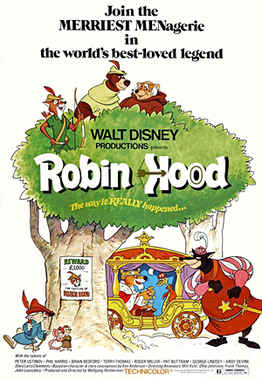
Robin Hood (1973)

Errol Flynn, Kevin Costner, Russell Crowe, Sean Connery, Cary Elwes and an athletic, wise-cracking fox. What do they all have in common? They have all played the iconic literary character and legendary Middle Ages outlaw Robin Hood. Does that last one seem out of place? If it does, shame on you. You must not have had an entertaining childhood. Change of pace review today, a favorite from growing up, the 1973 animated Disney classic, Robin Hood.

Outlaws on the run, Robin Hood (voice of Brian Bedford) and his portly sidekick Little John (voice of Phil Harris) are living it up in Sherwood Forest. In the nearby town of Nottingham, the weakly Prince John (voice of Peter Ustinov) and his enforcer, the Sheriff (Pat Buttram), are taxing the population heavily to the point where there is no money left in town. Always one from steal from the rich and give to the poor, Robin and Little John do their best to cause all the problems they can for Prince John to deal with, but that roguish outlaw has other plans. Robin also wants to win back his longtime love, Maid Marian (Monica Evans). Wouldn't you know it? All these problems might end up crashing head-on.

Is there a more pointless plot description than the one I just wrote? Everyone and their Mother knows at least part of the Robin Hood story, right? Eh, maybe I'm wrong, but I weep for those people. The names are iconic and instantly recognizable, everyone from Robin Hood to Little John to Friar Tuck (voice of Andy Devine, a perfect, spot-on choice, Tuck as a badger) to the evil Sheriff of Nottingham. It's that familiar image of the iconic outlaw in his Lincoln green clothing, appearing out of Sherwood Forest to wreak havoc on the rich. This Disney classic is a classic for a reason, putting a spin on the story for a younger audience. I grew up watching this one, loved it then, loved it now. Yeah, I sound like an old fogy, but they just don't make them like this anymore.

Ready for the part that will blow your mind? Well, that is if you've already forgotten the first paragraph a few clicks up. All these characters are played by anamorphic animals. Flynn, Costner, Crowe, Connery, all fine actors, but they just don't hold a candle to Robin Hood as a....fox. Between the 1950s and the middle of the 1970s, the Disney animated movies were cranking on all levels, many of them using animals as main characters in this way. Maybe it's the little kid that grew up watching these movies, but there's something cool about seeing Robin Hood (a fox) and Little John (a bear) fighting the Sheriff (a wolf) and Prince John (a lion). It sounds criminally simple that it should work so well, but it does. So there. Deal with it. I love this movie and won't be swayed from my opinion.

All these old animated Disney movies are a gem in my head. Yes, some are better than others, but in the age before computer generated images, these movies were actually drawn. They look great, a portal into a time that we may never see again in movies aimed at families with young children. The screen is always full of color and action, and the animation -- dated though it may be -- is a gem to watch. Pixar Studios is immensely talented, and I'll always enjoy their ventures into animated movies, but there is an undeniable charm to these old school Disney flicks.

Oh, right, the voice talents involved. There's not a bad choice in the bunch as the Robin Hood story turns into a story performed by animals. British actor Bedford has some fun as Robin (called 'Rob' by Little John), giving an animated character some personality, as does the whole cast. Harris (Baloo in another classic, The Jungle Book) brings his big, booming voice to the table, providing a great sidekick for Robin. Ustinov is an inspired choice for the weakly, sniveling Prince John, Terry-Thomas playing his maligned "assistant" of sorts, Sir Hiss (a snake). Carole Shelley is very funny as Lady Kluck, always at Maid Marian's side (Evans doing a fine job as Robin's lost love). George Lindsey and Ken Curtis supply their voices as Trigger and Nutsy, two of the Sheriff's dimwitted vulture guards. Yes, vultures. I told you this movie was awesome. Watch the intro HERE to get a look at all the main characters. 

A childhood favorite. I love it and always will.  Also worthwhile for the voice talents of singer Roger Miller who plays Allan-a-Dale, the talented singing and colorful rooster of Sherwood. The main theme -- Oo-de-lally -- is a classic, listen to it HERE. There's a handful of other songs too, all of them memorable, especially Harris' song as Little John mocking Prince John. The soundtrack in general from frequent Disney composer George Bruns is a classic in itself, just one in a sea of positives about this movie.

Robin Hood <---trailer (1973): ****/****

Sunday, February 19, 2012

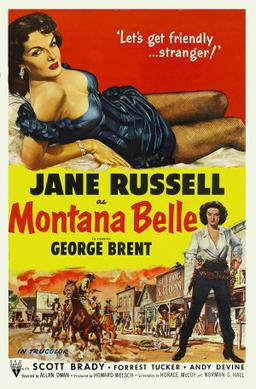
Montana Belle

Operating for over a decade in the last half of the 19th Century, the Dalton gang specialized in bank and train robberies before ultimately meeting their maker in a bloody shootout. Belle Starr was a female outlaw in the old west who rose to notoriety late in life. By all accounts, the two never crossed paths, but what's the fun in that? In a Abbot and Costello-like pairing, they do team up in 1952's Montana Belle.

Rescued from a lynch mob by Bob Dalton (Scott Brady), infamous outlaw Belle Starr (Jane Russell) joins up with the Dalton gang at their hideout in the hills. Bob quickly sets his sights on Belle, but it will have to wait. His brothers, especially Emmett (Ray Teal), want nothing to do with her, especially as they're planning their next robbery. Belle is left behind with two other members of the gang and when a posse shows up soon after, they draw their own conclusions. The Daltons set them up to take a fall, but Belle and Co. escape, vowing to start their own gang and go up against the brothers. The two are on a collision course, and with the law after them, nothing will come easily.

A no frills western from RKO studios, this is one of many B-movies that the studio became famous for. It lacks the scale of much bigger, more epic movies of the time, and in general has that quasi-cheap feel to it. The outdoor scenes are clearly filmed inside on sound stages, and the indoor sets are stylish and clean within an inch of their lives. In other words, like no wild west that ever existed. Now whether it's because it is 59 years later or just the look of the film, even the colors are washed out where everything looks faded now.  A big budget isn't a must for a successful movie though, and 'Montana' has enough going for it to recommend.

For starters, the stable of RKO character actors is turned out here. Russell rose to fame with the then-scandalous The Outlaw in 1943, but never became a huge star in the late 1940s or 1950s. She was relegated to quick, entertaining movies like this. Without the greatest range as an actress, Russell holds her own though as a tough female character until the story requires her not to be. More on that later. Brady and Teal are the more visible of the Daltons, including background parts for Rory Mallinson (Grat) and Holly Bane (Ben). Forrest Tucker and Jack Lambert are bright spots as Mac and Ringo, Belle's partners in crime. Even look for Andy Devine in a supporting part that doesn't have him as shrill as he usually was.  I guess that's a positive.

The story for this 82-minute western is more than a little schizophrenic with far too much going on in such a short movie. At different points, Russell is in love with or at least being pursued by Brady's Bob, Tucker's Mac, and George Brent as Tom Bradfield, the owner of a gambling house Belle intends to knock over. The story takes quick and surprising detours, bouncing back and forth between a more typical western story with its shootouts and betrayals with a less successful love story(ies). The pacing isn't a huge problem, but basically any scene with Russell's Belle and Brent's Tom lag a bit. Quite a singer when she wasn't acting, Russell also gets to sing two songs, including the Gilded Lily and The Man in the Moon. She's a good singer and seeing her dressed up as a saloon girl is never a bad thing, but both numbers bring the already drifting story to a screeching halt.

But just when it looks like things are going nowhere fast, 'Montana' redeems itself in the end. Belle's gang and the Daltons end up putting their differences aside and work together to rob a bank holding $1 million bucks waiting to be issued to cattle sellers. As harmless and even generic as the story has been up to this point, things change in a big way. Somewhat similar to the Dalton's Coffeyville raid, the robbery doesn't go off anywhere near as planned. There is a realism and darkness to this ending that the rest of the movie was lacking. A more pointed story in this vein certainly would have boosted the rating a bit. It also has one of the all-time great western lines ever, Bob Dalton telling Mac, "Let's walk out of this town." I don't want to give it away so see it in context!

Not a particularly memorable western, but fans of the genre should find enough to enjoy it. Make sure to stay through the end too, or at least the shootout in town. A last scene between Belle and Tom is sappy beyond belief, but the failed robbery makes some of the slower moments throughout worth the wait.

Montana Belle <---TCM trailer (1952): ** 1/2 /****

Saturday, November 7, 2009

Slaughter Trail

If there's anything one thinks of in a western it's the cowboys vs. Indians, the gunfighters, the cattle drives, the outlaws. One thing I clearly don't associate westerns with is singing, whether it be musicals like Oklahoma! or even singing cowboys like Gene Autry. They just seem out of place. 'Hey, I just saved the pretty school teacher from bandits, let me get my guitar out and sing about it a little!' So you might ask, how do you make it worse? Combine the two with a ballad soundtrack that runs throughout and not singing cowboys, but singing cavalrymen. That evil combination comes to fruition with 1951's Slaughter Trail.

With a brisk running time of 78 minutes, director Irving Allen apparently did not have enough in the way of a story for a feature length movie. By my guess, there's about 30 minutes of actual story and 48 minutes of ballad soundtrack and various asides with characters bursting into song. There's not enough here to make a worthwhile Gunsmoke or Bonanza episode much less a theater-released movie. Other westerns have used a ballad-like sountrack, High Noon comes to mind, but never this much. Four and five minutes pass as a cavalry troop rides across the desert, not a word spoken, with the 'Slaughter Trail' ballad booming.

There's also six different musical numbers thrown in with the story when the ballad isn't blaring. Some fit better than others, like a dance at a fort in Arizona, but most seem thrown together to make the movie a little longer. At one point, Andy Devine's Sergeant Macintosh actually hands another soldier a guitar and asks him to play so he serenades the troopers. How sweet. All this happy singing is just out of place in a story that a typical B-western could have handled nicely, or at least better than this clunker.

Working together to knock off stagecoaches and the money/gold/jewels they're carrying, outlaw Ike Vaughn (Gig Young) and Lorabelle Larkin (Virginia Grey) hit the jackpot when they discover a purse full of diamonds onboard a stagecoach. Ike passes them off to Lorabelle for safe-keeping so he and his gang can get away. But as they run, the gang steals three horses from a small group of Navajo Indians, killing two of three. The one survivor returns to the tribe where the chief calls for war because the white men broke the treaty. At the nearest outpost, Fort Marcy, the commander, Captain Dempster (Brian Donlevy) has to figure out what to do in hopes of stopping what could be a bloody rampage.

This B-western story is nothing new or inventive, but it is a good story if nothing else. There's never enough time spent on that story though for it to be any good. There are some limitations with the budget as seen in the finale. The Fort Marcy set is a great, expansive outdoor location that was used in a long list of movies in the 40s and 50s. It's situated in a small valley ringed by hills. But when the Navajos attack, they're attacking on wide, dusty plain in the middle of nowhere. We never actually see the warriors in the same shot with the soldiers firing at them. There's also the angle that Donlevy's Dempster takes about the three outlaws. He won't turn them over to the Navajos, instead posting them outside the walls to apparently be brutally killed. Ends justify the means I guess.

Known as much for playing the evil villain as much as anything, Donlevy gets a crack at playing the heroic good guy and does pretty well as he looks out for his daughter and the fort and even tries to work some magic with Grey's Lorabelle, a forced movie relationship if there ever was one. He even compliments her, 'That was quick thinking,' when she picks off an Indian about to kill someone. Smooth talker that Capt. Dempster. Young as Ike Vaughn is all right, the outlaw with the maniacal laugh. Devine is his typically annoying, braying self as the apparently veteran cavalry sergeant.

On to one more thing that bugged me that I can thank all the John Wayne movies I've watched for helping me spot. Chuck Hayward was a long-time stunt man who always got bit parts in westerns and war movies, a face you'd probably recognize, if you've seen enough of these movies. In Slaughter Trail, he plays two bit parts, one as the Indian survivor in the beginning and two as the Indian scout working for the cavalry. At one point, his two characters are actually in the same scene together. Talk about a small budget, but that is just impressive. A stinker all around, I fortunately could not find a trailer for this gem. Steer way clear of this one.

Slaughter Trail (1951): */****