You know what was so great about the 1960s and much of the 1970s? B-movies just didn't care...like at all. Politically incorrect, racist, needlessly violent, in poor taste, random bits of nudity, drugs and rock and roll. They had them all! Sure, these weren't major studio releases that were too worried about public outcry -- audiences wanted all those things -- but still, there's a charm to the "We don't give a F***!" mentality. Today's entry? A prison flick, 1969's Riot.
Serving a five-year sentence for an unnamed crime, Cully Briston (Jim Brown) goes about his business as best he can, trying not to cause any issues at all. Well, that's about to change. Sent to see a deputy warden by a guard, Cully is in the wrong place at the wrong time in the administration building. A group of prisoners in isolation cells, led by Red Fraker (Gene Hackman), has managed to escape and take a handful of guards and officials hostage. They hope to buy some time and pull off an escape, but their plan is thrown awry when someone is able to signal the guards. Now, the group is forced to improvise as guards line the walls with every weapon they have. Forced to work with Red and his fellow prisoners, Cully has to tread a fine line. He's right in the thick of it but has to decide what's the best plan of attack for himself. He's gotta decide quick with time running out.
What an interesting movie. Based on a non-fiction novel from author Frank Elli, 'Riot' tells the true story of a riot in a prison with at least a couple possible influences. Now all that said, I can't find the real-life incident it's based on so go figure. 'Riot' has all sorts of positives that just wouldn't seem to work in a 2014 flick. For starters, it was filmed on location at the Arizona State Prison with the real-life warden playing himself. Actual inmates played many of the background and supporting parts. What?!? Brown and Hackman have one scene after another with real inmates. Now who knows, maybe these were inmates in prison for robbing a pack of gum, but they're in prison just the same. The locations, the prison inmate casting, it adds a real cool touch to the movie, a sense of authenticity in this gritty prison B-movie.
Now if you're going to have real-life prison inmates starring in your B-movie, you'd better have a couple actors/stars who can hold their own. Yeah, I guess Jim Brown and Gene Hackman qualify in that scenario, huh? Sorta I guess. Right in his heyday, Brown's Cully is the perfect anti-hero, calm, cool and collected as a prisoner thrust into an unlikely leadership role. He's trying to keep about 100 different plates spinning, all with an end game in sight. Hackman has a fun part too, avoiding anything too hammy as the confident, plan-wielding Red who sees that plan fall apart pretty quickly. Having worked together a year earlier in 1968's The Split, it's cool to see these two tough guy actors working together again. They're the two biggest names by far, and their scenes together were the movie's high point for me.
Who else to look for? Some recognizable names and faces if not big stars. Mike Kellin plays Bugsy, the antsy right hand man to Red who seems to buckle under the slightest push, while Ben Carruthers (who was one of The Dirty Dozen with Brown) plays Surefoot, a wild-eyed Indian hoping to put a knife right in Cully's gut. Gerald S. O'Loughlin plays Grossman, a tough-talking guard who freaks out when the tables are turned.
There are certain things that scream 1960s B-movie though, that lack of interest in doing anything mainstream or familiar. Where to start? It doesn't shy away from the brutality of prison life. We meet a gay prisoner/hospital attendant named Mary (Clifford David), not to mention two other prisoners dubbed 'Queens' in the cast listing. They dress up as women with skirts, underwear, wigs and makeup, and dance for the pleasure of the other prisoners. At one point, Brown's Cully has a great dream sequence where he escapes and is dropped off -- via helicopter -- at a pool surrounded by bikini-clad women. It's so cheesy it works. There's plenty of moments like that sprinkled throughout director Buzz Kulik's 96-minute prison movie. A little overdone but who cares? You get the sense Kulik stood there and just said 'Here's my movie. Hate it if you want.'
If there is anything misleading about the movie's title, well, there isn't much of a riot. The movie is far more of a hostage situation with some prisoners living it up detours. The build-up is interesting throughout as we wait to see which side will blink first, the guards or the prisoners, but it never quite builds to what you think it will be. The finale does offer a couple twists amidst some graphic violence, but 'Riot' wasn't exactly the movie you'd think it would be. Still highly entertaining and a very passable way to spend an hour and a half in the guilty pleasure department. In the anti-hero folk character department, Brown even gets a theme song, 100 Years, that you can listen to HERE.
Riot (1969): ** 1/2 /****
The Sons of Katie Elder
"First, we reunite, then find Ma and Pa's killer...then read some reviews."
Showing posts with label Prisons. Show all posts
Thursday, December 11, 2014
Monday, June 9, 2014
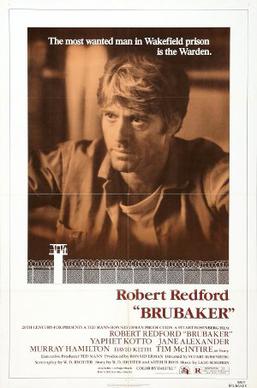
Brubaker
Well, it may be time to add a new label and genre for the right-hand column. I've written double-digit reviews about prisoners-of-war stories but what about good, old-fashioned prison stories? Movies like The Shawshank Redemption, Cool Hand Luke, Papillon, and plenty others ranging from classics to good to just bad. It's official. I'll add the Prison movie to the list, and here's a new one, 1980's Brubaker.
A new shipment of prisoners is arriving at the Wakefield State Prison, among them a quiet, mysterious prisoner who puts his head down and minds his own business. The prisoner quickly sees how horrific prison life is from abusive guards -- both physical, mental and sexual abuse -- to cramped living quarters, insect-ridden food to corruption on all levels of how the prison is run. After several days though, the prisoner reveals himself as Henry Brubaker (Robert Redford), the prison's new warden who's been tasked with cleaning up the prison, both for the prisoners and as a government-funded location. His appearance scares countless people to death, their corrupt, nasty world about to get thrown for a loop. His methods are demanding and fast-acting, making many people incredibly nervous. With pressure from inside and out, can Brubaker clean up the prison? Or has he pushed too far and endangered his own life?
From director Stuart Rosenberg, 'Brubaker' asks some interesting questions. Prison reform is meant to make sure that prisoners are treated like decent human beings. They don't deserve to be beaten, abused, violated and treated like dirt. Or do they? As the movie points out in snippets, these men are criminals, found guilty of a variety of crimes from rape to murder, robbery to manslaughter and all sorts of pleasant stuff in between. How well do they deserve to be treated considering the crimes they've been found guilty of committing? Should we rehabilitate prisoners so they can reenter the world as better individuals or simply let them waste away in under-funded prisons? The answer is probably somewhere in between. And enough of the social commentary, on with the movie!
'Brubaker' is a good movie, a story featuring some social commentary that for the most part avoids getting too obvious with its message. It is based on the book Accomplices to the Crime: The Arkansas Prison Scandal, the warden posing as a prisoner made up for the sake of the film. This is dark stuff from the get-go, Brubaker's undercover mission incredibly uncomfortable to watch. Things only get worse as he undertakes his new job, so many people around him -- inside and outside the prison -- trying to stop him, or at least slow him down. 'Brubaker' was filmed at Junction City Prison (recently closed) in Ohio, giving the story a filthy, seedy look that adds to the tension and the reality Rosenberg was aiming for. It doesn't feel like some Hollywood studio posing as a prison. It is a prison, and that goes a long ways toward authenticity. Also worth mentioning is composer Lalo Schifrin's score, equal parts underplayed and quiet with fast-moving, adrenaline-pumping sequences.
Who best to lead the way as a progressive prison warden who's not interested in whips, abuses, punishments and beatings? Why Robert Redford of course, at the height of his popularity. In his personal life, Redford has gotten behind and backed causes he believed to be worthwhile so this doesn't feel forced as an acting role. I would have liked some more background about the Brubaker character -- how did he end up here? What drives him? What's his motivation -- but an intelligent, thoughtful warden who becomes almost obsessed with accomplishing his mission is a great hero to lead the way. Redford was, is and will be a likable star to lead the way in a movie, and he's the best thing going here. Also look for Jane Alexander as Lillian Gray, his government connection, their background and relationship hinted at but never specified.
There's plenty of solid supporting parts to back Redford, starting with Yaphet Kotto as Coombes, a trusty who Brubaker counts on to help his reform get rolling while also questioning what's going on, and David Keith as Larry Lee Bullen, a lifer, a prisoner who's piled up three felonies and earned himself a life sentence. The scenes among Redford, Kotto and Keith are some of the strongest throughout the 132-minute movie. As for other trustees, look for Matt Clark, Tim McIntire, Everett McGill, Val Avery, and Joe Spinell. Murray Hamilton plays the evil Governor with Albert Salmi, M. Emmet Walsh, and Wilford Brimley also representing the evil System.
Just a good movie with a strong cast and an interesting story that takes some surprising twists as the it develops. The ending gets a little heavy-handed with a slow clap and all, but the movie as a whole is easy to recommend.
Brubaker (1980): ***/****
A new shipment of prisoners is arriving at the Wakefield State Prison, among them a quiet, mysterious prisoner who puts his head down and minds his own business. The prisoner quickly sees how horrific prison life is from abusive guards -- both physical, mental and sexual abuse -- to cramped living quarters, insect-ridden food to corruption on all levels of how the prison is run. After several days though, the prisoner reveals himself as Henry Brubaker (Robert Redford), the prison's new warden who's been tasked with cleaning up the prison, both for the prisoners and as a government-funded location. His appearance scares countless people to death, their corrupt, nasty world about to get thrown for a loop. His methods are demanding and fast-acting, making many people incredibly nervous. With pressure from inside and out, can Brubaker clean up the prison? Or has he pushed too far and endangered his own life?
From director Stuart Rosenberg, 'Brubaker' asks some interesting questions. Prison reform is meant to make sure that prisoners are treated like decent human beings. They don't deserve to be beaten, abused, violated and treated like dirt. Or do they? As the movie points out in snippets, these men are criminals, found guilty of a variety of crimes from rape to murder, robbery to manslaughter and all sorts of pleasant stuff in between. How well do they deserve to be treated considering the crimes they've been found guilty of committing? Should we rehabilitate prisoners so they can reenter the world as better individuals or simply let them waste away in under-funded prisons? The answer is probably somewhere in between. And enough of the social commentary, on with the movie!
'Brubaker' is a good movie, a story featuring some social commentary that for the most part avoids getting too obvious with its message. It is based on the book Accomplices to the Crime: The Arkansas Prison Scandal, the warden posing as a prisoner made up for the sake of the film. This is dark stuff from the get-go, Brubaker's undercover mission incredibly uncomfortable to watch. Things only get worse as he undertakes his new job, so many people around him -- inside and outside the prison -- trying to stop him, or at least slow him down. 'Brubaker' was filmed at Junction City Prison (recently closed) in Ohio, giving the story a filthy, seedy look that adds to the tension and the reality Rosenberg was aiming for. It doesn't feel like some Hollywood studio posing as a prison. It is a prison, and that goes a long ways toward authenticity. Also worth mentioning is composer Lalo Schifrin's score, equal parts underplayed and quiet with fast-moving, adrenaline-pumping sequences.
Who best to lead the way as a progressive prison warden who's not interested in whips, abuses, punishments and beatings? Why Robert Redford of course, at the height of his popularity. In his personal life, Redford has gotten behind and backed causes he believed to be worthwhile so this doesn't feel forced as an acting role. I would have liked some more background about the Brubaker character -- how did he end up here? What drives him? What's his motivation -- but an intelligent, thoughtful warden who becomes almost obsessed with accomplishing his mission is a great hero to lead the way. Redford was, is and will be a likable star to lead the way in a movie, and he's the best thing going here. Also look for Jane Alexander as Lillian Gray, his government connection, their background and relationship hinted at but never specified.
There's plenty of solid supporting parts to back Redford, starting with Yaphet Kotto as Coombes, a trusty who Brubaker counts on to help his reform get rolling while also questioning what's going on, and David Keith as Larry Lee Bullen, a lifer, a prisoner who's piled up three felonies and earned himself a life sentence. The scenes among Redford, Kotto and Keith are some of the strongest throughout the 132-minute movie. As for other trustees, look for Matt Clark, Tim McIntire, Everett McGill, Val Avery, and Joe Spinell. Murray Hamilton plays the evil Governor with Albert Salmi, M. Emmet Walsh, and Wilford Brimley also representing the evil System.
Just a good movie with a strong cast and an interesting story that takes some surprising twists as the it develops. The ending gets a little heavy-handed with a slow clap and all, but the movie as a whole is easy to recommend.
Brubaker (1980): ***/****
Labels:
1980s,
David Keith,
Matt Clark,
Murray Hamilton,
Prisons,
Robert Redford,
Yaphet Kotto
Wednesday, June 4, 2014
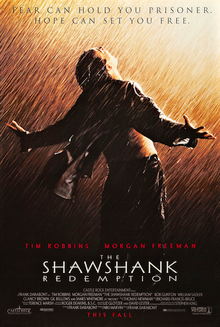
The Shawshank Redemption
Sometimes you just have to shake your head at audiences and moviegoers. Some movies just aren't meant to make some money in theaters no matter how good reviews are, no matter how good the cast and crew is. It just isn't meant to be. Take 1994's The Shawshank Redemption, a movie that barely recovered its budget in theaters but has become a ridiculously popular movie in the 20 years since its release. How good is it? On the IMDB Top 250 (of all-time), it's currently rocking the No. 1 ranking...of All-Time. Not the most scientific voting, but still...
It's 1947 when banker Andy Dufresne (Tim Robbins) is convicted of murdering his wife and the man she was having an affair with. Andy maintains his innocence but the evidence is overwhelmingly against him, and he receives consecutive life sentences as a verdict. He is sent to Shawshank Prison near Portland, Maine and settles into prison life as best he can. More than that, he just wants to survive. Days to weeks, weeks to months, months to years, Andy becomes close friends with a fellow prisoner, Red (Morgan Freeman), who is similarly serving a sentence for murder. Prison life is one step above hell itself, Andy carving out a niche for himself as best he can. Will it ultimately prove to be too much? Will it wear Andy down over the years? Can he somehow prove his innocence when on one else believes him and the evidence against him seems like a sure thing? In prison with life sentences on the line, only time will tell.
What a difficult movie to review in a somewhat concise plot synopsis. I tried to build this movie up to someone recently who had never seen it, and without giving too much away....well, let's just say it proved difficult. It's difficult, but it's for good reason. In the 20 years since 'Redemption' was released, it has gained quite the positive reputation, director Frank Darabont also adapting a screenplay from a short story by acclaimed author Stephen King. For about three years in the early 2000s, AMC and TNT and TBS seemed to show this movie EVERY SINGLE WEEKEND, and I probably watched it every other weekend or so. It had been years since I'd seen the movie straight through in one sitting, and not surprisingly, it holds up one basically all levels. Who knows how it will be remembered in years to come. Will it be a classic? A highly-regarded film? Maybe both, but for me, it's a personal favorite.
As I prepare to write some reviews, I try to identify some flaws, if I haven't already from during the viewing. So those flaws here....yeah, there aren't any. This is one of those perfect movies you can sit back and appreciate on any number of levels. The biggest strength is the story, a dark, unsettling story that is able to blend drama and comedy and even elements of horror effortlessly. The look of the movie reflects the story, colors washed out to pale shades of blue and grey, the Ohio State Reformatory serving as the backdrop for Shawshank. The immense prison walls tower over the prisoners, its hallways holding all kinds of hellish horrors. Another of the movie's strongest features is the soundtrack from Thomas Newman, my personal favorite score from an excellent composer. Listen to the entire soundtrack HERE, music equal parts emotional and moving with unsettling and uncomfortable.
Above all else, this movie rides on the shoulders of its stars, Tim Robbins and Morgan Freeman. Talk about an effortless chemistry. These two pros make it look downright easy. This isn't acting, just two very talented actors doing their thing. Natural doesn't begin to describe the power of their performances, the relationship between Andy and Red developing into a genuine friendship as the years pass. Their conversations crackle, two men talking because, well, because there's plenty of time to talk in prison. They talk about life, about their pasts, their likes and dislikes, but bigger things too. Andy and Red talk about hope -- check that, Hope -- and dreams, about something bigger, about finding your spot and persevering no matter what's thrown in front of you. I can't think of other films where Robbins and Freeman were better than this. Two great actors bringing two flawed, fascinating characters to life.
Who else to look for? How about evil personified as Shawshank's warden (Bob Gunton) and his lead guard and enforcer Byron Hadley (Clancy Brown), two of the most evil, despicable villains ever. James Whitmore, 73 years old at the time and having worked in Hollywood since the late 1940s, is a scene-stealer as Brooks, an aging prisoner who's become institutionalized as his sentence runs into its fifth decade. Other prisoners include William Salder as Haywood, an overbearing at times but generally likable inmate, with Larry Brandenburg, Neil Giuntoli, Brian Libby, Joseph Ragno and David Proval rounding out Red's clique of prisoners. Also look for Gil Bellows as Tommy, a young prisoner who comes to Shawshank in the mid 1960s with knowledge that could change Andy's life.
Maybe the biggest effect this movie has had on audiences is Morgan Freeman Narration Syndrome. Featuring one of the all-time great voiceover narrations, 'Shawshank' propelled Freeman into another stratosphere. It would be fun to listen to Freeman read a phone book. He's that good. The narration is what holds the movie together, almost 20 years of story packed into 142 minutes. There is a simple elegance to the narration, conversations about hope and fate, destiny and love, all of it giving a deeper sense of what's going on. It also features one of my all-time favorite movie lines, Red taking one of Andy's thoughts to heart. 'Get busy living or get busy dying....Damn right.' Just good stuff. Narration can be overdone, condescending, pretentious, but here? It's damn perfect.
There really isn't a weakness in this movie. Not a one. Now that said, the last 40 minutes or so is one of the strongest extended sequences in film history. This is a story that builds and builds, but you're not necessarily sure where. It doesn't drop hints so when a twist comes along, it genuinely shocks and surprises. One twist and surprise on top of each other -- all of them working effortlessly -- that don't feel forced. Thankfully, no 'Gotcha!' moments here. It leads to an ending that is beyond perfect. Moving, emotional and dramatic, including a beautiful final shot set to Newman's music. One of those great movies, a classic that gets better with repeated viewings. Sit back and enjoy it beginning to end.
The Shawshank Redemption (1994): ****/****
It's 1947 when banker Andy Dufresne (Tim Robbins) is convicted of murdering his wife and the man she was having an affair with. Andy maintains his innocence but the evidence is overwhelmingly against him, and he receives consecutive life sentences as a verdict. He is sent to Shawshank Prison near Portland, Maine and settles into prison life as best he can. More than that, he just wants to survive. Days to weeks, weeks to months, months to years, Andy becomes close friends with a fellow prisoner, Red (Morgan Freeman), who is similarly serving a sentence for murder. Prison life is one step above hell itself, Andy carving out a niche for himself as best he can. Will it ultimately prove to be too much? Will it wear Andy down over the years? Can he somehow prove his innocence when on one else believes him and the evidence against him seems like a sure thing? In prison with life sentences on the line, only time will tell.
What a difficult movie to review in a somewhat concise plot synopsis. I tried to build this movie up to someone recently who had never seen it, and without giving too much away....well, let's just say it proved difficult. It's difficult, but it's for good reason. In the 20 years since 'Redemption' was released, it has gained quite the positive reputation, director Frank Darabont also adapting a screenplay from a short story by acclaimed author Stephen King. For about three years in the early 2000s, AMC and TNT and TBS seemed to show this movie EVERY SINGLE WEEKEND, and I probably watched it every other weekend or so. It had been years since I'd seen the movie straight through in one sitting, and not surprisingly, it holds up one basically all levels. Who knows how it will be remembered in years to come. Will it be a classic? A highly-regarded film? Maybe both, but for me, it's a personal favorite.
As I prepare to write some reviews, I try to identify some flaws, if I haven't already from during the viewing. So those flaws here....yeah, there aren't any. This is one of those perfect movies you can sit back and appreciate on any number of levels. The biggest strength is the story, a dark, unsettling story that is able to blend drama and comedy and even elements of horror effortlessly. The look of the movie reflects the story, colors washed out to pale shades of blue and grey, the Ohio State Reformatory serving as the backdrop for Shawshank. The immense prison walls tower over the prisoners, its hallways holding all kinds of hellish horrors. Another of the movie's strongest features is the soundtrack from Thomas Newman, my personal favorite score from an excellent composer. Listen to the entire soundtrack HERE, music equal parts emotional and moving with unsettling and uncomfortable.
Above all else, this movie rides on the shoulders of its stars, Tim Robbins and Morgan Freeman. Talk about an effortless chemistry. These two pros make it look downright easy. This isn't acting, just two very talented actors doing their thing. Natural doesn't begin to describe the power of their performances, the relationship between Andy and Red developing into a genuine friendship as the years pass. Their conversations crackle, two men talking because, well, because there's plenty of time to talk in prison. They talk about life, about their pasts, their likes and dislikes, but bigger things too. Andy and Red talk about hope -- check that, Hope -- and dreams, about something bigger, about finding your spot and persevering no matter what's thrown in front of you. I can't think of other films where Robbins and Freeman were better than this. Two great actors bringing two flawed, fascinating characters to life.
Who else to look for? How about evil personified as Shawshank's warden (Bob Gunton) and his lead guard and enforcer Byron Hadley (Clancy Brown), two of the most evil, despicable villains ever. James Whitmore, 73 years old at the time and having worked in Hollywood since the late 1940s, is a scene-stealer as Brooks, an aging prisoner who's become institutionalized as his sentence runs into its fifth decade. Other prisoners include William Salder as Haywood, an overbearing at times but generally likable inmate, with Larry Brandenburg, Neil Giuntoli, Brian Libby, Joseph Ragno and David Proval rounding out Red's clique of prisoners. Also look for Gil Bellows as Tommy, a young prisoner who comes to Shawshank in the mid 1960s with knowledge that could change Andy's life.
Maybe the biggest effect this movie has had on audiences is Morgan Freeman Narration Syndrome. Featuring one of the all-time great voiceover narrations, 'Shawshank' propelled Freeman into another stratosphere. It would be fun to listen to Freeman read a phone book. He's that good. The narration is what holds the movie together, almost 20 years of story packed into 142 minutes. There is a simple elegance to the narration, conversations about hope and fate, destiny and love, all of it giving a deeper sense of what's going on. It also features one of my all-time favorite movie lines, Red taking one of Andy's thoughts to heart. 'Get busy living or get busy dying....Damn right.' Just good stuff. Narration can be overdone, condescending, pretentious, but here? It's damn perfect.
There really isn't a weakness in this movie. Not a one. Now that said, the last 40 minutes or so is one of the strongest extended sequences in film history. This is a story that builds and builds, but you're not necessarily sure where. It doesn't drop hints so when a twist comes along, it genuinely shocks and surprises. One twist and surprise on top of each other -- all of them working effortlessly -- that don't feel forced. Thankfully, no 'Gotcha!' moments here. It leads to an ending that is beyond perfect. Moving, emotional and dramatic, including a beautiful final shot set to Newman's music. One of those great movies, a classic that gets better with repeated viewings. Sit back and enjoy it beginning to end.
The Shawshank Redemption (1994): ****/****
Labels:
1990s,
James Whitmore,
Morgan Freeman,
Prisons,
Stephen King,
Tim Robbins
Thursday, June 21, 2012
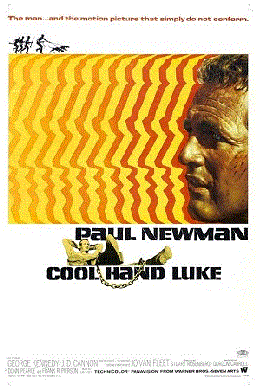
Cool Hand Luke
Heroes are supposed to be noble, loyal, honor-bound and always do what's right. But in the 1960s and its increased cynicism from the audience, was that concept of a hero really going to fly? The idea of an anti-hero started popping up in the 1950s thanks to James Dean and Marlon Brando among others, but for me, the one that kicked the door open in the 1960s was Paul Newman in 1967's Cool Hand Luke.
Having taken the heads off of a long row of parking meters, a drunken Lucas Jackson (Newman) is arrested and sentenced to a two-year sentence on a chain gang in Florida. He meets the Captain (Strother Martin) and his bevy of guards who keep their prison camp roster of 50 prisoners busy on the roads six days a week, but this camp has had nothing like Luke. Easy going enough early on in his sentence, he begins to bristle at being imprisoned, at being told what he's supposed to do. He becomes a hero to his other prisoners, forming a friendship with head honcho, Dragline (George Kennedy), but Luke can only take being held down for so long, and he wants out now.
Paul Newman is one of my all-time favorites, and this is HIS iconic part. Butch Cassidy, The Hustler, The Sting, and many others, all memorable roles, but nothing quite like this one. Want a face for a 1960s audience looking for something different? In steps Lucas Jackson, a man who has little regard for what society says he should do with his life, even less regard for any sort of authority hovering over him. Newman makes Luke -- dubbed 'Cool Hand' for a bluff in poker -- a charming, likable individual, his easy-going, natural smile disarming you in a second. We learn a lot about this character with little background (a veteran, countless jobs, a drifter), finding out that no one and no thing will slow him down. He will do things on his terms, and anyone else can be damned. Newman at his best.
With Newman's Oscar-nominated part at the head, 'Cool' has become one of the seminal movies of the late 1960s, ranking up there with The Wild Bunch, The Graduate, Bonnie and Clyde and several others I'm missing. This is a movie made for a late 1960s audience that isn't content with the status quo. No respect for authority or the so-called 'system'? Check. An anti-hero that wants to do things and live his life his way? Double check. The system are Martin's quiet but intense Captain, Boss Godfrey (Morgan Woodward), the silent guard who wears his ever-present aviator glasses, along with steely-eyed Luke Askew, Richard Donner and John McLiam. The system is the villain here, imprisoning and breaking the individual down to conform. It's easy to see the appeal in 1967, and just as easy to see now 45 years later in 2012. The thinker, the free spirit, the intelligent rebel, it's an appealing character and premise to root for.
Because Newman's performance is so strong at the top, another part of the film gets lost in the shuffle, and that's the ensemble cast all around him from Martin and Kennedy to the guards to the prisoners. Martin is perfect in his few scenes, including muttering the iconic 'What we have here is failure to communicate.' Kennedy won an Oscar for his part as Dragline, an illiterate but intelligent and fast-talking prisoner who all the other prisoners look up to. Newman and Kennedy play off each other impeccably, the subtle, underplayed Luke with the showier, aggressive and funny Dragline. Other prisoners include J.D. Cannon, Lou Antonio, Robert Drivas, Harry Dean Stanton, Dennis Hopper, Wayne Rogers, Ralph Waite, Joe Don Baker, Dick Davalos and Buck Kartalian among others. Clifton James and Anthony Zerbe are good as prisoners turned associates who help the guards.
Like any movie that lives on so many years after its release, there's got to be something to make it memorable, and director Stuart Rosenberg doesn't disappoint. The most obvious is Luke stating he can eat 50 eggs in an hour, a classic sequence in its humor, but there's so much more. Luke singing Plastic Jesus -- watch HERE -- after receiving some distressing news is an all-time great. There's Luke earning everyone's respect in a brutal, knock-down boxing match (watch HERE), refusing to go down even when he's beat. There's a teenager washing a car, driving the on-looking prisoners wild (HERE), and up there with Plastic Jesus for the most moving scene, Luke talking with his dying mother, Arletta (Jo Van Fleet). Almost scene-to-scene is aided by composer Lalo Schifrin's amazingly spot-on music, especially the main theme which you can listen to HERE.
What struck me most in my latest viewing was the darkness of the story. The first hour is generally light-hearted, introducing characters, backgrounds and interactions, setting us up by liking Newman's Luke so much in spite of his bullheaded stubbornness. I'd forgotten then how intensely dark and at times uncomfortable the second half of the movie is. From the start, we know Luke is heading down a bad road, but that unbearable tension and impending sense of doom keeps building. The movie still has its lighter touches -- Luke's escapes provide some unlikely humor -- but there will not be a truly happy ending here. In the end though, one of the final shots shows that free spirits might not always win, but that also doesn't mean the system, authority and power positions will win either. The symbolism can be a little obvious, a little heavy-handed, but the message still strikes a chord.
A classic from beginning to end. End of story.
Cool Hand Luke <---trailer (1967): ****/****
Having taken the heads off of a long row of parking meters, a drunken Lucas Jackson (Newman) is arrested and sentenced to a two-year sentence on a chain gang in Florida. He meets the Captain (Strother Martin) and his bevy of guards who keep their prison camp roster of 50 prisoners busy on the roads six days a week, but this camp has had nothing like Luke. Easy going enough early on in his sentence, he begins to bristle at being imprisoned, at being told what he's supposed to do. He becomes a hero to his other prisoners, forming a friendship with head honcho, Dragline (George Kennedy), but Luke can only take being held down for so long, and he wants out now.
Paul Newman is one of my all-time favorites, and this is HIS iconic part. Butch Cassidy, The Hustler, The Sting, and many others, all memorable roles, but nothing quite like this one. Want a face for a 1960s audience looking for something different? In steps Lucas Jackson, a man who has little regard for what society says he should do with his life, even less regard for any sort of authority hovering over him. Newman makes Luke -- dubbed 'Cool Hand' for a bluff in poker -- a charming, likable individual, his easy-going, natural smile disarming you in a second. We learn a lot about this character with little background (a veteran, countless jobs, a drifter), finding out that no one and no thing will slow him down. He will do things on his terms, and anyone else can be damned. Newman at his best.
With Newman's Oscar-nominated part at the head, 'Cool' has become one of the seminal movies of the late 1960s, ranking up there with The Wild Bunch, The Graduate, Bonnie and Clyde and several others I'm missing. This is a movie made for a late 1960s audience that isn't content with the status quo. No respect for authority or the so-called 'system'? Check. An anti-hero that wants to do things and live his life his way? Double check. The system are Martin's quiet but intense Captain, Boss Godfrey (Morgan Woodward), the silent guard who wears his ever-present aviator glasses, along with steely-eyed Luke Askew, Richard Donner and John McLiam. The system is the villain here, imprisoning and breaking the individual down to conform. It's easy to see the appeal in 1967, and just as easy to see now 45 years later in 2012. The thinker, the free spirit, the intelligent rebel, it's an appealing character and premise to root for.
Because Newman's performance is so strong at the top, another part of the film gets lost in the shuffle, and that's the ensemble cast all around him from Martin and Kennedy to the guards to the prisoners. Martin is perfect in his few scenes, including muttering the iconic 'What we have here is failure to communicate.' Kennedy won an Oscar for his part as Dragline, an illiterate but intelligent and fast-talking prisoner who all the other prisoners look up to. Newman and Kennedy play off each other impeccably, the subtle, underplayed Luke with the showier, aggressive and funny Dragline. Other prisoners include J.D. Cannon, Lou Antonio, Robert Drivas, Harry Dean Stanton, Dennis Hopper, Wayne Rogers, Ralph Waite, Joe Don Baker, Dick Davalos and Buck Kartalian among others. Clifton James and Anthony Zerbe are good as prisoners turned associates who help the guards.
Like any movie that lives on so many years after its release, there's got to be something to make it memorable, and director Stuart Rosenberg doesn't disappoint. The most obvious is Luke stating he can eat 50 eggs in an hour, a classic sequence in its humor, but there's so much more. Luke singing Plastic Jesus -- watch HERE -- after receiving some distressing news is an all-time great. There's Luke earning everyone's respect in a brutal, knock-down boxing match (watch HERE), refusing to go down even when he's beat. There's a teenager washing a car, driving the on-looking prisoners wild (HERE), and up there with Plastic Jesus for the most moving scene, Luke talking with his dying mother, Arletta (Jo Van Fleet). Almost scene-to-scene is aided by composer Lalo Schifrin's amazingly spot-on music, especially the main theme which you can listen to HERE.
What struck me most in my latest viewing was the darkness of the story. The first hour is generally light-hearted, introducing characters, backgrounds and interactions, setting us up by liking Newman's Luke so much in spite of his bullheaded stubbornness. I'd forgotten then how intensely dark and at times uncomfortable the second half of the movie is. From the start, we know Luke is heading down a bad road, but that unbearable tension and impending sense of doom keeps building. The movie still has its lighter touches -- Luke's escapes provide some unlikely humor -- but there will not be a truly happy ending here. In the end though, one of the final shots shows that free spirits might not always win, but that also doesn't mean the system, authority and power positions will win either. The symbolism can be a little obvious, a little heavy-handed, but the message still strikes a chord.
A classic from beginning to end. End of story.
Cool Hand Luke <---trailer (1967): ****/****
Sunday, January 16, 2011
The Last Mile
I've always believed one of the best things about movies is that they let you get away from everything, just sit back and enjoy something entertaining for a few hours if you so choose. They let you step into the shoes of someone else, something else, anything. You can be an astronaut, a cop, a businessman, a gunfighter, name a profession and there's most likely a movie out there about it. But what about the movies that aren't specifically made to entertain, but instead deliver a message, an objective of some kind? That's mostly what I thought about while watching 1959's The Last Mile.
Have you ever wondered it would be like to be a Death Row inmate awaiting your coming death, those last few days, hours and minutes both flying by and dragging at the same time? I can't say I have, but it's an interesting premise. People die from any number of things, some by surprise and quickly in car accidents or as innocent bystanders. Others pass on from medical issues, diseases that ravage your body. But what about an individual who did something so horrifically wrong that they too are sentenced to die for their actions? All they can do is wait and wonder...what if? That's this movie, an unsettling look at life in the death house, the prisoners awaiting their final judgment in the electric chair.
Sentenced to death for a murder he committed, Richard Walters (Clifford David) is assigned to Death Row, the aptly titled 'Death House' where all prisoners awaiting corporal punishment are held. Walters is just two weeks away from his date with the electric chair and has nothing to do but sit back and wait, pondering all the thoughts that race through his head in his final days. It is during these days that he meets and bonds with his fellow cellmates even though he can't see them, only hear them. He especially forms a bond with his next-door neighbor, Johnny Mears (Mickey Rooney). As the date of his execution nears, Walters begins to fear that the stay of execution will not come in time, but in the next cell over, Mears has a plan that could save them all, or get them all killed in the process.
Director Howard Koch makes a wise decision in telling this story that's a remake of a 1932 film and loosely based on a real-life incident in a Southwestern prison. With eight cells in 'the death house,' it would have been incredibly easy to vilify these main characters. It's safe to assume if you're awaiting your execution, you've done something horrific to get to that point. But with a movie meant to condemn the unnecessary brutality of the prison system, you just can't delve into the crimes these men have committed if as a director you want the viewer to have any sort of sympathy for these men. We find out Walters killed a man -- he claims he didn't mean to -- but never the circumstances or situation that prompted the act. It's a wise choice in story-telling because when the sh*t does hit the fan, you're oddly drawn to these Death Row inmates.
Filmed in black and white with minimal sets -- the eight cells of the death house dominate the movie -- Koch's movie has the distinct feel of a stage play. The camera rarely ventures into the cells, choosing to stay on the other side of the imposing bars of the cell. The black and white camerawork keeps everything in the shadows, the prisoners hiding in the darkness of their cells, the guards lurking around just out of sight. It's an incredibly uncomfortable movie to watch, seeing men waiting for their death, hopeless waiting for some sort of reprieve. An early segment shows a prisoner (John Vari) in his final hours, finally being pulled from his chair and sent to the electric chair. We don't see the results first hand, instead only witnessing the overhead lights flickering as the switch is pulled. It's a startling opening and does a great job of setting the mood for what's to come, especially when Walters' death sentence nears.
The opening credits of the movie list only Mickey Rooney as the star, and for good reason. This is his movie from the beginning. He plays Johnny Mears, a condemned killer who is typically quiet, subdued and a calming influence on the other prisoners. Rooney's stature can throw you off. He's not tall, and you wouldn't normally think of him as an intimidating, imposing person. But this Mears character, when he blows, he blows in a big way. Pushed too far, he takes matters into his own hands leading a violent, take no prisoners approach to the standoff. It's the type of performance that you just can't take your eyes off of. Rooney steals the movie, including one of the great final lines and shots of a movie I can remember. The other prisoners include David, Vari, Michael Constantine, George Marcy, John McCurry, Ford Rainey, Johnny Seven, and Sully Michaels. They're all relative unknowns, and are good enough in their parts without distracting from Rooney. Also look for Frank Overton as Father O'Connors, the prison priest, and Clifton James, Red Barry, Leon Janney and Clifton James as the most sadistic guards.
So the story builds and builds, and all the while I'm thinking this could be the most depressing movie I've ever seen. 90 minutes of sitting around listening to a group of men talk about their fear of death? Rooney's Mears leads a prison revolt that gets bloody very quickly with hostages taken. It's an interesting balance because Mears and his fellow prisoners stand to lose nothing. What are the guards and warden going to do? Kill them twice? From the warden's perspective, he can't give in to their demands without causing a domino effect in prisons across the country. The ending keeps things on line with the whole movie's tone and demeanor, staying cynical to the end. Stick around until the end credits though because that ending is a whopper of a good one.
The Last Mile (1959): *** 1/2 /****
Have you ever wondered it would be like to be a Death Row inmate awaiting your coming death, those last few days, hours and minutes both flying by and dragging at the same time? I can't say I have, but it's an interesting premise. People die from any number of things, some by surprise and quickly in car accidents or as innocent bystanders. Others pass on from medical issues, diseases that ravage your body. But what about an individual who did something so horrifically wrong that they too are sentenced to die for their actions? All they can do is wait and wonder...what if? That's this movie, an unsettling look at life in the death house, the prisoners awaiting their final judgment in the electric chair.
Sentenced to death for a murder he committed, Richard Walters (Clifford David) is assigned to Death Row, the aptly titled 'Death House' where all prisoners awaiting corporal punishment are held. Walters is just two weeks away from his date with the electric chair and has nothing to do but sit back and wait, pondering all the thoughts that race through his head in his final days. It is during these days that he meets and bonds with his fellow cellmates even though he can't see them, only hear them. He especially forms a bond with his next-door neighbor, Johnny Mears (Mickey Rooney). As the date of his execution nears, Walters begins to fear that the stay of execution will not come in time, but in the next cell over, Mears has a plan that could save them all, or get them all killed in the process.
Director Howard Koch makes a wise decision in telling this story that's a remake of a 1932 film and loosely based on a real-life incident in a Southwestern prison. With eight cells in 'the death house,' it would have been incredibly easy to vilify these main characters. It's safe to assume if you're awaiting your execution, you've done something horrific to get to that point. But with a movie meant to condemn the unnecessary brutality of the prison system, you just can't delve into the crimes these men have committed if as a director you want the viewer to have any sort of sympathy for these men. We find out Walters killed a man -- he claims he didn't mean to -- but never the circumstances or situation that prompted the act. It's a wise choice in story-telling because when the sh*t does hit the fan, you're oddly drawn to these Death Row inmates.
Filmed in black and white with minimal sets -- the eight cells of the death house dominate the movie -- Koch's movie has the distinct feel of a stage play. The camera rarely ventures into the cells, choosing to stay on the other side of the imposing bars of the cell. The black and white camerawork keeps everything in the shadows, the prisoners hiding in the darkness of their cells, the guards lurking around just out of sight. It's an incredibly uncomfortable movie to watch, seeing men waiting for their death, hopeless waiting for some sort of reprieve. An early segment shows a prisoner (John Vari) in his final hours, finally being pulled from his chair and sent to the electric chair. We don't see the results first hand, instead only witnessing the overhead lights flickering as the switch is pulled. It's a startling opening and does a great job of setting the mood for what's to come, especially when Walters' death sentence nears.
The opening credits of the movie list only Mickey Rooney as the star, and for good reason. This is his movie from the beginning. He plays Johnny Mears, a condemned killer who is typically quiet, subdued and a calming influence on the other prisoners. Rooney's stature can throw you off. He's not tall, and you wouldn't normally think of him as an intimidating, imposing person. But this Mears character, when he blows, he blows in a big way. Pushed too far, he takes matters into his own hands leading a violent, take no prisoners approach to the standoff. It's the type of performance that you just can't take your eyes off of. Rooney steals the movie, including one of the great final lines and shots of a movie I can remember. The other prisoners include David, Vari, Michael Constantine, George Marcy, John McCurry, Ford Rainey, Johnny Seven, and Sully Michaels. They're all relative unknowns, and are good enough in their parts without distracting from Rooney. Also look for Frank Overton as Father O'Connors, the prison priest, and Clifton James, Red Barry, Leon Janney and Clifton James as the most sadistic guards.
So the story builds and builds, and all the while I'm thinking this could be the most depressing movie I've ever seen. 90 minutes of sitting around listening to a group of men talk about their fear of death? Rooney's Mears leads a prison revolt that gets bloody very quickly with hostages taken. It's an interesting balance because Mears and his fellow prisoners stand to lose nothing. What are the guards and warden going to do? Kill them twice? From the warden's perspective, he can't give in to their demands without causing a domino effect in prisons across the country. The ending keeps things on line with the whole movie's tone and demeanor, staying cynical to the end. Stick around until the end credits though because that ending is a whopper of a good one.
The Last Mile (1959): *** 1/2 /****
Wednesday, July 21, 2010
The Last Castle
In about a year and a half or so I've written over 350 reviews while trying to cover a wide range of movies and actors from all sorts of different genres. Some names come up more than others, but I feel really bad about missing one in particular, the always cool Robert Redford. In 350-plus reviews, I didn't do one Redford movie. It wasn't an intentional slight, and all I can come up with is that I've tried to review movies I haven't seen in the past. Looking at Redford's filmography, I've seen about half so that explains it to a certain point. So anyways, here goes, a Redford review starting with 2001's The Last Castle.
One of the biggest stars of the 1960s and 1970s, Redford has stepped back from the limelight over the last 15 years, content to direct more than act while also organizing the annual Sundance Film Festival. At 74 years old, he is one of those few actors you could really call a 'movie star.' He has aged gracefully without any sort of controversy or media event to scar his career, and he is as cool as ever. In 'Castle,' he was making his first on-screen appearance in three years, and even though Redford is typically strong in the lead, the movie just can't sustain any sort of momentum before derailing in the final act.
A decorate army general, Lt. General Gene Irwin (Redford) has been court martialled and sentenced to serve a 10-year team in a military prison. It is a maximum security prison full of the dredges from all the armed forces with a brutal commander, Colonel Winters (James Gandolfini), in charge, doing his best to remain order while also having some fun at the prisoners' expense. Early on as he begins to serve his sentence, Irwin is content to sit back and let the days go by. But soon enough, he sees Winters for what he really is; a sadistic commander watching over his prison like a puppetmaster, making the prisoners do things for his entertainment. Irwin refuses to go along with what he sees and puts a complicated plan into action for ousting Winters.
Prison or P.O.W. movies have a popularity all to themselves, and because of that there's a tried and true formula to follow. 'Castle' does deviate from the formula in one big way; the prisoners aren't trying to escape. As military criminals, they realize to a point where are they really going to go? So with any escape plans out the window, the story settles into a battle of wills between two type-A personalities, Redford's Irwin and Gandolfini's Winters. While obviously not as good a movie overall, the dynamic here reminded me of The Bridge on the River Kwai with the struggle for power a key ingredient to the story.
At the age of 65 making this movie, Redford looks like he's about 45, maybe 50 if you push it. Since he started directing movies in the early 90s, he's acted less so it's always good to see him in front of the camera. As Lt. General Irwin, he's clearly the more sympathetic character. We find out midway through the movie why he was court martialed and therefore why early on he just wanted to do his time and avoid any of the politics of a general being in a military prison. Seeing Winters play his mind games with prisoners and generally manipulate the facility for his enjoyment finally pushes Irwin too far, including one incident with a marine (Clifton Collins Jr. in a great supporting part) where unnecessary violence is taken to a new level by the commandant.
Right in the middle of his huge success as part of The Sopranos, Gandolfini does his fair share of scenery-chewing as the prison commander. He butts heads instantly with Irwin when he overhears a comment about his military antique collection and it goes downhill from there. What works so well with this dynamic is the egos involved. Both men want to prove they're better than the other, even when the situation is escalated to a whole new level. I'm not a huge Gandolfini fan, but he is a really fun actor to watch. Also in the cast is Delroy Lindo as General Wheeler, an old friend of Irwin's suspicious of what's really happening in the prison, Mark Ruffalo as Yates, a prisoner no one likes who may or may not be playing both sides, and Steve Burton as Capt. Peretz, Winters' aide.
Through the first hour of 'Castle,' I was liking where the story was building to if not loving it. After that, the whole movie rolls over a land mine, derails, hits a wall, whatever you want to call it. Pushed too far, Irwin -- a master of command and strategy -- leads a coup from inside the prison against the heavily outnumbered guards. On a purely action scale, the last half hour is everything you could ask for. But from where the story is coming, it comes out of nowhere with no warnings or explanations which would have helped fill in some holes. It's just a weird ending that made me realize what a weird movie this was as a whole. Take away the performances from Redford and Gandolfini, and this movie is pretty bad in a cartoonish way. Go figure.
The Last Castle <----trailer (2001): **/****
One of the biggest stars of the 1960s and 1970s, Redford has stepped back from the limelight over the last 15 years, content to direct more than act while also organizing the annual Sundance Film Festival. At 74 years old, he is one of those few actors you could really call a 'movie star.' He has aged gracefully without any sort of controversy or media event to scar his career, and he is as cool as ever. In 'Castle,' he was making his first on-screen appearance in three years, and even though Redford is typically strong in the lead, the movie just can't sustain any sort of momentum before derailing in the final act.
A decorate army general, Lt. General Gene Irwin (Redford) has been court martialled and sentenced to serve a 10-year team in a military prison. It is a maximum security prison full of the dredges from all the armed forces with a brutal commander, Colonel Winters (James Gandolfini), in charge, doing his best to remain order while also having some fun at the prisoners' expense. Early on as he begins to serve his sentence, Irwin is content to sit back and let the days go by. But soon enough, he sees Winters for what he really is; a sadistic commander watching over his prison like a puppetmaster, making the prisoners do things for his entertainment. Irwin refuses to go along with what he sees and puts a complicated plan into action for ousting Winters.
Prison or P.O.W. movies have a popularity all to themselves, and because of that there's a tried and true formula to follow. 'Castle' does deviate from the formula in one big way; the prisoners aren't trying to escape. As military criminals, they realize to a point where are they really going to go? So with any escape plans out the window, the story settles into a battle of wills between two type-A personalities, Redford's Irwin and Gandolfini's Winters. While obviously not as good a movie overall, the dynamic here reminded me of The Bridge on the River Kwai with the struggle for power a key ingredient to the story.
At the age of 65 making this movie, Redford looks like he's about 45, maybe 50 if you push it. Since he started directing movies in the early 90s, he's acted less so it's always good to see him in front of the camera. As Lt. General Irwin, he's clearly the more sympathetic character. We find out midway through the movie why he was court martialed and therefore why early on he just wanted to do his time and avoid any of the politics of a general being in a military prison. Seeing Winters play his mind games with prisoners and generally manipulate the facility for his enjoyment finally pushes Irwin too far, including one incident with a marine (Clifton Collins Jr. in a great supporting part) where unnecessary violence is taken to a new level by the commandant.
Right in the middle of his huge success as part of The Sopranos, Gandolfini does his fair share of scenery-chewing as the prison commander. He butts heads instantly with Irwin when he overhears a comment about his military antique collection and it goes downhill from there. What works so well with this dynamic is the egos involved. Both men want to prove they're better than the other, even when the situation is escalated to a whole new level. I'm not a huge Gandolfini fan, but he is a really fun actor to watch. Also in the cast is Delroy Lindo as General Wheeler, an old friend of Irwin's suspicious of what's really happening in the prison, Mark Ruffalo as Yates, a prisoner no one likes who may or may not be playing both sides, and Steve Burton as Capt. Peretz, Winters' aide.
Through the first hour of 'Castle,' I was liking where the story was building to if not loving it. After that, the whole movie rolls over a land mine, derails, hits a wall, whatever you want to call it. Pushed too far, Irwin -- a master of command and strategy -- leads a coup from inside the prison against the heavily outnumbered guards. On a purely action scale, the last half hour is everything you could ask for. But from where the story is coming, it comes out of nowhere with no warnings or explanations which would have helped fill in some holes. It's just a weird ending that made me realize what a weird movie this was as a whole. Take away the performances from Redford and Gandolfini, and this movie is pretty bad in a cartoonish way. Go figure.
The Last Castle <----trailer (2001): **/****
Sunday, February 7, 2010
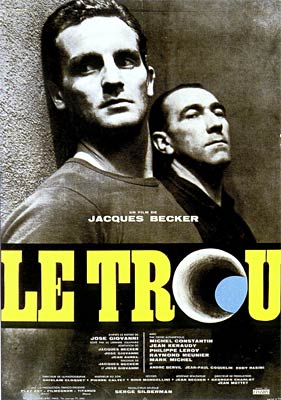
Le Trou
Last year, Jean-Pierre Melville's Le Cercle Rouge was the best movie I saw, and this year, 1960's Le Trou is an early candidate for best movie...personally that is. Directed by Jacques Becker -- who died before the movie was even released -- this is a story that is captivating in every way, surprising considering VERY LITTLE actually happens. Based on a true story of a prison break from a French prison in 1947, this is storytelling at its finest with no wasted moments, no wasted shots. These prisoners are going to escape no matter what it takes, and Becker shows this in excruciating detail. It's a movie that may drive you nuts, but is it ever worth it.
Awaiting sentence for the attempted murder of his wife, convict Claude Gaspard (Marc Michel) is moved from his cell as it undergoes some rehabbing. Gaspard moves into another cell already occupied by four other prisoners, all lower to middle class men who are suspicious of the more upper class new guy. But he gains their trust, and they let him in on their secret. All four men are facing lengthy sentences -- at best, some face death -- and are planning a jail break. Gaspard can join in on the escape as long as he helps out in the process. Claude agrees, and they go about finding a way out. But can they pull it off before any of the five are convicted, or what seems more imminent, Claude being moved back to his original cell?
Brace yourself, I'm pulling out what little movie knowledge I have when it comes to sounding like a movie snob. Becker films 'Le Trou' like a documentary with no music and a minimalist style. His camerawork is never invasive and allows the viewer to be the fly on the wall in this cramped little cell where five men have been forced to live. Casting these five men, Becker picked four relatively unknown actors and one person who was a real-life prison escapee. Along with Michel's Gaspard, there's Geo (Michel Constantin), Roland (Jean Keraudy, the real life convict), Manu (Philippe Leroy), and Monseigneur (Raymond Meunier). We're given little to no background about these four men, but by the end you're fully rooting for them to pull off the impossible and get out for good.
This lack of backstory is essential because the story keys in exclusively on the relationship among these five men and their one, united goal of escape. Everything else would have just been fat on the bone. The techniques used in the escape are nothing new, just men putting their head down and going to work. Instead of a montage of the process, Becker uses long shots with no cuts, like when the cellmates break through the floor with a crowbar. The shot goes on and on as one by one these men tire before passing the bar off. There's nothing going on other than the bar hitting the concrete slab (we don't even see the faces, just hands and crowbar) and the tension built up is indescribable. They do seem to be making a lot of noise -- one of the few flaws in the movie, no one hears what's going on? Really? -- in the process.
Several scenes like that eat up several minutes that are oddly transfixing in their execution, but the best segment is an almost 25-minute scene (starts HERE and continues into the next two segments) as the escape process is revealed. They've broken through the floor and come out in the prison's extensive cellar that's linked by pitch black corridors. The goal? To find a sewer shaft that goes out under the wall of the prison and out to freedom. Manu and Roland walk through these corridors, very aware guards are patrolling the same shadowy, poor lit areas, trying to find the shaft. It's an incredible sequence that unfolds in real-time until they find out they'll have to tunnel their way around another concrete wall, only to realize it's almost time for a bed check. Ranks with Rififi's heist sequence as one of the most riveting ever committed to film.
Lost in the reality of the movie is the incredible job done by these actors in portraying their characters. Claude is given the most background, Geo some, Roland is an expert escapee, Monseigneur is the elder statesman, and Manu is suspicious of Claude. That's pretty much it, but by the end it feels like we've somehow gotten to know these men. No background and dialogue is kept to a minimum, but even then, the characterization still works. Keraudy was not an actor but still delivers one of the best performances I've ever seen, subtle but strong, and Leroy's Manu is just as impressive. He holds everything close to his chest, but this escape attempt allows him to open up some and trust.
This all builds and builds until it feels like we as viewers have been there with them all along finding their way to freedom. Even at over 2 hours, the storytelling is never dull and keeps you riveted until the very end. As for the ending, it's one of those finales that makes you feel like you've been punched in the stomach...repeatedly. In terms of the movie's tone and story, a happy ending probably would not have worked, but this one just hurts. It's an incredible ending though and features one of the creepiest reveals I've ever seen in a movie just in terms of catching you off-guard and sending a chill down your back.
I guess that's enough rambling about one movie, but I was blown away by this French prison drama. Very real from beginning to end without a fake moment or even a "big movie moment." It's one of the most realistic movies I've ever seen and was clearly setting the groundwork for years to come in prison movies. Watch Escape from Alcatraz or The Shawshank Redemption and tell me Le Trou didn't make an impact. Le Trou is available to watch on Youtube, starting here with Part 1 of 12. It's not a movie that will suffer watching it on the computer so feel free to give it a try.
Le Trou (1960): ****/****
Subscribe to:
Posts (Atom)