The Sons of Katie Elder

The Sons of Katie Elder
"First, we reunite, then find Ma and Pa's killer...then read some reviews."
Showing posts with label James Caan. Show all posts

Wednesday, September 16, 2015

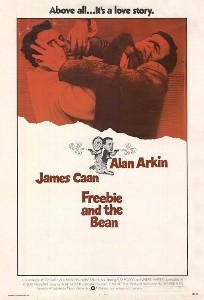
Freebie and the Bean

Let's get down to business. And I mean business. The buddy cop genre is the greatest genre in the history of cinema. Go ahead. I dare you to identify one that is better. See? You simply can-not. There were sprinklings before here and there, but the genre took off in the 1980's. One of those early sprinklings? An oddball, off-the-wall, politically incorrect comedy from 1974's Freebie and the Bean.

Longtime partners working the Intelligence Unit in San Francisco, Bean (Alan Arkin) and Freebie (James Caan) usually get the job done, sometimes in spite of themselves with their constant bickering. Their latest target? The duo has long sought to put well-known and long successful racketeer Red Meyers (Jack Kruschen) behind bars. After most of a year investigating, they've got the evidence -- finally -- but the key witness can't be put into custody for three more days. The solution? Freebie and Bean must shadow Meyers and make sure nothing goes wrong before they can officially arrest him. There are problems of course. Many people would be in trouble should Meyers testify so a hit man from Detroit (maybe more) has been dispatched to finish him. Oh, and it's Super Bowl week. Oh, and Freebie and Bean might kill each other in the process. What could possibly go wrong?

Reading some reviews and message boards about this 1974 buddy cop flick, I saw a lot of people questioning why this is a movie just about completely forgotten over the years. I'm glad I wasn't the only one to think of that issue. I love James Caan and Alan Arkin, and I'd never even vaguely, remotely even kinda heard of it. Why is that? Well, it's not a classic, but it's pretty good. It is kooky, completely without a story, has tonal shifts left and right, is especially goofy and is incredibly politically incorrect. There are flaws, but my goodness, is it a fun ride.

Arkin and Caan. Caan and Arkin. How can you possibly go wrong? You can't here. Two of my favorite actors working together make it look effortless. As you expect from any buddy cop pairing, the duo has to bitch and moan and criticize and ridicule...even though they're the best of friends. Arkin is Bean, a Mexican officer, all business, no nonsense. Caan is Freebie, wild and all over the place and not one to turn down a free gift here and there (hence the nickname). The story drifts as needed, and you get a sense the script was a couple set pieces, an outline of a story, and just blank sports for Arkin and Caan to improvise, to fire lightning fast insults and jokes and one-liners for as long as they could. Too many classic lines to mention -- most of them foul-mouthed, racist, sexist and generally inappropriate -- but quite the Batman and Batman (no Robin here) to lead the way.

'Freebie/Bean' comes from director Richard Rush and comes as a bit of fresh air considering the time it was released. We're talking cynical cop flicks like French Connection, Bullitt, the Dirty Harry movies and plenty others. It's just a funny movie. That's all and that's it. That's not a bad thing. You sit back and enjoy it because there isn't any messages in sight or anything dark or hard-hitting. These are two cops who are friends and fight like an old married couple bombing their way through San Francisco who stop at nothing to put their case together. If half the city should be destroyed in the process....well, so be it. We had a good time. San Francisco looks great as a backdrop as well, an interesting choice considering so many cop movies were shot on-location there. Moral of the story? As much as I love those previously mentioned flicks, it's cool to see a cop movie do a complete 180.

Who else to look for? Some fun, familiar faces. Kruschen has a ton of fun as Meyers, the racketeer who can't believe how stupid the cops pursuing him really are. Loretta Swit of MASH fame plays his pretty young wife. Also look for Alex Rocco as the conviction rate-minded district attorney, Mike Kellin as the boys' lieutenant, Paul Koslo and Christopher Morley as a couple witnesses, and a scene-stealing Valerie Harper as Bean's possibly cheating wife, Consuelo.

So there's gotta be something wrong...right? It's the bizarre, often out of left field shifts in tone. It's dark and funny and politically incorrect, and then a complete direction change into a never-ending car and motorcycle chase (had...HAD to be an influence on The Blues Brothers) that relies on sight gags and Keystone Cops-esque humor. There's little warning too as things shift, especially toward the end with more than a few crazy twists, some that work, some that are shocking, and one that almost had me questioning the whole movie. Thankfully, it was a twist within a twist in a mystery surrounded by a paradox. Anyhoo, this is all complaining to complain. The movie is a ton of fun with one laugh after another. It's James Caan and Alan Arkin basically spending 2 hours causing collateral damage and bitching at each other in their downtime. If that's not a recipe for success, I don't know what is.

Freebie and the Bean (1974): ***/**** 

Thursday, August 7, 2014

Silent Movie

Certain names rise above the genre they're associated with. And when you talk about the comedy genre in Hollywood, few names hold such power, respect and name recognition as Mel Brooks. A director, writer, actor and producer extraordinaire, Brooks did it all with too many classics to even mention to his name. And what do you get with power and an ability to make some serious amounts of cash? A movie like the 1976 comedy Silent Movie.

A very successful movie director, Mel Funn (Brooks) has fallen on some very rough times as he has retreated into a bottle.  After years away from movies, Funn has a script that will hopefully turn his career around. With his friends and sidekicks at his side, Marty Eggs (Marty Feldman) and Dom Bell (Dom DeLuise), Funn heads into Hollywood with his script and convinces a Big Studio executive (Sid Caesar) to back his movie....if he can get some big stars attached to the production. With their work cut out for them, Funn and Co. set out to find enough big movie stars to work with but it's going to be easier said than done. A film studio, Engulf and Devour, has been scooping up struggling movie studios left and right, and they'd like nothing more than to buy up Big Studio too. Can Funn put his drinking problem aside to get his dream movie made? What is that dream movie? Well, Funn intends to make a silent movie. Dun-dun-duh!!!

Ready for a twist? Writing, starring and directing 'Silent,' Brooks is at the helm of an actual....silent movie!!! You know, because there's always so much demand for that throwback feel of a silent movie! It plays as a tribute to the slapstick stars of the silent era like Charlie Chaplin and Buster Keaton, even evoking moments of The Three Stooges, The Marx Brothers, Abbott and Costello, and Laurel and Hardy. Famously, only one word is audibly spoken in this comedy, dialogue cards popping up as our stars discuss and talk on-screen silently. We're introduced to sight gags, musical cues, sound effects throughout the 87-minute running time, a series of jokes on top of each other. Brooks has a ton of fun with those little moments, the soundtrack setting up a joke and then pulling out the rug from under us.

That's all well and good, the tribute working well. But still, I don't think the movie is as funny as the movie thinks it is. The script is interesting, the stars very talented, and a handful of cameos providing some memorable moments. 'Silent' is going for the laughs, but they're not necessarily there in the end. I chuckled a couple times, smiled a bunch, laughed out loud once or twice but at no point did I think I was watching a hilarious, laugh-riddled comedy. None of this is to say it's not good. It is good, but 'Silent' isn't even close to as funny as it think it truly is. Moments work, a sight gag here and there, but as a whole, there's no unifying link that holds it all together unfortunately.

So, yes, the laughs aren't there in abundance as I might have liked. There are moments though that work because quite honestly, there's too much talent assembled here for it to not be somewhat entertaining. So Brooks, Feldman and DeLuise? Yeah, they have their moments. It's the little things, not the big moments. It's how they walk in step inches apart from each other. It's how they hug like they've won the lotto when the movie gets approved, prompting the beginning of a running gag with on-lookers muttering a perfectly placed slur. They each get their bits, Brooks the leader who falls for a sexy seductress (Bernadette Peters) sent by Engulf and Devour to destroy Funn. Feldman's Eggs is always trying to hook up with beautiful women, usually going down in flames, while DeLuise's Bell is perpetually drinking Coke and always needing to go to the bathroom. Great comedic minds at work.

Also look for Harold Gould as Engulf and Ron Carey as Devour, the studio heads so desperately trying to stop Funn from making a successful movie. Huge, over the top parts with so obviously evil villains.

All things considered, the best thing for me from 'Silent' was the cameos, some big-time stars poking fun at themselves with some quick appearances. That group includes Burt Reynolds, James Caan, Liza Minnelli, Anne Bancroft, Marcel Marceau and Paul Newman. Reynolds especially stands out, playing up his good looks into a star obsessed with his own looks. The scene where Funn, Eggs and Bell end up in the shower with him is pretty perfect, one of the moments I genuinely laughed out loud. Caan too is very good, playing the kinda slow movie star who invites Funn and Co. into his off-balance trailer as they serve some lunch. It is a solid example of how subtle physical humor can work in an almost effortless fashion.

Still, I struggled to get through this one. No cohesive link, some solid moments lost in a wave of lesser moments that don't work so well. Not a positive rating, but it's still one I can mildly, mildly, recommend because when it works, it works real well.

Silent Movie (1976): **/****

Tuesday, December 24, 2013

Elf

Everyone has their favorite Christmas movies, the movies you have to watch ever holiday season. It seems most of them aren't that recent -- Holiday Inn to White Christmas, Christmas Story to It's a Wonderful Life and many more -- but there are some recent entries that will no doubt be on that must-see list for years to come. Maybe the best new Christmas movie of the last 15 years or so, 2003's Elf.

While delivering toys around the world one Christmas Eve, Santa Clause (Ed Asner) accidentally picks up a return gift to the North Pole....a baby from an adoption center. No one knows what to do, Papa Elf (Bob Newhart) choosing to care for the human baby as if it was his own. Years pass and the boy grows into a man, Buddy (Will Ferrell), who simply doesn't fit in with the rest of Santa's elves working at the North Pole. He doesn't quite realize it though that he's human, not an elf, and that's when Santa Clause and Papa Elf tell Buddy the truth about how he came to be one of Santa's Elves. Without a solution if he sticks around the North Pole, Buddy decides to travel to New York City where he can meet his real birth father, Walter Hobbs (James Caan) but there's a twist there too. Walter, a book publisher, is on the Naughty List!!! Can Buddy figure it all out though in the big, bad real world? He's going to have some fun either way.

I saw this Christmas flick soon after its release in 2003, only recently catching up with director Jon Favreau's flick recently as part of the holiday season. It is incredibly easy to see the appeal in this very sweet, very funny X-Mas comedy. 'Elf' treads that fine line between just plain dumb and dumb....but still really funny. Don't be confused, most if not all of the humor is pretty dumb, but everyone and everything commits to the goofiness, credit going to screenwriter David Berenbaum in that department. Smart or dumb, the message is the most important thing. This is a Christmas flick about just that, Christmas and the holiday spirit. Mixed in with Buddy's effort to find his family is Buddy's effort to help save Santa and Christmas during a New York City detour. It's the time of the season meant for family, fun, being together and believing. How can you go wrong with that sort of message no matter the package?

Now while I'm a big fan, I can appreciate that Will Ferrell's humor usually isn't for everyone. With movies like Anchorman, Talladega Nights and Step Brothers to his name, I'll always be a fan. Not everyone likes his typically odd, off the wall and most importantly, random sense of humor. For those few folks who haven't seen Elf, it's without a doubt his most family friendly movie. His performance as Buddy takes the movie from really good and funny to really good, funny and near classic. It works because Ferrell absolutely and completely commits to the goofiness. Growing up in the North Pole, working with the Elves every year, Buddy doesn't have a mean bone in him. He's polite, ridiculously nice and naive to....well, everything. He looks at and experiences life in the most pleasant way possible, with pure, unadulterated GLEE. It's impossible not to like Ferrell's Buddy, a great lead character for this sweet story.

There's too many memorable, truly funny scenes to mention, but some definitely stand out from the rest. Buddy's arrival in New York City is priceless, the genuinely naive man-child no idea what he's stepped into. He hops across a Manhattan sidewalk like he's playing hopscotch. He eats gum hidden under rails like the used gum is hidden treasure. He spins in a door like it's a roller coaster, waving at a businessman hailing a cab because he thinks he's just waving, takes paper ads and handouts because it'd be rude not to, the list goes on. As I mentioned, Ferrell absolutely commits to the part. It never feels forced, just an actor going for the best laugh possible. There's plenty of other moments to mention -- Buddy unknowingly getting drunk and dancing in a mail room, realizing a department store Santa (Artie Lange) is an imposter -- and one funnier than the next. Up to you to pick your favorite.

Kudos to the entire cast for committing, especially James Caan as the curmudgeonly, greedy book publisher who doesn't quite believe Buddy could possible be his son. It's fun seeing Caan do a lighter role, and he plays an excellent straight man to Ferrell's Buddy and his antics. The same for Ed Asner and Bob Newhart as Santa and Papa Elf, Newhart especially standing out with his typically deadpan delivery with seemingly no emotion at all. Also look for Zooey Deschanel as Jovie, a woman Buddy meets at Gimbel's working as an elf and instantly likes, Mary Steenburgen as Walter's wife who wants her husband to not be such a Grinch, Daniel Tay as Michael, Walter's younger son and Buddy's half-brother, and Faizon Love as the Gimbel's manager who has to deal with Buddy and all his antics.

There's a certain style here that plays well in addition to the story. The North Pole looks animated, and when it is real, it's pretty clearly an indoor set with "snow" and everything. When Buddy leaves, he talks to cartoon whales, penguins, bears and an arctic puffin as well as a wise snowman who tells Buddy it will be okay. The visual look reminded me of the old Christmas TV specials like Frosty the Snowman and Rudolph the Red-Nosed Reindeer. It all adds up to a gem of a Christmas flick, one that's definitely worth watching every December.

Elf (2003): *** 1/2 /****

Thursday, November 7, 2013

The Gambler

I've been to casinos exactly twice in my lifetime. It's easy to see what the appeal is, and I think that's what I avoid it. I can easily see myself thinking I'll earn millions and quickly busting my bank. Ah, the appeal of gambling from sports bets to poker to slot machines. Quite a jumping off point for a movie, hhmm? Maybe like 1974's The Gambler.

An English professor at a university in New York City, Axel Freed (James Caan) has a gambling problem, and this time, he's dug himself quite the hole. Gambling at an illegal casino, Freed loses $44,000 which he doesn't have, forcing him to improvise before the bookie's thugs come after him. This isn't anything new for Axel who's long struggled with gambling, but recently seemed to have gotten a grip on his addiction. He only has a few days to get his hands on the money, turning to his mother (Jacqueline Brookes) who is a doctor at a free clinic. Worrying about her son's well-being, she scrapes the bottom of the barrel to get the money Axel needs, begging her son to pay his debt and walk away from gambling. That would be the easy way to do it, wouldn't it?

From director Karel Reisz, 'Gambler' is one of those hidden gems from the 1970s. It doesn't have a huge reputation, and it can be more than a little tricky to find. It was on my Saved DVD queue at Netflix for months only to pop up on a movie channel recently. And record! I'm glad I caught up with it. Besides an excellent leading performance from James Caan, it has that perfect blend of 70s grittiness and style (but not too much). It was filmed on the streets and homes and illegal casinos in and around New York City, a great backdrop for a whole lot of movies in the 1970s. Jerry Fielding's musical score is perfect, subtle and underplayed for the most part, elevating the tension when needed as Axel struggles to cope. It certainly deserves more of a reputation for all it's got going for it. Solid drama, no frills, and that's not a bad formula.

One of my favorite actors, James Caan was struggling through his own addiction to cocaine while filming this movie, and even identifies it as one of his personal favorites in terms of roles. It's easy to see why. Caan brings Axel to life, a human being with an addiction more than a stereotype or one big cliche. Axel is successful with an excellent job as a professor, his friends and family, a girlfriend (a solid Lauren Hutton), and in general, a lot going for him. He also has a problem. Whatever he gets involved in, he's always looking for "the juice," in other words the thrill of winning, or bizarrely....losing. He tells his friend, Hips (Paul Sorvino), also his bookie, that he could make any number of bets that are sure things. What's the point then? Where's the thrill? There's got to be a possibility of losing for it to feel real, to feel the rush. It's a really simple concept that is pretty scary when you think about it.

Caan does a fine job building off that. His Axel has everything a man could/should want. That's not the definition of a self-destructive fellow now, is it? Through all the people he drives away -- friends, family, girlfriend -- he still somehow manages to make Axel Freed somewhat, remotely, kinda sorta sympathetic. Are we actually rooting for him? Maybe not, maybe we're just rooting for him not to get the crap beat out of him. He pulls cons and fast ones on just about everyone around him, but there's something very human about the character. I guess we're not rooting for him. Instead, it's more how he'll get out of one more self-caused problems. We want to see how low he'll really get, and Caan's Axel certainly pushes the limits there. It's a great, understated performance that avoids all the obvious pratfalls that could come with the part.

The cast doesn't feature much in the way of big names, but that opens the door with some potential. We meet all these people who Axel knows -- for good and bad -- like a window into the gambling world. Brooks is heartbreaking as his mother, Naomi, wanting what's best for her son but knowing she's enabling him at the same time. Hutton is very good as Billie, his girlfriend who sees him spiraling out of control. Sorvino is excellent as bookie and friend, Hips, who genuinely likes Axel but knows he's pushing the limits of their friendship. Also look for Burt Young in an effective, quick part as a bookie's enforcer, Morris Carnovsky as Axel's very rich, very successful grandfather, Carl W. Crudup as Spencer, one of Axel's students and a star player on the basketball team, and even a very young James Woods as a bank teller who incurs Axel's wrath.

If there's a weakness it comes in the finale. I'm not sure exactly what it's trying to say or what it's going for. The finale the story was seemingly building to seemed pretty obvious to me, but 'Gambler' doesn't go quite that far. It's not a bad ending, just one that isn't as strong as it could have been. I liked the movie a lot though, Axel's lectures in class ending up being a reflection on himself. Caan is pretty perfect in the part, one that any fans should definitely seek out.

The Gambler (1974): ***/****

Monday, January 21, 2013

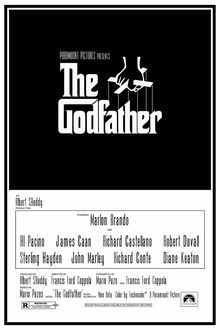
The Godfather

Some movies are just better than others, plain and simple. They're the ones that even the most casual movie fans among us are aware of, films like Gone With the Wind, Casablanca, Lawrence of Arabia, and one of my favorite movies, and maybe the greatest movie ever made, 1972's The Godfather.

It's just a few months since the end of WWII, and Vito Corleone (Marlon Brando), the head of the Corleone crime family in New York City and dubbed the Godfather, is at the height of his power. He has an epically successful business, running the unions and all the gambling in the city, and he's able to do it because he has countless politicians and judges in his back pocket. Things are changing though all around him, especially the underworld and the business he helped create.  Vito is approached about a deal he could bankroll, but it involves drugs, and he chooses to ignore it. The decision is one that drastically affects the family, one that will incorporate all his family members, especially fiery firstborn Santino (James Caan), adopted Irish son, Tom Hagen (Robert Duvall), and his youngest and smartest son, Michael (Al Pacino). What does the future hold? Who will rise up to help their father?

Based off a novel of the same name by author Mario Puzo, 'Godfather' is one of those rarest films; it's perfect. In that sense, director Francis Ford Coppola improves on Puzo's novel, the rare film that is better than its source novel. None of that is a dig at Puzo -- the novel is one of my favorites, a well-written gem -- but the film takes the idea, premise and characters and runs with it. Clocking in at 175 minutes, it never slows down, never feels dull. The dialogue and script provide countless engrossing talking scenes. The look of the movie with its authentic wardrobe, cars and sets is incredible, Coppola filming in an earthy fashion where things always look dark and burned-out to a point. Oh, and composer Nino Rota's score is halfway decent (that's sarcasm by the way), one of the great, classic scores in Hollywood history. You know it already, but listen to the theme HERE.  

What sets Coppola's film apart from countless other films about the Mafia, mobsters and organized crime is the impeccably written story. Puzo's novel introduces countless characters, relationships, history at the reader with all sorts of backstory, and the film assembles it into an expertly told, very coherent (sounds simple, but you'd be surprised) story that develops nicely. It covers over 10 years of time, but at no point does it feel even slightly rushed. Puzo's novel (he also worked with Coppola on the script) introduces characters and within minutes we feel like we've got a good idea of who they are as an individual. Imagine that with over 10 characters that get a fair share of screentime. There is a comfort level with the characters -- the good guys and the bad guys -- that makes the movie more enjoyable the second it begins. Does it all fall into place right away? No, it takes some time, but getting there is half the fun.

As far as true acting movies go, this 1972 classic is hard to beat. There isn't a performance that falls short or feels fake, but two rise above the rest; Brando as Vito Corleone and Pacino as his son, Michael. Playing one of the most iconic characters in film history, Brando's performance has opened the doors for all sorts of impressions, caricatures and stereotypes, but it is a career-best performance (and that's saying something considering Brando's career). It is a layered, nuanced performance, a man in the second half of his life who is highly intelligent, kind and ruthless at the same time, and a man who will stop at nothing to care for his family. Pacino's Michael goes through the film's biggest transition, a young man and WWII hero who wants nothing to do with his family's shady background but finds himself thrust into the family business when outside forces descend on the Corleones. Brando won an Oscar -- fully deserved -- and Pacino was nominated, but whatever the award nominations out there, it's two amazing performances.

Coppola's film earned plenty of acting nominations, three alone for Best Supporting Actor with Pacino, Duvall and Caan all earning a nod. The coolest part? All three deserved it for one reason or another. Caan and Duvall get less screentime, but they make the most of it. Caan is a scene-stealer as the fiery, hot-tempered Santino, known to friends and family as Sonny, the oldest Corleone son. The same for Duvall as Tom Hagen, but in a different way. Where Caan is more aggressive, Duvall underplays his part as Tom, the unofficial Irish Corleone brother, a childhood friend of Sonny's who Vito welcomed into the house. Other members of the Corleone family and operation? Richard Castellano and Abe Vigoda as Clemenza and Tessio, the Corleone caporegimes (think right-hand men, enforcers), John Cazale as Fredo, the Corleone brother and screw-up, Talia Shire as Connie, the lone Corleone sister and her similarly fiery husband, Carlo (Gianni Russo), and Diane Keaton as Kay, young Michael's love who must decide how much she's willing to put up with.

And then there's the opposition, the all-around nice individuals who are trying to take down the Corleones. For starters there's Richard Conte as Barzini, a head of another NYC crime family, Sterling Hayden as Capt. McCluskey, an NYC cop on a rival's payroll, John Marley as a film studio head who incurs the wrath of the Corleones, Al Lettieri as Sollozzo, a drug supplier looking for funding and backing, and Alex Rocco as a casino owner dealing with a buy-out of his casino.

On repeated viewings, I've noticed different features about the film, different layers that can affect how I view it. The biggest is simple; family. Yes, it's a pretty hardcore, violent story about a crime family with its hand in illegal happenings, but it's still family. If you can look past that whole criminal aspect, the biggest focus is the family and the dynamics and relationships among family members. Through the rather vicious, violent ups and downs, love and hate, they're there for each other (for this movie at least). I love how Vito dotes on his kids and grandchildren but can balance that out with a brutal mindset -- it's business, not personal -- at the same time. The relationship between Vito and Michael is the most heartfelt, including one of my all-time favorite scenes as father and son discuss what could have been, maybe what should have been. A worrying Vito wanted more for his son, but a firmly entrenched Michael (very much looking out for the family) calmly states "We'll get there, Pop." It's an endearing, heartfelt moment, one of many.

There are far too many memorable, iconic, and all-time great scenes to discuss one by one.  Big picture, that's probably what viewers will remember the most on initial viewing. The infamous horse head scene, the introduction of Vito, his loyal enforcer, Luca Brasi (Lenny Montana), and his "offer he can't refuse," the perfect simplicity and natural quality of the opening wedding, a slight detour to Sicily and its beautiful hills, a meeting among Michael, Sollozzo, and McCluskey in a traditional Italian restaurant, and maybe the most memorable, the baptism scene, almost entirely silent other than Rota's score playing over the developing scenes. Each of the above scenes could be analyzed in a review unto itself, but this review is already getting long-winded. Long story short? It's maybe the greatest movie in Hollywood history without a flaw in sight. Shame on you if you haven't seen it by the way. What are you waiting for?

The Godfather (1972): ****/****

Monday, October 22, 2012

Harry and Walter Go to New York

Some films are doomed from the start. They just are. Production problems, casting decisions, pacing/tone issues, any and all can derail a movie. There's a whole wing of Hollywood movies that are known as Epic Failures. Some overcame it, others didn't. Massively over-budget, 1976's Harry and Walter Go To New York is one that didn't despite an impressive cast.

It's 1908 and a pair of vaudeville actors, Harry (James Caan) and Walter (Elliott Gould), are struggling to make any money at all at their shows, eventually resorting to pickpocketing where they are not surprisingly caught quickly. At the same time, infamous millionaire safecracker Adam Worth (Michael Caine) is caught during a robbery and sent to prison. Working as Worth's slave-servants, Harry and Walter manage to escape and with the blueprints for the infamous bank robber's next job. Unfortunately the well-to-do Worth isn't far behind, and now it's a race against the clock to see who can pull off the job first; the bumbling performers turned con men or the experienced, expert robber?

For whatever reason, this is a movie that received generally poor reviews. On the other hand, I liked it a lot. As Roger Ebert mentions in his review, 'Harry and Walter' is clearly made in the vein of The Sting. There isn't much ink about the movie or its troubled production, but I'm guessing the massive budget problems had to do with the lavish period sets and costumes. It's turn of the century Massachusetts and New York, and everything from the ultra-detailed sets to the immaculate time-appropriate suits to the light-hearted, goofy score from David Shire works well together, especially Laszlo Kovacs' Earth-toned, dulled down color cinematography. It is a period piece, and this 1976 flick gets the period details done the right way.

I'm thinking the biggest reason for the generally negative reviews is the type of humor. Where The Sting was well-written and funny in its ability to underplay the situation, 'Harry and Walter' is not so subtle. High comedy this is not, director Mark Rydell's period-heist movie relying far more on physical humor, and bumbling humor at that. I typically don't go for that type of humor, but it worked for me here. Much of that credit goes to Caan and Gould as the buddy relationship that produces much of the laughs. I've always been a Caan fan, but this is a showier part for him, not the usual tough guy role. Case in point: he sings and dances. Caan's Harry is the confident know-it-all, Gould's Walter the quiet, nervous knows it won't work partner. They play off each other effortlessly.

If James Caan and Elliott Gould weren't enough though (and shame on you if that's the case), the supporting cast shouldn't disappoint. How often do you see Michael Caine get third billing in a movie? His Adam Worth is a scene-stealer, not quite a villain but certainly approaching that territory. Diane Keaton plays Lissa Chestnut, a crusading newspaper woman who joins the bank robbing effort and has everyone fall for her. Charles Durning is the worried bank owner trying to save his $. Also look for Lesley Ann Warren, Michael Conrad, Burt Young, Val Avery, Carol Kane, Jack Gilford, Dennis Dugan and Ted Cassidy rounding out a very deep cast.

A period piece merged with a heist flick certainly had my curiosity on high alert. The actual heist isn't anything special as Harry and Walter's "expert team" attempt to get into Durning's perfect safe. In order to create a diversion, Harry and Walter end up hijacking a stage show with their own hijinx and shenanigans. The act finally wears thin a little, but it's not enough to detract from a movie I enjoyed a lot. The cast is too talented so even if you don't go along with the physical comedy/humor, you should still get some enjoyment out of it. If nothing else, look for the prison from The Shawshank Redemption as a familiar location. Well worth checking out.

Harry and Walter Go To New York <---trailer (1976): ***/****  

Saturday, October 20, 2012

Slither (1973)

James Caan is cool. He's Santino Corleone. That's basically the only reason I checked out 1973's Slither during a recent Caan marathon on Turner Classic Movies. I should have steered clear of this one because Caan-cool factor aside, this is one bad movie.

Fresh out of prison having served part of a sentence for grand theft auto, Dick Kanipsia (Caan) is dealt a strange hand when an old friend is killed after picking him up. Before he dies though, the friend mysteriously tells him two names, and that he should seek them out. With no other options or opportunities in front of him, Dick seeks out one of the names, Barry Fenaka (Peter Boyle), who lets him in on a plan. Years prior, Barry and the since-dead friend embezzled some $312,000 and now know where they can get it. Dick signs on as Barry's partner, traveling all over California in hopes of finally getting their hands on the money. Who knows what kooky, crazy antics await them on the open road.

In previous reviews of 1970s films, I've mentioned that there is a distinct quality of watching a movie from that decade. It was a major turning point in the darkness/reality of how films were portrayed, and much of the time it was for the better. There's a different pacing to so many 1970s movies with more of a focus on the people and stories rather than the scope and scale. From director Howard Zieff, 'Slither' unfortunately tries to do just that. It aims to be a quirky, off-beat story with quirky, off-beat characters, but never ultimately gets to that point. At 97 minutes, it drifts aimlessly without even a semblance of even a drifting story. Characters come along, disappear and then return as necessary.

This flick is listed at IMDB as a comedy-crime thriller, and I'm thinking "That was a comedy?" I must have missed all those really funny parts. It is neither a comedy nor a thriller, and any drama seems to be an accident more than anything. Caan's ex-con is an amiable enough guy, sort of drifting along with a plan that could net him some easy money. He meets all sorts of eccentrics along the road, but none of them are truly funny. The twist is that Dick and Barry are being followed by a menacing black van (Alex Rocco, Len Lesser, Allen Garfield, and Alex Henteloff are the "baddies" inside) with some sinister objective. The actual twist? Incredibly disappointing, and actually, mindlessly stupid that doesn't make a whole lot of sense. But then again, that's kind of the whole movie.

Even as a fan, I can admit Caan looks like he's sleepwalking. He doesn't look too interested in any of the proceedings going on, maybe realizing what a mess he got caught up in. I think there's some jokes meant with his name (13-year old's giggle), but even that is mishandled. Boyle is a little better as Barry, but his background is kept so much in the dark that he's wasted. The character even disappears midway through the movie, apparently that's the thriller aspect, but another twist there falls short. Sally Kellerman starts off as the sexy chick Dick meets on the road, Kitty Kopetzky, then degenerates into a complete nut-bag. Louise Lasser plays Mary, Barry's wife who spends much of the movie being worried in the couple's RV motorhome.

I struggle with what else to rip about this mess. The end turns into a big chase scene with the intimidating black van gunning it after a station wagon hauling an RV. I don't even know. It's bad, and the more I think about it, the badder it gets.

Slither <---TCM trailer/clips (1973): */****

Thursday, April 5, 2012

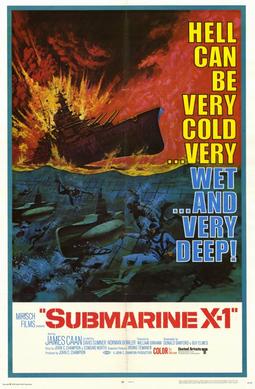
Submarine X-1

Hitting it big, James Caan had roles in 1971 and 1972 that catapulted him to stardom, the TV movie Brian's Song where he played Chicago Bears fullback Brian Piccolo and in The Godfather as fiery Sonny Corleone. But through the 1960s, Caan had to put his time in, taking less glamorous roles both in film and TV. Some were obviously better than others -- his supporting part alongside John Wayne in El Dorado standing out -- but most just weren't very good, especially 1969's Submarine X-1.

Commanding a British sub in the North Atlantic, Commander Richard Bolton (Caan) makes a costly decision in battle that costs the lives of 50 of his crew as the sub sinks in a battle with a heavily armored German battleship. Having survived with a handful of men, Bolton is given a new mission. He is to take a small group of sailors and train them like commandos for a dangerous mission using midget submarines. Unfortunately, some of the men are the survivors of his previous ship, and they still hold Bolton responsible for the casualties. Bolton pushes on though, forcing his men to go through the brutal training when the mission is finally revealed. Leading three midget submarines, Bolton will lead a sneak attack in the Norwegian fjords on the very battleship that cost him his last command.

 Like the spaghetti westerns, there's a certain charm to WWII movies made in the 1960s. There's a certain look and feel to these war flicks, seeing the same faces pop up, the same plot devices, the same locations. For the most part though, 'Submarine' is missing all those little things that can bring a movie up a notch...or at least make it bearable to watch. It is clearly filmed on a small budget with a relatively unknown cast in support of a young James Caan. It takes the well-worn formula of a team of commandos (however unlikely) on an impossible mission key to the war's success and....does nothing with it. Low budget (or cheap) isn't a bad thing, but when a movie has as little energy as this one, you're in for a long movie.

That thought is odd considering that 'Submarine' doesn't even break the 90-minute mark, clocking in at an epic 89 minutes. My first thought was that it was a no frills, bare-bones but still exciting story focusing on the training and execution of the mission, based off the true story of Operation Source. I was partially right. It's not interested in love interests or character development. The only problem? It's not that interested in the mission either. At least 35-45 minutes of this WWII story is shots of divers swimming underwater, the midget submarines gliding toward a target, the commandos cutting through nets to allow the subs to pass through. Sounds pretty exciting, doesn't it? It is the dullest dangerous and/or suicide mission I've ever seen in a commando movie. The only real obstacle in the mission is the net, and watching three commandos cut through it is not the spectacular visual you'd imagine. Go figure.

The only recognizable star here is a young Caan, but it's far from his best work. It's never explained why Caan is serving with the British, but if you look close you can see 'Canada' stitched on his shoulder so there's that. The script does him no favors, but he looks downright bored with the part. He delivers his lines as flatly as humanly possible, squinting much of the time like he's in pain. Then there's his three crews, some of the most nondescript commandos ever seen. The only ones we even get to know by name are Lt. Davies (David Sumner), an officer who holds a grudge against Bolton, Lt. Pennington (Norman Bowler), a second commander, Seaman Quentin (Paul Young), an enlisted man trying to prove himself, and Gogan (William Dysart), Bolton's right hand man. There is no character development...NONE, so we're given no reason at all to be interested in any one of these men. Any emotional impact is then thrown out the window.

There were moments I liked. The cold opening -- Caan and four survivors washing ashore -- is surprisingly effective. A German commando raid on Bolton's base in northern Scotland in the middle of the movie is exciting on a small-scale. The Germans send six commandos, not a lot if you ask me for what they're sent to do, but the mission doesn't go as planned, the one part of the movie with some energy and excitement. The mission itself attacking the German battleship in the Norwegian fjords is slow-moving even when the plan goes awry. The story is a blending of 1955's The Cockleshell Heroes and 1964's 633 Squadron, but it doesn't even touch those movies in terms of quality. An all-around stinker.

Submarine X-1 <---trailer (1969): */****

Monday, November 14, 2011

Irma La Douce

Tweaking my intro to Bell Book and Candle, here goes for another pairing. After starring in the highly successful The Apartment, it took Jack Lemmon and Shirley MacLaine three years to star in another movie together, the odd screwball dramedy (drama-comedy) from 1963 Irma La Douce.

Rewarded a new beat for an act of bravery, naive Parisian cop Nestor Patou (Lemmon) goes on patrol, finding a street full of prostitutes looking for customers. He's unaware the girls, their pimps, and a hotel owner have to "look around" the obvious illegalities of the situation, and arrests them all. Among the girls is an affable, pretty hooker named Irma La Douce (MacLaine) who Nestor likes right away. Unfortunately, he gets fired for his actions and finds himself on the streets where he eventually meets, fights, and defeats Irma's "handler" (read: Pimp). Now, Nestor finds himself as Irma's handler. The only problem? He fell for her, and he fell for her hard. She refuses to leave the business so how can Nestor stop the woman he loves from sleeping with other men for money?

Anything strike you as particularly odd about the plot? Yeah, the story about prostitutes played for laughs. Director Billy Wilder pushed the boundaries throughout his career, but this one just didn't work for me in the least. There is just something skeevy with a story about a cop turned pimp trying to get the woman he loves to stop being a hooker with a crazy scheme, and by the way, it is a 1960s screwball comedy. Either ahead of its time by 10 years or so or just lost in the ether somewhere, 'Irma' is an oddity. There are moments of drama, comedy and sex jokes, but none of them work too well. It runs 147 minutes, and it feels it, every minute. Too long, not funny and/or serious enough, and proof that prostitution is not a good basis for a screwball comedy.

Filling out the elements of the screwball aspect is a "clever" scheme developed by Lemmon's Nestor that Lucy and Ethel would have been envious of in an episode of I Love Lucy. He doesn't want Irma sleeping with men for money so he poses as Lord X, an aging and very rich British man who pays Irma for her time and nothing else. He pays so much she doesn't need to "do business" elsewhere. It seems like a perfect plan, and it could be one of the dumbest gimmicks/schemes I've ever seen. Lemmon overplays his scenes as Lord X, the prim and proper stiff upper lip Englishman, and are we really supposed to believe Irma -- seemingly pretty intelligent -- doesn't see through the disguise? The story requires Irma not to notice so that's all the explanation needed I suppose.

During filming, MacLaine was apparently less than pleased with the script -- I don't blame her -- but her performance is nonetheless the best thing going for the movie. She was nominated for Best Actress for her titular part, eventually losing to Patricia Neal for her part in Hud. Playing Irma, MacLaine makes the character a hooker with a heart of gold, albeit with a weird sense of personal pride and ideals. Her introduction that is played over the opening credits is truly funny (watch it HERE), seeing her hustle her customers. As was the case with The Apartment, her chemistry with Lemmon is dead-on which makes it all harder to go along with. Comedy? Drama? Neither? Both? I wish Wilder would have chosen one route and stuck with it. It is surprising to see how much Wilder gets away with showing for a 1964 movie, MacLaine doing a handful of nude (<---discreetly covered in the right places) or partially nude scenes.

One other supporting part really impressed me, that of Lou Jacobi as Moustache, the owner of a bar where the pimps hang out while their girls bring in the cash. He apparently has had 20 or 30 previous lives with all the professions he claim to have done and all the knowledge he has floating around in his head. Standing behind his bar, Jacobi's Moustache dispenses wisdom and advice to anyone who will listen and some who won't. Not quite the straight man, he delivers his lines flawlessly, just that right blend of confidence and cocky, confused and helpful. Also look for James Caan in a wordless appearance as a soldier looking for a good time, his first part in a movie.

I was hoping the movie would end quickly when ta-da, the ending came along! Except it didn't make any sense, delivering a "twist" that defies logic. Wilder was famous for his off-the-wall endings that come out of left field, but this one was almost stupid in its surprise. A disappointing end to a movie that I never really got into despite Shirley MacLaine's Oscar-nominated performance. The link above is the first of 11 parts if you want to watch the whole thing.

Irma La Douce <---TCM trailer/clips (1964): **/****

Saturday, April 30, 2011

Journey to Shiloh

Coming of age stories are universal. Every one at some point grows up so you can appreciate what someone else went through.  Well, in a perfect world I guess.  The late 1960s were a time of coming of age for the whole country as the United States went through an incredible transformation, and the movies reflected that. Cynicism and loss of faith in the government certainly didn't help, and nowhere was that problem more evident than in the US's involvement in Vietnam.  Movies took some not so subtle jabs at that involvement, thinly veiled stories that were obviously criticisms of Vietnam but based in a different time or place in history.

That was basically the last thing on my mind as I started watching 1968's Journey to Shiloh, a Civil War western that plays like a TV movie but features a very interesting cast (more on that later). At the outbreak of the war in 1861, hundreds of thousands of troops went off to fight a war they all figured would be over after one good battle, beliefs of a glorious, noble fight in front of them. They quickly found out that there's nothing glorious or noble about war, and this low-budget western/war picture reflects that. Young men go off to war, wanting to do what they believe and know is right only to be dealt a startling wake-up call. For some though, it comes to late.

It's 1862 as young Buck Burnett (James Caan) and Miller Nalls (Michael Sarrazin) lead a small company of teenagers toward the fighting in the East, hoping to join up with General Hood's Texas forces fighting with Robert E. Lee's army in Virginia. These seven riders -- they call themselves the Concho County Comanches -- from west Texas want to join the fight, not to fight for slaves or state rights but because they think it's the right thing to do.  But as they leave Texas and head into Louisiana, they quickly find that nothing is quite as it was made out to be.  Anyone and everyone is looking to get a dollar or two out of the fighting, and they're eventually shanghaied into joining a Confederate infantry unit.  The group of friends is separated and put into different units as the Confederate army prepares for the upcoming fight at Shiloh (read about the Battle of Shiloh).

Through a cornball opening via folk song, we get to know the "Comanches" as they call themselves, and I was immediately encouraged, thinking I'd stumbled across a quasi-Magnificent Seven remake.  Caan is the star of the movie regardless of how big the cast is, and other than a ridiculous-looking wig Buck is required to wear, does an admirable job as the quiet, loyal, confident and capable leader.  Sarrazin is underused (as is most of the cast) as Miller, Buck's best friend and right hand man.  Rounding out the group is Todo McClean (Don Stroud), the strong, silent type, J.C. Sutton (Paul Petersen, earlier of The Donna Reed Show), the fast draw and best gunman, Eubie Bell (Michael Burns), the jokester, Little Bit Lucket (Jan-Michael Vincent), the youngster, and Willie Bill (Harrison Ford). In one of his first movies, Ford has about 8 lines of dialogue unfortunately and is mostly a background filler.  Regardless of the quality of the movie, it's cool to see up and coming stars like Caan, Sarrazin, Vincent and Ford in some earlier roles.

Even among all the poorly delivered lines and stilted action, the movie has its appeal.  There just aren't many Civil War movies out there, and fewer that show the war behind the lines, away from the fighting. 'Shiloh' if nothing else gives a picture of the towns and villages and  travel along the roads as the war rages between North and South. The story is a tad episodic at times -- making me think it was a TV movie, even though it isn't -- as the seven riders head east, meeting people along the way and seeing that the war isn't something as simple as North vs. South. They see the war for what it really is, and start to question why there were so geared up for fighting complete strangers from the North with whom they have no prior argument.  It's not a heavy-handed attempt to show this, but more and more I kept thinking about America's involvement in Vietnam and the sentiment at the time (as the war was turning to the negative) as it got worse and worse.  Corny at times, the movie does aspire to say something so even though it might not get completely there, it's a solid attempt.

Unfortunately though, the movie is ultimately handicapped by anything resembling a respectable budget.  California is a poor stand-in for Texas, Louisiana and Tennessee no matter how you cut it. The episodic story feels rushed, and I'm betting some scenes were out of order in the storyline.  The portrayal of the battle of Shiloh is so laughably cheap I wished they would have almost ignored the whole thing.  Stock footage from previous Civil War movies -- especially 1965's Shenandoah -- stands in for actual battles, but whole shots are repeated two and three times in the matter of seconds.  Then we get the cut-ins of Caan and Sarrazin with a few extras, but the attempt is awful to try and sync it together.  On the positive, the soundtrack (other than the theme song at beginning and end) from composer David Gates is good, keeping the action flowing along.  And even with the negatives, the message is there. Stop reading if you don't want to know the ending.

SPOILERS STOP READING SPOILERS  As the movie neared its conclusion (handled rather clumsily), I was hoping director William Hale stuck to his guns and went through an appropriately downer of an ending. Caan is the only one of the group to survive, but if Hale wanted to deliver a great cynical, timely conclusion, he has Caan get killed too, and there was the chance for it.  The ending still works, just not as good as it could have been.  As for the general rushed feeling of things, two characters are killed off-screen, one gets sick and dies in the span of a day or so, and another dies conveniently when Caan arrives.  The emotional impact could have been much greater if these deaths were handled a little better. END OF SPOILERS

Mentioning the rest of the cast, Noah Beery Jr is his usual hammy self as Sgt. Mercer Barnes, the Confederate soldier who takes the youngsters under his wing, John Doucette as Confederate general Braxton Bragg, and Brenda Scott as Gabrielle, a dance hall girl Buck falls for in Vicksburg.  The movie is hard to find, odd considering what the cast would go on to do, but it's a good movie, if a flawed one. It's on Starz Play currently and is available to watch on Netflix's Instant Watch if you're curious.

Journey to Shiloh <---opening song/intro (1968): ** 1/2 /****

Saturday, October 30, 2010

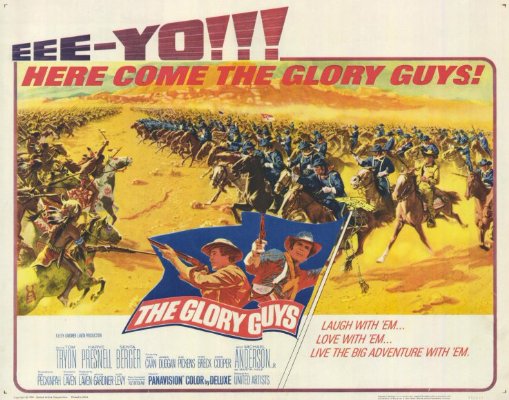
The Glory Guys

For over two years, I've been a Netflix member and have caught up with a lot of movies that were either impossible to find or I just wasn't willing to buy to actually see them.  Over the two years, Netflix has added many features but maybe none better than the ability to watch a long list of movies instantly through your computer or even by downloading through your TV.  There are some hidden gems among these many movies, but you've just got to find them.  I stumbled across a western today I've long wanted to see, 1965's The Glory Guys.

I don't know how many years back, but I caught the last 10 or 15 minutes of this on TCM when I got home from school.  Because it looked good and I was interested in seeing it again, it obviously hasn't been on TCM and of course is not available in any format.  Thank you, Netflix, for making it available.  With a screenplay by infamous director Sam Peckinpah, this western is a thinly veiled version of the massacre at the Little Big Horn when George Armstrong Custer and the 7th Cavalry were wiped out by a huge grouping of plains Indians. TV director Arnold Laven is listed as the movie's director, but rumors persist that Peckinpah handled some of the directing duties.  For a western that is long forgotten, it has too many positives to be left behind as it is.

After fighting the Apaches in the southwest, Captain Demas Harrod (Tom Tryon) is transferred to Fort Doniphan by the orders of famed Indian fighter General Frederick McCabe (Andrew Duggan).  He is assigned a company in the renowned 3rd Cavalry, but the men are a motley group of misfits with little experience with horses or firearms.  With the help of his company sergeant, Gregory (Slim Pickens), Harrod goes about whipping the men into shape for the coming campaign. Harrod also finds himself in a fight for the hand of widowed gunslinger Lisa Woodard (the always lovely Senta Berger) against Army scout Sol Rogers (Harve Presnell). All their problems aside though, the 3rd Cavalry is part of a huge campaign meant to control the plains Indians for good, and Gen. McCabe is looking for glory in the process, no matter the cost in men.

Part of the reason this western has been forgotten over the last 45 years is the casting of the leads, Tryon and Presnell.  Neither actor was a big star coming into 'Glory Guys' and neither would be afterward.  They're the type of roles you can see much bigger names taking over, but for me I thought the two did solid jobs.  Tryon can be a tad wooden at times, and Presnell's character is underwritten and underused, but they have a good chemistry together as they fight for Berger (and who'd blame them?). The unnecessary love triangle isn't as awful as it could have been thankfully, and besides a few scenes that kill momentum in the middle is left by the wayside.

More than a few things here reminded me of Peckinpah's other 1965 western, Major Dundee.  The big ones are obvious, a cavalry story fighting Indians serving as the basis for both movies' story.  But then there's the location filming in Durango, Mexico for both, and the casting of Berger, Pickens, and Michael Anderson Jr. in an eerily similar role to the one he played in Major Dundee. Whoever ended up directing more of 'Glory Guys,' there is the distinct feel of a Peckinpah movie whether it's seeing the same locations or just the dynamic among male characters.  Peckinpah had a knack for tough, hard-edged male characters who fight and fight only to side with each other when the chips are down.  There is a code among men like these, and they tend to live by it no matter the end result.  So yes, it may be an average western, but it's elements like this that help lift it up a notch or two.

What works best when the story isn't focusing on the love triangle is the training and development of Harrod's D Company as they arrive at the fort only to turn into highly competent cavalry soldiers.  Pickens is perfectly cast as tough Sgt. Gregory with Anderson Jr., a very young James Caan as brawling Irishman Anthony Duggan (the accent is must-hear), Adam Williams, and Erik Holland rounding out the recognizable faces in the company.  Peckinpah's screenplay is at its best when dealing with the training and the camaraderie that develops among these men.  The characters lean to outlines more than red-blooded characters, but Cann especially stands out, as does Anderson Jr.  Tryon's Harrod pushes his men because he's seen Gen. McCabe's dangerous battlefield tactics and knows the better prepared his men are, the more likely they'll make it through alive.  I wish more time could have been spent with D Company, but what's here is quality.

Now onto one of my self-named elements of movies I love, the sense of doom.  With a story about an eventual massacre, you know where everything's going to end up.  The last 45 minutes are dripping with tension as the 3rd Cavalry unknowingly rides to their doom.  The actual battle is a spectacle to behold, hundreds of cavalry and Indians on horseback going toe to toe.  Clearly some serious money was spent on the finale, an epic, well choreographed and constructed battle that would preview similar scenes in Major Dundee and The Wild Bunch.  If you're a Netflix member, I recommend checking this one out, and if not, keep an eye out for it.  How hard is it to find? I couldn't even find a trailer or a video clip.

The Glory Guys (1965): ***/****

Monday, October 25, 2010

Countdown

In maybe the greatest movie ever made, 1972's The Godfather, my two favorite characters have always been James Caan's Sonny Corleone and Robert Duvall's Tom Hagen.  I love the actors as much as the characters so even with supporting roles they end up standing out to me. Both actors were rising stars at the time having paid their dues through the 1960s with some lesser roles in lesser movies.  If I've learned anything from watching too many movies like I do, it's to pay attention to those pre-star movies.  Take 1968's Countdown, an earlier pairing of Caan and Duvall.

On July 20, 1969, Apollo 11 landed on the moon, the first time man had ever set foot on the surface. It was a defining moment in history, but what about all the years leading up to it?  This wasn't a quick thrown together process.  Space exploration was and probably always will fascinate people -- myself included -- and what better way to explore space than through the movies?  That's the main reason I'll give 'Countdown' a slight recommendation because through all its flaws (and there's plenty) it gives you a great sense of the anxiety and pressure NASA felt in beating the Russians to getting a man on the moon.

Preparing for an Apollo mission, a crew that includes astronauts Lee Stegler (Caan) and Chiz (Duvall) is pulled from their assignment with rumors of something big swirling.  There's whispers that the Russians have made a breakthrough and are about to send a shuttle to the moon, beating the American effort by months.  Chiz is the higher ranking astronaut, but he's bumped for his a non-military astronaut in Lee for a dangerous, even suicidal mission.  In hopes of beating the Russians to the moon, NASA will send a one-man shuttle to the man so that the United States can claim the first steps taken on the moon's surface.  The only problem?  They won't be able to rescue him anytime soon so the astronaut may have to spend up to a year on the moon in a small shelter.  Very aware he could die on the mission, Lee goes about training with his friend's Chiz help.

I've reviewed other space movies here before including 1969's Marooned, a big-star vehicle that never amounted to anything other than an impressive cast listing.  There are certain limitations that any movie regardless of the budget couldn't overcome.  For one, there's no really good way to make "space travel" look real because miniatures and blue screen or any sort of animation is going to cry out in the obvious department.  For the most part, Countdown avoids that, spending more time on the emotional impact this dangerous mission will have on Lee and his family, friends and co-workers.  The "space travel" (semi-SPOILER Lee gets to the moon, but there's more to come SPOILER) is limited, and the moon set doesn't look half bad.

Focusing instead on the emotional impact isn't always a good thing though.  Director Robert Altman (still two years away from MASH) is limited by what looks to be a smallish budget that gives his finished product a definite made-for-TV appearance.  If a scene is indoors, it looks like a set that would blow over if a stiff wind got inside the studio.  Thankfully there is some very cool footage of NASA and its facilities, not to mention some great shots of the shuttles actually blasting off the pads.  In 1968 or 2010, it will always be cool to see the immense amount of force needed to physically send something into outer space.  Of course, the blaring, in your face soundtrack doesn't help anything either.  So with the balance between the two, the weak cinematography cancels itself out.

Leading the cast, Caan and Duvall make the most of a script that gets into a loop and keeps repeating itself over and over again.  There is a friendship between the two men but also a fierce rivalry over being chosen or snubbed for this dangerous mission. Duvall's Chiz is looking out for the younger Lee for his own safety/benefit, but also because he'd rather go on the mission.  Caan's Lee balances out the drive to be the first man on the moon with the fear that he might die trying to accomplish his mission.  The rest of the cast doesn't leave much of an impression other than Joanna Moore as Mickey, Lee's wife who tears herself up worrying about her husband's decision. Also look for pre-Mary Tyler Moore Ted Knight as NASA's public relations director interacting with the rabid media.

One more complaint and I'll call it quits for Countdown.  For most of an hour, I wasn't quite sure what the mission actually was.  Long conversations detailed what Lee would be doing but never specified that he'd be on the moon for possibly a year by himself.  It could have just been me, but I was confused.  The last 45 minutes are the best part of the movie when the actual mission gets underway.  The ending had a chance to go for a real downer, but everything rights itself in the end.  I would have liked the downer ending -- as I usually do -- but this one works just fine too.

Countdown <---TCM trailer (1968): ** 1/2 /****

Saturday, January 9, 2010

Rollerball

Since the earliest science fiction movies were made, viewers have been treated to pictures and ideas of what the future holds for us. Some are in other universes created in someone's imagination, but then there is those movies that are just a presentation of what Earth and its population will look like down the road. Now, some 30 and 40 years later it's interesting to look at these movies because many were based in the first quarter of the 21st century, like Soylent Green, Death Race 2000, and even to a certain extent Planet of the Apes. So how 'off' were some of these movies thinking about what the future holds for us? Not too far in some cases.

Take 1975's Rollerball which is set in 2018 when there are no more countries, just corporations who rule cities around the world. To help control the population, the corporations have developed a game called Rollerball, an odd combination of basketball, roller derby, football, and hand-to-hand combat with motorcycles thrown in for good measure, which appeals to the masses and gives them something to not only root for and support, but to get some of their bloodlust out and flowing.

Leading the defending champion Houston team, superstar and 10-year veteran Jonathan E (James Caan) is the face of the sport and known all around the world for his play. But just a few games away from another championship, Jonathan is approached by RCI Energy's CEO, Mr. Bartholomew (John Houseman), with a proposition. All the CEOs want him to retire and leave the game behind with no reason or excuse given. The rollerball superstar bristles at the thought, he loves the game he's become a star in and doesn't want to leave, but of course it's not that simple. The corporation CEOs want and need him out and are prepared to do whatever it takes to get Jonathan to leave, even if that means changing the rules of the game to make it even more dangerous.

Right off the bat, I was impressed with the creation of the game of rollerball. Sports movies typically have an advantage right away because viewers are familiar with the game being presented. That way, if the sports scenes are handled well, it's easier to suck the viewer in. But with rollerball, there's no background, no previous knowledge so we're forced to pick it up on the fly. Simply put, the game is something else. Three main sequences -- 3 different games as Houston battles Madrid, Tokyo, and New York -- highlight the story and instantly sucked me in. Imagine gladiators on roller skates. The games start off brutal enough, but are taken to a whole new level once the rules are changed. Here's SPOILERS a cool fanmade video highlighting some of the games.

With some obvious variations, one way or another these futuristic sci-fi movies present a dystopian society. This 2018 society doesn't so look bad, but everyday life is completely controlled by these corporations, everything from reading books to watching television (certain people are given "privileges"). Like 1984, there's a sense of Big Brother all over Rollerball's story. That sense of impending doom grows as Jonathan refuses to retire. He becomes paranoid, questioning to what point the corporations will take it? All of that worry and unease builds to the championship game where there are no penalties and no substitutions. The ending itself (check it out HERE) is the perfect finale, a sequence done with little dialogue as the game unfolds.

When I reviewed Thief late last summer, I revealed my man-crush on James Caan, one of my favorite actors around. Alongside The Godfather and maybe even the TV show Las Vegas, Rollerball is probably Caan's most well-known role and for good reason. His Jonathan E. is Michael Jordan, Babe Ruth, Wayne Gretzky, and Walter Payton rolled into one. He's a sports star playing a game he loves, just trying to figure out why the powers that be want him out. It's a great performance and one that dominates the movie. With a small but key part, Houseman is incredibly intimidating as Bartholomew, Houston's CEO. Other key supporting parts include scene-stealing John Beck as Moonpie, Jonathan's teammate (think of a hit man on skates), Moses Gunn as Clete, a former rollerball coach, Maud Adams as Ella, Jonathan's ex-wife, and Ralph Richardson as the Librarian.

An iconic movie from the 1970s but for all the right reasons. It's an action movie with a message, a deeper sense of the story other than just athletes on skates beating the crap out of each other. The Rollerball sequences are great, surprisingly captivating, and it is all aided by some strong casting, especially Caan in the lead.

Rollerball <----trailer (1975): *** 1/2 /****

Tuesday, July 7, 2009

Thief

Before there was Heat, Collateral or most recently Public Enemies, even director Michael Mann had to start somewhere. Directing his first feature film, Mann was already showing a style that he's become famous for with 1981's Thief.

With some directors, it takes time for a personal style to develop, but with Mann and Thief, it wouldn't be hard to believe if someone had told me this movie was made in the late 90s when he had become a very bankable director. It has all the elements fans have become used to, and in some cases scenes that are almost completely duplicated with later efforts, but more on that later.

Working on his own as a safecracker, ex-convict Frank (James Caan) is at the top of his game and bringing in a pretty penny while doing it. With help from his partner, Barry (Jim Belushi), it seems there's not a safe or vault out there the two men can't take down. Frank has only one demand when it comes to jobs, only money or diamonds, nothing too exotic and he picks the jobs. But after one particularly successful job, Frank is approached by a fence named Leo (Robert Prosky) to work under contract exclusively for him.

Frank wavers at first, but decides to take the offer. His plan is simple; do a handful of lucrative jobs and walk away from his career as a thief with his new wife, Jessie (Tuesday Weld). Apparently, Frank's never seen a mafia movie to know that as long as you make money for organized crime, they're not going to let you go easily. So for the expert safecracker, the situation goes from bad to worse, and he must now find a way out. Story-wise, this is nothing that hasn't been dealt with before in movies, books, and TV shows. But with Mann at the helms, you barely even notice that this all sounds really familiar. He does everything so well, so smoothly, that I got so wrapped up in the movie I didn't even notice the familiar storyline.

Ranking up there with Robert Deniro's Neal McCauley and Tom Cruise's Vincent, Caan as Frank is a great anti-hero and the perfect hard-edged character to lead the movie. Caan is one of those few actors who is just cool standing there. He doesn't have to try or pretend to be somebody he's not. For God's sake the man played Sonny Corleone! As Frank, Caan gives one of his career's best performances. After serving 11 years in prison, he's making up for lost time whether it be with his career or his newlywed bride. The scene where the two really connect for the first time, check it out here, is one example of a similar scene Mann would use 14 years later in Heat. It's the perfect scene to really get to know a character, and Caan is dead-on in the scene and Weld matches him.

As Frank's wife, Weld delivers a strong performance as a woman with a similarly troubled past. At first, she doesn't know how to read Frank's advances, but comes to see him as he really is, honest, sometimes brutally so, straightforward and just looking to lead a happy life. Prosky provides a good villain who for much of the movie is just a business partner. Of course, any self-respecting moviegoer knows he's not as legit as he's made out and problems arise. Belushi in a smaller part makes the partnership between Frank and Barry completely believable with very little said between them. And surprisingly, Willie Nelson joins the cast as Okla, a convict and sort of mentor/father figure to Frank who's serving the last 10 months of his sentence. He's only in 2 scenes, but Nelson is strong in both, giving a depth to Frank's background we otherwise would have no idea about.

On to the movie's style which is evident from the opening credits and the first vault break-in, seen here. Much of the movie's tone has to be chalked up to the score from Tangerine Dream which is a moody, dark, intense, very 80s electronica score. At times it can be overbearing, maybe a little over the top, but it fits the movie so perfectly. Filmed in Chicago, Thief is shot in shadows and darkness, almost a modern film noir, with some really innovative camera shots. I'll always be in favor of on-location shooting, especially when it involves my hometown of Chicago, because it's hard to duplicate the feel of a city elsewhere, whether it be a studio or another city posing as Chicago.

Less reliant on action and shootouts than some of Mann's later movies, Thief nonetheless does not disappoint when it comes to gunplay. It's after a $4 million dollar heist that the situation goes all to hell and Frank realizes everyone he loves and everything he owns is at risk. Drawing on his prison experience, "you have to have the mindset that you're not scared of dying," Frank goes after Leo and his henchmen in one last desperate attempt. You can see the last 10 minutes here, but obviously MAJOR SPOILERS. It's a very stylish, moving ending to the movie with another great sample from Tangerine Dream playing, even if I would have altered the ending a bit.

So take what I say with a grain of salt, I'm a huge Michael Mann fan, but Thief is as good if not better than the director's most well-known and respected movies like Heat and Collateral. Featuring a great performance from James Caan as an all-around badass who won't be messed with by anyone and a worthy supporting cast, Thief is one you should not let slip by.

Thief <----- trailer (1981): *** 1/2 / ****