The Sons of Katie Elder

The Sons of Katie Elder
"First, we reunite, then find Ma and Pa's killer...then read some reviews."
Showing posts with label Francis Ford Coppola. Show all posts

Monday, January 21, 2013

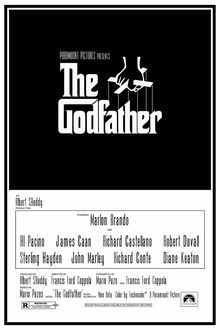
The Godfather

Some movies are just better than others, plain and simple. They're the ones that even the most casual movie fans among us are aware of, films like Gone With the Wind, Casablanca, Lawrence of Arabia, and one of my favorite movies, and maybe the greatest movie ever made, 1972's The Godfather.

It's just a few months since the end of WWII, and Vito Corleone (Marlon Brando), the head of the Corleone crime family in New York City and dubbed the Godfather, is at the height of his power. He has an epically successful business, running the unions and all the gambling in the city, and he's able to do it because he has countless politicians and judges in his back pocket. Things are changing though all around him, especially the underworld and the business he helped create.  Vito is approached about a deal he could bankroll, but it involves drugs, and he chooses to ignore it. The decision is one that drastically affects the family, one that will incorporate all his family members, especially fiery firstborn Santino (James Caan), adopted Irish son, Tom Hagen (Robert Duvall), and his youngest and smartest son, Michael (Al Pacino). What does the future hold? Who will rise up to help their father?

Based off a novel of the same name by author Mario Puzo, 'Godfather' is one of those rarest films; it's perfect. In that sense, director Francis Ford Coppola improves on Puzo's novel, the rare film that is better than its source novel. None of that is a dig at Puzo -- the novel is one of my favorites, a well-written gem -- but the film takes the idea, premise and characters and runs with it. Clocking in at 175 minutes, it never slows down, never feels dull. The dialogue and script provide countless engrossing talking scenes. The look of the movie with its authentic wardrobe, cars and sets is incredible, Coppola filming in an earthy fashion where things always look dark and burned-out to a point. Oh, and composer Nino Rota's score is halfway decent (that's sarcasm by the way), one of the great, classic scores in Hollywood history. You know it already, but listen to the theme HERE.  

What sets Coppola's film apart from countless other films about the Mafia, mobsters and organized crime is the impeccably written story. Puzo's novel introduces countless characters, relationships, history at the reader with all sorts of backstory, and the film assembles it into an expertly told, very coherent (sounds simple, but you'd be surprised) story that develops nicely. It covers over 10 years of time, but at no point does it feel even slightly rushed. Puzo's novel (he also worked with Coppola on the script) introduces characters and within minutes we feel like we've got a good idea of who they are as an individual. Imagine that with over 10 characters that get a fair share of screentime. There is a comfort level with the characters -- the good guys and the bad guys -- that makes the movie more enjoyable the second it begins. Does it all fall into place right away? No, it takes some time, but getting there is half the fun.

As far as true acting movies go, this 1972 classic is hard to beat. There isn't a performance that falls short or feels fake, but two rise above the rest; Brando as Vito Corleone and Pacino as his son, Michael. Playing one of the most iconic characters in film history, Brando's performance has opened the doors for all sorts of impressions, caricatures and stereotypes, but it is a career-best performance (and that's saying something considering Brando's career). It is a layered, nuanced performance, a man in the second half of his life who is highly intelligent, kind and ruthless at the same time, and a man who will stop at nothing to care for his family. Pacino's Michael goes through the film's biggest transition, a young man and WWII hero who wants nothing to do with his family's shady background but finds himself thrust into the family business when outside forces descend on the Corleones. Brando won an Oscar -- fully deserved -- and Pacino was nominated, but whatever the award nominations out there, it's two amazing performances.

Coppola's film earned plenty of acting nominations, three alone for Best Supporting Actor with Pacino, Duvall and Caan all earning a nod. The coolest part? All three deserved it for one reason or another. Caan and Duvall get less screentime, but they make the most of it. Caan is a scene-stealer as the fiery, hot-tempered Santino, known to friends and family as Sonny, the oldest Corleone son. The same for Duvall as Tom Hagen, but in a different way. Where Caan is more aggressive, Duvall underplays his part as Tom, the unofficial Irish Corleone brother, a childhood friend of Sonny's who Vito welcomed into the house. Other members of the Corleone family and operation? Richard Castellano and Abe Vigoda as Clemenza and Tessio, the Corleone caporegimes (think right-hand men, enforcers), John Cazale as Fredo, the Corleone brother and screw-up, Talia Shire as Connie, the lone Corleone sister and her similarly fiery husband, Carlo (Gianni Russo), and Diane Keaton as Kay, young Michael's love who must decide how much she's willing to put up with.

And then there's the opposition, the all-around nice individuals who are trying to take down the Corleones. For starters there's Richard Conte as Barzini, a head of another NYC crime family, Sterling Hayden as Capt. McCluskey, an NYC cop on a rival's payroll, John Marley as a film studio head who incurs the wrath of the Corleones, Al Lettieri as Sollozzo, a drug supplier looking for funding and backing, and Alex Rocco as a casino owner dealing with a buy-out of his casino.

On repeated viewings, I've noticed different features about the film, different layers that can affect how I view it. The biggest is simple; family. Yes, it's a pretty hardcore, violent story about a crime family with its hand in illegal happenings, but it's still family. If you can look past that whole criminal aspect, the biggest focus is the family and the dynamics and relationships among family members. Through the rather vicious, violent ups and downs, love and hate, they're there for each other (for this movie at least). I love how Vito dotes on his kids and grandchildren but can balance that out with a brutal mindset -- it's business, not personal -- at the same time. The relationship between Vito and Michael is the most heartfelt, including one of my all-time favorite scenes as father and son discuss what could have been, maybe what should have been. A worrying Vito wanted more for his son, but a firmly entrenched Michael (very much looking out for the family) calmly states "We'll get there, Pop." It's an endearing, heartfelt moment, one of many.

There are far too many memorable, iconic, and all-time great scenes to discuss one by one.  Big picture, that's probably what viewers will remember the most on initial viewing. The infamous horse head scene, the introduction of Vito, his loyal enforcer, Luca Brasi (Lenny Montana), and his "offer he can't refuse," the perfect simplicity and natural quality of the opening wedding, a slight detour to Sicily and its beautiful hills, a meeting among Michael, Sollozzo, and McCluskey in a traditional Italian restaurant, and maybe the most memorable, the baptism scene, almost entirely silent other than Rota's score playing over the developing scenes. Each of the above scenes could be analyzed in a review unto itself, but this review is already getting long-winded. Long story short? It's maybe the greatest movie in Hollywood history without a flaw in sight. Shame on you if you haven't seen it by the way. What are you waiting for?

The Godfather (1972): ****/****

Thursday, February 16, 2012

Apocalypse Now

As a fan of movies, there are just certain films you have to see. When you haven't seen those movies, you typically get a reaction something like 'HOW HAVE YOU NOT SEEN THAT? IT'S A CLASSIC!' The reaction can be angrier or happier depending on the individual. I've gotten that reaction concerning 1979's Apocalypse Now. Well, check that one off the list.

Having already served at least one tour in Vietnam, special forces Capt. Willard (Martin Sheen) is wasting away in Saigon as he battles through some personal demons. He waits and waits for a mission, and finally gets one, but it's nothing like he expected. Across the Cambodian border, an American officer and Special Forces vet, Col. Kurtz (Marlon Brando), has gone rogue, and Intelligence things he's gone insane with his adoring command still intact. Willard's mission sounds simple but is anything but. Boarding a small patrol boat with its close-knit crew, Willard travels all the way up a river into Cambodia with one objective; terminate Kurtz with extreme discretion.

While director Francis Ford Coppola's highly controversial and much debated movie is typically grouped as a war movie, it is really anything but. It is based off Joseph Conrad's Heart of Darkness, albeit based in a Vietnam setting. Not to sound pretentious -- the movie does enough of that -- but this movie isn't about war. It's more about the affects of war, how it hits people, how it impacts them. I watched Apocalypse Now Redux, the longer version Coppola released in 2001, and I feel safe saying it is unlike any movie I've ever seen before. Emotional, moving, existential, other-worldly, upsetting. It defies descriptions in so many ways.

The best I can do though is surreal. The Vietnam setting is a jumping off point for the weirdness. At 202 minutes (the Redux), it is a leisurely, slow moving story. It is one of the most incredibly visual movies I've ever seen, haunting in its beauty at times and upsetting at others. Working with his father, a composer himself, Coppola creates a musical score that is both classical and innovative. It uses an electronic synthesizer and lots of percussion, setting an eerie, unsettling mood to this trippy, even psychedelic trip up the river to Kurtz's compound. The feeling and aura of the movie is unreal and hard to put into words. Coppola creates a vision of a war -- Vietnam -- that I can only imagine was more terrifying than the actual war itself.

This is a movie about a journey though, both physically moving up the river and in one's mind, specifically Sheen's Capt. Willard. In a movie that runs three-plus hours, we get to see a lot of these bizarre, surreal moments in the journey. It starts with an opening set to The Doors' The End, and then we're off to the Intelligence community where the mission is explained, and then Willard is to to the Air Cav, a helicopter unit commanded by Col. Kilgore (Robert Duvall), more interested in surf conditions than objectives. That's just the start though. We see a disintegrating force of soldiers the further north the boat travels, officers in "command" long since gone. The patrol boat also runs into a USO show with Playboy playmates, the crew later running into them at an isolated Medevac station, and is also captured of sorts by French plantation owners (including Christian Marquand) still in Vietnam from the French occupation years before. The longer the journey, the stranger things get.

Through the good and the bad -- and there's a fair share of both -- are some moments of perfection. Kilgore's Air Cav command assaulting a Viet Cong coastline post is a brilliant sequence, one of the most realistic, intense, adrenaline-pumping action scenes ever. It's set to Wagner's Flight of the Valkyries, the music the attacking helicopters listen to as they fly into battle. Has to be seen to be believed and appreciated. Watch part of it HERE. Another highpoint is the patrol boat reaching the last American post on the river, a bridge under constant construction and under constant attack. Arriving in the dead of night during an attack with lights strung across the river, Willard and the crew find the semblance of what used to be a command in a dream-like, eerily beautiful sequence.

Onto the cast, and there's plenty to talk about there. Sheen nails his part as the tortured Capt. Willard. His narration fills in much of the movie's quieter gaps, treading the line between obnoxious and pretentious with genuinely heartfelt messages. His own descent into madness, his obsession to finish the mission is startling in its own right. Brando doesn't even appear until 150 minutes in, and his performance is almost a caricature of himself. It's all right, but a little much (more on that later). Duvall very much earns his Best Supporting Nod (but didn't win) as Col. Kilgore, infamously stating "I love the smell of napalm in the morning. The patrol boat's crew include Chief (Albert Hall), the no-nonsense commander, Clean (very young Laurence Fishburne), Chef (Frederic Forrest) and zen-like surfer Lance (Sam Bottoms). G.D. Spradlin and Harrison Ford have small parts as Intelligence officers giving Willard his mission. 

As good as parts of the movie can be, it also struggles to hold its momentum until the end. The story drifts along far too much, and by the time Brando's Kurtz actually reveals himself it's almost a disappointment. There is little energy in the build-up to the finale, an incredible ending that has stirred up controversy over the years in all its different variations. Dennis Hopper as a stoned-out photojournalist (Scott Glenn has a small part here as one of Willard's predecessors) and Brando spout off with lots of philosophical musings that mean nothing but sound good. Kurtz delivers one moving monologue about the horrors of war, but it's lost in a sea of drifting, pointless "messages." That's the problem with much of the movie. It wants to say something about war and man, but what exactly? 

Through everything though, this is an incredible movie. Even if you hate it, Apocalypse Now will almost certainly make an impact on you either negative or positive. I watched it two days ago and am still wrapping my head around it. It is unlike any other movie I can think of, and truly needs to be experienced.

Apocalypse Now <---trailer (1979): ***/****

Friday, July 29, 2011

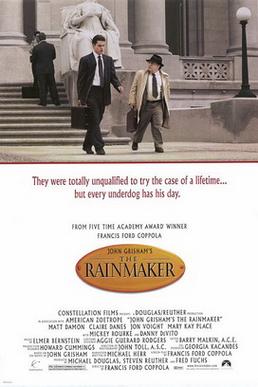
The Rainmaker (1997)

The name John Grisham is synonymous with courtroom dramas and legal thrillers. There is A Time to Kill, The Firm, Runaway Jury, Pelican Brief, The Rainmaker and The Client to name a few. I've only read one Grisham novel -- A Painted House, his departure from the courtroom ironically enough -- but his stories translate well to film. There is a natural drama to courtroom proceedings that just works well, especially with 1997's The Rainmaker, a drama that isn't flashy or showy, just a well-made, polished story.

The different elements that are all over the place here somehow find a way to click and gel together. Some of that can no doubt be chalked up to Grisham's familiarity and ease with his story and characters which smooth out any number of rough patches. The director here is Francis Ford Coppola, he of The Godfather series, who I wouldn't picture in a courtroom story. Rising star Matt Damon is aided by a pitch-perfect supporting cast with Elmer Bernstein providing a somewhat odd, blues/jazz mix for his soundtrack. It isn't a great movie, and maybe it isn't even a very good movie, but it is GOOD from the get-go.

Fresh out of law school in Memphis, Rudy Baylor (Damon) takes a job with ambulance chasing lawyer Bruiser Stone (Mickey Rourke) while he waits to pass the Bar exam. Working with insurance agent and attempted lawyer, Deck Shifflet (Danny DeVito), Rudy sees the writing on the wall and knows Bruiser is about to get taken down by the FBI. With Deck, he starts his own small firm. Their only case comes from a lower classic family, the Blacks, including mother Dot (Mary Kay Place) and son, Donny Ray (Johnny Whitworth), who is dying of leukemia. The Blacks' insurance company is denying their claim, but Rudy takes on the case -- his first -- in hopes of bringing the suffering family some peace. He's forced to learn on the fly, especially with his opponent, Leo Drummond (Jon Voight), an experienced, smart, tricky and veteran lawyer looking to take him to pieces.

So we can all agree lawyers suck, right? Okay, that's harsh. Maybe only like 96% of them. Movies have a chance and a way of humanizing them, especially here in the eyes of young, inexperienced lawyer Rudy. You need an underdog in a story like this, and Damon's Rudy supplies it in spades. While intelligent and book smart, he doesn't necessarily know the ins and outs of being a lawyer, the courtroom basics an experienced lawyer would take for granted. Damon's narration is at its best in its simplicity, a young man questioning the system he so wants to be a part of. For all the good it is intended to do, the judicial system is flawed in countless ways, something Rudy finds out quickly. It isn't just right and wrong anymore. It's about winning and losing plain and simple with plenty of money on the line. Innocent and even a little naive, Damon does a great job with this character, a sign of the acting ability we've come to appreciate in the years since.

How good is the cast here? Danny Glover plays the judge trying the case, a civil rights supporter and opponent of big business, and the man isn't even credited. DANNY GLOVER! DeVito gets a showier part -- if a background one -- as Deck, the almost-lawyer who still has a slimy veneer to him even when you can't help but like him and his nose for getting in and out of trouble. Voight is perfect as Leo Drummond, the snake oil lawyer who knows every trick in the business. Place, Whitworth and Red West give the movies its heart as the Black family, their scenes touching and heartbreaking as the story develops. Not enough for you? There's also Rourke, Virginia Madsen as a key witness, Dean Stockwell as an old school judge, Teresa Wright as Rudy's client and landlady, Roy Scheider as a CEO who could make or break the case, and even country singer Randy Travis in a great bit part as a potential juror. Good enough for you?

I liked this movie, but as I write this review I'm struggling to come up with reasons why. Thanks to shows like Law and Order and its countless spin-offs, the courtroom drama is far from original anymore. It seems stupid to be critical of a movie released almost 15 years ago for things that have happened since, but there it is. This Coppola-directed courtroom drama is the equivalent of comfort food. You have a good sense of what's going on, the semi-twists that will eventually be revealed, and in the end...well, let's not go there.  The movie and story are in their comfort zone in the court scenes with an easygoing sense of where they want to go and what they want to accomplish. Damon and Voight play off each other nicely with Glover and DeVito making their impact known as needed. The out-of-court scenes tend to meander a bit, but the movie always rights itself when needed.

The only real complaint I have for the movie, and the one part I genuinely didn't like was a subplot with Damon's Rudy and a client of his, Kelly (Claire Danes), a young wife married to an abusive husband (Andrew Shue). Rudy instantly develops feelings for her, wanting to save her from almost certain doom at the hands of her husband. In an effort to develop Rudy more as a character (unnecessary if you ask me), I felt like the story went down an easy path that Grisham is just better than. The story doesn't dwell too long on these scenes, but the damage is done early. Not a deal breaker, but it does bring the movie down a notch or two.

I'm struggling here. I don't know what else to say. I liked this movie if I didn't love it. Not bad at all, but it never reaches that level of courtroom drama classic. Solid if not so flashy directing from Coppola, and an all-star cast that does not disappoint, but it's just missing something overall. Still worth checking out though.

The Rainmaker <---trailer (1997): ***/****