The Sons of Katie Elder

The Sons of Katie Elder
"First, we reunite, then find Ma and Pa's killer...then read some reviews."
Showing posts with label John Frankenheimer. Show all posts

Saturday, February 28, 2015

Andersonville

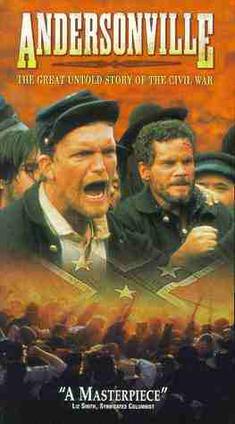
When you think of prisoner of war movies, World War II-era flicks dominate the landscape with movies like The Great Escape and Bridge on the River Kwai. There are others of course, some from the Korean and Vietnam Wars. But as if there wasn't already a scarcity of Civil War movies, there definitely aren't many Civil War P.O.W. movies. How about a gem, a made-for-TV flick from the mid-1990s? That's 1996's Andersonville.

During the battle of Cold Harbor in early June 1864, a group of Union troops from a Massachusetts regiment, including Corporal Josiah Day (Jarrod Emick) and Sergeant McSpadden (Frederic Forrest), are captured by Confederate forces. Packed into cattle cars, the Union infantry is shipped south to a prison camp that is quickly gaining a reputation for all the wrong reasons. It's called Andersonville, and thousands and thousands of prisoners are confined in a stockade meant for less than 8,000. Food, water and rations are limited, and the maniacal camp commandant, Capt. Henry Wirtz (Jan Triska), rules the camp with an iron fist. Josiah, McSpadden and their fellow Massachusetts men have no idea what awaits them in a prison camp where men drop like flies each day from disease, starvation and even a murdering group of prisoners called Raiders. Can they survive? As Andersonville wears on them, do they even want to survive?

Have you heard of Ted Turner? Well, he's quirky, rich and a Civil War enthusiast. Having already backed the 1993 Civil War epic Gettysburg, Turner turned his sights on this made-for-TV venture, bringing to the small screen a generally forgotten, truly dark part of American history. Once fighting began in 1861, both the Union and Confederate sides now had to deal with the ever-increasing number of prisoners of war. Clocking in at 167 minutes, 'Andersonville' is a horrifying, moving and realistic portrayal of the worst Civil War prison camp. Built in 1864, over 45,000 prisoners were held there, and over 13,000 died in just over a year-plus. The truth is horrifying just reading about it, but seeing it? Quite the moving experience.

With Turner backing the production, no expenses were cut short. An entire set was built almost to the exact measurements of the actual prison camp (it's a little bit smaller) to provide just a stunning visual for all the wrong reasons. Acres and acres of makeshift tents and shelters -- usually just holes in the ground covered with tarps -- stretch as far as the eye can see, prisoners packed into the camp like sardines. With no sanitation, you can only imagine how absolutely filthy and disease-ridden the camp was. Director John Frankenheimer brings this god-forsaken place to life, using long tracking shots that have the camera navigating through this claustrophobic, filthy, death lingering in the air, horrific location to life. By the end of the movie, you're exhausted, beaten up and truly get a sense of what living in the camp was like.

'Andersonville' utilizes an ensemble cast with some familiar faces, even some stage actors, but no huge stars. Playing the everyman hero, Emick -- a stage actor -- is our window into the camp as Josiah, an educated, well-spoken soldier who vows to survive no matter what it takes. Forrest too is excellent as the tough Sgt. McSpadden who wants nothing more than to get his Massachusetts men through this living hell. The prisoners we meet are a combination of those new Massachusetts infantry who arrive and the Pennsylvania miners who welcome them in, even letting them in their desperate escape attempt. Ted Marcoux plays Martin, one of the miners and simply a good man in who we see a horrific physical transformation over his time in the camp.

Also worth mentioning in a very solid supporting part is Cliff De Young (Glory, Centennial) as Sgt. Gleason, the leader of the Pennsylvania men who welcomes in the Massachusetts contingent. Experienced miners in the coal mines, Gleason's men are digging a tunnel under the wall. Their odds? Slim, but anything is better than staying in the camp. Also look for Jayce Bartok, Justin Henry, Andrew Kavovit, Olek Krupa, Thomas Wilson, Peter Murnik, and Gregory Sporleder as other key Union prisoners we meet. Frederick Coffin and William Sanderson play the leaders of the Raiders, more intent on survival than anything, even if it means attacking and killing fellow prisoners. Also look for William H. Macy as a Confederate officer tasked with examining what goes on within Andersonville's walls.

Originally broadcast over two separate nights, the story tries to accomplish a ton. The first half introduces our characters, the camp and the desperate escape attempt via tunnel while the second half shows the effort to rid the camp of raiders while also showing the horrific physical wear and tear the prisoners go through. It all builds to quite the ending, one that packs quite the emotional punch. It's heartbreaking with a last twist and ends on a quiet, somber note that shows the real horror of the camp. Highly recommended, an incredibly difficult movie to watch but one that is incredibly worthwhile.

Andersonville (1996): ****/****

Tuesday, March 18, 2014

The Gypsy Moths

Skydiving has always fascinated me, but I've never had the guts to do it. Odd considering I'm typically scared to death of heights, huh? Meh, big deal! Years ago on a DVD I can't remember, I caught a trailer for a movie from the 1960s about skydiving with a great cast that looked like a light, fun and entertaining flick. Well, I caught up with how many years later, and let me tell you, 1969's The Gypsy Moths ain't what I thought it was going to be.

It's the Fourth of July weekend when a three-man skydiving team, Mike Rettig (Burt Lancaster), an experienced diver, Joe Browdy (Gene Hackman), the motor-mouthed owner/diver, and Malcolm Webson (Scott Wilson), a young but talented diver, drive into a small Kansas town looking to put on a show and make some cash. Malcolm grew up in the little town, the group even staying at the home of some of Malcolm's family. Their mindsets on basically everything is vastly different from the townspeople, including the family, causing some riffs between the barnstorming skydivers and the town-based population. Joe's team gets out on the town though, advertising and getting the word out about their coming show. It won't be easy to put the show together though with weather concerns, and those problems are amplified when the group argues over whether Mike should do a dangerous cape jump as a grand finale.

This 1969 flick comes from one of my favorite directors, John Frankenheimer, the man behind The Train, The Manchurian Candidate and Seven Days in May among others. 'Moths' never got a full theatrical release in the United States, audiences only discovering it years later. The reasoning? My guess would be it was a couple years too early. In the 1970s, this movie may have flourished. There's surprising amounts of nudity, a forthright attitude about sex, adultery, life in general. Whatever the reason though, it didn't really get a chance with American audiences. Frankenheimer has even said in interviews that this was his favorite film he directed. That's all the convincing I need, but in very disappointing fashion, the movie doesn't amount to a great final package.

Some of that definitely comes from a perception of mine because I thought I was getting a different movie. That's not all of it though. I adjusted and went with a far darker story than I thought I would be watching. The screenplay from William Hanley looks to give a little slice of smalltown America and what better time to do that than a 4th of July weekend? Frankenheimer filmed on location all around Kansas, giving an authenticity that wouldn't work if it was filmed on a Hollywood backlot. It doesn't translate overall though. I think the movie is too thoughtful, too introspective, too brooding for its own good. These skydivers sure are moody, depressed, fighting amongst themselves and instantly clashing with the townspeople with their callous(?) outlooks on life. The first hour is painfully slow and so darkly down and depressing that I couldn't get into it at all. For me, that's saying something. I'm usually a big proponent of the darker the better in terms of story.

Whatever the tone though, 'Moths' has quite the cast. Are they used well? Eh, not really. I didn't really understand Lancaster's Mike character. He's a longtime skydiving veteran, an adrenaline junkie who's beginning to see the adrenaline wear off. Are his skydiving days beyond him? He may have found a future with Deborah Kerr's Elizabeth Brandon, a married woman and Malcolm's quasi-aunt. They're instantly drawn to each other, but it's never clear why. As near as I can figure, they're drawn to something different, Mike a settled down life with a wife and family, Elizabeth a wild and free life lived on the road to the fullest. Mostly, this relationship comes out of nowhere, one of those horrible movie relationships where two people fall for each other immediately with some knowing looks. This affair/relationship does push the story to some surprising twists, but the twist didn't have quite the dramatic shock I'm assuming was intended. Surprising? Yes. Effective dramatically? Eh, not quite.

The rest of the cast okay, nothing special. There is a chemistry among Lancaster, Hackman and Wilson, but there's not enough of it. When it does come around, it's too late. Hackman is solid as ever, a fast-talking charmer, the engine that makes the team go. He meets and clicks with a waitress (Sheree North, topless dancing and all) immediately as the skydiving show fast approaches. Wilson is moody and worrying and quiet as Malcolm, an underdeveloped character that falls for a young boarder, Annie (Bonnie Bedelia), at her aunt's home. These are all potentially interesting characters, but something just doesn't click to bring it all together. Also look for William Windom as Kerr's husband, seemingly seeing what's going on but not doing much about it.

The final 45 minutes at least make an effort to get the audience's adrenaline pumping. After all the introspective, slow-moving drama of the first hour, it is desperately needed as the skydiving team heads to their show. The footage is pretty crazy, cameramen jumping with the actual skydivers to get some great skydiving action. There are these ridiculous moments where you sit back and think "Man, that guy is hanging off the plane's wing waiting to drop. What if his parachute doesn't open?" The skydiving footage is the high point of the movie, no doubt about it, but it wasn't enough to save this Frankenheimer film for me. Unfortunate end result, a disappointing effort in the end that never connects.

The Gypsy Moths (1969): **/****

Sunday, January 9, 2011

The Extraordinary Seaman

When director John Frankenheimer got it right with his movies, he hit it out of the park.  We're talking movies like The Train, Seven Days in May, Grand Prix, The Manchurian Candidate, and Birdman of Alcatraz. These are movies that are classics or at least near-classics and should be must-watch for any movie fan.  Just about any director though has to have a couple duds on his/her resume, and until now I hadn't seen Frankenheimer's dud.  For all I know, he may only have the one, but 1969's The Extraordinary Seaman is one of the worst movies I've ever seen.

Reading through Turner Classic Movies' schedule each week, I typically look for actors/actresses I'm a fan of, or if nothing else a title that sounds interesting.  When I stumbled across the cast of this one, my first thought was how had I completely missed the boat on this one?  David Niven in the lead? Faye Dunaway and Alan Alda in supporting roles? Mickey Rooney too?  And it's a World War II story? I don't know at what point I realized this was an awful movie, but it didn't take long.  We're not talking a 'so bad it's good' type movie either.  No guilty pleasure, no real redeeming quality anywhere in sight.  Just plain awful and no amount of talent in the cast was going to save this clunker.

After their ship is sunk somewhere in the Pacific, four sailors (including Alda, Rooney and two relative unknowns) navigate their life boat to land where they seek help while trying to avoid any Japanese forces.  In their wanderings, the foursome stumbles upon an abandoned old gunship with no crew commanded by Commander Finchhaven (Niven) of the Royal Navy.  With his 'new crew,' the commander goes about readying his ship for sea and hopefully Australia.  The sailors, especially Alda's Lt. Krim, are suspicious of the British officer.  He drinks and drinks whiskey without ever getting drunk, never sleeps or eats, and never leaves the bridge of the ship.  What's going on with this possibly nutty officer on this crazy ship?

I feel stupid when I've watched a movie, hated it intensely, and then gone over to the IMDB and find it has a ridiculously high rating. Did I miss the boat on something or are movie viewers like monkeys who like what they're told to like?  So when I do watch a movie, hate it, and see that a majority of voters agree on how horrifically awful something is, it makes me feel better.  'Extraordinary' has earned itself a respectable 2.4 rating from 283 votes as of this review so clearly I wasn't missing anything major here.  It's just a bad movie, and that definitely made me feel slightly better about wasting 80 minutes of my life watching it.  I kept waiting for it to get better, but here's a secret for you...it doesn't.  Don't even bother.

My first thought when I saw the movie was only 82 minutes long was that it packed a lot into a very small window.  Yeah, I couldn't have been more wrong there.  Unsuccessfully trying to either make an existential dig at the lunacy of war or a slapstick comedy that is short on the laughs, Frankenheimer refuses to pick a direction to go in.  If there's a message, I missed it.  The same goes for any supposed laughs.  He uses an odd technique though, splicing in news reel footage of WWII and then editing in his cast.  The off-screen narration usually has some oddball link to what's happening to the characters, but it's incredibly random and doesn't add much to the story.  It's also overused to the point where I started fast-forwarding through huge stretches of the movie.  Actual run time is 82 minutes, but I'd say about 45-60 minutes is actual filmed scenes with a cast that deserves so much better.

So, yes, it's awful almost right from the start, but a cast like that has to save it a little bit, doesn't it?  That's what I figured.  It's not necessarily the cast's fault that what they're working with is one of the more bizarre scripts I've ever seen, but you've got to hold someone accountable.  Alan Alda is playing a younger version of Hawkeye Pierce, his M.A.S.H. character, with almost all of his eccentric mannerisms and oddities present.  Niven is sleep-walking through this part and doesn't bring any of his typical charm to the story.  I'm not sure why Faye Dunaway signed on for this because her character is completely unnecessary and has little involvement with the story.  She does look good so that might be the lone positive I take away from this movie.  Rooney is the lone one at least trying, his Oglethorpe character a paranoid cook convinced everyone is a Japanese spy.

What pulled me through this movie was some sort of explanation with David Niven's character.  SPOILERS When it is revealed, it's not surprisingly pretty underwhelming.  His family has a long tradition of dying in battle, and he did too...in 1914.  Apparently, his grandfather admiral can grant wishes from beyond the grave and forces Niven's Finchhaven to remain on Earth until he can redeem himself by sinking an enemy cruiser.  The only problem? The ending is so poorly handled that nothing is resolved at all.  No resolution for any of the characters is always a solid capper in my book.  What a bad, downright horrible movie. Talking about downright bad taste, read the caption on the poster above.  It's not often you hear Adolf Hitler thanked for something that claimed the lives of millions of people. 

The Extraordinary Seaman <---TCM clips (1969): */****   

Sunday, August 1, 2010

I Walk the Line

Is there a genre of movies that could be dubbed "I'm having a mid-life crisis?"  It sure seems like there has been enough movies where a middle-aged man, fed up with where his life has ended up, does something to reclaim his youth whether it be an affair with a younger woman, buying an expensive sports car, or the always reliable bail on your life and start over.  That's the basic premise for 1970's I Walk the Line

The movie of course is not based on Andy Taylor -- Andy Griffith's character in The Andy Griffith Show -- but there are a fair share of similarities between the TV sitcom character and the main star here, Gregory Peck. Directed by John Frankenheimer, 'Line' jumps right into the premise of small-town life in the south is like where big-city life seems like a far off thing and the excitement is minimal.  But what if something came along -- for one person at least -- that livened things up even for a little bit?  Would you embrace it or pass it up?  So goes Pecks' dilemma.

As the peace officer in a small Tennessee town, Sheriff Tawes (Peck) just doesn't have much to do.  His home life is quiet without much in the way of fireworks (good or bad), and he spends his days patrolling back roads and making sure everything is up to snuff.  One day he pulls over a truck driving wildly down the road and meets Alma McClain (Tuesday Weld), a teenage girl who is lively and exciting in a way little else is in his life.  They quickly start seeing each other -- secretly of course, this is the South -- only to have Alma's moonshiner father (Ralph Meeker) blackmail Tawes for protection so his moonshining business can keep going. As long as the sheriff gets to see Alma, he doesn't seem to care, but his hushed up affair becomes an issue when an FBI agent (Lonny Chapman) shows up with orders to clean out any moonshiners in the area.

This performance for Peck is quite a departure from his usual roles where he usually played stout men of principles where good was good and bad was bad.  Frankenheimer wisely doesn't paint Tawes as a hero or as a bad guy, instead just showing him as a man who's frustrated with the path his life has took.  Through Weld's Alma, Tawes sees a chance to be happy, to be young again.  Peck pulls this all off perfectly, like a man about to explode. With anything involving an older man and a younger woman (Alma's age is never specified, 19, 20 maybe?), there's a certain element of creepiness, but for the most part it is kept to a minimum.  Give Peck credit, he goes right up to that line of crazy, obsession love without going over...just barely.

Making his obsession fully understandable is Tuesday Weld because, well, she looks like she does.  The 27-year old actress is playing a part that is slightly younger than her, but this bubbly blond with the huge smile makes it easy to understand why a middle-aged man would feel the way he does about her.  What I liked about the character was the question of if she was playing Tawes for his protection or because she was genuinely interested in him, had real feelings for him.  Her motives are established late, leading to an ending that surprised me, but it certainly works as a "real" ending.  Also worth mentioning in the cast is Meeker in a smaller part as Alma's father Carl (subtle creepy incest hinted at), and Charles Durning as Hunnicutt, Tawes' deputy who always sticks his nose where it doesn't belong.

My biggest issue isn't in what we do see, but what we don't see.  Tawes gets involved with Alma very quickly without much in the way of character background.  It's obvious he is bored to death by his job, family and life in general, but there's only one scene that even shows it, a dinner scene with his wife (Estelle Parsons), their daughter and Tawes' father.  The peaceable sheriff looks like he's about to kill them all in a fit of rage.  I'm not looking for 30 minutes of mind-killing boredom where we saw Tawes and his descent, but even a little more background would have been interesting.

One review I read accurately identified 'Line' as a movie that feels like a folk song, a country ballad, and he's dead-on.  Singer Johnny Cash handles the soundtrack (including title song "I Walk the Line"), helping the movie move along in the montage sequences as Tawes and Alma sneak off to be together. Frankenheimer filmed in Tennessee, giving the story a sense of being separated from the rest of the world in this tiny backroads town.  It feels like you're there with them and not some movie studio set.  For an underrated, different movie, give this a try.  Watch it at Youtube starting here with Part 1 of 10.

I Walk the Line <---TCM trailer (1970): ** 1/2 /**** 

Thursday, July 8, 2010

52 Pick-Up

If movies have taught men anything, it's not to cheat on your spouse.  Movies have shown us you could be killed, double-crossed, blackmailed, and forced to do all sorts of ungodly things to keep your secret safe.  Then there's always the mistress and/or spouse finding out and turning on you.  Big picture?  Don't mess around, and you've got a good shot at avoiding all this stuff.  Too bad no one takes advice these days, like in 1986's 52 Pick-Up.

Working off an Elmore Leonard novel, director John Frankenheimer puts together a movie that you basically feel dirty for having watched it.  It's that perfectly wrong blend of sleaze and scum with the 1980s porno scene serving as a backdrop for some extramarital shenanigans. 'Pick-Up' has that feel of a low-budget B-movie, but not necessarily in a good way. The premise is interesting enough, but there's a handful of plotholes that make you groan, and worse than that, characters making decisions that no one in their right mind would do.  If you read no further, here's a good summation of the movie.  Death Wish for Cheaters.  That's the best I can do.

Going to see his nude model/topless dancer mistress, Cini (Kelly Preston) at her apartment, rich and married businessman Harry Mitchell (Roy Scheider) is caught off guard by three men waiting for him.  They have video footage of Harry on vacation with Cini in some comprising positions and now want him to pay up if he doesn't want the footage shown to his wife, Barbara (Ann-Margret). Making his decision worse, Barbara is running for local office with the district attorney and any news like Harry's cheating would completely derail her campaign.  But even as he's about ready to pay the money, Harry realizes they won't just let him get away so he decides to go on the offensive, taking it to the three mystery men blackmailing him for piles of cash.

Watching a movie based on an Elmore Leonard novel, you head in with a certain amount of higher expectations.  Not having read the book, I can't just how well the transfer was made and what was left out, but this movie has some of the dumbest villains I've ever seen.  Raimy (John Glover) is an owner of a porno theater and the mastermind of the plan.  Leo (Robert Trebor) runs the club where Cini works and seems genuinely surprised when everything hits the fan.  Last, there's Bobby (Clarence Williams III), a pimp who is just too trusting of his partners in crime.  They have to be the unlikeliest of villainous trios, but man, they sure are dumb.

The dynamic is funny among the three, Raimy being the insanely calm leader, Leo the freakishly nervous dupe, and Bobby the muscle who never seems to realize something bad could happen in this plan.  Glover stands out for his part as Alan Raimy, a truly over the top villain you just love to hate.  He's the only one of the three that really registers in any sort of intimidation with the other two more funny than scary -- unintentionally so.  The decisions these three make drove me nuts because they hope to blackmail Scheider's Harry for years and years to come, but then decide to get rid of all the evidence that would pin a murder on Harry.  There's stupid and there is criminally stupid.

As an actor, I really like Roy Scheider in the five or six movies I've seen him in.  This is a difficult character to get behind because of the actions he's taken against his wife (who would really cheat on Ann-Margret?) so he's in a hole right from the start.  The character as a whole is hard to put your finger on because he is so far over the place.  He's angry, worried, a vigilante, a detective, a rich businessman, and with an intelligence that has helped him amass a huge business.  Scheider's always very watchable, but this isn't my favorite character of his.  Ann-Margret is very good in a better part as Harry's wife Barbara, a woman struggling to deal with this bombshell that's been dropped on her while also trying to be elected to office.  Former model Vanity has a small part as one of Cini's fellow strippers while Preston needs to look scared and be naked for her part. Doug McClure has a small part as Arveson, the D.A. that Barbara is working for.

In most of his movies I've seen, Frankenheimer is a very visual director, and 'Pick-Up' does have it's moments as Harry tries to right his wrong. The movie was shot in some of Los Angeles' seedier areas on top of some locales that include a strip club, an orgy/party, and Raimy's porno theaters.  Needless to say, Frankenheimer isn't shy about nudity and violence in this flick.  It's almost too seedy though right from the start in a story that never quite figures out what it is.  Also, watch out for the obvious reference to The Mechanic near the end.  A laughably bad ending.

52 Pick-Up <----trailer (1986): **/****

Monday, March 8, 2010

Seconds

Can an ending to a movie save the whole movie? Today I watched 1966's Seconds after taping it last week off of TCM.  The first 80 minutes or so I absolutely hated, bored to tears and hoping the ending would salvage something out of this wreck.  Surprisingly enough, I was rewarded.  How often does that happen?  A movie you're not enjoying actually gets better?  No way.  But still, the build-up was excruciatingly dull at times in an effort to be different.  So did the ending save the movie?

Director John Frankenheimer is one of my favorite directors with his unique visual style and storytelling ability.  His critics use those things against him, saying that his movies often lacked heart.  True to a point but not as a broad, all-covering statement for a director that made his fair share of classics.  His 'Seconds' is a deeply flawed movie and one that certainly qualifies as heavy on style, short on heart (until the end at least).  It tries to be too different, too groundbreaking in delivering an interesting story that would have sufficed on its own.

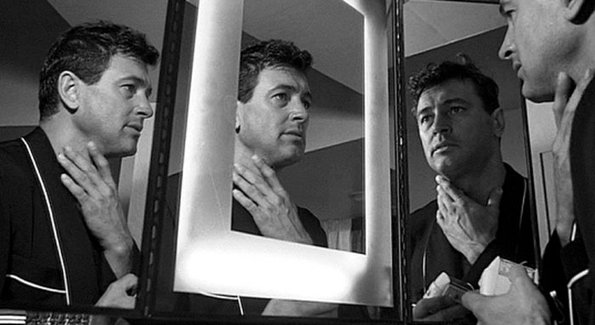
A middle-aged loan officer at a bank with a wife and kids, Arthur Hamilton (John Randolph) is in a rut.  He's incredibly on edge after he receives several calls in the dead of night from an old friend, Charlie, who Arthur believed was dead.  Charlie delivers an ominous message for Arthur to go to a specified address.  He somewhat suspiciously goes along and discovers a company that offers people a second chance in life.  For a fee, their death is faked and through extensive plastic surgery they are reborn and given a new life.  Arthur agrees and in his new life is Tony Wilson (Rock Hudson), a young painter living in California with absolutely no responsibilities.  But Arthur/Tony quickly realizes maybe his life wasn't so bad in the first place.

The story itself is pretty trippy and appropriately came from a source novel.  Kudos to the author on originality.  But that unique-feeling of the story is slowed down to a snail's pace as it is revealed.  The premise is great, but Frankenheimer spends too long on the reveal.  I won't say he's showing off with the camera, but some shaky-cam and in-your-face shooting is evident in the early segments.  The reveal itself with Jeff Corey playing an executive of the 'Seconds' company is pretty good, if somewhat confusing, but post-surgery the slow pacing comes back.  One really bizarre sequence has Tony and his new girlfriend, Nora (Salome Jens), taking part in some weird hippie wine-making ritual.

It is in his new life that Tony realizes he still has all the same problems he used to have.  He even breaks down and goes and sees his "widow," posing as an old friend of her dead husband.  This is when the movie picks up in terms of storytelling, style and a twist so perfect I wouldn't even think of blowing it here.  The ending twist isn't one that is hinted at other than a throwaway line early in the movie so when it comes, it should hopefully catch you completely off guard.  Credit to Hudson in these final scenes for some of the most emotional, wordless acting I've ever seen.

Other than the obvious physical differences between Randolph and Hudson -- and a 10-year age difference -- that makes the transformation a little too remarkably well done, I have no problem with the acting.  Randolph is a depressed middle-aged man looking for a second chance but at the same time is wary of an offer that seems too good to be true.  Hudson delivers maybe his best performance as Tony, an older man trying to live again as a younger man.  At times a little over the top, his part is still dead-on.  Corey and Will Geer are frighteningly calm as two executives at 'the company' with Richard Anderson as the brilliant surgeon rounding out the unholy trilogy.

So all that said, it's hard to recommend this one.  The first 75 minutes was extremely difficult for me to watch, even with a very visual style that borders on showing off.  Great movie to look at, sure, but in terms of story I wasn't interested.  And that's with an incredibly innovative premise!  However, the ending is a perfect mix of paranoia, fear and realizing your mistakes too late.  Know that the first 3/4 of the movie can be difficult to get through, but the ending makes those struggles worthwhile.

Seconds <----trailer (1966): **/****

Wednesday, December 23, 2009

Birdman of Alcatraz

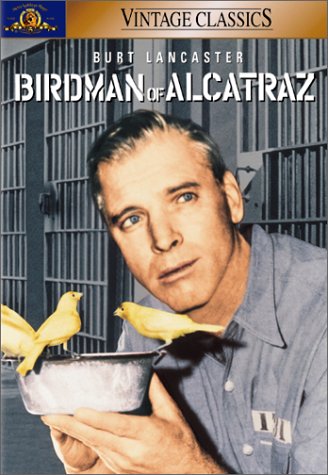
I wonder sometimes if directors and actors get sick of each other if they work together enough. Sure, there's probably a reason they choose to work together on multiple movies, but making movies is such a tough, difficult process that at some point nerves have to be a little shot. Don't they? Maybe the end result justifies some of the struggles, who knows for sure. Over a three year stretch, director John Frankenheimer and star Burt Lancaster worked together 4 times starting with The Young Savages and continuing into Birdman of Alcatraz, Seven Days in May, and The Train. In this case, the ends definitely justify the means.

Seven Days in May and The Train are classics and now I can add Birdman of Alcatraz to that list as Lancaster again turns in a defining performance from his career. Lancaster was able to balance out his roles, those that required more of an action edge, those that needed him to be at the top of his game acting, and those somewhere in the middle. Think of The Train, which required him to do both. As an actor, there's 2 sides to Lancaster that I've been able to piece together. One, there's Elmer Gantry where the actor is loud, boisterious and over the top from the opening scene. Then, there's 'Birdman' where he's quiet, composed and barely cracks a smile the whole movie...and still brings his character to life.

Based on the real life story of convict Robert Stroud, 'Birdman' starts in 1912 as a young Stroud (Lancaster) is sent to Leavenworth prison for killing a man (the victim was beating a prostitute). He clashes with warden Shoemaker (Karl Malden) right away and ends up killing a guard who is preventing his mother from visiting him. He is sentenced to hang but is saved by his mother (Thelma Ritter) who goes all the way to President Woodrow Wilson to save her son. Stroud is saved, but instead of death he's sent to solitary where he'll only have contact with a few guards while never seeing other prisoners.

Basically challenged to survive by Shoemaker, Stroud vows to win out in the end. One day in the yard, he finds a little sparrow who cannot fly and begins to care for it in his cell. So it starts as Stroud's actions impact other inmates who now want birds as cellmates. What starts as one small sparrow snowballs into many more. As the years pass, Stroud becomes an expert on birds and everything about their makeup, including how to treat bird diseases that previously had no cure. But other things are afoot as Shoemaker is now in charge of the Federal Bureau of Prisons which could impact Stroud and his birds.

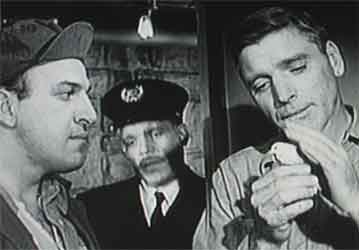
What was surprising about the movie is how fascinating these sequences with the birds really are. We're talking whole scenes with little to no dialogue as Lancaster's Stroud first treats just one sparrow (which he names Runty) to then trying to figure out what is happening to all the birds that occupy his cell as an unexplained epidemic races through the cages. These are the high points of the movie -- the first 90 minutes or so -- as Stroud learns much about his avian friends while also interacting with guard Bull Ransom (Neville Brand playing against type in a good guy role) and fellow inmate Feto Gomez (Telly Savalas also in an atypical part) who also bonds with birds sent to him by his family.

Really my only issue with the movie is a change that comes about 100 minutes into the story -- and at 149 minutes overall it is a tad long -- when Stroud is transferred to Alcatraz. He is forced to leave all his birds, his studies, his makeshift laboratory behind as he moves to the island prison in San Francisco. So other than the fact that Stroud never had birds at Alcatraz yet he's still dubbed 'the birdman of Alcatraz,' the story gets away from what made the first 90 minutes so strong. Granted, this is a story about a man, not the birds, so the natural progression has to be played out, but the last hour is somewhat dull as this long-time inmate struggles in a new prison. A subplot with a prison riot (with Seinfeld's Uncle Leo leading the riot) seems like it's out of another movie.

What carries the movie through some of it's struggles is the fine cast led by Lancaster and Malden. Malden especially is presented as a good and bad guy, a man trying to do his job who comes down hard sometimes on Stroud, as a viewer it comes across unnecessarily harsh. Brand also delivers one of his best performances in a key supporting role as a guard who unexpected bonds with two-time murderer Stroud, and Savalas gets a chance to play a non-crazy person for a change. Betty Field also makes a strong impression as Robert's wife Stella, and Edmond O'Brien has a bookend cameo as an author who wrote a book about Stroud. Lancaster, Ritter and Savalas were all nominated for their performances. Lancaster deserved to win for this scene with Malden's Shoemaker alone.

Overall though, the strengths of the first half of the movie outweigh the sometimes slow pacing of the second half. Elmer Bernstein's score is a little more understated than his usual booming efforts, and sounds reminiscent of the quieter moments in his Great Escape score. Watch this movie for the performances from Lancaster in the lead to the members of the supporting cast. Maybe Lancaster and Frankenheimer did get on each other's nerves, but if this was the result, it was worth it.

Birdman of Alcatraz <----trailer (1962): *** 1/2 /****

Sunday, June 14, 2009

The Train

It's rare that you find a movie that's just the perfect blend of action, drama, story and character. And to find it in a war movie which usually concentrates on one or two of those things? Even better. Director John Frankenheimer accomplished that, making maybe the perfect war movie, 1964's The Train, a tale of French resistance fighters in WWII in the days leading up to the fall of Paris.

In another casting choice that might seem odd, Burt Lancaster stars as Paul Labiche, a French railroad supervisor who is also a member of a small group of resistance that started the war with 18 members, but is now down to just three. An art museum curator, Mademoiselle Villard (Suzanne Flon) comes to him with a plea. The retreating Germans have boxed hundreds of famous paintings, Renoirs, Gaugins, Picassos, Van Goghs, and are putting them on a train heading deep into the Third Reich. Villard desperately requests Labiche and his men, Didont (Albert Remy) and Pesquet (Charles Millot), slow the train up enough that the advancing Allies can overtake it before it gets into Germany. Going up against a driven German colonel, Von Waldheim (Paul Schofield), who appreciates the beauty of the art, can the Resistance pull the job off?

I'm struggling to come up with many examples of war movies that so seamlessly blend a message with so many incredible action sequences, but The Train does it beautifully. Labiche and his men unwillingly join in on the plan to halt the train, all the while questioning if it's worth it. They're told the paintings are the 'heritage of France' but is the collection worth their lives? It's this question that haunts Labiche as the bodies start to pile up. What makes it more effective for these characters? They believe in the idea of the paintings. Didont admits never seeing any of them previously and tells Labiche when they complete their mission, 'we should have a look at the paintings.' He believes their mission is a necessary one, even if he and the others might not understand why.

As hundreds of Frenchmen along the rail line help the cause and the Germans begin to retaliate, Labiche meets Christine (Jeanne Moreau), a hotel owner still struggling with the loss of her husband. It's Christine who helps him realize the futility of what they're doing. Is it worth it to die for a painting? Some think so. But I found myself asking is Labiche continuing with his effort because he believes in his mission, or because he has to continue for the cost that's already been paid? It's that question that drives Lancaster's character, one of his best performances from a distinguished career.

Now onto the ridiculously good action sequences, and remember no CGI in 1964 for Frankenheimer. So many movies can be good, but that doesn't mean they're entertaining to watch. As a director, Frankenheimer has a flair for shooting action, even making tracking shots of characters walking through a trainyard or a busy German HQ memorable. SPOILERS if you're going to watch this clip, but imagine this scene made today in 2009. I'm thinking cheesey, ridiculous looking CGI trains. Frankenheimer crashes 3 trains at some pretty good speeds! But that's just the start, check these out too, a Spitfire chases Labiche in a locomotive, and an Allied bombing mission on Labiche's rail yard, in Spanish but it's for the visual.

Leading an otherwise mostly French cast, Lancaster does double duty for his part. He's the one who wavers in his decision to help the effort to stop the train. It seems ridiculous to him to work to save art when he could be doing any number of things to help the war effort. Looking at the action aspect of the movie, Lancaster, a stunt man before he was an actor, goes back to his roots as you could see in the bombing mission clip, 1:14-1:32. No cuts where a stunt man jumps in, Lancaster slides down that 25-foot ladder, lands smoothly, and boards a fast-moving train. I don't know what else to say. That's just badass.

As his opposite in the cat and mouse game to save the train, Schofield as von Waldheim matches Lancaster, no easy feat, in every scene. Expected to think of the paintings as degenerate art, Waldheim sees what a treasure the collection really is. But even then, he has to convince the High Command that the paintings are worth something, not just on a cultural level. He becomes obsessed with getting his train into Germany and meets his match in perseverance in Labiche.

The supporting cast is equally strong, especially Moreau as Christine and Remy and Millot as Lancaster's resistance partners. Michel Simon gives a memorable if short turn as Papa Boule, a veteran engineer who's convinced by others the importance of the train and starts the slowing-up effort. Regulard contributor to WWII movies as the requisite tough German officer Wolfgang Preiss plays Major Herren, an officer trying to help Waldheim even if he may think his superior has lost it.

Well, I've done my fair share of rambling about this movie, but it's really one of my favorites. The Train does everything right from beginning to end with a great story, developed characters that change over the course of the movie, impressively staged action, and some great French shooting locations. If you've missed this in the past, definitely check it out.

Friday, April 17, 2009

Grand Prix

One of my favorite things about movies is that if someone wants badly enough to make a movie on a specific topic, it's going to happen. And sometimes, more than one person likes that topic so moviegoers are hit with a wave of similar movies. Think of all the quasi-Lord of the Ring movies to come out in recent years, or the sci-fi avalanche that resulted from the original Star Wars trilogy. In the late 60s, it was racing movies as stars and directors turned their attention to fast cars. I've always liked Steve McQueen's 1971 semi-documentary Le Mans and I'd like to see Paul Newman's 1969 racing movie Winning. But the first of these late 60s and early 70s racing movies was 1966's Grand Prix.

I'd read many positive reviews of director John Frankenheimer's race epic that clocks in at just under three hours so I went into the movie really hoping to enjoy it. It tells the story of a whole season of Formula One racing in Europe and the U.S. through the eyes of four drivers. There's Pete Aron (James Garner), an American racer who's been in a two-year long slump but has a chance to climb back to the top with a Japanese racing team owned by Izo Yamura (Toshiro Mifune). Jean-Pierre Sarti (Yves Montand) is a veteran driver tiring of racing but still at the top of his game. He's married but is separated from his wife and during the season falls for an American photojournalist, Louise Frederickson (Eva Marie Saint). A new driver, up and coming Nino Barlini (Antonio Sabato) makes a splash on the circuit after becoming a champion motorcycle driver. And last, there's Scott Stoddard (Brian Bedford), a British driver trying to live up to the expectations set by his racing father.

The movie starts with a bang on the opening race of the season at Monte Carlo with a great credit sequence, and here's an extended clip just so you can get an idea of the racing footage. Teammates Aron and Stoddard have a miscommunication mid-race and Aron's car is destroyed and he's shaken up while Stoddard is badly broken up and so starts the tension. Director Frankenheimer clearly pulled out all the stops when it came to the racing footage. Cameras are placed on the cars, facing forward so you get a sense of how fast these cars are going and backward where we see the drivers. Then there's the big wide shots of the racers zipping by.

Not being a Nascar fan, I thought this would get repetitive over the course of the movie. I couldn't have been more wrong. The races never get old, and I recommend watching the movie for those alone. Here's a few more samples, the F1 Spa-Francorchamps and then the finale with SPOILERS at the Italian Monza course with its high banking turns. The footage is so good the race sequences feel like a documentary. It's by far the best racing footage I've come across in movies, right up there with Le Mans.

It's a shame then that Frankenheimer couldn't just have made a racing movie that ran about 2 hours and stopped there. The movie as is drags incredibly slowly once the racers leave their cars on the tracks. It took me a handful of sittings to get through the movie because of that slow pace. Each of the drivers has their personal issues to deal with, but the only one that comes across as sympathetic is Montand's Sarti.

Of course that doesn't mean the huge international cast isn't good. Garner was and still is a cool actor, making seem like he's not even trying. As Aron, the down but not out racer, he may not be the most sympathetic character but as a sort of underdog I was rooting for him. Sabato is having a lot of fun as the rags to riches Italian driver, and Bedford is good but doesn't leave a huge impression. Mifune rises above what could be a cliched role, and Marie Saint is a good counter to Montand. Jack Watson has a small but strong part as Jeff Jordan, Stoddard's fiery race manager. Adolfo Celi makes a quick appearance too as a race team owner.

Rewatching these racing clips as I post, I can't help but feel the adrenaline rush just watching them. And that's the reason to watch Grand Prix, here's a trailer. With so many directors relying on CGI these days, it's hard to imagine better quality race movies coming out. So even though the non-race sequences can be painfully slow, I'm highly recommending this one because I loved the races more than I hated the love stories.