The Sons of Katie Elder

The Sons of Katie Elder
"First, we reunite, then find Ma and Pa's killer...then read some reviews."
Showing posts with label Gregory Peck. Show all posts

Wednesday, December 30, 2015

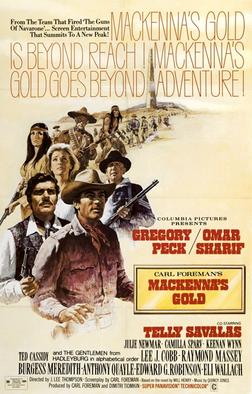
Mackenna's Gold

Oh, cable, how I love you. I basically have two channels on if I'm watching TV, either MLB Network or Encore Westerns. A whole channel devoted to western TV shows and movies?!? Aaahhh my head just exploded! It gives me a chance to revisit a whole bunch of movies I haven't seen in years, like 1969's Mackenna's Gold, a big-budget, all-star extravaganza that I remember liking (I think) on my first viewing. Does it hold up?

A marshal for the western town of Hadleyburg, Mackenna (Gregory Peck) is out on the trail when he's ambushed by an old Apache man who dies after a quick shootout. Before he dies, the Apache gives Mackenna a map to a famous, supposedly lost, canyon of gold ('Canon del Oro') that treasure hunters have long sought. Mackenna throws the map in the fire but not before noticing a couple landmarks on it. He's soon cornered by a Mexican bandit, Colorado (Omar Sharif), and his gang who similarly are looking for the canyon of gold. They're not alone. The desert seems full of treasure hunters and gold-hopefuls desperately searching for the gold. Discovering that Mackenna may hold the key to finding the canyon, he's taken along as Colorado's unwilling prisoner. The supposed location is days away across the vast desert with Mackenna, Colorado and his men forced to deal with a do-good posse out of Hadleyburg, an intervening cavalry troop and an Apache war party. How far will the prospect of gold drive all these folks?

I'm a sucker for westerns -- good and bad -- but this one is bad and just not that enjoyable. Talk about a movie where the ingredients don't come together (at all), and you've got this movie. The talent on-hand is unquestionable from director J. Lee Thompson, stars Gregory Peck and Omar Sharif leading a ridiculously deep cast, a cool, potential-filled story and a drop-dead look to it all...it should have been so much better. Or I guess I'd settle for just 'good' too. The formula seems to go after a western Guns of Navarone meets Treasure of the Sierra Madre combination, but it never jells into anything remotely coherent or especially enjoyable. That's tough to say because a cast this good should make a movie pretty decent on its own but alas, it wasn't meant to be this time! If you're looking for a Peck-Thompson-Carl Foreman pairing, stick with 'Navarone.'

Kudos to Encore Westerns. Watching the movie for the second time but first time since 2009, I watched it in widescreen, as it was meant to be. Thompson filmed in Super Panavision 70, a filming technique that fills the screen to epic proportions, almost like a panoramic picture. Shooting on-location in Monument Valley, Glen Canyon and Canyon de Chelly in Arizona adds a great visual appeal to the movie. Shots of riders galloping across these expanses are excellent to watch, a sight to behold, and unfortunately, one of the few genuine positives to take away from a western that's too long at 128 minutes. When a movie's looks are the best thing going...that's never a good thing.

Poor Gregory Peck, he looks like he's as bored as all get-out and doesn't quite know what to do. One of my all-time favorite actors, he's undone by all the shenanigans going on around him. Getting to play straight man to a murdering bandit, a gold-for-eyes posse, a bloodthirsty Apache war party, a murdering cavalry sergeant (an underused Telly Savalas), and all sorts of ancient legends coming to life is never a good thing. As reliable as anyone who's ever graced the screen, Peck is given little more to do than look out for Camilla Sparv's damsel in distress while navigating a love triangle with Julie Newmar's Apache warrior and Sparv. Yeah, you read that right. Catwoman plays an Apache warrior and looks great doing it! She even gets an odd nude swimming scene where she tries to kill both Peck and Sparv. So there's that!

So much of the rest of the cast is simply miscast. I like Sharif in just about any film he's ever done, but he's an odd choice to play our Mexican bandit, Colorado. His gang includes Keenan Wynn as a Mexican bandit named Sanchez, with Ted Cassidy (Lurch from The Addams Family), Rudy Diaz and Robert Phillips as Apache warriors. All spot-on casting! Brace for this list of appearances that amount to little more than cameos, members of a "posse" out of Hadleyburg that's looking for gold. The group includes Eli Wallach, Anthony Quayle, Lee J. Cobb, Burgess Meredith, Raymond Massey and Edward G. Robinson!!! Look at that Hollywood royalty! Unfortunately, they're introduced, given nothing to do and there basically because of their name recognition. So....yeah....there's that! Quite the cast, huh? I just wish they were given more to do. Maybe that character development was cut from the rumored 3-hour version of the film. Yeah, that's it I'm sure.
  
Just too many moving pieces that never get going in the same direction. There's virtually no story, just some character introductions and then they're off into the desert. The only detour are various ways to kill off characters in waves. Then, there's the beautiful location shooting, with a slight problem. Countless times, one after another, we see the location shots and then a quick cut to our actors in front of a rear projection shot. Nothing takes you out of the story's momentum like Peck, Sharif and Co. riding a "horse" as they tear across the desert. Throw in some odd, out of place narration (it's not Victor Jory's fault!), some painful theme ballads, and generally odd cutting and editing that is more and more jarring with each passing scene.

There's a meanness to the story that's hard to account for. Characters are introduced for the sake of dispatching them in unceremonious fashion, but the general tone of the movie itself isn't that dark. It feels like they're going for that "Greed will make you do horrible things" tone, but it's too light, fluffy and goofy to pull it off. There's some potential obviously with the all-star cast, some equally impressive camera angles and shots, and the location shooting, but there's just too much negative going on to ignore it. A stinker.

Mackenna's Gold (1969): **/****

Thursday, November 5, 2015

Billy Two Hats


I've been watching westerns for as long as I can remember. It's to the point I'm always searching for westerns -- especially from the 1960's and 1970's -- that I haven't seen. Well, God bless Turner Classic Movies and MGM-HD, because they've helped me out with some harder-to-find westerns. Our latest go-around, a revisionist western from 1974, Billy Two Hats.

In a sleepy western town, Sheriff Henry Gifford (Jack Warden) rides into town after a long time on the trail. He's tracking three bank robbers who escaped with a little over $400 and killed a man in a recent robbery. His ambush in the hotel works, killing one, capturing one, Billy (Desi Arnaz Jr.) while the third, Arch Deans (Gregory Peck), escapes, getting out of town unscathed. The sheriff rides out with Billy -- a half-breed with a Kiowa mother and white father -- in tow, riding across the desert to get back to town where Billy will be tried and likely hung for his involvement in the robbery, even though it was Arch who did the killing. Billy has accepted his fate to a point, going along quietly, but out in the desert hills, Arch has a plan to get his partner and friend free. Gifford's trapped in the middle, all the while trying to do his job.

Ah, revisionist westerns, where the goal is to show the wild west as it really was, not as a pleasant, adventure-filled time and place where a good 'ole time was had. Instead, it was horrifically violent where life was cheap and death waiting around every corner. There was little noble, heroic or pleasant about it. The good revisionist westerns just lay it all out there. The not-so-good ones, they lay it on thick with a heavy hand. Where does 'Billy' fall?

Unfortunately....it's right in the middle. While I was intrigued by the premise (and the fact I'd never seen it), I'm not sure what the point of the film was. The story is a quasi-chase with two major stops where everything concerning action grinds to a halt as characters opine about how awful their lives in the west are. The story was already pretty slow just getting to those scenes. The character development is nil, and at no point did I feel like I got to know either Arch or Billy even though they talk a fair amount. It's a story in its entirety that takes place over  three or four days but accomplishes little. I left this revisionist western feeling entirely "meh." I didn't especially like it, and I didn't hate it. It be right in the middle, a movie that had little to no impact on me at all.

Gregory Peck is the man, one of my favorites here at Just Hit Play. In the second half of his career, Peck turned to the general action genre -- westerns, adventure, war films -- early and often. No classics, but some solid movies. His Arch character is certainly interesting, an aging Scottish bandit who desperately misses the greenery of the Scottish highlands. He has a sort of fatherly/brotherly relationship with young Billy, but there's never much of an explanation or reason given for anything. Arch tries to look out for Billy, giving him advice on how to act, how to grow up. The fault is that the script does absolutely nothing for Arnaz Jr. as Billy Two Hats. It is one of the most poorly written characters I can think of and gives him nothing to do to help alleviate that lack of development.

That puts us, dear reader, in a delicate spot. I found myself not caring about any of the characters even a little. The script feels like it was half-written, following a sorta outline of a slow-paced chase with several talkative, unlikable characters. Winning formula, huh? Warden too is undone by the script. His sheriff is dedicated to his job, but he's so obsessed with this particular prisoner. He's filled with hate, maybe just epic frustration at the futility of what the criminals are up to. David Huddleston plays Copeland, an owner of a remote trading post who's moved on from his days as a buffalo hunter who's waiting for the railroad to come through his lucrative land while also wondering what his squaw wife is up to. Last, there's Spencer (John Pearce) and his recently purchased wife, Esther (Sian Barbara Allen). The dense, money-conscious farmer and his stuttering wife, adding to the general doom-and-gloom of an already pretty dark western.

When you're wrapping up a movie, there's not much worse than a general feeling of frustration of what could have been. 'Billy' has some potential, but it just has too many holes to help it live up to that potential. It was filmed in Israel, giving the film a bleak, stark, end of the world visual look. You're ALONE in this vast expanse of a desert and almost completely dependent on yourself. The music -- though little used -- is appropriate, and I thought pretty good. The script is the ultimate death rattle though. It's bad. It never jells together. The characters are poorly drawn and developed in worse fashion. When the bullets start to fly in this revisionist western, there's absolutely no emotional connection with anything going on in the story, and that ain't good. A disappointing negative review.

Billy Two Hats (1974): * 1/2 /****

Monday, April 21, 2014

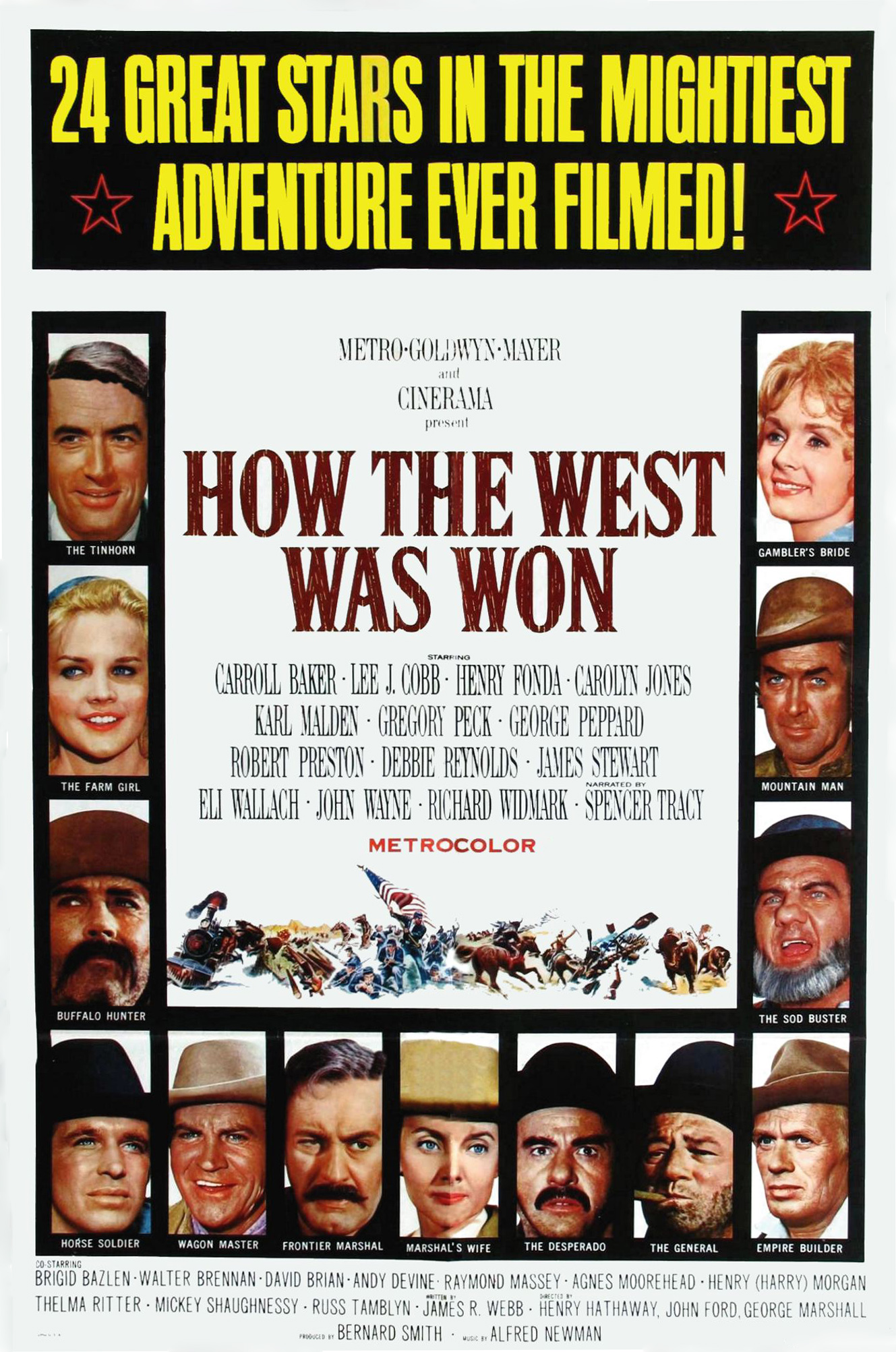
How the West Was Won

In the age of the epics -- the 1950s and 1960s -- some just stand above the rest. It's the stories, the cast, the scope. I don't love 1962's How the West Was Won but as far as epics go, there are very few in its neighborhood. There are obvious flaws, but when it works, it works in a big way. An impressive all-star cast, a story about the development of the American west and a shooting technique that is must-see. That's a winning formula.

A 162-minute film is broken up into five separate segments, the story following the Prescott-Rawlings family as it moves west and settles between the 1840s and the 1880s. It was directed by three different directors and covers a ton of ground. And away we go!

1. The Rivers (directed by Henry Hathaway): It's the 1840s, and the Prescott family, led by patriarch Zebulon (Karl Malden), is moving west and looking for a new life. In Zebulon's family is two daughters, Eve (Carroll Baker), looking for a new life in the west, and Lillith (Debbie Reynolds), wanting to stay in the far-more civilized East. In their dangerous travels on the rivers, they also meet Linus Rawlings (James Stewart), a mountain man with a canoe full of pelts.
Also starring: Lee Van Cleef, Walter Brennan, Agnes Moorehead, Brigid Bazlen.

2. The Plains (directed by Hathaway): Having worked for years on her own as a singer and dancer, Lillith Prescott (Reynolds) has just inherited a gold mine in the wake of the California gold rush. She heads west on a wagon train led by trail driver Richard Morgan (Robert Preston) with a gold-seeking gambler, Cleve Van Valen (Gregory Peck), also along too. 
Also starring: Thelma Ritter.

3. The Civil War (directed by John Ford): The war between the states in its early months, young Zeb Rawlings (George Peppard) leaves home with the blessing of his mother, Eve, to join the Ohio volunteers in the fighting. Like so many others, he thinks the war will be full of glory and be over quickly. Zeb finds out how very wrong he is at the bloody battle of Shiloh.
Also starring: John Wayne (as General Sherman), Russ Tamblyn (as a Confederate deserter), Harry Morgan (as General Grant), Andy Devine, Ken Curtis, Raymond Massey (as Abraham Lincoln).

4. The Railroad (directed by George Marshall): In the years following the Civil War, railroad companies race across the U.S. to link the two coasts. Now in the cavalry, Zeb Rawlings (Peppard) finds himself balancing out what his duty requires of him with what he knows is right, the railroad, including brutal supervisor Mike King (Richard Widmark), pushing the Arapahoes to their limit.
Also starring: Henry Fonda as Jethro Stuart, a former mountain man.

5. The Outlaws (directed by Hathaway): Having left the cavalry behind, Zeb Rawlings is now a family man with two kids, now trying to leave his profession as a lawman behind. He receives a letter from his aunt, Lillith (Reynolds), and readies the family to move. As they travel though, Zeb runs into Charlie Gant (Eli Wallach), a notorious outlaw gunning for Zeb.
Also starring: Lee J. Cobb, Carolyn Jones.

This is a movie that's simply put, BIG. It was filmed in Cinerama, three cameras filming each scene and then splicing the action together. The result? An immense look at the expansion of the west. Shots look like panoramic paintings, putting a whole new scope on the growth and development of the American west. It is a beautiful movie. Certain sequences especially stand out -- the camera on a raft trying to survive river rapids, an Indian attack on a wagon train, a stampeding buffalo herd trampling a railroad camp, a runaway train during an attempted robbery -- over the course of the movie, but visually there just isn't a weak spot. I love composer Alfred Newman's score -- listen to an extended sample HERE -- as it gives a moving background to the story. Countless gorgeous filming locations, providing a great backdrop while also transitioning from segment to segment.

It had been years since I watched this movie straight through in one sitting before my recent revisit of this 1962 epic. As you compare the five separate segments, I don't think it's really in question which one is the strongest. It's John Ford's Civil War segment, doing in 20 minutes what entire movies couldn't do in bringing the Civil War to life. Quick, dark, visually striking and unsettling, it is a gem of a sequence, especially Peppard meeting Tamblyn's Confederate deserter after the battle. The second strongest segment for me is the opening 'Rivers' with Stewart, Baker, Reynolds and Malden all leaving a positive impression. All five segments could be stretched out to a feature length film on their own, but these two especially stand out. They get their message across in a quick window and in both cases left me wanting more. Kudos to Ford and Hathaway for their work here.

What struck me more on the rewatch was the other three segments. They are by no means bad segments, but they're just not as good as the other two. I've always thought the weakest was the Plains segment, things feeling too rushed in general. The same qualifies for the Railroad and Outlaws portions. By the time you take away the Entr'Acte, intermission, and Finale music, we're looking at a movie with five segments covered in about 150 minutes (give or take). None of these three are given a chance to breathe to the point they feel downright rushed. As for some other positives? I loved the transitional scenes -- narrated by Spencer Tracy, directed in uncredited fashion by Richard Thorpe --  that set things up, explaining how America has changed, how its people change. These quick montages provide the heart of the movie, almost like a documentary in some ways. Like any movie that tries to accomplish so much, there's good and bad. The positives -- especially the Civil War middle -- is enough to outweigh the negatives thankfully.

One of my biggest worries in reviewing this 1962 epic was that the cast is too big. There's no way I was gonna be able to get all those names tagged with a 200-character limit. Who stands out? Stewart i excellent as Linus Rawlings, Fonda is good in a quick part as Jethro Stuart, and Baker is very strong too. The best parts though are Debbie Reynolds as Lillith and George Peppard as Zeb, the two hearts of the family. One or both is in every segment, the audience seeing them age, learn and adapt as America grows with them. Their scenes together in the Outlaws portion ring especially true. However you cut it though, just an impressive cast from top to bottom, one of the best ever assembled for a Hollywood film.

A doozy of a movie for what it's trying to accomplish. It falls short at times, but this is a movie worth watching for what it represents alone. This is a throwback film, a true epic that strives to be something great. If it doesn't live up those high hopes, so be it. The effort is admirable, a fascinating story of America growing up over an extremely turbulent portion of its history. Oh, and Debbie Reynolds singing A Home in the Meadow (listen HERE) is a truly beautiful song, a fitting one for the movie.

How the West Was Won (1962): ***/****

Friday, September 6, 2013

Pork Chop Hill

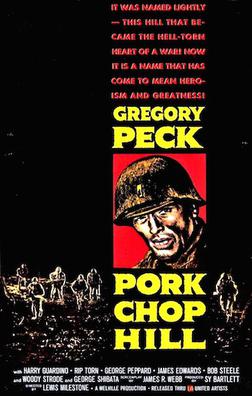
No soldier wants to die. But what about as a war nears its end? The end of the fighting may only be days away, maybe even hours away. So goes the background for the underrated Korean War drama from 1959, Pork Chop Hill.

It's April 1953 and both American and North Korean/Chinese commanders have agreed to a cease fire with the two sides meeting at Panmunjom. The negotiations though are moving along at a frustratingly slow pace with little being resolved. Near the front lines, the fighting rages on with Lt. Joe Clemons (Gregory Peck) and his King Company awaiting orders, supposedly to withdraw as the fighting dies down with negotiations picking up. The orders though are just the opposite, orders to move forward and take Pork Chop Hill, a worthless hill that's been lost and regained countless times. Now, the Chinese are in possession, but it is a spot on the line that's been deemed very important to negotiations. Clemons assembles his weary company, moving forward to take a hill that holds no military value.

Dubbed the Forgotten War, the Korean War pales in comparison to both World War II and Vietnam in terms of theatrical films released about them. From director Lewis Milestone (A Walk in the Sun, Halls of Montezuma, All Quiet on the Western Front), 'Hill' is a generally forgotten war film that certainly deserves better. It is similar in a lot of ways to 1962's Hell is For Heroes -- even using an eerily similar score from Leonard Rosenman -- and is based on a true story, the battle for Pork Chop Hill. It was filmed in black and white, a highly effective shooting technique, giving everything a sparse, cold and vacant look. Why isn't it remembered as the near-classic that it is? I've got no idea.

What jumped out at me on my recent viewing was the cynicism and darkness that's evident throughout. More surprising? It was made with cooperation from the U.S. Army which in itself isn't too surprising. It's that in exploring the battle, 'Hill' at times shows the complete ineptitude of the American commanders. Assaulting the hill, Clemon's company is put on the grid when American spotlights actually shine right on them in the dead of night. Other companies are given wrong orders, ranging from just plain wrong to misleading. Once King Company is in position, the rear command is genuinely confused, thinking they're fighting a mop-up action when in reality, they're holding on by their fingernails with limited ammunition, food and water. At one point, an U.S.O. photographer is sent up the hill to get photos of an American victory because the folks back home need to see an American win. Peck's reaction is priceless, a commander at wit's end who doesn't know what else to say.

This is an honest criticism of headquarters that's based in reality, and for a 1959 audience, it seems light years ahead of its time. If I didn't know better, it sounds like a Vietnam War movie like Platoon or Apocalypse Now more than a major studio release from 1959. Leading the way is the always reliable, always impressive Gregory Peck. His performance reminded me some of his Oscar-nominated turn in Twelve O'Clock High 10 years earlier. His Clemons is an effective commander simply trying to follow orders and get as many men through the battle unscathed as is possible. Even he is pushed to his limits as one bumbling order after another comes through, the commanders refusing to acknowledge that the battle isn't going as they expected. It's an understated part, but an emotionally effective one. We see the wear and tear on his face, his reassuring, confident tone slowly being worn down.

Beyond Peck though, 'Hill' is noteworthy for its supporting cast of rising and future stars. Harry Guardino and George Peppard play Forstman and Federson, two buddies lugging a machine gun around the hill. Rip Torn plays Lt. Russel, commander of the relief company assigned to help out King Company. 'Hill' is also one of the first war films to show integrated units, Woody Strode playing Franklin, a private fed up with the war, and James Edwards as Cpl. Jurgens, one of Clemon's most dependable, trustworthy men. Also cool casting is George Shibata as Lt. Ohashi, a Japanese-American soldier, Clemon's close friend and one of his platoon commanders. Also look for Norman Fell, Gavin MacLeod, Robert Blake, Biff Elliott, Martin Landau, Harry Dean Stanton, Clarence Williams III and several other familiar faces rounding out King Company's roster.

Clocking in at 97 minutes, a majority of 'Hill' is spent in the trenches and bunkers with King Company, a few asides here and there showing the negotiations of the cease fire. This is a movie interested in the nuts and bolts of the battle, the flanking movements, the reserve companies, the crossfires and preparations for counterattacks. It never gets bogged down though, the battle scenes uncomfortable and unsettling in their reality. It isn't graphic violence here, but that doesn't mean it's not hard to watch. Add in the psychological warfare of a Chinese broadcaster bombarding the American troops with propaganda, and you've got quite the battle here. It's not just bullets and soldiers anymore, but the effect it has on the soldiers' heads too. A great war movie, one that deserves more of a reputation/following.

Pork Chop Hill (1959): *** 1/2 /****

Thursday, June 6, 2013

The Gunfighter

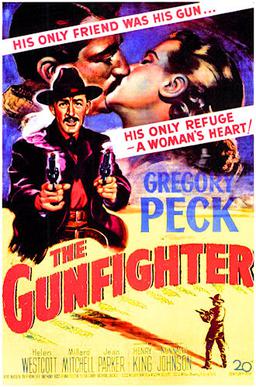
One of the enduring myths of the wild west was the idea of the fast draw gunslinger. The story as legend would have it was two men standing on a windy, empty street about 20 feet from each other, the duo finally squaring off to see who was quicker with the gun and ultimately, who would survive. Who was the fastest gun? Who was the best? It's a concept that has become a myth thanks to movie westerns, including one of the most under-appreciated westerns around, 1950's The Gunfighter.

A long, lean Texan, Jimmy Ringo (Gregory Peck) has created quite a name for himself over the last few years. Throughout Texas and the southwest, he's known as the quickest, deadliest gunfighter around with anywhere from 10 to 15 men killed under his gun. Now with his infamous reputation established, Ringo rides from town to town dealing with young guns and eager rivals who want to be the one who killed the famous Jimmy Ringo. Having killed one trigger happy gunslinger (Richard Jaeckel), Ringo finds himself again on the run with some pursuers, the gunslinger's three brothers. He heads for the town of Cayenne with a purpose; he wants to see a woman, Peggy (Helen Wescott), from his past, but it may take some convincing. Ringo is looking for a change in his life, but he may be running out of time.

I have long sought this western from director Henry King out with no luck. I could never find a VHS tape, never find a DVD, never find it airing in the dead of night on a movie channel. Until now that is. I found a video store (GASP!) that actually has old VHS tapes (double GASP!) and wouldn't you know it, this was available. It is a western that is ahead of its time. It takes the concept of the romantic western and twists it around to a more realistic, darker world. The west wasn't white hats vs. black hats. It was a truly nasty, brutal place. So a western that portrays a trail-weary gunslinger who's sick of what he's become....and in 1950?!? We're talking about a movie released two years before the overrated High Noon and with a vastly different, significantly darker message. Moral of the story; I loved this western for a lot of reasons.

More than the story or the characters, 'Gunfighter' has a lot going for it. Filmed in black and white, it has an almost stage-based film noir feel to it. With a few, quick detours, the entire 85-minute running time is spent in the Cayenne saloon as Ringo waits to meet Peggy. We see the story from inside the saloon, from the street in through the windows, and the most bizarre thing...it works ridiculously well. If you've got two working brain cells, you know where the story is heading with King doing an incredible job building up the tension. We know the three revenge-seeking brothers (including Alan Hale Jr., David Clarke and John Pickard) are close behind, some quick cutaways showing them riding with a purpose across the desert. As Ringo waits in the saloon, we see quick shots of a clock on the wall. It's an underplayed, low key tension, but it works in a big way in building up that sense of doom right up until the finale.

Gregory Peck continues to impress me. As far as acting goes, he hit the ground running and never really looked back. Already with a handful of gems to his name, he follows his Best Actor nomination from Twelve O'Clock High with a role that should have at least earned him a nomination. With a few quick scenes, a few dialogue exchanges, we learn a ton about him. Years ago, he wanted to be the fastest gun in the west, and he earned the tag but now he has to deal with it and all it ensues. We learn some tidbits from his past, including his past with Wescott's Peggy and also with Cayenne's sheriff, Mark Strett (Millard Mitchell). A great scene with a youngster in town gives Ringo an added layer of depth that makes him more than just an infamous gunhand. King's film does a wise thing; Ringo is neither a prototypical good guy or bad guy. He's one of the first sympathetic anti-heroes I can think of. Another big winner for Peck.

In the supporting cast, Wescott and Mitchell are gems as Peggy and Mark, maybe the only two people in Cayenne on Ringo's side. The history among the three is a worthy, necessary addition to the story. Also look for Karl Malden as Mac, the saloon owner/bartender who buddies up to Ringo, Jean Parker as Molly, a saloon girl who knows Ringo well, Skip Homeier as Hunt Bromly, a young, inexperienced gunfighter who wants his chance at Ringo, and Anthony Ross as Charlie, Mark's capable if cautious deputy. 

Some critical reviews point to the ending being a little heavy-handed in its execution. It's a fair criticism I suppose, but I think it's necessary to consider something. In 1950, a story shooting holes in the myth of the gunfighter is unique. It's new. It hasn't been seen. Yes, it spells everything out a little too much, but it was a necessary ending for a 1950 audience. What isn't in question is that the build-up and a surprising ending are pretty perfect. This is a western that deserves more notoriety (in a good way). It's a gem of the genre.

The Gunfighter (1950): ****/****

Thursday, June 28, 2012

Twelve O'Clock High

Right there with the stories of the soldiers on the front lines and the efforts on the home front, war movies can usually take solace in another genre staple; the trials of command. How does it wear on one individual to continually send their men into battle knowing that some -- if not many -- won't make it back? It has to be a emotionally draining, even destructive process, like it shows in 1949's Twelve O'Clock High.

It is still early in WWII in 1942, and Allied forces have turned to daylight precision bombing raids to help slow down the German war machine. The casualties are high though, and the effect on morale is easily seen, the men struggling to get from day-to-day. In the 918th Bomber Group, Colonel Keith Davenport (Gary Merrill), is being replaced by General Frank Savage (Gregory Peck), a squadron commander with plenty of flying experience. The men are weary, suspicious and not excited at the prospect of a driving commanding officer. Can Savage whip them into some sort of shape? Can the men realize he has their best interest -- survival -- at heart?

From director Henry King, 'Twelve' makes an interesting choice, one that ends up making this movie particularly memorable. This is a war story, but it isn't a front line war story. Almost the entire 132-minute movie takes place at the 918th's base in England. Even their bombing missions are kept in the background. The mission is presented, and then we see the aftermath; the surviving pilots returning to base. It is a surprisingly simple device, one that makes the final 30 minutes that much better when we actually go along with the B-17s on a daylight raid over Germany. We see the effect on the men from their commander, Savage, to his command staff, to the support crews on the ground.  What pilot and crew will return? Will any?

Nowhere is that more evident and in some cases, more powerful, than the performance delivered by Gregory Peck. I've long been a fan of Mr. Peck, but he continues to impress me. He received an Oscar nomination for Best Actor (losing to the showier, more obvious Broderick Crawford for All the King's Men), and it's easy to see why. As a commanding officer, he's forced to do things that are naturally unpleasant. He's replacing an officer who became too worried about his men, getting close to them, becoming friends and ultimately respecting them. To make them the best pilots and crews they can be, Peck's Savage has to keep pushing and pushing. Peck does a great job humanizing this part. We see what his men don't see. He's doing this for their benefit but at expense to himself.

Joining Peck in the 918th Bomber Group are familiar stock characters but tweaked to make them far from too familiar. Dean Jagger won a Best Supporting Actor Oscar for his part as Major Stovall, Savage's aide and a former lawyer, working hand in hand with his commander to strengthen the bomber group. Merrill is also very good as Davenport, a very capable pilot who becomes too emotionally involved to command. Some other pilots/crew include Gately (Hugh Marlowe), an effective pilot Savage is forced to call out, McIllhenny (Robert Arthur), the oft-promoted and disciplined assistant to Savage, Kaiser (Paul Stewart), the group physician, Cobb (John Kellogg), a hard-nosed pilot Savage appoints executive officer, and Bishop (Robert Patten), the youngest and best pilot in the group, one all the other pilots look to. We're given little to no information about them, but even then, these actors do a great job making them feel real. These characters resonate in a way that honestly surprised me.

Making this movie a classic as opposed to just a really good movie are a handful of scenes that strike all the right emotional chords. In bookends at the beginning and end, Jagger's Maj. Stovall walks around the deserted base some four years since the end of the war. The scenes are perfect, the soft echoes of the men singing hanging in the air. Peck's Savage has an early run-in with Marlowe's Gately, accusing him of cowardice. Gately takes it to heart, making a later scene between the two men heart-breaking in its honesty, Savage seeing Gately as he really is. Peck earns his nomination for me in that scene alone. The most moving parts are saved for the end as we see a daylight raid over Germany. The violence is startling and quick, the emotions as real as any war movie I can think of.

This doesn't feel like a 1949 WWII movie. It doesn't pull any punches, instead opting for realism and honesty. The intro to the squadron -- a bloody aftermath of a raid -- doesn't show the violence and gore. It hints at it off-screen as we hear about the debacle that took place up in the air. It's one of many moments that help make this WWII movie a classic. By the way, the above poster makes no sense. What 12 men? Eh, overthinking it. It looks cool.

Twelve O'Clock High <----trailer (1949): ****/****

Monday, October 31, 2011

The Omen (1976)

So let's go big picture here, real big picture. For everything good going on, there has to be an equal and opposite bad thing going on, right? Basically any movie ever has dealt with that concept on some level -- however big, however small -- but at its biggest there is good (God) and bad/evil (Satan). Personal beliefs, convictions, principles aside, that is the most epic struggle of all and the setting for the classic 1976 horror film The Omen

The U.S. ambassador to England, Robert Thorn (Gregory Peck) and his wife, Katharine (Lee Remick), are welcoming their first child when Robert is told the newborn died soon after delivery. Another baby was born at the same time, its mother with no family dying in childbirth. The staff tells Robert he can keep the baby, and he agrees, knowing the strain might be too much for his wife to handle. He doesn't tell her, and the family is a happy one as the years go by. Now five years old, their son Damien (Harvey Stephens) seems to have weird, unexplainable things happening around him. A frazzled priest approaches Robert with horrific, life-shattering news. He believes Damien is the son of the Devil, the Antichrist, and he must be stopped. Robert can't believe it. How could this little boy be evil? Could he?

This is an exception to the rule when it comes to horror movies. Directed by Richard Donner, 'Omen' isn't interested in surprise or 'Gotcha!' moments. This is a smart, well-written and well-thought out horror-mystery-thriller. It isn't scary in the way some horror movies are. Instead, it is decidedly unsettling. It makes you uncomfortable, and that can be scarier than anything. Serial killers, murderers, rapists? All immensely creepy. But what about something you can't combat? How do you stop something or someone that is inherently evil? You can't beat evil, can't negotiate with it. You just hope to slow it down. Donner's movie is one of the all-time greats at making an audience uncomfortable, an unseen and possibly all-powerful opponent that will not be stopped.

Now usually when a musical score is really good, I try and give it a mention in a sentence or two. I'm not much for explaining how musical cues affect audiences even though I try. For this movie though, I've got to make an effort. In a long and distinguished career, composer Jerry Goldsmith won his first and only Oscar for his 'Omen' score and did he ever deserve it. The main theme -- Ave Satani which you can listen to HERE -- is a choir singing in Latin, sounding like some sort of demonic cult. It sends chills up my back just thinking about it. The other main piece of music is a quieter but equally creepy sample, one that is supposed to put a question in your head, setting the groundwork for the chilling moments to come. Goldsmith had a lot of great scores through his career, but this may be the best.

When I think horror movies, I don't think of great acting performances. And to be fair, the performances in 'Omen' aren't great. They're good at what they're supposed to do, and it's always cool to see some big name actors take parts in a genre you wouldn't often associate them with. Take Gregory Peck for example, one of Hollywood's all-time greats. Now 60 years old when 'Omen' was made, Peck delivers an underrated performance, a possibly rising politician who finds himself involved in something much bigger than he could have ever anticipated. His disbelief, his wavering over what to do, his worries about his family, Peck does a great job, as does Remick as the emotionally fragile Katharine. Clues point to their son being different, but in what way? He couldn't really be evil, could he?

With the story focusing mostly on the Thorns, only a few supporting parts are even needed. David Warner is very good as Keith Jennings, a photographer who gets involved with Robert investigating these strange occurrences. His photos taken of all those involved might reveal something darker of what's to come. Billie Whitelaw is downright terrifying as Mrs. Baylock, Damien's new nanny after the previous one....well, the Thorns just needed another one. That's all. Whitelaw has a look in her eyes that just can't be described, pure evil if you ask me. Patrick Troughton plays Father Brennan, a priest with the most checkered of pasts now trying to redeem himself, telling Robert that he believes his son is the son of the Devil.

A horror movie has to have its memorable moments, and 'Omen' has plenty of them. I won't go into detail describing them because that would ruin much of the movie's enjoyment. All of them pale to the last 10 minutes of the movie, specifically the final two scenes, shocking and surprising in a way that is hard to describe. The final shot? One of the most perfect endings to a movie ever. One of the all-time best horror movies ever. Enough said.

The Omen <---trailer (1976): ****/****

Friday, May 13, 2011

The Chairman

I really didn't like 1969's The Chairman. There. That's my lead, my all-encompassing, powerful intro to this review. And you know what? It's the best I got. The Netflix rating didn't think I'd like it. The IMDB votes have it at 5.5 out of 10 as I write this review. I was curious though. I had seen a trailer that was a special feature on another DVD and thought it looked interesting so when I saw it pop up on TCM's schedule, I taped it. That was my first mistake.

Just a few days ago when I reviewed 1954's Night People (a movie light years ahead of this one), I mentioned the Cold War and the easy source for a villain, the Russians.  This 1969 film basically pegs everyone as a villain, American, Chinese, Russian, no one is immune. The paranoia that ruled the Cold War years is understandable. There was this cloud hanging over the world that the entire population of Earth could be wiped out in a second by massive payloads of nuclear weapons. It seems like an easy transition to make a movie out of that. Instead, The Chairman is a movie that just doesn't know where it is going at all.

An American scientist who years before won the Nobel Prize, Dr. John Hathaway (Gregory Peck) is approached by a deep undercover, multi-national military group (with government backing) to undertake a dangerous mission. An old teacher and mentor of Hathaway's, Professor Soong Li (Keye Luke), has surfaced in China, writing a letter to the doctor that he would like to see him. Leading the government-financed operation, Colonel Shelby (Arthur Hill) wants Hathaway to use the visit as a pretext to perform a secret mission. It is believed the Chinese have created an enzyme usable in agriculture so crops can grow year-round regardless of climate or conditions. Hathaway agrees, even allowing a small microchip to be placed into his skull so he can be heard and monitored at all times. What he doesn't know is that Shelby has a back-up plan for the chip if the mission fails.

I'll start with what I thought to be the biggest flaw, the microchip implanted in Hathaway's skull just behind his right ear. Because of a satellite flying over China, Shelby and his subordinate officers (Alan Dobie as Benson and Ori Levy as Shertov, his Russian counterpart) and everyone at the secret base can hear everything Hathaway says and does. It's a cool little technique, whether it be in 1969 when this concept had to be ahead of its time in terms of movie-making or now in 2011 when all sorts of technology is available to us.  As a plot device, it is great. Alone in a hotel room or standing at a window, Peck's Hathaway talks to his superiors as if they were in front of him, the officers anxiously awaiting what he has to report.

That of course is not the whole story. Implanting the chip in the doctor's skull, Shelby left out one essential tidbit of information. While the small device is a transmitter, it is also explosive. If the good doctor fails at his mission or is in danger of being captured, Shelby and Co. will push a button, detonate the device, and obviously kill Hathaway in the process.  First, why would they need to kill him? What does he know that could hurt America? In a conversation with Chairman Mao (Conrad Yama), Hathaway freely admits that he's there to find the enzyme and bring it back, or at least it's molecular structure. The Chinese know what he's there to do. They've allowed him in, welcoming him into the country.

Piling on to what could have been a cool plot device is the premise that Hathaway -- an unknowing, walking bomb -- could be used on a suicide mission to kill the Chairman when he meets him. Dobie's Benson asks Shelby about exactly that idea, taking him out in one clean swoop. Shelby reacts stunned and disgusted, and then thinks about it, even checking with his superiors. Okay, let me get this right. Working for a shadow company funded by $5 billion American dollars, Shelby (an otherwise seemingly intelligent man) never thought once that Hathaway could be used in that fashion? We're just going to put a bomb in his head just to be careful. Right. The movie never makes it very clear what the intention is so the whole thing suffers.

Having said I disliked this movie, I can also say there was certainly potential to do something good here. Working with director J. Lee Thompson for the fourth time, Peck does his best with an odd character, a mix of not-so-good secret agent and intelligent doctor. The tone of the movie is odd, and that's the best way I can classify it. There's romance with girlfriend Anne Heywood, some out of place moments of humor, a story that doesn't have a sense of urgency until too late, and a final scene that could have been out of a Doris Day comedy. Hathaway -- having narrowly escaped China into Russia (that's a whole other story) -- walks away with Heywood, almost doomed to be "accidentally" murdered, but he's got a smile on his face, talking about how glorious it will be to take down the system. Yeah, right. The Chairman 2: Hathaway's Vengeance. I'll pass, and so should you on this dud.

The Chairman <---TCM trailer (1969): */**** 

Wednesday, May 11, 2011

Captain Horatio Hornblower R.N.

The romance of the high seas in decades past has long been a source of story-telling, from books to movies and everything in between.  What's odd is that like so many things of the past, there is little to nothing glamorous or romantic about the high seas in a time where it took years to get from one location to another.  You lived in a cramped boat, had little quality food and less drinking water, and there is always the possibility of a gruesome death from disease and sea battles.  Sounds like a pretty horrific lifestyle, doesn't it?

Maybe it is the beauty of the ocean, hundreds and thousands of miles of open water.  Maybe it is the sight of the tall, wooden ships sailing across the water.  Maybe it is just the time of so long ago.  One of the most recognizable and loved fictional historical characters on the high seas was Horatio Hornblower, an officer in the Royal Navy during the Napoleonic wars. In a series of books written by author C.S. Forester, Hornblower sailed the seas, battling England's enemies wherever he went. A&E had a TV show appropriately titled show 'Hornblower' that ran for five years. Before all that though, there was 1951's Captain Horatio Hornblower R.N.

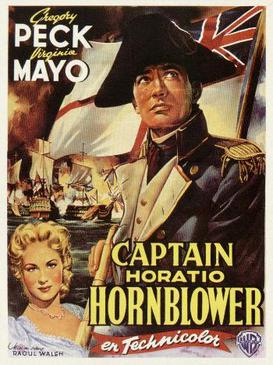
It's 1807 and Captain Horatio Hornblower (Gregory Peck) is at the helm of the HMS Lydia, a small British warship sailing around Cape Horn and heading toward Central America on a secret, very dangerous mission. His crew is suspicious of where he's leading them, questioning what he's up to.  Their objective is to help a Panamanian revolutionary leading an uprising against their Spanish occupiers. But just days after leaving an enormous cache of weapons with them, they discover that Spain has allied with England in an effort to defeat French dictator Napoleon.  His decision on what to do is made more difficult when a young British woman, Lady Barbara (Virginia Mayo), engaged to a British admiral, is placed in his care.  Now Hornblower must balance out his duty to England, the Navy and his crew with concerns over Barbara's safety.

That is about as condensed a plot description as you're going to get from this Raoul Walsh-directed sea epic. There is not so much a linear story line that has a beginning, a middle, and an end as much as it is Hornblower's adventures on the seas.  None of this is to be taken as a criticism because if anything the movie works better because of that lack of focused storytelling.  Instead, things sort of flow along, introducing problems here and there, situations to be solved, enemies to face and ultimately destroy.  Yes, Hornblower wins...spoilers, I guess.

That may be the best thing this sea epic has going for it.  Filmed in technicolor, the movie looks a little dated with its somewhat faded colors and obvious stage work.  It all adds to the appeal, adding to the mystique of the high seas.  This is how people must imagine life at sea, not what it was actually like.  Balancing out the scenes shot on-board the Lydia (and a later ship Hornblower commands) are gorgeous shots of these clippers cutting across the ocean.  You watch these scenes and understand why some people are drawn to sea travel.  There is something unexplainable about the beauty of an old warship with all its sails up cutting through the water.

Who better to play the stoic, courageous, noble British Navy captain than Gregory Peck, still rising to stardom at the age of 35. This is going to sound ridiculous considering Peck's legendary status as one of Hollywood's all-time greats, but the more I see of his films, the more I like him as an actor.  He has this balance on-screen, one minute the serious, stone-faced commander who makes difficult decision as easily as snapping his fingers. The next, he's stuttering upon meeting Mayo's Lady Barbara, fumbling for the right words. He gives Hornblower a personality, a likable quality that even in his most trying times, he's going to make the right decision. I don't often think of Peck as a love interest in his movies, but his chemistry with Mayo is spot-on, making their budding romance that can't be tougher to watch. It is 1951 though so you kind of know where things will end up...don't you?

Joining Peck on-board the Lydia is a supporting cast that does not disappoint in the least.  His fellow officers include Robert Beatty as Lt. Bush, Moultrie Kelsall as Lt. Crystal, Terence Morgan as Lt. Gerard, and James Kenney as Midshipman Longley, the youngest of the officers.  As for the crew, watch out for a very young-looking Stanley Baker and a scene-stealing James Robertson Justice as Quist. The crew gets their chance to shine in several exciting sea battles as these warships fire point blank into each other with cannon fire.  Enough action to keep you entertained without overdoing it.  The balance of the movie help make this movie what it is, a little bit of something for everyone watching. You can watch it at Youtube, starting HERE.

Captain Horatio Hornblower R.N. <---trailer (1951): *** 1/2 /**** 

Tuesday, May 10, 2011

Night People

From the end of World War II when Berlin was divided into two sections, American and Russians, the movies had a villain basically written for them for the next 50 years; the Russkies, the Red scare, the Pinkos, the Commies.  Whatever you want to call them, it worked. They were the complete opposites of us civil, humane Americans, always up to something shady in hopes of taking the United States and everything it represented down a notch or two or ten.

Made in 1954, Night People uses the Russians as the bad guys, but never puts a face on the villains.  Instead, they are only talked about, leaving the audience to make up their mind about them.  We hear about their tactics, their underhanded way of doing things. They're always up to something, holding a resentment against the Americans and anyone that opposes their way of life.  It is a weird little movie that can be hard to follow at times, but considering it was released in the midst of McCarthyism as Senator Joe McCarthy went on a Communist witch hunt in the U.S., it certainly is an interesting time capsule of the 1950s.

Walking back to the U.S. base in Berlin, an Army corporal is kidnapped and smuggled into the Russian sector in the city. An officer with the Provost Marshal, Colonel Steve Van Dyke (Gregory Peck) is given the case, told to get the corporal back through negotiations with the Russians. The soldier's father, Charles Leatherby (Broderick Crawford), is involved in big business back in the states and travels to Germany to help the effort, claiming he'll put pressure on people who aren't used to being pressured. Van Dyke though is a veteran of these prickly situations while Leatherby has no idea what he's getting into.  The Russians offer a prisoner exchange, the soldier for two private citizens living in Berlin they want to get their hands on.  Nothing comes easy though, and the exchange isn't as simple as it is made out to be.

Some reviews at the IMDB pointed out that director Nunnally Johnson's film doesn't have the same grittiness that similar movies like Carol Reed's The Third Man did. That's a fair criticism to make of Night People because honestly, it isn't as gritty or hard-hitting in its story about a post-WWII city trying to move on.  It was filmed in vivid Technicolor (which even pan-n-scan can't ruin) so the movie is full of color and brightness, gorgeous city locations.  It is too polished at times, too representative of a big studio production as opposed to a darker, seeder film.  I don't know what I'd expect differently though.  It's a movie made in 1954 meant for an audience rooting for the Americans.

Maybe ahead of its time is its handling of government matters concerning two governments who want nothing to do with each other as sworn enemies.  Both the Americans and Russians can't help each other out in the open, resorting to back channels, secret messages, double agents, and under the table agreements to get a job done.  Peck's Col. Van Dyke knows how to work the system for all it's worth to pull off the mission successfully.  We see his interactions with the state department (Max Showalter), his own agents in the field (Anita Bjork and Peter van Eyck), British intelligence (John Horsley), and in this situation, even the father of the kidnapped soldier who assumes he can do the job better than anyone else.  Sometimes difficult to follow, the plot does deliver a solid twist or two late that I didn't see coming.

A story about an American attempt to negotiate a kidnapped soldier sounds pretty serious to me in terms of a movie's tone and level of seriousness.  Why then does this movie rely on these little comedic bits that seem ripped from another much lighter movie?  Walter Abel's Doctor is constantly bumming cigarettes off anyone who will give him one, later claiming 'these things will kill you. That's why I don't smoke.' Buddy Ebsen's Sgt. McColloch is always slipping away to find a score of a baseball game, talking about all his 'dolls' in every city. Peck's Colonel Van Dyke says 'Holy Moses!' so much it could be a drinking game. The only reasonable explanation I can come up with is an attempt (a weak one at that) to humanize these American characters against the evil monstrosity that is the Russians.  The comedy definitely takes you out of the movie though, a completely unnecessary addition to the movie.

Now onto the cast which is pretty good.  I liked Peck's character the best, a young officer who's been worn down some by the nature of his job.  He knows it is a nasty business that has to be done, but it's always been his job.  When Crawford's Mr. Leatherby shows up, he is forced to show the newcomer how nasty his profession can be.  Peck and Crawford have a great chemistry together right from the start. Also look for Rita Gam as Ricki, Peck's girlfriend/secretary, Jill Esmond as one of the prisoners meant to be exchanged, along with Ebsen, Abel, Showatler, and all the other names previously mentioned.

Night People <---TCM trailer (1954): ** 1/2 /**** 

Friday, March 4, 2011

Arabesque

Released late last summer, The Tourist looked like plenty of movies released before it, pairing A-list stars Johnny Depp and Angelina Jolie in a story of international intrigue that had the duo globe-trotting across Europe with some mysterious baddies on their tail.  It sounded pleasant enough, even when Golden Globes host Ricky Gervais roasted the movie for its "well-deserved nominations." The formula is a tried and true one though, pair two huge stars together and basically let them just have fun together, allowing audiences to wonder what it'd be like to be a huge movie star.

Director Stanley Donen is guilty of going back to the well a couple times for this gem, first with 1963's Charade and then basically remaking that movie three years later with 1966's Arabesque. Starring Cary Grant and Audrey Hepburn, Charade is a genuinely good movie, switching back and forth between genre conventions, keeping you on your toes and guessing as to what's going to happen next. Using a similar story with the male/female roles reversed, Arabesque struggles to be even half as good a movie. Still, it's completely mindless and entertaining enough. But where Charade had a touch of seriousness to the proceedings, this quasi-sequel/remake is pure camp. Just know what you're about to watch.

Working at a university in England, American professor David Pollock (Gregory Peck) is approached to decipher a Hittite inscription by Arab businessman and all-around rich guy, Beshraavi (Alan Badel). He declines until he's approached by a Prime Minister from another Arab country (no names included), Hassan Jena (Carl Duering) to investigate the inscription.  Pollock is immediately thrust into a life and death situation where both sides want the much-needed information hidden in the Hittite message. Working closely with mysterious beauty, Yasmine (Sophia Loren), David isn't even sure who he can trust, especially when everything seems to point to an assassination attempt. Can he figure out when, who and where though before he gets knocked off?

Oh, no worries about Gregory Peck getting knocked off. He makes it, as does Sophia Loren. There is no threat at any moment in this movie where Peck's Pollock or Loren's Yasmine is even remotely in danger. So even as they're chased across London by people trying to drown, shoot, drug, smash, and in general, murder them, the movie loses some sort of edge because you know nothing is going to happen. That's maybe my biggest problem here. I was looking for something more along the lines of Charade, and it's just different enough to be disappointing.

Mindless is one thing, I love movies that make no demands on me as a somewhat coherent individual.  But this one pushed me too far. The plot relies almost exclusively on a MacGuffin, a generic item that doesn't necessarily mean anything until it's necessary for it to mean something. Long story short? It's something everyone wants and will do horrible things to get it. The script here is 75 minutes of twists and turns -- not all of which make complete sense -- as Peck and Loren run around in a panicked state trying to piece things together. Then once Donen's had enough, he reveals what the inscription really is.  It's not what you think by the way. The story is hard to follow and even ridiculous at times, taking away from that whole mindless aspect I so typically enjoy.

If this movie has a saving grace (I'm still not sure), it's that Peck and Loren are the ultimate professionals and commit to making the most of their characters and the story itself. Peck gets to ham it up some which is great as he throws away his titled, often wooden acting style (I'm a huge Gregory Peck fan, I can get away with criticizing him). He's funny and has some great throwaway lines which made me laugh.  Then there's the beautiful Sophia Loren, always very watchable and an underrated actress to boot. Lost in the shuffle of her constantly being half-naked or wearing next to nothing is that she is a great comedic actress, hamming it up right alongside Peck. Their chemistry together -- and what exactly Loren's character is up to -- makes the movie watchable above all else.

Other than that, nothing much worth mentioning here. Badel is a reliable smarmy villain who will get his due in the end, and Kieron Moore pops in here and there to play a rabid revolutionary playing all sides with John Merivale playing a constantly duped henchman who can't do anything right. The whole movie is ridiculous enough, all of it leading to an ending that in its stupidity is pretty entertaining. That's the movie. Stupid and entertaining with Peck and Loren clearly having a lot of fun. Instantly forgettable, but is that necessarily a bad thing?

Arabesque <---trailer (1966): ** 1/2 /****

Tuesday, February 15, 2011

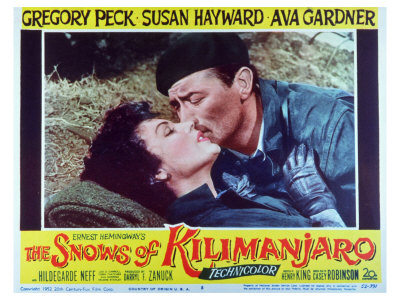
The Snows of Kilimanjaro

My lone venture into author Ernest Hemingway's repertoire is A Farewell to Arms which I had to read for an English class in high school.  I don't want to under/over sell my feelings on the book, but I hated it with a passion.  It wasn't so much Hemingway's style -- simplistic and understated -- because I appreciated that after reading unnecessarily wordy classics in every class I took. It was the actual story, a lost love story so sugary, so schmaltzy that I wanted both of the main characters to die horrifically.  I got through the book thankfully, but it was a trial.

Since then, I've been wary of anything Hemingway-related.  I don't avoid him or steer clear of him intentionally, but something he is associated with truly has to catch my eye.  Released in 1952, The Snows of Kilimanjaro caught my attention mostly because of the cast while the story sounded suspiciously like A Farewell to Arms.  I trudged on though, intent on giving this movie a chance.  It was a mixed bag that made me realize Hemingway continued to go back to the same well over and over again.  His main character is a variation on himself, a romantic, an idealist and a cynic at the same time who wants to explore and see everything the world has to offer.  It sounds interesting at least. 

While on safari with girlfriend/lover/fiance, Helen (Susan Hayward), writer/journalist Harry Street (Gregory Peck) scratches his knee on a thorn, the wound quickly becoming infected. Almost certainly staring death in the face if medical attention doesn't arrive soon, Harry lies on his cot in the isolated African savanna waiting for his end. Through the heat and the hallucinations, he looks back on the lost loves of his life, including Cynthia (Ava Gardner) who he meets and falls in love with in Paris following WWI, Countess Liz (Hildegard Knef), a well-to-do member of the upper class he meets on the French Riviera, and then lastly, Helen. But seeing all the mistakes he made in life, Harry tortures himself in what could be his final moments.

During his career, Hemingway went wherever the story was and ended up taking part in the World War I, Spanish Civil War, World War II, African safaris, while also visiting everywhere from Cuba to Paris and all cities in between. He was a storyteller, looking for answers of some sort, why men/women did what they did.  That was the biggest appeal of this story. Peck -- apparently channeling a Hemingway-like character -- is always on the move, following the action in his globe-trotting ways. It does become tiresome because we see the toll it takes on Harry's life and those he loves before he ever puts two and two together.  Still, a man who will drop anything to follow what he loves to do is an appealing main character.

In my previous Peck reviews, I know I've discussed the mental picture many moviegoers have of the famous Hollywood actor. He's Atticus Finch, the stoic, even wooden main character without much in the way of fire.  He did play many roles like that, but through the first 10 years of his career, it was different.  He played characters like this. Somewhat eccentric with a fire for life, nothing will stop him.  These are the type of roles I typically bring up when someone notes they are not Gregory Peck fans.  Even when the movie overall is a disappointment, he rarely is.

Channeling Hemingway though, it's not just the character. It's the lifestyle as well.  Director Henry King works off the source novel, but not having read it I can only guess what he was forced to do. Instead of focusing more on Harry and his relationships with Cynthia, Helen and Liz, 'Snow' serves more as a travel guide for the places they visit. Yes, I realize part of the story is Harry's adventures as he explores the world.  But long, unedited shots of animals on the African savanna, bullfights in Madrid, and a bizarre ending with a curious hyena do absolutely nothing for the story.  Go watch a PBS episode of Nature or The Travel Channel for an idea of what you will get here.

As for the story told in flashback mode, the one with Gardner is given the most attention and for good reason.  Frequent on-screen partners, Peck and Gardner had an incredibly natural chemistry that always makes the movie worthwhile to a point.  The other two flashbacks are not as successful.  Countess Liz is shrill and pretentious while Hayward's Helen feels tacked on to the point we're never given much information about her other than that she falls madly in love with Peck.  Hit or miss overall, but that's the movie as a whole.  Good and bad with the negative barely outweighing the positive. The movie is available to watch in its entirety on Youtube if you're curious.

The Snows of Kilimanjaro <---trailer (1952): **/****

Sunday, December 26, 2010

The Keys of the Kingdom

Some actors toil away for years trying to make it big in Hollywood.  All they’re looking for is that one big shot to step into the limelight. Others don’t spend much time at all on the climb up the ladder. In 1944, Gregory Peck made his debut in two movies featuring two great roles. In just his second movie overall, 1944’s The Keys of the Kingdom, he made such a positive impression that he earned an Oscar nomination for Best Actor. He didn’t win the award, but he surely deserved it.

The background of the movie is a sign of the times in the 1940s and early 1950s as studios made big budget stories about historical figures involved with religion, faith, and personal beliefs. Name a prominent historical figure with some involvement in religion over the years and chances are you can find a film from a major studio made about them.  As a person who doesn't have much use for organized religion, I usually try to steer clear of these movies as they shove some sort of rhetoric down your throat.  Thankfully, this one didn't do that, instead just focusing on the story of one man and his struggles and triumphs through his faith and personal beliefs.

After graduating from the Catholic college he's attending, Francis Chisolm (Peck) has no intention of continuing on to becoming a priest, but when something from his personal life changes his outlook on things, he opts for the priesthood.  From the start though, he questions if he's right for it and struggles in his first two years.  A bishop (Edmund Gwenn) who knows him well recommends him for a position in China where a Catholic priest is needed to start up a mission that has failed in the past.  Francis agrees to take the position and uproots himself to China where his work is cut out for him.  Upon arriving, he receives help from one of the few remaining converts, Joseph (Benson Fong), the young priest starts the work of building the mission and gaining converts who genuinely believe, not just because they're looking for food or shelter.

The story here is rare in that it covers over 40 years in Francis' life, but it never seems or feels rushed.  The important moments in his life and his struggles as a Catholic priest working as a missionary in China are all covered and given due course.  We see him in his ups and downs, his good and bad, the people he meets and who affect his life as much as he does theirs.  It is filmed in black and white -- I don't know how color would have worked here -- and the producers clearly spared no expense.  The mission set is ridiculously cool, and in general all the main sets are extravagant and textured.  They don't just look like wooden planks painted and propped up behind the actors.  Story and sets together, quite a combination here.  It seems obvious, but I'm always surprised how many movies take that for granted.

In just his second movie, Peck shows off an acting ability that would help catapult him to stardom.  Later in his career, he would gain a reputation as being somewhat stiff on-screen, playing the same character repeatedly with his strong, deep voice and commanding presence. I like Peck in just about everything he's done and can usually see past those criticisms, but I thought I should point them out.  Here, none of that's a problem.  His Francis is a lively, passionate man trying to do what he believes is right in an extremely difficult situation.  He's driven to do that at all costs no matter how difficult, willing to sacrifice for his converts who have come to trust him because of his actions and beliefs.  The character reminded me of a younger Atticus Finch, and that's never a bad thing.

This was Peck's movie from the start, but he is supported very capably by a cast full of studio players.  Thomas Mitchell plays Willie Tulloch, Francis' best friend back home, a doctor who is proud of his atheist beliefs. You can see why Willie and Francis are friends, they bond through their differences, neither man trying to convince the other of their convictions.  Vincent Price is Angus Mealey, Francis' childhood friend and fellow priest who is on a different road, a route where he climbs the ladder quickly in the church.  It's a good comparison to see the vast differences in the two men. Rose Stradner is a scene-stealer as Reverend Mother Maria-Veronica, a sister who struggles with her faith at times and how easily it comes to Francis.  She has a very moving, touching scene at the end of the movie that's worth watching on its own.  Also look for Roddy McDowall playing a young Francis, Cedric Hardwicke as a bishop in bookends of the movie questioning if Francis should be forcibly retired, and Leonard Strong as Mr. Chia, an opposing force of Francis' who ends up becoming fast friends with him. 

I was surprised by how much I liked this movie.  It doesn't try too hard delivering its message, a credit to the strengths of the cast who play the movie straight.  There's no hamming it up for the camera or speechifying at awkward moments.  The Chinese are not stereotyped like so many other movies do.  They're not shifty Asians capable of horrible things, and they're not ignorant peasants who must be taught how to do everything.  They're just people looking for something different in life.  Above all else though, watch this for Gregory Peck. You won't be disappointed in the 28-year old actor's secondary debut.

The Keys of the Kingdom <---trailer (1944): *** 1/2 /****

Tuesday, August 10, 2010

On the Beach

Not having lived through the Cold War, it's hard to fathom a life that always had a death cloud hanging over the world.  If the U.S. and the Soviet Union did decide to go to war, it would have been over in minutes with no real winner thanks to weapons that guaranteed both sides would be wiped out.  There was always that threat, that looming danger of what could be.  Movies like Fail Safe, Dr. Strangelove, and The Bedford Incident are just some of the movies that have dealt with this subject, but it's the rarer film that deals with after that big what-if, like 1959's On the Beach.

An American submarine commanded by Capt. Dwight Towers (Gregory Peck) surfaces off the coast of Australia and docks.  A nuclear holocaust has wiped out most of the world's population, but Australia was untouched by the apocalyptic fighting.  Towers and the U.S.S. Sawfish arrive to find a country and a continent not quite sure what to do with themselves.  Scientists and intellectuals predict that Australia has five or six months before radiation from the fallout reaches them, and then it will be a quick process of a week or two before all survivors are killed too.  With possibly months to live, what do you do?  Towers and his sub head north to see if there's any hope of survival, that the radiation may miss Australia.

First off, this has to qualify as one of the most depressing movies I've ever seen.  Director Stanley Kramer creates quite a vision of what a post-apocalyptic world would be like. The whole purpose of the movie is to ask what would your reaction be if you knew you only had months to live?  The vehicle of a nuclear fallout is how you to that question, but it works just as well dealing with mortality, we're all going to die.  It's just a matter of when and how.  The story is honest and doesn't try to whitewash anything here, these people are doomed and respond in different ways.

We see these reactions through a wide range of characters.  Peck's Towers lost his wife and two kids back home but sees similarities in an Australian woman, Moira Davidson (Ava Gardner), who has nothing and no one to live for. A young navy officer (Anthony Perkins) deals with his wife (Donna Anderson) who refuses to admit that anything is wrong, and that down the road to avoid unspeakable pain she may have to take her life and that of her baby.   An older scientist/doctor (Fred Astaire) copes by drinking and working on a Ferrari sports car he's purchased. No one reacts the same way, all responding individually to this horror that is presented.

Some moments provide these powerful instances of how the individual would respond.  While patrolling outside San Francisco, Towers' sub has a member of the crew (John Meillon) who is a native of the city escape from the sub and swim ashore, knowing he will die in a matter of days instead of months waiting back in Australia.  He tells Towers he wants to die at home, not in some strange place.  The scene where the sailor talks with Peck (via loudspeaker) is an incredibly moving one.  Just as moving, a scene where Astaire explains how this probably all started; one man probably looking at a computer screen swearing he saw a blip, an attack, and pushing the button or turning the key to assure the mutual destruction.  Kramer's film has a lot of these powerful moments, both those two stand out from the rest. 

For a movie that deals with the end of the world as we know it, in other words an epic scale, it also a very personal movie.  It depends on your reaction to the end of the world, your feelings about knowing that death is coming and there's nothing you can do about it.  My worry about halfway through the movie was that Kramer was waiting to pull the rug out from under the viewer, provide some sort of ridiculous solution that will allow these people to survive.  My worries were unfounded, Kramer is too talented of a director to do that, force some happy ending on the viewer for a story that needs to have an unhappy one.  The last 10 minutes are a perfect ending -- watch HERE -- including a final, very timely warning to 1959 viewers.

My one complaint, a minor one at that in relation to the whole movie, is that no one in Australia really tries to do anything to ensure survival.  With five or six months, much could be accomplished whether it's bomb shelters or finding some protection from the radiation.  Maybe it's naive to think that, probably only saving a few extra weeks or months, but all of Australia is content to go on with their lives as normal, drink a lot, go to the beach.  Everyone just seems freakishly calm, no riots, no looting.  They're all very mannerly about the end of the world.  A minor flaw in an otherwise really effective movie, but one I felt I had to point out.  Don't let it stop you from checking this one out.

On the Beach <----TCM trailer (1959): *** 1/2 /****

Sunday, August 8, 2010

The Purple Plains

As movies go, if you're a pilot and you fly enough, eventually you're going to crash in the wilderness somewhere and A. march back to safety B. fight a giant bear or C. survive Lord of the Flies style when your fellow survivors turn on you.  Most of these downed pilot movies I've seen qualify in the A department, a majority of them set in the military in one way or another, like Behind Enemy Lines with Owen Wilson and Gene Hackman.  But before that action extravaganza, that plot device has been used many times, like 1954's The Purple Plain.

In 1945 Burma in the closing months of WWII, Canadian fighter pilot Bill Forrester (Gregory Peck) is battling with some inner demons on a daily basis.  Early in the war his newlywed bride was killed in a bombing raid in London and ever since he's been looking and trying to die in combat with no luck, instead earning medals and citations. Forrester meets a young Burmese woman, Anna (Win Min Than in her only movie) working with the missionaries and falls in love with her, giving him a reason to live. But just when things are looking up him, a routine flight goes awry, and Bill is forced to crash land in the Burmese jungle with a passenger and a navigator.  They land safely, but they're 30 miles into Japanese territory with little supplies.  Do they attempt to march out or wait and hope help is coming?

'Plain' is divided fairly evenly between the two different stories, one is Forrester and his background and his personal struggles as he meets and gets to know Anna, and two his efforts to survive with an obnoxious whiny doctor (Maurice Denham) and an inexperienced navigator (Lyndon Brook) in the jungle. Director Robert Parrish doesn't go overboard with a sappy love story -- thankfully -- and also doesn't overhype the second half survival story. He finds a good mix in between because that first half is necessary if the second half is supposed to do anything to the viewer emotionally.  We've seen where Forrester is coming from, and now we get a chance to see what he's like when his mind is all there.

I've always been a Gregory Peck fan, but the more I see of him the bigger a fan I become.  I've yet to see a performance of his that isn't a solid one.  Some obviously work better than others, but he's almost always trying something new.  His Bill Forrester is a tortured individual, a man who wants nothing more than to die so he can be reunited with his dead wife.  While still fighting the war, he is clearly going through some post-traumatic stress disorder as he deals with his past.  The performance is a strong one for Peck, especially the second half as the character arc comes full circle.  Forced to improvise and become a leader or lay back and die, Peck's Forrester steps up to the plate and does what he has to to survive.

The survival aspect of the story is clearly the one that appealed to me more.  The on-location shooting was done in Sri Lanka where The Bridge on the River Kwai would be filmed three years later.  It's a funny thing, but the jungles look like real jungles.  Who would have thought that?  By the time Forrester and Co. crash, there's a real feeling of claustrophobia as if the jungle is closing in on you.  In a wise choice, Parrish never has the trio run into a Japanese patrol, much less see any trace of a single Japanese soldier.  The threat is enough, their ever lurking presence.  Besides, the real threat is among the group as Forrester and Blore try to decide what to do, make their own luck or wait for a rescue?

This isn't going to be a particularly long review.  I liked the movie, and that's about it.  It's not a great movie, but it is a different story and I'm always up for that.  Also in the cast look for a pre-James Bond Bernard Lee as Dr. Harris, a physician interested in helping Forrester out, and Brenda De Banzie as Mrs. McNabb, a missionary working in Burma who is like a mother to young Anna. The movie is available to watch via Youtube starting with Part 1.

The Purple Plain <---TCM clips (1954): ***/****