The Sons of Katie Elder

The Sons of Katie Elder
"First, we reunite, then find Ma and Pa's killer...then read some reviews."
Showing posts with label Martin Landau. Show all posts

Monday, May 4, 2015

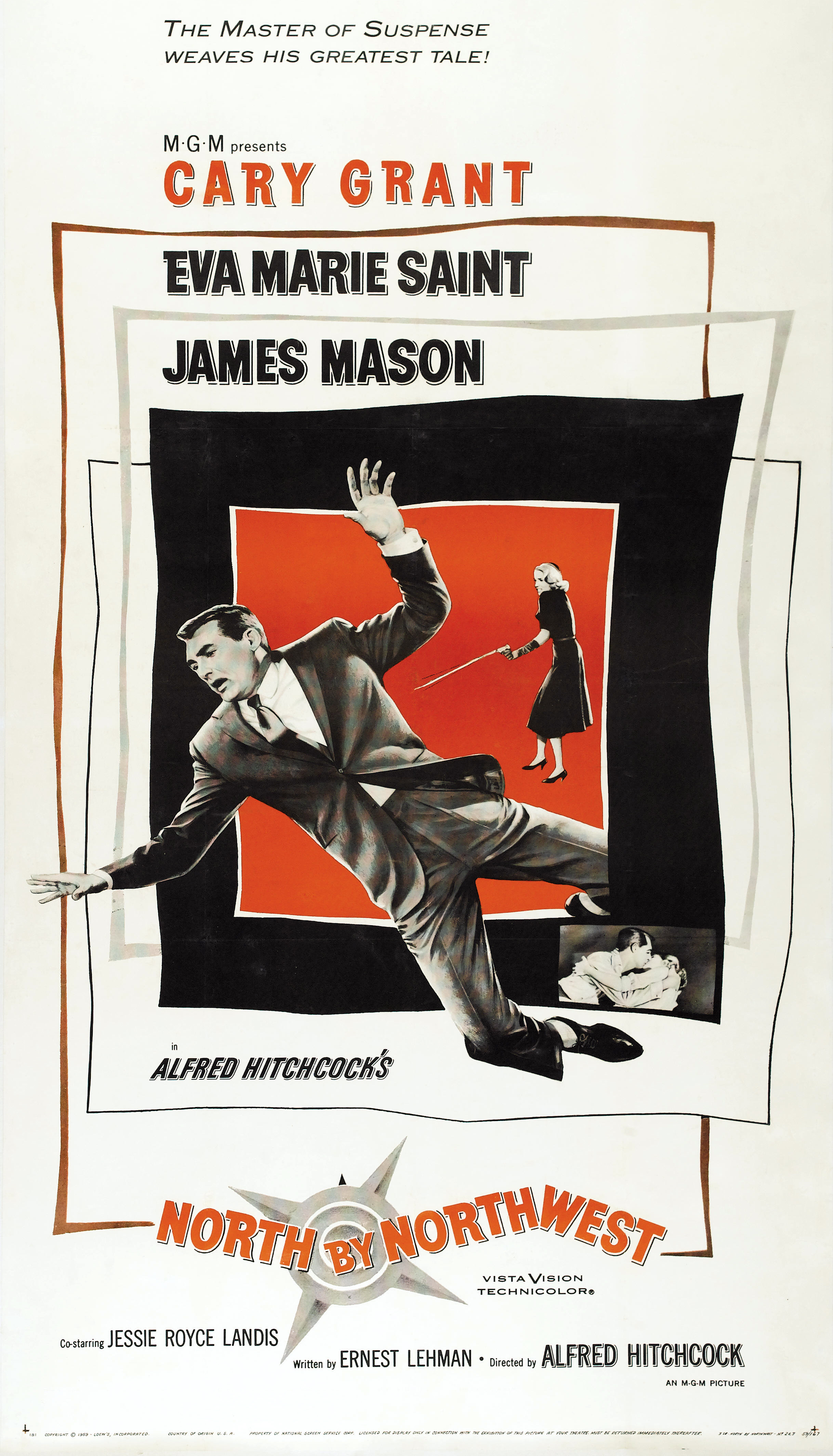
North by Northwest

Name a great director. A truly great one. Someone like Stanley Kubrick, John Ford, Billy Wilder, Orson Welles, and for today's review, Alfred Hitchcock. Ask any fan what their favorite movie is from their favorite actor, and you'll no doubt get some great answers; some agreed upon on and others surprising. For Mr. Hitchcock though, the Master of Suspense himself, that favorite movie is not worth arguing about, and I don't think it's that close either. Here's 1959's North by Northwest, my favorite Hitchcock movie by far and one of the best movies ever.

Working as an ad executive in New York City, Roger Thornhill (Cary Grant) leads quite the bachelor life in Manhattan. Well, he did lead quite the bachelor life. Visiting clients at lunch, Thornhill is taken by gunpoint out of the restaurant and driven to an isolated countryside mansion far from the city. There he meets a mysterious but eerily calm man, Vandamm (James Mason), who begins to ask him questions, questions that Thornhill has absolutely no idea how to answer. What do the questions lead Thornhill to believe? These men believe he's some sort of secret agent, a government official who's trying to stop them from doing...well, something. Vandamm and Co. have had enough though and decide to kill Thornhill, but he manages to escape. Now what? No one believes his improbable story. NO ONE. These men won't leave him alone though, and now, Thornhill is being framed for murder. He goes on the run, and the key to his safety may be a similarly mysterious but very beautiful young woman (Eva Marie Saint). Can Thornhill figure it out before his time runs out?

Sometimes, you just tip your cap to someone at the top of their game. That's Alfred Hitchcock here directing this 1959 mystery thriller. With more than a few genuine classics to his name already, Hitchcock hits this one out of the stadium. It's perfect. Smart, funny, frightening, impressive, so many adjectives come to mind. It's that Hitchcock does it all so seamlessly too. One scene, the tension is dripping off the screen. The next Grant and Saint engage some of the more scandalous dialogue to come out of the dialogue. Next up, a ridiculously charged chase scene. The movie clocks in at 136 minutes and covers a ton of ground, impressive when you consider the story basically has no plot, no huge reveals. So as I said, tip your cap. Some movies are untouchable, and this is planted firmly on that list. A master director at his absolute best.

A true test of a director's legacy is that all-important impact he/she makes with their films. One of Hitchcock's many, even countless impressions he's made is a little ditty called the 'macguffin.' It is a plot device that is SO FREAKING IMPORTANT, but never gets explained in the least. Like AT ALL. That's this entire movie. It's a movie about secret agents and the hidden government offices who run them. It's about bad guys who hold diabolical government secrets and must be stopped at all costs. So in that sense, there's literally no plot here. Yeah, Grant's Thornhill must stop Mason's Vandamm but...whatever. This is an epic case of mistaken identity that snowballs into something far more sinister, dangerous and potentially deadly. It takes a brave, talented and gutsy director to pull something like that off. I've always thought the 1950s were Hitchcock's strongest decade, and this is leading the way out front.

I got the sense watching 'Northwest' recently for this review that the Thornhill character was probably written for a younger actor. You know what though? It doesn't matter. Yeah, maybe Cary Grant was a little older than intended for the character, but his charming, likable on-screen persona and his smooth, deadpan delivery is beyond perfect for the part. As this case of mistaken identity unravels, Grant's charming, gentlemanly indignation fits effortlessly into the story. His chemistry with the lovely Eva Marie Saint is one of the best in film history, simple as that. Their dialogue is scandalous even a little bit now, ahead of its time for sure. You watch their scenes together and marvel. Just sit back and enjoy it. Hitchcock reveled in thumbing his nose at Hollywood's so-called rules, and my goodness, he pushes the envelope any time he can. I have to wonder, did the censors and studio just allow it? It's just too good to pass up.

The cast is so disgustingly good everywhere you look. Mason is the perfect foil to Grant, similarly charming, calculating and with a touch of diabolical intent. His henchmen are terrifying without saying more than a few words, Martin Landau and the creepiest eyes ever and Adam Williams as his knife-wielding enforcer. Just eight years older than Cary Grant, Jessie Royce Landis has a ball as Thornhill's worrying mother, the comic straight woman to all these antics, including her classic encounter with Landau and Williams in a packed elevator. There's also a great little part as Leo G. Carroll as the Professor, a mysterious, distinguished man interested in seeing how the proceedings develop. There's too many other familiar faces with small parts that pop up here and there to mention, but I noticed a cool, quick and you'll blink moment with a young Jeremy Slate as an alert policeman in Grant Central Station. A cool, very early part for a Just Hit Play favorite!

I hadn't watched this movie in years straight through, and man, it was fun catching up with this classic film. From Saul Bass' incredible credit sequence -- watch it HERE -- to composer Bernard Herrmann's phenomenal musical score -- give it a listen HERE -- this movie is technically perfect. Hitchcock uses some great visual tricks from matte paintings and green-screen techniques that trick your eye into seeing something you're not and doing it without calling attention to those techniques. Again, Hitchcock puts it all together. Sit back and take it all in.  

Talk to fans of the movie, and there's countless scenes that they'll mention as their favorites. There's the climactic chase ON Mount Rushmore (WHAT?!?), the painfully tension-riddled scene at an isolated crossroads with quite a twist in maybe the movie's most iconic scenes, and that's just two I'm willing to mention. If you haven't seen this movie, you are in for a treat. If you have seen it, go back and revisit 'Northwest.' There are few movies that click on all cylinders like Hitchcock's classic film does. From New York City to Chicago to Rapid City, a thrill a minute ride. A true, TRUE classic.

North by Northwest (1959): ****/****
Wednesday, October 22, 2014

Nevada Smith

Just a few weeks ago, I watched and reviewed 1964's The Carpetbaggers, the story of a business mogul expanding his empire in the 1920s and 1930s. A minor character in the story? An aging cowboy turned western movie star, Nevada Smith. His backstory is explained but not shown. That's for a prequel made two years later, 1966's Nevada Smith.

Working at his father's played-out mine that has recently produced some gold deposits, a young half-breed Max Sand (Steve McQueen) is away from the house when three outlaws (Karl Malden, Arthur Kennedy, Martin Landau) ride up looking for that gold. Max is too late to help though, arriving at the house to find the tortured, mutilated corpses of his parents. The outlaws are nowhere to be found, but their trail is easy enough to follow. Max's biggest problem though? He's capable of caring for himself on the trail, but he has little money and no real experience with guns, especially when it comes to actually using a pistol or rifle on a human being. Desperate and with no supplies left, Max tries to rob a man on the trail. Instead, the man, Jonas Cord (Brian Keith), an experienced trailsman and capable shot, teaches Max all he can in his quest for revenge. His biggest advice though? Abandon his quest for revenge and move on with his life, but Max isn't hearing it.

It had been years since I watched this 1966 western from director Henry Hathaway (a solid western director, True Grit, Sons of Katie Elder). My biggest takeaway? It isn't as good as I remembered. Still good, still enjoyable, but not as good. There's still positives to take away though. 'Nevada' was filmed on-location in Inyo National Forest and the Owens Valley in the Sierra Mountains. Visually, it is a stunningly good-looking film with the mountains as a backdrop to the revenge story. The score from composer Alfred Newman is solid -- especially the main theme -- but isn't necessarily used enough. The best thing going is the revenge motive, a pretty gruesome story at times. Not graphic, just really violent because we know what's happening. Stabbings, drownings, choking, beating, systematic shooting of an unarmed man. It can be pretty rough at times.

So if you watch this 1966 western and come away a little confused, there's a good reason. The Max Sand character is young, really young. I'm assuming a teenager, maybe approaching 20. When the movie was made in 1965, McQueen was...35. And he's a half-breed with a white father and Kiowa mother. So yeah, he doesn't really look like a teenage half-breed (with his blonde hair too) in a pretty obvious case of miscasting. Still, McQueen makes the most of it. With the revenge motive, it is a fascinating character. Max -- later dubbing himself Nevada Smith -- becomes obsessed with killing his parents' murderers no matter what the cost on those who are helping him. McQueen does a good job in a physically demanding part, doing his own stunts while also adding a dimension of pure physicality to the performance. It's not often spoken words, just a sad look here, a drop of his shoulders there. Not ideal casting, but McQueen makes the most of it.

But the rest of the cast? The rest of the cast?!? It's pretty great. Brian Keith has always been one of my favorites, but I think this is one of his bests. His Jonas Cord is only in the movie for about 20-25 minutes but steals every scene he's in. His chemistry with McQueen is pretty perfect, and their scenes together crackle, an experienced hand with a gun trying to teach the younger Max all he can through good and bad. The Jonas/Max dynamic has always been my favorite, the movie's strongest point. With the episodic story, Malden, Kennedy and Landau make the most of their screentime, three particularly nasty villains you can't wait to see get their due. Raf Vallone is good too as Father Zaacardi, a priest who comes across Max and helps him in a time of need. Also look for familiar western faces Gene Evans, Paul Fix, Pat Hingle, John Doucette, Lyle Bettger, Howard Da Silva and Strother Martin in supporting parts.

Where does 'Nevada' go a little off the tracks then? At 130 minutes, it drifts too much with some extremely slow portions involving the episodic story. There just isn't a ton of energy at times. Two semi-love interests are added, Janet Margolin as an Indian dance hall girl and Suzanne Pleshette as a Cajun girl, are meant to show Max's obsession over a possible future with either, but they become repetitive and tedious. Just not a ton happens. The performances are good, the locations cool, but it's missing that special something. Good but not great.

Also worth mentioning is a western nerd moment. Any western fan who's seen any number of 1960s westerns will recognize Chuck Roberson, Chuck Hayward and Jerry Gatlin as background players and supporting parts. 'Nevada' takes that to new levels. Watch closely and you see them all playing multiple parts. In one scene, Roberson is part of Malden's gang, and the next he's Paul Fix's deputy. It's a little much and a little lazy, something Hathaway also did in Sons of Katie Elder. Thus ends this rant.

Nevada Smith (1966): ** 1/2 /****

Friday, September 6, 2013

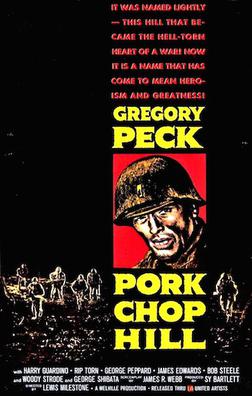
Pork Chop Hill

No soldier wants to die. But what about as a war nears its end? The end of the fighting may only be days away, maybe even hours away. So goes the background for the underrated Korean War drama from 1959, Pork Chop Hill.

It's April 1953 and both American and North Korean/Chinese commanders have agreed to a cease fire with the two sides meeting at Panmunjom. The negotiations though are moving along at a frustratingly slow pace with little being resolved. Near the front lines, the fighting rages on with Lt. Joe Clemons (Gregory Peck) and his King Company awaiting orders, supposedly to withdraw as the fighting dies down with negotiations picking up. The orders though are just the opposite, orders to move forward and take Pork Chop Hill, a worthless hill that's been lost and regained countless times. Now, the Chinese are in possession, but it is a spot on the line that's been deemed very important to negotiations. Clemons assembles his weary company, moving forward to take a hill that holds no military value.

Dubbed the Forgotten War, the Korean War pales in comparison to both World War II and Vietnam in terms of theatrical films released about them. From director Lewis Milestone (A Walk in the Sun, Halls of Montezuma, All Quiet on the Western Front), 'Hill' is a generally forgotten war film that certainly deserves better. It is similar in a lot of ways to 1962's Hell is For Heroes -- even using an eerily similar score from Leonard Rosenman -- and is based on a true story, the battle for Pork Chop Hill. It was filmed in black and white, a highly effective shooting technique, giving everything a sparse, cold and vacant look. Why isn't it remembered as the near-classic that it is? I've got no idea.

What jumped out at me on my recent viewing was the cynicism and darkness that's evident throughout. More surprising? It was made with cooperation from the U.S. Army which in itself isn't too surprising. It's that in exploring the battle, 'Hill' at times shows the complete ineptitude of the American commanders. Assaulting the hill, Clemon's company is put on the grid when American spotlights actually shine right on them in the dead of night. Other companies are given wrong orders, ranging from just plain wrong to misleading. Once King Company is in position, the rear command is genuinely confused, thinking they're fighting a mop-up action when in reality, they're holding on by their fingernails with limited ammunition, food and water. At one point, an U.S.O. photographer is sent up the hill to get photos of an American victory because the folks back home need to see an American win. Peck's reaction is priceless, a commander at wit's end who doesn't know what else to say.

This is an honest criticism of headquarters that's based in reality, and for a 1959 audience, it seems light years ahead of its time. If I didn't know better, it sounds like a Vietnam War movie like Platoon or Apocalypse Now more than a major studio release from 1959. Leading the way is the always reliable, always impressive Gregory Peck. His performance reminded me some of his Oscar-nominated turn in Twelve O'Clock High 10 years earlier. His Clemons is an effective commander simply trying to follow orders and get as many men through the battle unscathed as is possible. Even he is pushed to his limits as one bumbling order after another comes through, the commanders refusing to acknowledge that the battle isn't going as they expected. It's an understated part, but an emotionally effective one. We see the wear and tear on his face, his reassuring, confident tone slowly being worn down.

Beyond Peck though, 'Hill' is noteworthy for its supporting cast of rising and future stars. Harry Guardino and George Peppard play Forstman and Federson, two buddies lugging a machine gun around the hill. Rip Torn plays Lt. Russel, commander of the relief company assigned to help out King Company. 'Hill' is also one of the first war films to show integrated units, Woody Strode playing Franklin, a private fed up with the war, and James Edwards as Cpl. Jurgens, one of Clemon's most dependable, trustworthy men. Also cool casting is George Shibata as Lt. Ohashi, a Japanese-American soldier, Clemon's close friend and one of his platoon commanders. Also look for Norman Fell, Gavin MacLeod, Robert Blake, Biff Elliott, Martin Landau, Harry Dean Stanton, Clarence Williams III and several other familiar faces rounding out King Company's roster.

Clocking in at 97 minutes, a majority of 'Hill' is spent in the trenches and bunkers with King Company, a few asides here and there showing the negotiations of the cease fire. This is a movie interested in the nuts and bolts of the battle, the flanking movements, the reserve companies, the crossfires and preparations for counterattacks. It never gets bogged down though, the battle scenes uncomfortable and unsettling in their reality. It isn't graphic violence here, but that doesn't mean it's not hard to watch. Add in the psychological warfare of a Chinese broadcaster bombarding the American troops with propaganda, and you've got quite the battle here. It's not just bullets and soldiers anymore, but the effect it has on the soldiers' heads too. A great war movie, one that deserves more of a reputation/following.

Pork Chop Hill (1959): *** 1/2 /****

Friday, April 16, 2010

A Town Called Hell

When watching a spaghetti western, there's a certain amount of weirdness to be expected.  After all, these were typically European directors/producers/screenwriters interpreting the American west so weirdness just comes with the territory.  But beyond anti-heroes and crazy villains, the spaghettis were often heavy on graphic violence, religious imagery and symbolism, and no penchant for having to have a happy ending.  Basically, everything I like in a western.

For years, the craziest spaghetti I saw was 1967's Django Kill! which features some truly disgusting violence, a gang of gay cowboys, and...wait, that's enough, violence and gay cowboys is a good explanation.  Last night on Netflix Instant viewing, I checked out 1971's A Town Called Hell for a couple reasons, I've never been able to actually track a copy down, and two, the cast looks ridiculously good.  It's not a straight Italian spaghetti western with British and Spanish backing, but it's got all the right elements.  If anything, it's got too many elements.  This one is all over the place and ranks right up there with Django Kill! for new weirdest spaghetti.

It's 1905 in Mexico (right in the middle of the Mexican revolution for you history buffs).  A widower, Alvira (Stella Stevens) rides into the dusty, rundown town of Bastardo -- not 'Hell' as the title implies.  She is offering $20,000 for the man who murdered her husband, but she doesn't know who he is, only that he's in the town.  Alvira's only clue is a name...'Aguila.'  But other than that, she's got nothing to go on.  Three key people in Bastardo seem to have information.  There's the Priest (Robert Shaw), the Colonel (Martin Landau) with his army detachment, and Don Carlos (Telly Savalas), the town's corrupt mayor/bandit. But nothing comes easy, and the betrayals start flying and the bodies start to add up.

Where to start?  Spaghetti westerns generally had an extremely dark tone full of cynicism and violence, lots of anti-establishment feelings.  'Hell' certainly qualifies because no character is safe.  The violence isn't graphic but it is brutal in its honesty.  There are hangings, stabbings, shootings, and so much more.  The setting for this is a really desert town that has fortress walls on all sides, and even though the movie was made/filmed in Spain, it looks like Mexico in all its dusty, dirty glory.  I'm positive I'm reading too much into this, but the town could be some sort of purgatory, some bizarre version of hell.  Or it could just be a whacked out western, you make the decision. 

The story itself is too interesting with director Robert Parrish mixing and matching left and right.  An IMDB user stated there's at least 15 plots, they just last 2 or 3 minutes before moving on, and really, that's a pretty accurate description of this gothic, dark western.  Stevens sleeps in a coffin at night and has a pale deaf-mute protector, Spectre (Dudley Sutton), with her at all times.  Savalas is a violent dictator with an iron fist on this town...until he doesn't anymore when his men turn on him, crucifying him.  Shaw has a vivid dream where Stevens' Alvira kills him in his sleep.  Landau as a Mexican officer?  That does seem pretty logical.  A flashback with a sped-up version of the Battle of New Orleans and a bizarre, confusing backstory just caps it all off.  That's the movie in a nutshell, always moving and never slowing up enough to know how ridiculous it all sounds.

Through all of the craziness, there's a really cool if sometimes odd cast.  Robert Shaw is one of my favorite actors, and he's the star here.  Simply named 'the Priest,' he has a past that still gnaws at him, and he seems to be the only person who knows who 'Aguila' is.  On a non-consequential level, Shaw is also sporting a badass handlebar mustache and mutton chop-like sideburns.  Savalas is the shirtless bandit mayor (honestly, in his 30 minutes he never has a shirt on) who gets to ham it up.  His departure about 30 minutes does come as a surprise, mostly because we never see how he gets whacked.  Landau is the only one who doesn't work because well, he's not Mexican.  He's loud and obnoxious but still isn't a good villain.  Stevens is wasted -- but looks good doing it -- and appears like she wandered into the set and just started reciting lines.

There's also supporting parts for Fernando Rey as an old blind man who may hold the key to Aguila's identity, spaghetti western regular Aldo Sambrell as Calebra, one of Don Carlos' thugs, TV star Michael Craig in flashback as Paco, one of the Priest's partners, and Al Lettieri as La Bomba, Carlos' not so smart treacherous right hand man.  What I liked about this western -- and I did like it -- was the general weirdness of it all.  There's this great cast and no story (not a coherent one at least), but all the little things add up.  Recommending this almost in spite of itself.

A Town Called Hell <----trailer (1971): ** 1/2 /****