The Sons of Katie Elder

The Sons of Katie Elder
"First, we reunite, then find Ma and Pa's killer...then read some reviews."
Showing posts with label Harry Guardino. Show all posts

Sunday, January 3, 2016

Hell is For Heroes

In a career shortened by his tragic death at the age of 50, Steve McQueen turned in one memorable performance after another. Films like The Sand Pebbles and The Great Escape and Bullitt come to mind as frequent mentions as the King of Cool's most iconic roles (and rightfully so. They're gems). But how about an underrated performance that doesn't get its due? I've always thought 1962's Hell is For Heroes belonged in McQueen's best performance list. What do you think?

It's 1944 in France along the Siegfried Line and rumors are spreading that troops will be heading home soon. As the infantry waits, Private John Reese (McQueen) arrives as a replacement for an already undermanned squad commanded by Sgt. Larkin (Harry Guardino) with the platoon led by Sgt. Pike (Fess Parker). The troops aren't going home though. They're being sent back on the line. Larkin's squad is in for a surprise though. The entire company was moved in during the night, but many of the men were pulled back during the night and relocated up the line to serve as a reserve for an expected German counterattack. What's that mean for Larkin's squad? The sergeant and his five men, including Reese, must hold an extended portion of the line until reinforcements can arrive. Can they? What if the Germans catch on to who they're actually facing off against?

I think this is one of the best, most underrated war films ever made. It is rarely mentioned in conversations of great war films, but it certainly belongs in the conversation. Director Don Siegel -- one of the all-timers at tough guy flicks -- helms a low-budget (but never in a bad way) war story that genuinely tries to show the horrors of war on a more personal level. This isn't armies clashing over territory. This is a half-dozen tired American soldiers simply trying to survive against overwhelming odds and in spite of idiotic orders. There's no picture of the war or fighting on a grand scale. We're in the trenches and foxholes with the soldiers who are interested in getting some sleep, eating some good food and not being shot at for a change.

What's always appealed to me about Siegel's film is the stark, bleak look. 'Heroes' is filmed in black and white, an excellent decision that helps focus the story more on the soldiers and their bleak situation with little in the way of distraction. Much of the story is focused then on a stretch of line marked with trenches, dugouts, bombed-out pillboxes, dragon's teeth, foxholes and all the remnants of previous fighting littering the ground. Across the line a few hundred yards, the German infantry -- mostly unseen -- waits like a presence just waiting to strike. An obvious impact on TV's Combat!, 'Heroes' has a memorable look, Siegel not undone by his relatively small budget. Throw in a wartime score from Leonard Rosenman -- not used often, highly effective when used -- that's moody and dark and scene-setting and you've got all the ingredients! Watch the opening/closing credits HERE for a sample.

The thing holding it all together though is McQueen's performance as Private John Reese, a brutally efficient soldier and fighter who's most effective in combat. Once removed from the fighting, he starts to get in trouble. This is a performance built on such an intimidating presence that McQueen was supposedly incredibly difficult to work with on-set, rarely getting out of character. His physical appearance is gaunt with several day-old stubble on his face. For lack of a better description, Reese is a psychopath, albeit an incredibly capable soldier. One of the earliest method actors, McQueen radiates intensity and rage here like few performances I've ever seen. He barely speaks and when he does, he's short, quick and to the point. But my goodness, it is a highly memorable performance, one tortured individual who is most at home when the bullets are flying through the air and death is ever-present. One of my first thoughts when watching The Hurt Locker was that Jeremy Renner's character could have been Reese's son! What a performance from McQueen.

The entire ensemble is a strong one with McQueen leading the way. Fess Parker is solid as Pike, the tough sergeant trying to hold his men together even considering the hellish fighting they've been through. Larkin too is a capable soldier, Guardino doing a fine job of showing his unease at what he likely should do and what he's been ordered to do. His squad includes James Coburn as Henshaw, a mechanical genius, Bobby Darin as Corby, a scrounger always ready with a joke/quip, Mike Kellin as Kolinsky, the worrier, and Bill Mullikin as Cumberly, the cheery soldier with a positive outlook. The squad gets unlikely reinforcements in the form of Bob Newhart's Pvt. Driscoll, a typist who finds himself at the front line, and Nick Adams as Homer, a young Polish man who tags along with the squad. Also look for Joseph Hoover as Capt. Loomis, the company commander, and L.Q. Jones appearing very briefly as a supply sergeant.

This is one of the earliest examples of a real look at war I can think of. Sure, Darin has some jokes and Newhart briefly gets to do a telephone bit, but the message of the story is the absolute horror of war. There's nothing glamorous or glorifying about it. It's men killing men in horrific fashion. 'Heroes' is interested in small unit pictures, squad vs. squad, as we see some of the ruses Larkin's men use to trick the Germans into thinking there's far more of them than there really is. When the violence and gunfire erupts, it's quick, unsettling and vicious. Characters die in truly uncomfortable ways that isn't just "Bang...You're Dead." One characters screams "My guts! My guts! Don't tell my wife it was like this!" as he bleeds out before a medic arrives. Generally forgotten, 'Heroes' was one of the first to show war as it really was, laying the groundwork for many future war films.

Take this next part with a grain of salt (I'm not sure how true it is), but I've read Siegel simply ran out of money late in filming and the studio didn't give him anymore. What's next? An improvised ending that is actually one of the most memorable, startling endings I've ever seen. It stays in tune with the movie's general downbeat tone with no happy endings in sight. What I've always wondered then is this...what was the original ending if there was more of a budget? I'm still searching for that answer! In the meantime, it's an excellent movie, one that deserves far more of a reputation among war movie fans. It's a gem.

Hell is For Heroes (1962): ****/****
Rewrite of December 2010 review

Thursday, April 9, 2015

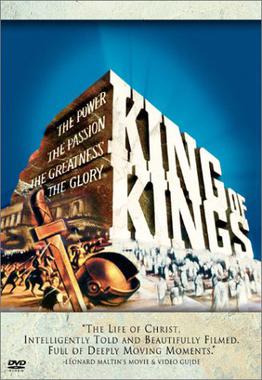
King of Kings

Is there a more daunting task as an actor to play a man millions of people around the world believe to be the Son of God? Sure, any portrayal of a real-life person has to be intimidating, but playing Jesus? That's gotta be on a whole other level. As I learned from the Internet, this movie was the first American film to show an actor's face portraying Jesus Christ. Here it is, a childhood favorite and one I revisited this past Easter weekend, 1961's King of Kings.

This is the story of Jesus (Jeffrey Hunter), a man who grew up in tumultuous times in Judea as Roman occupiers keep the Jewish/Hebrew people oppressed under their thumb. Revolts and rebellions rise up from year to year as Judea seeks its freedom, its independence to get away from the control of the Roman empire. Into this world, Jesus grows up into manhood ready to do his life's calling. Having worked his entire life and living in the Galilean town of Nazareth as a carpenter, Jesus in his late 20's ventures out into the world to embrace his calling as the messiah, the son of God who will teach the world how to live. It is a message that preaches peace but will no doubt send ripples throughout the Roman empire. As Jesus travels around the country with a small group of disciples, his name, his message and his words begin to spread. His followers increase, but so does the danger around him as many want nothing more than to kill him before he becomes too dangerous.

A plot description for a film about the life of Jesus Christ is pretty unnecessary, but I had to lay things out at least a little bit. In the age of the historical film epic, this entry from director Nicholas Ray has always been one of my favorites. I grew up watching it with my Mom every spring, and even years later, it holds up. If anything, I liked it more as a 29-year old viewer as opposed to a 10-year old kid. A whole lot of history is covered in 168 minutes but things never feel rushed. 'King' was filmed on-location in Spain with countless lavish sets and natural backdrops adding an incredibly authentic feel to the proceedings. The TCM print shown on Easter looked PHENOMENAL. Just a stunningly good-looking visual movie. The musical score from composer Miklos Rozsa is pretty perfect too, big and booming mixed in with softer, quieter and just as effective emotional moments. Listen to a sample HERE.

What struck me most in this 1961 epic about Jesus is that...well, it isn't just about Jesus. Ray and writer Philip Yordan use Jesus, his life and his teachings to tell a story about the times this man lived his life. Yes, the focus is on him, but it isn't exclusively focused on him. The casting is very solid with Jeffrey Hunter playing Jesus. Up there with The Searchers as his most famous, respected and recognizable role, Hunter does an excellent job here. It isn't the most human part, but that's not his fault. Hunter is sincere and likable and genuine with a script that keys in on Jesus' teachings more than getting to know the man as a person, as an individual. What works so well is the quieter moments and the impact we see as viewers that this man has on those around him, both the believers and the non-believers. Hunter never became the huge star he could have before his tragic death in 1969, but performances like this show his acting skill.

Four years later, a similarly-themed Jesus epic -- The Greatest Story Ever Told -- would set the bar for ridiculously overdone all-star casts. That ain't the case here. Ray fills out some major roles with recognizable faces and some stars, but this is even't close to being considered an all-star cast. Oh, and that's a good thing. The best supporting part goes to Ron Randell as Lucius, a Roman officer in the garrison at Jerusalem tasked with figuring out if Jesus is a threat to be dealt with. A human, questioning part, and a really good one. Next up, Irish actress Siobhan McKenna as Mary, Jesus' mother, making the character memorable with just a few quick scenes. And then there's the most recognizable face, Robert Ryan getting a meaty part as John the Baptist, a prophet more fiery than Jesus but who preaches the same peaceful message, one predicting the coming of the Son of God.

Who else to look for? If you're familiar with Jesus and the gospels, you know the names. Also in the cast are Pontius Pilate (Hurd Hatfield), Roman governor of Judea, Claudia (Viveca Lindfors), Pilate's more open-minded wife, Herod Antipas (Frank Thring), the Judean governor, his wife, Herodias (Rita Gam), and his stepdaughter, Salome (Brigid Bazlen), disciples Peter (Royal Dano) and Judas (Rip Torn), Barabbas (Harry Guardino), and Mary Magdalene (Carmen Sevilla).

Working consistently throughout the 1950s, director Ray carved a niche for himself as a director of smaller scale human dramas. A biblical epic about Jesus? Not his usual cup of tea. For all the immense scale though, it is the softer, quieter scenes that work. Quick montages of Jesus' miracles set to Rozsa's score are beautiful and effective. The sermon on the mount boasts all sorts of massive scale but is effective because of the dialogue and Hunter's acting. Certain events are glossed over more than others with a bigger focus late on the Passion and Resurrection. Obviously not nearly as graphic as the Passion of the Christ, it remains a moving finale.

King of Kings works because it doesn't try to be gigantically epic. It is content to tell a big story -- maybe history's BIGGEST story -- and to tell it well. Well worth it though, definitely worth checking out. Also listen for Ray Bradbury's uncredited narration, Orson Welles reading said narration, and future familiar face from the spaghetti western genre, Aldo Sambrell, making his screen debut.

King of Kings (1961): ****/****

Wednesday, February 26, 2014

Rollercoaster

It took me a couple visits to Six Flags Great America, and some peer pressure to boot (damn 8th grade field trip), but I eventually learned to love riding a rollercoaster. Do you? It's easy to see the appeal, but I've learned enough not to push people to get on a rollercoaster if they don't want to. The heights, the speed, the upside-down loops, and oh yeah, the potential to die horribly should something go wrong. That's nothing, right? Well, if you're wavering over ever riding an amusement park ride like that, steer clear of a 1977 disaster movie, Rollercoaster.

At a fan-favorite amusement park on the west coast, a man (Timothy Bottoms) walks around the park, taking part in some carnival games, eating some cotton candy, and then late in the day, he pulls a radio transmitter from his pocket and explodes a bomb on the park's oldest, safest and most loved rollercoaster, killing all aboard the ride. An inspector from the Department of Standards and Safety, Harry Calder (George Segal) is called in to investigate, his most recent inspection turning up nothing three months earlier. Just days later on the east coast, another rollercoaster accident claims more lives. The rides in ruins with no clues or evidence, Harry is convinced the accidents are tied together, especially when he finds his own connection about the owners of the amusement parks. Can he convince someone of his theory? He may not have to. The FBI, including lead agent Hoyt (Richard Widmark), have been called in to investigate. Can they stop the bomber before he strikes again?

With the success of the disaster movie wave waning some by 1977, director James Goldstone's film hit theaters the same summer as a mildly successful movie, Star Wars, and managed to hold its own, finding a niche with audiences. I liked this movie, didn't love it. It's cool to see a disaster movie that doesn't depend on some natural calamity or a giant skyscraper on fire, but instead a suspense story that is uncomfortable, really gets the adrenaline going at times, and works because...well, let's face it. Something like this could happen. For the most part, it avoids all the pratfalls that helped doom the genre. It never gets too jokey or goofy, never feels like we're watching a novelty film, there's no huge all-star cast. This is a movie about the build-up and the suspense, not a gimmick.

As for the cast, there really isn't a huge listing. George Segal has always been one of my favorites, and I liked him a lot here as Calder, the inspector who feels some responsibility for the bombings (it was his inspection) even though it wasn't his fault. He's Joe Everyman, a regular guy trying to do the right thing. That's tough when everyone around him is seemingly challenged. Richard Widmark does a good job in that department as Hoyt, the veteran FBI agent who, dammit, is going to do things his way and isn't going to take any advice from some wanna-be investigator. Segal and Widmark are the stars though, their arguments and discussions about how to handle things providing some of the movie's strongest moments. In the meaningless cameo department, Henry Fonda is around for two scenes as Davenport, Calder's boss who he's always busting his balls about one thing or another. The same for Harry Guardino as a police officer kinda attached to the case who hangs around for a couple scenes.

And then there's that bomber fellow, played to perfection by Timothy Bottoms. An underrated actor who never became a big star, Bottoms is listed here only as 'Young Man.' He's never given a name or any background, leaving his intentions or motivations in the dark. He says to Calder at one point over the phone that it's all about the money, but something else we never really learn about seems to be lurking. Would it have been nice to get a little explanation? I'd think so, but it works without it just the same. This guy doesn't care if lots of people get killed. He's going to accomplish what he wants. Bottoms does a creepy, sinister and underplayed job here. The character doesn't seem to have a pulse until late in the movie, a monotone delivery and calm mannerisms adding to that creepy nature. A solid part, avoiding as many cliches and stereotypes of disaster movie villains, suspense/thrillers too about psychopaths, madmen and murderers.

For the most part here, it's the set pieces that work. Well, two out of three at least. The opening bombing is slowly developed, tension hanging in the air just waiting for the explosion. Bottoms is at his eerie sinister best in this scene, not saying a word as he moves very deliberately around the park waiting for his chance. When the explosion comes, it's startling and unsettling as expected. The same for the finale, Calder, Hoyt and a team of agents trying to find the bomber as a new rollercoaster is unveiled to throngs of people, an extended sequence that takes most of 30 minutes. The weak point is in the middle, Bottoms' bomber sending Calder and the agents on a wild goose chase across a park as he tries to get his hands on a $1 million dollar ransom. His solution? Have Calder -- communicating via radio -- go on a bunch of rides to lose his tail. The potential is there, but the scene just keeps going, almost 20 minutes of painfully slow build-up with no real payoff. Still, a .667 batting average ain't bad, is it?

Overall, there's some cool positives. It was filmed on location at several actual amusement parks (talk about a whole bunch of positive advertisement, huh?!?), including Ocean View Park in Norfolk (the first sequence), Kings Dominion in Richmond (the middle sequence), making that long sequence very bearable, and Six Flags Magic Mountain for the finale. The actual parks provide some cool backdrops for the developing story, as well as a quick detour later to Navy Pier and the Hyatt Regency in Chicago. So what to say in the end? It's a good movie with some really solid moments that's hamstrung by some really slow-moving sequences. Worth it, an entertaining disaster movie. Also worth mentioning? Look for a young Helen Hunt as Segal's daughter and Steve Guttenberg in a blink and you'll miss it appearance.

Rollercoaster (1977): ** 1/2 /****

Friday, September 6, 2013

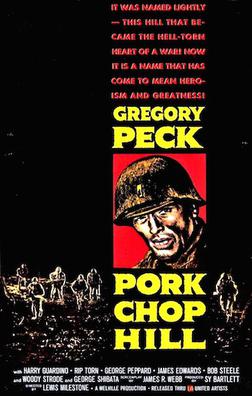
Pork Chop Hill

No soldier wants to die. But what about as a war nears its end? The end of the fighting may only be days away, maybe even hours away. So goes the background for the underrated Korean War drama from 1959, Pork Chop Hill.

It's April 1953 and both American and North Korean/Chinese commanders have agreed to a cease fire with the two sides meeting at Panmunjom. The negotiations though are moving along at a frustratingly slow pace with little being resolved. Near the front lines, the fighting rages on with Lt. Joe Clemons (Gregory Peck) and his King Company awaiting orders, supposedly to withdraw as the fighting dies down with negotiations picking up. The orders though are just the opposite, orders to move forward and take Pork Chop Hill, a worthless hill that's been lost and regained countless times. Now, the Chinese are in possession, but it is a spot on the line that's been deemed very important to negotiations. Clemons assembles his weary company, moving forward to take a hill that holds no military value.

Dubbed the Forgotten War, the Korean War pales in comparison to both World War II and Vietnam in terms of theatrical films released about them. From director Lewis Milestone (A Walk in the Sun, Halls of Montezuma, All Quiet on the Western Front), 'Hill' is a generally forgotten war film that certainly deserves better. It is similar in a lot of ways to 1962's Hell is For Heroes -- even using an eerily similar score from Leonard Rosenman -- and is based on a true story, the battle for Pork Chop Hill. It was filmed in black and white, a highly effective shooting technique, giving everything a sparse, cold and vacant look. Why isn't it remembered as the near-classic that it is? I've got no idea.

What jumped out at me on my recent viewing was the cynicism and darkness that's evident throughout. More surprising? It was made with cooperation from the U.S. Army which in itself isn't too surprising. It's that in exploring the battle, 'Hill' at times shows the complete ineptitude of the American commanders. Assaulting the hill, Clemon's company is put on the grid when American spotlights actually shine right on them in the dead of night. Other companies are given wrong orders, ranging from just plain wrong to misleading. Once King Company is in position, the rear command is genuinely confused, thinking they're fighting a mop-up action when in reality, they're holding on by their fingernails with limited ammunition, food and water. At one point, an U.S.O. photographer is sent up the hill to get photos of an American victory because the folks back home need to see an American win. Peck's reaction is priceless, a commander at wit's end who doesn't know what else to say.

This is an honest criticism of headquarters that's based in reality, and for a 1959 audience, it seems light years ahead of its time. If I didn't know better, it sounds like a Vietnam War movie like Platoon or Apocalypse Now more than a major studio release from 1959. Leading the way is the always reliable, always impressive Gregory Peck. His performance reminded me some of his Oscar-nominated turn in Twelve O'Clock High 10 years earlier. His Clemons is an effective commander simply trying to follow orders and get as many men through the battle unscathed as is possible. Even he is pushed to his limits as one bumbling order after another comes through, the commanders refusing to acknowledge that the battle isn't going as they expected. It's an understated part, but an emotionally effective one. We see the wear and tear on his face, his reassuring, confident tone slowly being worn down.

Beyond Peck though, 'Hill' is noteworthy for its supporting cast of rising and future stars. Harry Guardino and George Peppard play Forstman and Federson, two buddies lugging a machine gun around the hill. Rip Torn plays Lt. Russel, commander of the relief company assigned to help out King Company. 'Hill' is also one of the first war films to show integrated units, Woody Strode playing Franklin, a private fed up with the war, and James Edwards as Cpl. Jurgens, one of Clemon's most dependable, trustworthy men. Also cool casting is George Shibata as Lt. Ohashi, a Japanese-American soldier, Clemon's close friend and one of his platoon commanders. Also look for Norman Fell, Gavin MacLeod, Robert Blake, Biff Elliott, Martin Landau, Harry Dean Stanton, Clarence Williams III and several other familiar faces rounding out King Company's roster.

Clocking in at 97 minutes, a majority of 'Hill' is spent in the trenches and bunkers with King Company, a few asides here and there showing the negotiations of the cease fire. This is a movie interested in the nuts and bolts of the battle, the flanking movements, the reserve companies, the crossfires and preparations for counterattacks. It never gets bogged down though, the battle scenes uncomfortable and unsettling in their reality. It isn't graphic violence here, but that doesn't mean it's not hard to watch. Add in the psychological warfare of a Chinese broadcaster bombarding the American troops with propaganda, and you've got quite the battle here. It's not just bullets and soldiers anymore, but the effect it has on the soldiers' heads too. A great war movie, one that deserves more of a reputation/following.

Pork Chop Hill (1959): *** 1/2 /****

Monday, June 22, 2009

Netflix review #23: Madigan

At the top of any list of tough guy directors with Sam Peckinpah and Robert Aldrich, one that certainly belongs is Don Siegel. In the 60s and 70s, Siegel made a string of strong, gritty, realistic movies, often starring Clint Eastwood, that were often ahead of their times and rarely disappointing. Maybe most well known for directing Dirty Harry, Siegel actually made two lesser cop films in 1968, Coogan's Bluff which I reviewed a few months back, and Madigan. Neither are as good as Dirty Harry, but both have redeeming qualities.

In the 60s and 70s when everyone from John Wayne and Steve McQueen were making cop movies, it seemed every well-known guy's guy actor was taking a crack at the genre. And why not really? With American audiences becoming more cynical and wanting the more hard-hitting stories, movies could delve into tougher subjects and even previously taboo topics, like sex, drugs, racism, all that good stuff. Released in 1968, Madigan starts to incorporate those things, but it's almost just testing the waters. A villain who likes kinky sex? Mention it and move on. A cop who 'forgets' suspects' rights? Hint at it and change the topic!

New York detectives Daniel Madigan (Richard Widmark) and Rocco Bonaro (Harry Guardino) are looking to bring a witness in for questioning in a murder case. But what starts as routine investigating takes a nasty turn when the witness, Barney Benesch (Steve Ihnat), takes advantage of a brief lapse of concentration from the two veteran detectives. He pulls a gun on them, takes their guns and escapes into the city. Both detectives have come under fire in the past for their rough methods, but they're given 72 hours to bring Benesch in.

Looking down on all that happens from City Hall, police commisioner Anthony X. Russell (Henry Fonda) is trying to juggle any number of prickly cases, including the Madigan debacle, but also a possible corruption scandal with his close friend and Chief Inspector Charles Kane (James Whitmore). Russell has a past with Madigan and neither man thinks the other is completely on the up and up.

My first reaction after finishing the movie was that Siegel, typically as good as they get with telling a no-frills story that gets right to the point, bit off more than he could chew here. There's too much going on in the way of story here. It's not a long movie at just 101 minutes so both stories, Madigan and Bonaro hunting down the fugitive and Russell trying to keep rein on the city, suffer from lack of development. Both stories are interesting, but each could have had their own movie. Instead, we get a sometimes rushed, not all the way developed procedural cop movie.

Siegel's films almost always did a fine job casting, and for all its faults, Madigan has a strong cast top to bottom. Widmark was an anti-hero in the 1950s before anyone even knew what that meant so as Madigan he's an ideal choice. Det. Madigan is not a likable character with little in the way of redeeming qualities. He's completely driven by his job and cheats on his wife, Julia (a good part for Inger Stevens), mostly because he can. As his superior though, Fonda sleepwalks through his part as the police commisioner. It's not a great part to begin with, but even Fonda doesn't do much with it.

With Widmark, the best parts go to Guardino and Whitmore, two great, often underappreciated character actors. Guardino had already worked with Siegel in 1962's Hell is For Heroes, a WWII movie everyone should see, and would work with him again in Dirty Harry. The New York actor is an ideal sidekick to Widmark because he doesn't have to do much to be noticed. He's a good presence and works well with Widmark. Whitmore does the same as a veteran cop who's risen through the ranks but now sees his career possibly tumbling down around him for a decision he was forced to make. The rest of the cast includes Susan Clark, Michael Dunn, Don Stroud, Sheree North, Raymond St. Jacques, and Frank Marth.

Being a Siegel cop movie, certain touches are there that would be hard to miss. This isn't a good guys vs. bad guys cop movie from the 1950s. Right off the bat, there's nudity in the first scene. The villain is known for his kinky sex preferences and somewhat easier to track because of it. There's police brutality, hinted at more than shown, and quite a bit of shoot first, ask questions later mentality. None of these things are pushed too far or overdone, but even a year or two previously, these subjects might have shocked audiences.

So I can't say I loved the movie or even really enjoyed it, but because of the strong casting, especially Widmark in the lead, and Siegel's typically consistent style, I can mildly recommend Madigan. Here's the trailer with surprisingly enough, female nudity. I can't think of a trailer that's gotten away with that other than red-band trailers, even now in 2009.

Madigan (1968): **/****