The Sons of Katie Elder

The Sons of Katie Elder
"First, we reunite, then find Ma and Pa's killer...then read some reviews."
Showing posts with label Nicholas Ray. Show all posts

Wednesday, April 15, 2015

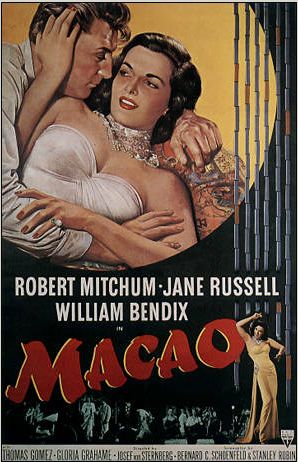
Macao

They don't have the all-time classics to their names that other film couples did. They weren't Tracy and Hepburn or Bogart and Hepburn or Wayne and O'Hara. But you know what stars Robert Mitchum and Jane Russell had in their two films together? An easy-going, sizzling charm that oozed off the screen. I'm hoping to write reviews for both soon, starting here with 1952's Macao, their second pairing.

Just 40 or so miles from Hong Kong, the city of Macao in the years following World War II has become a den of gambling, corruption, violence and any number of any other vices. One particularly crooked casino owner with his hands in everything, Vince Halloran (Brad Dexter), is especially worried though after he and his men killed an investigating officer from New York. They're playing the waiting game for the officer's replacement...and maybe some more heavy duty reinforcements. Coming ashore from a ship traveling from Hong Kong, all but three passengers are recognized, leading Halloran to believe one of them is the cop. The suspects? A Navy veteran on the run, Nick Cochran (Mitchum), a talkative salesman, Lawrence Trumble (William Bendix), and a nightclub singer looking for a job, Julie Benson (Russell). Who is the right one to target? Just which one is the cop looking to take Halloran in?

If that doesn't sound like the most pointed plot description, well, it ain't. Director Josef von Sternberg (along with some uncredited work from Nicholas Ray) was a silent film director who drifted along a touch when the sound era moved into the film industry. The Wikipedia page for 'Macao' specifically says "When von Sternberg's scenes made no sense dramatically..." so you know he wasn't always interested in a Point A to Point B (or C-through-Z) story to begin with. Production actually wrapped on filming in 1950, and then the finished product sat on the shelf for most of two years. How come? Producer Howard Hughes' track record basically. Decisions didn't have to make a whole lot of sense when your boss is one of the world's richest people. What's the end result then for this shelved, quasi-film noir?

It's good to great early on because of its randomness and general kookiness. It derails some in the last 20 minutes of its 80-minute running time. Let's focus on the positive though. 'Macao' is genuinely fun as everything is laid out and established. It mixes classic film noir with international intrigue with the huge chemistry between Mitchum and Russell with some laughs along the way. Long story short...it is a pleasant, enjoyable movie. It is dark, but not as dark as most film noirs. Some reviews point to that lack of a unified tone as a negative but the helter-skelter tone really worked for me. Should it have? Probably not but something clicks for me. Filmed in black and white with some stock footage of Macao and Hong Kong mixed in with the seedy Hollywood sets for the two cities, Sternberg's film has style and a great visual look.

Blah blah blah with all that film analysis. Let's talk about movie star chemistry!!! Robert Mitchum and Jane Russell are two of my favorites. Mitchum was that perfect tough guy anti-hero who just didn't give a crap. Russell was a solid actress, singer and performer who fit in well with the tough guys when her film roles allowed it. The end result? Two actors who don't look like they're acting. They're just hanging out, having a ton of fun bringing these two characters together. Their chemistry is evident from Scene No. 1 and never lets up. Not remembered as a great role -- and rightfully so -- Mitchum is pretty perfect, laconic and laid back with a checkered past hanging over his head. The same for Russell's Julie, bouncing from city to city looking for work. Oh, and Russell is drop dead gorgeous here. Hughes made her a star by utilizing her....natural talent I'll say. She's beautiful, and she's even given a chance to sing two songs.

The rest of the cast is solid throughout. I especially liked Bendix as Lawrence C. Trumble, fast-talking, looking to blow off some steam traveling salesman. His almost manic delivery pairs well with Mitchum's slower-paced line reads. Dexter is perfectly slimy as Halloran, the black market casino dealer always with an eye on shady deals and easy money. Also look for Thomas Gomez as the corrupt police officer working with Halloran, poorly and under-used Gloria Grahame as Halloran's much-maligned girlfriend, Philip Ahn as Halloran's steely-eyed enforcer, and Vladimir Sokoloff as a mysterious blind man who seems to pop up at the right moment whenever needed. A fun cast with some cool parts.

Now that line before about von Sternberg's lack of dramatic timing, yeah, that comes into play in the last 20 minutes. The cool, couldn't care less style loses all momentum. The finale turns into a big chase scene that doesn't keep the adrenaline flowing unfortunately. The ending itself feels a tad rushed, a disappointing end to an otherwise very enjoyable movie.

Macao (1952): ** 1/2 /****

Thursday, April 9, 2015

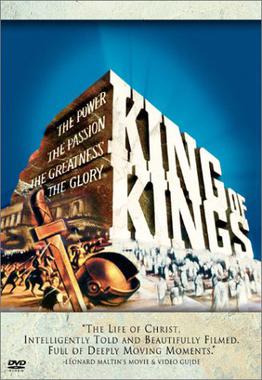
King of Kings

Is there a more daunting task as an actor to play a man millions of people around the world believe to be the Son of God? Sure, any portrayal of a real-life person has to be intimidating, but playing Jesus? That's gotta be on a whole other level. As I learned from the Internet, this movie was the first American film to show an actor's face portraying Jesus Christ. Here it is, a childhood favorite and one I revisited this past Easter weekend, 1961's King of Kings.

This is the story of Jesus (Jeffrey Hunter), a man who grew up in tumultuous times in Judea as Roman occupiers keep the Jewish/Hebrew people oppressed under their thumb. Revolts and rebellions rise up from year to year as Judea seeks its freedom, its independence to get away from the control of the Roman empire. Into this world, Jesus grows up into manhood ready to do his life's calling. Having worked his entire life and living in the Galilean town of Nazareth as a carpenter, Jesus in his late 20's ventures out into the world to embrace his calling as the messiah, the son of God who will teach the world how to live. It is a message that preaches peace but will no doubt send ripples throughout the Roman empire. As Jesus travels around the country with a small group of disciples, his name, his message and his words begin to spread. His followers increase, but so does the danger around him as many want nothing more than to kill him before he becomes too dangerous.

A plot description for a film about the life of Jesus Christ is pretty unnecessary, but I had to lay things out at least a little bit. In the age of the historical film epic, this entry from director Nicholas Ray has always been one of my favorites. I grew up watching it with my Mom every spring, and even years later, it holds up. If anything, I liked it more as a 29-year old viewer as opposed to a 10-year old kid. A whole lot of history is covered in 168 minutes but things never feel rushed. 'King' was filmed on-location in Spain with countless lavish sets and natural backdrops adding an incredibly authentic feel to the proceedings. The TCM print shown on Easter looked PHENOMENAL. Just a stunningly good-looking visual movie. The musical score from composer Miklos Rozsa is pretty perfect too, big and booming mixed in with softer, quieter and just as effective emotional moments. Listen to a sample HERE.

What struck me most in this 1961 epic about Jesus is that...well, it isn't just about Jesus. Ray and writer Philip Yordan use Jesus, his life and his teachings to tell a story about the times this man lived his life. Yes, the focus is on him, but it isn't exclusively focused on him. The casting is very solid with Jeffrey Hunter playing Jesus. Up there with The Searchers as his most famous, respected and recognizable role, Hunter does an excellent job here. It isn't the most human part, but that's not his fault. Hunter is sincere and likable and genuine with a script that keys in on Jesus' teachings more than getting to know the man as a person, as an individual. What works so well is the quieter moments and the impact we see as viewers that this man has on those around him, both the believers and the non-believers. Hunter never became the huge star he could have before his tragic death in 1969, but performances like this show his acting skill.

Four years later, a similarly-themed Jesus epic -- The Greatest Story Ever Told -- would set the bar for ridiculously overdone all-star casts. That ain't the case here. Ray fills out some major roles with recognizable faces and some stars, but this is even't close to being considered an all-star cast. Oh, and that's a good thing. The best supporting part goes to Ron Randell as Lucius, a Roman officer in the garrison at Jerusalem tasked with figuring out if Jesus is a threat to be dealt with. A human, questioning part, and a really good one. Next up, Irish actress Siobhan McKenna as Mary, Jesus' mother, making the character memorable with just a few quick scenes. And then there's the most recognizable face, Robert Ryan getting a meaty part as John the Baptist, a prophet more fiery than Jesus but who preaches the same peaceful message, one predicting the coming of the Son of God.

Who else to look for? If you're familiar with Jesus and the gospels, you know the names. Also in the cast are Pontius Pilate (Hurd Hatfield), Roman governor of Judea, Claudia (Viveca Lindfors), Pilate's more open-minded wife, Herod Antipas (Frank Thring), the Judean governor, his wife, Herodias (Rita Gam), and his stepdaughter, Salome (Brigid Bazlen), disciples Peter (Royal Dano) and Judas (Rip Torn), Barabbas (Harry Guardino), and Mary Magdalene (Carmen Sevilla).

Working consistently throughout the 1950s, director Ray carved a niche for himself as a director of smaller scale human dramas. A biblical epic about Jesus? Not his usual cup of tea. For all the immense scale though, it is the softer, quieter scenes that work. Quick montages of Jesus' miracles set to Rozsa's score are beautiful and effective. The sermon on the mount boasts all sorts of massive scale but is effective because of the dialogue and Hunter's acting. Certain events are glossed over more than others with a bigger focus late on the Passion and Resurrection. Obviously not nearly as graphic as the Passion of the Christ, it remains a moving finale.

King of Kings works because it doesn't try to be gigantically epic. It is content to tell a big story -- maybe history's BIGGEST story -- and to tell it well. Well worth it though, definitely worth checking out. Also listen for Ray Bradbury's uncredited narration, Orson Welles reading said narration, and future familiar face from the spaghetti western genre, Aldo Sambrell, making his screen debut.

King of Kings (1961): ****/****

Friday, May 27, 2011

Knock on Any Door

With as many movies as are readily available for viewing, you can't help but take certain movies, stars, and directors for granted at times. There are the instantly recognizable names (typically for good reasons), and recognizable names for all the bad reasons. But there's all sorts of names that are just there, quality movies that don't always get the press or publicity that others do. One of those names is director Nicholas Ray, a solid director who never reached iconic status. His movies are almost always solid with a few near-classics in his repertoire. Making his debut in 1949, Ray started with a courtroom drama, Knock on Any Door.

The natural drama and tension that comes as a result of a courtroom setting is basically a perfect place to base a movie in. If a director can't produce drama, tension and a bundle of nerves, maybe movies aren't for them. The back and forth of a lawyer questioning a witness, the science of getting a jury on your side, the desperate play which in a lot of ways can be a life and death situation, it is all screaming 'DRAMA!' For Ray's debut, the courtroom scenes are the best thing going for the movie. Unfortunately, it takes too long to get to those courtroom scenes, wasting time in some very 1950s melodrama that could have been ripped from a badly written soap opera. Making it worse, the ending gets a little preachy, trying to deliver a message that feels contrived and forced. Other than that, the movie is a solid debut.

A lawyer working for a firm that sees him as a future name partner, Andrew Morton (Humphrey Bogart) is faced with a difficult decision. A young man, Nick Romano (John Derek), who Andrew has defended before -- several times actually -- is again in trouble, but this time for a much more serious charge. Romano (dubbed 'Pretty Boy' by the newspapers) is on trial for robbing a bar and then murdering a police officer who tried to stop the robbery. Romano's record is checkered with past run-ins with the law so Morton has his work cut out for him. The case seems like a slam dunk against Romano, but Morton feels an obligation to defend him. His only tactic may be condemning society for turning Romano into the small-time thug that put him in this situation. But even making it a character issue, will that be enough?

 As a fan of both Bogart and Ray, I was excited to stumble across this one on TCM's schedule a few weeks ago. A courtroom drama with Bogie as a defense lawyer sounded like a slam dunk. And to be fair, the courtroom angle of the movie is the best thing going for Ray's debut. The negative comes from how long it takes to get to the actual trial. Most of an hour is spent in flashback-mode, giving plenty of background about Derek's Nick Romano. He grows up in Skid Row, turning to a life of crime to get by mostly because he doesn't want to work. He falls in love and marries good girl, Emma (Allene Roberts), only to push her away with his actions. My impression was that these scenes were meant to humanize Romano, even make us sympathize with him, but it fails. This is a despicable character in my mind. He has all the chances in the world to better himself and turns his back on every single one of them. The scenes are dull, repetitive and as mentioned before, melodramatic. It kills any momentum heading into the actual trial.

Then there's the courtroom. Playing a defense lawyer has to be the modern equivalent of playing a Shakespearean main character. These are parts tailor-made for above average actors (and actresses to be fair) to just go to town, throw everything at the wall and see what sticks. These are flashy parts. Think of Gregory Peck in To Kill a Mockingbird, James Stewart in Anatomy of a Murder, Tom Cruise in A Few Good Men, Maximillian Schell in Judgment at Nuremberg. These are parts that allow actors to stretch out, get settled and show off their skills. Bogart is one of the all-time greats so seeing him work the jury, the witnesses, the district attorney, even the judge is a thing of beauty. The back and forth as Bogie tries to get a not guilty verdict. Then there's the whole interest of if Romano is guilty. Ray keeps you guessing until the very end as to his innocence or guilt. The reveal is a little hammy, a little overdone, but it still works. It's just too bad that so much time was spent getting there.

Playing the noble defense lawyer, defending the downtrodden and beaten down, Bogart does not disappoint. He so often played the tough lead, the thug, the hired gun, the escaped convict, that it was great to see him playing a more polished, upper class role. The background on Bogie's Morton is that he's like Romano, the young man he is defending. He comes from Skid Row and rose above it, working his tail off to amount to something in life. He feels some obligation to Romano because he sees some of himself in him, a potential, a chance to make a good life for himself. As unlikable as Derek's Romano is, Bogart's Morton cancels it out. You like Morton, respect his ability in the courtroom to do what he needs to do. Bogart and Derek dominate the movie, not leaving much for the supporting cast. George Macready is the apparently slow-witted district attorney gunning for Romano, saving the big guns for late, Candy Toxton is Andrew's wife who has maybe 4 lines in the whole movie, Barry Kelley as Judge Drake, and Dewey Martin and Davis Roberts as two witnesses in Morton's case.

If there's one thing I don't like in my movies, it is a message that is delivered in such a heavy-handed fashion that it loses any meaning.  Not subtle or sly in its delivery, we're talking beat you over the head until it is battered into your brain. That's what Ray throws at you in the courtroom finale. Bogie gets his shot to blow away the audience and doesn't disappoint, delivering his angry monologue with fervor and passion. He condemns anyone and everyone, the individual, the family, the system, the government for creating a society where Skid Rows exist and young men have to turn to a life of crime to get by. He blames so many people and their lack of interest, initiative in making the world a better place, turning a blind eye to the plight of society that I completely tuned the message out. A message is one thing, but screaming that message at the viewer is the complete opposite end of the spectrum (and not in a good way). The final two shots of the movie help the movie end on a moving note, but that heavy-handed attempt just rubbed me the wrong way.The movie is a mixed bag, the courtroom scenes and Bogart making it worthwhile (barely).

Knock on Any Door <---TCM clips (1949): ** 1/2 /****

Thursday, June 17, 2010

The Lusty Men

When it comes to sports, I'll give just about anything a shot, and thanks to ESPN's family of networks I've gotten that shot at seeing all sorts of unique sporting events from the basics to fringe sports like bowling or billiards.  Then there's rodeo, a sport I've never really understood and some of that may have to do with where I've lived most of my life, Illinois and Indiana.  While not as violent as say bullfighting, rodeo has always rubbed me the wrong way for its treatment of animals.

TCM aired 1952's The Lusty Men last week, a story with the rodeo as the setting.  Before I get into this movie, I should say I've seen and enjoyed other rodeo movies like Junior Bonner with Steve McQueen or J.W. Coop with Cliff Robertson.  Some sports translate well to a movie form, football, basketball, baseball all come to mind, but I just don't think rodeo is one of them.  Up close and personal, I imagine it's a lot better to view, but there's a main flaw I have trouble getting past when it comes to movie versions.  That's for later though, let's talk story.

After one too many accidents on the rodeo circuit, past-his-prime cowboy Jeff McCloud (Robert Mitchum) gets a job as a ranch-hand where he meets fellow cowboy Wes Merritt (Arthur Kennedy).  Wes instantly recognizes Jeff and begs him to teach him some techniques and strategies for being successful at rodeos.  Married for two years to wife Louise (Susan Hayward), Wes is trying to save up $5,000 so they can buy a spread for themselves, but at his pay rate it will take years.  With Jeff's help, he sees a way to get the money fast, by joining the rodeo.  Louise is adamantly against it, but there's nothing she can do to stop her husband, sending him down a road she's worried he'll never come back down.

I was a little disappointed in the story here because for the first 90 minutes it is as predictable as possible.  If you've ever seen a movie with a teacher/mentor and a youngster/student, you basically know where this one is going.  McCloud and Merritt start off on the right foot, the younger cowboy idolizing his hero as he teaches him all he knows about the business.  But the second Wes gets any taste of success, he begins to resent his teacher who he previously looked up to. He doesn't want to be held back and wants to explore this new world on his own.

If about 15 minutes you haven't figured out where this movie is going, shame on you.  Wes does get a taste of the big-time after a lifetime of scraping by from month to month.  At first all he wanted was a little place of his own, but now he's living on easy street so why should he go back to busting his hump?  My only question in all of this was whether Mitchum's Jeff was going to pounce on Hayward's Louise.  That issue is resolved late, and I give props to director Nicholas Ray for not taking the easy way out. The ending as is has one character making a sacrifice -- unintentionally so -- that ends up making the other two very happy.

Watching this predictable storyline, hopefully you'll be saved by the three starring performances.  Mitchum plays his typical laid back, uber-cool guy who never gets too rattled by anything.  He drifts along, letting Kennedy do the heavy lifting with the meatier role of the cowboy turned rodeo star.  Through all their ups and downs though, the two still have a friendship that can't be broken up.  A wordless scene late between them -- a smile and a wink here -- show it will take more than one fight to split them up.  Hayward is the strongest part of the movie playing a woman who just wants to be happy with her husband, even though it seems he wants nothing to do with settling down.  Also, Arthur Hunnicutt plays Booker Davis, a former rodeo star now a near-cripple.  For the most part, Hunnicutt doesn't over-do it as his parts so often required him to do. Frank Faylen plays a stock owner traveling along with the rodeo.

Even with the rodeo movies I've enjoyed as mentioned above, my issue is with the actual rodeo scenes.  One, studios aren't going to let stars like Mitchum, McQueen, Kennedy, and Robertson actually do any bronc riding or bulldogging.  Instead, we get a quick shot of the star on a horse/bull and a quick cut to an actual cowboy in a long shot in the ring.  Repeat this over and over to your heart's delight.  I don't know now if CGI could help this, but it is always distracting and can be downright dull at times watching cowboys or stunt doubles take over instead of the actors.

While these rodeo scenes can be a little slow moving, the movie as a whole is still worth a watch.  Ray has some fun with some interesting looking camerawork, and the actors are all solid -- especially Hayward -- in making these three characters full-fledged, 3-D, believable people and not just cardboard cutouts.

The Lusty Men <----TCM trailer (1952): ** 1/2 /****

Friday, February 5, 2010

55 Days at Peking

By 1963, Charlton Heston had already portrayed Moses, a Judean prince, William Clark (of Lewis and Clark), Andrew Jackson and was still several years away from playing Michelangelo, John the Baptist, and Marc Anthony. If there was an actor better suited to the historical epic -- and reveling in it at the same time -- I can't come up with a name. Something about his style, his acting ability, it just worked well in period pieces, like 1963's 55 Days at Peking.

I'll be the first to admit that while U.S. history is one of my favorite subjects, I know very little about Asian history whether it be China, Japan or anything in between. The subject covered in 'Peking' is the Boxer Rebellion, which I've always been aware of but couldn't have told you one thing about it. Reading some reviews and critiques of the movie, it seems history was handled fairly and mostly honestly. Looking at it that way, it serves then as both a history lesson and an entertaining epic.

Arriving in 1900 Peking with a company of U.S. Marines, Major Matt Lewis (Heston) finds a city in turmoil and on the brink of war. The Boxers, a large group of anti-imperialism/anti-catholic citizens, are ready to revolt. The world powers all have an ambassador and embassy in Peking with a token force of their military -- around 400 total men -- there for protection. British ambassador Sir Arthur Robertson (David Niven) somehow convinces the other ambassadors to stay even when a revolution seems imminent that could take all their lives. The armed forces along with all family, women and children move into the Legation Quarter, a walled city that can serve as a fortress. But with limited supplies, including food and ammunition, can the multi-national group survive until reinforcements arrive?

Based on the actual Boxer Rebellion history, 'Peking' holds many similarities with 1960's The Alamo both in history and in movies with composer Dimitri Tiomkin doing the score for both. After some background, both historical and character driven, most of the movie settles in for the extended siege of the Legation Quarter. Director Nicholas Ray -- who usually worked on smaller, more manageable movies -- has his work cut out for him. Making a siege interesting to watch is a challenge, but Ray succeeds. The almost two-month long battle is never dull with plenty of tension and action, but more on that later.

Once past the big name stars, 'Peking' doesn't have a cast of thousands of A-list stars, but the leads more than handle their own. Heston is an ideal choice for the tough U.S. Marine trying to do what's right, and Niven hits all the right notes as a former soldier turned ambassador trying to prove he belongs. Rising above just an unnecessary eye candy role, Ava Gardner nails her part as Baroness Natalie Ivanoff, a woman being kicked out of the city forced to re-enter upon the attack. She has an instant connection with Heston's Lewis, but thankfully the script calls for her to dig deeper as Natalie sees the horror of the fighting. Also starring are Flora Robson as Empress Tzu-Hsi, John Ireland as Sgt. Harry, one of Heston's Marines, and Harry Andrews as Father de Bearn, a priest with some military background. There's also a worthwhile subplot with a Chinese girl (Lynne Sue Moon) who's father is a Marine.

A good test if whether the movie you're watching is an epic has an overture, intermission, and exit music. If you answered 'yes' to the question, enjoy YOUR EPIC! 'Peking' has spectacle written all over it from the cast to the sets to the thousands of extras. Huge sets were constructed in Spain, and they're a site to behold, giving the story a real authenticity that would have been lost with models or green screens. Hundreds and thousands of extras fill the screen for the battle scenes which are some of the bigger ones ever committed to the screen. With the list of differing armed forces nationalities, there's even some humor, like Ireland's Sgt. waking up soldiers in a litany of languages.

Now for whatever reason -- probably because it's a good movie and what'd be the point of it -- this movie has not been released on DVD, not a good one at least. It's one of those epics where you can honestly say 'they don't make them like that anymore.' 'Peking' is everything that was big and grand about a roadshow version of a movie with great casting, a bigger than life historical story, memorable score, huge action, and surprisingly enough, an effective message. After all, the Boxers just want their country back...even if they go about it in an extreme fashion.

I was unable to find a trailer -- an English one anyways, if you understand German I can help you out -- but TCM has posted 4 clips you can watch through their website. The print shown on TCM was pretty near flawless if you ask me so how about those studio execs get off their butts and get this one on DVD.

55 Days at Peking (1963): *** 1/2 /****

Friday, March 13, 2009

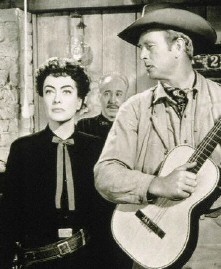
Johnny Guitar

Certain westerns try to switch things up when it comes to the old reliables of the genre. One of those is the male hero. Nicholas Ray's offbeat 1954 western Johnny Guitar turned that aspect of westerns away immediately with Joan Crawford as the lead and a woman as her main rival. A definite inspiration for Sergio Leone with Once Upon a Time in the West, the basic plot is similar, this was an interesting movie that certainly deserves its cult status.

A guitar-playing cowboy (it's not as bad as it sounds) rides into a lonely saloon one day looking for a job as a musician. His name: Johnny Guitar (Sterling Hayden in one of his better parts). He has a past with the saloon owner, Vienna (Joan Crawford), who is sitting on a fortune and everyone knows it. She owns much of the land where the railroad will have to drive through. When the rails reach her acreage, she'll be rich. But not so fast, Guitar finds out there's two factions in town, the ranchers and the outlaws.

Tough-talking Emma Small (Mercedes McCambridge) and ranch owner John McIvers (Ward Bond) want Vienna out of the town so they can swoop in and grab her land and saloon. On Vienna's side is a gang led by an outlaw called the Dancin' Kid (Scott Brady). The Kid and his gang, Turkey Ralston (Ben Cooper), Bart Lonergan (Ernest Borgnine), and Corey (Royal Dano) are as equally hated as Vienna. Johnny Guitar rode into town thinking he had an easy job playing his guitar but finds out quickly nothing comes easy. Throw in John Carradine and Paul Fix as two of Vienna's employees and you've got quite a cast.

Lots going on here in this western. It's a talkative western with some gunplay sprinkled in but not too much. There's elements of other genres, straight romance stories, bits of film noir, and even a little McCarthy-ism just for good measure. And as mentioned, there's a lot of influence on later westerns, especially OUATITW. A posse all dressed in black hunts down the Kid and his gang look like something out of a spaghetti western like Django Kill! And where most westerns don't know what to do with female characters, this one puts them front and center. Both characters are interesting and developed with the fanatical rivalry kinda frightening.

The cast works well for the most part. Crawford doesn't look comfortable, but she gives a good performance. Always a little wooden in the acting department, Hayden pulls off the part of a guitar-playing cowboy with a past well. McCambridge is a good counter to Crawford as two women who hate each other and would love to see the other one dead. The finale, a shootout between the two, is the only woman vs. woman gunfight I can even think of in a western. About as different from the norm as you could get with a western, especially in the straight-laced 50s, Johnny Guitar should be a must-see for western fans!