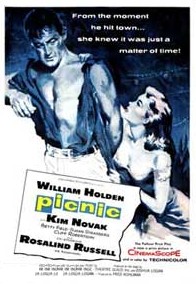
I tend to think of the 1950's as a pleasant mix of Leave it to Beaver and Happy Days. Naturally, that's not what the entire decade in the U.S. was like, but isn't it fun to think of it that way? They were more innocent times before the hair on fire 1960's rolled around, huh? Some of those 1950's movies though, you could see an indication of what was to come. One sexually charged or sexually repressed movie after another hit theaters, many of them based off scandalous novels or stage plays. One I've always been curious to watch and was finally able to track down? That's 1955's Picnic.
A freight train rolls into a quiet Kansas town on a hot summer day, and a man named Hal Carter (William Holden) jumps off. A drifter without a home or too much money in his pocket, Hal hopes to reunite with a friend from college and maybe get a job out of it...if possible. It doesn't take too long for Hal to find the friend, Alan Benson (Cliff Robertson), the well-to-do son of one of the richest men in town. Even after years apart and with both men having gone down such different paths, the two fraternity buddies pick things up like they were never apart. It's Labor Day, and Hal's timing is pretty good as the whole town is heading off to an immense picnic, a farewell of sorts to the summer. Hal is a little wary of the gathering as the outsider in town but ends up going. Problem? You bet, especially when Hal sets his sights on Madge (Kim Novak), Alan's beautiful girlfriend who comes from a poor(ish) family. Let the drama begin.
In the button-down, gentlemanly, poodle-skirt era of the 1950's, people simply did not have sex. It was simply...FORBIDDEN. Or so the movies would have you think. This was a huge time of change in Hollywood as studios got away from all sorts of production codes that limited what could and couldn't be shown. So as a result, audiences got a lot of sexually charged, forbidden love movies, often set in little towns where sexual frustrations apparently ran rampant. We got movies like this, Peyton Place, God's Little Acre, A Streetcar Named Desire, Baby Doll and plenty more I'm probably forgetting. All that repression and frustration always explodes in dramatic fashion! Ah, emotions and feelings! Yeah, at times, things can go a little overboard. That's Picnic. Some good moments, some good performances, with some really heavy, overdone moments.
'Picnic' is based off a Pulitzer Prize winning play that took Broadway by storm in 1953. Director Joshua Logan helmed both the play and the feature film, picking up an Oscar nomination in the process. In its filming techniques, 'Picnic' never feels like a stage-based play turned feature film. You can't say that for a lot of like-minded films. Logan filmed on-location in Hutchinson, Kansas and explores the town. You get a feel for the town, its people and its energy. The movie itself clocks in at 115 minutes and can clearly be divided in two parts. That first hour sets the stage, introducing all this hidden drama, rivalries, personal problems and lets the tension build into the high-drama of the second half as all those issues come to center stage. As for me? I loved the first hour and tolerated the second. More on that to come.
The cast doesn't feature a ton of big names, but that's not a bad thing. Holden took some heat because at 37 he was probably a little too old for the Hal part, but probably doesn't mean much. He brings the right energy to the part, hiding some personal demons while presenting an outgoing, fun-loving, likable persona. Really? He's a man in his mid-20s trying to find his lot in life, and so far, he's come up empty wherever he's turned. This isn't always a likable character, but Holden's Hal is a sympathetic one. His chemistry with Novak's Madge is perceptible in the air, just two people drawn to each other and they can't explain it. Novak would develop into a solid actress over the years, but here, her performance is a little rough. As a presence, she's unquestioned, stunningly beautiful, her Madge sick of everyone judging her by looks and looks alone.
Who else to look for? 'Picnic' was actually Cliff Robertson's first credited feature film, his Alan being an interesting mix, a spoiled kid who doesn't want to be the spoiled kid. We do get to see a mean streak in him though so stay tuned. Betty Field plays Flo, Madge's single mother, badgering and worrying and overbearing, while Susan Strasberg is Millie, Madge's tomboy little sister, smart, a reader and sick of Madge. Rosalind Russell hams it up as Rosemary, a 40-something schoolteacher in town, with a suitor/boyfriend of sorts in shop owner, Howard (Arthur O'Connell in an Oscar-nominated turn). Also look for Verna Felton as Helen Potts, the adorable next door neighbor, a bit of a conscience for the film/town, and Nick Adams as a horny teenager.
When Picnic is good, it's really good. But when it goes? Man, it goes. Everything comes to crazy fruition at the tail end of the picnic, and all hell breaks loose. The key, momentum-changing shift is started when a shirt gets torn, and literally everyone FREAKS THE EF OUT. A movie based on a stage play becomes very stagey and overdone and hammy. EMOTIONS and FEELINGS are everywhere. It's not that the drama isn't effective. It's that it lacks all subtlety at all. It becomes painful to watch at times. The ending itself is built up as a happy ending (of sorts), but man, when you think about it, this is NO happy ending at all. Still...it's a very cool final shot, so that counts for something right?
An interesting mix in the end. I really liked parts of it, especially Holden's performance, but the whole thing gets to be a little much in the end. The positives serve as a time capsule of sports. The entire story takes place in a 24-hour time period, and my goodness, it was quite the sunny, beautiful Labor Day. This is a beautiful movie to sit back and watch and appreciate it. We get a picture of 1950's life, especially in the extended picnic sequence as the whole town comes together to celebrate. Before all hell breaks loose in the emotions department in the second half, you get a sense of a more innocent time, and then Holden's shirt gets ripped and all bets are off. Still, there's enough to recommend but be forewarned that things turn into a sappy, tawdry soap opera in the second half.
Picnic (1955): ** 1/2 /****
The Sons of Katie Elder
"First, we reunite, then find Ma and Pa's killer...then read some reviews."
Showing posts with label Kim Novak. Show all posts
Monday, August 10, 2015
Thursday, January 15, 2015
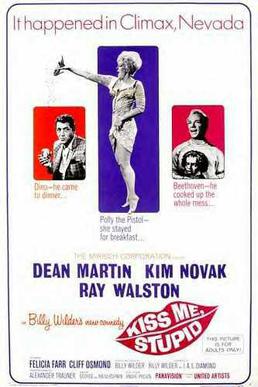
Kiss Me, Stupid
There wasn't much director and writer Billy Wilder didn't do over a career that spanned six decades. He did one of the best comedies of all-time in Some Like It Hot, one of the best dramas in Sunset Boulevard, some of the best noirs in Ace in the Hole and Double Indemnity, and many more I'm not even listing. How about something out of the ordinary then? Yeah, a romantic comedy...of sorts. Here's 1964's Kiss Me, Stupid.
Having closed out a successful show in Las Vegas, a highly successful musician and performer named Dino (Dean Martin) jumps in his car and starts driving toward Los Angeles. What's waiting him? A TV special and everything L.A. has to offer. Well, that's the plan at least. He stops in the little Nevada desert town of Climax where two aspiring songwriters, Orville (Ray Walston), a piano teacher, and Barney (Cliff Osmond), the gas station owner, see a chance to make their riches if they can sell a song or two to the famous singer. How should they go about it though? Dino has quite the reputation as a hard-drinking, partying womanizer so....what if he was interested in Orville's wife? The piano teacher can't go along with it, not with his actual wife at least. He enlists the help of a waitress, Polly the Pistol (Kim Novak), from the local roadhouse (that appears to be doubling as a bordello of sorts). Can they somehow pull this wacky plan off?
Leave it to Billy Wilder to completely throw an entire genre on its side and do it well. The 1960s were the age of the screwball sex comedies that as you watch them now 50-plus years later....they're not always that good. The jokes and innuendos are tame to say the least, and the attempts at humor are usually so overdone that any natural laughs get killed on the spot. Sure, there are some exceptions. There always are when the number of movies continues to pile up. This 1964 satire on the whole has some bite. All those laughs that fell short in the played straight for laughs comedies land with an effective boom here. The laughs crackle, they're subtle but not too subtle and overall? That formula just works so well. Sure, it's a little slow, a little long at times at 126 minutes, but for the most part it hits all the right buttons.
In production, 'Kiss' sure seemed like it was going to be a difficult film to make. Wilder originally wanted to cast Jack Lemmon (a frequent Wilder collaborator) in the Walston role, but Lemmon had prior obligations. Next up, Peter Sellers who was cast, started filming and had to bail when he had 13 freaking heart attacks!!! Six weeks into filming, Wilder had to recast the part, choosing Walston and then re-filming all those scenes. Does it show? No, not especially. Walston is excellent and the movie moves on without missing a beat. It was filmed in black and white -- I watched a beautiful print on MGM-HD on TV -- and is based off an Italian play and was later turned into an Italian feature film. The story develops like a play, the entire story taking place at Orville's home, Barney's gas station and the Belly Button (the roadhouse). It all fits together in pretty perfect fashion.
A movie that loses potential star power and quite the acting chops in Lemmon and Sellers could be quite an issue, but not here as the ensemble carries the sexually-charged comedic story. Martin plays a variation on himself, sleezy and without a care in the world other than hooking up with a different woman every night. Considering how harsh the script is, it's somewhat surprising Martin even took the role! Walston gets to ham it up some as Orville, paranoid and convinced his far prettier wife, Zelda (Felicia Farr), is cheating on him with anyone and everyone. In a role originally intended for Marilyn Monroe, Kim Novak -- one of my favorites -- is a sultry scene-stealer as Polly, a girl down on her luck who has to take some rather drastic measures to save some money. Playing Orville's sidekick of sorts, Osmond gets some big laughs as the big, boisterous Barney, putting this crazy plan into action.
The script/screenplay itself screams I Love Lucy episode when it comes to the gag Orville and Barney try to pull off. That's where some of that risque quality comes in. Using a stand-in wife, Orville just turns a blind eye to Martin's Dino making brutally obvious advances at his wife. He intends to give her to him. This is 1964?!? You can see why it met with some objections. Things get downright crazy and completely out of left field in the last 15 minutes in ways I was not expecting. So yeah, the ending kinda falls apart, but getting there is a lot of fun. The innuendos building up to it work pretty well, especially Orville talking about the size of his...well, never mind, and Polly overhearing the plan for what she's intended to do with Dino. Misunderstandings and all sorts of hijinks like that just shouldn't work, but it does.
A pleasant surprise. Go figure. Worst case? Kim Novak is downright perty here in one of her sexiest roles.
Kiss Me, Stupid (1964): ***/****
Having closed out a successful show in Las Vegas, a highly successful musician and performer named Dino (Dean Martin) jumps in his car and starts driving toward Los Angeles. What's waiting him? A TV special and everything L.A. has to offer. Well, that's the plan at least. He stops in the little Nevada desert town of Climax where two aspiring songwriters, Orville (Ray Walston), a piano teacher, and Barney (Cliff Osmond), the gas station owner, see a chance to make their riches if they can sell a song or two to the famous singer. How should they go about it though? Dino has quite the reputation as a hard-drinking, partying womanizer so....what if he was interested in Orville's wife? The piano teacher can't go along with it, not with his actual wife at least. He enlists the help of a waitress, Polly the Pistol (Kim Novak), from the local roadhouse (that appears to be doubling as a bordello of sorts). Can they somehow pull this wacky plan off?
Leave it to Billy Wilder to completely throw an entire genre on its side and do it well. The 1960s were the age of the screwball sex comedies that as you watch them now 50-plus years later....they're not always that good. The jokes and innuendos are tame to say the least, and the attempts at humor are usually so overdone that any natural laughs get killed on the spot. Sure, there are some exceptions. There always are when the number of movies continues to pile up. This 1964 satire on the whole has some bite. All those laughs that fell short in the played straight for laughs comedies land with an effective boom here. The laughs crackle, they're subtle but not too subtle and overall? That formula just works so well. Sure, it's a little slow, a little long at times at 126 minutes, but for the most part it hits all the right buttons.
In production, 'Kiss' sure seemed like it was going to be a difficult film to make. Wilder originally wanted to cast Jack Lemmon (a frequent Wilder collaborator) in the Walston role, but Lemmon had prior obligations. Next up, Peter Sellers who was cast, started filming and had to bail when he had 13 freaking heart attacks!!! Six weeks into filming, Wilder had to recast the part, choosing Walston and then re-filming all those scenes. Does it show? No, not especially. Walston is excellent and the movie moves on without missing a beat. It was filmed in black and white -- I watched a beautiful print on MGM-HD on TV -- and is based off an Italian play and was later turned into an Italian feature film. The story develops like a play, the entire story taking place at Orville's home, Barney's gas station and the Belly Button (the roadhouse). It all fits together in pretty perfect fashion.
A movie that loses potential star power and quite the acting chops in Lemmon and Sellers could be quite an issue, but not here as the ensemble carries the sexually-charged comedic story. Martin plays a variation on himself, sleezy and without a care in the world other than hooking up with a different woman every night. Considering how harsh the script is, it's somewhat surprising Martin even took the role! Walston gets to ham it up some as Orville, paranoid and convinced his far prettier wife, Zelda (Felicia Farr), is cheating on him with anyone and everyone. In a role originally intended for Marilyn Monroe, Kim Novak -- one of my favorites -- is a sultry scene-stealer as Polly, a girl down on her luck who has to take some rather drastic measures to save some money. Playing Orville's sidekick of sorts, Osmond gets some big laughs as the big, boisterous Barney, putting this crazy plan into action.
The script/screenplay itself screams I Love Lucy episode when it comes to the gag Orville and Barney try to pull off. That's where some of that risque quality comes in. Using a stand-in wife, Orville just turns a blind eye to Martin's Dino making brutally obvious advances at his wife. He intends to give her to him. This is 1964?!? You can see why it met with some objections. Things get downright crazy and completely out of left field in the last 15 minutes in ways I was not expecting. So yeah, the ending kinda falls apart, but getting there is a lot of fun. The innuendos building up to it work pretty well, especially Orville talking about the size of his...well, never mind, and Polly overhearing the plan for what she's intended to do with Dino. Misunderstandings and all sorts of hijinks like that just shouldn't work, but it does.
A pleasant surprise. Go figure. Worst case? Kim Novak is downright perty here in one of her sexiest roles.
Kiss Me, Stupid (1964): ***/****
Wednesday, November 20, 2013
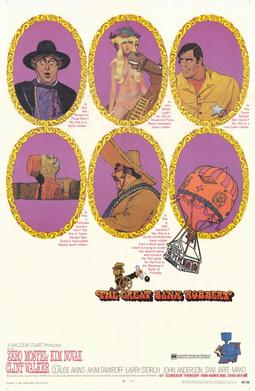
The Great Bank Robbery (1969)
From banks to trains, stagecoaches to payrolls and everything in between, wild west bandits, robbers and thieves had plenty of choices as to who and where to rob. But how about an impenetrable bank built specifically to hold back any would-be robbers? That's the basis for 1969's The Great Bank Robbery, a western spoof.
Having just pulled off a successful robbery of a government gold shipment, notorious outlaw Slade (Claude Akins) heads to the town of Friendly, Texas to stash his takings in a bank built by outlaws for outlaws. No one....no one can rob it. Well, that perfect bank is about to be tested. A con man and robber posing as a priest, Rev. Pious Blue (Zero Mostel), with his assistants, including "Sister" Lyda (Kim Novak), to tunnel into the bank. At the same time, a Mexican bandit (Akim Tamiroff), and his gang are prepping for an attack on the town and bank. Also, a Texas Ranger, Ben Quick (Clint Walker), has been sent to Friendly to investigate and to see if he can get into the bank too. His plan? Hire a group of Chinese laundry workers to tunnel into the bank as well. Well, this should be interesting as all these different groups unknowingly working toward the same goal.
Western comedies usually aren't my thing....like at all. This one worried me some with its low IMDB rating and generally across the board negative reviews. Still, the cast sounded pretty appealing, and who am I kidding? I'll give any western -- even a spoof-life comedy -- a shot when it comes right down to it. Well, I'm really glad I did. Is it dumb, even too stupid for its own good? Oh, yes, very much. Director Hy Averback works on a straightforward, broad comedic strokes level. This is not any subtle English humor. This is stereotyped Mexican bandits and Chinamen, one goofier situation on top of each other, and a madcap finale that includes colliding horses and wagons, a getaway via a hot air balloon and a cannon cutting loose on a church steeple. Nothing academic, smart or subtle here. We're talking LAUGH! moments. That said, I cracked up and liked it a lot.
Committing to the goofiness is a very solid cast that embraces the stupid. Walker plays the straight man, Texas Ranger Ben Quicky who is a good trailsman, a fast draw with his pistol and a gentleman to the end. Mostel is a scene-stealer as Reverend Pious Blue, a con man with an eye on a pot of gold. He even gets a goofy musical number with a boys choir that comes out of nowhere. Novak gets to sex kitten it up as Sister Lyda, always with a couple strategic buttons undone here and there. Lyda ends up being a diversion for the questioning Ranger Quick. Their scene together when Lyda gives Ben some peyote candy is priceless (watch it HERE), the Ranger no idea he's hallucinating. As for Pious' "assistants," look for John Fiedler as Br. Dismas (explosives), Peter Whitney as Br. Jordan (tunneling/engineering), and Sam Jaffe as Br. Lilac (art forger). In addition to the stereotypical (if fun) Mexican bandit, Papa, played by Tamiroff, is Larry Storch as his dim-witted but well-meaning son, Juan.
My favorite part goes to western veteran/regular and character actor Claude Akins as the outlaw and man in black, Slade. His part is underplayed to perfection in putting a new spin on that familiar character of the western baddie. Akins as Slade is a philosophical wondering man, calling all those around him "Scum" and "Scum of the Earth." When he shoots people -- kinda a must in the business he's chosen -- he questions "Why do they always make me do that?" He's a brooding, almost depressed man, always keeping his right hand man, Jeb (Elisha Cook Jr.), down with a series of threats and putdowns. A great, scene-stealing part for the always reliable Claude Akins. Also look for John Anderson as Kincaid, the crooked mayor and bank owner, Mako as Secret Agent Fong, working with Quick to find out what's going on, and Ruth Warrick as Mrs. Applebee, a curvy townswoman who takes an interest in Reverend Pious.
I can appreciate this comedy isn't rewriting the genre, and maybe it isn't even that good. But I keep coming back to one of my old standbys. Was I entertained? Throughout, even if that madcap finale is a little much and the movie just sort of ends. The always reliable Clint Walker, sex kitten Novak with a quasi-nude scene, Akins in a memorable part, there's a lot going for this comedic western that isn't trying to rewrite the genre. It's supposed to be fun and goofy and stupid. I liked it throughout.
The Great Bank Robbery (1969): ***/****
Having just pulled off a successful robbery of a government gold shipment, notorious outlaw Slade (Claude Akins) heads to the town of Friendly, Texas to stash his takings in a bank built by outlaws for outlaws. No one....no one can rob it. Well, that perfect bank is about to be tested. A con man and robber posing as a priest, Rev. Pious Blue (Zero Mostel), with his assistants, including "Sister" Lyda (Kim Novak), to tunnel into the bank. At the same time, a Mexican bandit (Akim Tamiroff), and his gang are prepping for an attack on the town and bank. Also, a Texas Ranger, Ben Quick (Clint Walker), has been sent to Friendly to investigate and to see if he can get into the bank too. His plan? Hire a group of Chinese laundry workers to tunnel into the bank as well. Well, this should be interesting as all these different groups unknowingly working toward the same goal.
Western comedies usually aren't my thing....like at all. This one worried me some with its low IMDB rating and generally across the board negative reviews. Still, the cast sounded pretty appealing, and who am I kidding? I'll give any western -- even a spoof-life comedy -- a shot when it comes right down to it. Well, I'm really glad I did. Is it dumb, even too stupid for its own good? Oh, yes, very much. Director Hy Averback works on a straightforward, broad comedic strokes level. This is not any subtle English humor. This is stereotyped Mexican bandits and Chinamen, one goofier situation on top of each other, and a madcap finale that includes colliding horses and wagons, a getaway via a hot air balloon and a cannon cutting loose on a church steeple. Nothing academic, smart or subtle here. We're talking LAUGH! moments. That said, I cracked up and liked it a lot.
Committing to the goofiness is a very solid cast that embraces the stupid. Walker plays the straight man, Texas Ranger Ben Quicky who is a good trailsman, a fast draw with his pistol and a gentleman to the end. Mostel is a scene-stealer as Reverend Pious Blue, a con man with an eye on a pot of gold. He even gets a goofy musical number with a boys choir that comes out of nowhere. Novak gets to sex kitten it up as Sister Lyda, always with a couple strategic buttons undone here and there. Lyda ends up being a diversion for the questioning Ranger Quick. Their scene together when Lyda gives Ben some peyote candy is priceless (watch it HERE), the Ranger no idea he's hallucinating. As for Pious' "assistants," look for John Fiedler as Br. Dismas (explosives), Peter Whitney as Br. Jordan (tunneling/engineering), and Sam Jaffe as Br. Lilac (art forger). In addition to the stereotypical (if fun) Mexican bandit, Papa, played by Tamiroff, is Larry Storch as his dim-witted but well-meaning son, Juan.
My favorite part goes to western veteran/regular and character actor Claude Akins as the outlaw and man in black, Slade. His part is underplayed to perfection in putting a new spin on that familiar character of the western baddie. Akins as Slade is a philosophical wondering man, calling all those around him "Scum" and "Scum of the Earth." When he shoots people -- kinda a must in the business he's chosen -- he questions "Why do they always make me do that?" He's a brooding, almost depressed man, always keeping his right hand man, Jeb (Elisha Cook Jr.), down with a series of threats and putdowns. A great, scene-stealing part for the always reliable Claude Akins. Also look for John Anderson as Kincaid, the crooked mayor and bank owner, Mako as Secret Agent Fong, working with Quick to find out what's going on, and Ruth Warrick as Mrs. Applebee, a curvy townswoman who takes an interest in Reverend Pious.
I can appreciate this comedy isn't rewriting the genre, and maybe it isn't even that good. But I keep coming back to one of my old standbys. Was I entertained? Throughout, even if that madcap finale is a little much and the movie just sort of ends. The always reliable Clint Walker, sex kitten Novak with a quasi-nude scene, Akins in a memorable part, there's a lot going for this comedic western that isn't trying to rewrite the genre. It's supposed to be fun and goofy and stupid. I liked it throughout.
The Great Bank Robbery (1969): ***/****
Labels:
1960s,
Akim Tamiroff,
Claude Akins,
Clint Walker,
Comedy,
Elisha Cook Jr.,
John Anderson,
Kim Novak,
westerns,
Zero Mostel
Friday, July 12, 2013
Pal Joey
There aren't too many actors-performers-entertainers cooler than Frank Sinatra. A movie star since the 1940s, Sinatra hit his groove as a dramatic actor in the mid 1950s in films like From Here to Eternity. How about 1957's Pal Joey? Based off a novel turned stage play, it allows Sinatra to show off that dramatic side while also playing a role that ain't so far removed from his real-life persona.
Kicked out of one town after another, second-rate singer and performer Joey Evans (Sinatra) arrives in San Francisco on the train with a few bucks in his pockets and the clothes on his back. A performer and singer, Joey wants nothing more than to have his own club, his name in lights outside, but his own troubles with women always derail those plans. He does manage to get a job at a small club where he meets Linda (Kim Novak), a naive, young dancer who still manages to see Joey's act. Undeterred, Joey still has his eyes set on her when he meets Vera Prentice-Simpson (Rita Hayworth), a former stripper turned lonely widow looking for a project. Getting along with Vera and more, Joey has a chance to hit the big time if he plays his cards right, but his old ways are just waiting to make an appearance, ruining everything.
A book turned highly successful musical turned highly successful movie, 'Pal' has quite the history. By the time it reached theaters in director George Sidney's film, it had undergone quite the transformation. Characters have been completely removed, some plot lines thrown by the wayside, other characters tweaked and turned to help make a pretty involved stage play more manageable. Sidney's film version picked up four Oscar nominations (but didn't win any) and two Golden Globe nominations, Sinatra winning for Best Actor. It is a fine example of a time and era in Hollywood long since past, stylish and cool without ever really trying too hard.
Here we are though, an issue I think I will have with every musical ever made. The singing, and more importantly, the out of left field, random, unexplained singing where everyone knows the words spontaneously (including the dance numbers). How does 'Pal' solve that issue? All the songs are naturally in the film's story, Joey, Linda and Vera all singing because the story requires it. Novel concept, huh? Sinatra gets his chance to sing, showing off that natural, easy-going stage ability, including The Lady Is a Tramp (HERE) and I Could Write a Book (HERE) among others, with Novak also getting a chance to sing/perform, Hayworth as well (performing but lip-synched). The best thing going though is simple. The songs are catchy, whistle-worthy songs that will be in your head for days. That's not necessarily a good thing, but it works here.
The Wikipedia entry for this flick is spot-on, many critics pointing to it as the definitive Sinatra flick. Sinatra does a fine job making a pretty despicable character at least mildly tolerable and even likable at times. Is it a stretch for him to play a smooth-talking, extremely talented, schmoozing entertainer? Um.....no, but he brings it to life. There are times you just want to slap the character, but that would be too perfect. It's Sinatra playing Sinatra with a slight twist. With several characters completely wiped from the play, the focus remains on Sinatra, Novak and Hayworth. Novak as Linda is in sex kitten mode, singing with that sultry voice and dancing with.....well, not much on (watch HERE). Hayworth as the slightly older, very smart and been there, seen that Vera is a scene-stealer as well, manipulating and twisting things as she sees necessary. A fine trio to lead the movie's smallish cast.
Also look for Barbara Nichols as Gladys, the conniving dancer/performer Joey bristles at, Bobby Sherwood as Ned, the bandleader who knows Joey's past and typical transgressions, and Hank Henry as Mike Miggins, the club owner who not so willingly gives Joey a shot at his club when he makes a high-reaching promise.
Having seen the play on the North Side of Chicago with the girlfriend in April, I was surprised to see how much was in fact snipped, cut up and prodded along to turn it into the film version. A lot has been changed. Most of the changes were wise choices in hopes of keeping the movie doable in a 109-minute final product. It is a 1957 movie, and the ending is basically the complete polar opposite of the play. For any sort of reality, it's dumb, basically washing away any character study we've developed up to this point with the Joey character. For the sake of a happy ending though, it works....I suppose. It drags a little in the second half, but the talents of the cast make up for some of the slow going. Long story short, it's Frank Sinatra being as cool as he ever was.
Pal Joey (1957): ***/****
Kicked out of one town after another, second-rate singer and performer Joey Evans (Sinatra) arrives in San Francisco on the train with a few bucks in his pockets and the clothes on his back. A performer and singer, Joey wants nothing more than to have his own club, his name in lights outside, but his own troubles with women always derail those plans. He does manage to get a job at a small club where he meets Linda (Kim Novak), a naive, young dancer who still manages to see Joey's act. Undeterred, Joey still has his eyes set on her when he meets Vera Prentice-Simpson (Rita Hayworth), a former stripper turned lonely widow looking for a project. Getting along with Vera and more, Joey has a chance to hit the big time if he plays his cards right, but his old ways are just waiting to make an appearance, ruining everything.
A book turned highly successful musical turned highly successful movie, 'Pal' has quite the history. By the time it reached theaters in director George Sidney's film, it had undergone quite the transformation. Characters have been completely removed, some plot lines thrown by the wayside, other characters tweaked and turned to help make a pretty involved stage play more manageable. Sidney's film version picked up four Oscar nominations (but didn't win any) and two Golden Globe nominations, Sinatra winning for Best Actor. It is a fine example of a time and era in Hollywood long since past, stylish and cool without ever really trying too hard.
Here we are though, an issue I think I will have with every musical ever made. The singing, and more importantly, the out of left field, random, unexplained singing where everyone knows the words spontaneously (including the dance numbers). How does 'Pal' solve that issue? All the songs are naturally in the film's story, Joey, Linda and Vera all singing because the story requires it. Novel concept, huh? Sinatra gets his chance to sing, showing off that natural, easy-going stage ability, including The Lady Is a Tramp (HERE) and I Could Write a Book (HERE) among others, with Novak also getting a chance to sing/perform, Hayworth as well (performing but lip-synched). The best thing going though is simple. The songs are catchy, whistle-worthy songs that will be in your head for days. That's not necessarily a good thing, but it works here.
The Wikipedia entry for this flick is spot-on, many critics pointing to it as the definitive Sinatra flick. Sinatra does a fine job making a pretty despicable character at least mildly tolerable and even likable at times. Is it a stretch for him to play a smooth-talking, extremely talented, schmoozing entertainer? Um.....no, but he brings it to life. There are times you just want to slap the character, but that would be too perfect. It's Sinatra playing Sinatra with a slight twist. With several characters completely wiped from the play, the focus remains on Sinatra, Novak and Hayworth. Novak as Linda is in sex kitten mode, singing with that sultry voice and dancing with.....well, not much on (watch HERE). Hayworth as the slightly older, very smart and been there, seen that Vera is a scene-stealer as well, manipulating and twisting things as she sees necessary. A fine trio to lead the movie's smallish cast.
Also look for Barbara Nichols as Gladys, the conniving dancer/performer Joey bristles at, Bobby Sherwood as Ned, the bandleader who knows Joey's past and typical transgressions, and Hank Henry as Mike Miggins, the club owner who not so willingly gives Joey a shot at his club when he makes a high-reaching promise.
Having seen the play on the North Side of Chicago with the girlfriend in April, I was surprised to see how much was in fact snipped, cut up and prodded along to turn it into the film version. A lot has been changed. Most of the changes were wise choices in hopes of keeping the movie doable in a 109-minute final product. It is a 1957 movie, and the ending is basically the complete polar opposite of the play. For any sort of reality, it's dumb, basically washing away any character study we've developed up to this point with the Joey character. For the sake of a happy ending though, it works....I suppose. It drags a little in the second half, but the talents of the cast make up for some of the slow going. Long story short, it's Frank Sinatra being as cool as he ever was.
Pal Joey (1957): ***/****
Labels:
1950s,
Frank Sinatra,
Kim Novak,
Musicals,
Rita Hayworth
Saturday, January 19, 2013
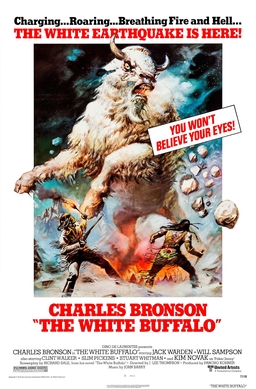
The White Buffalo
Gunfighter and army scout Wild Bill Hickok and Lakota warrior Crazy Horse are two of the most famous (even infamous), recognizable names in the history of the taming of the American west. At any point in their shortened lives -- they died a year apart in 1876 and 1877 -- did they meet? It's an interesting what-if and so goes 1977's The White Buffalo.
Having visited the East, Wild Bill Hickok (Charles Bronson) -- going under the alias 'James Otis' -- returns to the wild west. He has been tortured of late by a nightmare that plagues him night in and night out. It's the same nightmare each night; a vision of an immense white buffalo bearing down on him and ready to kill him in a second. Hickok doesn't know what to make of the dream, but when he hears rumors that a white buffalo has been spotted in the Black Hills, he goes on the hunt, bringing a trapper, Charlie Zane (Jack Warden), along for help. The famed gunfighter won't be alone though as they cross the path of Lakota chief Crazy Horse (Will Sampson) who similarly wants to hunt down and kill the alleged white buffalo. Which hunter will get him first?
This was an odd western to watch. It's from director J. Lee Thompson of Cape Fear and The Guns of Navarone fame. The IMDB summary lists it as a quasi-Jaws ripoff, and it's not completely off base while also not being completely on-point either. Even three days since I've watched it, I'm still not sure exactly what I watched. It comes across as an odd, sometimes enjoyable episodic story that never quite finds a rhythm. Is it about Wild Bill making his return? Is it saying something more profound about the changing times of the west, and even the closing years of the "wild" west? Is it just a cool what-if about pairing two of the most interesting figures in American history? It's probably a little of all of them, but it is definitely hurt by not picking a route and sticking with it.
At its strongest, the focus is on the changing times of the west. Two men -- Hickok and Crazy Horse -- are very similar in personality, character and history. Their only difference? Hickok hates Indians, Crazy Horse hates the never-ending flow of white men into Indian land. As they both search for the white buffalo, they cross each others' paths, each saving the other man's life in a do-or-die situation. They put aside their hatred and differences aside in a quest to accomplish their mutual goals. I liked Bronson's performance a lot, even if it is pretty typical western anti-hero stuff. Sampson rises above a pretty stereotypically written part too as Crazy Horse. He avoids the stilted "Me Indian...you white man....How" conversation and plays well off of Bronson. The high point is Hickok and Crazy Horse talking across a campfire, both men wondering what the future holds.
Of the rest of the cast, Warden is the only one actually given anything more than a cameo. He has some good scenes with Bronson's Hickok, but it's a pretty standard meat and potatoes kind of role. Beyond those three parts, 'Buffalo' consists of a handful of really random cameos. We're not talking 10-15 minutes on-screen. We're talking individual scenes, some no more than a minute or two. Kim Novak gets the meatiest cameo as Poker Jenny, a woman from Hickok's past. Clint Walker also has some fun as Whistling Jack Kileen, a bear of a man gunning for Hickok. Also keep an eye out for Slim Pickens, Stuart Whitman, John Carradine, and Ed Lauter.
One of the oddest things though for 'Buffalo' is just that.....the buffalo. It doesn't look cheap, but it certainly tries for the Jaws-effect. We never really get a pristine, clear at the buffalo. Instead, we get extreme close-ups of the raging buffalo's eyes or his horns, we get far-off shots of the buffalo charging. It doesn't look ridiculous, but it sure approaches it. The final showdown among the buffalo, Hickok and Crazy Horse is pretty cool though. Sure, there are flaws. Any night scene was clearly shot on an indoor set with fake snow, trees and rocks. It looks pretty cheesy. There's also the cool scenes, an almost iconic shot of Hickok wearing his low-brimmed hat, his darkened glasses, his buckskin coat and brace of pistols. So in the end, it's a mixed bag, both good and bad.
The White Buffalo (1977): ** 1/2 /****
Having visited the East, Wild Bill Hickok (Charles Bronson) -- going under the alias 'James Otis' -- returns to the wild west. He has been tortured of late by a nightmare that plagues him night in and night out. It's the same nightmare each night; a vision of an immense white buffalo bearing down on him and ready to kill him in a second. Hickok doesn't know what to make of the dream, but when he hears rumors that a white buffalo has been spotted in the Black Hills, he goes on the hunt, bringing a trapper, Charlie Zane (Jack Warden), along for help. The famed gunfighter won't be alone though as they cross the path of Lakota chief Crazy Horse (Will Sampson) who similarly wants to hunt down and kill the alleged white buffalo. Which hunter will get him first?
This was an odd western to watch. It's from director J. Lee Thompson of Cape Fear and The Guns of Navarone fame. The IMDB summary lists it as a quasi-Jaws ripoff, and it's not completely off base while also not being completely on-point either. Even three days since I've watched it, I'm still not sure exactly what I watched. It comes across as an odd, sometimes enjoyable episodic story that never quite finds a rhythm. Is it about Wild Bill making his return? Is it saying something more profound about the changing times of the west, and even the closing years of the "wild" west? Is it just a cool what-if about pairing two of the most interesting figures in American history? It's probably a little of all of them, but it is definitely hurt by not picking a route and sticking with it.
At its strongest, the focus is on the changing times of the west. Two men -- Hickok and Crazy Horse -- are very similar in personality, character and history. Their only difference? Hickok hates Indians, Crazy Horse hates the never-ending flow of white men into Indian land. As they both search for the white buffalo, they cross each others' paths, each saving the other man's life in a do-or-die situation. They put aside their hatred and differences aside in a quest to accomplish their mutual goals. I liked Bronson's performance a lot, even if it is pretty typical western anti-hero stuff. Sampson rises above a pretty stereotypically written part too as Crazy Horse. He avoids the stilted "Me Indian...you white man....How" conversation and plays well off of Bronson. The high point is Hickok and Crazy Horse talking across a campfire, both men wondering what the future holds.
Of the rest of the cast, Warden is the only one actually given anything more than a cameo. He has some good scenes with Bronson's Hickok, but it's a pretty standard meat and potatoes kind of role. Beyond those three parts, 'Buffalo' consists of a handful of really random cameos. We're not talking 10-15 minutes on-screen. We're talking individual scenes, some no more than a minute or two. Kim Novak gets the meatiest cameo as Poker Jenny, a woman from Hickok's past. Clint Walker also has some fun as Whistling Jack Kileen, a bear of a man gunning for Hickok. Also keep an eye out for Slim Pickens, Stuart Whitman, John Carradine, and Ed Lauter.
One of the oddest things though for 'Buffalo' is just that.....the buffalo. It doesn't look cheap, but it certainly tries for the Jaws-effect. We never really get a pristine, clear at the buffalo. Instead, we get extreme close-ups of the raging buffalo's eyes or his horns, we get far-off shots of the buffalo charging. It doesn't look ridiculous, but it sure approaches it. The final showdown among the buffalo, Hickok and Crazy Horse is pretty cool though. Sure, there are flaws. Any night scene was clearly shot on an indoor set with fake snow, trees and rocks. It looks pretty cheesy. There's also the cool scenes, an almost iconic shot of Hickok wearing his low-brimmed hat, his darkened glasses, his buckskin coat and brace of pistols. So in the end, it's a mixed bag, both good and bad.
The White Buffalo (1977): ** 1/2 /****
Saturday, July 28, 2012
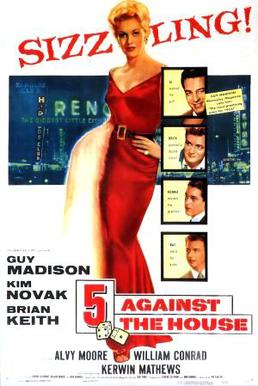
5 Against the House
Here's a thinker for you to puzzle. Have you ever thought what an episode of Happy Days would have been like if Richie, the Fonz and the gang tried to take down a casino? Or how about Betty, Veronica, Jughead and the crew? Oh, you haven't thought of that premise? Yeah, me either, but if it ever came to be, that movie would certainly have the feeling of 1955's 5 Against the House, a heist flick with some solid potential that's also weighed down by a lot of dead weight.
Heading back to a new semester at Midwestern University, four college students and friends -- Al (Guy Madison), Brick (Brian Keith), Roy (Alvy Moore) and Ronnie (Kerwin Matthews) -- stop in Reno to gamble a little at Harold's Club, a famous casino. They witness a botched robbery, overhearing a police officer mumble that no one could rob the place. As the semester wears on and things get boring, Ronnie comes up with a unique plan to do just that though; rob the place. His intention? Prove he can pull it off, then return the money (smart, huh?). Al is less than interested, focusing more on fiance Kay (Kim Novak), Roy goes along with it too a point, and Brick....well, Brick has his own plan.
From director Phil Karlson, this is an odd little movie. Comparing it to a Happy Days heist movies isn't fair, but that thought certainly crossed my mind as I was watching this quick 82-minute movie. There are good and bad -- like any movie I suppose -- but the bad is real bad. As we meet this foursome of friends, we're introduced to them through a nauseating and never-ending set of one-liners, most delivered by Moore. Madison walks around a casino telling them what time it is until they leave. Billed as a late film noir entry, it just ain't that type of movie. It's too light and fluffy early. The jokes are not only forced, but more importantly, just not very funny.
There's more to poke holes at, but that's the worst offender. The others involve two subplots, one more painful than the other. It's a heist movie, right? Then why is so much time spent on Al and Kay's budding romance? In one of her early roles, Novak looks great and sings two songs (sort of, she was dubbed for one), but she doesn't have chemistry with Madison at all. They fight, they kiss, they fight, and then they're back in love. A romance subplot is fine with me as long as it adds to a movie, not detracts from it. Anytime these two are on screen, it's a slow, halting trip. The other subplot has Roy and Ronnie convincing a freshman, Francis (Jack Dimond), to work as a servant-slave. Oh, those 1950s hijinks! It's just another example of the trying too hard, very forced and very unfunny humor that's jammed into the story.
So that gets the negatives out of the way, and we're onto the positives! Madison and Keith were 33 and 34 years old respectively when this was released so how do they come off as college students? Less than believable, but a key subplot involving them helps cushion that age difference. They're both veterans of the Korean War, Keith's shell-shocked Brick suffering through some version of post-traumatic stress disorder, Madison's Al doing his best to look out for a friend who saved his life. The relationship between the two "college students" is a high point of the film. Madison wasn't a great actor, but playing alongside Keith, they have an easy-going patter back and forth that reflects their history. Now if more time was spent on this aspect of the story, now we're onto something.
And then there's the heist aspect. In 1955, this is an early example of a heist film, and judging 'House' on that alone, it's a pretty solid movie. It was clearly an influence on the original Ocean's 11, released four years later. The heist is basically one big con job, pulling the wool over the casino's eyes while they steal away with the money. As part of a western fest, the quartet dress up as cowboys -- boots, beards and hats all -- to "blend in" with the rest of the clientele. Like much of the movie, the heist is low-key, but that doesn't away any of the tension. We're not sure exactly the details of the job, but we've gotten enough hints to see what's going on. As well, the film has several very cool on-location shots of mid 1950s Reno, a window, a time capsule into a very cool time in American history.
In the end, 'House' is a flawed venture. When it works, it's slightly above average. When it doesn't work, it struggles to maintain any pacing. Too bad a more pointed, heist-driven story with less romantic subplots couldn't have been used.
5 Against the House <---trailer (1955): ** 1/2 /****
Heading back to a new semester at Midwestern University, four college students and friends -- Al (Guy Madison), Brick (Brian Keith), Roy (Alvy Moore) and Ronnie (Kerwin Matthews) -- stop in Reno to gamble a little at Harold's Club, a famous casino. They witness a botched robbery, overhearing a police officer mumble that no one could rob the place. As the semester wears on and things get boring, Ronnie comes up with a unique plan to do just that though; rob the place. His intention? Prove he can pull it off, then return the money (smart, huh?). Al is less than interested, focusing more on fiance Kay (Kim Novak), Roy goes along with it too a point, and Brick....well, Brick has his own plan.
From director Phil Karlson, this is an odd little movie. Comparing it to a Happy Days heist movies isn't fair, but that thought certainly crossed my mind as I was watching this quick 82-minute movie. There are good and bad -- like any movie I suppose -- but the bad is real bad. As we meet this foursome of friends, we're introduced to them through a nauseating and never-ending set of one-liners, most delivered by Moore. Madison walks around a casino telling them what time it is until they leave. Billed as a late film noir entry, it just ain't that type of movie. It's too light and fluffy early. The jokes are not only forced, but more importantly, just not very funny.
There's more to poke holes at, but that's the worst offender. The others involve two subplots, one more painful than the other. It's a heist movie, right? Then why is so much time spent on Al and Kay's budding romance? In one of her early roles, Novak looks great and sings two songs (sort of, she was dubbed for one), but she doesn't have chemistry with Madison at all. They fight, they kiss, they fight, and then they're back in love. A romance subplot is fine with me as long as it adds to a movie, not detracts from it. Anytime these two are on screen, it's a slow, halting trip. The other subplot has Roy and Ronnie convincing a freshman, Francis (Jack Dimond), to work as a servant-slave. Oh, those 1950s hijinks! It's just another example of the trying too hard, very forced and very unfunny humor that's jammed into the story.
So that gets the negatives out of the way, and we're onto the positives! Madison and Keith were 33 and 34 years old respectively when this was released so how do they come off as college students? Less than believable, but a key subplot involving them helps cushion that age difference. They're both veterans of the Korean War, Keith's shell-shocked Brick suffering through some version of post-traumatic stress disorder, Madison's Al doing his best to look out for a friend who saved his life. The relationship between the two "college students" is a high point of the film. Madison wasn't a great actor, but playing alongside Keith, they have an easy-going patter back and forth that reflects their history. Now if more time was spent on this aspect of the story, now we're onto something.
And then there's the heist aspect. In 1955, this is an early example of a heist film, and judging 'House' on that alone, it's a pretty solid movie. It was clearly an influence on the original Ocean's 11, released four years later. The heist is basically one big con job, pulling the wool over the casino's eyes while they steal away with the money. As part of a western fest, the quartet dress up as cowboys -- boots, beards and hats all -- to "blend in" with the rest of the clientele. Like much of the movie, the heist is low-key, but that doesn't away any of the tension. We're not sure exactly the details of the job, but we've gotten enough hints to see what's going on. As well, the film has several very cool on-location shots of mid 1950s Reno, a window, a time capsule into a very cool time in American history.
In the end, 'House' is a flawed venture. When it works, it's slightly above average. When it doesn't work, it struggles to maintain any pacing. Too bad a more pointed, heist-driven story with less romantic subplots couldn't have been used.
5 Against the House <---trailer (1955): ** 1/2 /****
Labels:
1950s,
Brian Keith,
Guy Madison,
Heist movies,
Kerwin Matthews,
Kim Novak
Friday, March 2, 2012
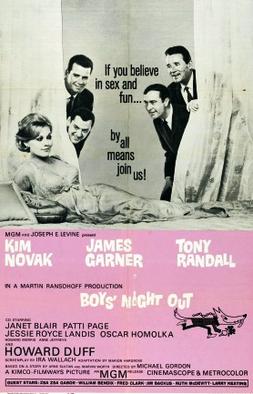
Boys' Night Out
Contrary to what more modern/current movies try and tell you, sex comedies don't have to be particularly raunchy to work. Okay, that sounds like a contradiction. American Pie -- already released 13 years ago -- jump-started a trend that had died away more or less through the 1990s, a trend that continued into the 2000s. Now none of this is to say earlier comedies were exempt, but they were a different sort of raunchy...censored raunchy...like 1962's Boys' Night Out.
Hanging out each Thursday night in New York City, four old friends, now all middle aged -- including Fred (James Garner), George (Tony Randall), Doug (Howard Duff) and Howard (Howard Morris) -- are in a bit of a mid-life rut. Somewhat jokingly they talk about renting a plush NYC apartment where they can bring their fictional mistresses to and escape from their everyday life. Well, Fred actually finds an apartment for a very low rent that the four can split for a reasonable rate, even finding a live-in girl, Cathy (Kim Novak), who will stick around for "companionship." The guys think they've got things made, except for Fred who starts to question what they're up to. None of them have any idea what Cathy has in mind for them.
Sounds kind of ominous, doesn't it? It wasn't intended that way. After all, it is a screwball sex comedy from 1962. Kim Novak isn't exactly going to murder and hack them up now, is she? Finally seeing Novak in more than just Hitchcock's Vertigo recently, I'm fast becoming a huge fan. Her gimmick here is of a sociology student student studying adolescent, sexual behavior in suburban men. When they assume she's some sort of hooker/escort, she takes the bait. None of them actually sleep with her, Novak's Cathy playing them like a fiddle. She gives them each what they want; George to talk, Doug to be a handyman around the house, and Howard to eat to his heart's desire. All problems at home that Cathy easily fixes. These scenes are subtle, underplayed comedy at its best, funny without trying too hard to be funny.
Through some rather major flaws, I'll still be giving this romantic comedy a positive review, most of that being chalked up to the casting. I'm used to Garner in more action-driven stories, but he easily handles the jump to some lighter fare. Working with the very beautiful Novak, he looks right at home in any romantic scenes. And working with Novak, I don't imagine those scenes were too difficult to film. Randall, Duff and Morris (later Ernest T. Bass on The Andy Griffith Show) round out the middle-aged quartet, all bringing different styles and backgrounds to their characters, the wives played by Janet Blair, Patti Page and Anne Jeffreys. Playing Fred's mother, Jessie Royce Landis is very funny in a small part, organizing the wives for some investigating. Oskar Homolka plays Dr. Prokosch, Cathy's professor, William Bendix makes a small but memorable cameo as Slattery, the wise bartender, and Jim Backus is a real estate agent trying to unload his tainted apartment.
Now that we've got all these pleasantries out of the way, let's move on. Not raunchy because 1960s censors wouldn't allow it, 'Boys' still manages to be pretty high up on the "Nasty Meter." First off, Garner's Fred is divorced and the only single one of the bunch. The other three never actually have sex, hook up, even touch Novak's Cathy which is important. Still, they believe that each of the other ones has, they're just too embarrassed to say they're not. Here's the nasty part, for me at least. It's 1962, and the story calls for George, Doug and Howard to "share" Novak, one getting Monday, the other Tuesday and so on. It doesn't bother them that they're passing this girl around? Sloppy seconds, thirds and fourths. Sounds kind of scandalous for a 1962 comedy. Granted, none of them actually do, but come on. They seem far too comfortable with the situation.
And because this is a screwball, romantic/sex comedy, we need an ending....a stupid one. Lots of miscommunication and misunderstanding basically has everyone meeting in Cathy's furnished apartment, fighting it out and screaming, Cathy just trying to explain herself. All the positive momentum (friends sexually sharing a woman aside) is nearly for naught. The last 15 minutes are nearly unbearable to watch. Painfully over the top theatrics, and all could be solved with one quick explanation. What's the fun in that though? We'd never get the awkwardness, Fred turning his back on Cathy even though he loves her. Oops, spoiler alert. My bad. Are you surprised though? The final scene has everyone happy and back together, the wives apparently choosing to forget that their husbands sought out affairs, even if they didn't go through with it. Oh, happy day, it's a 1960s comedy and everything is hunky-dory!
The positive of most of the movie is that for most of 90 minutes, Boys' Night Out is very good. It treads the fine line between stupid and funny, letting the cast have some fun with this screwy situation. This was Garner at the top of his game, Novak is sexy with that smoky voice and effortlessly funny, and the rest of the cast fills out the movie nicely. Yes, the resolution is bad, really bad, but getting there is fun. Too bad the movie couldn't end when Fred and Cathy end up together at a rained out Little League baseball game. Then it'd be a really good, worthwhile movie. As is now, it's still good.
Boys' Night Out <---TCM trailer (1962): ***/****
Hanging out each Thursday night in New York City, four old friends, now all middle aged -- including Fred (James Garner), George (Tony Randall), Doug (Howard Duff) and Howard (Howard Morris) -- are in a bit of a mid-life rut. Somewhat jokingly they talk about renting a plush NYC apartment where they can bring their fictional mistresses to and escape from their everyday life. Well, Fred actually finds an apartment for a very low rent that the four can split for a reasonable rate, even finding a live-in girl, Cathy (Kim Novak), who will stick around for "companionship." The guys think they've got things made, except for Fred who starts to question what they're up to. None of them have any idea what Cathy has in mind for them.
Sounds kind of ominous, doesn't it? It wasn't intended that way. After all, it is a screwball sex comedy from 1962. Kim Novak isn't exactly going to murder and hack them up now, is she? Finally seeing Novak in more than just Hitchcock's Vertigo recently, I'm fast becoming a huge fan. Her gimmick here is of a sociology student student studying adolescent, sexual behavior in suburban men. When they assume she's some sort of hooker/escort, she takes the bait. None of them actually sleep with her, Novak's Cathy playing them like a fiddle. She gives them each what they want; George to talk, Doug to be a handyman around the house, and Howard to eat to his heart's desire. All problems at home that Cathy easily fixes. These scenes are subtle, underplayed comedy at its best, funny without trying too hard to be funny.
Through some rather major flaws, I'll still be giving this romantic comedy a positive review, most of that being chalked up to the casting. I'm used to Garner in more action-driven stories, but he easily handles the jump to some lighter fare. Working with the very beautiful Novak, he looks right at home in any romantic scenes. And working with Novak, I don't imagine those scenes were too difficult to film. Randall, Duff and Morris (later Ernest T. Bass on The Andy Griffith Show) round out the middle-aged quartet, all bringing different styles and backgrounds to their characters, the wives played by Janet Blair, Patti Page and Anne Jeffreys. Playing Fred's mother, Jessie Royce Landis is very funny in a small part, organizing the wives for some investigating. Oskar Homolka plays Dr. Prokosch, Cathy's professor, William Bendix makes a small but memorable cameo as Slattery, the wise bartender, and Jim Backus is a real estate agent trying to unload his tainted apartment.
Now that we've got all these pleasantries out of the way, let's move on. Not raunchy because 1960s censors wouldn't allow it, 'Boys' still manages to be pretty high up on the "Nasty Meter." First off, Garner's Fred is divorced and the only single one of the bunch. The other three never actually have sex, hook up, even touch Novak's Cathy which is important. Still, they believe that each of the other ones has, they're just too embarrassed to say they're not. Here's the nasty part, for me at least. It's 1962, and the story calls for George, Doug and Howard to "share" Novak, one getting Monday, the other Tuesday and so on. It doesn't bother them that they're passing this girl around? Sloppy seconds, thirds and fourths. Sounds kind of scandalous for a 1962 comedy. Granted, none of them actually do, but come on. They seem far too comfortable with the situation.
And because this is a screwball, romantic/sex comedy, we need an ending....a stupid one. Lots of miscommunication and misunderstanding basically has everyone meeting in Cathy's furnished apartment, fighting it out and screaming, Cathy just trying to explain herself. All the positive momentum (friends sexually sharing a woman aside) is nearly for naught. The last 15 minutes are nearly unbearable to watch. Painfully over the top theatrics, and all could be solved with one quick explanation. What's the fun in that though? We'd never get the awkwardness, Fred turning his back on Cathy even though he loves her. Oops, spoiler alert. My bad. Are you surprised though? The final scene has everyone happy and back together, the wives apparently choosing to forget that their husbands sought out affairs, even if they didn't go through with it. Oh, happy day, it's a 1960s comedy and everything is hunky-dory!
The positive of most of the movie is that for most of 90 minutes, Boys' Night Out is very good. It treads the fine line between stupid and funny, letting the cast have some fun with this screwy situation. This was Garner at the top of his game, Novak is sexy with that smoky voice and effortlessly funny, and the rest of the cast fills out the movie nicely. Yes, the resolution is bad, really bad, but getting there is fun. Too bad the movie couldn't end when Fred and Cathy end up together at a rained out Little League baseball game. Then it'd be a really good, worthwhile movie. As is now, it's still good.
Boys' Night Out <---TCM trailer (1962): ***/****
Labels:
1960s,
Comedy,
James Garner,
Kim Novak,
William Bendix
Friday, January 27, 2012
Pushover
As I mentioned in my review of Billy Wilder's The Apartment, I have a hard time seeing Fred MacMurray as anything but the star of Disney movies like The Absent-Minded Professor and The Shaggy Dog or on the TV show My Three Sons. An all-American Dad if there ever was one so I have trouble going along with his darker roles like in 1954 film noir Pushover.
Working a case, middle-aged police officer Paul Sheridan (MacMurray) meets Lona (Kim Novak), the girlfriend of a gangster, Wheeler (Paul Richards) who's recently robbed a bank, escaping with $210,000 but killing a bank guard in the process. Bored with his life, Paul falls for her hard even when she figures out he's a cop. Upset with her situation of an absentee boyfriend, Lona similarly falls for Paul. Paul's precinct is working a stakeout in hopes of catching Lona's boyfriend, putting Paul in an interesting predicament. He comes up with a plan though, leaving his whole life behind him, taking the money if Wheeler shows up, and starting life over with Lona. Nothing comes easy though.
As a film noir, this has all the requisite pieces from the shadowy setting to the femme fatale in Novak to the anti-hero looking out for himself. Making her film debut, Novak is a bright spot as Lona McLane, the gangster's girlfriend frustrated with her situation. The 21-year old beauty was always gorgeous, but director Richard Quine shoots her like an angel....albeit one with a manipulative streak. Drop dead gorgeous came to mind anytime she was on the screen. Also a positive is the opening bank robbery, a silent sequence interrupted by gunfire. The early portions of the movie are especially good, MacMurray and Novak getting away with some risque scenes (for the time at least).
But as things start to develop with the gangster, the girl and the cash, my problems with MacMurray arose once again. I just don't buy him as a bad guy. Check that. He's not a bad guy, just a weak good guy who makes some epically bad, stupid decisions. The reviews pointed out that Novak manipulates MacMurray's Paul into stealing the stolen money, but I didn't see that. He is attracted to a younger, beautiful woman and sees a whole new life through her. The Paul character is still too much of a weakling though, and I had trouble buying him in the lead role. The other police officers include his partner, McAllister (Philip Carey), who's looking for a wife, Lt. Eckstrom (E.G. Marshall), the officer in charge, and Dolan (Allen Nourse), the veteran cop nearing his retirement and pension.
Once MacMurray's plan hits the fan, the story picks up to a pretty breakneck pace. It is 1954, and the Hollywood movie code still dictated that bad guys got their due. So in other words, once Paul starts making bad decisions, there's no end in sight. One mistake rolls onto another one, especially when Lola's neighbor (Dorothy Malone) sees Paul coming out of her apartment. It's only a matter of time before Paul's flimsy house of cards comes tumbling down, and when he does it is epically bad.
I should mention one thing though that ranks up there with MacMurray as some major issues in this 1954 film noir. A stakeout isn't exactly an exciting visual experience. Instead of spicing it up, Pushover actually shows it in all its excruciating detail. In an 88-minute movie, we get uninterrupted shots of policemen looking through binoculars, officers walking to a car and changing positions with other officers, that sort of thing. Pretty exciting, huh? Yeah, you bet. On the whole, the movie is pretty decent, but the negatives are hard to avoid.
Pushover <---TCM trailer/clips (1954): ** 1/2 /****
Working a case, middle-aged police officer Paul Sheridan (MacMurray) meets Lona (Kim Novak), the girlfriend of a gangster, Wheeler (Paul Richards) who's recently robbed a bank, escaping with $210,000 but killing a bank guard in the process. Bored with his life, Paul falls for her hard even when she figures out he's a cop. Upset with her situation of an absentee boyfriend, Lona similarly falls for Paul. Paul's precinct is working a stakeout in hopes of catching Lona's boyfriend, putting Paul in an interesting predicament. He comes up with a plan though, leaving his whole life behind him, taking the money if Wheeler shows up, and starting life over with Lona. Nothing comes easy though.
As a film noir, this has all the requisite pieces from the shadowy setting to the femme fatale in Novak to the anti-hero looking out for himself. Making her film debut, Novak is a bright spot as Lona McLane, the gangster's girlfriend frustrated with her situation. The 21-year old beauty was always gorgeous, but director Richard Quine shoots her like an angel....albeit one with a manipulative streak. Drop dead gorgeous came to mind anytime she was on the screen. Also a positive is the opening bank robbery, a silent sequence interrupted by gunfire. The early portions of the movie are especially good, MacMurray and Novak getting away with some risque scenes (for the time at least).
But as things start to develop with the gangster, the girl and the cash, my problems with MacMurray arose once again. I just don't buy him as a bad guy. Check that. He's not a bad guy, just a weak good guy who makes some epically bad, stupid decisions. The reviews pointed out that Novak manipulates MacMurray's Paul into stealing the stolen money, but I didn't see that. He is attracted to a younger, beautiful woman and sees a whole new life through her. The Paul character is still too much of a weakling though, and I had trouble buying him in the lead role. The other police officers include his partner, McAllister (Philip Carey), who's looking for a wife, Lt. Eckstrom (E.G. Marshall), the officer in charge, and Dolan (Allen Nourse), the veteran cop nearing his retirement and pension.
Once MacMurray's plan hits the fan, the story picks up to a pretty breakneck pace. It is 1954, and the Hollywood movie code still dictated that bad guys got their due. So in other words, once Paul starts making bad decisions, there's no end in sight. One mistake rolls onto another one, especially when Lola's neighbor (Dorothy Malone) sees Paul coming out of her apartment. It's only a matter of time before Paul's flimsy house of cards comes tumbling down, and when he does it is epically bad.
I should mention one thing though that ranks up there with MacMurray as some major issues in this 1954 film noir. A stakeout isn't exactly an exciting visual experience. Instead of spicing it up, Pushover actually shows it in all its excruciating detail. In an 88-minute movie, we get uninterrupted shots of policemen looking through binoculars, officers walking to a car and changing positions with other officers, that sort of thing. Pretty exciting, huh? Yeah, you bet. On the whole, the movie is pretty decent, but the negatives are hard to avoid.
Pushover <---TCM trailer/clips (1954): ** 1/2 /****
Labels:
1950s,
E.G. Marshall,
Film Noir,
Fred MacMurray,
Kim Novak,
Philip Carey,
Richard Quine
Sunday, November 13, 2011
Bell Book and Candle
Working together in Alfred Hitchcock's 1958 classic thriller Vertigo, co-stars James Stewart and Kim Novak showed off an impressive chemistry that helped make the movie what it was. Stewart was Hitchcock's flawed leading man and Novak the icy blonde. So what's the natural progression as the two worked again later that year? Naturally from a murder thriller to a romantic comedy, 1958's Bell Book and Candle.
A modern-day witch, Gillian Holroyd (Novak) does her best to hide the fact that she is in fact, a witch. With her brother, Nicky (Jack Lemmon), a warlock, and aunt and fellow witch, Queenie (Elsa Lanchester), Gillian is limited by what she can do without revealing herself. Running her little shop of voodoo and primitive art, Gillian has developed a bit of a crush on Shepherd Henderson (Stewart), a big-wig publisher who lives in the building. Well, sort of a crush, it can only go so far with witches. When she sees that he's engaged, she puts a hex on him, one that makes him fall in love with her. As things develop though, can Gillian tell him the truth? Can she develop feelings for just a regular old human being?
Just a couple months after reviewing Sunday in New York, here comes another well-written, well-acted, charming and even sweet romantic comedy from the 1950s and early 1960s. Where have they gone? They're just good movies. Sure, they are based in some sort of alternate universe where stories like this could actually exist, but that's part of the fun. The obvious influence this movie had is on the classic 1960s show Bewitched, a modern-day witch with her family trying to hide her "witch-dom." These aren't mean, cruel or vindictive witches -- for the most part, don't mess with Novak's Gillian -- but instead witches that are hiding who they are and struggling with it, seeing an easy way to easy cash and riches but unable to do anything about it.
The romantic pairing of Stewart and Novak might seem a little odd when you really look at it. This was actually Stewart's final role where he played a romantic interest because apparently he didn't think he was suited anymore for that type of role. He was 50 at the time while Novak was 25. So I'm no mathematician, but that's 25 years difference in age, right? For me, the age discrepancy was not an issue. If an on-screen duo has chemistry, that's great regardless of age. It can carry a movie, and here the age difference makes no impression at all. Stewart and Novak are great together, romantically, dramatically and in terms of the more obvious plays for laughs. The relationship is completely removed from the much darker Vertigo so it's fun to see two talented actors switch it up.
While I've always been familiar with her name, this was only the second movie I've seen Novak in, Vertigo being the other. She was only in 28 movies during her career, not many of them hugely popular or widely well-known. In 'Bell Book' Novak is the best thing going here. She is funny and smart and her voice is so perfectly sexy you can't help but fall for the character. Okay, well, I did. I don't care if you didn't. All I can say? I'll be looking for more movies with her starring roles. Yes, I kinda fell in love.
The rest of the cast looks to be having a lot of fun playing off the witchcraft hijinks. Lemmon and Lanchester are hysterical together, a warlord and witch quite content with their special "talents" and "abilities." Lemmon has some great scenes as the bongo band leader of a house band at the Zodiac Club, a den for witches and warlocks. Ernie Kovacs gets to ham it up as the drunken literary expert on all things mystical, including trying to write a book for Stewart's Henderson about witches in New York, not realizing what he's stepped into. Hermione Gingold is funny in a smaller part as Bianca de Passe, the higher-up of all witches, the woman to go to when some special powers are needed.
Funny, charming romantic comedy that I enjoyed from the start. Stewart is very funny, and it's a bonus seeing him do some physical comedy -- his facial expressions are hilarious -- while Novak plays off him well and is gorgeous so she's got that going for. Director Richard Quine has a real winner here.
Bell Book and Candle <---TCM trailer/clips (1958): ***/****
A modern-day witch, Gillian Holroyd (Novak) does her best to hide the fact that she is in fact, a witch. With her brother, Nicky (Jack Lemmon), a warlock, and aunt and fellow witch, Queenie (Elsa Lanchester), Gillian is limited by what she can do without revealing herself. Running her little shop of voodoo and primitive art, Gillian has developed a bit of a crush on Shepherd Henderson (Stewart), a big-wig publisher who lives in the building. Well, sort of a crush, it can only go so far with witches. When she sees that he's engaged, she puts a hex on him, one that makes him fall in love with her. As things develop though, can Gillian tell him the truth? Can she develop feelings for just a regular old human being?
Just a couple months after reviewing Sunday in New York, here comes another well-written, well-acted, charming and even sweet romantic comedy from the 1950s and early 1960s. Where have they gone? They're just good movies. Sure, they are based in some sort of alternate universe where stories like this could actually exist, but that's part of the fun. The obvious influence this movie had is on the classic 1960s show Bewitched, a modern-day witch with her family trying to hide her "witch-dom." These aren't mean, cruel or vindictive witches -- for the most part, don't mess with Novak's Gillian -- but instead witches that are hiding who they are and struggling with it, seeing an easy way to easy cash and riches but unable to do anything about it.
The romantic pairing of Stewart and Novak might seem a little odd when you really look at it. This was actually Stewart's final role where he played a romantic interest because apparently he didn't think he was suited anymore for that type of role. He was 50 at the time while Novak was 25. So I'm no mathematician, but that's 25 years difference in age, right? For me, the age discrepancy was not an issue. If an on-screen duo has chemistry, that's great regardless of age. It can carry a movie, and here the age difference makes no impression at all. Stewart and Novak are great together, romantically, dramatically and in terms of the more obvious plays for laughs. The relationship is completely removed from the much darker Vertigo so it's fun to see two talented actors switch it up.
While I've always been familiar with her name, this was only the second movie I've seen Novak in, Vertigo being the other. She was only in 28 movies during her career, not many of them hugely popular or widely well-known. In 'Bell Book' Novak is the best thing going here. She is funny and smart and her voice is so perfectly sexy you can't help but fall for the character. Okay, well, I did. I don't care if you didn't. All I can say? I'll be looking for more movies with her starring roles. Yes, I kinda fell in love.
The rest of the cast looks to be having a lot of fun playing off the witchcraft hijinks. Lemmon and Lanchester are hysterical together, a warlord and witch quite content with their special "talents" and "abilities." Lemmon has some great scenes as the bongo band leader of a house band at the Zodiac Club, a den for witches and warlocks. Ernie Kovacs gets to ham it up as the drunken literary expert on all things mystical, including trying to write a book for Stewart's Henderson about witches in New York, not realizing what he's stepped into. Hermione Gingold is funny in a smaller part as Bianca de Passe, the higher-up of all witches, the woman to go to when some special powers are needed.
Funny, charming romantic comedy that I enjoyed from the start. Stewart is very funny, and it's a bonus seeing him do some physical comedy -- his facial expressions are hilarious -- while Novak plays off him well and is gorgeous so she's got that going for. Director Richard Quine has a real winner here.
Bell Book and Candle <---TCM trailer/clips (1958): ***/****
Labels:
1950s,
Comedy,
Jack Lemmon,
James Stewart,
Kim Novak,
Richard Quine
Subscribe to:
Posts (Atom)