The Sons of Katie Elder

The Sons of Katie Elder
"First, we reunite, then find Ma and Pa's killer...then read some reviews."
Showing posts with label Virginia Mayo. Show all posts

Tuesday, February 16, 2016

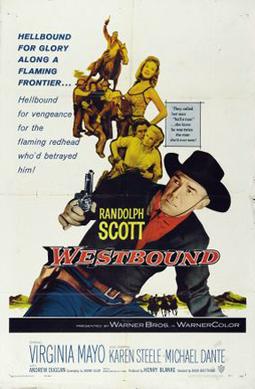
Westbound

Well, I did it. It may have taken me years, but I finally did it! Thanks to a recent airing on Turner Classic Movies (my go-to movie station), I was able to finally watch the only Budd Boetticher-Randolph Scott pairing I had not seen. That entry? From 1959, Westbound, actually the sixth of seven films the director and star worked together on. Where does it end up among the seven? Read on and find out!

It's late in the Civil War as the Union and Confederacy continue the bloody fighting, both sides looking for more gold to bankroll all the fighting. One of the keys? Getting that gold from California across the southwest to safety so it can be deposited in banks and mints. In steps John Hayes (Scott), an extremely capable Union cavalry officer who has a background in running a stagecoach line. He's now being sent to start up a line on the fly, one that will be running coaches full of gold being shipped as fast as humanly possible. The task is incredibly difficult, especially because Southerners in abundance are going to do their damnedest to stop him from succeeding. First up on that list is his former employee, Clay Putnam (Andrew Duggan), a Confederate sympathizer who's hijacked much of the already-established stage line. Into it all, Hayes steps in with little room for error and less time to get things right.

As a western fan, it is hard not to like these films, these seven pairings between Boetticher and Scott. Their reputation has grown over the years -- thankfully! -- to the point that western fans look to these films as some of the best of the genre, a canon to be recognized. Where does 'Westbound' fall? Right in the middle. I liked it a lot, but I can't put it on the same level as 7 Men from Now and Ride Lonesome, my two favorites of the bunch. It's better too than Decision at Sundown and Buchanan Rides Alone, putting it instead among Comanche Station and The Tall T as the 'good, but not great' entries. None of them are bad, just some better than others. 'Westbound' is one that grew on me during its 72-minute running time. Something clicked in about the 25-minute mark or so, and I was hooked.

I've made no bones about my dislike and worry over so many heavy, overdone adult westerns from the 1950's. The drama, the emotion, the betrayals, it was all laid on so thick. One of many beauties of the Boetticher/Scott films is their outlook on the west. There was good, bad and those caught in the middle, those who have to decide to do what's right (and possibly dangerous) or just go along with the easy payday, what's easy. Among westerns -- and films, stories in general -- there's nothing more direct than good vs. evil. Where will everyone fall in the end? Boetticher follows the similar formula, the same archetypes and at just 72-minutes, 'Westbound' is a fast-moving, often dark, adult western that flies by. An excellent, underrated final product.

Leading the way and navigating through the good and bad is star Randolph Scott, an ideal lead for these movies, a necessary front man. Movie-in and movie-out, Scott was what these movies needed. His John Hayes is no different, resolute in getting the job done no matter what odds are stacked against him. He doesn't see black or white or shades of grey. Hayes sees what is right and intends to get the job done. There's never a doubt of his intentions. These aren't anti-heroes, but instead, a last wave of true western heroes. Scott throws himself into those parts with abandon. He's believable. You buy it that he will never take the easy way out. But you ask, even when a lost love (Virginia Mayo) is waiting there to be swept away? NO! Our hero wouldn't dream of it! What about a lovely young bride (Karen Steele) who he's clearly attracted to? Double NO! It just ain't gonna happen, a true western hero, a dying breed by 1959 in the genre.

There's some good parts all around in this Boetticher western. I liked Duggan a lot as Putnam, the Confederate sympathizer determined to stop Hayes but even he has limits. His enforcer, Mace (Michael Pate), has no such limits, providing some tense moments as their plan is put into action. Mayo is Putnam's wife, a woman torn by her past feelings of Scott's Hayes and her genuine feelings for her current husband. Steele is a bright spot also as Jeanie Miller, a young bride to Rod (Michael Dante), a Union soldier who lost an arm in the fighting and was sent home. There's an interesting dynamic among Hayes, Jeanie and Rod as the stage plan comes together that takes some surprising turns as the story develops. Wally Brown provides some comic relief as Stubbs, the stagecoach driver, with John Daheim memorable as the sneering henchman of Mace's...Russ.

Nothing flashy, nothing too out of the ordinary. It wouldn't fit with Boetticher's straightforward, no-nonsense smile. This is a western at its finest with a story that doesn't pull any punches, a hero who it's easy to root for, villains you can't wait to see get their due, and all of it wrapped tightly in a nice 72-minute package. If you're a fan of the other Boetticher/Scott pairings, you'll definitely enjoy this one too.

Westbound (1959): ***/****

Friday, April 19, 2013

The Proud Ones

What's the more iconic figure from the wild wild west, the sheriff/marshal or the cowboy? My first thought is the cowboy, but I'm safe picking either one. Yes, I'm the judge and jury here so deal with it. Countless westerns have dealt with both figures, some better than others, but 1956's The Proud Ones is a generally forgotten gem, the story of a small-town sheriff.

The sheriff of a small Kansas town, Cass Silver (Robert Ryan) is expecting trouble. The town has managed to avoid violence and bloodshed for years, but that's about to change. A new railroad line has made the town an important cattle depot, meaning cattle drives can now use Cass' town as a destination. The first herd is due any day now, and along with them comes Honest John Barrett (Robert Middleton), a saloon owner who has quite the checkered past with Cass as a marshal. Barrett sees the town as a gold mine, the potential for money and riches just waiting at his fingertips. His problem? Cass knows how he operates and doesn't intend to be intimidated by him. The experienced lawman braces for Barrett's plan while also weighing how much a new deputy, Thad Anderson (Jeffrey Hunter), can help. Anderson too has his own secrets, one that could doom them all.

The 1950s were packed to the gills with westerns hitting theaters from bigger budget A-level movies with smaller scale, cheaper B-movies. From director Robert D. Webb, 'Proud' is a better, more enjoyable western because it falls in between the two. It's familiar stuff, the town sheriff protecting his town, his word and his honor against a power-hungry businessman. Familiar isn't bad. There's some solid casting with some A-list names, but they're not there for the sake of star power. The story is mostly relegated to the town set which looks a lot like the set from The Ox-Bow Incident (from 13 years earlier), but the crowded streets with bars, businesses and alleys ending up being a key ingredient to the escalating situation. I also really liked Lionel Newman's score, a combination of soft and subtle -- especially Cass' whistle theme, listen HERE -- with bigger, louder outbursts in tense action scenes. It's a lot of little things again, but combined together it works out nicely.

By 1956, Robert Ryan was an established star in Hollywood, a reliable tough guy know for his villainous roles but also his ability to play flawed heroes. Playing veteran marshal Cass Silver, Ryan's part definitely falls into that second category. He's good at what he goes, but his past is checkered to say the least, thanks in great part to his history with Middleton's Honest John (Get it? It's ironic!). Silver has a tenuous relationship with saloon girl turned restaurant owner Sally (always reliable Virginia Mayo) and has a definite future with her, if he can get out of town and his job alive. In a semi-interesting but still unnecessary twist, Cass also gets knocked over the head and starts experiencing headaches that render him temporarily blind. It seems like something more worthy of a spaghetti western. Isolated and all but on his own, Cass might fight for what he believes in, what's right and upholding his word. I liked the main character a lot, and behind him, things fall into place nicely.

Presenting the town marshal as a main character in a western is nothing new, but I liked what Webb did just the same. 'Proud' had to be an influence on Howard Hawks who three years later with Rio Bravo would make a western with some similar undertones (and some less subtle connections). Cass has two deputies, Jake (Walter Brennan, basically playing the same role he'd play in Rio Bravo), the old jailer trying to keep Cass on his toes, and Jim (Arthur O'Connell), the doting father worried about his expecting wife. There's also a great dynamic between Silver and Hunter's Thad Anderson, the cowboy turned deputy. He blames Silver for his father's death, but he doesn't know all the facts. It's not quite a father-son relationship that develops -- maybe more of a brotherly relationship -- but it's fun to watch Silver keep working with the young deputy, not knowing if he'll get a bullet in his back whenever he turns away.

Rounding out the leads, Middleton is smooth and slimy as Honest John, wanting to get his way no matter what or who stands in his way. In this case, his means to an end is to hire "friends," Pike (Ken Clark) and Chico (Rodolfo Acosta), gunfighters waiting to shoot Cass in the back. In a smaller role that basically has her disappear after an early intro, Mayo fits in well as Sally, Silver's girlfriend who worries about his pride costing him his life.

Released in 1956, 'Proud' is surprisingly dark for an American western of the time. It delves into greed, backstabbing, betrayal and out and out murder. Even cynicism is evident almost from the first scene on. Trying to live up to his job and his word, Cass sees the town turn to Sodom and Gomorrah once there is any sort of money on the line, in this case lots and lots of money. The gunfights are quick and hard-hitting, and the finale in a dark, claustrophobic barn features the earliest use of blood squibs I've ever seen. One character gets shot in the face, another in the head, blood shooting out on impact. It's a western I don't hear much about, but I liked it from the start. Highly recommended.

The Proud Ones (1956): ***/****  

Thursday, February 23, 2012

Fort Dobbs

Starring in TV's Cheyenne for seven seasons, Clint Walker shot to stardom as the burly hero of the long-running western. He never transitioned into a huge star in movies, but with a few exceptions (his supporting part in The Dirty Dozen among others) he was always quite at home in the western. Natural jump, right, TV to film? An underrated, exciting, well-made western, 1958's Fort Dobbs, was one he made during his Cheyenne run.

Having killed a man in the small town of Largo, Gar Davis (Walker) heads off into the desert ahead of a posse. Comanches are on the warpath and killing anyone in their path though, Gar stumbling across a dead man with an arrow in his back. He switches jackets with the corpse and manages to trick the posse into thinking the Comanches killed him. Gar is still on his own though amidst raiding Comanches until he walks onto a small ranch run by a wife, Celia Gray (Virginia Mayo), and her son, Chad (Richard Eyer), who are waiting for her husband to return. He agrees to help the Grays get to the relative safety of nearby Fort Dobbs, but Mrs. Gray begins to think that Gar has a secret, maybe even about her possibly missing husband.

This is an example of what a western can and should be. The story doesn't have to be on the level of The Searchers, Shane or High Noon where it delivers a message. It doesn't have to be mindlessly stupid either full of action and gunplay. From director Gordon Douglas, 'Dobbs' isn't a great, classic western. It is just a really good western, and that's fine with me. It is shot on a relatively small budget with Max Steiner's score sampling his score from They Died With Their Boots On and even borrows some action footage from 1953's The Charge at Feather River. But even on a small scale, it knows what it wants to do and how to get there. Unspectacular, solid entertainment that any western fan should be able to appreciate.

In the vein of the traditional, white-hat wearing hero from the 1940s westerns, Clint Walker is a great lead as Gar Davis. For starters, he looks like a western hero. Walker stood an imposing 6-foot-6 and weighed 235 pounds so he towers over basically everyone around him. When he starts talking, that deep, baritone voice sounds like it's going to bounce off of people and echo back. His backstory is explained late in the movie, giving Gar a slightly darker side albeit a righteous darker side. Don't go in thinking he's the flawless hero, but he is a good hero who will ultimately make the right choice. It's too bad Walker didn't become more of a star in films because as is the case here and yesterday's Gold of the Seven Saints, he's perfect for the western genre.

He is capably helped in three main supporting parts, all three of which could have gone obviously very wrong. We've got the damsel in distress, her possibly shrill, annoying son, and a smooth, conniving gunrunner. Credit to Mayo, Eyer and Brian Keith for making the most out of their parts. I've long been a fan of Virginia Mayo, an actress who was always able to hold her own against some of Hollywood's best tough guys. She's tough, smart and gorgeous, able to stand toe to toe with Walker. Eyer as her son, Chad, is also very good. So often in the 1950s (maybe more than any other decade), child actors could single-handedly ruin the movies they're in. In other films like Friendly Persuasion, The Desperate Hours, and The Seventh Voyage of Sinbad, Eyer shows he can act, genuinely act. He has a great scene with Walker too late in the movie, a natural, emotional scene for a 13-year old actor.

As for Mr. Keith, he's a scene stealer as Clett, a gunrunner who keeps crossing paths with Gar and Celia as they make a run for Fort Dobbs. He obviously has had some past run-ins with Gar, and that tension comes out in these scenes, especially when Keith's Clett goes after Mayo's Mrs. Gray. I'm used to seeing him as more of a straight-laced good guy (like in Nevada Smith) so it's great seeing him as a bad guy. It's more of a smooth, quick-talking bad guy, but you get the idea. The final confrontation between Gar and Clett is appropriately epic featuring some great dialogue that feels right at home in the western. It's not a huge part, but one that Keith knocks out of the park nonetheless.

The fairly straightforward story does just enough to keep you interested and/or guessing until the end. The Utah locations serve as a gorgeous backdrop to the trip to Fort Dobbs which upon arrival delivers quite a twist. The last 25-30 minutes are the more traditional cowboys and settlers vs. Indians story, but it's handled perfectly. The action is exciting, even surprisingly graphic, and in the end everything wraps up nicely. Russ Conway has a good part as the Largo Sheriff in this final portion. Good, underrated western. Definitely worth checking out.

Fort Dobbs <---Youtube montage (1958): ***/****

Wednesday, December 7, 2011

The Iron Mistress

Born in 1796, Jim Bowie packed a hell of a lot of living into his 40 years. An adventurer, a frontiersman, a slave trader, land owner, and knife fighter, Bowie did it all before his death at the Alamo in 1836. Most famously, he's known for inventing a particularly nasty-looking knife that was named after him, the Bowie knife. Why then with a life as adventurous and exciting as his is the 1952 bio-pic The Iron Mistress so dull?

Traveling to New Orleans in 1825, Jim Bowie (Alan Ladd) is looking to sell lumber from his family's mill. A backwoodsman more comfortable in the bayou, Jim is more than a little uncomfortable in the big city. He meets Narcisse (Douglas Dick), a well-to-do French land owner, and is then introduced to his sister, the very pretty Judalon (Virginia Mayo). Jim is drawn to her instantly but quickly discovers trouble surrounds her wherever she goes. The young knife fighter wants bigger and better things though, wants riches of his own. Land, cotton, slaves, it doesn't matter. Young Mr. Bowie intends to take the world by storm.

To say that this 1952 biography plays fast and loose with the history is a generous statement. What's true? There was a man named Jim Bowie, he had a wicked-looking knife created for him, and he was in Louisiana and Texas in the 1820s and 1830s.  Other than that? This could be any movie about an enterprising young businessman.  I'm a fan of Bowie historically and anything remotely connected to the Alamo, but even I can find little redeeming in this story.  It drags along at 109 minutes -- but feels much, much longer -- and is bogged down in the period look from the costumes down to the sets. The story simply tries to do too much, never focusing on anything specific, or for that matter....interesting.

The movie's fatal flaw comes in the casting. I'm not a huge fan of the typically wooden Alan Ladd to begin with, but he is a poor choice to play Bowie. The real-life Bowie was a particularly nasty guy so right off the bat Ladd is backed into a corner with this 1950s whitewashing of the historical, real life person. But whitewashing or not, Ladd appears to be sleepwalking. He gives Bowie little to no personality through his adventures. Even Sterling Hayden in The Last Command was better than Ladd. Of a big cast that leaves little positive impressions, Mayo is all right as the manipulative Judalon, Joseph Calleia plays Moreno, Bowie's opposition (later starring in John Wayne's The Alamo), Anthony Caruso the treacherous Sturdivant, and George Voskovec as a Quaker friend of Bowie's.

A movie about a famous knife and its creator doesn't disappoint in that regard. Several knife fights highlight the otherwise slow-moving and dull story. One has Bowie strapped at the wrist to Caruso, fighting in a ring surrounded by a mob. Another has Bowie running from armed riders trying to kill him, and even the infamous Sandbar Fight is dealt with in surprisingly gruesome fashion. The best scene by far has Bowie -- armed with his knife -- fighting a man armed with a sword in a darkened room. A beautifully put together, tension-packed sequence, great to look at and exciting on top of it. Also a plus, the scene where blacksmith James Black (David Wolfe) creates the original Bowie knife.    

Returning to the actual history, the story picks up in the last half hour as Bowie heads to Texas where he meets future wife Ursula De Veramendi (Phyllis Kirk), the daughter of the governor. This last half hour has solid pacing and actually picks up some momentum heading into the finale. The ending itself is ridiculous, basically setting up the last few years of Bowie's life without his knife. It is a deeply flawed biography of a very interesting historical figure with just enough going for it to mildly recommend.

The Iron Mistress <---TCM trailer (1952): **/****

Saturday, September 24, 2011

The Flame and the Arrow

For years, I knew who Nick Cravat was without really knowing what his name was.  Growing up, I watched Disney's Davy Crockett basically on a repeating loop, especially the finale as Davy fights at the Alamo.  One of the volunteers he brings with him? A Comanche warrior with a streak of bad luck dubbed Busted Luck, played by none other than Cravat. The character in terms of historical accuracy is hogwash, but the Indian communicating via signs was always such a cool character to me.

Since watching 'Davy Crockett' so many times -- still love it by the way -- I started to see Cravat pop up in movies here and there, usually in supporting parts where the diminutive actor still found a way to make himself seen.  Nowhere was that more evident than his roles next to Burt Lancaster in 1952's The Crimson Pirate and 1950's The Flame and the Arrow. They're both similar movies, high adventures with plenty of action and acrobatics, Lancaster and Cravat playing the hero and his loyal sidekick. Similar in a lot of ways to recently reviewed His Majesty O'Keefe, but more entertaining from start to finish.

In the 12th Century in Lombardy in Italy, a peasant hunter named Dardo (Lancaster) has free reign of the woods, living with his young son, Rudy (Gordon Gebert), after the boy's mother left them some years earlier. When Dardo goes against the German ruler in the area, Count 'the Hawk' Ulrich (Frank Allenby), he's forced to take action, retreating to the woods with a band of friends and outlaws. Biding his time, Dardo goes about planning how to get his son back, now living with his estranged mother (Lynn Baggett) who now is married to Ulrich. As he plans though, the outlaw with the growing notoriety meets Anne de Hesse (Virginia Mayo), Ulrich's niece. His plans become a part of something bigger though as the Italian villagers join in the revolt against their German rulers.

So that's kind of convoluted, isn't it?  Much more than I intended it to be, and the movie isn't actually that confusing.  If the story sounds a little familiar, it should. It's called Robin Hood but this Jacques Tourneur-directed action flick jumps from England to Italy with some names changed here and there. The good guys are really good, just fun-loving outlaws rebelling against the oppressive rulers while the bad guys are really bad, enjoying keeping the peasants under their thumbs.  There is plenty of action, some humor thrown in, and a long list of very cool stunt sequences courtesy of Lancaster and Cravat.

I learned from Wikipedia -- what doesn't that site offer? -- that the duo met at the age of nine and worked together for years to come in stage shows and circus performances, even forming an acrobatic team. They would then work together in 'Flame' and 'Crimson' where they got to show off their unique talents in a variety of action scenes. What's cool is that it is almost always them doing these stunts. There's no quick cut so a stunt man can jump in. Lancaster and Cravat are the ones doing it, gymnastics, acrobatics and tumbling that looks incredibly dangerous.  They were freakishly good at what they did though. There is a flow to their stunts that could only come from years of working together and hours upon hours of practice. No computer-generated stunt men either, just two actors (yeah, actual actors, cool factor increased) handling their business.

The same way His Majesty O'Keefe wasn't as good as it could have been, 'Flame' is about as good as it could be for this type of movie. It is a light-hearted popcorn movie that intends to entertain, never really slowing down with its mix of action and romance.  Lancaster is Lancaster at his largest, a BIG movie star who borders on the cartoonishly over the top. Is there any question he's going to rescue his son and get the girl (Virginia Mayo) in the end?  If you have to think about either question, you're thinking too hard. Allenby is a solid villain, as is Robert Douglas as the treacherous Marches Alessandro, a member of Dardo's band willing to go with whoever pays him the most.

Of Dardo's band -- mostly dudes dressed up to look like the Merry Men -- it is Cravat who stands out from the rest with the showiest part.  He is a mute who communicates through sign language, never traveling far from Dardo's side (as is his role as a sidekick). They're always getting in and out of trouble, never in any real danger. It's a tribute to Cravat for bringing this character to life and having some fun with him. Some of Dardo's other Merry Men include Norman Lloyd as Apollo, Marches' troubador, spouting song and rhyme whenever possible, Francis Pierlot as Papa Pietro, the village elder, and Robin Hughes as Skinner, the outlaw with talents galore with hands or feet. Other than Cravat, none of these are major parts, but they're all fun in their limited appearances.

A movie that was a lot of fun to watch, mostly because of Lancaster, Cravat, and their crazy stunts together. Definitely worth checking out.

The Flame and the Arrow <---TCM trailer (1950): ***/**** 

Wednesday, July 6, 2011

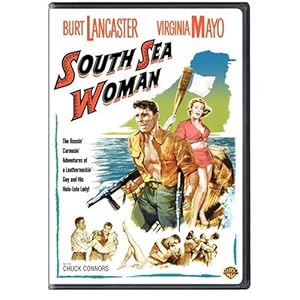
South Sea Woman

Working with stars like James Cagney, Gregory Peck and Burt Lancaster among others, it would have been easy for Virginia Mayo to get lost in the shuffle of the casts in her movies. She could have been a pretty background piece that didn't distract from the movie, letting her male co-stars do the heavy lifting.  Mayo started her career as a dancer and singer but transitioned into film. Not in many classic movies, she never achieved huge stardom but through the 1940s and 1950s, Mayo was almost always a good choice to play a strong female character without getting overwhelmed by her co-stars.

Released in 1953, South Sea Woman is a good indication of Mayo's talent.  Working alongside Lancaster for a second time after their pairing in The Flame and the Arrow with Chuck Connors playing the other lead role, she always remains at the forefront of this oddity of a movie.  The TCM description read 'A Marine sergeant battles Nazi agents to help a showgirl escape war torn China.' Having watched the movie now, I can say that is one of the most inaccurate plot descriptions I've ever read. Did the person who write that even see the movie? Regardless of its inaccuracy, the premise -- however wrong -- seems fairly serious, but this is a WWII comedy. Confused much? I certainly was in the first 15 minutes or so.

Brought up on a variety of charges at a court martial trail, Marine Corps. Sergeant James O'Hearn (Lancaster) faces over 100 years in jail and even possible execution if he is found guilty.  The veteran sergeant though remains completely quiet at his trial, prepared to face any and all charges which include everything from destruction of countless robberies, theft, and the most severe, desertion from his post.  Nothing rattles O'Hearn even as the trial begins, the story revealing itself how he got into this spot. One of his Marines, Pfc. Davey White (Connors) was trying to marry a camera girl in a bar in Shanghai, Ginger (Mayo), who O'Hearn thinks is into the young Marine for all the wrong reasons.  In hopes of helping White, O'Hearn ends up getting left behind when his unit sails, setting off a chain of events that no court is seemingly going to believe.

So for starters we've got a courtroom drama done in flashback mode with more comedic moments than you could ever count on concerning a story about two Marines and one beautiful woman all set around December 7th, 1941 when Japan attacked Pearl Harbor. It all seems like a natural fit for a story, doesn't it? I was skeptical when TCM host Robert Osborne explained that this seemingly WWII drama was in fact a comedy, but I went along for the ride. It is an uneven movie, and the humor isn't physical or slapstick thankfully. It's the natural humor that can arise out of perilous situations that ends up working the best. It never gets too heavy-handed, and when the time comes there's a sharp turn back to the dramatic.  Fun while it lasted though.

Throw all these different elements together, and you're certainly going to get your money's worth.  The movie is only 99 minutes, but director Arthur Lubin certainly packs a lot into that running time. The courtroom testimony -- including witnesses Mayo, Leon Askin, and Veola Vonn among others -- serve as a set-up for the flashbacks which tend to be episodic in nature. Lancaster, Mayo, and Connors certainly cover a lot of ground, running from gangsters, stowing away on a Chinese sailboat, getting shipwrecked on a remote island paradise, and then getting back into the war effort around Guadalacanal.  As crazy as it sounds though, 'Woman' never feels disjointed. The story just keeps flowing along with that nice balance of drama and comedy.

If you're going to make a dramatic comedy or a funny drama, you can do a whole lot worse than Burt Lancaster, one of those few actors who can handle both genres within the same movie. He's a genuinely funny performer, whether it's a subtle line delivery (like wooing Vonn's Madame's three non-English speaking nieces) or physical movement like masquerading as a hula dancer while still wearing his Marine-issued boots and a grass skirt. Mayo is similarly able to handle being really sexy while still being funny. So often, it's one or the other.  She has a great chemistry with both of her male co-stars.  This was Connors' first major role, and he more than handles his own with Lancaster. They play off each other well, rivals always willing to fight who are also close friends.

The courtroom drama and its flashbacks (which dominate the movie, the trial is only a jumping off point) develop and head toward that drama in the finale which surprised me.  The ending though -- and a key revelation about one character -- did provide a twist I didn't see coming as O'Hearn and White get back into the war effort in a big way.  Other performances include Barry Kelley, Paul Burke, and Raymond Greenleaf  as officers of the court, Bob Sweeney as the defense and Hayden Rorke as the prosecuting lawyer, and Arthur Shields, William O'Leary and John Alderson as members of O'Hearn's makeshift crew he assembles when stealing a yacht. Even a young Strother Martin has an uncredited part as a Marine at the trial.  

Odd little movie, but one that works surprisingly well when considering all the different elements assembled here.  Through drama or comedy though, the reason to see it is the cast, especially Burt Lancaster, Virginia Mayo and a very young Chuck Connors.

South Sea Woman <---TCM trailer (1953): ***/****

Wednesday, May 11, 2011

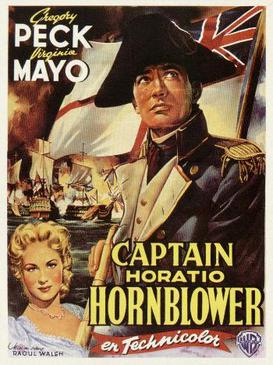
Captain Horatio Hornblower R.N.

The romance of the high seas in decades past has long been a source of story-telling, from books to movies and everything in between.  What's odd is that like so many things of the past, there is little to nothing glamorous or romantic about the high seas in a time where it took years to get from one location to another.  You lived in a cramped boat, had little quality food and less drinking water, and there is always the possibility of a gruesome death from disease and sea battles.  Sounds like a pretty horrific lifestyle, doesn't it?

Maybe it is the beauty of the ocean, hundreds and thousands of miles of open water.  Maybe it is the sight of the tall, wooden ships sailing across the water.  Maybe it is just the time of so long ago.  One of the most recognizable and loved fictional historical characters on the high seas was Horatio Hornblower, an officer in the Royal Navy during the Napoleonic wars. In a series of books written by author C.S. Forester, Hornblower sailed the seas, battling England's enemies wherever he went. A&E had a TV show appropriately titled show 'Hornblower' that ran for five years. Before all that though, there was 1951's Captain Horatio Hornblower R.N.

It's 1807 and Captain Horatio Hornblower (Gregory Peck) is at the helm of the HMS Lydia, a small British warship sailing around Cape Horn and heading toward Central America on a secret, very dangerous mission. His crew is suspicious of where he's leading them, questioning what he's up to.  Their objective is to help a Panamanian revolutionary leading an uprising against their Spanish occupiers. But just days after leaving an enormous cache of weapons with them, they discover that Spain has allied with England in an effort to defeat French dictator Napoleon.  His decision on what to do is made more difficult when a young British woman, Lady Barbara (Virginia Mayo), engaged to a British admiral, is placed in his care.  Now Hornblower must balance out his duty to England, the Navy and his crew with concerns over Barbara's safety.

That is about as condensed a plot description as you're going to get from this Raoul Walsh-directed sea epic. There is not so much a linear story line that has a beginning, a middle, and an end as much as it is Hornblower's adventures on the seas.  None of this is to be taken as a criticism because if anything the movie works better because of that lack of focused storytelling.  Instead, things sort of flow along, introducing problems here and there, situations to be solved, enemies to face and ultimately destroy.  Yes, Hornblower wins...spoilers, I guess.

That may be the best thing this sea epic has going for it.  Filmed in technicolor, the movie looks a little dated with its somewhat faded colors and obvious stage work.  It all adds to the appeal, adding to the mystique of the high seas.  This is how people must imagine life at sea, not what it was actually like.  Balancing out the scenes shot on-board the Lydia (and a later ship Hornblower commands) are gorgeous shots of these clippers cutting across the ocean.  You watch these scenes and understand why some people are drawn to sea travel.  There is something unexplainable about the beauty of an old warship with all its sails up cutting through the water.

Who better to play the stoic, courageous, noble British Navy captain than Gregory Peck, still rising to stardom at the age of 35. This is going to sound ridiculous considering Peck's legendary status as one of Hollywood's all-time greats, but the more I see of his films, the more I like him as an actor.  He has this balance on-screen, one minute the serious, stone-faced commander who makes difficult decision as easily as snapping his fingers. The next, he's stuttering upon meeting Mayo's Lady Barbara, fumbling for the right words. He gives Hornblower a personality, a likable quality that even in his most trying times, he's going to make the right decision. I don't often think of Peck as a love interest in his movies, but his chemistry with Mayo is spot-on, making their budding romance that can't be tougher to watch. It is 1951 though so you kind of know where things will end up...don't you?

Joining Peck on-board the Lydia is a supporting cast that does not disappoint in the least.  His fellow officers include Robert Beatty as Lt. Bush, Moultrie Kelsall as Lt. Crystal, Terence Morgan as Lt. Gerard, and James Kenney as Midshipman Longley, the youngest of the officers.  As for the crew, watch out for a very young-looking Stanley Baker and a scene-stealing James Robertson Justice as Quist. The crew gets their chance to shine in several exciting sea battles as these warships fire point blank into each other with cannon fire.  Enough action to keep you entertained without overdoing it.  The balance of the movie help make this movie what it is, a little bit of something for everyone watching. You can watch it at Youtube, starting HERE.

Captain Horatio Hornblower R.N. <---trailer (1951): *** 1/2 /**** 

Friday, April 22, 2011

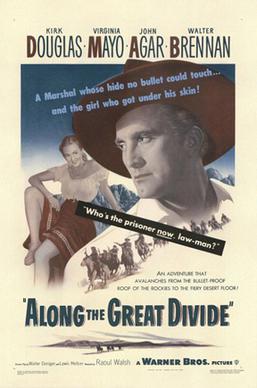
Along the Great Divide

Making his screen debut in John Ford's 1948 cavalry western Fort Apache, John Agar seemed to have all the makings of a star. In the next two years, he starred in two more John Wayne movies, holding his own alongside the Duke I always thought.  But after Sands of Iwo Jima in 1949, that stardom never came for Agar.  Instead, he was relegated to B-movies where he worked consistently into the 1970s and 1980s.  A good if not great actor, Agar was often cast as a second or third banana, the key supporting character, like in 1951's Along the Great Divide.

This western from director Raoul Walsh is an interesting one for several reasons. For one, it was star Kirk Douglas' first western, first of many really as he would return to the genre often during his career. Building off Douglas' strong performance in the lead role though, 'Divide' is a dark western, not like the whitewashed, bland westerns that were so often the product of the 1950s.  It had the potential to be extremely dark at that, but it is the 1950s, and we're not talking a spaghetti western here (unfortunately).  As I was watching this Walsh western though, I couldn't help but think that I'd seen this movie before.  It took me about 15 minutes in, and I had it figured, but I won't give it away yet. Read the plot summary and see if you can figure it out too.

Riding through the desert, U.S. Marshal Len Merrick (Douglas) and two deputies, Billy (Agar) and Lou (Ray Teal) stumble across a lynching. They save rancher Pop Keith (Walter Brennan) from another rancher, Roden (Morris Ankrum) who claims that Keith rustled 15 head of his cattle and murdered his oldest son in the process. Merrick can't prove either way if Keith is guilty or innocent but overpowers the lynch mob, promising to take the old rancher into the nearest town, Santa Loma, for a fair trial.  They hit the trail, picking up Keith's daughter Ann (Virginia Mayo) along the way.  But as they cut across the desert hoping to reach the next waterhole in time, Merrick sees that Roden has kept his word and is charging after them, ready to shoot them all to gain vengeance for his son's death.

This isn't a dead-on comparison where I'm saying they were identical movies, but it's pretty damn close with a few tweaks here and there.  Two years later, director Anthony Mann revamped this basic story with 1953's The Naked Spur, a classic western that is far better remembered than Along the Great Divide.  The story and characters are just too close for Mann not to have been influenced by this western.  Yes, certain things were changed. Douglas is a Marshal, not a bounty hunter like Jimmy Stewart. Brennan isn't a bad guy the way Robert Ryan was, but other things certainly ring true.  Janet Leigh is a spot-on copy of Mayo's character, and Agar and Teal were basically reworked into Ralph Meeker and Millard Mitchell.  I don't say any of this as a judgment or condemnation of The Naked Spur, a western I very much enjoyed.  Instead, I think it speaks to Along the Great Divide which jumps up a notch in my book because of how heavily it influenced 'Spur.'

By 1951, Kirk Douglas was a star, but still a rising star.  His best work was still ahead of him, but his Len Merrick character certainly shows the potential of his ability.  He was an intense actor, capable of high drama and comedy at the same time, and he always had quite a presence on-screen, especially when handling a majority of his own stunts.  So in his first western, Douglas shows a knack for playing that heroic lead who isn't so heroic.  His good guys always had a sense of being not quite so good, men with checkered pasts that rear their ugly heads at the worst possible time.  That is Len Merrick in a nutshell, a marshal trying to prove himself, partially for some sort of redemption for a past deed gone horribly wrong, one that still plagues his mind.  I liked this character though from the start as his ultra-driven motivations take over, pushing those around him to the limit as they struggle with a lack of water in the blazing desert heat.  A good first performance in a western, and a strong indication of what is to come.

More than just The Naked Spur, 'Great Divide' reminded me of several other movies, similar stories with a group of people trying to survive the hell that is the desert. At different points I thought of The Treasure of the Sierra Madre, The Professionals, 3 Godfathers, Yellow Sky and several other westerns and quasi-westerns.  That's basically my only real complaint here with Walsh's western. The story is predictable, and if you're paying attention at all, you know the ending almost from the first scene.  Walter Brennan played his fair share of bad guys, but it's clear this old, coot of a rancher isn't a killer.  It can be a little cookie-cutter at times as the story develops, the pieces falling into place.  On the positive though, it's never boring at 88-minutes, and Walsh films enough on location in the Sierra Madres and Mojave Desert to recommend the movie on just a visual level.  Filmed in black and white, that desert has an intimidating beauty about it, daring riders to come on in and see if they can make it.

I thought Douglas stole the movie here as the tortured U.S. Marshal, but the rest of the cast led by Brennan is nothing to shake your head at.  His Pop Keith character isn't a killer, but he's got a devious streak in him that the story keeps you guessing with as to his actual background.  Mayo as his daughter Ann is the necessary love interest, an easy on the eyes love interest at that.  Agar especially represents himself well as young deputy Billy who looks up to Merrick like a big brother while Teal plays a character he played countless times in other westerns, a gunslinger willing to go on either side of the law, usually the side that pays better.  Ankrum is good as rancher Roden while James Anderson plays his surviving son. An unfortunately little known western, but one I enjoyed very much. Definitely worth watching too if you're a fan of The Naked Spur.

Along the Great Divide <---TCM clips (1951): ***/****   

Friday, November 19, 2010

White Heat

Certain movie one-liners just resonate with fans more than others.  The best are those that everyone knows.  Knowing the context or even seeing the movie are not requisites for knowing the line.  I'd never seen 1949's White Heat, but having seen enough movie montages and read enough about the most famous lines in movie history, I'd stumbled across this movie's most classic line. In terms of describing a character in as few words as possible, James Cagney's 'Made it, Ma! Top of the world!' is hard to beat.

I've written before that Cagney as a movie star was never one of my favorites, his acting style very theatrical and over the top.  I've come around some as I've seen in him a few of his more subdued parts.  The one movie I was told I had to give a chance was this one, White Heat.  If I didn't like it, I was in the free and clear and should probably steer clear of his lesser efforts.  Well, no problem there.  Cagney's performance is theatrical and over the top but it is a part that demands he be both of those things.  Considered his best acting job for a reason, this is a perfect introduction for anyone looking to get to know one of Hollywood's biggest stars of the 1930s and 1940s.

Running his brutal gang, Cody Jarrett (Cagney) faces a difficult decision.  After a highly successful train robbery that netted over $300,000 but also produced four dead bodies, Jarrett is feeling the heat as FBI agent Philip Evans (John Archer) leads the manhunt to bring him to justice. Cody takes a lesser rap for a heist he didn't actually take part in, but it gives him an alibi for the job that would have sent him to the electric chair.  Evans knows he's been duped with Jarrett taking a short sentence that will have him out on the streets in 2 years.  He brings in one of his best undercover agents, Vic Pardo (Edmond O'Brien), and plants him in Jarrett's cell as a convict.  Notoriously hot-tempered, Jarrett still takes to Vic and takes him under his wing almost like a little brother.  Evans' plan works as Jarrett organizes a daring escape with Vic as the newest member of his dangerous gang.

Director Raoul Walsh wastes about four minutes post-credits before showing that his main character Cody Jarrett is one of the nastiest gangsters you're ever going to come across in a movie.  In the opening heist of a train carrying a Wells Fargo shipment of cash, Jarrett callously guns down the engineer and his assistant at the very mention of his name (Henry Fonda had a similar reaction some 19 years later in Once Upon a Time in the West).  That was part of the appeal of this movie, it's not a conventional 1940s flick where you can predict everything coming 15 or 20 minutes before it happens.  The characters aren't particularly likable -- no redeeming qualities in sight for the most part -- and the attitudes toward sex and violence are far more lenient than most movies that came out of this stage in Hollywood's history.  Of course, there is that Cagney guy leading the way.

In my messed up head watching movies about the bad guys (simplistic description, but it gets the idea across), I typically find myself rooting for said bad guys.  Cagney pushes my tolerance for rooting for the bad guy because Cody Jarrett is one nasty dude.  However, the fact that I was even contemplating being in this guy's corner is a testament to not only Cagney's acting ability but the strength of the screenplay.  It digs into this character and really fleshes him out.  He's the definition of a mama's boy with Ma Jarrett (Margaret Wycherly) doting on her son as she helps him run his gang. It is 1949 though so while certain things are hinted at (cough Oedipus complex cough) the hint is as far as things go.  Then there's Cody's slutty wife Verna (Virginia Mayo) who latches on to whoever can get her the farthest in life with as much money and worldly possessions as possible.

So throw all this together along with a gang of murderers and cutthroats, and you kinda see where Cody's coming from.  Not rationalizing here, just explaining.  He has to be the nastiest S.O.B around or else he would get taken down in minutes by the wolves nipping at his heels.  It's always refreshing to see a character fleshed out as much as this.  There are moments where you are disgusted by his actions, but then you see him looking out for O'Brien's Vic like a little brother, and you feel for him.  Of course, from the moment this character is introduced, you know what fate he's going to meet.  It's never in doubt.  Cody Jarrett is going out in a blaze of glory like no other.  The ending -- as Jarrett, Pardo and the gang knock off a payroll at a chemical plant -- is a whopper of a finish, leading to the oft-repeated line 'Top of the world.' A finale that's about as good as they get.

I'm not sure how Cagney wasn't nominated in some way for his part as homicidal Cody Jarrett, but the lead performance is just one of many rock-solid acting jobs pulled here.  Wycherly as Ma Jarrett is the picture of a devoted mother who knows her son is doomed but can't stop him, Mayo the femme fatale, Steve Cochrane as treacherous Big Ed Somers, and O'Brien especially as Pardo.  In a similar way to the viewer, Pardo has this unexplainable connection to Jarrett.  That's the movie in a nutshell.  You're drawn in by this character you should despise but just can't come around.  A must-see.

White Heat <---trailer (1949): *** 1/2 /**** 

Thursday, September 9, 2010

A Robert Stack double feature

As part of their annual Summer Under the Stars festival in August, Turner Classic Movies has again done a great job of going beyond the typically popular stars and devoting a day to them.  Sure, some of the bigger stars get their days, but for the most part lesser stars are getting their shots.  One included TV star Robert Stack who before he became Elliott Ness was in a fair number of movies in the 1950s. But I'm going to pull a bit of a cop-out here.  I taped two westerns Stack starred in, and really, neither was anything special.  So you all know what that means....a two-fer review!

The two westerns, 1956's Great Day in the Morning and 1953's Conquest of Cochise, are pretty typical of most 1950s westerns. They're hamstrung by a smallish budget and a small scale, and are basically filled out with enough good guy vs. bad guy action and romantic triangles to fill 90 minutes and give the audience what they paid for.  'Morning' has some unused potential to be a really good B-western while 'Conquest' is more content to just sit back with some odd casting and let the story do its own work.  Neither are available on DVD, probably for a reason, but I can think of worse westerns, and I've seen some doozies.

With war on the horizon in 1861, Owen Pentecost (Stack) rides west into Colorado.  A Southerner, he's used to putting up with some anti-South sentiments, even more so when he wins a saloon in a poker game from a northern businessman, Jumbo Means (Raymond Burr). With some help with a saloon girl (Ruth Roman), Owen goes about building a business as the Civil War looms and animosity grows between the North and South. A pretty new shopowner (Virginia Mayo) has arrived in town to stir up some more problems, and a rumor that a Southern-owned mine is transporting gold back to the east hovers over the town.

Watching movies, I struggle more and more with main characters who just aren't likable.  I don't need a lovey-dovey sweetheart, but give me some reason to like a character.  Stack's Pentecost (what kind of name is that?) is that condescending a-hole who comes across as too standoffish, and therefore, I don't like him.  Burr is an immense villain -- the guy looks huge -- and Roman delivers a good performance as the saloon girl with a heart of gold...sort of. The story deals with a topic most westerns steer clear of -- pre Civil War in the west -- but it's pretty run of the mill overall.  There was a chance to be something better, but I can't put my finger on exactly what's missing that director Jacques Tourneur didn't accomplish.  Look for Leo Gordon as a heavy with a grudge against Stack.

In 'Conquest,' Stack plays Major Tom Burke, a cavalry officer assigned with four companies to Tucson to help keep the hostile situation in control.  Apache chief Cochise (John Hodiak) could go either way, start a war with the ever-growing number of American settlers settling on Apache land, or arrange a peace treaty so the two sides may live in peace. That's just one problem though as a tribe of Comanches is nearby and threatening to attack everyone in sight, whites, Mexicans and Apaches alike. Major Burke and his cavalry and Cochise and his warriors may be forced to fight alongside each other if they have any chance of surviving the coming war.

What surprised me about this 70-minute western was the almost complete disregard for the cavalry perspective for a change, instead focusing on the Apache's perspective.  Once you get past the ridiculous casting of Hodiak as an Apache chief, it's a good ride.  When he's not talking in stunted, stilted "Indian talk," Hodiak is more than solid at introducing the Apache way of life.  For a B-western average in any other way, it's a refreshing look at the Indians' way of life in the 19th Century.  How authentic? I'm not sure, but effort gets points here.  Stack's portrayal of a woman-chasing cavalry officer is downright dull, and he ends up disappearing for about 20, maybe 25 minutes late in the movie only to reappear at a strategically necessary time.

Not being a huge Robert Stack fan to begin with -- he always come across as bland and wooden to me -- these two movies did nothing to change my mind either way.  The supporting casts were actually better than the star in both cases, and if nothing else the stories tried something new, a little different, where many westerns play it safe.  Average but not bad either.

Great Day in the Morning <---TCM trailer (1956): ** 1/2 /**** 
Conquest of Cochise <--- TCM trailer (1953): **/****

Tuesday, June 22, 2010

The Silver Chalice

They can't all be winners, right?  Over a long career, at some point movie stars have to have a dud every so often.  In most cases though you'll never hear the star actually admit that part of the equation.  Well, most cases other than Paul Newman.  One of Hollywood's greatest actors and a true legend, even Newman had to start somewhere, making his screen debut in 1954's The Silver Chalice. It's been critically roasted, and more than that, roasted by Newman who took out a full page ad in a newspaper in the 1960s to encourage TV viewers not to watch this movie when it was shown on TV.  Now that's the kind of honesty we need more of.

Let's get this out of the way early.  'Chalice' is a bad movie, a truly bad movie, that is entertaining in its awfulness.  It was an early trendsetter in huge Biblical epics like The Ten Commandments, The Robe, King of Kings, Spartacus and many others.  But you know what all those epics had going for them?  A somewhat decent script and some actual scale in terms of sets, costuming and 'a cast of thousands.'  Directed by Victor Saville, 'Chalice' has none of those things.  Other than an impressive cast full of not quite yet stars and some hopefully unintentionally funny scenes, this one is a big stinker.

Twenty years after the death and resurrection of Jesus Christ, a Greek silversmith in Antioch by the name of Basil (Newman) is fighting for his freedom after his uncle throws him into slavery.  He is offered freedom by a man named Joseph of Arimathea (Walter Hampden) who presents a challenge for him as an artist.  Joseph owns the cup Jesus used during the Last Supper and wants to give it a proper resting place in the form of an immense chalice that will feature the faces of all those closest to Jesus, mainly the apostles.  Basil accepts the challenge and goes to work, but surrounding powers want to get their hands on the Holy Grail, including a revolutionary group led by Mijamin (Joseph Wiseman) and a magician named Simon (Jack Palance).

I'll start with the positives -- however few there were.  The cast is something to behold because many of the actors and actresses involved went on to much bigger and better things, Newman obviously at the top of that list.  There's also Italian beauty Pier Angeli, future Bonanza star Lorne Greene as Peter, a young Natalie Wood as a slave girl, E.G. Marshall as Basil's adopted father, Michael Pate as Angeli's worrying father, and Virginia Mayo as the key ingredient in the always interesting love triangle. Of course some of these parts are nothing more than a 'blink and you'll miss them' appearance, but with as 'involving' as the story is, it shouldn't be hard.

One of the selling points of these huge historical epics was the lavish sets, costumes and uses of thousands of extras.  'Chalice' basically passes on all three of those -- okay, the costumes are interesting.  The sets are absolutely ridiculous, and I'm guessing about $18 was spent putting them together.  It's very clear these are on soundstages with gigantic stage-like curtains in the background standing in for actual background.  At times, the sets look like Legos or Duplos assembled by toddlers.  They're so bad it becomes funny to see how cheesy they look.  Check out the backgrounds in THIS scene, the inside of a temple. It looks like they drew in 'the bricks' with a sharpie marker.

Newman later stated in interviews that he thought this was his worst ever performance.  I haven't seen all of them, but I'm inclined to agree.  He's miscast as a Greek to begin with, and he hasn't developed that on-screen persona, that charm that made him so likable in so many later movies.  The rest of the cast isn't exactly challenging for any Oscars either.  Mayo looks done up like some sort of drag queen with eyebrows that look like they'd stab someone.  Her sexy magician's assistant (seems right at home in a biblical movie) is torn between Basil and Simon, but she looks too ridiculous to even take too seriously.  As for the rest of the cast, Angeli has a sexy accent, and Wiseman is a creepy enough 2nd villain.

But more than all the cheap sets and sluggish dialogue, the one star really breathing some life into the movie is Jack Palance as Simon, a magician who believes he has the talent, the ability to convince the Christians he is more powerful than Christ.   He chews scenery like nobody's business, hamming it up with his monologues and magic tricks.  His Simon also provides one so unintentionally funny moment late in the movie that I almost felt bad for having laughed...almost being the key word.  It's the one true worthwhile part of this dud, but if curious, watch it at Youtube starting here with Part 1 of 15.

The Silver Chalice <----trailer (1954): * 1/2 /**** 

Tuesday, December 8, 2009

Devil's Canyon

Sometimes I wonder if older movies even tried to be believable, authentic, or realistic. Granted, much of this can be attributed to budget -- or lack of -- but make an effort at least. It's always been a pet peeve of mine about westerns, especially with pre-1960 genre entries. The west was a dirty, dusty, scorching hot place that didn't exactly have all the facilities to make personal hygiene a priority. That's one reason spaghetti westerns are among my favorites, they made the west look like it actually was, albeit in Spain and Italy.

And yeah, yeah, I know audiences might not go see a glamorous 50s actress looking like a frontier woman who hasn't seen a bathtub in months, but at least try to make it look like that actress is not walking onto the set right from the photo shoot. Not that the guy's appearance isn't an issue, it's just not as noticeable in most cases. So is the case with 1953 B-western Devil's Canyon, an effort from RKO Pictures that had a fair share of potential but never rises to the occasion.

Supposedly based on a true story (names have been changed to protect the individuals involved, no joke, they use that line), Devil's Canyon tells the story of retired marshal Billy Reynolds (Dale Robertson) who no longer even wears a gun. One day in town, Abby Nixon (Virginia Mayo), a female outlaw, rides in and warns Billy that the Gorman brothers are coming to kill him. Billy disregards a local ordinance that has outlawed gunplay, kills the two Gorman brothers in self defense, and is still sent to the Yuma Territorial Prison with a 10-year sentence.

The problems are just starting for Reynolds as Jessie Gorman (Stephen McNally), the oldest of the clan, is a prisoner at Yuma and has every intention of getting his revenge. The prison warden (Robert Keith) wants to reform Reynolds, but there are other things afoot. Abby gets herself thrown into prison as well on a robbery charge and begins to go to work setting up a jail break with dreamy Reynolds and her old flame Jessie.

First off, besides some flaws I'll get into later with the small budget and any sense of realism, I liked this movie. It has a dark edge to it in telling a story almost completely self-contained in the real-life Yuma Prison. The build-up is enjoyable, the supporting cast is noteworthy, and the ending while predictable is particulary vicious. Three key members of the supporting cast include Reynolds' fellow cellmates, Arthur Hunnicutt playing Arthur Hunnicutt as he always did, George Lewis and Whit Bissell as an arsonist who burned down his own warehouse because he "likes to watch fire." Jay C. Flippen is also good as the head guard, and Earl Holliman makes his first credited appearance as one of Gorman's henchmen.

Mayo and Robertson are capable enough as the leads, but their appearances make me smile just thinking of it. Mayo is always perfectly done up with hair, makeup, and apparel, including strategically cut shirts that fall all the way to her chest. Convenient, huh? And in an all-male prison too, that makes sense. She also wears one of those pointy 1950s bras that look like they'd take an eye out if you weren't careful. Robertson is a little wooden as the stalwart hero, but let's face it, his hair is the star here. Robertson's WALL of hair must be five or six inches tall, and it is always nicely coiffed and gelled. McNally's bad guy doesn't let him off so easily, pushing his hair to the limit as well. Is any of this key to the story? Absolutely not, but it's hard to miss.

What works so well is the final jailbreak. The Yuma set is just that, an indoor set, which limits the capabilities of the story. Made years later and with a much bigger budget, There Was a Crooked Man showed what is possible with an outdoor, fully workable prison set. But in the end with plenty of shadows and full night colors, the jailbreak makes for an exciting end if not entirely original. If the showdown itself was in a movie made 10 years later, we're talking Bonnie and Clyde-esque violence. An enjoyable, utterly average B-western that I enjoyed, even if there was no Devil's Canyon ever mentioned in the story. Curious if you ask me although I did read some interpretations that were rather graphic and had to do with Miss Mayo's body. The particularly misleading trailer below seems to play that up.

Devil's Canyon <----TCM trailer (1953): ** 1/2 /****