The Sons of Katie Elder

The Sons of Katie Elder
"First, we reunite, then find Ma and Pa's killer...then read some reviews."
Showing posts with label Raymond Burr. Show all posts

Thursday, April 23, 2015

His Kind of Woman

Occasionally I have some genuine freak-out moments. Case in point? I’ve been writing movie reviews here with Just Hit Play since January 2009. I must be getting old! I’ve mentioned before though the timing of starting some of these reviews. I watched some good, even great, movies in the months right before I started this site but never reviewed them, not feeling confident enough to review months later from memory. That’s today’s review, a film noir from 1951, His Kind of Woman, that’s one of my favorites.

A down on his luck gambler living in Los Angeles, Dan Milner (Robert Mitchum) is drifting along with the clothes on his back and very little money in his pocket. Then, his luck turns on a dime, but it seems so easy. A mysterious man with underworld connections offers him a huge payday if he’ll simply leave the country and visit Mexico. There’s a catch though. He can’t know why, only get to a remote hotel on the Baja California peninsula and wait. From there, he won’t be able to return to the United States for at least a year. Suspicious but in need of the money, Milner takes the deal and heads to Mexico. There at the hotel, he meets a beautiful singer, Lenore (Jane Russell), in pursuit of a popular Hollywood actor, Mark Cardigan (Vincent Price), and an odd assortment of guests and locals. Milner sits back and waits for what’s heading his way. What has he gotten himself into exactly?

I saw this 1951 film noir in November 2008, two months before I started writing these reviews. Talk about bad timing, huh? I loved it, something pulling me in and keeping me interested throughout its two-hour running time. It comes from bazillionaire Howard Hughes and had a whole bunch of production problems that become evident in the final act. Now that said, there’s something charming and fun about it from beginning to end. It hasn’t been distributed much, if at all, since its release and ‘Kind’ doesn’t have a huge following. The moral of the story is simple. It should. I highly recommend it.

To say this is a film noir is limiting. It is to be sure, but it tries to do a lot more and generally, succeeds on most of those fronts. Director John Farrow (and an uncredited Richard Fleischer when Hughes didn’t like Farrow’s work) is at the helm of an equal parts film noir, love story, comedy with some action and shootouts thrown in. It isn’t always perfect, but the script makes a mostly successful go at it. Six different people are listed at the IMDB page for this movie as having written part of ‘Kind’ (again reflecting the behind the scenes drama). It’s smart. The dialogue crackles. The story is sorta kinda there, relying on the actors to bring the at-times slow story to life. I think the biggest compliment I can say is that it almost plays like a spoof of the film noir genre itself…but never truly becomes a spoof. Now that takes some doing. Not too light, not too heavy-handed, but more importantly and more successfully, somewhere in between.

Just a few weeks ago, I reviewed 1952’s Macao, another pairing of stars Robert Mitchum and Jane Russell. I watched ‘Kind’ back in 2008 in my Jane Russell phase. I’d never seen her films but fell hard for her right away, and this was only my second Russell film I believe. Again, talk about an on-screen match made in heaven. It’s easy to say Mitchum does the same thing movie in and movie out – that laconic, loner anti-hero – but he brings a different edge and energy with each passing film. I loved his Milner character, a man who knows he’s in trouble but keeps going along to figure out what’s up. The same for Russell’s Lenore, a young woman looking for love but with a fair share of failed attempts behind her. The duo just WORKS so well together. Their scenes are pretty pitch perfect throughout. They’re believable, you like them, and they seem to like each other. How can you go wrong?

What surprised me about the movie’s general unknown quality is the cast. With the cast assembled, how does it not have more of a reputation even by accident? Mitchum and Russell are excellent, but it’s Vincent Price who steals the show. His Mark Cardigan is an Errol Flynn-like movie star, a swashbuckler who’s looking for his movie star life to become his real life. A little too much at times, but very funny. Still not enough? There’s also Tim Holt as an investigating cop, Charles McGraw as a thug and enforcer, Raymond Burr as a mobster trying to get back into the U.S., Jim Backus as a talkative investment banker, Philip Van Zandt as the hotel owner, and an uncredited Anthony Caruso a brooding sidekick to Burr. Not bad at all.

An additional character worth mentioning is the hotel set on the Baja California peninsula. It’s so 1940s/1950s stylish with its bungalows and pool and just some really cool architecture. The sets date the movie a bit, but it truly becomes an additional character. The ending? Yeah, things fall apart a bit as the last 40 minutes get a little too kooky. Even when it goes off the tracks though, ‘Kind’ is still a really fun movie. Definitely worth seeking out, the 1951 film noir popping up occasionally on Turner Classic Movie’s schedule.

His Kind of Woman (1951): *** 1/2 /****

Wednesday, July 27, 2011

Station West

A singer, actor, producer, director and studio head over a cancer-shortened career, Dick Powell did it all in his short time in Hollywood.  He made a name for himself in the 1930s in musicals but made the jump to more and more genres over the 1940s and 1950s. Of all his roles though -- film, television, radio, stage -- Powell only did one western as an actor, an interesting gem from 1948 called Station West.

Interesting is a nice way of saying here that I was very skeptical going into this movie because of all the different (even weird) elements that needed to work together for it to be successful.  As is so often the case with my overthinking anything and everything, the joke was on me because my worries were unfounded. I still maintain it is a very different western -- atypical to just about any other western I can think of -- but somehow it works.  Actors not associated with the genre, a story full of twists and turns, and the feel of a film noir as opposed to a western oater.  Sounds like the makings of an interesting western now, don't it?

An undercover government investigator assigned to investigate the murder of two cavalry troopers guarding a gold shipment, Lt. Haven (Powell) arrives a remote western outpost trying to piece everything together. The nearby fort is brimming with gold shipments that need to be moved, but bandits keep hitting the shipments. Haven works his magic and gets a job with a woman who rules over everything in the area, Charlie (Jane Greer), working to rebuild her stagecoach line. He is sure she is somehow involved with the gold robberies with her right hand man, Prince (Gordon Oliver), and henchman, Mick (Guinn Williams), but he can't prove it just yet. As he investigate the case though, Haven starts to fall for Charlie so can he find the culprits before he gets too involved?

A day after watching this movie, I keep coming back to a thought that popped up time and time again as I watched it. While it has all the fixings of a western, I feel more comfortable calling it an anti-western...if that makes any sense. 'Station' more has the feel of a murder mystery that happens to be based in a western setting as opposed to a western with a murder mystery. Director Sidney Lanfield shoots his movie like a film noir, full of shadows and darkness as Powell's Haven investigates who is stealing gold and killing U.S. cavalry troopers. This is not a down and dirty western that you might expect. Everyone is immaculately dressed -- nice, pressed suits for the guys and Greer always wearing ball gowns with perfect hair -- and the saloons look like some pretty classy establishments. None of this counts against the movie. It isn't trying to be a gritty, hard-edged realistic western. It's a murder mystery film noir western, a first in my mind.

Working against the typical conventions of the western hero and the lead female character, enter Dick Powell and Jane Greer. None of this is intended as a complaint, instead it ends up being a ringing positive endorsement for the movie. Nothing about Powell screams WESTERN HERO! His Haven character drinks champagne and wine, smokes a pipe, and generally has an easygoing way about him. He's especially smooth with Greer's Charlie and puts his own spin on the typical western hero. When I think of Greer, I think film noir, the femme fatale like in 1947's Out of the Past. She would seem to be out of place in a western, but as the kingpin in the area who pulls all the strings, she's perfect in the part. Her Charlie is beautiful, intelligent and another new one in the western genre; a bad guy...um, lady. Well, sort of, she wants to go straight, but she might be too far gone. Two strong leads -- with some great chemistry -- that set the tone for the whole movie.

As for the murder mystery aspect of the story, Lanfield keeps the viewer guessing and up on their toes if they want to keep up. It's pretty clear from the start that Greer's Charlie is heavily involved with the continuing gold robberies, but as for how, that's kept in the dark for awhile. Throwing you for a loop, we get a list of possible suspects, some more inclined to shenanigans than others. Working with Greer are Oliver and Williams, two solid henchmen that immediately incriminate her just because they're clearly henchmen. There's also Agnes Moorehead as Mrs. Caslon, a rich woman working with Haven, who you immediately think is up to no good because Moorehead always played shady characters. Tom Powers plays Captain Iles, the shady commander of the post with Raymond Burr making a good impression in a smaller part as Bristow, a weasel of a lawyer trying to play all sides. Christmas crooner Burl Ives is also good as a hotel owner who sings and knows everyone in town, quite a help to Haven.

I went along for the ride on this one, enjoying it for all the little different things that make it an atypical western. Some parts drag as Powell's Haven investigates -- long scenes of a man walking around, looking through things tend to that -- and other scenes have stagecoaches or Powell on horseback riding across the rocky desert. Beautiful to look at in smaller doses, they get a little tedious at times. No movie is perfect though, right? Casting and story, this one just works because it does try to be different. Not particularly well known, but a hidden gem in the film noir western category (if there is that category).

Station West <---Youtube clip (1948): ***/****

Thursday, July 21, 2011

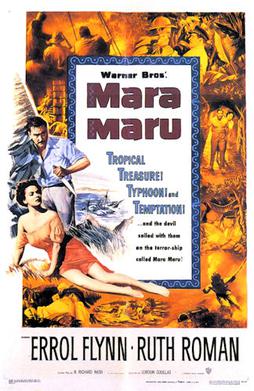
Mara Maru

Inevitably with movie stars, that star is going to fade a bit if your career has any sort of prolonged success. Audiences may tire of you a bit, or maybe the scripts just aren't there anymore.  How do you respond then? By 1952, Errol Flynn had his heyday in the late 1930s and throughout much of the 1940s. He continued acting up until his death in 1959 at the age of 50, but his movies through the 1950s just weren't par on with his previous work. A decent movie but not particularly memorable in any way, 1952's Mara Maru is one of those flicks.

Working with partner, Andy (Richard Webb), and former war buddy, Greg Mason (Flynn) runs and operates a successful salvaging business based out of post-WWII Manila.  Returning from a job, Mason finds Andy dead just a few hours after he was talking about a life-altering job, a treasure of over a million dollar's worth of diamonds at the bottom of the ocean. Mason is sure someone is trying to blackmail him for the murder, especially when shadowy businessman Brock Benedict (Raymond Burr) approaches him with a deal to recover the diamonds. Mason agrees to take on the job, hoping to move away with past love and Andy's recent widow, Stella (Ruth Roman), with his take from the job. With a nosy, greedy private detective, Ranier (Paul Picerni), along, the group heads out on the high seas to the location that only Mason knows for sure. 

One of those unheralded directors that never quite reached stardom, Gordon Douglas has quite a string of movies to his name from a 20-plus year career. He didn't have a personal touch that instantly alerted you to a Gordon Douglas movie, but his best efforts always had a knack for bringing a hard-edged, tough professionalism to his stories. 'Mara Maru' is listed as an adventure, but it is actually a little bit of everything. It is an adventure thrown in with some film noir and a murder mystery with a 'Who done it?' feel.  It is a little uneven because of that, the story not always sure what it wants to accomplish.

With a 98-minute run time, my biggest complaint would be an over-reliance on the script. This is a very talkative movie, but not the kind of dialogue that is that memorable. Long scenes of dialogue bring the first half of the movie to a snail's pace as all the characters and mysteries are presented.  It's not all bad though. The murder mysteries can't really be called a mystery because if you can't figure out who's pulling the strings, you should probably head back to elementary school.  Douglas does film in a shadowy black and white for that film noir feel, but it is so shadowy some scenes are difficult to follow. The same for the underwater salvage scenes which mainly consist of Flynn's stunt double walking slowly in a underwater diving suit.

Even in movies that weren't up to his standard, Flynn is always interesting to watch. I won't say he sleepwalks through this part, but the same energy just isn't there that you would have seen in his classics years before.  I don't know where you attribute that. The script? The direction? The only exception is Burr and Picerni who brings their typical flair to their parts. Burr is most remembered for his TV role as lawyer Perry Mason, but he made a name for himself in the 1950s as a menacing, intimidating bad guy. Picerni has some fun as a keeps you guessing P.I., always looking to make a quick buck. Roman too doesn't look very interested in being there for the movie, playing all sides for the best hand.

This review is going to be a short one just because there isn't much to talk about. It's not a bad movie, but I didn't like it either. Errol Flynn is cool as always, but that only takes it so far.

Mara Maru (1952): **/****

Thursday, September 9, 2010

A Robert Stack double feature

As part of their annual Summer Under the Stars festival in August, Turner Classic Movies has again done a great job of going beyond the typically popular stars and devoting a day to them.  Sure, some of the bigger stars get their days, but for the most part lesser stars are getting their shots.  One included TV star Robert Stack who before he became Elliott Ness was in a fair number of movies in the 1950s. But I'm going to pull a bit of a cop-out here.  I taped two westerns Stack starred in, and really, neither was anything special.  So you all know what that means....a two-fer review!

The two westerns, 1956's Great Day in the Morning and 1953's Conquest of Cochise, are pretty typical of most 1950s westerns. They're hamstrung by a smallish budget and a small scale, and are basically filled out with enough good guy vs. bad guy action and romantic triangles to fill 90 minutes and give the audience what they paid for.  'Morning' has some unused potential to be a really good B-western while 'Conquest' is more content to just sit back with some odd casting and let the story do its own work.  Neither are available on DVD, probably for a reason, but I can think of worse westerns, and I've seen some doozies.

With war on the horizon in 1861, Owen Pentecost (Stack) rides west into Colorado.  A Southerner, he's used to putting up with some anti-South sentiments, even more so when he wins a saloon in a poker game from a northern businessman, Jumbo Means (Raymond Burr). With some help with a saloon girl (Ruth Roman), Owen goes about building a business as the Civil War looms and animosity grows between the North and South. A pretty new shopowner (Virginia Mayo) has arrived in town to stir up some more problems, and a rumor that a Southern-owned mine is transporting gold back to the east hovers over the town.

Watching movies, I struggle more and more with main characters who just aren't likable.  I don't need a lovey-dovey sweetheart, but give me some reason to like a character.  Stack's Pentecost (what kind of name is that?) is that condescending a-hole who comes across as too standoffish, and therefore, I don't like him.  Burr is an immense villain -- the guy looks huge -- and Roman delivers a good performance as the saloon girl with a heart of gold...sort of. The story deals with a topic most westerns steer clear of -- pre Civil War in the west -- but it's pretty run of the mill overall.  There was a chance to be something better, but I can't put my finger on exactly what's missing that director Jacques Tourneur didn't accomplish.  Look for Leo Gordon as a heavy with a grudge against Stack.

In 'Conquest,' Stack plays Major Tom Burke, a cavalry officer assigned with four companies to Tucson to help keep the hostile situation in control.  Apache chief Cochise (John Hodiak) could go either way, start a war with the ever-growing number of American settlers settling on Apache land, or arrange a peace treaty so the two sides may live in peace. That's just one problem though as a tribe of Comanches is nearby and threatening to attack everyone in sight, whites, Mexicans and Apaches alike. Major Burke and his cavalry and Cochise and his warriors may be forced to fight alongside each other if they have any chance of surviving the coming war.

What surprised me about this 70-minute western was the almost complete disregard for the cavalry perspective for a change, instead focusing on the Apache's perspective.  Once you get past the ridiculous casting of Hodiak as an Apache chief, it's a good ride.  When he's not talking in stunted, stilted "Indian talk," Hodiak is more than solid at introducing the Apache way of life.  For a B-western average in any other way, it's a refreshing look at the Indians' way of life in the 19th Century.  How authentic? I'm not sure, but effort gets points here.  Stack's portrayal of a woman-chasing cavalry officer is downright dull, and he ends up disappearing for about 20, maybe 25 minutes late in the movie only to reappear at a strategically necessary time.

Not being a huge Robert Stack fan to begin with -- he always come across as bland and wooden to me -- these two movies did nothing to change my mind either way.  The supporting casts were actually better than the star in both cases, and if nothing else the stories tried something new, a little different, where many westerns play it safe.  Average but not bad either.

Great Day in the Morning <---TCM trailer (1956): ** 1/2 /**** 
Conquest of Cochise <--- TCM trailer (1953): **/****

Friday, February 19, 2010

A Place in the Sun

Alfred Hitchcock’s influence and impact on movies is as strong as ever some 30 years since his death. Even this weekend in reviews of Martin Scorsese’s Shutter Island comparisons are being made in terms of directorial style. But in 2010, that’s all they are…comparisons. What about movies made when Hitchcock was still alive? I’m guilty of it too, but when you don’t know much about a movie or its background, you go to what you know.

So in my head, I see a thriller based in personal reactions and relationships, my mind goes right to Hitchcock who made classic very personal thrillers like Vertigo, Notorious, Rear Window, and many others. Yesterday, I watched 1951's A Place in the Sun which parts of distinctly reminded me of a Hitchcock-esque thriller. Sorry, George Stevens – the actual director of the movie – but isn’t it a compliment that I thought your movie was from the master of thrillers himself? Well, maybe not.

Quitting his job as a bellman at a Chicago hotel, George Eastman (Montgomery Clift) moves west and gets a job at his uncle’s clothing factory. George quickly hits it off with another employee, Alice Tripp (Shelley Winters), but they have to be discreet about their relationship (dating fellow employees is a no-no). Growing up in a poor family, George loves nothing more than the decadent lifestyle his uncle and his family have, including a young family friend from another rich family, Angela Vickers (Elizabeth Taylor).

George is smitten with Angela from the first time he sees her so when the beautiful young woman shows an interest in him he forgets anything and everything about his life. His mind goes blank, and all he can see is Angela. They quickly fall in love, but that’d be just too easy, wouldn’t it? Alice tells George she’s pregnant, and she wants him to marry her so they won’t cause a stir. If he doesn’t, she threatens to go to the elder Eastman’s house and blows George’s “cover” wide open. Seeing a future with Angela, his mind starts to race, even going as far as murder.

Stevens’ movie is easily broken down into segments, some stronger than the others. The first hour or so is George adjusting to his new life, especially his relationship with Alice. The two individuals are very similar in terms of background, but George wants something more of his life and aspires to reach the heights his uncle has. It’s not the most exciting segment, but Clift and Winters make it worth watching. The middle segment is the best as George meets Angela and begins to think about killing his pregnant girlfriend.

This middle part of the movie is what was reminiscent of a Hitchcock thriller, especially George’s plan being put into action. SPOILERS Alice dies, but we don’t see if George could have saved her. He takes her out on a row boat, and Alice – who can’t swim – actually capsizes the boat when she stands up. Stevens makes the choice not to show us the aftermath, only George swimming up to shore. END OF SPOILERS We don’t know what actually happens until the very last scene. This middle portion is Stevens’ movie at its best, full of tension and anxiety with a sense of coming doom. Is George capable of the thoughts racing through his head? 

This builds and builds, including the aftermath as Clift tries to cover things up, and then there’s a huge letdown. He’s caught by a pre-Perry Mason Raymond Burr as a district attorney and sent to trial for first-degree murder. This last 30 minutes lacks a certain energy when it should be the most exciting part of the movie, especially after all the build-up. Instead of sprinting to the finale, ‘Place’ sort of limps to its finish in the final scenes. The reveal as to George’s intentions doesn’t really come as a surprise because let’s face it…this story is not going to have a big twist ending.

Even with the problems concerning the story, the three leads make the most of it no matter how good or bad some of the story is. Clift isn’t the slimiest of guys, but the situation he puts himself into doesn’t make it easy to root for him. I'd like to think George loves both women in one way or another, but he's out of his mind, physically, mentally in love with Taylor's Angela.  As basically the ideal woman, Taylor is perfect, beautiful, smart, funny, and makes you understand what Clift sees in her. Now in her 80s, Taylor has made some news for some off-the-wall statements and relationships, but early in her career, she was a great actress and one of the most beautiful ones at that.  The two have a definite chemistry that extended offscreen where they were incredibly close as friends.

Winters is the woman just looking for happiness, only to end up with a guy who would drop her at the first sign of something better coming down the road. Definitely watch this one for the acting which makes the lapses in story less obvious.

A Place in the Sun <----trailer (1951): ** 1/2 /****

Tuesday, February 3, 2009

Rear Window


I've always been aware of director Alfred Hitchcock with his movies and TV show. I've always known he's respected as one of the best directors of Hollywood's Golden Age and beyond. But even knowing that, I never really sought his movies out even though I've really enjoyed the ones I've seen, North By Northwest and Vertigo especially. So when Rear Window was on TCM this past weekend I thought I'd give it a try.

Through the first half hour or so, I thought maybe I was missing something. Jimmy Stewart is L.B. Jefferies, an out of work photographer who's been hobbled for weeks with a heavy cast on his left leg. In his small two-room apartment, Jefferies gazes out the window and keeps tabs on his neighbors because he's got nothing else to do. One night, unable to sleep but dozing off here and there, he sees a neighbor in the apartment across the courtyard, Lars Thorwald, leave and return three times with a large metal suitcase. After that, Jefferies doesn't see Thorwald's wife anymore.

Could he have murdered her and disposed of the body by cutting it up and hiding the body parts all over New York? The clues seem to point to that, and soon Jefferies has his girlfriend/fiance, Lisa, and nurse Stella, believing his wild theories too. The movie's pace picks up by the 30-minute mark and doesn't really slow down at any point. The pace hits breakneck speed in the last half hour as the trio decide to "go on the offensive" and find out what really happened.

Just like 12 Angry Men, Rear Window uses just one set for the whole movie, specifically Jefferies' little apartment and then the whole apartment complex around him. As a viewer, the whole movie is told from the perspective of the apartment with a hobbled Jefferies, sometimes from his exact POV whether it be a long-lens camera or a pair of binoculars.

So many Hitchcock thrillers are known and respected for their twist endings, but Rear Window goes down the opposite road. Are we supposed to believe Jefferies as the amateur detective? Did Thorwald actually kill his wife? The ending is good regardless, you should get butterflies during the Thorwald apartment showdown, and the same when Thorwald realizes he's being watched.

Besides Jimmy Stewart, the cast is strong all around, especially Raymond Burr in a pre-Perry Mason part as Thorwald. He's one of cinema's creepiest villains, and he doesn't even have a close-up until the last 10 or 15 minutes of the movie. I've never understood Grace Kelly's appeal when it comes to the acting department, her looks were never in question, but the future Princess of Monaco is excellent here. She starts off as the basic upper-class girlfriend, perfect in every way, but rises above the stereotypical part when she sides with Jefferies in his detective work. Character actor Thelma Ritter is great, providing some of the movie's funnier lines, as Stella, Jefferies' nurse.

So as I try to watch more Hitchcock movies, I'll admit Rear Window isn't quite what I thought it'd be, but it is an excellent movie, especially the finale. I will definitely be looking for more of Hitchcock's movies in the past. And just in case anyone was wondering, I didn't spot the director's cameo this time around.