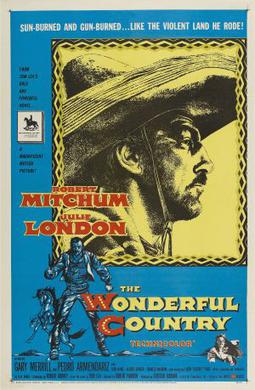
Compared to the 1960's, the 1950's just doesn't stand up for me when it comes to the western genre. Movies were too much soap opera, not enough wild west. Sure, there were plenty of good to great to classic entries, but the following decade was a stretch of a genre at its best. Closing out the decade strong though was a 1957 western that's been generally forgotten over the years, The Wonderful Country.
Working for the powerful Castro family in Mexico, gunfighter and hired gun Martin Brady (Robert Mitchum) is crossing the Rio Grande and entering the United States. An incident from his past drastically changed his life, forcing him to retreat into Mexico where he developed a name for himself as quite the dangerous pistolero. Now, he's on a mission from the Castros to pick up an illegal shipment of repeating rifles and ammunition. It isn't soon after crossing the border that his horse throws him, breaking Martin's leg. He can't ride so he's forced to wait and heal in the border town, shipping the guns and ammunition back to Mexico without him. So with nothing to do but wait, Martin sits back and heals but doesn't quite know what awaits him. People from his past, new acquaintances, and those who want to see him dead, they all await in the coming weeks, especially when news reaches town that the gun shipment has been stolen. But by who?
What an interesting, genuinely odd, even offbeat movie. I watched this western from director Robert Parrish years ago and revisited it recently when it popped up on MGM-HD. I liked it a lot then, and a second viewing produced the same result...albeit with the same response. This is an odd movie, no doubt about it. There are touches of an almost art-house film sprinkled throughout. The story is disjointed to say the least, covering months (and maybe more) from beginning to end but with no real sense of the passage of time. But coursing through it all, an odd energy hangs in the air that I found appealing. A bit of a mess but a good mess to watch.
Robert Mitchum was the best. He had no rivals, a rogue in Hollywood before it was cool to be a rogue. He was one of the first anti-heroes too, the tortured hero who transitioned into bigger and better. One of his specialties? As I've mentioned before, Mitchum was drawn to Mexico including this film but also The Wrath of God, Villa Rides, 5 Card Stud, Bandido and probably several more I'm forgetting. Who better then to play an expatriate American who embraced the Mexican lifestyle almost entirely? I can't think of anyone.
Mitchum's Martin Brady is the one constant through all the craziness and winding story. Yeah, his accent is a little rough at times, but when he speaks Spanish, this isn't an actor remembering his lines. He speaks it fluently. But the character as a whole is interesting because it feels so ahead of its time. This is the somber, even doomed gunfighter running from his past but not really knowing what the future holds for him. All he's known is his pistol, but his ability with the gun has him tied down so he can't escape. From the look of the character -- the immense sombrero, the stubble, the vaquero attire -- to the potentially doomed development, it's a more than worthwhile lead performance.
The rest of the cast is more of an ensemble with a few bright spots. Julie London plays Helen Colton, the wife of the local army outpost commander, Major Stark Colton (Gary Merrill), a generally ineffective officer. Helen has a past and is drawn to Mitchum's Brady but she may have other ideas. But then things get weird in almost variety show ensemble territory, including Albert Dekker (a Texas Ranger captain), Jack Oakie (a well-meaning railroad man), scene-stealing Charles McGraw (an amiable doctor), former Negro League/MLB pitcher Satchel Paige (a cavalryman, a Buffalo Soldier), Anthony Caruso (a Mexican farmer), Mike Kellin (a Mexican pistolero), Victor Manuel Mendoza (the army officer) and his brother, the Governor (Pedro Armendariz), John Banner (the German store owner), Jay Novello (a Mexican soldier and Brady's friend) and Max Slaten (his naive visiting nephew). Enough for you? McGraw is especially good, as is Armendariz in a smaller part.
Definitely worth mentioning is the visual appeal of the movie. 'Country' filmed on-location in Mexico, making the movie look almost like a country's tour guide. Some locations are familiar from other like-minded westerns, but for the most part, you're seeing a country as it is, not done up for the sake of a movie. With a Mexican-themed score combined with that beautiful countryside serving as a backdrop, we've got a winner in the technical department. Sure, the story drifts along too much, bouncing from one character and situation to the next almost without warning, but this is a movie that's very enjoyable if you drift along with it. Not a classic, but a pretty darn good western.
The Wonderful Country (1959): ***/****
The Sons of Katie Elder
"First, we reunite, then find Ma and Pa's killer...then read some reviews."
Showing posts with label Anthony Caruso. Show all posts
Friday, December 18, 2015
Thursday, April 23, 2015
His Kind of Woman
Occasionally I have some genuine freak-out moments. Case in point? I’ve been writing movie reviews here with Just Hit Play since January 2009. I must be getting old! I’ve mentioned before though the timing of starting some of these reviews. I watched some good, even great, movies in the months right before I started this site but never reviewed them, not feeling confident enough to review months later from memory. That’s today’s review, a film noir from 1951, His Kind of Woman, that’s one of my favorites.
A down on his luck gambler living in Los Angeles, Dan Milner (Robert Mitchum) is drifting along with the clothes on his back and very little money in his pocket. Then, his luck turns on a dime, but it seems so easy. A mysterious man with underworld connections offers him a huge payday if he’ll simply leave the country and visit Mexico. There’s a catch though. He can’t know why, only get to a remote hotel on the Baja California peninsula and wait. From there, he won’t be able to return to the United States for at least a year. Suspicious but in need of the money, Milner takes the deal and heads to Mexico. There at the hotel, he meets a beautiful singer, Lenore (Jane Russell), in pursuit of a popular Hollywood actor, Mark Cardigan (Vincent Price), and an odd assortment of guests and locals. Milner sits back and waits for what’s heading his way. What has he gotten himself into exactly?
I saw this 1951 film noir in November 2008, two months before I started writing these reviews. Talk about bad timing, huh? I loved it, something pulling me in and keeping me interested throughout its two-hour running time. It comes from bazillionaire Howard Hughes and had a whole bunch of production problems that become evident in the final act. Now that said, there’s something charming and fun about it from beginning to end. It hasn’t been distributed much, if at all, since its release and ‘Kind’ doesn’t have a huge following. The moral of the story is simple. It should. I highly recommend it.
To say this is a film noir is limiting. It is to be sure, but it tries to do a lot more and generally, succeeds on most of those fronts. Director John Farrow (and an uncredited Richard Fleischer when Hughes didn’t like Farrow’s work) is at the helm of an equal parts film noir, love story, comedy with some action and shootouts thrown in. It isn’t always perfect, but the script makes a mostly successful go at it. Six different people are listed at the IMDB page for this movie as having written part of ‘Kind’ (again reflecting the behind the scenes drama). It’s smart. The dialogue crackles. The story is sorta kinda there, relying on the actors to bring the at-times slow story to life. I think the biggest compliment I can say is that it almost plays like a spoof of the film noir genre itself…but never truly becomes a spoof. Now that takes some doing. Not too light, not too heavy-handed, but more importantly and more successfully, somewhere in between.
Just a few weeks ago, I reviewed 1952’s Macao, another pairing of stars Robert Mitchum and Jane Russell. I watched ‘Kind’ back in 2008 in my Jane Russell phase. I’d never seen her films but fell hard for her right away, and this was only my second Russell film I believe. Again, talk about an on-screen match made in heaven. It’s easy to say Mitchum does the same thing movie in and movie out – that laconic, loner anti-hero – but he brings a different edge and energy with each passing film. I loved his Milner character, a man who knows he’s in trouble but keeps going along to figure out what’s up. The same for Russell’s Lenore, a young woman looking for love but with a fair share of failed attempts behind her. The duo just WORKS so well together. Their scenes are pretty pitch perfect throughout. They’re believable, you like them, and they seem to like each other. How can you go wrong?
What surprised me about the movie’s general unknown quality is the cast. With the cast assembled, how does it not have more of a reputation even by accident? Mitchum and Russell are excellent, but it’s Vincent Price who steals the show. His Mark Cardigan is an Errol Flynn-like movie star, a swashbuckler who’s looking for his movie star life to become his real life. A little too much at times, but very funny. Still not enough? There’s also Tim Holt as an investigating cop, Charles McGraw as a thug and enforcer, Raymond Burr as a mobster trying to get back into the U.S., Jim Backus as a talkative investment banker, Philip Van Zandt as the hotel owner, and an uncredited Anthony Caruso a brooding sidekick to Burr. Not bad at all.
An additional character worth mentioning is the hotel set on the Baja California peninsula. It’s so 1940s/1950s stylish with its bungalows and pool and just some really cool architecture. The sets date the movie a bit, but it truly becomes an additional character. The ending? Yeah, things fall apart a bit as the last 40 minutes get a little too kooky. Even when it goes off the tracks though, ‘Kind’ is still a really fun movie. Definitely worth seeking out, the 1951 film noir popping up occasionally on Turner Classic Movie’s schedule.
His Kind of Woman (1951): *** 1/2 /****
Monday, June 16, 2014
Objective, Burma!
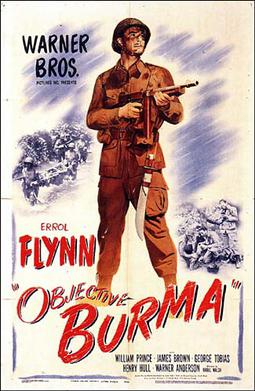
With any actor or actress with a devoted fan following, that following is going to have differing opinions. What is your favorite film? This one or that one? All of them? When we're talking about an actor who worked over multiple decades, it gets that much tougher. Take Errol Flynn who started working in the 1930s and stayed in films through the 1950s. He's got more than a few gems to his name, but my favorite is and always will be 1945's Objective, Burma!
It's 1944 in Burma and Allied forces are preparing to invade the country they were kicked out of by Japanese forces two years earlier. The men across the branches are just waiting for their orders. Among the forces waiting to unleash the attack is Capt. Nelson (Flynn), an officer in command of a platoon of paratroopers. With his friend and second-in-command, Lt. Sid Jacobs (William Prince), Nelson will lead a behind the lines mission into Burma, his men tasked with finding and destroying a key radar station used by the Japanese forces. A 2,000 man garrison isn't too far away from the radar station, meaning Nelson's paratroopers must drop in miles away and find the hidden radar station, all the while avoiding thick Japanese patrols. With a newspaper reporter, Mark Williams (Henry Hull), along to report on the mission, the paratroopers take off from their base with a dangerous mission ahead of them. As prepared as they are though, nothing can really prepare them for what awaits.
What a great movie, one that qualifies in the overused at times but appropriate 'They don't make them like that anymore' category. As far as pure action/adventure movies go, this 1945 WWII flick from director Raoul Walsh is simply hard to beat. It was released in theaters in early 1945, the war winding down but the fighting still very much going on both in the Pacific and Europe. It was a movie ahead of its time, patriotic but not flag-waving and propaganda thankfully. With an Oscar-nominated score from composer Franz Waxman (one that would be used again in the similarly-themed Merrill's Marauders), the action in the 142-minute movie is always on the go, never really slowing down. You feel like you're there with the soldiers, seeing their exhaustion, beards and facial hair appearing as the mission goes awry. It's the perfect popcorn movie, but there are other layers and levels to appreciate. A war movie that still resonates almost 70 years later.
At the tail end of his heyday in terms of popularity, Flynn is the without a doubt, no question star here. I love his performance, especially because he switches things up a bit. Flynn was Robin Hood, a pirate, a swashbuckler, a ladies man, but here, he is just a very capable, very tough and well-liked officer. His Captain Charlie Nelson has been tasked with a dangerous mission that will prove essential to the Allied war effort. Is he rattled, even nervous? Yes, every minute, but he embraces it, hides the feeling away and shows that confidence and even a little bit of a swagger so his men need to see. Flynn was an underrated actor -- for me at least -- but that's one of his biggest attributes. He was confident. He was cool, smooth, and he looked like he belonged on-screen. If it looks like he's not acting, that's the work of an actor who could make it look effortless. At one point with the mission in doubt, one of Nelson's men encourages the other men with "I'd follow him down the barrel of a cannon." Little schmaltzy? Sure, but it works in context, and you see why. I'd follow Errol Flynn into battle too!
Take a look at the cast and you see some names and faces you recognize, but this is Flynn's movie. The rest of the cast becomes part of the unit picture, men brought together from disparate backgrounds forced to work together to get the job done. I liked Hull's journalist, a crotchety old writer trying to tell the story of the soldiers. Nelson's friendship with Prince's Jacobs certainly adds another layer to the story as well. As for Nelson's paratroopers, look for James Brown, George Tobias, John Alvin, Richard Erdman, Joel Allen, and uncredited parts for Anthony Caruso and George Tyne in uncredited parts. Warner Anderson and Hugh Beaumont (Beaver Cleaver's Dad) play higher-ranking officers while Mark Stevens gives a solid supporting part as Lt. Barker, a pilot with the closest ties to Nelson's paratroopers. I liked Tobias, and there's another paratrooper I can't identify by name who has a great bit with a Japanese soldier.
There's so much good going on here, things I picked up on during a recent viewing. It is that perfect war action movie, but it's more. There are a handful of scenes that really resonate, giving an eye into the eyes and thoughts of the paratroopers. Prior to jumping into Burma, the camera moves along a row of faces, the men reacting differently to their upcoming jump and mission. When the mission goes awry, we see the looks on their faces when they have to adjust on the fly. I thought the highlight though was when Nelson and his men come across the mutilated bodies of the paratroopers who didn't make it, the result of a Japanese ambush. One soldier remains, Walsh filming only the man in a door frame so we can't see what's been done to him. We only know he's been cut up, shot up, and he's bleeding out. Over the course of the movie, we see the exhaustion set in, the frustration weighing on all their shoulders. An epically exciting action movie? Yes, and much more.
That is one of the huge appeals for 'Burma.' The action is everywhere, and it doesn't disappoint. The attack on the radar station is the biggest set piece, the rest of the shooting all about the tension and the chase. We don't see the Japanese in frame a lot, but their off-screen presence is a menacing, intimidating cloud hanging over the paratroopers just waiting to strike. The final sequence is especially effective, the pursuing Japanese trying to infiltrate the paratroopers' position on a lonely isolated hill marked by trenches and foxholes. Filmed in the dark with little music, it is a doozy of a success. The whole movie is, one of the great war movies around.
Objective, Burma! (1945): ****/****
It's 1944 in Burma and Allied forces are preparing to invade the country they were kicked out of by Japanese forces two years earlier. The men across the branches are just waiting for their orders. Among the forces waiting to unleash the attack is Capt. Nelson (Flynn), an officer in command of a platoon of paratroopers. With his friend and second-in-command, Lt. Sid Jacobs (William Prince), Nelson will lead a behind the lines mission into Burma, his men tasked with finding and destroying a key radar station used by the Japanese forces. A 2,000 man garrison isn't too far away from the radar station, meaning Nelson's paratroopers must drop in miles away and find the hidden radar station, all the while avoiding thick Japanese patrols. With a newspaper reporter, Mark Williams (Henry Hull), along to report on the mission, the paratroopers take off from their base with a dangerous mission ahead of them. As prepared as they are though, nothing can really prepare them for what awaits.
What a great movie, one that qualifies in the overused at times but appropriate 'They don't make them like that anymore' category. As far as pure action/adventure movies go, this 1945 WWII flick from director Raoul Walsh is simply hard to beat. It was released in theaters in early 1945, the war winding down but the fighting still very much going on both in the Pacific and Europe. It was a movie ahead of its time, patriotic but not flag-waving and propaganda thankfully. With an Oscar-nominated score from composer Franz Waxman (one that would be used again in the similarly-themed Merrill's Marauders), the action in the 142-minute movie is always on the go, never really slowing down. You feel like you're there with the soldiers, seeing their exhaustion, beards and facial hair appearing as the mission goes awry. It's the perfect popcorn movie, but there are other layers and levels to appreciate. A war movie that still resonates almost 70 years later.
At the tail end of his heyday in terms of popularity, Flynn is the without a doubt, no question star here. I love his performance, especially because he switches things up a bit. Flynn was Robin Hood, a pirate, a swashbuckler, a ladies man, but here, he is just a very capable, very tough and well-liked officer. His Captain Charlie Nelson has been tasked with a dangerous mission that will prove essential to the Allied war effort. Is he rattled, even nervous? Yes, every minute, but he embraces it, hides the feeling away and shows that confidence and even a little bit of a swagger so his men need to see. Flynn was an underrated actor -- for me at least -- but that's one of his biggest attributes. He was confident. He was cool, smooth, and he looked like he belonged on-screen. If it looks like he's not acting, that's the work of an actor who could make it look effortless. At one point with the mission in doubt, one of Nelson's men encourages the other men with "I'd follow him down the barrel of a cannon." Little schmaltzy? Sure, but it works in context, and you see why. I'd follow Errol Flynn into battle too!
Take a look at the cast and you see some names and faces you recognize, but this is Flynn's movie. The rest of the cast becomes part of the unit picture, men brought together from disparate backgrounds forced to work together to get the job done. I liked Hull's journalist, a crotchety old writer trying to tell the story of the soldiers. Nelson's friendship with Prince's Jacobs certainly adds another layer to the story as well. As for Nelson's paratroopers, look for James Brown, George Tobias, John Alvin, Richard Erdman, Joel Allen, and uncredited parts for Anthony Caruso and George Tyne in uncredited parts. Warner Anderson and Hugh Beaumont (Beaver Cleaver's Dad) play higher-ranking officers while Mark Stevens gives a solid supporting part as Lt. Barker, a pilot with the closest ties to Nelson's paratroopers. I liked Tobias, and there's another paratrooper I can't identify by name who has a great bit with a Japanese soldier.
There's so much good going on here, things I picked up on during a recent viewing. It is that perfect war action movie, but it's more. There are a handful of scenes that really resonate, giving an eye into the eyes and thoughts of the paratroopers. Prior to jumping into Burma, the camera moves along a row of faces, the men reacting differently to their upcoming jump and mission. When the mission goes awry, we see the looks on their faces when they have to adjust on the fly. I thought the highlight though was when Nelson and his men come across the mutilated bodies of the paratroopers who didn't make it, the result of a Japanese ambush. One soldier remains, Walsh filming only the man in a door frame so we can't see what's been done to him. We only know he's been cut up, shot up, and he's bleeding out. Over the course of the movie, we see the exhaustion set in, the frustration weighing on all their shoulders. An epically exciting action movie? Yes, and much more.
That is one of the huge appeals for 'Burma.' The action is everywhere, and it doesn't disappoint. The attack on the radar station is the biggest set piece, the rest of the shooting all about the tension and the chase. We don't see the Japanese in frame a lot, but their off-screen presence is a menacing, intimidating cloud hanging over the paratroopers just waiting to strike. The final sequence is especially effective, the pursuing Japanese trying to infiltrate the paratroopers' position on a lonely isolated hill marked by trenches and foxholes. Filmed in the dark with little music, it is a doozy of a success. The whole movie is, one of the great war movies around.
Objective, Burma! (1945): ****/****
Labels:
1940s,
Anthony Caruso,
Errol Flynn,
George Tobias,
Henry Hull,
Men on a Mission,
Raoul Walsh,
WWII
Wednesday, March 21, 2012
The Badlanders
Released in 1950 and based off a novel by writer W.R. Burnett, The Asphalt Jungle has withstood the test of time and still remains one of the best examples of a film noir ever released. It is a classic that deserves its reputation built up over the years. Just eight years later, the successful noir was back in theaters with a little twist, it was now a western, the movie 1958's The Badlanders.
Having served a majority of his sentence, Peter van Hoek (Alan Ladd), better known as 'the Dutchman,' is released early from the Yuma territorial prison. A mining engineer, Dutchman maintains that he was framed for a robbery of a gold shipment, still claiming his innocence. He's got a plan to get back at those who set him up, robbing a supposedly useless mine that never produced any gold, or so it seemed. Dutchman enlists the help of McBain (Ernest Borgnine), another recently released prisoner, and Vincente (Nehemiah Persoff), a dynamite specialist, to help in the plan which will require split second timing. The plan seems perfect, but one never knows what might come up when so much gold is involved.
I've never hidden the fact that I'm not a fan of remakes, especially remakes of movies like The Asphalt Jungle that didn't need to be touched. On the other hand, if you're going to do a remake, add something new, a unique feature or departure from the original, much like director Delmer Daves did here. Transplanting the team of crooks, robbers and specialists to the dusty desert of the wild west is an inspired choice. 'Badlanders' was filmed in Old Tucson, Arizona, a filming location western fans will be especially familiar with. The lonely western town surrounded by mountains is a great backdrop to the heist story. As a fan of both westerns and heist flicks, I couldn't help but like this one. How often do we actually see western heists? Few and far between.
The cast is streamlined some, certain characters tweaked or completely dropped from 'Asphalt.' The focus is on Ladd's Dutchman and Borgnine's McBain. Ladd's quiet, easy-going and understated acting style works here, even if a little more visible revenge-seeking would have helped. His background is never fully explained, but we know he wants some revenge, and he's had years to think about it. Playing his partner in crime, Borgnine shows a different side of his acting ability. He isn't the loud, aggressive thug he played so often in the 1950s as he built up a name for himself. His McBain was sent to prison on a manslaughter charge and then saw his land and home pulled out from under him. He too wants revenge but doesn't know where to start until the Dutchman approaches him with a plan. A subplot with McBain and Anita (Katy Jurado), a prostitute in town, helps develop the character as well.
Having two very solid leads in those roles is both good and bad. The good is obvious; it's fun to see Ladd and Borgnine working together on this heist. The bad in an 85-minute movie? The focus is on them, but little else gets dealt with. We hear about both Dutchman and McBain's predicament, their background in getting sent to the Yuma prison, but that's all. We hear, but there's little in the way of details. When Dutchman sets up the plan, are the higher-ups in town the ones who set him up? Does he intend to get them back or just earn himself some money? Not even breaking the 90-minute mark, things feel rushed, like key scenes and explanations were left in the editing room. The villains aren't developed, subplots that are there feel forced and/or pointless, and all the sudden the movie's over. It's an enjoyable ride along the way, but it could have been much better.
Throwing so many different elements into an 85-minute long movie is unfortunate because there's just too much going on. Jurado's Anita is a bright spot, making the most of her time with Borgnine's McBain as the heist plan comes together, but Persoff doesn't come across as well as the Mexican dynamite expert. As mentioned though, the villains are weak and poorly developed. Kent Smith is Lounsberry, the town hot-shot who will serve as a fence for the stolen gold, Robert Emhardt playing Sample, a partner in the coming double-cross. Claire Kelly is Ada (sexy name, huh?), Lounsberry's girlfriend literally locked away in a hotel room until she's needed, there because Ladd's Dutchman needs a love interest. Supporting player in the original 'Asphalt,' Anthony Caruso is Comanche, one of Sample's gunhands while Adam Williams does what he did best, playing a possibly unhinged, highly dangerous gunfighter, albeit a deputy named Leslie.
Like a lot of movies, this one had the potential to be an above average, pretty memorable western, but it never quite gets there. Where 'Asphalt' reveled in its darkness and cynicism, 'Badlanders' refuses to go there, especially in its ending which is just too nice and tidy when it could have been incredibly dark and surprising. It's still a good movie with some solid performances, but it isn't as good as it could have been.
The Badlanders <---TCM trailer (1958): ** 1/2 /****
Having served a majority of his sentence, Peter van Hoek (Alan Ladd), better known as 'the Dutchman,' is released early from the Yuma territorial prison. A mining engineer, Dutchman maintains that he was framed for a robbery of a gold shipment, still claiming his innocence. He's got a plan to get back at those who set him up, robbing a supposedly useless mine that never produced any gold, or so it seemed. Dutchman enlists the help of McBain (Ernest Borgnine), another recently released prisoner, and Vincente (Nehemiah Persoff), a dynamite specialist, to help in the plan which will require split second timing. The plan seems perfect, but one never knows what might come up when so much gold is involved.
I've never hidden the fact that I'm not a fan of remakes, especially remakes of movies like The Asphalt Jungle that didn't need to be touched. On the other hand, if you're going to do a remake, add something new, a unique feature or departure from the original, much like director Delmer Daves did here. Transplanting the team of crooks, robbers and specialists to the dusty desert of the wild west is an inspired choice. 'Badlanders' was filmed in Old Tucson, Arizona, a filming location western fans will be especially familiar with. The lonely western town surrounded by mountains is a great backdrop to the heist story. As a fan of both westerns and heist flicks, I couldn't help but like this one. How often do we actually see western heists? Few and far between.
The cast is streamlined some, certain characters tweaked or completely dropped from 'Asphalt.' The focus is on Ladd's Dutchman and Borgnine's McBain. Ladd's quiet, easy-going and understated acting style works here, even if a little more visible revenge-seeking would have helped. His background is never fully explained, but we know he wants some revenge, and he's had years to think about it. Playing his partner in crime, Borgnine shows a different side of his acting ability. He isn't the loud, aggressive thug he played so often in the 1950s as he built up a name for himself. His McBain was sent to prison on a manslaughter charge and then saw his land and home pulled out from under him. He too wants revenge but doesn't know where to start until the Dutchman approaches him with a plan. A subplot with McBain and Anita (Katy Jurado), a prostitute in town, helps develop the character as well.
Having two very solid leads in those roles is both good and bad. The good is obvious; it's fun to see Ladd and Borgnine working together on this heist. The bad in an 85-minute movie? The focus is on them, but little else gets dealt with. We hear about both Dutchman and McBain's predicament, their background in getting sent to the Yuma prison, but that's all. We hear, but there's little in the way of details. When Dutchman sets up the plan, are the higher-ups in town the ones who set him up? Does he intend to get them back or just earn himself some money? Not even breaking the 90-minute mark, things feel rushed, like key scenes and explanations were left in the editing room. The villains aren't developed, subplots that are there feel forced and/or pointless, and all the sudden the movie's over. It's an enjoyable ride along the way, but it could have been much better.
Throwing so many different elements into an 85-minute long movie is unfortunate because there's just too much going on. Jurado's Anita is a bright spot, making the most of her time with Borgnine's McBain as the heist plan comes together, but Persoff doesn't come across as well as the Mexican dynamite expert. As mentioned though, the villains are weak and poorly developed. Kent Smith is Lounsberry, the town hot-shot who will serve as a fence for the stolen gold, Robert Emhardt playing Sample, a partner in the coming double-cross. Claire Kelly is Ada (sexy name, huh?), Lounsberry's girlfriend literally locked away in a hotel room until she's needed, there because Ladd's Dutchman needs a love interest. Supporting player in the original 'Asphalt,' Anthony Caruso is Comanche, one of Sample's gunhands while Adam Williams does what he did best, playing a possibly unhinged, highly dangerous gunfighter, albeit a deputy named Leslie.
Like a lot of movies, this one had the potential to be an above average, pretty memorable western, but it never quite gets there. Where 'Asphalt' reveled in its darkness and cynicism, 'Badlanders' refuses to go there, especially in its ending which is just too nice and tidy when it could have been incredibly dark and surprising. It's still a good movie with some solid performances, but it isn't as good as it could have been.
The Badlanders <---TCM trailer (1958): ** 1/2 /****
Saturday, February 25, 2012
Drum Beat
History provides all sorts of little tidbits, small, little-known stories that are often enough lost in the history books. The development of the American west had countless examples of this in the 19th Century, small-scale incidents that were major at the time, but were generally forgotten. Made in 1954, Drum Beat is a solid and generally forgotten western telling the story of the Modoc War in 1872 and 1873.
A well-known and respected Indian fighter, Johnny MacKay (Alan Ladd) has been tasked with a mission from President Grant (Hayden Rorke). In the Oregon territory, the Modoc tribe has left the reservation and causing problems for the white settlers. Johnny is hired as a peace commissioner with the hopes of both the white settlers and and Modoc Indians signing a treaty that will bring a halt to all the violence. He is skeptical of the two sides working together, but Johnny travels back west hoping to meet with Captain Jack (Charles Bronson), the chief of this group of Modocs. The Indians are less than cooperative though, and peace won't come easily.
From director Delmer Daves, this is a BIG western. It isn't an epic that runs 3-hours with intermission and a cast of thousands, but it is nonetheless big. It was filmed in Cinerama and takes full advantage of the on-location shooting in Sonora. You can see and feel the immensity of the frontier as the settlers tangle with the warring Indians. The developing story is somewhat familiar in that sense, but it never feels dull. Yes, there are scenes that rely solely on the natural background, long, uninterrupted scenes of riders moving across a horizon. At 111 minutes, it is a tad long in the tooth, but it's not a deal breaker. Victor Young's score is appropriately sweeping without overpowering anything on-screen, and thankfully the Ballad of Drum Beat is only played over the opening credits.
With Daves at the helm, the story is just solid. He's an underrated, underappreciated director who was consistent throughout his career, directing one excellent movie after another. The story is familiar here -- settlers/whites vs. Indians -- but it doesn't feel familiar. Credit to Ladd and Bronson there. I really liked Ladd's performance as Johnny MacKay, an Indian fighter who's good at what he does but doesn't necessarily enjoy it. Bronson as an Indian seems like a bad choice, but that too works. It borders on a caricature but never goes too far. He looks out for the best interest of his tribe...at first...only to get swept up in the glory of fighting. Their scenes together are surprisingly good, especially their final scene in the closing minutes. The fight leading up to that scene ain't too shabby either.
An ensemble cast of familiar faces backs up Ladd and Bronson, Audrey Dalton leading the way as Nancy, an Easterner who's moved west to help the cause and surprise, surprise...falls for Ladd's Johnny! Who saw that coming?!? Oh, everybody? My bad. Marisa Pavan and Anthony Caruso rise above stereotypes as Toby and Mannock, two peaceful Modocs working with Johnny and not against him. Robert Keith plays Bill, an older frontiersman with a grudge while Rodolfo Acosta and Perry Lopez play two of Bronson's warriors. Look for recognizable character actors Willis Bouchey, Elisha Cook Jr., Strother Martin and Denver Pyle in small parts.
As a quasi-western buff, I do have to poke some holes in this story. A title card starts with 'This is true except for the fictional characters and storylines needed to dramatize the truth.' So basically a cop-out. A true story until the truth isn't entertaining enough. Sonora, Arizona does not look like Oregon in the least, and the Modocs look and are portrayed more like Apaches than any other tribe. Just weird observations that ran through my head. Still a good movie, especially a large-scale battle on a Modoc fortress on an impenetrable rock formation, with an interesting cast.
Drum Beat <---credits/opening (1954): ***/****
A well-known and respected Indian fighter, Johnny MacKay (Alan Ladd) has been tasked with a mission from President Grant (Hayden Rorke). In the Oregon territory, the Modoc tribe has left the reservation and causing problems for the white settlers. Johnny is hired as a peace commissioner with the hopes of both the white settlers and and Modoc Indians signing a treaty that will bring a halt to all the violence. He is skeptical of the two sides working together, but Johnny travels back west hoping to meet with Captain Jack (Charles Bronson), the chief of this group of Modocs. The Indians are less than cooperative though, and peace won't come easily.
From director Delmer Daves, this is a BIG western. It isn't an epic that runs 3-hours with intermission and a cast of thousands, but it is nonetheless big. It was filmed in Cinerama and takes full advantage of the on-location shooting in Sonora. You can see and feel the immensity of the frontier as the settlers tangle with the warring Indians. The developing story is somewhat familiar in that sense, but it never feels dull. Yes, there are scenes that rely solely on the natural background, long, uninterrupted scenes of riders moving across a horizon. At 111 minutes, it is a tad long in the tooth, but it's not a deal breaker. Victor Young's score is appropriately sweeping without overpowering anything on-screen, and thankfully the Ballad of Drum Beat is only played over the opening credits.
With Daves at the helm, the story is just solid. He's an underrated, underappreciated director who was consistent throughout his career, directing one excellent movie after another. The story is familiar here -- settlers/whites vs. Indians -- but it doesn't feel familiar. Credit to Ladd and Bronson there. I really liked Ladd's performance as Johnny MacKay, an Indian fighter who's good at what he does but doesn't necessarily enjoy it. Bronson as an Indian seems like a bad choice, but that too works. It borders on a caricature but never goes too far. He looks out for the best interest of his tribe...at first...only to get swept up in the glory of fighting. Their scenes together are surprisingly good, especially their final scene in the closing minutes. The fight leading up to that scene ain't too shabby either.
An ensemble cast of familiar faces backs up Ladd and Bronson, Audrey Dalton leading the way as Nancy, an Easterner who's moved west to help the cause and surprise, surprise...falls for Ladd's Johnny! Who saw that coming?!? Oh, everybody? My bad. Marisa Pavan and Anthony Caruso rise above stereotypes as Toby and Mannock, two peaceful Modocs working with Johnny and not against him. Robert Keith plays Bill, an older frontiersman with a grudge while Rodolfo Acosta and Perry Lopez play two of Bronson's warriors. Look for recognizable character actors Willis Bouchey, Elisha Cook Jr., Strother Martin and Denver Pyle in small parts.
As a quasi-western buff, I do have to poke some holes in this story. A title card starts with 'This is true except for the fictional characters and storylines needed to dramatize the truth.' So basically a cop-out. A true story until the truth isn't entertaining enough. Sonora, Arizona does not look like Oregon in the least, and the Modocs look and are portrayed more like Apaches than any other tribe. Just weird observations that ran through my head. Still a good movie, especially a large-scale battle on a Modoc fortress on an impenetrable rock formation, with an interesting cast.
Drum Beat <---credits/opening (1954): ***/****
Wednesday, December 7, 2011
The Iron Mistress
Born in 1796, Jim Bowie packed a hell of a lot of living into his 40 years. An adventurer, a frontiersman, a slave trader, land owner, and knife fighter, Bowie did it all before his death at the Alamo in 1836. Most famously, he's known for inventing a particularly nasty-looking knife that was named after him, the Bowie knife. Why then with a life as adventurous and exciting as his is the 1952 bio-pic The Iron Mistress so dull?
Traveling to New Orleans in 1825, Jim Bowie (Alan Ladd) is looking to sell lumber from his family's mill. A backwoodsman more comfortable in the bayou, Jim is more than a little uncomfortable in the big city. He meets Narcisse (Douglas Dick), a well-to-do French land owner, and is then introduced to his sister, the very pretty Judalon (Virginia Mayo). Jim is drawn to her instantly but quickly discovers trouble surrounds her wherever she goes. The young knife fighter wants bigger and better things though, wants riches of his own. Land, cotton, slaves, it doesn't matter. Young Mr. Bowie intends to take the world by storm.
To say that this 1952 biography plays fast and loose with the history is a generous statement. What's true? There was a man named Jim Bowie, he had a wicked-looking knife created for him, and he was in Louisiana and Texas in the 1820s and 1830s. Other than that? This could be any movie about an enterprising young businessman. I'm a fan of Bowie historically and anything remotely connected to the Alamo, but even I can find little redeeming in this story. It drags along at 109 minutes -- but feels much, much longer -- and is bogged down in the period look from the costumes down to the sets. The story simply tries to do too much, never focusing on anything specific, or for that matter....interesting.
The movie's fatal flaw comes in the casting. I'm not a huge fan of the typically wooden Alan Ladd to begin with, but he is a poor choice to play Bowie. The real-life Bowie was a particularly nasty guy so right off the bat Ladd is backed into a corner with this 1950s whitewashing of the historical, real life person. But whitewashing or not, Ladd appears to be sleepwalking. He gives Bowie little to no personality through his adventures. Even Sterling Hayden in The Last Command was better than Ladd. Of a big cast that leaves little positive impressions, Mayo is all right as the manipulative Judalon, Joseph Calleia plays Moreno, Bowie's opposition (later starring in John Wayne's The Alamo), Anthony Caruso the treacherous Sturdivant, and George Voskovec as a Quaker friend of Bowie's.
A movie about a famous knife and its creator doesn't disappoint in that regard. Several knife fights highlight the otherwise slow-moving and dull story. One has Bowie strapped at the wrist to Caruso, fighting in a ring surrounded by a mob. Another has Bowie running from armed riders trying to kill him, and even the infamous Sandbar Fight is dealt with in surprisingly gruesome fashion. The best scene by far has Bowie -- armed with his knife -- fighting a man armed with a sword in a darkened room. A beautifully put together, tension-packed sequence, great to look at and exciting on top of it. Also a plus, the scene where blacksmith James Black (David Wolfe) creates the original Bowie knife.
Returning to the actual history, the story picks up in the last half hour as Bowie heads to Texas where he meets future wife Ursula De Veramendi (Phyllis Kirk), the daughter of the governor. This last half hour has solid pacing and actually picks up some momentum heading into the finale. The ending itself is ridiculous, basically setting up the last few years of Bowie's life without his knife. It is a deeply flawed biography of a very interesting historical figure with just enough going for it to mildly recommend.
The Iron Mistress <---TCM trailer (1952): **/****
Traveling to New Orleans in 1825, Jim Bowie (Alan Ladd) is looking to sell lumber from his family's mill. A backwoodsman more comfortable in the bayou, Jim is more than a little uncomfortable in the big city. He meets Narcisse (Douglas Dick), a well-to-do French land owner, and is then introduced to his sister, the very pretty Judalon (Virginia Mayo). Jim is drawn to her instantly but quickly discovers trouble surrounds her wherever she goes. The young knife fighter wants bigger and better things though, wants riches of his own. Land, cotton, slaves, it doesn't matter. Young Mr. Bowie intends to take the world by storm.
To say that this 1952 biography plays fast and loose with the history is a generous statement. What's true? There was a man named Jim Bowie, he had a wicked-looking knife created for him, and he was in Louisiana and Texas in the 1820s and 1830s. Other than that? This could be any movie about an enterprising young businessman. I'm a fan of Bowie historically and anything remotely connected to the Alamo, but even I can find little redeeming in this story. It drags along at 109 minutes -- but feels much, much longer -- and is bogged down in the period look from the costumes down to the sets. The story simply tries to do too much, never focusing on anything specific, or for that matter....interesting.
The movie's fatal flaw comes in the casting. I'm not a huge fan of the typically wooden Alan Ladd to begin with, but he is a poor choice to play Bowie. The real-life Bowie was a particularly nasty guy so right off the bat Ladd is backed into a corner with this 1950s whitewashing of the historical, real life person. But whitewashing or not, Ladd appears to be sleepwalking. He gives Bowie little to no personality through his adventures. Even Sterling Hayden in The Last Command was better than Ladd. Of a big cast that leaves little positive impressions, Mayo is all right as the manipulative Judalon, Joseph Calleia plays Moreno, Bowie's opposition (later starring in John Wayne's The Alamo), Anthony Caruso the treacherous Sturdivant, and George Voskovec as a Quaker friend of Bowie's.
A movie about a famous knife and its creator doesn't disappoint in that regard. Several knife fights highlight the otherwise slow-moving and dull story. One has Bowie strapped at the wrist to Caruso, fighting in a ring surrounded by a mob. Another has Bowie running from armed riders trying to kill him, and even the infamous Sandbar Fight is dealt with in surprisingly gruesome fashion. The best scene by far has Bowie -- armed with his knife -- fighting a man armed with a sword in a darkened room. A beautifully put together, tension-packed sequence, great to look at and exciting on top of it. Also a plus, the scene where blacksmith James Black (David Wolfe) creates the original Bowie knife.
Returning to the actual history, the story picks up in the last half hour as Bowie heads to Texas where he meets future wife Ursula De Veramendi (Phyllis Kirk), the daughter of the governor. This last half hour has solid pacing and actually picks up some momentum heading into the finale. The ending itself is ridiculous, basically setting up the last few years of Bowie's life without his knife. It is a deeply flawed biography of a very interesting historical figure with just enough going for it to mildly recommend.
The Iron Mistress <---TCM trailer (1952): **/****
Sunday, June 27, 2010
The Asphalt Jungle
Whether he was behind the camera directing or in front of the camera acting, there were few directors or actors as tough/cool/badass as John Huston. As an actor, he always played characters with an edge and with his gravelly voice and not so classic looks, he always sold the part. As a director, he excelled with movies that were as tough as the stories they told. They were 'guy's guys movies' that rarely disappointed and one of his best was 1950's The Asphalt Jungle.
This 1950 heist movie is worth talking about for two reasons. One, released at the height of film noir popularity, 'Jungle' finds a way to put its own spin on the story and it ends up being a classic in the genre. Two, you can judge it by the impact it had on later underworld heist movies. Watch a heist movie released since 1950, and it's almost impossible not to make some connection or influence Huston's flick had. At just under two hours, there is not a wasted minute in the build-up, heist, and fall out of a jewelry robbery.
Just out of jail after seven years inside, Doc Reidenschneider (Sam Jaffe) wastes no time setting up a job that could net him and his partners almost a million dollars. With some help and financial backing from a crooked lawyer, Alonzo Emmerich (Louis Calhern), Doc reveals his plan to knock off a diamond exchange. He'll need some help though and recruits three men, Dix Handley (Sterling Hayden), the muscle, Gus Minnisi (James Whitmore), the getaway driver, and Louis Ciavelli (Anthony Caruso), the safe-cracker to help him pull off the job. The Doc has everything figured out down to the second, but all the planning in the world can't account for the unexpected. And then there's Emmerich, who may have ulterior motives for the heist.
The 'jungle' of the title is the underworld, the crime figures who threaten to take over cities and ruin the lives of good people all across the country, or at least that's how Police Commissioner Hardy (John McIntire) explains it. Like most noir movies, Huston shoots in black and white in this unnamed midwest city. The characters live and die in smokey rooms and dark, shadowy alleys as they go about their heist. Like few other movies, Huston creates a real feeling of the underworld, the seedier parts of town that you don't want to be caught in after a certain hour. With composer Miklos Rozsa's score, you've got the right start to a winner.
Working with an ensemble cast, Huston gets the best out of this talented crew. Often stiff and a little wooden in starring roles, Hayden delivers a career-best performance as Dix Handley (other than the pornstar-sounding name). Handley is a two-bit thug -- dubbed a 'hooligan' -- who dreams (watch HERE) of raising enough money to buy his childhood farm and leaving this dirty city life. I don't think he was ever better than he was here. Jaffe too is beyond perfect casting as the small in stature but brilliant planner of crimes and heists, earning an Oscar nomination for his part. His Doc is incredibly intelligent and a gentleman to boot, seemingly involved in crime because he's good at it. These two characters end up forming an unlikely friendship based on truth and hard knocks, a surprising friendship to come out of a heist movie.
The rest of the cast isn't anything to sneeze at as well. Calhern as Emmerich is the prototypical slimy villain. From the moment the heist is brought up, you know he's looking to double-cross Doc and his crew (with some help from equally slimy Brad Dexter). Where Handley might beat you with his fists, Emmerich would do the same with words and intellect, never ruffling a hair on his head or putting a crease in his suit. Jean Hagen is solid as Doll, a wandering young woman attracted to Handley in who she sees something good where no one else does. Whitmore too is great in his quick appearance as Gus, the hunchback getaway driver who will be loyal to the end. Also look for an actress you might have heard of, Marilyn Monroe in just her 3rd credited role, as Emmerich's mistress. You look at her and understand what Emmerich was thinking.
The beauty of 'Jungle' is in the execution because it never slows down. The actual heist -- an exciting if not groundbreaking sequence -- is over less than an hour into the movie. The fallout from the heist is where the movie revels because even Doc can't plan for everything, in this case unforeseen accidents popping up when least expected. It's an idea and a premise used in so many types of movies, but it is has never been used so well as it is in the heist movie. Without giving too much a way, it's safe to say 'Jungle' doesn't exactly have a happy ending -- it is 1950 -- but overall it works better because there wasn't a happy ending.
Because so many heist movies have been made since, The Asphalt Jungle may play like a movie that you've seen many times before...been there, done that. But watch it thinking that when it was released in 1950, there hadn't been a movie quite like this before. Director Huston puts together a doozy of a cast with Hayden delivering a career-best part leading the way, and there isn't an aspect of the movie that fails. A winner in every sense of the word.
The Asphalt Jungle <----trailer (1950): ****/****
This 1950 heist movie is worth talking about for two reasons. One, released at the height of film noir popularity, 'Jungle' finds a way to put its own spin on the story and it ends up being a classic in the genre. Two, you can judge it by the impact it had on later underworld heist movies. Watch a heist movie released since 1950, and it's almost impossible not to make some connection or influence Huston's flick had. At just under two hours, there is not a wasted minute in the build-up, heist, and fall out of a jewelry robbery.
Just out of jail after seven years inside, Doc Reidenschneider (Sam Jaffe) wastes no time setting up a job that could net him and his partners almost a million dollars. With some help and financial backing from a crooked lawyer, Alonzo Emmerich (Louis Calhern), Doc reveals his plan to knock off a diamond exchange. He'll need some help though and recruits three men, Dix Handley (Sterling Hayden), the muscle, Gus Minnisi (James Whitmore), the getaway driver, and Louis Ciavelli (Anthony Caruso), the safe-cracker to help him pull off the job. The Doc has everything figured out down to the second, but all the planning in the world can't account for the unexpected. And then there's Emmerich, who may have ulterior motives for the heist.
The 'jungle' of the title is the underworld, the crime figures who threaten to take over cities and ruin the lives of good people all across the country, or at least that's how Police Commissioner Hardy (John McIntire) explains it. Like most noir movies, Huston shoots in black and white in this unnamed midwest city. The characters live and die in smokey rooms and dark, shadowy alleys as they go about their heist. Like few other movies, Huston creates a real feeling of the underworld, the seedier parts of town that you don't want to be caught in after a certain hour. With composer Miklos Rozsa's score, you've got the right start to a winner.
Working with an ensemble cast, Huston gets the best out of this talented crew. Often stiff and a little wooden in starring roles, Hayden delivers a career-best performance as Dix Handley (other than the pornstar-sounding name). Handley is a two-bit thug -- dubbed a 'hooligan' -- who dreams (watch HERE) of raising enough money to buy his childhood farm and leaving this dirty city life. I don't think he was ever better than he was here. Jaffe too is beyond perfect casting as the small in stature but brilliant planner of crimes and heists, earning an Oscar nomination for his part. His Doc is incredibly intelligent and a gentleman to boot, seemingly involved in crime because he's good at it. These two characters end up forming an unlikely friendship based on truth and hard knocks, a surprising friendship to come out of a heist movie.
The rest of the cast isn't anything to sneeze at as well. Calhern as Emmerich is the prototypical slimy villain. From the moment the heist is brought up, you know he's looking to double-cross Doc and his crew (with some help from equally slimy Brad Dexter). Where Handley might beat you with his fists, Emmerich would do the same with words and intellect, never ruffling a hair on his head or putting a crease in his suit. Jean Hagen is solid as Doll, a wandering young woman attracted to Handley in who she sees something good where no one else does. Whitmore too is great in his quick appearance as Gus, the hunchback getaway driver who will be loyal to the end. Also look for an actress you might have heard of, Marilyn Monroe in just her 3rd credited role, as Emmerich's mistress. You look at her and understand what Emmerich was thinking.
The beauty of 'Jungle' is in the execution because it never slows down. The actual heist -- an exciting if not groundbreaking sequence -- is over less than an hour into the movie. The fallout from the heist is where the movie revels because even Doc can't plan for everything, in this case unforeseen accidents popping up when least expected. It's an idea and a premise used in so many types of movies, but it is has never been used so well as it is in the heist movie. Without giving too much a way, it's safe to say 'Jungle' doesn't exactly have a happy ending -- it is 1950 -- but overall it works better because there wasn't a happy ending.
Because so many heist movies have been made since, The Asphalt Jungle may play like a movie that you've seen many times before...been there, done that. But watch it thinking that when it was released in 1950, there hadn't been a movie quite like this before. Director Huston puts together a doozy of a cast with Hayden delivering a career-best part leading the way, and there isn't an aspect of the movie that fails. A winner in every sense of the word.
The Asphalt Jungle <----trailer (1950): ****/****
Subscribe to:
Posts (Atom)