The Sons of Katie Elder

The Sons of Katie Elder
"First, we reunite, then find Ma and Pa's killer...then read some reviews."
Showing posts with label Gene Hackman. Show all posts

Friday, August 21, 2015

Wyatt Earp

When it comes to iconic, famous names in American history, specifically the wild west of the 1860's and on to the turn of the century, rise above all others. Names like Billy the Kid, Buffalo Bill, Jesse James, Wild Bill Hickok are all synonymous with the wild west, but maybe none more known and recognizable than lawman Wyatt Earp. He led a remarkably busy (and unscathed) life, and has been immortalized in both films and television shows alike. Here's 1994's Wyatt Earp, a bio-pic I'd never seen before a recent viewing.

Growing up on the family farm with his parents and brothers and sisters, young Wyatt Earp grows up learning to trust in himself and his family, and to always be there should that family need help. But as he puts his teenage years behind him, Wyatt (Kevin Costner) marries a beautiful young woman (Annabeth Gish) and looks to settle down and start a life. When his wife dies from typhoid, Wyatt is distraught, turning to alcohol and going into an epic depression. That's not the end that's meant for this enterprising young man though. Wyatt heads west, attracted by the possibility of riches in the untamed regions of the young country. Freight driver, bounty hunter, buffalo hunter, he tries it all, but his ultimate calling? That may be as a lawman, and the west is in great need of those. From boomtown to boomtown like Dodge City and Abilene, Wyatt's reputation grows and grows. That name begins to mean something -- fear, respect, intimidation -- as the far-more experienced, cynical Wyatt heads west once again with his brothers. This stop? Tombstone, Arizona.

I ain't real good at writing the words to describe an epic biography that covers multiple decades, introduces countless characters and in general, ain't easy to succinctly describe. And that's what this movie is. From director Lawrence Kasdan (also directed Silverado), 'Earp' is a three-hour biography of one of the west's most recognizable names, a bio-pic that was originally intended as a miniseries. Big impression? It probably would have been better that way. Even at three hours, this western feels like it tackled too much, taking on too much and not enough depending on the scene. Second big impression? It came out a year after one of the best westerns ever that dealt with the same topic, 1993's Tombstone. That's two strikes. What's gonna be the third one? Pick and choose because there's plenty.

History has a fun way of remembering folks. Case in point...Wyatt Earp. He was not a pleasant fella to say the least. The thing he is remembered most for -- the gunfight at the OK Corral -- led some to consider him and his brothers outright murderers. Wisely, 'Earp' does not try to gloss over the foibles and flaws in its titular character. Costner does a fine job showing Wyatt Earp's dark, cold, brutal side...but that's it. At a certain point, it gets repetitive. It becomes a performance without emotion because Wyatt becomes this one-note person. He wants to make a fortune for himself and his brothers. Anything else is just getting in the way. I found myself actively disliking the character and maybe that's the point. This is a bio-pic that probably shows Earp as he really was, not as we'd like to think of him. Accuracy is always a bonus in biographies, but that doesn't make it entertaining.

Almost from the beginning, 'Earp' felt like it handles everything in matter-of-fact fashion. Again...realistic but not necessarily entertaining (or even enjoyable). In its execution, this is a western epic that's trying to be EPIC and never quite gets there. Just not enough energy to bring it up to an epic level, much less a classic level. Gene Hackman gets to speechify in a small part as Wyatt's father, instilling (you could say drilling) the values that will impact his son for the rest of his life. One bbbbbbig moment after another comes along -- always with composer James Newton Howard's scoring swelling at the right moment -- and I kept waiting for these countless scenes to have some sort of impact on me...but they never did. When you know there's a three-hour running time still ahead of you, that's never a good feeling when you're not..well, feeling much at all about the movie.

One of the best things about Tombstone is the casting and characters. Here, dealing with the same people and the same basic story, only one performance really stands out. That's Dennis Quaid as Doc Holliday, a dentist, southern gentleman and gambler who's dying of tuberculosis. He has the unenviable task of following Val Kilmer's scene-stealing part as Doc, but creates his own character and performance. Quaid lost 30 pounds for the part of the dying gambler, giving him a distinctly sickly look. He's quick with a putdown and insult, just as quick as he is with a gun or knife in a scene-stealing performance. The only problem is that he's not around enough. There's too many speaking parts in general and most of them aren't developed nearly enough. Like so much else here, it felt like a wasted opportunity.

That said, 'Earp' does featuring some cool casting choices, even if they're misused. Michael Madsen, David Andrews, Linden Ashby and Jim Caviezel all play Earp brothers with Madsen and Ashby standing out for the positive. The Earp women, wives and sorta wives, played by Catherine O'Hara, JoBeth Williams and Mare Winningham, are given nothing to do other than complain Wyatt is mean in one-note performances (no fault of their own). In cool parts, Tom Sizemore and Bill Pullman play Bat and Ed Masterson, friends of the Earps and fellow lawmen, but they too are underused. Also look for Mark Harmon, Jeff Fahey, Joanna Going, Isabella Rossellini, and James Gammon in other supporting parts. Too many excellent historical figures are glossed over somewhat or entirely to the point it was unnecessary to even mention them.

I've always felt saying a movie is 'boring' is a cop-out, but man, this movie was boring. The last two hours are far better than the first, but I still kept waiting for the story and characters to pull me in. An epic disappointment unfortunately on basically on all levels.

Wyatt Earp (1994): **/****

Tuesday, July 7, 2015

Night Moves (1975)

The time of the film noir was long since past, its shadowy streets, scarred, flawed anti-heroes and dastardly villains gone the way of the do-do bird. The genre lived on into the 1950s some before moving on. Then...THEN, along came the 1960s and everything weird and drug-induced and dark and cynical. Here came a new type of film noir, almost as if it was on LCD or acid of some sort. A whole sub-genre of flicks came along, the private detective meets film noir meets general weirdness. That's today's flick, a 1975 neo-noir called Night Moves.

A former pro football player, Harry Moseby (Gene Hackman) is a mildly successful private investigator working in Los Angeles. He's a dogged investigator and good at what he does, stubborn to a fault to get answers, but there just isn't much money in the business. His home life with his wife (Susan Clark) becoming increasingly frustrated with that lifestyle, but now Harry has a case on his plate that's peaks his curiosity. A past her prime actress, Arlene Iverson (Janet Ward), wants Harry to track down her missing daughter, Delly, who's been gone for several days with no word at all. Delly is a teenager with a free spirit who's embraced quite the freeing lifestyle. Where to start though? Delly...well, she got around but Harry decides to start in Florida where her stepfather lives a life of ease (seemingly). Immediately though with anyone he talks to, Harry feels like he's getting the run-around. What has he stumbled into?

I recorded this movie on Turner Classic Movies a few months back and never got around to it, eventually deleting it. Just my luck, it popped back up on the schedule a few weeks ago so I gave it another shot. What to say? What an interesting, weird, off-the-wall movie in just about every description I can come up with. 'Night' comes from director Arthur Penn, he of Bonnie and Clyde, Little Big Man and The Missouri Breaks, among others. His movies were part of a New Wave in Hollywood, featuring European influences (mostly French) while also blending the general cynicism washing across America. Authority, the government, the system, all of it would come under question in the late 1960s and into the 1970s.

The filming style and technique used by Penn is a more natural effort. Scenes transition from one to the next in the blink of an eye. The story itself drifts along as Hackman's Harry meets one person after another, some he's met in the past, others he's meeting for the first time. There is some description or background of these people, but not a lot so pay attention or you'll miss the little tidbits here and there. There has to be a confidence within the story and the director and his crew to pull off something like that. Yeah, 'Night' has the idea of a story, but it is far from your typical, even straightforward story. So in that sense, this is a movie that drifts along in pretty easy-going fashion. It's also intensely frustrating at times because it slows down to a snail's pace where there's literally no story movement. The thing that holds it together...

Maybe you've heard of him. His name is Gene Hackman. The 1970s were Hackman's decade with one classic role and movie after another. Even when he hams it up a bit, he's still eternally watchable. When he plays things straight, you get movies like this. Hackman's Harry is calm and cool and exceptionally good at what he does. His personal life is a different story, like when he discovers his wife is having an affair (with Harris Yulin). Frustrated to no end, this P.I. dives back into his work, seeking some sort of solace in finding answers for his cases. He gets a lot of screentime with Jennifer Warren's Paula, a woman in her 30s with quite the checkered past that got her to this place. I didn't love the movie overall and struggled at time to stick with it, but Hackman helps get through the rough patches in a very solid lead performance.

The rest of the cast is okay, but nothing crazy. Not much in the way of big names so instead we get a lot of familiar faces in character actors. Along with Clark, Yulin and Warren, look for Edward Binns, Kenneth Mars, Anthony Costello, and John Crawford. In two of the best supporting parts, 17-year old Melanie Griffith plays the sexually free Delly while James Woods plays a mechanic who may be up to something who's also a friend of our young Delly. 'Night' caused a stir because the underage Griffith has several nude scenes and even had several love scenes cut from the final product. Woods is already brimming with intensity which works well in several scenes with Hackman.

It's been a week since I watched this 1975 detective noir story, and man, I still can't wrap my head around it. The second half of the movie does pack some surprises as Harry's investigation uncovers all sorts of shady dealings, but it never quite comes together. By the time everything is laid out....yeah, I'm still not sure what happened and why that person is dead or that person betrayed somebody. Confusing to say the least, but even with that said, there is still something oddly entertaining about this not so normal detective story. Flawed but interesting.

Night Moves (1975): ** 1/2 /****

Friday, April 3, 2015

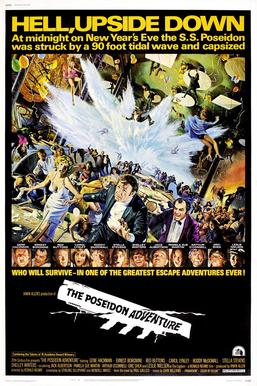
The Poseidon Adventure (1972)

Every so often I get embarrassed when it comes to movies. Yeah, those movies you should have seen by now. The classics for good and bad, the great performances, an award-winning something or other. We've all got them. I do my best to make sure that list is ever-shrinking, but there are gaps. So while I've reviewed all sorts of dud disaster flicks from The Swarm to When Time Ran Out, I'd never seen one of the first disaster films all the way through in one sitting until a recent viewing. Here's 1972's The Poseidon Adventure. Don't judge me. You think you're better than me?!?

Sailing from New York City to Athens, the S.S. Poseidon is making one last voyage after years of service around the world, a ship destined for the scrap heap. That voyage is behind schedule though, and its captain (Leslie Nielsen) is under pressure to make up some serious time with so much money on the line. That speed may make up lost time but it puts the ship, crew and passengers at serious risk, but none of them know what awaits. Sailing through the Mediterranean, the Poseidon receives news of an immense earthquake off the Greek coast and its repercussions are heading right for the fully-loaded passenger ship. During a New Year's Eve celebration, an enormous wave moving at dangerous speeds is coming right for them. The ship is capsized in the wave's wake with much of the crew and many passengers killed. One small group survives though, and led by a fiery, trouble-making reverend, Scott (Gene Hackman), they try to make it through an upside down apocalyptic environment that was their ocean liner. Can they make it to the hull and possible rescue?

When it comes to disaster movies, I typically associate two movies with kick-starting the genre into its highest popularity. First, there's 1970's Airport. Second, well, here we sit. Though I've seen the entire movie here, I'd never before seen it in one viewing where I just sat down and blazed through it. Thanks, TCM! I didn't love it, but I did like it. It's difficult to watch this movie in 2015 and see it with a fresh light. This is a movie that has impacted hundreds of flicks since its release in 1972. So now on a fist-time view over 40 years later, it feels cliched, familiar and at times, overdone. None of those criticisms prove to be a deal-breaker in the end, but it will definitely impact your viewing. Still, this is a movie that helped launch an entire genre that was everywhere in theaters for almost a full decade. They weren't always classics -- or even that good -- but let's give credit where it is due.

One of the biggest impacts 'Poseidon' had on its future is the casting. This disaster movie from director Ronald Neame (and an uncredited Irwin Allen, the producer as well) assembles a pretty solid all-star cast. Future flicks would take the all-star cast concept to ridiculous levels where EVERYONE in Hollywood would make an appearance. If the script here is a little goofy, who better to keep righting the ship than Gene Hackman? I submit No One. His Reverend Scott is angry, a leader, a fighter and not interested in any excuses or garbage. When all else seems lost, he keeps his motley crew of survivors to keep moving as the water levels keep on rising. He's also rocking an impressive combover and a very stylish turtleneck. With a lot of actors, maybe the part gets a tad hammy, but because it's Gene Hackman, you go along for the ride. It's Hackman!

So what's the appeal of the ensemble all-star cast? Let's get down to business. We want to see which celebrity lives and which celebrity is due for an overdramatic death scene. So who is possible fodder for that finale? A Just Hit Play favorite, Ernest Borgnine goes for the gusto as Rogo, a police officer traveling with his new bride, a former hooker (Stella Stevens). There's also an older Jewish couple (Shelley Winters, Jack Albertson) traveling to see their grandson, two siblings (Pamela Sue Martin, Eric Shea) going to meet their parents, a lonely, middle-aged man (Red Buttons) who bonds with the ship band singer (Carol Lynley), and a member of the ship's crew, a waiter (Roddy McDowall). Winters was nominated for a Best Supporting Actress and comes across the best. The kids are pretty shrill, Borgnine and Hackman yell a lot, and Buttons is also very solid. A little hit or miss, but a strong cast overall.

How about some originality? Well, a capsized ocean liner quickly filling with water sure is a unique starting point. The survivors have to navigate their potential tomb...upside down. It's a hellish, claustrophobic, steamy, smoky environment littered with dead bodies and an ever-rising water level. You definitely feel like you're there with the survivors as they navigate this almost other-worldly situation. It's a cool premise that definitely pays dividends. The early, doom-building scenes are also incredibly effective as is the actual capsizing scene, just one epically uncomfortable extended sequence featuring some very cool special effects.

Sure, things get a touch overdone at times, especially with the pissing contest between Hackman and Borgnine for control of the group. Sure, the God/religion/faith aspects get to be a little much. Overall, it's an enjoyable movie that I've got to give a notch up simply because of its profound impact on countless movies released in its wake. Any movie that is still impacting flicks over 40 years later is okay in my book. Took quite a long time to sit down and watch it, but 'Poseidon' was worth the wait.

The Poseidon Adventure (1972): ***/****

Thursday, December 11, 2014

Riot

You know what was so great about the 1960s and much of the 1970s? B-movies just didn't care...like at all. Politically incorrect, racist, needlessly violent, in poor taste, random bits of nudity, drugs and rock and roll. They had them all! Sure, these weren't major studio releases that were too worried about public outcry -- audiences wanted all those things -- but still, there's a charm to the "We don't give a F***!" mentality. Today's entry? A prison flick, 1969's Riot.

Serving a five-year sentence for an unnamed crime, Cully Briston (Jim Brown) goes about his business as best he can, trying not to cause any issues at all. Well, that's about to change. Sent to see a deputy warden by a guard, Cully is in the wrong place at the wrong time in the administration building. A group of prisoners in isolation cells, led by Red Fraker (Gene Hackman), has managed to escape and take a handful of guards and officials hostage. They hope to buy some time and pull off an escape, but their plan is thrown awry when someone is able to signal the guards. Now, the group is forced to improvise as guards line the walls with every weapon they have. Forced to work with Red and his fellow prisoners, Cully has to tread a fine line. He's right in the thick of it but has to decide what's the best plan of attack for himself. He's gotta decide quick with time running out.

What an interesting movie. Based on a non-fiction novel from author Frank Elli, 'Riot' tells the true story of a riot in a prison with at least a couple possible influences. Now all that said, I can't find the real-life incident it's based on so go figure. 'Riot' has all sorts of positives that just wouldn't seem to work in a 2014 flick. For starters, it was filmed on location at the Arizona State Prison with the real-life warden playing himself. Actual inmates played many of the background and supporting parts. What?!? Brown and Hackman have one scene after another with real inmates. Now who knows, maybe these were inmates in prison for robbing a pack of gum, but they're in prison just the same. The locations, the prison inmate casting, it adds a real cool touch to the movie, a sense of authenticity in this gritty prison B-movie.

Now if you're going to have real-life prison inmates starring in your B-movie, you'd better have a couple actors/stars who can hold their own. Yeah, I guess Jim Brown and Gene Hackman qualify in that scenario, huh? Sorta I guess. Right in his heyday, Brown's Cully is the perfect anti-hero, calm, cool and collected as a prisoner thrust into an unlikely leadership role. He's trying to keep about 100 different plates spinning, all with an end game in sight. Hackman has a fun part too, avoiding anything too hammy as the confident, plan-wielding Red who sees that plan fall apart pretty quickly. Having worked together a year earlier in 1968's The Split, it's cool to see these two tough guy actors working together again. They're the two biggest names by far, and their scenes together were the movie's high point for me.

Who else to look for? Some recognizable names and faces if not big stars. Mike Kellin plays Bugsy, the antsy right hand man to Red who seems to buckle under the slightest push, while Ben Carruthers (who was one of The Dirty Dozen with Brown) plays Surefoot, a wild-eyed Indian hoping to put a knife right in Cully's gut. Gerald S. O'Loughlin plays Grossman, a tough-talking guard who freaks out when the tables are turned.

There are certain things that scream 1960s B-movie though, that lack of interest in doing anything mainstream or familiar. Where to start? It doesn't shy away from the brutality of prison life. We meet a gay prisoner/hospital attendant named Mary (Clifford David), not to mention two other prisoners dubbed 'Queens' in the cast listing. They dress up as women with skirts, underwear, wigs and makeup, and dance for the pleasure of the other prisoners. At one point, Brown's Cully has a great dream sequence where he escapes and is dropped off -- via helicopter -- at a pool surrounded by bikini-clad women. It's so cheesy it works. There's plenty of moments like that sprinkled throughout director Buzz Kulik's 96-minute prison movie. A little overdone but who cares? You get the sense Kulik stood there and just said 'Here's my movie. Hate it if you want.'

If there is anything misleading about the movie's title, well, there isn't much of a riot. The movie is far more of a hostage situation with some prisoners living it up detours. The build-up is interesting throughout as we wait to see which side will blink first, the guards or the prisoners, but it never quite builds to what you think it will be. The finale does offer a couple twists amidst some graphic violence, but 'Riot' wasn't exactly the movie you'd think it would be. Still highly entertaining and a very passable way to spend an hour and a half in the guilty pleasure department. In the anti-hero folk character department, Brown even gets a theme song, 100 Years, that you can listen to HERE.

Riot (1969): ** 1/2 /****

Tuesday, December 2, 2014

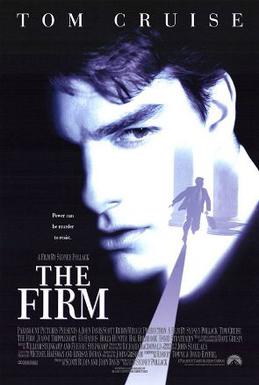
The Firm

So this John Grisham fella, he's a pretty decent writer I hear. A specialist in legal thrillers, Grisham has a long list of bestselling books to his name. Growing up though in the 1990s, I was at that age where neither the books nor the film adaptations really appealed to me. In 1995, 10-year old me wasn't too interested in the world of law. Go figure. The positive? 20-something me has gotten to catch up with both the books and the movies! Today's flick is 1993's The Firm.

Graduating from Harvard Law School, Mitch McDeere (Tom Cruise) has the world at his fingertips. Job offers from countless impressive, prestigious law firms are flowing in, and Mitch is able to make the decision on his own. He accepts an offer from Bendini, Lambert & Locke, a small, tax/accounting firm in Memphis. Their offer blows the others out of the water, and everything about the firm seems too good to be true. The family-like atmosphere appeals to Mitch so with his wife, Abby (Jeanne Tripplehorn), he moves to Memphis with his new house, new Mercedes and new job. He fully commits himself, a talented lawyer pushing himself to his absolute limit and testing his marriage with Abby because he's so committed to making this job work. His goals are pure, but maybe the job isn't? Mitch begins to suspect there's far more going on behind closed doors than he's being told. What secrets is the firm holding?

I'm a book nerd too on top of my movie nerdiness. If there's a book available of a forthcoming flick, I'll typically try and read the book first, and this Grisham novel/adaptation combo was no different. One of the author's most famous books, The Firm was an excellent read. Well-written, good story, cool/interesting characters. The film adaptation from director Sydney Pollack has all those ingredients and for the most part, works pretty well. It was filmed on-location in Memphis with the city serving an excellent backdrop to the story. The characters are fascinating, and the cast is impressive in its depth and talent. I don't usually criticize soundtracks, but I thought this Memphis blues (with a lot of piano) infused score was a big flop overall as well, to the point the score becomes a distraction because it didn't fit with the tone and rhythm.

Now onto one of my movie theories. Ah, screw it, theories in general! I call it the Christmas Eve theory. Do you want to know what your presents are or is the mystery and the build-up and the anticipation the best part? The mystery here works in a big way -- we're talking epic SENSE OF DOOM -- and the payoff does too. No Spoilers here though, sorry. It's the execution after the reveal that didn't work as well for me. The screenplay takes some giant liberties with Grisham's novel, making changes that severely alter characters, the entire story, the motivations and the payoff in the end. It's a long movie to begin with at 154 minutes, but I found myself drifting in the second half. There's some really intense, life and death chase scenes that are exhilarating to watch but things get disjointed in a big way. The ensemble gets lost in the shuffle, and the scene with the payoff feels almost laughable. Talk about a disappointment in the finale.

With all that said, the movie is still worth watching. Starting with Cruise, the cast is pretty impeccable. In quite a string of successful movies, Cruise is an excellent lead. Reading the book, he wasn't what I thought Mitch would look like, but the casting works. Cruise brings the right amount of confidence and smarts and then intense terror to the character. This isn't a flawless character -- thankfully -- but an interesting one. Of the supporting performances, I thought Gene Hackman was the best. Go figure, Gene Hackman being good at acting! He plays Avery Tolar, a partner at Bendini and Mitch's mentor who's supposed to take the young lawyer under his wing as he preps for the BAR exam. Their scenes as they meet and get to know each other feature some of the movie's strongest scenes. It's two actors going toe to toe, one holding the firm's secret, one trying to carve a niche out for himself.

Who else to look out for? LOTS of folks. Start with Hal Holbrook and Jerry Hardin as two heads of the firm who recruit Mitch to join Bendini. Wilford Brimley and his impressive mustache are quite imposing (and unintentionally funny at one line) as DeVasher, the firm's head of security. Helping Mitch figure out exactly what's going on are Gary Busey as a private detective and Holly Hunter as his sexy Southern secretary. Pushing Mitch to make a life-altering decision are some government officials -- cough FBI cough -- in the form of Ed Harris (with a shaved head and angry demeanor) and Steven Hill (taking a break from Law and Order). And also, look for David Straithairn as Mitch's brother, Ray, who has a secret that could cripple them all. Last but not least, also look for Paul Sorvino, Tobin Bell, Dean Norris, Margo Martindale, and Joe Viterelli in some other key supporting parts I don't want to give too much away about.

I wanted to like this movie more than I did. All the potential is certainly there from the cast to the novel to the directing (Pollack is a favorite of mine). It just never quite lives up to that potential. The first half is better than the second half, but the ending disappoints, limping to the finish. I sound like that guy, but the book is better than the movie. Oh, and Tom Cruise runs for his life around Memphis a lot so there's that.

The Firm (1993): ** 1/2 /****

Monday, October 6, 2014

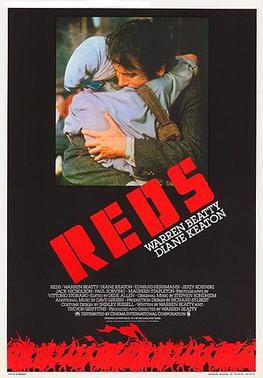
Reds

The amount of information, facts and tidbits I don't know about Russian history could full volumes. I love history -- ALL of it -- but something about the immensity of Russia and its history has proved rather intimidating to me. Where to even start? Well, movies seem to agree with me. I liked but didn't love 1965's Doctor Zhivago, but there's another Russian epic that's long been recommend to me. Let's get going with 1981's Reds.

Living in Portland, Oregon in 1915, Louise Bryant (Diane Keaton) has a relatively safe if dull life. She's married, does art and is a hopeful writer. Then, she meets John Reed (Warren Beatty), a highly respected if somewhat controversial writer with an impressive following. She is immediately drawn to him and ends up following him to New York City to be with him while also hopefully pursuing a career as a writer and a journalist. There's a relative catch though. John is a staunch supporter of the socialist movement, a movement that threatens to tear World War I apart as workers around the world, especially in Russia, begin to push for more rights, more privileges. In the midst of World War I (and with the Russian Revolution looming), Louise has entered into one of history's most tumultuous times. She loves John and he loves her, but the world seems on the brink of blowing itself up. What will happen next?

For years, my Mom has recommended this movie to me. It's one of her all-time favorites, and she knows far more about the time and backstory than I do. For some background reading, read about the Russian Revolution HERE at Wikipedia. It's not even fair to say this is a Russian Revolution movie. This is a story about two people's lives amidst that turbulent time in world history with a heavy socialist focus. For more reading, read about John Reed and Louise Bryant, two incredibly interesting individuals. It is a big, epic movie, clocking in at equally intimidating 194 minutes, and took Beatty (who starred, directed, produced and wrote) and his cast and crew a full year to film. That's before you consider a lengthy editing process. Beatty is no dummy, taking on films that mean something to him, and this is the definition of that. This is a message movie, an intellectual, thought-out, impressive film. Is it good though?

I will say it is more interesting than it is good, if that makes sense. 'Reds' picked up 12 Oscar nominations, ultimately winning three, including Beatty as Best Director. For a movie that clocks in at almost three and a half hours, it did well at the box office and resonated with critics and has developed quite a following among fans. It was filmed in New York City, Finland, England, Sweden and Spain. So....yeah, what else? 'Reds' is an epic. The scale and immensity is impressive. This is an epic about an idea though, the idea of socialism. This is 194 minutes of almost entirely talking. This is talking about a principle, about government, about corruption, about history, about the system. 'Reds' isn't Lawrence of Arabia or The Godfather or Gone With the Wind. It is its own epic, and with Beatty backing it all the way, it is quite okay with being its own film. I struggled at times because it is such a smart, well-written movie. Is that enough to hamstring a film? I don't know, but definitely know what you're getting into here.

Picking up two of the film's four Oscar acting nominations, Beatty and Keaton carry the film. Either one or the other is in almost every scene, and apparently the filming was so strenuous on their off-screen relationship they ultimately broke up. I didn't necessarily buy their doomed love, their unexplained chemistry. What did I buy? Their performances themselves are excellent. These are two extremely intelligent individuals, drawn to each other but who's personalities butt heads because they're both so strong-willed. Based on historical figures, both characters are 3-D, blood and guts people, not cardboard cutouts. Kudos to both actors who again make their characters interesting/fascinating if not necessarily likable.

Up until 2012's Silver Linings Playbook, 'Reds' was the last film to receive Oscar nominations for all four acting categories. The culprits? Jack Nicholson as playwright/writer Eugene O'Neill and Maureen Stapleton as famed anarchist Emma Goldman. These aren't huge supporting parts, but what's there is choice, two actors making the most of their relatively small screentime. Also look for Edward Herrmann, Jerzy Kosinski, M. Emmet Walsh, Paul Sorvino, William Daniels, Gene Hackman, and R.G. Armstrong in supporting parts. Some of them are pretty quick, none of them truly developed, and a couple are nothing more than a single scene. Of the smaller parts, Kosinski is memorable as a socialist leader working with Reed and Hackman as a booze-loving, honest newspaper editor.

One of the best choices Beatty makes as a director was a wise style choice. Along with the actual story, interviews with those who knew Reed and Bryant during the 1910s and 1920s are interspersed throughout the movie. These people -- now in their 70s and 80s -- reminiscing about John and Louise, about the times, about how things have changed, these are the moments that proved most memorable for me. Check out the list of witnesses HERE. So as I mentioned before, this is an excellent movie. One you appreciate and admire and respect. I felt like I learned some things as the story develops, but did I love the movie like I hoped I would? Nope. Still very much worth checking out, but not quite the movie I was expecting.

Reds (1981): ** 1/2 /****

Tuesday, March 18, 2014

The Gypsy Moths

Skydiving has always fascinated me, but I've never had the guts to do it. Odd considering I'm typically scared to death of heights, huh? Meh, big deal! Years ago on a DVD I can't remember, I caught a trailer for a movie from the 1960s about skydiving with a great cast that looked like a light, fun and entertaining flick. Well, I caught up with how many years later, and let me tell you, 1969's The Gypsy Moths ain't what I thought it was going to be.

It's the Fourth of July weekend when a three-man skydiving team, Mike Rettig (Burt Lancaster), an experienced diver, Joe Browdy (Gene Hackman), the motor-mouthed owner/diver, and Malcolm Webson (Scott Wilson), a young but talented diver, drive into a small Kansas town looking to put on a show and make some cash. Malcolm grew up in the little town, the group even staying at the home of some of Malcolm's family. Their mindsets on basically everything is vastly different from the townspeople, including the family, causing some riffs between the barnstorming skydivers and the town-based population. Joe's team gets out on the town though, advertising and getting the word out about their coming show. It won't be easy to put the show together though with weather concerns, and those problems are amplified when the group argues over whether Mike should do a dangerous cape jump as a grand finale.

This 1969 flick comes from one of my favorite directors, John Frankenheimer, the man behind The Train, The Manchurian Candidate and Seven Days in May among others. 'Moths' never got a full theatrical release in the United States, audiences only discovering it years later. The reasoning? My guess would be it was a couple years too early. In the 1970s, this movie may have flourished. There's surprising amounts of nudity, a forthright attitude about sex, adultery, life in general. Whatever the reason though, it didn't really get a chance with American audiences. Frankenheimer has even said in interviews that this was his favorite film he directed. That's all the convincing I need, but in very disappointing fashion, the movie doesn't amount to a great final package.

Some of that definitely comes from a perception of mine because I thought I was getting a different movie. That's not all of it though. I adjusted and went with a far darker story than I thought I would be watching. The screenplay from William Hanley looks to give a little slice of smalltown America and what better time to do that than a 4th of July weekend? Frankenheimer filmed on location all around Kansas, giving an authenticity that wouldn't work if it was filmed on a Hollywood backlot. It doesn't translate overall though. I think the movie is too thoughtful, too introspective, too brooding for its own good. These skydivers sure are moody, depressed, fighting amongst themselves and instantly clashing with the townspeople with their callous(?) outlooks on life. The first hour is painfully slow and so darkly down and depressing that I couldn't get into it at all. For me, that's saying something. I'm usually a big proponent of the darker the better in terms of story.

Whatever the tone though, 'Moths' has quite the cast. Are they used well? Eh, not really. I didn't really understand Lancaster's Mike character. He's a longtime skydiving veteran, an adrenaline junkie who's beginning to see the adrenaline wear off. Are his skydiving days beyond him? He may have found a future with Deborah Kerr's Elizabeth Brandon, a married woman and Malcolm's quasi-aunt. They're instantly drawn to each other, but it's never clear why. As near as I can figure, they're drawn to something different, Mike a settled down life with a wife and family, Elizabeth a wild and free life lived on the road to the fullest. Mostly, this relationship comes out of nowhere, one of those horrible movie relationships where two people fall for each other immediately with some knowing looks. This affair/relationship does push the story to some surprising twists, but the twist didn't have quite the dramatic shock I'm assuming was intended. Surprising? Yes. Effective dramatically? Eh, not quite.

The rest of the cast okay, nothing special. There is a chemistry among Lancaster, Hackman and Wilson, but there's not enough of it. When it does come around, it's too late. Hackman is solid as ever, a fast-talking charmer, the engine that makes the team go. He meets and clicks with a waitress (Sheree North, topless dancing and all) immediately as the skydiving show fast approaches. Wilson is moody and worrying and quiet as Malcolm, an underdeveloped character that falls for a young boarder, Annie (Bonnie Bedelia), at her aunt's home. These are all potentially interesting characters, but something just doesn't click to bring it all together. Also look for William Windom as Kerr's husband, seemingly seeing what's going on but not doing much about it.

The final 45 minutes at least make an effort to get the audience's adrenaline pumping. After all the introspective, slow-moving drama of the first hour, it is desperately needed as the skydiving team heads to their show. The footage is pretty crazy, cameramen jumping with the actual skydivers to get some great skydiving action. There are these ridiculous moments where you sit back and think "Man, that guy is hanging off the plane's wing waiting to drop. What if his parachute doesn't open?" The skydiving footage is the high point of the movie, no doubt about it, but it wasn't enough to save this Frankenheimer film for me. Unfortunate end result, a disappointing effort in the end that never connects.

The Gypsy Moths (1969): **/****

Wednesday, September 11, 2013

The Split

A stylish, dark heist flick from the 1960s with one of the all-time great tough guy casts. It's a winning formula for sure, especially for a sucker like me for heist movies. It took me years to track down 1968's The Split -- which I first reviewed in August 2009 -- and I was less than impressed with the film on my first viewing. When it popped up on Turner Classic Movie's schedule recently, I was going to give it another try. I mean....come on.....look at this cast!

A master thief who's gone off the grid seemingly for several years, a man named McClain (Jim Brown) is reunited with a former partner and an expert planner, Gladys (Julie Harris), when it comes to pulling off impossible jobs. They team up again, Gladys putting forth the plan; rob the L.A. Coliseum during an NFL playoff game that will net $500,000. McClain assembles a team of crooks who haven't worked together in the past, but he convinces them to put their differences aside with the thought of a very lucrative payday. The five-man team goes about planning the job with very little time to do so. The dangerous job is one thing though, but the fallout from the job may be even more dangerous, especially when an investigating detective, Lt. Brill (Gene Hackman), catches wind of them and is right behind them.

For years, this 1968 heist film from director Gordon Flemyng wasn't available in any form; DVD, VHS, nothing. Now, it's available on a burn-for-order DVD so if you've never seen it and are dying to catch up, there it is for you. First or second viewing though, I had the same issues. 'Split' has a lot of potential, much of it tied to the casting, but it never quite goes anywhere. It's got the style from its frame-in-frame credits sequence to its Quincy Jones soundtrack, the on-location shooting at the L.A. Coliseum to the dark nature of the team of crooks working together. All these disparate elements never manage to jell, ending up with a heist film that takes a really bizarre turn in the last third of the movie. A very disappointing end result because it did have so much potential.

How about that casting though? In assembling his team for the robbery, Brown's McClain brings together Bert Clinger (Ernest Borgnine), a gym owner and strong man, Harry Kifka (Jack Klugman), a down on his luck limo driver who will serve as the team's getaway driver, Marty Gough (Warren Oates), a temperamental safe cracker, and Dave Negli (Donald Sutherland), a smooth as ice hit man and hired killer. And NFL great turned action star Jim Brown for good measure?!? How can you lose??? Well, as dark and dirty as things get, something is missing from the group. The movie runs only 91 minutes and after McClain's recruiting, things move right along to the actual heist. The group is full of so many bad guys I never found myself rooting for them to pull the job off successfully. Still, it is an impressive grouping of star power, misutilized though they may be.

I think that's the problem for 'Split' in general. With so much going on, the right tone is never picked out. It bounces back and forth and among all these different things. Brown's McClain meets up with his jilted ex-wife, Ellie (Diahann Carroll), still holding a grudge, but darn it, she still likes him a lot as we see in a montage set to a Jones song as they walk along a beach. The actual recruiting of the team just feels a tad bit off, like certain things aren't fitting together well, but it's entertaining enough. The robbery at the Coliseum lacks a certain energy with no real catch of anything unique helping them pull the job off. But the biggest problem? That would be the final half hour.

One of the keys to a good heist film is oddly enough, not the heist. It's the fallout after the job when the cops close in, the team has to wait for things to cool down to get their money, and seemingly inevitably....turn on each other. That's fine and dandy, just about any good heist movie follows that formula. Ready for the derail? It comes in a really odd one-scene cameo from James Whitmore as Ellie's creepy landlord. Then, Gene Hackman doesn't even make his first appearance until 70 minutes into a 90-minute movie. From there on in, the story and twists and turns feel rushed. It's a pretty dark ending, but even that feels mishandled. The movie just sort of ends, leaving all sorts of questions unanswered. A truly disappointing movie, one that handled differently could have been a near-classic among the heist genre. Oh, and the above poster is bad, giving the impression the team is just a bunch of friends out to pull a job. Um.....no.

The Split (1968): **/****
Rewrite of August 2009 review

Tuesday, April 16, 2013

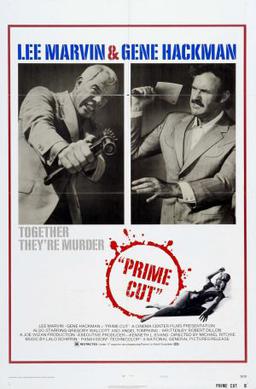
Prime Cut

Some movies are just a variety of odd, weird and offbeat. That can be a good thing as long as a movie commits to being quirky. I don't really know what to make of 1972's Prime Cut having just finished it. It is all of those things, but the best part? It embraces the quirkiness and goes with it. Better because it's weird.

Working as an enforcer for the Irish mob in Chicago, Nick Devlin (Lee Marvin) has pretty much seen it all. This time around, he's got a job that even he couldn't quite plan for. With some help from three young Irish enforcers, Nick must head to Kansas City to deal with Mary Ann (Gene Hackman), a mobster himself running a crooked slaughterhouse with some secrets. Several other enforcers have been sent with lousy results. The last one? Mary Ann had him ground up and sent back to Chicago as sausage (quite literally, he's sausage links). Nick isn't one to shy away from a job -- any job -- so he travels to Kansas City and get the $500,000 that Mary Ann owes the Irish mob. The experienced enforcer doesn't quite know everything though, finding upon arrival that even Mary Ann has some tricks up his sleeve.

This is truly a flick that defies just about any description I can come up with. From director Michael Ritchie, I figured it would be a pretty straightforward, enjoyable gangster flick starring the always reliable, always tough Lee Marvin. It's an apt description to a point, but it's also so much more, and for the good. Because it covers so much ground and does it effectively, calling it a crime thriller with pulpy undertones on top of an out of left field love story with an almost existential feel to the fast-paced story that an art house film might be proud of is....very fair. It's all of that, and it does it well. Impressive considering the flick only runs 88 minutes and never really slows down. I was expecting one movie and got another instead, for the better.

Let's start with probably the most normal thing about 'Cut,' and that's Lee Marvin (a favorite here at Just Hit Play). The description of his part sounded a little bit like Point Blank, and at it's most basic, it is. He does the tough guy anti-hero part like nobody's business. A former Marine, he handles the action scenes expertly and capably, but he's not a one-trick pony. Marvin can deliver a snappy one-liner with the best. His Nick Devlin has quite the past (hinted at more than shown), but it's a great lead character. How about Gene Hackman as a villain? Sounds good, right? How about an over the top villain named Mary Ann who oozes sleaze and slime and runs a corrupt slaughterhouse where you can buy top choice meat.....and drugged up young women sold as slaves? Yep, that's a good villain if there ever was. Hackman's part isn't gigantic, but every time he is on-screen, you can't help but love to hate him.

So where to start in general? There's a lot of worthy jumping off points, but the obvious is the opening credits, a montage of the inner workings of Mary Ann's slaughterhouse. Uh-oh, is that a shoe...and then a man being ground up? Watch it HERE. It's an unsettling, realistic opening that certainly sets the tone. Not subtle by any means, things get switched up then in the next scene as Nick, three enforcers and a driver drive to KC in a montage scene reminiscent of a French art house crime thriller. It's quite the change of pace from one scene to the next. Things get ratcheted up then when we meet Mary Ann, Nick walking through his display barn only to see naked young women (heavily drugged) lying in cattle pens for buyers to purchase. The meeting between Nick and Mary Ann (again, why the woman's name?) is perfect, two sides testing the other for all they're worth. Some of these transitions could be kind of jarring if handled incorrectly, but Ritchie manages to make this mess of a story work, and work well.

It's the balance that works. I wouldn't have expected an endearing love story to develop between Marvin's Nick and a young woman he rescues from Mary Ann's sale, Poppy, played in her screen debut by Sissy Spacek. She comes from a sheltered past where she was raised to be sold as a slave, but she's managed to rise above it -- focusing on the simple positives of life -- and finds an ally in Nick, her rescuer. Having rescued her, Nick buys a handful of different dresses and takes her out for an expensive dinner. While everyone else stares at her revealing dress, Nick -- ever the gentleman -- stares them down, teaching her which silverware to use and when. It's almost surreal in its oddness. I make no bones about my dislike of force-feeding a love story into a movie that doesn't need it, but when handled correctly (like here), it's hard to make any complaints.

Then there's the more pulpy crime stuff I expected going in. That's not a negative by any means. It is a tough guy film and that means a whole lot of crazy 1970s action. Probably the most memorable scene is a confrontation at a crowded country fair, Nick running with Poppy from Mary Ann's small army of overall-wearing, shotgun-wielding country boys. The capper is a gem, the duo running in an immense open wheatfield from a thresher. Watch it HERE. The big blowout is saved for last, Nick -- using a submachine gun -- and his remaining enforcers approaching Mary Ann's farm fortress through a field of sunflowers. It's a tense, well-choreographed sequence that sets up the actual finale quite well.

As for the rest of the cast, Gregory Walcott is quite memorable as Weenie, Mary Ann's thuggish, perverted brothers, and Angel Tompkins as Clarabelle, Mary Ann's wife who has a past with Nick. William Morey (in his only role) plays Shay, Nick's driver who's worked many times in the past with him, with Clint Ellison, Howard Platt and Les Lannom as the young enforcers. This is one epically weird movie overall, but I loved just about everything it offers. It most definitely is weird so know what you're getting into, but I highly recommend this one.

Prime Cut (1972): *** 1/2 /****

Thursday, August 9, 2012

First to Fight

An interesting mess of a movie, 1967's First to Fight at first gave me the impression of being a recruitment film made by the United States Marines. Little research proved nothing of the sort, but go figure. I maintain my stance. Moral of the story? The movie's all over the place; B-movie with a very low budget, soap opera quality love scenes, vicious if somewhat overdone battles, and at times it actually utilizes a pretty solid cast. Unfortunately in the end, it never amounts to much as a finished product.

The lone survivor from his unit after a horrifically costly firefight with the Japanese on Guadalcanal in 1942, Sgt. Jack Connell (Chad Everett) is awarded the Congressional Medal of Honor and shipped back home to help the war effort by encouraging Americans to buy war bonds. He can't help but think of the friends he left behind though and starts to question if he is more valuable in the Pacific fighting. Connell meets Peggy Sanford (Marilyn Devin), his "guide" on the war bond tour, and quickly hits it off, the couple marrying. Connell gets orders to report to Camp Pendleton as a drill instructor, but the thought still lingers. Should he volunteer for combat or keep his promise to Peggy to avoid the war?

Where to start here? I can't completely rip this movie from director Christian Nyby because at different points there are positives to take away from it. The problem with that is simple; the positives get buried under mountains of the negative. A B-movie does not necessarily mean a movie is bad, not by a long shot. That rogue, renegade, cheap shooting from the hip style can be an attribute to a lot of movies. 'Fight' doesn't qualify there. That cheap quality actually hamstrings the story. Any indoor sets look like retread sets from 1960s TV shows, and the musical score -- battle scenes an exception, those work -- is that aggressive, blaring type that DEFIES you not to be emotionally moved. Here's some advice. If you're a B-movie (yes, I'm talking to an abstract idea), just embrace it. Don't convince and beg us to like you.

Those are the little things that bother you (okay, just me) as you're watching a movie. Not enough to ruin a movie, but it certainly can bring a movie down a notch or two. The bigger issue here is the story, one straight from the War Cliches Department. The opening intro -- the bloody firefight on Guadalcanal -- opens things with a punch to the jaw in a highly effective action sequence. Most of the next hour though is spent on Jack and Peggy's oh-so-lovely relationship. It is Dullsville for sure. Everett quotes Bogie in two different scenes after the couple goes and watches Casablanca, then using 'As Times Goes By' as "their song." Oh, free advertising for Warner Bros. in an odd, extended clip from the movie. One montage actually has Jack and Peggy walking in place pointing at things as super-imposed images show all the fun stuff they're doing. Thankfully you can fast forward through these parts, but that's never a good sign when you're hoping to enjoy a movie.

Playing the lead character, Everett is an okay if not particularly flashy actor. Mostly known for his parts on TV shows and TV movies, he does the best he can with a character that for all his interesting background just isn't that interesting. The lovey-dovey relationship with Devin's Peggy of course doesn't help either. The last 30 minutes let Everett do some heavy lifting, and to be fair, he's very good as his now-Lieutenant returns to combat. What caught my eye when this movie appeared on TCM was the rest of the cast, some used better than others. A pre-stardom Gene Hackman is the best thing going here as Sgt. Tweed, the tough as nails Marine sergeant, a familiar/cliched part, but a scene-stealing one just the same. Dean Jagger is also solid as Colonel Baseman, Connell's commanding officer. Unfortunately Claude Akins is wasted in his two-scene appearance (maybe 3 combined minutes on-screen), and James Best is underused as Sgt. Ed Carnavan, Connell's best friend, a key part that's not given it's due. Also look for Norm Alden as one of Jack's Marines.   

What will no doubt bring some viewers in is the WWII setting, and for the most part, that's why I can somewhat give this a recommendation. For all the unnecessary and repetitive Wilhelm screams (listen HERE) and "exploding" soldiers jumping and twirling off of trampolines, there is a bloody, chaotic realism to some of these scenes. The opening attack along a stream on Guadalcanal is a gem for all the right reasons. The same goes for Connell's return to combat on Saipan as his rifle platoon moves toward dug-in Japanese forces. Unfortunately there just isn't enough of that in a 92-minute movie. Too much time is spent on the generally unbelievable love story. When will movie studios learn? Make a love story or a war story. It's the rare combination that works.

First to Fight (1967): **/****

Friday, May 11, 2012

Heist

I knew the name if not his work necessarily. David Mamet has done a bit of everything in Hollywood from writing to directing to producing. Whatever he is doing though, I can say this. Even with my little knowledge or background info, I knew that Mamet is a talented if eccentric guy. Playing on some genre conventions that will no doubt seem very familiar at times, Mamet directs the simply-titled 2001 film, Heist.

While pulling off an intricate diamond exchange robbery with his team, veteran thief Joe Moore (Gene Hackman) is caught on a security camera and plans to retire from the business. His plans are brought to a halt though when his fence, Mickey Bergman (Danny DeVito), refuses to share his half of the take from the diamond robbery. He'll give him the money, provided he takes on one more job. Everything is set down to the smallest details for the job -- robbing an airplane of a heavy shipment of Swiss gold -- but Joe smells a rat. It seems too easy, especially when Mickey insists his nephew, Jimmy Silk (Sam Rockwell), "tag along" to keep an eye on things. It won't be easy getting out unscathed, but an old pro like Joe has some tricks too.

No matter the talent -- or lack of -- I'll sit down and watch a heist film. Almost always there is some attempt to throw a new wrinkle into the familiar genre, what new job/scheme can be pulled off against the odds? Mamet doesn't go for that new wrinkle, sticking with the old reliables and doing it well. We see familiar characters -- the thief on his last job, his long-time partner, the smooth-talking con man, the shady fence, the femme fatale -- and familiar situations throughout. 'Heist' isn't interested in a BIG story with a huge scale. It stays on a more personal level and has a more believable feel. A shootout is quick and violent, betrayals come left and right, and there's always a twist around the next corner. Subdued or understated isn't the right word, but it's a professionally done story that knows where it wants to get.

I'll save the flaws for later, but the positives are obvious; namely, the cast. No matter the role, I'll give Gene Hackman a chance, and he rarely disappoints. His character -- the veteran thief doing his last job -- is the definition of a stock character we've seen countless times before, but Hackman breathes some new life into that familiar part. I especially liked his partnership with Delroy Lindo's Bob Blane, another experienced, fiery thief who works with Joe like a brother. There few scenes together (just them) provide the most memorable, enjoyable scenes in the whole movie. Also on Joe's team are Rebecca Pidgeon (Mrs. Mamet) as Fran, Joe's wife, and Ricky Jay as Pinky, the chubby, fast-talking con artist who can do a little bit of everything. DeVito and Rockwell (sporting a porno-esque mustache) are solid villains, DeVito's Mickey hamming it up a bit in the sinister intensity department, Rockwell the more sly bad guy. A lot of talent here that all works well together.

So what then goes wrong here? I really can't put my finger on it for sure. I was never bored, enjoyed it all the way to the end, and would recommend it.....but. Yeah, it's missing something, something that stops it from being a great or even just a really good movie. As is, it's a good movie and nothing more. Is it too familiar? Maybe, but that can't be it. It is definitely a movie that might improve on second and multiple viewings. At times, the acting is a little over-dramatic -- almost comical in its delivery -- and Hackman's Joe could possibly be the world's smartest man the way he sees betrayals coming and dances around them. No one....no one...could be that smart, I don't care how "experienced" you are. In being clever though, some major plotholes developed, ones that didn't quite make sense. There are times the movie knows it's smart, well-written and clever. That's the risk you play with movies like this. It knows it is all those things and wants to show how smart and clever it is.

Still, it's a heist movie and a pretty decent one at that. The opening heist in the diamond/jewelry exchange is a gem (yes, pun intended), quick and to the point in its effectiveness. The same goes for the heist of the airliner packed with gold. The build-up is intense in its quietness, as is the heist. Very little dialogue is used at all in the extended sequence which is unique in its setting. How many on-the-tarmac heists have you seen? I can honesty say 'One.' The twists and turns and betrayals get to be a little much in the last 30 minutes, but the ending -- especially the final shot -- is particularly memorable. So what to say about this one? Flawed, but in a good way.

Heist <---trailer (2001): ** 1/2 /****

Monday, August 8, 2011

Get Shorty

With his role in Quentin Tarantino's 1994 movie Pulp Fiction, John Travolta burst back onto the Hollywood scene in a big way.  He was in the Look Who's Talking Movies up to that point, but not much else over a 10-plus year time span. But starting in 1994, Travolta seemed to be marketable again, someone audiences wanted to see in theaters.  Over the next several years, he starred in Michael, Phenomenon, Face/Off, and in one of his best parts, 1995's Get Shorty.

Not to sound smarmy or condescending, but from director Barry Sonnenfeld, this is a movie about movies...literally.  All the characters are working toward (and against each other) about a supposedly can't miss script which we discover little about, which then turns into another movie.  It is stylish and fun with a story that does its fair share of twisting and turning as characters turn on each other over and over again. But more than that, it is a self conscious movie -- in a good way. The story quotes other movies, characters appreciate movie history (especially Travolta), and the movie even ends in a film within a film. Don't be confused though, it all works nicely.

A mobster and loan shark based out of Miami, Chili Palmer (Travolta) is feeling the wrath of new boss and possibly nuts mobster Ray 'Bones' Barboni (Dennis Farina). Palmer heads west after an unpaid debt, finding out that someone who owes him money defrauded the insurance company out of $300,000 and is now in Los Angeles after a successful trip to Las Vegas.  Chili quickly and easily finds the man, but in the process meets B-movie director/producer extraordinaire Harry Zimm (Gene Hackman) with who he quickly hits it off through their appreciation of movies. Harry has a can't miss script on his desk and enlists Chili to help him get it made with all his "talents." Not so easy though, even with Chili's ability to get things done because another loan shark, Bo Catlett (Delroy Lindo), wants in on the movie and isn't worried about ruffling some feathers.

With how wrapped up celebrities and the movie business can get with themselves, it is always nice to see those celebrities poke fun in their own direction. Sonnenfeld's movie paints a big target and rips anyone and everyone involved with the movie business, but it never comes across as mean-spirited or cruel humor, just an honest look at a shady business.  We meet primadonna actors, has-been and never will-be stars, past their prime directors, and loan sharks with an eye for a quick and easy payday.  More than anything though, it is a fun dig at all these people and professions.  If you're going to do that, you'd better have a lot of talent on-board, and Sonnenfeld assembles quite a cast to do so.

I have always liked John Travolta as an actor. The man can act, but when he is at his best, I like to think it is because of his presence, his ability to ham it up at times as his character requires.  His Chili Palmer is a strong mix of both so we get a chance to see Travolta act but also have a lot of fun with a part that allows him to explore some.  He is supremely confident in his abilities but never cocky or arrogant.  He knows he will get a job done.  Most importantly though in his line of work, he is one persuasive S.O.B. but never in an intimidating way. He just has a knack for convincing you that what he needs is what you need to do. The change Chili makes is great too, trying to sell his story of what he's doing at the moment (chasing down a debt) as a feature film. Loan shark and mobster maybe, but he's a movie fan above all else, quoting everything from John Wayne to Bette Davis. Good to see you back, Mr. Travolta.

With Travolta's Chili Palmer, you have a character capable of carrying a movie, and at times, he does, dominating his scenes with ease.  Of course that's not all the movie got. Hackman is perfectly cast as Harry Zimm, a veteran aging director looking for one more hit. I'd like to think this is a spin on Roger Corman, but I could be off-base.  Rene Russo plays Karen Flores, a B-movie scream queen who never quite reached stardom but is still a recognizable face in the movie. Danny DeVito is hilarious and beyond perfect as Martin Weir, an actor's actor, a method actor who wants to BECOME the role he's playing. His scenes with Travolta are priceless as Martin tries to become a loan shark. Farina and Lindo get to milk their bad guy roles, hamming it up as the relatively bad guys with James Gandolfini playing Bear, Lindo's henchman and a former stunt man himself. It would be easy for a cast like this to fight it out for screen-time, but this group has an ease working together that never throws the movie off. Watch out late for a quick but perfect cameo from Harvey Keitel in the finale too.

I'm looking for more to say but coming up with nothing. There is nothing really new or groundbreaking about Sonnenfeld's well-made, stylish comedy. But every weekend when you see really stupid comedies and lazy remakes hitting theaters or being released on DVD, it is nice to see a movie like this. There is an abundance of talent involved, and they're having as much fun making the movie as we are watching it (hopefully at least, I enjoyed it). It is smart and funny right from the start. Now as for the sequel that came 10 years later, 2005's Be Cool? I'll let you know about that one.

Get Shorty <---trailer (1995): ***/****

Tuesday, August 3, 2010

Downhill Racer

Through some 30-plus movies, Robert Redford has made a career of playing that roguish character you can't help but like.  Women want to be with him, and men want to be him.  The man has been in his fair share of classics, but through them all he never truly played an out-and-out villain.  Sure, there were characters that weren't on the straight and narrow, but they weren't all bad.  Tell me the Sundance Kid isn't the coolest wild west outlaw ever.  So maybe never a bad guy, but how about someone you just hate and is incredibly dislikable? 

That's 1969's Downhill Racer, a somewhat odd choice for Criterion to release on DVD but who knows what's really going on with DVD/studio releases.  Redford plays a character that is by no means a bad guy, but he's clearly not the good guy either.  He's interested in only himself and doesn't really care who gets knocked down in the process as long as it benefits him.  Besides some other issues I had with the movie, that was the biggest one.  Through all his characters, I can say that I like Robert Redford as a star and an actor.  Watching him play someone who is so egocentric was a tough pill to swallow.

When a key member of the U.S. national ski team is knocked out with an injury, coach Eugene Claire (Gene Hackman) is forced to improvise to fill out his roster. He turns to a young skier, Dave Chappellet (Redford), who clearly has the talent to be great but was never able to put it all together.  Still two years away from the winter Olympics, Dave joins the team and quickly alienates everyone around him with his interest in himself above all others.  But in the process, he starts to win races and creates quite a name for himself.  With the Olympics drawing near and his star becoming ever brighter, can Dave get a hold of himself and his ever-growing arrogance coupled with his huge talent?

The story itself is nothing new in relation to a sports movie or any other rags to riches story.  It's been done before with the down and out, poor individual gets a chance to amount to something more.  There's the inevitable rise to power and of course, that fall down the backside of that hill.  For the most part, 'Downhill' does its best to avoid most of the cliches you might have seen in a similar story elsewhere.  But it still feels like we've been here before as a viewer.  The one detour comes from the ending which certainly surprised me.  I'm still mulling it over and not quite sure what to say about it other than I could have thought of a better ending.  Still, the whole tone of the Chappellet character has been unapologetic so why mess with it?

Now just because I didn't like Redford's character doesn't mean the character isn't a good one.  Redford does an excellent job as this ambitious young skier who wants to be the best at what he does, consequences and repercussions be damned.  Through a quick scene with his father we see that his behavior isn't anything new, he's most likely been doing it for years.  It's probably Redford's easiest character to hate, but that doesn't take away from his solid performance.  Hackman unfortunately is wasted as the ski team's coach, usually having to confront Chappellet about his actions before fading into the background for long stretches.  Swedish beauty Camilla Sparv plays Carole, Dave's fling/girlfriend, while Jim McMullan plays Johnny Creech, the ski team's best athlete and therefore Dave's rival, and Karl Michael Vogler plays Machet, a well-to-do businessman with a lot to lose.

Director Michael Ritchie tells his generally plotless story -- it covers almost 3 full years -- with a documentary-like filmmaking style.  The skiing sequences (filmed in Austria and Switzerland) are the movie at their best, exciting and fast-paced, as well as the scenes of the event of the downhill race with the crowds gathering, vendors setting up shop, and media preparing to cover the event.  An annoying smooth jazz score is played over several of these scenes, but thankfully that part of the score is generally left by the wayside.  My one complaint is that obviously Redford and the cast couldn't actually do their own skiing.  Thankfully, Ritchie doesn't use any tricks to make it look like they are skiing.  He wisely just lets his stunt men do their thing.

For all the good though that comes from the documentary-like storytelling, it goes out the window to a certain point in the non-skiing scenes.  It can be dull watching Chappellet brood his way through life, pissing everyone in his life off and not looking like he cares one bit.  I'm not saying make him a different character depending on the scene, but by the end of the movie you're rooting against the guy...or at least I was.  I WANTED him to lose in the Olympics.  As for whether he does win or lose and how you feel about it, check the movie out.

Downhill Racer <---trailer (1969): ** 1/2 /****

Sunday, July 4, 2010

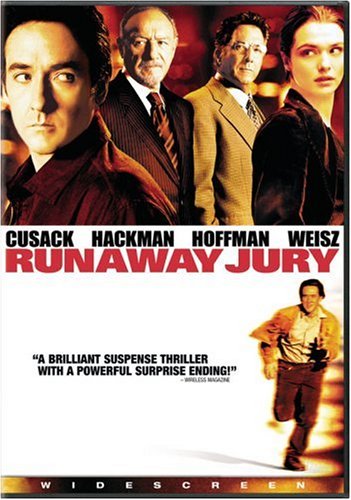
Runaway Jury

So you check the mail, and that dreaded letter appears, the one you fear finding...JURY SUMMONS!!!  Ah, the benefits of a democracy where accused crooks get to be tried by a jury of their peers.  Too bad about being on the jury though.  You get to meet all sorts of new idiots, get paid very little, and in general, are taken away from your everyday life.  That is unless you're on a jury in the movies.  There you get to meet Henry Fonda, save the world, and deal with all sorts of intrigue and deception behind the scenes of the courtroom trial, like 2003's Runaway Jury.

That description of course minimalizes the movie and the duty of being a jury member.  Based on a novel from courtroom master John Grisham, this 2003 thriller benefits from a very strong, very deep cast that turns in worthy performances from top to bottom.  The main idea of the novel/movie is one that should make you chuckle.  Someone actually wants to serve on a jury.  As for their motivations, I can't give everything away here.

After two years of pretrial, a court case is finally going to trial.  A lawyer, husband and father (an uncredited Dylan McDermott) is gunned down in his office along with 10 other employees.  The man's wife is suing the guns distributor with a famed prosecutor from New Orleans, Wendell Rohr (Dustin Hoffman), agreeing to take the case.  The arms companies understand that if this case is lost, they stand to lose possibly billions of dollars, and hire a specialist to make sure the verdict goes their way.  His name is Rankin Finch (Gene Hackman), and he specializes in blackmail and deception to get the right jury candidates on the jury and then use them to his advantage.  One juror, Nick Easter (John Cusack), isn't going to go along so easy though.  With help from his girlfriend Marlee (Rachel Weisz), Nick plans to blackmail Finch into paying for him to sway the jury.  Of course, the offer stands for Rohr too so whoever comes through with the $10 million gets his jury.

As I reviewed several weeks ago with Primal Fear, courtroom dramas translate incredibly well from play, novel, and TV to the big screen.  It's a setting that is naturally full of tension and nerves so when you throw a halfway decent script into a mix with a very deep cast, it can be hard to mess that formula up.  In a nice twist though, the courtroom drama is secondary here with the behind the scenes situation ending up being far more interesting.  Cusack's character starts off as this clueless dolt, and then you realize he's the one duping us all along.  But with girlfriend Marlee, are they looking for a huge payout or do they have ulterior motives with their actions?

That's where I was a little disappointed with this Gary Fleder-directed courtroom drama; the ending.  Easter and Marlee clearly know what they're doing and more than hold their own in these confrontations with the always-intimidating Gene Hackman.  You're honestly not sure of their intentions for much of the movie, but it's apparent they are not just in it for the money.  When their true motivations are revealed in the last 10 minutes, everything fits together nicely that can be wrapped up with a nice bow.  But there is something missing, and for me, the finale limps to the finish.  I won't call it sappy, but it certainly tries to pull at the heart strings.  It is not necessarily a bad ending, but not the one I envisioned.

Complain about whatever you'd like from this movie, but the casting is basically off-limits.  And with so many names, characters drift in and out, but almost each one is given their chance to shine.  The jury includes chameleon-like Cliff Curtis as an ex-Marine, Jennifer Beals, Nora Dunn, an uncredited Luis Guzman, and several other recognizable faces.  In the courtroom, Bruce McGill plays Judge Harkin, Bruce Davison plays defense lawyer Durwood Cable (doesn't he just sound bad?), and Jeremy Piven is a jury specialist working with Hoffman, and Stanley Anderson as the face of the guns distributors.  As two of the four main leads, Cusack and Weisz work well together, Weisz especially standing out from the crowd with her performance.

What really stuck with me though was the performances from Hoffman and Hackman, two of the biggest stars to come out of the late 1960s and then the 1970s.  Before this 2003 drama, the two had never worked together so it's a treat to see them in the same movie.  The problem though? Originally they weren't even supposed to have a scene together.  Problem solved when a quick rewrite had the two in a confrontation in a courthouse restroom that echoes De Niro and Pacino talking in Heat (the DVD special features discuss this in detail).  It's a scene full of great dialogue and a camera that never really stops moving, pushing the frenetic conversation to an even more anxious level.  Their performances on the whole stand out from the rest of the movie, but their scene together -- almost 7 minutes long -- is a big reason to watch this movie.

So overall a flawed courtroom drama, but one that is definitely worth looking into.  The story is set in New Orleans, and while location shooting doesn't always jive well with typically inside courtroom dramas, Fleder does show off the city when given the chance.  Above everything else -- including an ending that didn't blow me away -- the cast is the main reason to watch this one.

Runaway Jury <----trailer (2003): ***/****         

Monday, June 28, 2010

Hoosiers

Attending Indiana University for four years, it's safe to say I know how serious Indiana -- the state and the university -- takes its basketball.  Pro, college, and high school, it doesn't matter.  The state loves basketball.  Maybe the best way to see this love of the sport is in 1986's Hoosiers, the best basketball movie ever made and easily one of the top five sports movies ever made.  Where it might take a couple hours to explain how much Indiana love their basketball heroes, it's easier to say this.  Just check out the movie.

Based very loosely on the 1954 Milan state championship team, Hoosiers paints a picture of what life in small-town Indiana was like in the 1950s.  In the same way that Friday Night Lights showed what high school football means to Texas, so goes high school basketball to Indiana.  In a town where there's little to do and not much in the way of excitement, the basketball team was a top priority in entertainment.  On Friday nights, the town packed the gym to root on their boys.  When they traveled, the town did too.  Naturally there's a huge amount of pressure that goes with that on the coaches and players.  In telling this story, director David Anspaugh creates one of the more emotional, powerful, and enjoyable underdog stories, a perfect example of what can be right about sports.

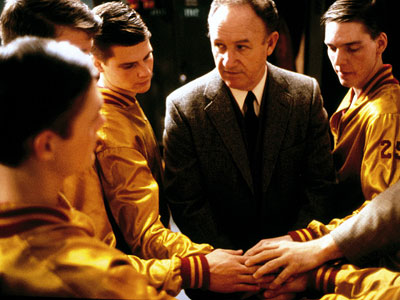
After 10 years away from coaching, Norman Dale (Gene Hackman) accepts a coaching position in Hickory, Indiana, a small high school with just under 70 students.  He quickly meets resistance on just about every front possible including the acting principal, Miss Fleener (Barbara Hershey), the townsfolk who expect their team to be perfect, and worst of all, the team's best player, Jimmy Chitwood (Maris Valainis) has decided not to play in honor of the last coach's passing.  Undeterred, Dale goes about his business of trying to coach his 7-man squad to be the best team they can be.  A weird thing starts to happen even as everyone objects to Dale's strategy, Hickory starts winning, and it looks like nothing is going to stop them.

There's so many positives going on with this movie I really don't know where to start.  A hugely under-appreciated actor, I don't know if Hackman was ever better than he was here.  His Norman Dale has been given a second chance to do something good after an incident from his past hung over his head all these years.  He clearly knows what he's doing coaching on the sidelines, but he has to convince everyone else he knows what he's doing.  As for the necessary 'coach' moment, listen to this speech and tell me that wouldn't get a team fired up.  I love so many of Hackman's parts -- good guys and bad guys alike -- but this may be my favorite.

As for the basketball, it's handled well in scenes that always allow you to keep up with the action.  Local high school and college athletes filled out the Hickory squad, and with the exception of Valainas as Chitwood, none of the players ever acted again.  You never get a sense of someone putting on a show or overacting.  These were kids in their late teens playing themselves.  And even down to a set-shot jumper or style of play, they look like they could have played in the 1950s.  The basketball scenes are instrumental in getting that 1950s feel to the story.  We're not talking massive gymnasiums for playing, we're talking tiny, claustrophobic places where the crowd is right on top of the action.

I'm going to say SPOILERS here, but if you don't know how Hoosiers ends where have you been these last 24 years?  Chitwood rejoins the team and saves Dale's job, sparking the team all the way to the state title game at Hinkle Fieldhouse in Indianapolis against a powerhouse team from South Bend. An absolutely inspired scene has Dale measuring the basket and the free throw line at Hinkle to show that the venue may be much bigger, but the court is just the same. The ending of course is obvious, Hickory has to win, but that doesn't take away from the power of the moment. Valainis says maybe 20 words the whole movie, but none speak larger than 'I'll make it.'  Done, and game over.  Gives me chills just thinking of it.

Beyond the underdog story, sports movies are so often about second chances and rising to the occasion.  In many ways, they're about people coming to together in a situation out of their comfort zone.  Dale butts heads with Hershey's Myra Fleener for his tactics but ends up wearing her down.  Dale takes on the town drunk and one of the player's fathers, Shooter (Dennis Hopper, Oscar-nominated for his role), because he knows basketball like few others do despite his drinking problems.  Chitwood wants nothing to do with basketball at first, only to realize how much it means to him and more importantly, his town.  The sports aspect is key, but the interpersonal relationships that develop are as big a part of the sports flick above all else.

Comparing sports movies though, a key element is that one moment, that special scene that does send chills down your back.  Hoosiers has too many to even count, most of them aided by Jerry Goldsmith's Oscar-nominated score.  Give it a listen HERE and HERE.  There's the entrance at the fieldhouse, Ollie hitting two underhanded free throws to win the regional title game, Hackman sending four players out and stating 'My team is on the floor,' or Hopper's Shooter forced to coach and lead his team to victory.  It is the moments like that which make sports movies special.

I don't intend this as a cop-out, but you watch Hoosiers and just know it's a good movie.  It lives on in Indiana -- people still talk about Milan, and are angry that with the class system there'll never be another Milan -- as if this story was the true one.  Every so often in movies, every little thing fits perfectly together in a way that is hard to express or explain.  It's just good, and that's what counts.

Hoosiers <----trailer (1986): ****/****