The Sons of Katie Elder

The Sons of Katie Elder
"First, we reunite, then find Ma and Pa's killer...then read some reviews."
Showing posts with label Jim Caviezel. Show all posts

Sunday, February 28, 2016

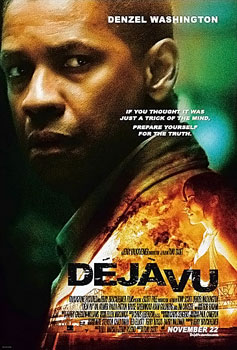
Deja Vu

The thought of time travel in film rattles my brain. It's never as simple as John Smith goes back in time and explores. There are dire consequences and horrific consequences for each and every action!!! Cue intense, foreboding music! When handled correctly though -- or as much as my feeble mind can grasp -- it can be a gem, like 2006's Deja Vu.

It's Fat Tuesday in New Orleans when late in the morning the Canal Street Ferry explodes in a fiery blast that claims 500-plus lives. There is little doubt the attack was the work of a terrorist with countless law enforcement agencies descending on the town to investigate. Among them is ATF agent Doug Carlin (Denzel Washington) out of the New Orleans office. A dogged investigator, Carlin follows the clues, trying to find out why a suspicious corpse ended up in the explosion's aftermath. He's approached by an FBI agent (Val Kilmer) leading a special investigative team that has some special technology at its disposal. They say it enables them to compile satellite images to see what happened some four days before. Carlin goes along with it, starting to piece it all together, all in hopes of finding some clue that will lead them to the terrorist bomber. It isn't long though before he figures out the "satellite" description is garbage. Somehow, some way, he's literally looking back in time...

What a fun, smart, stylish movie. Like I mentioned, time-travel movies are inherently complicated to the point it is difficult/impossible to 1. Keep up with it and 2. Not shake your head at the goofiness of it. With director Tony Scott at the helm, it has some of the stylistic elements of his previous efforts, especially Man on Fire, Spy Game and Enemy of the State. The quick cuts, the rapid camera movement, the unique shooting angles, it's all there, combining with a memorable score from Harry Gregson-Williams to add that great secondary layer to the story.

For me though what sets 'Deja Vu' apart from so many time travel movies -- Back to the Future to The Terminator, Looper to Planet of the Apes and many more -- is its creativity. It seems to revel in that creativity, that original, generally unique idea. How so? SPOILERS Carlin figures out they're not looking back in time, they're literally watching the past happen through some time-bending technology this investigative team has stumbled upon. Plot holes, time discrepancies aside, it's so cool as a premise. Scott's clearly having some fun with the time-bending concept, especially with a bit of technology that allows Carlin to wear a goggle headset so the time-traveling moves with him, what he sees through the goggles is what happened previously. Wwwwwhhhhaaaatttt? The premise injects some crazy energy into the always fun car chase sub-genre. Just watch this extended chase scene, sit back and smile, take it all in.

There is something eternally watchable about Denzel Washington in just about any movie he does, from heavy drama like Philadelphia or Glory to more mainstream, fun affairs like 2 Guns, Out of Time and Deja Vu. His Doug Carlin is a career agent with the ATF, and a good agent at that. He's a dogged investigator, stubbornly pursuing his cases, especially a terrorist attack that tears apart a city with the deaths of 500-plus people. Washington is so good, so effortless, it's just a pleasure to watch him do his thing. He's calm and cool...until he isn't like when he pieces it all together and figures out exactly what kind of technology he's working with. The case develops around the dead body of a beautiful young woman (Paula Patton) from New Orleans, Carlin wondering what he could have done to save her. Could he have done something different? Not one of his best performances, but just about any Denzel is good Denzel.

Dezel is the star, and Paula Patton gets a chance to shine in the final act, but who else to look for? Doc Holliday himself, Val Kilmer, has some good chemistry as Carlin's quasi-counter, not always telling the full truth while not lying either. His team includes the always reliable Adam Goldberg, Erika Alexander and Elden Henson. As for the villain who we see in all sorts of different ways courtesy of the time-bending story, Jim Caviezel is perfectly creepy, a so-called patriot but an unhinged one willing to go to horrific measures. Bruce Greenwood is a high-ranking FBI official on the case while Matt Craven appears briefly as Doug's long-time partner in the field.

It can be so easy with time-traveling stories for things to derail and do so quickly. That's not the case here with a story that manages to hold it all together under some post-movie scrutiny. The multiple storylines (and timelines) hold together when you really (really) think about it. Through it all, it's fun, even a final act that comes across as a little forced, a little too gimmicky. Still, 'Deja' is ridiculously fun from beginning to end with a finale that's frustrating a touch, but mostly, it just works so well. So freaking entertaining. Highly recommended, a great time-bending thriller.

Deja Vu (2006): ***/****

Friday, August 21, 2015

Wyatt Earp

When it comes to iconic, famous names in American history, specifically the wild west of the 1860's and on to the turn of the century, rise above all others. Names like Billy the Kid, Buffalo Bill, Jesse James, Wild Bill Hickok are all synonymous with the wild west, but maybe none more known and recognizable than lawman Wyatt Earp. He led a remarkably busy (and unscathed) life, and has been immortalized in both films and television shows alike. Here's 1994's Wyatt Earp, a bio-pic I'd never seen before a recent viewing.

Growing up on the family farm with his parents and brothers and sisters, young Wyatt Earp grows up learning to trust in himself and his family, and to always be there should that family need help. But as he puts his teenage years behind him, Wyatt (Kevin Costner) marries a beautiful young woman (Annabeth Gish) and looks to settle down and start a life. When his wife dies from typhoid, Wyatt is distraught, turning to alcohol and going into an epic depression. That's not the end that's meant for this enterprising young man though. Wyatt heads west, attracted by the possibility of riches in the untamed regions of the young country. Freight driver, bounty hunter, buffalo hunter, he tries it all, but his ultimate calling? That may be as a lawman, and the west is in great need of those. From boomtown to boomtown like Dodge City and Abilene, Wyatt's reputation grows and grows. That name begins to mean something -- fear, respect, intimidation -- as the far-more experienced, cynical Wyatt heads west once again with his brothers. This stop? Tombstone, Arizona.

I ain't real good at writing the words to describe an epic biography that covers multiple decades, introduces countless characters and in general, ain't easy to succinctly describe. And that's what this movie is. From director Lawrence Kasdan (also directed Silverado), 'Earp' is a three-hour biography of one of the west's most recognizable names, a bio-pic that was originally intended as a miniseries. Big impression? It probably would have been better that way. Even at three hours, this western feels like it tackled too much, taking on too much and not enough depending on the scene. Second big impression? It came out a year after one of the best westerns ever that dealt with the same topic, 1993's Tombstone. That's two strikes. What's gonna be the third one? Pick and choose because there's plenty.

History has a fun way of remembering folks. Case in point...Wyatt Earp. He was not a pleasant fella to say the least. The thing he is remembered most for -- the gunfight at the OK Corral -- led some to consider him and his brothers outright murderers. Wisely, 'Earp' does not try to gloss over the foibles and flaws in its titular character. Costner does a fine job showing Wyatt Earp's dark, cold, brutal side...but that's it. At a certain point, it gets repetitive. It becomes a performance without emotion because Wyatt becomes this one-note person. He wants to make a fortune for himself and his brothers. Anything else is just getting in the way. I found myself actively disliking the character and maybe that's the point. This is a bio-pic that probably shows Earp as he really was, not as we'd like to think of him. Accuracy is always a bonus in biographies, but that doesn't make it entertaining.

Almost from the beginning, 'Earp' felt like it handles everything in matter-of-fact fashion. Again...realistic but not necessarily entertaining (or even enjoyable). In its execution, this is a western epic that's trying to be EPIC and never quite gets there. Just not enough energy to bring it up to an epic level, much less a classic level. Gene Hackman gets to speechify in a small part as Wyatt's father, instilling (you could say drilling) the values that will impact his son for the rest of his life. One bbbbbbig moment after another comes along -- always with composer James Newton Howard's scoring swelling at the right moment -- and I kept waiting for these countless scenes to have some sort of impact on me...but they never did. When you know there's a three-hour running time still ahead of you, that's never a good feeling when you're not..well, feeling much at all about the movie.

One of the best things about Tombstone is the casting and characters. Here, dealing with the same people and the same basic story, only one performance really stands out. That's Dennis Quaid as Doc Holliday, a dentist, southern gentleman and gambler who's dying of tuberculosis. He has the unenviable task of following Val Kilmer's scene-stealing part as Doc, but creates his own character and performance. Quaid lost 30 pounds for the part of the dying gambler, giving him a distinctly sickly look. He's quick with a putdown and insult, just as quick as he is with a gun or knife in a scene-stealing performance. The only problem is that he's not around enough. There's too many speaking parts in general and most of them aren't developed nearly enough. Like so much else here, it felt like a wasted opportunity.

That said, 'Earp' does featuring some cool casting choices, even if they're misused. Michael Madsen, David Andrews, Linden Ashby and Jim Caviezel all play Earp brothers with Madsen and Ashby standing out for the positive. The Earp women, wives and sorta wives, played by Catherine O'Hara, JoBeth Williams and Mare Winningham, are given nothing to do other than complain Wyatt is mean in one-note performances (no fault of their own). In cool parts, Tom Sizemore and Bill Pullman play Bat and Ed Masterson, friends of the Earps and fellow lawmen, but they too are underused. Also look for Mark Harmon, Jeff Fahey, Joanna Going, Isabella Rossellini, and James Gammon in other supporting parts. Too many excellent historical figures are glossed over somewhat or entirely to the point it was unnecessary to even mention them.

I've always felt saying a movie is 'boring' is a cop-out, but man, this movie was boring. The last two hours are far better than the first, but I still kept waiting for the story and characters to pull me in. An epic disappointment unfortunately on basically on all levels.

Wyatt Earp (1994): **/****

Friday, March 28, 2014

Unknown

Airing for five seasons on CBS between 1959 and 1964, The Twilight Zone helped rewrite the science fiction and thriller genre, especially for television. There weren't too many weak episodes, but the best ones presented these mysterious situations with no explanation provided. How did we get here? Who am I? Where am I? They were these great little stories, wrapped up nicely in 30-minute episodes. Watching 2006's Unknown, all I could think of was that the Twilight Zone was a big inspiration.

A man (Jim Caviezel) wakes up in an odd, vacant warehouse with no idea who he is and absolutely no recollection of how he got there. The situation is about to get a lot weirder. He's not alone, with several other men unconscious in the same warehouse. One man (Joe Pantoliano) is tied up to a chair, another (Jeremy Sisto) is handcuffed and hanging from a bar overhead, a third (Greg Kinnear) lies face-down in a pool of blood, and a fourth (Barry Pepper) is quickly regaining consciousness. Trying to piece it all together, the first man answers the phone, a voice (Peter Stormare) at the other end, asking a couple questions and then telling him "We'll be back soon." With no answers, no clues as to what's going on, the first man realizes the rest of the men are waking up. All they know is they're trapped in a warehouse with no exits in the middle of the desert. Who put them there? Were some of them involved? All they know is they could be in trouble if they don't find a way out immediately. 

What a perfectly straightforward, highly enjoyable flick from director Simon Brand and screenwriter Matthew Waynee. Mystery, countless unanswered questions, and a whole bunch of confused, angry men in a hellish situation. Sometimes the most straightforward, simple premise works this best. I don't remember this thriller getting a release in theaters in 2006, but I liked it a lot from the get-go. Just like the men in this isolated warehouse, as an audience we have no idea what's going on. NONE. There really isn't a weak point in the story, but 'Unknown' hits the ground running. The high points are the opening, five knocked-out men waking up in a warehouse and freaking out (rightfully so). They panic, scream, yell, argue and then settle in, knowing their time is running out if they want to get out unscathed. I like movies like this that capitalize on a gimmick and do it well. If you're gonna use a gimmick, do it right.

More than the story, I was drawn to this movie because of the cast. These aren't huge names, but that's a good thing. These are some of the more talented actors working in Hollywood, working together to form a great ensemble cast. We kinda sorta learn some of their names, but in the cast listing they're identified by some distinguishing feature, Caviezel is Jean Jacket, Pantoliano is Bound Man, Pepper is Ranch Shirt, Kinnear is Broken Nose, Stormare is Snakeskin Boots and Sisto is Handcuffed Man. The performances are uniformly good, Caviezel, Kinnear and Pepper getting the most of the screentime. The group does a strong job showing the various reactions, Caviezel curious and questioning himself, Kinnear absolutely flipping out, Pepper the middle ground trying to weight all their options. We see the dynamics -- individually and as a group -- as everyone involved must decide which people to side with. Should they side with anyone? These folks are in a life and death situation. That's it. That's all.

That group dominates the screentime, but there are some key supporting parts. Bridget Moynahan plays a worried woman trying to get one of the men out, a small but key part. Chris Mulkey and Clayne Crawford are two police detectives on the hunt, looking to follow the clues as presented, looking for someone in the warehouse. Mark Boone Junior plays an associate working with Snakeskin Boots.

With a story like this, it would be really easy to give away some major spoilers. But what's the fun in that?!? I want you to enjoy the movie like I did, going in blind and trying to piece it all together, see if you can figure it out before the twists are revealed. The amnesia storytelling device can be a make or break gimmick, but it doesn't feel forced here. A bottled chemical is released, knocking these five men out for over a day to the point they remember nothing about who they are or how they got there. After waking up, they slowly begin to figure things out, to remember all those touches and snippets of their lives. We see these portions in blurry, hyper-edited flashbacks, everything falling into place. My usual worry is that the premise in innovative stories like this is far better than the twist, the payoff. It comes as disappointing when the reveal is made. Not the worry here. The script, the story, the twist, it all works and does so really well.

The only disappointing part of this quick 85-minute long movie is in the finale. Far from a dealbreaker, but the potential for some giant twists (giant good twists) is there. The ending is good but it could have been great. There's also a surprising, secondary twist revealed in the last two minutes that felt unnecessary, everything kinda hanging in the balance when the credits start to roll. Still, these are minor issues with a thriller that I loved watching. Uncomfortable and mysterious, adrenaline-pumping right until the end, this 2006 film is a gem.

Unknown (2006): *** 1/2 /****

Wednesday, March 26, 2014

Escape Plan

The 1980s and much of the 1990s were the Age of the Overblown, Dumb, Mindless Action Movies, stars like Jean-Claude Van Damme, Steven Seagal, Dolph Lundgren and others dominating the genre. The action genre has changed a ton in the years since, but the stars are still there, including two of the biggest stars who reunite in 2013's Escape Plan.

A former lawyer turned specialist, Ray Breslin (Sylvester Stallone) is the best in the business. That business? He's inserted into federal penitentiaries and maximum security prisons as a prisoner at large, no one aware of his identity, and devises a way to escape. Breslin has no equals, doing the job for years and helping to improve overall security, earning himself quite the reputation over the years. His reputation has gotten him quite the job offer, a $5 million payday if he can escape from a new, state-of-the-art prison facility that has been deemed 'impossible to escape' from. The background seems a little shaky, but Ray takes the job only to find out he's been duped once he's inside the prison. The warden, Hobbes (Jim Caviezel), has no intention of even giving him a chance to escape, leaving Ray in an impossible situation. His possible out? Help from a fellow prisoner, Rottmayer (Arnold Schwarzenegger) who desperately wants out.

Action movies can't just be action movies anymore, can they? They have to do something different, out of left field, desperately trying to rewrite the genre. Is there anything wrong with a throwback to the 1980s/1990s when it was acceptable for an action movie to have really cool good guys, really despicable bad guys and a lot of mindless fight scenes with some stupid one-liners along the way. That's the formula director Mikael Hafstrom follows in this action flick that earned over $137 million in theaters. Is it particularly good? No, not especially, but if absolutely nothing else, it is refreshing to see a movie like this. Too bad it wasn't better, some really fun, solid moments lost in mostly mediocre moments in a too-long 115-minute long flick.

Come on now. The reasoning I'm guessing 99% of movie fans sought this movie out was the pairing of two of the all-time great action icons, Sylvester Stallone and Arnold Schwarzenegger. We're talking Rambo and the Terminator, side by side and pissed at the world. It's the pairing that fans wanted to see for years in the 80s and 90s, finally getting a taste of it with the two Expendables movies. There is a certain cheeseball charm to this pairing of Stallone and Schwarzenegger, screenwriters Miles Chapman and Jason Keller's script giving them plenty of chances to bust each other, make fun of each other and basically argue about anything and everything. It isn't anything that's going to strain any brain activity, but it's fun. Any scene where the duo is together is automatically better just because they're there. They have an easygoing chemistry that reflects two old friends, Stallone the smart-ass straight man, Schwarzenegger the funner, livelier part. Whether it's 1984, 1994 or 2014, it's cool to see these two action icons working together in lead roles.

I wish I could say the same for the rest of the cast. The script's goal is to give Stallone and Schwarzenegger a premise to work with....and that's about it. There's no real development anywhere else. Good = good, bad = bad, and Vincent D'Onofrio = bad because well, it's Vincent D'Onofrio. I don't consider that a spoiler so deal with it. It's cool seeing Jesus himself, um, uh, Caviezel in a bad guy role, hamming it up with steely eyes and a pristine black suit, but we know nothing about him. How'd he end up as warden of a corrupt prison like this? Vinnie Jones plays his enforcer, Drake. Faran Tahir tries to avoid stereotypes as much as possible as Javed, a Muslim prisoner who hates Breslin but may have to work with him to escape. Along with D'Onofrio, Amy Ryan and 50 Cent are Breslin's partners and business associates, wondering if they've stumbled into something surprising. Oh, and Sam Neill is cool because he's Sam Neill.

There was potential here, but moments along the way help derail the story. The script is obsessed with giving Sly and Arnie as many stupid, forced one-liners as humanly possible. I figure they're going for laughs, but the jokes and lines fell short for me. The premise is cool, no doubt about it, an inescapable, perfectly built prison that no one can get out of, and let me tell you, there's a good twist about where exactly that prison is. There's an even bigger twist in the finale that does work in some ways, but again, it feels like such an effort was made to trick the audience and pull the rug out from under us that it loses most of its impact. It's not painfully bad, but it's not as good as I'm sure it was intended.

So what are we left with? Mostly a pairing of Stallone and Schwarzenegger. The action is kept on the backburner until the last 30 minutes, definitely the most enjoyable part of the movie. It's got all those cliches we've come to expect from an action movie, slow motion bullets, bad guys with insanely bad aim, heroes with amazingly good aim, and all those little touches that look ridiculous...in a fun way. A meh movie if there ever was unfortunately.

Escape Plan (2013): **/****

Monday, July 4, 2011

The Thin Red Line

With just five movies to his names over a 39-year span, director Terrence Malick's movies have been few and far between to say the least. He doesn't take just any movie. He takes on projects that appeal to him. Malick is a director that was probably born a generation too late because he would have fit perfectly with the French auteurs of the 1950s and 1960s.  Not making a movie for 20 years after 1978's Days of Heaven, Malick returned in 1998 with a heavily anticipated WWII film based off a James Jones novel, The Thin Red Line.

The timing of the release no matter how anticipated this movie was could not have been much worse.  'Red Line' was released in early 1999 after a limited release in December '98, just five months removed from Steven Spielberg's Saving Private Ryan was shown in theaters.  It's not fair to compare the two movies, but the damage was done. Malick's film is the complete opposite of Private Ryan, and in the years since has been lost in the shadow of the Spielberg film.  I revisited The Thin Red Line, remembering enjoying it through several viewings. Instead this time around, I found a deeply flawed, even boring movie that I struggled to get through.

To write a plot synopsis of a Malick movie would be a waste of words so I'm not going to bother. He doesn't have stories in the linear sense. The Jones novel and this film are based on the fighting at Guadalcanal in 1942, but for Malick's purposes and his screenplay the setting is unnecessary. It could as easily have been Iwo Jima, Tarawa, Okinawa or any number of other Pacific islands that saw fighting in WWII. This isn't a story about the scope of war or the immensity of it all.  This is soldiers at their most basic, the thoughts racing through their heads as they take part in the unnatural act of killing another human being. Malick's screenplay does its best to delve into that aspect of war but ends up assembling an uneven, odd finished product that I can only qualify as an 'art house World War II movie.'

A trademark of Malick's in all his films is narration filling in for actual dialogue which is so often nuts and bolts conversation in his screenplays. When used correctly, narration can carry a movie, bringing emotion and power to a story that simple dialogue just couldn't do. Among the cast at different points just about everyone gets a crack at their own narration, but most prominently used are Jim Caviezel, Ben Chaplin, and John Dee Smith who appears only at the beginning and the end but narrates throughout. First, all three of these narrators are Southerners with a heavy drawl, making it nearly impossible to distinguish which one of them is which in their narration.

More than some tough accents to get used to though is the fact that these narrations are so poetic, so lyrical, so ethereal and from another world that very little of it registers.  I've seen the movie several times, but only an exchange or two sticks with me.  Chaplin's Pvt. Bell constantly thinks of his wife, the love and desire he feels for her.  It is so mind-numbingly tedious that I completely lost interest anytime he started talking, his thoughts drifting back to the time he spent with her (played in flashback by Miranda Otto). All of the soldiers -- who end up being dirt-covered, nameless individuals -- wonder about life, love, death, God, pain, suffering, righteousness, faith, and so much more. It is well written, but it is so unnatural that it sounds like a poetry jam. The eerily calm toning and pacing will no doubt put some viewers to sleep. Malick is in absolutely no rush to speed things up to get where he wants.

That's the problem I've had with this movie though since I first saw it. What is Malick trying to accomplish? What's he trying to say? Anti-war message for sure, but in what way?  We see the horrendous physical and psychological efforts war and combat can take on the individual. We see the inner turmoil tearing soldiers apart as they battle with their inner demons. But the tone of the movie is so odd I don't quite know what the intention was. 

The background of this film is interesting in itself, worthy of its own review. When Malick came out of the woodwork to make a movie, actors -- big, big name stars -- lined up to fill out the cast for this WWII story. Rumors persist of some epic five or six hour movie. Malick had to make cuts to his final movie, completely editing out parts for Bill Pullman, Gary Oldman, Viggo Mortensen, and Mickey Rourke among others. As is, the finished product is 170 minutes long and still features an interesting cast full of recognizable names. Along with those mentioned earlier, there's Nick Nolte, Sean Penn, John Cusack, Elias Koteas, Woody Harrelson, Adrien Brody and Thomas Jane. That's some of the cast. Check out the IMDB page for a complete listing. Even George Clooney and John Travolta make brief, pointless cameos.

With so many speaking parts, only a few get a chance to leave an impression -- positive or negative. Caviezel is the best as Pvt. Witt, a man who just doesn't belong in the army. His Heaven is the little Pacific village he deserts to, but he's torn away and brought back to the fighting as he's reunited with his company. He joins the fighting but doesn't quite know why. Sean Penn is great as Sgt. Welsh, the veteran sergeant who serves as the sounding board for all his men. His scenes with Caviezel's Pvt. Witt provide some of the movie's most memorable and more importantly, most moving movements as they question what they're accomplishing. Koteas too is a scene-stealer among the faceless soldiers as Capt. Staros, Charlie Company commander who refuses to waste his men in a frontal assault that has little hope of succeeding and feels the wrath from above.

That's probably the most frustrating part of this movie for me. There are moments of perfection that you just sit back and revel in, let them wash over you. Malick's directorial eye is never in question, his movies beyond gorgeous. Some directors work best with scripts and actors. Malick is a visual director, here Australia filling in for Guadalcanal. This is a story of nature and its beauty torn apart by the fighting. Malick is quite content to show a hillside with its long, green grass blowing in the wind.  Add in the musical score from Hans Zimmer, and you've got a winner. His main theme with the Melanesian choirs send chills down my back every time I hear it. Listen HERE. The rest of the score is more subdued than Zimmer's more well-known scores, but it soothes, it meditates, playing almost constantly in hushed tones over the action in some cases and the narration in others (Try HERE). There is something soothing about this movie in its execution and its message. It just can't keep up the momentum throughout.

Certain moments of this movie have stuck with me over the years. Almost an hour is spent in excruciating detail as C Company tries to take a Japanese bunker on a grassy hillside. Later, a running firefight takes the company through a ravaged Japanese camp, Zimmer's score combining with the action to make it one of the great realistic battle sequences ever, the aftermath as moving as the actual fighting. Witt's conversations with Welsh have always stuck with me, and Witt's final scenes as C Company goes on a patrol bring the movie full-circle in an inevitable way that you know is coming.

Is the movie pretentious and even tedious at times? Oh hell yes. There were times I wanted to fast forward through vast stretches of narration and shots of nature. The narration is done to death by the end of the movie, little lines of dialogue straight from a poet that I didn't even always comprehend what I'm hearing. But with all that said, I just can't give this movie a negative rating. The moments that work are so good they overpower and overshadow the weaker moments.  You have to know what you're getting into when you watch this movie, and even then, there's no guarantee you will like it. It is a movie experience though, and one every movie fan should at least try.

The Thin Red Line <---trailer (1998): ***/****