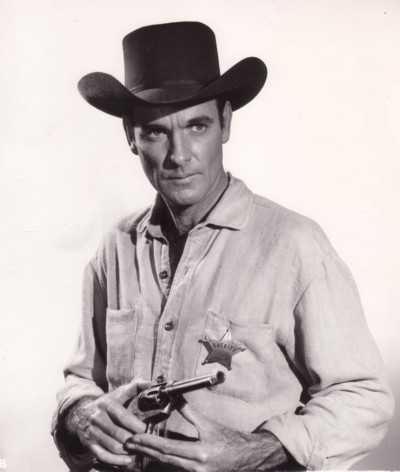
The Sons of Katie Elder

The Sons of Katie Elder
"First, we reunite, then find Ma and Pa's killer...then read some reviews."
Showing posts with label James Best. Show all posts

Sunday, March 27, 2016

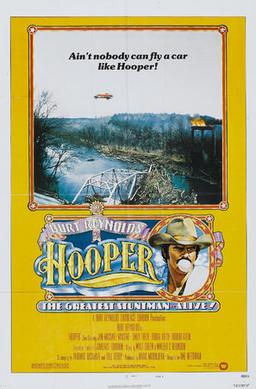
Hooper

Names like Yakima Canutt, Bud Ekins, Dar Robinson, Chuck Roberson, and Chuck Hayward may not ring a bell as an instantly recognizable Hollywood icons. They should though. These are just some of the thankless stars of the stunt business, doing the crazy stunts the actors/actresses just couldn't. Right up there with that crew (and countless others we could mention) was stuntman-actor-director Hal Needham. Who better to direct the story of an aging stuntman trying to hold on for a little more glory? N-O ONE. Here's 1978's Hooper.

For years now, Sonny Hooper (Burt Reynolds) has been the BEST stuntman working in Hollywood. Versatile in all his stunts, from car chases to aerial acrobatics, chases on horseback to a brutal fistfight, there's nothing Sonny can't do and there is no stunt he'll turn down. He'll try anything. That reckless attitude toward his work is catching up with him. He's now in his 40's and has a laundry list of broken bones and horrifically painful injuries to show for his well-earned reputation. Well, now that reputation is on the line a little bit. Though everyone still respects Sonny and looks to him to pull off the craziest of the crazy, there's a new kid on the lots, Ski (Jan-Michael Vincent), who's showing a similar knack for pulling off the impossible. How far will Sonny go to keep his unofficial title as 'Best Stuntman Around'? Maybe the most dangerous stunt of his career will do it...

Movies and stories about the making of said movies can be funny, dramatic, condescending, pretentious, revealing, and sometimes all of the above. A movie about stunt men being crazy and goofy and generally acting like idiots? Say what you want about Needham's 'Hooper,' but it is fun. It is dumb, slightly disjointed and drifts too much, but from beginning to end, it is F-un. At 100 minutes, it doesn't overstay its welcome and in the second half does feature some darker (potentially at least) moments. That said, it's a Burt Reynolds movie. Things aren't going to get too dark here. Sit back with a beer and enjoy this one.

Through the general goofiness, the most pleasant part of the story is seeing that behind-the-scenes world of the stunt men. They walk onto the set, do their stunt and...yeah, they're done for the day. Now yeah, those stunts are horrifically dangerous but you get the idea. They're celebrities among the cast and crew, albeit anonymously to the viewing public. Coming from Needham and Reynolds (who got his start as a stuntman), you know the respect will be there with the profession, along with the helter-skelter mindset of these nutcases who willingly put themselves in peril day-in and day-out. The conversation doesn't seem scripted, just guys being guys busting each other left and right. So as mentioned, the story isn't necessarily the most pointed thing around, just a series of connecting scenes linking it all together. Fun though. Definitely fun.

Who better to help us jump into the world of the stuntman headfirst than Burt Reynolds? Nobody! One of the biggest stars of the 1970's, this isn't a heavy acting part -- most of his best parts seem to be variations on his own personality -- but it is nonetheless a strong performance. You get a feel for Reynolds' Sonny, past his prime but still kicking strong. He's seen and done it all in a career that's not young anymore. Now, he has to decide how far he wants to push it. At the height of his star power, Reynolds is excellent. Playing off that familiar new fast gun in the area, Vincent is a good match for Reynolds. It's a rivalry between the dueling stuntmen, but there seems to be a genuine friendship and respect between the two men. Like I said, it never gets too dramatic along the way. The tone and spirit is generally pretty lighthearted.

The cast overall here is pretty impressive, especially if you're a fan of countless guy's guys movies from the 1960's and 1970's. Also keep an eye out for Sally Field (the girlfriend), Brian Keith (the former best stuntman around/potential father-in-law), James Best (Sonny's friend/manager), John Marley (the film's producer), Robert Klein (the ego-maniacal director), Adam West (the star), and even NFL QB Terry Bradshaw has a fun appearance. Also look for Jim Burk as a stuntman and friend of Sonny's. Burk was a frequent performer in John Wayne's later movies and finally gets a part that lets him say a few words.

The best thing going here is the actual stunts. Stands to reasons we're here for a stuntman movie so might as well see some ridiculously cool stunts, right? Reynolds does a lot of his own work, but 'Hooper' runs the gamut in terms of the variety of what we get to see. A whole bunch of craziness -- the movie they're working on seems like a James Bond knock-off -- and all of it leading to a ridiculously choreographed sequence that Klein's director wants shot in one take. ONE TAKE! It's lunacy but just go along with it. The capper? The longest car jump ever as Sonny and Ski are supposed to drive a rocket car over a river where a bridge has recently been demolished. Yeah, crazy, kooky stuff. Make sure to stick around for the end though with Reynolds pulling his usual shtick and breaking the fourth wall.

A fun movie. A dumb movie but fun!

Hooper (1978): ** 1/2 /****

Tuesday, January 12, 2016

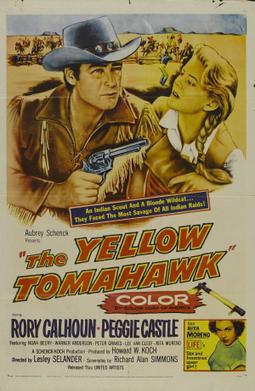
The Yellow Tomahawk

Every so often, I just need a good, old-fashioned B-western. It doesn't have to be great or even particularly good, but I need that dose of WESTERN. So while 1954's The Yellow Tomahawk is pretty run-of-the-mill, I liked it. Entertaining, surprisingly violent and with a cool cast, it's a solid western that's worth a watch.

Riding out of the wilderness, frontiersman Adam Reed (Rory Calhoun) finds himself being chased by Cheyenne warriors. He's cornered and looks to be in trouble until his blood brother, Cheyenne warrior Fire Knife (Lee Van Cleef), steps in, all of it a show to arrange a meeting. Fire Knife has a warning and a message he would like delivered. The U.S. cavalry is building a new fort nearby with a commander, Major Ives (Warner Anderson), who lead a bloody massacre months prior against a peaceful Indian camp. His reputation has preceded him with Fire Knife passing his message along to Reed. What is it? Tell Ives to stop building the fort and risk an attack that will wipe out the partially-assembled fort. Reed rides down to the fort and passes it along but Ives isn't having it, doubting the truth of the threat. What awaits for the small garrison and the soldiers' families who have traveled west? Reed sees the writing on the wall but no one else seems to believe what's coming.

Nothing flashy here, nothing too crazy. From director Lesley Selander, 'Tomahawk' is nonetheless an entertaining, pretty solid western that isn't limited by its budget or limitations. A longtime director in film and television, Selander is a pro at spinning a movie like this. So often, westerns are town-bound. limited by a fake-looking set that never allows the story to breathe. This particular entry does not have that problem with virtually no sets! The cavalry building a fort allows for no sets other than a couple half-assembled walls. It was shot on-location at the Kanab Movie Ranch and Fort, giving the story a cool, intimidating, scary sense of the openness of the desert and wilderness. You're all alone out there, and with the threat of an imminent Indian attack, there's no place to hide.

A star of B-westerns who often played supporting roles in bigger budget pictures, Calhoun is a favorite of mine. He plays a memorable, roguish good guy, a solid anti-hero with an edge who is quite comfortable in the western and in the saddle. His Adam Reed character, a frontiersman and scout of sorts, is interesting because of his hinted-at backstory. It's never told in detail, but it appears he lived with the Cheyenne at some point, his brotherhood and family connection with a young Lee Van Cleef as warrior Fire Knife. If there was a little more time to breathe ('Tomahawk' is a very pleasant 82 minutes), maybe we could have learned some more about out hero. Still, what's there is pretty cool.

No A-listers on-hand here, but that doesn't detract from an overall good cast. Peggie Castle (Lily Merrill on TV's Lawman) is the necessary love interest, a beautiful woman visiting her fiance, a cavalry officer, at the budding fort. She's no damsel in distress either, a welcome addition to the genre. Noah Beery Jr. has some stereotypical fun as Tonio, an ay-ay-ay Mexican horse wrangler with a beautiful Indian girl, Honey Bear (Rita Moreno), who follows him around. As the stupidly blind officer, Major Ives, Warner Anderson is frighteningly uncomfortable, portraying an officer that was probably all too familiar in the wild west. Also look for Peter Graves (gold prospector) and Adam Williams and James Best (cavalry troopers) in key supporting parts.

One good western after another followed a simple formula. Introduce a disparate group of survivors and individuals, throw them into a survival situation with an ever-present Indian war party, and see who makes it out. After an intense, tension-building first 30 minutes or so, that's what 'Tomahawk' uses as a base. We follow a small group of survivors of an Indian attack trying to get across the desert to safety. The action itself is pretty intense in itself, especially the Cheyenne attack on the hastily-built and poorly-defended fort. It's not hugely graphic -- it is still 1954 after all -- but the violence is incredibly rough and if it had been shown on-screen, whoo, we're talking one nasty picture. The ending too is pretty honest for a mid-1950's western, something that surprised me, caught me off-guard a little bit.

A solid western overall. Worth checking out.

The Yellow Tomahawk (1954): ** 1/2 /****

Saturday, December 12, 2015

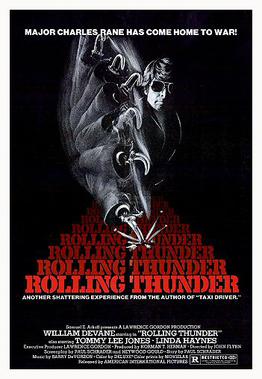
Rolling Thunder

The Vietnam War ended, and American soldiers came home to a country that felt strongly opposed to what had been done as part of the fighting. They were not greeted as heroes as our veterans had been welcomed in previous wars, especially World War II. For some -- and not to sound too flowery -- the fighting was just beginning as those vets tried to re-acclimate to living back home. That's what we've got in 1977's Rolling Thunder as a jumping-off point.

Major Charlie Rane (William Devane) is coming home to San Antonio, Texas. He's spent the last seven years as a prisoner of the North Vietnamese, subjected to horrific treatment and torture meant to beat him down into nothing. Somehow, some way, he survived though, and he is welcomed back as a hero. Rane on the other hand, he's not so sure. He steps back into a home situation where his wife wants a divorce so she can remarry. His son is almost 10 years old, and he barely knows him. Rane simply doesn't know how to readjust to life as he used to know it. What little balance he finds is quickly destroyed when personal tragedy strikes, the reasoning...simple, pure greed with too many lives as an expense. Rane himself barely survives the incident, telling the police he doesn't remember much about what happened. The Air Force veteran...he remembers though, and Rane intends to exact his own revenge.

I'd never heard of this Vietnam War-themed flick from director John Flynn until recently it popped up on the movie channel Retroplex. It certainly sounded interesting, and in the end, it was. It's not a great film, but 'Thunder' is darkly entertaining, a morbid cloud of cynicism hanging over the proceedings. Isn't that what we all want to see?!? No nonsense about the story either. Straightforward revenge with a more vigilante-themed story mixed in with the more message-oriented story of Vietnam vets struggling to readjust to life back in the states after the horror of what they saw during their tours of duty. It ain't flashy, but it's violent, gritty and uncomfortable to watch. Worth seeking out.

A good to great character actor who never quite became a full-on movie star, William Devane does not disappoint with one of his few starring roles. It's his movie, and he carries it. His time spent as a North Vietnamese prisoner has worn him down while making him tougher in the process. His Major Charlie Rane is almost mute, is claustrophobic, has some form of PTSD and struggles to get back to the things he used to know and love. It is an unsettling performance, full of intensity and menace as Rane struggles to piece it all together. What does it? A release of hatred, a hate-oriented goal of retribution and revenge. He seems to find himself when tasked with a mission, however dangerous. Devane is excellent in a quiet, emotional leading performance. Two thumbs up for a guy often relegated to bad guy roles. Part Travis Bickle, part Paul Kersey, part Wild West vigilante, this is a fascinating character.

I haven't seen much of Tommy Lee Jones' pre-Lonesome Dove work, but here the 31-year old actor shows off that quiet, intimidating charisma that has served him so well in the 35-plus years since. He's underused as Johnny Vohden, a fellow prisoner who experienced everything Rane went through. Through their common, horrifying experience, they've bonded to become friends that can't be broken up. Excellent supporting part. Linda Haynes plays Linda Forchet, a young woman in her 20's fascinated with Rane, drawn to him in ways she can't describe. It's a good part, but somewhat distracting, as her character's personality seems to be wearing tight, thin shirts without a bra. Just an observation. Also look for James Best and Luke Askew as two gutter-trash crooks who wrong Rane in a big old way (wait for those fireworks!). Also look for Dabney Coleman, Lisa Blake Richards and Lawrason Driscoll in supporting parts.

'Thunder' is a bit of a slow burn, even following the surprising, horrifically violent twist about 35 minutes into the 95-minute long flick. It's trying to build that intensity to almost unbearable levels as we wait for Devane's Rane to blow like a volcano. In that sense, it treads that fine line. Things can be a little slow in parts. Never boring, but at the same time, never as interesting as things could have been. I'll give credit where it is due though. Everyone involved seems to know where they want to end up, all the while building up to a blood and bullet-riddled finale. It could have gone for a horrifically dark ending but taps the brakes a bit.

So overall, good but not great. A crime thriller set along the Texas/Mexico border has a gritty, dark feeling, almost like a film noir with a lot of blood squibs! This is a revenge movie that certainly belongs along the likes of movies like Taxi Driver and Death Wish and the Dirty Harry movies. A tad on the slow side at times, but worth checking out.

Rolling Thunder (1977): ** 1/2 /****

Thursday, January 29, 2015

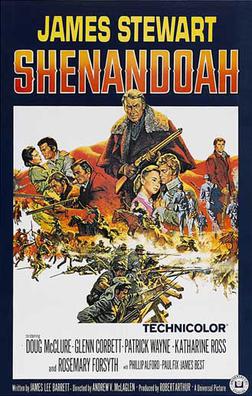
Shenandoah

As far as directing powerhouses of the 1960s, Andrew V. McLaglen will never be remembered as one of the greats. He started off in television before making the jump to feature film, teaming several times with John Wayne while also specializing in audience friendly "guy movies." Good guys versus bad guys, lots of familiar faces and situations, you know the formula. One of his best? An underrated Civil War drama, 1965's Shenandoah.

It's 1864 in Virginia, and the tide of the Civil War has turned as the Union forces are slowly beating down the Confederate armies. Doing his best to remain free of the bloody fighting, farmer and patriarch Charlie Anderson (James Stewart) wants nothing to do with the war. Both for himself and his family -- seven kids, one daughter-in-law -- Anderson simply wants to keep working his 500-acre farm and get through the war unscathed. Fight for Virginia? Fight for slaves he doesn't have? He fights for what he believes in, his family and his farm. Well, that's what he'd like to do. While the fighting rages on, Charlie is stunned when he finds out his youngest son (Phillip Alford) has been confused as a Confederate soldier and captured by nearby Union forces. Now the war and the fighting that Anderson has done so well to steer clear of has landed square on his front porch. Can he find his son amidst the hell of war?

This was a movie I watched often growing up when my sister and I had sleepovers with my Grandma. It made an excellent Civil War double feature with Friendly Persuasion, and let me tell ya, they both hold up! I watched this McLaglen-directed Civil War drama for the first time in years, and it resonated just as much now as an adult as it did when I was a kid, if not more. McLaglen had some excellent movies to his name -- The Wild Geese is a favorite, Hondo, McLintock are also excellent -- but this is his best movie overall. The story is a series of very effective, often moving and often disturbing vignettes, all held together by the Anderson family. Filmed on-location in Oregon and California, 'Shenandoah' is an underrated visual film, and the musical score from composer Frank Skinner is a gem. So what stands out viewing this one as a 29-year old, not a 13-year old kid?

That would be James Stewart, one of my favorites in just about any movie he's in. This doesn't get the attention or notoriety as one of Stewart's best performances, but it certainly belongs in the conversation. I love what he does with the part of Charlie Anderson, a stubborn, feisty Virginia farmer and widower looking out for the best intentions of his family. He doesn't care about the war, about slavery, about Union and Confederate. He will do anything, ANYTHING, to protect his family. Stewart has some great scenes with the younger supporting cast, especially Alford's youngest son, only called 'Boy,' with his daughter, Jenny (Rosemary Forsyth), daughter-in-law, Anne (Katharine Ross), and his sons. There are too many memorable, emotional scenes to mention, but my favorites are the most simple. Minutes before the Andersons go to church each Sunday, Charlie visits his wife's grave and just talks to her. Simple perfection, Stewart absolutely nailing the underplayed but charged scenes. 

Stewart is the unquestioned star of McLaglen's film, but 'Shenandoah' offers quite the ensemble of recognizable faces. Glenn Corbett and Patrick Wayne play Jacob and James, the two oldest brothers. Corbett especially stands out as Jacob who's beginning to question if their choice to stay out of the war is the right decision. Wayne is solid too, especially in his scenes with Ross. In her film debut, Forsyth is excellent, a subtle scene-stealer as innocent, tough and thoughtful Jenny who's also interested in a young Confederate soldier, Sam (Doug McClure). The other Anderson boys include Charles Robinson, Jim McMullan and Tim McIntire. Maybe the best thing you can say about the story is that the family dynamic, it just works. You believe them as one cohesive unit, one that stands together through thick and thin.

But wait, there's more! Also look for George Kennedy as a sympathetic Union officer, Gene Jackson as Gabriel, a friend of Boy's, a slave, Paul Fix as the local doctor, Denver Pyle as the pastor, James Best as Carter, a fellow prisoner who takes Boy under his wing, Harry Carey Jr. as another Confederate prisoner, Tom Simcox as Lt. Johnson, a Confederate officer, with Kevin Hagen, Dabbs Greer and Strother Martin also playing small but memorable parts.

So 29-year old me certainly picked up some new things, or at least was able to process things differently. This is one hell of an anti-war flick. The portrayal of the latter stages of the Civil War is unsettling and often times, disturbing. Death awaits around every corner, hiding behind every tree. The lines are up in the air as the war takes a turn toward its ultimate conclusion. A late battle between a small Confederate camp and a larger Union force with heavy artillery is quick and awful and uncomfortable, one of the more underrated battle sequences I can think of. The last half hour especially features one kick in the gut after another that truly hammers home the anti-war message. And that last scene? Pretty perfect, the possibility of hope lingering in the air amongst all this pain and suffering and death. One of my favorite movies.

Shenandoah (1965): ****/****

Monday, January 5, 2015

The Raid (1954)

My movie list of hard to find films and hidden gems seems to get shorter every year. One, I'm proud of my persistence in tracking some down that aren't readily available. Two, I'm realizing how many movies I actually watch. Yeah, I kinda have a problem in that department. I read about this Civil War drama years ago when I stumbled across its ridiculously cool tough guy cast. Where'd I find it? Fox Movies Retro On-Demand. Here's 1954's The Raid.

It's fall of 1864 and the tide of the Civil War has fully turned in favor of the Union forces on all fronts. At a prison camp in the northeast, a group of Confederate prisoners led by Major Neal Benton (Van Heflin) plots their escape and manage to break out, hoping to head north into Canada. From there? Hopefully lead raids into Union territory to help ease the pressure on Southern forces. Their first target is a small town in Vermont, St. Albans, that offers several banks just waiting to be knocked off with the funds meant to help the Confederate cause. With his fellow escapees and several other Rebel soldiers hiding out in Canada, Benton puts the plan into play. He starts off posing as a landowner and businessman just visiting St. Albans, but all the while he's putting the pieces together to pull off the successful raid and robbery. There's so many pieces though and success depends on everything going off without a hitch. Can Benton and his Confederates succeed and get out alive in the process?

The American Civil War lasted four years, three weeks and six days between 1861 and 1865 with hundreds of thousands of soldiers killed, wounded and crippled. It is probably the darkest time in American history -- or certainly one of them -- and in general, is a historical era underutilized in film. There just aren't many Civil War movies out there for viewing pleasure. The unfortunate part? A movie like this is a prime example, a true story of a real-life incident. Read through the history books and there are literally hundreds and thousands of stories like this just waiting to be told. Sure, there are the major battles like Gettysburg, Shiloh and Antietam, but what about stories like these? Read about the real-life raid HERE if you're curious.

I was very glad to finally track this one down. From director Hugo Fregonese, 'Raid' clocks in at a crisp 83 minutes and has that distinct B-movie feel but is never held down by its relatively small scale and budget. It's dark and dirty and nasty with the raid being unleashed partially as a counter to Sherman's march through Georgia. In other words, it's about the war, but it's more too. It's about revenge. Title cards introduce the days as the raid draws closer, Benton's plan being put into action with minute details. Much of the story takes place in the St. Albans set with some brief detours into the prison camp and also across the U.S./Canada border. 'Raid' is content to not be an epic but to tell a little known story that's become a footnote in most Civil War and history books. Nothing flashy, but well done and always interesting.

Now what originally caught my eye with this 1954 Civil War drama was the cast. There's some established stars and some rising stars who would go onto bigger and better things in the late 1950s and into the 1960s and beyond. Heflin is just solid as always, the relative anti-hero and leader of the raid. We learn his family was murdered and his home burned down, the desire for revenge coursing through his body. His men include Lee Marvin as a fiery, unpredictable and possibly unhinged Confederate fanatic, Peter Graves as Benton's loyal, capable second-in-command, James Best, an uncredited Claude Akins and later, John Dierkes. Some cool names working together, giving some variety to the Rebel group.

A big plus to the story is that nothing is black and white. It isn't Confederates good and Union bad or vice versa. It's both. This was war, and there was nothing particularly pleasant about it. We get to meet some of the St. Alban residents, starting with Anne Bancroft (just 23 years old) as a widowed boarding house owner (with young Tommy Rettig playing her son), Richard Boone as a Union officer trying to overcome a mistake he made in combat, and assorted other townspeople from farmers to business owners to preachers. It adds a cool element to the story as we see this raid won't be as easy as planned once Benton gets to meet people around town.

If there is a relative disappointment, it comes in the finale, the actual raid. The quick-moving story builds and builds, and the raid is well done as Fregonese sticks pretty close to the facts of the 1864 raid. Unfortunately, the ending just kinda...well, ends. It's fairly accurate to the truth, but this is one case where maybe stretching the truth even a little would have livened things up a touch. As is, the ending scene is rather abrupt as 'THE END' pops up on the screen. It is still a worthwhile movie but the ending could have been far stronger. Still, it tells a little known slice of Civil War history that simply isn't very well known. Worth tracking down a copy for sure.

The Raid (1954): ** 1/2 /****

Thursday, August 9, 2012

First to Fight

An interesting mess of a movie, 1967's First to Fight at first gave me the impression of being a recruitment film made by the United States Marines. Little research proved nothing of the sort, but go figure. I maintain my stance. Moral of the story? The movie's all over the place; B-movie with a very low budget, soap opera quality love scenes, vicious if somewhat overdone battles, and at times it actually utilizes a pretty solid cast. Unfortunately in the end, it never amounts to much as a finished product.

The lone survivor from his unit after a horrifically costly firefight with the Japanese on Guadalcanal in 1942, Sgt. Jack Connell (Chad Everett) is awarded the Congressional Medal of Honor and shipped back home to help the war effort by encouraging Americans to buy war bonds. He can't help but think of the friends he left behind though and starts to question if he is more valuable in the Pacific fighting. Connell meets Peggy Sanford (Marilyn Devin), his "guide" on the war bond tour, and quickly hits it off, the couple marrying. Connell gets orders to report to Camp Pendleton as a drill instructor, but the thought still lingers. Should he volunteer for combat or keep his promise to Peggy to avoid the war?

Where to start here? I can't completely rip this movie from director Christian Nyby because at different points there are positives to take away from it. The problem with that is simple; the positives get buried under mountains of the negative. A B-movie does not necessarily mean a movie is bad, not by a long shot. That rogue, renegade, cheap shooting from the hip style can be an attribute to a lot of movies. 'Fight' doesn't qualify there. That cheap quality actually hamstrings the story. Any indoor sets look like retread sets from 1960s TV shows, and the musical score -- battle scenes an exception, those work -- is that aggressive, blaring type that DEFIES you not to be emotionally moved. Here's some advice. If you're a B-movie (yes, I'm talking to an abstract idea), just embrace it. Don't convince and beg us to like you.

Those are the little things that bother you (okay, just me) as you're watching a movie. Not enough to ruin a movie, but it certainly can bring a movie down a notch or two. The bigger issue here is the story, one straight from the War Cliches Department. The opening intro -- the bloody firefight on Guadalcanal -- opens things with a punch to the jaw in a highly effective action sequence. Most of the next hour though is spent on Jack and Peggy's oh-so-lovely relationship. It is Dullsville for sure. Everett quotes Bogie in two different scenes after the couple goes and watches Casablanca, then using 'As Times Goes By' as "their song." Oh, free advertising for Warner Bros. in an odd, extended clip from the movie. One montage actually has Jack and Peggy walking in place pointing at things as super-imposed images show all the fun stuff they're doing. Thankfully you can fast forward through these parts, but that's never a good sign when you're hoping to enjoy a movie.

Playing the lead character, Everett is an okay if not particularly flashy actor. Mostly known for his parts on TV shows and TV movies, he does the best he can with a character that for all his interesting background just isn't that interesting. The lovey-dovey relationship with Devin's Peggy of course doesn't help either. The last 30 minutes let Everett do some heavy lifting, and to be fair, he's very good as his now-Lieutenant returns to combat. What caught my eye when this movie appeared on TCM was the rest of the cast, some used better than others. A pre-stardom Gene Hackman is the best thing going here as Sgt. Tweed, the tough as nails Marine sergeant, a familiar/cliched part, but a scene-stealing one just the same. Dean Jagger is also solid as Colonel Baseman, Connell's commanding officer. Unfortunately Claude Akins is wasted in his two-scene appearance (maybe 3 combined minutes on-screen), and James Best is underused as Sgt. Ed Carnavan, Connell's best friend, a key part that's not given it's due. Also look for Norm Alden as one of Jack's Marines.   

What will no doubt bring some viewers in is the WWII setting, and for the most part, that's why I can somewhat give this a recommendation. For all the unnecessary and repetitive Wilhelm screams (listen HERE) and "exploding" soldiers jumping and twirling off of trampolines, there is a bloody, chaotic realism to some of these scenes. The opening attack along a stream on Guadalcanal is a gem for all the right reasons. The same goes for Connell's return to combat on Saipan as his rifle platoon moves toward dug-in Japanese forces. Unfortunately there just isn't enough of that in a 92-minute movie. Too much time is spent on the generally unbelievable love story. When will movie studios learn? Make a love story or a war story. It's the rare combination that works.

First to Fight (1967): **/****

Friday, February 24, 2012

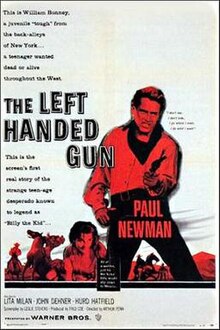
The Left Handed Gun

One of the most well known names to come out of the old west, William Bonney was better known as Billy the Kid, a gunslinger who reportedly killed 21 people in his short 21-year life. This controversial figure has become a favorite in the western genre, his quick, violent life being translated to the screen countless times. The problem? None of them are very good, all of them extremely flawed, especially 1958's The Left Handed Gun.

A drifter and gunslinger without much to his name, William Bonney (Paul Newman) is hired by rancher John Tunstall (Colin Keith-Johnston) to work as a cowhand. In the midst of a cattle range war, Tunstall is killed soon after by rival factions, leaving Bonney looking for vengeance. The four men responsible for the murder are basically let off without a slap on the wrist with young Billy deciding it's up to him to administer justice. With two other cowhands, he sets out to kill the men, one by one, gaining quite a reputation in the process. His name might be too big though with a new governor moving into the territory. Billy's friend, Pat Garrett (John Dehner), has been hired as a marshal to bring him in, and a tortured Billy seems to be running out of time.

The history here is one of the most well-known and still disputed stories involving the wild west. The general facts are known, the names, places and times, but it seems everyone has an opinion about Billy the Kid, especially his death in 1881. There is a comfort level then with a movie like this with anyone even remotely familiar with the Lincoln County War. Anyone not familiar? Oh, boy, this could be interesting. Director Arthur Penn takes a revisionist look at the story. That isn't automatically a bad thing. Many revisionist westerns try to paint the west as it really was, not as it is remembered. Mostly because of Newman's performance the movie is at least watching, but at other times it is surreal in its execution...and not in a good way.

Depending on the account you read, Billy the Kid was an amiable young man who was personable, intelligent and that his outlaw exploits were greatly exaggerated. How then does 'Left Handed' portray him? An uncaged animal who has the maturity of a 13-year old boy, the emotions of a schizophrenic, and personal demons that threaten to cripple his every move. Newman does what he can with the part, making it interesting if not very good, overacting like a crazy man. But no matter what he does, the portrayal of Billy is just plain weird. With his friends Tom Folliard (James Best) and Charlie Boudre (James Congdon), Billy is a cackling, giggling pre-teen who can snap into psycho with the snap of a finger, ready to gun down anyone. His struggles with women leads to the possible rape of Lita Milan's Celsa, a pretty Mexican girl. His vengeance comes after knowing Tunstall for a day (as the movie says, not real life), Billy clearly looking for some sort of father figure. He wastes away as the bodies mount, an anti-hero to conquer all anti-heroes. Worst though, I'm not sure what Penn is going for or what he's trying to say.

The part of Billy was originally given to James Dean, but the young actor was killed before production started and in stepped Paul Newman. The original casting is perfect because Billy here is basically Rebel Without a Cause with a six-shooter. I give Newman credit for committing to this part. He is eternally watchable no matter the part, and that is on display here. In the hands of a lesser actor, this part would have been a trainwreck, the overemotional, high strung gunslinger basically being asked to be gunned down. To a point, Newman keeps it grounded as much as he can, but the movie on the whole does nothing to help him. In its attempts to make the events "real," the story ends up being so theatrically ridiculous, so BIG emotionally, that it all falls apart.

There just isn't much going for this movie. The score from Alexander Courage basically blares in your ear the whole time, telling you what to feel emotionally. Dehner as Pat Garrett has potential, including several good scenes with Billy, but his reason for hunting down the Kid is laughable, and the theatrics of his explosion are equally laughable. Yes, big, angry eyes and screaming. The black and white shooting offers a stark look at the story, a washed out feel to this dark story, but it seems just one town set was used repeatedly. Oh, and for trivia buffs out there, Billy the Kid wasn't a left handed gun. He was a righty. Read about it HERE. It might be more interesting than the overdone movie.

The Left Handed Gun <---trailer (1958): * 1/2 /****

Sunday, July 24, 2011

The Beast from 20,000 Fathoms

Fans of director John Ford's movies will no doubt recognize the gruff, worn face if not know his name. Often playing a bit part or a supporting role as a background player, Jack Pennick wasn't an actor so much as an ever-present part of the movie as a whole. A veteran who served in the Marines (World War I) and the Navy (World War II), Pennick was one of Ford's company of character actors that fans have come to know and love. His parts were usually so quick, so small that it's cool to see him actually get to do something that is essential to the story, like 1953's The Beast from 20,000 Fathoms.

Now for starters, I don't want to give the impression that Pennick is in every scene and dominates the movie's 80-minute running time.  His part only requires two or three scenes out of him, and he's rather unceremoniously just disappears mid-scene at one point never to return. It is a cool little bit of casting in a movie that has several several oddities. James Best has a bit part as an Army radio operator, Vera Miles and Paul Picerni apparently made appearances in a trailer at some point (I didn't spot them), and one part late in the movie couldn't help but put a smile on my face. As for the rest of the movie? Pretty good so let's do this thing.

On an expedition in the Arctic, Professor Tom Nesbitt (Swedish actor Paul Hubschmid) believes he's seen a prehistoric creature that was unleashed from the thousands of feet of ice and snow by a nuclear detonation. Everyone around him believes that Nesbitt has lost his mind and is imagining things except for Lee Hunter (Paula Raymond), the assistant of Professor Elson (Cecil Kellaway), the world's leading paleontologist. Nesbitt identifies the creature he saw in a sketch and feels even more assured what he saw was real when strange reports of a sea creature attacking ships continue to filter in. The creature looks like it is making its way down the Atlantic current along the east coast heading for New York. With help from an old friend, Army colonel Jack Evans (Kenneth Tobey), Nesbitt tries to convince anyone and everyone how much danger the city is in, but it may be too late.

From the story down to how the sci-fi flick actually looks, my first thought was that 'Beast' was a cheap American knock-off of the original Japanese flick Godzilla.  Well, yeah, that one is on me. Beast was released a year before Godzilla (released in 1954). Nuclear detonations here don't create the beast, they just free him from his icy hibernation so it's not a dead on comparison, but it's similar enough. When the beast does reach New York City, the scenes are almost a blue print for the stereotypical shots of Godzilla attacking Tokyo, mass chaos in the streets, the fleeing masses screaming bloody murder as they flee.  Where so many of these 1950s creature features are a guilty pleasure though, this is a genuinely good movie, thanks in great part to the special effects work of who else? Ray Harryhausen.

As I know I've mentioned in all my other reviews with Harryhausen in the crew, it's easy to brush this man's work aside. Watch a movie made with computer generated effects and all its polish and clarity, and you get spoiled. To create his animation effects, Harryhausen had to take 24 still frames for each second that was on-screen to create the appearance of movement. That's not the right way of wording it I'm quite sure, but I'm drawing a blank right now to make it clearer. So when you see the beast move through the water or run across the frozen Arctic tundra, Harryhausen had to do hours, days and even weeks of work for a few quick seconds of actual screentime. The scenes of the beast attacking NYC are pretty cool no matter how long the they took to construct, the city serving as a great background for the battle between the cops, the Army and our friendly beast from 20,000 fathoms.

Watch movies like this, and if you're like me, you are just looking for the cast and the acting to be not horrible. I don't need award-winning stuff, just serviceable and not downright embarrassing. Working off a story from sci-fi writer Ray Bradbury (I don't know how close the story stays to his story), the characters are pretty cookie-cutter, but that's not a bad thing. Credited as 'Paul Christian,' Hubschmid overcomes his sometimes heavy Swedish accent to play the intelligent professor no one believes with Raymond playing the love interest and pretty assistant, the only person who believes him. Kellaway as Dr. Elson has a cool part -- including an unintentionally funny death scene -- and Tobey is as solid as ever, playing a similar role to the one he played in The Thing from Another World. Any American or spaghetti westerns will appreciate future star Lee Van Cleef showing up as Cpl. Stone, an Army sharpshooter called in to make a ridiculous shot on the beast. He looks almost bored with the proceedings, but come on, it's Lee Van Cleef, and he's still cooler than you.

As I've watched far too many of these movies over the last month thanks to TCM's Thursday marathons, I've noticed the same trend. We have these creatures/monsters/beasts that can't be stopped so...how do we stop them? The finale doesn't disappoint providing an answer that makes some sense (I guess, I'm not really scientifically inclined) and is executed well. The beast ends up cornered at Coney Island in a roller coaster where Professor Nesbitt and Van Cleef's sharpshooter have to fire a radioactive isotope at it. I'll give the movie this, it's got an interesting use of the actual roller coaster that plays into the solution. Seriously though, this is a good sci-fi movie, and one that set the stage for many more in the 1950s.

The Beast from 20,000 Fathoms <---TCM clips/trailer (1953): ***/****

Thursday, July 14, 2011

The Quick Gun

A user review at the IMDB points out a simple but key problem working against the success of the 1964 B-western The Quick Gun. Succinctly wrapping it all up, the user states 'It's not exciting.' As I struggled to come up with something to write about, that's what hit me. The story is a rehash of other westerns as is the case with the characters. But rehashes isn't always a bad thing so I kept watching. It never got better though as the movie coasts along.

After reviewing two Audie Murphy westerns these last couple of days, I was looking forward to this third western that aired as part of Turner Classic Movie's Audie Murphy night. I enjoyed both Drums Across the River and The Guns of Fort Petticoat, but 'Quick' never rises to that level. By the 1960s, Murphy's star had started to fade some which is reflected in his movie roles. The 60s were marked by low budget B-westerns that never rose above their smallish budgets.  IMDB ratings aren't a hard and fast rule because voters can strategically increase or decrease a ratings, but of Murphy's 40 roles, The Quick Gun is his lowest rated movie, and that says something. It just isn't very good.

Two years after he was provoked into a gunfight where he killed the two sons of a local rancher (Walter Sande), gunfighter Clint Cooper (Murphy) returns home to the town he grew up in. He's not sure what reaction he will get from the townspeople who were happy to see him go, but his return is halted on the road into town. He meets Jud Spangler (Ted de Corsia), the leader of a gang Clint briefly rode with in the past. Spangler offers for Clint to ride with them as they rob the bank in town, but he refuses and manages to escape, riding into town. No one is happy to see him other than his old friend turned sheriff, Scotty Wade (James Best). The rancher is still looking for revenge, and suspicions abound when Clint informs the town of the news of Spangler's impending robbery. They believe Clint's working as an inside man so can he convince them otherwise in time?

You would think with a movie that doesn't even break the 90-minute barrier, a story would not have trouble moving things along. That's not the case here with director Sidney Salkow's western which struggles with a pacing problem throughout. I can deal with familiar stories and cliched characters, but something has to actually happen for a movie to be even a little enjoyable. Murphy's Clint rides into town, gets stared at a lot, he helps prepare a defense and he ends up in jail when he's forced to kill in self defense. By the time Spangler's gang actually shows up I was bored to tears.  These townspeople don't deserve the help he's offering. More than any lack of excitement -- of which there's little to none -- is that there is no energy to the movie at all. No one seems that worried about the coming robbery.

In those previous Murphy western reviews, I mentioned the actor's somewhat limited range that usually worked well within westerns. The idea of the Clint Cooper character is a good one, a take on the prodigal son as this infamous gunfighter wants to return home after years away. His intentions are pure, just wanting to get a second chance, and he gets it when he stumbles into the news of the coming robbery. But like the rest of the movie, Murphy looks to be sleepwalking through the part. Some of that can be attributed to his character, a beaten down gunfighter sick of what he's done in the past. There's no real sense of urgency for this character who actually ends up spending about 30 minutes of the 87-minute movie in a jail cell. Now that just ain't right.

A bright spot from the slow-moving story is James Best as Sheriff Scotty Wade.  Too often Best is remembered for his part in the 1980s TV show The Dukes of Hazard as Sheriff Rosco Coltrane, but he made a name for himself in the 1950s and 1960s, usually in supporting parts in westerns and war movies. It's great to see him in a leading role, keeping up with Murphy and eventually making more of a positive impression. Wade is now engaged to Helen (Merry Anders), the town schoolteacher who used to go with Clint, and he quickly sees the writing on the wall. Calling him a tragic character in this B-western is a little much, but the character is certainly on that path. It's clear it will not work out for him as he's torn between his duty to the town and the people, to his fiance Helen, and to his old friend who he genuinely believes is telling the truth. In an otherwise pedestrian western, Best's performance stands out from the rest.

The rest of the story and cast is more hit or miss. Anders as Helen is pretty awful, somewhat redeeming herself in the end when all seems lost. Ted de Corsia gets to ham it up as Spangler, the not quite maniacal bad guy who looks to be enjoying himself in the spotlight. Sande and Rex Holman are the secondary villains, the Morrisons, the ranchers looking for revenge, but they're not around enough to leave an impression. Frank Ferguson is solid as Dan Evans, the hotel owner who used to be close friends with Clint, while Mort Mills and Gregg Palmer play two of Spangler's gunmen.

Cynical watcher of westerns that I am, I was hoping for the darkest of endings here, especially about midway through the movie when I was losing interest. The most appropriate ending (in my head) has Murphy getting gunned down as he ultimately saves the town with Best's Wade ending up with the girl. That of course is not the ending we get, but I can wish. The shootout in the main street at the end has a chance to be good because it is far from a happy ending, but right before going into really dark territory, The Quick Gun takes its foot off the pedal and slams on the brakes.  Too bad, a different ending could have saved it a little.

The Quick Gun <---TCM clips (1964): **/****

Thursday, June 2, 2011

Seven Angry Men

One of the most controversial people in American history was a driven, even obsessed abolitionist who made a name for himself in the years before the Civil War, John Brown. I have always been fascinated by Brown mostly because his belief that all men should be free. The only problem was his extreme execution of these beliefs. His actions were those of an extremist, an individual who was going to get what he wanted no matter the cost. His reasoning was sound, but his actions bordered on the insane.

Complete hogwash in terms of historical accuracy, 1940's Santa Fe Trail is the only movie I can even think of that has Brown playing a major role. He played a huge role in starting the Civil War -- the bloodiest conflict in American history -- but has generally been forgotten in the pages of history books over the last 150-plus years. At the height of his popularity, actor Raymond Massey played the infamous abolitionist in a movie that while entertaining, is about as accurate as saying that the sun is green and the moon is made of cheese. It is a performance that is downright terrifying at times. Some 14 years later, once again bearing a striking resemblance to the real-life Brown, Massey reprised the role of John Brown in 1955's Seven Angry Men.

It's 1856 and brothers Owen (Jeffrey Hunter) and Oliver (Larry Pennell) are traveling to Kansas to work with their father, John Brown (Massey), in his efforts to help the territory enter the United States as a free state. Four other Brown brothers are already waiting as the family is reunited, all in hopes of making Kansas a place where slaves are illegal.  Their father, John, though is willing to do anything necessary to ensure that with the coming vote.  Sticking with his father through thick and thin -- even going against his wife, Elizabeth (Debra Paget), and her intentions -- Owen quickly realizes how obsessed the man really is. John has bigger, grander plans than just Kansas though. He has his sites set on Harpers Ferry, Virginia, and the U.S. Military arsenal there where he hopes to arm an army of freed and escaped slaves.

The Civil War is one of the most interesting times in American history, but the build-up to the bloodiest war ever fought on American soil is just as interesting.  In the five years before the war, Kansas was dubbed 'Bleeding Kansas' as abolitionists fought pro-slavers over the future of the state, whether it would enter the United States as a free or slave state. Brown's raid on Harpers Ferry (read about it HERE) is similarly one of the most fascinating chapters in American history (to me at least). However miserably the raid failed, Brown's intentions are amazing when you think about it. The topic can be a touchy one (Kansas and Harpers Ferry) so it's easy to understand why movies have generally steered clear of it, but the history is incredibly interesting.

The tone of the two movies -- Santa Fe Trail and Seven Angry Men -- are basically polar opposites, but the positive you can take from both movies is Raymond Massey's acting performances as John Brown. As I mentioned earlier, he bears a striking resemblance to the real-life Brown. His acting though is so much more, bringing this obsessed, completely and blindly driven man to life. His intentions were genuine -- all men should be free regardless of color -- but his actions were deplorable, believing in an Old Testament form of justice. Making him more interesting/believable/frightening is that Brown (an ultra religious man) believes God is using him as his vessel on Earth to do what he needs to get accomplished. Scary much?

So director Charles Marquis Warren has those two great things working for him -- interesting history, more interesting historical person -- and what does he focus his story on? The budding relationship of Brown's son, Owen, his right hand man, and a fellow abolitionist, Elizabeth, who believes John's actions are despicable. Do you think there's a chance they might put their differences aside and get hitched? They talk about these problems a lot, and then share some very passionate 1950s movie kisses and some scandalous embraces. Because of that, Massey's John Brown gets pushed to the background far too often.  In the rest of the cast is Dennis Weaver, James Best, John Smith and Pennell as the brothers who actually make an impression. Also look for James Edwards as Green, a freed black man fighting with the Browns, and Leo Gordon in heavy mode as pro-slaver leader gunning for Brown.

I wanted to like this movie more than I did, but it just has so many things working against it. A B-movie or even an A-level movie on a smallish budget can overcome a lot with some basic things; avoid overacting, don't get too exaggerated, keep the music in a non-blaring mode. 'Angry' misses on all counts. Carl Brandt's score is painfully obvious, almost willing you to feel certain emotions. The love story is equally bad, and I can't decide if that's on the actors, the script or the director. Maybe worst of all is that the movie just doesn't know what it wants to say. Is John Brown a hero or a traitor? The ending has the Battle Hymn of the Republic playing over Brown's execution just minutes after vilifying the man. Which one is it? Massey is great, and the relatively forgotten history is interesting, but otherwise this one is worth passing on.

Seven Angry Men <--- TCM clips (1955): **/****        

Wednesday, April 6, 2011

Shock Corridor

For a look into a mental institution, one needs only go as far as One Flew Over the Cuckoo's Nest.  It's a good look to, honest but sympathetic in most ways, well except for Nurse Ratchet that is.  Reading about 1963's Shock Corridor, I thought I was going into a similar story, the inner workings of a mental institution from the perspective of the patients.  When I saw Samuel Fuller directed the film, I was even more excited. That excitement wore off pretty quickly. This movie was bad from the start, dated and campy but not in a good way.  Instead, it ends up being surprisingly funny, but I'd assume for all the wrong reasons.

A movie that tries to explore social dilemmas, problems that should be dealt with, it has to be handled correctly or else the finished product is going to blow up on the launch pad.  I was surprised and not surprised this movie is held in high regard by moviegoers and critics alike.  For a movie released in 1963, it certainly does tackle some issues that were ahead of its time.  But the execution of it on top of the really bad acting and hackneyed dialogue end up crippling any chance of success this movie had. Maybe I'm just looking at it the wrong way, but I thought this movie was awful and couldn't wait to get through it.

A highly-regarded newspaper reporter, John Barrett (Peter Breck) has thought of a story idea that he's convinced will win him the Pulitzer Prize.  Recently, an unsolved murder occurred in a local mental institution, but the murderer was never found and the police gave up on the case (apparently). Barrett hopes to get himself committed to the place and piece things together from the inside. He goes through training so he can act like and appreciate what some of the patients will be going through. His girlfriend, Cathy (Constance Towers), poses as his sister who says her "brother" has made advances on her and has him committed. John goes along with it, feeling things out as he goes through therapy sessions -- some more extreme than the others -- trying to figure out what happened to the murdered patient. But as the clues come together, John begins to descend into his own madness. Can he figure out the murderer before it's too late for him?

I like Fuller as a director, but this was just a weird movie overall. It's off the wall and ridiculous, portraying the patients in such a bizarre way that the movie doesn't serve as a condemnation of mental institutions. Instead, it's more a big joke. One immensely obese patient (Larry Tucker) believes he is Pagliacci, constantly singing opera in the ward.  Some patients do nothing but sit all day in the hallway, "the street" dubbed by the staff where patients who have behaved get to interact and have some sense of freedom. That's where most of the movie takes place, in the hallway, Breck's John doing his best to figure out exactly what's happened. It never works though. The murder mystery is never really established (it's fairly easy to predict who the killer is) and feels like the script needed any excuse to put this respected journalist into an institution.

Watching Barrett basically fall apart day by day and week by week, I came to dislike the character more and more until finally I just decided I hated him. Part of that is the character's fault because he just isn't likable. The other part is that Breck delivers a downright bad performance. His stream of conscious narration is hilarious, and his two go-to moves to show he's going crazy is stoned silence with an empty stare or scream like toddler who isn't getting his way. He's so obsessively driven to pull the stunt off and get his story he becomes oblivious to his own issues. You know where it's going almost from the start, and it isn't going to end well for Barrett.  I'll also add this as someone with no medical experience or background. Are mental illnesses contagious? Can you catch some sort of sickness by just acting like you have said sickness? I realize he's basically imbedded himself in a world of crazy, but can that turn you crazy? I wouldn't think so, but the whole movie relies on that ridiculous (to me at least) premise.

Treading the ever so thin line between overacting and just delivering highly dramatic parts are three key supporting characters, the witnesses to the murder Barrett is trying to solve.  They include James Best, Fuller favorite Gene Evans, and Hari Rhodes. All sane men at some point, they all had breakdowns. Best was captured in Korea and brainwashed by the North Koreans and Chinese, returning never quite the same. Evans was a brilliant scientist who just snapped one day, his mind regressing back to his childhood days. Rhodes plays a black student who broke the color barrier at an all-white school, and now thinks he's white, terrorizing the black patients.  Each man is given a scene that delves into their mind (or what's left of it). If I had to recommend anything about this movie, it would be those three extended scenes.  They're intense (if a little overbearing) and feel like the one authentic thing going for this story.  On a sidenote, Barrett doesn't actually "investigate" anything. He talks to them, they rant for awhile, and he finally blurts out "Who killed Sloan?!?!" That's just good detective work there, sir! Good work.

All positives aside, there is much, MUCH more toward the negative. Constance Towers isn't a bad actress, but her character is mind-blowingly stupid. Pretending to be Barrett's sister who he's sexually interested in, she passionately kisses him during one of their visits at the institution.  Yes, I can appreciate she's worried about her boyfriend/fiance, but does she not see the problem in her actions? She flips out then when Barrett pushes her away.  Most of her part has her slinking around (she's a stripper for her day job) in Barrett's nightmares, convincing him that she's hooking up with other men while he's wasting away in the institution.  The moments of clarity patients go through are laughable and border on the pretentious. The breakdowns are laughable when they do happen, and made me laugh more than I was probably supposed to. The best though by far is Barrett accidentally stumbling into a ward for a certain type of female patients. He realizes who and what they are, his first thought via narration...."NYMPHOS!" They proceed to attack him in a truly awful but still funny scene which you can watch HERE.

I really did not know what to make of this movie. At one time effective, others so misplayed that the movie comes across like a camp classic.  Maybe because there was some potential here that the end result is that much more disappointing.  Stretching for a positive is an increased role for Chuck Roberson, John Wayne's stunt double and one of the most talented stunt men in the business.  If you've seen a Wayne movie from the 1960s, I guarantee you've seen Roberson whether you know it or not.  He plays Wilkes, one of the institution's attendants who tries to help Barrett through his struggles.  It's a small part, but one of the bigger ones Roberson had in an impressive career, rivaling his screentime in 1960's The Alamo.  Still, it's a minor positive in a sea of major negatives.

Shock Corridor <---trailer (1963): */****

Monday, July 19, 2010

Ride Lonesome

Last fall I reviewed a western from director Budd Boetticher, Buchanan Rides Alone, one of seven pairings with star Randolph Scott.  'Buchanan' was one of the two I hadn't seen prior, and I enjoyed it, if not as much as the other pairings.  Everyone has their favorites, but one always stood out from the others for me, 1959's Ride Lonesome, a western typical of the Boetticher/Scott pairings.

These were B-westerns, but in the most positive sense of what a B-movie can be when handled the right way.  Almost criminal in their simplicity, these are must-see westerns for fans of the genre.  'Ride' has all the necessary elements; a tough, veteran cast, scenic Western locations, and a solid if unspectacular story that almost always features a twist or two.  I won't say the films are a romantic portrayal of the old west, but at times it sure feels like it.  Instead they followed a trend in the 1950s of more adult westerns, including a string of Anthony Mann and James Stewart westerns that are some of the best the genre has ever produced.

A former lawman turned bounty hunter, Ben Brigade (Scott) captures young outlaw Billy Joe (James Best), wanted for murder in Santa Cruz.  Stopping over at a stagecoach station, Brigade runs into two men who tread that fine line on either side of the law, Boone (Pernell Roberts) and Whit (James Coburn). Anyone who brings Billy in earns an amnesty for past actions, and Boone and Whit intend to collect.  Along for the ride is Carrie Lane (Karen Steele), the recent widow of the stagecoach station's owner. Brigade doesn't plan on giving his prisoner over to Boone and Whit, but he knows trouble is following them and he'll need their help.  Wearing out horses behind them, Billy's brother Frank (Lee Van Cleef) and his gang are hot on their trail. 

There are typically three different variations of characters in a Boetticher western -- four if you count the damsel in distress.  There's the good, the bad and the yet to be determined.  Scott always play the good, if a somewhat tortured good.  The bad is the straight villain with no basically no chance of survival (sorry Lee).  And third and the most fun is the yet to be determined, played here by Roberts and Coburn.  These are the characters you're not quite sure which way they'll go.  Will they turn on the good guy Scott or stay on the righteous path?  It depends on the movie which way they turn, but there's always that sense of mystery.  It's also the meatier, more showy character to have, but more on that later.

As the steely-eyed, tortured good guy, Scott has about 20 lines to say in the whole movie.  The thing is? He doesn't need to say more than that.  He's a man of few words with principles and beliefs he lives by, end result be damned.  Scott is going to do the right thing no matter the cost.  His Brigade has a past incident haunting him -- as most of his characters did in the Boetticher westerns -- and he will right a wrong whether you want him to or not.  The more showy character is Roberts playing Boone, an outlaw looking for a second chance.  He has this easy way about him that you can't help but like him, even if you're curious what he's really up to.  A real scene-stealing part.  Coburn in his first movie also shows some of the talent that would make him such a big star in the coming years.

On to the other elements, this one has the good and bad.  Karen Steele plays the eye of everyone's affection, the babely widowed station owner's wife.  Her platinum blonde hair and bras that could take an eye out look out of place, but her character is a whole lot tougher than most female characters in a western. Her looks sure don't hurt though.  Best isn't given much to do other than negotiate for his release, and Van Cleef only has two scenes where he actually talks.  For filming, Boetticher chose the California deserts and mountains, and along with cinematographer Charles Lawton Jr. turns in a gorgeous looking western that rivals some of John Ford's best in Monument Valley. The score by Heinz Roemheld is nothing special, but that's a minor complaint.

At just 73 minutes, there isn't a wasted moment or unnecessary scene anywhere to be found.  Some reviews call it a dull or slow-moving story, but the time flies by.  It isn't heavy on action if that's what you're looking for, instead building up to these quick outbursts of gunfire after long scenes of quiet.  The dialogue from screenwriter Burt Kennedy is top-notch and features some quotable western lines while also giving some inspirations for Sergio Leone and the Dollars trilogy.  It is available to watch through Youtube (here's Part 1), but it's in pan-n-scan.  If you can find a widescreen version, I'd recommend watching that one. 

Ride Lonesome <----TCM trailer (1959): *** 1/2 /****

Sunday, September 13, 2009

The Naked and the Dead

When I think of author Norman Mailer, one thing comes to mind. Big books, real big books. I haven't read any of Mailer's stories, partly because I get intimidated when I see a paperback I could knock someone out with if using it as a weapon. His take on WWII in the Pacific, based on his own service, was a huge hit upon its release and surprise, surprise, turned into a movie of the same name, The Naked and The Dead.

Now looking at a reissue of Mailer's novel, the Amazon listing has it as over 700 pages so any movie version is going to have to cut things out. The 1958 movie clocks in at 131 minutes so I tried to keep that in mind while watching it. TCM's Robert Osborne said the novel upon its initial release was a huge success because of its 'salty language' with plenty of four-letter words and its frank way of dealing with some touchy subject matters. Of course, a movie from 1958 had to strip much of that away with censors. So right off the bat, the movie already has two strikes against it, but I'll move on.

The story centers around an American infantry battalion on an unnamed Pacific island midway through the war. Three main characters step to the front, giving the viewer a good sense of all the different ranks in the battalion. First, there's Sgt. Sam Croft (Aldo Ray in a part he was born to play), the leader of an intelligence and recon platoon that is understrength after several campaigns on the front lines. His men hate him almost to a man, and he gives them good reason. Croft is sadistic, killing unarmed prisoners callously and then prying the gold teeth out of their mouths. Second, there's Lt. Robert Hearn (Cliff Robertson), a young officer with connections back home. Translation = Earns a job far from the front lines. And third, there's General Cummings (Raymond Massey), the battalion commander obsessed with casualty estimates and striking fear into his men's hearts, often for pointless power trips.

I liked the idea of seeing the war from different perspectives, from the high-ranking general to the men on the front line. With war movies, it's typically one or the other. But in the execution, something doesn't translate. The first 70 minutes are extremely reliant on dialogue scenes meant to flesh out the main characters. Maybe this was the purpose, but none of the three are particularly likable. Croft is pure evil, Hearn is a cocky, arrogant spoiled son of a you know what, and Cummings borders on the crazy. These early scenes drag on too much.

The pace picks up when a twist to the storyline is thrown in. On this Japanese-held island, Cummings' advance has slowed to a halt. He puts into action a plan that should break the stalemate, but he needs behind the lines info. Croft and his platoon are selected to go behind the Japanese lines and set up an observation post for their advancing battalion mates. After pissing off Cummings, Hearn is given command of the platoon. So now, they're not only tangling with Japanese patrols, but a fight for power between Hearn and Croft.

The patrol segment is by far the better part of the movie. There's a natural tension as Croft and his men walk through the jungle (Panama substitituing for the actual Pacific) trying to get to their objective while avoiding the Japanese. What I enjoyed most in the movie was Croft's platoon which includes Richard Jaeckel, William Campbell, James Best as the bible-thumping, drawling medic, Jerry Paris and Rat Packer Joey Bishop as two Jewish soldiers, Robert Gist, and L.Q. Jones at his overacting best. Jaeckel and Jones are really the only ones given any development, and reading the book reviews it seems the platoon's back story was sacrificed from the 700-page plus behemoth.

For a WWII movie, the action is pretty sparse and when it comes along, it's pretty disappointing. The gunfire sounds like prop guns and the explosions look as staged as a movie explosion can be. As mentioned before with the censors, the violence is often off-screen, like a Japanese patrol burning in a lit-up field, and comes off as too tame. It's hard to judge a movie for the time it was made in, but if this movie was released in the 90s we're talking a Pacific version of Saving Private Ryan.

So compared to other WWII movies in the 50s and 60s, this one is pretty average but a lot of my complaints come from the censors. Director Raoul Walsh tried to make the definitive, honest look at a platoon of soldiers in the Pacific in WWII, but it is hamstringed by any number of forces working against it. Worth a watch for Aldo Ray's performance and the list of character actors who make up his platoon, but otherwise this one's only worth it for diehard war movie fans.

The Naked and The Dead (1958): **/****