The Sons of Katie Elder

The Sons of Katie Elder
"First, we reunite, then find Ma and Pa's killer...then read some reviews."
Showing posts with label Patrick Wayne. Show all posts

Thursday, January 29, 2015

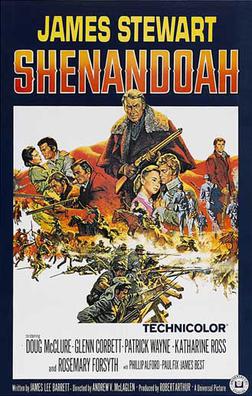
Shenandoah

As far as directing powerhouses of the 1960s, Andrew V. McLaglen will never be remembered as one of the greats. He started off in television before making the jump to feature film, teaming several times with John Wayne while also specializing in audience friendly "guy movies." Good guys versus bad guys, lots of familiar faces and situations, you know the formula. One of his best? An underrated Civil War drama, 1965's Shenandoah.

It's 1864 in Virginia, and the tide of the Civil War has turned as the Union forces are slowly beating down the Confederate armies. Doing his best to remain free of the bloody fighting, farmer and patriarch Charlie Anderson (James Stewart) wants nothing to do with the war. Both for himself and his family -- seven kids, one daughter-in-law -- Anderson simply wants to keep working his 500-acre farm and get through the war unscathed. Fight for Virginia? Fight for slaves he doesn't have? He fights for what he believes in, his family and his farm. Well, that's what he'd like to do. While the fighting rages on, Charlie is stunned when he finds out his youngest son (Phillip Alford) has been confused as a Confederate soldier and captured by nearby Union forces. Now the war and the fighting that Anderson has done so well to steer clear of has landed square on his front porch. Can he find his son amidst the hell of war?

This was a movie I watched often growing up when my sister and I had sleepovers with my Grandma. It made an excellent Civil War double feature with Friendly Persuasion, and let me tell ya, they both hold up! I watched this McLaglen-directed Civil War drama for the first time in years, and it resonated just as much now as an adult as it did when I was a kid, if not more. McLaglen had some excellent movies to his name -- The Wild Geese is a favorite, Hondo, McLintock are also excellent -- but this is his best movie overall. The story is a series of very effective, often moving and often disturbing vignettes, all held together by the Anderson family. Filmed on-location in Oregon and California, 'Shenandoah' is an underrated visual film, and the musical score from composer Frank Skinner is a gem. So what stands out viewing this one as a 29-year old, not a 13-year old kid?

That would be James Stewart, one of my favorites in just about any movie he's in. This doesn't get the attention or notoriety as one of Stewart's best performances, but it certainly belongs in the conversation. I love what he does with the part of Charlie Anderson, a stubborn, feisty Virginia farmer and widower looking out for the best intentions of his family. He doesn't care about the war, about slavery, about Union and Confederate. He will do anything, ANYTHING, to protect his family. Stewart has some great scenes with the younger supporting cast, especially Alford's youngest son, only called 'Boy,' with his daughter, Jenny (Rosemary Forsyth), daughter-in-law, Anne (Katharine Ross), and his sons. There are too many memorable, emotional scenes to mention, but my favorites are the most simple. Minutes before the Andersons go to church each Sunday, Charlie visits his wife's grave and just talks to her. Simple perfection, Stewart absolutely nailing the underplayed but charged scenes. 

Stewart is the unquestioned star of McLaglen's film, but 'Shenandoah' offers quite the ensemble of recognizable faces. Glenn Corbett and Patrick Wayne play Jacob and James, the two oldest brothers. Corbett especially stands out as Jacob who's beginning to question if their choice to stay out of the war is the right decision. Wayne is solid too, especially in his scenes with Ross. In her film debut, Forsyth is excellent, a subtle scene-stealer as innocent, tough and thoughtful Jenny who's also interested in a young Confederate soldier, Sam (Doug McClure). The other Anderson boys include Charles Robinson, Jim McMullan and Tim McIntire. Maybe the best thing you can say about the story is that the family dynamic, it just works. You believe them as one cohesive unit, one that stands together through thick and thin.

But wait, there's more! Also look for George Kennedy as a sympathetic Union officer, Gene Jackson as Gabriel, a friend of Boy's, a slave, Paul Fix as the local doctor, Denver Pyle as the pastor, James Best as Carter, a fellow prisoner who takes Boy under his wing, Harry Carey Jr. as another Confederate prisoner, Tom Simcox as Lt. Johnson, a Confederate officer, with Kevin Hagen, Dabbs Greer and Strother Martin also playing small but memorable parts.

So 29-year old me certainly picked up some new things, or at least was able to process things differently. This is one hell of an anti-war flick. The portrayal of the latter stages of the Civil War is unsettling and often times, disturbing. Death awaits around every corner, hiding behind every tree. The lines are up in the air as the war takes a turn toward its ultimate conclusion. A late battle between a small Confederate camp and a larger Union force with heavy artillery is quick and awful and uncomfortable, one of the more underrated battle sequences I can think of. The last half hour especially features one kick in the gut after another that truly hammers home the anti-war message. And that last scene? Pretty perfect, the possibility of hope lingering in the air amongst all this pain and suffering and death. One of my favorite movies.

Shenandoah (1965): ****/****

Sunday, August 18, 2013

The Comancheros

Following Texas' war for independence with Mexico in 1836, the expansive republic was on its own for government, economy and protection without help from outsiders. Who came to the forefront to help protect the fledgling republic? The Texas Rangers, and no, not the Major League Baseball team, instead a small group of law officers who patrolled Texas trying to protect its citizens. Recurring characters in the western genre, one of the best portrayals of the Rangers is 1961's The Comancheros.

It's 1843 when a Louisiana gambler, Paul Regret (Stuart Whitman), finds himself on the run following an accidental death in a duel. Regret heads for Texas but as he readies to disembark from the riverboat, he is instead arrested for murder by a Texas Ranger, Captain Jake Cutter (John Wayne). The duel was fair by all accounts, but the dead man was the son of a powerful judge who wants vengeance. Intending to bring Regret back to Louisiana, Cutter instead finds himself working with the man. All through the territory, Comanche raiding parties are attacking one ranch and homestead after another. Cutter has long thought the Comanches are being led by a gang of white men who pull the strings, but he has no proof. Posing as a gunrunner and with Regret as his somewhat unwilling partner, Cutter heads into Comanche territory and finds just what he thought he would, a gang of drifters, bandits and killers -- Comancheros -- working with the Comanches. Can they get out alive?

The 1960s were a big time for John Wayne. He wasn't just a box office star, but by now after 30-plus years in the business, he was a screen legend. This was the decade where -- for better or worse -- he started playing himself more than meaty roles like The Searchers, She Wore a Yellow Ribbon, and The Man Who Shot Liberty Valance. His mindset changed some as he started to make movies that typically had one objective....please the audience. These were movies meant to entertain, movies the whole family could go see. They would revolve around action-packed stories, good casts of familiar faces, great locations and whistle-worthy scores, movies like this one, The Undefeated, Sons of Katie Elder, McLintock!, Donovan's Reef and Hatari. This is a prime example of that type of movie. It's fun, exciting and with a whole lot of action. A groundbreaking, innovative western? Nope, but as far as popcorn movies go, it's hard to beat.

This obviously isn't a comedy western, but it isn't as dark and downbeat as the plot description might imply. For me, the best thing going for 'Comancheros' has always been the pairing of Wayne and Whitman, an Odd Couple pairing that works extremely well. It almost plays like a buddy western movie, the resolute Ranger and the roguish gambler. Wayne especially gets to show off a comedic side that most of his movies just didn't allow. His backwoods Ranger mispronounces Monsieur as Mon-sewer, providing some good laughs throughout. Whitman too looks right at home alongside the Duke, the duo exchanging some great dialogue scenes together on the trail. It looks easy watching them. Regret is far from a veteran trailsman, but he picks it up quick. Cutter bristles at times with his prisoner's unique ways, but thrust into a do-or-die situation, they end up becoming unlikely friends. Two good lead performances for sure.

While the A-list names might not be there, 'Comancheros' offers a very solid cast, one all western fans should appreciate. Lee Marvin makes what amounts to a cameo as Tully Crow, a brutal, vicious Comanchero, stealing the show and providing some great moments with Wayne in their scenes together. The one weak point is Ina Balin as Pilar, a beautiful young woman who falls for Regret and vice versa. Her scenes are pretty painful, especially as she "analyzes" love. Nehemiah Persoff is similarly a scene-stealer as Graile, the handicapped, brutal leader of the Comancheros with Michael Ansara as his sadistic henchman, Amelung, and also look for Jack Elam as one of the Comancheros. As for the other Rangers, look for Bruce Cabot as Major Henry and Patrick Wayne as Tobe, a young ranger along on the mission into Comanchero territory. Also look for the beautiful Joan O'Brien as Melinda, a widow who cares deeply for Cutter (and maybe more...uh-oh!) with Wayne's daughter Aissa playing Melinda's daughter.  

Looking at the credits, Michael Curtiz is listed as the director, but Curtiz became sick during filming and was unable to complete the movie, dying soon after its release. Wayne stepped in and directed in uncredited fashion, finishing the movie. The story itself is pretty episodic, the first 45 minutes spent with the hunt and escape and hunt and escape between Regret and Cutter. It covers a lot of ground before the Comancheros are even introduced, but it's never dull and never really slows down. There actually isn't a ton of action, but what's there is enjoyable. What is noteworthy is a talented cast clearly having some fun with a story that's hard not to go along with. Also worth mentioning, Elmer Bernstein's memorable score, especially the theme. Listen to it HERE. Get your popcorn ready, sit back and enjoy this one.

The Comancheros (1961): ***/****

Sunday, December 16, 2012

Big Jake

From his starring screen debut in 1930's The Big Trail to his final film in 1976's The Shootist, John Wayne became one of Hollywood's most beloved stars. For me, he will always be one of my favorites. Some look to The Searchers, She Wore a Yellow Ribbon and The Shootist as his best roles (and they are), but one of my favorites from the Duke is a change of pace western from 1971, Big Jake

It's 1909 along the Texas/Mexico border when an outlaw, John Fain (Richard Boone), leads his gang of murderers and cutthroats in a vicious attack on the expansive McCandles Ranch. Ten people are killed, and ranch owner Martha (Maureen O'Hara) sees her grandson kidnapped. Fain demands a ransom of $1 million, leaving a note that says simply "Follow the map." Knowing her grandson could be killed no matter what she decides, Martha seeks out her estranged husband, Jacob (Wayne), to take the ransom money into Mexico and get his grandson (who he didn't know) back. With help from his two sons, James (Patrick Wayne) and Michael (Christopher Mitchum), and an old friend, Apache Sam Sharpnose (Bruce Cabot), Jacob agrees, setting off to bring his grandson back alive or his captors dead.

Without a doubt, this is the most graphically violent movie of Wayne's career. Others like The Alamo are violent, but nothing quite like this. For western fans alone, that feature makes this George Sherman-directed western worth watching. Sidenote: With Sherman sick and unable to be on-location during shooting, Wayne directed much of the movie. In a career that spanned five decades, this is certainly a departure for the Duke. It is trying to be more modern, using some heavy-duty blood squibs. Even when the violence isn't on-screen, it is beyond startling and even disturbing in some scenes. Somewhat oddly, there is still an oddly comic tune at times that feels out of place alongside the sometimes extreme violence.

Wouldn't you know it though? I grew up watching this film -- still have an old VHS recording off TBS along with the bare-bones DVD -- and will always remember it fondly. Beyond the on-screen violence, there is something different about this western that's hard to put my finger on. I think I like it because of its general eccentric nature; the violence mixed with the odd humor. 'Jake' was shot on location in Mexico in Durango and Zacatecas, giving it a real sense of authenticity. Many Wayne westerns -- The War Wagon, Sons of Katie Elder, The Undefeated -- were shot in Mexico, and wouldn't you know it? Mexico looks like Mexico, giving a great backdrop to the story. The always reliable Elmer Bernstein turns in an eclectic score that covers a lot of ground, but in a good way. Listen to the main theme HERE, but that's just a taste of what Bernstein's score has to offer. Another case of the little things aiding the bigger cause.

What else though? I love the interaction between Wayne and his two sons he hasn't seen in years. Estranged from his family (for unknown reasons), he only comes back at his wife's request. Wayne's introduction is priceless, O'Hara's Martha saying she needs a man as unpleasant as the mission he'll undertake. Cut to Wayne squinting down the barrel of a rifle in an extreme close-up with Bernstein's score playing. Jake is believed to have been killed years before, forcing him to hear many people say "I thought you were dead." Nope, still kicking, traveling through Texas and Mexico with his fiercely loyal dog. Seeing his sons again provides some of the movie's genuinely funny moments and also some surprisingly effective dramatic moments. Neither Patrick Wayne or Mitchum are out of this world actors, but they hold their own, as does a scene-stealing Cabot as an aging Apache.

The cast is far from done there, especially an underused Richard Boone as the calculating, brutal John Fain. Most villains cower in Wayne's shadow, but not Boone. Their scenes together are beyond perfect, few though they may be. Watch THIS scene for proof (apologies for the low quality). Fain's gang includes O'Brien (Glenn Corbett), a half-breed gunslinger, Pop Dawson (an unrecognizable Harry Carey Jr.), Kid Duffy (stuntman Dean Smith), a deadshot with a rifle, John Goodfellow (Gregg Palmer), a machete-wielding psycho, Trooper (Jim Burk), an Army deserter, and Will Fain (Robert Warner), John's brother who favors a shotgun. Singer Bobby Vinton makes a brief appearance as Jake's third son. Also look for recognizable western faces John Doucette, John Agar, Jim Davis, Hank Worden, Chuck Roberson (Wayne's stunt double), and Roy Jenson. Wayne's real-life son, Ethan Wayne, plays the kidnapped Little Jake.

Following the startling opening attack at the McCandles Ranch, things more or less settle down until the finale in the action department. After dealing with some pistoleros who want to get their hands on the $1 million ransom, Jacob and Co. head to the ruins of an old Spanish mission for the exchange. On a stormy night, the sequence that follows is a gem. It's brutal and vicious -- with at least two surprises -- but it always stays on a small-scale level where you know what's going on. The mission and plaza was supposedly used in the 1910s by revolutionary Pancho Villa for executions, adding a dark edge to the scenes. The gunplay isn't remembered as one of the all-time bests, but the finale is one of my favorites, partially due to the action, some to the script with its great one-liners.

Whatever the reasoning, I love this movie. I know it's not a great movie, but I love it just the same. John Wayne fans should appreciate this one, and western fans on the whole as well.

Big Jake <----trailer (1971): ****/****
Rewrite of review from July 2009

Tuesday, March 6, 2012

The Alamo (1960)

From the time I was introduced to Fess Parker as Davy Crockett in the Disney episodes, I fell hook, line and sinker for the story of the siege and fall of the Alamo. Even as a kid, I was able to appreciate the courage, the sheer bravery of the defenders of the mission who sacrificed themselves. But while I love the Disney Davy Crockett episodes, one thing stands above. Right alongside The Great Escape as my favorite movie, 1960's The Alamo.

It's February 1836 and the Mexican province of Texas is fighting for its freedom against Mexico and its dictator Antonio Lopez de Santa Anna. Leading the Texas revolutionaries is General Sam Houston (Richard Boone) who leads a nonexistent army and needs time to assemble and train a fighting force. In the town of San Antonio stands the Alamo, an old mission built by Franciscan monks over a 100 years earlier, a mission never intended for military use. With hopes of buying Houston the time he needs, Lt. Colonel William Travis (Laurence Harvey), knife-fighter and adventurer Jim Bowie (Richard Widmark), and famed frontiersman and former Congressman Davy Crockett (John Wayne) and 180-odd volunteers have forted up in the Alamo and are quickly surrounded by Santa Anna's army of over 7,000 men.

For star John Wayne, The Alamo was a labor of love, a film he had wanted to make for 14 years. He not only stars in it but also produced it and directed, his first ever film as a director. The story of the battle of the Alamo had long appealed to him -- the bravery, the heroism, the sacrifice -- and it was a story he wanted and needed to tell. He spared no expense in this truly epic production. In Bracketville, Texas, Wayne had a complete Alamo mission built, not to mention the town of San Antonio too in the middle of the Texas desert. The set -- dubbed Alamo Village -- becomes an additional character, adding a sense of realism and authenticity that no studio set would have done justice. The actual Alamo mission constructed is a sight to behold, a behemoth fortress that puts in perspective how difficult it would have been for 180 men to defend against an army of thousands. Wayne's love child, most will disagree with me, but I think it's a nearly perfect movie.

Playing three legendary figures, Wayne, Widmark and Harvey all deliver layered, nuanced performances, all of them unique and different from the rest. As Davy Crockett, Wayne is a huge presence. It's far from his best acting roles -- The Searchers, She Wore a Yellow Ribbon -- but Crockett of the time was a legend in his own right. Who better to play him than one of Hollywood's biggest stars? Much of the tension in the movie comes from the rivalry over command between Widmark's Bowie and Harvey's Travis, both actors representing themselves flawlessly. Widmark is fiery and hot-tempered, Harvey condescending, intelligent and an idealist, but they share a common goal. All differences aside, both men are willing to sacrifice themselves for the cause they're fighting. I love the banter, the back and forth, the chemistry among the three. Making a two-scene cameo as Houston, Boone too doesn't disappoint, making those two scenes more than just throwaway fluff.

In terms of actual screentime, the big three dominate, but as a director, Wayne assembled quite a cast. Ken Curtis plays Capt. Dickinson, Travis' second-in-command, with Joan O'Brien as his loyal, equally brave wife, Susannah. Crockett's Tennessee volunteers include singer Frankie Avalon as Smitty, the youngest Alamo defender, Chill Wills (in an Oscar-nominated turn) as Beekeeper, the drinking, jovial fighter, Denver Pyle as Thimblerig, the thinker and gambler, Hank Worden as the Parson, a preacher, with Chuck Roberson (a talented stunt man and Wayne's double) and Rudy Robbins as two unnamed Tennesseans, engaging in their running bit; 'Do that mean what I think it do?....It do.'  Other defenders include Patrick Wayne as Lt. Bonham, the Alamo's famous messenger, John Dierkes as Jocko and his blind wife, Nell (Veda Ann Borg), Joseph Calleia as Juan Seguin, and Guinn Williams as Lt. Finn, and Jack Pennick as Sgt. Lightfoot. Two other worthwhile performances include singer Jester Hairston as Jethro, Bowie's slave, and the lovely Linda Cristal as Flaca, a young woman who shares a brief relationship with Wayne's Crockett.

Anyone remotely familiar with the historical facts knows that on March 6, 1836, the Mexican army assaulted the Alamo and wiped out the defenders to a man in a brutal, bloody massacre; extreme casualties on both sides. For a first-time director, Wayne puts together one of the all-time great battle sequences ever committed to film (if not the best ever). Almost five full minutes are shown as the Mexican army marches into formation around the doomed mission, an eerie silence hanging in the air for several seconds before the attack begins. The assault features hundreds of extras -- and in one scene, thousands -- as the garrison tries to repel the soldiers from the walls only to be ultimately overwhelmed. Cavalry, infantry, artillery, this defines the SPECTACLE of an epic. More than that, it is a moving sequence, each of the defenders we've come to know meeting their death. More details later on this, but Dimitri Tiomkin's score here is some of his best work. You can watch the battle sequence HERE, but to be appreciated, see it on a large, large screen.   

Wayne's film has its share of detractors, and the complaints are fair (even if I disagree with them). The original version is 192 minutes and has its slower moments. Speechifying abound from James Edward Grant's script, but I eat this stuff up. Big speeches about freedom, Republic, right and wrong. That's John Wayne at his best. What does work? The very real emotion of the movie. Countless scenes impact me the more I watch this movie. Travis addressing his men, knowing death awaits those who stay, is beautifully simple. Watch it HERE. I love too, that Crockett's men dismount before him. Overlooking a field covered with casualties, Pyle's Thimblering says 'Speaks well for a man who's willing to die because he believes right is on his side...speaks well.' The night before the final assault is the most effective though, the defenders sitting quietly as they wait for the inevitable in the morning. Bowie releases Jethro, but the former slave decides to stay and fight. Roberson's Tennessean delivers a simple monologue that is profound in its outlook on life. And best of all, Crockett is asked by Thimblering, "What are you thinking about?" to which Crockett answers "Not thinking....just remembering." The last 45 minutes features some of the most perfect dialogue, emotion, music and spectacle of any movie ever. The Green Leaves of Summer (listen HERE), one of the most beautiful songs ever, playing over this sends chills up and down my back at the thought of it.

A criticism of The Alamo is the complete lack of historical accuracy as pertaining to the actual 1836 battle, and that's true. Wayne never set out to do a spot-on, dead-on accurate telling of the story. The 2004 film -- The Alamo -- does that. Instead, Wayne wanted to tell the story honoring the men who fought and died. They fight because they believe in what they're fighting for. Surrounded on all sides with no hope of reinforcement, the Alamo defenders stay inside the walls, knowing certain death awaits. They go out fighting, go down swinging. That is what Wayne was going for. I have difficulty even processing that sort of heroism. Crockett's Tennesseans dismounting before him illustrates that. Crockett has seen some of his men die already and doesn't want to see anymore die, but his men don't look to him for a decision. They do it because they want to, not because they're told. Say what you want about Wayne as a director/star with a heavy-handed message, but he got that part right to a T.

Initial reviews were mixed for The Alamo, forcing Wayne to cut 30 minutes from his 192-minute long movie. Those cut portions include Intro Music, an Intermission and Entr' Acte, and Exit Music with about 15-20 minutes of scenes, some better than others. The scene that truly needed to be in the final print was Parson's death, a beyond moving, effective scene as the battle becomes very real for Crockett and his men. Watch it HERE. The actual prints of the 192-minute version seem lost to the ages, but many of the deleted scenes are available at Youtube. Watch several of them in one video, HERE. Among them is Scotty's death, and a birthday party held for Lisa Dickinson, played by Wayne's daughter Aissa. As a fan of the movie, it's great to see any of this footage.

So what else can I ramble about? That's probably enough. I love this movie and everything about it. Wayne gets the spirit right, showing the bravery and heroism of the Alamo defenders as they faced certain death and didn't shy away from it. A true epic with scale and spectacle to impress all moviegoers. Great cast, an amazing set of the Alamo mission, Tiomkin's phenomenal score, and a battle sequence that few can even approach in terms of quality. They don't make them like this anymore.

The Alamo <---trailer (1960): ****/****

Friday, January 6, 2012

The Deserter

When a poster at a message board brought the movie up, I didn't believe him, thinking the movie he talked about was made up. As a western fan, how had this one slipped past me? Somehow it did, probably thanks to no U.S. DVD release and an old VHS (thank you Amazon vendors). The movie? A spaghetti western of sorts, think The Dirty Dozen in the West. It's 1970's The Deserter.

Returning from a patrol, Captain Viktor Caleb (Bekim Fehmiu) finds his wife on the brink of death, raped and tortured by an Apache war party. He mercifully ends her suffering, shooting her, and abandons his post but not before shooting the commander, Maj. Brown (Richard Crenna), who he blames. Two years pass and the cavalry Border Command has a new commander, General Miles (John Huston). Caleb has spent two years waging his own war on the Apaches, but Miles needs his help. An Apache chief, Mangus Durango, is organizing a huge war party that threatens to wipe out everyone in the territory. Their only hope? Caleb selects a small group of men and train them to fight like Apaches, striking the Apache camp in Mexico before the slaughter begins.

From American director Burt Kennedy, 'Deserter' isn't your prototypical spaghetti western. It was filmed in Almeria, Spain -- with some familiar locations for spaghetti fans -- and features a quirky but memorable score from Piero Piccioni. Listen to the main theme HERE. As opposed to bandits and gunslingers, the story obviously focuses on the cavalry and the Apaches so it's a cool change of pace. Mostly though, it is an above average men on a mission story, one of my favorite sub-genres in movies. A small group of men, all experts and specialists in their own way assigned an almost impossible, nearly suicidal mission. The movie follows the cookie-cutter formula, but in a good way. First, lay things out and assemble the team. Second, train them. And third, unleash them for their mission.

My rating far down below may be high in the eyes of some readers, but there's a reason. This isn't a great, classic movie that will live on in movie history. On the other hand, it is a great, fun and entertaining movie that quickly climbed into my list of favorites upon first viewing. Kennedy was a workmanlike director more than an auteur, but he knows how to manage this movie. The screenplay by western regular Clair Huffaker is a gem, nothing original but full of great one-liners, the perfect dialogue for a team of tough as nails "volunteers." This always sounds like a cop-out to me, but it's just a fun movie. Sit back and enjoy 100 minutes of running and gunning action in the desert.

Read some reviews about this generally forgotten western, and you'll find plenty of criticism of the casting of star Fehmiu in the lead. A Yugoslavian actor, this is one of his few English-speaking roles. I had absolutely no problem with him as Caleb and even think his steely-eyed, ice water running through his veins acting style is a high point of the film. Caleb doesn't care about living or dying, just avenging his wife's brutal death. That can be an appealing trait in a lead character. While I came to like Fehmiu as Caleb, what drew me into this movie was the supporting cast.

Big names? No, not especially, but reading the cast listing should put a smile on any western fan's face. Crenna is solid as needed as Caleb's opposition, and Huston is a scene-stealer as General Miles, chewing the scenery like only he can. Then there's Caleb's squad, a who's who of western characters. Start with Slim Pickens and Ricardo Montalban as Tattinger, a crotchety veteran scout, and Natchai, an Apache scout, both of them Caleb's closest friends. Not enough? There's also Chuck Connors as Reynolds, a dynamite-wielding chaplain, Ian Bannen as Crawford, an English soldier touring the Southwest, Brandon De Wilde as Ferguson, the young, unproven officer, Woody Strode as Jackson, the strong man and troublemaker, Albert Salmi as Schmidt, the soldier with a grudge against Caleb, Patrick Wayne as Robinson, the Gatling gun operator with his brother, Doc Greaves as Scott, the doctor, and recognizable spaghetti face Fausto Tozzi as Orozco, the knife fighter.

Good cast much?  If you can't go along with that group, westerns probably aren't your thing. It is a men on a mission movie, and that means....wait for it...action! Most of it is saved for the last 40 minutes, but the training sequences leading up to it are equally as fun, a quick montage highlighting all the mayhem. The mission is the high point though, and even though some night scenes are limited by obviously indoor sets, it isn't a deal breaker. Men on a mission movie means casualties though, and the results here were surprising as to who makes it and who doesn't. Violent, bloody and chaotic, a worthwhile end to an underrated western.

Now this link won't be to a pristine, widescreen print, but it you're curious about seeing the movie you can see it at Youtube HERE. It's a Public Domain print and looks to be missing about 6 minutes from the VHS I have, but when a movie is as hard to find as this one, take what you can. Hope you enjoy it as much as I do!

The Deserter <---trailer (1971): ****/****   

Sunday, November 21, 2010

Sinbad and the Eye of the Tiger

I take it for granted sometimes when watching movies that computer generated images – yes, CGI – didn’t always exist. Before computers could crank out some ridiculously cool images, moviemakers had to improve in a lot of ways to get the necessary images to fill out their movies. Just like I pointed out in my review of 1965’s Jason and the Argonauts, one of the best ways to improvise was special effects master Ray Harryhausen who over a long career created a long line of special effects creatures. Now in 2010 they may look a little dated, but that doesn’t take away from their iconic status.

Of course, they’re not all winners that Harryhausen was a part of. But just because a movie overall is below average doesn’t mean Harryhausen’s effects aren’t worthwhile, 1975’s Sinbad and the Eye of the Tiger a prime example. It was the rare movie where his effects were a part of that can’t be included somewhere in the horror/monster/sci-fi/fantasy genres.  So even with the stop motion filming technology, the effects still work and serve almost as a time capsule of a pre-CGI world. Unfortunately for this entry, Sinbad doesn’t have much else going for it. Bad acting, little to no story, and if anything, an overreliance on the effects.

Sailing into port, adventurer Sinbad (Patrick Wayne) is prepared to ask for the hand of Princess Farah (Jane Seymour) in marriage.  Instead, Sinbad and his crew find a city torn apart by an evil curse. Prince Kasim – about to be crowned prince in a week’s time – has been cursed, supposedly by his evil stepmother Zenobia (Margaret Whiting). If Kasim isn’t able to take power, her son Rafi (Kurt Christian) will step in for him. To reverse the curse, Sinbad can think of only one person to do the job, a mysterious man named Melanthius (Patrick Troughton) who may not even exist.  With time working against them, Sinbad, Farah and his crew embark on an adventure that will take them halfway around the world to a place of legend and myth, Zenobia not far behind.

Let’s get the positives out of the way first. Other Harryhausen movies I’ve seen used his effects and skills but sparingly, here and there with the tension building up to their reveals.  That’s not the case here as director Sam Wanamaker goes to town with an abundance of special effects creations.  Just some include three demon fire creatures, a primitive cave man, a giant prehistoric killer walrus, an unfrozen tiger, a Minotaur, and a couple more I might be forgetting. There is A LOT of them. If anything, there’s too many of them. It’s hard to appreciate how cool each individual creature creation is if the second they’re off the screen another is appearing.  Still, in a movie as bad as this, that is THE positive.

If the budget for this movie was $100, I feel safe saying at least $98.50 was spent on paying Harryhausen to create his effects. Everything else is lacking, starting with the script.  The premise of finding a mysterious man with special powers is nothing new and has been used in countless other mythology and fairy tale stories. That’s fine because it opens the door for all sorts of adventures, but that’s it. In between Harryhausen creations, we get long, extended scenes of Sinbad’s ship sailing across the seas or his crew walking across desert and winter landscapes. It feels like there wasn’t much of a script at all so instead of thinking something up, we see shots like that over and over again. Then there’s the whole green screen effect where the cast is shown in close-up clearly on a studio with a digitalized backdrop, then a cut to a 2nd unit crew of stuntmen walking off into the actual desert.  Cheap, cheap, cheap, this movie reeked of it.

Right up there with the lack of script is the next casualty, lack of character. I like Patrick Wayne, but he’s best suited for supporting roles where he can play off bigger stars with more acting ability. As Sinbad, he’s supposed to be courageous, honorable, and a bit of an eccentric. Playing Sinbad though, Wayne is incredibly stiff and his line deliveries always have the same inflection whether he’s in trouble or trying to woo his bride to be. As much as I like Wayne, he just wasn’t cut out for this part. Seymour hadn’t developed as an actress so early in her career, but her part is basically eye candy. She is scantily clad every time she’s on-screen and screams like a champ whenever danger arises.

None of the rest of the supporting cast registers in a positive way, ranging from neutral to bad to just awful. And that's about all I can say.  The movie on a whole is pretty awful, and even Harryhausen's special effects can't save this dreck. If you're feeling adventurous, give the movie a try via Youtube, starting here with Part 1.

Sinbad and the Eye of the Tiger <---trailer (1977): */****

Friday, September 10, 2010

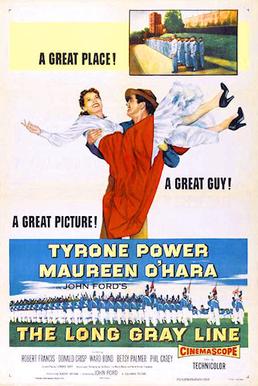
The Long Gray Line

Through all his films, a common, somewhat unexpected link bonds the movies of director John Ford.  It's not cowboys vs. Indians or John Wayne, Henry Fonda or Richard Widmark, but a sense of family and the importance of staying close to those you're related to. One of 11 children from an Irish family, Ford's beliefs filtered into his movies.  The stories, the settings, the characters, the famous John Ford stock company of supporting actors and actresses, Ford for all his aggression and belligerence was a family man.

When comparing his movies, it's easy to overlook his non-westerns.  When in front of a Congressional hearing, Ford even introduced himself saying "I'm John Ford, I make westerns."  But over a career that spanned decades and over 100 movies, it's unfair to just say he was a good director of westerns.  He was a good director for all his faults and tendencies that can drive me nuts at times.  Maybe the best example of a Ford movie -- non-western -- is 1955's The Long Gray Line, a departure from the expected Ford movie but still similar in many ways. 

An Irish immigrant fresh off the boat in New York, young Martin Maher (Tyrone Power) travels to the United States Military Academy at West Point in upstate New York. He enlists in the army and right away begins helping the cadets, some just as a mentor, others as an instructor in classes.  Marty can be a bit of a klutz, a bit of a doof at times, but when the chips are down, he's a good friend and a better man.  The years go by, and Marty continues to reenlist while also marrying Mary O'Donnell (Maureen O'Hara), a pretty redhead from Ireland. They send for Marty's family from Ireland (father Donald Crisp, brother Sean McClory) and life continues, the whole family together again.  And so the years go by, West Point unchanging as the world changes around it in the first half of the 20th Century.

When Ford gets it right, he typically hits a home run, and this qualifies in many ways.  One review described it as a "very Irish" movie.  And somehow that description is dead on more than just the main characters being Irish.  It's about family and sticking together through thick and thin.  More than that, it's the extended family you make in your life.  All those things that drive me up the wall are here, but whether he realized it or not, Ford reins it all in.  It never gets to be too much.  The story is downright sappy at  times, but I don't think Ford ever intended to do anything but that.  For the most part, it hits all the right notes, happy, sad and everything in between.

This was never an intentional slight, but this was the first Tyrone Power movie I'd ever seen from beginning to end.  I never had a negative idea of Power as an actor, but I guess it's fair to say it wasn't particularly positive either.  Above all else, Power's performance here as Sgt. Martin Maher is the reason to check this one out.  Marty is one of the most likable characters ever, willing to help whatever and whoever needs his help.  We see this over the years the impression he makes on his cadets who end up looking at him as a father figure, or at least a big brother looking out for their best interests.  Power gives Marty some funny bits, nails the emotional scenes, and handles an Irish accent that if handled poorly could have derailed the part.  A great performance to lead the movie.

Mentioned earlier, Ford's stock company of actors was a long list of actors/actresses the director worked with on repeated times.  If you've seen more than one Ford movie, you've no doubt seen these faces whether you knew it or not.  'Gray Line' is full of these folks, starting with O'Hara in a perfectly cast part as Marty's tough-minded wife Mary, an ideal match for the equally strong-willed and tough-minded Marty.  Crisp isn't in the movie for long but certainly makes quite an impression as Marty's old school Pops.  My favorite of the stock company has always been Ward Bond, and he doesn't disappoint as Major Keeler, Marty's commanding officer. Also look for Ford regulars Harry Carey Jr. and Patrick Wayne along with Robert Francis, Peter Graves, Philip Carey and William Leslie filling out some meatier supporting parts.

Only one complaint here, and I'll keep it brief.  A story that covers 50-plus years in 140 minutes can't help but feel a little episodic, a little disjointed.  Characters go in and out at will, no explanations offered, but the link through all the slower moving segments is Power as Martin Maher.  Throw the performances in with some great on-location shooting at West Point that help sell the tradition and honor of the academy, and you've got a winner if not quite a classic.

The Long Gray Line <---trailer (1955): ***/****

Friday, May 21, 2010

Cheyenne Autumn

A solid director early in his career, John Ford shot to stardom behind the camera thanks to success in one particular genre, the western.  Starting with Stagecoach in 1939 and continuing into the 1940s with his 'cavalry trilogy,' Ford became a go-to director westerns that he was able to put his own personal -- often romantic -- look at the American west in the latter half of the 19th century.  And in almost every one of these westerns, Native Americans were portrayed in a negative light, whether as a fearful presence or as murdering on-screen savages.

With his last western, 1964's Cheyenne Autumn, Ford did an about face in terms of the depiction with something that has since been dubbed 'white man's guilt.' Based on a true story, the movie attempts to put Native Americans in a positive light instead of the stereotypical savage so often associated with westerns.  It's a noble concept and feels like a bit of an apology on Ford's part, but too many things work against this movie from the start, ranging from the casting to the dull, slow-paced storyline.

It's 1878 and 300 members of a Cheyenne tribe on a reservation in the southwestern desert have had enough.  They don't receive supplies promised to them -- food, clothes, medicine -- and are basically being ignored by the U.S. government.  Led by two proud warriors (Ricardo Montalban and Gilbert Roland), the Cheyenne leave the reservation in the dead of night with hopes of marching almost 1,500 miles north to their ancestral hunting grounds in South Dakota and Montana.  Pursuing them is a cavalry outfit led by the sympathetic Capt. Archer (Richard Widmark) who tries his best to bring the Cheyenne in peacefully.  Nothing comes easy though and the terror sets in of 300 Cheyenne roaming the west in towns all along their trail.

To tell this story, Ford assembles a remarkable cast but as is so often the case with huge casts of big name stars, many are lost in the shuffle.  Along with those mentioned already, there's also Karl Malden, Edward G. Robinson, Dolores Del Rio, Carroll Baker, Jimmy Stewart, Arthur Kennedy, Sal Mineo, George O'Brien, and Sean McClory, along with several others I'll mention later.  Needless to say, that's a ton of talent involved, but the odd thing is almost NOTHING happens the entire movie.  It's downright dull at many points and never really gets the viewer invested in what's going on.

First off, the story does represent the Cheyennes in a positive light as a tribe just trying to survive now that their heyday has passed.  But then Ford spends a majority of the time with the white characters as the Cheyenne tribe disappears here and there for long stretches.  There's also the issue of casting Hispanic actors as Indians which just doesn't make much sense to me.  I figure there weren't many Native American actors working in Hollywood in the 1960s, but for a story trying to be authentic and fair, it would have been worthwhile to cast one or two.  Montalban and Roland represent themselves well as the warriors leading the tribe while Mineo says two or three words and enthusiastically takes his shirt off at one point.

One criticism of Ford over his career is his bawdy, broad humor that populates his movies, and Cheyenne Autumn doesn't disappoint.  About 90 minutes in, a 20-plus minute segment takes a complete detour from the story for some incredibly out of place humor in Dodge City with Stewart playing Wyatt Earp and Kennedy playing Doc Holliday.  Besides being incredibly miscast as the famous gunfighters, the tone of this extended segment is comical and over the top.  The tone to this point has been downbeat if not entirely interesting, and we get a segment here that is ripped right from any of the cavalry trilogy.  This comedic segment is so out of place that it can be difficult to watch in its badness.

What I enjoyed most about this movie were the scenes on the trail with the Indians or with the cavalry pursuing them.  Widmark makes the most of a part that just doesn't give him much to do, but Ford seems incredibly comfortable in the cavalry scenes.  Patrick Wayne (the Duke's son) plays Lt. Scott, a young officer out for blood, Mike Mazurki plays the veteran sergeant, and in a nod to Rio Grande and She Wore a Yellow Ribbon, Ben Johnson and Harry Carey Jr play troopers Plumtree and Smith. A running bit between the two has Archer consistently forgetting Carey's name.  Both parts were uncredited ones for the veteran character actors. Maybe because it feels like a throwback to better westerns, but the cavalry portions of the story are infinitely more watchable than much of the rest of the movie.

For all its flaws, 'Autumn' is still worth watching just to see that huge cast work together and as is typical with a Ford western, the Monument Valley scenery.  Through all the movies ever shot there, I don't know if its ever looked better serving as a backdrop for the story.  Overall though, this is an average movie from a great director like Ford.  It's too inconsistent to call a good western, but one that fans should still see.  A disappointing but intriguing last western from one of the genre's best.

Cheyenne Autumn <----trailer (1964) **/****