The Sons of Katie Elder

The Sons of Katie Elder
"First, we reunite, then find Ma and Pa's killer...then read some reviews."
Showing posts with label Shirley MacLaine. Show all posts

Friday, April 4, 2014

Gambit

I feel like I've probably seen too many heist movies. Why you ask? Because I'm pretty sure I could rob a bank or an armored car or an impenetrable art gallery and get away with it. That premise of course, is ridiculous. I would most likely get shot down immediately. But what have heist movies taught me? That no matter how much you plan, right down to the smallest detail, something, SOMETHING, will go wrong. From 1966, Gambit has a lot of fun with that simple genre premise.

An experienced thief who has managed to stay under the radar (those pesky police), Harry Dean (Michael Caine) has come up with a brilliantly unique plan that will net him quite the profit. He's going to rob the apartment of the supposed richest man in the world, Shahbandar (Herbert Lom), in Dammuz, a Middle Eastern city. His plan? He recruits Nicole Chang (Shirley MacLaine), a dance hall girl trapped in Hong Kong without money or passport. Nicole bears a striking resemblance to Shahbandar's wife who died some 20 years ago. Harry assumes that if the richest man in the world even sees Nicole, he'll be dumbstruck. So, soooo, while Shahbandar is distracted with Nicole -- posing as Harry's wife -- Harry intends to get into his heavily guarded, fortified with security apartment. He's got it all planned down to the miniscule details....and nothing seems like it can go as planned.

Not gonna lie, about 25 minutes into this comedy heist film from director Ronald Neame, I was ridiculously close to bailing. Why you ask? SPOILERS STOP READING FOR FIRST 30 MINUTE SPOILERS Well, the entire first half four of the story is a what-if. We don't know it at the time, but just the same, that's what it is. What we see is how Harry envisions his plan coming together. Every little thing comes together perfectly, no flubs or screw-ups, just a plan developing like a well-oiled machine. I did get a kick out of it that MacLaine's Nicole says absolutely NOTHING over the opener, Harry's plan ideally having her silent. I don't know why, but that premise cracked me up. Still, while it's clever, I also felt it was quite a gimmick, like a wasted half hour I wouldn't be getting back anytime soon. Thankfully in this case, I was wrong. Yes, it's a gimmick, but because of what came after it, that darn gimmick worked well.

Considering the stars involved, I was surprised I'd never heard of this heist comedy. It is funny, never going into Spoof or Stupid Territory, keeping the laughs low-key and pretty natural without too much forced. 'Gambit' is hard to peg, but it's enjoyable throughout its 109-minute running time. The biggest reason is the gimmick's payoff. The what-if first 25 minutes is dull because, well, everything goes well. What's the fun in seeing everything work out? It's all part of the set-up. We're then transported back to where Harry began, laying out his plan for the robbery. The last 90 minutes is excellent because we've already seen what Harry thinks (even expects) to happen. Seeing it go in almost the exact opposite way provides some great moments, the seemingly smooth Cockney thief unraveling with one miscue after another. MacLaine's Nicole -- now allowed to speak -- is sweet, charming and intelligent, correcting Harry ad nauseum. In those quiet, underplayed moments with genuine laughs, that's where 'Gambit' is at its absolute best.

All style choices aside, this flick's success rode on the shoulders of stars Shirley MacLaine and Michael Caine. An established star, MacLaine shows off her impeccable comedic timing with each passing scene. It's hard not to like her and more importantly, her character, Nicole, an Asian-American looking for an out of Hong Kong. It's odd to think of this, but this film was Caine's first American film after the British success of Zulu, The Ipcress File, Alfie and The Wrong Box. The part was an excellent introduction of sorts for American audiences, a smooth Brit who isn't so smooth under pressure. On their own, these are two really fun, entertaining characters, but together? There's a reason MacLaine and Caine are two of the best to ever grace the silver screen. Their chemistry is pitch-perfect, MacLaine's calm meets chipper demeanor vs. Caine's ultra-smooth, ultra-confident thief playing well off each other. Just sit back and watch two pros do their thing.

Beyond the star duo, the cast is pretty limited here. Lom rounds out the lead trio as Shahbandar, the target of Harry's brilliantly put together robbery. Not quite a villain, not quite a good guy, he's in between as he tries to figure out exactly what Harry and Nicole are up to. Who else to look for? Roger C. Carmel as Ram, the hotel attendant Harry is counting on, John Abbott as Emile, Harry's partner in crime, Arnold Moss as Abdul, Shahbandar's loyal assistant, and Richard Angarola as Salim, the police chief.

Lesson No. 2 from the Heist genre: There's always a twist. Does it always work? No. The ending here falls in between. It works, but it's not as smart as it probably thinks it is. The twist certainly does come out of left field and for the most part it all clicks together. Still, the fun is getting to the finale. If the bookends aren't the strongest aspects overall, so be it, because the middle portion is quite easy to recommend. Definitely worth checking out. Composer Maurice Jarre has some fun with his musical score, touching on a variety of different genres with his cues.

Gambit (1966): ***/****

Thursday, January 9, 2014

The Secret Life of Walter Mitty

What do you think of when you hear the name Ben Stiller? Most people -- including myself -- think of comedies, Zoolander to Tropic Thunder, Dodgeball to There's Something About Mary and plenty others in between. I've always been a fan, but Stiller is better to me when he underplays parts. Yeah, his over the top roles, like Dodgeball, are funny, but he's at his best with underplayed genre. Take 2013's The Secret Life of Walter Mitty, a great part for Stiller and a great part in general.

A negatives analyst working at Life Magazine, Walter Mitty (Stiller) is the best at what he does, working with all the pictures Life uses over his 16 years with the magazine. With the changing times in the media, magazines and technology, Life is in for a change too, the iconic magazine going to an online-only format. A longtime photographer who's held in international regard, Sean O'Connell (Sean Penn) has sent Life and Walter a roll of film with one picture, Frame 25, that's perfect for the cover of the last print edition. There's a problem though. That one frame is missing, and Walter's bosses want and need that picture. Where could it be? The mysterious Sean isn't exactly easy to track down. A middle-aged man who doesn't feel like he's accomplished a whole lot with his wife -- daydreaming and zoning out all the time -- Walter decides this is his chance. This is his opportunity to get out in the world and find that possibly historic single picture. Can he find it in time?

Sometimes critics really throw me off. 'Mitty' has across the board mixed reviews, Rotten Tomatoes totaling 49%, Metacritic a 55% . Heading into movies, I really try not to read reviews, wanting to go into each new movie with a clean slate. Well, let's say this. I really don't want to read those reviews now, having seen the recent release. Why? Because they're wrong. That's all. I didn't like this movie, even really like it. I loved it. I loved the story and the message and everything really. Thankfully, it seems audiences are ignoring the critics (oh, wait, I'm a critic...ah, my head hurts!) and going out and seeing the movie. As I write this review, it has earned over $100 million in theaters and possesses a 7.7 rating at IMDB. I have some general issues, a couple criticisms, but what's important is a moving, straightforward, encouraging and emotional message that hopefully will resonate with you as much as it did me.

What hit me a couple hours after watching 'Mitty' was that the message is reminiscent of a Frank Capra movie. This is a movie that wants to believe in the genuine goodness of mankind/humanity, and that the world is a great place. Most of the time, I think it is. There's just so much negative at times that it is hard to go along with. But Stiller's film -- he starred and directed, working off a screenplay by Steve Conrad -- wants to believe in the positive. It is a story about dreams, striving for your dreams, having faith in yourself and others, appreciating the big moments and the little moments, appreciating your family and all the people you meet in your day-to-day life, the impact you can have on all those people and vice versa. If it seems a little dated, a bit of a throwback film, so be it. I fell for it hook, line and sinker.

So four paragraphs into the review, I haven't delved into an important aspect of this movie. Walter daydreams....a lot. The style in which that is shown is seamless. We see Walter in a normal, everyday interaction and then he isn't as he rescues a dog from a burning building, imagines a what-if encounter in the future, sees someone that isn't there, an epic fight scene that tears apart New York City, popping out of a magazine cover. Then, as quick as we saw them, they're gone, Walter's daydreaming broken up momentarily. As a director, Stiller shows off his skill in these scenes, blending the real and the imagined without missing a beat. In general, the style is everywhere from the credits that play like scenery, the scene-to-scene transitions, the soundtrack (Indie rock songs and a solid score from composer Theodore Shapiro), the beautiful visuals, it all rolls into one very enjoyable, pretty perfect package.

Directing and starring in the same movie can be tricky, but Stiller nails it. As a director, I think he does a fine job at the helm of an ambitious film that strives to do a whole lot. I was even more impressed with his acting job here. This isn't over the top Ben Stiller, but human, very dramatic Ben Stiller who perfectly underplays his part as Walter Mitty. We learn why Walter is the way he is, kinda quiet, a hard worker, shy but a nice guy in general, someone who has more impact on others than he could possibly imagine. His backstory is interesting and explanatory, adding another layer to Walter's personality. I love what he becomes. He decides he wants to accomplish something, something big and crazy because he's done nothing of the sort his whole life because he couldn't. What he doesn't realize is that just because your life hasn't been big and crazy doesn't mean you haven't accomplished something. Everything about the character though, I loved Walter.

This is Walter's movie, but like Capra's It's a Wonderful Life, it's also about the people with Walter. Kristen Wiig similarly pulls a Stiller, showing off a dramatic side on top of her comedy chops as Cheryl, a co-worker at Life who he has a crush on, Marcus Antturi playing her son. Penn is a scene-stealer as Sean, a photographer who has no qualms about going anywhere to get the picture he needs, as is Shirley MacLaine as Walter's Mom who's getting older and struggling with some medical issues, Kathryn Hahn as Walter's kinda goofy but well-meaning sister. Adrian Martinez is Walter's co-worker in the negatives room and a close friend, Hernando, while Adam Scott is Mr. Potter...um, uh, Ted Hendricks, the new boss in charge of the Life transition, in general an a-hole who revels in being that boss everyone hates. Also worth mentioning is Patton Oswalt in a great comedic part as Todd, a customer service representative at E-Harmony working with Walter over the phone.      

Trying to limit this movie to one specific genre is tough. It's a fantasy, a comedy, a drama, all of the above and more. Globetrotting from NYC to Iceland to Greenland to Afghanistan and the Himalayas, it is a movie full of beautiful moments that kept on impressing me with each passing minute. I loved it all, especially the ending that had me worried we were about to see some stupid, out of left field twist. No worries there. It is a great ending for a great movie. Shooting myself in the foot here a bit, but it's a prime example of not taking a critics' rating as a hard and fast rule. I can't recommend this one enough.

The Secret Life of Walter Mitty (2013): ****/****

Saturday, April 13, 2013

Ocean's Eleven (1960)

One of my favorite movies from the 2000s, I love 2001's Ocean's Eleven. I'm no dummy though, and I remember stating that the 2001 remake was better than the original. Well, it took me a little while -- okay, well over a year, but who's counting? -- but I'm revisiting that statement. Was I right or wrong? Maybe somewhere in between? Let's get started with the Rat Pack original, 1960's Ocean's Eleven.

A former paratrooper with countless daring, behind the lines missions under his belt during World War II, Danny Ocean (Frank Sinatra) has moved on with his life, but some 15 years since the end of the war, he's got a plan. The catch? He needs help from his old army buddies to pull off a daring heist. Ocean gets the group together, including Sam Harmon (Dean Martin), Jimmy Foster (Peter Lawford), and Josh Howard (Sammy Davis Jr.) among others, and lays out the plan for them. Just a few days away, Ocean and Co. plan on hitting five of Las Vegas's biggest casinos on New Year's Eve when the vaults are packed to the gills with money. Could it work? The plan depends on to-the-second timing, teamwork and countless little details, maybe even a little luck. It sounds like an impossible plan, but Ocean's crew might be crazy enough to pull it off.

Starting in the mid 1950s, Sinatra, Martin, Davis Jr., Lawford and Joey Bishop teamed up to star in movies that are simply known as....Rat Pack movies. Classic cinema they are not, but they are basically the definition of a good popcorn flick. Just sit back and enjoy them. Of all the Rat Pack movies though, this one is the best by far. Lewis Milestone directs, but his job is basically to get Sinatra and the boys on the right track and let them go. In that sense, he hits it out of the park. It is a vastly different movie than the 2001 remake which is really a remake in name and basic premise alone. The script, the heist, and the Vegas setting are all a means to an end. If you like Sinatra, Martin or any of the Rat Pack, you will enjoy this movie.

Singing or performing on stage, starring in movies, the Rat Pack had an innate chemistry that most entertainers dream of having. So cutting away a lot of other things, this movie is about the Packers hanging out, drinking some liquor, smoking a lot of cigarettes and wearing impeccably cool suits. Is it self-indulgent? Yes, basically the definition of self-indulgent. If you're a fan of Sinatra, Martin or any of the guys, this is the movie for you. It's genuinely funny with plenty of quick, snappy dialogue, lots of one-liners that don't feel like a script. It feels like it is a bunch of friends hanging out busting each other. Oh, and they happen to be planning an epic casino robbery too so they've got that going for them.

One of the biggest differences between the 1960 original and the 2001 remake is the background. Made 15 years after the end of WWII, the paratroopers angle is pretty cool. Sinatra's Danny is the sergeant, Lawford the entitled officer, Martin's Sam the soldier who saved Danny's life and best friend, and so on. Along with Davis. Jr as Josh and Bishop as Mushy, Danny's crew includes Richard Conte as Tony, just out of prison and looking to provide for his son, Henry Silva as smooth, quick-talking Roger, Buddy Lester as Vince, the former club bouncer with an in, Richard Benedict as Curly, Norman Fell as Peter, the explosives specialist, and Clem Harvey as Jackson, the drawling cowboy. Like the best men-on-a-mission movies, there's something inherently cool about a group of specialists working together to pull of an impossible job. When you actually like some of the group? That's even better, like a fastball down the middle.

Not surprisingly, the focus here is on Danny's crew, but the rest of the cast is pretty solid. Angie Dickinson plays Beatrice, Danny's wife who's working through some issues with her always moving husband. Cesar Romero is Duke Santos, a well-connected former gangster who stumbles into Ocean's plan and who happens to be engaged to Jimmy's mother (Ilka Chase). Akim Tamiroff gets a lot of laughs as Spyros, the ex-con who concocted the casino heist but can't come up with the details, turning to Danny for that part. Also look for Red Skelton playing himself in a casino scene, frustrated and wanting more money, and George Raft as a casino head in a strategy session. Even look for an uncredited Shirley MacLaine as a drunken New Year's Eve partygoer who meets Martin's Sam during the heist. And lastly, listen for Richard Boone providing his voice talents in a key scene late, even if he never appears on-screen.

I loved the style from this 1960 heist movie, and that doesn't come as a surprise considering the talent involved. The credits sequence from Saul Bass gets things going nicely. Watch it HERE, composer Nelson Riddle's score playing as accompaniment. Much of the film was shot on location in Las Vegas, and who would have thought? 1960 Vegas looks amazingly fun, like a time capsule into a smooth, cool era. Even the indoor sets look cheesy, but they're cool cheesy. The heist itself is pretty cool if a little more simplistic than the 2001 remake (Damn technology!). As most heist films will tell you though, it's the post-robbery stuff that's the issue. It's Vegas in the middle of the desert. How do you escape or hide the money? The ending delivers a couple great twists, especially the final one that sets up a very cool, very stylish final scene as Ocean's Eleven walk along the Vegas strip.

There is a simple, stylish elegance to this movie. Is it a classic film, an example of great cinema? No, but in terms of pure entertainment value, it's hard to beat. The scene where the crew discuss the upcoming heist in Spyros' well-decorated man cave is epically cool, Ocean's Eleven huddled around the pool table discussing the ins and outs of the heist. It's a fun, cool and entertaining movie that's a prime example of the style of a past era in Hollywood. The Rat Pack is cool. If you agree, you'll like this movie.

Ocean's Eleven (1960): ****/****         

Saturday, April 6, 2013

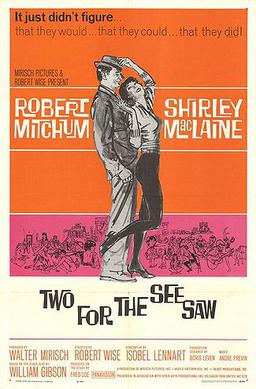
Two for the Seesaw

In January 1958, Two for the Seesaw starring Henry Fonda and Anne Bancroft debuted on Broadway and was quite the success. It ran for 750 performances and even was nominated for the 1958 Tony Award for Best Play. Successful stage plays often make the jump to film, and four years later the highly successful Broadway play made that jump with 1962's Two for the Seesaw.

Several months removed from the separation from his wife of 12-plus years, Omaha lawyer Jerry Ryan (Robert Mitchum) has packed up his belongings and with just limited cash has moved to New York City. He's been in NYC, wasting away, saving what little money he has and living day-to-day, often wondering if it's worth going on. One night at a party, he meets Gittel Moscawitz (Shirley MacLaine), a 29-year old young woman living in Greenwich Village. He can't quite put his finger on it, but Jerry is drawn to the quirky New Yorker with an honesty and forthrightness he's never seen before. They bond quickly, finding a common ground through their own past relationships and inner demons, and soon enough they're in an exclusive relationship. Jerry tries to start up his law career again, and Gittel works to open a dance studio, but their past demons threaten to tear the relationship apart before it can even get started.

There's quite a list of worthy stage plays that have made the jump from play to film, ranging from 12 Angry Men to Annie, West Side Story to The Sound of Music, Oliver! to Chicago, and many more. I've never written a thing about stage plays, Broadway, anything, so I can only imagine how difficult the transition is from stage to film, but director Robert Wise pulls it off nicely here. Maybe the biggest key is the choice to film in black and white. This will sound obvious -- maybe even odd/dumb -- but you lose the color, but there's an added depth to the visual. It doesn't hurt either than now in 2013, there's a distinct nostalgic, retro feel as you watch the film. For the most part, 'Seesaw' is limited to just two small sets; Jerry's rinky-dink, poorly furnished apartment, and Gittel's cramped little Greenwich Village studio.

It works in a simple way. The camera is always right there on the floor in these cramped little apartments with Jerry and Gittel. One technique I found particularly effective was the couple talking on the phone from each other's apartment. Wise shoots the apartments as if they were right next to each other, a dark, shadowed wall separating them. They're miles away, but in the visual sense, it's just a few feet. Much like a stage play, his scenes are dialogue heavy and are in no rush to get anywhere. They develop at a natural pace, just two people talking to each other. Some go on too long (more on that later), but it stays true to its stage roots, and that's a bonus. Another obvious plus is Wise shooting on-location in NYC. I knew about two seconds into the movie I was going to like it. The opening shot has Mitchum's Jerry standing on the Manhattan Bridge, and it's a beauty. Over the opening credits, Jerry walks through various parts of NYC, and because it's the best description I can come up with....it looks so ridiculously cool. Big, wide open shots of 1962 NYC is a sight to behold. Watch it HERE at Youtube.

Once again sticking to the stage roots, the cast is primarily just Mitchum and MacLaine. Yes, other supporting parts are around for a scene or two, but the two stars are literally in every single scene, whether it be together or on the phone. There's only a few where they're even separate from each other. Kinda a daunting premise for an actor, huh? Both actors are up to the challenge. Some critics complain that Mitchum is too old for the part, and too old for MacLaine (17 years younger at the time), but I don't get it. I think they're perfect for each other, and they show a chemistry that carries the movie. For all his tough guy antics, Mitchum had great chemistry with many of his on-screen co-stars from Jane Russell to Deborah Kerr and many more. A whole lot of other, deeper and far more specific things could be stated, but it comes down to this. I liked the two performances a lot, and that can fix a lot of issues in a film.

Now that said, there are issues. At 119 minutes, 'Seesaw' is long and lags in the final 30 minutes. That's never good when things are coming together and wrapping up toward the finale. Not just on an emotional level, but the last half hour is painfully slow to watch. The ending gets points for not going for an easy, happy ending, but getting there is a trial. Getting up to that point, it works. We watch a developing relationship with all its flaws and imperfections in both individuals, both wanting things to work out while working through their own issues. I really struggled through the ending, but I very much liked the build-up. A mixed bag, but Mitchum and MacLaine are two Hollywood legends for a reason. Definitely give it a try. Oh, and this isn't the romantic comedy the above poster would have you think it is. Just an FYI.

Two for the Seesaw (1962): ***/****

Monday, September 17, 2012

Around the World in 80 Days (1956)

There are epics, and then there are EPICS. In the age of such immense, gigantically-scaled films of the 1950s and 1960s, studios pulled out all the stops in hopes of impressing moviegoers. Huge all-star casts with thousands of extras, lavish sets and costumes, and in general, a sight to behold on the big screen. Some movies were just made for a viewing that only a full-size movie theater can offer, like 1956's Around the World in 80 Days.

It is the 1870s and new technological advances have made travel to far-off places not only possible but quicker, more efficient, and more entertaining. A prim and proper Englishman, Phileas Fogg (David Niven), even boasts to his fellow members of the Reform Club that he can travel completely travel around the world in just 80 days. The club members laugh at the thought, but Fogg maintains his stance and a bet is born. With a significant amount of money on the line, Fogg and his assistant/valet, Passepartout (Mexican actor Cantinflas), embark on a journey around the world against the clock with no idea of what will be actually thrown their way during their adventurous travels.

If you were trying to define what an old-school Hollywood epic is to someone who didn't know, this would be a great start. Filming in locations around the world from Japan, the U.S., Thailand, Spain, England, France, Pakistan and China, '80 Days' is a true visual stunner. The screen is filled with incredible locations packed to the gills with the cast and then hundreds and thousands of extras behind them. Director Michael Anderson filmed with a Todd-AO technique, an ultra-widescreen filming process that makes certain shots look like epically wide panoramic shots. I was impressed watching the film on my 32-inch TV. I can only imagine what this film would look like on a movie screen. As well, composer Victor Young's score (which won an Oscar) is light-hearted and fun, keeping the travels moving.

It is hard to criticize this movie on its technical levels. It is far easier to criticize the movie for basically everything else. Oh, didn't see that twist coming, did you? All that epic quality comes at the expense of character, story and any sort of development involving either of those. This is a movie you appreciate, just sit back and enjoy it. The widescreen filming process is a sight to behold, but they become tedious by the 11th or 12th such long shot of a mountain vista, train running down a track, Cantinflas fighting a bull. Yes, I get it. On visuals alone, this is a stunningly beautiful movie. But at almost three-hours long, it feels like nothing more than an extended world travel guide. There never is even the slightest sense of urgency to the 80 day deadline until the final 10 minutes. Instead we get the visual, Niven's Fogg paying someone to right a wrong, then another nature shot.

I'll go into more depth about the supporting cast of thousands in a bit, but let's start with the lead performances. David Niven is one of my favorite actors, but I came away disappointed here. His Fogg is the definition of a prim and proper Englishman. He's even asked 'Why must you be so British?' at one point. At no point though does he actually look interested in bringing the part to life. To me, Niven look bored, and that's tough to say as a fan. Famed Mexican actor Cantinflas sure takes some grief for his part as Passepartout, but I thought he did a fine job with his limited grasp of English. His bit with Red Skelton is a highlight, the duo shoveling food into the others mouth in a very funny routine. Other bigger parts include Shirley MacLaine oddly cast as an Indian princess traveling with Fogg and Passepartout, and Robert Newton as Mr. Fix, a bank investigator trailing Fogg who's convinced the Englishman is an infamous bank robber.

Then there's the cameos, a long list that must put even The Greatest Story Ever Told to shame. Take a deep breath, and here goes. Look out for Finlay Currie, Robert Morley, Noel Coward, Trevor Howard, John Gielgud, Charles Boyer, Gilbert Roland, Cesar Romero, Cedric Hardwicke, Peter Lorre, George Raft, Marlene Dietrich, Frank Sinatra, John Carradine, Buster Keaton, Joe E. Brown, Andy Devine, Victor McLaglen, John Mills and Glynis Johns among others. I include those names because I recognized them in the cast, not because I necessarily saw them in the actual film. They are the 'blink and you'll miss them' type of cameos to the point many don't even register. Sinatra is shown over his shoulder three times and then turns and smiles. Mind you, he doesn't even say anything. He SMILES. That's it. Yes, it's fun seeing all these actors/actresses together but give them something to do.

This is a tough one to review in the end. It's too long, downright dull at times, a visual treat to watch, and a movie experience unlike any other. It's flaws though are crippling. '80 Days' may be three-hour longs but because of its schizo, hyper kinetic energy that bounces all over the place, it feels significantly longer and has not aged well over the years. A movie to be appreciated for its positives for what it does amount to, even if I won't be watching it again anytime soon. Okay, maybe in a movie theater.

Around the World in 80 Days <---trailer (1956): ** 1/2/****         

Monday, November 14, 2011

Irma La Douce

Tweaking my intro to Bell Book and Candle, here goes for another pairing. After starring in the highly successful The Apartment, it took Jack Lemmon and Shirley MacLaine three years to star in another movie together, the odd screwball dramedy (drama-comedy) from 1963 Irma La Douce.

Rewarded a new beat for an act of bravery, naive Parisian cop Nestor Patou (Lemmon) goes on patrol, finding a street full of prostitutes looking for customers. He's unaware the girls, their pimps, and a hotel owner have to "look around" the obvious illegalities of the situation, and arrests them all. Among the girls is an affable, pretty hooker named Irma La Douce (MacLaine) who Nestor likes right away. Unfortunately, he gets fired for his actions and finds himself on the streets where he eventually meets, fights, and defeats Irma's "handler" (read: Pimp). Now, Nestor finds himself as Irma's handler. The only problem? He fell for her, and he fell for her hard. She refuses to leave the business so how can Nestor stop the woman he loves from sleeping with other men for money?

Anything strike you as particularly odd about the plot? Yeah, the story about prostitutes played for laughs. Director Billy Wilder pushed the boundaries throughout his career, but this one just didn't work for me in the least. There is just something skeevy with a story about a cop turned pimp trying to get the woman he loves to stop being a hooker with a crazy scheme, and by the way, it is a 1960s screwball comedy. Either ahead of its time by 10 years or so or just lost in the ether somewhere, 'Irma' is an oddity. There are moments of drama, comedy and sex jokes, but none of them work too well. It runs 147 minutes, and it feels it, every minute. Too long, not funny and/or serious enough, and proof that prostitution is not a good basis for a screwball comedy.

Filling out the elements of the screwball aspect is a "clever" scheme developed by Lemmon's Nestor that Lucy and Ethel would have been envious of in an episode of I Love Lucy. He doesn't want Irma sleeping with men for money so he poses as Lord X, an aging and very rich British man who pays Irma for her time and nothing else. He pays so much she doesn't need to "do business" elsewhere. It seems like a perfect plan, and it could be one of the dumbest gimmicks/schemes I've ever seen. Lemmon overplays his scenes as Lord X, the prim and proper stiff upper lip Englishman, and are we really supposed to believe Irma -- seemingly pretty intelligent -- doesn't see through the disguise? The story requires Irma not to notice so that's all the explanation needed I suppose.

During filming, MacLaine was apparently less than pleased with the script -- I don't blame her -- but her performance is nonetheless the best thing going for the movie. She was nominated for Best Actress for her titular part, eventually losing to Patricia Neal for her part in Hud. Playing Irma, MacLaine makes the character a hooker with a heart of gold, albeit with a weird sense of personal pride and ideals. Her introduction that is played over the opening credits is truly funny (watch it HERE), seeing her hustle her customers. As was the case with The Apartment, her chemistry with Lemmon is dead-on which makes it all harder to go along with. Comedy? Drama? Neither? Both? I wish Wilder would have chosen one route and stuck with it. It is surprising to see how much Wilder gets away with showing for a 1964 movie, MacLaine doing a handful of nude (<---discreetly covered in the right places) or partially nude scenes.

One other supporting part really impressed me, that of Lou Jacobi as Moustache, the owner of a bar where the pimps hang out while their girls bring in the cash. He apparently has had 20 or 30 previous lives with all the professions he claim to have done and all the knowledge he has floating around in his head. Standing behind his bar, Jacobi's Moustache dispenses wisdom and advice to anyone who will listen and some who won't. Not quite the straight man, he delivers his lines flawlessly, just that right blend of confidence and cocky, confused and helpful. Also look for James Caan in a wordless appearance as a soldier looking for a good time, his first part in a movie.

I was hoping the movie would end quickly when ta-da, the ending came along! Except it didn't make any sense, delivering a "twist" that defies logic. Wilder was famous for his off-the-wall endings that come out of left field, but this one was almost stupid in its surprise. A disappointing end to a movie that I never really got into despite Shirley MacLaine's Oscar-nominated performance. The link above is the first of 11 parts if you want to watch the whole thing.

Irma La Douce <---TCM trailer/clips (1964): **/****

Friday, November 4, 2011

The Apartment

Versatility counts when it comes to directing. Some directors get pigeon-holed into one genre, for good or bad, like John Ford with the western. It doesn't have to be a bad thing, the director's equivalent of being typecast as an actor would be. One director who is nearly impossible to typecast was Billy Wilder, a master of comedy, film noir, drama, war stories, epics. It didn't matter. He did them all and did them all well. One that I liked but didn't love is 1960s's The Apartment. Am I missing something?

Working for an enormous insurance firm in New York City, Bud 'C.C.' Baxter (Jack Lemmon) is one of thousands of nameless employees who goes about their daily work and takes some pride in it. Baxter however would like nothing more than getting a promotion, getting bumped upstairs to an office with windows. His plan for going about it? He makes a positive impression with four different insurance supervisors by letting them use his apartment with their mistresses. It is obviously a tax and burden on Baxter's somewhat lonely bachelor life, but it takes a turn when the big boss, Shelldrake (Fred MacMurray), finds out about the operation and requests the apartment for himself. With no real out, Baxter agrees, only to find out that Shelldrake is using the apartment with Fran Kubelik (Shirley MacLaine), an elevator girl at the office he's long had a crush on. 

This is a classic film that I've always been told I would like. There's just too much talent involved for me not to like it. It was nominated for 10 Academy Awards and won five of them (Best Picture, Director for Wilder, screenplay among them) with Lemmon and MacLaine also receiving nominations. So looking back on it, I can't help but feel I missed something. It is a good story, very professionally done, and in 1960 I'm sure it was ahead of its time in terms of subject matter; marital infidelity on an epic level (the male gender takes a beating here), a bachelor pretending to hook up with a different girl every night, attempted suicide. Something didn't click for me, and I'm struggling to put my finger on it.

What I can explain is my issue between comedy and drama, two genres that can work together when handled correctly. Sometimes the two go hand in hand, drama coming out of a comedic situation or vice versa. For a darker story though -- with all the above mentioned topical issues -- it is handled with too much comedy. Lemmon is one of my favorite actors, but some of his mannerisms and physicality doesn't work. An effort to lighten the proceedings some? Maybe. The premise is there and interesting; a beaten-down, lonely, even depressed middle-aged man loaning his apartment to his bosses for flings with their mistresses. Either make it a madcap, ridiculous comedy or a dark as night drama. I lean toward the drama working better overall because 'Apartment' is at its best in the heavier, dramatic moments.

None of this is intended as a disclaimer or anything of the sort that the movie isn't good. It's just not as good as I had been told. There is too much talent for it not to be enjoyable on some level. Lemmon's Baxter is a pushover of epic proportions -- a little too much at times -- but the veteran actor delivers a great performance, earning him the third of eight Oscar nominations he would receive. He's Joe Everyman, a regular guy who wants success at work and a family at home. His chemistry with MacLaine is what makes this movie special. I like MacLaine more and more with each movie I see her in, and this is her best to date. They would work together again two years later in Wilder's Irma La Douce. As for MacMurray, it's hard to see the Disney star of The Absent Minded Professor and the father in TV's My Three Sons as a cheating husband and all around scumbag, but give the man credit. He's good at what he does.

There is a style from this 1960 that's hard to duplicate nowadays. So many 1960s comedies have that feature, a time capsule of an era long since past that is so much fun to watch. New York City is an ideal setting for a story like this, a personal level with three people looking for some sort of happiness. Baxter's apartment is a cool, little place, an additional character. The supporting parts are strong too, especially Jack Kruschen as Dr. Dreyfuss, Baxter's suspicious neighbor (earned him a Best Supporting Actor nod), and Ray Walston, Willard Waterman, David White and David Lewis are appropriately creepy and/or sceevy as Baxter's supervisors.  

I liked the movie but not as much as I thought I would. Performances from Lemmon and MacLaine make it worth recommending.

The Apartment <---TCM trailer/clips (1960): ** 1/2 /****

Thursday, August 25, 2011

The Sheepman

Watching and reading enough about the taming of the west in the second half of the 19th Century, you notice certain rivalries popping up...if rivalries is the right word.  There was cowboys vs. Indians (not aliens), outlaws and bandits against marshals, sheriffs and law enforcement, American vs. Mexican (among any number of other nationalities who didn't care for each other), and because it wasn't just beef being shipped around the country, cattle vs. sheep.

Cattle grazed on the land while sheep basically picked the land clean, ripping the grass out by the roots so it didn't grow back.  Didn't think you were going to get that sort of introduction to a western now, did you?  That's the basic problem in many cattle vs. sheep westerns, including the 1958 oater The Sheepman. I'd seen this movie a few years ago but watched it recently on Turner Classic Movies when I thought I had not seen it. I watch a fair share of westerns so they start running together at a certain point...my bad.  A good, entertaining and relatively harmless western, typical of so many 1950s westerns.

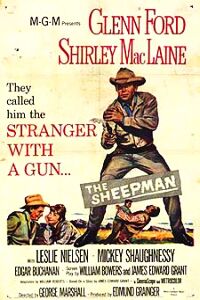
In the western town of Powder Valley where the cattle dominates the land, a stranger, Jason Sweet (Glenn Ford), arrives one day on the train. He quickly makes his presence felt, buying a saddle, buying drinks, picking a fight with the town tough guy. What's he up to? Jason is making sure everyone knows he's not a man to be tangled with because the next day his herd of sheep are inbound on the train.  The cattle owners want nothing to do with Jason's herd, and they don't intend to go along quietly.  The big man in the area who controls everything, Colonel Bedford (Leslie Nielsen) -- who Jason knows from his opposite side of the law past -- leads the charge to stop him, but the situation gets murky when Jason meets Dell Payton (Shirley MacLaine), Bedford's fiance. Now it is more than just a cattle and sheep situation, and the solution doesn't seem like an easy one.

This is a western that is pretty typical of a 1950s genre entry.  Director George Marshall handles his straightforward, no frills story with his typical professionalism.  The movie is only 87 minutes long so there is not much in the way of wasted time here.  The story knows where it wants to get, especially that first half hour as Jason "introduces" himself around Powder Valley. That's the aspect of the comedic western that works best, an easy going, fun introduction.  From there on in, things settle in with the good guys taking on the bad guys. Until late in the movie, the bad guys -- Nielsen included -- aren't even that bad.  Finally Ford's Jason is pushed too far though, and he has to respond.

Realizing I've probably written this with all my Glenn Ford movie reviews, I think Ford is one of the most under-appreciated western stars that came out of the 1950s and 1960s.  He doesn't have the name recognition that a John Wayne would, mostly because his westerns aren't considered classics.  Ford probably belongs with Randolph Scott for his star caliber, solid, quality westerns that don't often wow you, but are always entertaining.  As sheep herder Jason Sweet, he brings his typical western persona to the part.  Ford was always very natural on-screen, showing off an ease that could give the impression he wasn't acting at all.  He is likable though from the start, and you're rooting for him.  Pointless bit of movie trivia, Ford wore the same hat in all his westerns.  Not the same hat style, the actual hat. It still looks relatively clean here.

Playing the part of the female love interest, Shirley MacLaine makes the most of her appearance.  So often this character -- the center of a pointless, needless, and unnecessary love triangle -- is forced into the story for the sake of having the character around. Not much is done to actually develop MacLaine's Dell character, but if nothing else she's trying, and that's all you're looking for at times. Anyone with an IQ over 10 or so knows from the second she is introduced she'll end up with Ford's Jason, but they've got to keep us guessing a little, right?  MacLaine isn't the damsel in distress thankfully, just a frontier woman caught in a bad situation. Her chemistry with Ford in their scenes together is easily seen, and their dialogue/conversations have an easy flow to them throughout.

Because there isn't a ton else to analyze about this one, we get more cast analysis and criticism! Yeah for people!  Before he became most well-known for The Naked Gun movies, Nielsen was a dramatic actor capable of drama, comedy, and action.  He's not the baddest of bad guys until late in the movie, but he has some good back and forths with Ford.  The rest of the cast includes some very recognizable western faces including Mickey Shaughnessy as one of Nielsen's henchmen, Edgar Buchanan as the wily, shifty stable owner who knows everything and everyone, Willis Bouchey as Dell's father, Pernell Roberts as Choctaw Neil, a gunslinger and adversary of Jason's, Slim Pickens as the town marshal who goes fishing when trouble arises, and Pedro Gonzalez Gonzalez as Angelo, one of Jason's sheepherders.

Not a great western, but certainly not a bad western. Just sort of in between, a western you can watch every couple years without getting bored or worn down.

The Sheepman <---trailer (1958): ** 1/2 /****