Not often remembered as one of Hollywood's great on-screen couples -- I'm totally stealing Turner Classic Movie's Ben Mankiewicz's introduction! -- Fred MacMurray and Barbara Stanwyck worked together four times during their illustrious characters. Double Indemnity is a classic, and I loved the Christmas-themed Remember the Night. Let's add a third to the list with today's review, 1953's The Moonlighter.
Wasting away in a jail in a small western town, an outlaw, Wes Anderson (MacMurray), has been captured for cattle rustling and is awaiting trial. Outside the jail though, some restless cowboys don't want to wait for that trial though, and through a case of mistaken identity, the wrong man is lynched, leaving Wes to escape with his life. He's torn up inside because a relatively innocent man (a hobo) died for absolutely no reason and struggles with how to handle the guilt. The only thing Wes knows is the outlaw life, whether it be rustling or bank robbing, and that's right where he reverts back to with no other options available to him. As Wes puts together a plan to rob a bank -- with some help from an old partner and his down-on-his-luck brother -- he finds out that a woman from his past, Rela (Stanwyck), is on his trail and looking for some answers.
I love westerns. I thought I'd like this generally forgotten, low-budget(ish) entry to the genre from director Roy Rowland. I was wrong. It's just not very good with too many negatives that cancel out some of its elements with some potential to offer. Good cast? Check. Story with rapid changes in tone? Double check. As soon as there's something to sit back and enjoy/appreciate, there's something equally frustrating that cancels it out.
That starts with the Wes character, MacMurray getting a rare chance at a villainous character. Sounds good, right? Can't go wrong with a star often associated with Father Knows Best and several Disney movies as a cattle-rustling outlaw...until you can. The script is rough. It starts off promising as we meet a grizzled Wes who hasn't shaved in days and is patiently sitting in a jail cell. When everything goes to hell with a lynching of mistaken identity (new band name?), so does the character. Wes' guilt is too much, and he takes it out on the lynching party. It's played like we should feel for him as he's wracked with guilt over what happened, but yeah, I'm not seeing it. His "revenge" is pretty weak too, roping some of the lynchers and then dragging them for awhile. He ropes Jack Elam (because Jack Elam was a villain in EVERY 1950 western) and we're not necessarily sure how much he does so there's that, but come on, if he's full of angst and vengeance, do it right. Make him pissed off and vengeful!
Further removing any edge off the character is the reliance on the love story. MacMurray and Stanwyck had unquestioned chemistry, but again, there's little reason to feel sympathetic for their stories. A tortured love from the past is typically a western-killer, especially when Stanwyck's Rela admits that "her love was too demanding, too strong" and that her demands drove...Wes...to...crime. Ugh, gag me. That's weak. And true love if you ask me! There's also a wasted subplot that doesn't live up to its potential with Wes' younger brother, Tom (William Ching), now engaged to Rela but struggling with where he's at in life. Never quite lives up to its dark potential, including the final act after a genuinely good -- if somewhat telegraphed -- 'twist.' Meh, why go with interesting when you can go with never-ending love full of passionate hugs and adults rubbing cheeks with their love?!?
Also look for Ward Bond as Cole Gardner, Wes' old partner, another rare opportunity for an actor who typically played good guys to get a bad guy role. Along with Elam, look for familiar faces John Dierkes and Morris Ankrum in small parts.
Just a western that tries too much. It's 75-minutes long and tries to tackle way too much. It even has an intermission! It starts off very strong but derails following the lynching scene, including a bizarre flashback as Wes starts to exact his revenge on the lynching party and the town. The scene develops with an intense tone of doom but ends up playing like a spoof. 'Moonlighter' is unfortunately never truly able to recover. It isn't awful -- there's simply too much talent on display -- but it sure ain't good either. Worth it as more of a western novelty than anything, especially with MacMurray, Stanwyck and Bond leading the way.
The Moonlighter (1953): **/****
The Sons of Katie Elder

"First, we reunite, then find Ma and Pa's killer...then read some reviews."
Showing posts with label Fred MacMurray. Show all posts
Showing posts with label Fred MacMurray. Show all posts
Sunday, February 21, 2016

Wednesday, March 11, 2015
The Swarm
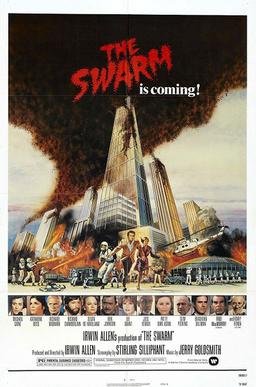
At an isolated army installation in the American Southwest, a heavily armed patrol slowly navigates the eerily empty facility. What the hell happened here? Deep underground at the installation, the investigating patrol finds several dead bodies and a few lucky survivors, including a mysterious doctor, Brad Crane (Michael Caine), who says he's an expert on the world of insects. A much larger army force, commanded by crotchety General Slater (Richard Widmark), arrives soon after, and they're too stunned at what they find and what Crane claims is behind the mysterious attack. The responsibility goes to....an immense swarm of African killer bees. Bees!!!! Making the situation worse, there's no cure for the bees' surprisingly venomous sting and seemingly no one is immune. It looks like nothing can stop the not-so-fast moving bees, and they're heading for Houston.
Sometimes you DO just know. When this 1978 disaster flick from director Irwin Allen -- Master of Disaster flicks -- popped up on Turner Classic Movies' schedule, I had to set it to record. I HAD to. Movies with casts like this don't pop up too often so I had to at least give it a try. Worst case, it's just entertaining in a bad, guilty pleasure fashion, right? Well, that's what you would think. This wasn't even good in a 'So bad it's good' way. It just isn't entertaining. Apparently, I'm not the only one who thinks so. 'Swarm' is on all sorts of worst movies ever made lists and bombed in epic fashion in theaters back in 1978. If that's not a recipe for success, I don't know what is!
Maybe the most frightening thing to take away from this bee-disaster flick is that there's a director's cut available out there clocking in at 156 minutes. The TCM version I saw was an already painfully long 116 minutes. God knows what else could be expanded on in an additional 40 minutes because I was losing interest in the shortened version at the 60-minute mark. For goodness sake, 'Swarm' utilizes a love triangle featuring Olivia de Havilland, Ben Johnson and Fred MacMurray (in his last role) as a subplot! Yes, because that's what we need, three Hollywood legends in a senior citizen love triangle in a disaster flick where a swarm of killer bees are the villains. Seems reasonable, don't it? I can't say I'd be too interested in seeking out that longer version of a dud like this.
Star Michael Caine has said this is the worst movie he ever made, and it's hard to disagree. As the insect/bug specialist, Caine looks to be immensely bored throughout. If there's a slightly redeeming quality in 'Swarm,' it's that the cast is epically impressive. Now are any of them given much of anything to do? That would be a big N-O, but still, look at all those Hollywood stars! Along with Caine and perpetually angry Widmark, look for Katharine Ross, Henry Fonda and Richard Chamberlain as some of the scientists tasked with halting the advance of the bees. Also look for Lee Grant, Jose Ferrer, Patty Duke, Bradford Dillman, Slim Pickens, and Cameron Mitchell in other supporting parts, some more painfully forced than others.
Things unfortunately develop in more spoof-fashion than straight disaster flick. How many slow motion bee attack scenes can we witness before it just becomes laughable? Because the movie is about bees, we get one hilarious scene after another about our very talented cast discussing what the bees' intentions are, if they're seeking revenge, if there is a major bee plan to take over the world. It's all done so straight that it becomes spoof-like, and that's never a good thing. The problem is there just isn't that one reason to sit back and watch this one, and that's considering the star power on hand. The cast is given little to nothing to do, the killer bees are a laughable "villain," and the entertainment value just isn't there. Give this one a wide berth.
The Swarm (1978): */****
Sunday, July 7, 2013
Double Indemnity

An experienced and successful insurance salesman with 11 years under his belt, Walter Neff (Fred MacMurray) is very good at what he does, able to sell policies to people who didn't even want insurance. On one house visit where he's looking to re-up on an auto policy, Walter meets Phyllis Dietrichson (Barbara Stanwyck), a young woman who's married but it's far from a happy marriage. He is magnetically drawn to her and can't stop thinking about her. Getting to know her better, Walter finds out about Phyllis and her background with her husband (Tom Powers). Moral of the story? Phyllis wants out, and Walter is going to help. He intends to get her husband to unknowingly sign a life insurance policy and then kill him. A longtime salesman, he's got a perfect plan to pull it off and have him and Phyllis split the $100,000 payout. Could it actually work?
One of the great films from Hollywood's Golden Era (and Hollywood history in general), 'Indemnity' is one of those movies I just never sought out even though I knew its reputation. It was worth the wait. Watching it on a first viewing, it seems familiar -- if in a good way. Why? Because hundreds of movies have tried to duplicate its success in the 60-plus years since its release. The duped male anti-hero, the brutal femme fatale, the characters in general who are interested in me-first, everyone else....well, never. The entire genre in general was ahead of its time, but this was one of the first examples, and it definitely deserves its classic status.
Based off a 'ripped from the headlines' story, the script from director Wilder and another halfway decent writer, Raymond Chandler, is like much of the movie, far ahead of its time. In its incredible darkness, honest depiction of just how nasty people can be with money on the line, it feels like a movie that would have been right at home in the equally dark/sinister late 1960s and 1970s. The script lays it all out there, setting it up and letting Walter's predicament get the best of...well, everyone. The dialogue seems a little stilted at times, but it's sharp and quick and well-written for the most part (obviously delivered pretty well too).
The cast doesn't call for too many key roles, but on a bigger level, it doesn't need more characters. MacMurray and Stanwyck are perfectly cast, playing off each other so well. In past reviews, I've mentioned my troubles with watching MacMurray in darker roles because I'm used to him as the star of My 3 Sons or any number of Disney movies, but there's a sinister charm that works nicely here. Stanwyck is the equally sinister femme fatale, like a snake waiting to strike. A match made in movie heaven (eh, maybe hell. We know this won't end well). In a scene-stealing part, Edward G. Robinson is Keyes, the inspector at the insurance company tasked with seeking out payouts that aren't on the level. Robinson expressed some concern at the time that he was taking a supporting part, but he needn't have been worried.
The development of Walter's plan is what sets this movie apart from the rest. Wilder and Chandler's script develops flawlessly, the tension building and building with each passing scene. The actual execution of the plan (oh, watch out, murder!) is tough to watch. We're clearly not rooting for them to succeed and murder someone, but at the same time, it's almost unbearable to watch because at the same time, you don't want them to get caught. It's the fallout afterward that is even tougher to watch. Wilder uses another ahead of its time technique, revealing in the opening scene courtesy of Neff that the plan will not succeed. That could be a dealbreaker for a lesser movie. We basically know the ending a minute into the movie, but it adds an interesting layer to the film. Okay, it's not going to work. How then is it going to crumble?
A classic movie from Hollywood's Golden Era for a reason. This would start Wilder on a ridiculously successful path that would help elevate him to one of Hollywood's all-time great directors. The style, the characters, the dark story and script, the score from composer Miklos Rozsa, it all works well, like puzzle pieces fitting together. Any movie that has influenced so many other films in the years following its release is/was clearly doing something right. Too bad I took so long catching up with it, but it is the rare film that was worth the wait.
Double Indemnity (1944): *** 1/2 /****
Friday, January 27, 2012
Pushover

Working a case, middle-aged police officer Paul Sheridan (MacMurray) meets Lona (Kim Novak), the girlfriend of a gangster, Wheeler (Paul Richards) who's recently robbed a bank, escaping with $210,000 but killing a bank guard in the process. Bored with his life, Paul falls for her hard even when she figures out he's a cop. Upset with her situation of an absentee boyfriend, Lona similarly falls for Paul. Paul's precinct is working a stakeout in hopes of catching Lona's boyfriend, putting Paul in an interesting predicament. He comes up with a plan though, leaving his whole life behind him, taking the money if Wheeler shows up, and starting life over with Lona. Nothing comes easy though.
As a film noir, this has all the requisite pieces from the shadowy setting to the femme fatale in Novak to the anti-hero looking out for himself. Making her film debut, Novak is a bright spot as Lona McLane, the gangster's girlfriend frustrated with her situation. The 21-year old beauty was always gorgeous, but director Richard Quine shoots her like an angel....albeit one with a manipulative streak. Drop dead gorgeous came to mind anytime she was on the screen. Also a positive is the opening bank robbery, a silent sequence interrupted by gunfire. The early portions of the movie are especially good, MacMurray and Novak getting away with some risque scenes (for the time at least).
But as things start to develop with the gangster, the girl and the cash, my problems with MacMurray arose once again. I just don't buy him as a bad guy. Check that. He's not a bad guy, just a weak good guy who makes some epically bad, stupid decisions. The reviews pointed out that Novak manipulates MacMurray's Paul into stealing the stolen money, but I didn't see that. He is attracted to a younger, beautiful woman and sees a whole new life through her. The Paul character is still too much of a weakling though, and I had trouble buying him in the lead role. The other police officers include his partner, McAllister (Philip Carey), who's looking for a wife, Lt. Eckstrom (E.G. Marshall), the officer in charge, and Dolan (Allen Nourse), the veteran cop nearing his retirement and pension.
Once MacMurray's plan hits the fan, the story picks up to a pretty breakneck pace. It is 1954, and the Hollywood movie code still dictated that bad guys got their due. So in other words, once Paul starts making bad decisions, there's no end in sight. One mistake rolls onto another one, especially when Lola's neighbor (Dorothy Malone) sees Paul coming out of her apartment. It's only a matter of time before Paul's flimsy house of cards comes tumbling down, and when he does it is epically bad.
I should mention one thing though that ranks up there with MacMurray as some major issues in this 1954 film noir. A stakeout isn't exactly an exciting visual experience. Instead of spicing it up, Pushover actually shows it in all its excruciating detail. In an 88-minute movie, we get uninterrupted shots of policemen looking through binoculars, officers walking to a car and changing positions with other officers, that sort of thing. Pretty exciting, huh? Yeah, you bet. On the whole, the movie is pretty decent, but the negatives are hard to avoid.
Pushover <---TCM trailer/clips (1954): ** 1/2 /****
Friday, November 4, 2011
The Apartment

Working for an enormous insurance firm in New York City, Bud 'C.C.' Baxter (Jack Lemmon) is one of thousands of nameless employees who goes about their daily work and takes some pride in it. Baxter however would like nothing more than getting a promotion, getting bumped upstairs to an office with windows. His plan for going about it? He makes a positive impression with four different insurance supervisors by letting them use his apartment with their mistresses. It is obviously a tax and burden on Baxter's somewhat lonely bachelor life, but it takes a turn when the big boss, Shelldrake (Fred MacMurray), finds out about the operation and requests the apartment for himself. With no real out, Baxter agrees, only to find out that Shelldrake is using the apartment with Fran Kubelik (Shirley MacLaine), an elevator girl at the office he's long had a crush on.
This is a classic film that I've always been told I would like. There's just too much talent involved for me not to like it. It was nominated for 10 Academy Awards and won five of them (Best Picture, Director for Wilder, screenplay among them) with Lemmon and MacLaine also receiving nominations. So looking back on it, I can't help but feel I missed something. It is a good story, very professionally done, and in 1960 I'm sure it was ahead of its time in terms of subject matter; marital infidelity on an epic level (the male gender takes a beating here), a bachelor pretending to hook up with a different girl every night, attempted suicide. Something didn't click for me, and I'm struggling to put my finger on it.
What I can explain is my issue between comedy and drama, two genres that can work together when handled correctly. Sometimes the two go hand in hand, drama coming out of a comedic situation or vice versa. For a darker story though -- with all the above mentioned topical issues -- it is handled with too much comedy. Lemmon is one of my favorite actors, but some of his mannerisms and physicality doesn't work. An effort to lighten the proceedings some? Maybe. The premise is there and interesting; a beaten-down, lonely, even depressed middle-aged man loaning his apartment to his bosses for flings with their mistresses. Either make it a madcap, ridiculous comedy or a dark as night drama. I lean toward the drama working better overall because 'Apartment' is at its best in the heavier, dramatic moments.
None of this is intended as a disclaimer or anything of the sort that the movie isn't good. It's just not as good as I had been told. There is too much talent for it not to be enjoyable on some level. Lemmon's Baxter is a pushover of epic proportions -- a little too much at times -- but the veteran actor delivers a great performance, earning him the third of eight Oscar nominations he would receive. He's Joe Everyman, a regular guy who wants success at work and a family at home. His chemistry with MacLaine is what makes this movie special. I like MacLaine more and more with each movie I see her in, and this is her best to date. They would work together again two years later in Wilder's Irma La Douce. As for MacMurray, it's hard to see the Disney star of The Absent Minded Professor and the father in TV's My Three Sons as a cheating husband and all around scumbag, but give the man credit. He's good at what he does.
There is a style from this 1960 that's hard to duplicate nowadays. So many 1960s comedies have that feature, a time capsule of an era long since past that is so much fun to watch. New York City is an ideal setting for a story like this, a personal level with three people looking for some sort of happiness. Baxter's apartment is a cool, little place, an additional character. The supporting parts are strong too, especially Jack Kruschen as Dr. Dreyfuss, Baxter's suspicious neighbor (earned him a Best Supporting Actor nod), and Ray Walston, Willard Waterman, David White and David Lewis are appropriately creepy and/or sceevy as Baxter's supervisors.
I liked the movie but not as much as I thought I would. Performances from Lemmon and MacLaine make it worth recommending.
The Apartment <---TCM trailer/clips (1960): ** 1/2 /****
Friday, June 11, 2010
Dive Bomber

Considering the timing of the release of the movie -- August 1941 -- just a few months before the Japanese attack on Pearl Harbor makes this war flick a fascinating look into a pre-war United States armed forces. Made with the full backing of the U.S. Navy, the film almost seems like a dare to any possible enemies. "Come and get us, we're ready for you." And above all else, the planes are the reason to see this movie, and there are lots of them, but more on that later. Because remember, you can always have too much of a good thing.
Working as a flight surgeon in Hawaii, Dr./Lt. Doug Lee (Errol Flynn) loses a patient in surgery who blacked out during a dive bombing exercise and almost severed his spinal cord in the crash. Lee notices that this problem is facing pilots through the armed forces and starts to work on solving the issue. He goes through flight training and teams with Dr. Lance Rogers (Ralph Bellamy) as they begin to explore options on preventing dive bomber pilots from blacking out mid-dive. With help from a test pilot, Joe Blake (Fred MacMurray), the trio push the limits of how far and how high pilots can go, realizing a pressurized suit might be the best option in solving the problem.
In a movie centered around pilots and aviation, a certain amount of flying sequences are to be expected, but director Michael Curtiz doesn't know when to stop. I'm assuming to a certain point that with their full backing the Navy insisted on a set number of these sequences to show how skilled and talented their pilots were. And honestly, these flying scenes are something else as we see all sorts of formations and aerial tricks performed in the skies. But by the 10th or 12th time we see these long, uncut shots it all gets a little tedious. And with a movie that is far too long at 132 minutes, these scenes become more and more obvious as something worth cutting.
The flight sequences if nothing else balance the good and the bad, but I realized something about midway through the movie. You know what isn't that exciting to watch? Scientific experiments, even those dealing with flight and highly-trained pilots. The first hour is interesting as Lee, Rogers and Blake put aside their differences and work together. They make a big breakthrough that should help prevent pilots blacking out, and everything seems peachy. Then you realize there's another 70 minutes to go of more pressurized experiments and tedious aerial shots. Somebody should have snuck into the editing room with a pair of scissors and helped the movie out.
But as is so often the case with movies from Hollywood's Golden Age, producers and studios insisted on fleshing out so many things that are completely unnecessary to the essential story. Alexis Smith plays the cutest stalker around who keeps following Flynn's doctor/pilot wherever he's stationed. She's just so darn cute he doesn't seem bothered by her stalkerish tendencies. Then there's the comedic segments where Lee's assistant, Lucky (Allen Jenkins), has to avoid his recently divorced wife who is trying to get his money. He avoids her by hiding in an isolation ward not once, not twice, but three times in scenes that go on far too long. Oh, that 1940s humor, it is a humdinger!
Even with all those complaints, the movie has some interesting elements, most of them related to the casting. Playing a Navy doctor is a bit of a change of pace for ladies man Flynn, but it's a good change of pace. Bellamy is a good counter to the charming Flynn, and MacMurray is the arrogant a-hole who ends up coming around in the end because 'aw shucks, let's all be friends!' The three do have a good chemistry together and help move the slower parts along. My recommendation is watch the first hour, and then stop. You're going to see the same thing over and over again.
Dive Bomber <---trailer (1941): **/****

Tuesday, January 27, 2009
The Far Horizons
 Certain stories are synonymous with Manifest Destiny, the idea that Americans were supposed to move across the country and settle the land, with maybe the most well known story being that of the Lewis and Clark expedition. It's too bad then that the only movie made on the subject was such a bust, 1955's The Far Horizons. Just about all school kids know the story of Lewis and Clark and their expeditionary party being helped out by a Shoshone woman, Sacagewea. Now of all the actresses in the 1950s, who would be the most unlikely one to play the young Indian girl? If you guessed Donna Reed, you're a winner!
The surprising thing is that Reed isn't even the most distracting aspect of the movie. Her performance is actually pretty good, even if she looks ridiculous. That casting has to rank up there with John Wayne as Genghis Khan or Omar Sharif as Che Guevara as the most bizarre to ever come out of Hollywood. What was the worst part of the movie was Fred MacMurray as Meriwether Lewis. Talk about a wooden actor. This role could have been played by any number of people, Wayne, Henry Fonda, Robert Mitchum, anybody but MacMurray who just seems out of place.
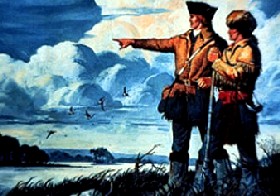 His counterpart, William Clark, is perfectly cast with Charlton Heston filling those shoes. Heston made a career out of big, lavish historical epics and period pieces, and for good reason, his performances were always very strong whether it be as Moses or Michelangelo. But the movie plays loosely with historical fact, which isn't a sure deal-breaker, but so much could have been done with the story. Prior to leaving, Clark proposes to Julia Hamilton, who Lewis has been a friend with for years and is sweet on. She accepts and so the tension begins.
Along the trail after meeting Sacagewea, Clark starts to fall for her, making Lewis mad at him for falling in love and at the same time forgetting about his fiance back in Washington. That's right, one of the best stories in American history has turned into a love triangle, a completely inaccurate one at that. It's just an odd movie from beginning to end. I'm a sucker for historical period pieces, but this one is not worth it. Watch "Horizons" for the gorgeous location shooting in Grand Teton National Park, but don't expect much else.
The Far Horizons (1955): **/****
Subscribe to:
Posts (Atom)