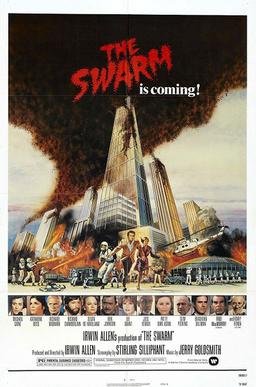
I'm not always the quickest learner so I'll take the blame for this one. I guess I should have learned quicker. While there are exceptions, there just weren't many good disaster movies in the 1970s and then into the 1980s. So for every Airport, Towering Inferno and Poseidon Adventure, there are movies like 1978's The Swarm. Yep, another nail in the coffin of a genre struggling to hold on for dear life.
At an isolated army installation in the American Southwest, a heavily armed patrol slowly navigates the eerily empty facility. What the hell happened here? Deep underground at the installation, the investigating patrol finds several dead bodies and a few lucky survivors, including a mysterious doctor, Brad Crane (Michael Caine), who says he's an expert on the world of insects. A much larger army force, commanded by crotchety General Slater (Richard Widmark), arrives soon after, and they're too stunned at what they find and what Crane claims is behind the mysterious attack. The responsibility goes to....an immense swarm of African killer bees. Bees!!!! Making the situation worse, there's no cure for the bees' surprisingly venomous sting and seemingly no one is immune. It looks like nothing can stop the not-so-fast moving bees, and they're heading for Houston.
Sometimes you DO just know. When this 1978 disaster flick from director Irwin Allen -- Master of Disaster flicks -- popped up on Turner Classic Movies' schedule, I had to set it to record. I HAD to. Movies with casts like this don't pop up too often so I had to at least give it a try. Worst case, it's just entertaining in a bad, guilty pleasure fashion, right? Well, that's what you would think. This wasn't even good in a 'So bad it's good' way. It just isn't entertaining. Apparently, I'm not the only one who thinks so. 'Swarm' is on all sorts of worst movies ever made lists and bombed in epic fashion in theaters back in 1978. If that's not a recipe for success, I don't know what is!
Maybe the most frightening thing to take away from this bee-disaster flick is that there's a director's cut available out there clocking in at 156 minutes. The TCM version I saw was an already painfully long 116 minutes. God knows what else could be expanded on in an additional 40 minutes because I was losing interest in the shortened version at the 60-minute mark. For goodness sake, 'Swarm' utilizes a love triangle featuring Olivia de Havilland, Ben Johnson and Fred MacMurray (in his last role) as a subplot! Yes, because that's what we need, three Hollywood legends in a senior citizen love triangle in a disaster flick where a swarm of killer bees are the villains. Seems reasonable, don't it? I can't say I'd be too interested in seeking out that longer version of a dud like this.
Star Michael Caine has said this is the worst movie he ever made, and it's hard to disagree. As the insect/bug specialist, Caine looks to be immensely bored throughout. If there's a slightly redeeming quality in 'Swarm,' it's that the cast is epically impressive. Now are any of them given much of anything to do? That would be a big N-O, but still, look at all those Hollywood stars! Along with Caine and perpetually angry Widmark, look for Katharine Ross, Henry Fonda and Richard Chamberlain as some of the scientists tasked with halting the advance of the bees. Also look for Lee Grant, Jose Ferrer, Patty Duke, Bradford Dillman, Slim Pickens, and Cameron Mitchell in other supporting parts, some more painfully forced than others.
Things unfortunately develop in more spoof-fashion than straight disaster flick. How many slow motion bee attack scenes can we witness before it just becomes laughable? Because the movie is about bees, we get one hilarious scene after another about our very talented cast discussing what the bees' intentions are, if they're seeking revenge, if there is a major bee plan to take over the world. It's all done so straight that it becomes spoof-like, and that's never a good thing. The problem is there just isn't that one reason to sit back and watch this one, and that's considering the star power on hand. The cast is given little to nothing to do, the killer bees are a laughable "villain," and the entertainment value just isn't there. Give this one a wide berth.
The Swarm (1978): */****
The Sons of Katie Elder
"First, we reunite, then find Ma and Pa's killer...then read some reviews."
Showing posts with label Jose Ferrer. Show all posts
Wednesday, March 11, 2015
Friday, November 28, 2014
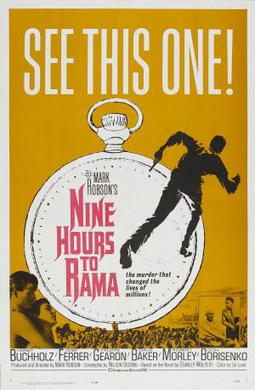
Nine Hours to Rama
So you know what isn't the most uplifting source for stories? Assassins and their assassination attempts. You don't hear a lot of movies about John Wilkes Booth, Lee Harvey Oswald, James Earl Ray and Sirhan Sirhan. How come? Well, it's odd because there's a fascination with killers and those they killed. And then there's the movies that are made, almost completely forgotten like 1963's Nine Hours to Rama, the story of the killer of Mahatma Gandhi.
It's January 30, 1948 in New Delhi, India. Just a few months into the country's independence after 200-plus years under Great Britain's rule, India is still finding its voice as an independent nation, and peace-preaching Mahatma Gandhi is that voice. The police and the army have been mobilized. Evidence and rumors suggest an assassination attempt is going to be made on Gandhi before the day is out. The killer? An extremist hell bent on ending Gandhi's life, his name Naturam Godse (Horst Buchholz). He's been chosen by his movement as the man supposed to kill Gandhi and he is ready to do whatever it takes to accomplish his mission. His work is cut out for him though, as the police, including police superintendent Gopal Das (Jose Ferrer), are closing in on him.
What I don't know about Gandhi's life could fill volumes. The same for Indian history, even more recent history like earning its independence from England. This 1963 story from director Mark Robson has been basically completely forgotten over the last 50-plus years. I caught a couple minutes of 'Rama' a few years back on AMC and finally was able to catch up with the feature film thanks to a recent airing on TV. What an interesting if flawed movie. Robson filmed on location in India, an incredibly nice touch that gives his film quite the authentic feel. He films the crowded streets, the country roads, the people, and there's almost a documentary feel as the story develops. Composer Malcolm Arnold turns in an excellent score, slightly reminiscent of his Bridge on the River Kwai score, to aid the assassination story that's based on the truth but mostly fictionalized.
One of my favorite movies is The Magnificent Seven, a western featuring a cast full of stars and recognizable character actors...and Horst Buchholz, a German actor playing a Mexican gunfighter. It's a very good part, but one of two movies I actually have seen Buchholz in. Well, make that three now with Buchholz doing a solid job here as Naturam. I think the script makes a wise choice in not demonizing him. He's a flawed character, obsessive in his beliefs and convinced he's in the right through his actions. If you know the history, it takes some of the mystery out of where this will end up but that doesn't take away from the strength of the story.
And how about the weakness of the story? That's from a storytelling device that can make or break a movie...the dreaded flashback. This is a story with two paths. One, Naturam in the hours building up to his assassination attempt. Two, his life, how he ended up on this path. His motivations and reasons are one thing, but that doesn't make the flashbacks interesting. Maybe in a separate movie, the flashback device works, but I felt that it fell short here mostly because the other half of the movie is so straightforward and effective. The main focus is on Naturam's troubled relationship with Rani (Valerie Gearon), a woman from vastly different backgrounds and beliefs who's still drawn to Naturam. A fiery, up and down relationship, it just doesn't work well in context. Minimizing the story of Gandhi's assassin to a tortured love story just doesn't work.
With the rest of the cast, Ferrer is the best supporting part. His Das is a dedicated, driven police officer who wants India to succeed as an independent nation. He knows that future needs its leader, Gandhi (J.S. Casshyap, a dead ringer for Gandhi), and has to convince the great man to listen to advice when his life is in danger. Don Borisenko plays Naturam's worrying accomplice, Diane Baker plays a prostitute who Naturam comes across in his efforts to hide while the police search for him and Harry Andrews and Robert Morley don some face-darkening makeup to play an Indian general and an Indian politician.
'Rama' is at its absolute best in the assassination plotline. Ten years before The Day of the Jackal was released, Robson's film does a great job laying things out, a race against time with life and death on the line through a crowded city. Naturam knows he's being pursued with the police close behind every step of the way. The tension keeps building and building as the sun begins to set, especially knowing where the story will end up. Knowledge of the history isn't a hindrance to any enjoyment of the story. It all builds to an incredibly moving ending, a flawed movie that manages to rise above its flaws in its strongest moments. A not so well known historical story but an interesting one to watch develop to its inevitable end.
Nine Days to Rama (1963): ** 1/2 /****
It's January 30, 1948 in New Delhi, India. Just a few months into the country's independence after 200-plus years under Great Britain's rule, India is still finding its voice as an independent nation, and peace-preaching Mahatma Gandhi is that voice. The police and the army have been mobilized. Evidence and rumors suggest an assassination attempt is going to be made on Gandhi before the day is out. The killer? An extremist hell bent on ending Gandhi's life, his name Naturam Godse (Horst Buchholz). He's been chosen by his movement as the man supposed to kill Gandhi and he is ready to do whatever it takes to accomplish his mission. His work is cut out for him though, as the police, including police superintendent Gopal Das (Jose Ferrer), are closing in on him.
What I don't know about Gandhi's life could fill volumes. The same for Indian history, even more recent history like earning its independence from England. This 1963 story from director Mark Robson has been basically completely forgotten over the last 50-plus years. I caught a couple minutes of 'Rama' a few years back on AMC and finally was able to catch up with the feature film thanks to a recent airing on TV. What an interesting if flawed movie. Robson filmed on location in India, an incredibly nice touch that gives his film quite the authentic feel. He films the crowded streets, the country roads, the people, and there's almost a documentary feel as the story develops. Composer Malcolm Arnold turns in an excellent score, slightly reminiscent of his Bridge on the River Kwai score, to aid the assassination story that's based on the truth but mostly fictionalized.
One of my favorite movies is The Magnificent Seven, a western featuring a cast full of stars and recognizable character actors...and Horst Buchholz, a German actor playing a Mexican gunfighter. It's a very good part, but one of two movies I actually have seen Buchholz in. Well, make that three now with Buchholz doing a solid job here as Naturam. I think the script makes a wise choice in not demonizing him. He's a flawed character, obsessive in his beliefs and convinced he's in the right through his actions. If you know the history, it takes some of the mystery out of where this will end up but that doesn't take away from the strength of the story.
And how about the weakness of the story? That's from a storytelling device that can make or break a movie...the dreaded flashback. This is a story with two paths. One, Naturam in the hours building up to his assassination attempt. Two, his life, how he ended up on this path. His motivations and reasons are one thing, but that doesn't make the flashbacks interesting. Maybe in a separate movie, the flashback device works, but I felt that it fell short here mostly because the other half of the movie is so straightforward and effective. The main focus is on Naturam's troubled relationship with Rani (Valerie Gearon), a woman from vastly different backgrounds and beliefs who's still drawn to Naturam. A fiery, up and down relationship, it just doesn't work well in context. Minimizing the story of Gandhi's assassin to a tortured love story just doesn't work.
With the rest of the cast, Ferrer is the best supporting part. His Das is a dedicated, driven police officer who wants India to succeed as an independent nation. He knows that future needs its leader, Gandhi (J.S. Casshyap, a dead ringer for Gandhi), and has to convince the great man to listen to advice when his life is in danger. Don Borisenko plays Naturam's worrying accomplice, Diane Baker plays a prostitute who Naturam comes across in his efforts to hide while the police search for him and Harry Andrews and Robert Morley don some face-darkening makeup to play an Indian general and an Indian politician.
'Rama' is at its absolute best in the assassination plotline. Ten years before The Day of the Jackal was released, Robson's film does a great job laying things out, a race against time with life and death on the line through a crowded city. Naturam knows he's being pursued with the police close behind every step of the way. The tension keeps building and building as the sun begins to set, especially knowing where the story will end up. Knowledge of the history isn't a hindrance to any enjoyment of the story. It all builds to an incredibly moving ending, a flawed movie that manages to rise above its flaws in its strongest moments. A not so well known historical story but an interesting one to watch develop to its inevitable end.
Nine Days to Rama (1963): ** 1/2 /****
Labels:
1960s,
Harry Andrews,
Horst Buchholz,
Jose Ferrer,
Mark Robson,
Robert Morley
Sunday, May 20, 2012
The Cockleshell Heroes
Writing reviews about World War II, I've watched epics about large-scale battles, personal stories about the home front, behind the scenes stories about government/administration, but my favorite has always been the men-on-a-mission sub-genre, commandos, specialists and secret agents working together to pull off an impossible mission. One of my favorites I recently rewatched for the first time in quite awhile is 1955's The Cockleshell Heroes.
Early in 1942 with WWII's outcome still very much in question, Royal Marines Captain Stringer (Jose Ferrer) has been tasked with an improbable mission. German ships operating out of the French city of Bordeaux have been wreaking havoc on Allied shipping, and Stringer must attempt to reach the harbor city with a small group of commandos, destroying as many ships as possible. The catch? They'll be doing it by paddling up the Garonne River in two-man canoes. With help from a career Marine officer, Captain Thompson (Trevor Howard), Stringer goes about training his team of volunteers for a mission that seems suicidal to everyone involved.
From star and director Ferrer (one of 7 films he directed), 'Heroes' is based on the true story of Operation Frankton which took place in December 1942. I watched it as a kid on the History Channel and have always remembered it fondly. Released in 1955, it is more of a heroic look at the bravery these commandos showed on their mission. It doesn't yet have the darkness, cynicism or reality of so many WWII movies released a few years later in the 1960s. There is still an innocence to the story, a "nice" factor. The commandos are the heroes, their Nazi counterparts stereotypically evil. 'Heroes' is only 98 minutes long and was shot on a smaller scale (some cool English locations providing good background) with the focus on this specific mission. There's no sense of a bigger issue or the state of the war. Instead, it's about 8 commandos and the officers leading them. When handled right, who needs a bigger scale than that?
Not a hugely well known movie, 'Heroes' doesn't have the same name recognition in its cast so many other war films have. Ferrer is solid but not particularly memorable as Major Stringer, the unlikely, volunteer commander of the mission. He has several strong dialogue scenes with Howard's Thompson as a rivalry develops about how the mission should be handled, but there's little doubt who the star is. Trevor Howard is a scene-stealer, putting a spin on the stiff upper lip British officer. He's prim and proper and interested in the bottom line -- the success of the mission -- more than how the men feel about him. Thompson is the only character given any real background and Howard does not disappoint. The commandos include Victor Maddern as Sgt. Craig, Thompson's right hand man, as well as the Marine volunteers; Anthony Newley as Clarke, the smart-alec, David Lodge as Ruddock, the strongest of the Marines, Peter Arne as Stevens, the capable Corporal, Percy Herbert, Graham Stewart, John Fabian as Cooney, the Irishman, John Van Eyssen, and Robert Desmond (The Great Escape). Newly, Maddern and Lodge stand out from the group as memorable.
At its heart, this is a men on a mission movie. It just so happens to be based on a true story, the results of the movie mission exaggerated a bit relative to the actual history. Truth or not, 'Heroes' follows a familiar formula. The story is pretty clearly divided in two parts; the training for the mission and then the execution of said-mission. I would have liked some more character background on the commandos, but the training scenes do just enough to differentiate them from each other. There are some original, unique scenes, including Stringer parachuting his commandos into England.....dressed as German soldiers. No money, no identification, they must trek some 300-plus miles back to the base without getting caught. These are some necessary scenes, giving us a rooting interest in these men as they head off to their mission.
Not surprisingly then, the best parts of the movie are the actual mission, dubbed 'Cockleshell,' as Stringer's team is dropped off by a British sub (commanded by Christopher Lee) and must paddle over 70 miles up the Garonne River to their target, ships waiting in the harbor. The final 40 minutes are tense and adrenaline-pumping as they navigate the river. It's here where I started to question. If I didn't know this was in fact a real mission, I'd say it was ridiculous. The bravery exhibited here in insane, commandos in 2-man canoes paddling exposed up a heavily guarded/defended river. HERE is a Google Map showing how far they actually traveled. The ending is downbeat with a sense of success, Howard delivering a very moving final line. Success at what cost though? Listen to some of the main theme HERE, a whistle-worthy score from composer John Addison. The link below is a documentary about the real-life mission. As for the movie, a hidden gem and one I've always enjoyed.
The Cockleshell Heroes <---documentary (1955): ***/****
Early in 1942 with WWII's outcome still very much in question, Royal Marines Captain Stringer (Jose Ferrer) has been tasked with an improbable mission. German ships operating out of the French city of Bordeaux have been wreaking havoc on Allied shipping, and Stringer must attempt to reach the harbor city with a small group of commandos, destroying as many ships as possible. The catch? They'll be doing it by paddling up the Garonne River in two-man canoes. With help from a career Marine officer, Captain Thompson (Trevor Howard), Stringer goes about training his team of volunteers for a mission that seems suicidal to everyone involved.
From star and director Ferrer (one of 7 films he directed), 'Heroes' is based on the true story of Operation Frankton which took place in December 1942. I watched it as a kid on the History Channel and have always remembered it fondly. Released in 1955, it is more of a heroic look at the bravery these commandos showed on their mission. It doesn't yet have the darkness, cynicism or reality of so many WWII movies released a few years later in the 1960s. There is still an innocence to the story, a "nice" factor. The commandos are the heroes, their Nazi counterparts stereotypically evil. 'Heroes' is only 98 minutes long and was shot on a smaller scale (some cool English locations providing good background) with the focus on this specific mission. There's no sense of a bigger issue or the state of the war. Instead, it's about 8 commandos and the officers leading them. When handled right, who needs a bigger scale than that?
Not a hugely well known movie, 'Heroes' doesn't have the same name recognition in its cast so many other war films have. Ferrer is solid but not particularly memorable as Major Stringer, the unlikely, volunteer commander of the mission. He has several strong dialogue scenes with Howard's Thompson as a rivalry develops about how the mission should be handled, but there's little doubt who the star is. Trevor Howard is a scene-stealer, putting a spin on the stiff upper lip British officer. He's prim and proper and interested in the bottom line -- the success of the mission -- more than how the men feel about him. Thompson is the only character given any real background and Howard does not disappoint. The commandos include Victor Maddern as Sgt. Craig, Thompson's right hand man, as well as the Marine volunteers; Anthony Newley as Clarke, the smart-alec, David Lodge as Ruddock, the strongest of the Marines, Peter Arne as Stevens, the capable Corporal, Percy Herbert, Graham Stewart, John Fabian as Cooney, the Irishman, John Van Eyssen, and Robert Desmond (The Great Escape). Newly, Maddern and Lodge stand out from the group as memorable.
At its heart, this is a men on a mission movie. It just so happens to be based on a true story, the results of the movie mission exaggerated a bit relative to the actual history. Truth or not, 'Heroes' follows a familiar formula. The story is pretty clearly divided in two parts; the training for the mission and then the execution of said-mission. I would have liked some more character background on the commandos, but the training scenes do just enough to differentiate them from each other. There are some original, unique scenes, including Stringer parachuting his commandos into England.....dressed as German soldiers. No money, no identification, they must trek some 300-plus miles back to the base without getting caught. These are some necessary scenes, giving us a rooting interest in these men as they head off to their mission.
Not surprisingly then, the best parts of the movie are the actual mission, dubbed 'Cockleshell,' as Stringer's team is dropped off by a British sub (commanded by Christopher Lee) and must paddle over 70 miles up the Garonne River to their target, ships waiting in the harbor. The final 40 minutes are tense and adrenaline-pumping as they navigate the river. It's here where I started to question. If I didn't know this was in fact a real mission, I'd say it was ridiculous. The bravery exhibited here in insane, commandos in 2-man canoes paddling exposed up a heavily guarded/defended river. HERE is a Google Map showing how far they actually traveled. The ending is downbeat with a sense of success, Howard delivering a very moving final line. Success at what cost though? Listen to some of the main theme HERE, a whistle-worthy score from composer John Addison. The link below is a documentary about the real-life mission. As for the movie, a hidden gem and one I've always enjoyed.
The Cockleshell Heroes <---documentary (1955): ***/****
Wednesday, January 18, 2012
Crisis
In a career that spanned four decades, director Richard Brooks was at the helm of more than a few classics, ranging from Cat on a Hit Tin Roof to The Professionals, Elmer Gantry to In Cold Blood. He started off in the 1940s writing screenplays and in 1950 finally got his first crack at a feature film, the simply titled Crisis.
Vacationing in an unnamed South American country with his wife, Helen (Paula Raymond), American doctor Eugene Ferguson (Cary Grant) is planning to head home when he is stopped and taken into custody by police and army officials. He is told nothing and forced to travel by train to the capital city where he meets the country's ruler, a vicious dictator, Raoul Farrago (Jose Ferrer), who desperately needs his help. Farrago has a brain tumor that is quickly crippling him, but he has no surgeons in-country capable of pulling off the extremely difficult surgery. In steps Eugene, a brain surgeon from John Hopkins. Will he be pressured into performing the surgery? Farrago's opponents intend to do their best to convince him otherwise.
Even with his first film, Brooks shows a knack for putting together a quality story. It has the look and feel of a film noir -- albeit set in South America in a revolution-torn country -- while keeping it on a personal level. Bigger things are certainly at stake, but the story comes down to one character deciding if he will help another. Set almost entirely in Farrago's palace, I get the distinct impression this was a stage-based story, but I would be wrong. Yet will all the good things and positives you can take away from 'Crisis,' I came away mildly disappointed with the end result.
Right at the top of his fame, Cary Grant does a good job portraying Eugene as a doctor. You believe him as a highly-respected surgeon. But too often, it looks like Grant is sleepwalking through his part. For someone who was kidnapped and forced against their will to do something, he never seems genuinely angry. Perturbed, maybe a little upset? Yes, but his passive aggressive response doesn't work. Grant was always smooth on-screen, and that's no different here, but there is little to no energy or emotion in the part. Ferrer on the other hand relies almost solely on energy and emotion. He can be a little too much at times, but it works for the portrayal of a dictator who rules with an iron fist and is always concerned about fighting off any uprisings against his government.
The portrayal of a revolution-ravaged South American country is a worthy one, honest without being too theatrical. The only downside is when "big" conversations come up, Ferguson and Farrago talking about free will, individual rights and freedom...check that, Freedom. It gets to be a little pretentious at times, the American arguing with the brutal dictator. Neither man is going to change the other one's mind so the scenes drag. Showing Farrago's country, I wanted to see and hear more. We're dropped into a country under martial law but hear little about how it came to be this way, or even see why he's such an awful, bloody dictator. Yes, I'm not completely slow. I can figure it out, but when we're supposed to root against a character -- even hate him -- it helps to see why we should feel that way.
Heading toward an ending that will inevitably be an unhappy one, the last 30 minutes are much more interesting than the build-up. Grant's Ferguson must decide if he will go through with the surgery having been approached by a revolutionary group (headed by Gilbert Roland) to "accidentally" have the surgery go south. No one would know the difference, but Ferguson's hippocratic oath says otherwise. The ending features a couple good twists, one better than the other. The final shot is a doozy, an ironic ending that surprised me for sure. For a movie released in 1950, it was ahead of its time.
'Crisis' is a decent enough movie and story, but I just struggled to get into it. I was never too interested in Cary Grant's character, and the whole thing went downhill from there. Raymond is very good as his wife Helen with Signe Hasso as Farrago's devoted wife, Ramon Novarro as Colonel Adragon, a loyal officer in Farrago's army, and Leon Ames as an American oil driller rounding out the cast.
Crisis <---trailer (1950): ** 1/2 /****
Vacationing in an unnamed South American country with his wife, Helen (Paula Raymond), American doctor Eugene Ferguson (Cary Grant) is planning to head home when he is stopped and taken into custody by police and army officials. He is told nothing and forced to travel by train to the capital city where he meets the country's ruler, a vicious dictator, Raoul Farrago (Jose Ferrer), who desperately needs his help. Farrago has a brain tumor that is quickly crippling him, but he has no surgeons in-country capable of pulling off the extremely difficult surgery. In steps Eugene, a brain surgeon from John Hopkins. Will he be pressured into performing the surgery? Farrago's opponents intend to do their best to convince him otherwise.
Even with his first film, Brooks shows a knack for putting together a quality story. It has the look and feel of a film noir -- albeit set in South America in a revolution-torn country -- while keeping it on a personal level. Bigger things are certainly at stake, but the story comes down to one character deciding if he will help another. Set almost entirely in Farrago's palace, I get the distinct impression this was a stage-based story, but I would be wrong. Yet will all the good things and positives you can take away from 'Crisis,' I came away mildly disappointed with the end result.
Right at the top of his fame, Cary Grant does a good job portraying Eugene as a doctor. You believe him as a highly-respected surgeon. But too often, it looks like Grant is sleepwalking through his part. For someone who was kidnapped and forced against their will to do something, he never seems genuinely angry. Perturbed, maybe a little upset? Yes, but his passive aggressive response doesn't work. Grant was always smooth on-screen, and that's no different here, but there is little to no energy or emotion in the part. Ferrer on the other hand relies almost solely on energy and emotion. He can be a little too much at times, but it works for the portrayal of a dictator who rules with an iron fist and is always concerned about fighting off any uprisings against his government.
The portrayal of a revolution-ravaged South American country is a worthy one, honest without being too theatrical. The only downside is when "big" conversations come up, Ferguson and Farrago talking about free will, individual rights and freedom...check that, Freedom. It gets to be a little pretentious at times, the American arguing with the brutal dictator. Neither man is going to change the other one's mind so the scenes drag. Showing Farrago's country, I wanted to see and hear more. We're dropped into a country under martial law but hear little about how it came to be this way, or even see why he's such an awful, bloody dictator. Yes, I'm not completely slow. I can figure it out, but when we're supposed to root against a character -- even hate him -- it helps to see why we should feel that way.
Heading toward an ending that will inevitably be an unhappy one, the last 30 minutes are much more interesting than the build-up. Grant's Ferguson must decide if he will go through with the surgery having been approached by a revolutionary group (headed by Gilbert Roland) to "accidentally" have the surgery go south. No one would know the difference, but Ferguson's hippocratic oath says otherwise. The ending features a couple good twists, one better than the other. The final shot is a doozy, an ironic ending that surprised me for sure. For a movie released in 1950, it was ahead of its time.
'Crisis' is a decent enough movie and story, but I just struggled to get into it. I was never too interested in Cary Grant's character, and the whole thing went downhill from there. Raymond is very good as his wife Helen with Signe Hasso as Farrago's devoted wife, Ramon Novarro as Colonel Adragon, a loyal officer in Farrago's army, and Leon Ames as an American oil driller rounding out the cast.
Crisis <---trailer (1950): ** 1/2 /****
Labels:
1950s,
Cary Grant,
Gilbert Roland,
Jose Ferrer,
Richard Brooks
Sunday, April 25, 2010
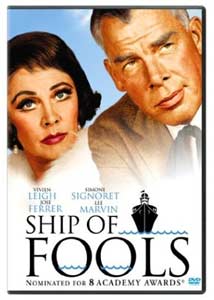
Ship of Fools
In 1933, the Nazi Party took over in Germany, a power that would run through the end of WWII in 1945. At the time, no one really could known what was coming with Adolf Hitler and the Nazis in charge of Germany, but it was a turning point in history for how it changed the world and the millions of lives it impacted. Even at first, did the German people know what they were voting for when the Nazi Party took office? We'll never know, but 1965's Ship of Fools explores the idea of what is to come.
Director Stanley Kramer made a name for himself with movies just like this, big pictures with big casts and some big ideas. 'Fools' has the feel of a 1970s disaster movie except without the disaster. Throw a group of people into a confined setting and let the fireworks begin. Here though, there's no fireworks. It is a movie that at 149-minutes is one of the most dialogue-heavy movies I've ever seen, some good and some bad. With a huge cast, lots of tumultuous relationships, and some bigger takes on love, prejudice, and common decency, 'Fools' has a lot going on, too much if you ask me. A streamlined version couldn't have hurt.
In 1933 in the port of Vera Cruz, Mexico, a German cruise ship leaves port bound for a quick stop in Cuba and then on home to mother Germany. On board is a good sample section of Germans, Jews, Austrians, a few Americans from a variety of backgrounds, and over 500 field workers being sent back to Cuba because the work has dried up. The Nazi Party has taken power in Germany, and the election is still at the forefront of discussion. The trip to Germany is expected to take almost a month, and on this trip, nothing is going to go smoothly.
Don't take any of that to mean this is an action movie, far from it. Here is just some of the characters involved. The ship's doctor (Oskar Werner) is coming off heart troubles and is generally depressed at the plight of the world, but he bonds with an upper-class woman (Simone Signoret) who helped arm a workers rebellion. A boorish German Austrian (Jose Ferrer) spouts the power of the Nazis and their plans to build a super race. A young American couple (George Segal and Elizabeth Ashley) try to figure out if they're meant to be together. A hard-edged, washed up American baseball player (Lee Marvin) tries to figure out what to do with his life, all the while talking often with a recent divorcee (Vivien Leigh). A German Jew salesman (Heinz Ruhmann) tries to shrug of the increasingly anti-Semitic feelings on board. The problem isn't with the strength of the casting -- all those mentioned turn in fine performances -- but with the fact that all those mentioned are about half of the storylines.
There is many more storylines with many more characters as Kramer attempts to show a wide variety of people, families, and individuals on board this second rate ship. It's just too much as the camera bounces from story to story -- some much better than others -- instead of focusing on the key, interesting ones. There's an odd inclusion of a Spanish flamenco group who are really nothing more than a pimp who sells his dancers and also feature two satanic little kids who at one point throw a dog overboard. Many of these characters could have been more interesting with some more development, but it felt like Kramer was more interested in quantity over quality, and he throws a lot at the viewer before quickly moving on to another subplot.
'Fools' is based off a novel, but to me it had the distinct feel of a stage play with almost nothing to distract from the always ongoing dialogue. Besides a tangent here and there, the 149-minutes is almost all dialogue, sometimes between two people and others among a group. With all these presentations of what love is and its power/effect, the story does tread that line between intellectual and pretentious, usually ending up on the right side. Michael Dunn (Dr. Loveless in Wild, Wild West) plays Glocken, the character who opens and closes the movie by addressing the viewer, telling us what we are to see and then summing it up. It was a performance that earned him an Oscar nomination, and for good reason. Dunn was a dwarf, and in any other movie he may have seemed out of place, but here he's probably the most normal of them all.
With such a dialogue-heavy movie, it's the actors/actresses who shine. Leigh in her last-ever movie is remarkable in a very strong performance. Werner isn't easy to like because he seems so down on himself and the world, but the character comes around in the end -- which is a downer. Signoret and Werner have a chemistry together that is unlike a typical budding movie romance. Ruhmann and Dunn have a similar chemistry -- hold the romance -- as two Jews forced to eat separately from the rest of the German passengers, both men able to laugh off the prejudice. A scene late in the movie as they discuss this growing prejudice is eerie because as viewers we of course know what is to come during the Holocaust.
If this was from any other director, the rating might have gone up, but Kramer has Mad, Mad World and Nuremberg to his name among others, and 'Fools' just doesn't live up to those expectations. It could have though, and that's what is disappointing. The potential is there for a great movie. Cut about 30 minutes and some of those extra, wasted characters, and you've got a gem of a movie. Still, it's not a bad movie, just one with some fairly major flaws. Check it out for the depth of a great cast and a window into 1933 and what was coming down the road. Don't be thrown off by the DVD either, this is not some light-hearted romance.
Ship of Fools <----trailer (1965): ** 1/2 /****
Director Stanley Kramer made a name for himself with movies just like this, big pictures with big casts and some big ideas. 'Fools' has the feel of a 1970s disaster movie except without the disaster. Throw a group of people into a confined setting and let the fireworks begin. Here though, there's no fireworks. It is a movie that at 149-minutes is one of the most dialogue-heavy movies I've ever seen, some good and some bad. With a huge cast, lots of tumultuous relationships, and some bigger takes on love, prejudice, and common decency, 'Fools' has a lot going on, too much if you ask me. A streamlined version couldn't have hurt.
In 1933 in the port of Vera Cruz, Mexico, a German cruise ship leaves port bound for a quick stop in Cuba and then on home to mother Germany. On board is a good sample section of Germans, Jews, Austrians, a few Americans from a variety of backgrounds, and over 500 field workers being sent back to Cuba because the work has dried up. The Nazi Party has taken power in Germany, and the election is still at the forefront of discussion. The trip to Germany is expected to take almost a month, and on this trip, nothing is going to go smoothly.
Don't take any of that to mean this is an action movie, far from it. Here is just some of the characters involved. The ship's doctor (Oskar Werner) is coming off heart troubles and is generally depressed at the plight of the world, but he bonds with an upper-class woman (Simone Signoret) who helped arm a workers rebellion. A boorish German Austrian (Jose Ferrer) spouts the power of the Nazis and their plans to build a super race. A young American couple (George Segal and Elizabeth Ashley) try to figure out if they're meant to be together. A hard-edged, washed up American baseball player (Lee Marvin) tries to figure out what to do with his life, all the while talking often with a recent divorcee (Vivien Leigh). A German Jew salesman (Heinz Ruhmann) tries to shrug of the increasingly anti-Semitic feelings on board. The problem isn't with the strength of the casting -- all those mentioned turn in fine performances -- but with the fact that all those mentioned are about half of the storylines.
There is many more storylines with many more characters as Kramer attempts to show a wide variety of people, families, and individuals on board this second rate ship. It's just too much as the camera bounces from story to story -- some much better than others -- instead of focusing on the key, interesting ones. There's an odd inclusion of a Spanish flamenco group who are really nothing more than a pimp who sells his dancers and also feature two satanic little kids who at one point throw a dog overboard. Many of these characters could have been more interesting with some more development, but it felt like Kramer was more interested in quantity over quality, and he throws a lot at the viewer before quickly moving on to another subplot.
'Fools' is based off a novel, but to me it had the distinct feel of a stage play with almost nothing to distract from the always ongoing dialogue. Besides a tangent here and there, the 149-minutes is almost all dialogue, sometimes between two people and others among a group. With all these presentations of what love is and its power/effect, the story does tread that line between intellectual and pretentious, usually ending up on the right side. Michael Dunn (Dr. Loveless in Wild, Wild West) plays Glocken, the character who opens and closes the movie by addressing the viewer, telling us what we are to see and then summing it up. It was a performance that earned him an Oscar nomination, and for good reason. Dunn was a dwarf, and in any other movie he may have seemed out of place, but here he's probably the most normal of them all.
With such a dialogue-heavy movie, it's the actors/actresses who shine. Leigh in her last-ever movie is remarkable in a very strong performance. Werner isn't easy to like because he seems so down on himself and the world, but the character comes around in the end -- which is a downer. Signoret and Werner have a chemistry together that is unlike a typical budding movie romance. Ruhmann and Dunn have a similar chemistry -- hold the romance -- as two Jews forced to eat separately from the rest of the German passengers, both men able to laugh off the prejudice. A scene late in the movie as they discuss this growing prejudice is eerie because as viewers we of course know what is to come during the Holocaust.
If this was from any other director, the rating might have gone up, but Kramer has Mad, Mad World and Nuremberg to his name among others, and 'Fools' just doesn't live up to those expectations. It could have though, and that's what is disappointing. The potential is there for a great movie. Cut about 30 minutes and some of those extra, wasted characters, and you've got a gem of a movie. Still, it's not a bad movie, just one with some fairly major flaws. Check it out for the depth of a great cast and a window into 1933 and what was coming down the road. Don't be thrown off by the DVD either, this is not some light-hearted romance.
Ship of Fools <----trailer (1965): ** 1/2 /****
Labels:
1960s,
George Segal,
Jose Ferrer,
Lee Marvin,
Simone Signoret,
Stanley Kramer
Subscribe to:
Posts (Atom)