Well, it's been about a year since I reviewed a cheap Italian war movie so we might as well dive back in, right? Part of the Combat Classics 50 Movie Pack DVD set, here's 1969's The War Devils, another not so well known World War II movie. Not a spaghetti western, but a spaghetti war movie instead!
The fighting is raging in North Africa, and Captain George Vincent (Guy Madison), an American Ranger, has been tasked with leading a squad of commandos deep behind enemy lines. Though the mission proves costly, Vincent and his men pull it off but are left stranded in the desert. Their only possibility to get out alive? The American commandos are forced to team up with a squad of similarly stranded German infantry, commanded by fiery Captain Heinrich Meinike (Venantino Venantini). Both sides must put their differences aside if they hope to survive, but the desert is full of obstacles. Whatever happens, the war and the fighting might not be done with both Vincent and Meinike even when the war seems so far removed.
I can't quite put my finger on it. Growing up, I fell hard for the western genre and eventually fell just as hard for the spaghetti western genre. I kinda naturally assumed I would love the Euro-war genre that popped up in Italy in the wake of the popularity of the spaghetti western craze of the late 1960s. So far? It just hasn't been there. Now granted I haven't seen a ton of these films -- I mildly enjoyed 1968's Hell in Normandy -- and the ones I'm watching are public domain DVDs so the quality isn't always there in terms of viewing quality. I've enjoyed the movies, but there's that special something missing. Now if only a young budding star like Clint Eastwood had starred in these movies and helped make them more readily available for foreign audiences....eh, I guess that's wishful thinking.
I'll give credit where and when it's due. From director Bitto Albertini (who also worked on the story/screenplay), 'Devils' definitely tries something a little out of the ordinary. It is one of very few movies that makes a major jump in theaters, bouncing from continent to continent. 'Devils' runs about 96 minutes and splits down the middle, the first 50 minute following the fighting in North Africa while the last 45 jump to fighting in France in 1944. The reasoning behind that time jump? SPOILERS Both Vincent and Heinrich survive the fighting in North Africa, the German captain vowing to kill his American counterpart should they ever run into each other again. They do -- of course -- a year later in France. END OF SPOILERS It's nothing too crazy, but it does work as far as throwing something slightly different into a familiar formula.
A TV and film star in America in the 1950s, Guy Madison ended up getting another crack at stardom via Euro-war flicks and spaghetti westerns. He's in his mid 40s here, looking grayed and grizzled a bit as the most recognizable face in the cast. Not great acting (now THAT would be out of place), but Madison was always a pretty cool screen presence. His counterpart, Venantini, gets to ham it up a little bit as the very loud, emotional and fiery German intelligence captain. Pascale Petit gets to play the sexy young French woman, thrust into the mission with her father's life on the line, because every WWII movie needs a sexy young French woman. Also look for Anthony Steel in a small part as Colonel Steele (originality not required), a key intelligence officer, Claudio Biava as Sgt. Kelp, Vincent's right-hand man, and in the odd casting department, John Ireland making a one-scene appearance as an Allied officer and Raf Baldassarre in a wordless part as a sheik helping Vincent's commandos.
Now there's an end-all, be-all with these flicks, and that's ACTION!!! There's plenty, with two major firefights dotting the running time. 'Devils' may have a small budget, but that money was spent on some decent pyrotechnics. Lots of bullets flying, lots of arm-flailing deaths as dead soldiers go tumbling through the air. Still, there's got to be something more. Soldiers get killed, and the camera lingers like we're supposed to be distraught. That's a problem when they've been background players in most of the scenes up to that point. The action is tolerable, but the movie itself is pretty dull unfortunately. Check out the full movie below if you're curious.
The War Devils (1969): **/****
The Sons of Katie Elder

"First, we reunite, then find Ma and Pa's killer...then read some reviews."
Showing posts with label Guy Madison. Show all posts
Showing posts with label Guy Madison. Show all posts
Monday, November 24, 2014

Tuesday, October 1, 2013
Hell in Normandy

It's the days leading up to the D-Day invasion and a key German installation on the coast has to be knocked out. An intelligence agent, Lt. Strobel (Peter Lee Lawrence), poses as a German officer with a professor, Aubernet (Philippe Hersent), along to try and scope out the coming mission. Back in England, a special squad of American commandos led by Capt. Jack Murphy (Guy Madison) is training to take out the installation, a heavily fortified pillbox guarded by crack troops and an intricately laid minefield. The plan is to parachute into France the night before the invasion and take out the pillbox, but everything is thrown off its schedule when the invasion is postponed a day. It's too late for Murphy and many of his men though who jumped from the plane before the postponement signal came through. Now working with Strobel, Murphy and his men must hide out for a day, waiting for their chance to strike.
Poke around the site, and you'll see I love spaghetti westerns and generally will give any cheap European flick from the 1960s/1970s a pretty fair shot. The war collection has a fair share of similarly minded war flicks, Euro-war movies that were made on the cheap with an American star or two and a cast filled out by Italian actors. They were light on story and heavy on action. How can you lose, right? Like so many other like-minded flicks, 'Normandy' is pretty standard stuff. At different points in its 90-minute running time, it's exciting, dull, too much going on, not enough going on, and generally pretty goofy. I didn't love it, and I didn't hate it. It was good enough for a one-time viewing, and fans of Italian war movies should get at least a kick out of it.
I'll give credit where it's due in the originality department. Now, I've seen my fair share of war movies, but I've never heard of the plot device utilized here. What exactly is the German installation the American commandos are so desperate to knock out? Well, other reviews seem to identify it as a heavily-guarded flamethrower, but unless I misunderstood some lousy dubbing, that'd be wrong. Instead, the Germans have set up fuel lines in the water along the coast. When the invasion comes, they will open the fuel lines and light the fuel on fire. In other words, a rather warm, rather unpleasant welcome awaits Allied troops on the beaches of Normandy. It's a cool if ridiculous premise, and it doesn't help that we only see about 12 feet stretch of this so-called "weapon" along the shore. Should the Allies have avoided this strip of fuel-injected water, I feel they would have been safe.
Having transitioned from American TV star to a regular in some middling spaghetti westerns, Guy Madison makes the jump to the Italian war movie genre. He isn't given much to do and isn't even introduced until 20 minutes or so into the flick, but his Capt. Jack Murphy is a cool character. He questions the point of his upcoming mission, knowing the chances of him and his team pulling it off successfully and getting out alive are slim at best. It's cool to see that cynicism in a main character in a war movie. His polar opposite is Peter Lee Lawrence as Strobel, a dedicated, even fanatical/obsessed officer hellbent on destroying the installation. Posing as a German officer, he puts himself directly in harm's way, a painful death awaiting him should he slip up in the least. Their scenes together are solid, two different characters working together to try and pull off the impossible.
There ends the conversation of "known actors" in the cast. Erika Blanc is solid as Denise, the young woman working with the French resistance and the commandos in helping them get the job done while also trying to protect her paranoid, aging father (Renato Pinciroli). Hersent is also good in a smaller part as the intelligent professor along with the mission for some reason. I couldn't quite figure out why his part is so key. Max Turilli is the main villain -- if underused -- as a highly driven German soldier close behind on the trail left by Murphy's men. The focus is almost exclusively on Madison, Lawrence and Blanc with the rest of the cast mostly serving as background players, the cast listing at IMDB not even listing most names.
Part of the beauty (some would say not so beautiful) of these film collections is that all the movies are public domain. In other words, they're cheap and feature a lot of films, but you get what you pay for. Public domain usually means pretty low quality, and that's no exception here with a washed-out look and a really lousy print of pan-n-scan that bounces all over the action. That said, it's enjoyable enough. Much of the action is saved for the finale in a run and gun battle between the German outfit garrisoning the installation and what remains of Murphy's men. The ending does provide quite the twist in the surprise department. A mild recommendation overall. Watch HERE if you're curious.
Hell in Normandy (1968): ** 1/2 /****
Monday, August 26, 2013
The Charge at Feather River
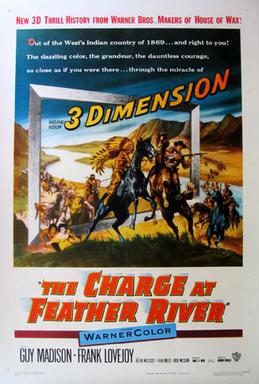
In the months following the end of the Civil War, former Union soldier Miles Archer (Guy Madison) returns to a ruined ranch with no cattle. He's approached by the commander at the nearby fort to undertake a dangerous mission. The railroad is moving into Cheyenne territory, leaving one last chance to get back two sisters who have long been held prisoners of the Cheyenne. Archer is less than enthused to take on this suicide mission, but he takes it on just the same, bringing a capable sergeant, Baker (Frank Lovejoy), to help him command a squad of prisoners from the guardhouse. Archer's squad heads into Cheyenne territory, but they find that only one of the women, Anne (Helen Westcott), even wants to be rescued while the other, Jennie (Vera Miles), is engaged to a chief, Thunder Hawk. More surprises await on this dangerous mission, Archer working to protect himself from threats inside and out.
According to a recent airing on Turner Classic Movies, 'Charge' was the highest grossing western released in 1953. Not bad when you consider Shane, Hondo, and The Naked Spur were all released that year. It's nothing special as a western, but it is enjoyable throughout. Director Gordon Douglas' movie is a solid cavalry vs. Indians western, featuring some cool locations and a memorable score from composer Max Steiner (borrowing some from his They Died With Their Boots On score). Listen to Steiner's main theme HERE. Using a familiar theme of saving captives from raiding Indians (The Searchers, Major Dundee), it's a pretty good example of what a pretty straightforward B-western can be. Some cool characters, good action and musical score. It doesn't have to be groundbreaking to be enjoyable.
What was the appeal then? No doubt some of the success had to do with the original release being in 3-D. I've never been a fan of 3-D filming, gone on record far too many times with that, but there is a cheesy charm when it's handled right. Maybe it has something to do with the 1953 release as opposed to 2013, but it's fun to watch. At different points, we get arrows, tomahawks, spears and lances chucked directly at the camera. Right in the midst of a battle, it can be a fun, diverting gimmick. At one point late, Lovejoy's Sgt. Baker even spits tobacco juice right at the camera!!! Twice!!! Take that rattlesnake about to bite him! Go figure, but the 3-D technique works here pretty well.
Taking a break from his starring role on TV's Adventures of Wild Bill Hickok, Madison is his typical workmanlike self, a tried and true hero to lead the way in an impossible mission. He's never flashy, but he was a good hero in countless westerns like this. Lovejoy too is well-cast as Baker, the necessary sidekick and right hand man, given a rivalry with Pvt. Ryan (Steve Brodie), who was trying to make a move on Baker's wife. Westcott is okay as the quasi-love interest while Miles gets to villain it up as Jennie, the captive turned future Indian princess. Madison's Guardhouse Brigade includes Cullen (Dick Wesson), a drunken thief providing some comic relief, Johnson (Onslow Stevens), a journalist/artist along for the mission, Johnny (Ron Hagerthy), the kidnapped sisters' younger brother, the treacherous Morgan (Neville Brand), Smiley (Henry Kulky), the boozing private, Zebulon (Lane Chandler), a former Confederate cavalry officer, and Connors (James Brown), the capable soldier.
It's a pretty straightforward formula once Archer and Co. get out on the mission road. We've got about 15-20 men on a dangerous mission in enemy territory. Who's going to make it, and who isn't? Various trials and tribulations are thrown at Archer's squad, providing some cool action scenes as they try and make it to safety with warring Indians seemingly all around them. The action is never on a large scale, but it's well put together, especially the finale with Thunder Hawk's war party closing in on all sides. What else to talk about? The scream of a certain Pvt. Wilhelm as he's hit with an arrow. Watch HERE. It is a scream that's been used in several movies since, including both the Star Wars and Indiana Jones series. Watch a compilation HERE. It's something little that helps make a good western particularly memorable. Solid western all-around.
The Charge at Feather River (1953): ***/****
Saturday, August 17, 2013
The Beast of Hollow Mountain

It's around the early 1900s in Mexico with an American cowboy, Jim Ryan (Guy Madison), and Mexican cowboy Felipe (Carlos Rivas) working as partners on a small but successful cattle ranch. The partners are in trouble though as all their workers abandon their jobs, claiming that the ranch is cursed and a beast waits in the mountains to kill them all. Both Jim and Felipe think otherwise but can't prove it. A local rancher seeking more land, Enrique (Eduardo Noriega), would like nothing more than to drive the duo off their land, and he's got the plan in place to do just that. Running low on money and with no one willing to help them, Jim and Felipe have signed a contract to deliver some of their cattle to a needy buyer. That may be the least of their problems as the mythical creature in the mountains isn't a myth and is ready to strike.
I thought the Turner Classic Movies description had screwed me again upon first viewing here. The beast is only even hinted at once through the first hour, finally making his entrance at the 60-minute mark. Come on, creature features! The build-up can be a tad slow here, a pretty typical western story revolving around ranchers competing for who can be the most successful. A subplot among Madison's Jim, Noriega's jealous Enrique and Patricia Medina's Sarita is pretty slow with Sarita engaged to the fiery Enrique. Uh-oh, here comes that dreamy American cowboy! It's a tad on the slow to dull side, waiting too long in an 81-minute movie to introduce the titular character, in this case an allosaurus, a lone dinosaur (that we see at least) that managed to live on all these years.
Okay, so it's 1956 and computer generated images are years away. How then should a moderately budgeted film show a dinosaur? In stepped special effects legend Willis O'Brien to handle the shooting of a dinosaur, done here with a stop motion technique known as replacement animation. Sure, at times it looks pretty bad, but for the time it was made? It looks pretty impressive. The last 20 minutes of the movie plays like one bad chase, countless characters running from the beast that's finally revealed itself. Watch a big chunk of those scenes HERE. What it lacks in special effects polish that we might take for granted in this CGI-World, it makes up for in excitement and energy. It can be a slow-moving trial to get to this point, but the payoff with the dinosaur and one extended chase helps make it worthwhile.
Fans of the western genre will no doubt get a kick out of this one. 'Beast' was made by MGM Studios and was filmed in Cinerama, a filming technique that truly took advantage of a giant screen, filling the screen with shots of impressive scale and scope. Making that decision better is the choice to film on location in Mexico with some familiar locations popping up. If you've seen The Magnificent Seven, Vera Cruz, Bandido, The Wrath of God and many others I'm probably forgetting, you'll enjoy watching this movie. The story may lag at times, but on visual terms alone, it's worthwhile from beginning to end. The main location was in Tepoztlan, almost the entire movie shot outdoors away from indoor sets. Never a bad thing if you ask me.
Beyond Madison, almost the entire cast is Mexican actors who typically starred in Mexican films. Playing the archetypal western hero, Madison is solid as usual as Jimmy Ryan, an American cowboy trying to carve a life for himself far south into Mexico. If nothing else, he looks to be having a lot of fun, including Rivas in a decent supporting part as his partner, Felipe. Medina is eye candy and given little to do, Noriega a weak back-boned bad guy to go up against Madison, and Julio Villareal as Don Pedro, the local mayor trying to keep his territory in peace and in check. Another nod to The Magnificent Seven, but look for Mario Navarro as Panchito, a young Mexican boy trying to keep his tequila-loving father, Pancho (Pascual Garcia Pena) in check. Navarro played one of the three village boys who tries to look after Charles Bronson's Bernardo O'Reilly.
A mixed bag overall, worthwhile in the end if you can make it through a sluggish, too familiar first hour. Kinda difficult to find so jump if you really want to see it and get the chance.
The Beast of Hollow Mountain (1956): ** 1/2 /****
Saturday, July 28, 2012
5 Against the House
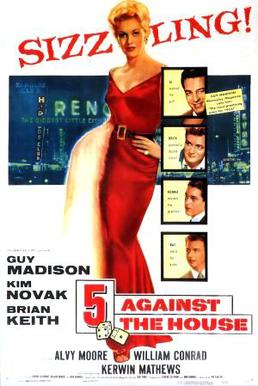
Heading back to a new semester at Midwestern University, four college students and friends -- Al (Guy Madison), Brick (Brian Keith), Roy (Alvy Moore) and Ronnie (Kerwin Matthews) -- stop in Reno to gamble a little at Harold's Club, a famous casino. They witness a botched robbery, overhearing a police officer mumble that no one could rob the place. As the semester wears on and things get boring, Ronnie comes up with a unique plan to do just that though; rob the place. His intention? Prove he can pull it off, then return the money (smart, huh?). Al is less than interested, focusing more on fiance Kay (Kim Novak), Roy goes along with it too a point, and Brick....well, Brick has his own plan.
From director Phil Karlson, this is an odd little movie. Comparing it to a Happy Days heist movies isn't fair, but that thought certainly crossed my mind as I was watching this quick 82-minute movie. There are good and bad -- like any movie I suppose -- but the bad is real bad. As we meet this foursome of friends, we're introduced to them through a nauseating and never-ending set of one-liners, most delivered by Moore. Madison walks around a casino telling them what time it is until they leave. Billed as a late film noir entry, it just ain't that type of movie. It's too light and fluffy early. The jokes are not only forced, but more importantly, just not very funny.
There's more to poke holes at, but that's the worst offender. The others involve two subplots, one more painful than the other. It's a heist movie, right? Then why is so much time spent on Al and Kay's budding romance? In one of her early roles, Novak looks great and sings two songs (sort of, she was dubbed for one), but she doesn't have chemistry with Madison at all. They fight, they kiss, they fight, and then they're back in love. A romance subplot is fine with me as long as it adds to a movie, not detracts from it. Anytime these two are on screen, it's a slow, halting trip. The other subplot has Roy and Ronnie convincing a freshman, Francis (Jack Dimond), to work as a servant-slave. Oh, those 1950s hijinks! It's just another example of the trying too hard, very forced and very unfunny humor that's jammed into the story.
So that gets the negatives out of the way, and we're onto the positives! Madison and Keith were 33 and 34 years old respectively when this was released so how do they come off as college students? Less than believable, but a key subplot involving them helps cushion that age difference. They're both veterans of the Korean War, Keith's shell-shocked Brick suffering through some version of post-traumatic stress disorder, Madison's Al doing his best to look out for a friend who saved his life. The relationship between the two "college students" is a high point of the film. Madison wasn't a great actor, but playing alongside Keith, they have an easy-going patter back and forth that reflects their history. Now if more time was spent on this aspect of the story, now we're onto something.
And then there's the heist aspect. In 1955, this is an early example of a heist film, and judging 'House' on that alone, it's a pretty solid movie. It was clearly an influence on the original Ocean's 11, released four years later. The heist is basically one big con job, pulling the wool over the casino's eyes while they steal away with the money. As part of a western fest, the quartet dress up as cowboys -- boots, beards and hats all -- to "blend in" with the rest of the clientele. Like much of the movie, the heist is low-key, but that doesn't away any of the tension. We're not sure exactly the details of the job, but we've gotten enough hints to see what's going on. As well, the film has several very cool on-location shots of mid 1950s Reno, a window, a time capsule into a very cool time in American history.
In the end, 'House' is a flawed venture. When it works, it's slightly above average. When it doesn't work, it struggles to maintain any pacing. Too bad a more pointed, heist-driven story with less romantic subplots couldn't have been used.
5 Against the House <---trailer (1955): ** 1/2 /****
Tuesday, January 17, 2012
This Man Can't Die

Working as an undercover agent for the cavalry, Martin Benson (Madison) has been assigned a mission where he must break up a gang of gunrunners who are selling and trading repeating rifles and whiskey with the Indian tribes. He somewhat unwillingly takes the job, but the gunrunners are on to him. The gang attacks the Benson ranch, killing Martin's parents, but his brother Daniel (Alberto Dell'Acqua), sisters Susan (Lucienne Bridou) and Jenny (Anna Liotti) and youngest brother Arias all survive the attack. Tracking the gang, Martin finds out about the attack. Hoping that with his help the now-hiding family can hold off the gang, Martin races home.
This is pretty typical of many of the spaghetti westerns made in Italy in the late 1960s and early 1970s. It is neither classic nor awful, just entertaining in a mindless sort of way. Because it is in that middle ground, it has little to no following with very little information even available on it wherever you look. The cast listing is especially bad with some main characters/villains not even listed by the names they're addressed as. Dell'Acqua is listed as 'Rooney' but is clearly called Daniel. The person listed as his younger brother -- Steve Merrick -- would have been 46 years old at the time. Now something ain't right there. Those "criticisms" aside, I did enjoy it for all its dumb qualities, some in a 'so bad it's good' fashion.
Looking like he aged quite a bit since his TV days in the 1950s, Madison looks somewhat out of place in this western. If he was getting paid by the line, the studios got off cheap. His Martin has maybe 12 lines of dialogue the whole movie, and on top of that, he's dubbed by someone else. It just sounds a little off. He also looks like he got lifted off the set of an American western and dropped into this Italian western, but I'll give credit when it's due. He handles most of his own stunts -- and there's a lot of them -- and does bring a cool, laid back appeal to the hero part. I wish they could have paired Madison and Dell'Acqua's Daniel earlier because the revenge-seeking gunslinging brothers could have been a cool addition.
Introducing someone to spaghetti westerns, I never claim the acting is anything special. Making it better or worse is that dubbing can ruin an already wooden or over the top performance. The villains here are pretty weak starting with Graham (Rik Battaglia), the leading businessman in town who's secretly running this gang of gunrunners. The gang leader isn't credited by the name I heard so I can't list him, but he's a creepy enough dude. When he rapes Jenny in the attack, you know it won't end well for him. Dell'Acqua is a solid, cool second banana, French beauty Bridou looks pretty, and Rosalba Neri makes the most of a smaller part as Martin's girl, Melina, a saloon girl.
Like any spaghetti western, there are some odd to really odd moments. For one, the score liberally borrows from Sergio Leone's A Fistful of Dollars. It's weird because the rest of the score is good if not great, and then all the sudden BAM! You're thinking 'I recognize that score," and you should. The violence is ratcheted up with the appearance of blood after some shootings, and 'Can't Die' features more nudity than I've seen in other spaghetti westerns. Those bad guys, they're always trying to rape somebody. It is a fun movie though, especially the last half hour with gunplay around every corner. There's better and there is worse, but not bad as far as spaghettis go. You can watch the full movie HERE at Youtube.
This Man Can't Die (1968): ** 1/2 /****
Friday, July 8, 2011
Till the End of Time
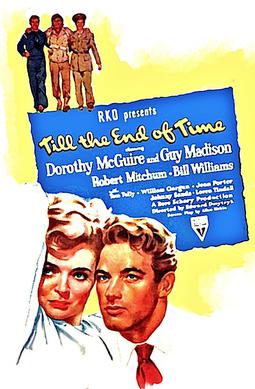
I have this notion that following the end of World War II in both the European and Pacific theaters that everything was hunky-dory, everything was just fine as soldiers returned home to their friends and families without missing a beat. That of course was not the truth. Thousands of young men had just taken part in a world-shattering and world-changing event that altered the course of history, and then after years of fighting, the war was over. As much as they may have wanted to go home, it just wasn't that easy. From director Edward Dmytryk, 'End of Time' is an honest, moving look at this transition through the eyes of three Marine veterans.
After three-plus years fighting in the Pacific, highly decorated Marine Cliff Harper (Guy Madison) is being mustered out just a few months after the end of WWII. He parts ways with his best friend, William Tabeshaw (Robert Mitchum), and heads home to California where he sees his parents (Tom Tully and Ruth Nelson) for the first time in years. Cliff is glad to be home, but he doesn't know quite what to do with himself. He finds himself lashing out at everyone around him. He wants nothing to do with any sort of job or responsibility. Nothing comes easy for him as he tries to readjust even when he meets Pat Ruscomb (Dorothy McGuire), a young widow who lost her pilot husband in Europe within the last year. Instantly drawn to a similarly struggling Pat, Cliff can't seem to do anything right though, and his struggles to keep his emotions in check might drive her away.
I had little to no expectations going into this one. The plot description sounded interesting, and I liked the two leads in McGuire and Madison, not even realizing one of my favorites in Robert Mitchum played a key supporting role. The premise was even more interesting considering the film was released within a year of the end of WWII. My picture of a post-WWII America is one where audiences did not want to see movies about their heroic veterans struggling to readjust to civilian life. This is a great movie, authentic, honest and moving. It doesn't try to whitewash these struggles so many veterans went through after surviving the hell of combat. I liked it so much more than 'Best Years' and wish it could receive some recognition alongside that much more well-known movie. Still, it doesn't take away from its value as a film that can stand alone on its own.
Certain moments take this movie to another level. In terms of a no-frills opening, the long, uninterrupted shot of Madison's Cliff walking through his childhood home upon returning is great. He slowly walks through the rooms, seeing things so much differently than he did only a few years before. Later, a veteran, Perry (Bill Williams), refuses to wear his prosthetic legs but finally swallows his pride and pushes his stubborness by the wayside. In a great reveal, he opens the door to his room dressed in his dress uniform, proudly walking to his beaming mother. The best though comes when Cliff and Pat are on a date at an ice rink where they see an Army soldier (Richard Benedict) struggling with a bout of the shakes. Both having dealt with similar circumstances in their own way, they help the young soldier who wants to go home but doesn't want to worry his parents. A scene that is incredibly moving in its execution, it is years ahead of its time in honesty.
Just 24 years old at the time, Guy Madison does not disappoint in his first starring role and second movie overall. What sets his Cliff Harper character apart is that at several different times, he's a complete asshole. Granted, it isn't so much him as his internal battle to adjust and be normal again, but he's aggressive and even violent, both physically and lashing out with words. Mostly though, he realizes what he's doing and does his best to stop it. His relationship with a scene-stealing McGuire feels real and never forced. These are two individuals who are dealing with similar problems but end up using the other for some sort of legitimacy or rationale. I have this picture of McGuire as the motherly character from Friendly Persuasion and Swiss Family Robinson so seeing her as a somewhat promiscuous young lady is quite a departure. You buy it though. Like Madison's Cliff, she doesn't know how to move on with her life.
Imagine my surprise when I sat through the credits and after McGuire and Madison I saw Robert Mitchum's name pop up. Consider me very pleased, even if his part is only a supporting one, if a key one at that. This is a pre-stardom Mitchum, but it's clear he's destined for bigger and better things. His character is also an ex-Marine who has a metal plate in his head after he was wounded. He refuses to deal with the ever-increasing headaches he has, living life as it presents itself. From what I've read about Mitchum, the character isn't too far removed from his real-life personality. In other words? He's always up to something, and it's always going to be entertaining.
There is little not to like about this movie. From the lead parts down to the supporting roles like Williams' ex-boxer Perry and Tully and Nelson as Cliff's parents, everyone hits that right note. It's that rare movie that hits almost all the right notes. It never gets too melodramatic or hammy, but also doesn't underplay the situation of these returning veterans. 'Best Years' is much more well-known, and it also features some great performances, but for me, I'll stick with this one.
Till the End of Time <---TCM clips (1946): *** 1/2 /****
Sunday, April 24, 2011
The Command

Part of my interest with these two movies is that neither is readily available in any format, although The Command is now available for purchase through the Warner Archive. Are they as good as I remember them? Maybe not, but they're still worth revisiting at least 10 years later. Good news, I have an old beat-up VHS tape of 'Feather River' and TCM recently showed a pristine widescreen presentation of The Command (thank you very much). Besides the fact that both movies are above average, pretty straightforward B-westerns, the other unifying link is that Guy Madison starred in both flicks. An actor who made a name for himself out of B-westerns like these, Madison had a short window of success in the 1950s before turning to Italian war movies and spaghetti westerns in the 1960s. Mostly though, he's known for playing Wild Bill Hickok in a western TV show that lasted seven years from 1951-1958. He wasn't a great actor -- a little stiff at times -- but he was what these B-westerns needed. Honest, strong-willed, and always ready to be a hero. That's certainly the case in The Command.
Riding along as part of a cavalry patrol, Doctor/Captain Robert MacClaw (Madison) has command thrust upon him when the patrol's commanding officer is mortally wounded and tells him to lead the patrol back to the fort. With no military/cavalry experience, MacClaw has to prove himself to the men of the troop who are immediately wary of this medical officer leading them. His one saving grace may be Sergeant Elliott (James Whitmore), a veteran soldier who is similarly skeptical of the doctor but willing to work with him. The troop reaches safety but is ordered to accompany a wagon train of settlers heading west that is accompanied by two companies of green recruits. To protect the troop from getting an infantry officer as a commander, MacClaw continues to pose as the troop's commander, even as he clashes with the infantry commander, veteran Colonel Janeway (Carl Benton Reid). The troop moves out though riding escort, but a large Indian war party is moving along with them. The Indians are just one problem though as a smallpox epidemic threatens to take out the whole column before they can reach the bigger body of the army's attacking force on the Paradise River.
While many B-westerns are really bad examples of what not to do with a medium-sized budget, decent story, and good if not great casting, The Command is a prime example of how everything can fall into place when handled the correct way. Released through Warner Bros., it is a beautifully shot western and the California locations, filming in a gorgeous widescreen presentation. The story is pretty straightforward, an outnumbered, rag-tag column traveling through Indian territory, hoping to threat the needle to safety. It's never boring though, and there's an actual sense of danger, the war party always closing in, always waiting for a chance to strike. Composer Dimitri Tiomkin keeps the action flowing with a solid soundtrack that will sound familiar to anyone familiar with his other scores. Maybe I give this movie a notch above what it actually deserves, but you know what? It's a fun story, full of action and some solid performances from the lead. The only problem of any consequence I had with the story was an insistence on adding a love interest for Madison's Capt. MacClaw.
Through all his wooden deliveries, I still find myself liking Guy Madison in the lead. His character is something new in a western, a doctor with no military training forced to learn what does and doesn't work fighting the Indians on the plains. Just by reading the cavalry tactics manual, he seems to pick it up rather quickly, but who's to complain, right? He isn't going to lose, is he? His mentor/student relationship with Whitmore is solid, and Madison more than handles himself in the action scenes (which are surprisingly grisly for a 1954 western). The character is different so right off the bat the movie is a little more interesting than it would have been with a seasoned officer trying to lead his company to safety. Trying to draw in that female audience though (I guess), Joan Weldon plays Martha, a young single woman traveling with the wagon train who butts heads with Madison's MacClaw only to fall deeply in love with him. I didn't see it coming either. Besides the fact that their developing relationship is boring, the duo doesn't have much in the way of chemistry together. Their scenes tend to drag on at times, killing an otherwise fast-moving story and all the momentum it builds up.
As a sucker for great character actors, I'm going to recommend this one mostly on the shoulders of James Whitmore. The movie is good enough on its own, but Whitmore definitely moves this western up a notch or two. His Sergeant Elliott character immediately reminded me of his Academy Award nominated performance from 1948's Battleground, and he plays a similar role, the part of the tough but fair sergeant. He's got years of experience and knows the Plains like few men in the troop do. As Madison's MacClaw adjusts to the position of command, Whitmore's Elliott is a cushion of sorts, answering questions when he can, and basically doing what he can to make the transition smoother both for the Doc and the men he's commanding. In his 40s here, Whitmore looked old no matter how old he actually was, and it all rolls into the character. He's gruff and surly, short on words, letting his actions do more of the talking for him. His chemistry is good with Madison which is essential, especially because their dialogue scenes dominate the landscape. Whitmore was a class act, always very watchable, and that's certainly the case here.
For a B-movie with a somewhat limited budget that clocks in at just 94 minutes, I was surprised by the epic quality of the finale which on its own takes almost 20 minutes. There is some impressive scope with a small army of extras standing in for the ever-growing Indian war party. The attack on the column's forted-up wagons is a great finale that reminded me a lot of a similar ending to Hondo, made the year before. The action all-around is impressive. The rest of the cast after the first two or three names is more hit or miss in smaller parts. Benton Reid is a one-note veteran, spouting how he's willing to die on his feet but not in the saddle. Other performers of note include some unnecessary humor from Harvey Lembeck as Pvt. Gottshalk (because there were a lot of snarky Jewish cavalry troopers from NYC in the old west), Ray Teal as the crotchety unit surgeon, and Don Shelton as Major Gibbs, a desk officer with no combat experience assigned to the infantry. An underrated western that gets lost in the sea of bad westerns from the 1950s when studios were cranking them out as quick as audiences could gobble them up. It's better than most so if you can find a copy, scoop it up.
The Command (1954): ***/****
Subscribe to:
Posts (Atom)