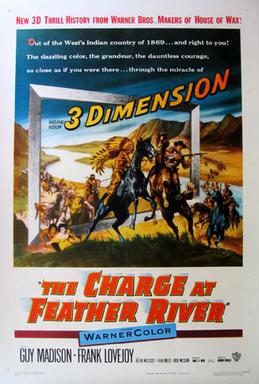
Why are some movies remembered and others aren't? It can be the tiniest thing, something that lingers with audiences long after viewing. A childhood favorite of mine, seemingly always airing on TNT, is 1953's The Charge at Feather River. What's it got going for it? Well, two things, an early use of 3-D technology that works surprisingly well and an iconic death scene that's influenced everything from Indiana Jones to Star Wars.
In the months following the end of the Civil War, former Union soldier Miles Archer (Guy Madison) returns to a ruined ranch with no cattle. He's approached by the commander at the nearby fort to undertake a dangerous mission. The railroad is moving into Cheyenne territory, leaving one last chance to get back two sisters who have long been held prisoners of the Cheyenne. Archer is less than enthused to take on this suicide mission, but he takes it on just the same, bringing a capable sergeant, Baker (Frank Lovejoy), to help him command a squad of prisoners from the guardhouse. Archer's squad heads into Cheyenne territory, but they find that only one of the women, Anne (Helen Westcott), even wants to be rescued while the other, Jennie (Vera Miles), is engaged to a chief, Thunder Hawk. More surprises await on this dangerous mission, Archer working to protect himself from threats inside and out.
According to a recent airing on Turner Classic Movies, 'Charge' was the highest grossing western released in 1953. Not bad when you consider Shane, Hondo, and The Naked Spur were all released that year. It's nothing special as a western, but it is enjoyable throughout. Director Gordon Douglas' movie is a solid cavalry vs. Indians western, featuring some cool locations and a memorable score from composer Max Steiner (borrowing some from his They Died With Their Boots On score). Listen to Steiner's main theme HERE. Using a familiar theme of saving captives from raiding Indians (The Searchers, Major Dundee), it's a pretty good example of what a pretty straightforward B-western can be. Some cool characters, good action and musical score. It doesn't have to be groundbreaking to be enjoyable.
What was the appeal then? No doubt some of the success had to do with the original release being in 3-D. I've never been a fan of 3-D filming, gone on record far too many times with that, but there is a cheesy charm when it's handled right. Maybe it has something to do with the 1953 release as opposed to 2013, but it's fun to watch. At different points, we get arrows, tomahawks, spears and lances chucked directly at the camera. Right in the midst of a battle, it can be a fun, diverting gimmick. At one point late, Lovejoy's Sgt. Baker even spits tobacco juice right at the camera!!! Twice!!! Take that rattlesnake about to bite him! Go figure, but the 3-D technique works here pretty well.
Taking a break from his starring role on TV's Adventures of Wild Bill Hickok, Madison is his typical workmanlike self, a tried and true hero to lead the way in an impossible mission. He's never flashy, but he was a good hero in countless westerns like this. Lovejoy too is well-cast as Baker, the necessary sidekick and right hand man, given a rivalry with Pvt. Ryan (Steve Brodie), who was trying to make a move on Baker's wife. Westcott is okay as the quasi-love interest while Miles gets to villain it up as Jennie, the captive turned future Indian princess. Madison's Guardhouse Brigade includes Cullen (Dick Wesson), a drunken thief providing some comic relief, Johnson (Onslow Stevens), a journalist/artist along for the mission, Johnny (Ron Hagerthy), the kidnapped sisters' younger brother, the treacherous Morgan (Neville Brand), Smiley (Henry Kulky), the boozing private, Zebulon (Lane Chandler), a former Confederate cavalry officer, and Connors (James Brown), the capable soldier.
It's a pretty straightforward formula once Archer and Co. get out on the mission road. We've got about 15-20 men on a dangerous mission in enemy territory. Who's going to make it, and who isn't? Various trials and tribulations are thrown at Archer's squad, providing some cool action scenes as they try and make it to safety with warring Indians seemingly all around them. The action is never on a large scale, but it's well put together, especially the finale with Thunder Hawk's war party closing in on all sides. What else to talk about? The scream of a certain Pvt. Wilhelm as he's hit with an arrow. Watch HERE. It is a scream that's been used in several movies since, including both the Star Wars and Indiana Jones series. Watch a compilation HERE. It's something little that helps make a good western particularly memorable. Solid western all-around.
The Charge at Feather River (1953): ***/****
The Sons of Katie Elder
"First, we reunite, then find Ma and Pa's killer...then read some reviews."
Showing posts with label Vera Miles. Show all posts
Monday, August 26, 2013
Saturday, December 15, 2012
The FBI Story
Released in 1959, The FBI Story is an interesting flick, but not always for the right reasons. Made with the support of J. Edgar Hoover and the FBI, the final product has that whitewashed, diluted feel to it. Hoover apparently ran roughshod over the making of the movie, and it shows. Some things stand out, but for the most part, it's one big dull pat on the back.
Working as a field agent in the infancy of the Federal Bureau of Investigations, Chip Hardesty (James Stewart) proposes to his long-time girlfriend, Lucy (Vera Miles), and agrees to resign his post. His timing could not be worse as the FBI is making drastic changes to become a more effective, more efficient government office. Chip maintains his status as an agent right as the U.S. is heading into some of its most tumultuous times in its young history. Chip sees all the good that he is able to accomplish through his work -- even with the danger -- while Lucy worries away at home with their growing family.
The biggest fault this movie has is that J. Edgar Hoover had any involvement at all with it. The FBI director apparently ordered film director Mervyn LeRoy to re-shoot certain scenes, insisting they show the FBI in a more positive light. So while Hoover attempted to make a movie that showed his agency for all its heroism and righteousness, the end result is a disgustingly positive "look" into the inner workings. These are Superheroes! G-Men! Infallible and can't be touched. The potential is there -- seeing the 1950s crime scene techniques, the depths an investigation will go to -- with some cool scenes, but it has an incredibly fake, forced feel. I can just see Hoover smiling like a nut thinking 'Oh, audiences will love this," almost like he's holding a door open to let us see. Nice try, Mr. Hoover.
In terms of the story, think of this movie as The FBI Story: The Forrest Gump Version. From when he joins the FBI in the mid 1920s, Stewart's Chip takes part in just about every important, watershed moment in FBI history. The Ku Klux Klan, murdered Native Americans for oil rights, shifty Communists, the gangsters of the 1930s, Axis agents in WWII, this guy does everything. The problem? In a 149-minute movie (a very long 149 minutes), none of these events are given their due. 'Story' covers 30-plus years in history, glazing over the most important -- and usually entertaining -- portions with broad strokes. All of those things are worthy of a movie on their own, but here we're treated to little windows, just snippets, of what was going on. Again, maybe chalk it up to Hoover trying to show everything the FBI has ever done? Who knows for sure.
Unfortunately, the solution to the above-problem is simple. Yes, it's a 149-minute long movie. I would guess anywhere from 90-100 minutes is actually about the FBI. The rest? As one IMDB reviewer so eloquently put it...."Father Knows Best: With Guns." Mindlessly tedious scenes with Chip, Lucy and their family are painful to watch. It even makes the FBI snippets insanely exciting (and they're really not). Chip goes on assignment. Lucy complains, buckles and lets him go. Chip goes on assignment..........and repeat eight or nine times. It's not interesting the first time so time No. 8 isn't any better. To top it off, Stewart and Miles (one of my least favorite actresses) don't have a ton of chemistry. She comes across as shrill, and Stewart to quirky-goofy at times in their home scenes.
Any more problems? Sure, why not! Other than Stewart and Miles, 'Story' has little in the way of star power. The movie doesn't call for a cast of thousands, all big name celebrities, but on the other hand, some more recognizable faces couldn't hurt. Murray Hamilton is good if underused as Chip's partner, Sam Crandall, who climbs the FBI ladder with him. Larry Pennell plays George Crandall, Sam's son who grows up wanting to be an FBI agent like his father. Also look for Nick Adams in a small part early as a mentally unhinged individual who plants on a bomb on a commercial airliner. Unfortunately, no one else truly stands out. Disappointed here overall. You know it's bad when even Jimmy Stewart can't save a movie, but this FBI-backed story just has too many holes and flaws.
The FBI Story (1959): **/****
Working as a field agent in the infancy of the Federal Bureau of Investigations, Chip Hardesty (James Stewart) proposes to his long-time girlfriend, Lucy (Vera Miles), and agrees to resign his post. His timing could not be worse as the FBI is making drastic changes to become a more effective, more efficient government office. Chip maintains his status as an agent right as the U.S. is heading into some of its most tumultuous times in its young history. Chip sees all the good that he is able to accomplish through his work -- even with the danger -- while Lucy worries away at home with their growing family.
The biggest fault this movie has is that J. Edgar Hoover had any involvement at all with it. The FBI director apparently ordered film director Mervyn LeRoy to re-shoot certain scenes, insisting they show the FBI in a more positive light. So while Hoover attempted to make a movie that showed his agency for all its heroism and righteousness, the end result is a disgustingly positive "look" into the inner workings. These are Superheroes! G-Men! Infallible and can't be touched. The potential is there -- seeing the 1950s crime scene techniques, the depths an investigation will go to -- with some cool scenes, but it has an incredibly fake, forced feel. I can just see Hoover smiling like a nut thinking 'Oh, audiences will love this," almost like he's holding a door open to let us see. Nice try, Mr. Hoover.
In terms of the story, think of this movie as The FBI Story: The Forrest Gump Version. From when he joins the FBI in the mid 1920s, Stewart's Chip takes part in just about every important, watershed moment in FBI history. The Ku Klux Klan, murdered Native Americans for oil rights, shifty Communists, the gangsters of the 1930s, Axis agents in WWII, this guy does everything. The problem? In a 149-minute movie (a very long 149 minutes), none of these events are given their due. 'Story' covers 30-plus years in history, glazing over the most important -- and usually entertaining -- portions with broad strokes. All of those things are worthy of a movie on their own, but here we're treated to little windows, just snippets, of what was going on. Again, maybe chalk it up to Hoover trying to show everything the FBI has ever done? Who knows for sure.
Unfortunately, the solution to the above-problem is simple. Yes, it's a 149-minute long movie. I would guess anywhere from 90-100 minutes is actually about the FBI. The rest? As one IMDB reviewer so eloquently put it...."Father Knows Best: With Guns." Mindlessly tedious scenes with Chip, Lucy and their family are painful to watch. It even makes the FBI snippets insanely exciting (and they're really not). Chip goes on assignment. Lucy complains, buckles and lets him go. Chip goes on assignment..........and repeat eight or nine times. It's not interesting the first time so time No. 8 isn't any better. To top it off, Stewart and Miles (one of my least favorite actresses) don't have a ton of chemistry. She comes across as shrill, and Stewart to quirky-goofy at times in their home scenes.
Any more problems? Sure, why not! Other than Stewart and Miles, 'Story' has little in the way of star power. The movie doesn't call for a cast of thousands, all big name celebrities, but on the other hand, some more recognizable faces couldn't hurt. Murray Hamilton is good if underused as Chip's partner, Sam Crandall, who climbs the FBI ladder with him. Larry Pennell plays George Crandall, Sam's son who grows up wanting to be an FBI agent like his father. Also look for Nick Adams in a small part early as a mentally unhinged individual who plants on a bomb on a commercial airliner. Unfortunately, no one else truly stands out. Disappointed here overall. You know it's bad when even Jimmy Stewart can't save a movie, but this FBI-backed story just has too many holes and flaws.
The FBI Story (1959): **/****
Labels:
1950s,
James Stewart,
Murray Hamilton,
Nick Adams,
Vera Miles
Subscribe to:
Posts (Atom)