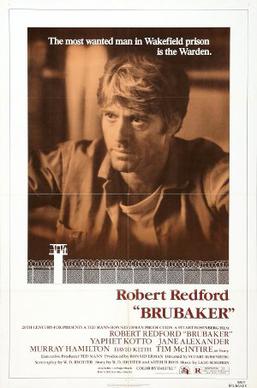
Well, it may be time to add a new label and genre for the right-hand column. I've written double-digit reviews about prisoners-of-war stories but what about good, old-fashioned prison stories? Movies like The Shawshank Redemption, Cool Hand Luke, Papillon, and plenty others ranging from classics to good to just bad. It's official. I'll add the Prison movie to the list, and here's a new one, 1980's Brubaker.
A new shipment of prisoners is arriving at the Wakefield State Prison, among them a quiet, mysterious prisoner who puts his head down and minds his own business. The prisoner quickly sees how horrific prison life is from abusive guards -- both physical, mental and sexual abuse -- to cramped living quarters, insect-ridden food to corruption on all levels of how the prison is run. After several days though, the prisoner reveals himself as Henry Brubaker (Robert Redford), the prison's new warden who's been tasked with cleaning up the prison, both for the prisoners and as a government-funded location. His appearance scares countless people to death, their corrupt, nasty world about to get thrown for a loop. His methods are demanding and fast-acting, making many people incredibly nervous. With pressure from inside and out, can Brubaker clean up the prison? Or has he pushed too far and endangered his own life?
From director Stuart Rosenberg, 'Brubaker' asks some interesting questions. Prison reform is meant to make sure that prisoners are treated like decent human beings. They don't deserve to be beaten, abused, violated and treated like dirt. Or do they? As the movie points out in snippets, these men are criminals, found guilty of a variety of crimes from rape to murder, robbery to manslaughter and all sorts of pleasant stuff in between. How well do they deserve to be treated considering the crimes they've been found guilty of committing? Should we rehabilitate prisoners so they can reenter the world as better individuals or simply let them waste away in under-funded prisons? The answer is probably somewhere in between. And enough of the social commentary, on with the movie!
'Brubaker' is a good movie, a story featuring some social commentary that for the most part avoids getting too obvious with its message. It is based on the book Accomplices to the Crime: The Arkansas Prison Scandal, the warden posing as a prisoner made up for the sake of the film. This is dark stuff from the get-go, Brubaker's undercover mission incredibly uncomfortable to watch. Things only get worse as he undertakes his new job, so many people around him -- inside and outside the prison -- trying to stop him, or at least slow him down. 'Brubaker' was filmed at Junction City Prison (recently closed) in Ohio, giving the story a filthy, seedy look that adds to the tension and the reality Rosenberg was aiming for. It doesn't feel like some Hollywood studio posing as a prison. It is a prison, and that goes a long ways toward authenticity. Also worth mentioning is composer Lalo Schifrin's score, equal parts underplayed and quiet with fast-moving, adrenaline-pumping sequences.
Who best to lead the way as a progressive prison warden who's not interested in whips, abuses, punishments and beatings? Why Robert Redford of course, at the height of his popularity. In his personal life, Redford has gotten behind and backed causes he believed to be worthwhile so this doesn't feel forced as an acting role. I would have liked some more background about the Brubaker character -- how did he end up here? What drives him? What's his motivation -- but an intelligent, thoughtful warden who becomes almost obsessed with accomplishing his mission is a great hero to lead the way. Redford was, is and will be a likable star to lead the way in a movie, and he's the best thing going here. Also look for Jane Alexander as Lillian Gray, his government connection, their background and relationship hinted at but never specified.
There's plenty of solid supporting parts to back Redford, starting with Yaphet Kotto as Coombes, a trusty who Brubaker counts on to help his reform get rolling while also questioning what's going on, and David Keith as Larry Lee Bullen, a lifer, a prisoner who's piled up three felonies and earned himself a life sentence. The scenes among Redford, Kotto and Keith are some of the strongest throughout the 132-minute movie. As for other trustees, look for Matt Clark, Tim McIntire, Everett McGill, Val Avery, and Joe Spinell. Murray Hamilton plays the evil Governor with Albert Salmi, M. Emmet Walsh, and Wilford Brimley also representing the evil System.
Just a good movie with a strong cast and an interesting story that takes some surprising twists as the it develops. The ending gets a little heavy-handed with a slow clap and all, but the movie as a whole is easy to recommend.
Brubaker (1980): ***/****
The Sons of Katie Elder
"First, we reunite, then find Ma and Pa's killer...then read some reviews."
Showing posts with label Murray Hamilton. Show all posts
Monday, June 9, 2014
Brubaker
Labels:
1980s,
David Keith,
Matt Clark,
Murray Hamilton,
Prisons,
Robert Redford,
Yaphet Kotto
Wednesday, June 26, 2013
Jaws 2
Some movies are just too successful not to follow up. The first true summer blockbuster, 1975's Jaws was an instant classic, a film that's as successful in terms of story and characters as it is on a far more technical level. The question of course is that everything is wrapped up nicely in the original. We didn't need a follow-up, a sequel that explored more. On the other hand, money is a powerful motivator, isn't it? Let's continue with the series, 1978's Jaws 2.
It's been three years since Chief Brody (Roy Scheider) helped dispatch an immense great white shark terrorizing Amity Island, and things have gone relatively back to normal. His kids have grown up, and his wife, Ellen (Lorraine Gary), is working closely with development and construction on the island. In the midst of summer rush though, weird occurrences start to happen including the disappearance of two divers and a bizarre boating accident where the driver and water skier are both killed. A killer whale even washes up on shore with huge bites in its side. No one has witnessed anything funny though, but Brody is convinced that all the weird incidents, evidence and clues point to another great white shark patrolling the waters around Amity Island. Can he convince anyone else of what he believes before more lives are claimed?
Much like its classic predecessor, 'Jaws 2' seemed doom from the start. The Steven Spielberg directed film from 1975 was obviously able to right the ship, becoming a fan favorite and one of Hollywood's all-time best flicks. Making its follow-up though was far from a smooth ride. Filming started and went on for over a month before the studio decided it wanted to go in a different direction. In stepped director Jeannot Szwarc and the tone of the movie was lightened up a bit (as much as you can with a movie about a killer shark), some of the darker ideas left behind. Filming went on with some other issues developing, and the final product went on to gross over $200,000,000 at the box office.
If you're going to make an unnecessary sequel, might as well do it right. Less than pleased about having to play Chief Brody again, Scheider apparently had some pretty intense on-set incidents with director Szwarc and crew. You'd never guess from watching the finished product. In the original, Scheider was part of an ensemble, carving out his own niche alongside similarly scene-stealing Robert Shaw and Richard Dreyfuss. This is his film, and he embraces it (issues he was there at all aside). We see character development, especially considering how his earlier interactions with the shark impacted him. He becomes paranoid, even obsessed when the possibility of another shark arises. We see Brody's descent into that obsession, putting his job and family at risk. It's a character we like and sympathize with, and Scheider does a fine job.
Along with Scheider, Gary returns as Ellen Brody, Martin's wife who worries more and more about her paranoid husband. She believes him and supports him, but even she questions if he's lost his mind a little bit. Also returning is Murray Hamilton as Larry Vaughan, money-minded mayor of Amity Island. Jeffrey Kramer plays Deputy Hendricks, Brody's goofy but well-meaning deputy.
Also setting it apart from the original is a more straightforward mentality. One of the most clever parts of the original is that we basically don't see the shark until the final third of the movie. The drama and tension builds until it's almost unbearable. Well, if you're watching a movie called 'Jaws 2,' you kinda know what it's about, right? No point in hiding the shark. The shark attacks are more aggressive, more in your face as we see the great white rip his victims to pieces (divers, swimmers, boaters, helicopters, stupid teenagers). Composer John Williams returns with his famous score, especially the main theme. Seeing the shark can be just as scary as the unknown, and we get our fair share of shark P.O.V. shots as he swims closer to his next meals. Similar to the original in the big picture, but it does enough to distance itself and create its own identity.
The biggest difference between the first two movies is the second hour. Instead of going on the hunt, Brody ends up being a rescuer. A bunch of horny, drinking teenagers, including Brody's son, Michael (Mark Gruner) and a tag-along younger son, Sean (Marc Gilpin), head out on their sailboats for the far-off lighthouse and more! The shark is in pursuit and wreaking havoc, Brody following behind in hopes of fending off the attacks. The build-up can be a little slow, but the last 45 minutes makes up for it. Also worthwhile to see how much it influenced future slasher films like Halloween and Friday the 13th among others. It's a solid ending to an enjoyable if unspectacular sequel.
Jaws 2 (1978): ***/****
It's been three years since Chief Brody (Roy Scheider) helped dispatch an immense great white shark terrorizing Amity Island, and things have gone relatively back to normal. His kids have grown up, and his wife, Ellen (Lorraine Gary), is working closely with development and construction on the island. In the midst of summer rush though, weird occurrences start to happen including the disappearance of two divers and a bizarre boating accident where the driver and water skier are both killed. A killer whale even washes up on shore with huge bites in its side. No one has witnessed anything funny though, but Brody is convinced that all the weird incidents, evidence and clues point to another great white shark patrolling the waters around Amity Island. Can he convince anyone else of what he believes before more lives are claimed?
Much like its classic predecessor, 'Jaws 2' seemed doom from the start. The Steven Spielberg directed film from 1975 was obviously able to right the ship, becoming a fan favorite and one of Hollywood's all-time best flicks. Making its follow-up though was far from a smooth ride. Filming started and went on for over a month before the studio decided it wanted to go in a different direction. In stepped director Jeannot Szwarc and the tone of the movie was lightened up a bit (as much as you can with a movie about a killer shark), some of the darker ideas left behind. Filming went on with some other issues developing, and the final product went on to gross over $200,000,000 at the box office.
If you're going to make an unnecessary sequel, might as well do it right. Less than pleased about having to play Chief Brody again, Scheider apparently had some pretty intense on-set incidents with director Szwarc and crew. You'd never guess from watching the finished product. In the original, Scheider was part of an ensemble, carving out his own niche alongside similarly scene-stealing Robert Shaw and Richard Dreyfuss. This is his film, and he embraces it (issues he was there at all aside). We see character development, especially considering how his earlier interactions with the shark impacted him. He becomes paranoid, even obsessed when the possibility of another shark arises. We see Brody's descent into that obsession, putting his job and family at risk. It's a character we like and sympathize with, and Scheider does a fine job.
Along with Scheider, Gary returns as Ellen Brody, Martin's wife who worries more and more about her paranoid husband. She believes him and supports him, but even she questions if he's lost his mind a little bit. Also returning is Murray Hamilton as Larry Vaughan, money-minded mayor of Amity Island. Jeffrey Kramer plays Deputy Hendricks, Brody's goofy but well-meaning deputy.
Also setting it apart from the original is a more straightforward mentality. One of the most clever parts of the original is that we basically don't see the shark until the final third of the movie. The drama and tension builds until it's almost unbearable. Well, if you're watching a movie called 'Jaws 2,' you kinda know what it's about, right? No point in hiding the shark. The shark attacks are more aggressive, more in your face as we see the great white rip his victims to pieces (divers, swimmers, boaters, helicopters, stupid teenagers). Composer John Williams returns with his famous score, especially the main theme. Seeing the shark can be just as scary as the unknown, and we get our fair share of shark P.O.V. shots as he swims closer to his next meals. Similar to the original in the big picture, but it does enough to distance itself and create its own identity.
The biggest difference between the first two movies is the second hour. Instead of going on the hunt, Brody ends up being a rescuer. A bunch of horny, drinking teenagers, including Brody's son, Michael (Mark Gruner) and a tag-along younger son, Sean (Marc Gilpin), head out on their sailboats for the far-off lighthouse and more! The shark is in pursuit and wreaking havoc, Brody following behind in hopes of fending off the attacks. The build-up can be a little slow, but the last 45 minutes makes up for it. Also worthwhile to see how much it influenced future slasher films like Halloween and Friday the 13th among others. It's a solid ending to an enjoyable if unspectacular sequel.
Jaws 2 (1978): ***/****
Tuesday, June 25, 2013
Jaws
The ocean is a big old place. Anything could be lurking in that water, right? It's a criminally simplistic fear, that of the unknown and the ocean is a perfect example. In a film that was the first real example of a summer blockbuster, 1975's Jaws is the rare perfect movie. Scared of the water? I am, and I won't be going anywhere near the water after watching this one.
Amity Island is a quiet, little resort town off the coast of New England, a town readying itself for huge crowds of tourists and vacationers on the upcoming Fourth of July weekend. The new police chief, Martin Brody (Roy Scheider), has a problem though as the bloody remains of a teenage girl wash up on shore. The culprit seems obvious; a shark, but no one else is willing to back the Chief up. He gets help -- and a confirmation on the shark -- from marine biologist Matt Hooper (Richard Dreyfuss) who recommends the beaches be closed with the immense, hunting shark in the waters. More attacks come fast and furious though, leaving Amity no choice but to pay for an experienced, grizzled shark hunter, Quint (Robert Shaw) to kill the great white shark once and for all. But as the trio heads to open waters, even they can't imagine what awaits in their hunt.
From a director who would go on to create a halfway decent name for himself, Steven Spielberg, 'Jaws' seemed doomed almost from the start. Based off a novel by Peter Benchley (the rare film better than the book here), the production went overbudget, over schedule and over everything as issues with a mechanical shark delayed shooting. A $4 million budget turned into $9 million. The end result? A classic film that audiences loved, the final product making $470,000,000 million in box office. It spawned three sequels -- none of them even remotely as good -- and changed the way films were made and the type of films Hollywood looked to make, market, and release for audiences. Not a bad formula for success, huh? Not at all.
On a very basic level, 'Jaws' is a horror movie. What is scarier than a creature that seemingly can't be stopped? The dark, gloomy, shadowy water can hide anything, and in this case it is an immensely terrifying 25-foot great white shark. As Hooper explains, all this oceanic creature does is swim and eat, eat and swim, nothing else. Maybe the best thing that could happen to Spielberg's famous film is the mechanical issues he had in shooting the shark. Because there were such issues, Spielberg tried to minimize the shark's actual on-screen time. We don't even get a really clear look/view of the shark until 80 minutes into a 124-minute movie (and it's a doozy of an appearance, watch the iconic scene HERE). It's all about the dread and impending doom. We know the attacks are coming, but that doesn't take away from that sense of doom hanging over every scene. It becomes almost unbearable at times, but more on that later.
I'll get to the actors and more focus on the story, but an additional star here is composer John Williams and his score, maybe the most instantly recognizable score EVER. Who doesn't know the dun-dun-dun-dun-DUNNA-DUNNA! theme that's paired with all of the shark's attacks? What separates a really good score from a great score is that ability to bring you into a movie. Williams' score succeeds on that level in epic fashion. You hear that theme, and for me, I get goosebumps right up my back (and I've seen this movie a ton of times!). It is moving and epic, unsettling and adventurous, a score that runs the gamut over the course of the entire flick.
From the opening scene -- skinny-dipping teenager eaten in pre-dawn darkness -- through the attacks and up to the finale, there's not really a weak point. Are there some parts that are better than others? Yes, most definitely. As good as the first hour is, the second hour is by far the best thing going here as Brody, Hooper and Quint board Quint's beat-up, shark-hunting ship, the Orca, and head out on the hunt. The next hour produces some of the most exciting chases and action scenes ever; just three men on a small boat doing battle with a shark of epic proportions. On a more personal level, the chemistry among Scheider, Dreyfuss and Shaw is phenomenal. It is perfect and simple and natural, three very different individuals forced to work together to accomplish a pretty suicidal mission. The movie is at home most on the high seas, Spielberg filming the entire shark hunt on the ocean. It sounds simple to do so, but it doesn't feel like a studio. It looks and feels like....the OCEAN!
When you think 'blockbuster,' you don't normally go to hugely impressive acting. Working with a scene-stealing shark, the cast here is spot-on and without the benefit of huge A-list stars, just hugely talented, reliable actors. I love Scheider as Brody, land-loving, water-hating Chief who wants to do right by the people nothing else. Dreyfuss as the highly intelligent Hooper is a perfect mix between inexperienced Brody and highly experienced Quint. Shaw of course is the biggest scene-stealer of them all, his grizzled veteran of the sea who's seen it all and done it all. Shaw's monologue explaining his involvement with the USS Indianapolis is a scene to behold as well (watch it HERE). Talk about a captivating, eye-popping scene, it's unreal and unsettling to watch. Kudos Mr. Shaw. Also look for Murray Hamilton as Amity Island's greedy mayor and Lorraine Gray as Ellen, Brody's wife.
It's easy to look past it when we're talking about the shark, the characters, the music and such that Spielberg at a young age is already showing a knack for the director's chair. If it gets lost in the shuffle, it's a shame, but this is an interesting visual movie to watch as Spielberg keeps us on our toes with his camera. Calm, cool long shots with little editing. Close-ups of Quint's eye, of the equipment clicking as the shark goes for the bait, the little things. The moral of the review is simple, I love this movie. It's got it all and features several of the greatest one-liners ever (my personal favorite being the subtle, perfectly delivered 'We're going to need a bigger boat.') It is a classic that deserves any and all of the accolades its received over the years. Look for reviews in the coming weeks of the sequels too.
Jaws (1975): ****/****
Amity Island is a quiet, little resort town off the coast of New England, a town readying itself for huge crowds of tourists and vacationers on the upcoming Fourth of July weekend. The new police chief, Martin Brody (Roy Scheider), has a problem though as the bloody remains of a teenage girl wash up on shore. The culprit seems obvious; a shark, but no one else is willing to back the Chief up. He gets help -- and a confirmation on the shark -- from marine biologist Matt Hooper (Richard Dreyfuss) who recommends the beaches be closed with the immense, hunting shark in the waters. More attacks come fast and furious though, leaving Amity no choice but to pay for an experienced, grizzled shark hunter, Quint (Robert Shaw) to kill the great white shark once and for all. But as the trio heads to open waters, even they can't imagine what awaits in their hunt.
From a director who would go on to create a halfway decent name for himself, Steven Spielberg, 'Jaws' seemed doomed almost from the start. Based off a novel by Peter Benchley (the rare film better than the book here), the production went overbudget, over schedule and over everything as issues with a mechanical shark delayed shooting. A $4 million budget turned into $9 million. The end result? A classic film that audiences loved, the final product making $470,000,000 million in box office. It spawned three sequels -- none of them even remotely as good -- and changed the way films were made and the type of films Hollywood looked to make, market, and release for audiences. Not a bad formula for success, huh? Not at all.
On a very basic level, 'Jaws' is a horror movie. What is scarier than a creature that seemingly can't be stopped? The dark, gloomy, shadowy water can hide anything, and in this case it is an immensely terrifying 25-foot great white shark. As Hooper explains, all this oceanic creature does is swim and eat, eat and swim, nothing else. Maybe the best thing that could happen to Spielberg's famous film is the mechanical issues he had in shooting the shark. Because there were such issues, Spielberg tried to minimize the shark's actual on-screen time. We don't even get a really clear look/view of the shark until 80 minutes into a 124-minute movie (and it's a doozy of an appearance, watch the iconic scene HERE). It's all about the dread and impending doom. We know the attacks are coming, but that doesn't take away from that sense of doom hanging over every scene. It becomes almost unbearable at times, but more on that later.
I'll get to the actors and more focus on the story, but an additional star here is composer John Williams and his score, maybe the most instantly recognizable score EVER. Who doesn't know the dun-dun-dun-dun-DUNNA-DUNNA! theme that's paired with all of the shark's attacks? What separates a really good score from a great score is that ability to bring you into a movie. Williams' score succeeds on that level in epic fashion. You hear that theme, and for me, I get goosebumps right up my back (and I've seen this movie a ton of times!). It is moving and epic, unsettling and adventurous, a score that runs the gamut over the course of the entire flick.
From the opening scene -- skinny-dipping teenager eaten in pre-dawn darkness -- through the attacks and up to the finale, there's not really a weak point. Are there some parts that are better than others? Yes, most definitely. As good as the first hour is, the second hour is by far the best thing going here as Brody, Hooper and Quint board Quint's beat-up, shark-hunting ship, the Orca, and head out on the hunt. The next hour produces some of the most exciting chases and action scenes ever; just three men on a small boat doing battle with a shark of epic proportions. On a more personal level, the chemistry among Scheider, Dreyfuss and Shaw is phenomenal. It is perfect and simple and natural, three very different individuals forced to work together to accomplish a pretty suicidal mission. The movie is at home most on the high seas, Spielberg filming the entire shark hunt on the ocean. It sounds simple to do so, but it doesn't feel like a studio. It looks and feels like....the OCEAN!
When you think 'blockbuster,' you don't normally go to hugely impressive acting. Working with a scene-stealing shark, the cast here is spot-on and without the benefit of huge A-list stars, just hugely talented, reliable actors. I love Scheider as Brody, land-loving, water-hating Chief who wants to do right by the people nothing else. Dreyfuss as the highly intelligent Hooper is a perfect mix between inexperienced Brody and highly experienced Quint. Shaw of course is the biggest scene-stealer of them all, his grizzled veteran of the sea who's seen it all and done it all. Shaw's monologue explaining his involvement with the USS Indianapolis is a scene to behold as well (watch it HERE). Talk about a captivating, eye-popping scene, it's unreal and unsettling to watch. Kudos Mr. Shaw. Also look for Murray Hamilton as Amity Island's greedy mayor and Lorraine Gray as Ellen, Brody's wife.
It's easy to look past it when we're talking about the shark, the characters, the music and such that Spielberg at a young age is already showing a knack for the director's chair. If it gets lost in the shuffle, it's a shame, but this is an interesting visual movie to watch as Spielberg keeps us on our toes with his camera. Calm, cool long shots with little editing. Close-ups of Quint's eye, of the equipment clicking as the shark goes for the bait, the little things. The moral of the review is simple, I love this movie. It's got it all and features several of the greatest one-liners ever (my personal favorite being the subtle, perfectly delivered 'We're going to need a bigger boat.') It is a classic that deserves any and all of the accolades its received over the years. Look for reviews in the coming weeks of the sequels too.
Jaws (1975): ****/****
Saturday, December 15, 2012
The FBI Story
Released in 1959, The FBI Story is an interesting flick, but not always for the right reasons. Made with the support of J. Edgar Hoover and the FBI, the final product has that whitewashed, diluted feel to it. Hoover apparently ran roughshod over the making of the movie, and it shows. Some things stand out, but for the most part, it's one big dull pat on the back.
Working as a field agent in the infancy of the Federal Bureau of Investigations, Chip Hardesty (James Stewart) proposes to his long-time girlfriend, Lucy (Vera Miles), and agrees to resign his post. His timing could not be worse as the FBI is making drastic changes to become a more effective, more efficient government office. Chip maintains his status as an agent right as the U.S. is heading into some of its most tumultuous times in its young history. Chip sees all the good that he is able to accomplish through his work -- even with the danger -- while Lucy worries away at home with their growing family.
The biggest fault this movie has is that J. Edgar Hoover had any involvement at all with it. The FBI director apparently ordered film director Mervyn LeRoy to re-shoot certain scenes, insisting they show the FBI in a more positive light. So while Hoover attempted to make a movie that showed his agency for all its heroism and righteousness, the end result is a disgustingly positive "look" into the inner workings. These are Superheroes! G-Men! Infallible and can't be touched. The potential is there -- seeing the 1950s crime scene techniques, the depths an investigation will go to -- with some cool scenes, but it has an incredibly fake, forced feel. I can just see Hoover smiling like a nut thinking 'Oh, audiences will love this," almost like he's holding a door open to let us see. Nice try, Mr. Hoover.
In terms of the story, think of this movie as The FBI Story: The Forrest Gump Version. From when he joins the FBI in the mid 1920s, Stewart's Chip takes part in just about every important, watershed moment in FBI history. The Ku Klux Klan, murdered Native Americans for oil rights, shifty Communists, the gangsters of the 1930s, Axis agents in WWII, this guy does everything. The problem? In a 149-minute movie (a very long 149 minutes), none of these events are given their due. 'Story' covers 30-plus years in history, glazing over the most important -- and usually entertaining -- portions with broad strokes. All of those things are worthy of a movie on their own, but here we're treated to little windows, just snippets, of what was going on. Again, maybe chalk it up to Hoover trying to show everything the FBI has ever done? Who knows for sure.
Unfortunately, the solution to the above-problem is simple. Yes, it's a 149-minute long movie. I would guess anywhere from 90-100 minutes is actually about the FBI. The rest? As one IMDB reviewer so eloquently put it...."Father Knows Best: With Guns." Mindlessly tedious scenes with Chip, Lucy and their family are painful to watch. It even makes the FBI snippets insanely exciting (and they're really not). Chip goes on assignment. Lucy complains, buckles and lets him go. Chip goes on assignment..........and repeat eight or nine times. It's not interesting the first time so time No. 8 isn't any better. To top it off, Stewart and Miles (one of my least favorite actresses) don't have a ton of chemistry. She comes across as shrill, and Stewart to quirky-goofy at times in their home scenes.
Any more problems? Sure, why not! Other than Stewart and Miles, 'Story' has little in the way of star power. The movie doesn't call for a cast of thousands, all big name celebrities, but on the other hand, some more recognizable faces couldn't hurt. Murray Hamilton is good if underused as Chip's partner, Sam Crandall, who climbs the FBI ladder with him. Larry Pennell plays George Crandall, Sam's son who grows up wanting to be an FBI agent like his father. Also look for Nick Adams in a small part early as a mentally unhinged individual who plants on a bomb on a commercial airliner. Unfortunately, no one else truly stands out. Disappointed here overall. You know it's bad when even Jimmy Stewart can't save a movie, but this FBI-backed story just has too many holes and flaws.
The FBI Story (1959): **/****
Working as a field agent in the infancy of the Federal Bureau of Investigations, Chip Hardesty (James Stewart) proposes to his long-time girlfriend, Lucy (Vera Miles), and agrees to resign his post. His timing could not be worse as the FBI is making drastic changes to become a more effective, more efficient government office. Chip maintains his status as an agent right as the U.S. is heading into some of its most tumultuous times in its young history. Chip sees all the good that he is able to accomplish through his work -- even with the danger -- while Lucy worries away at home with their growing family.
The biggest fault this movie has is that J. Edgar Hoover had any involvement at all with it. The FBI director apparently ordered film director Mervyn LeRoy to re-shoot certain scenes, insisting they show the FBI in a more positive light. So while Hoover attempted to make a movie that showed his agency for all its heroism and righteousness, the end result is a disgustingly positive "look" into the inner workings. These are Superheroes! G-Men! Infallible and can't be touched. The potential is there -- seeing the 1950s crime scene techniques, the depths an investigation will go to -- with some cool scenes, but it has an incredibly fake, forced feel. I can just see Hoover smiling like a nut thinking 'Oh, audiences will love this," almost like he's holding a door open to let us see. Nice try, Mr. Hoover.
In terms of the story, think of this movie as The FBI Story: The Forrest Gump Version. From when he joins the FBI in the mid 1920s, Stewart's Chip takes part in just about every important, watershed moment in FBI history. The Ku Klux Klan, murdered Native Americans for oil rights, shifty Communists, the gangsters of the 1930s, Axis agents in WWII, this guy does everything. The problem? In a 149-minute movie (a very long 149 minutes), none of these events are given their due. 'Story' covers 30-plus years in history, glazing over the most important -- and usually entertaining -- portions with broad strokes. All of those things are worthy of a movie on their own, but here we're treated to little windows, just snippets, of what was going on. Again, maybe chalk it up to Hoover trying to show everything the FBI has ever done? Who knows for sure.
Unfortunately, the solution to the above-problem is simple. Yes, it's a 149-minute long movie. I would guess anywhere from 90-100 minutes is actually about the FBI. The rest? As one IMDB reviewer so eloquently put it...."Father Knows Best: With Guns." Mindlessly tedious scenes with Chip, Lucy and their family are painful to watch. It even makes the FBI snippets insanely exciting (and they're really not). Chip goes on assignment. Lucy complains, buckles and lets him go. Chip goes on assignment..........and repeat eight or nine times. It's not interesting the first time so time No. 8 isn't any better. To top it off, Stewart and Miles (one of my least favorite actresses) don't have a ton of chemistry. She comes across as shrill, and Stewart to quirky-goofy at times in their home scenes.
Any more problems? Sure, why not! Other than Stewart and Miles, 'Story' has little in the way of star power. The movie doesn't call for a cast of thousands, all big name celebrities, but on the other hand, some more recognizable faces couldn't hurt. Murray Hamilton is good if underused as Chip's partner, Sam Crandall, who climbs the FBI ladder with him. Larry Pennell plays George Crandall, Sam's son who grows up wanting to be an FBI agent like his father. Also look for Nick Adams in a small part early as a mentally unhinged individual who plants on a bomb on a commercial airliner. Unfortunately, no one else truly stands out. Disappointed here overall. You know it's bad when even Jimmy Stewart can't save a movie, but this FBI-backed story just has too many holes and flaws.
The FBI Story (1959): **/****
Labels:
1950s,
James Stewart,
Murray Hamilton,
Nick Adams,
Vera Miles
Sunday, December 2, 2012
Bright Victory
Some of my favorite war movies focus almost exclusively on the actual combat and fighting in war. Some of the best focus on the post-war lives of the soldiers. What about the soldiers who were wounded and/or traumatized by what they saw and experienced? The most obvious choices include The Best Years of Our Lives, The Men, Born on the 4th of July, but 1951's Bright Victory belongs in that grouping.
Working with a forward artillery unit laying telephone wire in 1943 North Africa, Larry Nevins (Arthur Kennedy) is struck in the side of the head by a German sniper's bullet. His optic nerves are destroyed, and doctors don't believe that surgery will ever restore his sight. Back in the states at a rehab facility, Nevins goes about the slow work of learning how to live as a blind individual. In a weird way, he has to re-learn how to be a regular person, relying on his other senses, using a walking stick. He has help along the way from other wounded vets (similarly blinded) and one girl, Judy (Peggy Dow), who he hits it off with immediately. All the while though Larry is worried about the reaction he'll get back home, especially from fiance, Chris (Julie Adams).
Released in 1951 from director Mark Robson, 'Bright' is an impressive, well-made movie. Filmed in black and white, it's a meat and potatoes kind of movie. The focus is more on the personal level than any sort of large-scale action. This is Larry's story as he learns how to live as a blind person. We sees his reactions and how he copes; anger, frustration (even attempting suicide once), acceptance and finally a desire to work at it and move on with his life. It was filmed on location at Valley Forge Medical Center -- a nice touch for authenticity -- and detours once or twice to some cool Philadelphia locations. Why focus on the bigger picture when the smaller, more focused picture is more effective?
One of the best things going for 'Bright' comes from its honesty in exploring Larry's plight. He's born and raised in Florida, and living in the deep South, he's developed a racist streak right up his back. However, if you're blind.....Yeah, exactly. Voice inflections aside, how can you tell if someone is black or white? Working through his therapy, Larry strikes up a fast friendship with similarly wounded black soldier, Joe Morgan (James Edwards). Larry doesn't realize it though, one day making a statement about 'n***ers' being moved into the ward. And let the fireworks fly. The developing feeling in Larry is highly effective in its simplicity. It takes a life-altering incident to change his mind, but he starts to realize 'what difference does skin color make?' For a movie in 1951 years ahead of the Civil Rights movement, that's a profound message.
Casting Kennedy as Larry is a match made in heaven. Arthur Kennedy could be a despicable villain like nobody's business. More than that though, he's a great actor, and this is a part that allows him to show off his range. He's more than believable in the part, and when he's going through the life of a blinded veteran, it doesn't feel forced. His relationship with Dow's Judy is interesting without being too cute, and the dilemma he feels about what he said to Joe and also what awaits at home helps develop the character. The racist aspect gives an added dimension to the character too, all for the positive in a great part for Kennedy.
Also look for Will Geer and Nana Bryant as Larry's parents waiting back home in Florida, Joan Banks and a pre-Mr. Howell Jim Backus as Judy's sister and brother-in-law, and Richard Egan and Murray Hamilton as two blinded vets Larry meets in the rehab ward with John Hudson play Cpl. Flagg, a non-com working with the wounded vets. If you watch early, you can also see Rock Hudson in a bit part as one of Larry's repair crew working in North Africa.
An underrated WWII movie that deserves more of a following. Moments like Egan's soldier meeting his wife and son (who's he never seen/met) are perfection in their honesty. That's the feeling the whole movie gives off. It isn't aggressively shoving a story and message in its face. It's content to be what it is. An effective, well-told and well-acted story with some great performances. You can watch the entire movie HERE at Youtube.
Bright Victory <---Youtube clip (1951): *** 1/2 /****
Working with a forward artillery unit laying telephone wire in 1943 North Africa, Larry Nevins (Arthur Kennedy) is struck in the side of the head by a German sniper's bullet. His optic nerves are destroyed, and doctors don't believe that surgery will ever restore his sight. Back in the states at a rehab facility, Nevins goes about the slow work of learning how to live as a blind individual. In a weird way, he has to re-learn how to be a regular person, relying on his other senses, using a walking stick. He has help along the way from other wounded vets (similarly blinded) and one girl, Judy (Peggy Dow), who he hits it off with immediately. All the while though Larry is worried about the reaction he'll get back home, especially from fiance, Chris (Julie Adams).
Released in 1951 from director Mark Robson, 'Bright' is an impressive, well-made movie. Filmed in black and white, it's a meat and potatoes kind of movie. The focus is more on the personal level than any sort of large-scale action. This is Larry's story as he learns how to live as a blind person. We sees his reactions and how he copes; anger, frustration (even attempting suicide once), acceptance and finally a desire to work at it and move on with his life. It was filmed on location at Valley Forge Medical Center -- a nice touch for authenticity -- and detours once or twice to some cool Philadelphia locations. Why focus on the bigger picture when the smaller, more focused picture is more effective?
One of the best things going for 'Bright' comes from its honesty in exploring Larry's plight. He's born and raised in Florida, and living in the deep South, he's developed a racist streak right up his back. However, if you're blind.....Yeah, exactly. Voice inflections aside, how can you tell if someone is black or white? Working through his therapy, Larry strikes up a fast friendship with similarly wounded black soldier, Joe Morgan (James Edwards). Larry doesn't realize it though, one day making a statement about 'n***ers' being moved into the ward. And let the fireworks fly. The developing feeling in Larry is highly effective in its simplicity. It takes a life-altering incident to change his mind, but he starts to realize 'what difference does skin color make?' For a movie in 1951 years ahead of the Civil Rights movement, that's a profound message.
Casting Kennedy as Larry is a match made in heaven. Arthur Kennedy could be a despicable villain like nobody's business. More than that though, he's a great actor, and this is a part that allows him to show off his range. He's more than believable in the part, and when he's going through the life of a blinded veteran, it doesn't feel forced. His relationship with Dow's Judy is interesting without being too cute, and the dilemma he feels about what he said to Joe and also what awaits at home helps develop the character. The racist aspect gives an added dimension to the character too, all for the positive in a great part for Kennedy.
Also look for Will Geer and Nana Bryant as Larry's parents waiting back home in Florida, Joan Banks and a pre-Mr. Howell Jim Backus as Judy's sister and brother-in-law, and Richard Egan and Murray Hamilton as two blinded vets Larry meets in the rehab ward with John Hudson play Cpl. Flagg, a non-com working with the wounded vets. If you watch early, you can also see Rock Hudson in a bit part as one of Larry's repair crew working in North Africa.
An underrated WWII movie that deserves more of a following. Moments like Egan's soldier meeting his wife and son (who's he never seen/met) are perfection in their honesty. That's the feeling the whole movie gives off. It isn't aggressively shoving a story and message in its face. It's content to be what it is. An effective, well-told and well-acted story with some great performances. You can watch the entire movie HERE at Youtube.
Bright Victory <---Youtube clip (1951): *** 1/2 /****
Labels:
1950s,
Arthur Kennedy,
Julie Adams,
Mark Robson,
Murray Hamilton,
Richard Egan,
Rock Hudson,
Will Geer,
WWII
Thursday, August 12, 2010
The Brotherhood
A classic since it hit theaters in 1972, Francis Ford Coppola's The Godfather is and always will be remembered as one of the greatest movies ever made. It set the groundwork for how to do a movie about gangsters, crooks, the Mafia, and somehow make these otherwise extremely nasty characters sympathetic in the eyes of the viewer. It's been spoofed, honored, ripped off, and referenced in countless movies and TV shows since. But it certainly wasn't the first Mafia movie, seemingly borrowing from 1968's long-forgotten The Brotherhood.
Mario Puzo's The Godfather first hit book shelves in 1969 a year after 'Brotherhood,' but I'm not going to go out on a limb and say he plagiarized this Martin Ritt-directed movie. With stories based on similar backgrounds (the Mafia) there are going to be similarities. It just seems that a lot of similarities made the jump from one movie to another. No worries though, 'Brotherhood' isn't about to overtake Godfather as a better movie, but it makes an interesting companion piece, maybe a good double feature. Using some of the same character backgrounds, setting and story vehicles though, the 1968 flick is a more low-budget, studio oriented venture than the classic that would be released four years later.
Living in Sicily, Frank Ginetta (Kirk Douglas) lives in privacy with his wife (Irene Papas) away from the hustle and bustle of everyday life. He receives a message one day that his brother Vince (Alex Cord) is coming to visit, making him wonder if his brother has been sent to kill him. Flashback to years before at Vince's wedding when he approaches his mafioso brother, asking him if he can join in the family business. Frank is happy to have him as the Ginetta empire grows. But as the times change, Frank digs his heels in for the old ways, how things used to be done, instead of going along with a business proposition that could possibly net millions of dollars. The elder Ginetta is making unnecessary waves, only to find out that a traitor from years past is still close to him, forcing him to make a difficult decision.
Starting the movie, I thought the opening and finale were great. Frank drives to a prearranged meeting point to meet someone who's come to see him, not knowing it is his brother. The beginning and ending were filmed in Sicily, and as the story plays out the Sicilian countryside sure isn't bad to look at. But total, the story is probably only in Sicily for 20 minutes -- ten on either side of the flashback. The rest takes place back in New York at Vince's wedding after he's returned from Vietnam (cough Michael Corleone cough Corleone wedding cough). The problem is most of the rest of the movie is talking, a lot of talking that doesn't always go anywhere. The talent involved won't let it get boring, but it's not exactly exciting either way.
Douglas was an extremely gifted actor, but playing an Italian Mafia Don seemed like a stretch for me and was one of the big reasons I picked this one at Netflix. It's a solid if unspectacular performance as Douglas does what he can with a script that needs some work. Too often he does go for the over the top, theatrical portrayal of an Italian man with lots of rapid fire Sicilian and 'Mama Mia!' when he's upset. Okay, he doesn't say 'Mama Mia' but you know what I mean. Frank is a cool character though, seeing that the old ways don't necessarily work but refusing to go along with the new ways. An old school don, a creature of habit, nothing is going to change his mind, especially any threats.
The rest of the cast is all right, no one really calling too much attention to themselves. Cord as Frank's younger brother looks the part, but the performance is a little flat, a little lifeless. Vince is supposed to be this math/bookkeeping whiz, but that doesn't translate well in terms of a visual or a story effect. He's the one man who could convince his big brother to go along with the times, but we're never given a reason to see why he's so convincing. The "board" of Mafia higher ups and important local officials include Luther Adler, Murray Hamilton, Val Avery and Alan Hewitt, one of them playing a key role in Frank's possible rise and fall. As Frank's wife, Papas has little to do with a part that needs her to worry about her husband before fading into the background. Too bad because when given the chance she almost always hit a home run.
On to some other points, both good and bad. Ritt films in New York for some of his outdoor shots, giving a picture of late 1960s New York which is always cool with some location shooting. Any interiors look like studio sets though, canceling out any credit earned through the on-location shooting. Lalo Schifrin's score is good is not particularly memorable. Also, the constant use of Sicilian without any subtitles. I feel like I missed a lot just because characters are always talking in Sicilian. An average movie on the whole, but interesting in terms of comparing it with The Godfather's release some four years later.
The Brotherhood (1968): **/****
Mario Puzo's The Godfather first hit book shelves in 1969 a year after 'Brotherhood,' but I'm not going to go out on a limb and say he plagiarized this Martin Ritt-directed movie. With stories based on similar backgrounds (the Mafia) there are going to be similarities. It just seems that a lot of similarities made the jump from one movie to another. No worries though, 'Brotherhood' isn't about to overtake Godfather as a better movie, but it makes an interesting companion piece, maybe a good double feature. Using some of the same character backgrounds, setting and story vehicles though, the 1968 flick is a more low-budget, studio oriented venture than the classic that would be released four years later.
Living in Sicily, Frank Ginetta (Kirk Douglas) lives in privacy with his wife (Irene Papas) away from the hustle and bustle of everyday life. He receives a message one day that his brother Vince (Alex Cord) is coming to visit, making him wonder if his brother has been sent to kill him. Flashback to years before at Vince's wedding when he approaches his mafioso brother, asking him if he can join in the family business. Frank is happy to have him as the Ginetta empire grows. But as the times change, Frank digs his heels in for the old ways, how things used to be done, instead of going along with a business proposition that could possibly net millions of dollars. The elder Ginetta is making unnecessary waves, only to find out that a traitor from years past is still close to him, forcing him to make a difficult decision.
Starting the movie, I thought the opening and finale were great. Frank drives to a prearranged meeting point to meet someone who's come to see him, not knowing it is his brother. The beginning and ending were filmed in Sicily, and as the story plays out the Sicilian countryside sure isn't bad to look at. But total, the story is probably only in Sicily for 20 minutes -- ten on either side of the flashback. The rest takes place back in New York at Vince's wedding after he's returned from Vietnam (cough Michael Corleone cough Corleone wedding cough). The problem is most of the rest of the movie is talking, a lot of talking that doesn't always go anywhere. The talent involved won't let it get boring, but it's not exactly exciting either way.
Douglas was an extremely gifted actor, but playing an Italian Mafia Don seemed like a stretch for me and was one of the big reasons I picked this one at Netflix. It's a solid if unspectacular performance as Douglas does what he can with a script that needs some work. Too often he does go for the over the top, theatrical portrayal of an Italian man with lots of rapid fire Sicilian and 'Mama Mia!' when he's upset. Okay, he doesn't say 'Mama Mia' but you know what I mean. Frank is a cool character though, seeing that the old ways don't necessarily work but refusing to go along with the new ways. An old school don, a creature of habit, nothing is going to change his mind, especially any threats.
The rest of the cast is all right, no one really calling too much attention to themselves. Cord as Frank's younger brother looks the part, but the performance is a little flat, a little lifeless. Vince is supposed to be this math/bookkeeping whiz, but that doesn't translate well in terms of a visual or a story effect. He's the one man who could convince his big brother to go along with the times, but we're never given a reason to see why he's so convincing. The "board" of Mafia higher ups and important local officials include Luther Adler, Murray Hamilton, Val Avery and Alan Hewitt, one of them playing a key role in Frank's possible rise and fall. As Frank's wife, Papas has little to do with a part that needs her to worry about her husband before fading into the background. Too bad because when given the chance she almost always hit a home run.
On to some other points, both good and bad. Ritt films in New York for some of his outdoor shots, giving a picture of late 1960s New York which is always cool with some location shooting. Any interiors look like studio sets though, canceling out any credit earned through the on-location shooting. Lalo Schifrin's score is good is not particularly memorable. Also, the constant use of Sicilian without any subtitles. I feel like I missed a lot just because characters are always talking in Sicilian. An average movie on the whole, but interesting in terms of comparing it with The Godfather's release some four years later.
The Brotherhood (1968): **/****
Labels:
1960s,
Alex Cord,
Gangsters,
Kirk Douglas,
Murray Hamilton
Monday, June 14, 2010
Darby's Rangers
Released in 1955 to waiting audiences, Battle Cry ruined author Leon Uris' source novel. I read the book and loved it, going into the movie with high expectations just because the book was that good. Well, the movie ruined one of the best books I've read in years. Sappy, overdone romances, and battle sequences that unceremoniously killed off characters (sometimes even offscreen). Released three years later in 1958, Darby's Rangers used the tagline 'Nothing Like it Since Battle Cry!' and somehow found a way to make a similar but much, much worse movie.
It is based on the true story of the founding of the 1st Ranger Battalion, an American commando unit from WWII fashioned after British commando units that ended up taking part in France, North Africa, Sicily and Italy. The story sounded like an easy home run for a studio, and a young, impressive cast was assembled to fill out the important roles. Just last week I reviewed The Devil's Brigade, a prime example of the 'unit picture,' and I had high hopes for this one. But instead of telling a hard-hitting, realistic look at this fighting unit, director William Wellman turns in a soap opera-ish story that almost completely disregards the actual development and fighting history of the battalion for a handful of wasted falling in love subplots. In other words, an unofficial companion piece to 1955's Battle Cry.
Early in 1942, Army captain William Darby (James Garner) is chosen to lead a new American fighting force, the 1st Ranger Battalion, where regular Army soldiers can volunteer to be trained similar to British commandos. Their job will be to lead beachheads and often work behind enemy lines, causing whatever havoc they can. The volunteers go through arduous training in England and by the end only 600 of the 1,500 remain. Their training is completed, and it's not long before the Battalion is shipping out to help join the war effort, including missions and fighting in North Africa, Sicily and Italy.
For several years, I've tried to track this movie down, one, because of the subject matter, and two, the casting. Along with James Garner, there's Jack Warden as the tough sergeant, Edd Byrnes as a lieutenant fresh out of West Point, and enlisted men that include Stuart Whitman, Peter Brown, Murray Hamilton, and Adam Williams. First off, Garner is almost a secondary character even though Darby is the commander and has his name in the title! Right in the middle of his TV success with Maverick, Garner is completely wasted here, making an occasional speech or address to his men before disappearing off-screen. Too bad because his scenes with loyal sergeant Jack Warden provide the few positive moments this movie actually has.
The cast does what they can with their characters, but they're hamstrung by the movie's inability to pick a tone. Instead, it bounces all around from slapstick, broad, physical comedy to steamy romance to hard-edged battle scenes. Pick one and go with it, but don't bounce among all three. Byrnes, Whitman and Brown are all given romantic subplots -- the same way the platoon in Battle Cry did -- that grind the story to a halt, especially Whitman's and Byrnes' stories. A quick 2-3 minute firefight is shown, then Warden's narration, then a 20-minute interlude as Whitman woos a British girl and Byrnes falls for an Italian girl he mistakes as a hooker...oops! Repeat this several times, and you've got a 122-minute movie about soldiers falling in love.
Then there's the comedy angle which would have been more appropriate in a Marx Brothers movie or a Three Stooges short. One character is introduced in a comedic fistfight full of over the top stunts and over exaggeration with funny sound effects and all. Then there's a running gag with one private -- played by the director's son, William Wellman Jr. -- who always fall asleep on the go and falls off the back of the troop truck and has to run to catch up. Pretty hilarious, huh? Wellman Jr. also gets one of the most overdone theatrical deaths I've ever seen. And on a non-comedic rant, there's also a drawling, ladies man of a private (played by Corey Allen) who is billeted with an English family, seduces the wife, forces himself on her, convinces her to leave her husband and then dies in a training exercise. It's a despicable character who is dispatched quickly -- thankfully -- and serves no real purpose for even being there.
The one saving grace I figured could be the actual scenes of the Battalion forming and then going into battle. The training sequences are handled well enough with a few nice montages, but the battle scenes are hampered by some very obvious indoor work. Wellman showed with 1949's Battleground that indoor battles can work very effectively, but it doesn't click here. Epic sequences of a battalion under attack is an actor or two with a few extras getting shot alongside them. SPOILERS The battalion is all but wiped out in Italy, but we never see more than a handful of Rangers and the two or three German machine gun pits firing down on them. END OF SPOILERS Disappointed in the scale and lack of emotion brought up in these scenes. What scenes do work are those of the battalion bonding, the quiet moments as they rest and recuperate, but they are few and far between.
After years of being unable to find this movie, the Warner Archive has made it available to purchase through a made-to order DVD. It's a great system offering over 500 previously unreleased movies, but Darby's Rangers is a good example of doing your research before you buy. Thankfully, I didn't buy this one. It had a lot of potential but wastes a good cast and never makes up it's mind as to what type of war movie it wants to be. A disappointing negative review for sure.
Darby's Rangers <----TCM clips (1958: */****
It is based on the true story of the founding of the 1st Ranger Battalion, an American commando unit from WWII fashioned after British commando units that ended up taking part in France, North Africa, Sicily and Italy. The story sounded like an easy home run for a studio, and a young, impressive cast was assembled to fill out the important roles. Just last week I reviewed The Devil's Brigade, a prime example of the 'unit picture,' and I had high hopes for this one. But instead of telling a hard-hitting, realistic look at this fighting unit, director William Wellman turns in a soap opera-ish story that almost completely disregards the actual development and fighting history of the battalion for a handful of wasted falling in love subplots. In other words, an unofficial companion piece to 1955's Battle Cry.
Early in 1942, Army captain William Darby (James Garner) is chosen to lead a new American fighting force, the 1st Ranger Battalion, where regular Army soldiers can volunteer to be trained similar to British commandos. Their job will be to lead beachheads and often work behind enemy lines, causing whatever havoc they can. The volunteers go through arduous training in England and by the end only 600 of the 1,500 remain. Their training is completed, and it's not long before the Battalion is shipping out to help join the war effort, including missions and fighting in North Africa, Sicily and Italy.
For several years, I've tried to track this movie down, one, because of the subject matter, and two, the casting. Along with James Garner, there's Jack Warden as the tough sergeant, Edd Byrnes as a lieutenant fresh out of West Point, and enlisted men that include Stuart Whitman, Peter Brown, Murray Hamilton, and Adam Williams. First off, Garner is almost a secondary character even though Darby is the commander and has his name in the title! Right in the middle of his TV success with Maverick, Garner is completely wasted here, making an occasional speech or address to his men before disappearing off-screen. Too bad because his scenes with loyal sergeant Jack Warden provide the few positive moments this movie actually has.
The cast does what they can with their characters, but they're hamstrung by the movie's inability to pick a tone. Instead, it bounces all around from slapstick, broad, physical comedy to steamy romance to hard-edged battle scenes. Pick one and go with it, but don't bounce among all three. Byrnes, Whitman and Brown are all given romantic subplots -- the same way the platoon in Battle Cry did -- that grind the story to a halt, especially Whitman's and Byrnes' stories. A quick 2-3 minute firefight is shown, then Warden's narration, then a 20-minute interlude as Whitman woos a British girl and Byrnes falls for an Italian girl he mistakes as a hooker...oops! Repeat this several times, and you've got a 122-minute movie about soldiers falling in love.
Then there's the comedy angle which would have been more appropriate in a Marx Brothers movie or a Three Stooges short. One character is introduced in a comedic fistfight full of over the top stunts and over exaggeration with funny sound effects and all. Then there's a running gag with one private -- played by the director's son, William Wellman Jr. -- who always fall asleep on the go and falls off the back of the troop truck and has to run to catch up. Pretty hilarious, huh? Wellman Jr. also gets one of the most overdone theatrical deaths I've ever seen. And on a non-comedic rant, there's also a drawling, ladies man of a private (played by Corey Allen) who is billeted with an English family, seduces the wife, forces himself on her, convinces her to leave her husband and then dies in a training exercise. It's a despicable character who is dispatched quickly -- thankfully -- and serves no real purpose for even being there.
The one saving grace I figured could be the actual scenes of the Battalion forming and then going into battle. The training sequences are handled well enough with a few nice montages, but the battle scenes are hampered by some very obvious indoor work. Wellman showed with 1949's Battleground that indoor battles can work very effectively, but it doesn't click here. Epic sequences of a battalion under attack is an actor or two with a few extras getting shot alongside them. SPOILERS The battalion is all but wiped out in Italy, but we never see more than a handful of Rangers and the two or three German machine gun pits firing down on them. END OF SPOILERS Disappointed in the scale and lack of emotion brought up in these scenes. What scenes do work are those of the battalion bonding, the quiet moments as they rest and recuperate, but they are few and far between.
After years of being unable to find this movie, the Warner Archive has made it available to purchase through a made-to order DVD. It's a great system offering over 500 previously unreleased movies, but Darby's Rangers is a good example of doing your research before you buy. Thankfully, I didn't buy this one. It had a lot of potential but wastes a good cast and never makes up it's mind as to what type of war movie it wants to be. A disappointing negative review for sure.
Darby's Rangers <----TCM clips (1958: */****
Subscribe to:
Posts (Atom)
