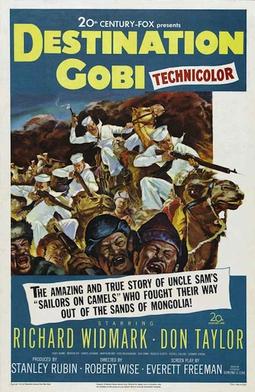
For every war film documenting a huge world-turning event like Saving Private Ryan, The Longest Day, A Bridge too Far, there are hundreds and thousands of other stories out there waiting to be told. And sometimes, it's good just to have a change of pace. These aren't stories that impacted thousands and millions of people or even altered the course of history. But as I've said before, dig a little and you'll always find some cool, very unique stories. Case in point, a 1953 World War II flick called Destination Gobi.
It's well into 1944 and with the tide of war officially turned toward the Allies, Chief Petty Officer Samuel McHale (Richard Widmark) is readying himself to head back into the fighting at Okinawa as part of the crew of the U.S.S. Enterprise. Well, that was his plan at least. He receives orders to report to a new office with an odd but very dangerous mission. McHale is going to be posted at a remote outpost in the Gobi Desert deep in Mongolia with a seven-man "garrison" tasked with observing weather patterns and how they will impact the fighting across the Pacific. The longtime Navy man wants nothing to do with the orders but ever the resolute soldier, he follows his duty and travels deep into the desert. Always used to having a ship's deck under his feet and water on all sides, McHale must adjust quickly at Argos Camp 6. Extremely isolated, the small camp must deal with limited/lousy supplies and growing rumors that Japanese forces are trying to find and destroy the camp (one of six all over the desert). McHale and the men must brace for what's coming, and oddly enough, a nomadic Mongol tribe that could help them.
What an interesting premise. I'll get into some details and depth in a bit, but the premise for 'Gobi' is incredibly interesting, and supposedly a true story. An opening title card introduces the basic premise as listed in Navy records as 'Saddle for Gobi.' Is it true? I hope. It's certainly fun to watch. From director Robert Wise, this is a World War II story far removed from the European battlefront and the island-hopping strategy of the Pacific fighting. It turns into far more of a survival story with some odd detours thrown in along the way. 'Gobi' covers a lot of ground in its 90-minute running time to the point I'd say it loses some of its effectiveness by the end credits. For the most part though, the ride is always fun and interesting, including some solid performances from an up and coming cast.
Start with Richard Widmark in a part that feels similar to several roles he did during the early 1950s as he carved out a niche and reputation for himself, many of them for 20th Century Fox. He specialized early on in manly roles like this, a tough guy leading other tough guys in movies like Halls of Montezuma, The Frogmen, and Take the High Ground!. Widmark spent years trying to distance himself from villainous roles like Kiss of Death that helped put him on the map, but he certainly did a good job. As Navy lifer Samuel McHale, Widmark is the strong, solid and resolute leader of Men who wants nothing more than to survive, to get through this hellish situation and to get his men through it too, even if it isn't his ideal posting. He's one of my favorite actors anyways, and this is a solid lead role.
Who else to look for at this isolated weather station in the sand-swept Gobi desert? Some familiar faces (and voices) to round out the inexperienced crew. The group includes Don Taylor as McHale's right-hand man, Max Showalter as the fast-talking ladies man of sorts, Darryl Hickman, Martin Milner, Ross Bagdasarian (creator of Alvin and the Chipmunks), Russell Collins, and an uncredited Earl Holliman. We don't learn much about the crew, just some off-hand comments about their backgrounds. Still, I liked the dynamic among the group as their scenes early-on show that natural, affable back-and-forth that seems realistic among men forced to get through such a difficult posting like the middle of the Gobi desert hundreds of miles from any sort of help. Nothing flashy, but some good parts.
It then proceeds to fall apart a touch because....well, because. An interesting angle is added when a tribe of nomadic Mongols, led by Kengtu (Murvyn Vye), a chieftain always looking out for the best interest of his people. At first, that involves helping the desert-bound American sailors and then it doesn't and then it does. The story proceeds to bounce around a ton among the survivors, their bickering, the Mongols, the patrolling Japanese and a surprising interlude across the Chinese border into a Japanese-held village. With just 90 minutes to do its thing, 'Gobi' simply tackles too much. In the last 20 minutes, things really fall apart. Is it the truth of the story behind the Navy files? Have things been stretched a little bit? Also look for Rodolfo Acosta, Judy Dan and Leonard Strong as some of Kengtu's tribesmen and tribeswomen.
A mixed bag in the end, but a mostly positive mixed bag. Now if they could just have fixed that last act!
Destination Gobi (1953): ** 1/2 /****
The Sons of Katie Elder
"First, we reunite, then find Ma and Pa's killer...then read some reviews."
Showing posts with label Richard Widmark. Show all posts
Monday, April 13, 2015
Wednesday, March 11, 2015
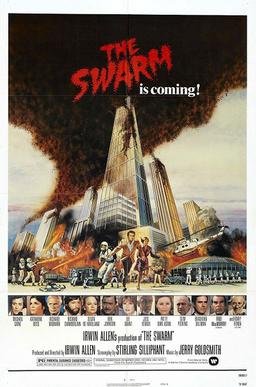
The Swarm
I'm not always the quickest learner so I'll take the blame for this one. I guess I should have learned quicker. While there are exceptions, there just weren't many good disaster movies in the 1970s and then into the 1980s. So for every Airport, Towering Inferno and Poseidon Adventure, there are movies like 1978's The Swarm. Yep, another nail in the coffin of a genre struggling to hold on for dear life.
At an isolated army installation in the American Southwest, a heavily armed patrol slowly navigates the eerily empty facility. What the hell happened here? Deep underground at the installation, the investigating patrol finds several dead bodies and a few lucky survivors, including a mysterious doctor, Brad Crane (Michael Caine), who says he's an expert on the world of insects. A much larger army force, commanded by crotchety General Slater (Richard Widmark), arrives soon after, and they're too stunned at what they find and what Crane claims is behind the mysterious attack. The responsibility goes to....an immense swarm of African killer bees. Bees!!!! Making the situation worse, there's no cure for the bees' surprisingly venomous sting and seemingly no one is immune. It looks like nothing can stop the not-so-fast moving bees, and they're heading for Houston.
Sometimes you DO just know. When this 1978 disaster flick from director Irwin Allen -- Master of Disaster flicks -- popped up on Turner Classic Movies' schedule, I had to set it to record. I HAD to. Movies with casts like this don't pop up too often so I had to at least give it a try. Worst case, it's just entertaining in a bad, guilty pleasure fashion, right? Well, that's what you would think. This wasn't even good in a 'So bad it's good' way. It just isn't entertaining. Apparently, I'm not the only one who thinks so. 'Swarm' is on all sorts of worst movies ever made lists and bombed in epic fashion in theaters back in 1978. If that's not a recipe for success, I don't know what is!
Maybe the most frightening thing to take away from this bee-disaster flick is that there's a director's cut available out there clocking in at 156 minutes. The TCM version I saw was an already painfully long 116 minutes. God knows what else could be expanded on in an additional 40 minutes because I was losing interest in the shortened version at the 60-minute mark. For goodness sake, 'Swarm' utilizes a love triangle featuring Olivia de Havilland, Ben Johnson and Fred MacMurray (in his last role) as a subplot! Yes, because that's what we need, three Hollywood legends in a senior citizen love triangle in a disaster flick where a swarm of killer bees are the villains. Seems reasonable, don't it? I can't say I'd be too interested in seeking out that longer version of a dud like this.
Star Michael Caine has said this is the worst movie he ever made, and it's hard to disagree. As the insect/bug specialist, Caine looks to be immensely bored throughout. If there's a slightly redeeming quality in 'Swarm,' it's that the cast is epically impressive. Now are any of them given much of anything to do? That would be a big N-O, but still, look at all those Hollywood stars! Along with Caine and perpetually angry Widmark, look for Katharine Ross, Henry Fonda and Richard Chamberlain as some of the scientists tasked with halting the advance of the bees. Also look for Lee Grant, Jose Ferrer, Patty Duke, Bradford Dillman, Slim Pickens, and Cameron Mitchell in other supporting parts, some more painfully forced than others.
Things unfortunately develop in more spoof-fashion than straight disaster flick. How many slow motion bee attack scenes can we witness before it just becomes laughable? Because the movie is about bees, we get one hilarious scene after another about our very talented cast discussing what the bees' intentions are, if they're seeking revenge, if there is a major bee plan to take over the world. It's all done so straight that it becomes spoof-like, and that's never a good thing. The problem is there just isn't that one reason to sit back and watch this one, and that's considering the star power on hand. The cast is given little to nothing to do, the killer bees are a laughable "villain," and the entertainment value just isn't there. Give this one a wide berth.
The Swarm (1978): */****
At an isolated army installation in the American Southwest, a heavily armed patrol slowly navigates the eerily empty facility. What the hell happened here? Deep underground at the installation, the investigating patrol finds several dead bodies and a few lucky survivors, including a mysterious doctor, Brad Crane (Michael Caine), who says he's an expert on the world of insects. A much larger army force, commanded by crotchety General Slater (Richard Widmark), arrives soon after, and they're too stunned at what they find and what Crane claims is behind the mysterious attack. The responsibility goes to....an immense swarm of African killer bees. Bees!!!! Making the situation worse, there's no cure for the bees' surprisingly venomous sting and seemingly no one is immune. It looks like nothing can stop the not-so-fast moving bees, and they're heading for Houston.
Sometimes you DO just know. When this 1978 disaster flick from director Irwin Allen -- Master of Disaster flicks -- popped up on Turner Classic Movies' schedule, I had to set it to record. I HAD to. Movies with casts like this don't pop up too often so I had to at least give it a try. Worst case, it's just entertaining in a bad, guilty pleasure fashion, right? Well, that's what you would think. This wasn't even good in a 'So bad it's good' way. It just isn't entertaining. Apparently, I'm not the only one who thinks so. 'Swarm' is on all sorts of worst movies ever made lists and bombed in epic fashion in theaters back in 1978. If that's not a recipe for success, I don't know what is!
Maybe the most frightening thing to take away from this bee-disaster flick is that there's a director's cut available out there clocking in at 156 minutes. The TCM version I saw was an already painfully long 116 minutes. God knows what else could be expanded on in an additional 40 minutes because I was losing interest in the shortened version at the 60-minute mark. For goodness sake, 'Swarm' utilizes a love triangle featuring Olivia de Havilland, Ben Johnson and Fred MacMurray (in his last role) as a subplot! Yes, because that's what we need, three Hollywood legends in a senior citizen love triangle in a disaster flick where a swarm of killer bees are the villains. Seems reasonable, don't it? I can't say I'd be too interested in seeking out that longer version of a dud like this.
Star Michael Caine has said this is the worst movie he ever made, and it's hard to disagree. As the insect/bug specialist, Caine looks to be immensely bored throughout. If there's a slightly redeeming quality in 'Swarm,' it's that the cast is epically impressive. Now are any of them given much of anything to do? That would be a big N-O, but still, look at all those Hollywood stars! Along with Caine and perpetually angry Widmark, look for Katharine Ross, Henry Fonda and Richard Chamberlain as some of the scientists tasked with halting the advance of the bees. Also look for Lee Grant, Jose Ferrer, Patty Duke, Bradford Dillman, Slim Pickens, and Cameron Mitchell in other supporting parts, some more painfully forced than others.
Things unfortunately develop in more spoof-fashion than straight disaster flick. How many slow motion bee attack scenes can we witness before it just becomes laughable? Because the movie is about bees, we get one hilarious scene after another about our very talented cast discussing what the bees' intentions are, if they're seeking revenge, if there is a major bee plan to take over the world. It's all done so straight that it becomes spoof-like, and that's never a good thing. The problem is there just isn't that one reason to sit back and watch this one, and that's considering the star power on hand. The cast is given little to nothing to do, the killer bees are a laughable "villain," and the entertainment value just isn't there. Give this one a wide berth.
The Swarm (1978): */****
Wednesday, January 28, 2015
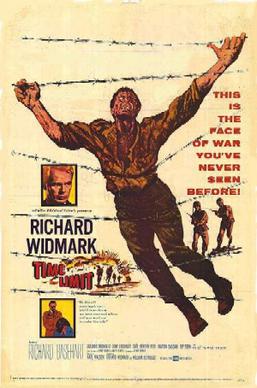
Time Limit
The Korean War helped change things when it came to portrayals of war in film. Sure, there were still huge, blockbuster epics to come like The Longest Day and The Greatest Escape. The nastiness of the war, changing times in America, darker methods of war, it all added up to something new, different and often times, uncomfortable. This wasn't soldier shoots soldier anymore. Part mystery, part prisoner of war drama, part courtroom drama, here's 1957's little-known Time Limit.
An officer in the Judge Advocate General's Corps, Colonel William Edwards (Richard Widmark) is wrapping up interviews for a messy little case that has crossed his desk. An Army major, Harry Cargill (Richard Basehart), has been accused of collaborating with the North Koreans during his time in a prisoner of war camp during the Korean War. Edwards has 14 other witnesses testifying what Cargill did in the P.O.W. camp and complicating matters is that Cargill absolutely refuses to defend himself, turning down legal counsel. If anything, it seems that the officer in question wants to be found guilty and prosecuted to the fullest extent, even if that court martial hearing sentences him to death. It seems like an open and shut case, and that's what makes Edwards curious. Something doesn't add up. What happened in that mountaintop prisoner of war camp in North Korea?
Despite the talent assembled to round out the cast in this 1957 military legal drama, I'd never really heard of this film. I've never seen it pop up in TV listings, and the DVD isn't readily available in Best Buys and Barnes and Nobles. But that Christmas stuff, you get some good presents, and I got this flick! What an interesting movie, one that doesn't get the attention and respect it deserves. Actor Karl Malden takes a crack at the directing chair (his only directing effort) and doesn't disappoint. It is a military film ahead of its time, willing to tackle some brutal, harsh realities about the changing concepts of war. As I mentioned earlier, this isn't Soldier A shoots Soldier B. This is total war that goes far beyond the battlefield. Maybe it's because 'Time' tackles those difficult to talk about subjects that its legacy has been buried over the years. Moral of the story? It's worth catching up with.
A co-producer who also encouraged Malden to direct the film, Widmark clearly had an interest in bringing this film to life. He's always been one of my favorite actors, and this is a performance that clearly shows off his ability. Some of his most well-known performances are big and bold, but this one is understated and subtle (and the better for it). His Colonel Edwards just wants to find out the truth, however dark it may be. It's also a performance that foreshadows Widmark's part four years later in Judgment at Nuremberg, a somewhat similarly-themed courtroom drama. Basehart gets the showier part as Major Cargill, an officer and former prisoner clearly struggling with some past demons. It's never over the top, just emotionally charged. Instead, this is a part of a man just trying to hold it all together as a secret from his past tears him apart.
'Time' doesn't have a huge cast, but there isn't a weak link in the bunch. Dolores Michaels provides a bit of a sexy secretary interest as Edwards' secretary, Jean, while Martin Balsam plays Sergeant Baker, Edwards' adjutant. I really liked and appreciated the dynamic among the trio in the office, three different people with different backgrounds all working toward the same goal. Some of the witnesses Edwards seeks out include June Lockhart as Cargill's worrying wife and Rip Torn as Lt. Miller, a fellow prisoner and bunkmate of Cargill's from the POW camp. Also look for Carl Benton Reid as Edwards' superior officer with a vested interest in the case and Khigh Dhiegh as Colonel Kim, the brutal POW camp commander.
Clocking in at 96 minutes, 'Time' is based on a play and definitely has that distinct feel. Malden's focus is on the actors, letting the camera linger for long, dialogue-driven scenes without a cut. Much of the movie is shot in Edwards' office with a quick departure near the halfway point to visit Lockhart's wife character. That lack of style oddly, gives 'Time' some style in a weird way. It's filmed in black and white and with some interesting camera angles, adds an unforeseen sense of tension that helps build the mystery. It isn't always the quickest movie -- especially the first 45 minutes -- but that momentum picks up in a huge way about the 45-minute mark as things start to reveal themselves.
I thought I had the twist pegged, but I was wrong. The final act features two different twists, one working just as well as the other. These aren't just twists for the sake of a surprise or shock either. These are genuine twists that work while also asking some tough questions. An underrated flick that deserves more of a reputation. Definitely worth checking out.
Time Limit (1957): ***/****
An officer in the Judge Advocate General's Corps, Colonel William Edwards (Richard Widmark) is wrapping up interviews for a messy little case that has crossed his desk. An Army major, Harry Cargill (Richard Basehart), has been accused of collaborating with the North Koreans during his time in a prisoner of war camp during the Korean War. Edwards has 14 other witnesses testifying what Cargill did in the P.O.W. camp and complicating matters is that Cargill absolutely refuses to defend himself, turning down legal counsel. If anything, it seems that the officer in question wants to be found guilty and prosecuted to the fullest extent, even if that court martial hearing sentences him to death. It seems like an open and shut case, and that's what makes Edwards curious. Something doesn't add up. What happened in that mountaintop prisoner of war camp in North Korea?
Despite the talent assembled to round out the cast in this 1957 military legal drama, I'd never really heard of this film. I've never seen it pop up in TV listings, and the DVD isn't readily available in Best Buys and Barnes and Nobles. But that Christmas stuff, you get some good presents, and I got this flick! What an interesting movie, one that doesn't get the attention and respect it deserves. Actor Karl Malden takes a crack at the directing chair (his only directing effort) and doesn't disappoint. It is a military film ahead of its time, willing to tackle some brutal, harsh realities about the changing concepts of war. As I mentioned earlier, this isn't Soldier A shoots Soldier B. This is total war that goes far beyond the battlefield. Maybe it's because 'Time' tackles those difficult to talk about subjects that its legacy has been buried over the years. Moral of the story? It's worth catching up with.
A co-producer who also encouraged Malden to direct the film, Widmark clearly had an interest in bringing this film to life. He's always been one of my favorite actors, and this is a performance that clearly shows off his ability. Some of his most well-known performances are big and bold, but this one is understated and subtle (and the better for it). His Colonel Edwards just wants to find out the truth, however dark it may be. It's also a performance that foreshadows Widmark's part four years later in Judgment at Nuremberg, a somewhat similarly-themed courtroom drama. Basehart gets the showier part as Major Cargill, an officer and former prisoner clearly struggling with some past demons. It's never over the top, just emotionally charged. Instead, this is a part of a man just trying to hold it all together as a secret from his past tears him apart.
'Time' doesn't have a huge cast, but there isn't a weak link in the bunch. Dolores Michaels provides a bit of a sexy secretary interest as Edwards' secretary, Jean, while Martin Balsam plays Sergeant Baker, Edwards' adjutant. I really liked and appreciated the dynamic among the trio in the office, three different people with different backgrounds all working toward the same goal. Some of the witnesses Edwards seeks out include June Lockhart as Cargill's worrying wife and Rip Torn as Lt. Miller, a fellow prisoner and bunkmate of Cargill's from the POW camp. Also look for Carl Benton Reid as Edwards' superior officer with a vested interest in the case and Khigh Dhiegh as Colonel Kim, the brutal POW camp commander.
Clocking in at 96 minutes, 'Time' is based on a play and definitely has that distinct feel. Malden's focus is on the actors, letting the camera linger for long, dialogue-driven scenes without a cut. Much of the movie is shot in Edwards' office with a quick departure near the halfway point to visit Lockhart's wife character. That lack of style oddly, gives 'Time' some style in a weird way. It's filmed in black and white and with some interesting camera angles, adds an unforeseen sense of tension that helps build the mystery. It isn't always the quickest movie -- especially the first 45 minutes -- but that momentum picks up in a huge way about the 45-minute mark as things start to reveal themselves.
I thought I had the twist pegged, but I was wrong. The final act features two different twists, one working just as well as the other. These aren't just twists for the sake of a surprise or shock either. These are genuine twists that work while also asking some tough questions. An underrated flick that deserves more of a reputation. Definitely worth checking out.
Time Limit (1957): ***/****
Monday, April 21, 2014
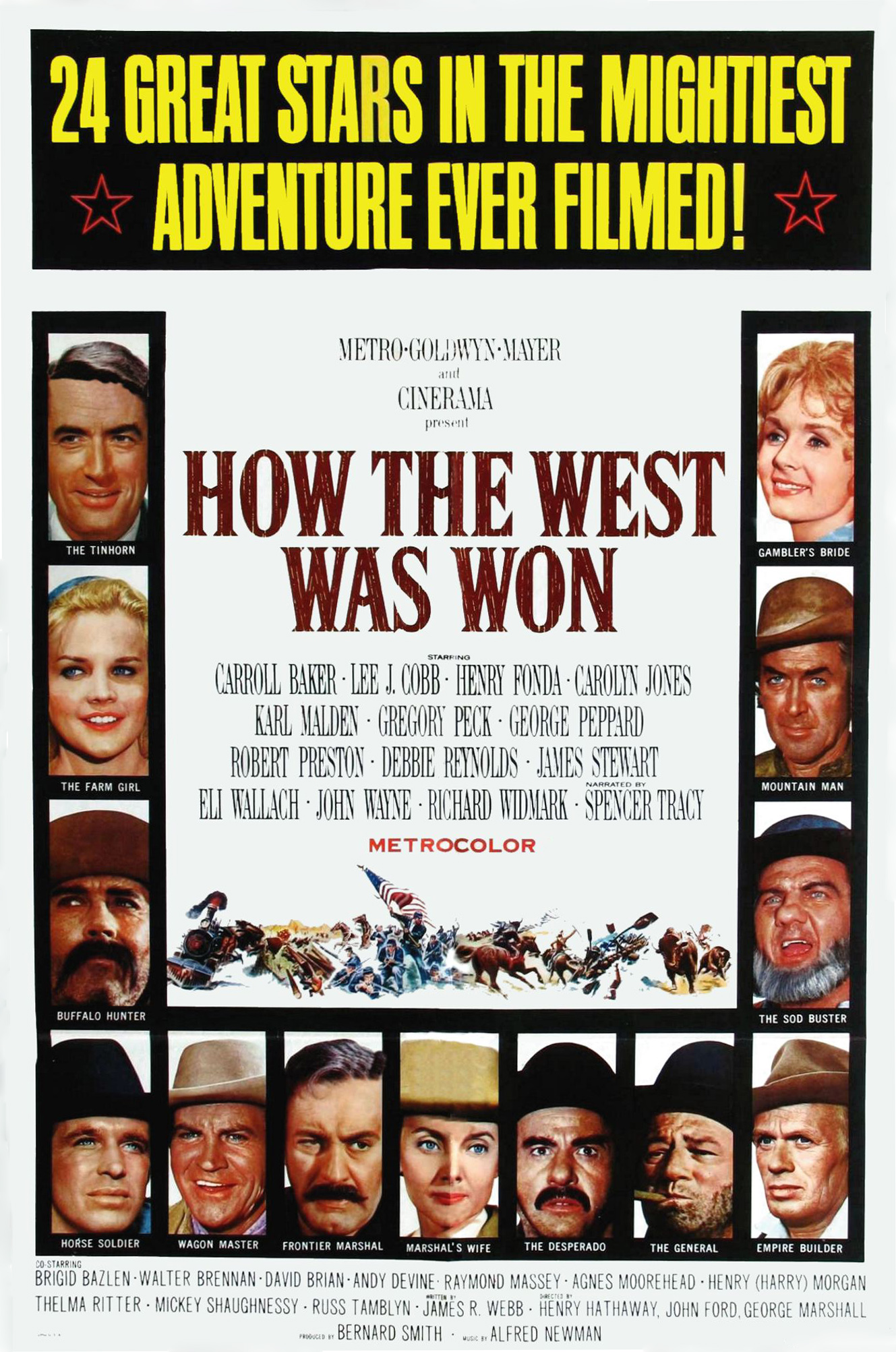
How the West Was Won
In the age of the epics -- the 1950s and 1960s -- some just stand above the rest. It's the stories, the cast, the scope. I don't love 1962's How the West Was Won but as far as epics go, there are very few in its neighborhood. There are obvious flaws, but when it works, it works in a big way. An impressive all-star cast, a story about the development of the American west and a shooting technique that is must-see. That's a winning formula.
A 162-minute film is broken up into five separate segments, the story following the Prescott-Rawlings family as it moves west and settles between the 1840s and the 1880s. It was directed by three different directors and covers a ton of ground. And away we go!
1. The Rivers (directed by Henry Hathaway): It's the 1840s, and the Prescott family, led by patriarch Zebulon (Karl Malden), is moving west and looking for a new life. In Zebulon's family is two daughters, Eve (Carroll Baker), looking for a new life in the west, and Lillith (Debbie Reynolds), wanting to stay in the far-more civilized East. In their dangerous travels on the rivers, they also meet Linus Rawlings (James Stewart), a mountain man with a canoe full of pelts.
Also starring: Lee Van Cleef, Walter Brennan, Agnes Moorehead, Brigid Bazlen.
2. The Plains (directed by Hathaway): Having worked for years on her own as a singer and dancer, Lillith Prescott (Reynolds) has just inherited a gold mine in the wake of the California gold rush. She heads west on a wagon train led by trail driver Richard Morgan (Robert Preston) with a gold-seeking gambler, Cleve Van Valen (Gregory Peck), also along too.
Also starring: Thelma Ritter.
3. The Civil War (directed by John Ford): The war between the states in its early months, young Zeb Rawlings (George Peppard) leaves home with the blessing of his mother, Eve, to join the Ohio volunteers in the fighting. Like so many others, he thinks the war will be full of glory and be over quickly. Zeb finds out how very wrong he is at the bloody battle of Shiloh.
Also starring: John Wayne (as General Sherman), Russ Tamblyn (as a Confederate deserter), Harry Morgan (as General Grant), Andy Devine, Ken Curtis, Raymond Massey (as Abraham Lincoln).
4. The Railroad (directed by George Marshall): In the years following the Civil War, railroad companies race across the U.S. to link the two coasts. Now in the cavalry, Zeb Rawlings (Peppard) finds himself balancing out what his duty requires of him with what he knows is right, the railroad, including brutal supervisor Mike King (Richard Widmark), pushing the Arapahoes to their limit.
Also starring: Henry Fonda as Jethro Stuart, a former mountain man.
5. The Outlaws (directed by Hathaway): Having left the cavalry behind, Zeb Rawlings is now a family man with two kids, now trying to leave his profession as a lawman behind. He receives a letter from his aunt, Lillith (Reynolds), and readies the family to move. As they travel though, Zeb runs into Charlie Gant (Eli Wallach), a notorious outlaw gunning for Zeb.
Also starring: Lee J. Cobb, Carolyn Jones.
This is a movie that's simply put, BIG. It was filmed in Cinerama, three cameras filming each scene and then splicing the action together. The result? An immense look at the expansion of the west. Shots look like panoramic paintings, putting a whole new scope on the growth and development of the American west. It is a beautiful movie. Certain sequences especially stand out -- the camera on a raft trying to survive river rapids, an Indian attack on a wagon train, a stampeding buffalo herd trampling a railroad camp, a runaway train during an attempted robbery -- over the course of the movie, but visually there just isn't a weak spot. I love composer Alfred Newman's score -- listen to an extended sample HERE -- as it gives a moving background to the story. Countless gorgeous filming locations, providing a great backdrop while also transitioning from segment to segment.
It had been years since I watched this movie straight through in one sitting before my recent revisit of this 1962 epic. As you compare the five separate segments, I don't think it's really in question which one is the strongest. It's John Ford's Civil War segment, doing in 20 minutes what entire movies couldn't do in bringing the Civil War to life. Quick, dark, visually striking and unsettling, it is a gem of a sequence, especially Peppard meeting Tamblyn's Confederate deserter after the battle. The second strongest segment for me is the opening 'Rivers' with Stewart, Baker, Reynolds and Malden all leaving a positive impression. All five segments could be stretched out to a feature length film on their own, but these two especially stand out. They get their message across in a quick window and in both cases left me wanting more. Kudos to Ford and Hathaway for their work here.
What struck me more on the rewatch was the other three segments. They are by no means bad segments, but they're just not as good as the other two. I've always thought the weakest was the Plains segment, things feeling too rushed in general. The same qualifies for the Railroad and Outlaws portions. By the time you take away the Entr'Acte, intermission, and Finale music, we're looking at a movie with five segments covered in about 150 minutes (give or take). None of these three are given a chance to breathe to the point they feel downright rushed. As for some other positives? I loved the transitional scenes -- narrated by Spencer Tracy, directed in uncredited fashion by Richard Thorpe -- that set things up, explaining how America has changed, how its people change. These quick montages provide the heart of the movie, almost like a documentary in some ways. Like any movie that tries to accomplish so much, there's good and bad. The positives -- especially the Civil War middle -- is enough to outweigh the negatives thankfully.
One of my biggest worries in reviewing this 1962 epic was that the cast is too big. There's no way I was gonna be able to get all those names tagged with a 200-character limit. Who stands out? Stewart i excellent as Linus Rawlings, Fonda is good in a quick part as Jethro Stuart, and Baker is very strong too. The best parts though are Debbie Reynolds as Lillith and George Peppard as Zeb, the two hearts of the family. One or both is in every segment, the audience seeing them age, learn and adapt as America grows with them. Their scenes together in the Outlaws portion ring especially true. However you cut it though, just an impressive cast from top to bottom, one of the best ever assembled for a Hollywood film.
A doozy of a movie for what it's trying to accomplish. It falls short at times, but this is a movie worth watching for what it represents alone. This is a throwback film, a true epic that strives to be something great. If it doesn't live up those high hopes, so be it. The effort is admirable, a fascinating story of America growing up over an extremely turbulent portion of its history. Oh, and Debbie Reynolds singing A Home in the Meadow (listen HERE) is a truly beautiful song, a fitting one for the movie.
How the West Was Won (1962): ***/****
A 162-minute film is broken up into five separate segments, the story following the Prescott-Rawlings family as it moves west and settles between the 1840s and the 1880s. It was directed by three different directors and covers a ton of ground. And away we go!
1. The Rivers (directed by Henry Hathaway): It's the 1840s, and the Prescott family, led by patriarch Zebulon (Karl Malden), is moving west and looking for a new life. In Zebulon's family is two daughters, Eve (Carroll Baker), looking for a new life in the west, and Lillith (Debbie Reynolds), wanting to stay in the far-more civilized East. In their dangerous travels on the rivers, they also meet Linus Rawlings (James Stewart), a mountain man with a canoe full of pelts.
Also starring: Lee Van Cleef, Walter Brennan, Agnes Moorehead, Brigid Bazlen.
2. The Plains (directed by Hathaway): Having worked for years on her own as a singer and dancer, Lillith Prescott (Reynolds) has just inherited a gold mine in the wake of the California gold rush. She heads west on a wagon train led by trail driver Richard Morgan (Robert Preston) with a gold-seeking gambler, Cleve Van Valen (Gregory Peck), also along too.
Also starring: Thelma Ritter.
3. The Civil War (directed by John Ford): The war between the states in its early months, young Zeb Rawlings (George Peppard) leaves home with the blessing of his mother, Eve, to join the Ohio volunteers in the fighting. Like so many others, he thinks the war will be full of glory and be over quickly. Zeb finds out how very wrong he is at the bloody battle of Shiloh.
Also starring: John Wayne (as General Sherman), Russ Tamblyn (as a Confederate deserter), Harry Morgan (as General Grant), Andy Devine, Ken Curtis, Raymond Massey (as Abraham Lincoln).
4. The Railroad (directed by George Marshall): In the years following the Civil War, railroad companies race across the U.S. to link the two coasts. Now in the cavalry, Zeb Rawlings (Peppard) finds himself balancing out what his duty requires of him with what he knows is right, the railroad, including brutal supervisor Mike King (Richard Widmark), pushing the Arapahoes to their limit.
Also starring: Henry Fonda as Jethro Stuart, a former mountain man.
5. The Outlaws (directed by Hathaway): Having left the cavalry behind, Zeb Rawlings is now a family man with two kids, now trying to leave his profession as a lawman behind. He receives a letter from his aunt, Lillith (Reynolds), and readies the family to move. As they travel though, Zeb runs into Charlie Gant (Eli Wallach), a notorious outlaw gunning for Zeb.
Also starring: Lee J. Cobb, Carolyn Jones.
This is a movie that's simply put, BIG. It was filmed in Cinerama, three cameras filming each scene and then splicing the action together. The result? An immense look at the expansion of the west. Shots look like panoramic paintings, putting a whole new scope on the growth and development of the American west. It is a beautiful movie. Certain sequences especially stand out -- the camera on a raft trying to survive river rapids, an Indian attack on a wagon train, a stampeding buffalo herd trampling a railroad camp, a runaway train during an attempted robbery -- over the course of the movie, but visually there just isn't a weak spot. I love composer Alfred Newman's score -- listen to an extended sample HERE -- as it gives a moving background to the story. Countless gorgeous filming locations, providing a great backdrop while also transitioning from segment to segment.
It had been years since I watched this movie straight through in one sitting before my recent revisit of this 1962 epic. As you compare the five separate segments, I don't think it's really in question which one is the strongest. It's John Ford's Civil War segment, doing in 20 minutes what entire movies couldn't do in bringing the Civil War to life. Quick, dark, visually striking and unsettling, it is a gem of a sequence, especially Peppard meeting Tamblyn's Confederate deserter after the battle. The second strongest segment for me is the opening 'Rivers' with Stewart, Baker, Reynolds and Malden all leaving a positive impression. All five segments could be stretched out to a feature length film on their own, but these two especially stand out. They get their message across in a quick window and in both cases left me wanting more. Kudos to Ford and Hathaway for their work here.
What struck me more on the rewatch was the other three segments. They are by no means bad segments, but they're just not as good as the other two. I've always thought the weakest was the Plains segment, things feeling too rushed in general. The same qualifies for the Railroad and Outlaws portions. By the time you take away the Entr'Acte, intermission, and Finale music, we're looking at a movie with five segments covered in about 150 minutes (give or take). None of these three are given a chance to breathe to the point they feel downright rushed. As for some other positives? I loved the transitional scenes -- narrated by Spencer Tracy, directed in uncredited fashion by Richard Thorpe -- that set things up, explaining how America has changed, how its people change. These quick montages provide the heart of the movie, almost like a documentary in some ways. Like any movie that tries to accomplish so much, there's good and bad. The positives -- especially the Civil War middle -- is enough to outweigh the negatives thankfully.
One of my biggest worries in reviewing this 1962 epic was that the cast is too big. There's no way I was gonna be able to get all those names tagged with a 200-character limit. Who stands out? Stewart i excellent as Linus Rawlings, Fonda is good in a quick part as Jethro Stuart, and Baker is very strong too. The best parts though are Debbie Reynolds as Lillith and George Peppard as Zeb, the two hearts of the family. One or both is in every segment, the audience seeing them age, learn and adapt as America grows with them. Their scenes together in the Outlaws portion ring especially true. However you cut it though, just an impressive cast from top to bottom, one of the best ever assembled for a Hollywood film.
A doozy of a movie for what it's trying to accomplish. It falls short at times, but this is a movie worth watching for what it represents alone. This is a throwback film, a true epic that strives to be something great. If it doesn't live up those high hopes, so be it. The effort is admirable, a fascinating story of America growing up over an extremely turbulent portion of its history. Oh, and Debbie Reynolds singing A Home in the Meadow (listen HERE) is a truly beautiful song, a fitting one for the movie.
How the West Was Won (1962): ***/****
Wednesday, February 26, 2014
Rollercoaster
It took me a couple visits to Six Flags Great America, and some peer pressure to boot (damn 8th grade field trip), but I eventually learned to love riding a rollercoaster. Do you? It's easy to see the appeal, but I've learned enough not to push people to get on a rollercoaster if they don't want to. The heights, the speed, the upside-down loops, and oh yeah, the potential to die horribly should something go wrong. That's nothing, right? Well, if you're wavering over ever riding an amusement park ride like that, steer clear of a 1977 disaster movie, Rollercoaster.
At a fan-favorite amusement park on the west coast, a man (Timothy Bottoms) walks around the park, taking part in some carnival games, eating some cotton candy, and then late in the day, he pulls a radio transmitter from his pocket and explodes a bomb on the park's oldest, safest and most loved rollercoaster, killing all aboard the ride. An inspector from the Department of Standards and Safety, Harry Calder (George Segal) is called in to investigate, his most recent inspection turning up nothing three months earlier. Just days later on the east coast, another rollercoaster accident claims more lives. The rides in ruins with no clues or evidence, Harry is convinced the accidents are tied together, especially when he finds his own connection about the owners of the amusement parks. Can he convince someone of his theory? He may not have to. The FBI, including lead agent Hoyt (Richard Widmark), have been called in to investigate. Can they stop the bomber before he strikes again?
With the success of the disaster movie wave waning some by 1977, director James Goldstone's film hit theaters the same summer as a mildly successful movie, Star Wars, and managed to hold its own, finding a niche with audiences. I liked this movie, didn't love it. It's cool to see a disaster movie that doesn't depend on some natural calamity or a giant skyscraper on fire, but instead a suspense story that is uncomfortable, really gets the adrenaline going at times, and works because...well, let's face it. Something like this could happen. For the most part, it avoids all the pratfalls that helped doom the genre. It never gets too jokey or goofy, never feels like we're watching a novelty film, there's no huge all-star cast. This is a movie about the build-up and the suspense, not a gimmick.
As for the cast, there really isn't a huge listing. George Segal has always been one of my favorites, and I liked him a lot here as Calder, the inspector who feels some responsibility for the bombings (it was his inspection) even though it wasn't his fault. He's Joe Everyman, a regular guy trying to do the right thing. That's tough when everyone around him is seemingly challenged. Richard Widmark does a good job in that department as Hoyt, the veteran FBI agent who, dammit, is going to do things his way and isn't going to take any advice from some wanna-be investigator. Segal and Widmark are the stars though, their arguments and discussions about how to handle things providing some of the movie's strongest moments. In the meaningless cameo department, Henry Fonda is around for two scenes as Davenport, Calder's boss who he's always busting his balls about one thing or another. The same for Harry Guardino as a police officer kinda attached to the case who hangs around for a couple scenes.
And then there's that bomber fellow, played to perfection by Timothy Bottoms. An underrated actor who never became a big star, Bottoms is listed here only as 'Young Man.' He's never given a name or any background, leaving his intentions or motivations in the dark. He says to Calder at one point over the phone that it's all about the money, but something else we never really learn about seems to be lurking. Would it have been nice to get a little explanation? I'd think so, but it works without it just the same. This guy doesn't care if lots of people get killed. He's going to accomplish what he wants. Bottoms does a creepy, sinister and underplayed job here. The character doesn't seem to have a pulse until late in the movie, a monotone delivery and calm mannerisms adding to that creepy nature. A solid part, avoiding as many cliches and stereotypes of disaster movie villains, suspense/thrillers too about psychopaths, madmen and murderers.
For the most part here, it's the set pieces that work. Well, two out of three at least. The opening bombing is slowly developed, tension hanging in the air just waiting for the explosion. Bottoms is at his eerie sinister best in this scene, not saying a word as he moves very deliberately around the park waiting for his chance. When the explosion comes, it's startling and unsettling as expected. The same for the finale, Calder, Hoyt and a team of agents trying to find the bomber as a new rollercoaster is unveiled to throngs of people, an extended sequence that takes most of 30 minutes. The weak point is in the middle, Bottoms' bomber sending Calder and the agents on a wild goose chase across a park as he tries to get his hands on a $1 million dollar ransom. His solution? Have Calder -- communicating via radio -- go on a bunch of rides to lose his tail. The potential is there, but the scene just keeps going, almost 20 minutes of painfully slow build-up with no real payoff. Still, a .667 batting average ain't bad, is it?
Overall, there's some cool positives. It was filmed on location at several actual amusement parks (talk about a whole bunch of positive advertisement, huh?!?), including Ocean View Park in Norfolk (the first sequence), Kings Dominion in Richmond (the middle sequence), making that long sequence very bearable, and Six Flags Magic Mountain for the finale. The actual parks provide some cool backdrops for the developing story, as well as a quick detour later to Navy Pier and the Hyatt Regency in Chicago. So what to say in the end? It's a good movie with some really solid moments that's hamstrung by some really slow-moving sequences. Worth it, an entertaining disaster movie. Also worth mentioning? Look for a young Helen Hunt as Segal's daughter and Steve Guttenberg in a blink and you'll miss it appearance.
Rollercoaster (1977): ** 1/2 /****
At a fan-favorite amusement park on the west coast, a man (Timothy Bottoms) walks around the park, taking part in some carnival games, eating some cotton candy, and then late in the day, he pulls a radio transmitter from his pocket and explodes a bomb on the park's oldest, safest and most loved rollercoaster, killing all aboard the ride. An inspector from the Department of Standards and Safety, Harry Calder (George Segal) is called in to investigate, his most recent inspection turning up nothing three months earlier. Just days later on the east coast, another rollercoaster accident claims more lives. The rides in ruins with no clues or evidence, Harry is convinced the accidents are tied together, especially when he finds his own connection about the owners of the amusement parks. Can he convince someone of his theory? He may not have to. The FBI, including lead agent Hoyt (Richard Widmark), have been called in to investigate. Can they stop the bomber before he strikes again?
With the success of the disaster movie wave waning some by 1977, director James Goldstone's film hit theaters the same summer as a mildly successful movie, Star Wars, and managed to hold its own, finding a niche with audiences. I liked this movie, didn't love it. It's cool to see a disaster movie that doesn't depend on some natural calamity or a giant skyscraper on fire, but instead a suspense story that is uncomfortable, really gets the adrenaline going at times, and works because...well, let's face it. Something like this could happen. For the most part, it avoids all the pratfalls that helped doom the genre. It never gets too jokey or goofy, never feels like we're watching a novelty film, there's no huge all-star cast. This is a movie about the build-up and the suspense, not a gimmick.
As for the cast, there really isn't a huge listing. George Segal has always been one of my favorites, and I liked him a lot here as Calder, the inspector who feels some responsibility for the bombings (it was his inspection) even though it wasn't his fault. He's Joe Everyman, a regular guy trying to do the right thing. That's tough when everyone around him is seemingly challenged. Richard Widmark does a good job in that department as Hoyt, the veteran FBI agent who, dammit, is going to do things his way and isn't going to take any advice from some wanna-be investigator. Segal and Widmark are the stars though, their arguments and discussions about how to handle things providing some of the movie's strongest moments. In the meaningless cameo department, Henry Fonda is around for two scenes as Davenport, Calder's boss who he's always busting his balls about one thing or another. The same for Harry Guardino as a police officer kinda attached to the case who hangs around for a couple scenes.
And then there's that bomber fellow, played to perfection by Timothy Bottoms. An underrated actor who never became a big star, Bottoms is listed here only as 'Young Man.' He's never given a name or any background, leaving his intentions or motivations in the dark. He says to Calder at one point over the phone that it's all about the money, but something else we never really learn about seems to be lurking. Would it have been nice to get a little explanation? I'd think so, but it works without it just the same. This guy doesn't care if lots of people get killed. He's going to accomplish what he wants. Bottoms does a creepy, sinister and underplayed job here. The character doesn't seem to have a pulse until late in the movie, a monotone delivery and calm mannerisms adding to that creepy nature. A solid part, avoiding as many cliches and stereotypes of disaster movie villains, suspense/thrillers too about psychopaths, madmen and murderers.
For the most part here, it's the set pieces that work. Well, two out of three at least. The opening bombing is slowly developed, tension hanging in the air just waiting for the explosion. Bottoms is at his eerie sinister best in this scene, not saying a word as he moves very deliberately around the park waiting for his chance. When the explosion comes, it's startling and unsettling as expected. The same for the finale, Calder, Hoyt and a team of agents trying to find the bomber as a new rollercoaster is unveiled to throngs of people, an extended sequence that takes most of 30 minutes. The weak point is in the middle, Bottoms' bomber sending Calder and the agents on a wild goose chase across a park as he tries to get his hands on a $1 million dollar ransom. His solution? Have Calder -- communicating via radio -- go on a bunch of rides to lose his tail. The potential is there, but the scene just keeps going, almost 20 minutes of painfully slow build-up with no real payoff. Still, a .667 batting average ain't bad, is it?
Overall, there's some cool positives. It was filmed on location at several actual amusement parks (talk about a whole bunch of positive advertisement, huh?!?), including Ocean View Park in Norfolk (the first sequence), Kings Dominion in Richmond (the middle sequence), making that long sequence very bearable, and Six Flags Magic Mountain for the finale. The actual parks provide some cool backdrops for the developing story, as well as a quick detour later to Navy Pier and the Hyatt Regency in Chicago. So what to say in the end? It's a good movie with some really solid moments that's hamstrung by some really slow-moving sequences. Worth it, an entertaining disaster movie. Also worth mentioning? Look for a young Helen Hunt as Segal's daughter and Steve Guttenberg in a blink and you'll miss it appearance.
Rollercoaster (1977): ** 1/2 /****
Friday, February 1, 2013
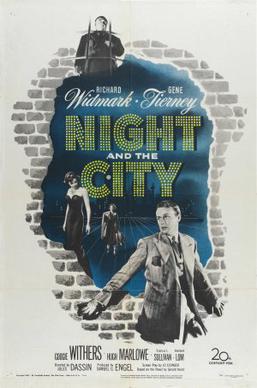
Night and the City
A director with over 20 credits to his name, Jules Dassin has his fair share of classics and memorable movies. But as a director, he hit his stride and reeled off a crazy list of film noir successes in the late 1940s including Brute Force, Thieves' Highway, The Naked City, and welcoming in the new decade, 1950's Night and the City.
An American living in London and trying to make things work with his longtime girlfriend, Mary (Gene Tierney), Harry Fabian (Richard Widmark) wants nothing more than to make it big and make a name for himself. The only problem? Harry has no real charm or talent to do it other than his own charm. In other words, he's a hustler and a con man, always looking for the big thing that will rocket him to the top. In debt and in trouble, Harry might finally have found his in. He meets Gregorious (real-life strongman/wrestler Stanislaus Zbyszko), an internationally renowned wrestler trying to build up the wrestling community/shows in London. It seems like a sure thing, an easy way to make a ton of money, but there's another problem. Gregorious' son, Kristo (Herbert Lom), already has a stranglehold on London wrestling and isn't going to give it away easily.
Released in the heyday of the film noir, 'City' has a trump card that makes it different (and better) from many other noirs of the time. I always think of noirs as taking places in NYC, Los Angeles, any number of small, grimy American towns with all sorts of shady dealings going on in the back alleys. As for this film? Dassin doesn't film his noir in a studio or back lot, he shot on location in and around London. It's a great look to the film, giving the sense of another character in the already incredibly dark story. Sure, much of the story takes place inside (in a studio), but whenever possible, Dassin shot on the streets, alleys, docks and landmarks of London. Filming in black and white, Dassin plays on the usual noir conventions -- darkness, smoke and shadows -- and transports it to London. It's a beyond perfect choice.
Another convention of the noir genre is the general nastiness of the world. Anyone and everyone is looking out for themselves. In other words, always watch your back. Even in the nastiest of movies, there was always that one beacon of light, one good person. Beyond a poor dock owner (Maureen Delaney) who's mixed up in the black market but a good person, there's nary a redeemable character anywhere in sight. In terms of story alone, this is easily one of the darkest, most cynical film noirs I've ever seen. We see the London criminal underworld in all that darkness. But with a talented director like Dassin behind the camera, it's an incredibly stylish if dark look at that world. Dassin uses his camera like few other directors of the time did, including one tracking shot from the back of an open-top convertible navigating London at night. It's a very simple, straightforward scene, but it looks great, and it was certainly far ahead of its time in style.
Still carving out a name for himself as an actor after the star-making role in Kiss of Death, Widmark again shows a knack for playing less than sympathetic characters (if significantly psychotic than Tommy Udo). If there was ever a doomed character in a film noir, Widmark's Harry Fabian has to be near the top of the list. The best part? He's not completely unsympathetic. Harry desperately wants to be something, but he's got no actual way to do it. Instead, he cons, hustles, talks and connives his way into everything he wants and needs. Widmark does a great job showing both sides of this character, but it's apparent from the start where things will end up. In his desperation, Harry simply pushes too far, pitting both sides against each other, and his precarious house of cards hangs in the balance. Another above average performance from a rising star.
And then there's the rest of the nastiness, a whole bunch of similarly despicable characters with their eyes always on the cash. Fabian works for Phillip Nosseross (Francis L. Sullivan), a condescending, immense man who owns a successful night club (maybe a strip club of sorts) with his wife, Helen (Googie Withers). She's also working with Fabian -- behind her husband's back -- to open up a nightclub with a forged license. In a smaller but still effective part, Lom is an ideal intense villain who does have a bit of a human side (however limited). The real-life strongman, Zbyszko is a natural on-screen, a scene-stealer as Gregorious, trying to create a name for a young Greco-Roman wrestler, Nikolas (Ken Richmond). His part is also highlighted by a brutal, knock-down fight with a rival wrestler, the Strangler (Mike Mazurki). Another halfway decent person is Hugh Marlowe's Adam, Mary's neighbor who may have his eyes set on her. Those are the big parts, but even the bit parts are nasty, all of which we see as Harry explores London.
I liked this one a lot right from the start. The only weakness comes in the finale. It's far from slow-moving, but the pacing takes a little time getting to where it wants to be. The issue is that anyone with a working brain knows exactly where it's going. It's not enough to ruin the movie -- not by a long shot -- but it's a minor flaw worth pointing out. An otherwise excellent film noir with a great cast, great look and perfect use of on-location shooting.
Night and the City (1950): ***/****
An American living in London and trying to make things work with his longtime girlfriend, Mary (Gene Tierney), Harry Fabian (Richard Widmark) wants nothing more than to make it big and make a name for himself. The only problem? Harry has no real charm or talent to do it other than his own charm. In other words, he's a hustler and a con man, always looking for the big thing that will rocket him to the top. In debt and in trouble, Harry might finally have found his in. He meets Gregorious (real-life strongman/wrestler Stanislaus Zbyszko), an internationally renowned wrestler trying to build up the wrestling community/shows in London. It seems like a sure thing, an easy way to make a ton of money, but there's another problem. Gregorious' son, Kristo (Herbert Lom), already has a stranglehold on London wrestling and isn't going to give it away easily.
Released in the heyday of the film noir, 'City' has a trump card that makes it different (and better) from many other noirs of the time. I always think of noirs as taking places in NYC, Los Angeles, any number of small, grimy American towns with all sorts of shady dealings going on in the back alleys. As for this film? Dassin doesn't film his noir in a studio or back lot, he shot on location in and around London. It's a great look to the film, giving the sense of another character in the already incredibly dark story. Sure, much of the story takes place inside (in a studio), but whenever possible, Dassin shot on the streets, alleys, docks and landmarks of London. Filming in black and white, Dassin plays on the usual noir conventions -- darkness, smoke and shadows -- and transports it to London. It's a beyond perfect choice.
Another convention of the noir genre is the general nastiness of the world. Anyone and everyone is looking out for themselves. In other words, always watch your back. Even in the nastiest of movies, there was always that one beacon of light, one good person. Beyond a poor dock owner (Maureen Delaney) who's mixed up in the black market but a good person, there's nary a redeemable character anywhere in sight. In terms of story alone, this is easily one of the darkest, most cynical film noirs I've ever seen. We see the London criminal underworld in all that darkness. But with a talented director like Dassin behind the camera, it's an incredibly stylish if dark look at that world. Dassin uses his camera like few other directors of the time did, including one tracking shot from the back of an open-top convertible navigating London at night. It's a very simple, straightforward scene, but it looks great, and it was certainly far ahead of its time in style.
Still carving out a name for himself as an actor after the star-making role in Kiss of Death, Widmark again shows a knack for playing less than sympathetic characters (if significantly psychotic than Tommy Udo). If there was ever a doomed character in a film noir, Widmark's Harry Fabian has to be near the top of the list. The best part? He's not completely unsympathetic. Harry desperately wants to be something, but he's got no actual way to do it. Instead, he cons, hustles, talks and connives his way into everything he wants and needs. Widmark does a great job showing both sides of this character, but it's apparent from the start where things will end up. In his desperation, Harry simply pushes too far, pitting both sides against each other, and his precarious house of cards hangs in the balance. Another above average performance from a rising star.
And then there's the rest of the nastiness, a whole bunch of similarly despicable characters with their eyes always on the cash. Fabian works for Phillip Nosseross (Francis L. Sullivan), a condescending, immense man who owns a successful night club (maybe a strip club of sorts) with his wife, Helen (Googie Withers). She's also working with Fabian -- behind her husband's back -- to open up a nightclub with a forged license. In a smaller but still effective part, Lom is an ideal intense villain who does have a bit of a human side (however limited). The real-life strongman, Zbyszko is a natural on-screen, a scene-stealer as Gregorious, trying to create a name for a young Greco-Roman wrestler, Nikolas (Ken Richmond). His part is also highlighted by a brutal, knock-down fight with a rival wrestler, the Strangler (Mike Mazurki). Another halfway decent person is Hugh Marlowe's Adam, Mary's neighbor who may have his eyes set on her. Those are the big parts, but even the bit parts are nasty, all of which we see as Harry explores London.
I liked this one a lot right from the start. The only weakness comes in the finale. It's far from slow-moving, but the pacing takes a little time getting to where it wants to be. The issue is that anyone with a working brain knows exactly where it's going. It's not enough to ruin the movie -- not by a long shot -- but it's a minor flaw worth pointing out. An otherwise excellent film noir with a great cast, great look and perfect use of on-location shooting.
Night and the City (1950): ***/****
Labels:
1950s,
Film Noir,
Gene Tierney,
Herbert Lom,
Hugh Marlowe,
Jules Dassin,
Richard Widmark
Tuesday, March 6, 2012
The Alamo (1960)
From the time I was introduced to Fess Parker as Davy Crockett in the
Disney episodes, I fell hook, line and sinker for the story of the
siege and fall of the Alamo. Even as a kid, I was able to appreciate the
courage, the sheer bravery of the defenders of the mission who
sacrificed themselves. But while I love the Disney Davy Crockett
episodes, one thing stands above. Right alongside The Great Escape as my
favorite movie, 1960's The Alamo.
It's February 1836 and the Mexican province of Texas is fighting for its freedom against Mexico and its dictator Antonio Lopez de Santa Anna. Leading the Texas revolutionaries is General Sam Houston (Richard Boone) who leads a nonexistent army and needs time to assemble and train a fighting force. In the town of San Antonio stands the Alamo, an old mission built by Franciscan monks over a 100 years earlier, a mission never intended for military use. With hopes of buying Houston the time he needs, Lt. Colonel William Travis (Laurence Harvey), knife-fighter and adventurer Jim Bowie (Richard Widmark), and famed frontiersman and former Congressman Davy Crockett (John Wayne) and 180-odd volunteers have forted up in the Alamo and are quickly surrounded by Santa Anna's army of over 7,000 men.
For star John Wayne, The Alamo was a labor of love, a film he had wanted to make for 14 years. He not only stars in it but also produced it and directed, his first ever film as a director. The story of the battle of the Alamo had long appealed to him -- the bravery, the heroism, the sacrifice -- and it was a story he wanted and needed to tell. He spared no expense in this truly epic production. In Bracketville, Texas, Wayne had a complete Alamo mission built, not to mention the town of San Antonio too in the middle of the Texas desert. The set -- dubbed Alamo Village -- becomes an additional character, adding a sense of realism and authenticity that no studio set would have done justice. The actual Alamo mission constructed is a sight to behold, a behemoth fortress that puts in perspective how difficult it would have been for 180 men to defend against an army of thousands. Wayne's love child, most will disagree with me, but I think it's a nearly perfect movie.
Playing three legendary figures, Wayne, Widmark and Harvey all deliver layered, nuanced performances, all of them unique and different from the rest. As Davy Crockett, Wayne is a huge presence. It's far from his best acting roles -- The Searchers, She Wore a Yellow Ribbon -- but Crockett of the time was a legend in his own right. Who better to play him than one of Hollywood's biggest stars? Much of the tension in the movie comes from the rivalry over command between Widmark's Bowie and Harvey's Travis, both actors representing themselves flawlessly. Widmark is fiery and hot-tempered, Harvey condescending, intelligent and an idealist, but they share a common goal. All differences aside, both men are willing to sacrifice themselves for the cause they're fighting. I love the banter, the back and forth, the chemistry among the three. Making a two-scene cameo as Houston, Boone too doesn't disappoint, making those two scenes more than just throwaway fluff.
In terms of actual screentime, the big three dominate, but as a director, Wayne assembled quite a cast. Ken Curtis plays Capt. Dickinson, Travis' second-in-command, with Joan O'Brien as his loyal, equally brave wife, Susannah. Crockett's Tennessee volunteers include singer Frankie Avalon as Smitty, the youngest Alamo defender, Chill Wills (in an Oscar-nominated turn) as Beekeeper, the drinking, jovial fighter, Denver Pyle as Thimblerig, the thinker and gambler, Hank Worden as the Parson, a preacher, with Chuck Roberson (a talented stunt man and Wayne's double) and Rudy Robbins as two unnamed Tennesseans, engaging in their running bit; 'Do that mean what I think it do?....It do.' Other defenders include Patrick Wayne as Lt. Bonham, the Alamo's famous messenger, John Dierkes as Jocko and his blind wife, Nell (Veda Ann Borg), Joseph Calleia as Juan Seguin, and Guinn Williams as Lt. Finn, and Jack Pennick as Sgt. Lightfoot. Two other worthwhile performances include singer Jester Hairston as Jethro, Bowie's slave, and the lovely Linda Cristal as Flaca, a young woman who shares a brief relationship with Wayne's Crockett.
Anyone remotely familiar with the historical facts knows that on March 6, 1836, the Mexican army assaulted the Alamo and wiped out the defenders to a man in a brutal, bloody massacre; extreme casualties on both sides. For a first-time director, Wayne puts together one of the all-time great battle sequences ever committed to film (if not the best ever). Almost five full minutes are shown as the Mexican army marches into formation around the doomed mission, an eerie silence hanging in the air for several seconds before the attack begins. The assault features hundreds of extras -- and in one scene, thousands -- as the garrison tries to repel the soldiers from the walls only to be ultimately overwhelmed. Cavalry, infantry, artillery, this defines the SPECTACLE of an epic. More than that, it is a moving sequence, each of the defenders we've come to know meeting their death. More details later on this, but Dimitri Tiomkin's score here is some of his best work. You can watch the battle sequence HERE, but to be appreciated, see it on a large, large screen.
Wayne's film has its share of detractors, and the complaints are fair (even if I disagree with them). The original version is 192 minutes and has its slower moments. Speechifying abound from James Edward Grant's script, but I eat this stuff up. Big speeches about freedom, Republic, right and wrong. That's John Wayne at his best. What does work? The very real emotion of the movie. Countless scenes impact me the more I watch this movie. Travis addressing his men, knowing death awaits those who stay, is beautifully simple. Watch it HERE. I love too, that Crockett's men dismount before him. Overlooking a field covered with casualties, Pyle's Thimblering says 'Speaks well for a man who's willing to die because he believes right is on his side...speaks well.' The night before the final assault is the most effective though, the defenders sitting quietly as they wait for the inevitable in the morning. Bowie releases Jethro, but the former slave decides to stay and fight. Roberson's Tennessean delivers a simple monologue that is profound in its outlook on life. And best of all, Crockett is asked by Thimblering, "What are you thinking about?" to which Crockett answers "Not thinking....just remembering." The last 45 minutes features some of the most perfect dialogue, emotion, music and spectacle of any movie ever. The Green Leaves of Summer (listen HERE), one of the most beautiful songs ever, playing over this sends chills up and down my back at the thought of it.
A criticism of The Alamo is the complete lack of historical accuracy as pertaining to the actual 1836 battle, and that's true. Wayne never set out to do a spot-on, dead-on accurate telling of the story. The 2004 film -- The Alamo -- does that. Instead, Wayne wanted to tell the story honoring the men who fought and died. They fight because they believe in what they're fighting for. Surrounded on all sides with no hope of reinforcement, the Alamo defenders stay inside the walls, knowing certain death awaits. They go out fighting, go down swinging. That is what Wayne was going for. I have difficulty even processing that sort of heroism. Crockett's Tennesseans dismounting before him illustrates that. Crockett has seen some of his men die already and doesn't want to see anymore die, but his men don't look to him for a decision. They do it because they want to, not because they're told. Say what you want about Wayne as a director/star with a heavy-handed message, but he got that part right to a T.
Initial reviews were mixed for The Alamo, forcing Wayne to cut 30 minutes from his 192-minute long movie. Those cut portions include Intro Music, an Intermission and Entr' Acte, and Exit Music with about 15-20 minutes of scenes, some better than others. The scene that truly needed to be in the final print was Parson's death, a beyond moving, effective scene as the battle becomes very real for Crockett and his men. Watch it HERE. The actual prints of the 192-minute version seem lost to the ages, but many of the deleted scenes are available at Youtube. Watch several of them in one video, HERE. Among them is Scotty's death, and a birthday party held for Lisa Dickinson, played by Wayne's daughter Aissa. As a fan of the movie, it's great to see any of this footage.
So what else can I ramble about? That's probably enough. I love this movie and everything about it. Wayne gets the spirit right, showing the bravery and heroism of the Alamo defenders as they faced certain death and didn't shy away from it. A true epic with scale and spectacle to impress all moviegoers. Great cast, an amazing set of the Alamo mission, Tiomkin's phenomenal score, and a battle sequence that few can even approach in terms of quality. They don't make them like this anymore.
The Alamo <---trailer (1960): ****/****
It's February 1836 and the Mexican province of Texas is fighting for its freedom against Mexico and its dictator Antonio Lopez de Santa Anna. Leading the Texas revolutionaries is General Sam Houston (Richard Boone) who leads a nonexistent army and needs time to assemble and train a fighting force. In the town of San Antonio stands the Alamo, an old mission built by Franciscan monks over a 100 years earlier, a mission never intended for military use. With hopes of buying Houston the time he needs, Lt. Colonel William Travis (Laurence Harvey), knife-fighter and adventurer Jim Bowie (Richard Widmark), and famed frontiersman and former Congressman Davy Crockett (John Wayne) and 180-odd volunteers have forted up in the Alamo and are quickly surrounded by Santa Anna's army of over 7,000 men.
For star John Wayne, The Alamo was a labor of love, a film he had wanted to make for 14 years. He not only stars in it but also produced it and directed, his first ever film as a director. The story of the battle of the Alamo had long appealed to him -- the bravery, the heroism, the sacrifice -- and it was a story he wanted and needed to tell. He spared no expense in this truly epic production. In Bracketville, Texas, Wayne had a complete Alamo mission built, not to mention the town of San Antonio too in the middle of the Texas desert. The set -- dubbed Alamo Village -- becomes an additional character, adding a sense of realism and authenticity that no studio set would have done justice. The actual Alamo mission constructed is a sight to behold, a behemoth fortress that puts in perspective how difficult it would have been for 180 men to defend against an army of thousands. Wayne's love child, most will disagree with me, but I think it's a nearly perfect movie.
Playing three legendary figures, Wayne, Widmark and Harvey all deliver layered, nuanced performances, all of them unique and different from the rest. As Davy Crockett, Wayne is a huge presence. It's far from his best acting roles -- The Searchers, She Wore a Yellow Ribbon -- but Crockett of the time was a legend in his own right. Who better to play him than one of Hollywood's biggest stars? Much of the tension in the movie comes from the rivalry over command between Widmark's Bowie and Harvey's Travis, both actors representing themselves flawlessly. Widmark is fiery and hot-tempered, Harvey condescending, intelligent and an idealist, but they share a common goal. All differences aside, both men are willing to sacrifice themselves for the cause they're fighting. I love the banter, the back and forth, the chemistry among the three. Making a two-scene cameo as Houston, Boone too doesn't disappoint, making those two scenes more than just throwaway fluff.
In terms of actual screentime, the big three dominate, but as a director, Wayne assembled quite a cast. Ken Curtis plays Capt. Dickinson, Travis' second-in-command, with Joan O'Brien as his loyal, equally brave wife, Susannah. Crockett's Tennessee volunteers include singer Frankie Avalon as Smitty, the youngest Alamo defender, Chill Wills (in an Oscar-nominated turn) as Beekeeper, the drinking, jovial fighter, Denver Pyle as Thimblerig, the thinker and gambler, Hank Worden as the Parson, a preacher, with Chuck Roberson (a talented stunt man and Wayne's double) and Rudy Robbins as two unnamed Tennesseans, engaging in their running bit; 'Do that mean what I think it do?....It do.' Other defenders include Patrick Wayne as Lt. Bonham, the Alamo's famous messenger, John Dierkes as Jocko and his blind wife, Nell (Veda Ann Borg), Joseph Calleia as Juan Seguin, and Guinn Williams as Lt. Finn, and Jack Pennick as Sgt. Lightfoot. Two other worthwhile performances include singer Jester Hairston as Jethro, Bowie's slave, and the lovely Linda Cristal as Flaca, a young woman who shares a brief relationship with Wayne's Crockett.
Anyone remotely familiar with the historical facts knows that on March 6, 1836, the Mexican army assaulted the Alamo and wiped out the defenders to a man in a brutal, bloody massacre; extreme casualties on both sides. For a first-time director, Wayne puts together one of the all-time great battle sequences ever committed to film (if not the best ever). Almost five full minutes are shown as the Mexican army marches into formation around the doomed mission, an eerie silence hanging in the air for several seconds before the attack begins. The assault features hundreds of extras -- and in one scene, thousands -- as the garrison tries to repel the soldiers from the walls only to be ultimately overwhelmed. Cavalry, infantry, artillery, this defines the SPECTACLE of an epic. More than that, it is a moving sequence, each of the defenders we've come to know meeting their death. More details later on this, but Dimitri Tiomkin's score here is some of his best work. You can watch the battle sequence HERE, but to be appreciated, see it on a large, large screen.
Wayne's film has its share of detractors, and the complaints are fair (even if I disagree with them). The original version is 192 minutes and has its slower moments. Speechifying abound from James Edward Grant's script, but I eat this stuff up. Big speeches about freedom, Republic, right and wrong. That's John Wayne at his best. What does work? The very real emotion of the movie. Countless scenes impact me the more I watch this movie. Travis addressing his men, knowing death awaits those who stay, is beautifully simple. Watch it HERE. I love too, that Crockett's men dismount before him. Overlooking a field covered with casualties, Pyle's Thimblering says 'Speaks well for a man who's willing to die because he believes right is on his side...speaks well.' The night before the final assault is the most effective though, the defenders sitting quietly as they wait for the inevitable in the morning. Bowie releases Jethro, but the former slave decides to stay and fight. Roberson's Tennessean delivers a simple monologue that is profound in its outlook on life. And best of all, Crockett is asked by Thimblering, "What are you thinking about?" to which Crockett answers "Not thinking....just remembering." The last 45 minutes features some of the most perfect dialogue, emotion, music and spectacle of any movie ever. The Green Leaves of Summer (listen HERE), one of the most beautiful songs ever, playing over this sends chills up and down my back at the thought of it.
A criticism of The Alamo is the complete lack of historical accuracy as pertaining to the actual 1836 battle, and that's true. Wayne never set out to do a spot-on, dead-on accurate telling of the story. The 2004 film -- The Alamo -- does that. Instead, Wayne wanted to tell the story honoring the men who fought and died. They fight because they believe in what they're fighting for. Surrounded on all sides with no hope of reinforcement, the Alamo defenders stay inside the walls, knowing certain death awaits. They go out fighting, go down swinging. That is what Wayne was going for. I have difficulty even processing that sort of heroism. Crockett's Tennesseans dismounting before him illustrates that. Crockett has seen some of his men die already and doesn't want to see anymore die, but his men don't look to him for a decision. They do it because they want to, not because they're told. Say what you want about Wayne as a director/star with a heavy-handed message, but he got that part right to a T.
Initial reviews were mixed for The Alamo, forcing Wayne to cut 30 minutes from his 192-minute long movie. Those cut portions include Intro Music, an Intermission and Entr' Acte, and Exit Music with about 15-20 minutes of scenes, some better than others. The scene that truly needed to be in the final print was Parson's death, a beyond moving, effective scene as the battle becomes very real for Crockett and his men. Watch it HERE. The actual prints of the 192-minute version seem lost to the ages, but many of the deleted scenes are available at Youtube. Watch several of them in one video, HERE. Among them is Scotty's death, and a birthday party held for Lisa Dickinson, played by Wayne's daughter Aissa. As a fan of the movie, it's great to see any of this footage.
So what else can I ramble about? That's probably enough. I love this movie and everything about it. Wayne gets the spirit right, showing the bravery and heroism of the Alamo defenders as they faced certain death and didn't shy away from it. A true epic with scale and spectacle to impress all moviegoers. Great cast, an amazing set of the Alamo mission, Tiomkin's phenomenal score, and a battle sequence that few can even approach in terms of quality. They don't make them like this anymore.
The Alamo <---trailer (1960): ****/****
Wednesday, November 16, 2011
The Bedford Incident
Assigned to write a story about navy life aboard a U.S. ship, journalist Ben Munceford (Sidney Poitier) is flown by helicopter to join the U.S.S. Bedford in a patrol somewhere off the Greenland coast. Aboard the destroyer, Ben meets its captain, Eric Finlander (Richard Widmark), a career officer with a long list of accolades. Finlander is after results even though the United States is not officially at war. Ben finds a crew pushed to their limits, ready to split at the seams as they "hunt." Off the Greenland coast, sonar spots a Russian submarine where it shouldn't be. Finlander orders the Bedford to track it, hoping to receive orders to make the sub surface and identify itself. Ben begins to question though. What is the captain really up to, and what does he hopes will happen?
Tension doesn't begin to describe this movie from director James B. Harris, and why it's been forgotten or not remembered with Fail Safe I will never know. Harris films in black and white, the Bedford the one and only location for the length of the movie. It's cramped and claustrophobic, an odd feeling in the immensity of the ocean. But with Finlander's crew, we feel pushed to far too. We're waiting for something to happen, a confrontation we always wait for but never comes. It becomes almost unbearable as the Bedford hunts a Russian sub -- dubbed 'Big Red' -- with Finlander pushing and pushing, but for what? What does he hope to accomplish?
That of course leads to the ending, one of the best final 20 minutes in a movie ever. In terms of its ability to leave you feeling unsettled and even a little queasy, 'Bedford' and its ending are top notch. It rivals Fail Safe for pure shock and surprise value, and in the same way tries to deliver a message about the lunacy of the Cold War, a very timely message for 1965 and one that still rings true now in 2011. I want to discuss the ending in more specific detail, but I don't want to take away the emotional impact it can and should have. Stick with this one through to the end, a sense of doom and tension building until the very last shot.
Having worked together twice previously, Poitier and Widmark show off a chemistry together that actors dream of. Poitier is the intellectual, the journalist trying to understand exactly why and what this destroyer is doing. Nothing adds up for him. Widmark is one of my favorites, but I think this may be his best and by far most impressive character. He's a strong leader but a flawed one, driven to the point of obsession, a patriot but maybe too far. His Finlander will protect America at all costs, no matter the cost. Their interview midway through the movie is a highlight, two very talented actors going toe to toe, Harris filming in a close-up of each man's face the whole time.
The DVD packaging pushes those two lead actors as selling points, but that's just some of a handful of impressive supporting parts. Martin Balsam plays Doctor Chester Potter, the new medical officer who arrives with Munceford, immediately finding that he's out of his element, especially with Capt. Finlander. A young James MacArthur is Ensign Ralston, a young officer who Finlander pushes and pushes, possibly too far. Eric Portman is a scene-stealer as Commodore Schrepke, a former U-boat commander serving as an adviser now to the Navy, an extremely gifted commander who sees Finlander for all his flaws and abilities. Also look for Donald Sutherland, Wally Cox and Michael Kane as members of the crew.
This is a movie that deserves better, or at least more recognition. It deserves to be mentioned in the same breath as both Fail Safe and Dr. Strangelove, featuring strong performances from a deep cast, a unique tension-filled story, and one of the all-time great shocker endings. Definitely one worth catching up with.
The Bedford Incident <---trailer (1965): *** 1/2 /****
Friday, May 21, 2010
Cheyenne Autumn
A solid director early in his career, John Ford shot to stardom behind the camera thanks to success in one particular genre, the western. Starting with Stagecoach in 1939 and continuing into the 1940s with his 'cavalry trilogy,' Ford became a go-to director westerns that he was able to put his own personal -- often romantic -- look at the American west in the latter half of the 19th century. And in almost every one of these westerns, Native Americans were portrayed in a negative light, whether as a fearful presence or as murdering on-screen savages.
With his last western, 1964's Cheyenne Autumn, Ford did an about face in terms of the depiction with something that has since been dubbed 'white man's guilt.' Based on a true story, the movie attempts to put Native Americans in a positive light instead of the stereotypical savage so often associated with westerns. It's a noble concept and feels like a bit of an apology on Ford's part, but too many things work against this movie from the start, ranging from the casting to the dull, slow-paced storyline.
It's 1878 and 300 members of a Cheyenne tribe on a reservation in the southwestern desert have had enough. They don't receive supplies promised to them -- food, clothes, medicine -- and are basically being ignored by the U.S. government. Led by two proud warriors (Ricardo Montalban and Gilbert Roland), the Cheyenne leave the reservation in the dead of night with hopes of marching almost 1,500 miles north to their ancestral hunting grounds in South Dakota and Montana. Pursuing them is a cavalry outfit led by the sympathetic Capt. Archer (Richard Widmark) who tries his best to bring the Cheyenne in peacefully. Nothing comes easy though and the terror sets in of 300 Cheyenne roaming the west in towns all along their trail.
To tell this story, Ford assembles a remarkable cast but as is so often the case with huge casts of big name stars, many are lost in the shuffle. Along with those mentioned already, there's also Karl Malden, Edward G. Robinson, Dolores Del Rio, Carroll Baker, Jimmy Stewart, Arthur Kennedy, Sal Mineo, George O'Brien, and Sean McClory, along with several others I'll mention later. Needless to say, that's a ton of talent involved, but the odd thing is almost NOTHING happens the entire movie. It's downright dull at many points and never really gets the viewer invested in what's going on.
First off, the story does represent the Cheyennes in a positive light as a tribe just trying to survive now that their heyday has passed. But then Ford spends a majority of the time with the white characters as the Cheyenne tribe disappears here and there for long stretches. There's also the issue of casting Hispanic actors as Indians which just doesn't make much sense to me. I figure there weren't many Native American actors working in Hollywood in the 1960s, but for a story trying to be authentic and fair, it would have been worthwhile to cast one or two. Montalban and Roland represent themselves well as the warriors leading the tribe while Mineo says two or three words and enthusiastically takes his shirt off at one point.
One criticism of Ford over his career is his bawdy, broad humor that populates his movies, and Cheyenne Autumn doesn't disappoint. About 90 minutes in, a 20-plus minute segment takes a complete detour from the story for some incredibly out of place humor in Dodge City with Stewart playing Wyatt Earp and Kennedy playing Doc Holliday. Besides being incredibly miscast as the famous gunfighters, the tone of this extended segment is comical and over the top. The tone to this point has been downbeat if not entirely interesting, and we get a segment here that is ripped right from any of the cavalry trilogy. This comedic segment is so out of place that it can be difficult to watch in its badness.
What I enjoyed most about this movie were the scenes on the trail with the Indians or with the cavalry pursuing them. Widmark makes the most of a part that just doesn't give him much to do, but Ford seems incredibly comfortable in the cavalry scenes. Patrick Wayne (the Duke's son) plays Lt. Scott, a young officer out for blood, Mike Mazurki plays the veteran sergeant, and in a nod to Rio Grande and She Wore a Yellow Ribbon, Ben Johnson and Harry Carey Jr play troopers Plumtree and Smith. A running bit between the two has Archer consistently forgetting Carey's name. Both parts were uncredited ones for the veteran character actors. Maybe because it feels like a throwback to better westerns, but the cavalry portions of the story are infinitely more watchable than much of the rest of the movie.
For all its flaws, 'Autumn' is still worth watching just to see that huge cast work together and as is typical with a Ford western, the Monument Valley scenery. Through all the movies ever shot there, I don't know if its ever looked better serving as a backdrop for the story. Overall though, this is an average movie from a great director like Ford. It's too inconsistent to call a good western, but one that fans should still see. A disappointing but intriguing last western from one of the genre's best.
Cheyenne Autumn <----trailer (1964) **/****
With his last western, 1964's Cheyenne Autumn, Ford did an about face in terms of the depiction with something that has since been dubbed 'white man's guilt.' Based on a true story, the movie attempts to put Native Americans in a positive light instead of the stereotypical savage so often associated with westerns. It's a noble concept and feels like a bit of an apology on Ford's part, but too many things work against this movie from the start, ranging from the casting to the dull, slow-paced storyline.
It's 1878 and 300 members of a Cheyenne tribe on a reservation in the southwestern desert have had enough. They don't receive supplies promised to them -- food, clothes, medicine -- and are basically being ignored by the U.S. government. Led by two proud warriors (Ricardo Montalban and Gilbert Roland), the Cheyenne leave the reservation in the dead of night with hopes of marching almost 1,500 miles north to their ancestral hunting grounds in South Dakota and Montana. Pursuing them is a cavalry outfit led by the sympathetic Capt. Archer (Richard Widmark) who tries his best to bring the Cheyenne in peacefully. Nothing comes easy though and the terror sets in of 300 Cheyenne roaming the west in towns all along their trail.
To tell this story, Ford assembles a remarkable cast but as is so often the case with huge casts of big name stars, many are lost in the shuffle. Along with those mentioned already, there's also Karl Malden, Edward G. Robinson, Dolores Del Rio, Carroll Baker, Jimmy Stewart, Arthur Kennedy, Sal Mineo, George O'Brien, and Sean McClory, along with several others I'll mention later. Needless to say, that's a ton of talent involved, but the odd thing is almost NOTHING happens the entire movie. It's downright dull at many points and never really gets the viewer invested in what's going on.
First off, the story does represent the Cheyennes in a positive light as a tribe just trying to survive now that their heyday has passed. But then Ford spends a majority of the time with the white characters as the Cheyenne tribe disappears here and there for long stretches. There's also the issue of casting Hispanic actors as Indians which just doesn't make much sense to me. I figure there weren't many Native American actors working in Hollywood in the 1960s, but for a story trying to be authentic and fair, it would have been worthwhile to cast one or two. Montalban and Roland represent themselves well as the warriors leading the tribe while Mineo says two or three words and enthusiastically takes his shirt off at one point.
One criticism of Ford over his career is his bawdy, broad humor that populates his movies, and Cheyenne Autumn doesn't disappoint. About 90 minutes in, a 20-plus minute segment takes a complete detour from the story for some incredibly out of place humor in Dodge City with Stewart playing Wyatt Earp and Kennedy playing Doc Holliday. Besides being incredibly miscast as the famous gunfighters, the tone of this extended segment is comical and over the top. The tone to this point has been downbeat if not entirely interesting, and we get a segment here that is ripped right from any of the cavalry trilogy. This comedic segment is so out of place that it can be difficult to watch in its badness.
What I enjoyed most about this movie were the scenes on the trail with the Indians or with the cavalry pursuing them. Widmark makes the most of a part that just doesn't give him much to do, but Ford seems incredibly comfortable in the cavalry scenes. Patrick Wayne (the Duke's son) plays Lt. Scott, a young officer out for blood, Mike Mazurki plays the veteran sergeant, and in a nod to Rio Grande and She Wore a Yellow Ribbon, Ben Johnson and Harry Carey Jr play troopers Plumtree and Smith. A running bit between the two has Archer consistently forgetting Carey's name. Both parts were uncredited ones for the veteran character actors. Maybe because it feels like a throwback to better westerns, but the cavalry portions of the story are infinitely more watchable than much of the rest of the movie.
For all its flaws, 'Autumn' is still worth watching just to see that huge cast work together and as is typical with a Ford western, the Monument Valley scenery. Through all the movies ever shot there, I don't know if its ever looked better serving as a backdrop for the story. Overall though, this is an average movie from a great director like Ford. It's too inconsistent to call a good western, but one that fans should still see. A disappointing but intriguing last western from one of the genre's best.
Cheyenne Autumn <----trailer (1964) **/****
Monday, May 17, 2010
The Law and Jake Wade
Rising to fame in the late 1940s and early 1950s, Richard Widmark made a name for himself for one big reason. Anybody can play the angelic good guy, but what about the devilish, laughing at death bad guy? From his screen debut in Kiss of Death as a psychotic killer, Widmark was typecast to a certain point early in his career as the villain. Why not really? He was the perfect bad guy. In the late 1950s though, he started to get more offers for leading roles, the good guys instead.
One of the last true villains Widmark played -- he took on some characters that lived in that gray area between good and bad -- was in 1958's The Law and Jake Wade. In this John Sturges western, Widmark isn't required to go crazy villain on the viewer, but just enough to be both charming and intimidating at the same time. Okay, maybe a little crazy, but not too much. Sturges is right in his comfort zone with this western and makes the most of a small-scale and most likely small budget in this above average western. With Widmark and a strong cast around him, 'Jake Wade' is better than it should have been.
After years of living on the outlaw trail, Jake Wade (Robert Taylor) has become a respectable marshal in a small New Mexico town -- apparently he formed a new identity. But before he can marry his sweetheart, Peggy (Patricia Owens), Wade feels he has one thing he has to do. He rides to a town several days ride away and busts out Clint Hollister (Widmark), his old partner, who's rotting away in a jail cell awaiting sentencing. Wade gets him out and sets him free, claiming they're even now. A few days pass though and Hollister shows up with his gang. He's not done with his old partner yet, wanting Wade to lead them to the $20,000 he hid years before after a robbery. Hollister kidnaps Peggy to force Wade to go along so they set off into the wilderness to get the money back.
As far as westerns go, this is pretty typical of many 1950s entries, but it handles everything so well it's elevated above so many others. Sturges keeps the story tight at under 90 minutes and the cast comes in at just eight key characters with little else to distract from the story at hand. As a director, he specialized in 'guy movies' where large casts of tough guy actors worked together and dealt with ideas of loyalty, honor, and betrayal. Some of those ideas were used to an even better point a year later in The Magnificent Seven. It's to the point, entertaining, and improves all the way to an exciting finale.
The only part that lags a bit is the midsection as Hollinger's gang -- with kidnappees -- head out into the desert to the spot where Wade buried $20,000 in cash years before. What makes this part tolerable is Widmark's part here in several campfire dialogue scenes as he explains the history he has with Wade. It's scenes like that brimming with tension and testosterone that make the middle portions anything but boring. Of course, there are too many long shots of riders on the horizon with the California locations in the background.
Widmark is the main reason I'd recommend this western, but the rest of the cast is nothing to sneeze at. Taylor is solid if not spectacular as Jake Wade, a outlaw turned peace officer trying to put his violent past behind him. Midway through the movie it looks like Taylor realizes he's being overshadowed by Widmark's villain and saves his energy for the finale. Wise choice, Rob, wise choice. Owens looks worried and screams when needed as her character requires little else. Hollister's gang includes Rennie (Henry Silva), Wexler (DeForest Kelley), Ortero (Robert Middleton) and Burke (Eddie Firestone), Silva as the nutty gunfighter and Middleton as the wavering bandit standing out from the rest in strong parts.
Sturges saves his best for last here as the gang reaches the sand-swept, windy ghost town where the money is buried. Arriving about the same time as the gang? A Comanche war party looking for scalps. Sturges and cinematographer Robert Surtees do an incredible job of filming this ghost town as if it was in the middle of a vast empty. This feeling of being trapped in a wide open space makes the shootout a great sequence as the Comanches close in. This ending would have been good on its own, but then we've got the inevitable Wade vs. Hollister showdown which doesn't disappoint either. An empty town and two men looking for revenge is always a good combination in a western. Solid ending to an overall above average western.
The Law and Jake Wade <----TCM trailer (1959): ***/****
Labels:
1950s,
Henry Silva,
John Sturges,
Richard Widmark,
Robert Middleton,
Robert Taylor,
westerns
Thursday, February 18, 2010
Murder on the Orient Express
Different directors have different personalities, different ways audiences look at them. Michael Bay? Loud, explosive movies. James Cameron? Huge blockbusters. Still chugging along at 86 years old, director Sidney Lumet has had a knack for working with some of Hollywood’s biggest stars in movies with a long list of those biggest stars. Working off an Agatha Christie source novel, 1974’s Murder on the Orient Express assembles one of the most impressive casts ever assembled.
Playing Belgian detective Hercule Poirot, Albert Finney leads this cast in an enjoyable, ridiculous murder mystery set in the 1935. Finney is in just about every scene and dominates the movie. I’ve never read a Christie novel or anything at all related with Poirot, but this character reminded me of Peter Falk’s TV detective Columbo. A quirky, eccentric detective solves convoluted crimes that no person in their right mind should be able to comprehend.
Boarding the Orient Express after receiving orders to return to London, famed detective Hercule Poirot (Finney) is given a berth on the crowded train thanks to a railroad official (Martin Balsam) and long-time friend. But on the second night out, a mysterious American passenger, Ratchett (Richard Widmark), is murdered, stabbed through the midsection 12 times. The railroad official turns to Poirot to solve the murder before the train reaches the next station. A snow-covered pass blocks the train’s way, giving Poirot free range to go about solving the mystery. The detective quickly figures out that Ratchett was involved in a well-known kidnapping case. So was it a hired killer, or was one of the many passengers onboard the murderer?
The murder mystery itself is an interesting one that unfolds quickly in the first 30 minutes or so. The whole next hour is devoted to a series of interrogations/interviews as Finney’s Poirot and Balsam’s Bianchi assemble the evidence concerning Ratchett’s murder. With a dialogue-heavy movie, the story sinks or swims on these scenes. In that sense, it swims long and hard. Finney earned an Oscar nomination for his performance, and it’s a treat to watch him interact with his supporting cast.
The cast is a who’s who of Hollywood stars from the Golden Age and then a newer wave of younger stars making a name for themselves and then a few in between. Describing all these characters would require a whole other review in itself so I’ll try and keep it shorter. Along with Finney, Balsam, and Widmark, there’s a list of names that include Anthony Perkins, Ingrid Bergman (Oscar-nominated supporting part), Lauren Bacall, Sean Connery, Michael York, Jacqueline Bisset, Vanessa Redgrave, Jean-Pierre Cassel, and John Gielgud. Most of them are given a brief intro and then their interrogations with Poirot. Basically that amounts to a cameo-like role for all of them, but it’s great just to see all those big-names working together.
SPOILERS Don’t read anymore if you want to know who the murderer is SPOILERS. Poirot does his detective work and then confronts all the train’s passengers. His conclusion? They all murdered Ratchett, each stabbing him once with the same knife. Each passenger has a connection to an infamous kidnapping case that Widmark’s Ratchett masterminded, resulting in the death of five people. So working together, the murdering dozen or so have planned this murder to a fault…they just didn’t plan on Poirot being onboard. This twist is stupid, ridiculous, over the top, and somehow…it works. The ending itself is a bit of a letdown, but that’s a minor complaint.
The reveal itself is well-handled in an almost 30-minute scene where all the clues and evidence comes together. Lumet handles it perfectly with quick flashbacks to Poirot’s questioning as Finney seemingly lose his mind only to figure everything out. And that’s why this is a movie worth watching, the performances from Finney to the long list of A-list actors making the most of their supporting roles. More than a little beyond the limits of believability, but still fun from beginning to end.
Murder on the Orient Express <----trailer (1974): ***/****
Sunday, February 14, 2010
Judgment at Nuremberg
Less than 15 years removed from these tribunals, Stanley Kramer assembled a remarkable cast to tell the story of one of the actual Nuremberg trials in 1961's Judgment at Nuremberg. What's amazing about this movie is its honesty and frankness in dealing with the subject at hand, a touchy one at that in talking about the Holocaust. Kramer presents evidence, lets the characters tell their stories, and then makes a brave choice. He presents an option for you as a viewer to make up his/her own mind. What did these men on trial deserve? It's up to you.
Arriving in Germany, Maine district court judge Dan Haywood (Spencer Tracy) is preparing for the biggest trial he's ever presided over. It's 3 years since the end of the war, and four German judges (including Burt Lancaster) are on trial for their actions during WWII and the years leading up to it. Leading the prosecution is Colonel Tad Lawson (Richard Widmark), a WWII veteran who's prosecuted many of the German war criminals since the close of the war. His opponent on the defense is a intelligent, fiery German lawyer, Hans Rolfe (Maximilian Schell), who must present an incredibly difficult case that maybe even he does not believe.
Set almost entirely in a courtroom at Germany's Palace of Justice -- with a few quick detours -- Kramer's courtroom drama works as a series of linked vignettes dealing with one topic. Whole segments could be removed from the movie as a whole and still be worth watching on their own. At over 3 hours long, 'Nuremberg' is never rushed or too fast-paced with long, lingering shots from the camera as the testimony unfolds. Kramer allows his cast to get all the attention with only a few moments of in-your-face style from behind the camera, like an extreme zoom to a close-up of someone's face. It's a remarkable movie heavy on the dialogue that won an Oscar for its writing.
These courtroom vignettes would have worked as a stand alone, but assemble them together and you've got a classic. Two witnesses are called to the stand in two of the movie's strongest segments, Montgomery Clift as a German man forced to undergo a sterilization surgery during the war and Judy Garland as a young German woman involved in a controversial court ruling that Lancaster's Emil Janning ruled on. Both were nominated for their supporting roles -- more on that later -- in what amount to one or two scene appearances. Clift is absolutely heartbreaking (check out his testimony/part HERE) and nearly brought me to tears, and Garland is equally effective. The powers that be only gave them Oscar nominations, not the win, with best supporting actor and actress going to West Side Story's George Chakiris and Rita Moreno.
It blew my mind when I read that. I realize West Side Story is a classic -- never seen it myself -- but Clift and Garland provide some of the most effective, moving parts I've ever seen, and they got snubbed. Definitely two of the biggest such snubs in Oscar history. A bigger issue is that just about everyone in 'Nuremberg' deserved an Oscar win with Schell taking home the Best Actor. Schell has an impossible task in front of him, defending four men who helped send hundreds and maybe thousands of people to their deaths in the concentration camps. It's hard to side with his defense, but it makes you think. Provoking thought concerning something as inherently evil as the Holocaust is remarkable in itself.
Where else to start with this huge cast? Each star is given their moment to shine and not a one disappoints. Clift's testimony is early on and starts the ball rolling, and the momentum just keeps on building. Lancaster is silent for much of the movie, just a stoic presence in the dock, until he has an outburst and then gets his chance on the stand (watch it HERE). Tracy's world weary judge who's been voted out of his position back home has the biggest decision of them all, how to judge these men. And with bigger things at play, his decision is even tougher. His summation is a simple, beautifully effective description of the situation. Widmark gets the flashier part as the prosecuting attorney and makes him human, a veteran who was among the troops who liberated the concentration camps and now tries to understand the horrors and atrocities he saw. If that wasn't enough, Marlene Dietrich has a supporting role as a German widow.
The tribunal is making a judgment on these four men, but Kramer's movie explores more than just that. It is brought up several times that Germany and the German people are on trial too. On a much bigger level, 'Nuremberg' explores the Holocaust, human actions, and morality. How could people do such horrible things to another? Wouldn't they have to know they were doing something wrong? The good of the country, yes, or so they believe, but at what cost? One extended segment has Widmark on the stand showing film of the liberation of the camps as a silent court watches from their seats. It's startling in 2010 to see that footage, much less 50 years ago in 1962.
A perfect example of how powerful a movie can be with a combination of acting and story with strong direction. Performances from a long list of Hollywood heavyweights -- Tracy, Lancaster, Schell, Clift, Garland, Dietrich and Widmark -- and a story dealing with an impossible subject make this a must-see and a true classic.
Judgment at Nuremberg <----trailer (1961): ****/****

Saturday, February 13, 2010
Kiss of Death
Most actors have to pay their due before they make it as a big star. Maybe do some low-budget movies, a TV show, Broadway plays. I'm hard pressed to think of many who make the jump from complete anonymity to instant stardom. Only two really come to mind, Burt Lancaster and Richard Widmark.A veteran of stage and radio, Widmark made the jump to movies in 1947 in a film noir classic called Kiss of Death. Making his screen debut, the 33-year old actor received fourth billing as a supporting character with three more established actors taking the lead roles. Even with a role that has him on-screen for maybe 20-25 minutes of a 98 minute movie, Widmark steals the film with a part that catapulted him to stardom and almost threatened to typecast him early in his Hollywood career.
Given a lengthy prison sentence for a jewel heist, low-level hood Nick Bianco (Victor Mature) refuses to squeal about the other men who took part on the job and accepts his sentence. Several years pass and then Bianco finds out his wife has killed herself and his two daughters have been sent to an orphanage. Cutting a deal with the assistant district attorney, Louis D'Angelo (Brian Donlevy), Bianco agrees to be a snitch for the cases D'Angelo is trying to put away. Bianco's first case? Get evidence on a suspected killer and a previous acquaintance, Tommy Udo (Widmark). Bianco gets the evidence and even testifies in court, but a jury acquits Udo and he quickly eludes his tail. Now living with his wife (Coleen Gray) and his two daughters, Bianco knows it's only a matter of time before Udo shows up looking for revenge.
With Mature and Donlevy taking the starring roles, Widmark leaves an instant impression as psychotic, cackling killer Tommy Udo. Mention 'Kiss of Death' and most people will associate Widmark with the movie, and more specifically one scene. Looking to catch a snitch, Udo infamously ties an old woman into her wheelchair and pushes her to her death down a flight of stairs, watch it HERE starting at the 2:40 mark. Widmark's Udo seems to revel and delight in administering punishment and death. His distinct giggle sends chills down your back, and hard to place accent with his low voice just add layers and personality to this character who is impossible to take your eyes off of.
In fact, Widmark was so good in the part that over the next three or four years, he was only offered similar roles, deranged psychos and villains in film noirish type movies. Granted, no actor wants to be typecast, but he's incredible in this part. The rest of the movie is entertaining enough, but when he's not onscreen it does lag in places. After the wheelchair incident, you're just not quite sure what he's capable of. Apparently audiences and critics agreed, Widmark was given his only Oscar nomination -- as best supporting actor -- for the part. On the irony meter, this one gets a 10. He lost to Edmund Gwenn who played Kris Kringle in Miracle on 34th Street. The most villainous guy around vs. the sweetest guy ever, too perfect.
The story takes a little while to develop, but the momentum picks up once Mature's Bianco cuts his deal with Donlevy's D'Angelo. Mature could be a little stiff in certain parts, but this is one of his stronger parts. Bianco has never really amounted to much and has spent several years behind bars, but when his daughters are in trouble he decides to do anything he can to make their lives better. Coleen Gray's Nettie used to babysit the girls and then marries Nick -- which has some creepy undertones as we see their marriage. Donlevy has a thankless role as the district attorney but always a professional still makes the character interesting. Also look for Karl Malden in a small part working with Donlevy.
The highlight of the movie is by the last 30 minutes following Udo's acquittal. The black and white shadows of film noir come to life and Henry Hathaway's direction creates an incredible mood, a sense of impending doom about to be unleashed. Mature sits in his home waiting for Udo to show up, only to decide he'll go on the offensive and seek out Udo instead. There's a great confrontation between Mature and Widmark in the finale although the climax does have a bit of a cop-out.
An above average, very professionally made film noir. Mature, Donlevy and Gray are decent enough with their respective leading parts, but this movie belongs to Richard Widmark in his screen debut. He'd go on to play more heroic parts, but this may be his most well-known role. Check the whole movie out at Youtube, starting with Part 1 of 10.
Kiss of Death <----trailer (1947): ***/****
Labels:
1940s,
Brian Donlevy,
Film Noir,
Henry Hathaway,
Richard Widmark,
Victor Mature
Monday, June 22, 2009
Netflix review #23: Madigan
In the 60s and 70s when everyone from John Wayne and Steve McQueen were making cop movies, it seemed every well-known guy's guy actor was taking a crack at the genre. And why not really? With American audiences becoming more cynical and wanting the more hard-hitting stories, movies could delve into tougher subjects and even previously taboo topics, like sex, drugs, racism, all that good stuff. Released in 1968, Madigan starts to incorporate those things, but it's almost just testing the waters. A villain who likes kinky sex? Mention it and move on. A cop who 'forgets' suspects' rights? Hint at it and change the topic!
New York detectives Daniel Madigan (Richard Widmark) and Rocco Bonaro (Harry Guardino) are looking to bring a witness in for questioning in a murder case. But what starts as routine investigating takes a nasty turn when the witness, Barney Benesch (Steve Ihnat), takes advantage of a brief lapse of concentration from the two veteran detectives. He pulls a gun on them, takes their guns and escapes into the city. Both detectives have come under fire in the past for their rough methods, but they're given 72 hours to bring Benesch in.
Looking down on all that happens from City Hall, police commisioner Anthony X. Russell (Henry Fonda) is trying to juggle any number of prickly cases, including the Madigan debacle, but also a possible corruption scandal with his close friend and Chief Inspector Charles Kane (James Whitmore). Russell has a past with Madigan and neither man thinks the other is completely on the up and up.
My first reaction after finishing the movie was that Siegel, typically as good as they get with telling a no-frills story that gets right to the point, bit off more than he could chew here. There's too much going on in the way of story here. It's not a long movie at just 101 minutes so both stories, Madigan and Bonaro hunting down the fugitive and Russell trying to keep rein on the city, suffer from lack of development. Both stories are interesting, but each could have had their own movie. Instead, we get a sometimes rushed, not all the way developed procedural cop movie.
Siegel's films almost always did a fine job casting, and for all its faults, Madigan has a strong cast top to bottom. Widmark was an anti-hero in the 1950s before anyone even knew what that meant so as Madigan he's an ideal choice. Det. Madigan is not a likable character with little in the way of redeeming qualities. He's completely driven by his job and cheats on his wife, Julia (a good part for Inger Stevens), mostly because he can. As his superior though, Fonda sleepwalks through his part as the police commisioner. It's not a great part to begin with, but even Fonda doesn't do much with it.
With Widmark, the best parts go to Guardino and Whitmore, two great, often underappreciated character actors. Guardino had already worked with Siegel in 1962's Hell is For Heroes, a WWII movie everyone should see, and would work with him again in Dirty Harry. The New York actor is an ideal sidekick to Widmark because he doesn't have to do much to be noticed. He's a good presence and works well with Widmark. Whitmore does the same as a veteran cop who's risen through the ranks but now sees his career possibly tumbling down around him for a decision he was forced to make. The rest of the cast includes Susan Clark, Michael Dunn, Don Stroud, Sheree North, Raymond St. Jacques, and Frank Marth.
Being a Siegel cop movie, certain touches are there that would be hard to miss. This isn't a good guys vs. bad guys cop movie from the 1950s. Right off the bat, there's nudity in the first scene. The villain is known for his kinky sex preferences and somewhat easier to track because of it. There's police brutality, hinted at more than shown, and quite a bit of shoot first, ask questions later mentality. None of these things are pushed too far or overdone, but even a year or two previously, these subjects might have shocked audiences.
So I can't say I loved the movie or even really enjoyed it, but because of the strong casting, especially Widmark in the lead, and Siegel's typically consistent style, I can mildly recommend Madigan. Here's the trailer with surprisingly enough, female nudity. I can't think of a trailer that's gotten away with that other than red-band trailers, even now in 2009.
Madigan (1968): **/****
Labels:
1960s,
Cops,
Don Siegel,
Harry Guardino,
Henry Fonda,
James Whitmore,
NYC,
Richard Widmark,
Sheree North
Subscribe to:
Posts (Atom)