The Sons of Katie Elder

The Sons of Katie Elder
"First, we reunite, then find Ma and Pa's killer...then read some reviews."
Showing posts with label Arthur Kennedy. Show all posts

Sunday, January 31, 2016

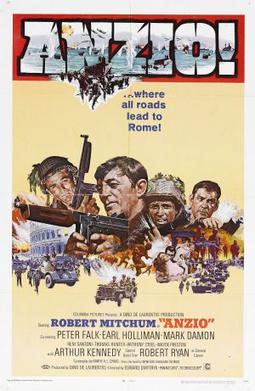
Anzio


Over the 1950's and 1960's, World War II movies were a dime a dozen hitting theaters. Even with the abundance of movies though, some theaters of war were often ignored, or at least covered less. Case in point? The Italian Campaign as Allied forces took Sicily and then Italy in horrific fighting that claimed thousands and thousands of lives in what some said/say was a waste of manpower. So while 1968's Anzio may not be a good movie, I can't help it. I'm a fan so sue me.

It's early 1944 and the fighting has dragged to a stalemate between Allied and Axis forces along the Monte Cassino line. The Allied forces are planning an invasion in Italy above the fighting as Cassino, intending to land some 70,000 troops north of the fighting at the port of Anzio. Among those landing is a war correspondent, Dick Ennis (Robert Mitchum), who will tag along with an American Ranger battalion (specially-trained infantry) as they hit the beaches. An expected hot landing is anything but...the troops hit the beaches with little to no resistance. There's no German forces for miles. On a patrol into the Italian countryside, Ennis and a corporal from the First Special Service Force, Jack Rabinoff (Peter Falk), discover just how open the countryside is. Back at the Allied beachhead though, no one on the general staff believes them. While the Allies dig in and establish a strong beachhead, the Germans take advantage, assembling a line as deadly as anything the war has seen.

If you're looking for a more detailed description of the Battle of Anzio, check out the Wikipedia page. I'm currently reading Alex Kershaw's The Liberator, an excellent read that explores the fighting in Italy in some detail. What's here in this 1968 war film is a condensed version with some embellishments and names changed. The actual battle of Anzio was a horrific miscalculation on the parts of the Allied commanders who made cautious decisions that ended up costing thousands of lives needlessly in fighting that could have been easily avoided. See? We learned something today!

'Anzio' itself is an interesting mess of a movie. It's from the 1960's, the age of the big, epic war films like The Great Escape, Battle of the Bulge, The Guns of Navarone, a trend that would continue into the 1970's. From director Edward Dmytryk (and Duilio Coletti in whatever the "Italian version" is), 'Anzio' is part of a trend of flicks dubbed Macaroni war movies (instead of spaghetti, get it?!?), films made with mostly Italian backing albeit with smaller budgets. Dino De Laurentiis produced the war film, bringing a respectable budget that's seen in landing shots where landing crafts empty of hundreds of soldiers hitting the beaches. There is a big budget feel (some of the time) as this story develops about one of the most costly battles of WWII. More detail later, but there's also truly odd moments sprinkled throughout, giving Dmytryk's film an off-balanced feel to the proceedings. More later!

Two performances here have always appealed to me, Robert Mitchum as war correspondent Dick Ennis, a character very loosely based on famed writer Ernie Pyle. Interesting tidbit? Mitchum earned an Oscar nomination for his performance in 1945's The Story of G.I. Joe, the story of Ernie Pyle in Italy! Ennis is a frontline guy, always sticking with the troops at the front even when he doesn't have to be. Mitchum treads that fine line between looking worn out and being interested, but that laconic, tired look favors Ennis well. He's sick of war, sick of stupid orders and commands that costs unnecessary lives. A good performance for Mitchum. As for Falk, it is an...interesting performance. His Jack Rabinoff is a SOLDIER. He loves fighting. He's good at it (maybe too good), and his backstory of how he ended up in the First Special Service Force is quite revealing. Again, there's some odd moments, but Falk brings a ton of energy, some humor to the part that's hard not to like.

This quasi-epic war film resorts to more familiar territory in the second half. Following a horrific German ambush, a small group of Rangers, including Ennis and Rabinoff, must get back to their own lines to report what the Allies are about to march into. If it's familiar, so be it. It's more at home. It's more comfortable. Among the survivors, look for Earl Holliman as the capable Sergeant Abe Stimmler, Reni Santoni as Pvt. Movie (always ready with an impression), an underused Mark DamonThomas HunterGiancarlo Giannini, and Joseph Walsh. In the epic vein, we also get unnecessary cameos from Robert Ryan and Arthur Kennedy with Kennedy at least getting something to do. Ryan is in two scenes, and he only speaks in one! Also look for ever the German, Wolfgang Preiss as Field Marshal Kesselring, the Allies' opposition across the line.

Where 'Anzio' falls in parts is its odd tone and general lack of epic qualities, even though it thinks it is an epic. It is NOT. It's a good, old-fashioned war flick. Simply put, it tries to cover too much ground in 117 minutes. The song that plays over the opening credits, This World is Yours (listen HERE), is awful. Truly out of place. The score itself is hit-and-miss, but when it works, I liked it a lot. As for the tone, this is a story that just refuses to pick one tone and go with it. Is it dark? Is it a light war film? While things are somewhat ironed out (not really), we get a painful scene of Falk's Rabinoff sitting in an ambulance with three prostitutes as he sings "Bye, Bye Blackbird" with them. There's another scene later where he does the same thing. What the hell is going on?!? Don't even get me started about the general combat tactics here either, highly-trained American troops charging into machine gun fire without even raising their weapons or trying to throw a grenade at the nest. Meh, run!!!

Now all that said, I've always liked this movie and held it up on my most recent reviewing. I love the Italian filming locations, especially the shots of Rome. I've always been a big fan of Mitchum and Falk, and even considering some script idiosyncrasies, they're both pretty good here, as is the whole supporting cast. Through all the general craziness and oddness, there's some...oddly charming. The action is harsh, including a late battle between our survivors and four German snipers, and from beginning to end, it is entertaining. It ain't a classic. So be it. It's very entertaining.

Anzio (1968): ***/****
Rewrite of May 2009 review

Friday, August 7, 2015

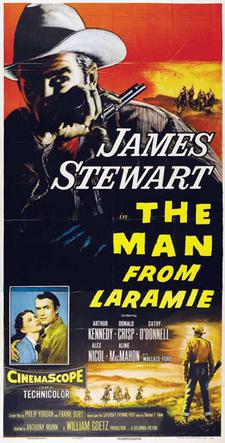
The Man From Laramie

By 1950, James Stewart had been working in Hollywood for 15-plus years, most of those years as a go-to star who audiences and critics alike liked and appreciated. In 1950 though, he starred in a western called Winchester '73, teaming with director Anthony Mann. It ended up playing a key -- if unappreciated -- role and movie as Stewart headed into the next portion of his career. From there on in, Stewart was a regular in the western genre, by my count starring in 17 westerns. Today's entry? That would be 1955's The Man from Laramie.

Having endured a long trip on the trail, Will Lockhart (Stewart) and his packed-to-the-gills freight wagons have finally arrived in the small, isolated desert town of Coronado. Lockhart sells his goods and is in no rush to get back to Laramie. Actually...he'd like to stick around. He's got some questions he would like answered about a cavalry patrol being massacred several months before by an Apache war party using repeating rifles. Where did those rifles come from? Who sold them to the Apaches? Now, Will isn't letting on to his real goal of being Coronado, but he quickly draws the ire of the local rancher, Alec Waggoman (Donald Crisp), who with his weak son, Dave (Alex Nicol), and loyal foreman, Vic (Arthur Kennedy), rule over the surrounding area. The clock is ticking on Lockhart if he wants to get his answers before he ends up six feet under with a bullet or knife in his back.

Early in his career, Stewart did star in one pretty excellent western, 1939's Destry Rides Again. Some more years under his belt, his service in World War II behind him, Stewart was a little more weathered, a little more grown up when he really dove into the western genre in the 1950's. He just looks like he belongs in the western, from the beat-up hat he wore in so many to the tall, lean look that screamed authentic cowboy. He's likable -- as always -- but as necessary, Stewart is able to call up this rage and fury as needed. That's especially important as we discover exactly what his Will Lockhart is up to in Coronado. It's an excellent performance from Jimmy Stewart all around, an actor and a man who appears quite comfortable in a genre that is and was happy to have him.

John Wayne had John Ford. Randolph Scott had Budd Boetticher. Jimmy Stewart....he had Anthony Mann. This is actually the fifth and final pairing of the actor/director combo, and it's a good one. They also paired in Winchester '73, Bend of the River, The Naked Spur, The Far Country, and this film. So many 1950's westerns were clean and polished, but there's a meanness, a darkness to these pairings. With touches of Shakespearean storylines, even some mythological storylines (greed, betrayal, lust, murder), Mann added a much-needed darkness and depth to the western. It wasn't always a cut and dry good and bad. It was tortured anti-heroes (a sign of things to come in the genre). It was realistic -- if not graphic -- violence. There are a fair share of pretty weak westerns from this decade, but when they were good? They were pretty good overall, like here, and so many Stewart/Mann, Scott/Boetticher pairings.

'Laramie' doesn't feature a huge cast or a ton of recognizable names, but the casting in general is solid because of the script with all that Shakespearean, mythology-based storylines. Crisp is excellent as the aging rancher who's desperately clinging to what he carved out of the wilderness. He's trying to keep it all together, balancing things between his whiny, weak-minded son, Dave (a sniveling Nicols), and the tougher, ruthless Vic Hansbro. Kennedy is excellent, as he usually was, without resorting too much to chewing the scenery. Cathy O'Donnell plays Barbara, Waggoman's niece and Vic's fiance, caught up in the middle of all the family drama, Aline MacMahon is a weathered, ranching rival to the Waggomans with a history with her rivals, Wallace Ford is Charley, Lockhart's quasi-partner and a tried and true wagon driver with experience to burn, and an underused Jack Elam doing what he did best as shifty, two-faced supporting villain.

This is a western with a ton to offer. It has elements of film noir storytelling, the mystery of the massacre playing out against a western backdrop. Lockhart's secret doesn't come as a huge surprise, but it works because the tension and mood is built up more with each passing scene. The final reveal in the closing scene is dealt with in almost matter of fact fashion, but getting there is a ton of fun. The score is nothing to write home about, but my goodness, the visuals from the on-location shooting in New Mexico are Stunning. What a beautiful picture, the rocky mountains and sand-swept plains and vistas filling the background with each passing scene. It is a sun-drenched western with seemingly no clouds anywhere near or around the location shooting. Story, twists and characters aside, you can just sit back and appreciate the natural beauty.

If there's a weakness, it's in the last 45 minutes or so of a 104-minute movie. As certain things are revealed, the story loses some momentum. The ending itself features some twists and betrayals and backstabbing along the way that do make it fun, but there isn't the same energy as was there in the first half. Still, it's a solid, well-made adult western from the 1950's and Jimmy Stewart is always fun to watch. Definitely worth seeking out.

The Man From Laramie (1955): ***/****

Wednesday, October 22, 2014

Nevada Smith

Just a few weeks ago, I watched and reviewed 1964's The Carpetbaggers, the story of a business mogul expanding his empire in the 1920s and 1930s. A minor character in the story? An aging cowboy turned western movie star, Nevada Smith. His backstory is explained but not shown. That's for a prequel made two years later, 1966's Nevada Smith.

Working at his father's played-out mine that has recently produced some gold deposits, a young half-breed Max Sand (Steve McQueen) is away from the house when three outlaws (Karl Malden, Arthur Kennedy, Martin Landau) ride up looking for that gold. Max is too late to help though, arriving at the house to find the tortured, mutilated corpses of his parents. The outlaws are nowhere to be found, but their trail is easy enough to follow. Max's biggest problem though? He's capable of caring for himself on the trail, but he has little money and no real experience with guns, especially when it comes to actually using a pistol or rifle on a human being. Desperate and with no supplies left, Max tries to rob a man on the trail. Instead, the man, Jonas Cord (Brian Keith), an experienced trailsman and capable shot, teaches Max all he can in his quest for revenge. His biggest advice though? Abandon his quest for revenge and move on with his life, but Max isn't hearing it.

It had been years since I watched this 1966 western from director Henry Hathaway (a solid western director, True Grit, Sons of Katie Elder). My biggest takeaway? It isn't as good as I remembered. Still good, still enjoyable, but not as good. There's still positives to take away though. 'Nevada' was filmed on-location in Inyo National Forest and the Owens Valley in the Sierra Mountains. Visually, it is a stunningly good-looking film with the mountains as a backdrop to the revenge story. The score from composer Alfred Newman is solid -- especially the main theme -- but isn't necessarily used enough. The best thing going is the revenge motive, a pretty gruesome story at times. Not graphic, just really violent because we know what's happening. Stabbings, drownings, choking, beating, systematic shooting of an unarmed man. It can be pretty rough at times.

So if you watch this 1966 western and come away a little confused, there's a good reason. The Max Sand character is young, really young. I'm assuming a teenager, maybe approaching 20. When the movie was made in 1965, McQueen was...35. And he's a half-breed with a white father and Kiowa mother. So yeah, he doesn't really look like a teenage half-breed (with his blonde hair too) in a pretty obvious case of miscasting. Still, McQueen makes the most of it. With the revenge motive, it is a fascinating character. Max -- later dubbing himself Nevada Smith -- becomes obsessed with killing his parents' murderers no matter what the cost on those who are helping him. McQueen does a good job in a physically demanding part, doing his own stunts while also adding a dimension of pure physicality to the performance. It's not often spoken words, just a sad look here, a drop of his shoulders there. Not ideal casting, but McQueen makes the most of it.

But the rest of the cast? The rest of the cast?!? It's pretty great. Brian Keith has always been one of my favorites, but I think this is one of his bests. His Jonas Cord is only in the movie for about 20-25 minutes but steals every scene he's in. His chemistry with McQueen is pretty perfect, and their scenes together crackle, an experienced hand with a gun trying to teach the younger Max all he can through good and bad. The Jonas/Max dynamic has always been my favorite, the movie's strongest point. With the episodic story, Malden, Kennedy and Landau make the most of their screentime, three particularly nasty villains you can't wait to see get their due. Raf Vallone is good too as Father Zaacardi, a priest who comes across Max and helps him in a time of need. Also look for familiar western faces Gene Evans, Paul Fix, Pat Hingle, John Doucette, Lyle Bettger, Howard Da Silva and Strother Martin in supporting parts.

Where does 'Nevada' go a little off the tracks then? At 130 minutes, it drifts too much with some extremely slow portions involving the episodic story. There just isn't a ton of energy at times. Two semi-love interests are added, Janet Margolin as an Indian dance hall girl and Suzanne Pleshette as a Cajun girl, are meant to show Max's obsession over a possible future with either, but they become repetitive and tedious. Just not a ton happens. The performances are good, the locations cool, but it's missing that special something. Good but not great.

Also worth mentioning is a western nerd moment. Any western fan who's seen any number of 1960s westerns will recognize Chuck Roberson, Chuck Hayward and Jerry Gatlin as background players and supporting parts. 'Nevada' takes that to new levels. Watch closely and you see them all playing multiple parts. In one scene, Roberson is part of Malden's gang, and the next he's Paul Fix's deputy. It's a little much and a little lazy, something Hathaway also did in Sons of Katie Elder. Thus ends this rant.

Nevada Smith (1966): ** 1/2 /****

Wednesday, February 13, 2013

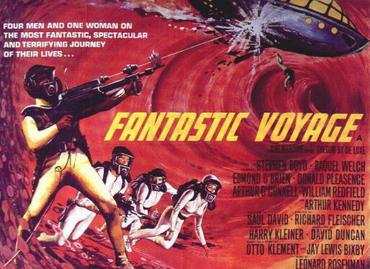
Fantastic Voyage

Groundbreaking doesn't mean groundbreaking for all-time. It qualifies only in the moment, maybe a few months, or even a year in the luckiest of situations. If a movie is considered groundbreaking, it kicks the door open and hundreds of rip-offs and wanna be follow-ups storm through the opening. That kept cycling through my head as I watched 1966's Fantastic Voyage.

A scientist (Jean Del Val) working for the Soviets has defected with American intelligence agencies desperate to help him and bring him to the United States. In the transport though, enemy agents attack, severely wounding him. He's in a coma with an unreachable blood clot on his brain, but he has info that the American government desperately wants. To relieve the pressure of the clot, a new technology will be utilized. A team of surgeons (including Arthur Kennedy and Donald Pleasence), a security officer (Stephen Boyd), and two others will travel via a submarine, be shrunk down to a microscopic size and injected into the scientist's body, traveling through his body and ultimately break up the clot and save his life. There's problems though. The body will most likely do everything it can to slow down the intruders, and they only have 60 minutes to get the job done before they begin to grow back to their normal size, whether they're in the body or not.

From director Richard Fleischer, this science fiction story won two Oscars, one for Best Art Direction and one for Best Special Effects. So while I didn't really care for the movie, I can appreciate the crazy visual on display. A tiny submarine the size of a period with five people inside traveling through a human body? How couldn't that be a great visual experience as a movie? Much of it comes from a green screen visual -- sets of the human body would be rather immense I'm supposing -- and just in terms of color alone, it's a beautiful movie. The little prototype submarine travels through the veins, arteries, lungs, heart, ears and ultimately, the brain.

So what do you think? A trip through the body and all its inner workings is unique, no doubt about that. Why then is this story so dull? I was bored to tears almost the second the submarine went to work. There's plenty of detours that provide some excitement. A miscalculation forces the crew to travel through the heart, but the problem is that the heart beating should tear the submarine apart. The medical staff monitoring the body basically shuts down the heart, giving the crew 60 seconds to travel through it. The premise presents all kinds of impressive, should-be cool situations like that. The crew is told that the body is going to do its best to protect itself, assuming that the submarine is a disease or virus of sorts. Those provide some cool visuals as well, antibodies swarming to the sub and the crew, but it's the weirdest thing. If that wasn't enough, someone involved with the mission is an enemy agent, but even that reveal is disappointing. It's a dull story of a very cool idea.

In a variation on one of my favorite sub-genres, 'Voyage' is a men-on-a-mission movie. Check that; a men-on-a-mission movie with Raquel Welch in a tight white bodysuit. So there it is, a group of specialists working to accomplish a mission. Along with Boyd's security and government agent, Kennedy's extremely talented lead surgeon, and Pleasence's reliable medical officer, there is Welch as Cora, Kennedy's assistant, and William Redfield as Capt. Owens, the Navy officer piloting the prototype submarine. Back at normal size, Edmond O'Brien and Arthur O'Connell play the bickering officers forced to make the difficult command decisions.  Also look for a young James Brolin as one of the technicians working in the lab. None are given much in the way of background so instead of characters working to accomplish a dangerous mission, we're watching Stephen Boyd, Arthur Kennedy and Raquel Welch accomplish the mission. In other words, there's little personal investment in accomplishing the mission.

I thought I would enjoy this movie a lot in the early goings. The virtually silent, unexplained opening is a great scene-setter, eerie and unsettling because we don't know what's going on. It reminded me a lot of 1965's The Satan Bug in its simple style. I can't explain it though, but the second the miniaturized mission was presented I lost almost all interest in the story. There are some cool moments, but they didn't add up to a finished product that I enjoyed that much. Sorry to say it because I've long wanted to see it, but I came away disappointed with this 1960s sci-fi classic.

Fantastic Voyage (1966): **/****

Sunday, December 2, 2012

Bright Victory

Some of my favorite war movies focus almost exclusively on the actual combat and fighting in war. Some of the best focus on the post-war lives of the soldiers. What about the soldiers who were wounded and/or traumatized by what they saw and experienced? The most obvious choices include The Best Years of Our Lives, The Men, Born on the 4th of July, but 1951's Bright Victory belongs in that grouping.

Working with a forward artillery unit laying telephone wire in 1943 North Africa, Larry Nevins (Arthur Kennedy) is struck in the side of the head by a German sniper's bullet. His optic nerves are destroyed, and doctors don't believe that surgery will ever restore his sight. Back in the states at a rehab facility, Nevins goes about the slow work of learning how to live as a blind individual. In a weird way, he has to re-learn how to be a regular person, relying on his other senses, using a walking stick. He has help along the way from other wounded vets (similarly blinded) and one girl, Judy (Peggy Dow), who he hits it off with immediately. All the while though Larry is worried about the reaction he'll get back home, especially from fiance, Chris (Julie Adams). 

Released in 1951 from director Mark Robson, 'Bright' is an impressive, well-made movie. Filmed in black and white, it's a meat and potatoes kind of movie. The focus is more on the personal level than any sort of large-scale action. This is Larry's story as he learns how to live as a blind person. We sees his reactions and how he copes; anger, frustration (even attempting suicide once), acceptance and finally a desire to work at it and move on with his life. It was filmed on location at Valley Forge Medical Center -- a nice touch for authenticity -- and detours once or twice to some cool Philadelphia locations. Why focus on the bigger picture when the smaller, more focused picture is more effective?

One of the best things going for 'Bright' comes from its honesty in exploring Larry's plight. He's born and raised in Florida, and living in the deep South, he's developed a racist streak right up his back. However, if you're blind.....Yeah, exactly. Voice inflections aside, how can you tell if someone is black or white? Working through his therapy, Larry strikes up a fast friendship with similarly wounded black soldier, Joe Morgan (James Edwards). Larry doesn't realize it though, one day making a statement about 'n***ers' being moved into the ward. And let the fireworks fly. The developing feeling in Larry is highly effective in its simplicity. It takes a life-altering incident to change his mind, but he starts to realize 'what difference does skin color make?' For a movie in 1951 years ahead of the Civil Rights movement, that's a profound message.

Casting Kennedy as Larry is a match made in heaven. Arthur Kennedy could be a despicable villain like nobody's business. More than that though, he's a great actor, and this is a part that allows him to show off his range. He's more than believable in the part, and when he's going through the life of a blinded veteran, it doesn't feel forced. His relationship with Dow's Judy is interesting without being too cute, and the dilemma he feels about what he said to Joe and also what awaits at home helps develop the character. The racist aspect gives an added dimension to the character too, all for the positive in a great part for Kennedy.

Also look for Will Geer and Nana Bryant as Larry's parents waiting back home in Florida, Joan Banks and a pre-Mr. Howell Jim Backus as Judy's sister and brother-in-law, and Richard Egan and Murray Hamilton as two blinded vets Larry meets in the rehab ward with John Hudson play Cpl. Flagg, a non-com working with the wounded vets. If you watch early, you can also see Rock Hudson in a bit part as one of Larry's repair crew working in North Africa.

An underrated WWII movie that deserves more of a following. Moments like Egan's soldier meeting his wife and son (who's he never seen/met) are perfection in their honesty. That's the feeling the whole movie gives off. It isn't aggressively shoving a story and message in its face. It's content to be what it is. An effective, well-told and well-acted story with some great performances. You can watch the entire movie HERE at Youtube.

Bright Victory <---Youtube clip (1951): *** 1/2 /****

Sunday, August 19, 2012

Trial

The system at its purest should always work. Yes, a pretentious "message" lede that I apologize for, but I've got nothing else. Government, politics and and the right to a fair trial are all ideal in their execution. It's when the human element is added that things get tricky, like 1955's Trial, a solid if somewhat meandering look at not only a courtroom case, but the sinister, sniveling grab for power in the background far from the court.

A law professor at a California university, David Blake (Glenn Ford) is in a jam. He's never actually had a court case so his superiors demand that if he wants to keep his job he must get some actual courtroom experience. Every lawyer and firm in town slams a door in his face except one, that of Barney Castle (Arthur Kennedy) who takes him on for an upcoming controversial murder case. A Mexican teenager, Angel Chavez (Rafael Campos), has been accused of murdering a white teenage girl, and things don't look good. Looking for experience and genuinely believing in the boy's innocence, David takes the case only to discover there's much more to the judicial system than knowing a law book.

What impressed me most about this Mark Robson-directed courtroom drama is that for much of its 105-minute running time, 'Trial' is less than interested in whether or not Angel actually committed the crime. His guilt or innocence is almost secondary. This is a story about the inner-workings of the system, how things get done not by what's right, but by who is able to tweak the system to their advantage. While obviously dealing with different subjects, 'Trial' reminds me in tone of Billy Wilder's Ace in the Hole. Not quite as dark -- especially in the ending here -- it still has a cynical, dark and jaded look at the people involved, at the individual and how simple and easy it is to manipulate the system.

Maybe in 2012, none of this should come as a surprise, but Robson's film is at its most effective in those very moments. When we meet Kennedy's Barney, he seems like a genuinely good guy willing to fight for the underdog and give this inexperienced lawyer a shot. Yeah, not even close. Everything in this world is a selfish, me-first type attitude. Robert Middleton's A.A. 'Fat Stamps, the county sheriff, will say and do anything that helps him get re-elected. Supremacist groups make the possible murder into a race riot, not a simple encounter gone wrong. Barney stirs up the masses wherever he goes, almost making Angel into a martyr before his guilt is decided. He manipulates Angel's mother (Katy Jurado) to embrace her Mexican culture for a sympathetic plea. The actual guilt or innocence steps to the forefront late, but the movie is at its best leading up to that.

Unfortunately a little more than halfway through 'Trial,' a big old curveball is thrown at us as an audience. It's timely for 1955, but overbearing and heavy-handed now. Yes, you guessed it. COMMUNISM!!!!! I won't go into specifics here as to how communism is involved, but there are ulterior motives working all over the place, all of them hamstringing an otherwise very solid courtroom drama. The last 45 minutes are slowed down significantly as communism rears its ugly head. We get it, Red Scare, Stalin, evil Russkies, but it feels overly forced here. On top of that, the ending forces a nice, happy conclusion on us, one that seems far-fetched for the story and out of left field.

Thankfully through all that craziness, the cast is uniformly above average. Chalk up another positive part for Glenn Ford, his David Blake an idealist who believes and has faith in the judicial system. When he sees it for what it really is? He's not naive anymore, just pissed. Like most of his roles, it comes across naturally, a tortured individual weighing all his options. His relationship with Barney's assistant, Abbe (Dorothy McGuire), is a bright spot too. Kennedy does what he does best, sneers and snivels and is generally as slimy as humanly possible. John Hodiak is Armstrong, the district attorney primed for bigger and better things down the road, making the most of a smaller, one-note performance. Along with Jurado and Middleton in supporting parts, Juano Hernandez is a scene-stealer as Judge Motley, an African American judge presiding over the case who must deal with prejudices and assumptions of everyone around him, especially on a racially charged case like this.

I've got mixed emotions about this movie. The parts I did like, I really liked. Ford and a deep cast are very watchable are solid throughout, even the portions of the movie that are too timely for their own good. In the end, the negatives prevent it from reaching its potential. Still a very worthwhile movie to seek out, but it never quite reaches the heights it could and should have.

Trial <---TCM clips (1955): ** 1/2 /****

Sunday, December 19, 2010

Air Force

As part of a themed day a few weeks ago, Turner Classic Movies aired a handful of World War II movies honoring the heroes of December 7, 1941 when the Japanese led a sneak attack on Pearl Harbor in Hawaii. Almost 70 years since one of the biggest, most violent on attacks ever on American soil, it's still hard to wrap your head around the immensity of the attack and how it drastically changed the course of human history.  Some movies like From Here to Eternity focus exclusively on the attack, but others use December 7th as a jumping off point, like 1943's Air Force.

Watching a movie released in 1943 in the U.S., you have to know what you're getting into.  Made with the backing of the U.S. Air Force (and most likely the U.S. government), this is a war story dripping with propaganda.  It was made to encourage the home front, make sure Americans knew what our armed forces were fighting for.  Overall, the movie doesn't overdo it with its message until an unnecessary gruesome finale, but the first 90 minutes is a perfect example of how good a movie can be even with an incredibly one-sided story.  Flag-waving in just about every scene and a can't beat the U.S. mentality end up working toward the positive here.

Taking off from a runway in San Francisco, a B-17 bomber named 'Mary Ann' piloted by 'Irish' Quincannon (John Ridgely) and Bill Williams (Gig Young) heads out over the Pacific bound for Hickam Field in Hawaii. With several new members of the nine-man crew, they have little experience working together but quickly find themselves needing to get on the same page.  They fly into Hawaii on the afternoon of Dec. 7, 1941 just hours after the sneak attack by the Japanese Navy that almost cripples the U.S. Pacific fleet.  They land and are are quickly given orders to continue flying to the west.  Reports of Japanese attacks throughout the Pacific have the High Command on a major alert, and every man, pilot, and plane is needed to hold back the advance if the U.S. has any chance of staying in the conflict.

Director Howard Hawks did a wise thing setting this story in and around the opening days of the U.S. involvement in World War II. Looking at the story as simplistically as possible, we get a tour of the Pacific in the days following the attack on Pearl Harbor.  We see Battleship Row still in flames, we see the heroic defenders of Wake Island as they await a Japanese attack, we see military bases in Manila falling back under waves of Japanese attackers.  It serves two purposes, one being a jumping off point for everything that's going on, and two, it shows these heroic efforts put forth by American soldiers, Marines, sailors, civilians and pilots throughout the Pacific against impossible odds.  And make no mistake, many of the people on Wake and throughout the Philippines were either killed or captured by the Japanese.

The propaganda is held in check for the most part with two major exceptions.  A machine gunner on the back of a small fighter plane is forced to bail and attempts to parachute to dry land.  Floating back to the ground, he is machine-gunned by a Japanese pilot.  Then as he lies dying on the ground, the pilot flies over again and finishes him off in brutal fashion.  First, there's documented cases of Japanese pilots doing this throughout the war.  Subtle it is not, but in terms of portraying the Japanese in as brutal a depiction as possible, this gets the job done.  Second exception, 2001's Pearl Harbor syndrome. Instead of just telling the story of Pearl Harbor, the 2001 movie adds on the telling of the Doolittle Raid on Tokyo because us Americans, we need our happy endings. Here in Air Force, Hawks depicts a fictional, very one-sided depiction of the American Air Force destroying a Japanese invasion fleet on its way to Australia.  It's overdone and just tries too hard, reveling in the defeat of the Japanese.  I understand this might have been a necessary ending in 1943, but now in 2010 it just doesn't work.

Those complaints aside, I loved the movie starting with one of Hawks' biggest strengths as a director.  He had a knack for working perfectly with predominantly male, ensemble casts, and Air Force has a good one.  Ridgely and Young play the pilots of B-17 Mary Ann with the crew including Harry Carey as veteran crew chief Robbie White, John Garfield as new machine gunner Joe Winocki, Arthur Kennedy as bombardier Tommy McMartin, Charles Drake as navigator Monk Hauser, George Tobias as mechanic Weinberg, Ward Wood as radioman Peters, Ray Montgomery as newbie Chester, and James Brown as tag-along fighter pilot Tex Raider. With such a big ensemble, we only get tidbits of info about each man, but they cover a melting pot of the Americans fighting in WWII.  They bond through their common goal and will to survive, doing whatever they can to take the war back at the Japanese.

When propaganda works, it is typically because it hits a nerve.  I've long been a fan of war movies across the board, and you can't help but root in patriotic fashion for this B-17 crew.  For a start, they're very easy to like, all of them.  When one of the crew dies following a Japanese attack, you see the others throw caution to the wind in hopes of reassembling the plane so they can rejoin the war effort.  Carey and Garfield cradling machine guns in their arms fighting off Japanese Zeroes hits you in the gut.  It's over the top and hammy, but it's perfectly portrayed. Obviously now in 2010, we know the Allies won WWII.  But in 1943 the war was still up for grabs, and Americans could always use a positive jolt.  This certainly qualifies.

Air Force <---trailer (1943): *** 1/2 /****  

Monday, July 12, 2010

A Minute to Pray, A Second to Die

What flies in one market doesn't necessarily do the same in a separate market.  Take 1968's A Minute to Pray, A Second to Die, a popular spaghetti western released in Europe with an almost 2-hour running time. On a separate note, if that title isn't one of the coolest ever, I don't know what is.  Anyhow, MGM gets their hands on it for a U.S. release, cuts about 20 minutes, and hacks away the ending so American audiences can leave with a happy conclusion.  What's left? A good but not great spaghetti western that will always have the question of 'What if?' floating around it.

Released at the height of the spaghetti western craze, 'Minute' has been left in the dust by more popular spaghettis from directors like Sergio Leone and Sergio Corbucci among others and other movies with bigger stars.  This is a western with all sorts of genre regulars from the gothic sounding soundtrack -- not Ennio Morricone -- to the anti-hero to the supporting cast full of recognizable faces to the familiar locations.  A classic it is not, but it still remains an interesting watch for spaghetti western fans.

Infamous outlaw Clay McCord (Alex Cord) has ridden the outlaw trail for years, but the law seems to be closing in.  He hides out in the desert, bandit town of Escondido, run by a thuggish gunhand, Kraut (Leone regular Mario Brega), who would like nothing more than to put a bullet between McCord's eyes. While hiding, McCord hears of an offer made by the new territorial governor (Robert Ryan) giving amnesty to any outlaws who will sign a document and surrender their guns. The outlaw is skeptical, but a recurring problem that he believes is epilepsy continues to plague him, paralyzing his gunhand whenever it is put under stress.  Sooner or later, it will happen at the least opportune moment.  As he prepares to ride in to sign the amnesty though, McCord not only has to deal with Kraut, but the local sheriff (Arthur Kennedy) who is suspicious of McCord's motives.

This is not your typical spaghetti western in a lot of ways, and in others, it's a good example of how strong the genre could be.  Not a big star, Cord plays McCord as a sympathetic character forced into a life of working as a gunhand.  Some eerie flashbacks show some of Clay's motivation as he watched his father succumb to epilepsy.  It's an appropriate addition to a genre that has had heroes who are blind, deaf, tortured, mutilated and generally disabled.  Ryan gives the movie credibility just by showing up as governor Lem Carter, and Kennedy looks to be enjoying himself in the midst of his European movies.  Also look for Italian beauty Nicoletta Machiavelli as Laurinda, a woman who helps Clay.  For the rest of the cast, if you're a Leone fan you'll recognize countless faces in supporting roles.

Not as action packed as some reviews would make it out to be *cough Roger Ebert cough * this western gives a little more character development to its anti-hero in Clay McCord.  There are gunfights, including the exciting finale in one of the movie's more noteworthy filming locations.  Not just shooting in the sparse deserts, director Franco Giraldi moves his story all around from desert to river areas to forests and never stays in one place too long filming in Italy and Spain for the American west.  Composer Carlo Rustichelli turns in a score with two main themes, one quiet tune for the hero, the other that drives the action. All the little elements that help up and add to the quality of the movie.

Unfortunately, the DVD feels the need to taunt its buyers with a claim of a 118-minute running time, the original length upon being released in the late 60s.  In fact, the DVD runs about 98 minutes and does have a disjointed feel at times with some awkward cuts.  The worst cut comes at the end though.  SPOILERS As is, McCord signs the amnesty and rides off to a new life.  The original version has McCord sign the amnesty and then be shot down a few miles outside of town by bounty hunters unaware of what he's done.  Talk about a shocker ending, I've never found anyone who's actually even seen the ending.  The DVD ending does work, but the cut ending just seems like it would work better, especially for the McCord character arc.

Not as well known as many spaghetti westerns, this is a hidden gem in the genre.  It's floated around in anonymity thanks to its lack of big names, but all the better for catching up with it now.  It is available to watch through Youtube, but it is in Spanish and isn't of the best quality.  If you can find the MGM DVD, it does offer a cleaned-up widescreen presentation.  Hopefully somewhere out there is a 2-hour version with the original ending, but for now, this will have to do.

A Minute to Pray, A Second to Die (1968): ***/****

Thursday, June 17, 2010

The Lusty Men

When it comes to sports, I'll give just about anything a shot, and thanks to ESPN's family of networks I've gotten that shot at seeing all sorts of unique sporting events from the basics to fringe sports like bowling or billiards.  Then there's rodeo, a sport I've never really understood and some of that may have to do with where I've lived most of my life, Illinois and Indiana.  While not as violent as say bullfighting, rodeo has always rubbed me the wrong way for its treatment of animals.

TCM aired 1952's The Lusty Men last week, a story with the rodeo as the setting.  Before I get into this movie, I should say I've seen and enjoyed other rodeo movies like Junior Bonner with Steve McQueen or J.W. Coop with Cliff Robertson.  Some sports translate well to a movie form, football, basketball, baseball all come to mind, but I just don't think rodeo is one of them.  Up close and personal, I imagine it's a lot better to view, but there's a main flaw I have trouble getting past when it comes to movie versions.  That's for later though, let's talk story.

After one too many accidents on the rodeo circuit, past-his-prime cowboy Jeff McCloud (Robert Mitchum) gets a job as a ranch-hand where he meets fellow cowboy Wes Merritt (Arthur Kennedy).  Wes instantly recognizes Jeff and begs him to teach him some techniques and strategies for being successful at rodeos.  Married for two years to wife Louise (Susan Hayward), Wes is trying to save up $5,000 so they can buy a spread for themselves, but at his pay rate it will take years.  With Jeff's help, he sees a way to get the money fast, by joining the rodeo.  Louise is adamantly against it, but there's nothing she can do to stop her husband, sending him down a road she's worried he'll never come back down.

I was a little disappointed in the story here because for the first 90 minutes it is as predictable as possible.  If you've ever seen a movie with a teacher/mentor and a youngster/student, you basically know where this one is going.  McCloud and Merritt start off on the right foot, the younger cowboy idolizing his hero as he teaches him all he knows about the business.  But the second Wes gets any taste of success, he begins to resent his teacher who he previously looked up to. He doesn't want to be held back and wants to explore this new world on his own.

If about 15 minutes you haven't figured out where this movie is going, shame on you.  Wes does get a taste of the big-time after a lifetime of scraping by from month to month.  At first all he wanted was a little place of his own, but now he's living on easy street so why should he go back to busting his hump?  My only question in all of this was whether Mitchum's Jeff was going to pounce on Hayward's Louise.  That issue is resolved late, and I give props to director Nicholas Ray for not taking the easy way out. The ending as is has one character making a sacrifice -- unintentionally so -- that ends up making the other two very happy.

Watching this predictable storyline, hopefully you'll be saved by the three starring performances.  Mitchum plays his typical laid back, uber-cool guy who never gets too rattled by anything.  He drifts along, letting Kennedy do the heavy lifting with the meatier role of the cowboy turned rodeo star.  Through all their ups and downs though, the two still have a friendship that can't be broken up.  A wordless scene late between them -- a smile and a wink here -- show it will take more than one fight to split them up.  Hayward is the strongest part of the movie playing a woman who just wants to be happy with her husband, even though it seems he wants nothing to do with settling down.  Also, Arthur Hunnicutt plays Booker Davis, a former rodeo star now a near-cripple.  For the most part, Hunnicutt doesn't over-do it as his parts so often required him to do. Frank Faylen plays a stock owner traveling along with the rodeo.

Even with the rodeo movies I've enjoyed as mentioned above, my issue is with the actual rodeo scenes.  One, studios aren't going to let stars like Mitchum, McQueen, Kennedy, and Robertson actually do any bronc riding or bulldogging.  Instead, we get a quick shot of the star on a horse/bull and a quick cut to an actual cowboy in a long shot in the ring.  Repeat this over and over to your heart's delight.  I don't know now if CGI could help this, but it is always distracting and can be downright dull at times watching cowboys or stunt doubles take over instead of the actors.

While these rodeo scenes can be a little slow moving, the movie as a whole is still worth a watch.  Ray has some fun with some interesting looking camerawork, and the actors are all solid -- especially Hayward -- in making these three characters full-fledged, 3-D, believable people and not just cardboard cutouts.

The Lusty Men <----TCM trailer (1952): ** 1/2 /****

Friday, May 21, 2010

Cheyenne Autumn

A solid director early in his career, John Ford shot to stardom behind the camera thanks to success in one particular genre, the western.  Starting with Stagecoach in 1939 and continuing into the 1940s with his 'cavalry trilogy,' Ford became a go-to director westerns that he was able to put his own personal -- often romantic -- look at the American west in the latter half of the 19th century.  And in almost every one of these westerns, Native Americans were portrayed in a negative light, whether as a fearful presence or as murdering on-screen savages.

With his last western, 1964's Cheyenne Autumn, Ford did an about face in terms of the depiction with something that has since been dubbed 'white man's guilt.' Based on a true story, the movie attempts to put Native Americans in a positive light instead of the stereotypical savage so often associated with westerns.  It's a noble concept and feels like a bit of an apology on Ford's part, but too many things work against this movie from the start, ranging from the casting to the dull, slow-paced storyline.

It's 1878 and 300 members of a Cheyenne tribe on a reservation in the southwestern desert have had enough.  They don't receive supplies promised to them -- food, clothes, medicine -- and are basically being ignored by the U.S. government.  Led by two proud warriors (Ricardo Montalban and Gilbert Roland), the Cheyenne leave the reservation in the dead of night with hopes of marching almost 1,500 miles north to their ancestral hunting grounds in South Dakota and Montana.  Pursuing them is a cavalry outfit led by the sympathetic Capt. Archer (Richard Widmark) who tries his best to bring the Cheyenne in peacefully.  Nothing comes easy though and the terror sets in of 300 Cheyenne roaming the west in towns all along their trail.

To tell this story, Ford assembles a remarkable cast but as is so often the case with huge casts of big name stars, many are lost in the shuffle.  Along with those mentioned already, there's also Karl Malden, Edward G. Robinson, Dolores Del Rio, Carroll Baker, Jimmy Stewart, Arthur Kennedy, Sal Mineo, George O'Brien, and Sean McClory, along with several others I'll mention later.  Needless to say, that's a ton of talent involved, but the odd thing is almost NOTHING happens the entire movie.  It's downright dull at many points and never really gets the viewer invested in what's going on.

First off, the story does represent the Cheyennes in a positive light as a tribe just trying to survive now that their heyday has passed.  But then Ford spends a majority of the time with the white characters as the Cheyenne tribe disappears here and there for long stretches.  There's also the issue of casting Hispanic actors as Indians which just doesn't make much sense to me.  I figure there weren't many Native American actors working in Hollywood in the 1960s, but for a story trying to be authentic and fair, it would have been worthwhile to cast one or two.  Montalban and Roland represent themselves well as the warriors leading the tribe while Mineo says two or three words and enthusiastically takes his shirt off at one point.

One criticism of Ford over his career is his bawdy, broad humor that populates his movies, and Cheyenne Autumn doesn't disappoint.  About 90 minutes in, a 20-plus minute segment takes a complete detour from the story for some incredibly out of place humor in Dodge City with Stewart playing Wyatt Earp and Kennedy playing Doc Holliday.  Besides being incredibly miscast as the famous gunfighters, the tone of this extended segment is comical and over the top.  The tone to this point has been downbeat if not entirely interesting, and we get a segment here that is ripped right from any of the cavalry trilogy.  This comedic segment is so out of place that it can be difficult to watch in its badness.

What I enjoyed most about this movie were the scenes on the trail with the Indians or with the cavalry pursuing them.  Widmark makes the most of a part that just doesn't give him much to do, but Ford seems incredibly comfortable in the cavalry scenes.  Patrick Wayne (the Duke's son) plays Lt. Scott, a young officer out for blood, Mike Mazurki plays the veteran sergeant, and in a nod to Rio Grande and She Wore a Yellow Ribbon, Ben Johnson and Harry Carey Jr play troopers Plumtree and Smith. A running bit between the two has Archer consistently forgetting Carey's name.  Both parts were uncredited ones for the veteran character actors. Maybe because it feels like a throwback to better westerns, but the cavalry portions of the story are infinitely more watchable than much of the rest of the movie.

For all its flaws, 'Autumn' is still worth watching just to see that huge cast work together and as is typical with a Ford western, the Monument Valley scenery.  Through all the movies ever shot there, I don't know if its ever looked better serving as a backdrop for the story.  Overall though, this is an average movie from a great director like Ford.  It's too inconsistent to call a good western, but one that fans should still see.  A disappointing but intriguing last western from one of the genre's best.

Cheyenne Autumn <----trailer (1964) **/****    

Wednesday, February 10, 2010

Desperate Journey

Before becoming one of the U.S.'s most popular presidents, Ronald Reagan made quite a name for himself in the 1930s and 1940s as a movie star. Makes that whole 'Star Wars' idea a little funnier if you ask me. He was usually limited to B-movies, but as an actor he had an easy-going, likable way about him on the screen. Reagan often played second banana to the main star of the movie and made a career -- a movie career at least -- at playing the funny sidekick.

By 1942, Reagan had already teamed once with Errol Flynn in 1940's Santa Fe Trail when they teamed up again for a WWII adventure, 1942's Desperate Journey, that is pretty blatant propaganda watching it now over 70 years later. It's not subtle in the least, and why should it be? Released in September 1942, the U.S. was only a few months removed from entering the war in the North African campaign, and maybe the home front needed some boosting. That propaganda borders on the painfully unfunny at times, but the movie itself is interesting enough to recommend.

Flying a dangerous mission to take out a German railroad yard, Flight Lieutenant Terry Forbes (Flynn) is forced to take command when the commander is killed. Forbes' bomber is able to take out the objective, but the plane is shot down in the process, and it's not long before German forces have scooped them up. The five crew survivors are interrogated by an SS major (Raymond Massey), but they manage to escape with key information about underground Messerschmidt factories. Among the group is a Scottish veteran of WWI (Alan Hale), a cocky American navigator (Reagan), an American flight officer (Arthur Kennedy), and a young British officer (Ronald Sinclair) trying to live up to his father's reputation. Can the five somehow get back to England with their news before the Germans catch them again?

The whole premise is pretty ridiculous and far-fetched in itself but it's entertaining enough. Flynn's Forbes is pretty gung-ho as the flight lieutenant who wants to take the war right at the German war effort. He's a leader who questions himself because the actions he undertook ended up taking the lives of some of his crew, but Flynn is also Joe America (even though he was Australian), the ideal soldier to lead the fight against the Nazis. With his gung-ho attitude, Flynn isn't content with just getting the news back to England, wanting to sabotage anything he can on the way back.

A reviewer at IMDB does point out that the Germans are rather cartoonish or particularly evil with little middle ground, asking where are Colonel Klink and Sergeant Schultz? Hogan's Heroes reference there for you. Their efforts are pretty clumsy in capturing the prisoners as it seems Massey's German major is the only one actually taking part in the chase. For five prisoners with news that could cripple the Germans, wouldn't more people join in the effort? Flynn and Co. even make it across Germany and into the Dutch countryside with little issue or much in the way of danger...and in German uniforms at that, even boarding Goerring's private train at one point.

Now all that said, the movie is incredibly entertaining, a good old-fashioned popcorn movie. The action is exciting -- especially the last half hour as the Germans close in -- including a car chase across the empty Dutch countryside with some boats of cars chugging along. Credit for making it so damn entertaining is the casting, especially Flynn as a WWII version of a swashbuckler who even manages to flirt some with a comely resistance fighter (Nancy Coleman). Reagan and Hale go for the laughs, hamming it up in some scenes that are hard to watch they feel so out of place. Kennedy is the straight man trying to keep the mission on the others' minds.

As for the propaganda, there's several scenes of dialogue where the cast is talking directly to the viewer. Coleman's resistance fighter tells Flynn (and American) to tell everyone that there's people fighting back against the Axis powers and don't forget about them. Flynn's final line is almost laughable "Now for Australia and a crack at those Japs!" but at the time I'm sure it probably drew some cheers from audiences. It's all part of this ridiculously over the top, far-fetched action adventure that is entertaining almost in spite of itself.

Desperate Journey <-----trailer (1942): ***/***